Customizing Vision-Language
Models for Real-World
Applications
Monika Jhuria
Technical Marketing Engineer
Nvidia
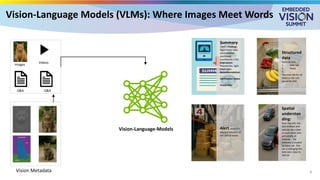
Vision-Language Models (VLMs): Where Images Meet Words
Vision-Language-Models
Q&A
Videos
Images
Vision Metadata
Summary:
report Findings:
Right lower lobe
consolidation
confirmed
(confidence 0.95)
Impression:
Pneumonia, right
lower lobe.
Recommendation:
…
Verification notes:
…
Visual Aids:
…
Structured
data
Items in cart:
1. Milk can
2. Pasta
3. …
The total bill for all
items in the cart
would be $40
Alert: Aisle 4 is
blocked because of
the spill of boxes
Spatial
understan
ding:
from the left, the
cars in black and
red are very close
to each other and
potentially at
collision. The
anomaly is caused
by black car. This
car is changing the
lane very close to
red car
Q&A
2
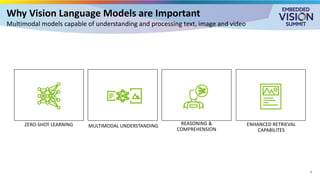
Why Vision Language Models are Important
Multimodal models capable of understanding and processing text, image and video
MULTIMODAL UNDERSTANDING
ZERO-SHOT LEARNING REASONING &
COMPREHENSION
ENHANCED RETRIEVAL
CAPABILITES
3
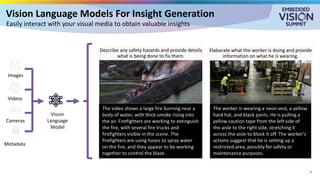
Vision Language Models For Insight Generation
Easily interact with your visual media to obtain valuable insights
Vision
Language
Model
Images
Videos
Metadata
Cameras
The worker is wearing a neon vest, a yellow
hard hat, and black pants. He is pulling a
yellow caution tape from the left side of
the aisle to the right side, stretching it
across the aisle to block it off. The worker's
actions suggest that he is setting up a
restricted area, possibly for safety or
maintenance purposes.
Elaborate what the worker is doing and provide
information on what he is wearing.
Describe any safety hazards and provide details
what is being done to fix them.
The video shows a large fire burning near a
body of water, with thick smoke rising into
the air. Firefighters are working to extinguish
the fire, with several fire trucks and
firefighters visible in the scene. The
firefighters are using hoses to spray water
on the fire, and they appear to be working
together to control the blaze.
4
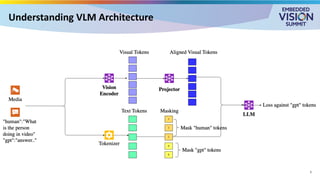
Understanding VLM Architecture
5
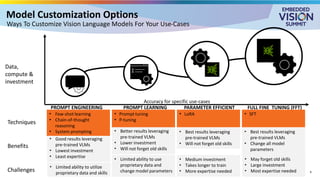
Model Customization Options
Ways To Customize Vision Language Models For Your Use-Cases
PROMPT ENGINEERING PROMPT LEARNING PARAMETER EFFICIENT
FINETUNING
FULL FINE TUNING (FFT)
Data,
compute &
investment
Accuracy for specific use-cases
Challenges
Benefits
• Good results leveraging
pre-trained VLMs
• Lowest investment
• Least expertise
• Better results leveraging
pre-trained VLMs
• Lower investment
• Will not forget old skills
• Best results leveraging
pre-trained VLMs
• Will not forget old skills
• Best results leveraging
pre-trained VLMs
• Change all model
parameters
• Limited ability to utilize
proprietary data and skills
• Limited ability to use
proprietary data and
change model parameters
• Medium investment
• Takes longer to train
• More expertise needed
• May forget old skills
• Large investment
• Most expertise needed
Techniques
• Few-shot learning
• Chain-of-thought
reasoning
• System prompting
• Prompt tuning
• P-tuning
• LoRA • SFT
6
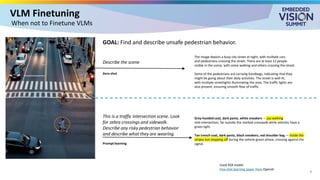
VLM Finetuning
7
When not to Finetune VLMs
Grey hooded coat, dark pants, white sneakers — jay-walking
mid-intersection, far outside the marked crosswalk while vehicles have a
green light.
Tan trench coat, dark pants, black sneakers, red shoulder bag — inside the
stripes but stepping off during the vehicle-green phase, crossing against the
signal.
Used XXX model
Few shot learning paper from OpenAI
The image depicts a busy city street at night, with multiple cars
and pedestrians crossing the street. There are at least 12 people
visible in the scene, with some walking and others crossing the street.
Some of the pedestrians are carrying handbags, indicating that they
might be going about their daily activities. The street is well-lit,
with multiple streetlights illuminating the area. The traffic lights are
also present, ensuring smooth flow of traffic.
Describe the scene
This is a traffic intersection scene. Look
for zebra crossings and sidewalk.
Describe any risky pedestrian behavior
and describe what they are wearing.
Prompt learning
Zero-shot
GOAL: Find and describe unsafe pedestrian behavior.
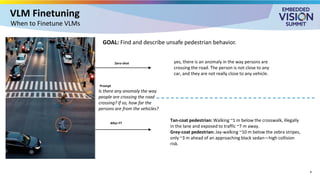
VLM Finetuning
8
When to Finetune VLMs
yes, there is an anomaly in the way persons are
crossing the road. The person is not close to any
car, and they are not really close to any vehicle.
Zero-shot
Is there any anomaly the way
people are crossing the road
crossing? If so, how far the
persons are from the vehicles?
After FT
Tan-coat pedestrian: Walking ~1 m below the crosswalk, illegally
in the lane and exposed to traffic ~7 m away.
Grey-coat pedestrian: Jay-walking ~10 m below the zebra stripes,
only ~3 m ahead of an approaching black sedan—high collision
risk.
Prompt
GOAL: Find and describe unsafe pedestrian behavior.
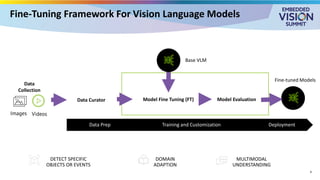
Fine-Tuning Framework For Vision Language Models
DETECT SPECIFIC
OBJECTS OR EVENTS
DOMAIN
ADAPTION
MULTIMODAL
UNDERSTANDING
Base VLM
Fine-tuned Models
Data
Collection
Images Videos
Data Curator Model Fine Tuning (FT) Model Evaluation
Deployment
Training and Customization
Data Prep
9
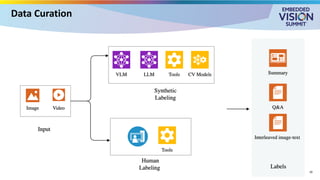
Data Curation
10
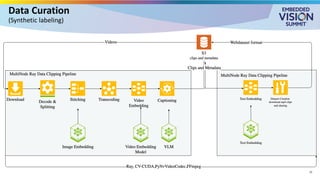
Data Curation
(Synthetic labeling)
11
Data Curation
(Type of Labels)
Q&A
Media
MCQ Style:
Questions: What Kind of anomaly
is present in this scene?
Options:
A: Pedestrian jaywalking
B: Vehicle running a red light
C: Pedestrian crossing at marked
crosswalk
GQA Style:
Questions: What unsafe action is
happening and why is it
dangerous?
Answer: The person is crossing
outside the designated
crosswalk….
Structured Style:
Question: Describe the occurred anomaly in the traffic
scene. Response in a json format: {“anomaly_type”: ,
“bbox”:.., “alert”:..}
Answer:
{
“anomaly_type”: “pedestrian jaywalking”,
“bbox”: [450, 300, 500, 600],
“alert”: “Pedestrian jaywalking detected”
}
Spatial Style:
Questions: “Describe the anomaly, including where
and how it’s occurring?”
Answer: “ A pedestrian is jaywalking at the bottom-
right of the frame (around 70% from the left, 85%
from the top), stepping onto the road outside the
marked crosswalk..”
12
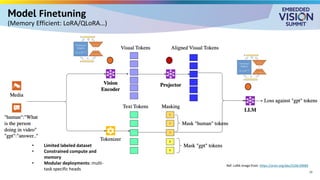
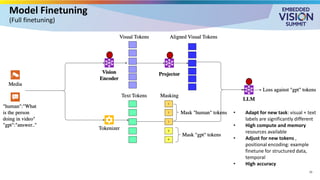
Model Finetuning
(Memory Efficient: LoRA/QLoRA…)
Ref: LoRA image from: https://arxiv.org/abs/2106.09685
• Limited labeled dataset
• Constrained compute and
memory
• Modular deployments: multi-
task specific heads
13
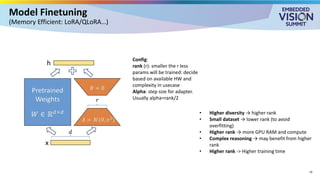
Model Finetuning
(Memory Efficient: LoRA/QLoRA…)
Config:
rank (r): smaller the r less
params will be trained: decide
based on available HW and
complexity in usecase
Alpha: step size for adapter.
Usually alpha=rank/2
• Higher diversity → higher rank
• Small dataset → lower rank (to avoid
overfitting)
• Higher rank → more GPU RAM and compute
• Complex reasoning → may benefit from higher
rank
• Higher rank -> Higher training time
14
Model Finetuning
(Full finetuning)
• Adapt for new task: visual + text
labels are significantly different
• High compute and memory
resources available
• Adjust for new tokens ,
positional encoding: example
finetune for structured data,
temporal
• High accuracy
15
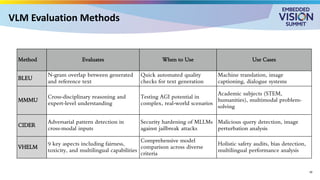
VLM Evaluation Methods
Method Evaluates When to Use Use Cases
BLEU
N-gram overlap between generated
and reference text
Quick automated quality
checks for text generation
Machine translation, image
captioning, dialogue systems
MMMU
Cross-disciplinary reasoning and
expert-level understanding
Testing AGI potential in
complex, real-world scenarios
Academic subjects (STEM,
humanities), multimodal problem-
solving
CIDER
Adversarial pattern detection in
cross-modal inputs
Security hardening of MLLMs
against jailbreak attacks
Malicious query detection, image
perturbation analysis
VHELM
9 key aspects including fairness,
toxicity, and multilingual capabilities
Comprehensive model
comparison across diverse
criteria
Holistic safety audits, bias detection,
multilingual performance analysis
16
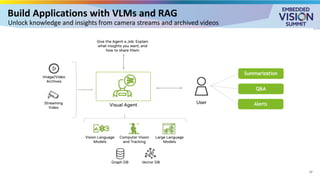
Build Applications with VLMs and RAG
Unlock knowledge and insights from camera streams and archived videos
17
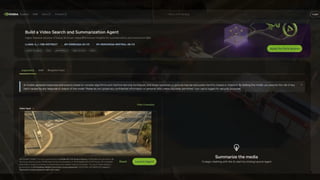
Agentic applications with VLMS
18
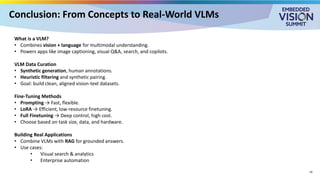
Conclusion: From Concepts to Real-World VLMs
What is a VLM?
• Combines vision + language for multimodal understanding.
• Powers apps like image captioning, visual Q&A, search, and copilots.
VLM Data Curation
• Synthetic generation, human annotations.
• Heuristic filtering and synthetic pairing.
• Goal: build clean, aligned vision-text datasets.
Fine-Tuning Methods
• Prompting → Fast, flexible.
• LoRA → Efficient, low-resource finetuning.
• Full Finetuning → Deep control, high cost.
• Choose based on task size, data, and hardware.
Building Real Applications
• Combine VLMs with RAG for grounded answers.
• Use cases:
• Visual search & analytics
• Enterprise automation
19
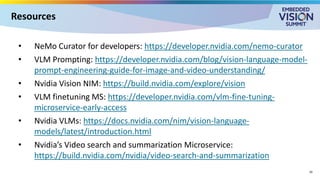
Resources
20
• NeMo Curator for developers: https://developer.nvidia.com/nemo-curator
• VLM Prompting: https://developer.nvidia.com/blog/vision-language-model-
prompt-engineering-guide-for-image-and-video-understanding/
• Nvidia Vision NIM: https://build.nvidia.com/explore/vision
• VLM finetuning MS: https://developer.nvidia.com/vlm-fine-tuning-
microservice-early-access
• Nvidia VLMs: https://docs.nvidia.com/nim/vision-language-
models/latest/introduction.html
• Nvidia’s Video search and summarization Microservice:
https://build.nvidia.com/nvidia/video-search-and-summarization
21
Disclaimer
The views and opinions expressed in this presentation are my own and do not necessarily reflect
those of my employer.

“Customizing Vision-language Models for Real-world Applications,” a Presentation from NVIDIA

  • 1.
    Customizing Vision-Language Models forReal-World Applications Monika Jhuria Technical Marketing Engineer Nvidia
  • 2.
    Vision-Language Models (VLMs):Where Images Meet Words Vision-Language-Models Q&A Videos Images Vision Metadata Summary: report Findings: Right lower lobe consolidation confirmed (confidence 0.95) Impression: Pneumonia, right lower lobe. Recommendation: … Verification notes: … Visual Aids: … Structured data Items in cart: 1. Milk can 2. Pasta 3. … The total bill for all items in the cart would be $40 Alert: Aisle 4 is blocked because of the spill of boxes Spatial understan ding: from the left, the cars in black and red are very close to each other and potentially at collision. The anomaly is caused by black car. This car is changing the lane very close to red car Q&A 2
  • 3.
    Why Vision LanguageModels are Important Multimodal models capable of understanding and processing text, image and video MULTIMODAL UNDERSTANDING ZERO-SHOT LEARNING REASONING & COMPREHENSION ENHANCED RETRIEVAL CAPABILITES 3
  • 4.
    Vision Language ModelsFor Insight Generation Easily interact with your visual media to obtain valuable insights Vision Language Model Images Videos Metadata Cameras The worker is wearing a neon vest, a yellow hard hat, and black pants. He is pulling a yellow caution tape from the left side of the aisle to the right side, stretching it across the aisle to block it off. The worker's actions suggest that he is setting up a restricted area, possibly for safety or maintenance purposes. Elaborate what the worker is doing and provide information on what he is wearing. Describe any safety hazards and provide details what is being done to fix them. The video shows a large fire burning near a body of water, with thick smoke rising into the air. Firefighters are working to extinguish the fire, with several fire trucks and firefighters visible in the scene. The firefighters are using hoses to spray water on the fire, and they appear to be working together to control the blaze. 4
  • 5.
  • 6.
    Model Customization Options WaysTo Customize Vision Language Models For Your Use-Cases PROMPT ENGINEERING PROMPT LEARNING PARAMETER EFFICIENT FINETUNING FULL FINE TUNING (FFT) Data, compute & investment Accuracy for specific use-cases Challenges Benefits • Good results leveraging pre-trained VLMs • Lowest investment • Least expertise • Better results leveraging pre-trained VLMs • Lower investment • Will not forget old skills • Best results leveraging pre-trained VLMs • Will not forget old skills • Best results leveraging pre-trained VLMs • Change all model parameters • Limited ability to utilize proprietary data and skills • Limited ability to use proprietary data and change model parameters • Medium investment • Takes longer to train • More expertise needed • May forget old skills • Large investment • Most expertise needed Techniques • Few-shot learning • Chain-of-thought reasoning • System prompting • Prompt tuning • P-tuning • LoRA • SFT 6
  • 7.
    VLM Finetuning 7 When notto Finetune VLMs Grey hooded coat, dark pants, white sneakers — jay-walking mid-intersection, far outside the marked crosswalk while vehicles have a green light. Tan trench coat, dark pants, black sneakers, red shoulder bag — inside the stripes but stepping off during the vehicle-green phase, crossing against the signal. Used XXX model Few shot learning paper from OpenAI The image depicts a busy city street at night, with multiple cars and pedestrians crossing the street. There are at least 12 people visible in the scene, with some walking and others crossing the street. Some of the pedestrians are carrying handbags, indicating that they might be going about their daily activities. The street is well-lit, with multiple streetlights illuminating the area. The traffic lights are also present, ensuring smooth flow of traffic. Describe the scene This is a traffic intersection scene. Look for zebra crossings and sidewalk. Describe any risky pedestrian behavior and describe what they are wearing. Prompt learning Zero-shot GOAL: Find and describe unsafe pedestrian behavior.
  • 8.
    VLM Finetuning 8 When toFinetune VLMs yes, there is an anomaly in the way persons are crossing the road. The person is not close to any car, and they are not really close to any vehicle. Zero-shot Is there any anomaly the way people are crossing the road crossing? If so, how far the persons are from the vehicles? After FT Tan-coat pedestrian: Walking ~1 m below the crosswalk, illegally in the lane and exposed to traffic ~7 m away. Grey-coat pedestrian: Jay-walking ~10 m below the zebra stripes, only ~3 m ahead of an approaching black sedan—high collision risk. Prompt GOAL: Find and describe unsafe pedestrian behavior.
  • 9.
    Fine-Tuning Framework ForVision Language Models DETECT SPECIFIC OBJECTS OR EVENTS DOMAIN ADAPTION MULTIMODAL UNDERSTANDING Base VLM Fine-tuned Models Data Collection Images Videos Data Curator Model Fine Tuning (FT) Model Evaluation Deployment Training and Customization Data Prep 9
  • 10.
  • 11.
  • 12.
    Data Curation (Type ofLabels) Q&A Media MCQ Style: Questions: What Kind of anomaly is present in this scene? Options: A: Pedestrian jaywalking B: Vehicle running a red light C: Pedestrian crossing at marked crosswalk GQA Style: Questions: What unsafe action is happening and why is it dangerous? Answer: The person is crossing outside the designated crosswalk…. Structured Style: Question: Describe the occurred anomaly in the traffic scene. Response in a json format: {“anomaly_type”: , “bbox”:.., “alert”:..} Answer: { “anomaly_type”: “pedestrian jaywalking”, “bbox”: [450, 300, 500, 600], “alert”: “Pedestrian jaywalking detected” } Spatial Style: Questions: “Describe the anomaly, including where and how it’s occurring?” Answer: “ A pedestrian is jaywalking at the bottom- right of the frame (around 70% from the left, 85% from the top), stepping onto the road outside the marked crosswalk..” 12
  • 13.
    Model Finetuning (Memory Efficient:LoRA/QLoRA…) Ref: LoRA image from: https://arxiv.org/abs/2106.09685 • Limited labeled dataset • Constrained compute and memory • Modular deployments: multi- task specific heads 13
  • 14.
    Model Finetuning (Memory Efficient:LoRA/QLoRA…) Config: rank (r): smaller the r less params will be trained: decide based on available HW and complexity in usecase Alpha: step size for adapter. Usually alpha=rank/2 • Higher diversity → higher rank • Small dataset → lower rank (to avoid overfitting) • Higher rank → more GPU RAM and compute • Complex reasoning → may benefit from higher rank • Higher rank -> Higher training time 14
  • 15.
    Model Finetuning (Full finetuning) •Adapt for new task: visual + text labels are significantly different • High compute and memory resources available • Adjust for new tokens , positional encoding: example finetune for structured data, temporal • High accuracy 15
  • 16.
    VLM Evaluation Methods MethodEvaluates When to Use Use Cases BLEU N-gram overlap between generated and reference text Quick automated quality checks for text generation Machine translation, image captioning, dialogue systems MMMU Cross-disciplinary reasoning and expert-level understanding Testing AGI potential in complex, real-world scenarios Academic subjects (STEM, humanities), multimodal problem- solving CIDER Adversarial pattern detection in cross-modal inputs Security hardening of MLLMs against jailbreak attacks Malicious query detection, image perturbation analysis VHELM 9 key aspects including fairness, toxicity, and multilingual capabilities Comprehensive model comparison across diverse criteria Holistic safety audits, bias detection, multilingual performance analysis 16
  • 17.
    Build Applications withVLMs and RAG Unlock knowledge and insights from camera streams and archived videos 17
  • 18.
  • 19.
    Conclusion: From Conceptsto Real-World VLMs What is a VLM? • Combines vision + language for multimodal understanding. • Powers apps like image captioning, visual Q&A, search, and copilots. VLM Data Curation • Synthetic generation, human annotations. • Heuristic filtering and synthetic pairing. • Goal: build clean, aligned vision-text datasets. Fine-Tuning Methods • Prompting → Fast, flexible. • LoRA → Efficient, low-resource finetuning. • Full Finetuning → Deep control, high cost. • Choose based on task size, data, and hardware. Building Real Applications • Combine VLMs with RAG for grounded answers. • Use cases: • Visual search & analytics • Enterprise automation 19
  • 20.
    Resources 20 • NeMo Curatorfor developers: https://developer.nvidia.com/nemo-curator • VLM Prompting: https://developer.nvidia.com/blog/vision-language-model- prompt-engineering-guide-for-image-and-video-understanding/ • Nvidia Vision NIM: https://build.nvidia.com/explore/vision • VLM finetuning MS: https://developer.nvidia.com/vlm-fine-tuning- microservice-early-access • Nvidia VLMs: https://docs.nvidia.com/nim/vision-language- models/latest/introduction.html • Nvidia’s Video search and summarization Microservice: https://build.nvidia.com/nvidia/video-search-and-summarization
  • 21.
    21 Disclaimer The views andopinions expressed in this presentation are my own and do not necessarily reflect those of my employer.