Graduating from HR Metrics to Workforce Analytics
Global competition for talent, outsourcing labor, compliance legislation, remote
workers, aging populations – these are just a few of the daunting challenges faced by
HR organizations today. Yet the most commonly monitored workforce metrics do very
little to deliver true insight into these topics. Leaders need to graduate from metrics to
analytics, surfacing the important connections and patterns in their data to make
better workforce decisions.
Definitions
Metrics Analytics
Provide a standard system of measurement Provide systematic computational analysis of data or statistics
Measure single data points Connect multiple data points
Provide information Provide insights
Guide tactics and operations Drive strategy
State the past and present State the past, present, and predict the future
Provide tabular outputs of counts and rates Provide visual outputs of patterns and trends
TheDataficationof HR
HR Metrics artwork 06_visier 14-03-05 11:05 AM Page 1
2
RecRuiting effectiveness
Recruitment is the HR function that has the most positive impact on revenue creation and profitability.1
Yet common recruiting
metrics, such as “time to fill” and “cost to fill,” do not answer strategic questions about the quality and value of the people being
hired. Rather, the following analytics provide greater insight, enabling HR to take meaningful action to improve recruiting
effectiveness, driving revenue creation and profitability.
Analytic value
New hire performance Determine if new recruits meet expected performance levels,
and adapt your recruiting processes as needed
New hire performance by lead source Identify your best sources for top talent, more efficiently targeting your
resources to find the next high quality hire
Recruitment pipeline status Spot “supply chain” problems in your recruitment pipeline,
and take remedial action before they become a pain
Employee exits before 90 days service Assess the characteristics of new recruits resigning in less than 90 days
to improve your recruitment process
PeRfoRMAnce
Companies that excel at Talent Management achieve earnings that are eighteen percent higher than their peers. For a Fortune
1000 company, this can translate into hundreds of millions of dollars in additional EBITDA earnings.2
To truly understand and
improve on performance management, companies need to look beyond metrics, such as “performance appraisal participation
rate” and “median performance rating,” to analytics. When it comes to analyzing performance to drive business success the
following areas should be considered:
Analytic value
Pay for performance Correlate total rewards, compa-ratio, and performance levels to
determine if you are effectively rewarding performance – top performers
will revert to average or resign if they do not perceive themselves to be
receiving a level of reward that recognizes their differential performance
Top talent characteristics Analyze the characteristics, tenure, work experiences, and managerial
connections of your top performers, leveraging your findings to grow
future top talent
Career progression Analyze the promotion rates, lateral moves, promotion wait times,
and internal hiring rates of top performers to determine whether you
are using the tools of opportunity to retain and maximize performance –
top performers will typically value opportunities for career progression
even more highly than their paycheck
1 Boston Consulting Group, From Capability to Profitability, July 2012.
2 The Hackett Group, Companies with Mature Talent Management Capabilities See 18 Percent Higher Earnings, December 2009.
HR Metrics artwork 06_visier 14-03-05 11:05 AM Page 2
tAlent Retention
With voluntary resignations at a five-year high,3
the competition for top talent remains a constant, and retention of top talent is a
key objective for most HR teams. Indeed, “turnover” is the single most prevalent HR metric. However, “turnover” does little to
support strategic business plans. To achieve true insight a more in depth analysis is required.
Analytic value
Predicting the risk of exit Identify employees at risk of leaving, based on analysis of key
characteristics of past resignations, and take action to prevent top talent
from leaving before they are out the door
Resignation drivers Determine what factors increase and decrease resignations,
more effectively targeting and fine tuning retention strategies
Resignation correlations Correlate resignation with factors such as compa-ratio, promotion
wait time, pay increases, training opportunities, and so forth, to make
better and more cost effective decisions around changes to pay,
benefits, and employee development
Resignation segments Compare how resignation rates vary across locations, functions,
tenure, age groups, diversity groups, and so forth, to ensure program
investments are targeted where they will deliver the biggest results
8.2%
Overall Resignation Rate
Increases rateDecreases rate
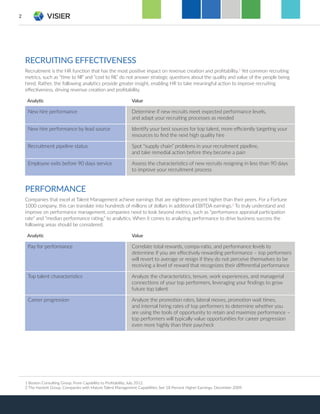
Analytics, such as the key factors decreasing and increasing resignation rates, enable HR to more effectively target and fine tune retention strategies
3 Bureau of Labor Statistics, Job Openings and Labor Turnover Survey, October 2013.
3
HR Metrics artwork 06_visier 14-03-05 11:05 AM Page 3
4
eMPloyee MoveMent
Organizations can be thought of as highly complex systems, which have both a structural element and a network element.
The structure is the organizational hierarchy, distribution of work, and business units. The network is the relationships and
connections between people within the organization. No matter how correct your structure, if the network element is missing
then your organization will not perform at its best. The primary way in which this network element is created and perpetuated
is through employee movement. The following analytics provide a greater understanding of the impact that movement has on
an organization.
Analytic value
Movement in and out of Ensure the business units that make the most difference to your
organizational units business are increasing in talent quality, and not experiencing
“brain drain”
Build versus buy Track promotions, lateral moves, and the relative performance of
individuals to achieve better results at a lower overall workforce cost –
internal candidates often perform better more quickly and stay longer
than “stars” who are parachuted in from outside 4
Leadership and succession modeling Tracking employee movement, promotions, and key experiences
provides insight into the organizational pathways that have developed
your top talent, and allow you to identify other likely succession
candidates – research by Jac Fitz-Enz5
found a direct correlation
between better succession management and revenue
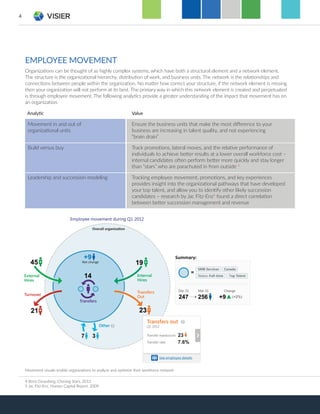
Movement visuals enable organizations to analyze and optimize their workforce network
4 Boris Groysberg, Chasing Stars, 2012
5 Jac Fitz-Enz, Human Capital Report, 2009.
HR Metrics artwork 06_visier 14-03-05 11:05 AM Page 4
5
1-888-277-9331 info@visier.com www.visier.com
©Visier, Inc. All rights reserved. Visier and Visier logo are trademarks of Visier, Inc.
All other brand and product names and logos are the trademarks and registered trademarks of their respective holders.
totAl RewARDs
With compensation contributing to the largest share of total expenses, it is imperative to ensure that total rewards programs
are competitive, yet also aligned with business goals. Typically compensation strategy and budgets are defined centrally, but
allocations and decisions are distributed throughout the organization. This can create a disconnect between strategy and
execution. The best analytics approach is to focus on the following areas:
Analytic value
Total direct compensation dynamics Understand the rate at which direct compensation costs are increasing
and how this reflects the FTE (full time equivalent) count in the business –
if your costs are higher and rising faster than your competition, then you
are at a cost disadvantage, which will impact profitability
Flexible workforce costs Identify effective cost management options by analyzing where people
costs can be flexed to reduce expenses or speed up revenue creation
(for example, overtime spending, budgeted salary for open hiring
requisitions, forecasted bonus expenses, costs of contingent workers,
and so forth)
Employment movement impacts Understand how entries to and exits from an organization impact
on compensation the total compensation expenses
the DAtAficAtion of hR
The challenges in today’s business environment require new approaches to remain competitive in an ever-shrinking world of
global competition. By graduating from metrics to analytics, HR professionals and leaders can better understand the contributing
factors that are impacting their organization, and take the right actions to implement programs that will provide a true
competitive advantage.
HR Metrics artwork 06_visier 14-03-05 11:05 AM Page 5

The Datafication of HR [WHITE PAPER]

  • 1.
    Graduating from HRMetrics to Workforce Analytics Global competition for talent, outsourcing labor, compliance legislation, remote workers, aging populations – these are just a few of the daunting challenges faced by HR organizations today. Yet the most commonly monitored workforce metrics do very little to deliver true insight into these topics. Leaders need to graduate from metrics to analytics, surfacing the important connections and patterns in their data to make better workforce decisions. Definitions Metrics Analytics Provide a standard system of measurement Provide systematic computational analysis of data or statistics Measure single data points Connect multiple data points Provide information Provide insights Guide tactics and operations Drive strategy State the past and present State the past, present, and predict the future Provide tabular outputs of counts and rates Provide visual outputs of patterns and trends TheDataficationof HR HR Metrics artwork 06_visier 14-03-05 11:05 AM Page 1
  • 2.
    2 RecRuiting effectiveness Recruitment isthe HR function that has the most positive impact on revenue creation and profitability.1 Yet common recruiting metrics, such as “time to fill” and “cost to fill,” do not answer strategic questions about the quality and value of the people being hired. Rather, the following analytics provide greater insight, enabling HR to take meaningful action to improve recruiting effectiveness, driving revenue creation and profitability. Analytic value New hire performance Determine if new recruits meet expected performance levels, and adapt your recruiting processes as needed New hire performance by lead source Identify your best sources for top talent, more efficiently targeting your resources to find the next high quality hire Recruitment pipeline status Spot “supply chain” problems in your recruitment pipeline, and take remedial action before they become a pain Employee exits before 90 days service Assess the characteristics of new recruits resigning in less than 90 days to improve your recruitment process PeRfoRMAnce Companies that excel at Talent Management achieve earnings that are eighteen percent higher than their peers. For a Fortune 1000 company, this can translate into hundreds of millions of dollars in additional EBITDA earnings.2 To truly understand and improve on performance management, companies need to look beyond metrics, such as “performance appraisal participation rate” and “median performance rating,” to analytics. When it comes to analyzing performance to drive business success the following areas should be considered: Analytic value Pay for performance Correlate total rewards, compa-ratio, and performance levels to determine if you are effectively rewarding performance – top performers will revert to average or resign if they do not perceive themselves to be receiving a level of reward that recognizes their differential performance Top talent characteristics Analyze the characteristics, tenure, work experiences, and managerial connections of your top performers, leveraging your findings to grow future top talent Career progression Analyze the promotion rates, lateral moves, promotion wait times, and internal hiring rates of top performers to determine whether you are using the tools of opportunity to retain and maximize performance – top performers will typically value opportunities for career progression even more highly than their paycheck 1 Boston Consulting Group, From Capability to Profitability, July 2012. 2 The Hackett Group, Companies with Mature Talent Management Capabilities See 18 Percent Higher Earnings, December 2009. HR Metrics artwork 06_visier 14-03-05 11:05 AM Page 2
  • 3.
    tAlent Retention With voluntaryresignations at a five-year high,3 the competition for top talent remains a constant, and retention of top talent is a key objective for most HR teams. Indeed, “turnover” is the single most prevalent HR metric. However, “turnover” does little to support strategic business plans. To achieve true insight a more in depth analysis is required. Analytic value Predicting the risk of exit Identify employees at risk of leaving, based on analysis of key characteristics of past resignations, and take action to prevent top talent from leaving before they are out the door Resignation drivers Determine what factors increase and decrease resignations, more effectively targeting and fine tuning retention strategies Resignation correlations Correlate resignation with factors such as compa-ratio, promotion wait time, pay increases, training opportunities, and so forth, to make better and more cost effective decisions around changes to pay, benefits, and employee development Resignation segments Compare how resignation rates vary across locations, functions, tenure, age groups, diversity groups, and so forth, to ensure program investments are targeted where they will deliver the biggest results 8.2% Overall Resignation Rate Increases rateDecreases rate Analytics, such as the key factors decreasing and increasing resignation rates, enable HR to more effectively target and fine tune retention strategies 3 Bureau of Labor Statistics, Job Openings and Labor Turnover Survey, October 2013. 3 HR Metrics artwork 06_visier 14-03-05 11:05 AM Page 3
  • 4.
    4 eMPloyee MoveMent Organizations canbe thought of as highly complex systems, which have both a structural element and a network element. The structure is the organizational hierarchy, distribution of work, and business units. The network is the relationships and connections between people within the organization. No matter how correct your structure, if the network element is missing then your organization will not perform at its best. The primary way in which this network element is created and perpetuated is through employee movement. The following analytics provide a greater understanding of the impact that movement has on an organization. Analytic value Movement in and out of Ensure the business units that make the most difference to your organizational units business are increasing in talent quality, and not experiencing “brain drain” Build versus buy Track promotions, lateral moves, and the relative performance of individuals to achieve better results at a lower overall workforce cost – internal candidates often perform better more quickly and stay longer than “stars” who are parachuted in from outside 4 Leadership and succession modeling Tracking employee movement, promotions, and key experiences provides insight into the organizational pathways that have developed your top talent, and allow you to identify other likely succession candidates – research by Jac Fitz-Enz5 found a direct correlation between better succession management and revenue Movement visuals enable organizations to analyze and optimize their workforce network 4 Boris Groysberg, Chasing Stars, 2012 5 Jac Fitz-Enz, Human Capital Report, 2009. HR Metrics artwork 06_visier 14-03-05 11:05 AM Page 4
  • 5.
    5 1-888-277-9331 info@visier.com www.visier.com ©Visier,Inc. All rights reserved. Visier and Visier logo are trademarks of Visier, Inc. All other brand and product names and logos are the trademarks and registered trademarks of their respective holders. totAl RewARDs With compensation contributing to the largest share of total expenses, it is imperative to ensure that total rewards programs are competitive, yet also aligned with business goals. Typically compensation strategy and budgets are defined centrally, but allocations and decisions are distributed throughout the organization. This can create a disconnect between strategy and execution. The best analytics approach is to focus on the following areas: Analytic value Total direct compensation dynamics Understand the rate at which direct compensation costs are increasing and how this reflects the FTE (full time equivalent) count in the business – if your costs are higher and rising faster than your competition, then you are at a cost disadvantage, which will impact profitability Flexible workforce costs Identify effective cost management options by analyzing where people costs can be flexed to reduce expenses or speed up revenue creation (for example, overtime spending, budgeted salary for open hiring requisitions, forecasted bonus expenses, costs of contingent workers, and so forth) Employment movement impacts Understand how entries to and exits from an organization impact on compensation the total compensation expenses the DAtAficAtion of hR The challenges in today’s business environment require new approaches to remain competitive in an ever-shrinking world of global competition. By graduating from metrics to analytics, HR professionals and leaders can better understand the contributing factors that are impacting their organization, and take the right actions to implement programs that will provide a true competitive advantage. HR Metrics artwork 06_visier 14-03-05 11:05 AM Page 5