HR Analytics
PanaEk Warawit
p.warawit@infomobius.com, @p_warawit
• Thai, Bangkok based
• B.Eng.(Electronics) & M.Sc. (MIS)
• 20 Yrs w/ P&G
• Most assignments related to Business Intelligence
• Asia BIM Competency Leader
• Trainer in EA, AM, BT
• Currently with InfoMobius
• Principal Business Intelligence Consultant
• Writes & speaks in the topic of
• Business Intelligence, Big Data, Business Analytics
• p.warawit@infomobius.com
• @p_warawit
♥ Married to Nay
♥ Only son – Kuang, 23
Hobbies & Interests
♦ Marathoner
♦ TED Thai Translator
♦ Reading / Blogging
♦ Internet / Coding
♦ CourseraMy strengths: Input, Connectedness, Intellection, Learner, Relator
Datafication of HR is Inevitable
Logistics &
Purchasing
Financial &
Budgeting
ERP
& Supply
Chain
Finance & ERP
Customer
Analytics
(Data
Warehouse)
Customer
Segmentation
Market
Basket
Web Buying
Behavior
Consumer & CRM
Recruiting
Learning
Performance
Talent Mgt
Workforce
Planning
Predictive
Models
For
Talent/HR
Talent,
Leadership, HR
The Industrial
Economy
The Financial
Economy
The Customer
Economy and Web
The Talent
Economy
Early 1900s 1950s-60s 1970s-80s Today
Steel, Oil, Railroads
Conglomerates
Financial Engineering
Customer Segmentation
Personalized Products
Globalization, Demographics
Skills and Leadership Shortages
Source: http://www.slideshare.net/hrtecheurope/josh-bersin-datafication-of-hr
5 Ways the Workforce Will Change in 5
Years
• Freelance employees will approach the 50% mark
• Flex-work becomes a new normal
• Career 'impatience' a driving factor
• The new workforce works small
• Gen X may have its day
Source: http://mashable.com/2014/08/25/workforce-in-5-years
“The goal is simple: put the right people with the right skills in the right
work, provide them with the necessary training and development
opportunities, and engage and empower them to perform at their highest
possible level"
"... higher quality, productivity, customer satisfaction, and market share --
and they're more profitable too."
- HBR, August 2013
Recruiting and
Workforce
Planning
Comp and
Benefits
Performance
Succession
Engagement
Learning
& Leadership
HRMS
Employee
Data
Engagement
& Assessment
+
Sales Revenue
Productivity
Customer
Retention
Product
Mix
Accidents
Errors
Fraud
Quality
Downtime
Losses
Groundbreaking New Insights &
Tools for Managers to Make Better Decisions
=
Data management, analytics, IT, and business consulting expertise
+
The Goal of HR Analytics:
Bring People & Business Data Together
Source: http://www.slideshare.net/hrtecheurope/josh-bersin-datafication-of-hr
Business Success Stories
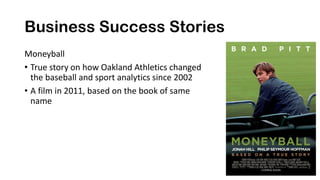
Moneyball
• True story on how Oakland Athletics changed
the baseball and sport analytics since 2002
• A film in 2011, based on the book of same
name
Lessons from “moneyball”
• What is the problem? (8:27-12:44)
• Opinion-based Selection
• Understanding real business issue
• Tactical vs Strategic
• Player Analytics (27:00-28:55)
• Clear Business Objectives
• Player performance index
• Compare with price to find “undervalued” players
• Implementing Strategy (31:28-35:18)
• Data-based decision
• Decision justification
• Focus on outcome
Metrics vs Analytics
Metrics on
HR’s processes
& transactions
In traditional HR view
The people side
of business
outcome
vs
Metrics
• A system or standard of
measurement
Analytics
• The systematic computational
analysis of data or statistics
Moving from metrics to analytics
Metrics Analytics
• What is my headcount? • What are the key characteristics
of top performers?
• How many people did we hire? • What are our best recruiting
sources for top performers?
• How many people resigned? • Who of our top performers is at
risk of leaving?
Source: Bersin by Deloitte Talent Analytics Maturity Model®
Level 4: Predictive Analytics
Development of predictive models, scenario planning
Risk analysis and mitigation, integration with strategic planning
4%
Level 3: Advanced Analytics
Segmentation, statistical analysis, development of “people models”;
Analysis of dimensions to understand cause and delivery of actionable solutions
10%
Level 2: Proactive – Advanced Reporting
Operational reporting for benchmarking and decision making
Multi-dimensional analysis and dashboards
30%
Level 1: Reactive – Operational Reporting
Ad-Hoc Operational Reporting
Reactive to business demands, data in isolation and difficult to analyze
56%
Talent Analytics Maturity Model®
Advancing Takes Effort
Level 2
Advanced Reporting
Level 3
Advanced Analytics
Level 4
Predictive Analytics
Level 1
Operational Reporting
Level of Value
Level of Effort
Choke Point
for Most
Organizations
Source: http://www.slideshare.net/hrtecheurope/josh-bersin-datafication-of-hr
Talent Analytics - Examples
• Retention Analytics
• Recruiting Effectiveness
• Total Cost of Workforce
• Employee Movement
Talent Retention
• Retention ≠ Turnover
• Turnover alone is not sufficient
• Lots of reasons people turnover – some good / some bad
• Once someone has left it is hard to get them back
• One number tells you nothing about how to change the outcome
Common Retention Metrics
Common Metrics
• Turnover
Shortcomings
• Do not provide
insights on why
• Does not allow for
meaningful
preventive action
• Not all turnover is
bad!
Talent Retention Analytics
Turnover by performance by tenure
Analytics: Segmentation of Turnover
by performance by tenure
Focus on relevant & value driven issues
Gauge recruitment & onboarding effectiveness
Cost and disruption of new hire turnover
Shedding top performers, critical & vulnerable roles
Poor performer tenure and turnover
Delivering on Employment Brand
Recruiting Effectiveness
“Recruitment is the HR function that has the most positive impact on
revenue creation and profitability…”
Boston Consulting Group
• Effective Hiring ≠ Time to hire
• Speed is highly dependent on the
market conditions effecting type of
talent
• Prioritizing speed over quality can have
negative results
• Effectiveness is not a single concept
• For example, hourly paid staff vs.
executive level hires
Common Recruiting Metrics
Common Metrics
• Time to fill
• Open Requisitions
• Cost to Hire
• Quota Attainment
Shortcomings
• Do not answer strategic questions about quality and value
• Do not provide insight into hiring connections to productivity
(revenue creation and profitability
Recruiting Analytics
Analytics applies powerful
visualization techniques to put
critical business answers in front
of decision makers – in an
intuitive way.
Total Cost of Workforce
“Total workforce costs average nearly 70% of a company’s operating
expenses.”
- Society for Human Resource Management
Common Compensation Metrics
Common Metrics
• Salaries
• Total Direct
Compensation
• Market
Compensation
• Comparison Ratio
Shortcomings
• Do not support strategic decisions about compensation
• Do not identify areas for optimization
Create a Cost Hierarchy:
Total Cost of Workforce
(TCoW)
o Total Salaries
o Total Benefits
 Direct Compensation
 Contingent Labor
Costs
Build from the bottom
Direct
Compensation
Indirect
Compensation
Deferred
Compensation
Contingent
Labor Costs
Total Cost of
Workforce
(TCoW)
Total Cost of Workforce Analytics
Total Cost of Workforce 1. Understand the true cost of the workforce which allows
any changes to the workforce in support of the business
strategy to be measured. Provides a basis for comparing
workforce costs to the competition.
Workforce Cost
Segmentation
2. Identify the direct, indirect, contingent, benefits, leave,
equity, etc. costs associated with the workforce so that
the various cost impacts can be compared to determine
where to focus to reduce costs, invest to attract talent,
etc.
Employment movement
impacts on compensation
3. Understand how entries to and exits from an organization
impact the total compensation expenses
Build costs into your plans
Employee Movement Analytics
Structure Network Organization
• Structure is the organizational hierarchy, distribution of work, and business units
• Network is the relationships and connections between people within the
organization
• No matter how correct your structure, if the network is missing your organization
will not perform at its best
Common Movement Metrics
Common Metrics
• Headcount / FTE
• Turnover
• Internal Moves
• External Hires
Shortcomings
• Do not provide insight into impact of employee
movement
• Do not correlate movement to other factors
Employee Movement Analytics
Analytic Value
Movement in and out of
organizational units
1. Ensure the business units that make the most difference
to your business are increasing in talent quality, and not
experiencing “brain drain”
Build versus buy 2. Track promotions, lateral moves, and the relative
performance of individuals to achieve better results at a
lower overall workforce cost – internal candidates often
perform better more quickly and stay longer than “stars”
who are parachuted in from outside
Leadership and succession
modeling
3. Tracking employee movement, promotions, and key
skills/experience provides insight into the organizational
pathways that have developed your top talent, and allow
you to identify other likely succession candidates –
research by Jac Fitz-Enz found a direct correlation
between better succession management and revenue
Visual
Dashboards
Advanced
Analytics
Predictive
Models
Data
Integration
Data
Dictionary
Data
Quality
Time and
Seasonality
Big Data
Tools
Data
Governance
Ownership
Reporting
Tools
Disparate
Systems
Visual
Skills
Stats and
Data Skills
The Ugly Side: Data Management
The Ugly Part of The Story
HR Data Challenges
• Human-reported in nature
• Qualitative vs Quantitative
• Subjective & vulnerable to biases
• Difficult to distinct between luck vs individual performance
• C.A.R. (Context Action Result) concept might helps but up to some extent
What’s next?
Adding new data types to better analytics
• Volometrix – Enterprise Analytics
• Smart Employee Badge
• Youtube: Smart employee ID badges track workers every move
www.humanyze.com
• Corporate Tryouts
• HBR Article: How Companies Are Using Simulations, Competitions, and
Analytics to Hire
• Idea - Kaggle for CEOs
Thank You

HR Analytics - PAaDS2016

  • 1.
  • 2.
    • Thai, Bangkokbased • B.Eng.(Electronics) & M.Sc. (MIS) • 20 Yrs w/ P&G • Most assignments related to Business Intelligence • Asia BIM Competency Leader • Trainer in EA, AM, BT • Currently with InfoMobius • Principal Business Intelligence Consultant • Writes & speaks in the topic of • Business Intelligence, Big Data, Business Analytics • p.warawit@infomobius.com • @p_warawit ♥ Married to Nay ♥ Only son – Kuang, 23 Hobbies & Interests ♦ Marathoner ♦ TED Thai Translator ♦ Reading / Blogging ♦ Internet / Coding ♦ CourseraMy strengths: Input, Connectedness, Intellection, Learner, Relator
  • 3.
    Datafication of HRis Inevitable Logistics & Purchasing Financial & Budgeting ERP & Supply Chain Finance & ERP Customer Analytics (Data Warehouse) Customer Segmentation Market Basket Web Buying Behavior Consumer & CRM Recruiting Learning Performance Talent Mgt Workforce Planning Predictive Models For Talent/HR Talent, Leadership, HR The Industrial Economy The Financial Economy The Customer Economy and Web The Talent Economy Early 1900s 1950s-60s 1970s-80s Today Steel, Oil, Railroads Conglomerates Financial Engineering Customer Segmentation Personalized Products Globalization, Demographics Skills and Leadership Shortages Source: http://www.slideshare.net/hrtecheurope/josh-bersin-datafication-of-hr
  • 4.
    5 Ways theWorkforce Will Change in 5 Years • Freelance employees will approach the 50% mark • Flex-work becomes a new normal • Career 'impatience' a driving factor • The new workforce works small • Gen X may have its day Source: http://mashable.com/2014/08/25/workforce-in-5-years
  • 5.
    “The goal issimple: put the right people with the right skills in the right work, provide them with the necessary training and development opportunities, and engage and empower them to perform at their highest possible level" "... higher quality, productivity, customer satisfaction, and market share -- and they're more profitable too." - HBR, August 2013
  • 10.
    Recruiting and Workforce Planning Comp and Benefits Performance Succession Engagement Learning &Leadership HRMS Employee Data Engagement & Assessment + Sales Revenue Productivity Customer Retention Product Mix Accidents Errors Fraud Quality Downtime Losses Groundbreaking New Insights & Tools for Managers to Make Better Decisions = Data management, analytics, IT, and business consulting expertise + The Goal of HR Analytics: Bring People & Business Data Together Source: http://www.slideshare.net/hrtecheurope/josh-bersin-datafication-of-hr
  • 11.
    Business Success Stories Moneyball •True story on how Oakland Athletics changed the baseball and sport analytics since 2002 • A film in 2011, based on the book of same name
  • 12.
    Lessons from “moneyball” •What is the problem? (8:27-12:44) • Opinion-based Selection • Understanding real business issue • Tactical vs Strategic • Player Analytics (27:00-28:55) • Clear Business Objectives • Player performance index • Compare with price to find “undervalued” players • Implementing Strategy (31:28-35:18) • Data-based decision • Decision justification • Focus on outcome
  • 14.
    Metrics vs Analytics Metricson HR’s processes & transactions In traditional HR view The people side of business outcome vs
  • 15.
    Metrics • A systemor standard of measurement Analytics • The systematic computational analysis of data or statistics Moving from metrics to analytics
  • 16.
    Moving from metricsto analytics Metrics Analytics • What is my headcount? • What are the key characteristics of top performers? • How many people did we hire? • What are our best recruiting sources for top performers? • How many people resigned? • Who of our top performers is at risk of leaving?
  • 17.
    Source: Bersin byDeloitte Talent Analytics Maturity Model® Level 4: Predictive Analytics Development of predictive models, scenario planning Risk analysis and mitigation, integration with strategic planning 4% Level 3: Advanced Analytics Segmentation, statistical analysis, development of “people models”; Analysis of dimensions to understand cause and delivery of actionable solutions 10% Level 2: Proactive – Advanced Reporting Operational reporting for benchmarking and decision making Multi-dimensional analysis and dashboards 30% Level 1: Reactive – Operational Reporting Ad-Hoc Operational Reporting Reactive to business demands, data in isolation and difficult to analyze 56% Talent Analytics Maturity Model®
  • 18.
    Advancing Takes Effort Level2 Advanced Reporting Level 3 Advanced Analytics Level 4 Predictive Analytics Level 1 Operational Reporting Level of Value Level of Effort Choke Point for Most Organizations Source: http://www.slideshare.net/hrtecheurope/josh-bersin-datafication-of-hr
  • 19.
    Talent Analytics -Examples • Retention Analytics • Recruiting Effectiveness • Total Cost of Workforce • Employee Movement
  • 20.
    Talent Retention • Retention≠ Turnover • Turnover alone is not sufficient • Lots of reasons people turnover – some good / some bad • Once someone has left it is hard to get them back • One number tells you nothing about how to change the outcome
  • 21.
    Common Retention Metrics CommonMetrics • Turnover Shortcomings • Do not provide insights on why • Does not allow for meaningful preventive action • Not all turnover is bad!
  • 22.
  • 23.
  • 24.
  • 25.
  • 26.
  • 27.
    Analytics: Segmentation ofTurnover by performance by tenure Focus on relevant & value driven issues Gauge recruitment & onboarding effectiveness Cost and disruption of new hire turnover Shedding top performers, critical & vulnerable roles Poor performer tenure and turnover Delivering on Employment Brand
  • 28.
    Recruiting Effectiveness “Recruitment isthe HR function that has the most positive impact on revenue creation and profitability…” Boston Consulting Group • Effective Hiring ≠ Time to hire • Speed is highly dependent on the market conditions effecting type of talent • Prioritizing speed over quality can have negative results • Effectiveness is not a single concept • For example, hourly paid staff vs. executive level hires
  • 29.
    Common Recruiting Metrics CommonMetrics • Time to fill • Open Requisitions • Cost to Hire • Quota Attainment Shortcomings • Do not answer strategic questions about quality and value • Do not provide insight into hiring connections to productivity (revenue creation and profitability
  • 30.
  • 31.
    Analytics applies powerful visualizationtechniques to put critical business answers in front of decision makers – in an intuitive way.
  • 32.
    Total Cost ofWorkforce “Total workforce costs average nearly 70% of a company’s operating expenses.” - Society for Human Resource Management
  • 33.
    Common Compensation Metrics CommonMetrics • Salaries • Total Direct Compensation • Market Compensation • Comparison Ratio Shortcomings • Do not support strategic decisions about compensation • Do not identify areas for optimization
  • 34.
    Create a CostHierarchy: Total Cost of Workforce (TCoW) o Total Salaries o Total Benefits  Direct Compensation  Contingent Labor Costs Build from the bottom Direct Compensation Indirect Compensation Deferred Compensation Contingent Labor Costs Total Cost of Workforce (TCoW)
  • 35.
    Total Cost ofWorkforce Analytics Total Cost of Workforce 1. Understand the true cost of the workforce which allows any changes to the workforce in support of the business strategy to be measured. Provides a basis for comparing workforce costs to the competition. Workforce Cost Segmentation 2. Identify the direct, indirect, contingent, benefits, leave, equity, etc. costs associated with the workforce so that the various cost impacts can be compared to determine where to focus to reduce costs, invest to attract talent, etc. Employment movement impacts on compensation 3. Understand how entries to and exits from an organization impact the total compensation expenses
  • 36.
    Build costs intoyour plans
  • 37.
    Employee Movement Analytics StructureNetwork Organization • Structure is the organizational hierarchy, distribution of work, and business units • Network is the relationships and connections between people within the organization • No matter how correct your structure, if the network is missing your organization will not perform at its best
  • 38.
    Common Movement Metrics CommonMetrics • Headcount / FTE • Turnover • Internal Moves • External Hires Shortcomings • Do not provide insight into impact of employee movement • Do not correlate movement to other factors
  • 39.
    Employee Movement Analytics AnalyticValue Movement in and out of organizational units 1. Ensure the business units that make the most difference to your business are increasing in talent quality, and not experiencing “brain drain” Build versus buy 2. Track promotions, lateral moves, and the relative performance of individuals to achieve better results at a lower overall workforce cost – internal candidates often perform better more quickly and stay longer than “stars” who are parachuted in from outside Leadership and succession modeling 3. Tracking employee movement, promotions, and key skills/experience provides insight into the organizational pathways that have developed your top talent, and allow you to identify other likely succession candidates – research by Jac Fitz-Enz found a direct correlation between better succession management and revenue
  • 41.
  • 42.
    HR Data Challenges •Human-reported in nature • Qualitative vs Quantitative • Subjective & vulnerable to biases • Difficult to distinct between luck vs individual performance • C.A.R. (Context Action Result) concept might helps but up to some extent
  • 43.
    What’s next? Adding newdata types to better analytics • Volometrix – Enterprise Analytics • Smart Employee Badge • Youtube: Smart employee ID badges track workers every move www.humanyze.com • Corporate Tryouts • HBR Article: How Companies Are Using Simulations, Competitions, and Analytics to Hire • Idea - Kaggle for CEOs
  • 44.