A key trend in 2014: talent.datafication
and the rise of the underdog
@Nicole_Dessain
June 19, 2014
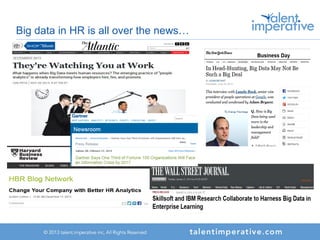
Big data in HR is all over the news…
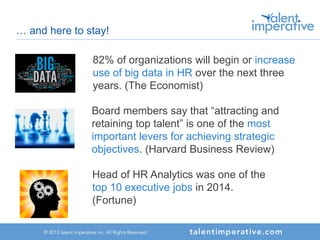
… and here to stay!
Board members say that “attracting and
retaining top talent” is one of the most
important levers for achieving strategic
objectives. (Harvard Business Review)
82% of organizations will begin or increase
use of big data in HR over the next three
years. (The Economist)
Head of HR Analytics was one of the
top 10 executive jobs in 2014.
(Fortune)
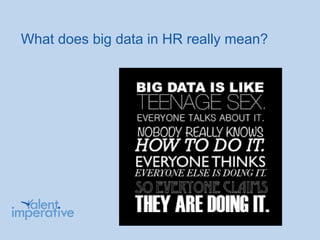
What does big data in HR really mean?
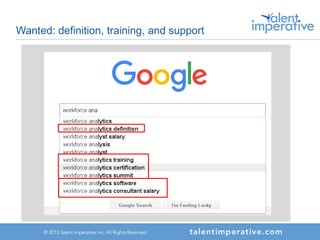
Wanted: definition, training, and support
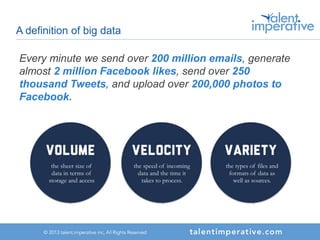
A definition of big data
Every minute we send over 200 million emails, generate
almost 2 million Facebook likes, send over 250
thousand Tweets, and upload over 200,000 photos to
Facebook.
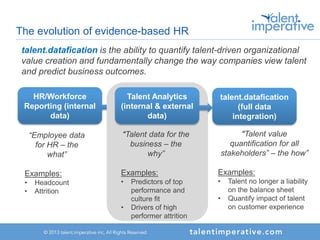
The evolution of evidence-based HR
talent.datafication is the ability to quantify talent-driven organizational
value creation and fundamentally change the way companies view talent
and predict business outcomes.
HR/Workforce
Reporting (internal
data)
“Employee data
for HR – the
what”
Examples:
• Headcount
• Attrition
Talent Analytics
(internal & external
data)
“Talent data for the
business – the
why”
Examples:
• Predictors of top
performance and
culture fit
• Drivers of high
performer attrition
talent.datafication
(full data
integration)
“Talent value
quantification for all
stakeholders” – the how”
Examples:
• Talent no longer a liability
on the balance sheet
• Quantify impact of talent
on customer experience
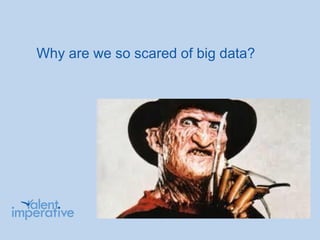
Why are we so scared of big data?
Myth #1: “I don’t work in talent analytics so why
should I care?”
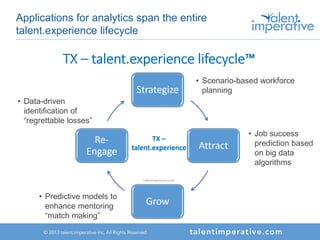
Applications for analytics span the entire
talent.experience lifecycle
• Scenario-based workforce
planning
• Job success
prediction based
on big data
algorithms
• Predictive models to
enhance mentoring
“match making”
• Data-driven
identification of
“regrettable losses”
Myth #2: “I don’t have the skills or tools to
manage analytics initiatives.”
 Is data getting
entered consistently?
 Does everybody
know how to use
current tools &
technology?
 Have you talked to
your current
technology vendors
about additional
training and analytics
capability?
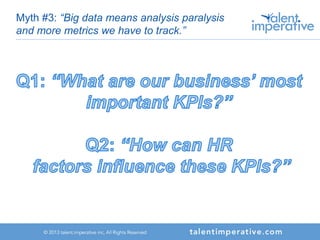
Myth #3: “Big data means analysis paralysis
and more metrics we have to track.”
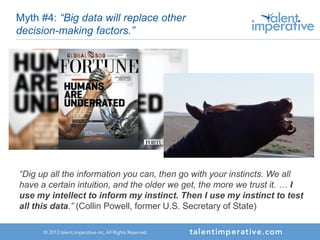
Myth #4: “Big data will replace other
decision-making factors.”
“Dig up all the information you can, then go with your instincts. We all
have a certain intuition, and the older we get, the more we trust it. … I
use my intellect to inform my instinct. Then I use my instinct to test
all this data.” (Collin Powell, former U.S. Secretary of State)
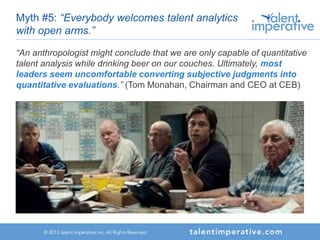
Myth #5: “Everybody welcomes talent analytics
with open arms.”
“An anthropologist might conclude that we are only capable of quantitative
talent analysis while drinking beer on our couches. Ultimately, most
leaders seem uncomfortable converting subjective judgments into
quantitative evaluations.” (Tom Monahan, Chairman and CEO at CEB)
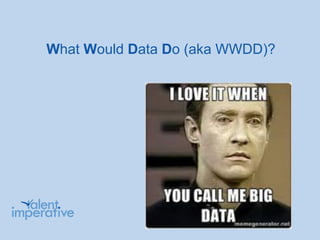
What Would Data Do (aka WWDD)?
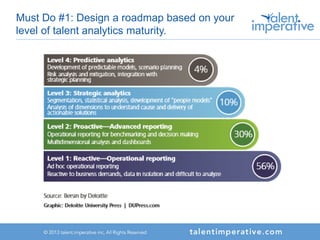
Must Do #1: Design a roadmap based on your
level of talent analytics maturity.
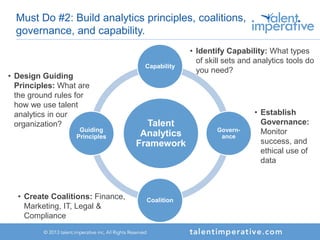
Must Do #2: Build analytics principles, coalitions,
governance, and capability.
Talent
Analytics
Framework
Capability
Govern-
ance
Coalition
Guiding
Principles
• Identify Capability: What types
of skill sets and analytics tools do
you need?
• Establish
Governance:
Monitor
success, and
ethical use of
data
• Create Coalitions: Finance,
Marketing, IT, Legal &
Compliance
• Design Guiding
Principles: What are
the ground rules for
how we use talent
analytics in our
organization?
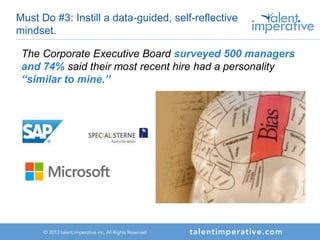
Must Do #3: Instill a data-guided, self-reflective
mindset.
The Corporate Executive Board surveyed 500 managers
and 74% said their most recent hire had a personality
“similar to mine.”
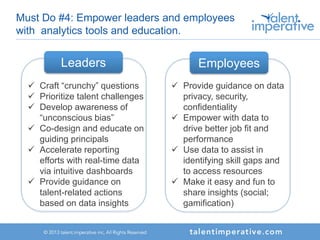
Must Do #4: Empower leaders and employees
with analytics tools and education.
Leaders
 Craft “crunchy” questions
 Prioritize talent challenges
 Develop awareness of
“unconscious bias”
 Co-design and educate on
guiding principals
 Accelerate reporting
efforts with real-time data
via intuitive dashboards
 Provide guidance on
talent-related actions
based on data insights
Employees
 Provide guidance on data
privacy, security,
confidentiality
 Empower with data to
drive better job fit and
performance
 Use data to assist in
identifying skill gaps and
to access resources
 Make it easy and fun to
share insights (social;
gamification)
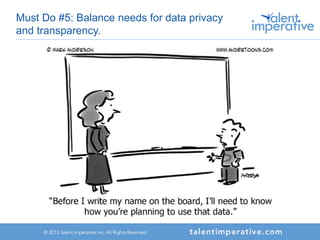
Must Do #5: Balance needs for data privacy
and transparency.
What does this all mean for me?
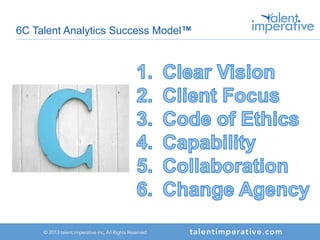
6C Talent Analytics Success Model™
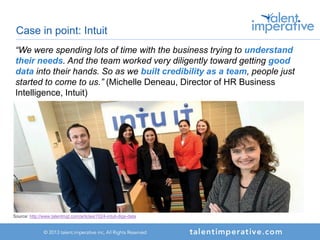
Case in point: Intuit
Source: http://www.talentmgt.com/articles/7024-intuit-digs-data
“We were spending lots of time with the business trying to understand
their needs. And the team worked very diligently toward getting good
data into their hands. So as we built credibility as a team, people just
started to come to us.” (Michelle Deneau, Director of HR Business
Intelligence, Intuit)
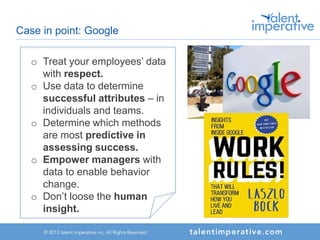
Case in point: Google
o Treat your employees’ data
with respect.
o Use data to determine
successful attributes – in
individuals and teams.
o Determine which methods
are most predictive in
assessing success.
o Empower managers with
data to enable behavior
change.
o Don’t loose the human
insight.
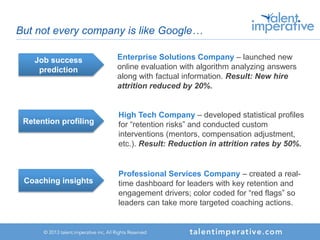
But not every company is like Google…
Job success
prediction
Enterprise Solutions Company – launched new
online evaluation with algorithm analyzing answers
along with factual information. Result: New hire
attrition reduced by 20%.
Retention profiling
High Tech Company – developed statistical profiles
for “retention risks” and conducted custom
interventions (mentors, compensation adjustment,
etc.). Result: Reduction in attrition rates by 50%.
Coaching insights
Professional Services Company – created a real-
time dashboard for leaders with key retention and
engagement drivers; color coded for “red flags” so
leaders can take more targeted coaching actions.
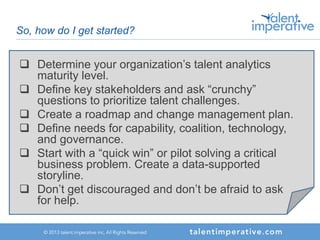
So, how do I get started?
 Determine your organization’s talent analytics
maturity level.
 Define key stakeholders and ask “crunchy”
questions to prioritize talent challenges.
 Create a roadmap and change management plan.
 Define needs for capability, coalition, technology,
and governance.
 Start with a “quick win” or pilot solving a critical
business problem. Create a data-supported
storyline.
 Don’t get discouraged and don’t be afraid to ask
for help.
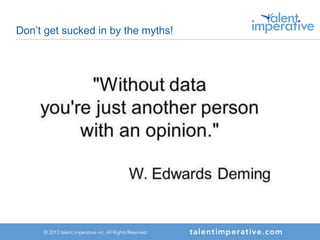
Don’t get sucked in by the myths!
Connect with us!
Nicole Dessain
Founder
talent.imperative inc
nicole@talentimperative.com
(312) 659-6499
talent.imperative company page
talent trends Group on LinkedIn
https://www.linkedin.com/in/ndessain
@NicoleDessain
https://www.youtube.com/channel/UCzsO_iZBb38uu_Fkzio1Iyg
Email us at info@talentimperative.com to receive a free copy of
our “Talent Analytics Self-Assessment”.
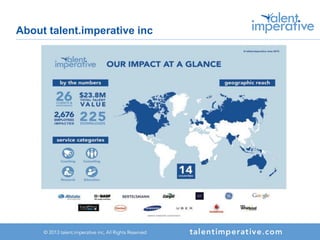
About talent.imperative inc

Big Data = Big Headache? Using People Analytics to Fuel ROI

  • 1.
    A key trendin 2014: talent.datafication and the rise of the underdog @Nicole_Dessain June 19, 2014
  • 2.
    Big data inHR is all over the news…
  • 3.
    … and hereto stay! Board members say that “attracting and retaining top talent” is one of the most important levers for achieving strategic objectives. (Harvard Business Review) 82% of organizations will begin or increase use of big data in HR over the next three years. (The Economist) Head of HR Analytics was one of the top 10 executive jobs in 2014. (Fortune)
  • 4.
    What does bigdata in HR really mean?
  • 5.
  • 6.
    A definition ofbig data Every minute we send over 200 million emails, generate almost 2 million Facebook likes, send over 250 thousand Tweets, and upload over 200,000 photos to Facebook.
  • 7.
    The evolution ofevidence-based HR talent.datafication is the ability to quantify talent-driven organizational value creation and fundamentally change the way companies view talent and predict business outcomes. HR/Workforce Reporting (internal data) “Employee data for HR – the what” Examples: • Headcount • Attrition Talent Analytics (internal & external data) “Talent data for the business – the why” Examples: • Predictors of top performance and culture fit • Drivers of high performer attrition talent.datafication (full data integration) “Talent value quantification for all stakeholders” – the how” Examples: • Talent no longer a liability on the balance sheet • Quantify impact of talent on customer experience
  • 8.
    Why are weso scared of big data?
  • 9.
    Myth #1: “Idon’t work in talent analytics so why should I care?”
  • 10.
    Applications for analyticsspan the entire talent.experience lifecycle • Scenario-based workforce planning • Job success prediction based on big data algorithms • Predictive models to enhance mentoring “match making” • Data-driven identification of “regrettable losses”
  • 11.
    Myth #2: “Idon’t have the skills or tools to manage analytics initiatives.”  Is data getting entered consistently?  Does everybody know how to use current tools & technology?  Have you talked to your current technology vendors about additional training and analytics capability?
  • 12.
    Myth #3: “Bigdata means analysis paralysis and more metrics we have to track.”
  • 13.
    Myth #4: “Bigdata will replace other decision-making factors.” “Dig up all the information you can, then go with your instincts. We all have a certain intuition, and the older we get, the more we trust it. … I use my intellect to inform my instinct. Then I use my instinct to test all this data.” (Collin Powell, former U.S. Secretary of State)
  • 14.
    Myth #5: “Everybodywelcomes talent analytics with open arms.” “An anthropologist might conclude that we are only capable of quantitative talent analysis while drinking beer on our couches. Ultimately, most leaders seem uncomfortable converting subjective judgments into quantitative evaluations.” (Tom Monahan, Chairman and CEO at CEB)
  • 15.
    What Would DataDo (aka WWDD)?
  • 16.
    Must Do #1:Design a roadmap based on your level of talent analytics maturity.
  • 17.
    Must Do #2:Build analytics principles, coalitions, governance, and capability. Talent Analytics Framework Capability Govern- ance Coalition Guiding Principles • Identify Capability: What types of skill sets and analytics tools do you need? • Establish Governance: Monitor success, and ethical use of data • Create Coalitions: Finance, Marketing, IT, Legal & Compliance • Design Guiding Principles: What are the ground rules for how we use talent analytics in our organization?
  • 18.
    Must Do #3:Instill a data-guided, self-reflective mindset. The Corporate Executive Board surveyed 500 managers and 74% said their most recent hire had a personality “similar to mine.”
  • 19.
    Must Do #4:Empower leaders and employees with analytics tools and education. Leaders  Craft “crunchy” questions  Prioritize talent challenges  Develop awareness of “unconscious bias”  Co-design and educate on guiding principals  Accelerate reporting efforts with real-time data via intuitive dashboards  Provide guidance on talent-related actions based on data insights Employees  Provide guidance on data privacy, security, confidentiality  Empower with data to drive better job fit and performance  Use data to assist in identifying skill gaps and to access resources  Make it easy and fun to share insights (social; gamification)
  • 20.
    Must Do #5:Balance needs for data privacy and transparency.
  • 21.
    What does thisall mean for me?
  • 22.
    6C Talent AnalyticsSuccess Model™
  • 23.
    Case in point:Intuit Source: http://www.talentmgt.com/articles/7024-intuit-digs-data “We were spending lots of time with the business trying to understand their needs. And the team worked very diligently toward getting good data into their hands. So as we built credibility as a team, people just started to come to us.” (Michelle Deneau, Director of HR Business Intelligence, Intuit)
  • 24.
    Case in point:Google o Treat your employees’ data with respect. o Use data to determine successful attributes – in individuals and teams. o Determine which methods are most predictive in assessing success. o Empower managers with data to enable behavior change. o Don’t loose the human insight.
  • 25.
    But not everycompany is like Google… Job success prediction Enterprise Solutions Company – launched new online evaluation with algorithm analyzing answers along with factual information. Result: New hire attrition reduced by 20%. Retention profiling High Tech Company – developed statistical profiles for “retention risks” and conducted custom interventions (mentors, compensation adjustment, etc.). Result: Reduction in attrition rates by 50%. Coaching insights Professional Services Company – created a real- time dashboard for leaders with key retention and engagement drivers; color coded for “red flags” so leaders can take more targeted coaching actions.
  • 26.
    So, how doI get started?  Determine your organization’s talent analytics maturity level.  Define key stakeholders and ask “crunchy” questions to prioritize talent challenges.  Create a roadmap and change management plan.  Define needs for capability, coalition, technology, and governance.  Start with a “quick win” or pilot solving a critical business problem. Create a data-supported storyline.  Don’t get discouraged and don’t be afraid to ask for help.
  • 27.
    Don’t get suckedin by the myths!
  • 28.
    Connect with us! NicoleDessain Founder talent.imperative inc nicole@talentimperative.com (312) 659-6499 talent.imperative company page talent trends Group on LinkedIn https://www.linkedin.com/in/ndessain @NicoleDessain https://www.youtube.com/channel/UCzsO_iZBb38uu_Fkzio1Iyg Email us at info@talentimperative.com to receive a free copy of our “Talent Analytics Self-Assessment”.
  • 29.