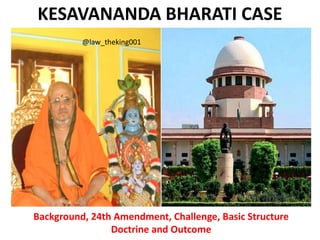
KESAVANANDA BHARATI CASE
Background, 24th Amendment, Challenge, Basic Structure
Doctrine and Outcome
@law_theking001
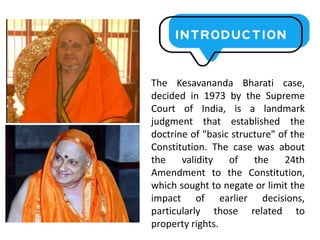
The Kesavananda Bharati case,
decided in 1973 by the Supreme
Court of India, is a landmark
judgment that established the
doctrine of "basic structure" of the
Constitution. The case was about
the validity of the 24th
Amendment to the Constitution,
which sought to negate or limit the
impact of earlier decisions,
particularly those related to
property rights.
Facts of the case:
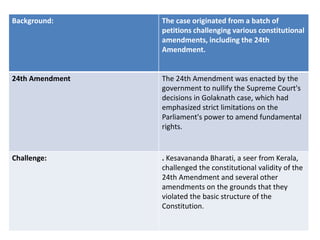
Background: The case originated from a batch of
petitions challenging various constitutional
amendments, including the 24th
Amendment.
24th Amendment The 24th Amendment was enacted by the
government to nullify the Supreme Court's
decisions in Golaknath case, which had
emphasized strict limitations on the
Parliament's power to amend fundamental
rights.
Challenge: . Kesavananda Bharati, a seer from Kerala,
challenged the constitutional validity of the
24th Amendment and several other
amendments on the grounds that they
violated the basic structure of the
Constitution.
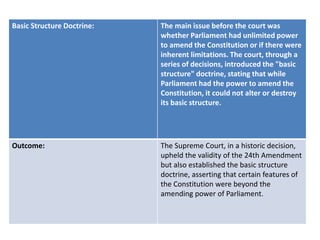
Basic Structure Doctrine: The main issue before the court was
whether Parliament had unlimited power
to amend the Constitution or if there were
inherent limitations. The court, through a
series of decisions, introduced the "basic
structure" doctrine, stating that while
Parliament had the power to amend the
Constitution, it could not alter or destroy
its basic structure.
Outcome: The Supreme Court, in a historic decision,
upheld the validity of the 24th Amendment
but also established the basic structure
doctrine, asserting that certain features of
the Constitution were beyond the
amending power of Parliament.

kesavananda bharati case.pptx

  • 1.
    KESAVANANDA BHARATI CASE Background,24th Amendment, Challenge, Basic Structure Doctrine and Outcome @law_theking001
  • 3.
    The Kesavananda Bharaticase, decided in 1973 by the Supreme Court of India, is a landmark judgment that established the doctrine of "basic structure" of the Constitution. The case was about the validity of the 24th Amendment to the Constitution, which sought to negate or limit the impact of earlier decisions, particularly those related to property rights.
  • 4.
    Facts of thecase: Background: The case originated from a batch of petitions challenging various constitutional amendments, including the 24th Amendment. 24th Amendment The 24th Amendment was enacted by the government to nullify the Supreme Court's decisions in Golaknath case, which had emphasized strict limitations on the Parliament's power to amend fundamental rights. Challenge: . Kesavananda Bharati, a seer from Kerala, challenged the constitutional validity of the 24th Amendment and several other amendments on the grounds that they violated the basic structure of the Constitution.
  • 5.
    Basic Structure Doctrine:The main issue before the court was whether Parliament had unlimited power to amend the Constitution or if there were inherent limitations. The court, through a series of decisions, introduced the "basic structure" doctrine, stating that while Parliament had the power to amend the Constitution, it could not alter or destroy its basic structure. Outcome: The Supreme Court, in a historic decision, upheld the validity of the 24th Amendment but also established the basic structure doctrine, asserting that certain features of the Constitution were beyond the amending power of Parliament.