Virus infection and virus
synthesis
• Virus infection and virus replication - synonymouslyused
Presented by :
Laxmi Prasad Joshi
PLP-09M-2019
Department of plant
Pathology
AFU, Rampur ,Chitwan
Virus Replication Strategy /Infection
process
STEPS,
1. Passage of virus through the cell wall .
2 . Entry of virus or its nucleic acid into cells and then
to replicative sites in cells
3. Removal of protein from nucleic acid
termed as “uncoating”
4. Translation of viral genome into replicase or a
protein of that enzyme .
5. Replication of viral nucleic acid.
6. Replication of coat protein .
7. Assembly of new virus . Agrios 2005
How virus enters the plant cell ?
a) Mechanical wounds or insects damage (wounds)
1. Mechanically :- TMV, BCMV, PVY, PYDV
2. Vectors :- PLRV, TLCV, WTV
b) By vector
c) Deposition into an ovule by an infected pollen grain
e.g. Prunus necrotic ring spot, Tobacco ring spot of Soyabean, Barley stripe mosaic
virus
d) Seeds or vegetative propagation
e.g. BCMV, CMV, Pea stripe virus
e) Fungal parasite
e.g. TNV, Barley yellow mosaic virus , Tobacco stunt virus .
 Types of plant virus nucleic acids
a. Double stranded (ds) DNA (rare)
b. Single stranded (ss)DNA (rare)
c. ssRNA , negative sense (rare) (can’t be translated directly )
d. ssRNA, Positive sense (common)
e. dsRNA (rare)
 Viruses does not produce any kind of reproductive structure , they multiply by Using host machinery .
 Host functions used by plant viruses .
1. Energy: - nucleoside triophosphate .
2. Protein synthesis :- Ribosome (80s Cytoplasmic ribosome) , tRNA and associated
enzymes and factors of host
3. Nucleic acid synthesis
4. Structural components of the cell :- ER, cytoplasmic skeleton.
Synthesis of RNA viruses
Carbonell et.al.2018 , eLS
Simplified replication of ssRNA virus nucleic acid
1. Uncoating of viral protein coat
 Uncoating ability Depends upon structure of virus coat protein .
2. Viral RNA Induces the host cell to form the viral RNA polymerase(RdRp) ,
• Itself act as mRNA.
• Also produces protein that inhibit host protein and host RNA synthesis .
3. Enzyme RNA polymerase utilizes the viral RNA as a template and
forms complementary RNA (-ve sense ).
• The first new RNA produced is not the viral RNA but a mirror image .
• Complementary RNA temporarily attached to viral strand
• soon separates to produce the original virus RNA and mirror image .
4. Later mirror image serves as the template for more virus (RNA synthesis )
Carbonell et.al.2018 , eLS
Minskaia and Luke,2015 , J Virol Retro
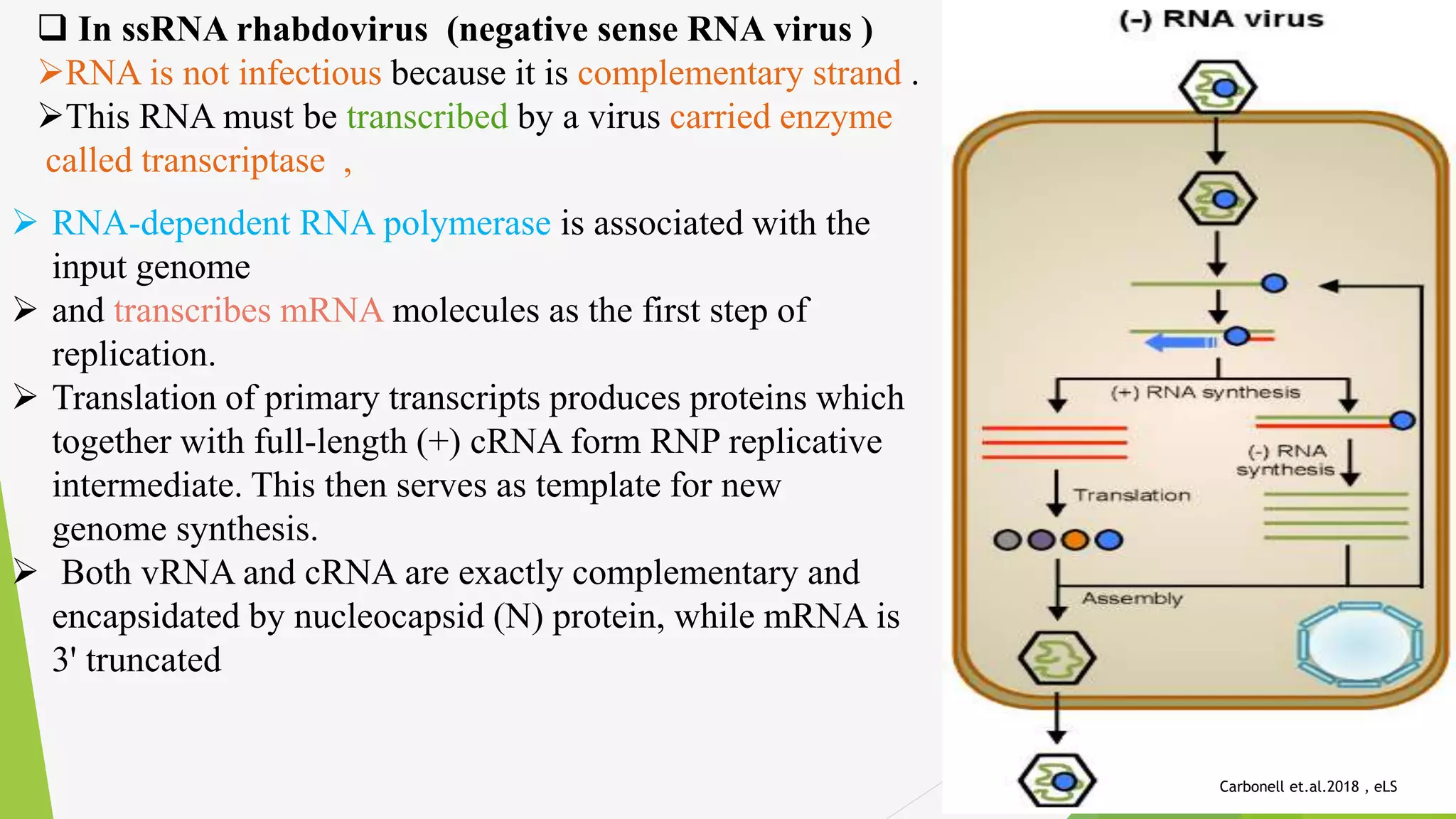
 In ssRNA rhabdovirus (negative sense RNA virus )
RNA is not infectious because it is complementary strand .
This RNA must be transcribed by a virus carried enzyme
called transcriptase ,
 RNA-dependent RNA polymerase is associated with the
input genome
 and transcribes mRNA molecules as the first step of
replication.
 Translation of primary transcripts produces proteins which
together with full-length (+) cRNA form RNP replicative
intermediate. This then serves as template for new
genome synthesis.
 Both vRNA and cRNA are exactly complementary and
encapsidated by nucleocapsid (N) protein, while mRNA is
3' truncated
Carbonell et.al.2018 , eLS
In dsRNA (isometric viruses)
 The RNA is segmented
within the same virus ,
 Non infectious and depends
for its replication in the host .
 Transcriptase enzyme also
carried within the virus .
 RNA dependent RNA
polymerase (RdRp)
Viral RdRp synthesizes and releases into the cytoplasm (+) strands that
are first translated and then packaged to form immature virions.
Virions mature by synthesising (−) RNA and by the addition of other viral protein Carbonell et.al.2018 , eLS
 In dsDNA virus ,
 viral DNA enters the cell nucleus - become
twisted and supercoiled forms mini chromosome
.
 Later transcribed into two ssRNA Using cellular
polymerase II
 Smaller RNA is transported to cytoplasma –
where it is translated into virus coded protein and
 large RNA is also transported to the same
location in the cytoplasma , but it becomes
encapsidated by coat protein sub units and is
Used as a template for reverse transcription into
complete virion dsDNA .
 Reverse transcription occurs in Electron dense
viroplasma .
The CaMV replication cycle.
 In ssDNA of ssDNA plant
virus have no method of
replication determined
with certainty yet (Agrios,
2005).
Rolling circle that produces
a multimeric complementary
strand which serves as
template for the production
of multimeric strands that are
then cleaved to produce unit
length .
Fig : Begomovirus life cycle
Bowdoin et al 2013 , nat rev microbiology
 Viruses in which different RNA
segments are present within two or
more virus particles ,All particles
must be present in the same cell for
the virus to replicate and for infection
to develop .
Formation of coat protein
 As soon as new viral nucleic acid is formed , it will be
translated
 Induces host cell to produce the protein molecule coded by
viral nucleic acid .
 Protein synthesis depends on presence of amino acids and
the cooperation of ribosomes, messenger RNA , and
transfer RNA.
mRNA the part of viral RNA coding for the viral protein.
The virus utilize the amino acid , ribosome , and transfer
RNA of the host .
When new virus nucleic acid and virus
proteins subunits have been produced , the
nucleic acid organize the protein subunits
around it
 the two are assembled together to form the
complete virus particle , the virion.
Assembling of viral nucleic acid and
protein
Sites of Multiplication
 The site of the cell in which virus nucleic acid and protein
are synthesized and in which these two components are
assembled to produce the virions varies with the particular
genus or family of the virus
RNA viruses :- RNA replicate in cytoplasm, produces viral
protein subunit in cytoplasm and finally assembly of virion
follows also in the cytoplasm .
ssDNA :- Every things seems to take place in the nucleus . From
which the virus particle are then released into the cytoplasm .
Sites of Multiplication
In some cases , chloroplast and other
organells perform the same function.
In potex , Caulimo , Gemini and
Tobamo virus replication and assembly
take place in nucleus and from where it
moves to cytoplasm.
In Tymovirus replication takes places in
chloroplast
Virus infection and virus synthesis

Virus infection and virus synthesis

  • 1.
    Virus infection andvirus synthesis • Virus infection and virus replication - synonymouslyused Presented by : Laxmi Prasad Joshi PLP-09M-2019 Department of plant Pathology AFU, Rampur ,Chitwan
  • 2.
    Virus Replication Strategy/Infection process STEPS, 1. Passage of virus through the cell wall . 2 . Entry of virus or its nucleic acid into cells and then to replicative sites in cells 3. Removal of protein from nucleic acid termed as “uncoating” 4. Translation of viral genome into replicase or a protein of that enzyme . 5. Replication of viral nucleic acid. 6. Replication of coat protein . 7. Assembly of new virus . Agrios 2005
  • 4.
    How virus entersthe plant cell ? a) Mechanical wounds or insects damage (wounds) 1. Mechanically :- TMV, BCMV, PVY, PYDV 2. Vectors :- PLRV, TLCV, WTV b) By vector c) Deposition into an ovule by an infected pollen grain e.g. Prunus necrotic ring spot, Tobacco ring spot of Soyabean, Barley stripe mosaic virus d) Seeds or vegetative propagation e.g. BCMV, CMV, Pea stripe virus e) Fungal parasite e.g. TNV, Barley yellow mosaic virus , Tobacco stunt virus .
  • 5.
     Types ofplant virus nucleic acids a. Double stranded (ds) DNA (rare) b. Single stranded (ss)DNA (rare) c. ssRNA , negative sense (rare) (can’t be translated directly ) d. ssRNA, Positive sense (common) e. dsRNA (rare)  Viruses does not produce any kind of reproductive structure , they multiply by Using host machinery .  Host functions used by plant viruses . 1. Energy: - nucleoside triophosphate . 2. Protein synthesis :- Ribosome (80s Cytoplasmic ribosome) , tRNA and associated enzymes and factors of host 3. Nucleic acid synthesis 4. Structural components of the cell :- ER, cytoplasmic skeleton.
  • 6.
    Synthesis of RNAviruses Carbonell et.al.2018 , eLS
  • 7.
    Simplified replication ofssRNA virus nucleic acid 1. Uncoating of viral protein coat  Uncoating ability Depends upon structure of virus coat protein . 2. Viral RNA Induces the host cell to form the viral RNA polymerase(RdRp) , • Itself act as mRNA. • Also produces protein that inhibit host protein and host RNA synthesis . 3. Enzyme RNA polymerase utilizes the viral RNA as a template and forms complementary RNA (-ve sense ). • The first new RNA produced is not the viral RNA but a mirror image . • Complementary RNA temporarily attached to viral strand • soon separates to produce the original virus RNA and mirror image . 4. Later mirror image serves as the template for more virus (RNA synthesis ) Carbonell et.al.2018 , eLS
  • 8.
    Minskaia and Luke,2015, J Virol Retro  In ssRNA rhabdovirus (negative sense RNA virus ) RNA is not infectious because it is complementary strand . This RNA must be transcribed by a virus carried enzyme called transcriptase ,  RNA-dependent RNA polymerase is associated with the input genome  and transcribes mRNA molecules as the first step of replication.  Translation of primary transcripts produces proteins which together with full-length (+) cRNA form RNP replicative intermediate. This then serves as template for new genome synthesis.  Both vRNA and cRNA are exactly complementary and encapsidated by nucleocapsid (N) protein, while mRNA is 3' truncated Carbonell et.al.2018 , eLS
  • 9.
    In dsRNA (isometricviruses)  The RNA is segmented within the same virus ,  Non infectious and depends for its replication in the host .  Transcriptase enzyme also carried within the virus .  RNA dependent RNA polymerase (RdRp) Viral RdRp synthesizes and releases into the cytoplasm (+) strands that are first translated and then packaged to form immature virions. Virions mature by synthesising (−) RNA and by the addition of other viral protein Carbonell et.al.2018 , eLS
  • 10.
     In dsDNAvirus ,  viral DNA enters the cell nucleus - become twisted and supercoiled forms mini chromosome .  Later transcribed into two ssRNA Using cellular polymerase II  Smaller RNA is transported to cytoplasma – where it is translated into virus coded protein and  large RNA is also transported to the same location in the cytoplasma , but it becomes encapsidated by coat protein sub units and is Used as a template for reverse transcription into complete virion dsDNA .  Reverse transcription occurs in Electron dense viroplasma . The CaMV replication cycle.
  • 11.
     In ssDNAof ssDNA plant virus have no method of replication determined with certainty yet (Agrios, 2005). Rolling circle that produces a multimeric complementary strand which serves as template for the production of multimeric strands that are then cleaved to produce unit length . Fig : Begomovirus life cycle Bowdoin et al 2013 , nat rev microbiology
  • 12.
     Viruses inwhich different RNA segments are present within two or more virus particles ,All particles must be present in the same cell for the virus to replicate and for infection to develop .
  • 13.
    Formation of coatprotein  As soon as new viral nucleic acid is formed , it will be translated  Induces host cell to produce the protein molecule coded by viral nucleic acid .  Protein synthesis depends on presence of amino acids and the cooperation of ribosomes, messenger RNA , and transfer RNA. mRNA the part of viral RNA coding for the viral protein. The virus utilize the amino acid , ribosome , and transfer RNA of the host .
  • 14.
    When new virusnucleic acid and virus proteins subunits have been produced , the nucleic acid organize the protein subunits around it  the two are assembled together to form the complete virus particle , the virion. Assembling of viral nucleic acid and protein
  • 15.
    Sites of Multiplication The site of the cell in which virus nucleic acid and protein are synthesized and in which these two components are assembled to produce the virions varies with the particular genus or family of the virus RNA viruses :- RNA replicate in cytoplasm, produces viral protein subunit in cytoplasm and finally assembly of virion follows also in the cytoplasm . ssDNA :- Every things seems to take place in the nucleus . From which the virus particle are then released into the cytoplasm .
  • 16.
    Sites of Multiplication Insome cases , chloroplast and other organells perform the same function. In potex , Caulimo , Gemini and Tobamo virus replication and assembly take place in nucleus and from where it moves to cytoplasm. In Tymovirus replication takes places in chloroplast