It's the ppt related to the mechanism of replication on virus which makes them inevitable pathogen in plants as well as animals .It's quite necessary to understand their morphology and physiological systems to understand their replication sites
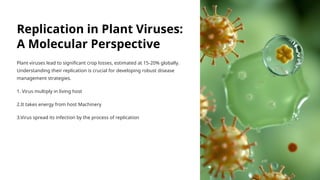
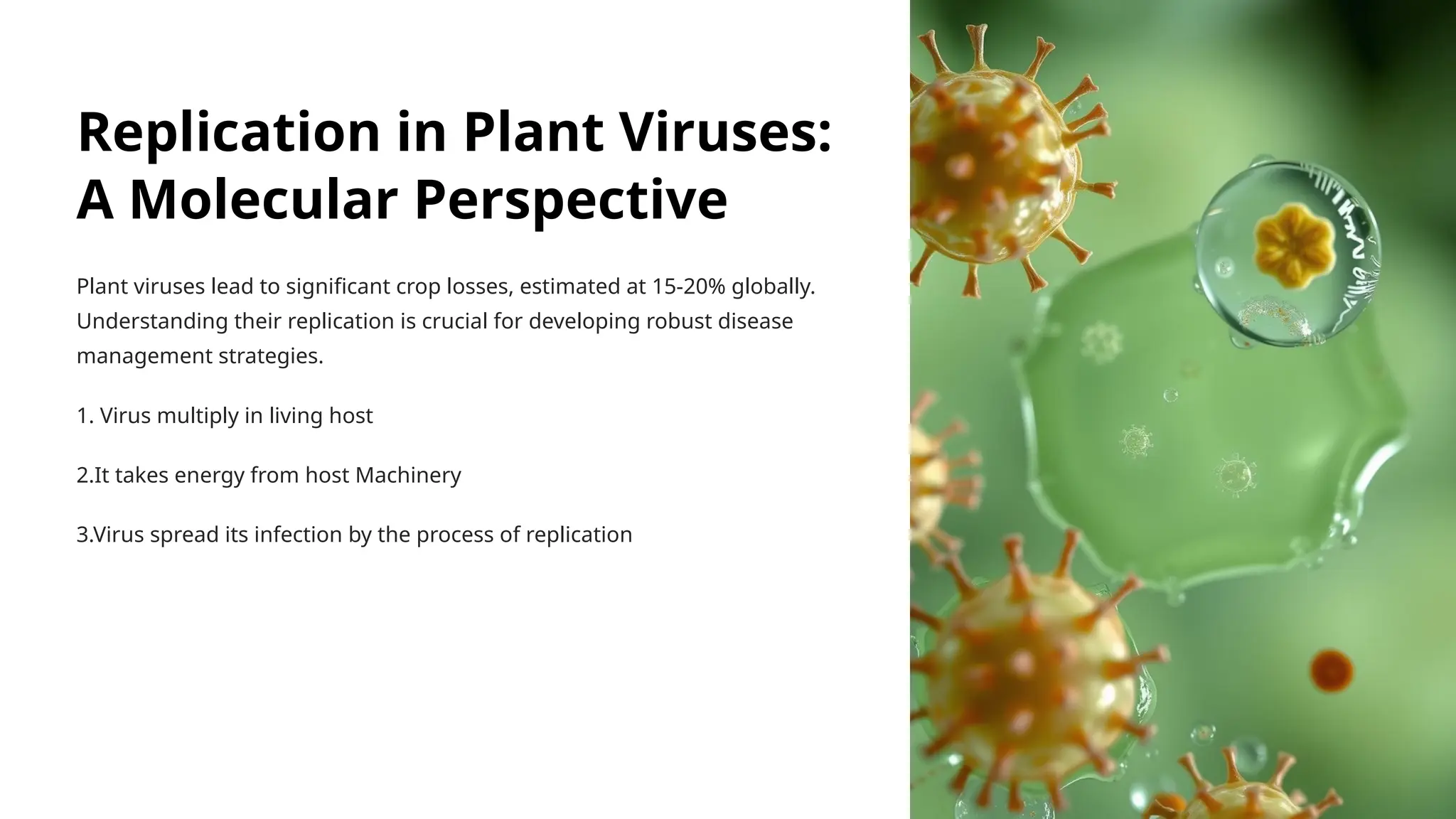
Replication in PlantViruses:
A Molecular Perspective
Plant viruses lead to significant crop losses, estimated at 15-20% globally.
Understanding their replication is crucial for developing robust disease
management strategies.
1. Virus multiply in living host
2.It takes energy from host Machinery
3.Virus spread its infection by the process of replication
2.
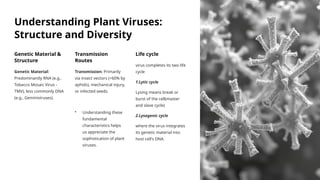
Understanding Plant Viruses:
Structureand Diversity
Genetic Material &
Structure
Genetic Material:
Predominantly RNA (e.g.,
Tobacco Mosaic Virus -
TMV), less commonly DNA
(e.g., Geminiviruses).
Transmission
Routes
Transmission: Primarily
via insect vectors (>60% by
aphids), mechanical injury,
or infected seeds.
• Understanding these
fundamental
characteristics helps
us appreciate the
sophistication of plant
viruses.
Life cycle
virus completes its two life
cycle
1.Lytic cycle
Lysing means break or
burst of the cell(master
and slave cycle)
2.Lysogenic cycle
where the virus integrates
its genetic material into
host cell's DNA
3.
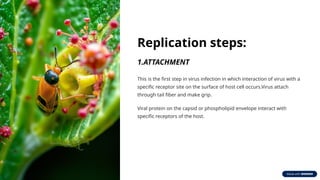
Replication steps:
1.ATTACHMENT
This isthe first step in virus infection in which interaction of virus with a
specific receptor site on the surface of host cell occurs.Virus attach
through tail fiber and make grip.
Viral protein on the capsid or phospholipid envelope interact with
specific receptors of the host.
4.
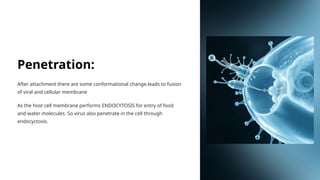
Penetration:
After attachment thereare some conformational change.leads to fusion
of viral and cellular membrane
As the host cell membrane performs ENDOCYTOSIS for entry of food
and water molecules. So virus also penetrate in the cell through
endocyctosis.
5.
Uncoating and GenomeRelease
The capsid is removed , exposing the viral RNA/DNA.
The genome becomes accessible for replication and translation
6.
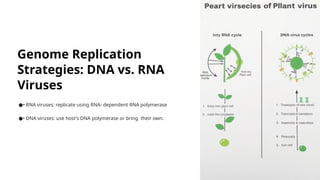
Genome Replication
Strategies: DNAvs. RNA
Viruses
•
● RNA viruses: replicate using RNA- dependent RNA polymerase
•
● DNA viruses: use host's DNA polymerase or bring their own.
7.
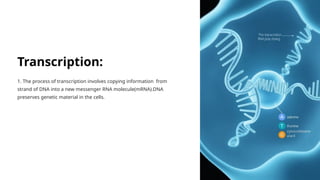
Transcription:
1. The processof transcription involves copying information from
strand of DNA into a new messenger RNA molecule(mRNA).DNA
preserves genetic material in the cells.
8.
Translation:
A process bywhich viral mRNA is translated into viral protein using the host cellular machinery.The ribosome a structure
that is a factory for the creation of proteins is where translation takes place.
9.
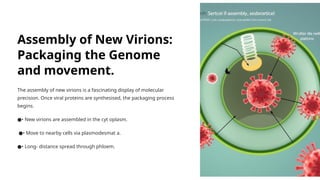
Assembly of NewVirions:
Packaging the Genome
and movement.
The assembly of new virions is a fascinating display of molecular
precision. Once viral proteins are synthesised, the packaging process
begins.
•
● New virions are assembled in the cyt oplasm.
•
● Move to nearby cells via plasmodesmat a.
•
● Long- distance spread through phloem.
10.
Conclusion
•
● Viral replicationis host - dependent.
•
● Involves genome release, replication, translation, and spread.
•
● Import ant in plant disease managemen


![ANIMAL_CELL_,_TISSUE_AND_ORGAN_CULTURE[1].pptx](https://cdn.slidesharecdn.com/ss_thumbnails/animalcelltissueandorganculture1-260204172026-4462b440-thumbnail.jpg?width=640&height=640&fit=bounds)


