
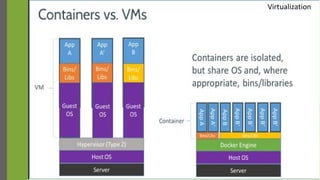
Virtualization
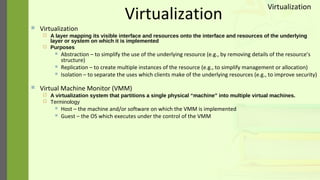
 Virtualization
 A layer mapping its visible interface and resources onto the interface and resources of the underlying
layer or system on which it is implemented
 Purposes
 Abstraction – to simplify the use of the underlying resource (e.g., by removing details of the resource’s
structure)
 Replication – to create multiple instances of the resource (e.g., to simplify management or allocation)
 Isolation – to separate the uses which clients make of the underlying resources (e.g., to improve security)
 Virtual Machine Monitor (VMM)
 A virtualization system that partitions a single physical “machine” into multiple virtual machines.
 Terminology
 Host – the machine and/or software on which the VMM is implemented
 Guest – the OS which executes under the control of the VMM
Virtualization
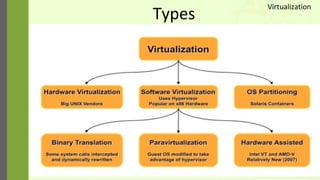
Types
Virtualization
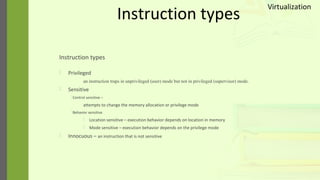
Instruction types
Instruction types
 Privileged
an instruction traps in unprivileged (user) mode but not in privileged (supervisor) mode.
 Sensitive
Control sensitive –
attempts to change the memory allocation or privilege mode
Behavior sensitive
 Location sensitive – execution behavior depends on location in memory
 Mode sensitive – execution behavior depends on the privilege mode
 Innocuous – an instruction that is not sensitive
Virtualization
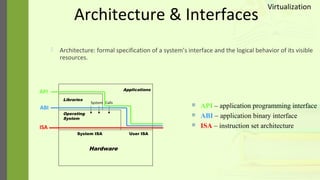
Architecture & Interfaces
 Architecture: formal specification of a system’s interface and the logical behavior of its visible
resources.
Hardware
System ISA User ISA
Operating
System
System Calls
Libraries
Applications
ISA
ABI
API
 API – application programming interface
 ABI – application binary interface
 ISA – instruction set architecture
Virtualization
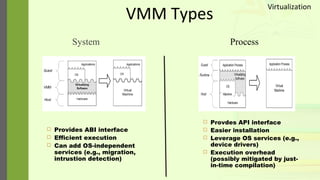
VMM Types
System Process
 Provides ABI interface
 Efficient execution
 Can add OS-independent
services (e.g., migration,
intrustion detection)
 Provdes API interface
 Easier installation
 Leverage OS services (e.g.,
device drivers)
 Execution overhead
(possibly mitigated by just-
in-time compilation)
Virtualization
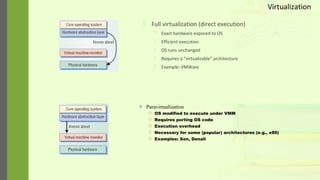
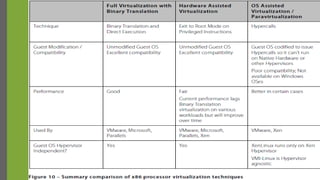
 Full virtualization (direct execution)
 Exact hardware exposed to OS
 Efficient execution
 OS runs unchanged
 Requires a “virtualizable” architecture
 Example: VMWare
 Paravirtualization
 OS modified to execute under VMM
 Requires porting OS code
 Execution overhead
 Necessary for some (popular) architectures (e.g., x86)
 Examples: Xen, Denali
Virtualization
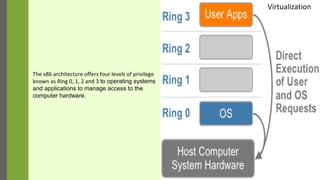
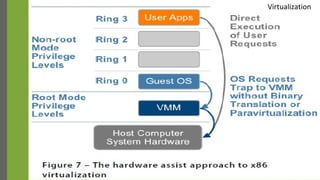
The x86 architecture offers four levels of privilege
known as Ring 0, 1, 2 and 3 to operating systems
and applications to manage access to the
computer hardware.
Virtualization
resource
vmm
privileged
instruction
trap
GuestOS
resource
emulate change
change
Virtualization
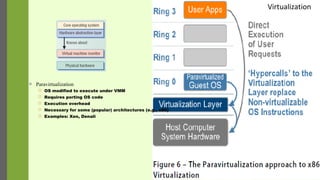
 Paravirtualization
 OS modified to execute under VMM
 Requires porting OS code
 Execution overhead
 Necessary for some (popular) architectures (e.g., x86)
 Examples: Xen, Denali
Virtualization
Virtualization
Virtualization
Virtualization

Virtualization Training

  • 2.
    Virtualization  Virtualization  Alayer mapping its visible interface and resources onto the interface and resources of the underlying layer or system on which it is implemented  Purposes  Abstraction – to simplify the use of the underlying resource (e.g., by removing details of the resource’s structure)  Replication – to create multiple instances of the resource (e.g., to simplify management or allocation)  Isolation – to separate the uses which clients make of the underlying resources (e.g., to improve security)  Virtual Machine Monitor (VMM)  A virtualization system that partitions a single physical “machine” into multiple virtual machines.  Terminology  Host – the machine and/or software on which the VMM is implemented  Guest – the OS which executes under the control of the VMM Virtualization
  • 3.
  • 4.
    Instruction types Instruction types Privileged an instruction traps in unprivileged (user) mode but not in privileged (supervisor) mode.  Sensitive Control sensitive – attempts to change the memory allocation or privilege mode Behavior sensitive  Location sensitive – execution behavior depends on location in memory  Mode sensitive – execution behavior depends on the privilege mode  Innocuous – an instruction that is not sensitive Virtualization
  • 5.
    Architecture & Interfaces Architecture: formal specification of a system’s interface and the logical behavior of its visible resources. Hardware System ISA User ISA Operating System System Calls Libraries Applications ISA ABI API  API – application programming interface  ABI – application binary interface  ISA – instruction set architecture Virtualization
  • 6.
    VMM Types System Process Provides ABI interface  Efficient execution  Can add OS-independent services (e.g., migration, intrustion detection)  Provdes API interface  Easier installation  Leverage OS services (e.g., device drivers)  Execution overhead (possibly mitigated by just- in-time compilation) Virtualization
  • 7.
     Full virtualization(direct execution)  Exact hardware exposed to OS  Efficient execution  OS runs unchanged  Requires a “virtualizable” architecture  Example: VMWare  Paravirtualization  OS modified to execute under VMM  Requires porting OS code  Execution overhead  Necessary for some (popular) architectures (e.g., x86)  Examples: Xen, Denali Virtualization
  • 8.
    The x86 architectureoffers four levels of privilege known as Ring 0, 1, 2 and 3 to operating systems and applications to manage access to the computer hardware. Virtualization
  • 9.
  • 10.
     Paravirtualization  OSmodified to execute under VMM  Requires porting OS code  Execution overhead  Necessary for some (popular) architectures (e.g., x86)  Examples: Xen, Denali Virtualization
  • 11.
  • 13.
  • 14.