VIRTUAL TEAM
CHALLENGES
6TH APRIL’20.
NO OF SLIDES :15
TIME REQUIRED : 30 MIN
BACKGROUND
Why Virtual ?
• Large-scale outbreaks of infectious disease Covid-19 across globe,
has greatly increased morbidity & mortality and caused significant
economic, social and political disruption led to Physical distancing &
working thru Virtual Platforms.
• What is a Virtual Team ?
A Virtual team (a dispersed team, distributed team or a
remote team) -a group of individuals who work together from different
geographic locations and rely on Electronic Communications for
collaboration
Majorly 3 Types of Challenges during a Virtual
Environment –
 Individual
 Organisation
 Society
CHALLENGES
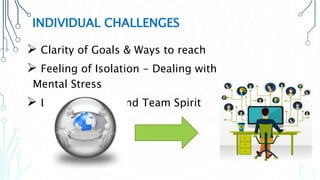
 Clarity of Goals & Ways to reach
 Feeling of Isolation - Dealing with
Mental Stress
 Loss of Morale and Team Spirit
INDIVIDUAL CHALLENGES
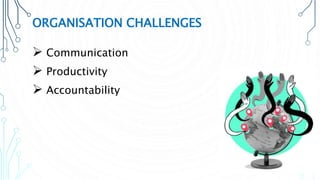
 Communication
 Productivity
 Accountability
ORGANISATION CHALLENGES
 Lack of Social Interaction
 Maintain Physical distance
SOCIETY CHALLENGES
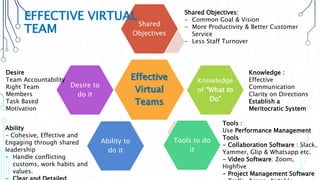
Effective
Virtual
Teams
Shared
Objectives
Knowledge
of “What to
Do”
Tools to do
it
Ability to
do it
Desire to
do it
EFFECTIVE VIRTUAL
TEAM
Tools :
Use Performance Management
Tools
- Collaboration Software : Slack,
Yammer, Glip & Whatsapp etc.
- Video Software: Zoom,
Highfive
- Project Management Software
Knowledge :
Effective
Communication
Clarity on Directions
Establish a
Meritocratic System
Ability
- Cohesive, Effective and
Engaging through shared
leadership
- Handle conflicting
customs, work habits and
values.
Desire
Team Accountability
Right Team
Members
Task Based
Motivation
Shared Objectives:
- Common Goal & Vision
- More Productivity & Better Customer
Service
- Less Staff Turnover
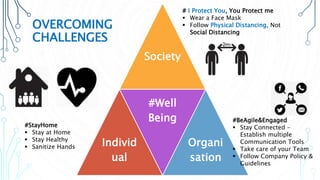
Society
Individ
ual
#Well
Being
Organi
sation
OVERCOMING
CHALLENGES
# I Protect You, You Protect me
 Wear a Face Mask
 Follow Physical Distancing, Not
Social Distancing
#StayHome
 Stay at Home
 Stay Healthy
 Sanitize Hands
#BeAgile&Engaged
 Stay Connected -
Establish multiple
Communication Tools
 Take care of your Team
 Follow Company Policy &
Guidelines
SOME QUESTIONS FOR YOU
• How will you establish effective team standards ?
• What are the communication modes you will use to address
virtual team ?
• How you will support and encourage Virtual team members ?
• How can you manage virtual team member’s performance ?
• What management style you will use while handing virtual team
?
ESTABLISH EFFECTIVE TEAM STANDARDS
• Set standards regarding the frequency of contact between team
members.
• Set standards for responding to E-mail communications.
• Set standards about which communication tools to use and how
to use.
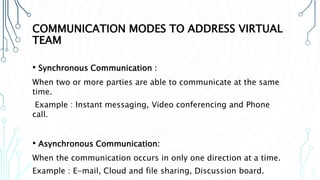
COMMUNICATION MODES TO ADDRESS VIRTUAL
TEAM
• Synchronous Communication :
When two or more parties are able to communicate at the same
time.
Example : Instant messaging, Video conferencing and Phone
call.
• Asynchronous Communication:
When the communication occurs in only one direction at a time.
Example : E-mail, Cloud and file sharing, Discussion board.
SUPPORT AND ENCOURAGE VIRTUAL TEAM MEMBERS
• It’s important to reward individual effort. If some one goes the
extra mile or has outstanding results, recognize and reward it.
• Rewarding team members when appropriate is a good way to
keep the team motivated. We tend to overlook while working
with remote teams.
• Hold regular meetings using video conferencing.
MANAGE VIRTUAL TEAM MEMBER’S PERFORMANCE
• Tailor task assignments based on team member’s skills.
• Ensure team members acknowledge the receipt of feedback if you
have given it via e-mail.
• Each team member should know one another’s role.
• Be prescriptive about what each team member is responsible for.
• Conduct regular review, evaluations against the set objective.
• Avoid giving negative feedback through e-mail. Preferable to give it
over phone or on video chat.
MANAGEMENT STYLE FOR HANDLING VIRTUAL TEAM
• Expected Excellence : Quick results, Setting deadlines.
• Authoritarian Style : While delivering major projects – Visioning and
setting goals.
• Emotional Style : Put team first, Show appreciation for their hard
work.
• Encouraging Style : Identifying potential in team member and
fostering growth.
• Learning Style : Take a step back, allow team in the fore-front.
THANKS

Virtual team challenges

  • 1.
    VIRTUAL TEAM CHALLENGES 6TH APRIL’20. NOOF SLIDES :15 TIME REQUIRED : 30 MIN
  • 2.
    BACKGROUND Why Virtual ? •Large-scale outbreaks of infectious disease Covid-19 across globe, has greatly increased morbidity & mortality and caused significant economic, social and political disruption led to Physical distancing & working thru Virtual Platforms. • What is a Virtual Team ? A Virtual team (a dispersed team, distributed team or a remote team) -a group of individuals who work together from different geographic locations and rely on Electronic Communications for collaboration
  • 3.
    Majorly 3 Typesof Challenges during a Virtual Environment –  Individual  Organisation  Society CHALLENGES
  • 4.
     Clarity ofGoals & Ways to reach  Feeling of Isolation - Dealing with Mental Stress  Loss of Morale and Team Spirit INDIVIDUAL CHALLENGES
  • 5.
     Communication  Productivity Accountability ORGANISATION CHALLENGES
  • 6.
     Lack ofSocial Interaction  Maintain Physical distance SOCIETY CHALLENGES
  • 8.
    Effective Virtual Teams Shared Objectives Knowledge of “What to Do” Toolsto do it Ability to do it Desire to do it EFFECTIVE VIRTUAL TEAM Tools : Use Performance Management Tools - Collaboration Software : Slack, Yammer, Glip & Whatsapp etc. - Video Software: Zoom, Highfive - Project Management Software Knowledge : Effective Communication Clarity on Directions Establish a Meritocratic System Ability - Cohesive, Effective and Engaging through shared leadership - Handle conflicting customs, work habits and values. Desire Team Accountability Right Team Members Task Based Motivation Shared Objectives: - Common Goal & Vision - More Productivity & Better Customer Service - Less Staff Turnover
  • 9.
    Society Individ ual #Well Being Organi sation OVERCOMING CHALLENGES # I ProtectYou, You Protect me  Wear a Face Mask  Follow Physical Distancing, Not Social Distancing #StayHome  Stay at Home  Stay Healthy  Sanitize Hands #BeAgile&Engaged  Stay Connected - Establish multiple Communication Tools  Take care of your Team  Follow Company Policy & Guidelines
  • 10.
    SOME QUESTIONS FORYOU • How will you establish effective team standards ? • What are the communication modes you will use to address virtual team ? • How you will support and encourage Virtual team members ? • How can you manage virtual team member’s performance ? • What management style you will use while handing virtual team ?
  • 11.
    ESTABLISH EFFECTIVE TEAMSTANDARDS • Set standards regarding the frequency of contact between team members. • Set standards for responding to E-mail communications. • Set standards about which communication tools to use and how to use.
  • 12.
    COMMUNICATION MODES TOADDRESS VIRTUAL TEAM • Synchronous Communication : When two or more parties are able to communicate at the same time. Example : Instant messaging, Video conferencing and Phone call. • Asynchronous Communication: When the communication occurs in only one direction at a time. Example : E-mail, Cloud and file sharing, Discussion board.
  • 13.
    SUPPORT AND ENCOURAGEVIRTUAL TEAM MEMBERS • It’s important to reward individual effort. If some one goes the extra mile or has outstanding results, recognize and reward it. • Rewarding team members when appropriate is a good way to keep the team motivated. We tend to overlook while working with remote teams. • Hold regular meetings using video conferencing.
  • 14.
    MANAGE VIRTUAL TEAMMEMBER’S PERFORMANCE • Tailor task assignments based on team member’s skills. • Ensure team members acknowledge the receipt of feedback if you have given it via e-mail. • Each team member should know one another’s role. • Be prescriptive about what each team member is responsible for. • Conduct regular review, evaluations against the set objective. • Avoid giving negative feedback through e-mail. Preferable to give it over phone or on video chat.
  • 15.
    MANAGEMENT STYLE FORHANDLING VIRTUAL TEAM • Expected Excellence : Quick results, Setting deadlines. • Authoritarian Style : While delivering major projects – Visioning and setting goals. • Emotional Style : Put team first, Show appreciation for their hard work. • Encouraging Style : Identifying potential in team member and fostering growth. • Learning Style : Take a step back, allow team in the fore-front.
  • 16.