OLUWAFEMI OSISANYA
FACILITATOR TRAINING PROGAM
11/17/2016
CUR/532
Danene Mims
THIS FOCUS:HOPE IN DETROIT, MICHIGAN
WELCOME
Today we are going to start on our 3 day training on what do you do
now that you have a teaching job with Focus: Hope.
We will go over issues such as
• Attendance procedure
• Educating the future
• Food Bank
• Community outreach
• So sit back and lets get the show on the road.
MY NAME IS OLUWAFEMI OSISANYA
I will be your facilitator training host. My goal is to lead you to the path
of effective facilitation which will empower you to with the knowledge
and skill to train others here at Focus: Hope.
If at any time you need to reach me, feel free to contact me via
Phone (313)587-1927 (call or text)
Email – doyinstar123@yahoo.com or
doyinstar123@email.phoenix.edu
TABLE OF CONTENTS (PART I)
Table Of Contents
Facilitator Training Program Synchronous 3-Day Module
Module 1
Part 1 – Vital Information in the Facilitator Training
1.1 Training program audience
1.2 Training program goals
1.3 Training program objectives
1.4 Summative assessment of trainee learning
AUDIENCE
Training Program Audience
• What are the assumed current skill sets?
College graduates, Graduate degrees, and experienced facilitators
• What are the assumed current experiences?
None to Well Versed Educational Experience
• What is the assumed level of current knowledge?
Knowledge differs from learner to learner
TRAINING PROGRAM GOALS
Training program goals
The key skills to be successful are:
• Communication
• Productivity
• Creativity
• Guidance
PROGRAM GOALS CONT.
Key Training Elements
1. Proficient with using online tools
2. Maintain online presence
3. Encourage an online learning community
4. Reaching out to the community
TRAINING PROGRAM OBJECTIVES
In order to under the training objectives, trainees must know the
mission of FOCUS: HOPE. The mission is:
Recognizing the dignity and beauty of every person, we pledge
intelligent and practical action to overcome racism, poverty, and
injustice. And to build a metropolitan community where all people may
live in freedom, harmony, trust and affection. Black and white, yellow,
brown and red from Detroit and its suburbs of every economic status,
national origin and religious persuasion we join in this covenant.
(focushope, 2016)
TRAINING PROGRAM OBJECTIVES
• Collaboration
Working together and in partnership with others to achieve shared goals related to our mission.
• Diversity
Committed to embracing the diversity of people, beliefs, and ideas that make up a fair and just society.
• Empowerment
Seeking to inspire people and communities to acquire the knowledge, tools, and resources they need to
achieve their full individual and collective potential.
• People
Valuing our colleagues and supporters as our most important assets and the key to our success and
sustainability.
• Describe how communication will be different in an online environment. • Clearly define expectations for
online learners. • Facilitate online discussions. • Monitor classroom discussions in the online environment..
SUMMATIVE ASSESSMENT OF
TRAINING
Summative Assessment of Training
Participants in the Distance Learning Facilitator Trainee
Program will:
1. Complete informal assessments based on course
rubrics
2. Demonstrate knowledge in a LMS simulation
3. Collaborate with peers and facilitators on simulation
TABLE OF CONTENTS (PART II)
Table of Contents
Facilitator Training Program Synchronous 3-Day Module
Module 1
Part II – Facilitator Skills and Instructional Materials
2.1 – Training materials
2.2 – Describe the phases of development for distance learning facilitators
2.3 – Identify the theories of distance learning
2.4 – Describe the theories for engaging distance learners
TRAINING MATERIALS
Skills Needed for Effective Distance Learning Facilitators
• Communicate clearly the requirements of the course requirements
• Develop training activities that includes trainee to trainee and facilitator to
trainee interaction
• Create a training/learning community online
• Facilitate and maintain online discussions
• Adaptation of training material and tools
• Assess trainee learning
• Provide feedback
• Be a tour guide and coach
TRAINING MATERIALS
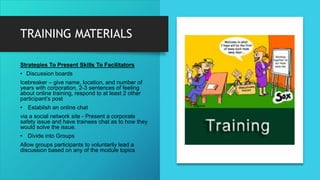
Strategies To Present Skills To Facilitators
• Discussion boards
Icebreaker – give name, location, and number of
years with corporation, 2-3 sentences of feeling
about online training, respond to at least 2 other
participant’s post
• Establish an online chat
via a social network site - Present a corporate
safety issue and have trainees chat as to how they
would solve the issue.
• Divide into Groups
Allow groups participants to voluntarily lead a
discussion based on any of the module topics
TRAINING MATERIALS
• Describe the phases of development
There are five stages
• Visitor – basic starter turning in work by email
• Novice – Have used some technology for online courses •
• Apprentice – New online teacher someone that has taught for one to two
years
• Insider – Taught more than two years and have mastered the technology
required to teach online
• Master – Taught for many years and feel right at home in the online
classroom
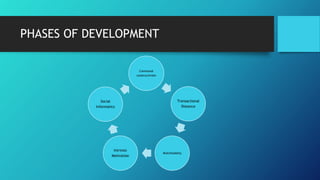
PHASES OF DEVELOPMENT
Communal
constructivism
Transactional
Distance
Multimodality
Intrinsic
Motivation
Social
Informatics
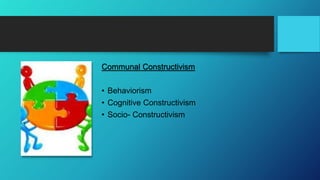
Communal Constructivism
• Behaviorism
• Cognitive Constructivism
• Socio- Constructivism
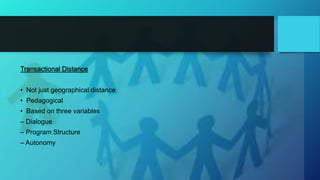
Transactional Distance
• Not just geographical distance
• Pedagogical
• Based on three variables
– Dialogue
– Program Structure
– Autonomy
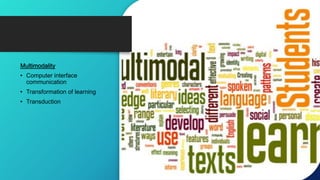
Multimodality
• Computer interface
communication
• Transformation of learning
• Transduction
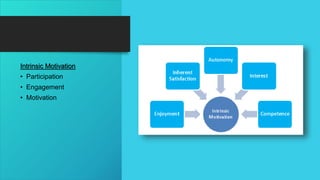
Intrinsic Motivation
• Participation
• Engagement
• Motivation
Social Informatics
• New technology changes social patterns
• More complex interaction
IDENTITY THE THEORIES OF DISTANCE
LEARNING
Identify the theories of distance learning.
• Framing and reframing occur throughout the process and the heart
of the process, the acts of learning, are transformative in that they
“transform” the existing state of knowledge into the new state that
emerges from the old (Haythornthwaite & Andrews, 2011).
• Because the online community is different from and interacts
differently than the learning community in an in-person class, the
nature of the learning itself is affected (Haythornthwaite & Andrews,
2011).
THEORIES FOR DISTANCE LEARNING
Theories for Engaging Distance Learners
• Online Presence
• Digital Media
• Community Building
• Clear Goals and Objectives
THEORIES FOR DISTANCE LEARNING
1.Online Presence – • Persona • Social • Instructional
2.Digital Media Visual aids – Still – Moving – Ubiquity of Learning
3.Clear Goals and Objectives – • Verbs • Unit goals • Program goals
4.Learning Communities – • Mentoring for new online facilitators •
Common sense of responsibility • Common goals and vision • Safe
environment • Shared resources • Mutual support
TABLE OF CONTENTS (PART III)
Table of Contents
Facilitator Training Program Synchronous 3-Day Model
Module 2
Part III – Management and Technology Tools
3.1 – Mentoring program for faculty
3.2 – Management and evaluation programs for facilitators
3.3 – Learning platform used by distance learning faculty for facilitating
classes
3.4 – Different Technology and media tools to engage and enhance student
learning
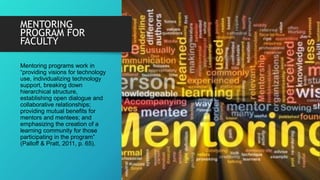
MENTORING
PROGRAM FOR
FACULTY
Mentoring programs work in
“providing visions for technology
use, individualizing technology
support, breaking down
hierarchical structure,
establishing open dialogue and
collaborative relationships;
providing mutual benefits for
mentors and mentees; and
emphasizing the creation of a
learning community for those
participating in the program”
(Palloff & Pratt, 2011, p. 65).
MENTORING PROGRAM FOR FACULTY
1. How many years has he/she been in distance education? One
year
2. How many classes have been taught successfully? Three classes
3. What is his/her criteria of success? 55% after course surveys The
performance status of the mentor
4. Must the mentor have had prior experience? Yes
MANAGEMENT AND EVALUATION PROGRAMS
FOR FACILITATORS
•Student evaluation
•Peer evaluation
•Management
•Outcomes
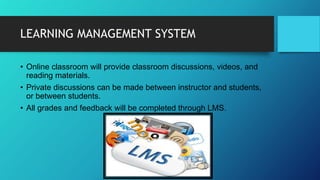
LEARNING MANAGEMENT SYSTEM
The learning management system allows Focus: Hope educational
team to develop and deliver training online.
The LMS allows us to
• track
• report to stakeholders The progress of the training participants.
LMS is a software based platform great for facilitating online training.
LEARNING MANAGEMENT SYSTEM
• Online classroom will provide classroom discussions, videos, and
reading materials.
• Private discussions can be made between instructor and students,
or between students.
• All grades and feedback will be completed through LMS.
LMS TECHNOLOGY/MEDIA TOOLS FOR
ENGAGEMENT
• LMS Technology/Media Tools for Engagement
• Animoto
• Dipity
• Google Drive
• Glogster
• Mindmeister
LMS TECHNOLOGY/MEDIA TOOLS FOR
ENGAGEMENT
• Audio – Podcasting, Learnoutloud, Podiobooks provides free
audiobooks that will enhance listening and concentration skills
• Video – YouTube, Ted presentations, Vimeo engages learner’s
higher order thinking skills, video gives 1st hand account of how to
projects, videos can be a catalyst for group discussions
• Visuals /Infographics – charts, graphs, icons, graphic organizers,
Piktochart, Prezi -motivates learning
• Games/simulations – allows learners to practice real world activities
in an online environment
TABLE OF CONTENTS (PART IV)
Table of Contents
Facilitator Training Program Synchronous 3-Day Module
Module 3
Part IV – Issues and Classroom Management
4.1 – Different technology tools for student collaboration
4.2 – A description of the different distance learners
4.3 – The differences between synchronous and asynchronous facilitation skills
4.4 – Technology management issues and resolutions
4.5 – Classroom management issues and resolutions
ISSUES AND CLASSROOM MANAGEMENT
Different Technology Tools for Student Collaboration
• TutorsClass – Users collaboration based on a mutual schedule. An online
platform for users to share.
• Capzle – The learning content applied to visuals, and narratives can be stored
and accessed by the group members via portals such as Face Book, iPhone apps
and many others
• Audioboo – Puts the learning content into audio files and clips. Groups can
provide input via mobile devices or personal computers.
• FotoBabble – Allows groups to compile, interact, and share via Face Books.
• Voice Thread – Groups can establish online conversation other than text based.
Connects with learners through video and voice. Learners can collaborate
whenever and wherever.
DESCRIPTION OF DIFFERENT LEARNERS
A description of the different distance learners
• Cultural - learners learn best from each other and
with students that share a common culture.
• Experiential - learners learn by doing.
Differences between synchronous and asynchronous facilitation
skills
• Asynchronous learning allows students access to classroom
material, interact with their peers, and ask questions without the
fear of being ridiculed, since it’s online.
• Synchronous facility focuses more on class attendance and
participation in real life time. Often used in traditional classroom
settings requiring lecturing and quizzing strategies to assess the
student’s progress within the classroom setting.
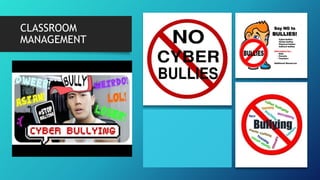
CLASSROOM
MANAGEMENT
CLASSROOM MANAGEMENT ISSUES AND
RESOLUTION
Classroom management issues and resolutions
Learner feedback •
• Text messages, e-mail, comments on projects, and comments on discussion •
• You always need to be consistent and in a timely manner
Challenging behaviors •
• Cyber-bullying - Set behavioral ground rules
• Inappropriate posts - intervene promptly and address the conflict directly (Kelly,
2013).
• Lack of participation or engagement - Support and engage
• Misunderstanding - Acknowledge the human tendency to stereotype and request
students to attempt to resist this tendency. (Kelly, 2013)
REFERENECES
• Ellis, R. (2009). Field guide to learning management systems. Learning Circuits (ASTD), retrieved
from http://www.astd.org
• Haythornthwaite, C., & Andrews, R. (2011). E-learning theory and practice. Los
Angeles, CA: Sage
• http://www.focushope.edu, Retrieved on November 17th, 2016
• Kelly, R. (March 19, 2013). Managing controversy in the online classroom, Faculty
Focus, retrieved from http://www.facultyfocus.com/articles/online-
education/managing- controversy-in-the-online-classroom/
• Palloff, R. M., & Pratt, K. (2011). The excellent online instructor: Strategies for
professional development. San Francisco, CA: Jossey-Bass

Cur532 final project

  • 1.
    OLUWAFEMI OSISANYA FACILITATOR TRAININGPROGAM 11/17/2016 CUR/532 Danene Mims
  • 2.
    THIS FOCUS:HOPE INDETROIT, MICHIGAN
  • 3.
    WELCOME Today we aregoing to start on our 3 day training on what do you do now that you have a teaching job with Focus: Hope. We will go over issues such as • Attendance procedure • Educating the future • Food Bank • Community outreach • So sit back and lets get the show on the road.
  • 4.
    MY NAME ISOLUWAFEMI OSISANYA I will be your facilitator training host. My goal is to lead you to the path of effective facilitation which will empower you to with the knowledge and skill to train others here at Focus: Hope. If at any time you need to reach me, feel free to contact me via Phone (313)587-1927 (call or text) Email – doyinstar123@yahoo.com or doyinstar123@email.phoenix.edu
  • 5.
    TABLE OF CONTENTS(PART I) Table Of Contents Facilitator Training Program Synchronous 3-Day Module Module 1 Part 1 – Vital Information in the Facilitator Training 1.1 Training program audience 1.2 Training program goals 1.3 Training program objectives 1.4 Summative assessment of trainee learning
  • 6.
    AUDIENCE Training Program Audience •What are the assumed current skill sets? College graduates, Graduate degrees, and experienced facilitators • What are the assumed current experiences? None to Well Versed Educational Experience • What is the assumed level of current knowledge? Knowledge differs from learner to learner
  • 7.
    TRAINING PROGRAM GOALS Trainingprogram goals The key skills to be successful are: • Communication • Productivity • Creativity • Guidance
  • 8.
    PROGRAM GOALS CONT. KeyTraining Elements 1. Proficient with using online tools 2. Maintain online presence 3. Encourage an online learning community 4. Reaching out to the community
  • 9.
    TRAINING PROGRAM OBJECTIVES Inorder to under the training objectives, trainees must know the mission of FOCUS: HOPE. The mission is: Recognizing the dignity and beauty of every person, we pledge intelligent and practical action to overcome racism, poverty, and injustice. And to build a metropolitan community where all people may live in freedom, harmony, trust and affection. Black and white, yellow, brown and red from Detroit and its suburbs of every economic status, national origin and religious persuasion we join in this covenant. (focushope, 2016)
  • 10.
    TRAINING PROGRAM OBJECTIVES •Collaboration Working together and in partnership with others to achieve shared goals related to our mission. • Diversity Committed to embracing the diversity of people, beliefs, and ideas that make up a fair and just society. • Empowerment Seeking to inspire people and communities to acquire the knowledge, tools, and resources they need to achieve their full individual and collective potential. • People Valuing our colleagues and supporters as our most important assets and the key to our success and sustainability. • Describe how communication will be different in an online environment. • Clearly define expectations for online learners. • Facilitate online discussions. • Monitor classroom discussions in the online environment..
  • 11.
    SUMMATIVE ASSESSMENT OF TRAINING SummativeAssessment of Training Participants in the Distance Learning Facilitator Trainee Program will: 1. Complete informal assessments based on course rubrics 2. Demonstrate knowledge in a LMS simulation 3. Collaborate with peers and facilitators on simulation
  • 12.
    TABLE OF CONTENTS(PART II) Table of Contents Facilitator Training Program Synchronous 3-Day Module Module 1 Part II – Facilitator Skills and Instructional Materials 2.1 – Training materials 2.2 – Describe the phases of development for distance learning facilitators 2.3 – Identify the theories of distance learning 2.4 – Describe the theories for engaging distance learners
  • 13.
    TRAINING MATERIALS Skills Neededfor Effective Distance Learning Facilitators • Communicate clearly the requirements of the course requirements • Develop training activities that includes trainee to trainee and facilitator to trainee interaction • Create a training/learning community online • Facilitate and maintain online discussions • Adaptation of training material and tools • Assess trainee learning • Provide feedback • Be a tour guide and coach
  • 14.
    TRAINING MATERIALS Strategies ToPresent Skills To Facilitators • Discussion boards Icebreaker – give name, location, and number of years with corporation, 2-3 sentences of feeling about online training, respond to at least 2 other participant’s post • Establish an online chat via a social network site - Present a corporate safety issue and have trainees chat as to how they would solve the issue. • Divide into Groups Allow groups participants to voluntarily lead a discussion based on any of the module topics
  • 15.
    TRAINING MATERIALS • Describethe phases of development There are five stages • Visitor – basic starter turning in work by email • Novice – Have used some technology for online courses • • Apprentice – New online teacher someone that has taught for one to two years • Insider – Taught more than two years and have mastered the technology required to teach online • Master – Taught for many years and feel right at home in the online classroom
  • 16.
  • 17.
    Communal Constructivism • Behaviorism •Cognitive Constructivism • Socio- Constructivism
  • 18.
    Transactional Distance • Notjust geographical distance • Pedagogical • Based on three variables – Dialogue – Program Structure – Autonomy
  • 19.
    Multimodality • Computer interface communication •Transformation of learning • Transduction
  • 20.
  • 21.
    Social Informatics • Newtechnology changes social patterns • More complex interaction
  • 22.
    IDENTITY THE THEORIESOF DISTANCE LEARNING Identify the theories of distance learning. • Framing and reframing occur throughout the process and the heart of the process, the acts of learning, are transformative in that they “transform” the existing state of knowledge into the new state that emerges from the old (Haythornthwaite & Andrews, 2011). • Because the online community is different from and interacts differently than the learning community in an in-person class, the nature of the learning itself is affected (Haythornthwaite & Andrews, 2011).
  • 23.
    THEORIES FOR DISTANCELEARNING Theories for Engaging Distance Learners • Online Presence • Digital Media • Community Building • Clear Goals and Objectives
  • 24.
    THEORIES FOR DISTANCELEARNING 1.Online Presence – • Persona • Social • Instructional 2.Digital Media Visual aids – Still – Moving – Ubiquity of Learning 3.Clear Goals and Objectives – • Verbs • Unit goals • Program goals 4.Learning Communities – • Mentoring for new online facilitators • Common sense of responsibility • Common goals and vision • Safe environment • Shared resources • Mutual support
  • 25.
    TABLE OF CONTENTS(PART III) Table of Contents Facilitator Training Program Synchronous 3-Day Model Module 2 Part III – Management and Technology Tools 3.1 – Mentoring program for faculty 3.2 – Management and evaluation programs for facilitators 3.3 – Learning platform used by distance learning faculty for facilitating classes 3.4 – Different Technology and media tools to engage and enhance student learning
  • 26.
    MENTORING PROGRAM FOR FACULTY Mentoring programswork in “providing visions for technology use, individualizing technology support, breaking down hierarchical structure, establishing open dialogue and collaborative relationships; providing mutual benefits for mentors and mentees; and emphasizing the creation of a learning community for those participating in the program” (Palloff & Pratt, 2011, p. 65).
  • 27.
    MENTORING PROGRAM FORFACULTY 1. How many years has he/she been in distance education? One year 2. How many classes have been taught successfully? Three classes 3. What is his/her criteria of success? 55% after course surveys The performance status of the mentor 4. Must the mentor have had prior experience? Yes
  • 28.
    MANAGEMENT AND EVALUATIONPROGRAMS FOR FACILITATORS •Student evaluation •Peer evaluation •Management •Outcomes
  • 29.
    LEARNING MANAGEMENT SYSTEM Thelearning management system allows Focus: Hope educational team to develop and deliver training online. The LMS allows us to • track • report to stakeholders The progress of the training participants. LMS is a software based platform great for facilitating online training.
  • 30.
    LEARNING MANAGEMENT SYSTEM •Online classroom will provide classroom discussions, videos, and reading materials. • Private discussions can be made between instructor and students, or between students. • All grades and feedback will be completed through LMS.
  • 31.
    LMS TECHNOLOGY/MEDIA TOOLSFOR ENGAGEMENT • LMS Technology/Media Tools for Engagement • Animoto • Dipity • Google Drive • Glogster • Mindmeister
  • 32.
    LMS TECHNOLOGY/MEDIA TOOLSFOR ENGAGEMENT • Audio – Podcasting, Learnoutloud, Podiobooks provides free audiobooks that will enhance listening and concentration skills • Video – YouTube, Ted presentations, Vimeo engages learner’s higher order thinking skills, video gives 1st hand account of how to projects, videos can be a catalyst for group discussions • Visuals /Infographics – charts, graphs, icons, graphic organizers, Piktochart, Prezi -motivates learning • Games/simulations – allows learners to practice real world activities in an online environment
  • 33.
    TABLE OF CONTENTS(PART IV) Table of Contents Facilitator Training Program Synchronous 3-Day Module Module 3 Part IV – Issues and Classroom Management 4.1 – Different technology tools for student collaboration 4.2 – A description of the different distance learners 4.3 – The differences between synchronous and asynchronous facilitation skills 4.4 – Technology management issues and resolutions 4.5 – Classroom management issues and resolutions
  • 34.
    ISSUES AND CLASSROOMMANAGEMENT Different Technology Tools for Student Collaboration • TutorsClass – Users collaboration based on a mutual schedule. An online platform for users to share. • Capzle – The learning content applied to visuals, and narratives can be stored and accessed by the group members via portals such as Face Book, iPhone apps and many others • Audioboo – Puts the learning content into audio files and clips. Groups can provide input via mobile devices or personal computers. • FotoBabble – Allows groups to compile, interact, and share via Face Books. • Voice Thread – Groups can establish online conversation other than text based. Connects with learners through video and voice. Learners can collaborate whenever and wherever.
  • 35.
    DESCRIPTION OF DIFFERENTLEARNERS A description of the different distance learners • Cultural - learners learn best from each other and with students that share a common culture. • Experiential - learners learn by doing.
  • 36.
    Differences between synchronousand asynchronous facilitation skills • Asynchronous learning allows students access to classroom material, interact with their peers, and ask questions without the fear of being ridiculed, since it’s online. • Synchronous facility focuses more on class attendance and participation in real life time. Often used in traditional classroom settings requiring lecturing and quizzing strategies to assess the student’s progress within the classroom setting.
  • 37.
  • 38.
    CLASSROOM MANAGEMENT ISSUESAND RESOLUTION Classroom management issues and resolutions Learner feedback • • Text messages, e-mail, comments on projects, and comments on discussion • • You always need to be consistent and in a timely manner Challenging behaviors • • Cyber-bullying - Set behavioral ground rules • Inappropriate posts - intervene promptly and address the conflict directly (Kelly, 2013). • Lack of participation or engagement - Support and engage • Misunderstanding - Acknowledge the human tendency to stereotype and request students to attempt to resist this tendency. (Kelly, 2013)
  • 39.
    REFERENECES • Ellis, R.(2009). Field guide to learning management systems. Learning Circuits (ASTD), retrieved from http://www.astd.org • Haythornthwaite, C., & Andrews, R. (2011). E-learning theory and practice. Los Angeles, CA: Sage • http://www.focushope.edu, Retrieved on November 17th, 2016 • Kelly, R. (March 19, 2013). Managing controversy in the online classroom, Faculty Focus, retrieved from http://www.facultyfocus.com/articles/online- education/managing- controversy-in-the-online-classroom/ • Palloff, R. M., & Pratt, K. (2011). The excellent online instructor: Strategies for professional development. San Francisco, CA: Jossey-Bass