ATerm Project Report
On
VIRTUAL REALITY
Submitted to
Amity University Uttar Pradesh
Bachelor ofTechnology
in
Computer Science and Engineering
DEPARTMENT OF COMPUTER SCIENCE
AMITY SCHOOL OF ENGINEERINGANDTECHNOLOGY
AMITY UNIVERSITY UTTAR PRADESH
NOIDA (U.P.)
Submitted By-
Kshitij Mittal
A2305214263
B.Tech. CS&E (2014-18)
3CSE 4Y
Guided By-
Mrs. Divya Gupta
Department of Computer Science
ASET (AUUP)
VIRTUAL REALITY
1
2
3
4
5
6
7
WHAT IS VIRTUAL REALITY?
WHAT IS SIMULATION?
TYPES OF VIRTUAL REALITY
COMPONENTS OF VIRTUAL REALITY
APPLICATIONS OF VIRTUAL REALITY
RESULT
CONCLUSION
INDEX
Three-dimensional images that
appeared to be life size from the
perspectives of the user.The ability to
track a user's motions’, particularly he
head and eye movements, and
correspondingly adjust the image’s on
the user's displayed to reflect the
change in perspectives
VIRTUAL REALITY
SIMULATION
Computer simulations are computer-
generated versions of real-world objects
or They may be presented in 2-D, text
driven formats or increasingly, 3-D,
multimedia formats. Computer
simulations can take many different
forms, ranging from computer
renderings of 3-D geometric shapes to
highly interactive, computer laboratory
experiments’.
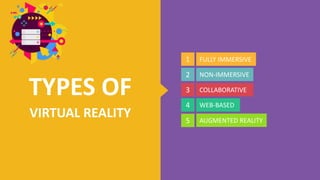
TYPES OF
VIRTUAL REALITY
1
2
3
4
5
FULLY IMMERSIVE
NON-IMMERSIVE
COLLABORATIVE
WEB-BASED
AUGMENTED REALITY
FULLY
IMMERSIVE
For the completeVR experienced, we need
three things. First, plausible, and richer
detailed virtual world to explore; a computer
model or simulation, in other words. Second,
a powerful computer that can detect what
we're going and adjust our experience
accordingly, in real time.Third, hardware
linking to the computer that fully immersed
us in the virtual world as we roam around.
NON
IMMERSIVE
COLLABORATIVE
WEB
BASED
AUGMENTED
REALITY
A highly realistic flight simulator on a
home PC might qualify as non-
immersive virtual reality, especially if it
uses a very wide screen, headphones or
surround sound, and a realistic joystick
and other controls. Not everyone wants
or needs to be fully immersed in an
alternative reality.
the idea of sharing an experience in a
virtual world with other people, often in
real time or something very close to it.
Collaboration and sharing are likely to
become increasingly important features
ofVR in future.
computer scientists developed a way of
building virtual worlds on the Web (using a
technology analogous to HTML called
Virtual Reality Markup Language,VRML),
ordinary people were much more
interested in the way the Web gave them
new ways to access real reality
Augmented reality is all about connected
the real world we experienced to the vast
virtual world of information that we've
collectively created on theWeb. Neither
of these worlds is virtual, but the idea of
exploring and navigating the two
simultaneously does, nevertheless, have
things in common with it.
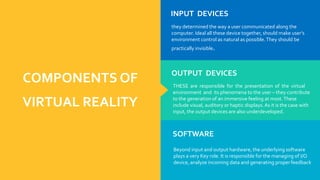
THESE are responsible for the presentation of the virtual
environment and its phenomena to the user – they contribute
to the generation of an immersive feeling at most.These
include visual, auditory or haptic displays.As it is the case with
input, the output devices are also underdeveloped.
OUTPUT DEVICES
Beyond input and output hardware, the underlying software
plays a very Key role. It is responsible for the managing of I/O
device, analyze incoming data and generating proper feedback
SOFTWARE
they determined the way a user communicated along the
computer. Ideal all these device together, should make user’s
environment control as natural as possible.They should be
practically invisible.
INPUT DEVICES
COMPONENTS OF
VIRTUAL REALITY
APPLICATIONS OF
VIRTUAL REALITY
1
2
3
4
EDUCATION
SCIENTIFICVISUALIZATION
INDUSTRIAL DESIGNANDARCHITECTURE
GAMES AND ENTERTAINMENT
Difficult and dangerous jobs are hard to
trained for. How can you safely practice
take a trip to space, land a jumbo jet,
making a parachute jump, or carried
out brain surgery?All these things are
obvious candidates for virtual reality
applications.As we've seen already,
flight cockpit simulators were among
the earliestVR applications; they can
trace their history back to mechanical
simulators developed by Edwin Link in
the 1920s. Just like pilots, surgeons are
now routinely trained usingVR.
EDUCATION
SCIENTIFIC
VISUALIZATION
Everything that happens at the atomic
or molecular scale is effective invisible
unless you're prepared to sitted with
your eyes glued to an electron
microscope. But suppose you want to
designed new material or drugs and you
want to experiment with the molecular
equivalent of LEGO.That's another
obvious application for it. Instead of
wrestling with numbers, equations, or
two-dimensional drawings of molecular
structures, you can snap complex
molecules together right before your
eyes usingVR system for explored the
interactions between protein molecules
and drugs.
Architect used to building models out of
card and paper; now they're much more
likely to build virtual reality computer
models you can walk through and explore.
By the same token, it's generally much
cheaper to designned cars, airplanes, and
other complex, expensive vehicles on a
computer screen than to model them in
wood, plastic, or other real-world
materials.This is an area where virtual
reality overlaps with computer modeling:
instead of simply making an immersive 3D
visual model for people to inspect and
explore, you're creating a mathematical
model that can be tested for its
aerodynamic, safety, or other qualities.
INDUSTRIAL DESIGN
AND
ARCHITECTURE
From flight simulators to race-car games,
VR has long hovered on the edges of the
gaming world never quite good enough to
revolutionize the experience of gamers,
largely due to computers being too slow,
displays lacking full 3D, and the lack of
decent HMDs and data gloves. Every that
may be about to change with the
development of affordable new
peripherals like the Oculus Rift.
GAMES AND
ENTERTAINMENT
RESULT
Compared to someone who has merely read
books or watched over the shoulders of their
peers? How many of us would rather practiced
our driving on a car simulator before we set
foot on the road? Or sit back and relax in a
Jumbo Jet, confident in the knowledge that our
pilot practiced landing at this very airport,
dozens of times, in aVR simulator before she
ever set foot in a real cockpit?
They can certainly be a great help in work and
in everyday life, but are they going to replace
physical contacts totally? Even today a lot of
people spend hours on the telephone because
they are too lazy to pay a visit to their friends.
In it, the user would be able to created an
image of him/her self often very ideal and far
from reality.
CONCLUSIONS
• After 30 years, we’re still at beginning of it.
• Every year, new, lighter, cheaper and more
powerful devices get into market.
• Sound and specially speech recognition and
synthesis reinforce symbiosis between
• human and the machine.
• Computers are advancing on gestures
recognition.
• Exoskeletons are being introduced to the market
and used on simulation of complex
• force feedback.
• Improvements on touch simulation thanks to use
of new materials on datagloves.
• Use of artificial noses and odor generators are
being developed.
• Introduction of cheap this systems for video
games world.
YOU
THANK

Virtual reality

  • 1.
    ATerm Project Report On VIRTUALREALITY Submitted to Amity University Uttar Pradesh Bachelor ofTechnology in Computer Science and Engineering DEPARTMENT OF COMPUTER SCIENCE AMITY SCHOOL OF ENGINEERINGANDTECHNOLOGY AMITY UNIVERSITY UTTAR PRADESH NOIDA (U.P.) Submitted By- Kshitij Mittal A2305214263 B.Tech. CS&E (2014-18) 3CSE 4Y Guided By- Mrs. Divya Gupta Department of Computer Science ASET (AUUP)
  • 2.
  • 3.
    1 2 3 4 5 6 7 WHAT IS VIRTUALREALITY? WHAT IS SIMULATION? TYPES OF VIRTUAL REALITY COMPONENTS OF VIRTUAL REALITY APPLICATIONS OF VIRTUAL REALITY RESULT CONCLUSION INDEX
  • 4.
    Three-dimensional images that appearedto be life size from the perspectives of the user.The ability to track a user's motions’, particularly he head and eye movements, and correspondingly adjust the image’s on the user's displayed to reflect the change in perspectives VIRTUAL REALITY
  • 5.
    SIMULATION Computer simulations arecomputer- generated versions of real-world objects or They may be presented in 2-D, text driven formats or increasingly, 3-D, multimedia formats. Computer simulations can take many different forms, ranging from computer renderings of 3-D geometric shapes to highly interactive, computer laboratory experiments’.
  • 6.
    TYPES OF VIRTUAL REALITY 1 2 3 4 5 FULLYIMMERSIVE NON-IMMERSIVE COLLABORATIVE WEB-BASED AUGMENTED REALITY
  • 7.
    FULLY IMMERSIVE For the completeVRexperienced, we need three things. First, plausible, and richer detailed virtual world to explore; a computer model or simulation, in other words. Second, a powerful computer that can detect what we're going and adjust our experience accordingly, in real time.Third, hardware linking to the computer that fully immersed us in the virtual world as we roam around. NON IMMERSIVE COLLABORATIVE WEB BASED AUGMENTED REALITY A highly realistic flight simulator on a home PC might qualify as non- immersive virtual reality, especially if it uses a very wide screen, headphones or surround sound, and a realistic joystick and other controls. Not everyone wants or needs to be fully immersed in an alternative reality. the idea of sharing an experience in a virtual world with other people, often in real time or something very close to it. Collaboration and sharing are likely to become increasingly important features ofVR in future. computer scientists developed a way of building virtual worlds on the Web (using a technology analogous to HTML called Virtual Reality Markup Language,VRML), ordinary people were much more interested in the way the Web gave them new ways to access real reality Augmented reality is all about connected the real world we experienced to the vast virtual world of information that we've collectively created on theWeb. Neither of these worlds is virtual, but the idea of exploring and navigating the two simultaneously does, nevertheless, have things in common with it.
  • 8.
    THESE are responsiblefor the presentation of the virtual environment and its phenomena to the user – they contribute to the generation of an immersive feeling at most.These include visual, auditory or haptic displays.As it is the case with input, the output devices are also underdeveloped. OUTPUT DEVICES Beyond input and output hardware, the underlying software plays a very Key role. It is responsible for the managing of I/O device, analyze incoming data and generating proper feedback SOFTWARE they determined the way a user communicated along the computer. Ideal all these device together, should make user’s environment control as natural as possible.They should be practically invisible. INPUT DEVICES COMPONENTS OF VIRTUAL REALITY
  • 9.
  • 10.
    Difficult and dangerousjobs are hard to trained for. How can you safely practice take a trip to space, land a jumbo jet, making a parachute jump, or carried out brain surgery?All these things are obvious candidates for virtual reality applications.As we've seen already, flight cockpit simulators were among the earliestVR applications; they can trace their history back to mechanical simulators developed by Edwin Link in the 1920s. Just like pilots, surgeons are now routinely trained usingVR. EDUCATION
  • 11.
    SCIENTIFIC VISUALIZATION Everything that happensat the atomic or molecular scale is effective invisible unless you're prepared to sitted with your eyes glued to an electron microscope. But suppose you want to designed new material or drugs and you want to experiment with the molecular equivalent of LEGO.That's another obvious application for it. Instead of wrestling with numbers, equations, or two-dimensional drawings of molecular structures, you can snap complex molecules together right before your eyes usingVR system for explored the interactions between protein molecules and drugs.
  • 12.
    Architect used tobuilding models out of card and paper; now they're much more likely to build virtual reality computer models you can walk through and explore. By the same token, it's generally much cheaper to designned cars, airplanes, and other complex, expensive vehicles on a computer screen than to model them in wood, plastic, or other real-world materials.This is an area where virtual reality overlaps with computer modeling: instead of simply making an immersive 3D visual model for people to inspect and explore, you're creating a mathematical model that can be tested for its aerodynamic, safety, or other qualities. INDUSTRIAL DESIGN AND ARCHITECTURE
  • 13.
    From flight simulatorsto race-car games, VR has long hovered on the edges of the gaming world never quite good enough to revolutionize the experience of gamers, largely due to computers being too slow, displays lacking full 3D, and the lack of decent HMDs and data gloves. Every that may be about to change with the development of affordable new peripherals like the Oculus Rift. GAMES AND ENTERTAINMENT
  • 14.
    RESULT Compared to someonewho has merely read books or watched over the shoulders of their peers? How many of us would rather practiced our driving on a car simulator before we set foot on the road? Or sit back and relax in a Jumbo Jet, confident in the knowledge that our pilot practiced landing at this very airport, dozens of times, in aVR simulator before she ever set foot in a real cockpit? They can certainly be a great help in work and in everyday life, but are they going to replace physical contacts totally? Even today a lot of people spend hours on the telephone because they are too lazy to pay a visit to their friends. In it, the user would be able to created an image of him/her self often very ideal and far from reality.
  • 15.
    CONCLUSIONS • After 30years, we’re still at beginning of it. • Every year, new, lighter, cheaper and more powerful devices get into market. • Sound and specially speech recognition and synthesis reinforce symbiosis between • human and the machine. • Computers are advancing on gestures recognition. • Exoskeletons are being introduced to the market and used on simulation of complex • force feedback. • Improvements on touch simulation thanks to use of new materials on datagloves. • Use of artificial noses and odor generators are being developed. • Introduction of cheap this systems for video games world.
  • 16.