A
Conceptual
Model
of
Service

    Exchange
in
Service‐Dominant
Logic

                         Geert
Poels

             Faculty
of
Economics
and
Business

              AdministraBon,
Ghent
University


19‐2‐2010
            IESS
1.0
Geneva
17‐19
February
2010
   1

Outline

•  Service‐Dominant
Logic

•  Service
System

•  Service
system
modelling
=
business
modelling

•  The
Resource‐Event‐Agent
conceptual
model

•  The
Resource‐Service‐System
conceptual

   model

•  Open
issues,
challenges,
future
research


19‐2‐2010
       IESS
1.0
Geneva
17‐19
February
2010
   2

Service‐Dominant
Logic

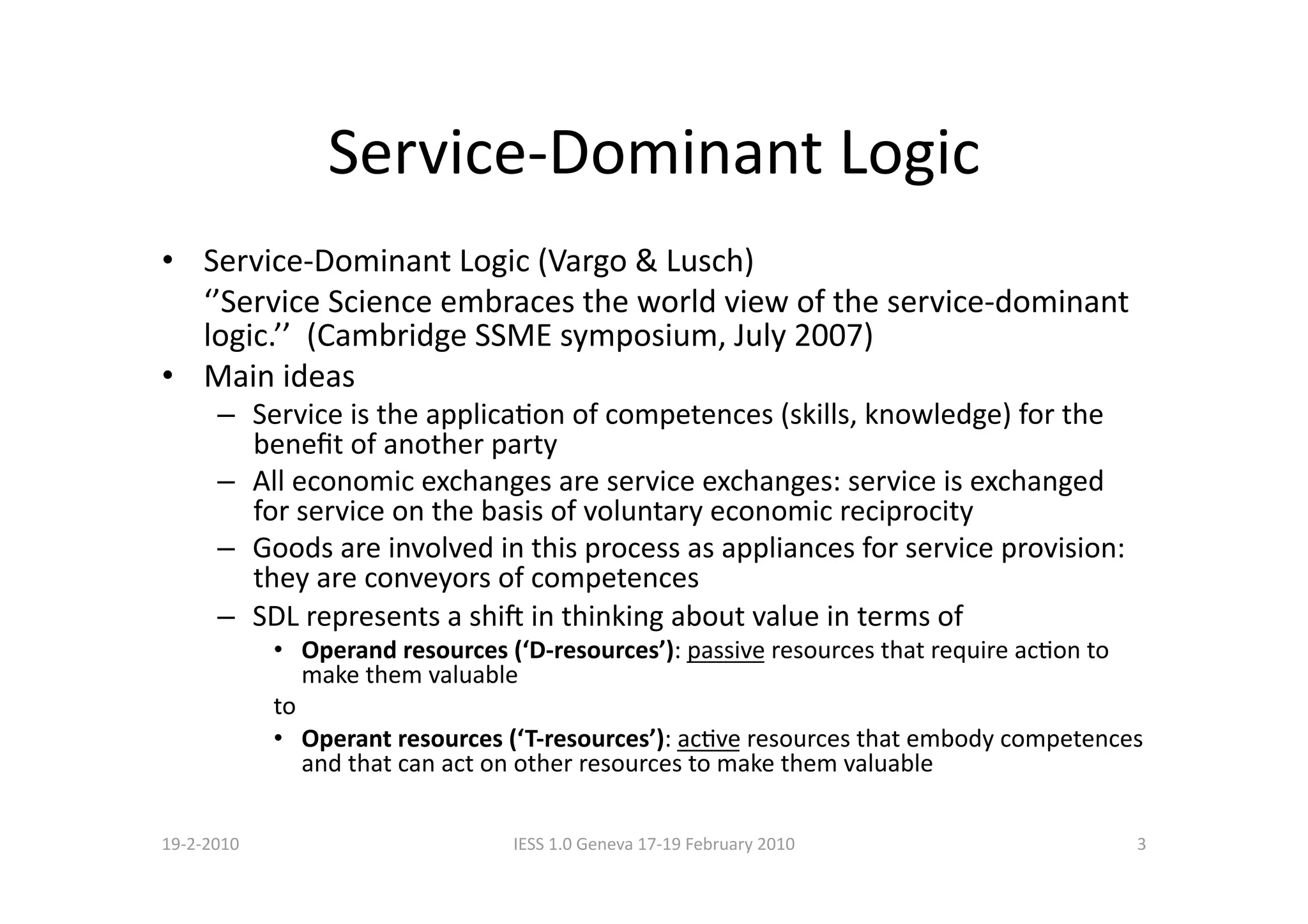
•  Service‐Dominant
Logic
(Vargo
&
Lusch)

   
‘’Service
Science
embraces
the
world
view
of
the
service‐dominant

    logic.’’

(Cambridge
SSME
symposium,
July
2007)

•  Main
ideas

      –  Service
is
the
applicaBon
of
competences
(skills,
knowledge)
for
the

         benefit
of
another
party

      –  All
economic
exchanges
are
service
exchanges:
service
is
exchanged

         for
service
on
the
basis
of
voluntary
economic
reciprocity

      –  Goods
are
involved
in
this
process
as
appliances
for
service
provision:

         they
are
conveyors
of
competences

      –  SDL
represents
a
shi
in
thinking
about
value
in
terms
of

             •  Operand
resources
(‘D‐resources’):
passive
resources
that
require
acBon
to

                make
them
valuable

             to

             •  Operant
resources
(‘T‐resources’):
acBve
resources
that
embody
competences

                and
that
can
act
on
other
resources
to
make
them
valuable


19‐2‐2010
                        IESS
1.0
Geneva
17‐19
February
2010
                   3

Comparing
the
‘new’
and
‘old’
logics


•  Goods‐Dominant
Logic
                       •  Service‐Dominant
Logic

      –  Services
are
seen
as
units
                  –  Service
is
seen
as
a
process

         of
output
                                   –  Value
in
use:
value
is

      –  Value
in
exchange:
value
is
                    created
through
resources

         created
through
transfer
of
                    acBng
upon
other

         resources
                                      resources

      –  One
party
produces
the
                      –  Each
party
brings
in
or

         services
and
another
party
                     makes
accessible
its
own

         consumes
the
services
                          resources
and
both
parBes

                                                         co‐create
value
for
the

                                                         service
beneficiary

     Service‐Dominant
Logic
represents
a
shi<
in
logic
of
exchange,

     not
just
a
shi<
in
type
of
product
that
is
under
invesCgaCon.

19‐2‐2010
                 IESS
1.0
Geneva
17‐19
February
2010
                      4

Service
System

•  DefiniBon
(Maglio,
Vargo,
Caswell,
Spohrer)

             ‘’an
open
system
(1)
capable
of
improving
the

             state
of
another
system
through
sharing
or

             applying
its
resources
(i.e.,
the
other
system

             determines
and
agrees
that
the
interacBon
has

             value),
and
(2)
capable
of
improving
its
own
state

             by
acquiring
external
resources
(i.e.,
the
system

             itself
sees
value
in
its
interacBon
with
other

             systems)’’


19‐2‐2010
                  IESS
1.0
Geneva
17‐19
February
2010
   5

•  Key
characterisBcs

      –  A
service
system
is
a
configuraBon
of
resources,
of
which

         at
least
one
operant
resource

             •    physical
resources
with
legal
rights
(people)

             •    conceptual
resources
with
legal
rights
(organizaBons)

             •    conceptual
resources
treated
as
property
(shared
informaBon)

             •    physical
resources
treated
as
property
(technology)

      –  Service
is
the
applicaBon
or
sharing
of
resources
for
the

         benefit
of
another
system

             •  At
least
one
operant
resource
that
embodies
competences
is

                applied
or
shared

      –  Service
entails
an
interacBon
with
another
service
system

             •  Service
is
co‐creaBon
of
value
rather
than
producBon
by
one
party

             •  The
other
party
needs
to
bring
in
or
make
accessible
its
resources

      –  There
is
an
economic
moBve
for
service
systems
to
interact

             •  A
service
leads
to
another
service
that
benefits
the
service
system


19‐2‐2010
                        IESS
1.0
Geneva
17‐19
February
2010
            6

Service
system
modelling
=

                 business
modelling

•  Service‐Dominant
Logic
assumes
an
economic
context

   for
service
exchanges

      –  Enterprises
are
a
major
category
of
service
system

      –  The
business
logic
of
an
enterprise
is
expressed
in
a

         business
model

      →
modelling
an
enterprise
as
a
service
system,
emphasizing

         the
applicaBon
of
its
resources
for
the
benefit
of
another

         system
in
the
context
of
economic
exchange,
is
business

         modelling

•  Business
modelling
knowledge
has
been
specified
and

   formalized
in
business
model
ontologies,
which
offer

   concepts
in
terms
of
which
business
models
can
be

   arBculated

19‐2‐2010
               IESS
1.0
Geneva
17‐19
February
2010
         7

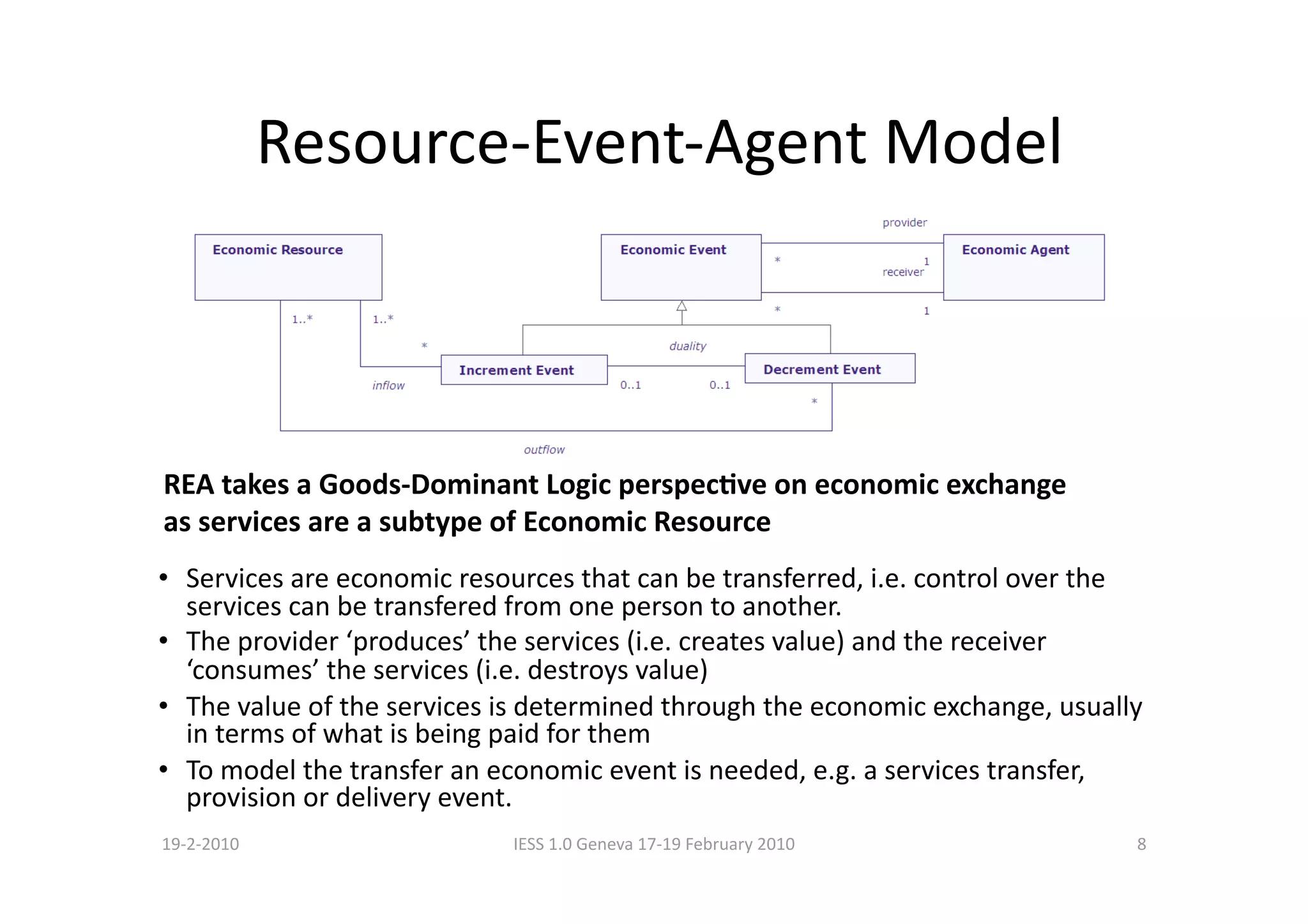
Resource‐Event‐Agent
Model


REA
takes
a
Goods‐Dominant
Logic
perspecCve
on
economic
exchange

as
services
are
a
subtype
of
Economic
Resource

•  Services
are
economic
resources
that
can
be
transferred,
i.e.
control
over
the

   services
can
be
transfered
from
one
person
to
another.

•  The
provider
‘produces’
the
services
(i.e.
creates
value)
and
the
receiver

   ‘consumes’
the
services
(i.e.
destroys
value)

•  The
value
of
the
services
is
determined
through
the
economic
exchange,
usually

   in
terms
of
what
is
being
paid
for
them

•  To
model
the
transfer
an
economic
event
is
needed,
e.g.
a
services
transfer,

   provision
or
delivery
event.

19‐2‐2010
                   IESS
1.0
Geneva
17‐19
February
2010
               8

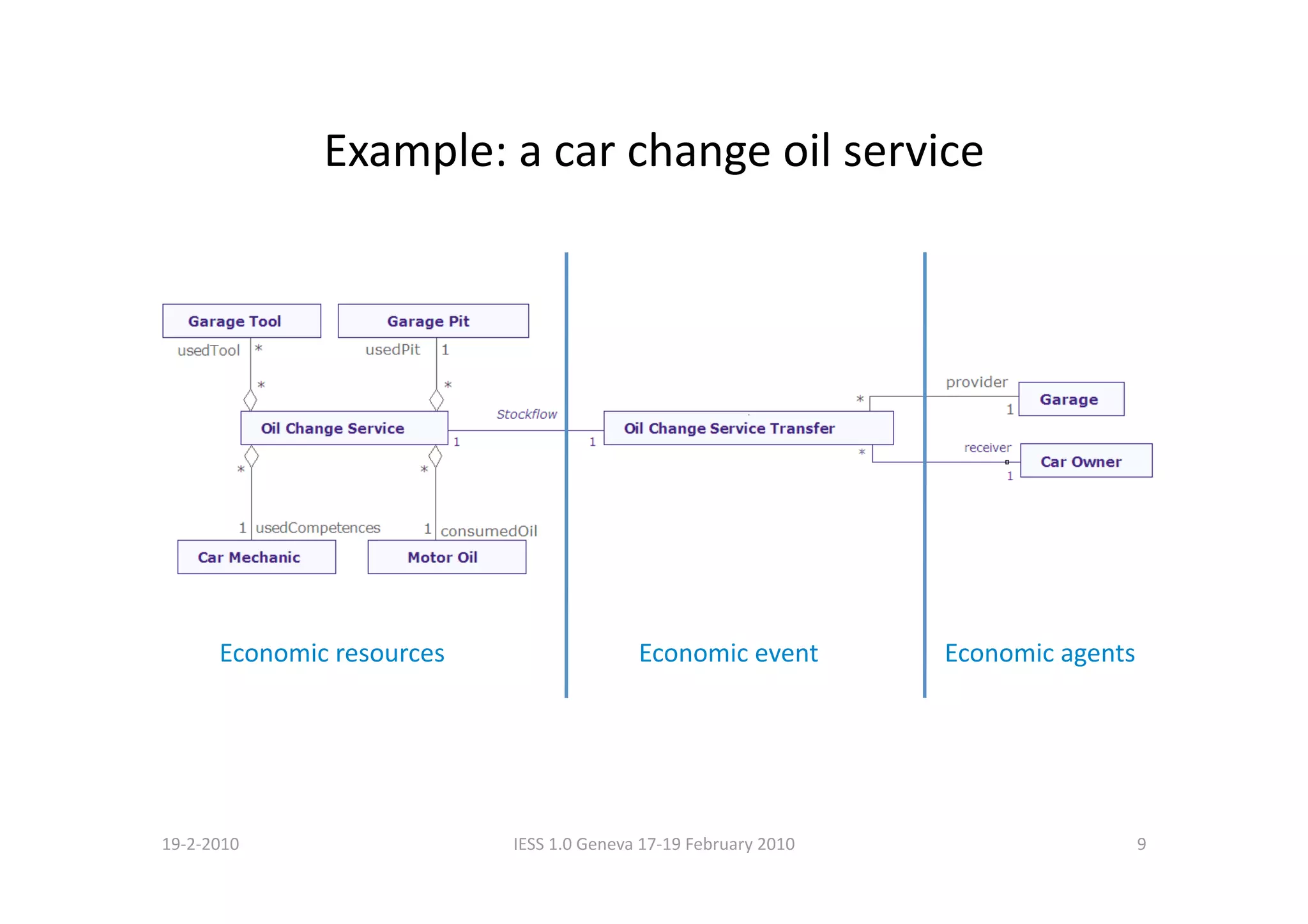
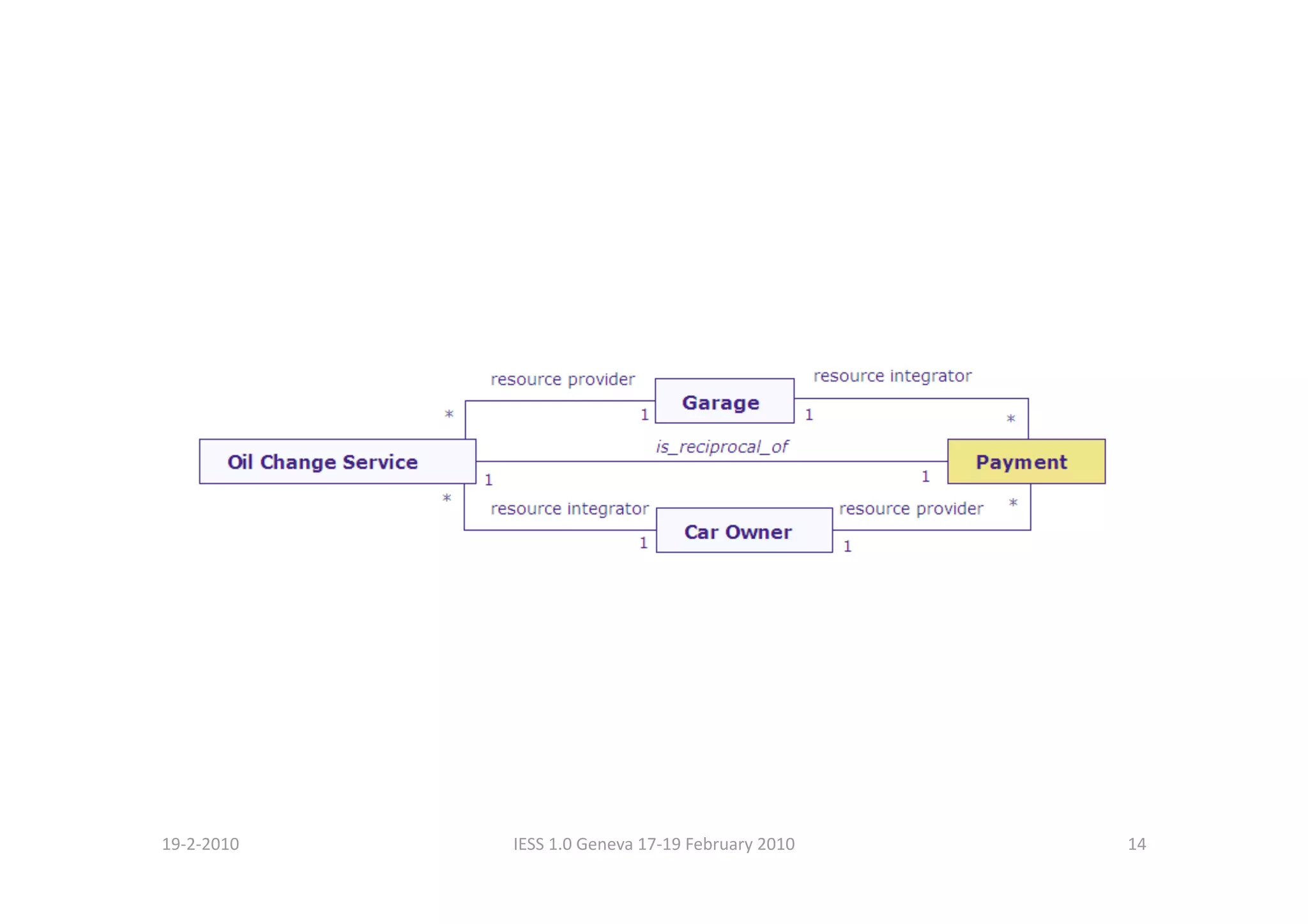
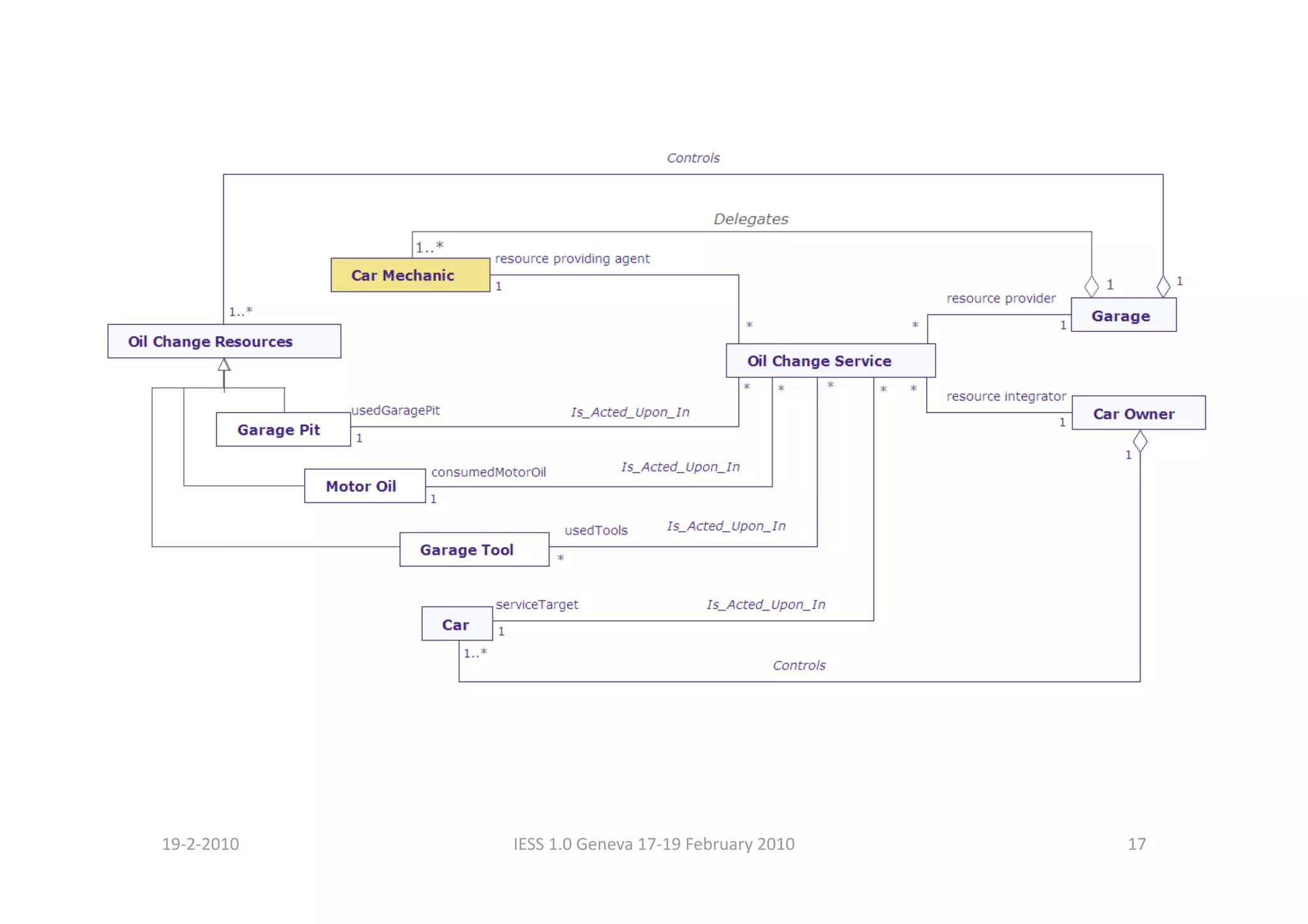
Example:
a
car
change
oil
service


       Economic
resources
                  Economic
event
         Economic
agents


19‐2‐2010
                   IESS
1.0
Geneva
17‐19
February
2010
                  9

19‐2‐2010
   IESS
1.0
Geneva
17‐19
February
2010
   10

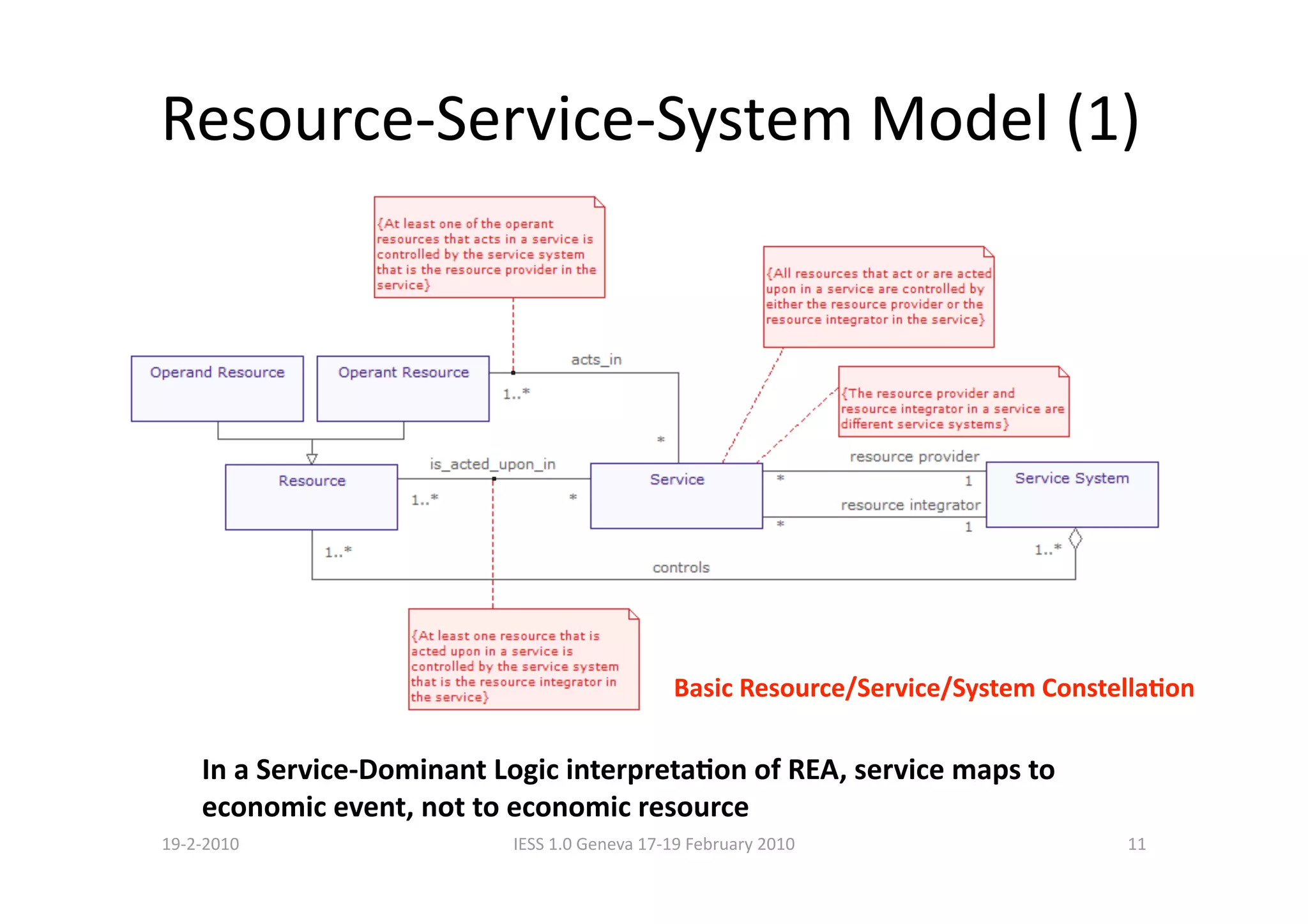
Resource‐Service‐System
Model
(1)


                                               Basic
Resource/Service/System
ConstellaCon


    In
a
Service‐Dominant
Logic
interpretaCon
of
REA,
service
maps
to

    economic
event,
not
to
economic
resource

19‐2‐2010
                 IESS
1.0
Geneva
17‐19
February
2010
                     11

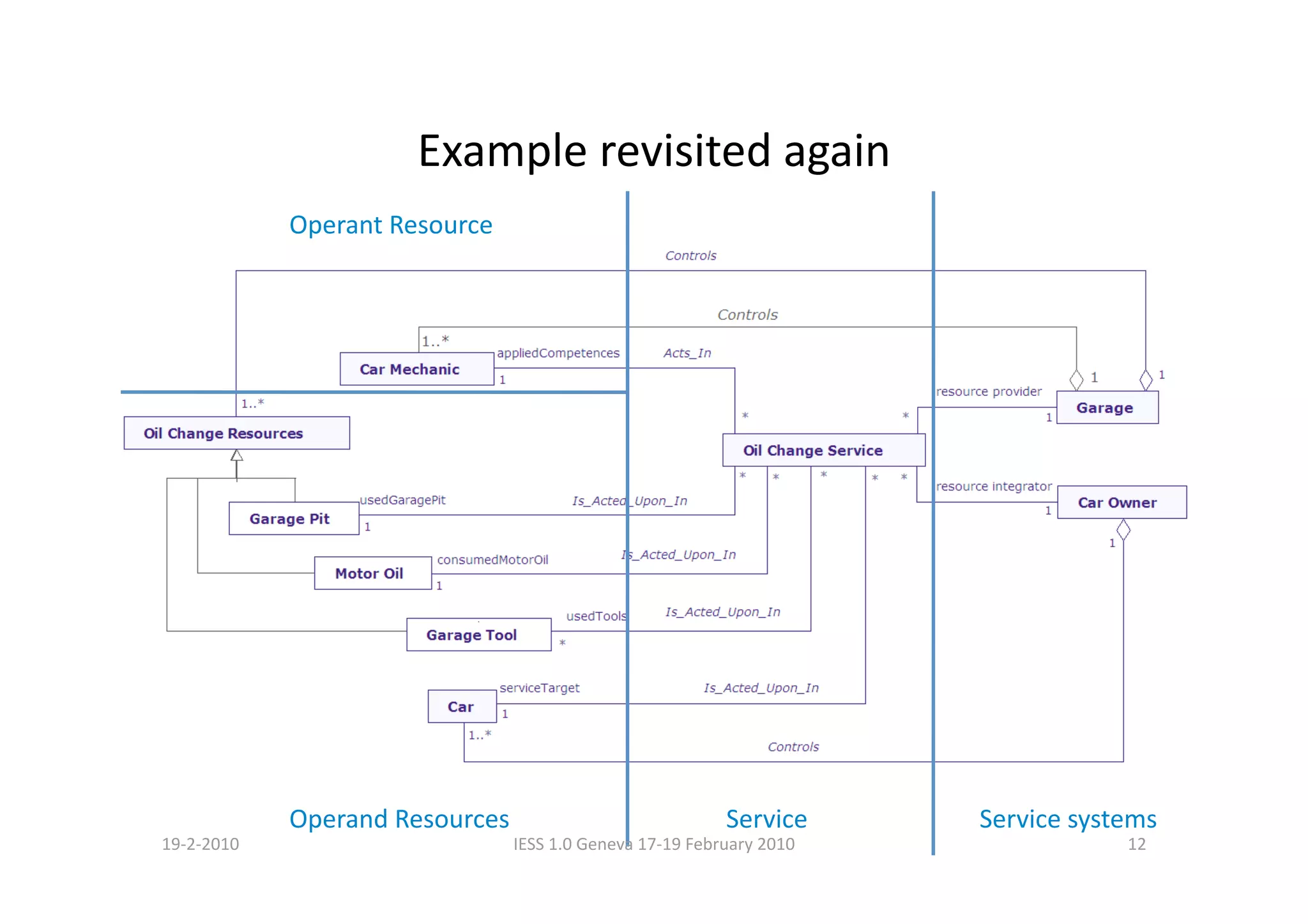
Example
revisited
again

             Operant
Resource


             Operand
Resources
                            Service
     Service
systems

19‐2‐2010
                       IESS
1.0
Geneva
17‐19
February
2010
               12

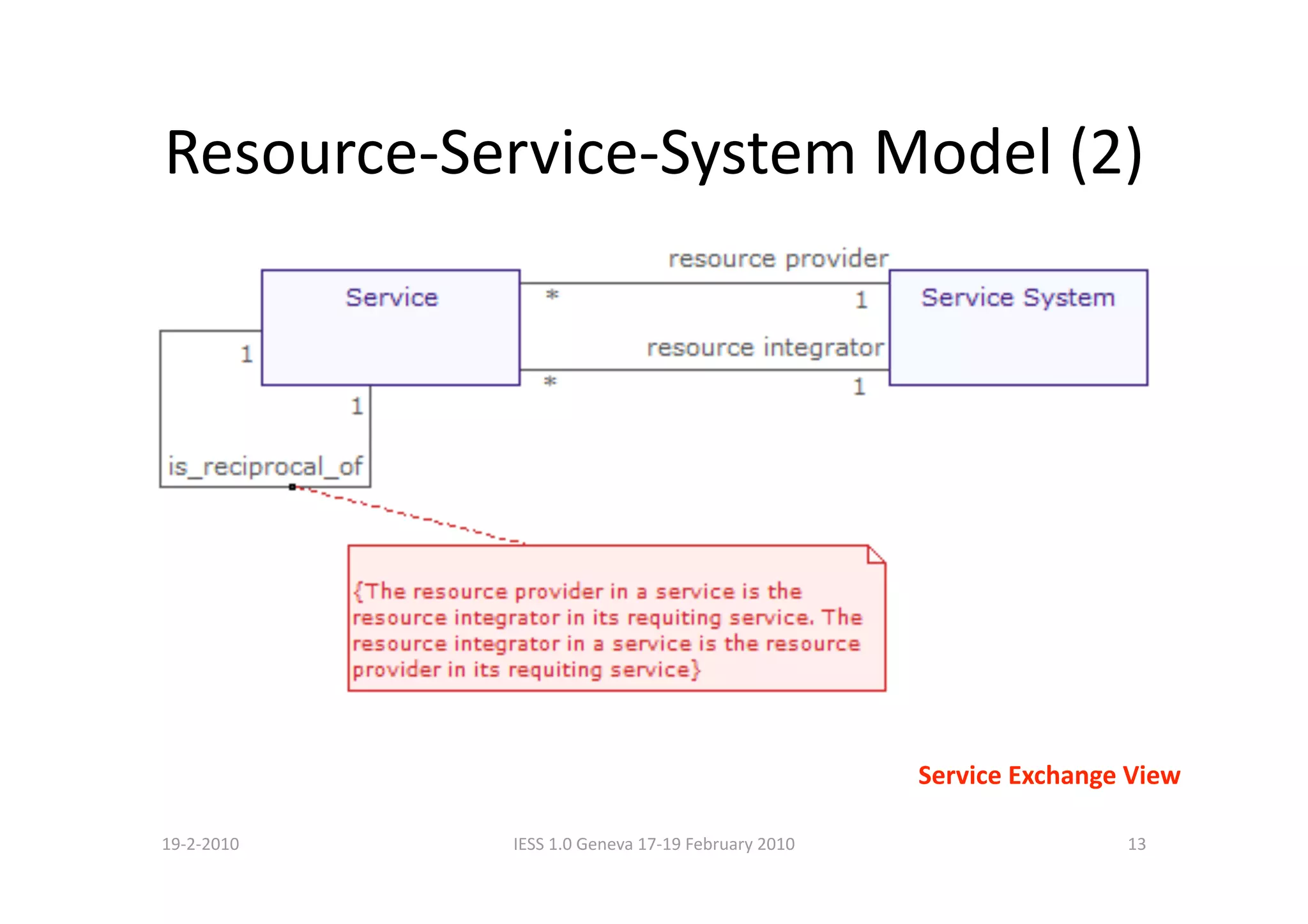
Resource‐Service‐System
Model
(2)


                                                    Service
Exchange
View


19‐2‐2010
   IESS
1.0
Geneva
17‐19
February
2010
                    13

19‐2‐2010
   IESS
1.0
Geneva
17‐19
February
2010
   14

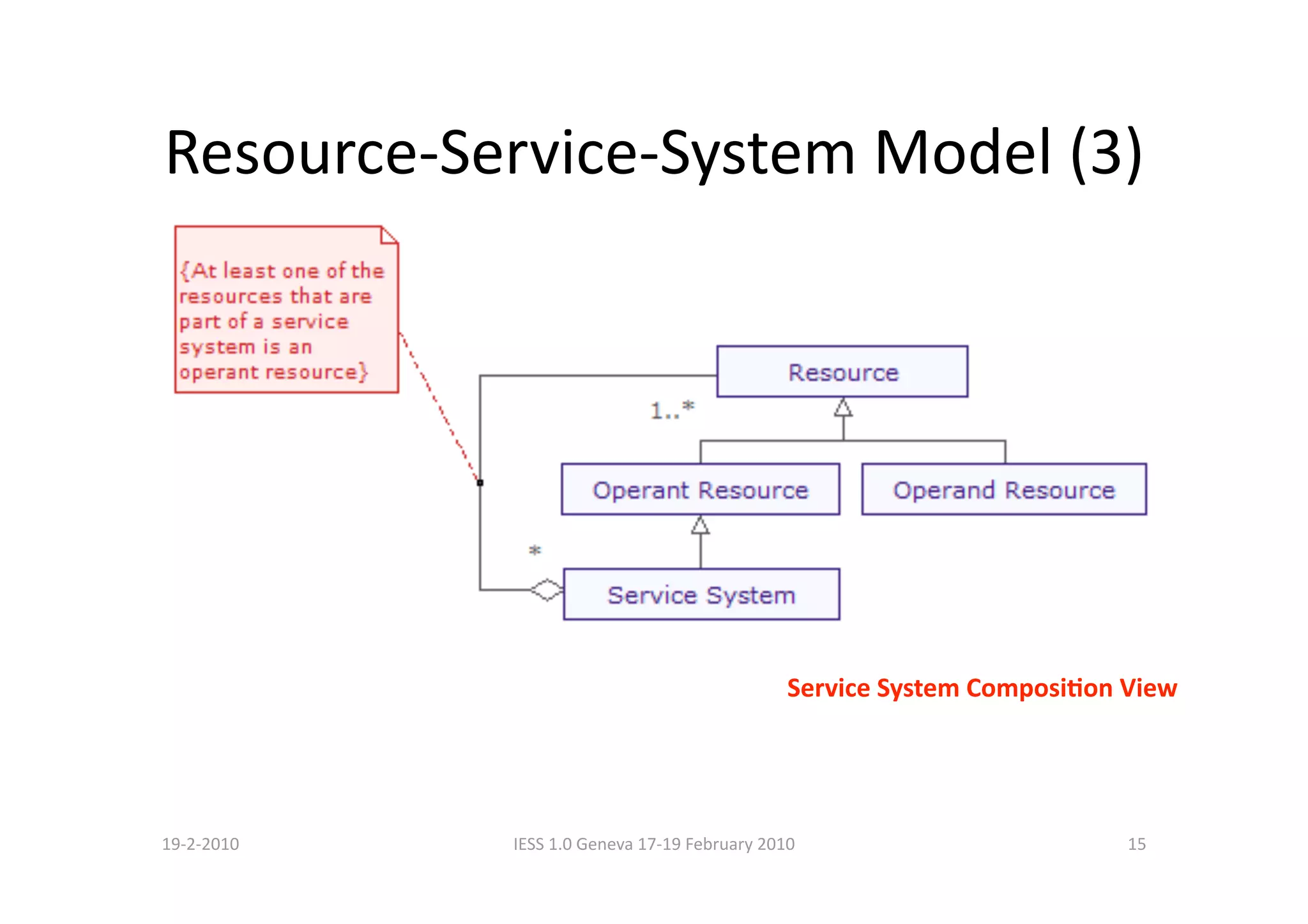
Resource‐Service‐System
Model
(3)


                                               Service
System
ComposiCon
View


19‐2‐2010
   IESS
1.0
Geneva
17‐19
February
2010
                        15

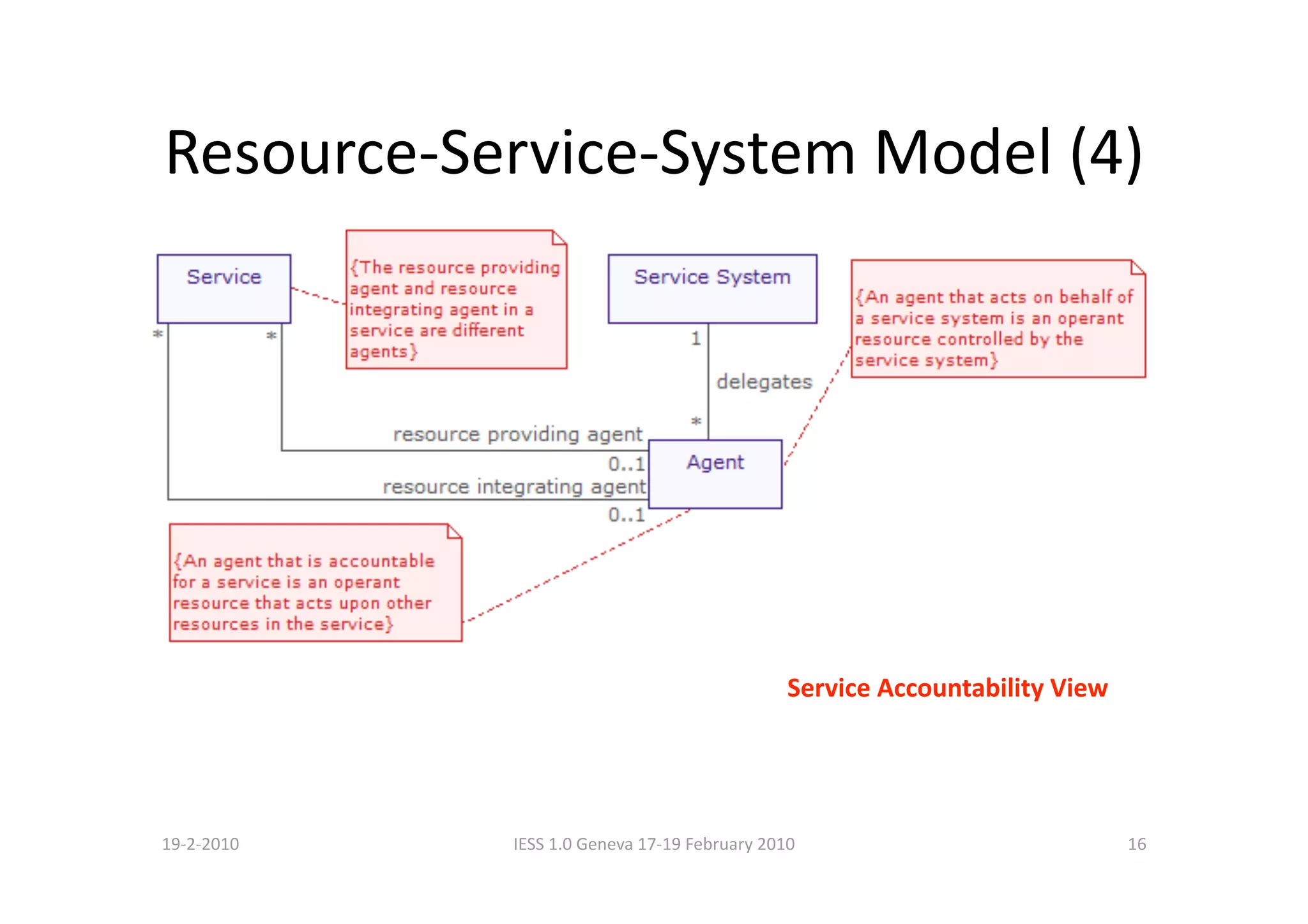
Resource‐Service‐System
Model
(4)


                                               Service
Accountability
View


19‐2‐2010
   IESS
1.0
Geneva
17‐19
February
2010
                             16

19‐2‐2010
   IESS
1.0
Geneva
17‐19
February
2010
   17

Future
research

•  Extend
conceptual
model
to
accommodate

      –  Process
structure
of
service:
service
lifecycle

         model

      –  Service
(system)
component
structure:
service

         composiBon
model

•  Model
tesBng

•  Ontology
development

•  Ontology
alignment


19‐2‐2010
             IESS
1.0
Geneva
17‐19
February
2010
   18

Auxiliary
slides


19‐2‐2010
     IESS
1.0
Geneva
17‐19
February
2010
   19

MoBvaBon
–
Service
Science

•  New
,
disBnct
field
based
on
an
interdisciplinary

   approach
to
research

•  IniBaBve
launched
in
2004
by
IBM,
intending
to

   integrate
separate
service
research
areas

•  DefiniBons
(Maglio
et
al.)

      –  ‘’Service
science
is
the
study
of
the
applicaBon
of
the

         resources
of
one
or
more
systems
for
the
benefit
of

         another
system
in
economic
exchange.’’

      –  ‘’NormaCve
service
science
is
the
study
of
how
one

         system
can
and
should
apply
its
resources
for
the
mutual

         benefit
of
another
system
and
of
the
system
itself.’’

      –  ‘’Service
science,
management,
and
engineering
(SSME)
is

         the
applicaBon
of
normaBve
service
science.’’


19‐2‐2010
              IESS
1.0
Geneva
17‐19
February
2010
    20

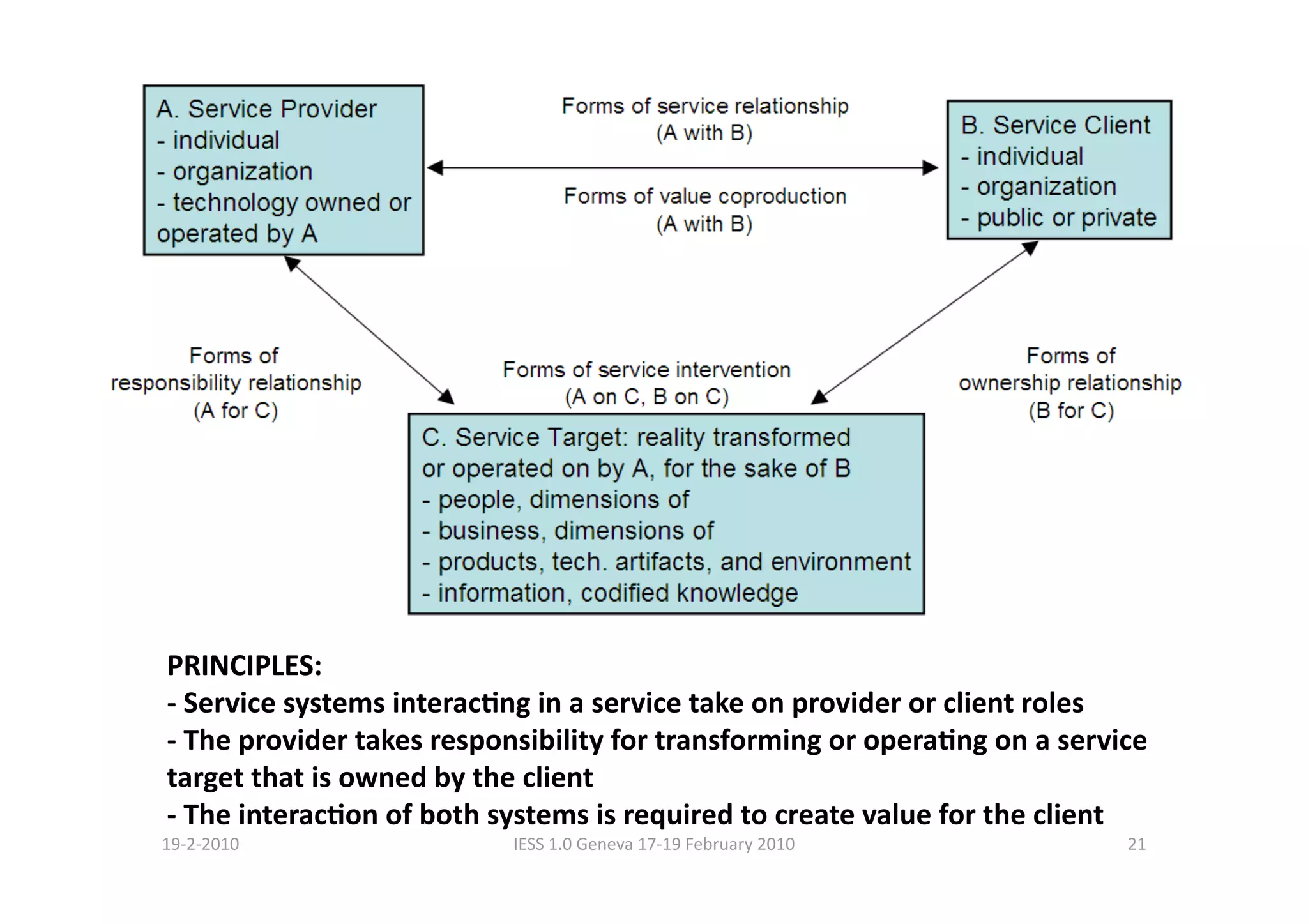
PRINCIPLES:

‐
Service
systems
interacCng
in
a
service
take
on
provider
or
client
roles

‐
The
provider
takes
responsibility
for
transforming
or
operaCng
on
a
service

target
that
is
owned
by
the
client

‐
The
interacCon
of
both
systems
is
required
to
create
value
for
the
client

19‐2‐2010
                 IESS
1.0
Geneva
17‐19
February
2010
            21

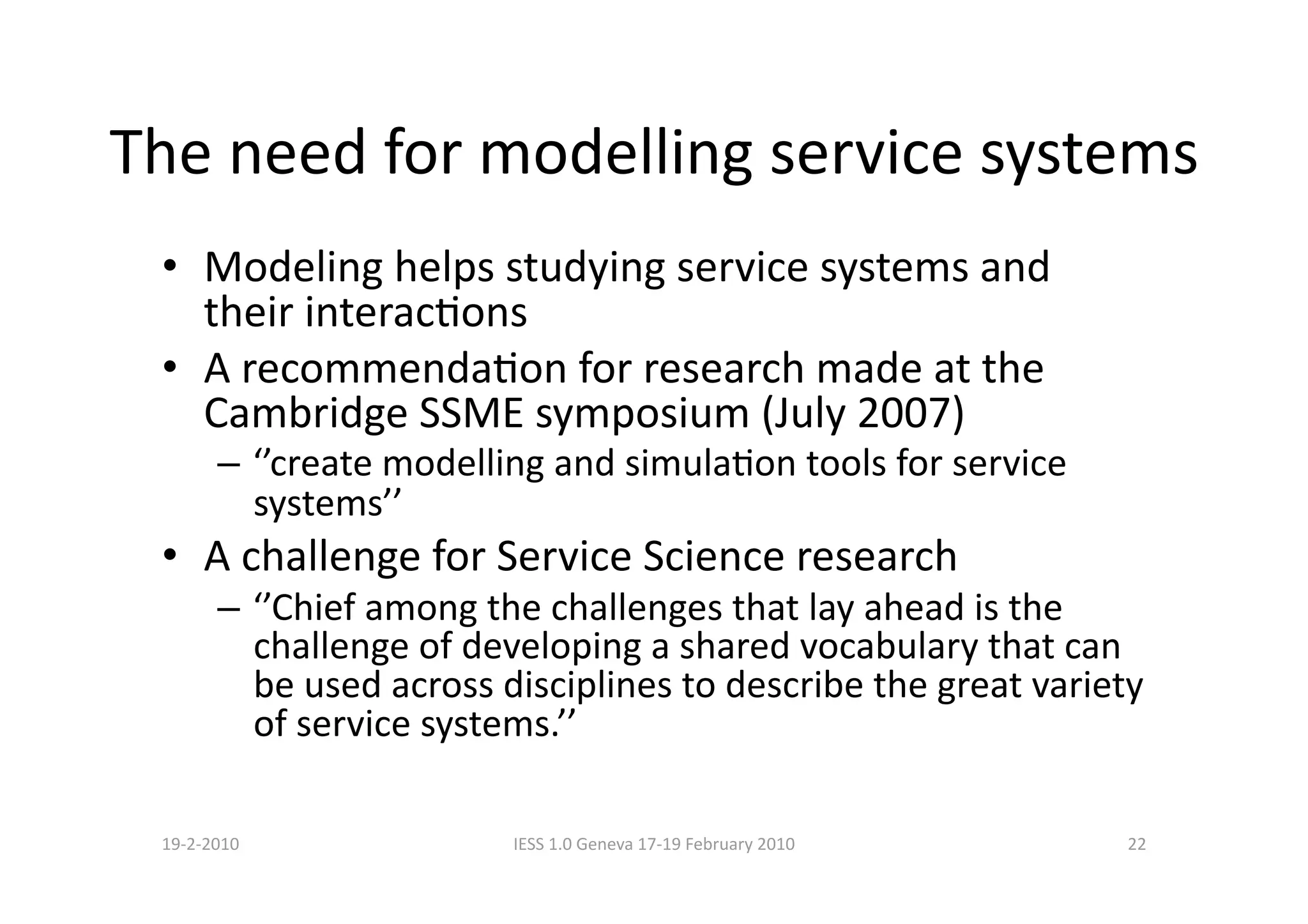
The
need
for
modelling
service
systems

 •  Modeling
helps
studying
service
systems
and

    their
interacBons


 •  A
recommendaBon
for
research
made
at
the

    Cambridge
SSME
symposium
(July
2007)

       –  ‘’create
modelling
and
simulaBon
tools
for
service

          systems’’

 •  A
challenge
for
Service
Science
research

       –  ‘’Chief
among
the
challenges
that
lay
ahead
is
the

          challenge
of
developing
a
shared
vocabulary
that
can

          be
used
across
disciplines
to
describe
the
great
variety

          of
service
systems.’’


 19‐2‐2010
              IESS
1.0
Geneva
17‐19
February
2010
    22

The
need
for
modelling
service
systems
–

    citaBons
from
Service
Science
literature

•  ‘’someday
service
scienBsts
may
work
with
formal
models

   of
service
systems”

•  “Models
and
analyBcal
methods
for
service
systems
will

   allow
us
to
find
opportuniBes
for
efficiency
gains
and
to

   create
new
informaBon‐based
services.”

•  ‘’understanding
service
and
service
innovaBon
requires

   new
ways
of
thinking
(worldviews
or
logics)
and
new

   abstracBons’’

•  ‘’Perhaps
more
than
any
other
subjects,
advancement
in

   Service
Science
depends
on
models
and
simulaBons
of

   alternaBve
service
systems
designs.’’

•  “Formal
representaBon
and
measurement
of
work
in

   service
systems
is
a
grand
challenge
for
the
services

   economy”

19‐2‐2010
           IESS
1.0
Geneva
17‐19
February
2010
     23

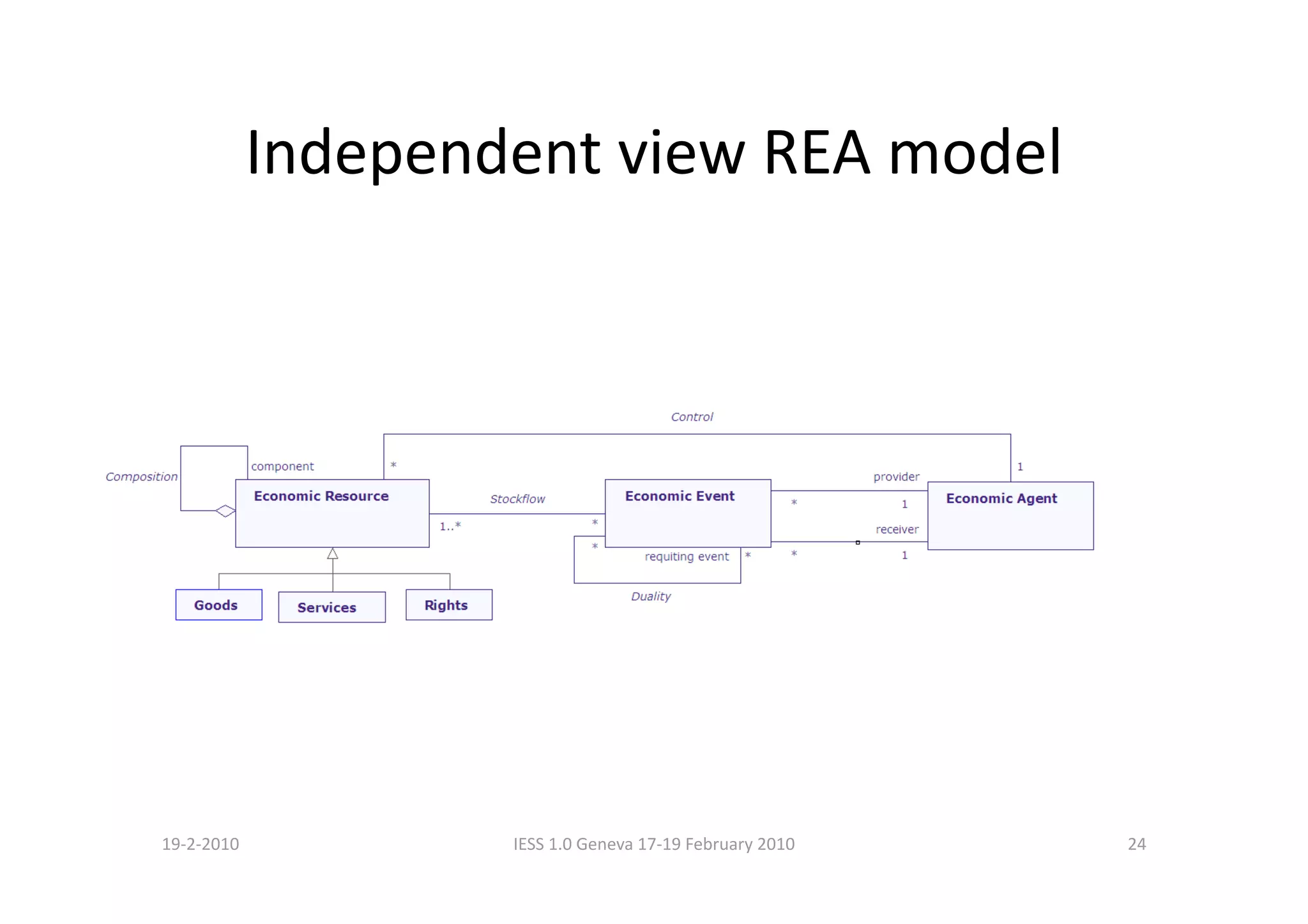
Independent
view
REA
model


19‐2‐2010
           IESS
1.0
Geneva
17‐19
February
2010
   24

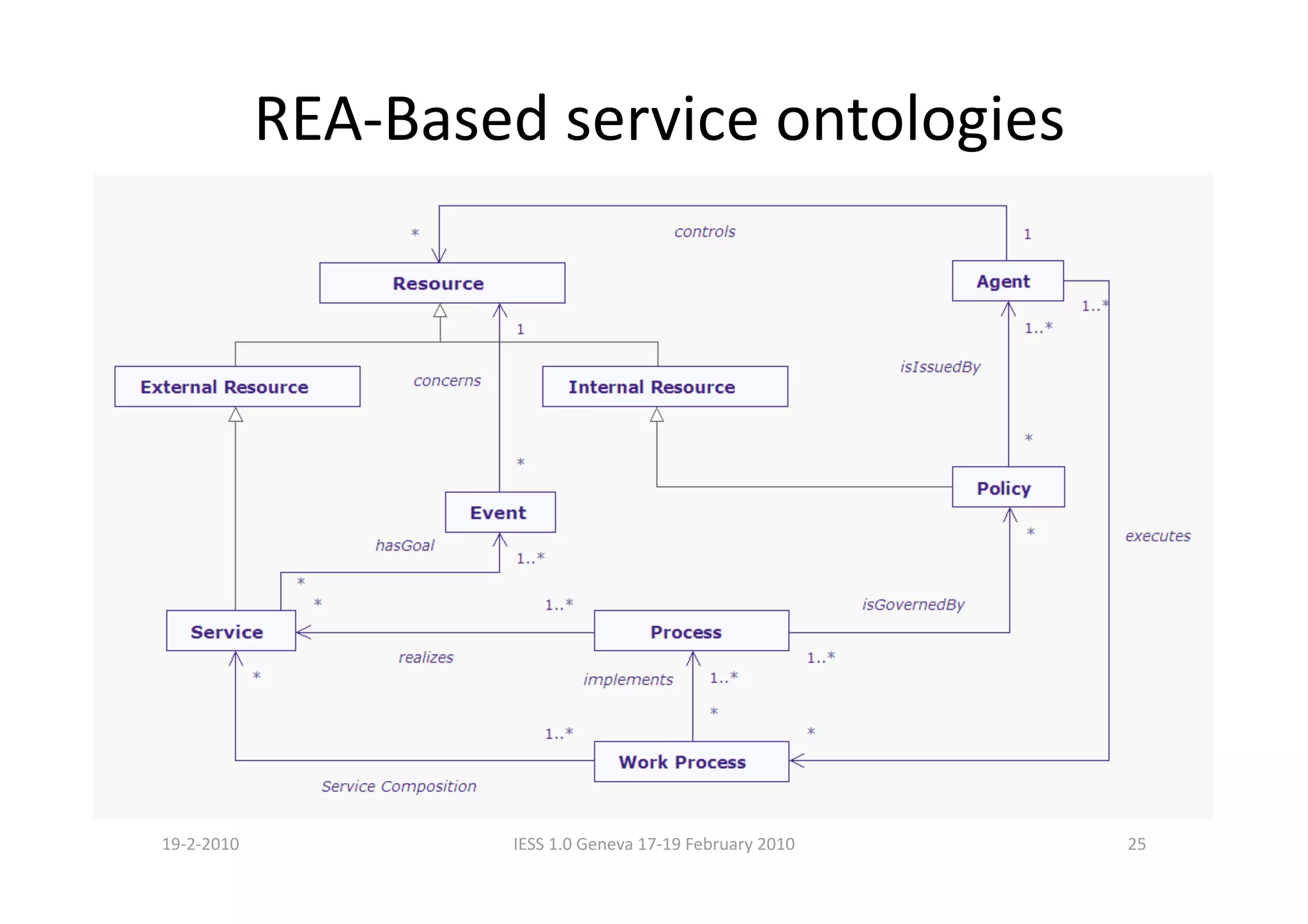
REA‐Based
service
ontologies


19‐2‐2010
            IESS
1.0
Geneva
17‐19
February
2010
   25

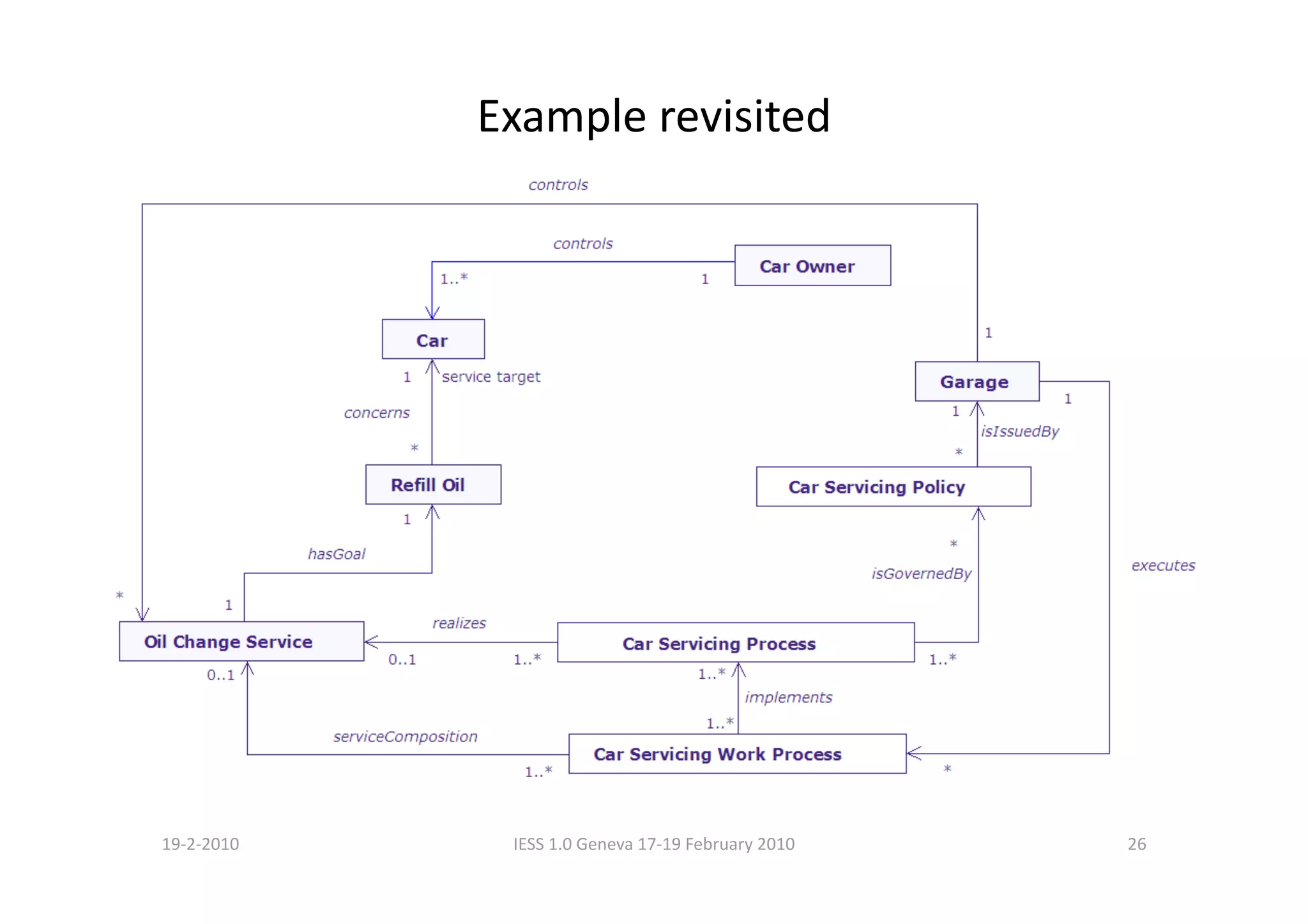
Example
revisited


19‐2‐2010
    IESS
1.0
Geneva
17‐19
February
2010
   26

FoundaBonal
Ontology
for
Service

             Science

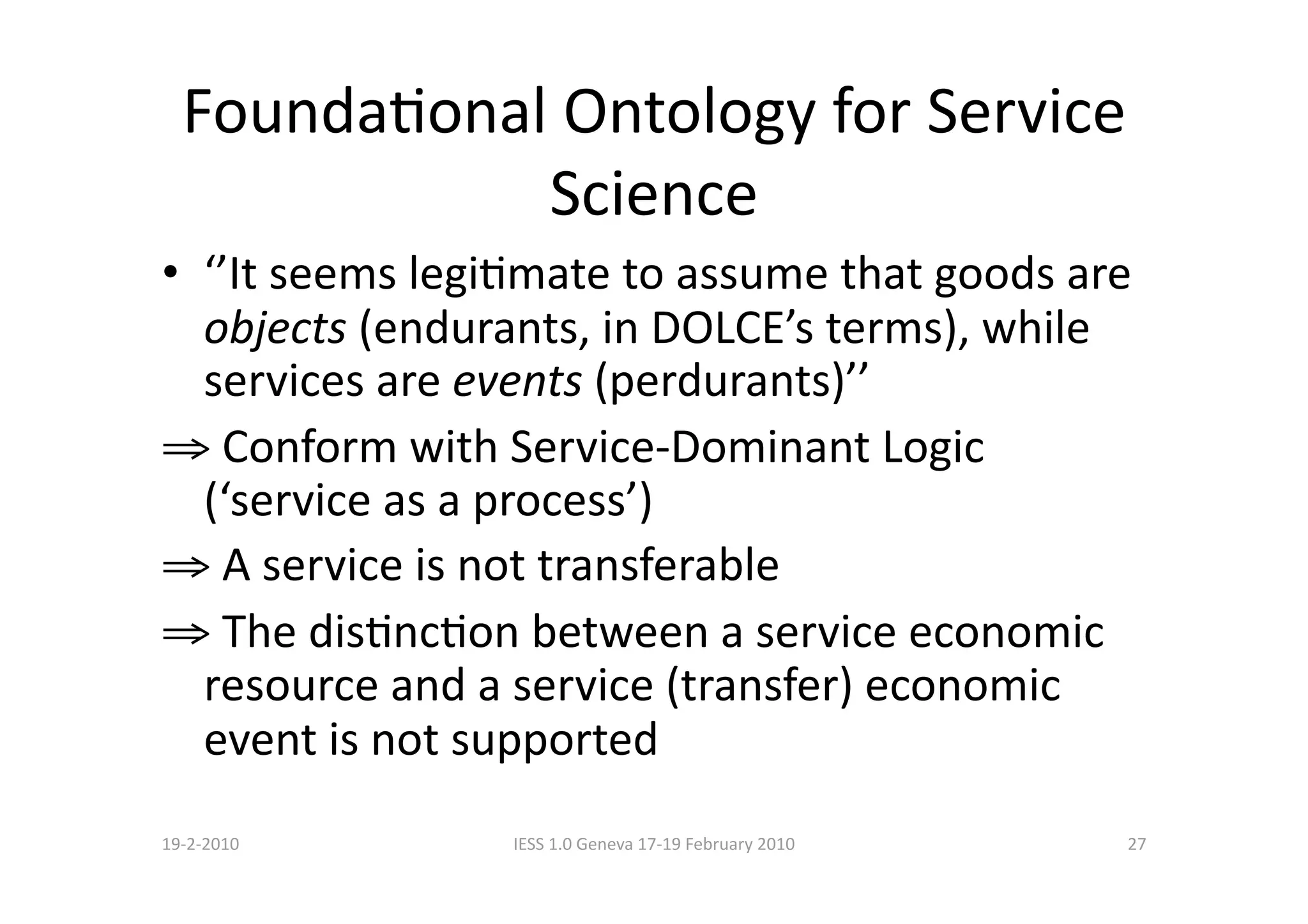
•  ‘’It
seems
legiBmate
to
assume
that
goods
are

   objects
(endurants,
in
DOLCE’s
terms),
while

   services
are
events
(perdurants)’’

⇒ 
Conform
with
Service‐Dominant
Logic

   (‘service
as
a
process’)

⇒ 
A
service
is
not
transferable

⇒ 
The
disBncBon
between
a
service
economic

   resource
and
a
service
(transfer)
economic

   event
is
not
supported

19‐2‐2010
       IESS
1.0
Geneva
17‐19
February
2010
   27

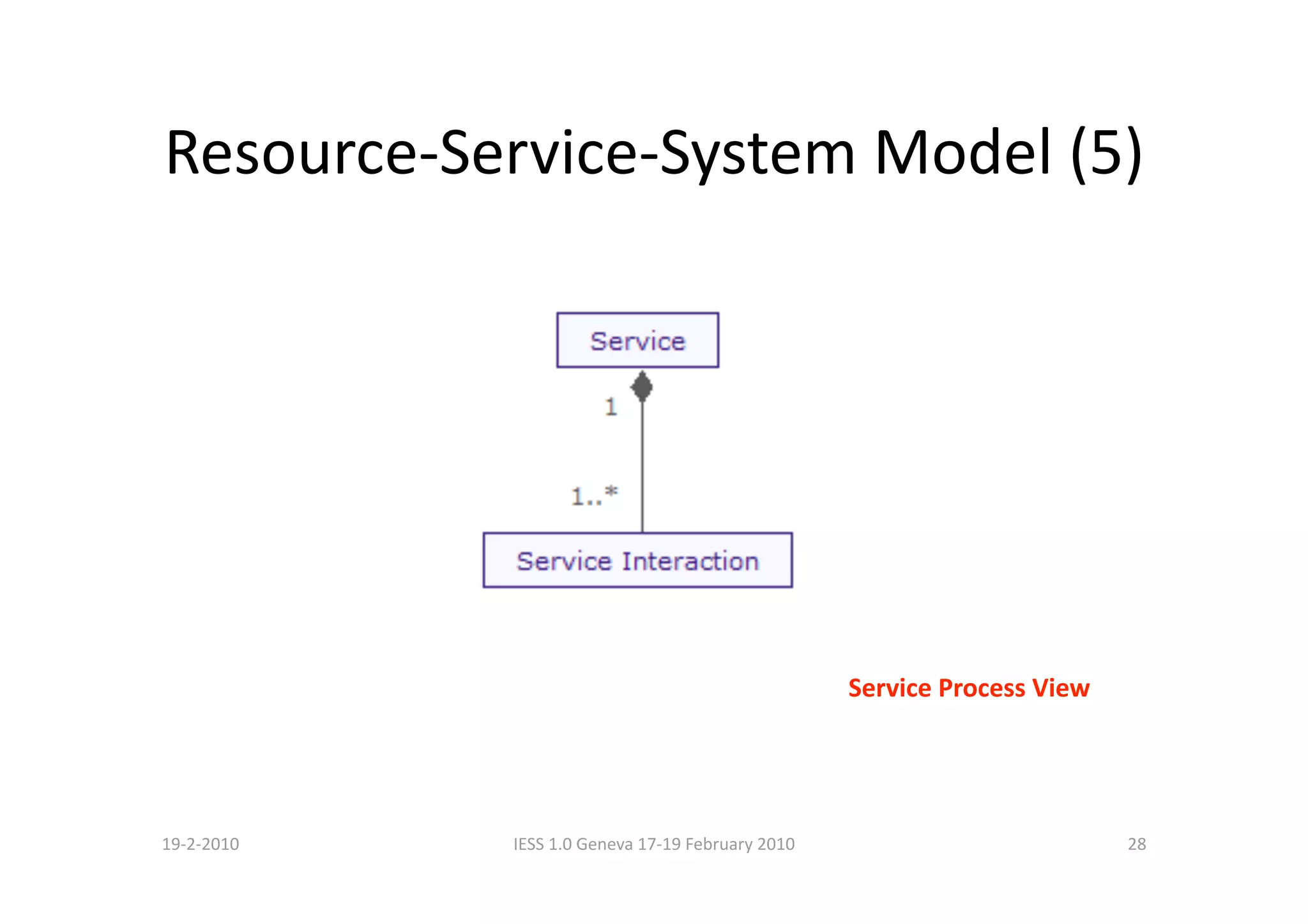
Resource‐Service‐System
Model
(5)


                                                    Service
Process
View


19‐2‐2010
   IESS
1.0
Geneva
17‐19
February
2010
                           28


Vii 1 Resource Service System

  • 1.
    A
Conceptual
Model
of
Service
 Exchange
in
Service‐Dominant
Logic
 Geert
Poels
 Faculty
of
Economics
and
Business
 AdministraBon,
Ghent
University
 19‐2‐2010
 IESS
1.0
Geneva
17‐19
February
2010
 1

  • 2.
    Outline
 •  Service‐Dominant
Logic
 •  Service
System
 • Service
system
modelling
=
business
modelling
 •  The
Resource‐Event‐Agent
conceptual
model
 •  The
Resource‐Service‐System
conceptual
 model
 •  Open
issues,
challenges,
future
research
 19‐2‐2010
 IESS
1.0
Geneva
17‐19
February
2010
 2

  • 3.
    Service‐Dominant
Logic
 •  Service‐Dominant
Logic
(Vargo
&
Lusch)
 
‘’Service
Science
embraces
the
world
view
of
the
service‐dominant
 logic.’’

(Cambridge
SSME
symposium,
July
2007)
 •  Main
ideas
 –  Service
is
the
applicaBon
of
competences
(skills,
knowledge)
for
the
 benefit
of
another
party
 –  All
economic
exchanges
are
service
exchanges:
service
is
exchanged
 for
service
on
the
basis
of
voluntary
economic
reciprocity
 –  Goods
are
involved
in
this
process
as
appliances
for
service
provision:
 they
are
conveyors
of
competences
 –  SDL
represents
a
shi
in
thinking
about
value
in
terms
of
 •  Operand
resources
(‘D‐resources’):
passive
resources
that
require
acBon
to
 make
them
valuable
 to
 •  Operant
resources
(‘T‐resources’):
acBve
resources
that
embody
competences
 and
that
can
act
on
other
resources
to
make
them
valuable

 19‐2‐2010
 IESS
1.0
Geneva
17‐19
February
2010
 3

  • 4.
    Comparing
the
‘new’
and
‘old’
logics
 •  Goods‐Dominant
Logic
 •  Service‐Dominant
Logic
 –  Services
are
seen
as
units
 –  Service
is
seen
as
a
process
 of
output
 –  Value
in
use:
value
is
 –  Value
in
exchange:
value
is
 created
through
resources
 created
through
transfer
of
 acBng
upon
other
 resources
 resources
 –  One
party
produces
the
 –  Each
party
brings
in
or
 services
and
another
party
 makes
accessible
its
own
 consumes
the
services
 resources
and
both
parBes
 co‐create
value
for
the
 service
beneficiary
 Service‐Dominant
Logic
represents
a
shi<
in
logic
of
exchange,
 not
just
a
shi<
in
type
of
product
that
is
under
invesCgaCon.
 19‐2‐2010
 IESS
1.0
Geneva
17‐19
February
2010
 4

  • 5.
    Service
System
 •  DefiniBon
(Maglio,
Vargo,
Caswell,
Spohrer)
 ‘’an
open
system
(1)
capable
of
improving
the
 state
of
another
system
through
sharing
or
 applying
its
resources
(i.e.,
the
other
system
 determines
and
agrees
that
the
interacBon
has
 value),
and
(2)
capable
of
improving
its
own
state
 by
acquiring
external
resources
(i.e.,
the
system
 itself
sees
value
in
its
interacBon
with
other
 systems)’’
 19‐2‐2010
 IESS
1.0
Geneva
17‐19
February
2010
 5

  • 6.
    •  Key
characterisBcs
 –  A
service
system
is
a
configuraBon
of
resources,
of
which
 at
least
one
operant
resource
 •  physical
resources
with
legal
rights
(people)
 •  conceptual
resources
with
legal
rights
(organizaBons)
 •  conceptual
resources
treated
as
property
(shared
informaBon)
 •  physical
resources
treated
as
property
(technology)
 –  Service
is
the
applicaBon
or
sharing
of
resources
for
the
 benefit
of
another
system
 •  At
least
one
operant
resource
that
embodies
competences
is
 applied
or
shared
 –  Service
entails
an
interacBon
with
another
service
system
 •  Service
is
co‐creaBon
of
value
rather
than
producBon
by
one
party
 •  The
other
party
needs
to
bring
in
or
make
accessible
its
resources
 –  There
is
an
economic
moBve
for
service
systems
to
interact
 •  A
service
leads
to
another
service
that
benefits
the
service
system
 19‐2‐2010
 IESS
1.0
Geneva
17‐19
February
2010
 6

  • 7.
    Service
system
modelling
=
 business
modelling
 •  Service‐Dominant
Logic
assumes
an
economic
context
 for
service
exchanges
 –  Enterprises
are
a
major
category
of
service
system
 –  The
business
logic
of
an
enterprise
is
expressed
in
a
 business
model
 →
modelling
an
enterprise
as
a
service
system,
emphasizing
 the
applicaBon
of
its
resources
for
the
benefit
of
another
 system
in
the
context
of
economic
exchange,
is
business
 modelling
 •  Business
modelling
knowledge
has
been
specified
and
 formalized
in
business
model
ontologies,
which
offer
 concepts
in
terms
of
which
business
models
can
be
 arBculated
 19‐2‐2010
 IESS
1.0
Geneva
17‐19
February
2010
 7

  • 8.
    Resource‐Event‐Agent
Model
 REA
takes
a
Goods‐Dominant
Logic
perspecCve
on
economic
exchange
 as
services
are
a
subtype
of
Economic
Resource
 •  Services
are
economic
resources
that
can
be
transferred,
i.e.
control
over
the
 services
can
be
transfered
from
one
person
to
another.
 •  The
provider
‘produces’
the
services
(i.e.
creates
value)
and
the
receiver
 ‘consumes’
the
services
(i.e.
destroys
value)
 •  The
value
of
the
services
is
determined
through
the
economic
exchange,
usually
 in
terms
of
what
is
being
paid
for
them
 •  To
model
the
transfer
an
economic
event
is
needed,
e.g.
a
services
transfer,
 provision
or
delivery
event.
 19‐2‐2010
 IESS
1.0
Geneva
17‐19
February
2010
 8

  • 9.
    Example:
a
car
change
oil
service
 Economic
resources
 Economic
event
 Economic
agents
 19‐2‐2010
 IESS
1.0
Geneva
17‐19
February
2010
 9

  • 10.
    19‐2‐2010
 IESS
1.0
Geneva
17‐19
February
2010
 10

  • 11.
    Resource‐Service‐System
Model
(1)
 Basic
Resource/Service/System
ConstellaCon
 In
a
Service‐Dominant
Logic
interpretaCon
of
REA,
service
maps
to
 economic
event,
not
to
economic
resource
 19‐2‐2010
 IESS
1.0
Geneva
17‐19
February
2010
 11

  • 12.
    Example
revisited
again
 Operant
Resource
 Operand
Resources
 Service
 Service
systems
 19‐2‐2010
 IESS
1.0
Geneva
17‐19
February
2010
 12

  • 13.
    Resource‐Service‐System
Model
(2)
 Service
Exchange
View
 19‐2‐2010
 IESS
1.0
Geneva
17‐19
February
2010
 13

  • 14.
    19‐2‐2010
 IESS
1.0
Geneva
17‐19
February
2010
 14

  • 15.
    Resource‐Service‐System
Model
(3)
 Service
System
ComposiCon
View
 19‐2‐2010
 IESS
1.0
Geneva
17‐19
February
2010
 15

  • 16.
    Resource‐Service‐System
Model
(4)
 Service
Accountability
View
 19‐2‐2010
 IESS
1.0
Geneva
17‐19
February
2010
 16

  • 17.
    19‐2‐2010
 IESS
1.0
Geneva
17‐19
February
2010
 17

  • 18.
    Future
research
 •  Extend
conceptual
model
to
accommodate
 –  Process
structure
of
service:
service
lifecycle
 model
 –  Service
(system)
component
structure:
service
 composiBon
model
 •  Model
tesBng
 •  Ontology
development
 •  Ontology
alignment
 19‐2‐2010
 IESS
1.0
Geneva
17‐19
February
2010
 18

  • 19.
    Auxiliary
slides
 19‐2‐2010
 IESS
1.0
Geneva
17‐19
February
2010
 19

  • 20.
    MoBvaBon
–
Service
Science
 •  New
,
disBnct
field
based
on
an
interdisciplinary
 approach
to
research
 •  IniBaBve
launched
in
2004
by
IBM,
intending
to
 integrate
separate
service
research
areas
 •  DefiniBons
(Maglio
et
al.)
 –  ‘’Service
science
is
the
study
of
the
applicaBon
of
the
 resources
of
one
or
more
systems
for
the
benefit
of
 another
system
in
economic
exchange.’’
 –  ‘’NormaCve
service
science
is
the
study
of
how
one
 system
can
and
should
apply
its
resources
for
the
mutual
 benefit
of
another
system
and
of
the
system
itself.’’
 –  ‘’Service
science,
management,
and
engineering
(SSME)
is
 the
applicaBon
of
normaBve
service
science.’’
 19‐2‐2010
 IESS
1.0
Geneva
17‐19
February
2010
 20

  • 21.
  • 22.
    The
need
for
modelling
service
systems
 •  Modeling
helps
studying
service
systems
and
 their
interacBons

 •  A
recommendaBon
for
research
made
at
the
 Cambridge
SSME
symposium
(July
2007)
 –  ‘’create
modelling
and
simulaBon
tools
for
service
 systems’’
 •  A
challenge
for
Service
Science
research
 –  ‘’Chief
among
the
challenges
that
lay
ahead
is
the
 challenge
of
developing
a
shared
vocabulary
that
can
 be
used
across
disciplines
to
describe
the
great
variety
 of
service
systems.’’
 19‐2‐2010
 IESS
1.0
Geneva
17‐19
February
2010
 22

  • 23.
    The
need
for
modelling
service
systems
–
 citaBons
from
Service
Science
literature
 •  ‘’someday
service
scienBsts
may
work
with
formal
models
 of
service
systems”
 •  “Models
and
analyBcal
methods
for
service
systems
will
 allow
us
to
find
opportuniBes
for
efficiency
gains
and
to
 create
new
informaBon‐based
services.”
 •  ‘’understanding
service
and
service
innovaBon
requires
 new
ways
of
thinking
(worldviews
or
logics)
and
new
 abstracBons’’
 •  ‘’Perhaps
more
than
any
other
subjects,
advancement
in
 Service
Science
depends
on
models
and
simulaBons
of
 alternaBve
service
systems
designs.’’
 •  “Formal
representaBon
and
measurement
of
work
in
 service
systems
is
a
grand
challenge
for
the
services
 economy”
 19‐2‐2010
 IESS
1.0
Geneva
17‐19
February
2010
 23

  • 24.
    Independent
view
REA
model
 19‐2‐2010
 IESS
1.0
Geneva
17‐19
February
2010
 24

  • 25.
    REA‐Based
service
ontologies
 19‐2‐2010
 IESS
1.0
Geneva
17‐19
February
2010
 25

  • 26.
    Example
revisited
 19‐2‐2010
 IESS
1.0
Geneva
17‐19
February
2010
 26

  • 27.
    FoundaBonal
Ontology
for
Service
 Science
 •  ‘’It
seems
legiBmate
to
assume
that
goods
are
 objects
(endurants,
in
DOLCE’s
terms),
while
 services
are
events
(perdurants)’’
 ⇒ 
Conform
with
Service‐Dominant
Logic
 (‘service
as
a
process’)
 ⇒ 
A
service
is
not
transferable
 ⇒ 
The
disBncBon
between
a
service
economic
 resource
and
a
service
(transfer)
economic
 event
is
not
supported
 19‐2‐2010
 IESS
1.0
Geneva
17‐19
February
2010
 27

  • 28.
    Resource‐Service‐System
Model
(5)
 Service
Process
View
 19‐2‐2010
 IESS
1.0
Geneva
17‐19
February
2010
 28