Towards an Ontological Foundation
    of Service Dominant Logic


             Garyfallos Fragidis
Technological Education Institute of Serres,
                    Greece

           Konstantinos Tarabanis
      University of Macedonia, Greece
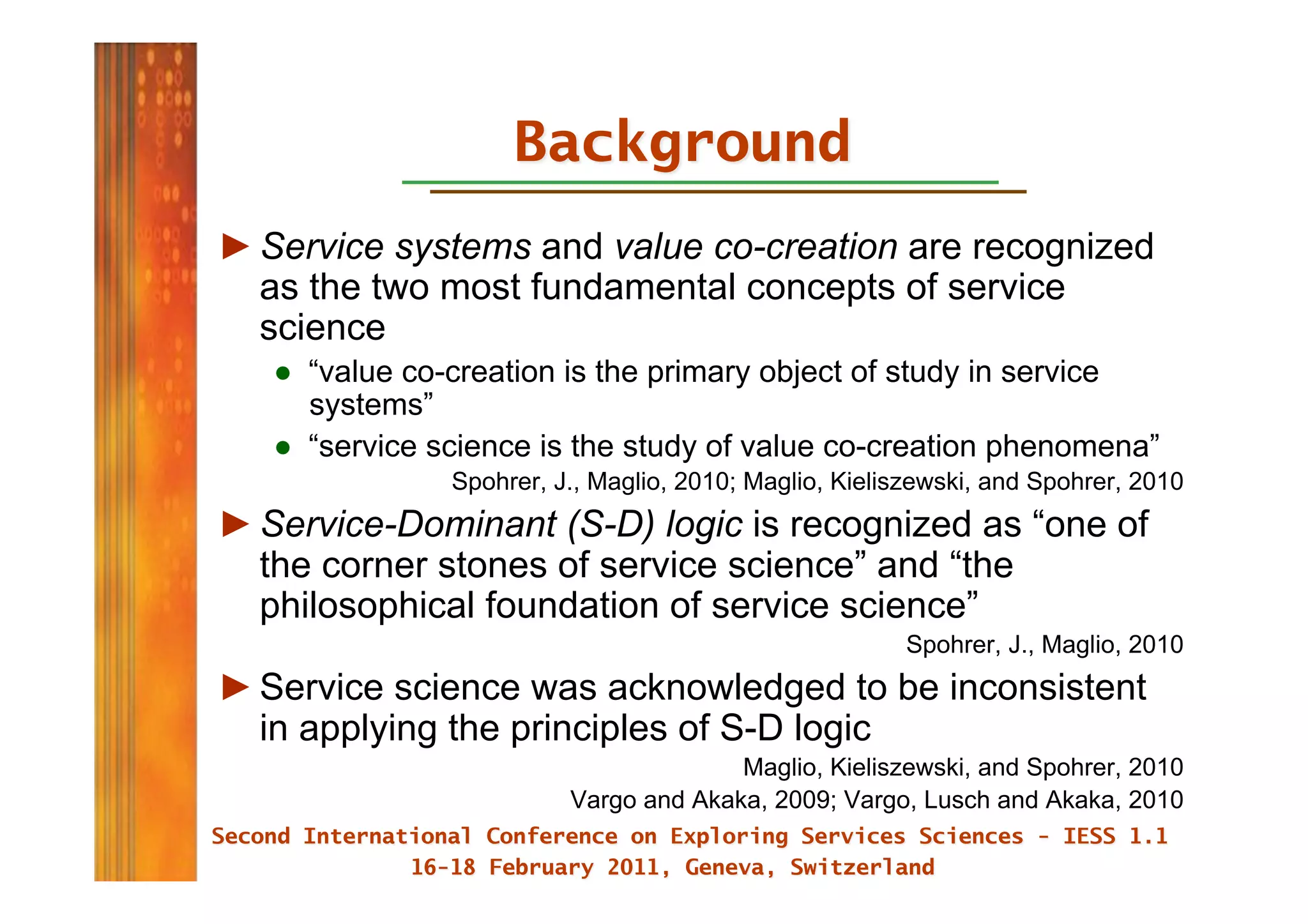
► Service systems and value co-creation are recognized
  as the two most fundamental concepts of service
  science
   ●  “value co-creation is the primary object of study in service
      systems”
   ●  “service science is the study of value co-creation phenomena”
               Spohrer, J., Maglio, 2010; Maglio, Kieliszewski, and Spohrer, 2010
► Service-Dominant (S-D) logic is recognized as “one of
  the corner stones of service science” and “the
  philosophical foundation of service science”
                                                       Spohrer, J., Maglio, 2010
► Service science was acknowledged to be inconsistent
  in applying the principles of S-D logic
                                       Maglio, Kieliszewski, and Spohrer, 2010
                         Vargo and Akaka, 2009; Vargo, Lusch and Akaka, 2010
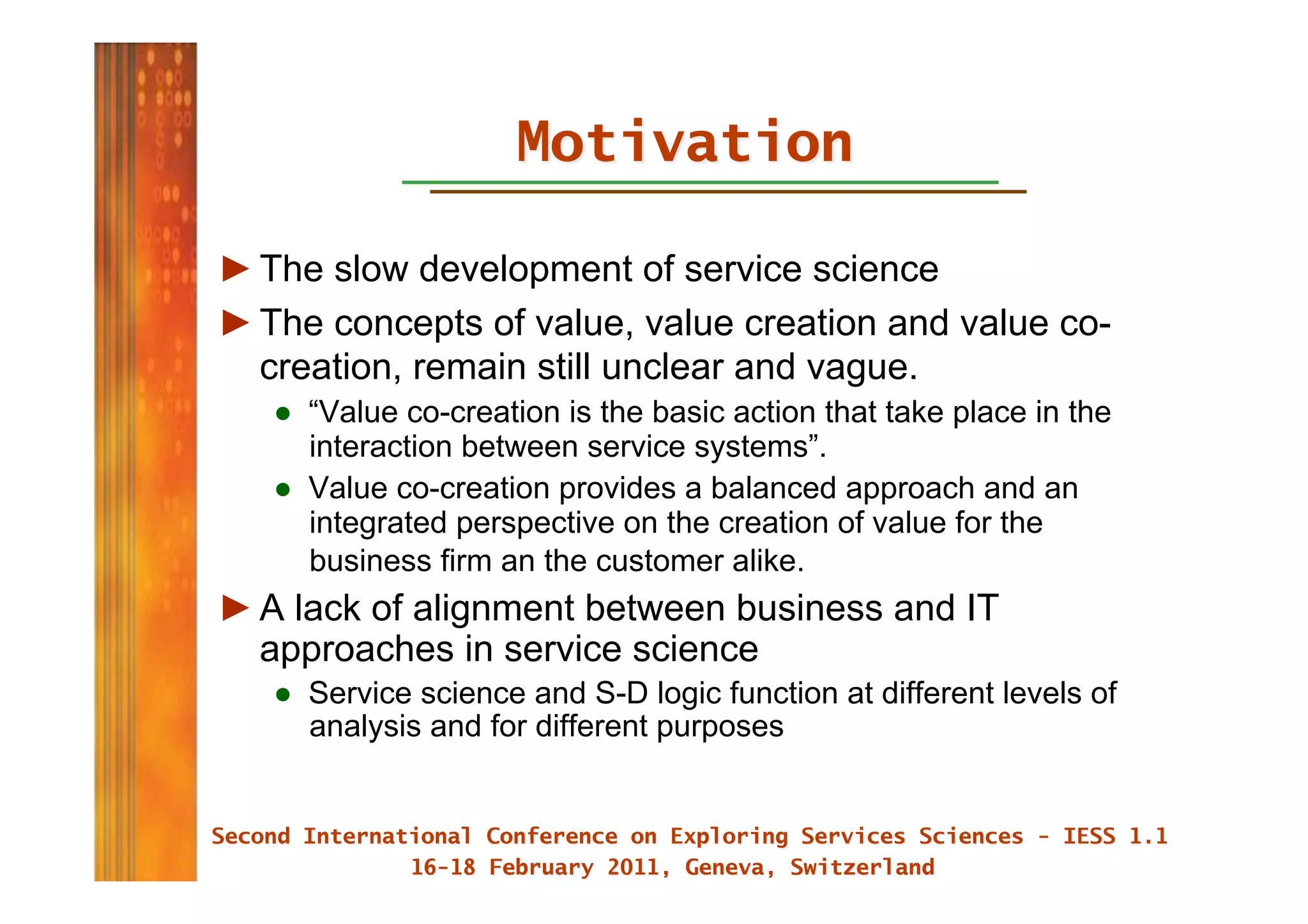
► The slow development of service science
► The concepts of value, value creation and value co-
  creation, remain still unclear and vague.
   ●  “Value co-creation is the basic action that take place in the
      interaction between service systems”.
   ●  Value co-creation provides a balanced approach and an
      integrated perspective on the creation of value for the
      business firm an the customer alike.
► A lack of alignment between business and IT
  approaches in service science
   ●  Service science and S-D logic function at different levels of
      analysis and for different purposes
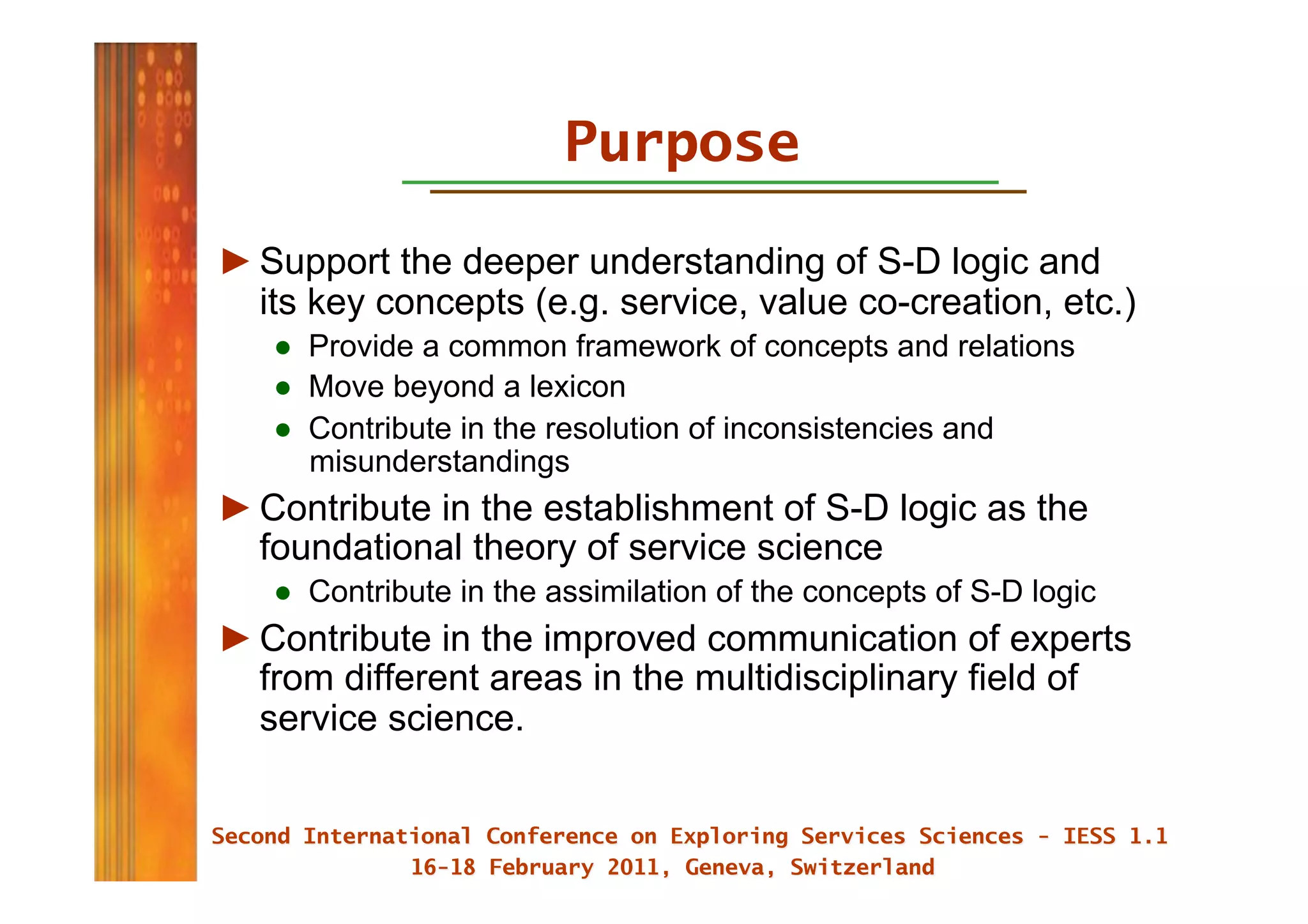
Purpose

► Support the deeper understanding of S-D logic and
  its key concepts (e.g. service, value co-creation, etc.)
   ●  Provide a common framework of concepts and relations
   ●  Move beyond a lexicon
   ●  Contribute in the resolution of inconsistencies and
      misunderstandings
► Contribute in the establishment of S-D logic as the
  foundational theory of service science
   ●  Contribute in the assimilation of the concepts of S-D logic
► Contribute in the improved communication of experts
  from different areas in the multidisciplinary field of
  service science.
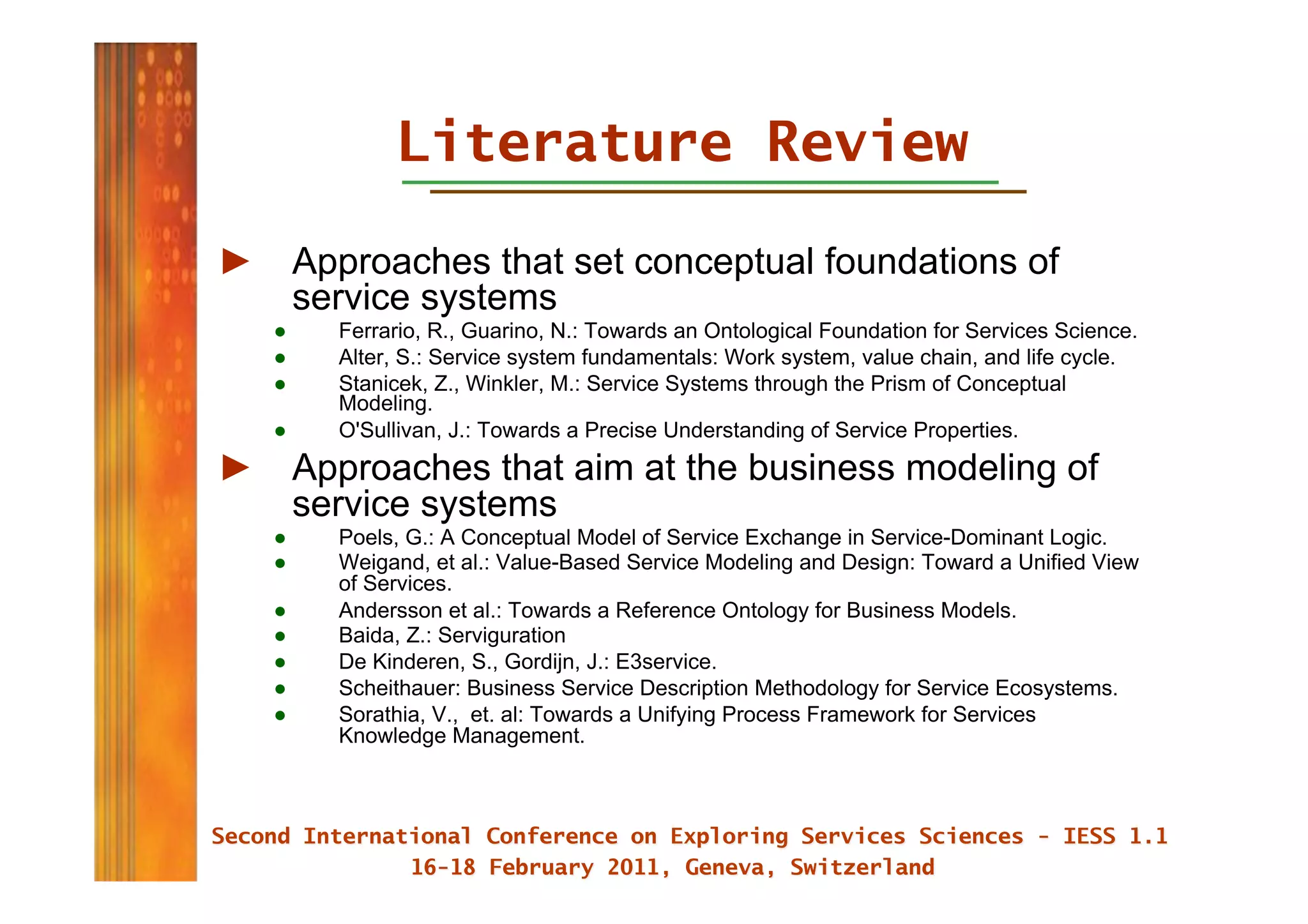
Literature Review

►  Approaches that set conceptual foundations of
   service systems
   ●    Ferrario, R., Guarino, N.: Towards an Ontological Foundation for Services Science.
   ●    Alter, S.: Service system fundamentals: Work system, value chain, and life cycle.
   ●    Stanicek, Z., Winkler, M.: Service Systems through the Prism of Conceptual
        Modeling.
   ●    O'Sullivan, J.: Towards a Precise Understanding of Service Properties.
►  Approaches that aim at the business modeling of
   service systems
   ●    Poels, G.: A Conceptual Model of Service Exchange in Service-Dominant Logic.
   ●    Weigand, et al.: Value-Based Service Modeling and Design: Toward a Unified View
        of Services.
   ●    Andersson et al.: Towards a Reference Ontology for Business Models.
   ●    Baida, Z.: Serviguration
   ●    De Kinderen, S., Gordijn, J.: E3service.
   ●    Scheithauer: Business Service Description Methodology for Service Ecosystems.
   ●    Sorathia, V., et. al: Towards a Unifying Process Framework for Services
        Knowledge Management.
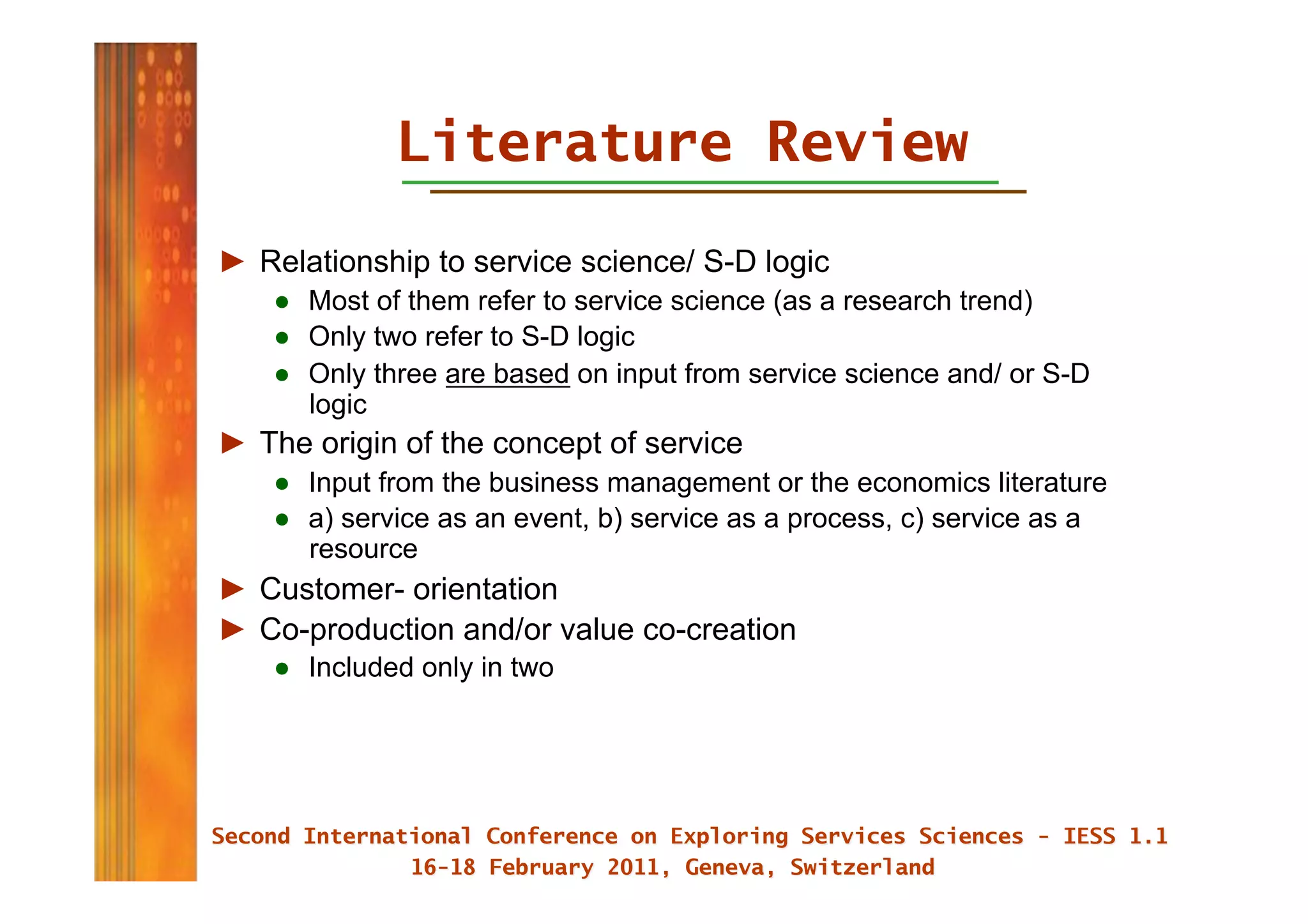
Literature Review
►  Relationship to service science/ S-D logic
    ●  Most of them refer to service science (as a research trend)
    ●  Only two refer to S-D logic
    ●  Only three are based on input from service science and/ or S-D
       logic
►  The origin of the concept of service
    ●  Input from the business management or the economics literature
    ●  a) service as an event, b) service as a process, c) service as a
       resource
►  Customer- orientation
►  Co-production and/or value co-creation
    ●  Included only in two
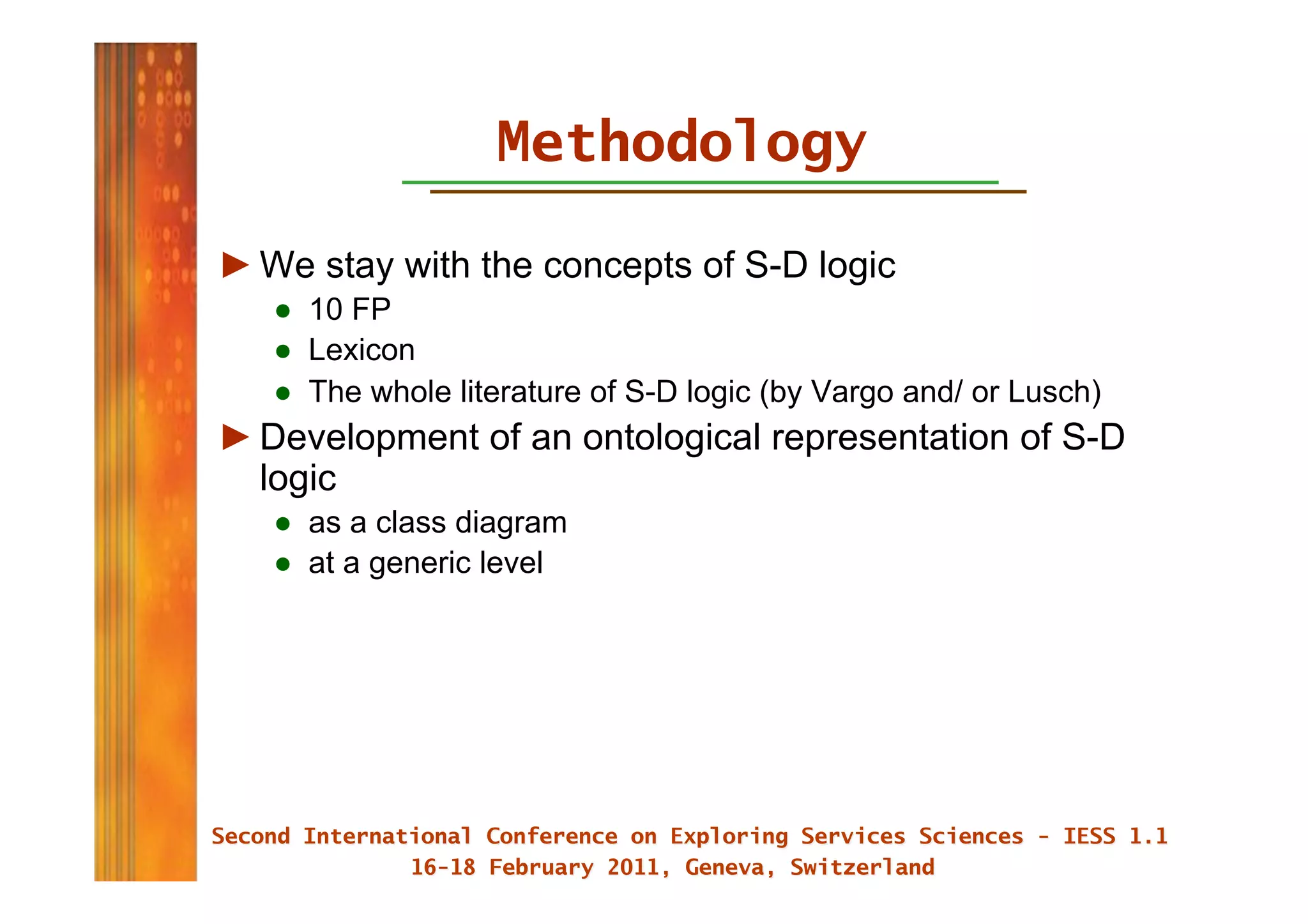
Methodology

► We stay with the concepts of S-D logic
   ●  10 FP
   ●  Lexicon
   ●  The whole literature of S-D logic (by Vargo and/ or Lusch)
► Development of an ontological representation of S-D
  logic
   ●  as a class diagram
   ●  at a generic level
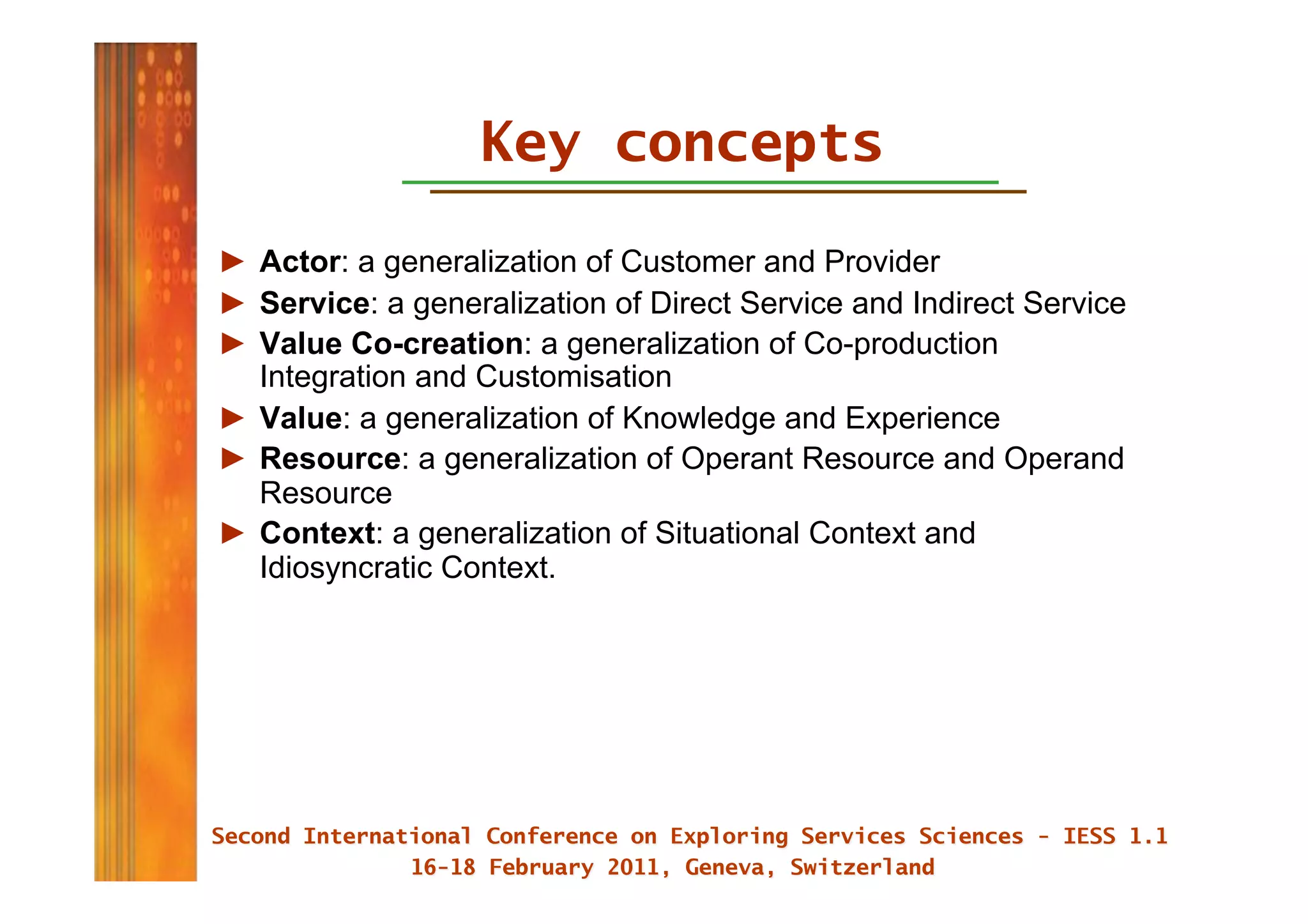
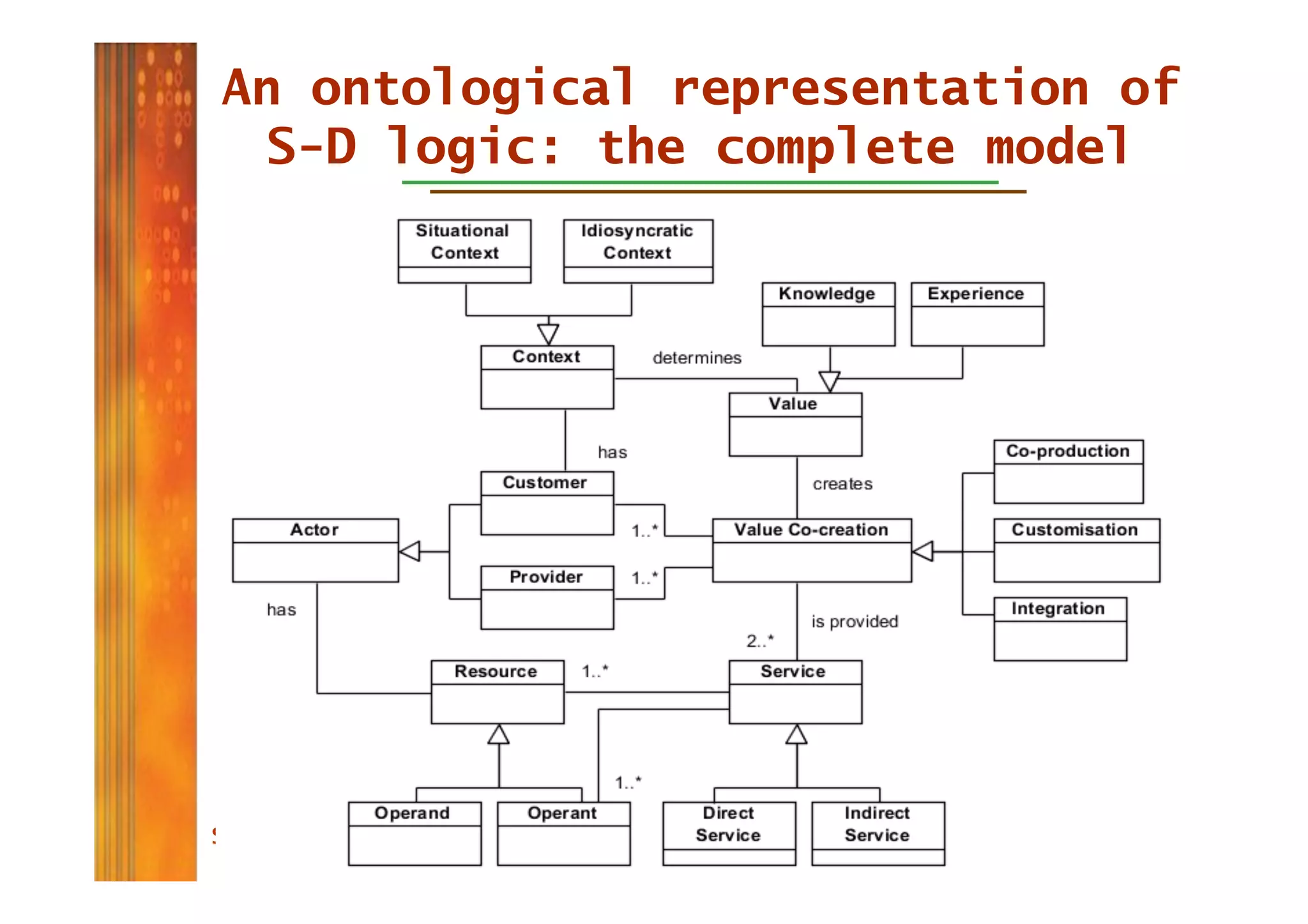
Key concepts
►  Actor: a generalization of Customer and Provider
►  Service: a generalization of Direct Service and Indirect Service
►  Value Co-creation: a generalization of Co-production
   Integration and Customisation
►  Value: a generalization of Knowledge and Experience
►  Resource: a generalization of Operant Resource and Operand
   Resource
►  Context: a generalization of Situational Context and
   Idiosyncratic Context.
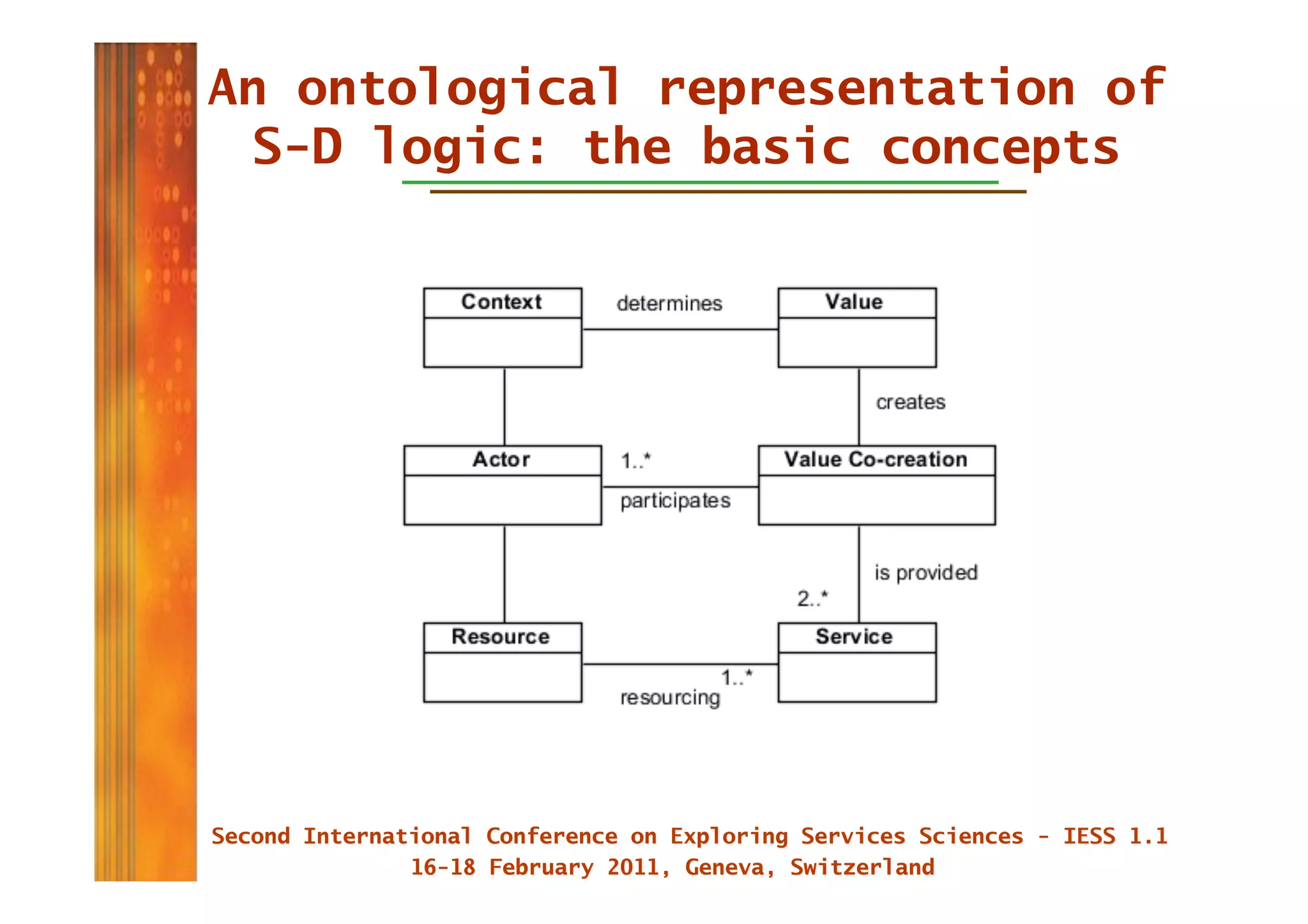
An ontological representation of
 S-D logic: the basic concepts
An ontological representation of
 S-D logic: the complete model
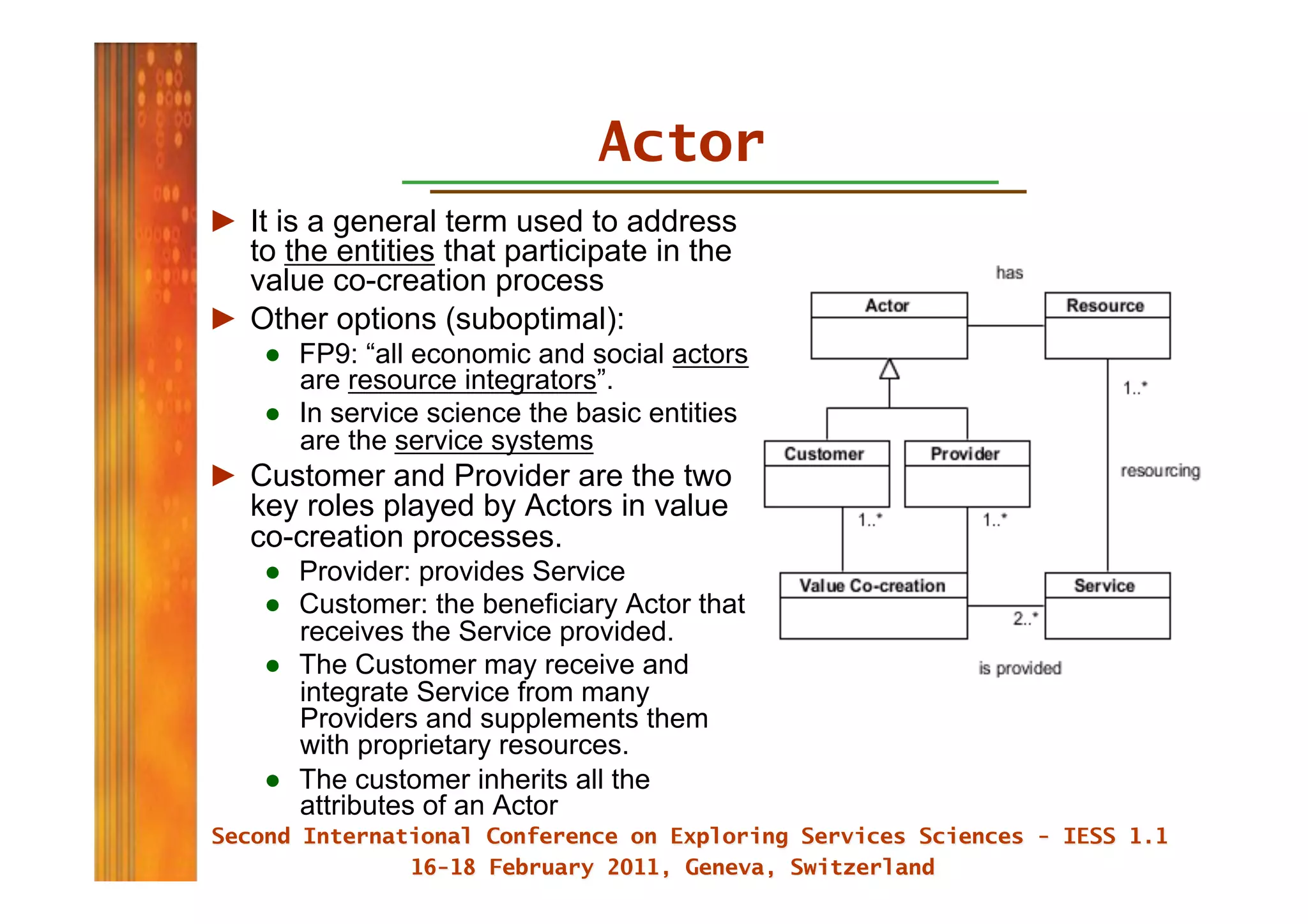
Actor
►  It is a general term used to address
   to the entities that participate in the
   value co-creation process
►  Other options (suboptimal):
    ●  FP9: “all economic and social actors
       are resource integrators”.
    ●  In service science the basic entities
       are the service systems
►  Customer and Provider are the two
   key roles played by Actors in value
   co-creation processes.
    ●  Provider: provides Service
    ●  Customer: the beneficiary Actor that
       receives the Service provided.
    ●  The Customer may receive and
       integrate Service from many
       Providers and supplements them
       with proprietary resources.
    ●  The customer inherits all the
       attributes of an Actor
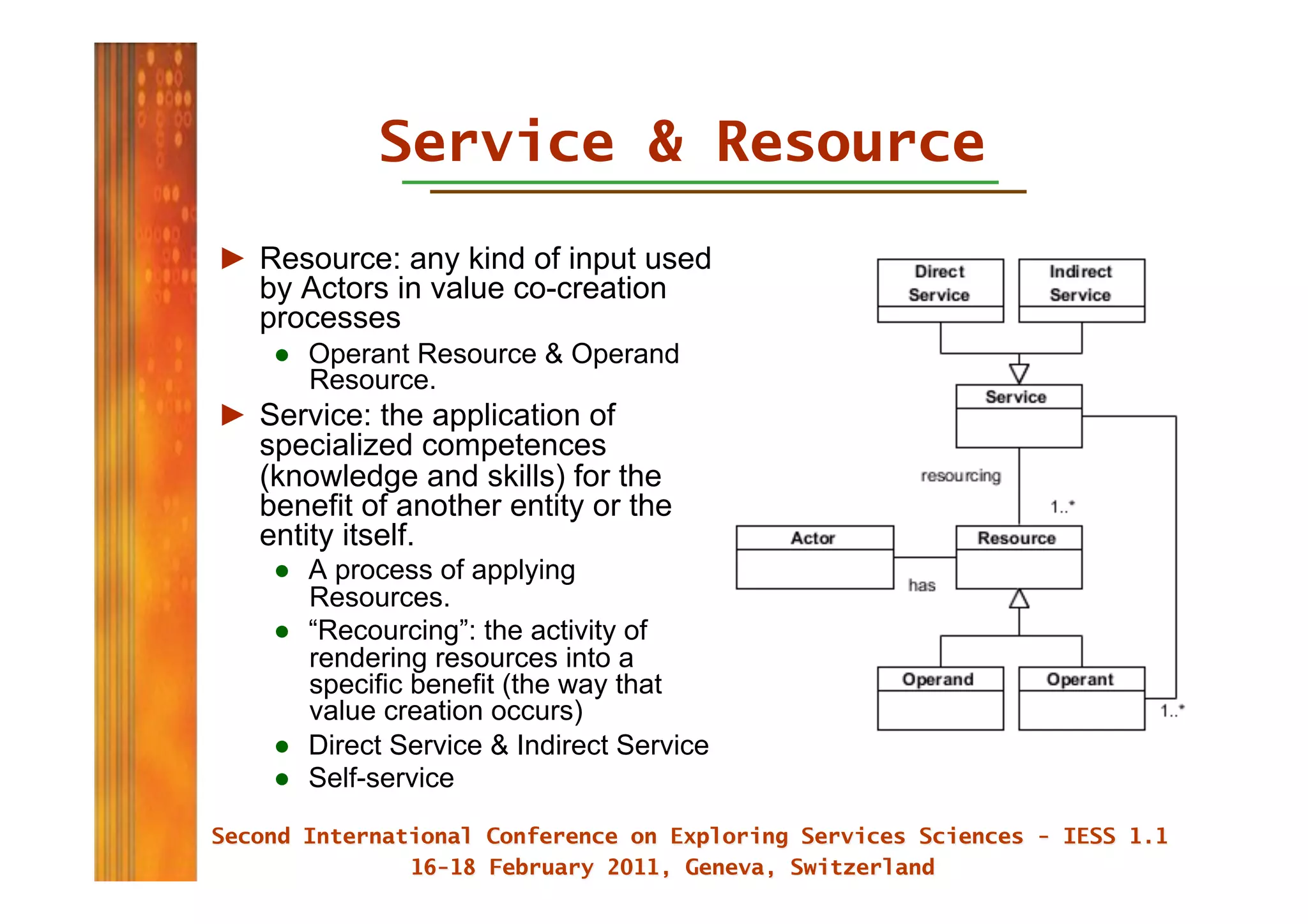
Service & Resource
►  Resource: any kind of input used
   by Actors in value co-creation
   processes
    ●  Operant Resource & Operand
       Resource.
►  Service: the application of
   specialized competences
   (knowledge and skills) for the
   benefit of another entity or the
   entity itself.
    ●  A process of applying
       Resources.
    ●  “Recourcing”: the activity of
       rendering resources into a
       specific benefit (the way that
       value creation occurs)
    ●  Direct Service & Indirect Service
    ●  Self-service
Value Co-creation
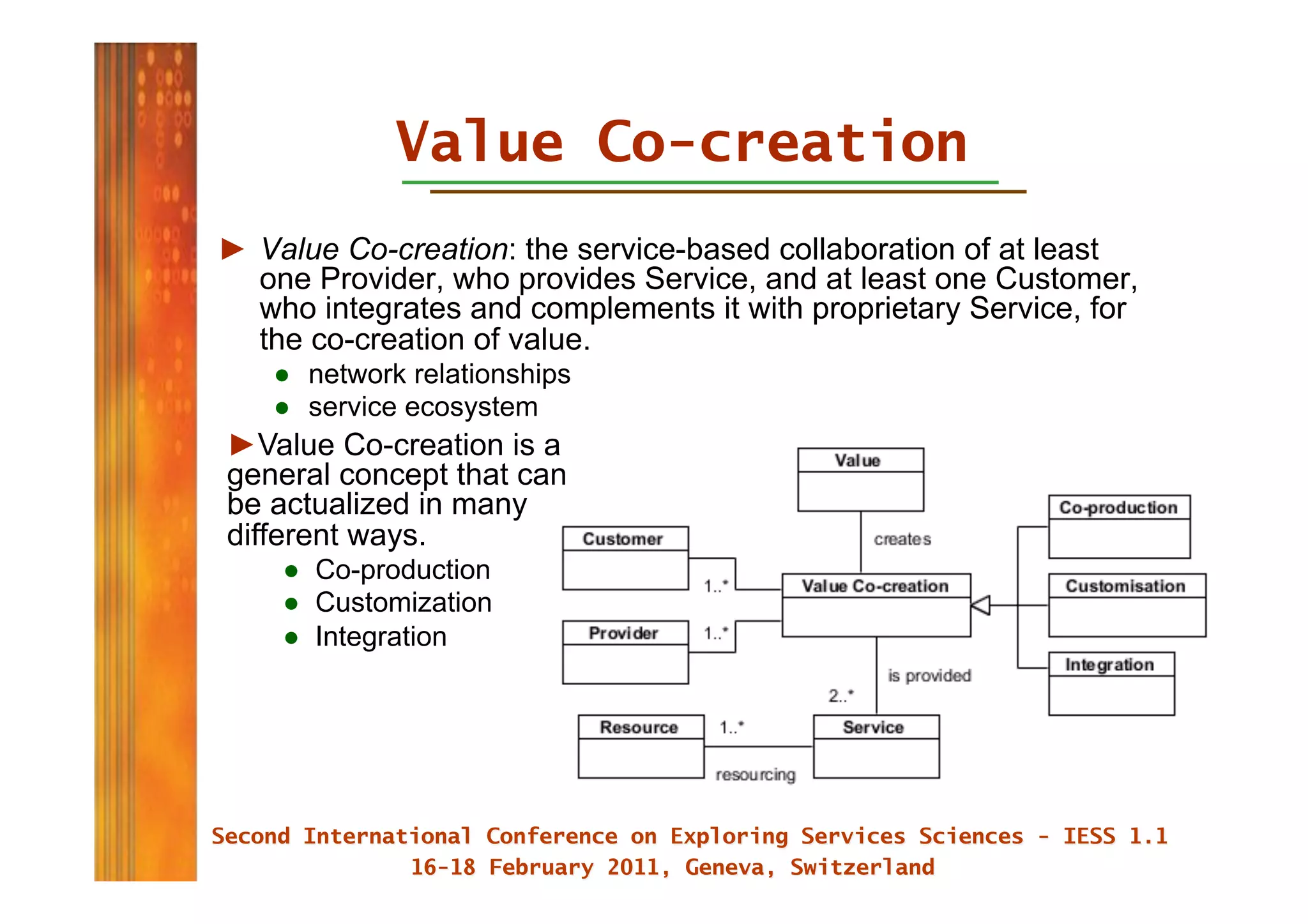
►  Value Co-creation: the service-based collaboration of at least
   one Provider, who provides Service, and at least one Customer,
   who integrates and complements it with proprietary Service, for
   the co-creation of value.
    ●  network relationships
    ●  service ecosystem
► Value Co-creation is a
general concept that can
be actualized in many
different ways.
    ●  Co-production
    ●  Customization
    ●  Integration
Value
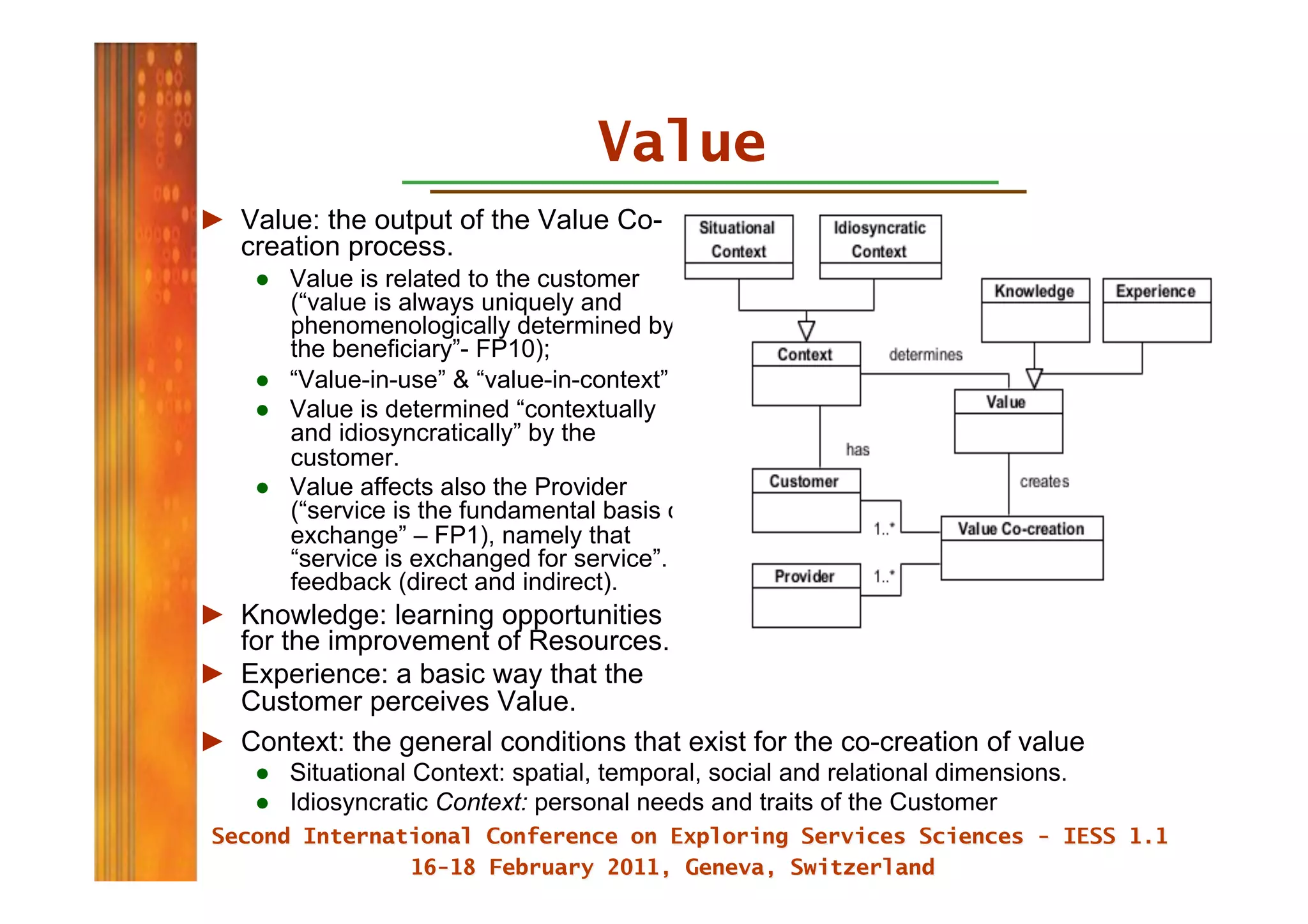
►  Value: the output of the Value Co-
   creation process.
    ●  Value is related to the customer
       (“value is always uniquely and
       phenomenologically determined by
       the beneficiary”- FP10);
    ●  “Value-in-use” & “value-in-context”
    ●  Value is determined “contextually
       and idiosyncratically” by the
       customer.
    ●  Value affects also the Provider
       (“service is the fundamental basis of
       exchange” – FP1), namely that
       “service is exchanged for service”.
       feedback (direct and indirect).
►  Knowledge: learning opportunities
   for the improvement of Resources.
►  Experience: a basic way that the
   Customer perceives Value.
►  Context: the general conditions that exist for the co-creation of value
    ●  Situational Context: spatial, temporal, social and relational dimensions.
    ●  Idiosyncratic Context: personal needs and traits of the Customer
Benefits from the ontological
  representation of S-D logic

► The logical analysis of S-D logic:
   ●  provides insights
   ●  clarifies concepts
   ●  singles out inconsistencies
► Interpretation & improvement of S-D logic
► A basis for transdisciplinary communication
► A vocabulary and modeling constructs for the
  development of “service-based” information systems
  (or “value-cocreation” information systems)
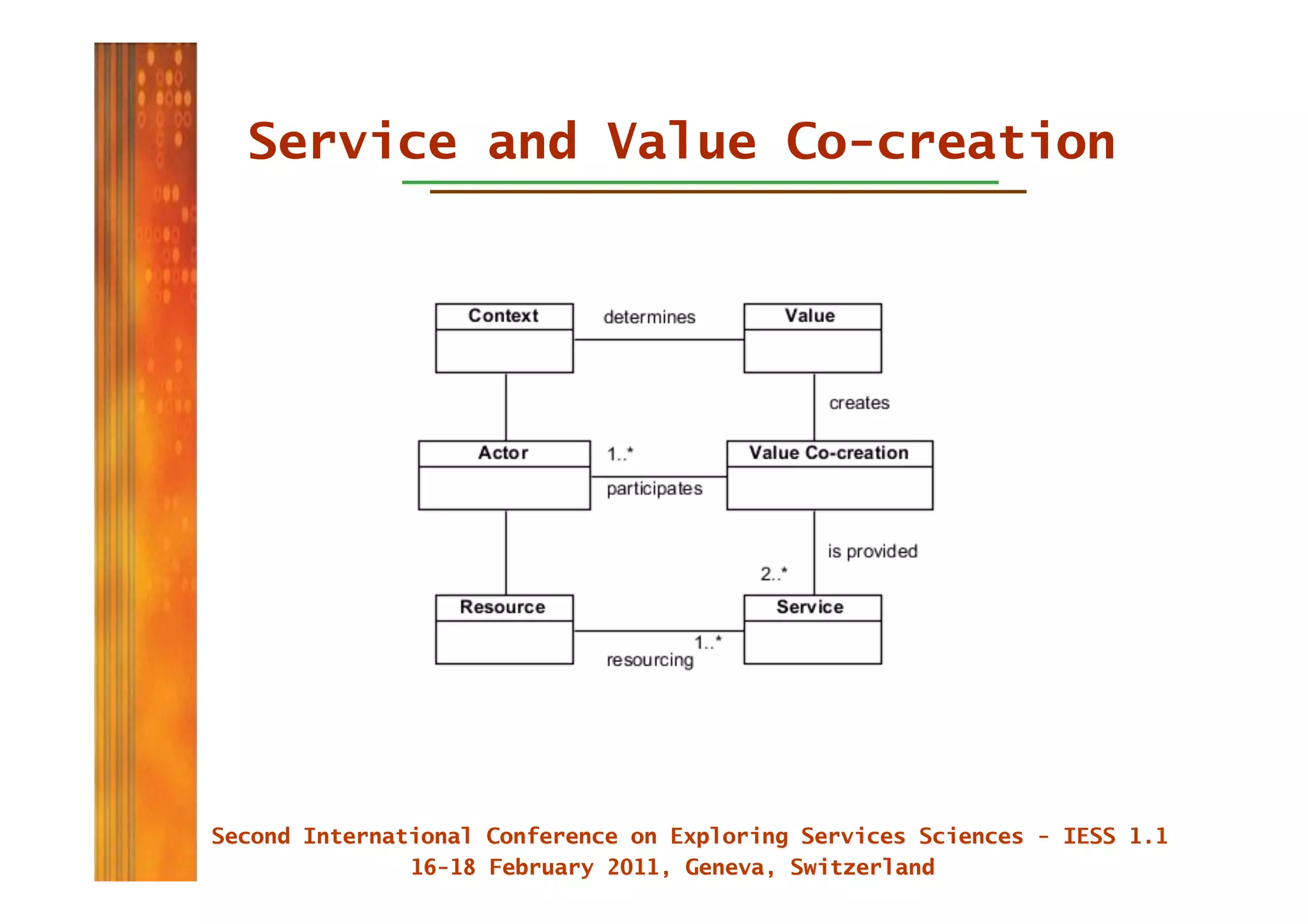
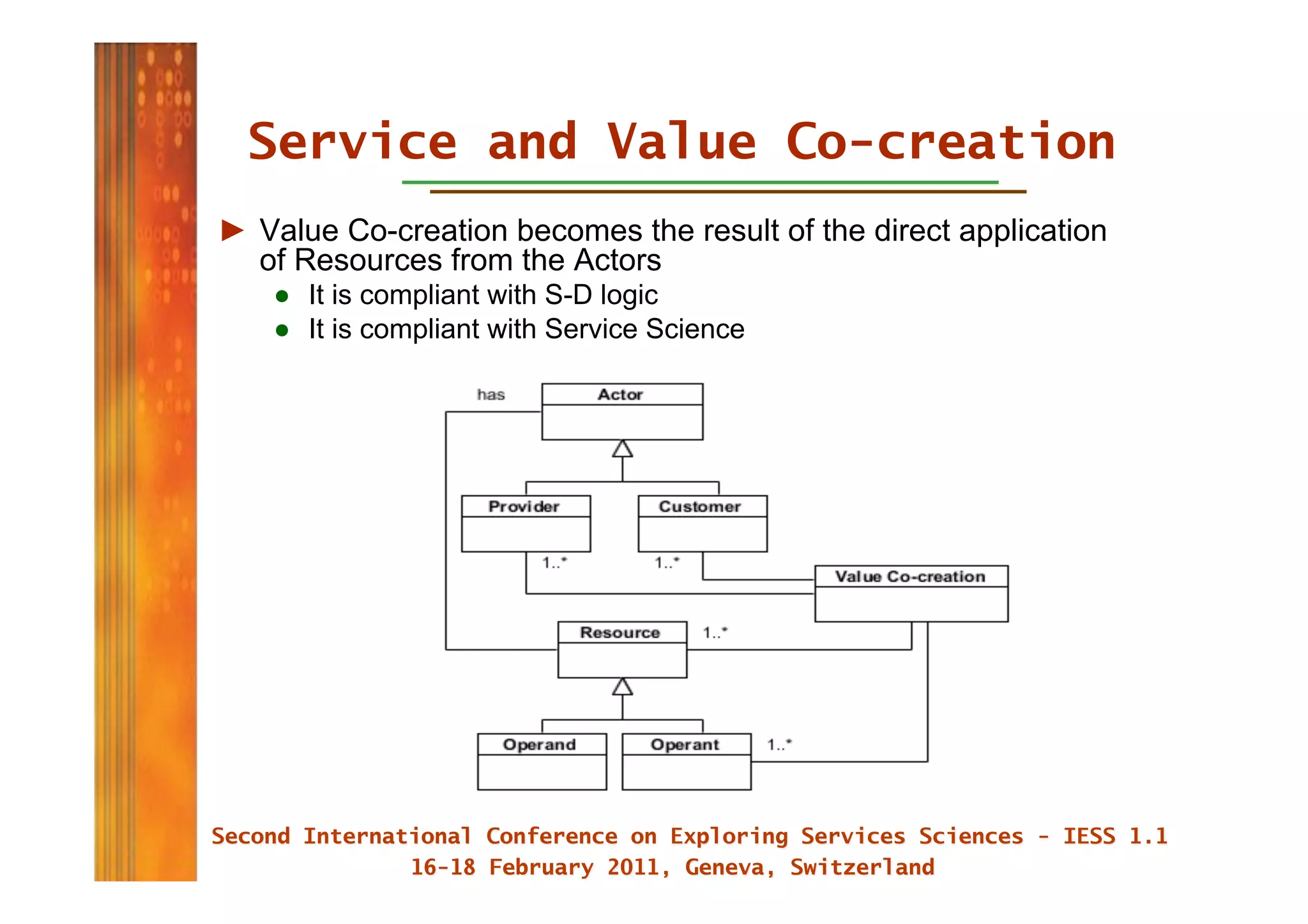
Service and Value Co-creation
►  Value Co-creation becomes the result of the direct application
   of Resources from the Actors
    ●  It is compliant with S-D logic
    ●  It is compliant with Service Science
Concepts not included

► Exchange (FP1 & FP2)
► Competitive advantage (FP4)
► Value proposition (FP7)
► Solution, dialogue, reciprocity/ interactivity, value-in-
  use, value-creation network and service ecosystem
  (possible entries to the S-D logic lexicon).
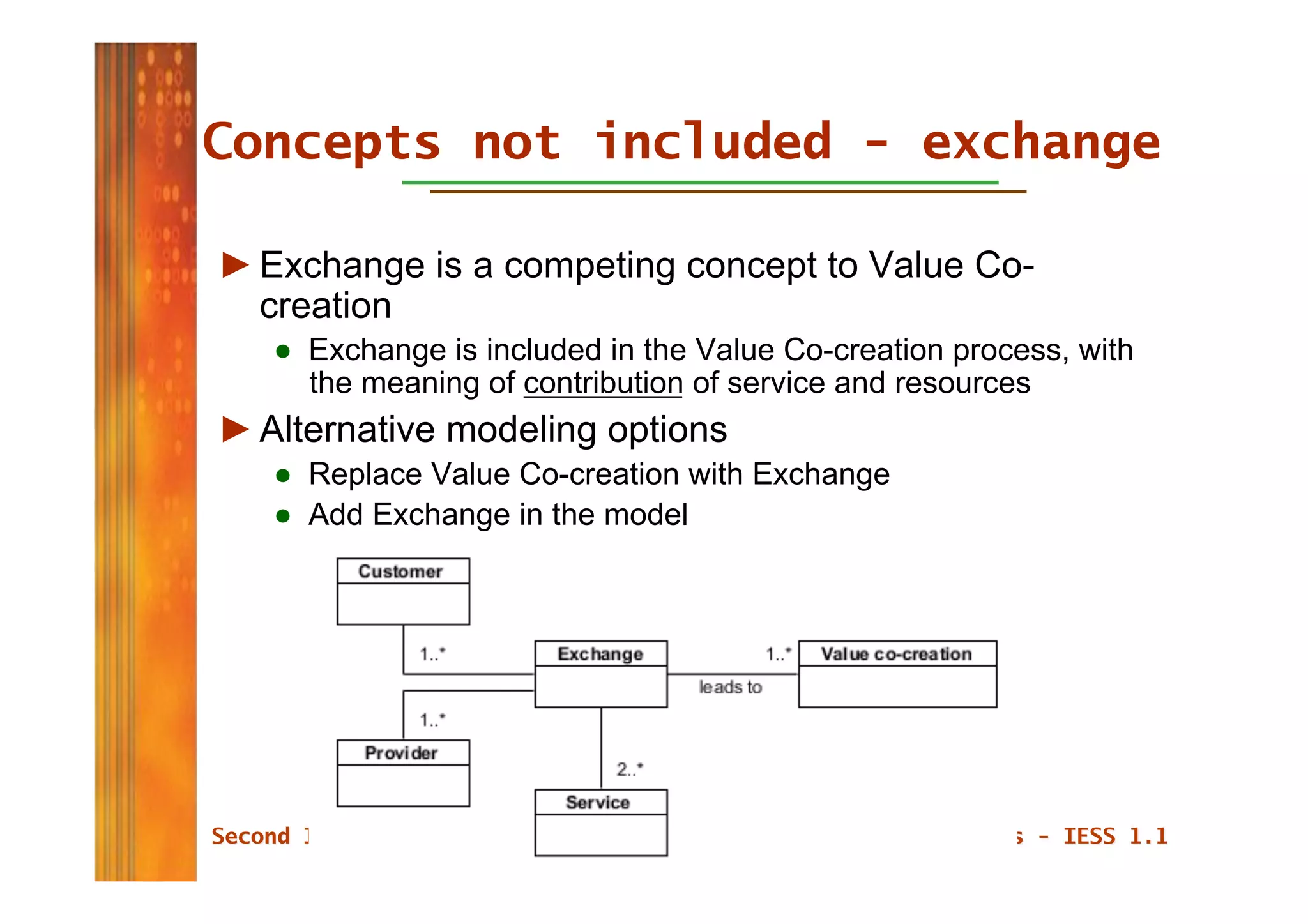
Concepts not included - exchange

► Exchange is a competing concept to Value Co-
  creation
   ●  Exchange is included in the Value Co-creation process, with
      the meaning of contribution of service and resources
► Alternative modeling options
   ●  Replace Value Co-creation with Exchange
   ●  Add Exchange in the model
Concepts not included

► Exchange (FP1 & FP2)
► Competitive advantage (FP4)
► Value proposition (FP7)
► Solution, dialogue, reciprocity/ interactivity, value-in-
  use, value-creation network and service ecosystem
  (possible entries to the S-D logic lexicon).
Problems & limitations

► The interpretation of S-D logic
   ●  Subjective interpretation, especially when the concepts are
      vague and the meaning/ implications unclear.
       •  E.g. “service is exchanged for service”
       •  “Value is always uniquely and phenomenologically determined
          by the beneficiary”
   ●  Stay with the general concepts, rather than emphasize on
      the specific words
► The ontological form (why an ontology?)
   ●  Informal vs. formal ontology
   ●  Generic vs. specific ontologies
Future research
►  The elaboration of the foundational ontology of S-D logic with
   additional concepts, relationships and rules (for example with
   regard to the types and respective processes of value co-
   creation, the types of value for the customer and the provider,
   the contextual parameters, etc.)
►  The elaboration of the foundational ontology of S-D logic with
   partial aspects aspects (e.g. business aspect, customer
   aspects, etc.).
►  Merging concepts between S-D logic and service science.
   Perhaps the development of a common/ integrated ontology.
►  The development of specific ontologies for some business
   domains or business models.
►  The formalization of the ontology.
►  The building of consensus.
Questions & comments


                       Thank you!
Gary Fragidis
Technological Education Institute of Serres
62124 Serres, Greece
E-mail: garyf@teiser.gr
tel.: +30 23 21049310

Towards an ontological foundation of service dominant logic

  • 1.
    Towards an OntologicalFoundation of Service Dominant Logic Garyfallos Fragidis Technological Education Institute of Serres, Greece Konstantinos Tarabanis University of Macedonia, Greece
  • 2.
    ► Service systems andvalue co-creation are recognized as the two most fundamental concepts of service science ●  “value co-creation is the primary object of study in service systems” ●  “service science is the study of value co-creation phenomena” Spohrer, J., Maglio, 2010; Maglio, Kieliszewski, and Spohrer, 2010 ► Service-Dominant (S-D) logic is recognized as “one of the corner stones of service science” and “the philosophical foundation of service science” Spohrer, J., Maglio, 2010 ► Service science was acknowledged to be inconsistent in applying the principles of S-D logic Maglio, Kieliszewski, and Spohrer, 2010 Vargo and Akaka, 2009; Vargo, Lusch and Akaka, 2010
  • 3.
    ► The slow developmentof service science ► The concepts of value, value creation and value co- creation, remain still unclear and vague. ●  “Value co-creation is the basic action that take place in the interaction between service systems”. ●  Value co-creation provides a balanced approach and an integrated perspective on the creation of value for the business firm an the customer alike. ► A lack of alignment between business and IT approaches in service science ●  Service science and S-D logic function at different levels of analysis and for different purposes
  • 4.
    Purpose ► Support the deeperunderstanding of S-D logic and its key concepts (e.g. service, value co-creation, etc.) ●  Provide a common framework of concepts and relations ●  Move beyond a lexicon ●  Contribute in the resolution of inconsistencies and misunderstandings ► Contribute in the establishment of S-D logic as the foundational theory of service science ●  Contribute in the assimilation of the concepts of S-D logic ► Contribute in the improved communication of experts from different areas in the multidisciplinary field of service science.
  • 5.
    Literature Review ►  Approachesthat set conceptual foundations of service systems ●  Ferrario, R., Guarino, N.: Towards an Ontological Foundation for Services Science. ●  Alter, S.: Service system fundamentals: Work system, value chain, and life cycle. ●  Stanicek, Z., Winkler, M.: Service Systems through the Prism of Conceptual Modeling. ●  O'Sullivan, J.: Towards a Precise Understanding of Service Properties. ►  Approaches that aim at the business modeling of service systems ●  Poels, G.: A Conceptual Model of Service Exchange in Service-Dominant Logic. ●  Weigand, et al.: Value-Based Service Modeling and Design: Toward a Unified View of Services. ●  Andersson et al.: Towards a Reference Ontology for Business Models. ●  Baida, Z.: Serviguration ●  De Kinderen, S., Gordijn, J.: E3service. ●  Scheithauer: Business Service Description Methodology for Service Ecosystems. ●  Sorathia, V., et. al: Towards a Unifying Process Framework for Services Knowledge Management.
  • 6.
    Literature Review ►  Relationshipto service science/ S-D logic ●  Most of them refer to service science (as a research trend) ●  Only two refer to S-D logic ●  Only three are based on input from service science and/ or S-D logic ►  The origin of the concept of service ●  Input from the business management or the economics literature ●  a) service as an event, b) service as a process, c) service as a resource ►  Customer- orientation ►  Co-production and/or value co-creation ●  Included only in two
  • 7.
    Methodology ► We stay withthe concepts of S-D logic ●  10 FP ●  Lexicon ●  The whole literature of S-D logic (by Vargo and/ or Lusch) ► Development of an ontological representation of S-D logic ●  as a class diagram ●  at a generic level
  • 8.
    Key concepts ►  Actor:a generalization of Customer and Provider ►  Service: a generalization of Direct Service and Indirect Service ►  Value Co-creation: a generalization of Co-production Integration and Customisation ►  Value: a generalization of Knowledge and Experience ►  Resource: a generalization of Operant Resource and Operand Resource ►  Context: a generalization of Situational Context and Idiosyncratic Context.
  • 9.
    An ontological representationof S-D logic: the basic concepts
  • 10.
    An ontological representationof S-D logic: the complete model
  • 11.
    Actor ►  It isa general term used to address to the entities that participate in the value co-creation process ►  Other options (suboptimal): ●  FP9: “all economic and social actors are resource integrators”. ●  In service science the basic entities are the service systems ►  Customer and Provider are the two key roles played by Actors in value co-creation processes. ●  Provider: provides Service ●  Customer: the beneficiary Actor that receives the Service provided. ●  The Customer may receive and integrate Service from many Providers and supplements them with proprietary resources. ●  The customer inherits all the attributes of an Actor
  • 12.
    Service & Resource ► Resource: any kind of input used by Actors in value co-creation processes ●  Operant Resource & Operand Resource. ►  Service: the application of specialized competences (knowledge and skills) for the benefit of another entity or the entity itself. ●  A process of applying Resources. ●  “Recourcing”: the activity of rendering resources into a specific benefit (the way that value creation occurs) ●  Direct Service & Indirect Service ●  Self-service
  • 13.
    Value Co-creation ►  ValueCo-creation: the service-based collaboration of at least one Provider, who provides Service, and at least one Customer, who integrates and complements it with proprietary Service, for the co-creation of value. ●  network relationships ●  service ecosystem ► Value Co-creation is a general concept that can be actualized in many different ways. ●  Co-production ●  Customization ●  Integration
  • 14.
    Value ►  Value: theoutput of the Value Co- creation process. ●  Value is related to the customer (“value is always uniquely and phenomenologically determined by the beneficiary”- FP10); ●  “Value-in-use” & “value-in-context” ●  Value is determined “contextually and idiosyncratically” by the customer. ●  Value affects also the Provider (“service is the fundamental basis of exchange” – FP1), namely that “service is exchanged for service”. feedback (direct and indirect). ►  Knowledge: learning opportunities for the improvement of Resources. ►  Experience: a basic way that the Customer perceives Value. ►  Context: the general conditions that exist for the co-creation of value ●  Situational Context: spatial, temporal, social and relational dimensions. ●  Idiosyncratic Context: personal needs and traits of the Customer
  • 15.
    Benefits from theontological representation of S-D logic ► The logical analysis of S-D logic: ●  provides insights ●  clarifies concepts ●  singles out inconsistencies ► Interpretation & improvement of S-D logic ► A basis for transdisciplinary communication ► A vocabulary and modeling constructs for the development of “service-based” information systems (or “value-cocreation” information systems)
  • 16.
    Service and ValueCo-creation
  • 17.
    Service and ValueCo-creation ►  Value Co-creation becomes the result of the direct application of Resources from the Actors ●  It is compliant with S-D logic ●  It is compliant with Service Science
  • 18.
    Concepts not included ► Exchange(FP1 & FP2) ► Competitive advantage (FP4) ► Value proposition (FP7) ► Solution, dialogue, reciprocity/ interactivity, value-in- use, value-creation network and service ecosystem (possible entries to the S-D logic lexicon).
  • 19.
    Concepts not included- exchange ► Exchange is a competing concept to Value Co- creation ●  Exchange is included in the Value Co-creation process, with the meaning of contribution of service and resources ► Alternative modeling options ●  Replace Value Co-creation with Exchange ●  Add Exchange in the model
  • 20.
    Concepts not included ► Exchange(FP1 & FP2) ► Competitive advantage (FP4) ► Value proposition (FP7) ► Solution, dialogue, reciprocity/ interactivity, value-in- use, value-creation network and service ecosystem (possible entries to the S-D logic lexicon).
  • 21.
    Problems & limitations ► Theinterpretation of S-D logic ●  Subjective interpretation, especially when the concepts are vague and the meaning/ implications unclear. •  E.g. “service is exchanged for service” •  “Value is always uniquely and phenomenologically determined by the beneficiary” ●  Stay with the general concepts, rather than emphasize on the specific words ► The ontological form (why an ontology?) ●  Informal vs. formal ontology ●  Generic vs. specific ontologies
  • 22.
    Future research ►  Theelaboration of the foundational ontology of S-D logic with additional concepts, relationships and rules (for example with regard to the types and respective processes of value co- creation, the types of value for the customer and the provider, the contextual parameters, etc.) ►  The elaboration of the foundational ontology of S-D logic with partial aspects aspects (e.g. business aspect, customer aspects, etc.). ►  Merging concepts between S-D logic and service science. Perhaps the development of a common/ integrated ontology. ►  The development of specific ontologies for some business domains or business models. ►  The formalization of the ontology. ►  The building of consensus.
  • 23.
    Questions & comments Thank you! Gary Fragidis Technological Education Institute of Serres 62124 Serres, Greece E-mail: garyf@teiser.gr tel.: +30 23 21049310