IESS 1.1
Second International Conference on Exploring Services Sciences
Geneva, 16-18 February 2011


  The Dual Perspective of Sustainable Development in
  Service Innovation: a Conceptual Model Proposition
   for Research and Technology Organizations (RTOs)


                           Pierre-Jean Barlatier and Eleni Giannopoulou
Background-Introduction

 ➤  Our purpose and theoretical contribution
           ➤    Propose a model of the complete image of sustainability in service innovation
 ➤  Why is this important?
    ➤  Innovation in Services
                 ●    rising topic of discussion among researchers and practitioners
                 ●    raises issues of sustainability
           ➤    Sustainable Innovation in Services has two aspects:
                 ●    Sustainable/responsible innovation (environmental, economical
                      and social constraints)
                 ●    Sustainable/continuous innovation
           ➤    BUT what about the current Research Frontier?
                 ●    Literature has been concentrated on one or the other aspect
                 ●    The combination is a more complete illustration of the concept
 ➤  Our Research Context: RTOs (higher responsibility and sensitivity
          towards both aspects of sustainability)

2/17/11                                                                                    2
A sneak-peak into the rest of the
                                                   presentation
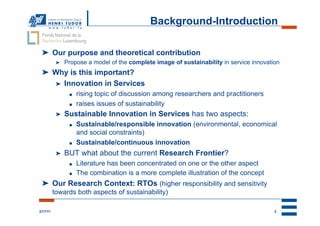
 ➤  Theoretical Elements
          ➤    The New Service Development (NSD) process
          ➤    Service Innovation through the Resource Based View (RBV) lens
                ●  Resources Combination and Resulting Capabilities

          ➤    The RTO’s assets
                ●  The Resource Base

                ●  The Experience Base

                ●  The Service Portfolio

          ➤    The two aspects of sustainability in Service Innovation (Strategy concern)
                ●  Sustainable/Continuous Innovation: Issues of Governance

                ●  Sustainable/Responsible Innovation: Environemental, Economical and

                   Social Responsibility
 ➤  The Model
 ➤  By Way of Discussion: A glance into existing models
 ➤  Conclusions


2/17/11                                                                                3
The New Service Development
                                                  (NSD) Process
 Defining the NSD process is essential
 ➤ Various models:
          ➤    NPD models (Booz, Allen and Hamilton (BAH) model (1982),
               Kline and Rosenberg (1986))
          ➤    NSD models
                ●    Linear (Shostack (1984), Scheuing and Johnson (1989), Edgett and
                     Jones (1991))
                ●    Iterative (Tax and Stuart (1997), De Jong et al. (2003), Johnson et
                     al., Zhou and Wei (2010))


 ➤  Iterative models illustrate better the NSD (control and
    flexibility)
 ➤  Including customers in NSD process (benefits and
    challenges)

2/17/11                                                                              4
The NSD through the Resource
                                   Based View (RBV) Lens
 Resource Based View (Penrose, 1959): Competitive
          advantage comes from a bundle of resources which are rare,
          valuable, imitable and without equivalent substitute
 ➤  Resources need to be managed effectively in order to create
    organizational capabilities that support the NSD process
 ➤  The capability to combine and deploy organizational resources is
    essential
 ➤  For innovative organizations (like RTOs) the aim is to develop
    innovation capabilities by deploying all their available resources
 ➤  Challenges arise: core capabilities should not become core
    rigidities (« dynamization » practices)

 ➤  The RTO needs to be aware of its assets in order to fully
    deploy and leverage them


2/17/11                                                                  5
The RTO’s Assets for Service
                                                                  Innovation
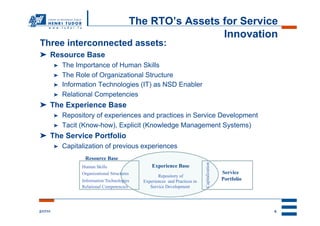
Three interconnected assets:
➤  Resource Base
          ➤    The Importance of Human Skills
          ➤    The Role of Organizational Structure
          ➤    Information Technologies (IT) as NSD Enabler
          ➤    Relational Competencies
➤  The Experience Base
          ➤    Repository of experiences and practices in Service Development
          ➤    Tacit (Know-how), Explicit (Knowledge Management Systems)
➤  The Service Portfolio
          ➤    Capitalization of previous experiences
                      Resource Base


                                                                                  Capitalization
                     Human Skills                      Experience Base
                     Organizational Structures                                                     Service
                                                          Repository of
                     Information Technologies      Experiences and Practices in                    Portfolio
                     Relational Competencies          Service Development


2/17/11                                                                                                        6
The Sustainable Development of
                                     Innovation in Services

 Reminding the two aspects:

 ➤ Sustainable/Continuous Innovation
          Governance of Resources and Capabilities for the Sustainability of
          the Innovation Process


 ➤ Sustainable/Responsible Innovation
          Environmental, Economical and Social Responsibility in Service
          Innovation


 It is a strategic concern to take care of both aspects


2/17/11                                                                    7
Sustainable/Continuous Innovation:
                         Issues of Governance (1)
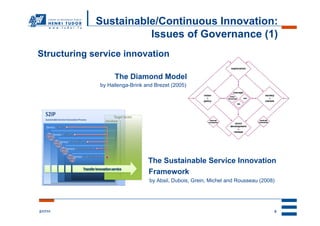
Structuring service innovation

                    The Diamond Model
               by Hallenga-Brink and Brezet (2005)


          ➤                       The Sustainable Service Innovation
                                  Framework
                                   by Absil, Dubois, Grein, Michel and Rousseau (2008)


2/17/11                                                                              8
Sustainable/Continuous Innovation:
                               Issues of Governance (2)

 ➤ Merely structuring the innovation process is not enough
   Need for an overall governance of resources and
   capabilities towards sustainability

 ➤ Lack of such effective practices, however:
    ➤  Two monitoring systems (Leitner, 2005)
          ●    Benefit: RTO learn about their knowledge production systems


 ➤ Managerial guidance rather than monitoring
 ➤ Innovation and creativity culture
 ➤ Leadership

2/17/11                                                                      9
Sustainable/Responsible Innovation:
                           Environmental, Economical and
                                     Social Responsibility

 Sustainable innovation constitutes a challenge

 ➤ RTOs due to their interrelation with academia,
   industry and government:
          ➤    Have increased responsibility towards society
 BUT also
          ➤    Can influence and shape innovation systems
          ➤    Can assist in the development of a sustainable innovation
               policy
          ➤    Can bridge the sustainability incentives gap between industry
               and government


2/17/11                                                                        10
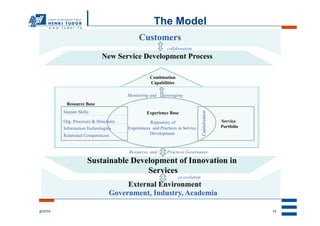
The Model
                                          Customers
                                          Customers
                                                       collaboration
                             New Service Development Process

                                               Combination
                                               Capabilities

                                     Monitoring and   leveraging
           Resource Base
          Human Skills          Organizational Assets for
                                                 Experience Base


                                                                             Capitalization
          Org. Processes & Structures
          Information Technologies
                                      Service Repository of in Service
                                                   Innovation
                                        Experiences and Practices
                                                                                              Service
                                                                                              Portfolio
          Relational Competencies              Development


                                     Resources and      Practices Governance

                     Sustainable Development of Innovation in
                                     Services
                                                              co-evolution
                                     External Environment
                                Government, Industry, Academia

2/17/11                                                                                                   11
A Glance at Existing Models

 ➤  Implications for the traditional sustainability in the innovation
    process (integrated strategy towards sustainability)
 ➤  Local references to sustainability (NSD process or culture)
 ➤  Noteworthy models:
     ➤  Brezet et al. (2001): a development process taking into account
        environmental issues at every step
     ➤  Flores et al. (2010): Four enablers to sustainable innovation;
        mass customization, value network, sustainable development
        and the complete product or service lifecycle
     ➤  Sustainable adaptation of the Diamond Model (Brezet et al.).


 ➤ However none of these models captures both
   internal and external aspects of sustainability


2/17/11                                                              12
Conclusions – Further Research
 ➤ Theoretical Contribution on the sustainable
   development of service innovation
          ➤    Two aspects of sustainability:
                ●    Sustainable/Continuous Service Innovation
                ●    Sustainable/Responsible Service Innovation
          ➤    Internal and External factors for service innovation


 ➤ Practical contributions
          ➤    From the qualitative, multiple case studies of European RTOs


 ➤ Expected benefits
          ➤    Validate and refine the model
          ➤    Valuable insights of sustainable service innovation current practices
               within RTOs
          ➤    Results maybe a source of inspiration for RTOs and other knowledge
               intensive organizations

2/17/11                                                                            13
Thank you

          Comments and Questions?


2/17/11                             14

Sustainable service innovation

  • 1.
    IESS 1.1 Second InternationalConference on Exploring Services Sciences Geneva, 16-18 February 2011 The Dual Perspective of Sustainable Development in Service Innovation: a Conceptual Model Proposition for Research and Technology Organizations (RTOs) Pierre-Jean Barlatier and Eleni Giannopoulou
  • 2.
    Background-Introduction ➤  Ourpurpose and theoretical contribution ➤  Propose a model of the complete image of sustainability in service innovation ➤  Why is this important? ➤  Innovation in Services ●  rising topic of discussion among researchers and practitioners ●  raises issues of sustainability ➤  Sustainable Innovation in Services has two aspects: ●  Sustainable/responsible innovation (environmental, economical and social constraints) ●  Sustainable/continuous innovation ➤  BUT what about the current Research Frontier? ●  Literature has been concentrated on one or the other aspect ●  The combination is a more complete illustration of the concept ➤  Our Research Context: RTOs (higher responsibility and sensitivity towards both aspects of sustainability) 2/17/11 2
  • 3.
    A sneak-peak intothe rest of the presentation ➤  Theoretical Elements ➤  The New Service Development (NSD) process ➤  Service Innovation through the Resource Based View (RBV) lens ●  Resources Combination and Resulting Capabilities ➤  The RTO’s assets ●  The Resource Base ●  The Experience Base ●  The Service Portfolio ➤  The two aspects of sustainability in Service Innovation (Strategy concern) ●  Sustainable/Continuous Innovation: Issues of Governance ●  Sustainable/Responsible Innovation: Environemental, Economical and Social Responsibility ➤  The Model ➤  By Way of Discussion: A glance into existing models ➤  Conclusions 2/17/11 3
  • 4.
    The New ServiceDevelopment (NSD) Process Defining the NSD process is essential ➤ Various models: ➤  NPD models (Booz, Allen and Hamilton (BAH) model (1982), Kline and Rosenberg (1986)) ➤  NSD models ●  Linear (Shostack (1984), Scheuing and Johnson (1989), Edgett and Jones (1991)) ●  Iterative (Tax and Stuart (1997), De Jong et al. (2003), Johnson et al., Zhou and Wei (2010)) ➤  Iterative models illustrate better the NSD (control and flexibility) ➤  Including customers in NSD process (benefits and challenges) 2/17/11 4
  • 5.
    The NSD throughthe Resource Based View (RBV) Lens Resource Based View (Penrose, 1959): Competitive advantage comes from a bundle of resources which are rare, valuable, imitable and without equivalent substitute ➤  Resources need to be managed effectively in order to create organizational capabilities that support the NSD process ➤  The capability to combine and deploy organizational resources is essential ➤  For innovative organizations (like RTOs) the aim is to develop innovation capabilities by deploying all their available resources ➤  Challenges arise: core capabilities should not become core rigidities (« dynamization » practices) ➤  The RTO needs to be aware of its assets in order to fully deploy and leverage them 2/17/11 5
  • 6.
    The RTO’s Assetsfor Service Innovation Three interconnected assets: ➤  Resource Base ➤  The Importance of Human Skills ➤  The Role of Organizational Structure ➤  Information Technologies (IT) as NSD Enabler ➤  Relational Competencies ➤  The Experience Base ➤  Repository of experiences and practices in Service Development ➤  Tacit (Know-how), Explicit (Knowledge Management Systems) ➤  The Service Portfolio ➤  Capitalization of previous experiences Resource Base Capitalization Human Skills Experience Base Organizational Structures Service Repository of Information Technologies Experiences and Practices in Portfolio Relational Competencies Service Development 2/17/11 6
  • 7.
    The Sustainable Developmentof Innovation in Services Reminding the two aspects: ➤ Sustainable/Continuous Innovation Governance of Resources and Capabilities for the Sustainability of the Innovation Process ➤ Sustainable/Responsible Innovation Environmental, Economical and Social Responsibility in Service Innovation It is a strategic concern to take care of both aspects 2/17/11 7
  • 8.
    Sustainable/Continuous Innovation: Issues of Governance (1) Structuring service innovation The Diamond Model by Hallenga-Brink and Brezet (2005) ➤  The Sustainable Service Innovation Framework by Absil, Dubois, Grein, Michel and Rousseau (2008) 2/17/11 8
  • 9.
    Sustainable/Continuous Innovation: Issues of Governance (2) ➤ Merely structuring the innovation process is not enough Need for an overall governance of resources and capabilities towards sustainability ➤ Lack of such effective practices, however: ➤  Two monitoring systems (Leitner, 2005) ●  Benefit: RTO learn about their knowledge production systems ➤ Managerial guidance rather than monitoring ➤ Innovation and creativity culture ➤ Leadership 2/17/11 9
  • 10.
    Sustainable/Responsible Innovation: Environmental, Economical and Social Responsibility Sustainable innovation constitutes a challenge ➤ RTOs due to their interrelation with academia, industry and government: ➤  Have increased responsibility towards society BUT also ➤  Can influence and shape innovation systems ➤  Can assist in the development of a sustainable innovation policy ➤  Can bridge the sustainability incentives gap between industry and government 2/17/11 10
  • 11.
    The Model Customers Customers collaboration New Service Development Process Combination Capabilities Monitoring and leveraging Resource Base Human Skills Organizational Assets for Experience Base Capitalization Org. Processes & Structures Information Technologies Service Repository of in Service Innovation Experiences and Practices Service Portfolio Relational Competencies Development Resources and Practices Governance Sustainable Development of Innovation in Services co-evolution External Environment Government, Industry, Academia 2/17/11 11
  • 12.
    A Glance atExisting Models ➤  Implications for the traditional sustainability in the innovation process (integrated strategy towards sustainability) ➤  Local references to sustainability (NSD process or culture) ➤  Noteworthy models: ➤  Brezet et al. (2001): a development process taking into account environmental issues at every step ➤  Flores et al. (2010): Four enablers to sustainable innovation; mass customization, value network, sustainable development and the complete product or service lifecycle ➤  Sustainable adaptation of the Diamond Model (Brezet et al.). ➤ However none of these models captures both internal and external aspects of sustainability 2/17/11 12
  • 13.
    Conclusions – FurtherResearch ➤ Theoretical Contribution on the sustainable development of service innovation ➤  Two aspects of sustainability: ●  Sustainable/Continuous Service Innovation ●  Sustainable/Responsible Service Innovation ➤  Internal and External factors for service innovation ➤ Practical contributions ➤  From the qualitative, multiple case studies of European RTOs ➤ Expected benefits ➤  Validate and refine the model ➤  Valuable insights of sustainable service innovation current practices within RTOs ➤  Results maybe a source of inspiration for RTOs and other knowledge intensive organizations 2/17/11 13
  • 14.
    Thank you Comments and Questions? 2/17/11 14