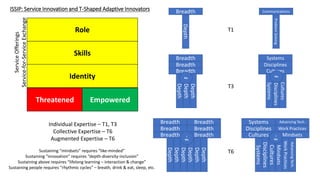
ISSIP: Service Innovation and T-Shaped Adaptive Innovators Breadth
Depth
Breadth
Depth
Depth
Depth
Breadth
Breadth
Breadth
Depth
Depth
Depth
Breadth
Breadth
Breadth
Depth
Depth
Depth
Breadth
Breadth
Communications
Problem
Solving
Cultures
Systems
Disciplines
Cultures
Disciplines
Systems
Cultures
Systems
Disciplines
Cultures
Disciplines
Systems
Mindsets
Mindsets
Work
Practices
Advancing
Tech.
Work Practices
Advancing Tech.
Individual Expertise – T1, T3
Collective Expertise – T6
Augmented Expertise – T6
Role
Skills
Identity
Threatened Empowered
Service
Offerings
Service-for-Service
Exchange
Sustaining “mindsets” requires “like-minded”
Sustaining “innovation” requires “depth-diversity-inclusion”
Sustaining above requires “lifelong learning – interaction & change”
Sustaining people requires “rhythmic cycles” – breath, drink & eat, sleep, etc.
T1
T3
T6
I
We
I
We
Me
Me
7/13/2022
The International Society of Service Innovation Professionals
(ISSIP.org)
2
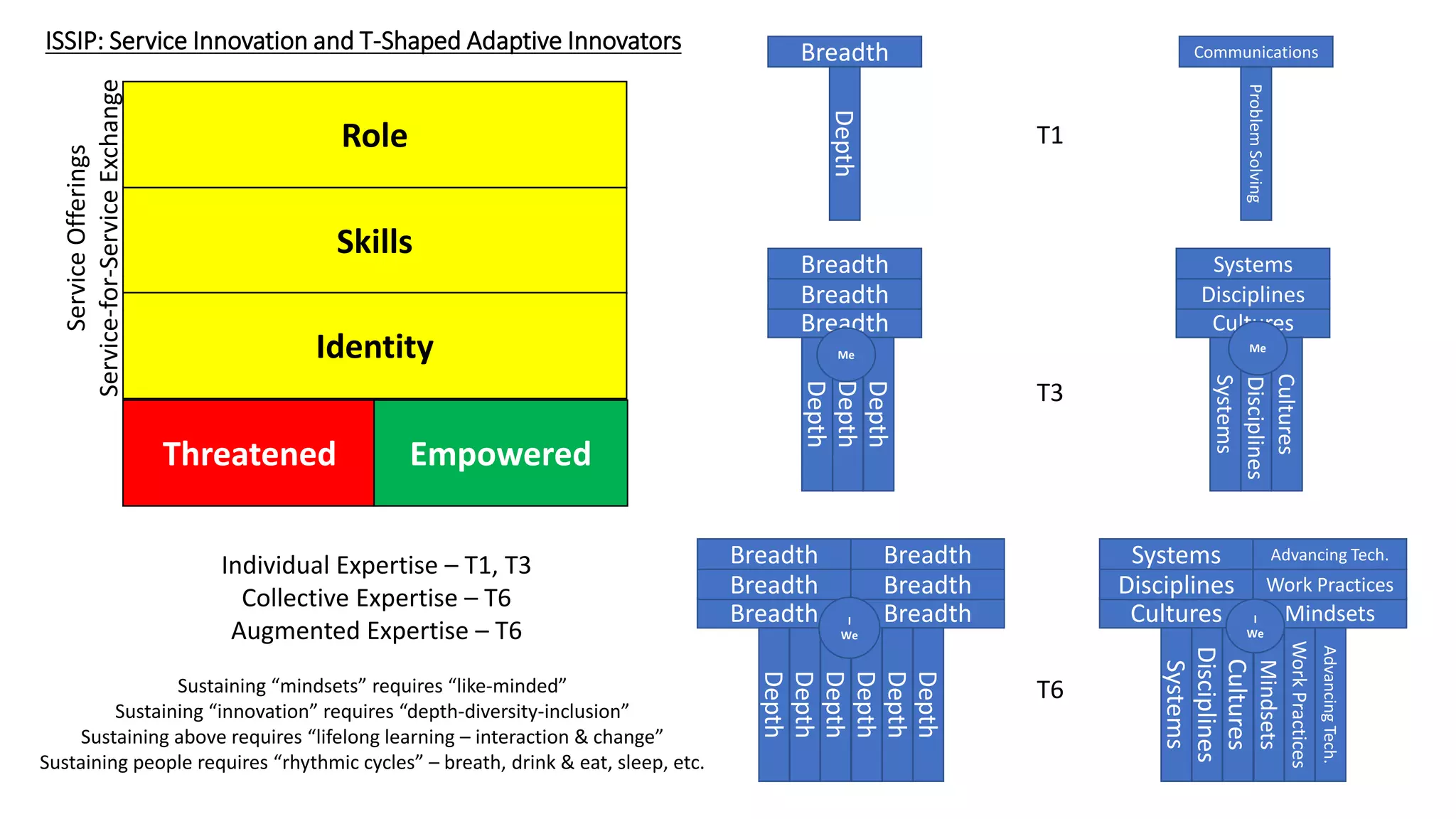
Advanced Tech: Cloud, AI,IoT ,Quantum, GreenTech, RegTech,
Work Practices: Agile, Service Design, Open Source
Mindsets: Growth Mindset, Positive Mindset, Entrepreneurial
Many disciplines
Many sectors
Many regions/cultures
(understanding & communications)
Deep
in
one
sector
Deep
in
one
region/culture
Deep
in
one
discipline
Disciplines: Management, Engineering, Social Sciences, etc.
Sectors/Systems: Transportation, Retail, Education, Healthcare, etc.
Cultures/Regions: USA, Mexico, Europe, Asia, Indigenous, etc.
In sum, IBM Smarter Planet depends on T-shaped Talent depends on Service Science which depends on S-D Logic
7/13/2022
The International Society of Service Innovation Professionals
(ISSIP.org)
3
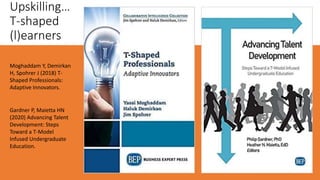
Heather McGowan
Upskilling…
T-shaped
(l)earners
Gardner P, Maietta HN
(2020) Advancing Talent
Development: Steps
Toward a T-Model
Infused Undergraduate
Education.
Moghaddam Y, Demirkan
H, Spohrer J (2018) T-
Shaped Professionals:
Adaptive Innovators.
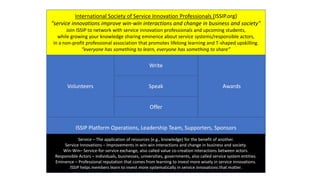
Write
Speak
Offer
Awards
Volunteers
ISSIP Platform Operations, Leadership Team, Supporters, Sponsors
International Society of Service Innovation Professionals (ISSIP.org)
“service innovations improve win-win interactions and change in business and society”
Join ISSIP to network with service innovation professionals and upcoming students,
while growing your knowledge sharing eminence about service systems/responsible actors,
in a non-profit professional association that promotes lifelong learning and T-shaped upskilling.
“everyone has something to learn, everyone has something to share”
Service – The application of resources (e.g., knowledge) for the benefit of another.
Service Innovations – Improvements in win-win interactions and change in business and society.
Win-Win– Service-for-service exchange, also called value co-creation interactions between actors.
Responsible Actors – individuals, businesses, universities, governments, also called service system entities.
Eminence – Professional reputation that comes from learning to invest more wisely in service innovations.
ISSIP helps members learn to invest more systematically in service innovations that matter.
5/18/22, 6:57 AM
Page 1 of 2
https://media.licdn.com/embeds/native- document.html?li_theme=light
See Ricardo Martins - https://www.linkedin.com/in/ricardoalexmartins/
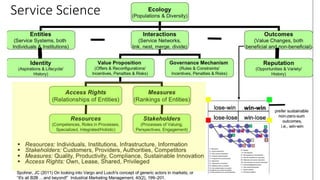
Service Science: Conceptual Framework
7/13/2022 (c) IBM MAP COG .| 10
Service Science
(c) IBM MAP COG .| 11
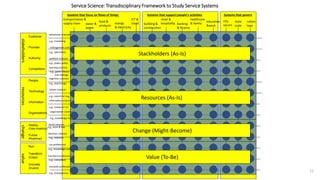
Service Science: Transdisciplinary Framework to Study Service Systems
Systems that focus on flows of things Systems that govern
Systems that support people’s activities
transportation &
supply chain water &
waste
food &
products
energy
& electricity
building &
construction
healthcare
& family
retail &
hospitality banking
& finance
ICT &
cloud
education
&work
city
secure
state
scale
nation
laws
social sciences
behavioral sciences
management sciences
political sciences
learning sciences
cognitive sciences
system sciences
information sciences
organization sciences
decision sciences
run professions
transform professions
innovate professions
e.g., econ & law
e.g., marketing
e.g., operations
e.g., public policy
e.g., game theory
and strategy
e.g., psychology
e.g., industrial eng.
e.g., computer sci
e.g., knowledge mgmt
e.g., statistics
e.g., knowledge worker
e.g., consultant
e.g., entrepreneur
stakeholders
Customer
Provider
Authority
Competitors
resources
People
Technology
Information
Organizations
change
History
(Data Analytics)
Future
(Roadmap)
value
Run
Transform
(Copy)
Innovate
(Invent)
Stackholders (As-Is)
Resources (As-Is)
Change (Might-Become)
Value (To-Be)
12
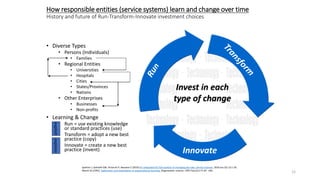
How responsible entities (service systems) learn and change over time
History and future of Run-Transform-Innovate investment choices
• Diverse Types
• Persons (Individuals)
• Families
• Regional Entities
• Universities
• Hospitals
• Cities
• States/Provinces
• Nations
• Other Enterprises
• Businesses
• Non-profits
• Learning & Change
• Run = use existing knowledge
or standard practices (use)
• Transform = adopt a new best
practice (copy)
• Innovate = create a new best
practice (invent) Innovate
Invest in each
type of change
Spohrer J, Golinelli GM, Piciocchi P, Bassano C (2010) An integrated SS-VSA analysis of changing job roles. Service Science. 2010 Jun;2(1-2):1-20.
March JG (1991) Exploration and exploitation in organizational learning. Organization science. 1991 Feb;2(1):71-87. URL:
exploit
explore
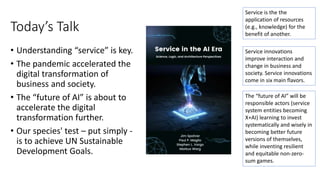
Today’s Talk
• Understanding “service” is key.
• The pandemic accelerated the
digital transformation of
business and society.
• The “future of AI” is about to
accelerate the digital
transformation further.
• Our species' test – put simply -
is to achieve UN Sustainable
Development Goals.
Service is the the
application of resources
(e.g., knowledge) for the
benefit of another.
Service innovations
improve interaction and
change in business and
society. Service innovations
come in six main flavors.
The “future of AI” will be
responsible actors (service
system entities becoming
X+AI) learning to invest
systematically and wisely in
becoming better future
versions of themselves,
while inventing resilient
and equitable non-zero-
sum games.
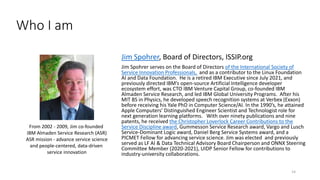
Jim Spohrer, Board of Directors, ISSIP.org
Jim Spohrer serves on the Board of Directors of the International Society of
Service Innovation Professionals, and as a contributor to the Linux Foundation
AI and Data Foundation. He is a retired IBM Executive since July 2021, and
previously directed IBM’s open-source Artificial Intelligence developer
ecosystem effort, was CTO IBM Venture Capital Group, co-founded IBM
Almaden Service Research, and led IBM Global University Programs. After his
MIT BS in Physics, he developed speech recognition systems at Verbex (Exxon)
before receiving his Yale PhD in Computer Science/AI. In the 1990’s, he attained
Apple Computers’ Distinguished Engineer Scientist and Technologist role for
next generation learning platforms. With over ninety publications and nine
patents, he received the Christopher Loverlock Career Contributions to the
Service Discipline award, Gummesson Service Research award, Vargo and Lusch
Service-Dominant Logic award, Daniel Berg Service Systems award, and a
PICMET Fellow for advancing service science. Jim was elected and previously
served as LF AI & Data Technical Advisory Board Chairperson and ONNX Steering
Committee Member (2020-2021), UIDP Senior Fellow for contributions to
industry-university collaborations.
14
From 2002 - 2009, Jim co-founded
IBM Almaden Service Research (ASR)
ASR mission - advance service science
and people-centered, data-driven
service innovation
Who I am
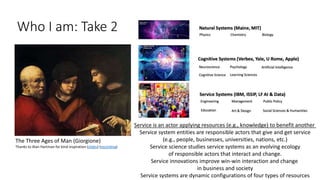
Who I am: Take 2
The Three Ages of Man (Giorgione)
Thanks to Alan Hartman for kind inspiration (slides) (recording)
Service is an actor applying resources (e.g., knowledge) to benefit another
Service system entities are responsible actors that give and get service
(e.g., people, businesses, universities, nations, etc.)
Service science studies service systems as an evolving ecology
of responsible actors that interact and change.
Service innovations improve win-win interaction and change
in business and society
Service systems are dynamic configurations of four types of resources

T6 20220713 v11.pptx

  • 1.
    ISSIP: Service Innovationand T-Shaped Adaptive Innovators Breadth Depth Breadth Depth Depth Depth Breadth Breadth Breadth Depth Depth Depth Breadth Breadth Breadth Depth Depth Depth Breadth Breadth Communications Problem Solving Cultures Systems Disciplines Cultures Disciplines Systems Cultures Systems Disciplines Cultures Disciplines Systems Mindsets Mindsets Work Practices Advancing Tech. Work Practices Advancing Tech. Individual Expertise – T1, T3 Collective Expertise – T6 Augmented Expertise – T6 Role Skills Identity Threatened Empowered Service Offerings Service-for-Service Exchange Sustaining “mindsets” requires “like-minded” Sustaining “innovation” requires “depth-diversity-inclusion” Sustaining above requires “lifelong learning – interaction & change” Sustaining people requires “rhythmic cycles” – breath, drink & eat, sleep, etc. T1 T3 T6 I We I We Me Me
  • 2.
    7/13/2022 The International Societyof Service Innovation Professionals (ISSIP.org) 2 Advanced Tech: Cloud, AI,IoT ,Quantum, GreenTech, RegTech, Work Practices: Agile, Service Design, Open Source Mindsets: Growth Mindset, Positive Mindset, Entrepreneurial Many disciplines Many sectors Many regions/cultures (understanding & communications) Deep in one sector Deep in one region/culture Deep in one discipline Disciplines: Management, Engineering, Social Sciences, etc. Sectors/Systems: Transportation, Retail, Education, Healthcare, etc. Cultures/Regions: USA, Mexico, Europe, Asia, Indigenous, etc. In sum, IBM Smarter Planet depends on T-shaped Talent depends on Service Science which depends on S-D Logic
  • 3.
    7/13/2022 The International Societyof Service Innovation Professionals (ISSIP.org) 3
  • 4.
  • 5.
    Upskilling… T-shaped (l)earners Gardner P, MaiettaHN (2020) Advancing Talent Development: Steps Toward a T-Model Infused Undergraduate Education. Moghaddam Y, Demirkan H, Spohrer J (2018) T- Shaped Professionals: Adaptive Innovators.
  • 6.
    Write Speak Offer Awards Volunteers ISSIP Platform Operations,Leadership Team, Supporters, Sponsors International Society of Service Innovation Professionals (ISSIP.org) “service innovations improve win-win interactions and change in business and society” Join ISSIP to network with service innovation professionals and upcoming students, while growing your knowledge sharing eminence about service systems/responsible actors, in a non-profit professional association that promotes lifelong learning and T-shaped upskilling. “everyone has something to learn, everyone has something to share” Service – The application of resources (e.g., knowledge) for the benefit of another. Service Innovations – Improvements in win-win interactions and change in business and society. Win-Win– Service-for-service exchange, also called value co-creation interactions between actors. Responsible Actors – individuals, businesses, universities, governments, also called service system entities. Eminence – Professional reputation that comes from learning to invest more wisely in service innovations. ISSIP helps members learn to invest more systematically in service innovations that matter.
  • 8.
    5/18/22, 6:57 AM Page1 of 2 https://media.licdn.com/embeds/native- document.html?li_theme=light See Ricardo Martins - https://www.linkedin.com/in/ricardoalexmartins/
  • 10.
    Service Science: ConceptualFramework 7/13/2022 (c) IBM MAP COG .| 10 Service Science
  • 11.
    (c) IBM MAPCOG .| 11 Service Science: Transdisciplinary Framework to Study Service Systems Systems that focus on flows of things Systems that govern Systems that support people’s activities transportation & supply chain water & waste food & products energy & electricity building & construction healthcare & family retail & hospitality banking & finance ICT & cloud education &work city secure state scale nation laws social sciences behavioral sciences management sciences political sciences learning sciences cognitive sciences system sciences information sciences organization sciences decision sciences run professions transform professions innovate professions e.g., econ & law e.g., marketing e.g., operations e.g., public policy e.g., game theory and strategy e.g., psychology e.g., industrial eng. e.g., computer sci e.g., knowledge mgmt e.g., statistics e.g., knowledge worker e.g., consultant e.g., entrepreneur stakeholders Customer Provider Authority Competitors resources People Technology Information Organizations change History (Data Analytics) Future (Roadmap) value Run Transform (Copy) Innovate (Invent) Stackholders (As-Is) Resources (As-Is) Change (Might-Become) Value (To-Be)
  • 12.
    12 How responsible entities(service systems) learn and change over time History and future of Run-Transform-Innovate investment choices • Diverse Types • Persons (Individuals) • Families • Regional Entities • Universities • Hospitals • Cities • States/Provinces • Nations • Other Enterprises • Businesses • Non-profits • Learning & Change • Run = use existing knowledge or standard practices (use) • Transform = adopt a new best practice (copy) • Innovate = create a new best practice (invent) Innovate Invest in each type of change Spohrer J, Golinelli GM, Piciocchi P, Bassano C (2010) An integrated SS-VSA analysis of changing job roles. Service Science. 2010 Jun;2(1-2):1-20. March JG (1991) Exploration and exploitation in organizational learning. Organization science. 1991 Feb;2(1):71-87. URL: exploit explore
  • 13.
    Today’s Talk • Understanding“service” is key. • The pandemic accelerated the digital transformation of business and society. • The “future of AI” is about to accelerate the digital transformation further. • Our species' test – put simply - is to achieve UN Sustainable Development Goals. Service is the the application of resources (e.g., knowledge) for the benefit of another. Service innovations improve interaction and change in business and society. Service innovations come in six main flavors. The “future of AI” will be responsible actors (service system entities becoming X+AI) learning to invest systematically and wisely in becoming better future versions of themselves, while inventing resilient and equitable non-zero- sum games.
  • 14.
    Jim Spohrer, Boardof Directors, ISSIP.org Jim Spohrer serves on the Board of Directors of the International Society of Service Innovation Professionals, and as a contributor to the Linux Foundation AI and Data Foundation. He is a retired IBM Executive since July 2021, and previously directed IBM’s open-source Artificial Intelligence developer ecosystem effort, was CTO IBM Venture Capital Group, co-founded IBM Almaden Service Research, and led IBM Global University Programs. After his MIT BS in Physics, he developed speech recognition systems at Verbex (Exxon) before receiving his Yale PhD in Computer Science/AI. In the 1990’s, he attained Apple Computers’ Distinguished Engineer Scientist and Technologist role for next generation learning platforms. With over ninety publications and nine patents, he received the Christopher Loverlock Career Contributions to the Service Discipline award, Gummesson Service Research award, Vargo and Lusch Service-Dominant Logic award, Daniel Berg Service Systems award, and a PICMET Fellow for advancing service science. Jim was elected and previously served as LF AI & Data Technical Advisory Board Chairperson and ONNX Steering Committee Member (2020-2021), UIDP Senior Fellow for contributions to industry-university collaborations. 14 From 2002 - 2009, Jim co-founded IBM Almaden Service Research (ASR) ASR mission - advance service science and people-centered, data-driven service innovation Who I am
  • 15.
    Who I am:Take 2 The Three Ages of Man (Giorgione) Thanks to Alan Hartman for kind inspiration (slides) (recording) Service is an actor applying resources (e.g., knowledge) to benefit another Service system entities are responsible actors that give and get service (e.g., people, businesses, universities, nations, etc.) Service science studies service systems as an evolving ecology of responsible actors that interact and change. Service innovations improve win-win interaction and change in business and society Service systems are dynamic configurations of four types of resources