The Human Side of Service Science,
     Engineering and Management
    Challenges and Justifications for A User-
Centric Quality Model of Services and Service
                                     Systems

                              Ahmed Seffah
    Keynote talk for the Second International
 Conference on Exploring Services Sciences,
                 Geneva, February 16, 2011
Human-Centric Quality Model

For today, how/for what and not why?
Agenda

 Quality attributes and model of services
  and service systems
 Implications on/for human-centric service
  design
 Persona, measures and patterns as
  design tools
Motivations
 Software and service
 Service as a software
 Service systems and software systems
 Service-oriented engineering
   Where previously objects were linked to
    compose software systems,
   We now see the emergence of independent
    services that can be put together dynamically at
    run time to form a system of services
Motivations
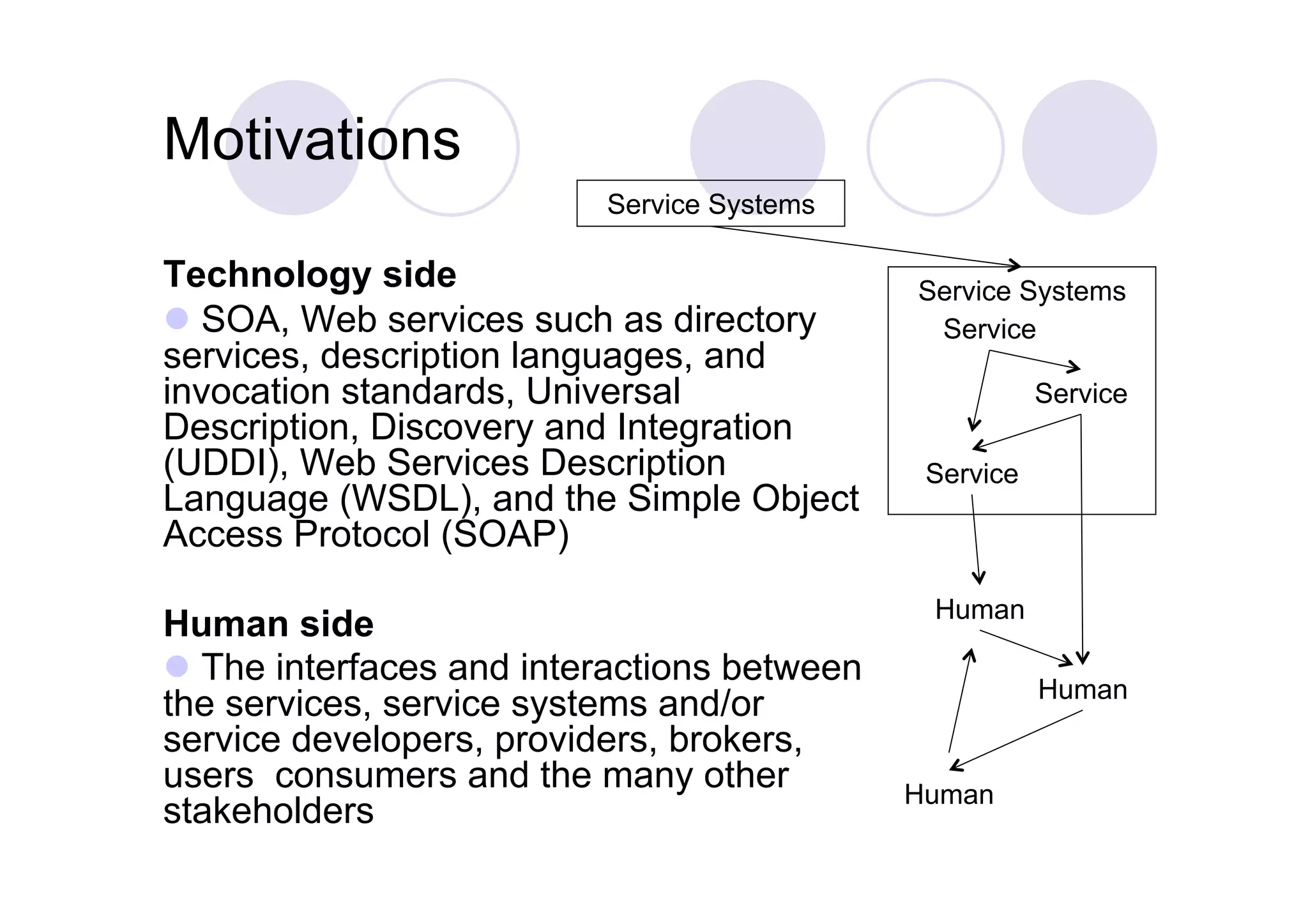
                          Service Systems

Technology side                              Service Systems
  SOA, Web services such as directory        Service
services, description languages, and
invocation standards, Universal                         Service
Description, Discovery and Integration
(UDDI), Web Services Description              Service
Language (WSDL), and the Simple Object
Access Protocol (SOAP)
                                              Human
Human side
  The interfaces and interactions between
                                                        Human
the services, service systems and/or
service developers, providers, brokers,
users consumers and the many other           Human
stakeholders
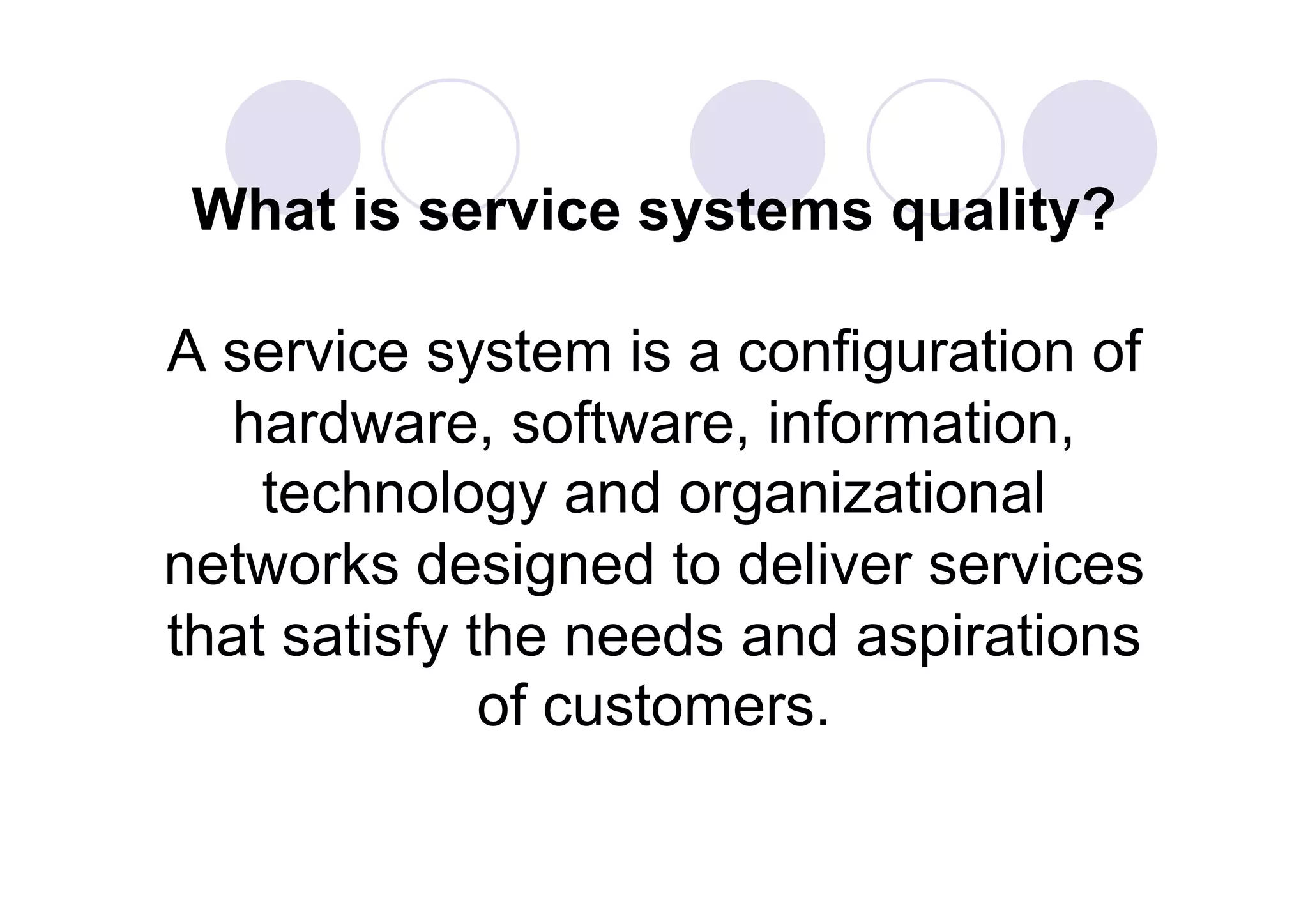
What is service systems quality?

A service system is a configuration of
   hardware, software, information,
    technology and organizational
networks designed to deliver services
that satisfy the needs and aspirations
              of customers.
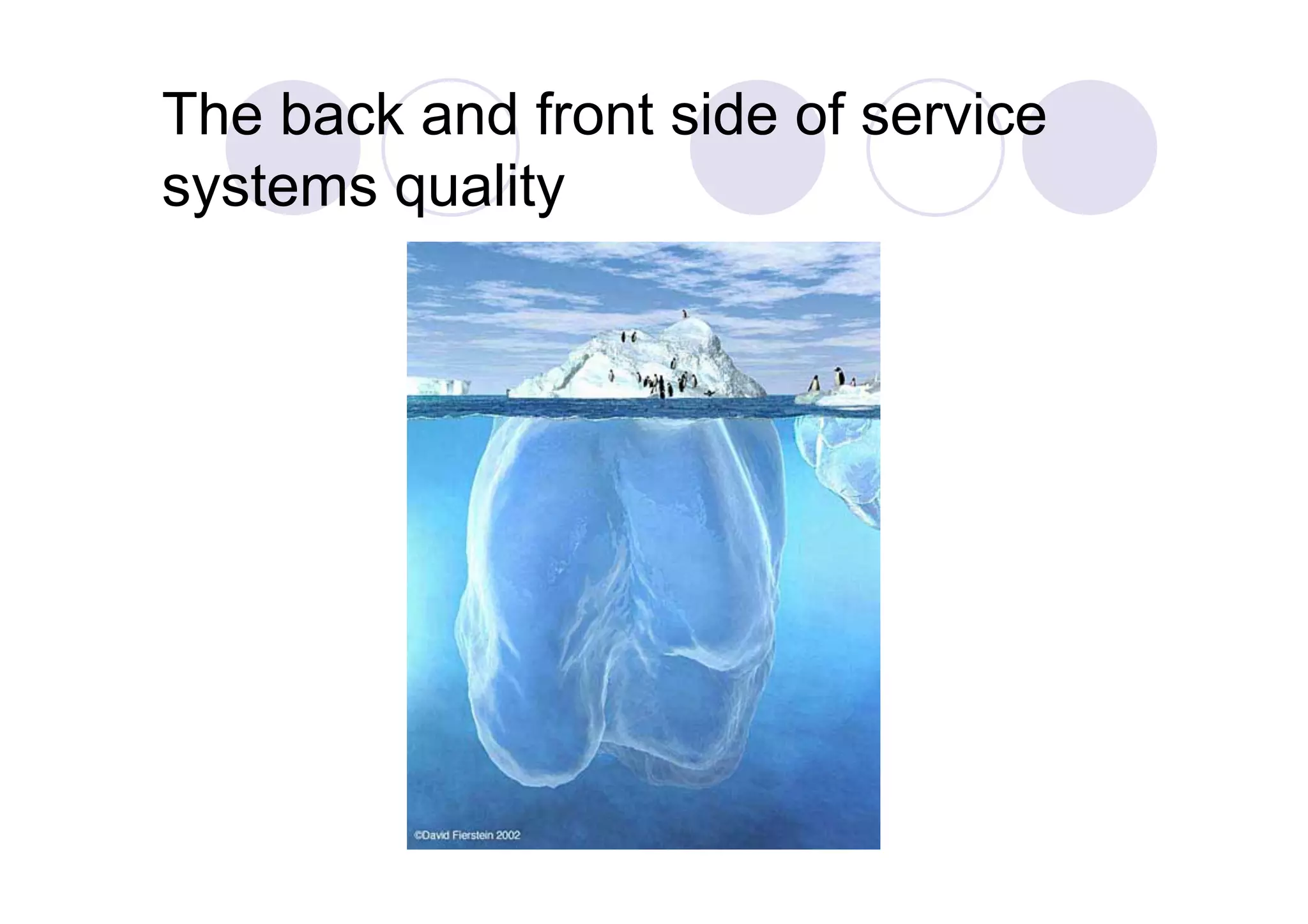
The back and front side of service
systems quality
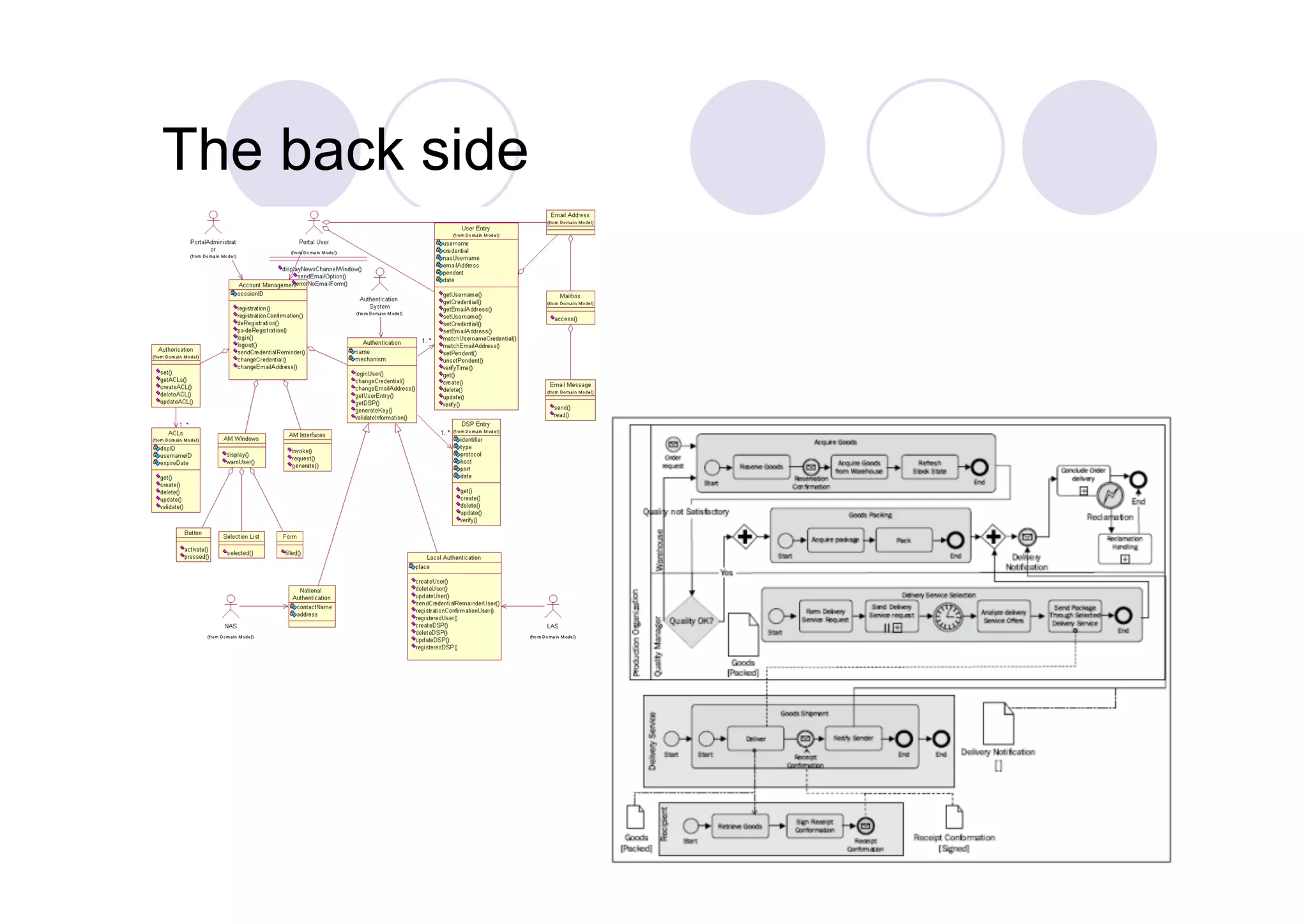
The back side
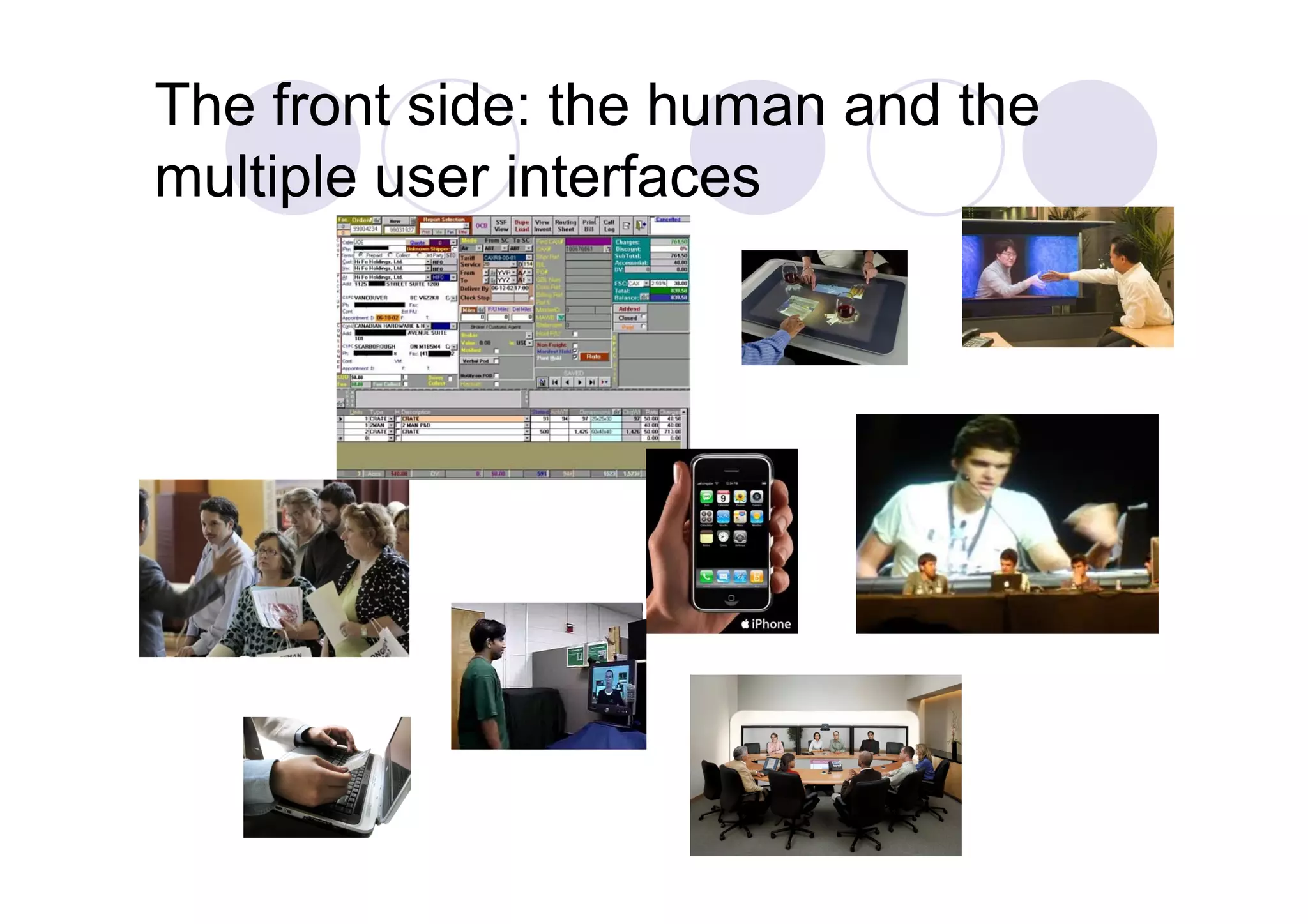
The front side: the human and the
multiple user interfaces
Existing service quality model
SERVQUAL
   Service quality can be measured as the gap between
    the service that customers expect and the
    performance they perceive to have received.

 Respondents rate their expectations of service
  from an excellent organization, and then rate the
  performance they received
 Service quality is calculated as the difference in
  the two scores where better service quality
  results in a smaller gap (Landrum, Prybutok,
  Kappelman, & Zhang, 2008).
The 10 aspects of service quality in
EVALQUAL
 Reliability, responsiveness, competence,
  access, courtesy, communication, credibility,
  security, understanding or knowing the customer
  and tangibles

  Nyeck, S., Morales, M., Ladhari, R., & Pons, F.
  (2002). "10 years of service quality
  measurement: reviewing the use of the
  SERVQUAL instrument."
Other models

 Variants of SERVIQUAL such as
  SERVPERF
 Satisfaction questionnaire
 Key indicators performance (KPIs)
 ISO standards such as ISO 9000, ISO
  9126, etc.
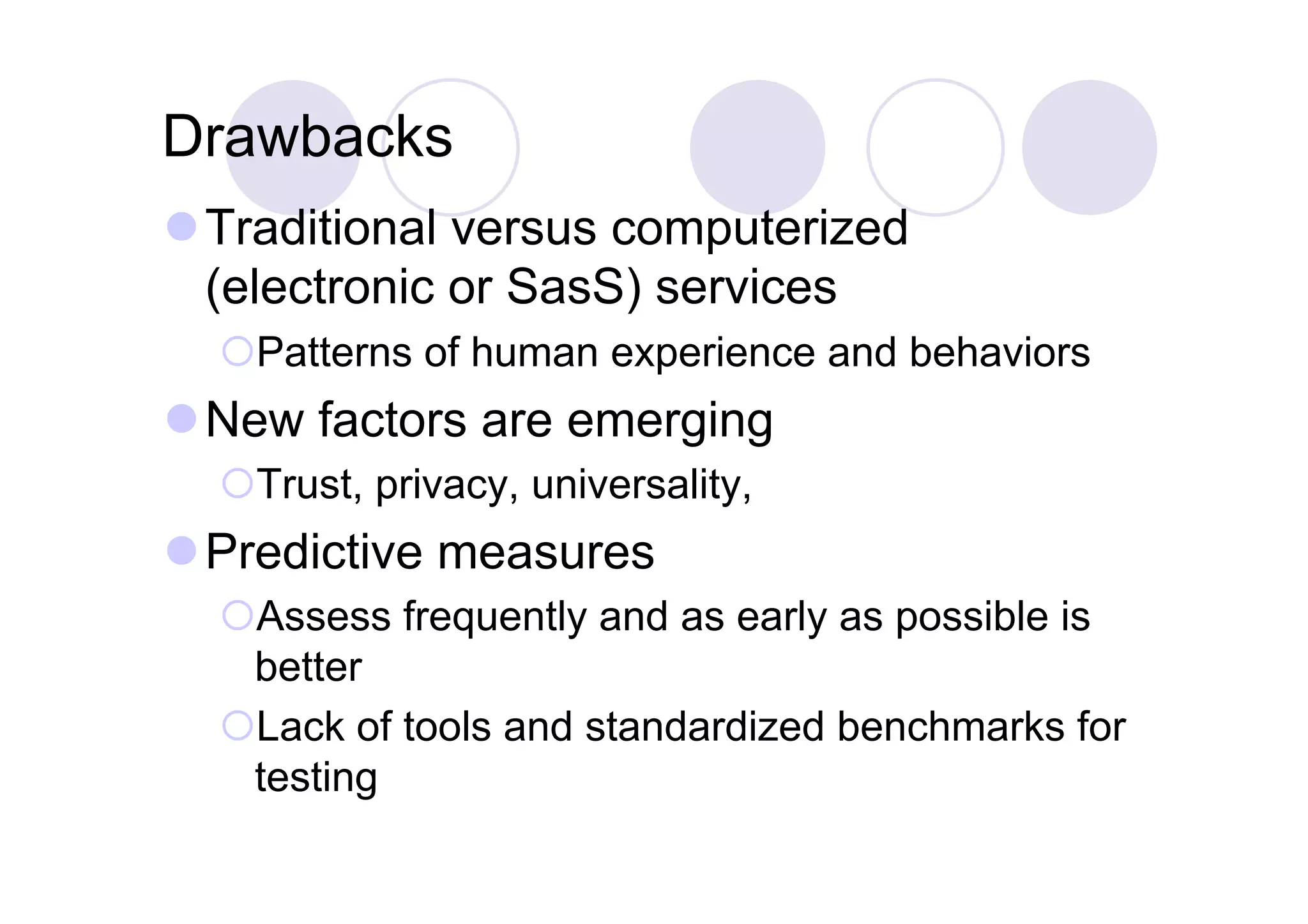
Drawbacks
 Traditional versus computerized
  (electronic or SasS) services
   Patterns of human experience and behaviors
 New factors are emerging
   Trust, privacy, universality,
 Predictive measures
   Assess frequently and as early as possible is
   better
   Lack of tools and standardized benchmarks for
   testing
Beside quality models, design
patterns …
 Proven solutions for well-known problems
  that occurs in several usage contexts and
  projects
Trustfulness

McKnight & Chervany (1996)
 Trust is the extent to which and individual
  or an organization is willing to depend on
  something (e.g service or system) or
  somebody (human, organization) in a
  given context with a feeling of relative
  security and safety, even though negative
  consequences are possible.
Pattern of trustfulness
  Online shopping takes place between parties who have never transacted
   with each other before, in an environment
      The service consumer often has insufficient information about the
       service provider, and about the goods and services offered.
      E.g. The consumer generally has no opportunity to see and try
       products, i.e. to “squeeze the oranges”, before he buys.
  The service provider, on the other hand, knows exactly what he gets, as
   long as he is paid in money.
      Face to face communication patterns cannot be applied, call us, we will
       help you! Also does not work

  (Barnes et Vidgen, 2001a ; Bressolles, 2002a; Wolfinbarger et Gilly, 2002)
   proposed a design pattern
      If the consumer can not try the product or service in advance, he can be
       confident that it will be what he expects as long as he or she gets all the
       information online.
      The pattern indicate how much, when and how to make visible the
       information
Privacy

 Privacy is the ability of an individual or a
  group of people (an organization, a
  community) to stop information about
  themselves from becoming known to an
  individual, a group of people and
  organization other than those they choose
  to give the information to
Pattern of privacy and reputation
  It is difficult, if not impossible, to complete a transaction
   without revealing some personal data – a shipping
   address, billing information, or product preference.
  Users may be unwilling to provide this necessary
   information or even to browse online
  (Hafiz, 2006) suggeted four design patterns that can aide
   the decision making process for the designers of privacy
   protecting systems.
  These patterns are applicable to the design of anonymity
   systems for various types of online communication,
   online data sharing, location monitoring, voting and
   electronic cash management.
Universality
 Universality is the ability to supporting a broad
  range of hardware, software, and network
  access and accommodating users with different
  skills, knowledge, age, gender, handicaps,
  literacy, culture, income, while bridging the user
  knowledge gap between what users know and
  what they need to know
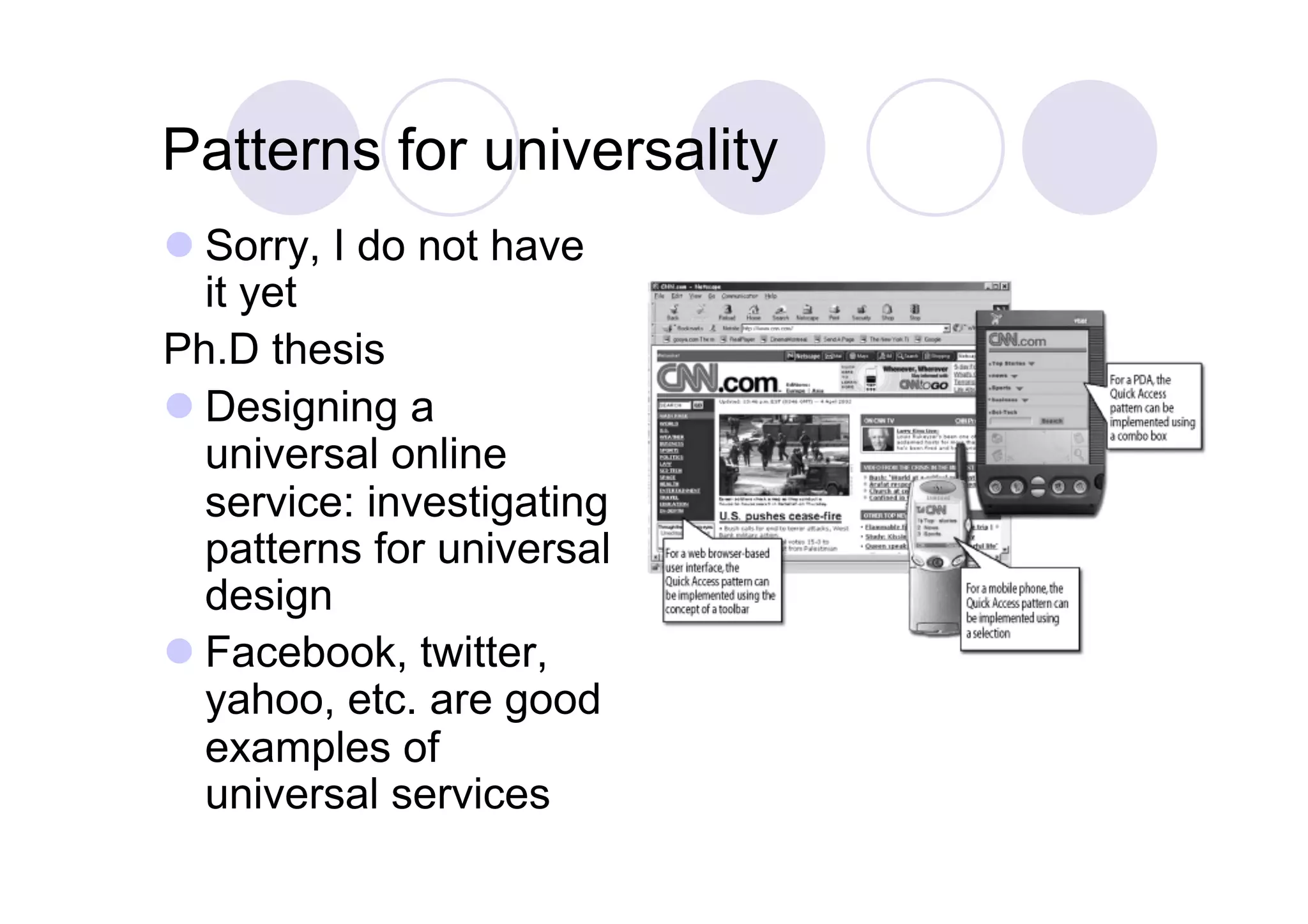
Patterns for universality
 Sorry, I do not have
  it yet
Ph.D thesis
 Designing a
  universal online
  service: investigating
  patterns for universal
  design
 Facebook, twitter,
  yahoo, etc. are good
  examples of
  universal services
But…

 We need to assess the quality of design
  patterns as well
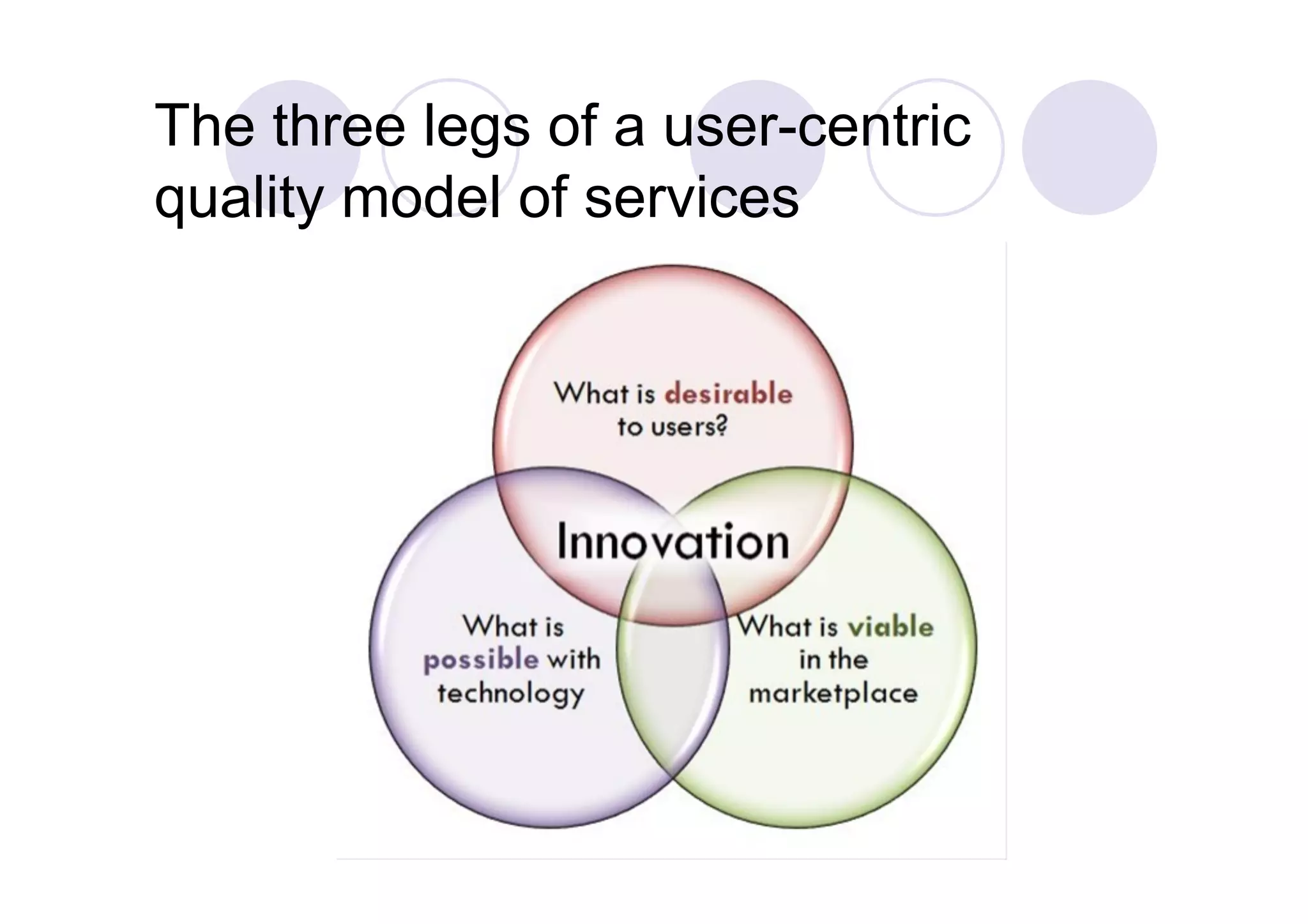
The three legs of a user-centric
quality model of services
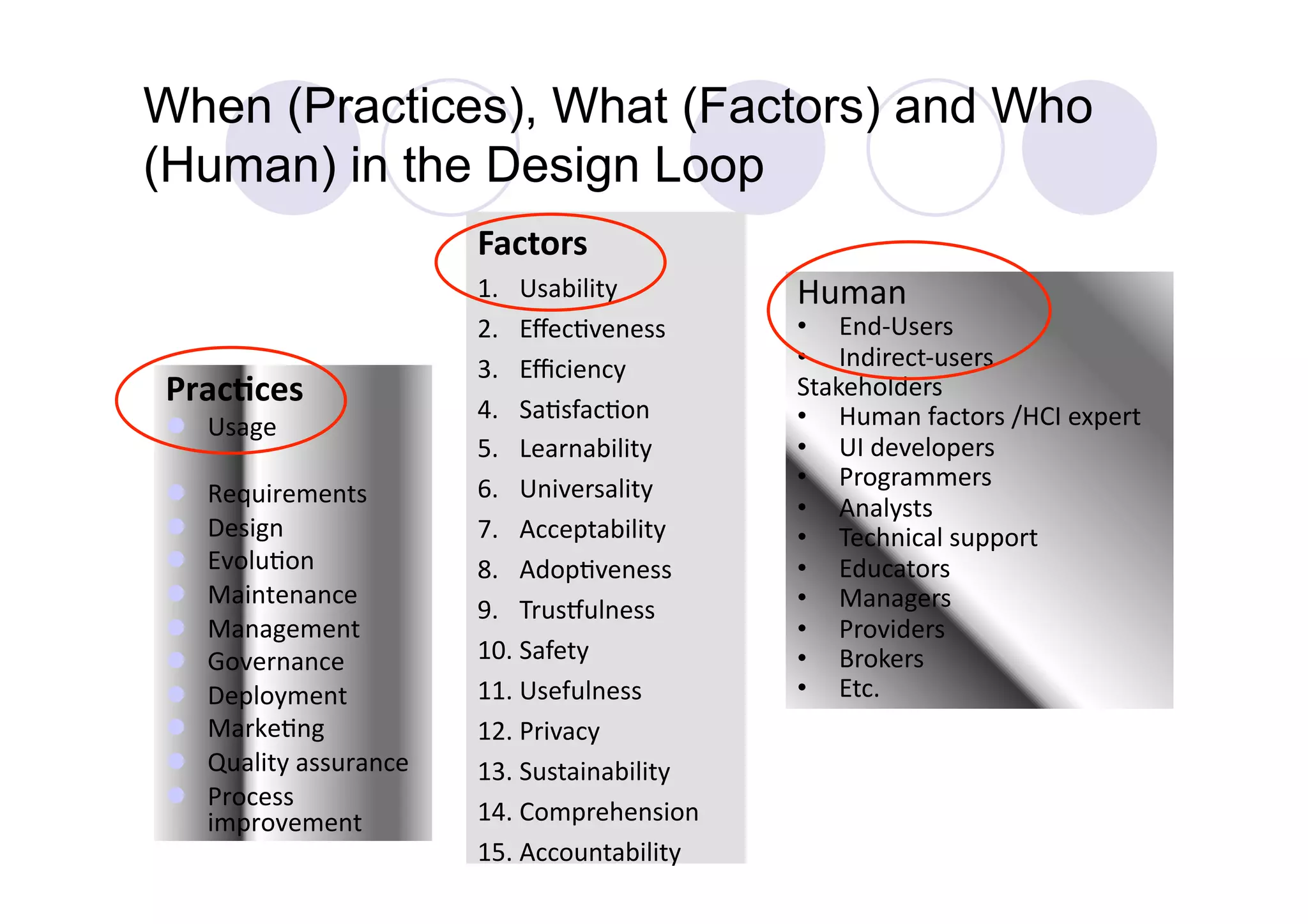
When (Practices), What (Factors) and Who
(Human) in the Design Loop
                                Factors	
  
                                1.  Usability	
            Human	
  
                                2.  Effec4veness	
          •  End-­‐Users	
  
                                3.  Efficiency	
             •  Indirect-­‐users	
  
Prac%ces	
                      4.  Sa4sfac4on	
  
                                                           Stakeholders	
  
  Usage	
                                                 •  Human	
  factors	
  /HCI	
  expert	
  
                                5.  Learnability	
  	
     •  UI	
  developers	
  
                                6.  Universality	
         •  Programmers	
  
    Requirements	
  
                                                           •  Analysts	
  
    Design	
                   7.  Acceptability	
        •  Technical	
  support	
  
    Evolu4on	
  	
             8.  Adop4veness	
          •  Educators	
  
    Maintenance	
                                         •  Managers	
  
                                9.  TrusPulness	
  
    Management	
                                          •  Providers	
  
    Governance	
               10. Safety	
               •  Brokers	
  
    Deployment	
               11. Usefulness	
           •  Etc.	
  
    Marke4ng	
                 12. Privacy	
  
    Quality	
  assurance	
     13. Sustainability	
  
    Process	
  	
  
     improvement	
              14. Comprehension	
  
                                15. Accountability	
  
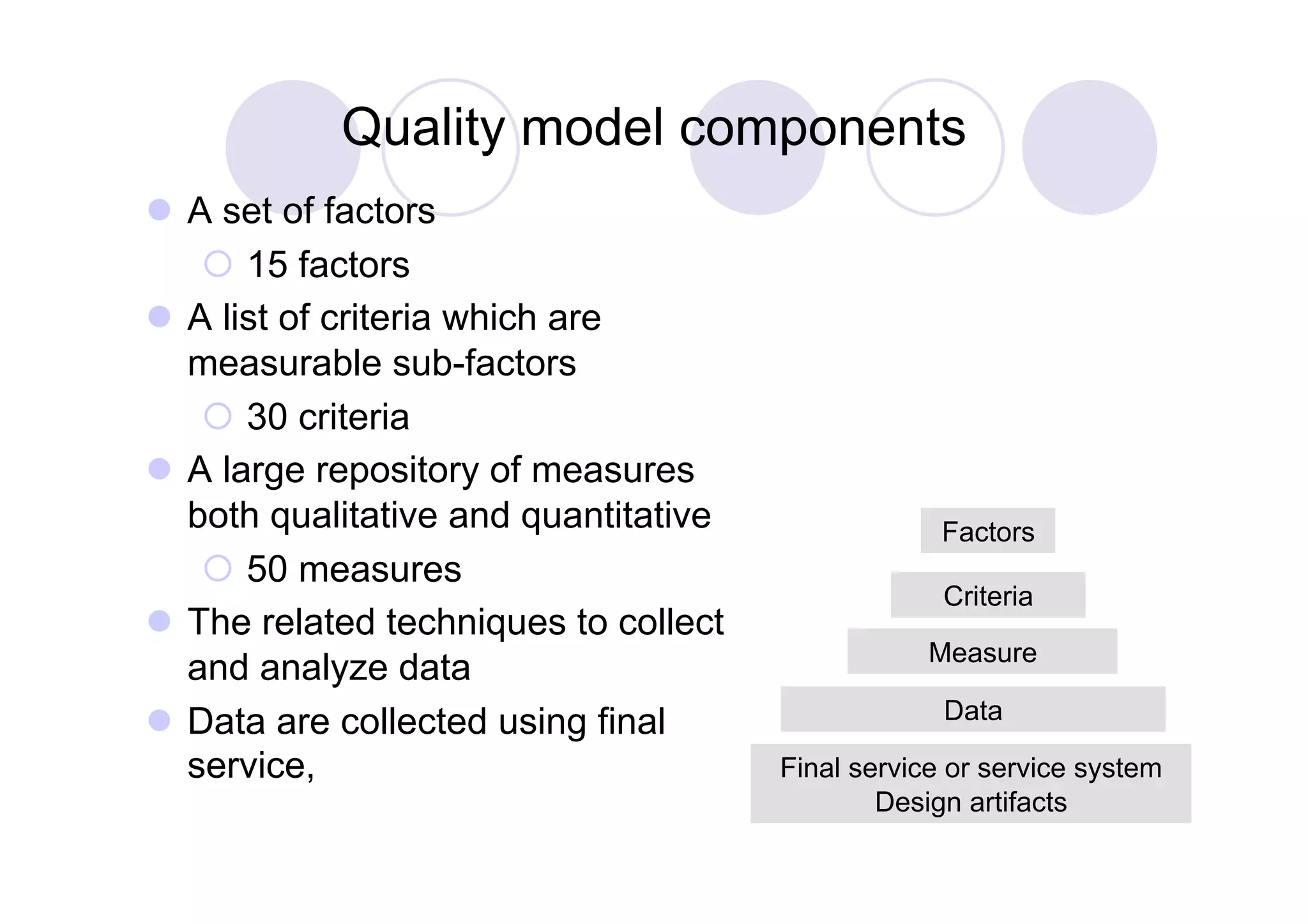
Quality model components
  A set of factors
      15 factors
  A list of criteria which are
   measurable sub-factors
      30 criteria
  A large repository of measures
   both qualitative and quantitative                Factors
      50 measures
                                                    Criteria
  The related techniques to collect
                                                   Measure
   and analyze data
  Data are collected using final                   Data

   service,                            Final service or service system
                                               Design artifacts
Not just…

 Services
 Service systems
But,
 Early design artifacts: prototypes, storyboards,
  sketches,
 Engineering documents: requirement portfolio,
  business plan
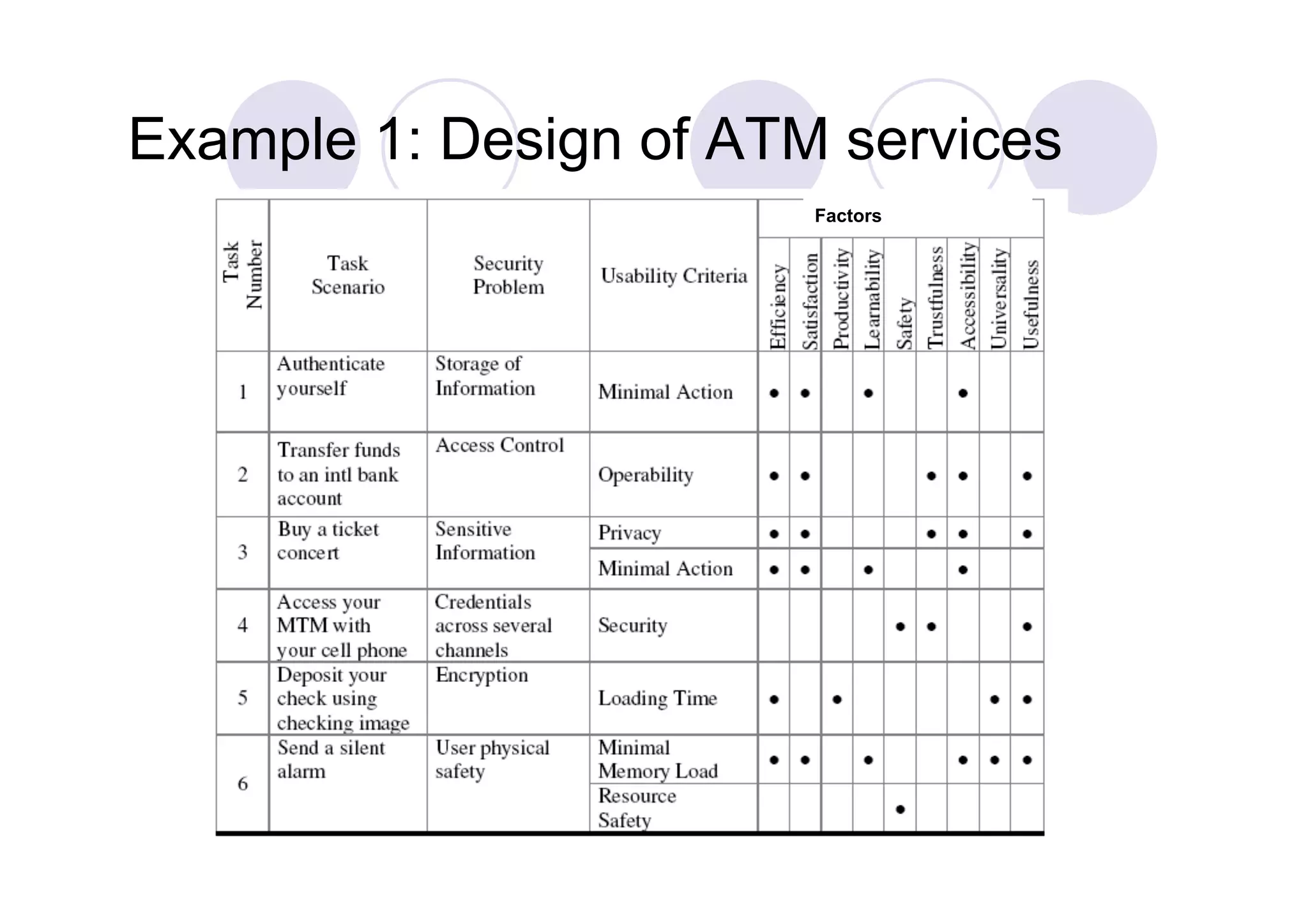
Example 1: Design of ATM services
                        Factors
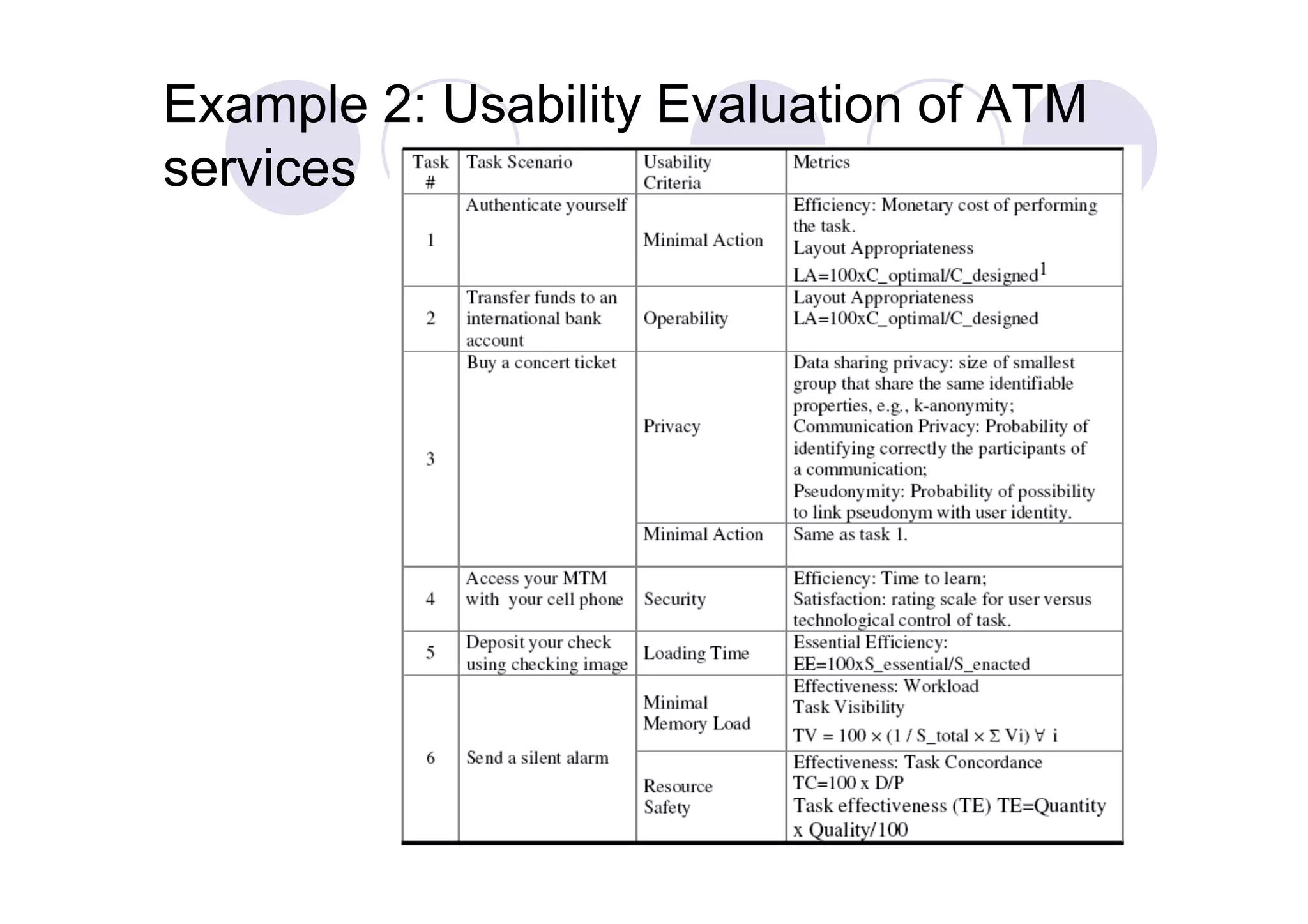
Example 2: Usability Evaluation of ATM
services
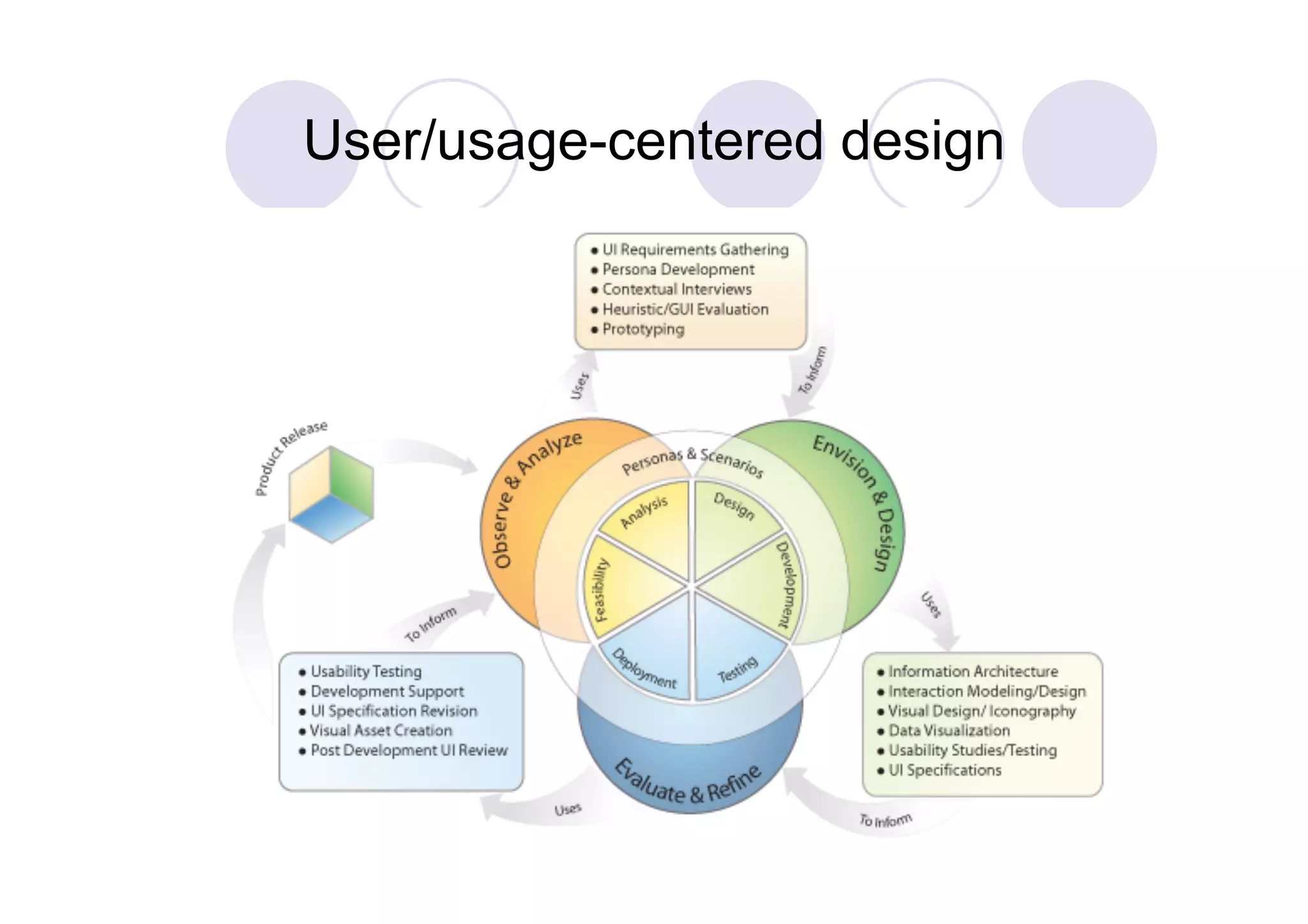
User/usage-centered design
Understanding and modeling user
and user experiences
 Identify and examine the different types of
  people who could play a role
 A persona contains information about a
  fictitious, archetypical person who holds
  an interest in the service.
   User Knowledge, skills, and abilities
   goals, motives, and concerns
   Usage patterns that a user would have of the
   system.
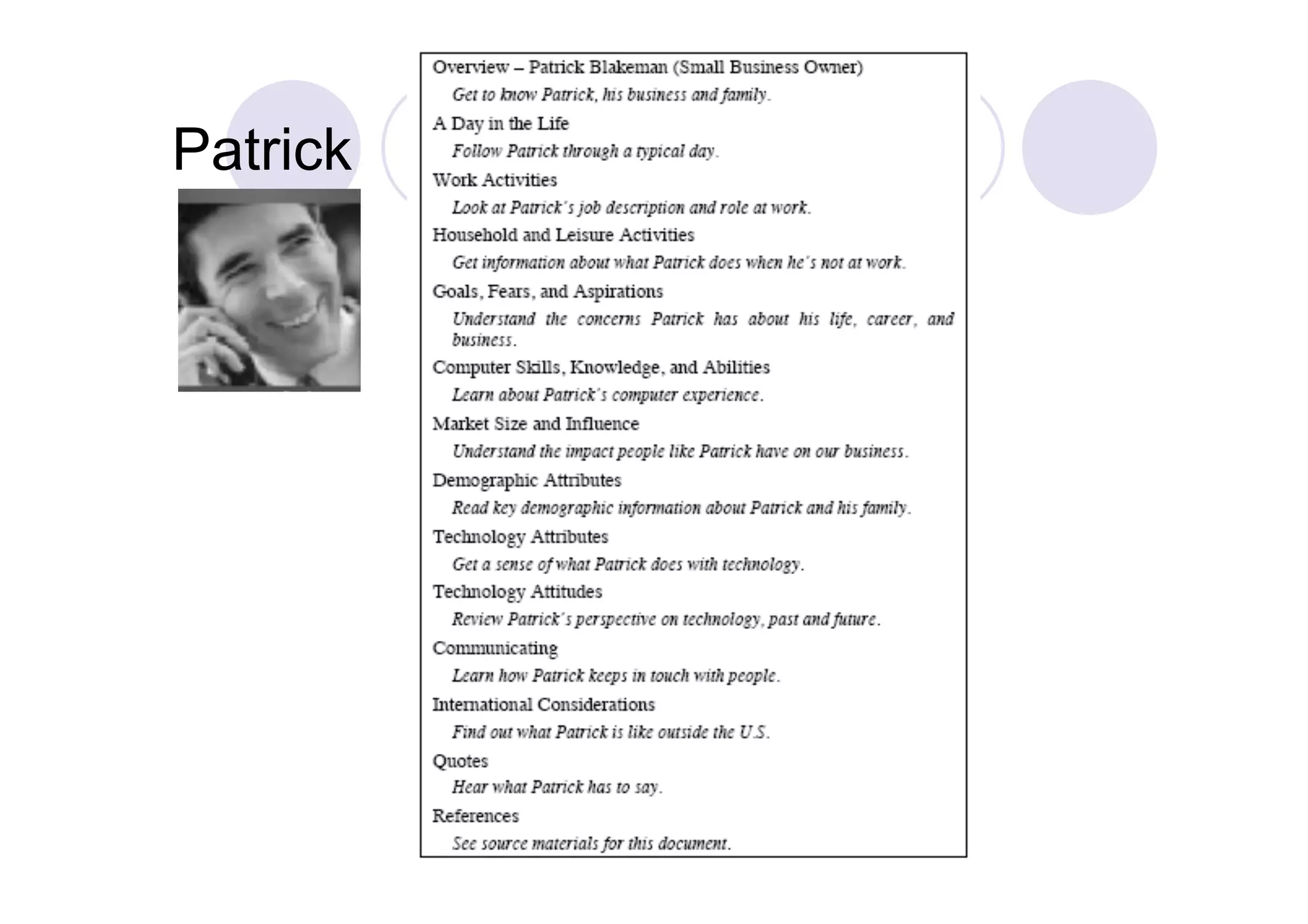
Patrick
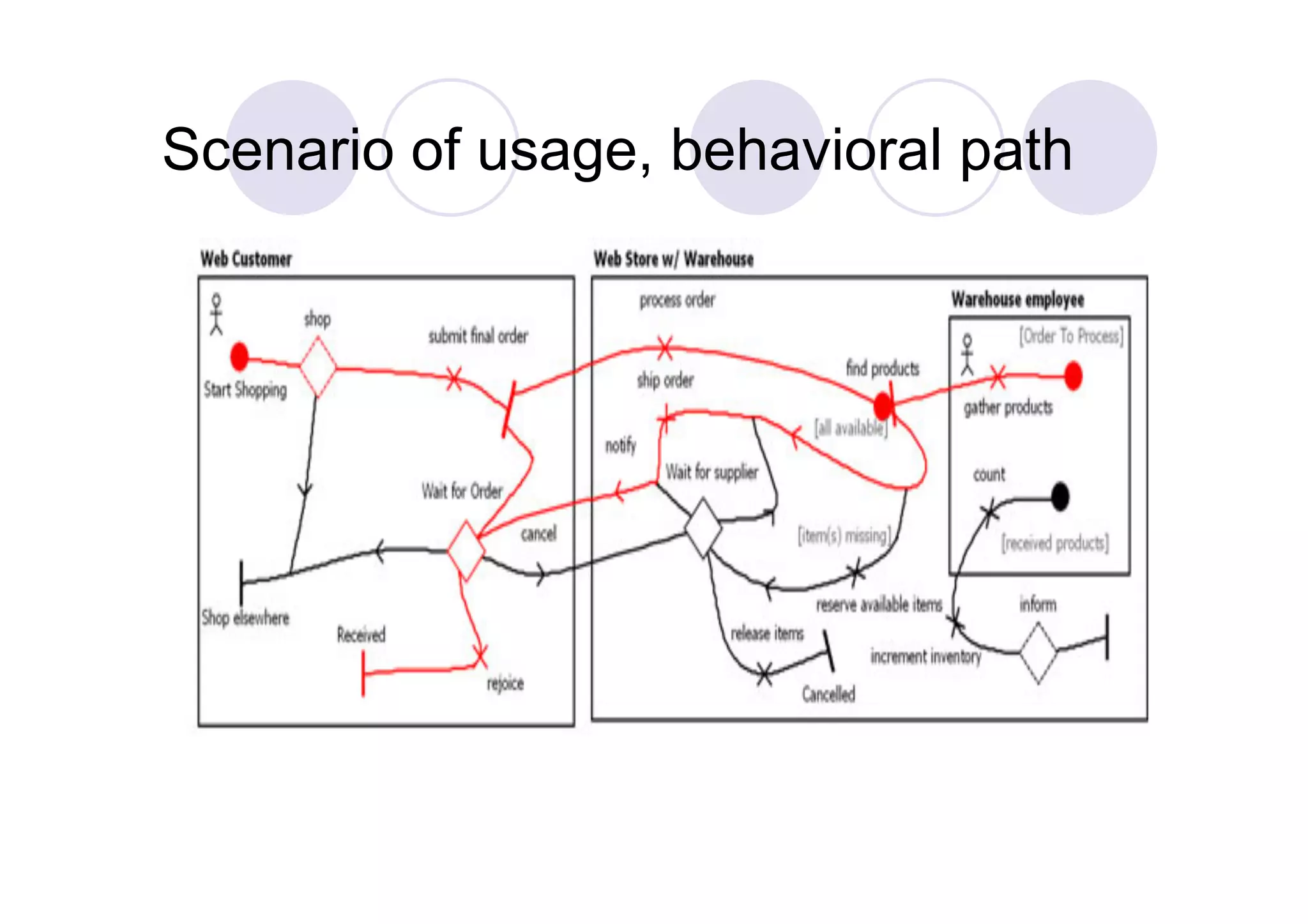
Scenario of usage, behavioral path
Human-centric service design: The
whole picture
 Scenario + persona as a platform for
  human engagement and service consumer
  experiences modeling
 Patterns as a tool to derive service system
  from scenarios and persona
 Quality model to assess and predict
  quality in use of services and service
  systems
Conclusion

 Bridging the front and the back side in
  service design
 Closing the gap between disciplines as
  stated by SSME manifesto
Further reading

  Adding User Experience into the Interactive Service
   Design Loop: A Persona-Based Method, Behavior and
   Information Technology Journal
  P2P Mapper: A Tool for Modeling User Experiences and
   Deriving User-Experience Driven Designs. AIS
   Transaction on Human Computer Interaction
Join us…
  Special Session on HCI concerns in Service Engineering. First
   Conference on the Human Side of Service Engineering, Jan Jose,
   July 2011

  Workshop on HCI concerns in Service Design and Engineering
  2011 Edition - Software as a Service: A User Experience Design
   Perspective
In conjunction with
  IEEE SERVICES 2011 – The Seventh World Congress on
   Services, July 5-10, 2011, Washington DC, USA
  INTERACT 2011 – 13th IFIP-TC 13 Conference on Human
   Computer Interaction September 5-9, 2011, Lisbon, Portugal
 

Seffah iess11 keynote the human side of service science

  • 1.
    The Human Sideof Service Science, Engineering and Management Challenges and Justifications for A User- Centric Quality Model of Services and Service Systems Ahmed Seffah Keynote talk for the Second International Conference on Exploring Services Sciences, Geneva, February 16, 2011
  • 2.
    Human-Centric Quality Model Fortoday, how/for what and not why?
  • 3.
    Agenda  Quality attributes andmodel of services and service systems  Implications on/for human-centric service design  Persona, measures and patterns as design tools
  • 4.
    Motivations  Software and service  Serviceas a software  Service systems and software systems  Service-oriented engineering  Where previously objects were linked to compose software systems,  We now see the emergence of independent services that can be put together dynamically at run time to form a system of services
  • 5.
    Motivations Service Systems Technology side Service Systems   SOA, Web services such as directory Service services, description languages, and invocation standards, Universal Service Description, Discovery and Integration (UDDI), Web Services Description Service Language (WSDL), and the Simple Object Access Protocol (SOAP) Human Human side   The interfaces and interactions between Human the services, service systems and/or service developers, providers, brokers, users consumers and the many other Human stakeholders
  • 6.
    What is servicesystems quality? A service system is a configuration of hardware, software, information, technology and organizational networks designed to deliver services that satisfy the needs and aspirations of customers.
  • 7.
    The back andfront side of service systems quality
  • 8.
  • 9.
    The front side:the human and the multiple user interfaces
  • 10.
    Existing service qualitymodel SERVQUAL  Service quality can be measured as the gap between the service that customers expect and the performance they perceive to have received.  Respondents rate their expectations of service from an excellent organization, and then rate the performance they received  Service quality is calculated as the difference in the two scores where better service quality results in a smaller gap (Landrum, Prybutok, Kappelman, & Zhang, 2008).
  • 11.
    The 10 aspectsof service quality in EVALQUAL  Reliability, responsiveness, competence, access, courtesy, communication, credibility, security, understanding or knowing the customer and tangibles   Nyeck, S., Morales, M., Ladhari, R., & Pons, F. (2002). "10 years of service quality measurement: reviewing the use of the SERVQUAL instrument."
  • 12.
    Other models  Variants ofSERVIQUAL such as SERVPERF  Satisfaction questionnaire  Key indicators performance (KPIs)  ISO standards such as ISO 9000, ISO 9126, etc.
  • 13.
    Drawbacks  Traditional versus computerized (electronic or SasS) services  Patterns of human experience and behaviors  New factors are emerging  Trust, privacy, universality,  Predictive measures  Assess frequently and as early as possible is better  Lack of tools and standardized benchmarks for testing
  • 14.
    Beside quality models,design patterns …  Proven solutions for well-known problems that occurs in several usage contexts and projects
  • 15.
    Trustfulness McKnight & Chervany(1996)  Trust is the extent to which and individual or an organization is willing to depend on something (e.g service or system) or somebody (human, organization) in a given context with a feeling of relative security and safety, even though negative consequences are possible.
  • 16.
    Pattern of trustfulness  Online shopping takes place between parties who have never transacted with each other before, in an environment   The service consumer often has insufficient information about the service provider, and about the goods and services offered.   E.g. The consumer generally has no opportunity to see and try products, i.e. to “squeeze the oranges”, before he buys.   The service provider, on the other hand, knows exactly what he gets, as long as he is paid in money.   Face to face communication patterns cannot be applied, call us, we will help you! Also does not work   (Barnes et Vidgen, 2001a ; Bressolles, 2002a; Wolfinbarger et Gilly, 2002) proposed a design pattern   If the consumer can not try the product or service in advance, he can be confident that it will be what he expects as long as he or she gets all the information online.   The pattern indicate how much, when and how to make visible the information
  • 17.
    Privacy  Privacy is theability of an individual or a group of people (an organization, a community) to stop information about themselves from becoming known to an individual, a group of people and organization other than those they choose to give the information to
  • 18.
    Pattern of privacyand reputation   It is difficult, if not impossible, to complete a transaction without revealing some personal data – a shipping address, billing information, or product preference.   Users may be unwilling to provide this necessary information or even to browse online   (Hafiz, 2006) suggeted four design patterns that can aide the decision making process for the designers of privacy protecting systems.   These patterns are applicable to the design of anonymity systems for various types of online communication, online data sharing, location monitoring, voting and electronic cash management.
  • 19.
    Universality  Universality is theability to supporting a broad range of hardware, software, and network access and accommodating users with different skills, knowledge, age, gender, handicaps, literacy, culture, income, while bridging the user knowledge gap between what users know and what they need to know
  • 20.
    Patterns for universality  Sorry,I do not have it yet Ph.D thesis  Designing a universal online service: investigating patterns for universal design  Facebook, twitter, yahoo, etc. are good examples of universal services
  • 21.
    But…  We need toassess the quality of design patterns as well
  • 22.
    The three legsof a user-centric quality model of services
  • 23.
    When (Practices), What(Factors) and Who (Human) in the Design Loop Factors   1.  Usability   Human   2.  Effec4veness   •  End-­‐Users   3.  Efficiency   •  Indirect-­‐users   Prac%ces   4.  Sa4sfac4on   Stakeholders     Usage   •  Human  factors  /HCI  expert   5.  Learnability     •  UI  developers   6.  Universality   •  Programmers     Requirements   •  Analysts     Design   7.  Acceptability   •  Technical  support     Evolu4on     8.  Adop4veness   •  Educators     Maintenance   •  Managers   9.  TrusPulness     Management   •  Providers     Governance   10. Safety   •  Brokers     Deployment   11. Usefulness   •  Etc.     Marke4ng   12. Privacy     Quality  assurance   13. Sustainability     Process     improvement   14. Comprehension   15. Accountability  
  • 24.
    Quality model components  A set of factors   15 factors   A list of criteria which are measurable sub-factors   30 criteria   A large repository of measures both qualitative and quantitative Factors   50 measures Criteria   The related techniques to collect Measure and analyze data   Data are collected using final Data service, Final service or service system Design artifacts
  • 25.
    Not just…  Services  Service systems But,  Earlydesign artifacts: prototypes, storyboards, sketches,  Engineering documents: requirement portfolio, business plan
  • 26.
    Example 1: Designof ATM services Factors
  • 27.
    Example 2: UsabilityEvaluation of ATM services
  • 28.
  • 29.
    Understanding and modelinguser and user experiences  Identify and examine the different types of people who could play a role  A persona contains information about a fictitious, archetypical person who holds an interest in the service.  User Knowledge, skills, and abilities  goals, motives, and concerns  Usage patterns that a user would have of the system.
  • 30.
  • 31.
    Scenario of usage,behavioral path
  • 32.
    Human-centric service design:The whole picture  Scenario + persona as a platform for human engagement and service consumer experiences modeling  Patterns as a tool to derive service system from scenarios and persona  Quality model to assess and predict quality in use of services and service systems
  • 33.
    Conclusion  Bridging the frontand the back side in service design  Closing the gap between disciplines as stated by SSME manifesto
  • 34.
    Further reading   AddingUser Experience into the Interactive Service Design Loop: A Persona-Based Method, Behavior and Information Technology Journal   P2P Mapper: A Tool for Modeling User Experiences and Deriving User-Experience Driven Designs. AIS Transaction on Human Computer Interaction
  • 35.
    Join us…   SpecialSession on HCI concerns in Service Engineering. First Conference on the Human Side of Service Engineering, Jan Jose, July 2011   Workshop on HCI concerns in Service Design and Engineering   2011 Edition - Software as a Service: A User Experience Design Perspective In conjunction with   IEEE SERVICES 2011 – The Seventh World Congress on Services, July 5-10, 2011, Washington DC, USA   INTERACT 2011 – 13th IFIP-TC 13 Conference on Human Computer Interaction September 5-9, 2011, Lisbon, Portugal 