ISSIP Course
Jim Spohrer
January 27, 2025
(DRAFT EXAMPLE)
Recording: https://youtu.be/ixyT-67IPvE
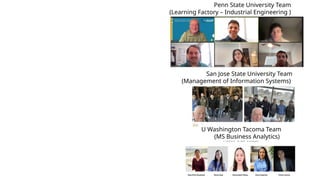
Penn State University Team
(Learning Factory – Industrial Engineering )
U Washington Tacoma Team
(MS Business Analytics)
San Jose State University Team
(Management of Information Systems)
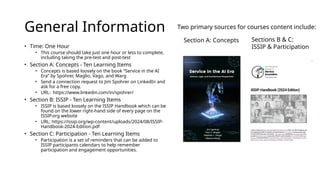
General Information
• Time: One Hour
• This course should take just one hour or less to complete,
including taking the pre-test and post-test
• Section A: Concepts - Ten Learning Items
• Concepts is based loosely on the book “Service in the AI
Era” by Spohrer, Maglio, Vago, and Warg
• Send a connection request to Jim Spohrer on LinkedIn and
ask for a free copy.
• URL: https://www.linkedin.com/in/spohrer/
• Section B: ISSIP - Ten Learning Items
• ISSIP is based loosely on the ISSIP Handbook which can be
found on the lower right-hand side of every page on the
ISSIP.org website
• URL: https://issip.org/wp-content/uploads/2024/08/ISSIP-
Handbook-2024-Edition.pdf
• Section C: Participation - Ten Learning Items
• Participation is a set of reminders that can be added to
ISSIP participants calendars to help remember
participation and engagement opportunities.
Section A: Concepts Sections B & C:
ISSIP & Participation
Two primary sources for courses content include:
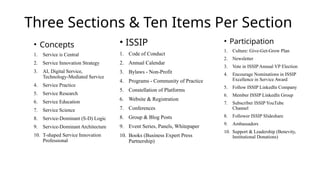
Three Sections & Ten Items Per Section
• Concepts
1. Service is Central
2. Service Innovation Strategy
3. AI, Digital Service,
Technology-Mediated Service
4. Service Practice
5. Service Research
6. Service Education
7. Service Science
8. Service-Dominant (S-D) Logic
9. Service-Dominant Architecture
10. T-shaped Service Innovation
Professional
• ISSIP
1. Code of Conduct
2. Annual Calendar
3. Bylaws - Non-Profit
4. Programs - Community of Practice
5. Constellation of Platforms
6. Website & Registration
7. Conferences
8. Group & Blog Posts
9. Event Series, Panels, Whitepaper
10. Books (Business Expert Press
Partnership)
• Participation
1. Culture: Give-Get-Grow Plan
2. Newsletter
3. Vote in ISSIP Annual VP Election
4. Encourage Nominations in ISSIP
Excellence in Service Award
5. Follow ISSIP LinkedIn Company
6. Member ISSIP LinkedIn Group
7. Subscriber ISSIP YouTube
Channel
8. Follower ISSIP Slideshare
9. Ambassadors
10. Support & Leadership (Benevity,
Institutional Donations)
Important – Before
• Before taking the course, please take the pre-test here.
• https://docs.google.com/forms/d/e/1FAIpQLSf0lK9NWj3rqIrP_9Vyu
VCdlLCnbvgGHav4PlEbaIGEzahP8w/viewform
Section A: Concepts
• Ten Learning Items
1. Service is Central
2. Service Innovation Strategy
3. AI, Digital Service, Technology-Mediated Service
4. Service Practice
5. Service Research
6. Service Education
7. Service Science
8. Service-Dominant (S-D) Logic
9. Service-Dominant Architecture
10.T-shaped Service Innovation Professional
Concept 1: Service is Central
• Service is defined by ISSIP as “the application of resources (e.g.,
knowledge, skills, tools, etc.) for the benefit of another.”
• Simply put, becoming better at helping others
• Daily life depends on the give-get-grow of service
• Historically, service is a ‘hot topic’ of economic and practical
importance because:
• Economist use the term to describe the largest sector of advanced
economies where the majority of jobs exists, and
• Technologist are building more and more advanced types of service
delivery devices (e.g., smartphones).
• Exercise: Name the resources you use most to help others?
Concept 2: Service Innovation Strategy
• Service innovation is defined by ISSIP as “a dynamic configuration of
designed and evolving technological capabilities, business model
benefits, and institutional arrangements that mitigate harms.”
• We prefer ‘service innovation’ to only using ‘innovation’ because
innovations alone can be used by good actors (to create benefits) or bad
actors (to create harms) – so it is important for service innovation
professionals to benefit humanity and to ask four types of questions:
• Should we? Who will benefit? Is there a market?
• Can we? What capability is being amplified? Is it technological possible?
• May we? Who might be harmed? Is it legal? Are there ways to mitigate the
harms from bad actors, accidents, and unintended consequences?
• Will we? What will we all learn from doing this? Is it a top priority and highly
meaningful use for our resources? Is the timing right for this?
Concept 3: AI, Digital Service,
Technology-Mediated Service
• Technology has been one of the driving forces transforming business and
society with each passing generation of people.
• In the old times, service was delivered person-to-person and mostly within
small family groups, but advancing technologies have amplified individual
capabilities, and also new organizational forms (e.g., businesses, nations)
allow for complex application of resources to benefit others.
• The Internet, World-Wide-Web, and Smartphones have greatly increase
screentime, and increased the amount of daily technology-mediated service
in the world.
• Artificial Intelligence (AI) is one of the newest resources that we have access
to and can apply to benefit others. This AI transformation of service is
happening now.
Concept 4: Service Practice
• Service practice deals with the pursuit of the best means of
using resources to achieve ends that benefit others.
• Industry: Businesses are constantly in search of competitive
and comparative advantages in service practice for their
customers, employees, shareholders, and partner
businesses (ecosystem).
• Society: Nations are constantly in search of comparative and
comparative advantages in service practice for their citizens,
government employees, businesses, and partner nations.
Concept 5: Service Research
• Research (e.g., new knowledge) helps drive new innovations.
• Service research is a ‘big tent’ that spans academic
disciplines, industry sectors, and cultural boundaries.
• Exercise: Examine current and back issues of the Sage
“Journal of Service Research” and make a list of ten research
topics explored.
Concept 6: Service Education
• Education is the primary means of getting expert knowledge
into practice and for preparing the next generations for
roles in business and society.
• Service education exists across academic disciplines:
• Business schools: Service marketing, service operations, etc.
• Engineering schools: Service systems engineering, service
computing, etc.
• Social sciences schools: Service economics, etc.
• Professional schools: Medical, legal, education, public policy,
divinity, public healthy, etc.
Concept 7: Service Science
• Science is a systematic process for creating new knowledge.
• Service science is an emerging transdiscipline that studies service systems,
including their design and evolution.
• Service system entities give and get service.
• Service systems are defined as “dynamic configurations of people, technology,
information, and organizations, all interconnected by value propositions.”
• Service systems include people, families, businesses, universities, and nations,
and other entities that give and get service across a wide-spectrum of scales.
• Service science is short for “Service Science, Management, Engineering,
Design, Arts, and Public Policy (SSME-DAPP)” which is a longer name reflecting
more aspects of the emerging transdiscipline.
Concept 8: Service-Dominant (S-D)
logic
• Good logics in people’s heads can help them interact with others in win-win ways.
• Logics are alternative ways of looking at the world and sometimes called mindsets.
• Goods-Dominant (G-D) logic is what most people use in thinking about world as full of things
(resources) that have value.
• Service-Dominant (S-D) logic is an alternative way of thinking about the world in which value is
cocreated through systems of exchange.
• S-D logic is based on five propositions (axioms):
• (a) service is the basis of exchange,
• (b) value is always cocreated by a multitude of actors,
• (c) actors obtain new resources through the integration of resources obtained through service exchange,
• (d) value is a measure of the well-being of a focal beneficiary, and
• (e) institutions (e.g., social norms, rules, norms) play an important role in the coordination of direct and
indirect value cocreation.
• The implications of these propositions can be nuanced and may be difficult to accept by those
entrenched in the traditional G-D logic mindset, in which things (rather than actions and
outcomes) are the key concepts.
Concept 9: Service Dominant Architecture
(SDA)
• Good architectural designs can help organizations keep up with change.
• Most people are familiar with the architecture of buildings, but organizations
have architectures as well.
• In a dynamic world, well-designed organizational architectures can make simple
changes easy and harder changes possible.
• Service Dominant Architecture (SDA) is grounded in service-dominant (S-
D) logic and service science and provides an organizing logic for shaping
companies, service platforms, and service ecosystems through design
patterns aimed at making it possible to build and orchestrate
capabilities in a systematic way.
• Exercise: Take this online course to learn a lot more about SDA
• https://www.ifsd.hamburg/CERTIFICATE-SDA-PROFESSIONAL-ONE/
Concept 10: T-shaped Service
Innovation Professionals
• Talent: T-shaped skills is a metaphor for having both breadth and depth.
• Breadth helps people communicate with each other in teams better.
• Depth helps people be specialists in particular problem-solving expertise.
• Breadth also helps people learn new areas of expertise faster.
• Depth also helps people learn the discipline of seeing knowledge gaps.
• Six areas for T-shaped depth and breadth include advanced technologies,
academic disciplines, industry sectors, cultural patterns, work practices, and
growth mindsets.
• Because the world is changing rapidly and because service innovation play a major role
in all our daily lives, lifelong learning is essential for all who aim to become better
service innovation professionals - to give-get-and-grow service for business and society.
• Exercise: For each of the six areas list three top items of interest to you (e.g.,
advanced technologies = AI, quantum computing, augmented reality)
Section B: ISSIP
• Ten Learning Items
1. Code of Conduct
2. Annual Calendar
3. Bylaws - Non-Profit
4. Programs - Community of Practice
5. Constellation of Platforms
6. Website & Registration
7. Conferences
8. Group & Blog Posts
9. Event Series, Panels, Whitepaper
10.Books (Business Expert Press Partnership)
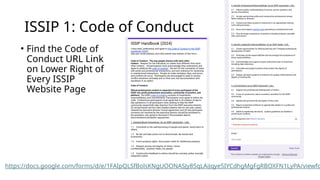
ISSIP 1: Code of Conduct
• Find the Code of
Conduct URL Link
on Lower Right of
Every ISSIP
Website Page
https://docs.google.com/forms/d/e/1FAIpQLSfBolsKNgUOONASJy85qLAiJqye5IYCdhgMgFgRBOXFN1LyPA/viewfo
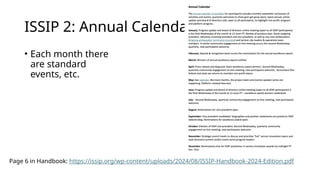
ISSIP 2: Annual Calendar
• Each month there
are standard
events, etc.
Page 6 in Handbook: https://issip.org/wp-content/uploads/2024/08/ISSIP-Handbook-2024-Edition.pdf
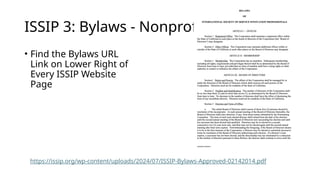
ISSIP 3: Bylaws - Nonprofit
• Find the Bylaws URL
Link on Lower Right of
Every ISSIP Website
Page
https://issip.org/wp-content/uploads/2024/07/ISSIP-Bylaws-Approved-02142014.pdf
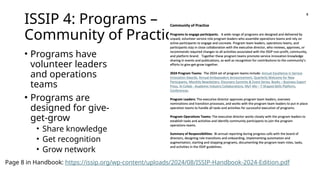
ISSIP 4: Programs –
Community of Practice
• Programs have
volunteer leaders
and operations
teams
• Programs are
designed for give-
get-grow
• Share knowledge
• Get recognition
• Grow network
Page 8 in Handbook: https://issip.org/wp-content/uploads/2024/08/ISSIP-Handbook-2024-Edition.pdf
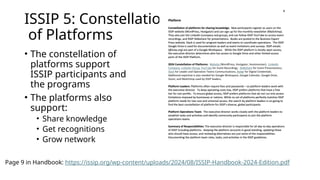
ISSIP 5: Constellation
of Platforms
• The constellation of
platforms support
ISSIP participants and
the programs
• The platforms also
support:
• Share knowledge
• Get recognitions
• Grow network
Page 9 in Handbook: https://issip.org/wp-content/uploads/2024/08/ISSIP-Handbook-2024-Edition.pdf
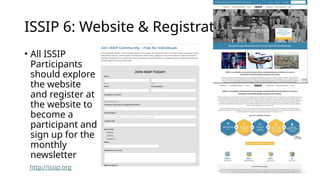
ISSIP 6: Website & Registration
• All ISSIP
Participants
should explore
the website
and register at
the website to
become a
participant and
sign up for the
monthly
newsletter
http://issip.org
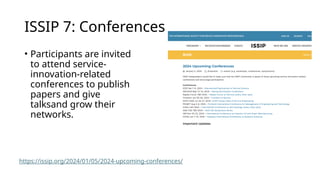
ISSIP 7: Conferences
• Participants are invited
to attend service-
innovation-related
conferences to publish
papers and give
talksand grow their
networks.
https://issip.org/2024/01/05/2024-upcoming-conferences/
ISSIP 8: LinkedIn Group & Website Blog
Posts
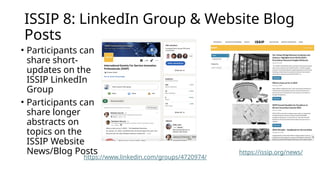
• Participants can
share short-
updates on the
ISSIP LinkedIn
Group
• Participants can
share longer
abstracts on
topics on the
ISSIP Website
News/Blog Posts https://issip.org/news/
https://www.linkedin.com/groups/4720974/
ISSIP 9: Event Series, Panels, and
Whitepapers
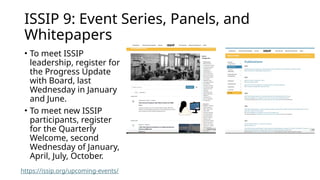
• To meet ISSIP
leadership, register for
the Progress Update
with Board, last
Wednesday in January
and June.
• To meet new ISSIP
participants, register
for the Quarterly
Welcome, second
Wednesday of January,
April, July, October.
https://issip.org/upcoming-events/
ISSIP 10: Books (Business Expert Press)
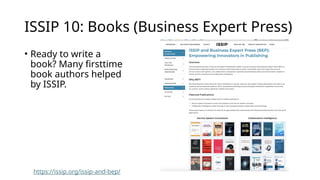
• Ready to write a
book? Many firsttime
book authors helped
by ISSIP.
https://issip.org/issip-and-bep/
Section C: Participation
• Ten Learning Items
1. Culture: Give-Get-Grow Plan
2. Newsletter
3. Vote in ISSIP Annual VP Election
4. Encourage Nominations in ISSIP Excellence in Service Award
5. Follow ISSIP LinkedIn Company
6. Member ISSIP LinkedIn Group
7. Subscriber ISSIP YouTube Channel
8. Follower ISSIP Slideshare
9. Ambassadors
10.Support & Leadership (Benevity, Institutional Donations)
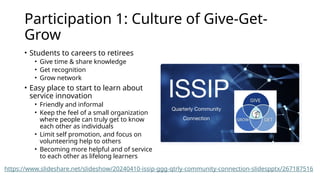
Participation 1: Culture of Give-Get-
Grow
• Students to careers to retirees
• Give time & share knowledge
• Get recognition
• Grow network
• Easy place to start to learn about
service innovation
• Friendly and informal
• Keep the feel of a small organization
where people can truly get to know
each other as individuals
• Limit self promotion, and focus on
volunteering help to others
• Becoming more helpful and of service
to each other as lifelong learners
https://www.slideshare.net/slideshow/20240410-issip-ggg-qtrly-community-connection-slidespptx/267187516
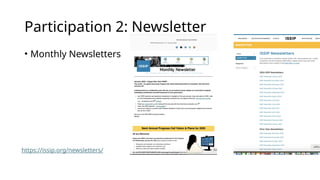
Participation 2: Newsletter
• Monthly Newsletters
https://issip.org/newsletters/
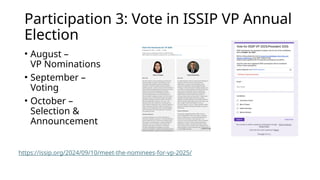
Participation 3: Vote in ISSIP VP Annual
Election
• August –
VP Nominations
• September –
Voting
• October –
Selection &
Announcement
https://issip.org/2024/09/10/meet-the-nominees-for-vp-2025/
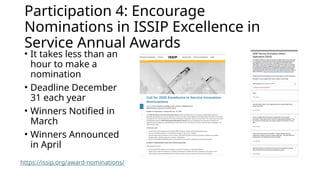
Participation 4: Encourage
Nominations in ISSIP Excellence in
Service Annual Awards
• It takes less than an
hour to make a
nomination
• Deadline December
31 each year
• Winners Notified in
March
• Winners Announced
in April
https://issip.org/award-nominations/
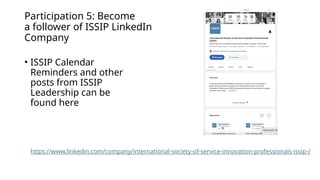
Participation 5: Become
a follower of ISSIP LinkedIn
Company
• ISSIP Calendar
Reminders and other
posts from ISSIP
Leadership can be
found here
https://www.linkedin.com/company/international-society-of-service-innovation-professionals-issip-/
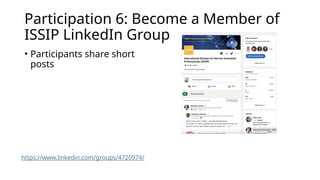
Participation 6: Become a Member of
ISSIP LinkedIn Group
• Participants share short
posts
https://www.linkedin.com/groups/4720974/
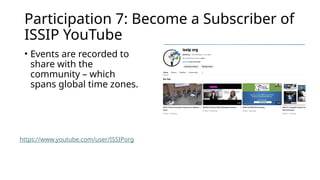
Participation 7: Become a Subscriber of
ISSIP YouTube
• Events are recorded to
share with the
community – which
spans global time zones.
https://www.youtube.com/user/ISSIPorg
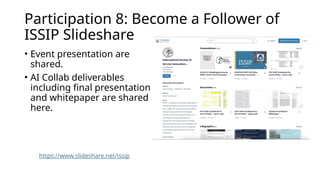
Participation 8: Become a Follower of
ISSIP Slideshare
• Event presentation are
shared.
• AI Collab deliverables
including final presentation
and whitepaper are shared
here.
https://www.slideshare.net/issip
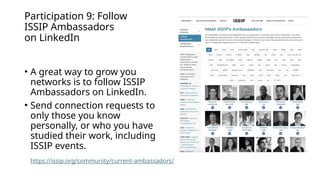
Participation 9: Follow
ISSIP Ambassadors
on LinkedIn
• A great way to grow you
networks is to follow ISSIP
Ambassadors on LinkedIn.
• Send connection requests to
only those you know
personally, or who you have
studied their work, including
ISSIP events.
https://issip.org/community/current-ambassadors/
Participation 10: Volunteer Support
(Benevity and Institutional Donations)
• Benevity – log volunteer hours
• Institutional Donations
• Reimbursement for any individual donations for professional
association participation fees or education/certifications fees
• By design, ISSIP.org tries to keep operating costs low
• Primary expense is Executive Director service to do community-of-
practice program management, including website, newsletter,
volunteer management, non-profit professional association
donations, constellation of platforms upkeep.
• Conference support, awards, platforms, and ISSIP Foundation
monthly donations are other costs.
https://benevity.com
Important – After
• After taking the course, please take the post-test here.
• https://docs.google.com
/forms/d/e/1FAIpQLSfG_x6NQ6_qXahCch2i6E9yVmu7jtwefVX33nf4
pYiJZG41zg/
viewform
20250127 Draft Course - 30 learning items v5 copy.pptx

  • 1.
    ISSIP Course Jim Spohrer January27, 2025 (DRAFT EXAMPLE) Recording: https://youtu.be/ixyT-67IPvE
  • 2.
    Penn State UniversityTeam (Learning Factory – Industrial Engineering ) U Washington Tacoma Team (MS Business Analytics) San Jose State University Team (Management of Information Systems)
  • 3.
    General Information • Time:One Hour • This course should take just one hour or less to complete, including taking the pre-test and post-test • Section A: Concepts - Ten Learning Items • Concepts is based loosely on the book “Service in the AI Era” by Spohrer, Maglio, Vago, and Warg • Send a connection request to Jim Spohrer on LinkedIn and ask for a free copy. • URL: https://www.linkedin.com/in/spohrer/ • Section B: ISSIP - Ten Learning Items • ISSIP is based loosely on the ISSIP Handbook which can be found on the lower right-hand side of every page on the ISSIP.org website • URL: https://issip.org/wp-content/uploads/2024/08/ISSIP- Handbook-2024-Edition.pdf • Section C: Participation - Ten Learning Items • Participation is a set of reminders that can be added to ISSIP participants calendars to help remember participation and engagement opportunities. Section A: Concepts Sections B & C: ISSIP & Participation Two primary sources for courses content include:
  • 4.
    Three Sections &Ten Items Per Section • Concepts 1. Service is Central 2. Service Innovation Strategy 3. AI, Digital Service, Technology-Mediated Service 4. Service Practice 5. Service Research 6. Service Education 7. Service Science 8. Service-Dominant (S-D) Logic 9. Service-Dominant Architecture 10. T-shaped Service Innovation Professional • ISSIP 1. Code of Conduct 2. Annual Calendar 3. Bylaws - Non-Profit 4. Programs - Community of Practice 5. Constellation of Platforms 6. Website & Registration 7. Conferences 8. Group & Blog Posts 9. Event Series, Panels, Whitepaper 10. Books (Business Expert Press Partnership) • Participation 1. Culture: Give-Get-Grow Plan 2. Newsletter 3. Vote in ISSIP Annual VP Election 4. Encourage Nominations in ISSIP Excellence in Service Award 5. Follow ISSIP LinkedIn Company 6. Member ISSIP LinkedIn Group 7. Subscriber ISSIP YouTube Channel 8. Follower ISSIP Slideshare 9. Ambassadors 10. Support & Leadership (Benevity, Institutional Donations)
  • 5.
    Important – Before •Before taking the course, please take the pre-test here. • https://docs.google.com/forms/d/e/1FAIpQLSf0lK9NWj3rqIrP_9Vyu VCdlLCnbvgGHav4PlEbaIGEzahP8w/viewform
  • 6.
    Section A: Concepts •Ten Learning Items 1. Service is Central 2. Service Innovation Strategy 3. AI, Digital Service, Technology-Mediated Service 4. Service Practice 5. Service Research 6. Service Education 7. Service Science 8. Service-Dominant (S-D) Logic 9. Service-Dominant Architecture 10.T-shaped Service Innovation Professional
  • 7.
    Concept 1: Serviceis Central • Service is defined by ISSIP as “the application of resources (e.g., knowledge, skills, tools, etc.) for the benefit of another.” • Simply put, becoming better at helping others • Daily life depends on the give-get-grow of service • Historically, service is a ‘hot topic’ of economic and practical importance because: • Economist use the term to describe the largest sector of advanced economies where the majority of jobs exists, and • Technologist are building more and more advanced types of service delivery devices (e.g., smartphones). • Exercise: Name the resources you use most to help others?
  • 8.
    Concept 2: ServiceInnovation Strategy • Service innovation is defined by ISSIP as “a dynamic configuration of designed and evolving technological capabilities, business model benefits, and institutional arrangements that mitigate harms.” • We prefer ‘service innovation’ to only using ‘innovation’ because innovations alone can be used by good actors (to create benefits) or bad actors (to create harms) – so it is important for service innovation professionals to benefit humanity and to ask four types of questions: • Should we? Who will benefit? Is there a market? • Can we? What capability is being amplified? Is it technological possible? • May we? Who might be harmed? Is it legal? Are there ways to mitigate the harms from bad actors, accidents, and unintended consequences? • Will we? What will we all learn from doing this? Is it a top priority and highly meaningful use for our resources? Is the timing right for this?
  • 9.
    Concept 3: AI,Digital Service, Technology-Mediated Service • Technology has been one of the driving forces transforming business and society with each passing generation of people. • In the old times, service was delivered person-to-person and mostly within small family groups, but advancing technologies have amplified individual capabilities, and also new organizational forms (e.g., businesses, nations) allow for complex application of resources to benefit others. • The Internet, World-Wide-Web, and Smartphones have greatly increase screentime, and increased the amount of daily technology-mediated service in the world. • Artificial Intelligence (AI) is one of the newest resources that we have access to and can apply to benefit others. This AI transformation of service is happening now.
  • 10.
    Concept 4: ServicePractice • Service practice deals with the pursuit of the best means of using resources to achieve ends that benefit others. • Industry: Businesses are constantly in search of competitive and comparative advantages in service practice for their customers, employees, shareholders, and partner businesses (ecosystem). • Society: Nations are constantly in search of comparative and comparative advantages in service practice for their citizens, government employees, businesses, and partner nations.
  • 11.
    Concept 5: ServiceResearch • Research (e.g., new knowledge) helps drive new innovations. • Service research is a ‘big tent’ that spans academic disciplines, industry sectors, and cultural boundaries. • Exercise: Examine current and back issues of the Sage “Journal of Service Research” and make a list of ten research topics explored.
  • 12.
    Concept 6: ServiceEducation • Education is the primary means of getting expert knowledge into practice and for preparing the next generations for roles in business and society. • Service education exists across academic disciplines: • Business schools: Service marketing, service operations, etc. • Engineering schools: Service systems engineering, service computing, etc. • Social sciences schools: Service economics, etc. • Professional schools: Medical, legal, education, public policy, divinity, public healthy, etc.
  • 13.
    Concept 7: ServiceScience • Science is a systematic process for creating new knowledge. • Service science is an emerging transdiscipline that studies service systems, including their design and evolution. • Service system entities give and get service. • Service systems are defined as “dynamic configurations of people, technology, information, and organizations, all interconnected by value propositions.” • Service systems include people, families, businesses, universities, and nations, and other entities that give and get service across a wide-spectrum of scales. • Service science is short for “Service Science, Management, Engineering, Design, Arts, and Public Policy (SSME-DAPP)” which is a longer name reflecting more aspects of the emerging transdiscipline.
  • 14.
    Concept 8: Service-Dominant(S-D) logic • Good logics in people’s heads can help them interact with others in win-win ways. • Logics are alternative ways of looking at the world and sometimes called mindsets. • Goods-Dominant (G-D) logic is what most people use in thinking about world as full of things (resources) that have value. • Service-Dominant (S-D) logic is an alternative way of thinking about the world in which value is cocreated through systems of exchange. • S-D logic is based on five propositions (axioms): • (a) service is the basis of exchange, • (b) value is always cocreated by a multitude of actors, • (c) actors obtain new resources through the integration of resources obtained through service exchange, • (d) value is a measure of the well-being of a focal beneficiary, and • (e) institutions (e.g., social norms, rules, norms) play an important role in the coordination of direct and indirect value cocreation. • The implications of these propositions can be nuanced and may be difficult to accept by those entrenched in the traditional G-D logic mindset, in which things (rather than actions and outcomes) are the key concepts.
  • 15.
    Concept 9: ServiceDominant Architecture (SDA) • Good architectural designs can help organizations keep up with change. • Most people are familiar with the architecture of buildings, but organizations have architectures as well. • In a dynamic world, well-designed organizational architectures can make simple changes easy and harder changes possible. • Service Dominant Architecture (SDA) is grounded in service-dominant (S- D) logic and service science and provides an organizing logic for shaping companies, service platforms, and service ecosystems through design patterns aimed at making it possible to build and orchestrate capabilities in a systematic way. • Exercise: Take this online course to learn a lot more about SDA • https://www.ifsd.hamburg/CERTIFICATE-SDA-PROFESSIONAL-ONE/
  • 16.
    Concept 10: T-shapedService Innovation Professionals • Talent: T-shaped skills is a metaphor for having both breadth and depth. • Breadth helps people communicate with each other in teams better. • Depth helps people be specialists in particular problem-solving expertise. • Breadth also helps people learn new areas of expertise faster. • Depth also helps people learn the discipline of seeing knowledge gaps. • Six areas for T-shaped depth and breadth include advanced technologies, academic disciplines, industry sectors, cultural patterns, work practices, and growth mindsets. • Because the world is changing rapidly and because service innovation play a major role in all our daily lives, lifelong learning is essential for all who aim to become better service innovation professionals - to give-get-and-grow service for business and society. • Exercise: For each of the six areas list three top items of interest to you (e.g., advanced technologies = AI, quantum computing, augmented reality)
  • 17.
    Section B: ISSIP •Ten Learning Items 1. Code of Conduct 2. Annual Calendar 3. Bylaws - Non-Profit 4. Programs - Community of Practice 5. Constellation of Platforms 6. Website & Registration 7. Conferences 8. Group & Blog Posts 9. Event Series, Panels, Whitepaper 10.Books (Business Expert Press Partnership)
  • 18.
    ISSIP 1: Codeof Conduct • Find the Code of Conduct URL Link on Lower Right of Every ISSIP Website Page https://docs.google.com/forms/d/e/1FAIpQLSfBolsKNgUOONASJy85qLAiJqye5IYCdhgMgFgRBOXFN1LyPA/viewfo
  • 19.
    ISSIP 2: AnnualCalendar • Each month there are standard events, etc. Page 6 in Handbook: https://issip.org/wp-content/uploads/2024/08/ISSIP-Handbook-2024-Edition.pdf
  • 20.
    ISSIP 3: Bylaws- Nonprofit • Find the Bylaws URL Link on Lower Right of Every ISSIP Website Page https://issip.org/wp-content/uploads/2024/07/ISSIP-Bylaws-Approved-02142014.pdf
  • 21.
    ISSIP 4: Programs– Community of Practice • Programs have volunteer leaders and operations teams • Programs are designed for give- get-grow • Share knowledge • Get recognition • Grow network Page 8 in Handbook: https://issip.org/wp-content/uploads/2024/08/ISSIP-Handbook-2024-Edition.pdf
  • 22.
    ISSIP 5: Constellation ofPlatforms • The constellation of platforms support ISSIP participants and the programs • The platforms also support: • Share knowledge • Get recognitions • Grow network Page 9 in Handbook: https://issip.org/wp-content/uploads/2024/08/ISSIP-Handbook-2024-Edition.pdf
  • 23.
    ISSIP 6: Website& Registration • All ISSIP Participants should explore the website and register at the website to become a participant and sign up for the monthly newsletter http://issip.org
  • 24.
    ISSIP 7: Conferences •Participants are invited to attend service- innovation-related conferences to publish papers and give talksand grow their networks. https://issip.org/2024/01/05/2024-upcoming-conferences/
  • 25.
    ISSIP 8: LinkedInGroup & Website Blog Posts • Participants can share short- updates on the ISSIP LinkedIn Group • Participants can share longer abstracts on topics on the ISSIP Website News/Blog Posts https://issip.org/news/ https://www.linkedin.com/groups/4720974/
  • 26.
    ISSIP 9: EventSeries, Panels, and Whitepapers • To meet ISSIP leadership, register for the Progress Update with Board, last Wednesday in January and June. • To meet new ISSIP participants, register for the Quarterly Welcome, second Wednesday of January, April, July, October. https://issip.org/upcoming-events/
  • 27.
    ISSIP 10: Books(Business Expert Press) • Ready to write a book? Many firsttime book authors helped by ISSIP. https://issip.org/issip-and-bep/
  • 28.
    Section C: Participation •Ten Learning Items 1. Culture: Give-Get-Grow Plan 2. Newsletter 3. Vote in ISSIP Annual VP Election 4. Encourage Nominations in ISSIP Excellence in Service Award 5. Follow ISSIP LinkedIn Company 6. Member ISSIP LinkedIn Group 7. Subscriber ISSIP YouTube Channel 8. Follower ISSIP Slideshare 9. Ambassadors 10.Support & Leadership (Benevity, Institutional Donations)
  • 29.
    Participation 1: Cultureof Give-Get- Grow • Students to careers to retirees • Give time & share knowledge • Get recognition • Grow network • Easy place to start to learn about service innovation • Friendly and informal • Keep the feel of a small organization where people can truly get to know each other as individuals • Limit self promotion, and focus on volunteering help to others • Becoming more helpful and of service to each other as lifelong learners https://www.slideshare.net/slideshow/20240410-issip-ggg-qtrly-community-connection-slidespptx/267187516
  • 30.
    Participation 2: Newsletter •Monthly Newsletters https://issip.org/newsletters/
  • 31.
    Participation 3: Votein ISSIP VP Annual Election • August – VP Nominations • September – Voting • October – Selection & Announcement https://issip.org/2024/09/10/meet-the-nominees-for-vp-2025/
  • 32.
    Participation 4: Encourage Nominationsin ISSIP Excellence in Service Annual Awards • It takes less than an hour to make a nomination • Deadline December 31 each year • Winners Notified in March • Winners Announced in April https://issip.org/award-nominations/
  • 33.
    Participation 5: Become afollower of ISSIP LinkedIn Company • ISSIP Calendar Reminders and other posts from ISSIP Leadership can be found here https://www.linkedin.com/company/international-society-of-service-innovation-professionals-issip-/
  • 34.
    Participation 6: Becomea Member of ISSIP LinkedIn Group • Participants share short posts https://www.linkedin.com/groups/4720974/
  • 35.
    Participation 7: Becomea Subscriber of ISSIP YouTube • Events are recorded to share with the community – which spans global time zones. https://www.youtube.com/user/ISSIPorg
  • 36.
    Participation 8: Becomea Follower of ISSIP Slideshare • Event presentation are shared. • AI Collab deliverables including final presentation and whitepaper are shared here. https://www.slideshare.net/issip
  • 37.
    Participation 9: Follow ISSIPAmbassadors on LinkedIn • A great way to grow you networks is to follow ISSIP Ambassadors on LinkedIn. • Send connection requests to only those you know personally, or who you have studied their work, including ISSIP events. https://issip.org/community/current-ambassadors/
  • 38.
    Participation 10: VolunteerSupport (Benevity and Institutional Donations) • Benevity – log volunteer hours • Institutional Donations • Reimbursement for any individual donations for professional association participation fees or education/certifications fees • By design, ISSIP.org tries to keep operating costs low • Primary expense is Executive Director service to do community-of- practice program management, including website, newsletter, volunteer management, non-profit professional association donations, constellation of platforms upkeep. • Conference support, awards, platforms, and ISSIP Foundation monthly donations are other costs. https://benevity.com
  • 39.
    Important – After •After taking the course, please take the post-test here. • https://docs.google.com /forms/d/e/1FAIpQLSfG_x6NQ6_qXahCch2i6E9yVmu7jtwefVX33nf4 pYiJZG41zg/ viewform
Editor's Notes

  • #1 Service is central to all value cocreation We want ISSIP to make that point clearly. Markus webpage – coordinate (build up-structure and need service systems thinking) Come from the strategy of each company… Strategy – strategy – strategy Service Adesso – 10K software company
  • #3 YouTube: Service in the AI Era URL: https://youtu.be/31GEBHOXpl0
  • #8 Strategy – strategy – strategy Do you think stand-alone is best Approach collaboration … Strategy fit and all the stakeholders Danger is too complex Keep it simple and understandable
  • #15 WargCourse Warg Cert - Markus Warg online certification - https://www.ifsd.hamburg/CERTIFICATE-SDA-PROFESSIONAL-ONE/ Markus wrote: I have adapted the narrative and have already won in the last two month some icons of German companies as customers with the new introduction to service science. Topic: WHY IS SERVICE AT THE CORE? 1. initial situation Today (Porters three waves): digitalization, networking devices, digital transformations, platform economy... 2. from value chain to value creation constellations (Normann)... please see the figure attached ISSIP helps to manage the core question: how to organize the offering and the relationships with partner and customer (in dynamic  networks) 3. service is the basis of social and economic exchange and thus of co-operation, value co-creation, resource density, service innovation..... I know ALL of you love AI, me to, but my recommendation is to pronounce first of all THAT SERVICE IS AT THE CORE of cooperation and then AI as ONE case for improving.
  • #18 URL: https://docs.google.com/forms/d/e/1FAIpQLSfBolsKNgUOONASJy85qLAiJqye5IYCdhgMgFgRBOXFN1LyPA/viewform
  • #19 Page 6 in ISSIP Handbook https://issip.org/wp-content/uploads/2024/08/ISSIP-Handbook-2024-Edition.pdf
  • #20 URL: https://issip.org/wp-content/uploads/2024/07/ISSIP-Bylaws-Approved-02142014.pdf
  • #21 Page 68 in Handbook: https://issip.org/wp-content/uploads/2024/08/ISSIP-Handbook-2024-Edition.pdf
  • #22 Page 9 in Handbook: https://issip.org/wp-content/uploads/2024/08/ISSIP-Handbook-2024-Edition.pdf
  • #23 https://issip.org
  • #24 URL: https://issip.org/2024/01/05/2024-upcoming-conferences/
  • #25 News & Blog Posts URL: https://issip.org/news/ LinkedIn Group URL: https://www.linkedin.com/groups/4720974/
  • #26 URL: https://issip.org/upcoming-events/
  • #27 URL: https://issip.org/issip-and-bep/
  • #29 URL: https://www.slideshare.net/slideshow/20240410-issip-ggg-qtrly-community-connection-slidespptx/267187516
  • #30 URL: https://issip.org/newsletters/
  • #31 https://issip.org/2024/09/10/meet-the-nominees-for-vp-2025/
  • #32 https://issip.org/award-nominations/ https://docs.google.com/forms/d/e/1FAIpQLSdYEuEykcYnIEUL9gASo1amkpDqYMXa8hIkKCQem3yG83iIMA/viewform
  • #33 https://www.linkedin.com/company/international-society-of-service-innovation-professionals-issip-/?viewAsMember=true
  • #35 https://www.youtube.com/user/ISSIPorg
  • #36 https://www.slideshare.net/issip
  • #37 https://issip.org/community/current-ambassadors/
  • #38 https://benevity.com
  • #39 Note: Responder Link versus Preview Link Important Responder Link URL: https://docs.google.com/forms/d/e/1FAIpQLSfG_x6NQ6_qXahCch2i6E9yVmu7jtwefVX33nf4pYiJZG41zg/viewform