Being Creative by Design

     Everyone agrees that we need to be more innovative in our recommendations to
       clients to create greater impact. However, despite rightful intent and efforts,
     there seems to be great variation in the quality of outcomes. Some practitioners
      by experience or intellect are able to provide wider perspectives than majority.
        So what does the majority do besides blaming education, experience or IQ?


I believe that conscious and rigorous employing of seemingly contradicting perspectives
on any context can help us widen the universal set of possibilities leading to potentially
better advice. This is what we reckon as “being creative by design”. Listed below are
some of the perspectives (about objectives, strategy and execution) put forward by gurus
that although contrarian to established thinking seems to be management true as well in
specific contexts. You may like to further add to this list.


   1. Stakeholders get motivated differently:

              What motivates a professional manager may not motivate the owner of the firm.
               Economists have always insisted on goal alignment between owners and
               professional managers under principal-agent theory. There is considerable
               debate on whether shareholder wealth maximization or stakeholder value
               generation should be the key objective functions of an enterprise.
              Further, managers and employees may get motivated differently. Even in the
               same group, individuals may stand at different levels on the Missionary-
               Mercenary Orientation Continuum.
              Off-course, there is need for an overarching objective that collectively reflects
               the aspirations of all stakeholders. But, for the message to engage, it should be
               able to connect to individual level legitimate aspirations as well.


                                        Implications

        Do not assume! Ascertain that every stakeholder’s priorities and expendables
         are well understood and the look towards achievement of Pareto Optimality.


   2. Selective Strategic Views are standalone traps:

              Strategy formulation is essentially a creative exercise, an art that is being
               continuously scientisized through different frameworks, each approach
               providing a specific view towards strategy formulation.
              Unconscious of single view limitations, consultants often pick specific approach
               (framework) as favorites and apply it in all situations limiting the options.
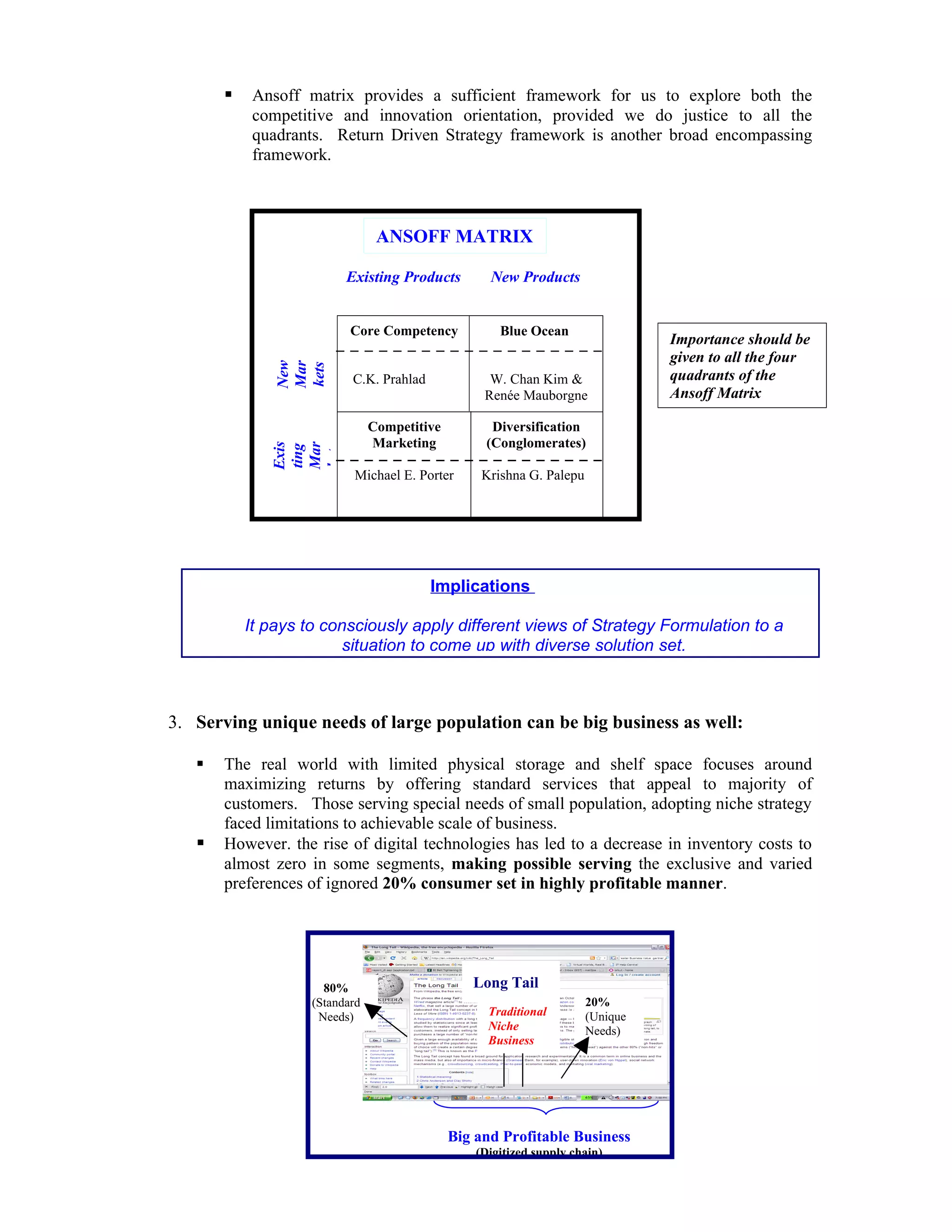
    Ansoff matrix provides a sufficient framework for us to explore both the
            competitive and innovation orientation, provided we do justice to all the
            quadrants. Return Driven Strategy framework is another broad encompassing
            framework.


                                 ANSOFF MATRIX

                          Existing Products         New Products


                           Core Competency            Blue Ocean
                                                                                 Importance should be
                                                                                 given to all the four
              New
              Mar
              kets


                           C.K. Prahlad             W. Chan Kim &                quadrants of the
                                                   Renée Mauborgne               Ansoff Matrix

                                Competitive          Diversification
                                Marketing           (Conglomerates)
              Exis

              Mar
              ting

              kets


                           Michael E. Porter       Krishna G. Palepu


                                          Implications

           It pays to consciously apply different views of Strategy Formulation to a
                         situation to come up with diverse solution set.


3. Serving unique needs of large population can be big business as well:

      The real world with limited physical storage and shelf space focuses around
       maximizing returns by offering standard services that appeal to majority of
       customers. Those serving special needs of small population, adopting niche strategy
       faced limitations to achievable scale of business.
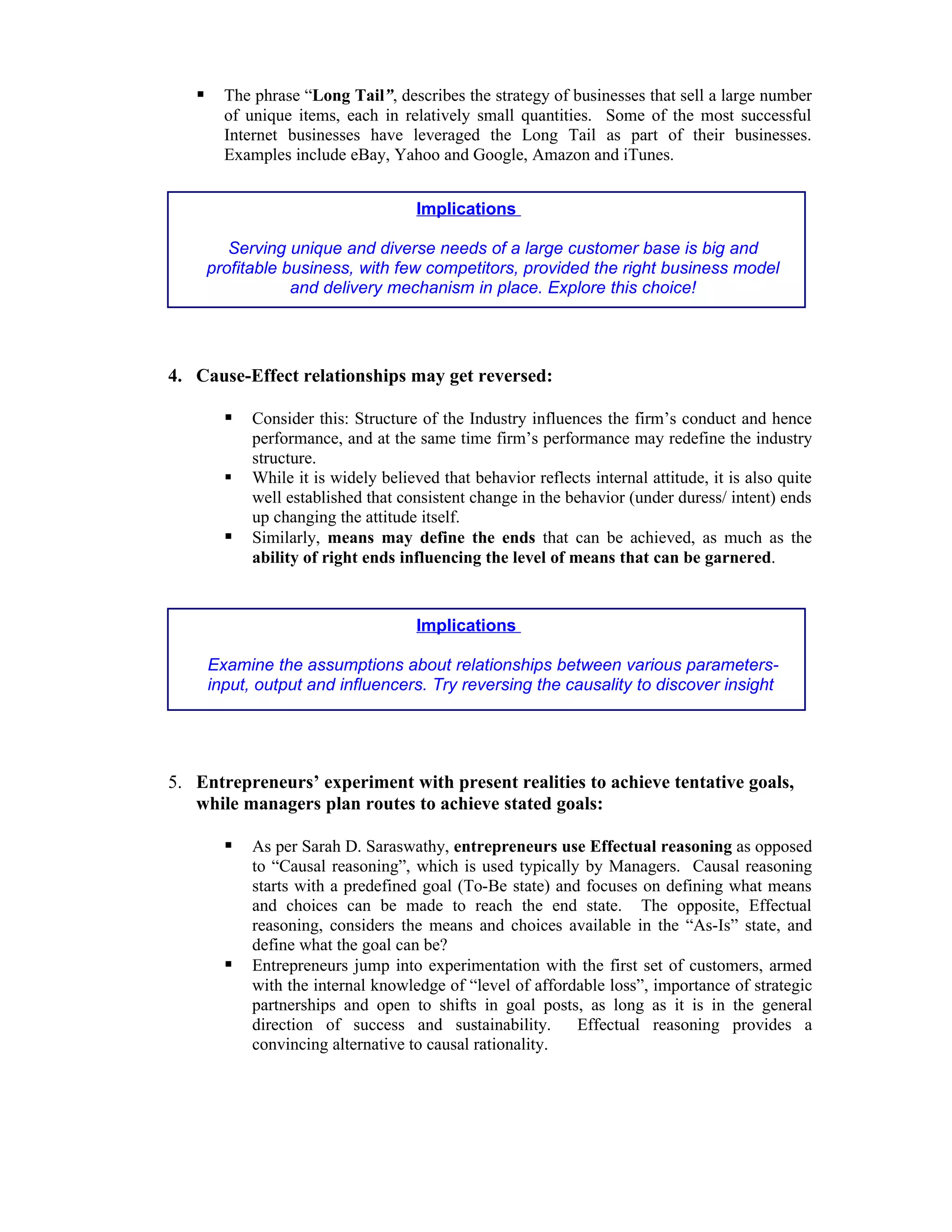
      However. the rise of digital technologies has led to a decrease in inventory costs to
       almost zero in some segments, making possible serving the exclusive and varied
       preferences of ignored 20% consumer set in highly profitable manner.


                      80%                        Long Tail
                    (Standard                                          20%
                     Needs)                         Traditional        (Unique
                                                    Niche              Needs)
                                                    Business


                                              Big and Profitable Business
                                                  (Digitized supply chain)
     The phrase “Long Tail”, describes the strategy of businesses that sell a large number
         of unique items, each in relatively small quantities. Some of the most successful
         Internet businesses have leveraged the Long Tail as part of their businesses.
         Examples include eBay, Yahoo and Google, Amazon and iTunes.


                                      Implications

          Serving unique and diverse needs of a large customer base is big and
       profitable business, with few competitors, provided the right business model
                   and delivery mechanism in place. Explore this choice!


4. Cause-Effect relationships may get reversed:

            Consider this: Structure of the Industry influences the firm’s conduct and hence
             performance, and at the same time firm’s performance may redefine the industry
             structure.
            While it is widely believed that behavior reflects internal attitude, it is also quite
             well established that consistent change in the behavior (under duress/ intent) ends
             up changing the attitude itself.
            Similarly, means may define the ends that can be achieved, as much as the
             ability of right ends influencing the level of means that can be garnered.


                                      Implications

       Examine the assumptions about relationships between various parameters-
       input, output and influencers. Try reversing the causality to discover insight


5. Entrepreneurs’ experiment with present realities to achieve tentative goals,
   while managers plan routes to achieve stated goals:

            As per Sarah D. Saraswathy, entrepreneurs use Effectual reasoning as opposed
             to “Causal reasoning”, which is used typically by Managers. Causal reasoning
             starts with a predefined goal (To-Be state) and focuses on defining what means
             and choices can be made to reach the end state. The opposite, Effectual
             reasoning, considers the means and choices available in the “As-Is” state, and
             define what the goal can be?
            Entrepreneurs jump into experimentation with the first set of customers, armed
             with the internal knowledge of “level of affordable loss”, importance of strategic
             partnerships and open to shifts in goal posts, as long as it is in the general
             direction of success and sustainability.       Effectual reasoning provides a
             convincing alternative to causal rationality.
   As consultants, it may pay to consciously ask: “How will an
           entrepreneur look at this situation, and what else is achievable
           besides/instead of the stated goals, given the present means”. If the
           potential alternative is more easily achievable and of equal proportion in
           impact, it may be worthwhile to question the stated goal. After all, often
           the “goals” at one level are “means” at the super-ordinate level.

                                    Implications

    Get into an entrepreneur’s shoes and see what other goals / targets/ future is
            possible with given set of resources and allowable downsides.


6. Data Analysis and Instincts – Both have their place in decision making:

      In today's digital age, a great degree of focus is laid on information driven decision
       making. Data Analytics is the new buzzword, and business executives are
       increasingly relying on significant amount of data to back up their decisions. But, it
       does take time for data to get generated enough to define a trend which a
       sophisticated tool can help pick faster and better.
      However, in the book "Blink", Malcolm Gladwell explains the principle of "thin
       slicing" which points to the fact that effective decisions can also be made by
       intuitive thinking based on experience of individuals, rather than being driven by
       data only.
      In management, unlike engineering, application may precede theorizing. Thus,
       effectiveness of decision making might not be directly proportional to the level of
       data analysis.


                                   Implications

        Decisions may not be always driven by data analysis, as consultants you
           should also sometimes trust your experience-driven instincts.


7. Rational beings can be predictably irrational:

          Steven Levitt, supported by Tim Harford has convincingly established that all
           our choices are not necessarily rational. Like fearing Swine flu more than the
           road accident, while the probability is reverse, with almost similar impact. We
           value what we have more than what we lose? Loss gain probability of 10/90 is
           not appealing enough for people to act.
          Further, individuals think differently in groups. As much as psychology
           underlines the uniqueness of an individual, as sociology reinforces the views that
           individuals behave differently in groups. Group dynamics often harden the
positions initially taken by the members- whether it is towards risk taking or
              aversion. Remember- “Camel” is a “horse” designed by a Committee.
             Dan Ariely has provided greater insights into how marketers and social scientists
              can leverage human decision making peculiarities for economic and social gains.


                                         Implications

               Banking solely on consumer’s ability to make a rational choice may be a
           vulnerable preposition. Better understanding of decision dynamics may open
                 more options and save from potential surprises during execution.


    8. Change need not be Top-Bottom always:

             Critical success factors for every initiative list “leadership sponsorship”
              partially to avoid resistance from potentially stronger stakeholder set and
              partially relying on their position and power to steamroll any gaps in underling
              logic or plan.
             Top leadership commitment may not be forthcoming for multiple reasons besides
              merit of the case. Welcome to informal organization realities!
             At the same time, there are growing instances where bottom-up approach
              (leading-up) to achieving organization wide sustainable change has been quite
              effective. Although bottom-up instigated change erupts in limited pockets,
              successful projections of the out-of-the ordinary success, creates enough
              provocation for organization-wide adoption.


                                     Implications

       Sometimes, top leadership sponsorship may be difficult to ascertain. Do not
     abandon. As long as there is no stated objection, and the middle managers are
        sufficiently empowered, it is worthwhile to select a unit to provide proof of
                                         concept.


                                   CONCLUSION

The above illustrations from different management theories
underlines the clear recognition of contradicting perspectives that
hold true depending upon appropriate context. As consultants,
conscious execution of these perspectives in any situation may be
more effective in generating greater solution set, than using your
favorite approach.
(Tushar Khosla with special inputs from Param P Singh)


20%


ANSOFF MATRIX

Being creative by design

  • 1.
    Being Creative byDesign Everyone agrees that we need to be more innovative in our recommendations to clients to create greater impact. However, despite rightful intent and efforts, there seems to be great variation in the quality of outcomes. Some practitioners by experience or intellect are able to provide wider perspectives than majority. So what does the majority do besides blaming education, experience or IQ? I believe that conscious and rigorous employing of seemingly contradicting perspectives on any context can help us widen the universal set of possibilities leading to potentially better advice. This is what we reckon as “being creative by design”. Listed below are some of the perspectives (about objectives, strategy and execution) put forward by gurus that although contrarian to established thinking seems to be management true as well in specific contexts. You may like to further add to this list. 1. Stakeholders get motivated differently:  What motivates a professional manager may not motivate the owner of the firm. Economists have always insisted on goal alignment between owners and professional managers under principal-agent theory. There is considerable debate on whether shareholder wealth maximization or stakeholder value generation should be the key objective functions of an enterprise.  Further, managers and employees may get motivated differently. Even in the same group, individuals may stand at different levels on the Missionary- Mercenary Orientation Continuum.  Off-course, there is need for an overarching objective that collectively reflects the aspirations of all stakeholders. But, for the message to engage, it should be able to connect to individual level legitimate aspirations as well. Implications Do not assume! Ascertain that every stakeholder’s priorities and expendables are well understood and the look towards achievement of Pareto Optimality. 2. Selective Strategic Views are standalone traps:  Strategy formulation is essentially a creative exercise, an art that is being continuously scientisized through different frameworks, each approach providing a specific view towards strategy formulation.  Unconscious of single view limitations, consultants often pick specific approach (framework) as favorites and apply it in all situations limiting the options.
  • 2.
    Ansoff matrix provides a sufficient framework for us to explore both the competitive and innovation orientation, provided we do justice to all the quadrants. Return Driven Strategy framework is another broad encompassing framework. ANSOFF MATRIX Existing Products New Products Core Competency Blue Ocean Importance should be given to all the four New Mar kets C.K. Prahlad W. Chan Kim & quadrants of the Renée Mauborgne Ansoff Matrix Competitive Diversification Marketing (Conglomerates) Exis Mar ting kets Michael E. Porter Krishna G. Palepu Implications It pays to consciously apply different views of Strategy Formulation to a situation to come up with diverse solution set. 3. Serving unique needs of large population can be big business as well:  The real world with limited physical storage and shelf space focuses around maximizing returns by offering standard services that appeal to majority of customers. Those serving special needs of small population, adopting niche strategy faced limitations to achievable scale of business.  However. the rise of digital technologies has led to a decrease in inventory costs to almost zero in some segments, making possible serving the exclusive and varied preferences of ignored 20% consumer set in highly profitable manner. 80% Long Tail (Standard 20% Needs) Traditional (Unique Niche Needs) Business Big and Profitable Business (Digitized supply chain)
  • 3.
    The phrase “Long Tail”, describes the strategy of businesses that sell a large number of unique items, each in relatively small quantities. Some of the most successful Internet businesses have leveraged the Long Tail as part of their businesses. Examples include eBay, Yahoo and Google, Amazon and iTunes. Implications Serving unique and diverse needs of a large customer base is big and profitable business, with few competitors, provided the right business model and delivery mechanism in place. Explore this choice! 4. Cause-Effect relationships may get reversed:  Consider this: Structure of the Industry influences the firm’s conduct and hence performance, and at the same time firm’s performance may redefine the industry structure.  While it is widely believed that behavior reflects internal attitude, it is also quite well established that consistent change in the behavior (under duress/ intent) ends up changing the attitude itself.  Similarly, means may define the ends that can be achieved, as much as the ability of right ends influencing the level of means that can be garnered. Implications Examine the assumptions about relationships between various parameters- input, output and influencers. Try reversing the causality to discover insight 5. Entrepreneurs’ experiment with present realities to achieve tentative goals, while managers plan routes to achieve stated goals:  As per Sarah D. Saraswathy, entrepreneurs use Effectual reasoning as opposed to “Causal reasoning”, which is used typically by Managers. Causal reasoning starts with a predefined goal (To-Be state) and focuses on defining what means and choices can be made to reach the end state. The opposite, Effectual reasoning, considers the means and choices available in the “As-Is” state, and define what the goal can be?  Entrepreneurs jump into experimentation with the first set of customers, armed with the internal knowledge of “level of affordable loss”, importance of strategic partnerships and open to shifts in goal posts, as long as it is in the general direction of success and sustainability. Effectual reasoning provides a convincing alternative to causal rationality.
  • 4.
    As consultants, it may pay to consciously ask: “How will an entrepreneur look at this situation, and what else is achievable besides/instead of the stated goals, given the present means”. If the potential alternative is more easily achievable and of equal proportion in impact, it may be worthwhile to question the stated goal. After all, often the “goals” at one level are “means” at the super-ordinate level. Implications Get into an entrepreneur’s shoes and see what other goals / targets/ future is possible with given set of resources and allowable downsides. 6. Data Analysis and Instincts – Both have their place in decision making:  In today's digital age, a great degree of focus is laid on information driven decision making. Data Analytics is the new buzzword, and business executives are increasingly relying on significant amount of data to back up their decisions. But, it does take time for data to get generated enough to define a trend which a sophisticated tool can help pick faster and better.  However, in the book "Blink", Malcolm Gladwell explains the principle of "thin slicing" which points to the fact that effective decisions can also be made by intuitive thinking based on experience of individuals, rather than being driven by data only.  In management, unlike engineering, application may precede theorizing. Thus, effectiveness of decision making might not be directly proportional to the level of data analysis. Implications Decisions may not be always driven by data analysis, as consultants you should also sometimes trust your experience-driven instincts. 7. Rational beings can be predictably irrational:  Steven Levitt, supported by Tim Harford has convincingly established that all our choices are not necessarily rational. Like fearing Swine flu more than the road accident, while the probability is reverse, with almost similar impact. We value what we have more than what we lose? Loss gain probability of 10/90 is not appealing enough for people to act.  Further, individuals think differently in groups. As much as psychology underlines the uniqueness of an individual, as sociology reinforces the views that individuals behave differently in groups. Group dynamics often harden the
  • 5.
    positions initially takenby the members- whether it is towards risk taking or aversion. Remember- “Camel” is a “horse” designed by a Committee.  Dan Ariely has provided greater insights into how marketers and social scientists can leverage human decision making peculiarities for economic and social gains. Implications Banking solely on consumer’s ability to make a rational choice may be a vulnerable preposition. Better understanding of decision dynamics may open more options and save from potential surprises during execution. 8. Change need not be Top-Bottom always:  Critical success factors for every initiative list “leadership sponsorship” partially to avoid resistance from potentially stronger stakeholder set and partially relying on their position and power to steamroll any gaps in underling logic or plan.  Top leadership commitment may not be forthcoming for multiple reasons besides merit of the case. Welcome to informal organization realities!  At the same time, there are growing instances where bottom-up approach (leading-up) to achieving organization wide sustainable change has been quite effective. Although bottom-up instigated change erupts in limited pockets, successful projections of the out-of-the ordinary success, creates enough provocation for organization-wide adoption. Implications Sometimes, top leadership sponsorship may be difficult to ascertain. Do not abandon. As long as there is no stated objection, and the middle managers are sufficiently empowered, it is worthwhile to select a unit to provide proof of concept. CONCLUSION The above illustrations from different management theories underlines the clear recognition of contradicting perspectives that hold true depending upon appropriate context. As consultants, conscious execution of these perspectives in any situation may be more effective in generating greater solution set, than using your favorite approach.
  • 6.
    (Tushar Khosla withspecial inputs from Param P Singh) 20% ANSOFF MATRIX