Concrete as a three phase system
Binaya Prasad dhakal
acme ENGINEERING COLLEGE
introduction
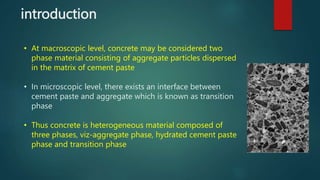
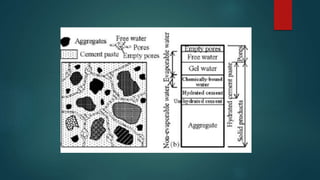
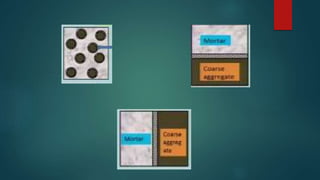
• At macroscopic level, concrete may be considered two
phase material consisting of aggregate particles dispersed
in the matrix of cement paste
• In microscopic level, there exists an interface between
cement paste and aggregate which is known as transition
phase
• Thus concrete is heterogeneous material composed of
three phases, viz-aggregate phase, hydrated cement paste
phase and transition phase
Aggregate phase
• Aggregates in concrete are chemically stable, The properties of concrete are
influenced by the physical properties of aggregates
• This phase is responsible for unit weight, elastic modulus and thermal
properties of concrete
• More angular and rougher aggregates give better bonding with cement paste
• Larger the size of aggregates in concrete greater will be the internal bleeding
due to less surface area
• This phase is stronger than other two phases
• Failure through aggregates occur only when other two zones are stronger than
it in high strength concrete
Hydrated cement phase (HCP)
1. Solids in HCP
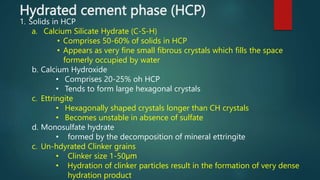
a. Calcium Silicate Hydrate (C-S-H)
• Comprises 50-60% of solids in HCP
• Appears as very fine small fibrous crystals which fills the space
formerly occupied by water
b. Calcium Hydroxide
• Comprises 20-25% oh HCP
• Tends to form large hexagonal crystals
c. Ettringite
• Hexagonally shaped crystals longer than CH crystals
• Becomes unstable in absence of sulfate
d. Monosulfate hydrate
• formed by the decomposition of mineral ettringite
c. Un-hdyrated Clinker grains
• Clinker size 1-50μm
• Hydration of clinker particles result in the formation of very dense
hydration product
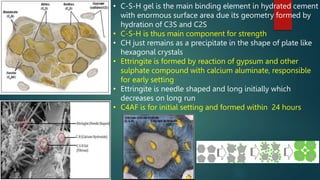
• C-S-H gel is the main binding element in hydrated cement
with enormous surface area due its geometry formed by
hydration of C3S and C2S
• C-S-H is thus main component for strength
• CH just remains as a precipitate in the shape of plate like
hexagonal crystals
• Ettringite is formed by reaction of gypsum and other
sulphate compound with calcium aluminate, responsible
for early setting
• Ettringite is needle shaped and long initially which
decreases on long run
• C4AF is for initial setting and formed within 24 hours
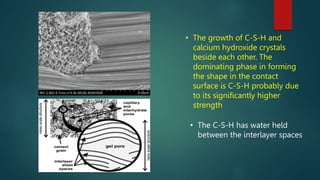
• The growth of C-S-H and
calcium hydroxide crystals
beside each other. The
dominating phase in forming
the shape in the contact
surface is C-S-H probably due
to its significantly higher
strength
• The C-S-H has water held
between the interlayer spaces
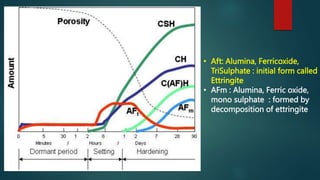
• Aft: Alumina, Ferricoxide,
TriSulphate : initial form called
Ettringite
• AFm : Alumina, Ferric oxide,
mono sulphate : formed by
decomposition of ettringite
2. Voids in HCP
a) Interlayer space in C-S-H
• Void size is small and has no effect on strength and
permeability, about 2nm in diameter
b) Capillary voids
• These are the spaces not filled by solids of HCP
• Irregular in shape and has adverse effects on strength
and permeability
• 10-50 nm in low w/c and 3-5μ in high
c) Entrapped air voids
• Irregular in shape
• Produced due to improper mixing of concrete
• Larger than capillary voids
d) Entrained air voids
• Spherical in shape
• Produced due to addition of air entraining mixture
• 0.02-1mm
2. Water in HCP
a) Capillary water
• Water present in voids larger than 2nm
• Water held by capillary action
• Affects strength and shrinkage
b) Adsorbed water
• Water held to solid surface due to attractive force
• Responsible for shrinkage of HCP on drying
c) Interlayer water
• Associated with C-S-H structure
• Lost only on drying
• Responsible for shrinkage of C-S-H on drying
d) Chemically combined water air voids
• Integral part of structure
• No loss on drying
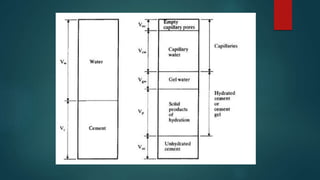
• The hydrated cement paste or cement gel consists of solid products of
hydration and water held physically or adsorbed on the hydrated
surface
• This water is called gel water and is located in between the solid
products of hydration in so called gel pores. The size of gel pores is
about 2nm
• The volume of gel water is 28% of the mass of the dry cement
• Addition to gel water, water combined chemically or physically with the
products of hydration is held firmly
• This amount of water is the non-evaporable water and in fully hydrated
cement represents about 23 % of the mass of dry cement
• The solid products of hydration occupy a volume less than the sum of
the absolute volumes of original dry cement giving rise to residual
space within gross volume of paste which is about 18.5 % of original
volume of dry cement
• These residual space form of voids or capillary pores which can be full
or empty depending upon original mix water and curing conditions
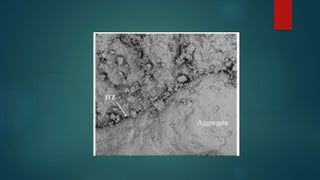
INTERFACIAL Transition zone in
concrete(itz)
• Interfacial region between particles of core aggregate and hardened cement paste
• Transition zone is a plane of weakness and has greater influence on mechanical
behavior of concrete
• Although this zone has bulk cement paste the quality of paste is of poorer quality
• Due to internal bleeding water accumulate below elongated flaky and large pieces
of aggregates resulting in reduction of bond between paste and aggregate
• Due to drying shrinkage or temperature variation the transition zone develops
micro cracks even before the structure is loaded
• When the structure is loaded these micro cracks propagate and larger cracks are
formed causing failure of bond
• Considered as strength limiting phase of concrete
• The formation of micro cracks can be also due to differential volume change
between aggregates and cement paste
View Concrete as a three phase system.pptx

View Concrete as a three phase system.pptx

  • 1.
    Concrete as athree phase system Binaya Prasad dhakal acme ENGINEERING COLLEGE
  • 2.
    introduction • At macroscopiclevel, concrete may be considered two phase material consisting of aggregate particles dispersed in the matrix of cement paste • In microscopic level, there exists an interface between cement paste and aggregate which is known as transition phase • Thus concrete is heterogeneous material composed of three phases, viz-aggregate phase, hydrated cement paste phase and transition phase
  • 3.
    Aggregate phase • Aggregatesin concrete are chemically stable, The properties of concrete are influenced by the physical properties of aggregates • This phase is responsible for unit weight, elastic modulus and thermal properties of concrete • More angular and rougher aggregates give better bonding with cement paste • Larger the size of aggregates in concrete greater will be the internal bleeding due to less surface area • This phase is stronger than other two phases • Failure through aggregates occur only when other two zones are stronger than it in high strength concrete
  • 4.
    Hydrated cement phase(HCP) 1. Solids in HCP a. Calcium Silicate Hydrate (C-S-H) • Comprises 50-60% of solids in HCP • Appears as very fine small fibrous crystals which fills the space formerly occupied by water b. Calcium Hydroxide • Comprises 20-25% oh HCP • Tends to form large hexagonal crystals c. Ettringite • Hexagonally shaped crystals longer than CH crystals • Becomes unstable in absence of sulfate d. Monosulfate hydrate • formed by the decomposition of mineral ettringite c. Un-hdyrated Clinker grains • Clinker size 1-50μm • Hydration of clinker particles result in the formation of very dense hydration product
  • 5.
    • C-S-H gelis the main binding element in hydrated cement with enormous surface area due its geometry formed by hydration of C3S and C2S • C-S-H is thus main component for strength • CH just remains as a precipitate in the shape of plate like hexagonal crystals • Ettringite is formed by reaction of gypsum and other sulphate compound with calcium aluminate, responsible for early setting • Ettringite is needle shaped and long initially which decreases on long run • C4AF is for initial setting and formed within 24 hours
  • 6.
    • The growthof C-S-H and calcium hydroxide crystals beside each other. The dominating phase in forming the shape in the contact surface is C-S-H probably due to its significantly higher strength • The C-S-H has water held between the interlayer spaces
  • 7.
    • Aft: Alumina,Ferricoxide, TriSulphate : initial form called Ettringite • AFm : Alumina, Ferric oxide, mono sulphate : formed by decomposition of ettringite
  • 8.
    2. Voids inHCP a) Interlayer space in C-S-H • Void size is small and has no effect on strength and permeability, about 2nm in diameter b) Capillary voids • These are the spaces not filled by solids of HCP • Irregular in shape and has adverse effects on strength and permeability • 10-50 nm in low w/c and 3-5μ in high c) Entrapped air voids • Irregular in shape • Produced due to improper mixing of concrete • Larger than capillary voids d) Entrained air voids • Spherical in shape • Produced due to addition of air entraining mixture • 0.02-1mm
  • 9.
    2. Water inHCP a) Capillary water • Water present in voids larger than 2nm • Water held by capillary action • Affects strength and shrinkage b) Adsorbed water • Water held to solid surface due to attractive force • Responsible for shrinkage of HCP on drying c) Interlayer water • Associated with C-S-H structure • Lost only on drying • Responsible for shrinkage of C-S-H on drying d) Chemically combined water air voids • Integral part of structure • No loss on drying
  • 11.
    • The hydratedcement paste or cement gel consists of solid products of hydration and water held physically or adsorbed on the hydrated surface • This water is called gel water and is located in between the solid products of hydration in so called gel pores. The size of gel pores is about 2nm • The volume of gel water is 28% of the mass of the dry cement • Addition to gel water, water combined chemically or physically with the products of hydration is held firmly • This amount of water is the non-evaporable water and in fully hydrated cement represents about 23 % of the mass of dry cement • The solid products of hydration occupy a volume less than the sum of the absolute volumes of original dry cement giving rise to residual space within gross volume of paste which is about 18.5 % of original volume of dry cement • These residual space form of voids or capillary pores which can be full or empty depending upon original mix water and curing conditions
  • 13.
    INTERFACIAL Transition zonein concrete(itz) • Interfacial region between particles of core aggregate and hardened cement paste • Transition zone is a plane of weakness and has greater influence on mechanical behavior of concrete • Although this zone has bulk cement paste the quality of paste is of poorer quality • Due to internal bleeding water accumulate below elongated flaky and large pieces of aggregates resulting in reduction of bond between paste and aggregate • Due to drying shrinkage or temperature variation the transition zone develops micro cracks even before the structure is loaded • When the structure is loaded these micro cracks propagate and larger cracks are formed causing failure of bond • Considered as strength limiting phase of concrete • The formation of micro cracks can be also due to differential volume change between aggregates and cement paste