High-Strength and High- 
Performance Concrete 
• It is important to note the high-strength and high-performance 
concrete are not synonymous. 
• Concrete is defined as “high-strength concrete” solely on 
the basis of its compressive strength measured at a given 
age. 
• In the 1970’s, any concrete mixtures that showed 40 MPa 
or more compressive strength at 28-days were designed as 
high-strength concrete. 
• Later, 60-100 MPa concrete mixtures were commercially 
developed and used in the construction of high-rise 
buildings and long-span bridges in many parts of the 
world.
Definitions 
• The definition of high-performance concrete 
is more controversial. 
• Mehta and Aitcin[1] used the term, high-performance 
concrete (HPC) for concrete 
mixtures possessing high workability, high 
durability and high ultimate strength. 
[1]
Definitions 
• ACI defined high-performance concrete as 
a concrete meeting special combinations of 
performance and uniformity requirements 
that cannot always be achieved routinely 
using conventional constituents and normal 
mixing, placing, and curing practice. 
[1]
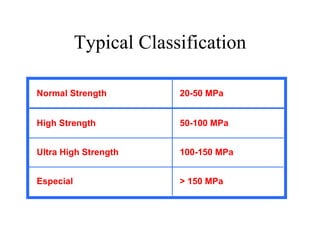
Typical Classification 
Normal Strength 20-50 MPa 
High Strength 
Ultra High Strength 
Especial 
50-100 MPa 
100-150 MPa 
> 150 MPa
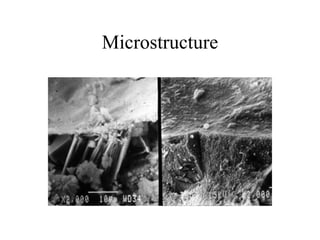
Microstructure
Microstructure 
• From the general principles behind the 
design of high-strength concrete mixtures, it 
is apparent that high strengths are made 
possible by reducing porosity, 
inhomogeneity, and microcracks in the 
hydrated cement paste and the transition 
zone.
Microstructure 
• The utilization of fine pozzolanic materials in high-strength 
concrete leads to a reduction of the size of the 
crystalline compounds, particularly, calcium hydroxide. 
• Consequently, there is a reduction of the thickness of the 
interfacial transition zone in high-strength concrete. 
• The densification of the interfacial transition zone allows 
for efficient load transfer between the cement mortar and 
the coarse aggregate, contributing to the strength of the 
concrete. 
• For very high-strength concrete where the matrix is 
extremely dense, a weak aggregate may become the weak 
link in concrete strength.
Materials - Cement 
• Almost any ASTM portland cement type can be 
used to obtain concrete with adequate rheology 
and with compressive strength up to 60 MPa. 
• In order to obtain higher strength mixtures while 
maintaining good workability, it is necessary to 
study carefully the cement composition and 
finenesses and its compatibility with the chemical 
admixtures. 
• Experience has shown that low-C3A cements 
generally produce concrete with improved 
rheology.
Materials -- Aggregate 
• In high-strength concrete, the aggregate plays an 
important role on the strength of concrete. 
• The low-water to cement ratio used in high-strength 
concrete causes densification in both the 
matrix and interfacial transition zone, and the 
aggregate may become the weak link in the 
development of the mechanical strength. 
• Extreme care is necessary, therefore, in the 
selection of aggregate to be used in very high-strength 
concrete.
Materials -- Aggregate 
• The particle size distribution of fine aggregate that meets 
the ASTM specifications is adequate for high-strength 
concrete mixtures. 
• If possible, Aitcin recommends using fine aggregates with 
higher fineness modulus (around 3.0). His reasoning is as 
follows: 
– a) high-strength concrete mixtures already have large amounts of 
small particles of cement and pozzolan, therefore fine particles of 
aggregate will not improve the workability of the mix; 
– b) the use of coarser fine aggregates requires less water to obtain 
the same workability; and 
– c) during the mixing process, the coarser fine aggregates will 
generate higher shearing stresses that can help prevent floculation 
of the cement paste.
Guidelines for the selection of 
materials 
• The higher the targeted compressive strength, the 
smaller the maximum size of coarse aggregate. 
• Up to 70 MPa compressive strength can be 
produced with a good coarse aggregate of a 
maximum size ranging from 20 to 28 mm. 
• To produce 100 MPa compressive strength 
aggregate with a maximum size of 10 to 20 mm 
should be used. 
• To date, concretes with compressive strengths of 
over 125 MPa have been produced, with 10 to 14 
mm maximum size coarse aggregate.
Guidelines for the selection of 
materials 
• Using supplementary cementitious materials, such as blast-furnace 
slag, fly ash and natural pozzolans, not only 
reduces the production cost of concrete, but also addresses 
the slump loss problem. 
• The optimum substitution level is often determined by the 
loss in 12- or 24-hour strength that is considered 
acceptable, given climatic conditions or the minimum 
strength required. 
• While silica fume is usually not really necessary for 
compressive strengths under 70 MPa, most concrete 
mixtures contain it when higher strengths are specified.
Differences Between NSC and 
HSC 
• In normal strength concrete, the microcracks form 
when the compressive stress reaches ~ 40% of the 
strength. The cracks interconnect when the stress 
reaches 80-90% of the strength 
• For HSC, Iravani and MacGregor reported 
linearity of the stress-strain diagram at 65 to 70, 
75 to 80 and above 85% of the peak load for 
concrete with compressive strengths of 65, 95, and 
105 MPa.
Differences Between NSC and 
HSC (2) 
• The fracture surface in NSC is rough. The 
fracture develops along the transition zone 
between the matrix and aggregates. Fewer 
aggregate particles are broken. 
• The fracture surface in HSC is smooth. The 
cracks move without discontinuities 
between the matrix and aggregates.
Mechanical Behavior 
• Stress-strain curve is more linear 
• The strain corresponding to the maximum 
stress increases with strength 
• The post-peak domain gets steeper 
• The ultimate deformation decreases with the 
increasing strength
Strength 
• Based on 289 observations of moist-cured 
high-strength concrete samples made with 
Type III cement, Mokhtarzadeh and French 
obtained the following relationship 
[ 
fcm = fc28 
t 
0.89 + 0.97t 
 
 
 

Long-term strength 
• Iravani and MacGregor suggested the following 
strength values for sustained loading: 
• 70 to 75% (of the short-time loading strength) for 
65 MPa concrete 
• 75 to 80% for 95 MPa concrete, without silica 
fume 
• 85 to 90% for 105 MPa concrete, with silica fume 
• 85 to 90% for 120 MPa concrete, with silica fume
Elastic Modulus 
• Great care should be taken if using well-established 
equations developed for normal-strength 
concrete to estimate the elastic 
modulus of high-strength concrete. 
Extrapolation beyond the validity of the 
equations often leads to overestimation of 
the elastic modulus.
Elastic Modulus 
• for normal weight concrete with 21 MPa < 
fc < 83 MPa 
• where Ec is the elastic modulus of concrete, 
fc the compressive strength. 
Ec = 3320 fc + 6900 MPa
Data from Tomosawa and Noguchi 
60000 
40000 
20000 
0 
river gravel 
Crushed Graywack 
Crushed Quartz 
Crushed Limestone 
Crushed Andesite 
Blast furnace slag 
Calcined bauxite 
Crushed Cobble 
Crushed Basalt 
Lightweight CA 
Lightweight FA + CA 
Model 
0 50 100 150 200 
Elastic Modulus (MPa) 
Compressive Strength (MPa)
Chemical and Autogeneous 
shrinkage 
• During hydration of the cement paste in a closed system, 
the volume of the hydration products, , is less than the sum 
of the volume of water and the volume of cement that is 
hydrated. This leads to chemical shrinkage whose 
magnitude can be expressed by 
εch = 
Vc + Vw ( ) − Vh 
Vci + Vwi 
where and are the current and initial volume of cement, and 
and are the current and initial volume of water, respectively.
Early Volume Change 
• Before setting, the chemical shrinkage is not 
constrained and, therefore, it will induce 
shrinkage of the same magnitude in the 
cement paste. As a rigid network of 
hydration products starts to develop, the 
values of the chemical shrinkage and that of 
the measured shrinkage in the cement paste 
start to diverge, since the rigidity of the 
paste restrains the deformation.
Definition of the autogenous 
shrinkage according to the Japanese 
Concrete Institute 
• macroscopic volume reduction of 
cementitious materials when cement 
hydrates after initial setting. Autogenous 
shrinkage does not include volume change 
due to loss or ingress of substances, 
temperature variation, and application of 
an external force and restraint.
Concerns with the use of HSC (1) 
• The lower modulus predicted by design 
codes. 
• (note, not a problem anymore since most 
codes now have adequate equations)
Concerns with the use of HSC (2) 
• The reported decrease of strength over time.
Concerns with the use of HSC (3) 
• Fire resistance
Concerns with the use of HSC (4) 
• Is AE necessary for HSC?
Examples of application 
The bridge constructed in Joigny used 
concrete with 60 MPa instead of 
concrete with 35 Mpa. The volume 
of concrete reduced 30%
Examples of application 
• Prof. Zia has shown that for 29-m spans 
with 80 Mpa concrete instead of 40 Mpa 
allow a 17% increase in span.
Examples of application 
• Jobse has demonstrated that by increasing 
the compressive strength of concrete from 
40 Mpa to 70 Mpa the number of supports 
could be reduced from nine to four
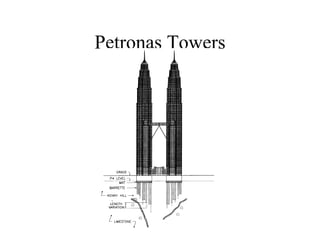
Petronas Towers
Pertronas Towers 
• in Kuala Lumpur (Malasia) 
• 450 m high 
• 40-80 Mpa concrete 
• Local workers
Advantages of using HSC in the 
Petronas Towers 
• Structural Economy 
• Efficient method of concrete placement 
• Simplified construction joints 
• Reduced vibration due to high wind
Special considerations used in 
Petronas Towers 
• Complete study of creep and shrinkage 
• Detailed analysis of wind effect on the 
structures. Note that the damping of 
concrete is twice as much as of steel
Construction Stage: Jan.
Construction Stage: Dez.
Construction Stage: March
Construction Stage: June

Hsc

  • 1.
    High-Strength and High- Performance Concrete • It is important to note the high-strength and high-performance concrete are not synonymous. • Concrete is defined as “high-strength concrete” solely on the basis of its compressive strength measured at a given age. • In the 1970’s, any concrete mixtures that showed 40 MPa or more compressive strength at 28-days were designed as high-strength concrete. • Later, 60-100 MPa concrete mixtures were commercially developed and used in the construction of high-rise buildings and long-span bridges in many parts of the world.
  • 2.
    Definitions • Thedefinition of high-performance concrete is more controversial. • Mehta and Aitcin[1] used the term, high-performance concrete (HPC) for concrete mixtures possessing high workability, high durability and high ultimate strength. [1]
  • 3.
    Definitions • ACIdefined high-performance concrete as a concrete meeting special combinations of performance and uniformity requirements that cannot always be achieved routinely using conventional constituents and normal mixing, placing, and curing practice. [1]
  • 4.
    Typical Classification NormalStrength 20-50 MPa High Strength Ultra High Strength Especial 50-100 MPa 100-150 MPa > 150 MPa
  • 5.
  • 6.
    Microstructure • Fromthe general principles behind the design of high-strength concrete mixtures, it is apparent that high strengths are made possible by reducing porosity, inhomogeneity, and microcracks in the hydrated cement paste and the transition zone.
  • 7.
    Microstructure • Theutilization of fine pozzolanic materials in high-strength concrete leads to a reduction of the size of the crystalline compounds, particularly, calcium hydroxide. • Consequently, there is a reduction of the thickness of the interfacial transition zone in high-strength concrete. • The densification of the interfacial transition zone allows for efficient load transfer between the cement mortar and the coarse aggregate, contributing to the strength of the concrete. • For very high-strength concrete where the matrix is extremely dense, a weak aggregate may become the weak link in concrete strength.
  • 8.
    Materials - Cement • Almost any ASTM portland cement type can be used to obtain concrete with adequate rheology and with compressive strength up to 60 MPa. • In order to obtain higher strength mixtures while maintaining good workability, it is necessary to study carefully the cement composition and finenesses and its compatibility with the chemical admixtures. • Experience has shown that low-C3A cements generally produce concrete with improved rheology.
  • 9.
    Materials -- Aggregate • In high-strength concrete, the aggregate plays an important role on the strength of concrete. • The low-water to cement ratio used in high-strength concrete causes densification in both the matrix and interfacial transition zone, and the aggregate may become the weak link in the development of the mechanical strength. • Extreme care is necessary, therefore, in the selection of aggregate to be used in very high-strength concrete.
  • 10.
    Materials -- Aggregate • The particle size distribution of fine aggregate that meets the ASTM specifications is adequate for high-strength concrete mixtures. • If possible, Aitcin recommends using fine aggregates with higher fineness modulus (around 3.0). His reasoning is as follows: – a) high-strength concrete mixtures already have large amounts of small particles of cement and pozzolan, therefore fine particles of aggregate will not improve the workability of the mix; – b) the use of coarser fine aggregates requires less water to obtain the same workability; and – c) during the mixing process, the coarser fine aggregates will generate higher shearing stresses that can help prevent floculation of the cement paste.
  • 11.
    Guidelines for theselection of materials • The higher the targeted compressive strength, the smaller the maximum size of coarse aggregate. • Up to 70 MPa compressive strength can be produced with a good coarse aggregate of a maximum size ranging from 20 to 28 mm. • To produce 100 MPa compressive strength aggregate with a maximum size of 10 to 20 mm should be used. • To date, concretes with compressive strengths of over 125 MPa have been produced, with 10 to 14 mm maximum size coarse aggregate.
  • 12.
    Guidelines for theselection of materials • Using supplementary cementitious materials, such as blast-furnace slag, fly ash and natural pozzolans, not only reduces the production cost of concrete, but also addresses the slump loss problem. • The optimum substitution level is often determined by the loss in 12- or 24-hour strength that is considered acceptable, given climatic conditions or the minimum strength required. • While silica fume is usually not really necessary for compressive strengths under 70 MPa, most concrete mixtures contain it when higher strengths are specified.
  • 13.
    Differences Between NSCand HSC • In normal strength concrete, the microcracks form when the compressive stress reaches ~ 40% of the strength. The cracks interconnect when the stress reaches 80-90% of the strength • For HSC, Iravani and MacGregor reported linearity of the stress-strain diagram at 65 to 70, 75 to 80 and above 85% of the peak load for concrete with compressive strengths of 65, 95, and 105 MPa.
  • 14.
    Differences Between NSCand HSC (2) • The fracture surface in NSC is rough. The fracture develops along the transition zone between the matrix and aggregates. Fewer aggregate particles are broken. • The fracture surface in HSC is smooth. The cracks move without discontinuities between the matrix and aggregates.
  • 15.
    Mechanical Behavior •Stress-strain curve is more linear • The strain corresponding to the maximum stress increases with strength • The post-peak domain gets steeper • The ultimate deformation decreases with the increasing strength
  • 16.
    Strength • Basedon 289 observations of moist-cured high-strength concrete samples made with Type III cement, Mokhtarzadeh and French obtained the following relationship [ fcm = fc28 t 0.89 + 0.97t    
  • 17.
    Long-term strength •Iravani and MacGregor suggested the following strength values for sustained loading: • 70 to 75% (of the short-time loading strength) for 65 MPa concrete • 75 to 80% for 95 MPa concrete, without silica fume • 85 to 90% for 105 MPa concrete, with silica fume • 85 to 90% for 120 MPa concrete, with silica fume
  • 18.
    Elastic Modulus •Great care should be taken if using well-established equations developed for normal-strength concrete to estimate the elastic modulus of high-strength concrete. Extrapolation beyond the validity of the equations often leads to overestimation of the elastic modulus.
  • 19.
    Elastic Modulus •for normal weight concrete with 21 MPa < fc < 83 MPa • where Ec is the elastic modulus of concrete, fc the compressive strength. Ec = 3320 fc + 6900 MPa
  • 20.
    Data from Tomosawaand Noguchi 60000 40000 20000 0 river gravel Crushed Graywack Crushed Quartz Crushed Limestone Crushed Andesite Blast furnace slag Calcined bauxite Crushed Cobble Crushed Basalt Lightweight CA Lightweight FA + CA Model 0 50 100 150 200 Elastic Modulus (MPa) Compressive Strength (MPa)
  • 21.
    Chemical and Autogeneous shrinkage • During hydration of the cement paste in a closed system, the volume of the hydration products, , is less than the sum of the volume of water and the volume of cement that is hydrated. This leads to chemical shrinkage whose magnitude can be expressed by εch = Vc + Vw ( ) − Vh Vci + Vwi where and are the current and initial volume of cement, and and are the current and initial volume of water, respectively.
  • 22.
    Early Volume Change • Before setting, the chemical shrinkage is not constrained and, therefore, it will induce shrinkage of the same magnitude in the cement paste. As a rigid network of hydration products starts to develop, the values of the chemical shrinkage and that of the measured shrinkage in the cement paste start to diverge, since the rigidity of the paste restrains the deformation.
  • 23.
    Definition of theautogenous shrinkage according to the Japanese Concrete Institute • macroscopic volume reduction of cementitious materials when cement hydrates after initial setting. Autogenous shrinkage does not include volume change due to loss or ingress of substances, temperature variation, and application of an external force and restraint.
  • 24.
    Concerns with theuse of HSC (1) • The lower modulus predicted by design codes. • (note, not a problem anymore since most codes now have adequate equations)
  • 25.
    Concerns with theuse of HSC (2) • The reported decrease of strength over time.
  • 26.
    Concerns with theuse of HSC (3) • Fire resistance
  • 27.
    Concerns with theuse of HSC (4) • Is AE necessary for HSC?
  • 28.
    Examples of application The bridge constructed in Joigny used concrete with 60 MPa instead of concrete with 35 Mpa. The volume of concrete reduced 30%
  • 29.
    Examples of application • Prof. Zia has shown that for 29-m spans with 80 Mpa concrete instead of 40 Mpa allow a 17% increase in span.
  • 30.
    Examples of application • Jobse has demonstrated that by increasing the compressive strength of concrete from 40 Mpa to 70 Mpa the number of supports could be reduced from nine to four
  • 31.
  • 32.
    Pertronas Towers •in Kuala Lumpur (Malasia) • 450 m high • 40-80 Mpa concrete • Local workers
  • 33.
    Advantages of usingHSC in the Petronas Towers • Structural Economy • Efficient method of concrete placement • Simplified construction joints • Reduced vibration due to high wind
  • 34.
    Special considerations usedin Petronas Towers • Complete study of creep and shrinkage • Detailed analysis of wind effect on the structures. Note that the damping of concrete is twice as much as of steel
  • 35.
  • 36.
  • 37.
  • 38.