+

Using Video to
Enhance or Flip
ESL Speaking,
Listening, and
Pronunciation

Marsha Chan
The Pronunciation Doctor
Mission College and Sunburst Media
+

Value of using video clips for
listening, speaking, pronunciation


To enhance learning during class














With audiovisual input
Can be created specifically for English learners
Can be carefully selected material for a general audience
Can be theme-based with material for discussion
Can present functional language
Can focus on prosody and other pronunciation elements
Should provide a model for learners to copy/emulate
To preview material in a course book
To augment material in a course book
To expand on material in a course book

To enhance learning outside of class…
+

What is flip teaching?


A form of blended learning



Encompasses the use of technology to leverage learning
in the classroom



Most commonly done using teacher-created videos that
students view outside of class time



Moves “lecture” home and “homework” into class hours



Allows students more time to review and absorb “lecture”
content.



Allows more hands-on time with the instructor guiding the
students during class
+

What are benefits of flip teaching?



Enables students more time to review and absorb
lecture/presentation content.



Allows more hands-on time with the instructor guiding the
students during class



Creates more collaborative learning opportunities among
students



More 1-on-1 interaction builds stronger student-teacher
relationships



Offers a way to share lecture material easily with
colleagues, substitute teachers, students’ family, community
+

Today’s examples
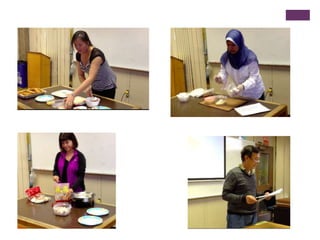
 Homemade





Written with particular language objectives
Recorded on Apple Macintosh
Edited in Quicktime, iMovie, Final Cut Express
Uploaded to www.youtube.com/pronunciationdoctor

 Mission



videos

College students access the Internet

On campus
At home
+

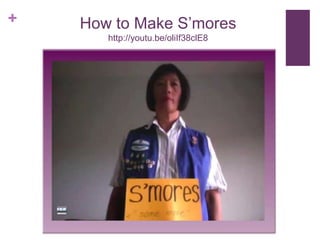
How to Make S’mores
from Pronunciation Doctor’s Youtube Channel
www.youtube.com/pronunciationdoctor

 Example


Instructional, describes a process, tangible, short

 Video



viewing assignments (homework)

Intermediate-low/mid
Intermediate-high – Advanced-low

 Post-viewing

discussion

 Presentation

planning and implementation
+

How to Make S’mores
http://youtu.be/oliIf38clE8
+

Video viewing assignment
 Introduction
 Ingredients
 Other

things you’ll need

 Directions
 Optional

follow-up: Plan a presentation
+

Introduction
word don’t is acontractionof do and not. S’more
is a contractionof what two words?

 The

 When

people in the United States go camping, what
do they like to do at nighttime?

what cookbook did the first s’more recipe first
appear?

 In
+

Prepare these things
Ingredients


To make s’mores for about 1020 campers, what will you
need?


a bag of large
, about a pound



a box of
_______________________
__, about a pound



a dozen
__________________, about
a pound

Other things you need


A __________ or



A clean ____________



A ______________
+

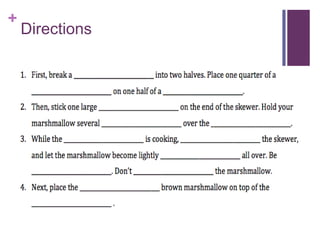
Directions
+

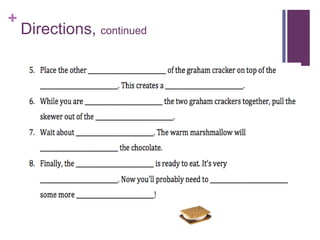
Directions, continued
+

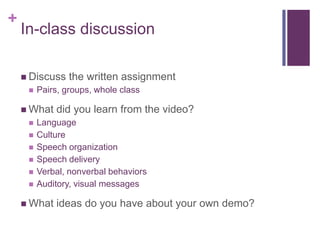
In-class discussion
 Discuss


Pairs, groups, whole class

 What







the written assignment

did you learn from the video?

Language
Culture
Speech organization
Speech delivery
Verbal, nonverbal behaviors
Auditory, visual messages

 What

ideas do you have about your own demo?
+

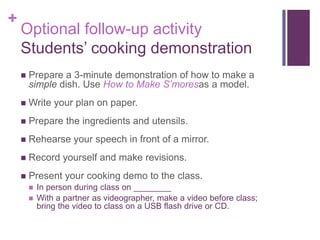
Optional follow-up activity
Students’ cooking demonstration


Prepare a 3-minute demonstration of how to make a
simple dish. Use How to Make S’moresas a model.



Write your plan on paper.



Prepare the ingredients and utensils.



Rehearse your speech in front of a mirror.



Record yourself and make revisions.



Present your cooking demo to the class.



In person during class on ________
With a partner as videographer, make a video before class;
bring the video to class on a USB flash drive or CD.
+

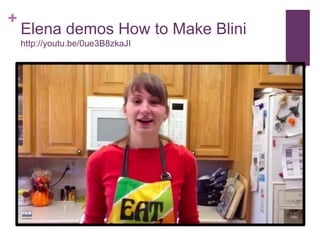
Elena demos How to Make Blini
http://youtu.be/0ue3B8zkaJI
+

Tiffany’s Daffodils


Example from Pronunciation Doctor’s Youtube Channel
www.youtube.com/pronunciationdoctor




Narrative, a story in the past time, concrete, focused on past
tense phonology

Video viewing assignments (homework)


Intermediate-low/mid



Intermediate-high – Advanced-low



Classroom discussion



Post-viewing discussion



Presentation planning and implementation
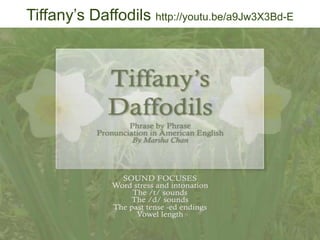
Tiffany’s Daffodils http://youtu.be/a9Jw3X3Bd-E
+

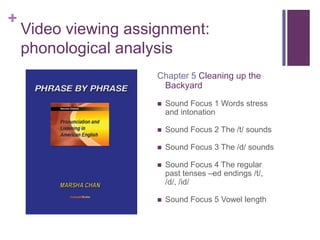
Video viewing assignment:
phonological analysis
Chapter 5 Cleaning up the
Backyard


Sound Focus 1 Words stress
and intonation



Sound Focus 2 The /t/ sounds



Sound Focus 3 The /d/ sounds



Sound Focus 4 The regular
past tenses –ed endings /t/,
/d/, /id/



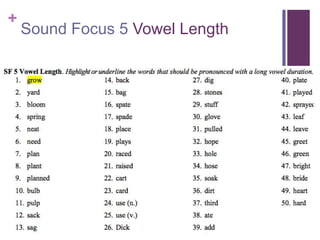
Sound Focus 5 Vowel length
+

Sound Focus 1 Word Stress and
Intonation
+

Sound Focus 2 The /t/ sounds
+

Sound Focus 3 The /d/ sounds
+ Sound Focus 4 Regular past tense
endings /t/, /d/, /id/
+

Sound Focus 5 Vowel Length
+

In-class discussion


Discuss the written assignment




What did you learn from the video?









Pairs, groups, whole class

Pronunciation
Vocabulary
Story telling
Speech delivery
Illustrations
Auditory, visual messages

What ideas do you have about developing your own
story?
+

Oral presentation: a story about an
event in the past time
 Compose

your own story about something that
happened in the past.

 Bring

a first draft of your story to class on
_________________.

 Prepare

the story for oral presentation on
_________________.
Kim Chi traveled to Canada
http://youtu.be/J-ltTI6s170
+

Many other video sources,
among them…
 TED

talks Riveting talks by remarkable people, free
to the world (Advanced learners)


www.ted.com

 VOA Voice



of America

www.voa.gov
learningenglish.voanews.com


Levels 1 and 2




Vocabulary, Comprehension, Listening

Audio, pictures, captioned videos, quizzes and other
downloadable learning materials
Marsha Chan

CATESOL 2013 presentations


Using Video to Flip ESL
Speaking, Listening, and
Pronunciation Fri 8:30-9:30

Contact information





Games Employing
Movement, Memory, Meaning, Minglin
g, Monitoring, & Communication Fri
11:00-12:00
What Language Teachers Must Know
to Teach Pronunciation Fri 3:30-5:00
Teaching of Pronunciation Interest
Group Networking & Business
Meeting Fri 5:00-5:45



Read, Write, Listen, Speak: Projects
for Integrating Language Skills Sat
2:30-3:30



www.youtube.com/PronunciationDo
ctor



www.linkedin.com/in/PronunciationD
octor



www.slideshare.net/purplecast



www.marshaprofdev.blogspot.com
www.sunburstmedia.com/present/pr
esent.html



www.missioncollege.edu/depts/esl/f
aculty/chan/chan.html

Learning and Teaching the Music of
Spoken English Sat 10:15-11:15



marsha@sunburstmedia.com







Using Video to Flip ESL Speaking, Listening, and Pronunciation

  • 1.
    + Using Video to Enhanceor Flip ESL Speaking, Listening, and Pronunciation Marsha Chan The Pronunciation Doctor Mission College and Sunburst Media
  • 2.
    + Value of usingvideo clips for listening, speaking, pronunciation  To enhance learning during class            With audiovisual input Can be created specifically for English learners Can be carefully selected material for a general audience Can be theme-based with material for discussion Can present functional language Can focus on prosody and other pronunciation elements Should provide a model for learners to copy/emulate To preview material in a course book To augment material in a course book To expand on material in a course book To enhance learning outside of class…
  • 3.
    + What is flipteaching?  A form of blended learning  Encompasses the use of technology to leverage learning in the classroom  Most commonly done using teacher-created videos that students view outside of class time  Moves “lecture” home and “homework” into class hours  Allows students more time to review and absorb “lecture” content.  Allows more hands-on time with the instructor guiding the students during class
  • 4.
    + What are benefitsof flip teaching?  Enables students more time to review and absorb lecture/presentation content.  Allows more hands-on time with the instructor guiding the students during class  Creates more collaborative learning opportunities among students  More 1-on-1 interaction builds stronger student-teacher relationships  Offers a way to share lecture material easily with colleagues, substitute teachers, students’ family, community
  • 5.
    + Today’s examples  Homemade     Writtenwith particular language objectives Recorded on Apple Macintosh Edited in Quicktime, iMovie, Final Cut Express Uploaded to www.youtube.com/pronunciationdoctor  Mission   videos College students access the Internet On campus At home
  • 6.
    + How to MakeS’mores from Pronunciation Doctor’s Youtube Channel www.youtube.com/pronunciationdoctor  Example  Instructional, describes a process, tangible, short  Video   viewing assignments (homework) Intermediate-low/mid Intermediate-high – Advanced-low  Post-viewing discussion  Presentation planning and implementation
  • 7.
    + How to MakeS’mores http://youtu.be/oliIf38clE8
  • 8.
    + Video viewing assignment Introduction  Ingredients  Other things you’ll need  Directions  Optional follow-up: Plan a presentation
  • 9.
    + Introduction word don’t isacontractionof do and not. S’more is a contractionof what two words?  The  When people in the United States go camping, what do they like to do at nighttime? what cookbook did the first s’more recipe first appear?  In
  • 10.
    + Prepare these things Ingredients  Tomake s’mores for about 1020 campers, what will you need?  a bag of large , about a pound  a box of _______________________ __, about a pound  a dozen __________________, about a pound Other things you need  A __________ or  A clean ____________  A ______________
  • 11.
  • 12.
  • 13.
    + In-class discussion  Discuss  Pairs,groups, whole class  What       the written assignment did you learn from the video? Language Culture Speech organization Speech delivery Verbal, nonverbal behaviors Auditory, visual messages  What ideas do you have about your own demo?
  • 14.
    + Optional follow-up activity Students’cooking demonstration  Prepare a 3-minute demonstration of how to make a simple dish. Use How to Make S’moresas a model.  Write your plan on paper.  Prepare the ingredients and utensils.  Rehearse your speech in front of a mirror.  Record yourself and make revisions.  Present your cooking demo to the class.   In person during class on ________ With a partner as videographer, make a video before class; bring the video to class on a USB flash drive or CD.
  • 16.
    + Elena demos Howto Make Blini http://youtu.be/0ue3B8zkaJI
  • 17.
    + Tiffany’s Daffodils  Example fromPronunciation Doctor’s Youtube Channel www.youtube.com/pronunciationdoctor   Narrative, a story in the past time, concrete, focused on past tense phonology Video viewing assignments (homework)  Intermediate-low/mid  Intermediate-high – Advanced-low  Classroom discussion  Post-viewing discussion  Presentation planning and implementation
  • 18.
  • 19.
    + Video viewing assignment: phonologicalanalysis Chapter 5 Cleaning up the Backyard  Sound Focus 1 Words stress and intonation  Sound Focus 2 The /t/ sounds  Sound Focus 3 The /d/ sounds  Sound Focus 4 The regular past tenses –ed endings /t/, /d/, /id/  Sound Focus 5 Vowel length
  • 20.
    + Sound Focus 1Word Stress and Intonation
  • 21.
    + Sound Focus 2The /t/ sounds
  • 22.
    + Sound Focus 3The /d/ sounds
  • 23.
    + Sound Focus4 Regular past tense endings /t/, /d/, /id/
  • 24.
    + Sound Focus 5Vowel Length
  • 25.
    + In-class discussion  Discuss thewritten assignment   What did you learn from the video?        Pairs, groups, whole class Pronunciation Vocabulary Story telling Speech delivery Illustrations Auditory, visual messages What ideas do you have about developing your own story?
  • 26.
    + Oral presentation: astory about an event in the past time  Compose your own story about something that happened in the past.  Bring a first draft of your story to class on _________________.  Prepare the story for oral presentation on _________________.
  • 27.
    Kim Chi traveledto Canada http://youtu.be/J-ltTI6s170
  • 28.
    + Many other videosources, among them…  TED talks Riveting talks by remarkable people, free to the world (Advanced learners)  www.ted.com  VOA Voice   of America www.voa.gov learningenglish.voanews.com  Levels 1 and 2   Vocabulary, Comprehension, Listening Audio, pictures, captioned videos, quizzes and other downloadable learning materials
  • 29.
    Marsha Chan CATESOL 2013presentations  Using Video to Flip ESL Speaking, Listening, and Pronunciation Fri 8:30-9:30 Contact information   Games Employing Movement, Memory, Meaning, Minglin g, Monitoring, & Communication Fri 11:00-12:00 What Language Teachers Must Know to Teach Pronunciation Fri 3:30-5:00 Teaching of Pronunciation Interest Group Networking & Business Meeting Fri 5:00-5:45  Read, Write, Listen, Speak: Projects for Integrating Language Skills Sat 2:30-3:30  www.youtube.com/PronunciationDo ctor  www.linkedin.com/in/PronunciationD octor  www.slideshare.net/purplecast  www.marshaprofdev.blogspot.com www.sunburstmedia.com/present/pr esent.html  www.missioncollege.edu/depts/esl/f aculty/chan/chan.html Learning and Teaching the Music of Spoken English Sat 10:15-11:15  marsha@sunburstmedia.com   

Editor's Notes

  • #4 Flip teaching (or flipped classroom) is a form of blended learning [CLICK] which encompasses any use of technology to leverage the learning in a classroom, so a teacher can spend more time interacting with students instead of lecturing. [CLICK] This is most commonly being done using teacher-created videos that students view outside of class time. It is also known as backwards classroom, reverse instruction, flipping the classroom, and reverse teaching.[1][CLICK]The traditional pattern of teaching has been to assign students to read a section of a textbook after-school, which will then be discussed the next day in class. Students would then be assigned an assessment for homework to demonstrate their mastery of the topic. In flip teaching, the student first studies the topic by himself or herself, typically using video lessons created by the instructor[2][3] or shared by another educator, such as those provided by the Khan Academy. In the classroom, the pupil then tries to apply the knowledge by solving problems and doing practical work.[4][5][6] The role of the classroom teacher is then to tutor the student when they become stuck, rather than to impart the initial lesson. This allows time inside the class to be used for additional learning-based activities,[7] including use of differentiated instruction and project-based learning.[8] [CLICK]Flip teaching allows more hands-on time with the instructor guiding the students, allowing them to assist the students when they are assimilating information and creating new ideas (upper end of Bloom's Taxonomy).[9] Flipping the classroom has also proved to lessen the drop out rate among students, and an increase in the amount of information that the students learn. Many people speculate that flipping the classroom would be harmful to students who do not have access to the internet outside of school. However, many teachers have found ways around this by burning CDs, and giving out thumb drives with the videos on it.[8]-Wikipedia[CLICK]Essentially, flip teaching allows teachers to time-shift and expand total learning time. - TED-Ed | About
  • #8 Toaccess this video, copy and paste this URL into your browser: http://youtu.be/oliIf38clE8
  • #14 Ask audience: What can ESL students learn from this video? (language, culture, how to organize ideas, how to present, deliver)
  • #17 Toaccess this video, copy and paste this URL into your browser: http://youtu.be/0ue3B8zkaJI
  • #19 Toaccess this video, copy and paste this URL into your browser: http://youtu.be/a9Jw3X3Bd-E4 minutes
  • #26 Ask audience: Which speaking assignment is more difficult, the cooking demo or the story in the past? Why?
  • #28 To view this video, copy and paste this URL into your browser: http://youtu.be/J-ltTI6s1701:27