I.F.D.C. LENGUAS VIVAS
TALLER DE PRÁCTICA DOCENTE
Tutora: Aurelia Velázquez
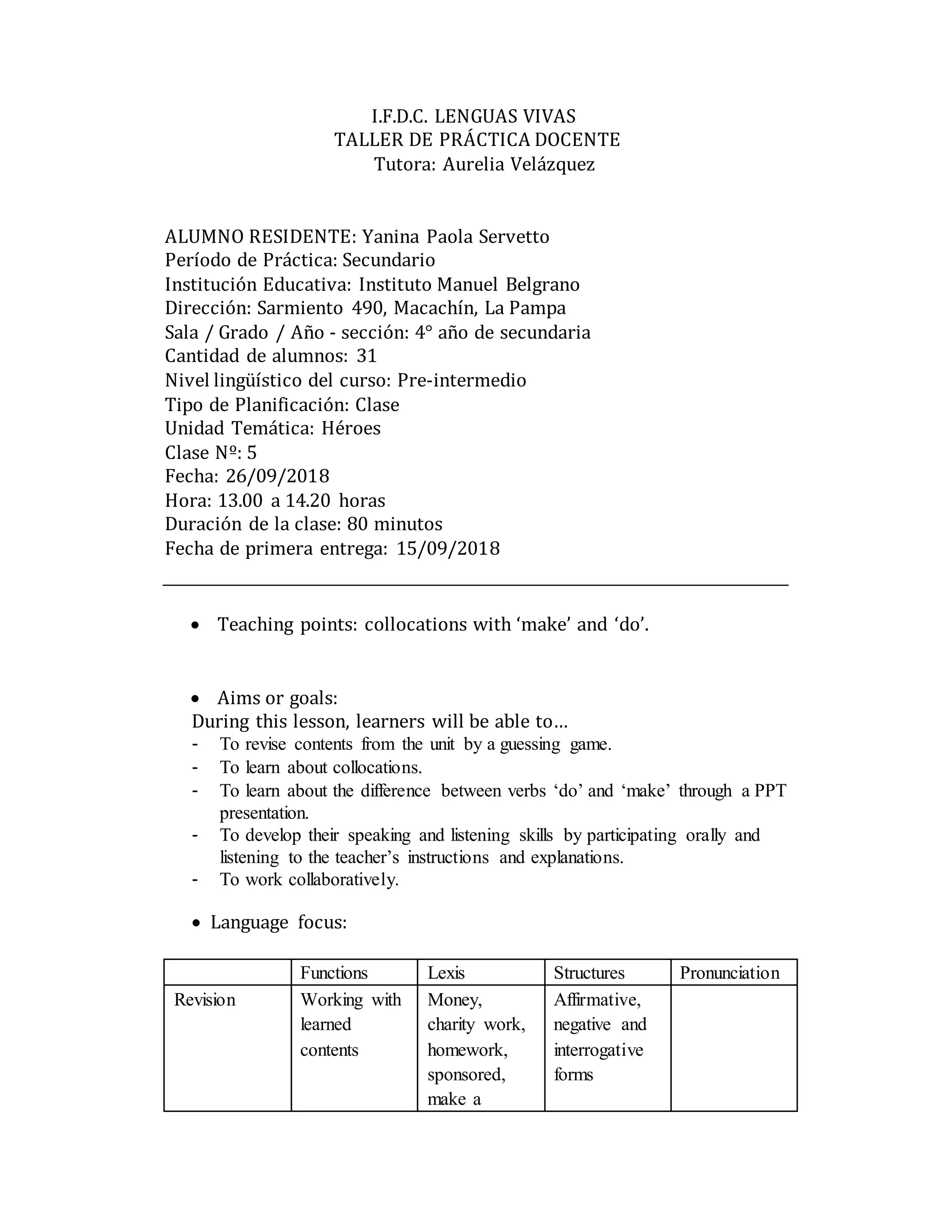
ALUMNO RESIDENTE: Yanina Paola Servetto
Período de Práctica: Secundario
Institución Educativa: Instituto Manuel Belgrano
Dirección: Sarmiento 490, Macachín, La Pampa
Sala / Grado / Año - sección: 4° año de secundaria
Cantidad de alumnos: 31
Nivel lingüístico del curso: Pre-intermedio
Tipo de Planificación: Clase
Unidad Temática: Héroes
Clase Nº: 5
Fecha: 26/09/2018
Hora: 13.00 a 14.20 horas
Duración de la clase: 80 minutos
Fecha de primera entrega: 15/09/2018
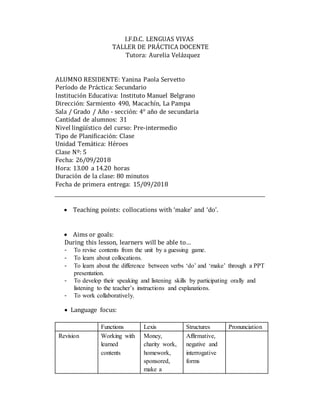
 Teaching points: collocations with ‘make’ and ‘do’. 



 Aims or goals: 
During this lesson, learners will be able to…
- To revise contents from the unit by a guessing game.
- To learn about collocations.
- To learn about the difference between verbs ‘do’ and ‘make’ through a PPT
presentation.
- To develop their speaking and listening skills by participating orally and
listening to the teacher’s instructions and explanations.
- To work collaboratively.
 Language focus:
Functions Lexis Structures Pronunciation
Revision Working with
learned
contents
Money,
charity work,
homework,
sponsored,
make a
Affirmative,
negative and
interrogative
forms
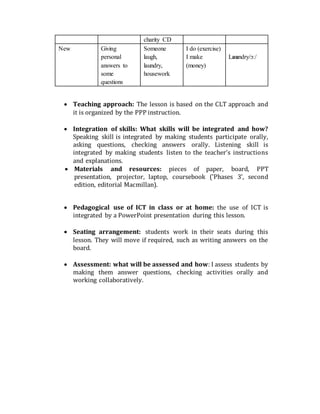
charity CD
New Giving
personal
answers to
some
questions
Someone
laugh,
laundry,
housework
I do (exercise)
I make
(money)
Laundry/ɔː/
 Teaching approach: The lesson is based on the CLT approach and
it is organized by the PPP instruction.

 Integration of skills: What skills will be integrated and how?
Speaking skill is integrated by making students participate orally,
asking questions, checking answers orally. Listening skill is
integrated by making students listen to the teacher’s instructions
and explanations. 
 Materials and resources: pieces of paper, board, PPT
presentation, projector, laptop, coursebook ('Phases 3', second
edition, editorial Macmillan).
 Pedagogical use of ICT in class or at home: the use of ICT is
integrated by a PowerPoint presentation during this lesson.

 Seating arrangement: students work in their seats during this
lesson. They will move if required, such as writing answers on the
board. 

 Assessment: what will be assessed and how: I assess students by
making them answer questions, checking activities orally and
working collaboratively.

Routine: 5’
Purpose: To start the lesson and greet students.
T enters the classroom, greets the students and asks them “How
are you today?”
Transition: “Ok, let’s play a guessing game...”
Warm-up: 15’
Purpose: to revise previous contents from the unit and to
introduce students to the teaching points.
T asks students to work in small groups. Each group receives
some sentences that they will unscramble, and then write on the
board, for example:
T makes students pay attention to the verbs in the sentences
(do, make).
Transition: “Very good students! Now, let me show you a
PowerPoint presentation I’ve prepared related to these two
common verbs...”
Presentation: 25’
Purpose: to introduce vocabulary from the unit using a
PowerPoint presentation.
T shows students the following presentation using a projector.
Each slide will be showed and then explained by the T who will
encourage students to discuss meanings orally as a whole group.
‘ve / never/ a/ I/ sponsored/ for/ done/ walk/charity.
(I’ve never done a sponsored walk for charity)
The/ a/ CD/ made/ students/ last/ charity/ year.
(The students made a charity CD last year)
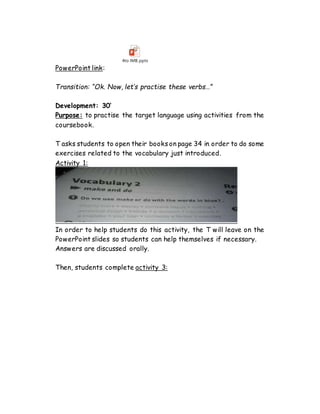
PowerPoint link:
4to IMB.pptx
Transition: “Ok. Now, let’s practise these verbs…”
Development: 30’
Purpose: to practise the target language using activities from the
coursebook.
T asks students to open their books on page 34 in order to do some
exercises related to the vocabulary just introduced.
Activity 1:
In order to help students do this activity, the T will leave on the
PowerPoint slides so students can help themselves if necessary.
Answers are discussed orally.
Then, students complete activity 3:
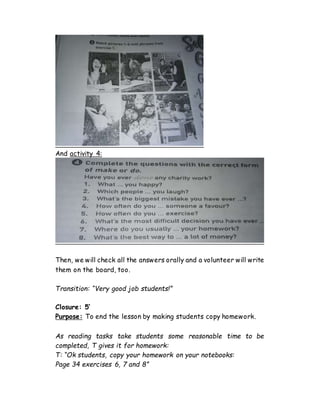
And activity 4:
Then, we will check all the answers orally and a volunteer will write
them on the board, too.
Transition: “Very good job students!”
Closure: 5’
Purpose: To end the lesson by making students copy homework.
As reading tasks take students some reasonable time to be
completed, T gives it for homework:
T: “Ok students, copy your homework on your notebooks:
Page 34 exercises 6, 7 and 8”
“Great students! See you on Friday!”
The format in which the stages are presented will vary according to the
teaching approach or combination of approaches you decide to base your
lesson plan upon.
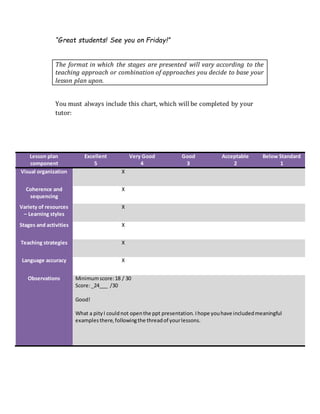
You must always include this chart, which will be completed by your
tutor:
Lesson plan
component
Excellent
5
Very Good
4
Good
3
Acceptable
2
Below Standard
1
Visual organization X
Coherence and
sequencing
X
Variety of resources
– Learning styles
X
Stages and activities X
Teaching strategies X
Language accuracy X
Observations Minimumscore:18 / 30
Score:_24___ /30
Good!
What a pityI couldnot openthe ppt presentation. Ihope youhave includedmeaningful
examplesthere,followingthe threadof yourlessons.

lesson 5- secondary level

  • 1.
    I.F.D.C. LENGUAS VIVAS TALLERDE PRÁCTICA DOCENTE Tutora: Aurelia Velázquez ALUMNO RESIDENTE: Yanina Paola Servetto Período de Práctica: Secundario Institución Educativa: Instituto Manuel Belgrano Dirección: Sarmiento 490, Macachín, La Pampa Sala / Grado / Año - sección: 4° año de secundaria Cantidad de alumnos: 31 Nivel lingüístico del curso: Pre-intermedio Tipo de Planificación: Clase Unidad Temática: Héroes Clase Nº: 5 Fecha: 26/09/2018 Hora: 13.00 a 14.20 horas Duración de la clase: 80 minutos Fecha de primera entrega: 15/09/2018  Teaching points: collocations with ‘make’ and ‘do’.      Aims or goals:  During this lesson, learners will be able to… - To revise contents from the unit by a guessing game. - To learn about collocations. - To learn about the difference between verbs ‘do’ and ‘make’ through a PPT presentation. - To develop their speaking and listening skills by participating orally and listening to the teacher’s instructions and explanations. - To work collaboratively.  Language focus: Functions Lexis Structures Pronunciation Revision Working with learned contents Money, charity work, homework, sponsored, make a Affirmative, negative and interrogative forms
  • 2.
    charity CD New Giving personal answersto some questions Someone laugh, laundry, housework I do (exercise) I make (money) Laundry/ɔː/  Teaching approach: The lesson is based on the CLT approach and it is organized by the PPP instruction.   Integration of skills: What skills will be integrated and how? Speaking skill is integrated by making students participate orally, asking questions, checking answers orally. Listening skill is integrated by making students listen to the teacher’s instructions and explanations.   Materials and resources: pieces of paper, board, PPT presentation, projector, laptop, coursebook ('Phases 3', second edition, editorial Macmillan).  Pedagogical use of ICT in class or at home: the use of ICT is integrated by a PowerPoint presentation during this lesson.   Seating arrangement: students work in their seats during this lesson. They will move if required, such as writing answers on the board.    Assessment: what will be assessed and how: I assess students by making them answer questions, checking activities orally and working collaboratively. 
  • 3.
    Routine: 5’ Purpose: Tostart the lesson and greet students. T enters the classroom, greets the students and asks them “How are you today?” Transition: “Ok, let’s play a guessing game...” Warm-up: 15’ Purpose: to revise previous contents from the unit and to introduce students to the teaching points. T asks students to work in small groups. Each group receives some sentences that they will unscramble, and then write on the board, for example: T makes students pay attention to the verbs in the sentences (do, make). Transition: “Very good students! Now, let me show you a PowerPoint presentation I’ve prepared related to these two common verbs...” Presentation: 25’ Purpose: to introduce vocabulary from the unit using a PowerPoint presentation. T shows students the following presentation using a projector. Each slide will be showed and then explained by the T who will encourage students to discuss meanings orally as a whole group. ‘ve / never/ a/ I/ sponsored/ for/ done/ walk/charity. (I’ve never done a sponsored walk for charity) The/ a/ CD/ made/ students/ last/ charity/ year. (The students made a charity CD last year)
  • 4.
    PowerPoint link: 4to IMB.pptx Transition:“Ok. Now, let’s practise these verbs…” Development: 30’ Purpose: to practise the target language using activities from the coursebook. T asks students to open their books on page 34 in order to do some exercises related to the vocabulary just introduced. Activity 1: In order to help students do this activity, the T will leave on the PowerPoint slides so students can help themselves if necessary. Answers are discussed orally. Then, students complete activity 3:
  • 5.
    And activity 4: Then,we will check all the answers orally and a volunteer will write them on the board, too. Transition: “Very good job students!” Closure: 5’ Purpose: To end the lesson by making students copy homework. As reading tasks take students some reasonable time to be completed, T gives it for homework: T: “Ok students, copy your homework on your notebooks: Page 34 exercises 6, 7 and 8”
  • 6.
    “Great students! Seeyou on Friday!” The format in which the stages are presented will vary according to the teaching approach or combination of approaches you decide to base your lesson plan upon. You must always include this chart, which will be completed by your tutor: Lesson plan component Excellent 5 Very Good 4 Good 3 Acceptable 2 Below Standard 1 Visual organization X Coherence and sequencing X Variety of resources – Learning styles X Stages and activities X Teaching strategies X Language accuracy X Observations Minimumscore:18 / 30 Score:_24___ /30 Good! What a pityI couldnot openthe ppt presentation. Ihope youhave includedmeaningful examplesthere,followingthe threadof yourlessons.