
Enhancing the “E” in English: Increasing fluencyPhrase by PhrasePresented by Marsha Chan Mission College and Sunburst MediaPronunciation and Listening in American English
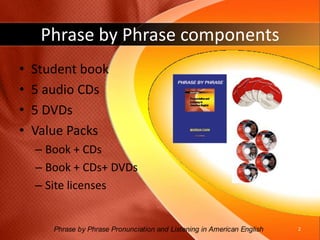
Phrase by Phrase componentsStudent book 5 audio CDs 5 DVDs Value Packs	Book + CDsBook + CDs+ DVDsSite licensesPhrase by Phrase Pronunciation and Listening in American English 2
Learners of English Train listening and pronunciation systematically.Enjoy interesting stories and lively dialogs. Hear and perceive the melody of English.  Watch the mouth in motion.View vivid pronunciation demonstrations.Observe clearly explained lessons.Distinguish similarities, differences and patterns.Improve pronunciation skills. Increase intelligibility in spoken English.Build accuracy, fluency, and confidence.3Phrase by Phrase Pronunciation and Listening in American English
Phrase by Phrase Pronunciation and Listening in American English 4LISTENINGVocabulary Focus Picture FocusPreparing to listen to the storyListening ComprehensionListening for ideasListening ClozeListening for words in contextFollow-up QuestionsReflecting on the passageSound FocusesPerceiving andpracticing specific soundsSounds in Context: Phrase by Phrase 1Listening to and practicing sounds in short phrasesSounds in Context: Phrase by Phrase 2Listening to and practicing soundsin the context of longer phrasesSounds in Context: Phrase by Phrase 3Listening to and practicing phrases in sentencesOn Your Own and AssessmentPracticing longer pieces of discourseListening to and monitoring your pronunciationOral Composition and AssessmentExpanding on the topic – Speaking out – Assessing your successSPEAKINGLISTENINGHourglassPRONUNCIATION
Holistic & systematic approachVocabulary Focus – Gaining familiarity with wordsPicture Focus - Preparing to listen to the story or dialogListening to the story Listening Comprehension - Listening for ideasListening Cloze - Listening for words in contextFollow-up Questions - Reflecting on the listening passageSound Focuses - Perceiving specific sounds and sound patternsPhrase by Phrase Pronunciation and Listening in American English 5
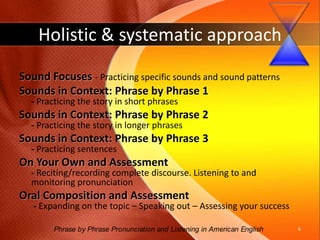
Holistic & systematic approachSound Focuses - Practicing specific sounds and sound patternsSounds in Context: Phrase by Phrase 1 - Practicing the story in short phrasesSounds in Context: Phrase by Phrase 2 - Practicing the story in longer phrasesSounds in Context: Phrase by Phrase 3- Practicing sentencesOn Your Own and Assessment- Reciting/recording complete discourse. Listening to and monitoring pronunciationOral Composition and Assessment - Expanding on the topic – Speaking out – Assessing your success6Phrase by Phrase Pronunciation and Listening in American English
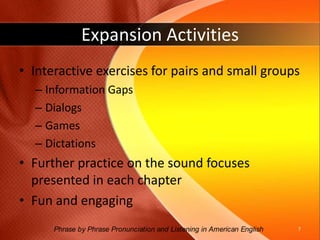
Expansion Activities Interactive exercises for pairs and small groupsInformation GapsDialogsGamesDictationsFurther practice on the sound focuses presented in each chapter Fun and engaging7Phrase by Phrase Pronunciation and Listening in American English
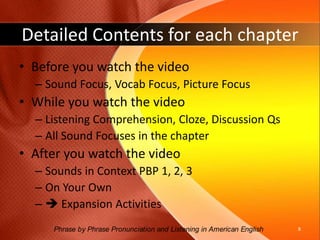
Detailed Contents for each chapterBefore you watch the videoSound Focus, Vocab Focus, Picture FocusWhile you watch the videoListening Comprehension, Cloze, Discussion QsAll Sound Focuses in the chapterAfter you watch the videoSounds in Context PBP 1, 2, 3On Your Own Expansion ActivitiesPhrase by Phrase Pronunciation and Listening in American English 8
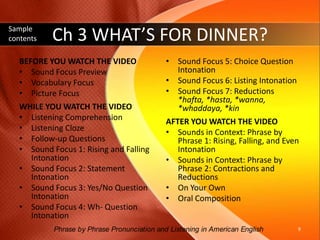
Ch 3 WHAT’S FOR DINNER?BEFORE YOU WATCH THE VIDEO Sound Focus PreviewVocabulary FocusPicture FocusWHILE YOU WATCH THE VIDEOListening ComprehensionListening ClozeFollow-up QuestionsSound Focus 1: Rising and Falling IntonationSound Focus 2: Statement IntonationSound Focus 3: Yes/No Question IntonationSound Focus 4: Wh- Question IntonationSound Focus 5: Choice Question IntonationSound Focus 6: Listing IntonationSound Focus 7: Reductions *hafta, *hasta, *wanna, *whaddaya, *kinAFTER YOU WATCH THE VIDEOSounds in Context: Phrase by Phrase 1: Rising, Falling, and Even IntonationSounds in Context: Phrase by Phrase 2: Contractions and ReductionsOn Your OwnOral CompositionPhrase by Phrase Pronunciation and Listening in American English 9Samplecontents
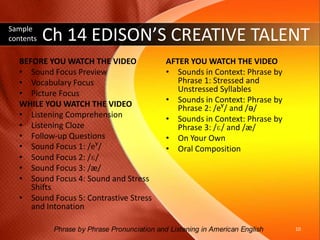
Ch 14 EDISON’S CREATIVE TALENTBEFORE YOU WATCH THE VIDEO	Sound Focus PreviewVocabulary FocusPicture FocusWHILE YOU WATCH THE VIDEOListening ComprehensionListening ClozeFollow-up QuestionsSound Focus 1: /eʸ/Sound Focus 2: /ɛ/Sound Focus 3: /æ/Sound Focus 4: Sound and Stress ShiftsSound Focus 5: Contrastive Stress and IntonationAFTER YOU WATCH THE VIDEOSounds in Context: Phrase by Phrase 1: Stressed and Unstressed SyllablesSounds in Context: Phrase by Phrase 2: /eʸ/ and /ə/Sounds in Context: Phrase by Phrase 3: /ɛ/ and /æ/On Your OwnOral CompositionPhrase by Phrase Pronunciation and Listening in American English 10Samplecontents
1st and 2nd EditionsIf you are familiar with the first edition, here’s a quick guide to what’s new in the second edition:Phrase by Phrase Pronunciation and Listening in American English 11
What’s New in the Second Edition (1)Print, audio, and video materials are fully coordinated; instructions specify when and how to use the components in an integrated and effective way. Vocabulary and cloze items have been revised with consideration given to frequency based on corpus data. Sound Focus exercises have been expanded to include material previously available only on video and additional practical exercises for pairs.12Phrase by Phrase Pronunciation and Listening in American English
What’s New in the Second Edition (2)Illustrations and improved formatting enhance pronunciation and listening concepts and tasks.New oral composition topics are provided for all chapters, and they specify the sounds to apply.New assessment questions guide students to monitor their pronunciation of the chapter passage and the oral composition.13Phrase by Phrase Pronunciation and Listening in American English
What’s New in the Second Edition (3)A whole new section, EXPANSION ACTIVITIES, presents interactive exercises for pairs and small groups to further practice the sound focuses presented in each chapter. Included are information gaps, dialogs, games, and dictations.14Phrase by Phrase Pronunciation and Listening in American English
What’s New in the Second Edition (4)A Pronunciation Scoring Guideline provides a method for an instructor to evaluate students’ pronunciation holistically.The Stress Stretch technique, well-known to participants in Marsha Chan’s pronunciation workshops, is another bonus feature.15Phrase by Phrase Pronunciation and Listening in American English

Enhancing the "E" in English: Increasing Fluency Phrase by Phrase

  • 1.
    Enhancing the “E”in English: Increasing fluencyPhrase by PhrasePresented by Marsha Chan Mission College and Sunburst MediaPronunciation and Listening in American English
  • 2.
    Phrase by PhrasecomponentsStudent book 5 audio CDs 5 DVDs Value Packs Book + CDsBook + CDs+ DVDsSite licensesPhrase by Phrase Pronunciation and Listening in American English 2
  • 3.
    Learners of EnglishTrain listening and pronunciation systematically.Enjoy interesting stories and lively dialogs. Hear and perceive the melody of English. Watch the mouth in motion.View vivid pronunciation demonstrations.Observe clearly explained lessons.Distinguish similarities, differences and patterns.Improve pronunciation skills. Increase intelligibility in spoken English.Build accuracy, fluency, and confidence.3Phrase by Phrase Pronunciation and Listening in American English
  • 4.
    Phrase by PhrasePronunciation and Listening in American English 4LISTENINGVocabulary Focus Picture FocusPreparing to listen to the storyListening ComprehensionListening for ideasListening ClozeListening for words in contextFollow-up QuestionsReflecting on the passageSound FocusesPerceiving andpracticing specific soundsSounds in Context: Phrase by Phrase 1Listening to and practicing sounds in short phrasesSounds in Context: Phrase by Phrase 2Listening to and practicing soundsin the context of longer phrasesSounds in Context: Phrase by Phrase 3Listening to and practicing phrases in sentencesOn Your Own and AssessmentPracticing longer pieces of discourseListening to and monitoring your pronunciationOral Composition and AssessmentExpanding on the topic – Speaking out – Assessing your successSPEAKINGLISTENINGHourglassPRONUNCIATION
  • 5.
    Holistic & systematicapproachVocabulary Focus – Gaining familiarity with wordsPicture Focus - Preparing to listen to the story or dialogListening to the story Listening Comprehension - Listening for ideasListening Cloze - Listening for words in contextFollow-up Questions - Reflecting on the listening passageSound Focuses - Perceiving specific sounds and sound patternsPhrase by Phrase Pronunciation and Listening in American English 5
  • 6.
    Holistic & systematicapproachSound Focuses - Practicing specific sounds and sound patternsSounds in Context: Phrase by Phrase 1 - Practicing the story in short phrasesSounds in Context: Phrase by Phrase 2 - Practicing the story in longer phrasesSounds in Context: Phrase by Phrase 3- Practicing sentencesOn Your Own and Assessment- Reciting/recording complete discourse. Listening to and monitoring pronunciationOral Composition and Assessment - Expanding on the topic – Speaking out – Assessing your success6Phrase by Phrase Pronunciation and Listening in American English
  • 7.
    Expansion Activities Interactiveexercises for pairs and small groupsInformation GapsDialogsGamesDictationsFurther practice on the sound focuses presented in each chapter Fun and engaging7Phrase by Phrase Pronunciation and Listening in American English
  • 8.
    Detailed Contents foreach chapterBefore you watch the videoSound Focus, Vocab Focus, Picture FocusWhile you watch the videoListening Comprehension, Cloze, Discussion QsAll Sound Focuses in the chapterAfter you watch the videoSounds in Context PBP 1, 2, 3On Your Own Expansion ActivitiesPhrase by Phrase Pronunciation and Listening in American English 8
  • 9.
    Ch 3 WHAT’SFOR DINNER?BEFORE YOU WATCH THE VIDEO Sound Focus PreviewVocabulary FocusPicture FocusWHILE YOU WATCH THE VIDEOListening ComprehensionListening ClozeFollow-up QuestionsSound Focus 1: Rising and Falling IntonationSound Focus 2: Statement IntonationSound Focus 3: Yes/No Question IntonationSound Focus 4: Wh- Question IntonationSound Focus 5: Choice Question IntonationSound Focus 6: Listing IntonationSound Focus 7: Reductions *hafta, *hasta, *wanna, *whaddaya, *kinAFTER YOU WATCH THE VIDEOSounds in Context: Phrase by Phrase 1: Rising, Falling, and Even IntonationSounds in Context: Phrase by Phrase 2: Contractions and ReductionsOn Your OwnOral CompositionPhrase by Phrase Pronunciation and Listening in American English 9Samplecontents
  • 10.
    Ch 14 EDISON’SCREATIVE TALENTBEFORE YOU WATCH THE VIDEO Sound Focus PreviewVocabulary FocusPicture FocusWHILE YOU WATCH THE VIDEOListening ComprehensionListening ClozeFollow-up QuestionsSound Focus 1: /eʸ/Sound Focus 2: /ɛ/Sound Focus 3: /æ/Sound Focus 4: Sound and Stress ShiftsSound Focus 5: Contrastive Stress and IntonationAFTER YOU WATCH THE VIDEOSounds in Context: Phrase by Phrase 1: Stressed and Unstressed SyllablesSounds in Context: Phrase by Phrase 2: /eʸ/ and /ə/Sounds in Context: Phrase by Phrase 3: /ɛ/ and /æ/On Your OwnOral CompositionPhrase by Phrase Pronunciation and Listening in American English 10Samplecontents
  • 11.
    1st and 2ndEditionsIf you are familiar with the first edition, here’s a quick guide to what’s new in the second edition:Phrase by Phrase Pronunciation and Listening in American English 11
  • 12.
    What’s New inthe Second Edition (1)Print, audio, and video materials are fully coordinated; instructions specify when and how to use the components in an integrated and effective way. Vocabulary and cloze items have been revised with consideration given to frequency based on corpus data. Sound Focus exercises have been expanded to include material previously available only on video and additional practical exercises for pairs.12Phrase by Phrase Pronunciation and Listening in American English
  • 13.
    What’s New inthe Second Edition (2)Illustrations and improved formatting enhance pronunciation and listening concepts and tasks.New oral composition topics are provided for all chapters, and they specify the sounds to apply.New assessment questions guide students to monitor their pronunciation of the chapter passage and the oral composition.13Phrase by Phrase Pronunciation and Listening in American English
  • 14.
    What’s New inthe Second Edition (3)A whole new section, EXPANSION ACTIVITIES, presents interactive exercises for pairs and small groups to further practice the sound focuses presented in each chapter. Included are information gaps, dialogs, games, and dictations.14Phrase by Phrase Pronunciation and Listening in American English
  • 15.
    What’s New inthe Second Edition (4)A Pronunciation Scoring Guideline provides a method for an instructor to evaluate students’ pronunciation holistically.The Stress Stretch technique, well-known to participants in Marsha Chan’s pronunciation workshops, is another bonus feature.15Phrase by Phrase Pronunciation and Listening in American English

Editor's Notes

  • #3 Phrase by Phrase: Pronunciation and Listening in American English is designed to enable learners of English to speak more clearly. This program, comprised of a student book, audio CDs, and DVDs, is intended for students who can already understand and use some oral English. The lessons are flexible enough to be used by high-beginning, intermediate, and low-advanced English as a second or foreign language (ESL/EFL) classes. The material in this book is especially suitable for use in pronunciation, listening and speaking, and oral communication courses, and provides an important balance in integrated skills language course. It is effective in traditional face-to-face classrooms, in distance education environments, and in learning labs.
  • #4 The activities in Phrase by Phrase are systematically presented to help learners develop auditory sensitivity and improve accuracy, fluency, and confidence in their oral production of English. Learners listen for different purposes (comprehension of meaning, inference, words, and distinction of consonants, vowels, intonation). This preparation allows them to focus on improving pronunciation. The vocabulary and listening activities prepare learners for success in speaking clearly. Learners enjoy interesting stories and conversations. The video enables them to watch the mouth in motion and view vivid demonstrations of how sounds are produced. Pronunciation explanationsare simple but informative, and the instructor uses verbal, visual, and kinesthetic methodsso that students can increase their understanding of and intelligibility in spoken English.
  • #5 Sounds and sound patterns are presented in the context of connected discourse, a more natural and holistic approach than lists of isolated words and sentences. The organization of each lesson takes the shape of an hourglass, moving from general to specific listening tasks, and then from specific to general pronunciation tasks. Keep this shape in mind as we examine the next slides.
  • #6 Sounds and sound patterns are presented in the context of connected discourse, a more natural and holistic approach than lists of isolated words and sentences. After schema-building exercises on vocabulary and pictures, each lesson begins with a story or dialog. Students are guided to listen for different purposes: ideas, words in context, connections with their own lives, and sounds and sound patterns of oral English. In essence progressing from general to specific listening tasks.
  • #7 Then the process of building up from specific to general pronunciation skills occurs. Through progressivepractice and assessment, learners are guided to listen to and monitor their own progress and make revisions in their pronunciation. They are further encouraged to apply what they have learned by composing an original story or dialog in the “On Your Own” section.
  • #8 The activities in the back of the book expand on the sound focuses of each chapter. They include information gaps, asking and answering, dictation and writing, and games. Of course, they all involve pronunciation and listening! Most are designed for pairs of students; others are for teams; some of them can be done for homework
  • #9 The table of contents gives details about the instructional points of each lesson, for each part of the lesson: activities before, while, and after you watch the video. The TOC enumerates the sound focuses addressed in each chapter.Phrase by Phrase introduces syllables, stress, intonation, reduction, and linking from the beginning of the text, and it reinforces and expands upon these suprasegmental features throughout the program. These features provide the basis for the rhythm and melody of English, a necessary foundation for learners from all language backgrounds. When speakers understand and produce these key features well, their pronunciation becomes clearer and easier to understand. As a result, their oral communication is smoother and more successful.