American English CEF Level: B1 (PET) Young Adults and Adults Quick Catalogue Review
CAN DO STATEMENTS FOR LEVEL B1: Can understand the main points of clear standard input on familiar matters regularly encountered in work, school, leisure, etc. Can deal with most situations likely to arise whilst travelling in an area where the language is spoken. Can produce simple connected text on topics which are familiar or of personal interest. Can describe experiences and events, dreams, hopes and ambitions and briefly give reasons and explanations for opinions and plans.
The course 4 levels (intro to 3) American English Young adults and adults 70 to 120 hours (full edition) 35 to 60 hours (split edition: A / B) 4 skills instruction
COMPONENTS www.cambridge.org/interchange Test Crafter  NEW Interchange Third Edition/Passages Placement and Evaluation Package Whiteboard Software Network  NEW Teacher's Resource Book Full Contact B Workbook B Full Contact A Workbook A Whiteboard Software Student's Book B with Self-study Audio CD CD-ROM for Windows Student's Book A with Self-study Audio CD Lab Audio CDs Class Audio CDs Lab Guide Class Audio Cassettes Video Teacher's Guide Teacher's Edition Video Activity Book Workbook Video/NTSC Student's Book Video/DVD Student's Book with Self-study Audio CD
Students’ needs Engaging activities Clear goals and procedures Opportunities for personalization Flexibility Achievable results Feedback
Key features Real world topics Conversational language Grammar in communicative contexts Task-based listening activities Student-centered Complete teacher support
Unit format Units integrate topics, functions, grammar and skills Two lesson-sequences within each unit Activities build on each other, culminating in fluency activity Activities can serve as a springboard for supplementary practice
Unit format 16 units 16 communication tasks (interchange activities) 8 Progress checks Two topical or functional sections Perspectives 16 projects  16 self-study listening activities Cycle 1 Cycle 2
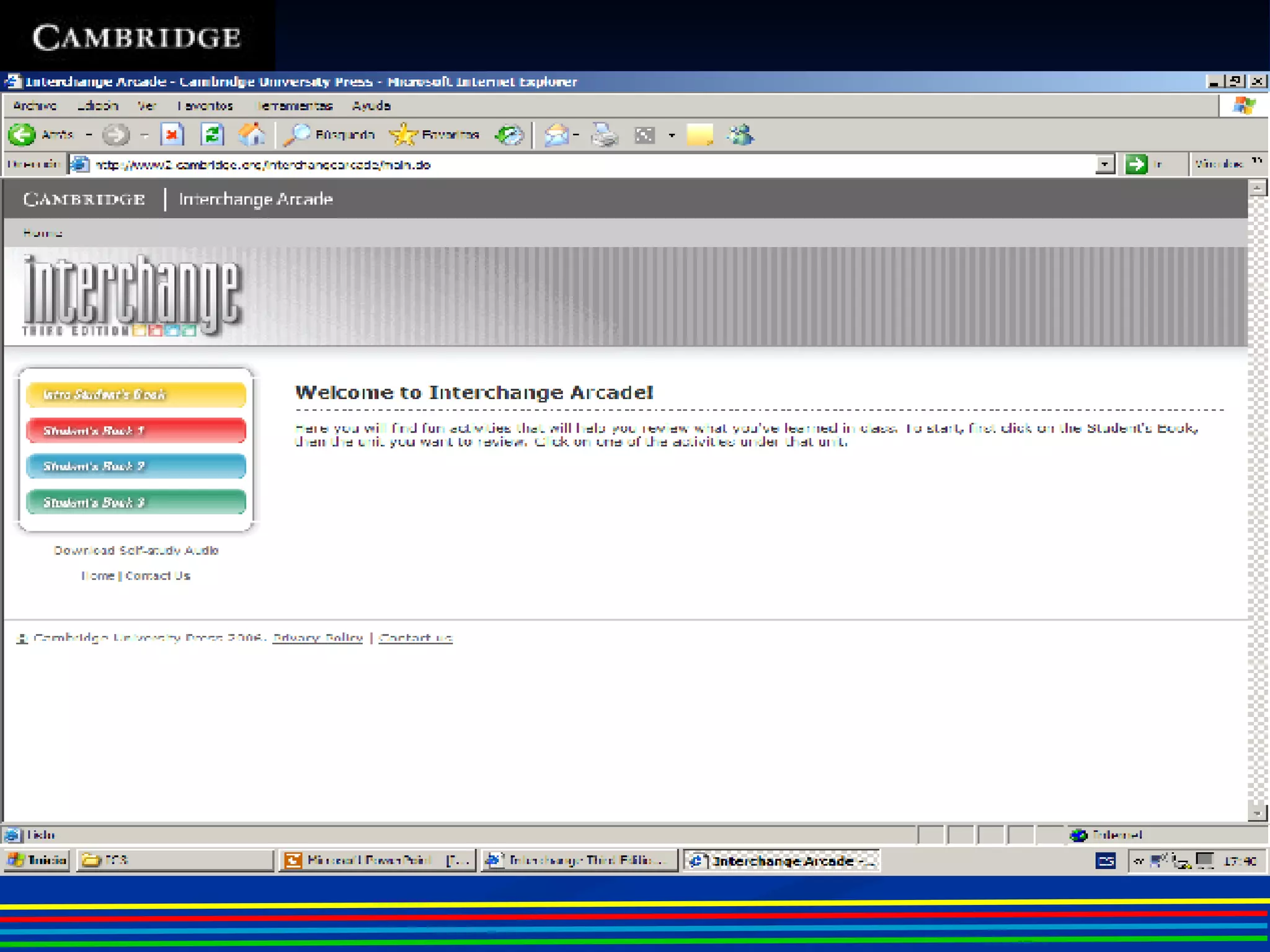
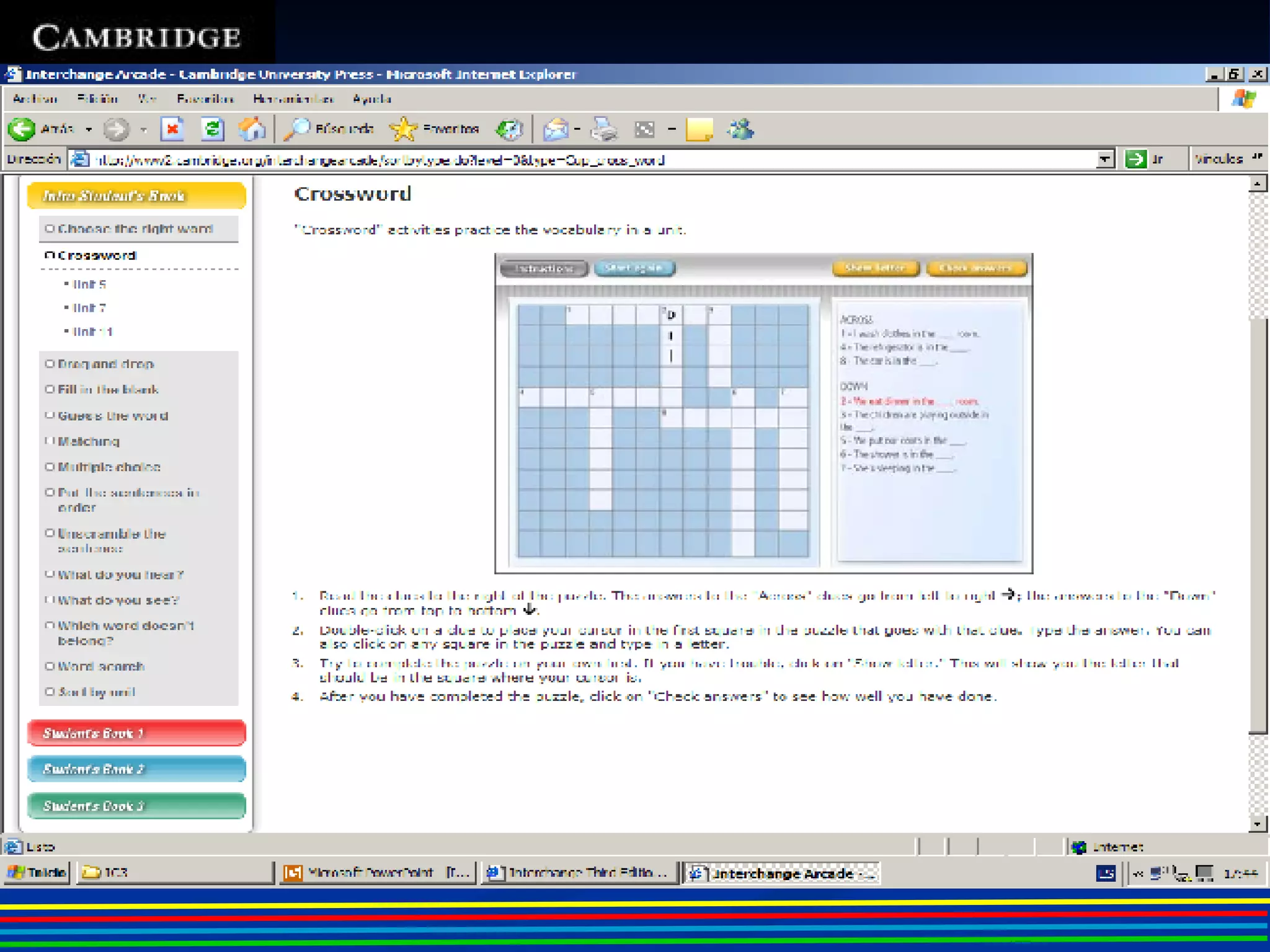
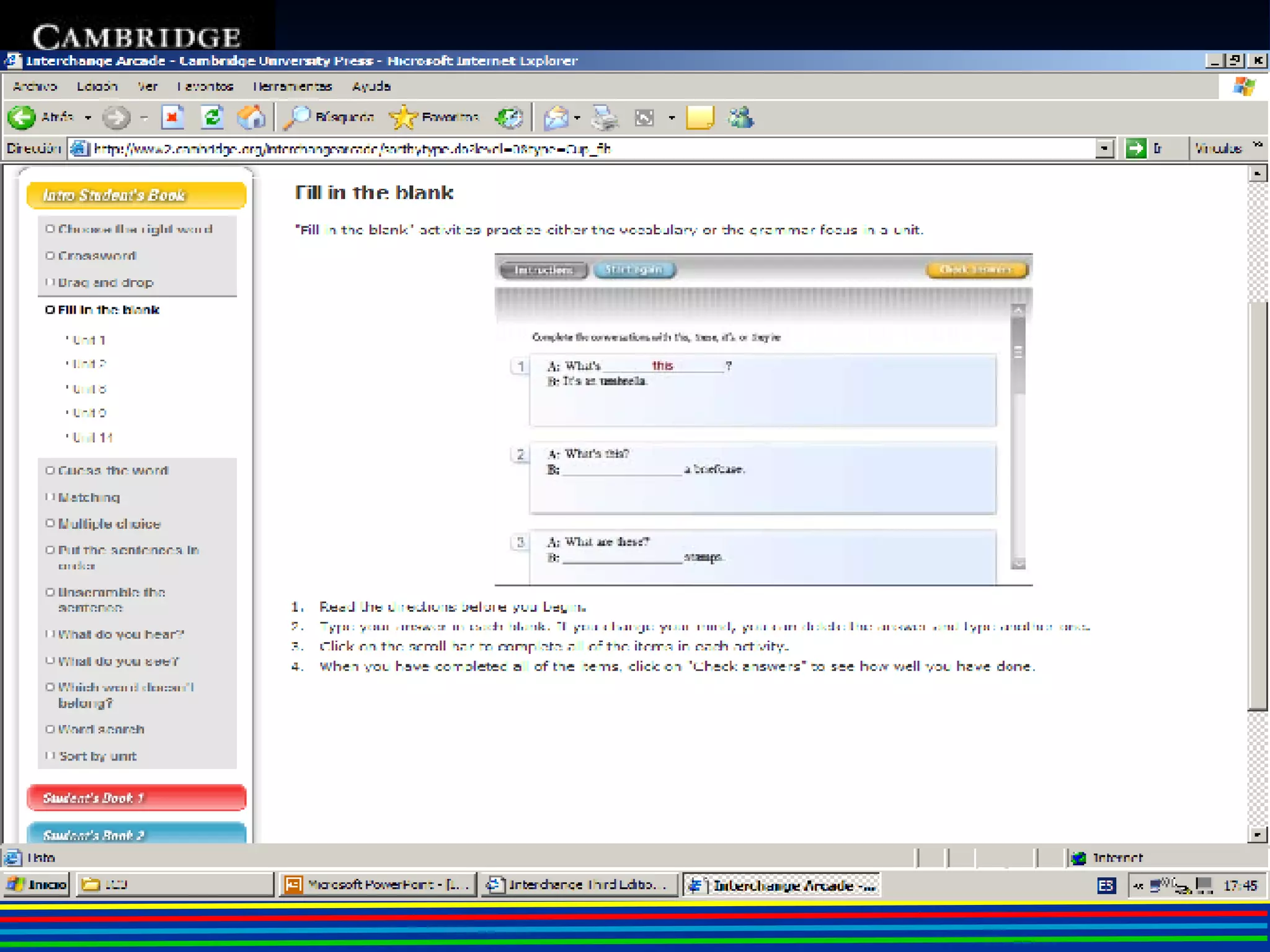
Unit content Snapshot Word power Conversation Grammar focus Pronunciation Interchange  Speaking Arcade: different kinds  of interactive activities on the internet! Discussion Fluency exercises Listening Writing Reading Perspectives Self-study listenings Projects
Snapshot Introduces the topic Provides real world information Builds receptive & productive vocabulary Is presented in graphic form (easy to read) Includes follow-up questions (discussion)
Snapshot
Snapshot Teaching Step 1: Books closed. Introduce the new Topic Teaching Step 2: Books closed.  Lead the students through the information in the  Snapshot. Teaching Step 3: Do the follow-up questions in pairs, groups, or as a class. TEACHING STEPS
Snapshot Should the  Snapshot be brief or long? Why does the Teaching Tip suggest that you keep the Snapshot brief? How can you make the Snapshot a meaningful activity? If you were to teach this Snapshot, would you prefer  to  have your  students  do the follow-up  questions as  a whole class, in groups, or in pairs?  Why?
Snapshot PERSONALIZATON: The teacher adds more personalized questions  that  relate to her/his  students  own  lives and culture.  Why is this  important?
Word Power Develops Ss´ vocabulary Is related to the unit Includes variety of exercises (word maps and collocations) Is followed by oral and written practice (vocabulary in context)
Word Power
Word Power What is the aim of Word Power? What skills can be practiced?
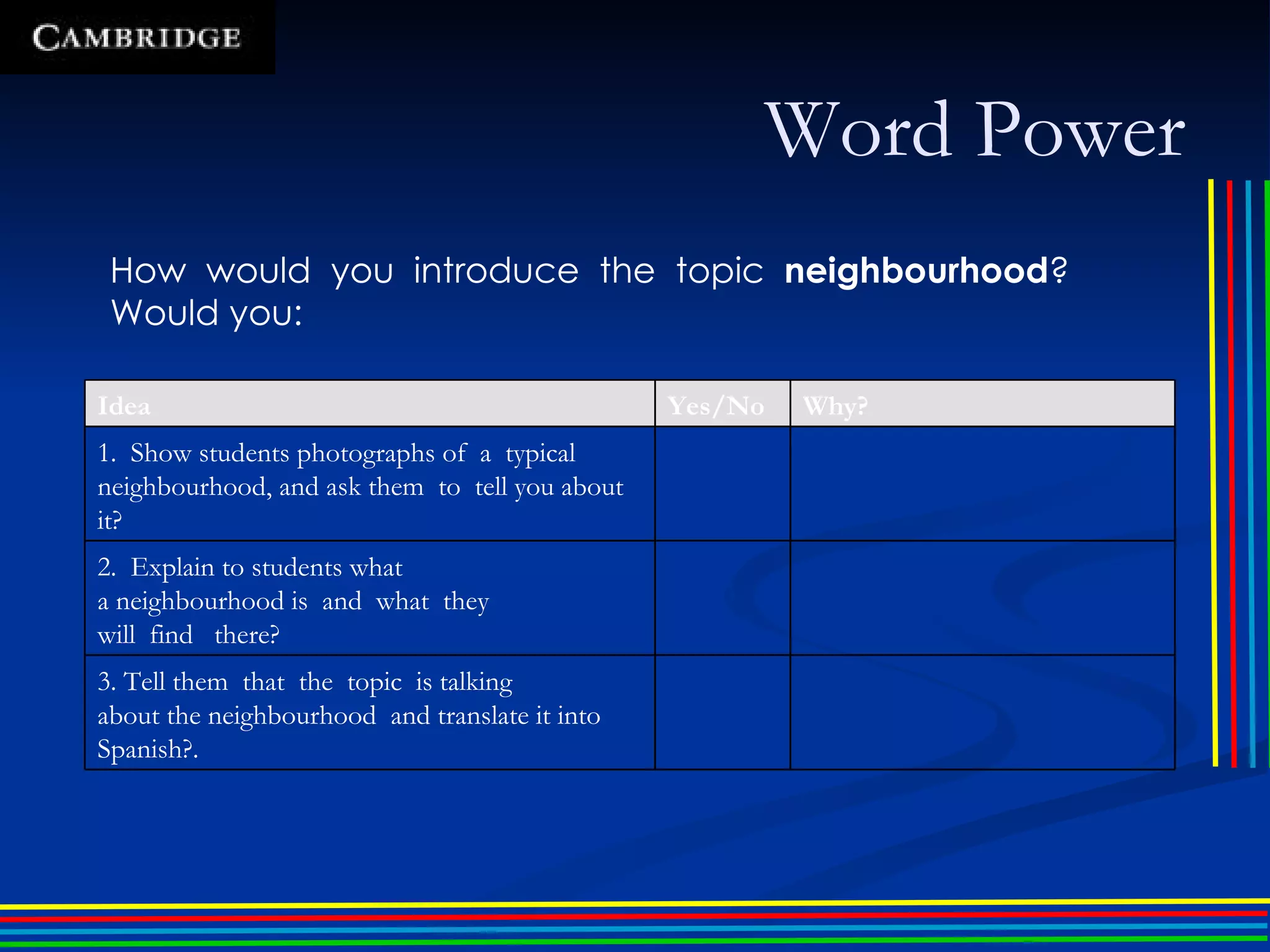
Word Power How  would  you  introduce  the  topic  neighbourhood ?  Would you: 3. Tell them  that  the  topic  is talking about the neighbourhood  and translate it into Spanish? . 2.  Explain to students what a neighbourhood is  and  what  they will  find  there? 1.  Show students photographs of  a  typical neighbourhood, and ask them  to  tell you about it? Why? Yes/No Idea
Word Power TEACHING STEPS Teaching Step One: Introduce the topic and elicit  associated vocabulary.  Use  vocabulary  teaching  techniques. Teaching Step Two:  Model the pronunciation  of  new words. Teaching Step Three: Explain and model the task. Teaching Step Four: Students complete the task. Teaching Step Five: Check answers with class.  Individual work, peer correction.
Word Power 5.  Haircut 4.  Wash and  dry clothes 3.  Department  store 2. Area 1. Neighbourhood Give an example Elicit an example Give a definition Elicit a definition Mime Translate Vocabulary
Word Power Why should  we  find  out  what  students  already  know  before pre-teaching vocabulary?  Suggest a reason why  this is  a good  idea. Why  should  students sit in front of each other and look at each other during a speaking  activity?  How  can you  personalize  the  word power section? What  do you  think is  better, eliciting  definition and examples  or giving them?  Why?
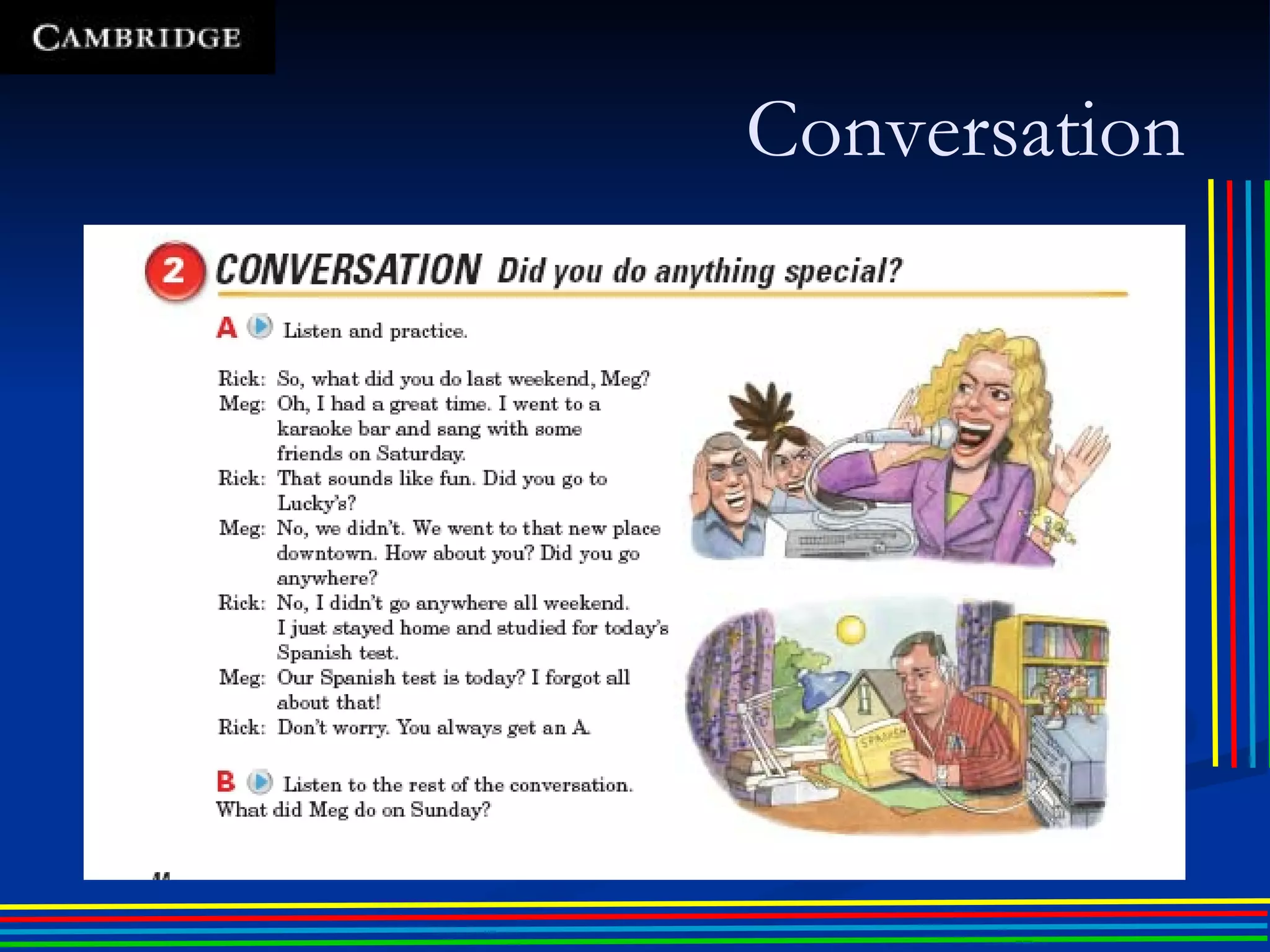
Conversation Introduces new function or grammar Creates a communicative and situational context Serves as a model for conversational expressions Provides a listening task Focuses on accurate repetition Avoids “reading like” intonation
Conversation
Models Practical Meaningful  Memorable Transferable
Conversation
Conversation Which  grammar  points  does the  conversation present? Can you find  examples of  functions in the  Conversation?  Write examples.
Conversation MEANING, FORM, AND USE Imagine  that  you are learning  a  new  language (e.g. Swahili).  Your  teacher  gives  you a short  dialog, which contains a grammar structure you have  never seen before (e.g.  mimi ninakwenda).  What  would  you  want  your  teacher to explain first?  Rank these in order of importance: What the structure means How to  form  the  new structure How to use the structure
Conversation TEACHING STEPS ___ Check students’ comprehension. ___ Books open. Students read silently as they listen  once more. ___ Set the scene.  Set a focus question. ___ Students practice the conversation. ___ Books closed.  Students listen to the audio  program once or twice. ___ Explain unfamiliar vocabulary. 1 2 3 6 5 4
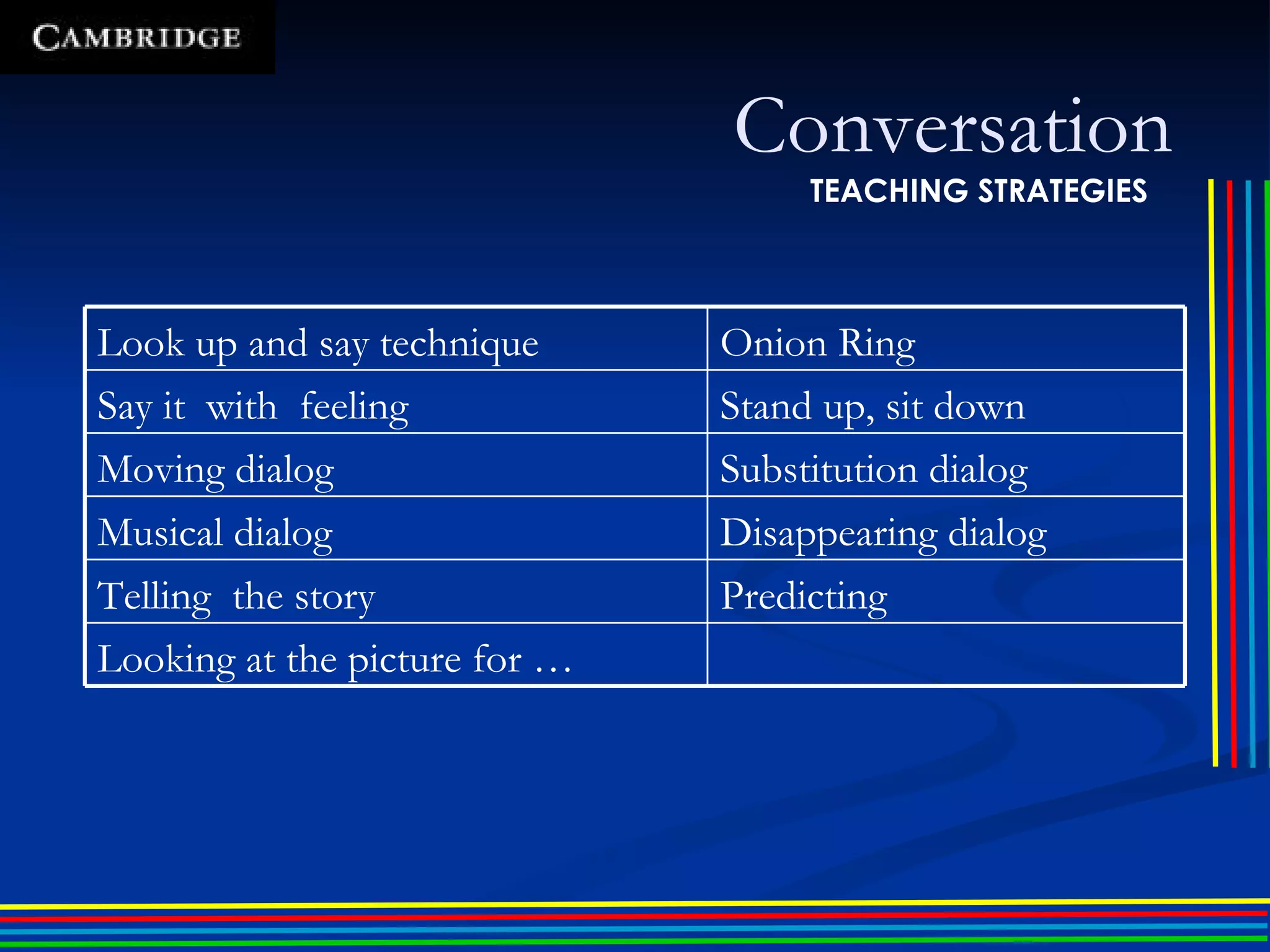
Conversation TEACHING STRATEGIES Looking at the picture for … Predicting  Telling  the story Disappearing dialog  Musical dialog Substitution dialog Moving dialog Stand up, sit down Say it  with  feeling Onion Ring Look up and say technique
Grammar Focus Summary of grammar items Exercises in context Controlled to freer practice Communicative exercises Personal context (often)
Grammar Focus
Elicit or explain the rules. Inductive or deductive teaching. Present example sentences using the audio program. Model the task. Students complete the task. Check answers with the class.  Peer correction. Grammar Focus TEACHING STEPS
Two different point of  views about teaching grammar I avoid turning the Grammar Focus into a  heavy  grammar class. Instead, I lead my students into the  fluency activity quickly, so they learn to use the language. I like to spend a lot  of  time  on  grammar  rules  and  doing  controlled exercises until I am sure my students know the structures.  Then we try producing the language . Grammar Focus
Grammar Focus 4.  Ask your students to go back to the Conversation and substitute their own information in the dialog. 3.  After eliciting grammar rules, create real sentences about themselves, using the new structure. 2.  Give a  handout  with grammar rules to your students for studying. 1. Use a grammar game from the Teacher´s Edition. Why? Yes/No Technique
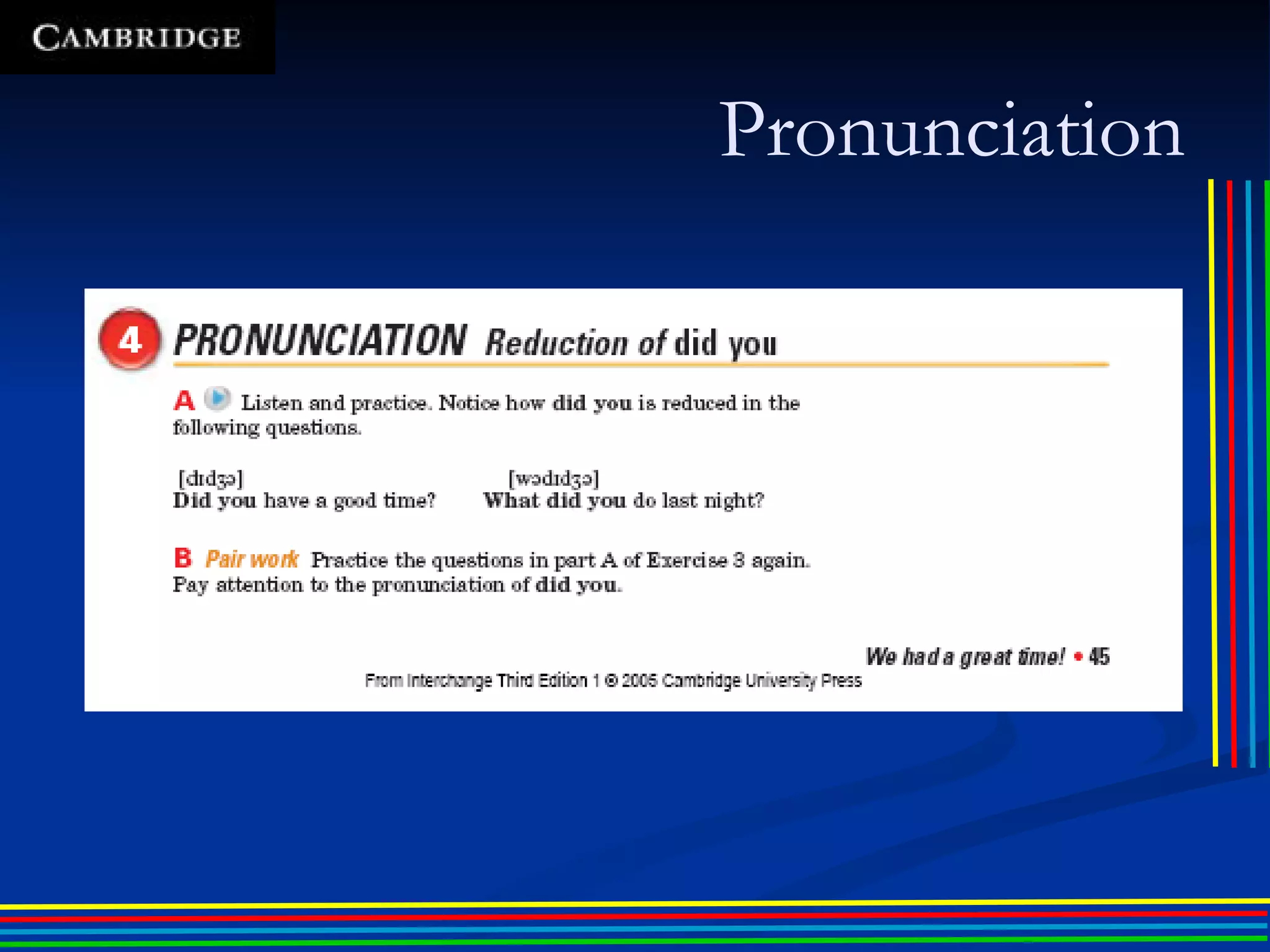
Pronunciation Highlights  pronunciation  features Rhythm, stress, intonation, blending, reductions, etc. Is taken from “Conversation” or “Grammar Focus” sections Improves listening & speaking skills Builds student’s awareness & confidence
Pronunciation
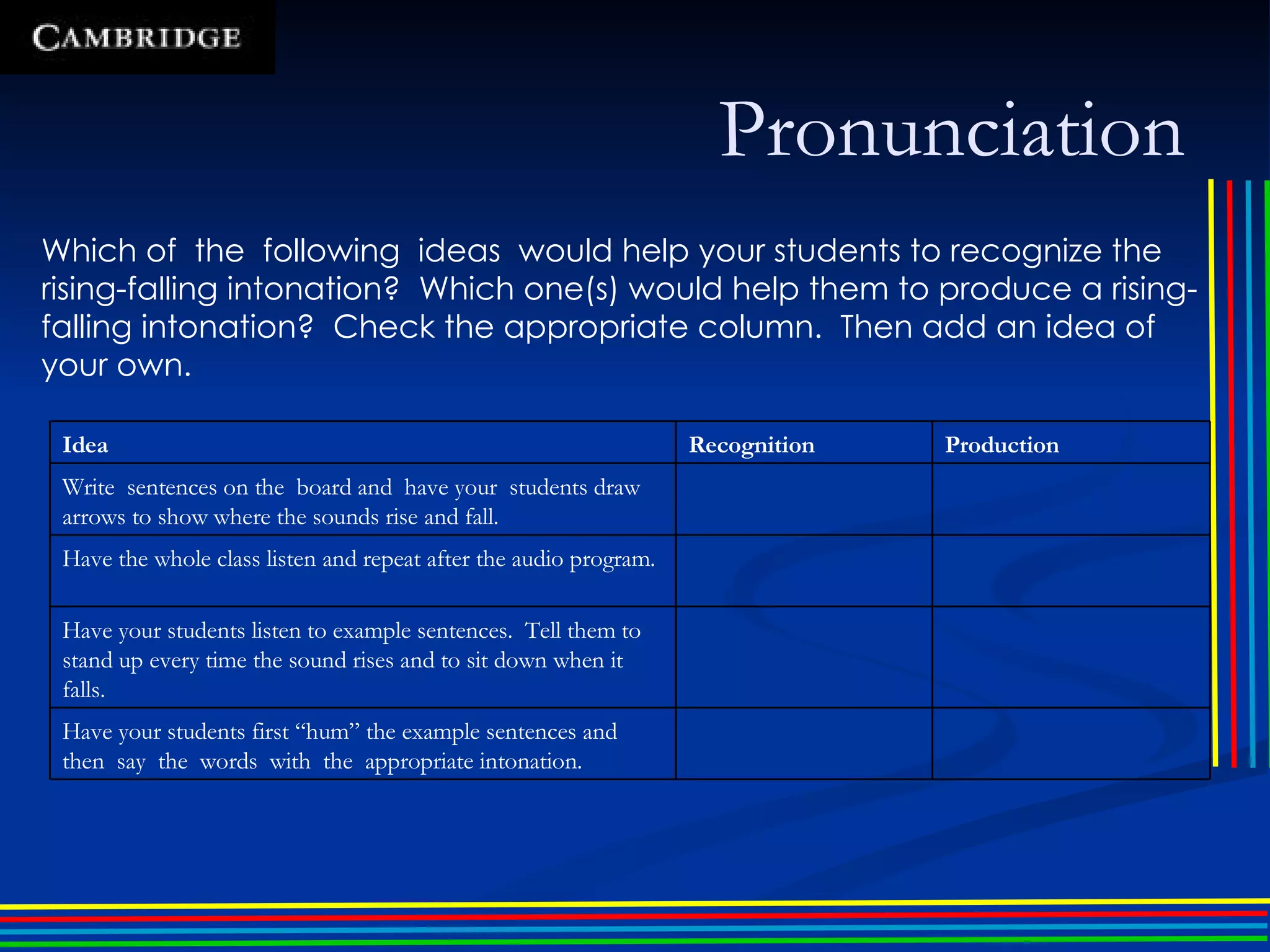
Pronunciation Which of  the  following  ideas  would help your students to recognize the  rising-falling intonation?  Which one(s) would help them to produce a rising-falling intonation?  Check the appropriate column.  Then add an idea of your own. Have your students first “hum” the example sentences and  then  say  the  words  with  the  appropriate intonation. Have your students listen to example sentences.  Tell them to  stand up every time the sound rises and to sit down when it falls. Have the whole class listen and repeat after the audio program. Write  sentences on the  board and  have your  students draw arrows to show where the sounds rise and fall. Production Recognition Idea
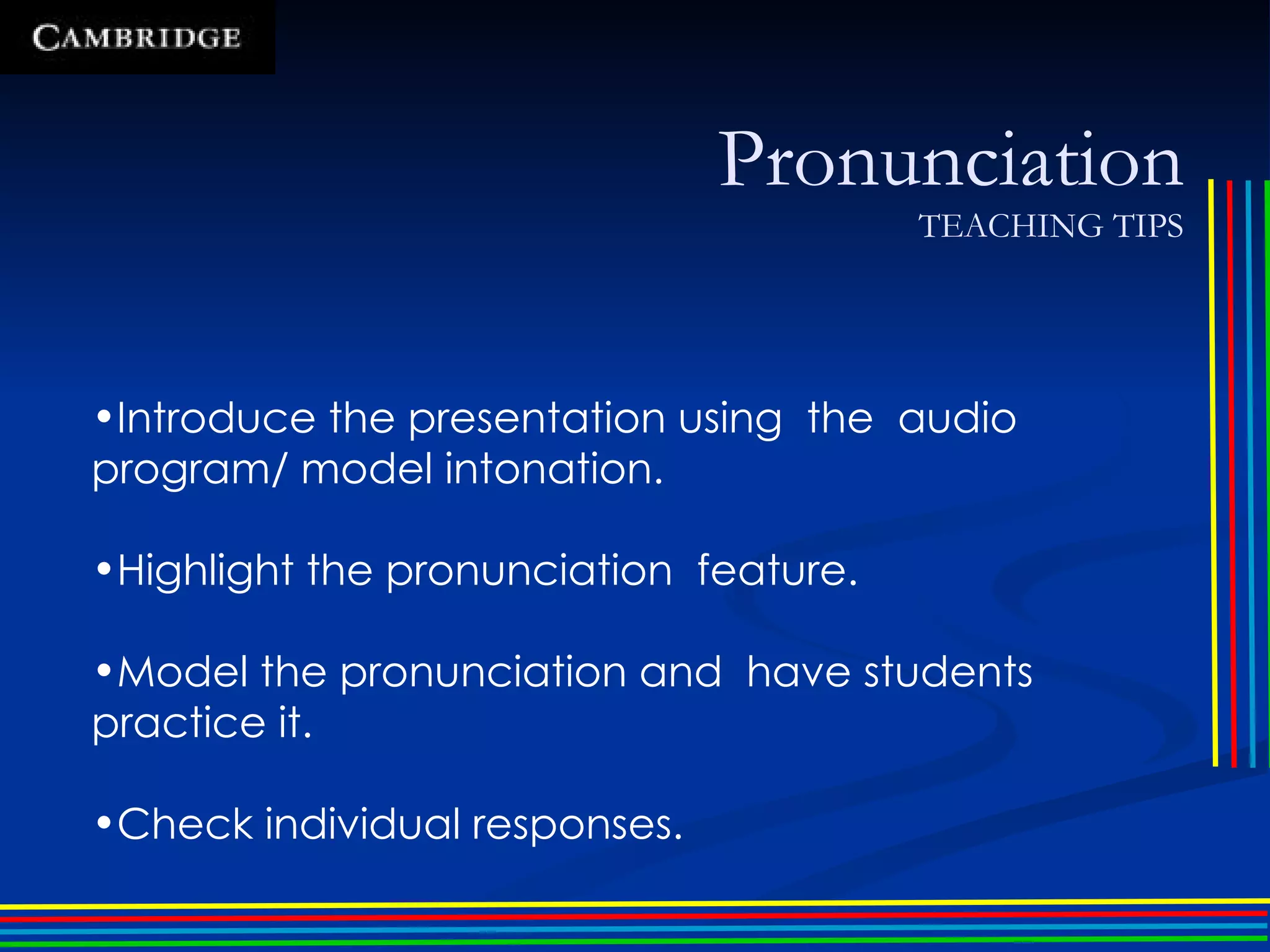
Pronunciation TEACHING TIPS Introduce the presentation using  the  audio program/ model intonation. Highlight the pronunciation  feature. Model the pronunciation and  have students practice it. Check individual responses.
Fluency exercises They are: Pair or group work Role plays and class activities Interchange activities More personalized practice Real-life content in a safe environment Meaningful experience Opportunities for individual participation
Fluency exercises
Fluency exercises
Set the scene and review the model. Explain and model the task. Divide the class into pairs or groups. Students complete the task. Give students feedback. Fluency exercises TEACHING TIPS
www.cambridge.org/elt/interchange/ www.cambridge.org/us/ www.cambridge.org/elt/ic3/   Web support


Questions?
THANKS!!!

Ict Long

  • 1.
  • 2.
  • 3.
    American English CEFLevel: B1 (PET) Young Adults and Adults Quick Catalogue Review
  • 4.
    CAN DO STATEMENTSFOR LEVEL B1: Can understand the main points of clear standard input on familiar matters regularly encountered in work, school, leisure, etc. Can deal with most situations likely to arise whilst travelling in an area where the language is spoken. Can produce simple connected text on topics which are familiar or of personal interest. Can describe experiences and events, dreams, hopes and ambitions and briefly give reasons and explanations for opinions and plans.
  • 5.
    The course 4levels (intro to 3) American English Young adults and adults 70 to 120 hours (full edition) 35 to 60 hours (split edition: A / B) 4 skills instruction
  • 6.
    COMPONENTS www.cambridge.org/interchange TestCrafter NEW Interchange Third Edition/Passages Placement and Evaluation Package Whiteboard Software Network NEW Teacher's Resource Book Full Contact B Workbook B Full Contact A Workbook A Whiteboard Software Student's Book B with Self-study Audio CD CD-ROM for Windows Student's Book A with Self-study Audio CD Lab Audio CDs Class Audio CDs Lab Guide Class Audio Cassettes Video Teacher's Guide Teacher's Edition Video Activity Book Workbook Video/NTSC Student's Book Video/DVD Student's Book with Self-study Audio CD
  • 7.
    Students’ needs Engagingactivities Clear goals and procedures Opportunities for personalization Flexibility Achievable results Feedback
  • 8.
    Key features Realworld topics Conversational language Grammar in communicative contexts Task-based listening activities Student-centered Complete teacher support
  • 9.
    Unit format Unitsintegrate topics, functions, grammar and skills Two lesson-sequences within each unit Activities build on each other, culminating in fluency activity Activities can serve as a springboard for supplementary practice
  • 10.
    Unit format 16units 16 communication tasks (interchange activities) 8 Progress checks Two topical or functional sections Perspectives 16 projects 16 self-study listening activities Cycle 1 Cycle 2
  • 11.
    Unit content SnapshotWord power Conversation Grammar focus Pronunciation Interchange Speaking Arcade: different kinds of interactive activities on the internet! Discussion Fluency exercises Listening Writing Reading Perspectives Self-study listenings Projects
  • 12.
    Snapshot Introduces thetopic Provides real world information Builds receptive & productive vocabulary Is presented in graphic form (easy to read) Includes follow-up questions (discussion)
  • 13.
  • 14.
    Snapshot Teaching Step1: Books closed. Introduce the new Topic Teaching Step 2: Books closed. Lead the students through the information in the Snapshot. Teaching Step 3: Do the follow-up questions in pairs, groups, or as a class. TEACHING STEPS
  • 15.
    Snapshot Should the Snapshot be brief or long? Why does the Teaching Tip suggest that you keep the Snapshot brief? How can you make the Snapshot a meaningful activity? If you were to teach this Snapshot, would you prefer to have your students do the follow-up questions as a whole class, in groups, or in pairs? Why?
  • 16.
    Snapshot PERSONALIZATON: Theteacher adds more personalized questions that relate to her/his students own lives and culture. Why is this important?
  • 17.
    Word Power DevelopsSs´ vocabulary Is related to the unit Includes variety of exercises (word maps and collocations) Is followed by oral and written practice (vocabulary in context)
  • 18.
  • 19.
    Word Power Whatis the aim of Word Power? What skills can be practiced?
  • 20.
    Word Power How would you introduce the topic neighbourhood ? Would you: 3. Tell them that the topic is talking about the neighbourhood and translate it into Spanish? . 2. Explain to students what a neighbourhood is and what they will find there? 1. Show students photographs of a typical neighbourhood, and ask them to tell you about it? Why? Yes/No Idea
  • 21.
    Word Power TEACHINGSTEPS Teaching Step One: Introduce the topic and elicit associated vocabulary. Use vocabulary teaching techniques. Teaching Step Two: Model the pronunciation of new words. Teaching Step Three: Explain and model the task. Teaching Step Four: Students complete the task. Teaching Step Five: Check answers with class. Individual work, peer correction.
  • 22.
    Word Power 5. Haircut 4. Wash and dry clothes 3. Department store 2. Area 1. Neighbourhood Give an example Elicit an example Give a definition Elicit a definition Mime Translate Vocabulary
  • 23.
    Word Power Whyshould we find out what students already know before pre-teaching vocabulary? Suggest a reason why this is a good idea. Why should students sit in front of each other and look at each other during a speaking activity? How can you personalize the word power section? What do you think is better, eliciting definition and examples or giving them? Why?
  • 24.
    Conversation Introduces newfunction or grammar Creates a communicative and situational context Serves as a model for conversational expressions Provides a listening task Focuses on accurate repetition Avoids “reading like” intonation
  • 25.
  • 26.
    Models Practical Meaningful Memorable Transferable
  • 27.
  • 28.
    Conversation Which grammar points does the conversation present? Can you find examples of functions in the Conversation? Write examples.
  • 29.
    Conversation MEANING, FORM,AND USE Imagine that you are learning a new language (e.g. Swahili). Your teacher gives you a short dialog, which contains a grammar structure you have never seen before (e.g. mimi ninakwenda). What would you want your teacher to explain first? Rank these in order of importance: What the structure means How to form the new structure How to use the structure
  • 30.
    Conversation TEACHING STEPS___ Check students’ comprehension. ___ Books open. Students read silently as they listen once more. ___ Set the scene. Set a focus question. ___ Students practice the conversation. ___ Books closed. Students listen to the audio program once or twice. ___ Explain unfamiliar vocabulary. 1 2 3 6 5 4
  • 31.
    Conversation TEACHING STRATEGIESLooking at the picture for … Predicting Telling the story Disappearing dialog Musical dialog Substitution dialog Moving dialog Stand up, sit down Say it with feeling Onion Ring Look up and say technique
  • 32.
    Grammar Focus Summaryof grammar items Exercises in context Controlled to freer practice Communicative exercises Personal context (often)
  • 33.
  • 34.
    Elicit or explainthe rules. Inductive or deductive teaching. Present example sentences using the audio program. Model the task. Students complete the task. Check answers with the class. Peer correction. Grammar Focus TEACHING STEPS
  • 35.
    Two different pointof views about teaching grammar I avoid turning the Grammar Focus into a heavy grammar class. Instead, I lead my students into the fluency activity quickly, so they learn to use the language. I like to spend a lot of time on grammar rules and doing controlled exercises until I am sure my students know the structures. Then we try producing the language . Grammar Focus
  • 36.
    Grammar Focus 4. Ask your students to go back to the Conversation and substitute their own information in the dialog. 3. After eliciting grammar rules, create real sentences about themselves, using the new structure. 2. Give a handout with grammar rules to your students for studying. 1. Use a grammar game from the Teacher´s Edition. Why? Yes/No Technique
  • 37.
    Pronunciation Highlights pronunciation features Rhythm, stress, intonation, blending, reductions, etc. Is taken from “Conversation” or “Grammar Focus” sections Improves listening & speaking skills Builds student’s awareness & confidence
  • 38.
  • 39.
    Pronunciation Which of the following ideas would help your students to recognize the rising-falling intonation? Which one(s) would help them to produce a rising-falling intonation? Check the appropriate column. Then add an idea of your own. Have your students first “hum” the example sentences and then say the words with the appropriate intonation. Have your students listen to example sentences. Tell them to stand up every time the sound rises and to sit down when it falls. Have the whole class listen and repeat after the audio program. Write sentences on the board and have your students draw arrows to show where the sounds rise and fall. Production Recognition Idea
  • 40.
    Pronunciation TEACHING TIPSIntroduce the presentation using the audio program/ model intonation. Highlight the pronunciation feature. Model the pronunciation and have students practice it. Check individual responses.
  • 41.
    Fluency exercises Theyare: Pair or group work Role plays and class activities Interchange activities More personalized practice Real-life content in a safe environment Meaningful experience Opportunities for individual participation
  • 42.
  • 43.
  • 44.
    Set the sceneand review the model. Explain and model the task. Divide the class into pairs or groups. Students complete the task. Give students feedback. Fluency exercises TEACHING TIPS
  • 45.
  • 46.
  • 47.
  • 48.
  • 49.
  • 50.
  • 51.
  • 52.
  • 53.
  • 54.
  • 55.
  • 56.