NET-CHALLENGE OVERVIEW Methodology for Non-Hierarchical collaboration Date, Place Presenter
Net-Challenge values   13. Overall process Net-Challenge motivation Net-Challenge overview Net-Challenge objectives Collaboration perspectives Collaboration lifecycle Success story of collaboration in wine industry Success story of collaboration in electronic industry Networking layers Outcomes of Non-Hierarchical Networks Net-Challenge integrated framework Collaborative planning: software application tool Agenda
Promotion of shared decision making process Support collaborative business environment Establish trust, honesty and integrity among partners Provide shared innovations, experiences, statuses, results and knowledge Enable sharing both risks and benefits among partners Net-Challenge values
Net-Challenge motivation European SMEs have to focus on innovative, customised and short lead time manufacturing in order to compete against low labour cost countries To be competitive, European SMEs have to collaborative with the objective to sharing costly resources and expertise among each other To be successful in collaboration, the SMEs have to share the knowledge of their product design and development processes
Systematically collect partnering information Share and integrate business processes Create a community to meet, share and build trust Bring business partners closer using modern technology Collaborate using shared predefined processes Use shared processes that really support the business model Move together from subcontracting towards shared products Change business model from capacity selling subcontractor to shared product platform based business model Net-Challenge overview
Net-Challenge objectives The Net-Challenge Framework aims to support  SMEs in creating and managing successful non-hierarchical networks for complex products design and manufacturing, including: a  methodology  to help SMEs in the formation and operation of dynamic and non-hierarchical networks.  define and explain approach on how to form and manage those Networks reference collaboration processes for the relevant business processes distributed decision support tools , including  collaborative planning  with dynamic capacity management and real-time order promising  real-time  monitoring  with  event management  and  performance management
Collaboration perspectives Selling larger projects together Reducing lead time by utilising resources efficiently Sharing resources Creating synergy between the partners Managing deviations in systematic way Improving quality by specialisation Enabling larger projects by sharing risks Better commitment by sharing profits Enabling new product/service Innovations Sharing performance results of the community Creating own products instead of subconstruction Knowledge donation
Collaboration lifecycle The methodology supports the management of: Business community ETO Virtual organisations CTO Virtual organisations
Success story of collaboration in wine business Lavradores de Feitoria Producers of wine in the Douro Valley region - individually they could hardly sell their wine (only part of it, at very low prices) Created a network (15 farms) to support activities in: distribution (new brand, advertising, new distribution channels) production (advanced support in the wine yards, new production facilities) Result: large improvement in sales volume and margins
Success story of collaboration in electronic industry Supply Network Shannon (Ireland) In 1997 a directory with 80 companies in the Shannon region was created (companies related with the electronics industry) The directory was the first step for the development of a community, including tools for benchmarking and partner searching There is a small structure responsible for the animation and development of the community  -  workshops and other events are used to promote trust between members, and to share and develop knowledge The small companies from this region got larger and better business opportunities, providing a better service by integrating competencies of partners Besides other direct advantages, this community facilitates the creation of specific business networks to respond to emerging market opportunities
Networking layers Business community is a long lasting business network to share knowledge and partner profile to qualify and manage performance of a partner Virtual organisation is project based consortium of partners To fulfill temporary business opportunities
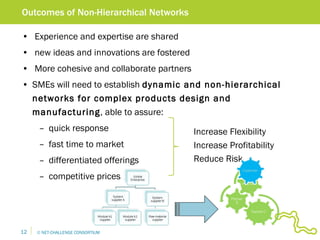
Outcomes of Non-Hierarchical Networks Experience and expertise are shared new ideas and innovations are fostered More cohesive and collaborate partners SMEs will need to establish  dynamic and non-hierarchical networks  for complex products design and manufacturing , able to assure: quick response fast time to market differentiated offerings competitive prices Increase Flexibility Increase Profitability Reduce Risk
Net-Challenge integrated Framework Methodology Reference Collaboration Processes Decision Support Tools and Infrastructure Business Community Operational Management Aggregate collaborative planning Detailed collaborative planning Events Management Aggregate collaborative planning Performance Management VO Formation & Operational Management Business Community Management Performance Management ETO VO Management CTO  VO Management Capacity Management Detailed collaborative planning Event Management
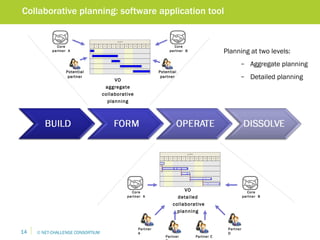
Collaborative planning: software application tool Partner B Partner C Potential partner Potential partner Planning at two levels: Aggregate planning Detailed planning VO  detailed  collaborative planning  Partner  A Partner D Core partner  A Core partner  B VO  aggregate  collaborative  planning  Core partner  A Core partner  B
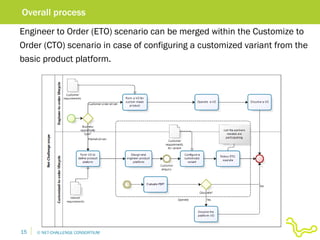
Overall process Engineer to Order (ETO) scenario can be merged within the Customize to Order (CTO) scenario in case of configuring a customized variant from the basic product platform.

Net challenge training_material_overview_final

  • 1.
    NET-CHALLENGE OVERVIEW Methodologyfor Non-Hierarchical collaboration Date, Place Presenter
  • 2.
    Net-Challenge values 13. Overall process Net-Challenge motivation Net-Challenge overview Net-Challenge objectives Collaboration perspectives Collaboration lifecycle Success story of collaboration in wine industry Success story of collaboration in electronic industry Networking layers Outcomes of Non-Hierarchical Networks Net-Challenge integrated framework Collaborative planning: software application tool Agenda
  • 3.
    Promotion of shareddecision making process Support collaborative business environment Establish trust, honesty and integrity among partners Provide shared innovations, experiences, statuses, results and knowledge Enable sharing both risks and benefits among partners Net-Challenge values
  • 4.
    Net-Challenge motivation EuropeanSMEs have to focus on innovative, customised and short lead time manufacturing in order to compete against low labour cost countries To be competitive, European SMEs have to collaborative with the objective to sharing costly resources and expertise among each other To be successful in collaboration, the SMEs have to share the knowledge of their product design and development processes
  • 5.
    Systematically collect partneringinformation Share and integrate business processes Create a community to meet, share and build trust Bring business partners closer using modern technology Collaborate using shared predefined processes Use shared processes that really support the business model Move together from subcontracting towards shared products Change business model from capacity selling subcontractor to shared product platform based business model Net-Challenge overview
  • 6.
    Net-Challenge objectives TheNet-Challenge Framework aims to support SMEs in creating and managing successful non-hierarchical networks for complex products design and manufacturing, including: a methodology to help SMEs in the formation and operation of dynamic and non-hierarchical networks. define and explain approach on how to form and manage those Networks reference collaboration processes for the relevant business processes distributed decision support tools , including collaborative planning with dynamic capacity management and real-time order promising real-time monitoring with event management and performance management
  • 7.
    Collaboration perspectives Sellinglarger projects together Reducing lead time by utilising resources efficiently Sharing resources Creating synergy between the partners Managing deviations in systematic way Improving quality by specialisation Enabling larger projects by sharing risks Better commitment by sharing profits Enabling new product/service Innovations Sharing performance results of the community Creating own products instead of subconstruction Knowledge donation
  • 8.
    Collaboration lifecycle Themethodology supports the management of: Business community ETO Virtual organisations CTO Virtual organisations
  • 9.
    Success story ofcollaboration in wine business Lavradores de Feitoria Producers of wine in the Douro Valley region - individually they could hardly sell their wine (only part of it, at very low prices) Created a network (15 farms) to support activities in: distribution (new brand, advertising, new distribution channels) production (advanced support in the wine yards, new production facilities) Result: large improvement in sales volume and margins
  • 10.
    Success story ofcollaboration in electronic industry Supply Network Shannon (Ireland) In 1997 a directory with 80 companies in the Shannon region was created (companies related with the electronics industry) The directory was the first step for the development of a community, including tools for benchmarking and partner searching There is a small structure responsible for the animation and development of the community - workshops and other events are used to promote trust between members, and to share and develop knowledge The small companies from this region got larger and better business opportunities, providing a better service by integrating competencies of partners Besides other direct advantages, this community facilitates the creation of specific business networks to respond to emerging market opportunities
  • 11.
    Networking layers Businesscommunity is a long lasting business network to share knowledge and partner profile to qualify and manage performance of a partner Virtual organisation is project based consortium of partners To fulfill temporary business opportunities
  • 12.
    Outcomes of Non-HierarchicalNetworks Experience and expertise are shared new ideas and innovations are fostered More cohesive and collaborate partners SMEs will need to establish dynamic and non-hierarchical networks for complex products design and manufacturing , able to assure: quick response fast time to market differentiated offerings competitive prices Increase Flexibility Increase Profitability Reduce Risk
  • 13.
    Net-Challenge integrated FrameworkMethodology Reference Collaboration Processes Decision Support Tools and Infrastructure Business Community Operational Management Aggregate collaborative planning Detailed collaborative planning Events Management Aggregate collaborative planning Performance Management VO Formation & Operational Management Business Community Management Performance Management ETO VO Management CTO VO Management Capacity Management Detailed collaborative planning Event Management
  • 14.
    Collaborative planning: softwareapplication tool Partner B Partner C Potential partner Potential partner Planning at two levels: Aggregate planning Detailed planning VO detailed collaborative planning Partner A Partner D Core partner A Core partner B VO aggregate collaborative planning Core partner A Core partner B
  • 15.
    Overall process Engineerto Order (ETO) scenario can be merged within the Customize to Order (CTO) scenario in case of configuring a customized variant from the basic product platform.

Editor's Notes