Enter Time Zone to Know Timing
THE TENSES
for Secondary School
Presented by
M Prahallada
PGT English
NVS Centre of Excellence, BangaloreTenses in English
M PRAHALLADA NVS CENTRE OF
EXCELLENCE BANGALORE
1
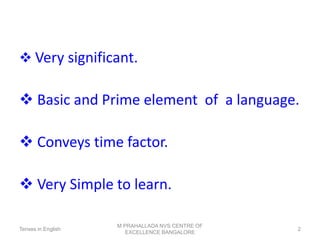
❖ Very significant.
❖ Basic and Prime element of a language.
❖ Conveys time factor.
❖ Very Simple to learn.
Tenses in English
M PRAHALLADA NVS CENTRE OF
EXCELLENCE BANGALORE
2
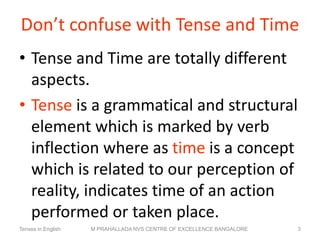
Don’t confuse with Tense and Time
• Tense and Time are totally different
aspects.
• Tense is a grammatical and structural
element which is marked by verb
inflection where as time is a concept
which is related to our perception of
reality, indicates time of an action
performed or taken place.
Tenses in English M PRAHALLADA NVS CENTRE OF EXCELLENCE BANGALORE 3
See some examples
• Present tense can be used to express future time.
Ex.
1. He can complete the work tomorrow.
2. His project is going to be completed by next year.
Future tense can be used to express Present time
Ex.
1. He will go to Bangalore today.
2. He will complete his assignment now.
Future Tense can be used to express present time and
Present tense can be used to express future time.
Tenses in English
M PRAHALLADA NVS CENTRE OF
EXCELLENCE BANGALORE
4
Now let’s get into the tenses.
Meaning:
• The word tense literally means time. it is
the form of the verb to indicate the time
of an action.
Tenses in English
M PRAHALLADA NVS CENTRE OF
EXCELLENCE BANGALORE
5
Note:
❖Identify the tense with the auxiliary verb only
when both Main Verb and Auxiliary verb are
there in a sentence.
❖ When there is only main verb in a sentence,
we should identify the tense with the form of
main verb .
Tenses in English
M PRAHALLADA NVS CENTRE OF
EXCELLENCE BANGALORE
6
Types Of Tenses
1. The Present tense
Ex. I have
2. The Past tense
Ex. I had
3. The Future tense
Ex. I will have
Note: We should know when and why
these tenses must be used.
Tenses in English
M PRAHALLADA NVS CENTRE OF
EXCELLENCE BANGALORE
7
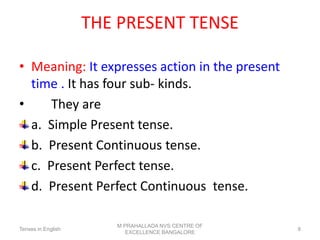
THE PRESENT TENSE
• Meaning: It expresses action in the present
time . It has four sub- kinds.
• They are
a. Simple Present tense.
b. Present Continuous tense.
c. Present Perfect tense.
d. Present Perfect Continuous tense.
Tenses in English
M PRAHALLADA NVS CENTRE OF
EXCELLENCE BANGALORE
8
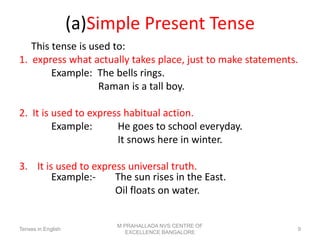
(a)Simple Present Tense
This tense is used to:
1. express what actually takes place, just to make statements.
Example: The bells rings.
Raman is a tall boy.
2. It is used to express habitual action.
Example: He goes to school everyday.
It snows here in winter.
3. It is used to express universal truth.
Example:- The sun rises in the East.
Oil floats on water.
Tenses in English
M PRAHALLADA NVS CENTRE OF
EXCELLENCE BANGALORE
9
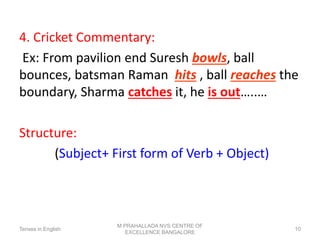
4. Cricket Commentary:
Ex: From pavilion end Suresh bowls, ball
bounces, batsman Raman hits , ball reaches the
boundary, Sharma catches it, he is out…..…
Structure:
(Subject+ First form of Verb + Object)
Tenses in English
M PRAHALLADA NVS CENTRE OF
EXCELLENCE BANGALORE
10
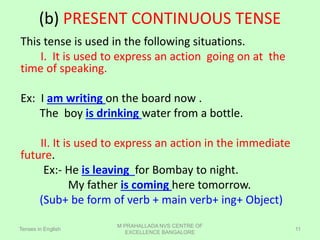
(b) PRESENT CONTINUOUS TENSE
This tense is used in the following situations.
I. It is used to express an action going on at the
time of speaking.
Ex: I am writing on the board now .
The boy is drinking water from a bottle.
II. It is used to express an action in the immediate
future.
Ex:- He is leaving for Bombay to night.
My father is coming here tomorrow.
(Sub+ be form of verb + main verb+ ing+ Object)
Tenses in English
M PRAHALLADA NVS CENTRE OF
EXCELLENCE BANGALORE
11
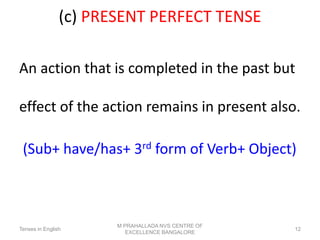
(c) PRESENT PERFECT TENSE
An action that is completed in the past but
effect of the action remains in present also.
(Sub+ have/has+ 3rd form of Verb+ Object)
Tenses in English
M PRAHALLADA NVS CENTRE OF
EXCELLENCE BANGALORE
12
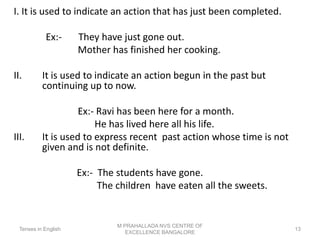
I. It is used to indicate an action that has just been completed.
Ex:- They have just gone out.
Mother has finished her cooking.
II. It is used to indicate an action begun in the past but
continuing up to now.
Ex:- Ravi has been here for a month.
He has lived here all his life.
III. It is used to express recent past action whose time is not
given and is not definite.
Ex:- The students have gone.
The children have eaten all the sweets.
Tenses in English
M PRAHALLADA NVS CENTRE OF
EXCELLENCE BANGALORE
13
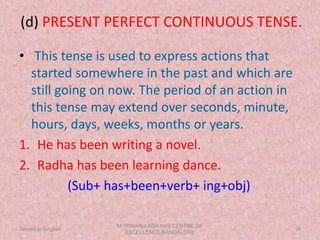
(d) PRESENT PERFECT CONTINUOUS TENSE.
• This tense is used to express actions that
started somewhere in the past and which are
still going on now. The period of an action in
this tense may extend over seconds, minute,
hours, days, weeks, months or years.
1. He has been writing a novel.
2. Radha has been learning dance.
(Sub+ has+been+verb+ ing+obj)
Tenses in English
M PRAHALLADA NVS CENTRE OF
EXCELLENCE BANGALORE
14
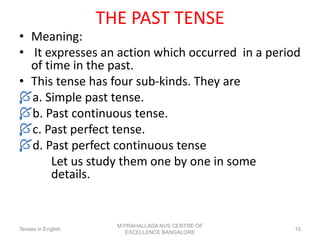
THE PAST TENSE
• Meaning:
• It expresses an action which occurred in a period
of time in the past.
• This tense has four sub-kinds. They are
a. Simple past tense.
b. Past continuous tense.
c. Past perfect tense.
d. Past perfect continuous tense
Let us study them one by one in some
details.
Tenses in English
M PRAHALLADA NVS CENTRE OF
EXCELLENCE BANGALORE
15
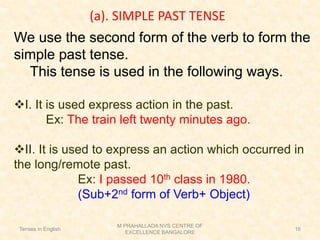
(a). SIMPLE PAST TENSE
We use the second form of the verb to form the
simple past tense.
This tense is used in the following ways.
❖I. It is used express action in the past.
Ex: The train left twenty minutes ago.
❖II. It is used to express an action which occurred in
the long/remote past.
Ex: I passed 10th class in 1980.
(Sub+2nd form of Verb+ Object)
Tenses in English
M PRAHALLADA NVS CENTRE OF
EXCELLENCE BANGALORE
16
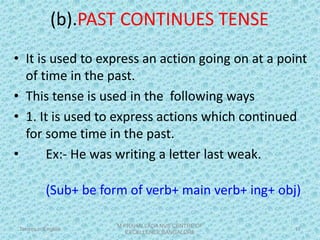
(b).PAST CONTINUES TENSE
• It is used to express an action going on at a point
of time in the past.
• This tense is used in the following ways
• 1. It is used to express actions which continued
for some time in the past.
• Ex:- He was writing a letter last weak.
(Sub+ be form of verb+ main verb+ ing+ obj)
Tenses in English
M PRAHALLADA NVS CENTRE OF
EXCELLENCE BANGALORE
17
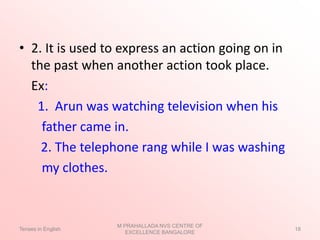
• 2. It is used to express an action going on in
the past when another action took place.
Ex:
1. Arun was watching television when his
father came in.
2. The telephone rang while I was washing
my clothes.
Tenses in English
M PRAHALLADA NVS CENTRE OF
EXCELLENCE BANGALORE
18
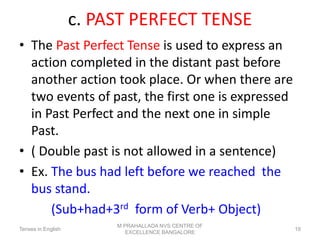
c. PAST PERFECT TENSE
• The Past Perfect Tense is used to express an
action completed in the distant past before
another action took place. Or when there are
two events of past, the first one is expressed
in Past Perfect and the next one in simple
Past.
• ( Double past is not allowed in a sentence)
• Ex. The bus had left before we reached the
bus stand.
(Sub+had+3rd form of Verb+ Object)
Tenses in English
M PRAHALLADA NVS CENTRE OF
EXCELLENCE BANGALORE
19
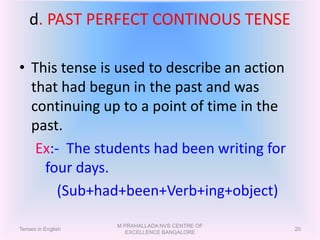
d. PAST PERFECT CONTINOUS TENSE
• This tense is used to describe an action
that had begun in the past and was
continuing up to a point of time in the
past.
Ex:- The students had been writing for
four days.
(Sub+had+been+Verb+ing+object)
Tenses in English
M PRAHALLADA NVS CENTRE OF
EXCELLENCE BANGALORE
20
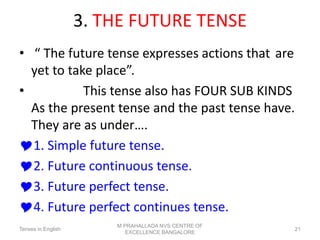
3. THE FUTURE TENSE
• “ The future tense expresses actions that are
yet to take place”.
• This tense also has FOUR SUB KINDS
As the present tense and the past tense have.
They are as under….
1. Simple future tense.
2. Future continuous tense.
3. Future perfect tense.
4. Future perfect continues tense.
Tenses in English
M PRAHALLADA NVS CENTRE OF
EXCELLENCE BANGALORE
21
I. SIMPLE FUTURE TENSE
• Simple future tense is used to express an
action that is going to take place. This tense is
used in the following cases.
a. It is used to express action in the future.
Ex: My father will meet you.
Ex: My father will meet you tomorrow.
I shall go to market next week.
I shall buy new dress for my birthday.
(Sub+will/Shall+1st form of Verb + Object)
Tenses in English
M PRAHALLADA NVS CENTRE OF
EXCELLENCE BANGALORE
22
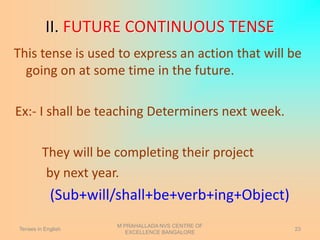
II. FUTURE CONTINUOUS TENSE
This tense is used to express an action that will be
going on at some time in the future.
Ex:- I shall be teaching Determiners next week.
They will be completing their project
by next year.
(Sub+will/shall+be+verb+ing+Object)
Tenses in English
M PRAHALLADA NVS CENTRE OF
EXCELLENCE BANGALORE
23
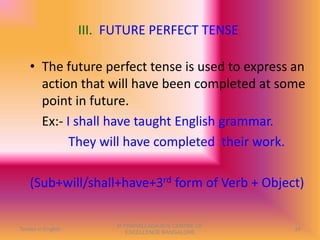
III. FUTURE PERFECT TENSE.
• The future perfect tense is used to express an
action that will have been completed at some
point in future.
Ex:- I shall have taught English grammar.
They will have completed their work.
(Sub+will/shall+have+3rd form of Verb + Object)
Tenses in English
M PRAHALLADA NVS CENTRE OF
EXCELLENCE BANGALORE
24
IV. FUTURE PERFECT CONTINOUS TENSE.
Future perfect continuous tense is used to express the
actions that are expected to continue up to a point of
time in the future.
Ex:- When I turn sixty , I will have been teaching English
for 37 years.
(Sub+will+have+been+verb+ing+Object)
Tenses in English
M PRAHALLADA NVS CENTRE OF
EXCELLENCE BANGALORE
25

English Tenses

  • 1.
    Enter Time Zoneto Know Timing THE TENSES for Secondary School Presented by M Prahallada PGT English NVS Centre of Excellence, BangaloreTenses in English M PRAHALLADA NVS CENTRE OF EXCELLENCE BANGALORE 1
  • 2.
    ❖ Very significant. ❖Basic and Prime element of a language. ❖ Conveys time factor. ❖ Very Simple to learn. Tenses in English M PRAHALLADA NVS CENTRE OF EXCELLENCE BANGALORE 2
  • 3.
    Don’t confuse withTense and Time • Tense and Time are totally different aspects. • Tense is a grammatical and structural element which is marked by verb inflection where as time is a concept which is related to our perception of reality, indicates time of an action performed or taken place. Tenses in English M PRAHALLADA NVS CENTRE OF EXCELLENCE BANGALORE 3
  • 4.
    See some examples •Present tense can be used to express future time. Ex. 1. He can complete the work tomorrow. 2. His project is going to be completed by next year. Future tense can be used to express Present time Ex. 1. He will go to Bangalore today. 2. He will complete his assignment now. Future Tense can be used to express present time and Present tense can be used to express future time. Tenses in English M PRAHALLADA NVS CENTRE OF EXCELLENCE BANGALORE 4
  • 5.
    Now let’s getinto the tenses. Meaning: • The word tense literally means time. it is the form of the verb to indicate the time of an action. Tenses in English M PRAHALLADA NVS CENTRE OF EXCELLENCE BANGALORE 5
  • 6.
    Note: ❖Identify the tensewith the auxiliary verb only when both Main Verb and Auxiliary verb are there in a sentence. ❖ When there is only main verb in a sentence, we should identify the tense with the form of main verb . Tenses in English M PRAHALLADA NVS CENTRE OF EXCELLENCE BANGALORE 6
  • 7.
    Types Of Tenses 1.The Present tense Ex. I have 2. The Past tense Ex. I had 3. The Future tense Ex. I will have Note: We should know when and why these tenses must be used. Tenses in English M PRAHALLADA NVS CENTRE OF EXCELLENCE BANGALORE 7
  • 8.
    THE PRESENT TENSE •Meaning: It expresses action in the present time . It has four sub- kinds. • They are a. Simple Present tense. b. Present Continuous tense. c. Present Perfect tense. d. Present Perfect Continuous tense. Tenses in English M PRAHALLADA NVS CENTRE OF EXCELLENCE BANGALORE 8
  • 9.
    (a)Simple Present Tense Thistense is used to: 1. express what actually takes place, just to make statements. Example: The bells rings. Raman is a tall boy. 2. It is used to express habitual action. Example: He goes to school everyday. It snows here in winter. 3. It is used to express universal truth. Example:- The sun rises in the East. Oil floats on water. Tenses in English M PRAHALLADA NVS CENTRE OF EXCELLENCE BANGALORE 9
  • 10.
    4. Cricket Commentary: Ex:From pavilion end Suresh bowls, ball bounces, batsman Raman hits , ball reaches the boundary, Sharma catches it, he is out…..… Structure: (Subject+ First form of Verb + Object) Tenses in English M PRAHALLADA NVS CENTRE OF EXCELLENCE BANGALORE 10
  • 11.
    (b) PRESENT CONTINUOUSTENSE This tense is used in the following situations. I. It is used to express an action going on at the time of speaking. Ex: I am writing on the board now . The boy is drinking water from a bottle. II. It is used to express an action in the immediate future. Ex:- He is leaving for Bombay to night. My father is coming here tomorrow. (Sub+ be form of verb + main verb+ ing+ Object) Tenses in English M PRAHALLADA NVS CENTRE OF EXCELLENCE BANGALORE 11
  • 12.
    (c) PRESENT PERFECTTENSE An action that is completed in the past but effect of the action remains in present also. (Sub+ have/has+ 3rd form of Verb+ Object) Tenses in English M PRAHALLADA NVS CENTRE OF EXCELLENCE BANGALORE 12
  • 13.
    I. It isused to indicate an action that has just been completed. Ex:- They have just gone out. Mother has finished her cooking. II. It is used to indicate an action begun in the past but continuing up to now. Ex:- Ravi has been here for a month. He has lived here all his life. III. It is used to express recent past action whose time is not given and is not definite. Ex:- The students have gone. The children have eaten all the sweets. Tenses in English M PRAHALLADA NVS CENTRE OF EXCELLENCE BANGALORE 13
  • 14.
    (d) PRESENT PERFECTCONTINUOUS TENSE. • This tense is used to express actions that started somewhere in the past and which are still going on now. The period of an action in this tense may extend over seconds, minute, hours, days, weeks, months or years. 1. He has been writing a novel. 2. Radha has been learning dance. (Sub+ has+been+verb+ ing+obj) Tenses in English M PRAHALLADA NVS CENTRE OF EXCELLENCE BANGALORE 14
  • 15.
    THE PAST TENSE •Meaning: • It expresses an action which occurred in a period of time in the past. • This tense has four sub-kinds. They are a. Simple past tense. b. Past continuous tense. c. Past perfect tense. d. Past perfect continuous tense Let us study them one by one in some details. Tenses in English M PRAHALLADA NVS CENTRE OF EXCELLENCE BANGALORE 15
  • 16.
    (a). SIMPLE PASTTENSE We use the second form of the verb to form the simple past tense. This tense is used in the following ways. ❖I. It is used express action in the past. Ex: The train left twenty minutes ago. ❖II. It is used to express an action which occurred in the long/remote past. Ex: I passed 10th class in 1980. (Sub+2nd form of Verb+ Object) Tenses in English M PRAHALLADA NVS CENTRE OF EXCELLENCE BANGALORE 16
  • 17.
    (b).PAST CONTINUES TENSE •It is used to express an action going on at a point of time in the past. • This tense is used in the following ways • 1. It is used to express actions which continued for some time in the past. • Ex:- He was writing a letter last weak. (Sub+ be form of verb+ main verb+ ing+ obj) Tenses in English M PRAHALLADA NVS CENTRE OF EXCELLENCE BANGALORE 17
  • 18.
    • 2. Itis used to express an action going on in the past when another action took place. Ex: 1. Arun was watching television when his father came in. 2. The telephone rang while I was washing my clothes. Tenses in English M PRAHALLADA NVS CENTRE OF EXCELLENCE BANGALORE 18
  • 19.
    c. PAST PERFECTTENSE • The Past Perfect Tense is used to express an action completed in the distant past before another action took place. Or when there are two events of past, the first one is expressed in Past Perfect and the next one in simple Past. • ( Double past is not allowed in a sentence) • Ex. The bus had left before we reached the bus stand. (Sub+had+3rd form of Verb+ Object) Tenses in English M PRAHALLADA NVS CENTRE OF EXCELLENCE BANGALORE 19
  • 20.
    d. PAST PERFECTCONTINOUS TENSE • This tense is used to describe an action that had begun in the past and was continuing up to a point of time in the past. Ex:- The students had been writing for four days. (Sub+had+been+Verb+ing+object) Tenses in English M PRAHALLADA NVS CENTRE OF EXCELLENCE BANGALORE 20
  • 21.
    3. THE FUTURETENSE • “ The future tense expresses actions that are yet to take place”. • This tense also has FOUR SUB KINDS As the present tense and the past tense have. They are as under…. 1. Simple future tense. 2. Future continuous tense. 3. Future perfect tense. 4. Future perfect continues tense. Tenses in English M PRAHALLADA NVS CENTRE OF EXCELLENCE BANGALORE 21
  • 22.
    I. SIMPLE FUTURETENSE • Simple future tense is used to express an action that is going to take place. This tense is used in the following cases. a. It is used to express action in the future. Ex: My father will meet you. Ex: My father will meet you tomorrow. I shall go to market next week. I shall buy new dress for my birthday. (Sub+will/Shall+1st form of Verb + Object) Tenses in English M PRAHALLADA NVS CENTRE OF EXCELLENCE BANGALORE 22
  • 23.
    II. FUTURE CONTINUOUSTENSE This tense is used to express an action that will be going on at some time in the future. Ex:- I shall be teaching Determiners next week. They will be completing their project by next year. (Sub+will/shall+be+verb+ing+Object) Tenses in English M PRAHALLADA NVS CENTRE OF EXCELLENCE BANGALORE 23
  • 24.
    III. FUTURE PERFECTTENSE. • The future perfect tense is used to express an action that will have been completed at some point in future. Ex:- I shall have taught English grammar. They will have completed their work. (Sub+will/shall+have+3rd form of Verb + Object) Tenses in English M PRAHALLADA NVS CENTRE OF EXCELLENCE BANGALORE 24
  • 25.
    IV. FUTURE PERFECTCONTINOUS TENSE. Future perfect continuous tense is used to express the actions that are expected to continue up to a point of time in the future. Ex:- When I turn sixty , I will have been teaching English for 37 years. (Sub+will+have+been+verb+ing+Object) Tenses in English M PRAHALLADA NVS CENTRE OF EXCELLENCE BANGALORE 25