Verb Tense Consistency
Majed Almutairi
Eric Heaps
ENGL 1010
Presentation Guide
• Foundation Knowledge
• Inconsistency
• Problems With Inconsistency
• Correcting Inconsistency
• Consistency in Sentences
• Consistency in Paragraphs
• Consistency in Essays
• Conclusion/Rules to Remember
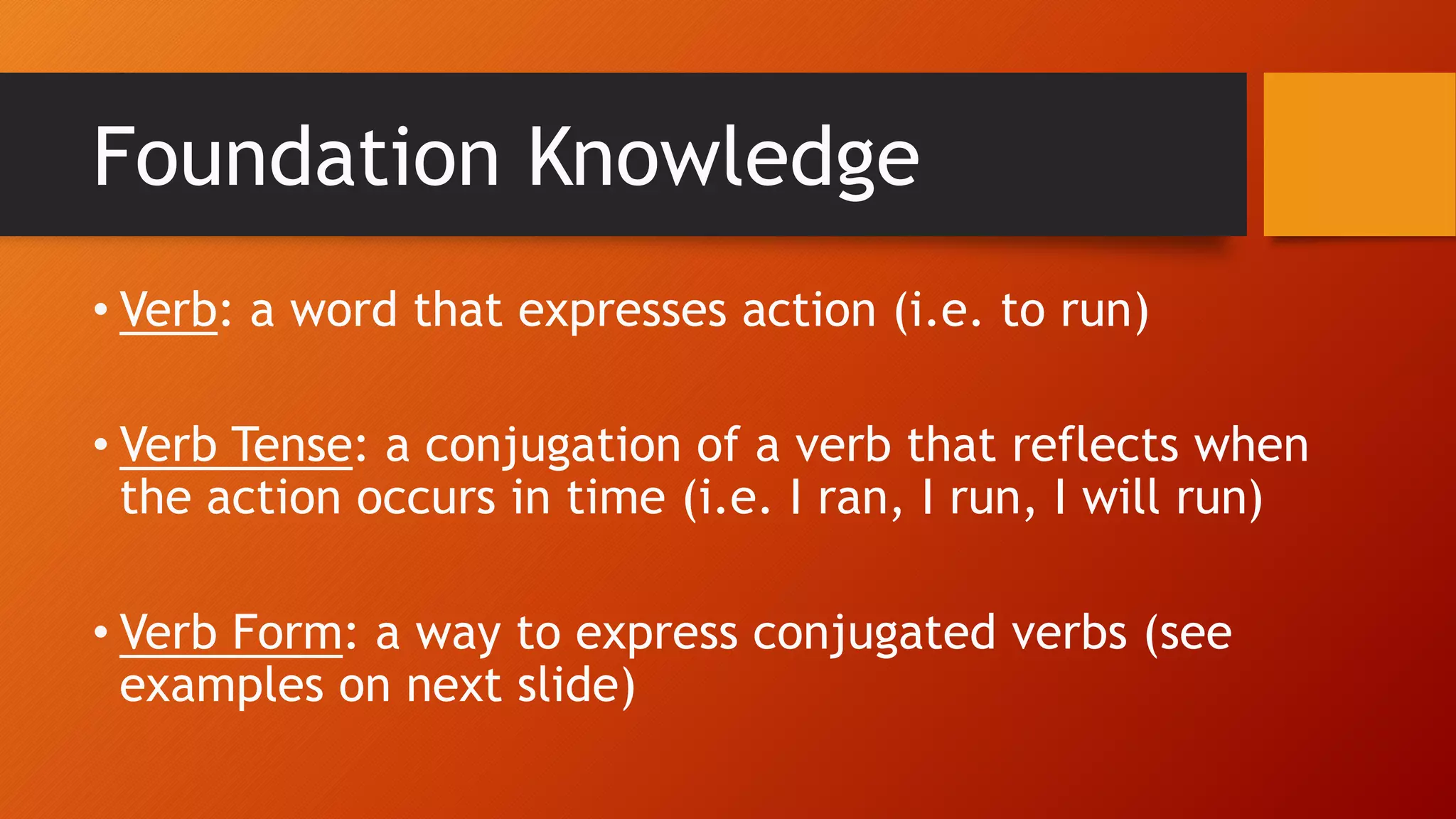
Foundation Knowledge
• Verb: a word that expresses action (i.e. to run)
• Verb Tense: a conjugation of a verb that reflects when
the action occurs in time (i.e. I ran, I run, I will run)
• Verb Form: a way to express conjugated verbs (see
examples on next slide)
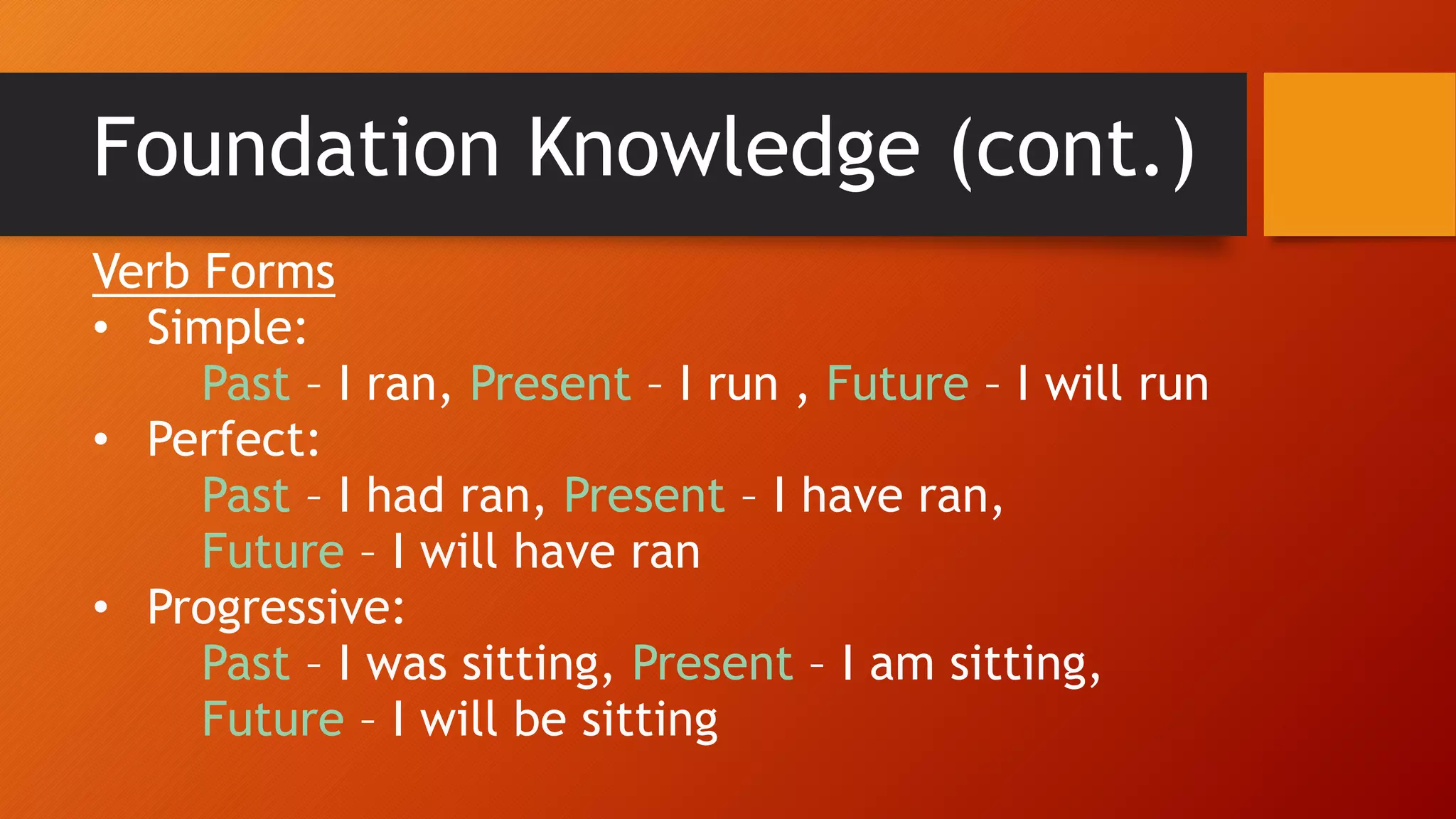
Foundation Knowledge (cont.)
Verb Forms
• Simple:
Past – I ran, Present – I run , Future – I will run
• Perfect:
Past – I had ran, Present – I have ran,
Future – I will have ran
• Progressive:
Past – I was sitting, Present – I am sitting,
Future – I will be sitting
Inconsistency
To understand the importance of Verb Tense Consistency, it helps
to understand Inconsistency.
Example: I ran past the water station and grab a cup of water.
I ran (Simple Past) [I] grab (Simple Present)
The verbs “to run” and “to grab” describe an action that
occurred in the past but “to grab” is inconsistent with this idea.
Problems With Inconsistency
• Verb tense inconsistency, first and foremost, is grammatically
incorrect. In college writing, this will most likely be seen as a
mistake and possibly cost the writer points on a grade.
• It is a habit formed in common speech that does not translate to
college writing. An example might be someone telling someone
else a story and using the present tense to describe an action that
occurred in the past, like in the example on the previous slide.
• In writing, it can be confusing and awkward.
Correcting Inconsistency
In order to correct inconsistency, it is necessary to establish when
the action occurred.
In the example, a person describes running past a water station
and grabbing a cup of water. If this person is describing an event
in the past, it should look like this:
Example: I ran past the water station and grabbed a cup of water.
I ran (Simple Past) [I] grabbed (Simple Past)
Consistency in Sentences
Just like in the previous example, writers can check for
verb tense consistency in each sentence individually.
This does not mean that each verb necessarily has to be
conjugated the same way. If the time an action occurs
changes in the sentence, the appropriate conjugation
should be used.
Example: I was sad, but now I am happy.
I was (Simple Past) I am (Simple Present)
Consistency in Paragraphs
A paragraph is simply a group of sentences that work together to
communicate a greater idea. Verb tense consistency is just as important,
but may be subject to more change. In the following example, try to
identify the verbs and their conjugations. Are they consistent? How would
you write this paragraph?
Example: I am a runner. Just last week I ran in a 10K race that I have been
training for all month. During the race, I ran by a water station and
grabbed a cup of water. I was surprised when I saw a bee in the cup just
before I drank it. I immediately threw the cup away. From now on I will be
more careful when I take water from water stations.
Consistency in Essays
An essay is a number of paragraphs that work together to complete a theme of
ideas. Verb tense consistency may change in essays, but it may be generally
useful to use consistent tenses in each paragraph. Using the paragraph from the
previous slide, here is an example outline of how tenses may be used in a
narrative.
Paragraph 1: My hobby of running (mostly present tense)
Paragraph 2: My 10K and the bee (mostly past tense)
Paragraph 3: Being careful with water stations (some present, some future tense)
Conclusion/A Rule to Remember
Review:
• Verbs, verb tenses, and verb forms determine what happens, when it
happens, and how the action is presented.
• Verb tense consistency is necessary for grammatically correct, and clear,
understandable writing.
• Consistency is important in sentences individually, paragraphs, and in
essays.
General Rule: A verb tense should not change unless the time an action
occurs changes.

Verb tense consistency

  • 1.
    Verb Tense Consistency MajedAlmutairi Eric Heaps ENGL 1010
  • 2.
    Presentation Guide • FoundationKnowledge • Inconsistency • Problems With Inconsistency • Correcting Inconsistency • Consistency in Sentences • Consistency in Paragraphs • Consistency in Essays • Conclusion/Rules to Remember
  • 3.
    Foundation Knowledge • Verb:a word that expresses action (i.e. to run) • Verb Tense: a conjugation of a verb that reflects when the action occurs in time (i.e. I ran, I run, I will run) • Verb Form: a way to express conjugated verbs (see examples on next slide)
  • 4.
    Foundation Knowledge (cont.) VerbForms • Simple: Past – I ran, Present – I run , Future – I will run • Perfect: Past – I had ran, Present – I have ran, Future – I will have ran • Progressive: Past – I was sitting, Present – I am sitting, Future – I will be sitting
  • 5.
    Inconsistency To understand theimportance of Verb Tense Consistency, it helps to understand Inconsistency. Example: I ran past the water station and grab a cup of water. I ran (Simple Past) [I] grab (Simple Present) The verbs “to run” and “to grab” describe an action that occurred in the past but “to grab” is inconsistent with this idea.
  • 6.
    Problems With Inconsistency •Verb tense inconsistency, first and foremost, is grammatically incorrect. In college writing, this will most likely be seen as a mistake and possibly cost the writer points on a grade. • It is a habit formed in common speech that does not translate to college writing. An example might be someone telling someone else a story and using the present tense to describe an action that occurred in the past, like in the example on the previous slide. • In writing, it can be confusing and awkward.
  • 7.
    Correcting Inconsistency In orderto correct inconsistency, it is necessary to establish when the action occurred. In the example, a person describes running past a water station and grabbing a cup of water. If this person is describing an event in the past, it should look like this: Example: I ran past the water station and grabbed a cup of water. I ran (Simple Past) [I] grabbed (Simple Past)
  • 8.
    Consistency in Sentences Justlike in the previous example, writers can check for verb tense consistency in each sentence individually. This does not mean that each verb necessarily has to be conjugated the same way. If the time an action occurs changes in the sentence, the appropriate conjugation should be used. Example: I was sad, but now I am happy. I was (Simple Past) I am (Simple Present)
  • 9.
    Consistency in Paragraphs Aparagraph is simply a group of sentences that work together to communicate a greater idea. Verb tense consistency is just as important, but may be subject to more change. In the following example, try to identify the verbs and their conjugations. Are they consistent? How would you write this paragraph? Example: I am a runner. Just last week I ran in a 10K race that I have been training for all month. During the race, I ran by a water station and grabbed a cup of water. I was surprised when I saw a bee in the cup just before I drank it. I immediately threw the cup away. From now on I will be more careful when I take water from water stations.
  • 10.
    Consistency in Essays Anessay is a number of paragraphs that work together to complete a theme of ideas. Verb tense consistency may change in essays, but it may be generally useful to use consistent tenses in each paragraph. Using the paragraph from the previous slide, here is an example outline of how tenses may be used in a narrative. Paragraph 1: My hobby of running (mostly present tense) Paragraph 2: My 10K and the bee (mostly past tense) Paragraph 3: Being careful with water stations (some present, some future tense)
  • 11.
    Conclusion/A Rule toRemember Review: • Verbs, verb tenses, and verb forms determine what happens, when it happens, and how the action is presented. • Verb tense consistency is necessary for grammatically correct, and clear, understandable writing. • Consistency is important in sentences individually, paragraphs, and in essays. General Rule: A verb tense should not change unless the time an action occurs changes.