Informational Writing

Nonfiction text (real, not just “realistic”)
Used to inform or explain something to
         the reading audience
         Many different types…
Examples of informational
           texts:

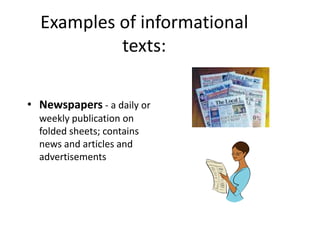
• Newspapers - a daily or
  weekly publication on
  folded sheets; contains
  news and articles and
  advertisements
Examples of informational
         texts:
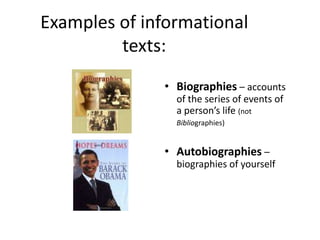
              • Biographies – accounts
                of the series of events of
                a person’s life (not
                Bibliographies)


              • Autobiographies –
                biographies of yourself
Examples of informational
           texts:

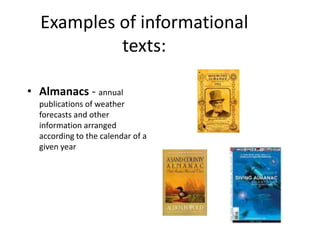
• Almanacs - annual
  publications of weather
  forecasts and other
  information arranged
  according to the calendar of a
  given year
Dos and Don’ts of formal writing

Don’t write in first person
Do begin with a topic sentence that grabs the reader’s attention
  and introduces your topic .
Do have a purpose to your writing
Do include ONLY facts
Don’t include information that is not true (fiction)
Do remember who the reader will be and use appropriate
  language
When you write to inform, you are explaining
or informing the reader about facts. It answers
the basic questions:
Who? What? When? Where? When? Why?
How?
When writing to inform, give information in a
logical order. The writer can explain a process
of how to do something or tell events in
sequence or time order. When writing about a
process you can use signal words such as: first,
second, third, finally, to begin, to continue,
afterward, to finish, start by, next, then, and
last.
When writing to inform, the writer can compare
and contrast two subjects. They are telling how
the two subjects are similar and different. Signal
words for similarities are: both, similarly, likewise,
same, and, also, etc. Signal words for differences
are: however, by contrast, otherwise, different,
but, and while.
When writing to inform the writer can explain
why something happens; how facts or events
(causes) lead to other facts or events
(effects). Signal words that show cause and effect
are: due to, because of, as the result of,
therefore, because, so, consequently, for this
reason, is caused by, if....then, leads/led to, so
that, and when....then
When writing to inform, the writer can
describe a problem and present one or
more solutions to that problem. Signal
words for problem and solution: solve,
resolve, concluded that, fix, issue
being dealt with, problem, solution,
remedy, and issue.