Vector Space Models
Natural Language Processing
Emory University
Jinho D. Choi
Document Representation
2
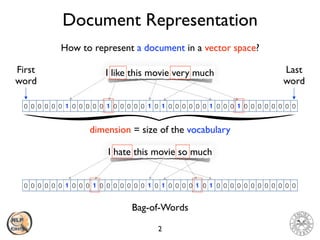
How to represent a document in a vector space?
Last
word
First
word
I like this movie very much
Bag-of-Words
0 0 0 0 0 0 0 0 0 0 0 0 0 0 0 0 0 0 0 0 0 0 0 0 0 0 0 0 0 0 0 0 0 0 0 0 0 0 0 01 11 1 1 1
dimension = size of the vocabulary
0 0 0 0 0 0 0 0 0 0 0 0 0 0 0 0 0 0 0 0 0 0 0 0 0 0 0 0 0 0 0 0 0 0 0 0 0 0 0 0
I hate this movie so much
1 11 1 11
Bag-of-Words
3
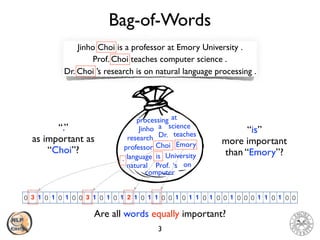
Jinho Choi is a professor at Emory University .
Prof. Choi teaches computer science .
Dr. Choi ’s research is on natural language processing .
0 0 0 0 0 0 0 0 0 0 0 0 0 0 0 0 0 0 0 0 0 0 0 0 0 0 0 0 0 0 0 0 0 0 0 0 0 0 0 011 1 1 1 1 1 111 1 11 1 111 1 11
Jinho
Choi
is
a
professor
at
Emory
University
Prof.
.
teaches
computer
science
Dr.
‘s
research
onnatural
language
processing
Are all words equally important?
33
“.”
as important as
“Choi”?
“is”
more important
than “Emory”?
2
Term Frequency
Bag-of-Words
4
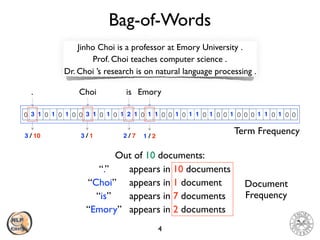
Jinho Choi is a professor at Emory University .
Prof. Choi teaches computer science .
Dr. Choi ’s research is on natural language processing .
0 0 0 0 0 0 0 0 0 0 0 0 0 0 0 0 0 0 0 0 0 0 0 0 0 0 0 0 0 0 0 0 0 0 0 0 0 0 0 0111 3 1 1 1 213 1 11 1 111 1 11
Choi is. Emory
Out of 10 documents:
“.” appears in 10 documents
“Choi” appears in 1 document
“is” appears in 7 documents
“Emory” appears in 2 documents
3 / 10 3 / 1 2 / 7 1 / 2
Document
Frequency
TF-IDF
5
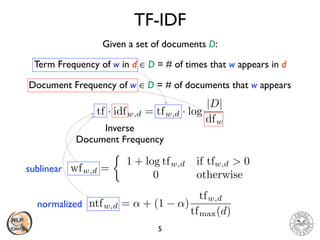
Term Frequency of w in d ∈ D = # of times that w appears in d
Given a set of documents D:
Document Frequency of w ∈ D = # of documents that w appears
tf · idfw,d = tfw,d · log
|D|
dfw
Inverse
Document Frequency
wfw,d =
⇢
1 + log tfw,d if tfw,d > 0
0 otherwise
ntfw,d = ↵ + (1 ↵)
tfw,d
tfmax(d)
sublinear
normalized
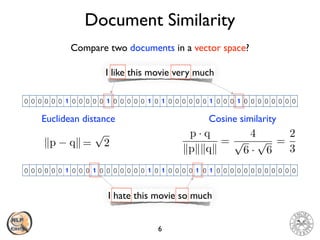
Document Similarity
6
I like this movie very much
Compare two documents in a vector space?
0 0 0 0 0 0 0 0 0 0 0 0 0 0 0 0 0 0 0 0 0 0 0 0 0 0 0 0 0 0 0 0 0 0 0 0 0 0 0 01 11 1 1 1
I hate this movie so much
0 0 0 0 0 0 0 0 0 0 0 0 0 0 0 0 0 0 0 0 0 0 0 0 0 0 0 0 0 0 0 0 0 0 0 0 0 0 0 01 11 1 11
Euclidean distance Cosine similarity
kp qk =
p
2
p · q
kpkkqk
=
4
p
6 ·
p
6
=
2
3
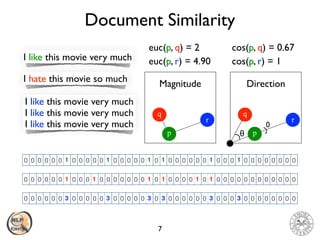
Document Similarity
7
0 0 0 0 0 0 0 0 0 0 0 0 0 0 0 0 0 0 0 0 0 0 0 0 0 0 0 0 0 0 0 0 0 0 0 0 0 0 0 01 11 1 11
0 0 0 0 0 0 0 0 0 0 0 0 0 0 0 0 0 0 0 0 0 0 0 0 0 0 0 0 0 0 0 0 0 0 0 0 0 0 0 01 11 1 1 1
0 0 0 0 0 0 0 0 0 0 0 0 0 0 0 0 0 0 0 0 0 0 0 0 0 0 0 0 0 0 0 0 0 0 0 0 0 0 0 03 33 3 3 3
I like this movie very much
I hate this movie so much
euc(p, q) = 2 cos(p, q) = 0.67
r
p
q
r
p
q
θ
0
euc(p, r) = 4.90 cos(p, r) = 1
Magnitude Direction
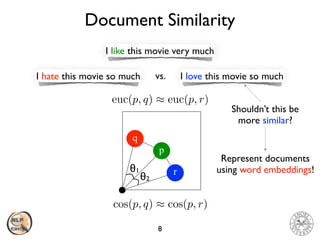
Document Similarity
8
I hate this movie so much I love this movie so muchvs.
q
p
θ1 r
θ2
Shouldn’t this be
more similar?
cos(p, q) ⇡ cos(p, r)
Represent documents
using word embeddings!
I like this movie very much
euc(p, q) ⇡ euc(p, r)
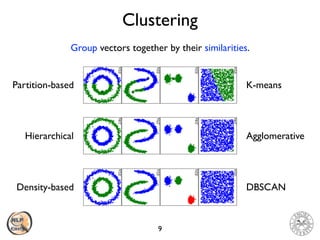
Clustering
9
Group vectors together by their similarities.
Partition-based
Hierarchical
Density-based
K-means
Agglomerative
DBSCAN
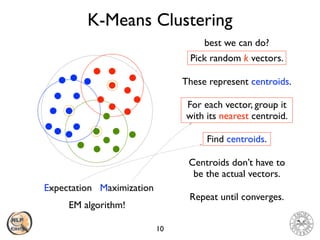
K-Means Clustering
10
Pick random k vectors.
For each vector, group it

with its nearest centroid.
These represent centroids.
Find centroids.
Repeat until converges.
Centroids don’t have to

be the actual vectors.
EM algorithm!
Expectation Maximization
best we can do?
K-Means++ Clustering
11
Introduce a random vector c as the first centroid.
Pick a random number r in (0, 1].
D(x) = min
8c
dist(x, c)
Choose xi as the next centroid s.t. C(xi 1) < r  C(xi)
C(xi) =
iX
j=1
P(xj)C(x0) = 0
Measure the distance between every vertex x to its nearest centroid c.
Measure the distance probability for each vertex x.
Measure the cumulative probability for each vertex x.
P(x) =
D(x)2
P
8x D(x)2
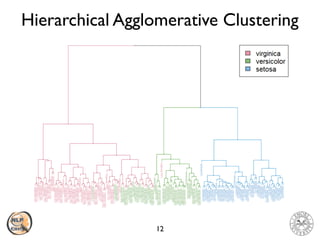
Hierarchical Agglomerative Clustering
12
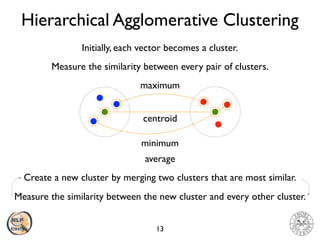
Hierarchical Agglomerative Clustering
13
Initially, each vector becomes a cluster.
Measure the similarity between every pair of clusters.
Create a new cluster by merging two clusters that are most similar.
Measure the similarity between the new cluster and every other cluster.
maximum
minimum
centroid
average
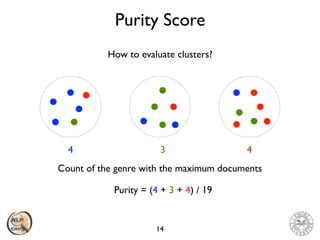
Purity Score
14
How to evaluate clusters?
Count of the genre with the maximum documents
4 3 4
Purity = (4 + 3 + 4) / 19

Vector Space Models

  • 1.
    Vector Space Models NaturalLanguage Processing Emory University Jinho D. Choi
  • 2.
    Document Representation 2 How torepresent a document in a vector space? Last word First word I like this movie very much Bag-of-Words 0 0 0 0 0 0 0 0 0 0 0 0 0 0 0 0 0 0 0 0 0 0 0 0 0 0 0 0 0 0 0 0 0 0 0 0 0 0 0 01 11 1 1 1 dimension = size of the vocabulary 0 0 0 0 0 0 0 0 0 0 0 0 0 0 0 0 0 0 0 0 0 0 0 0 0 0 0 0 0 0 0 0 0 0 0 0 0 0 0 0 I hate this movie so much 1 11 1 11
  • 3.
    Bag-of-Words 3 Jinho Choi isa professor at Emory University . Prof. Choi teaches computer science . Dr. Choi ’s research is on natural language processing . 0 0 0 0 0 0 0 0 0 0 0 0 0 0 0 0 0 0 0 0 0 0 0 0 0 0 0 0 0 0 0 0 0 0 0 0 0 0 0 011 1 1 1 1 1 111 1 11 1 111 1 11 Jinho Choi is a professor at Emory University Prof. . teaches computer science Dr. ‘s research onnatural language processing Are all words equally important? 33 “.” as important as “Choi”? “is” more important than “Emory”? 2
  • 4.
    Term Frequency Bag-of-Words 4 Jinho Choiis a professor at Emory University . Prof. Choi teaches computer science . Dr. Choi ’s research is on natural language processing . 0 0 0 0 0 0 0 0 0 0 0 0 0 0 0 0 0 0 0 0 0 0 0 0 0 0 0 0 0 0 0 0 0 0 0 0 0 0 0 0111 3 1 1 1 213 1 11 1 111 1 11 Choi is. Emory Out of 10 documents: “.” appears in 10 documents “Choi” appears in 1 document “is” appears in 7 documents “Emory” appears in 2 documents 3 / 10 3 / 1 2 / 7 1 / 2 Document Frequency
  • 5.
    TF-IDF 5 Term Frequency ofw in d ∈ D = # of times that w appears in d Given a set of documents D: Document Frequency of w ∈ D = # of documents that w appears tf · idfw,d = tfw,d · log |D| dfw Inverse Document Frequency wfw,d = ⇢ 1 + log tfw,d if tfw,d > 0 0 otherwise ntfw,d = ↵ + (1 ↵) tfw,d tfmax(d) sublinear normalized
  • 6.
    Document Similarity 6 I likethis movie very much Compare two documents in a vector space? 0 0 0 0 0 0 0 0 0 0 0 0 0 0 0 0 0 0 0 0 0 0 0 0 0 0 0 0 0 0 0 0 0 0 0 0 0 0 0 01 11 1 1 1 I hate this movie so much 0 0 0 0 0 0 0 0 0 0 0 0 0 0 0 0 0 0 0 0 0 0 0 0 0 0 0 0 0 0 0 0 0 0 0 0 0 0 0 01 11 1 11 Euclidean distance Cosine similarity kp qk = p 2 p · q kpkkqk = 4 p 6 · p 6 = 2 3
  • 7.
    Document Similarity 7 0 00 0 0 0 0 0 0 0 0 0 0 0 0 0 0 0 0 0 0 0 0 0 0 0 0 0 0 0 0 0 0 0 0 0 0 0 0 01 11 1 11 0 0 0 0 0 0 0 0 0 0 0 0 0 0 0 0 0 0 0 0 0 0 0 0 0 0 0 0 0 0 0 0 0 0 0 0 0 0 0 01 11 1 1 1 0 0 0 0 0 0 0 0 0 0 0 0 0 0 0 0 0 0 0 0 0 0 0 0 0 0 0 0 0 0 0 0 0 0 0 0 0 0 0 03 33 3 3 3 I like this movie very much I like this movie very much I like this movie very much I like this movie very much I hate this movie so much euc(p, q) = 2 cos(p, q) = 0.67 r p q r p q θ 0 euc(p, r) = 4.90 cos(p, r) = 1 Magnitude Direction
  • 8.
    Document Similarity 8 I hatethis movie so much I love this movie so muchvs. q p θ1 r θ2 Shouldn’t this be more similar? cos(p, q) ⇡ cos(p, r) Represent documents using word embeddings! I like this movie very much euc(p, q) ⇡ euc(p, r)
  • 9.
    Clustering 9 Group vectors togetherby their similarities. Partition-based Hierarchical Density-based K-means Agglomerative DBSCAN
  • 10.
    K-Means Clustering 10 Pick randomk vectors. For each vector, group it
 with its nearest centroid. These represent centroids. Find centroids. Repeat until converges. Centroids don’t have to
 be the actual vectors. EM algorithm! Expectation Maximization best we can do?
  • 11.
    K-Means++ Clustering 11 Introduce arandom vector c as the first centroid. Pick a random number r in (0, 1]. D(x) = min 8c dist(x, c) Choose xi as the next centroid s.t. C(xi 1) < r  C(xi) C(xi) = iX j=1 P(xj)C(x0) = 0 Measure the distance between every vertex x to its nearest centroid c. Measure the distance probability for each vertex x. Measure the cumulative probability for each vertex x. P(x) = D(x)2 P 8x D(x)2
  • 12.
  • 13.
    Hierarchical Agglomerative Clustering 13 Initially,each vector becomes a cluster. Measure the similarity between every pair of clusters. Create a new cluster by merging two clusters that are most similar. Measure the similarity between the new cluster and every other cluster. maximum minimum centroid average
  • 14.
    Purity Score 14 How toevaluate clusters? Count of the genre with the maximum documents 4 3 4 Purity = (4 + 3 + 4) / 19