• What isIR
• Evaluation
– Precision – Recall, F measure
• Tokenization and properties of text
3.
Today
• Vector methodsfor documents and queries
– Text embeddings
• Bag of words
• Measures of similarity – vector scoring
• Similarity scoring as ranking
4.
Motivation
• How toenable computers to use words
• They need to use words (tokens)
• How do we do this?
– Vector methods for words
• vectorization
• Word embeddings
• Process for understanding words in
– Natural language processing
– AI and machine learning
– Information retrieval and search
– Recommender systems
5.
Vectorization (embeddings)
• Documentrepresentation
• Used for document
– Encoding
– Similarity
– Ranking
– Importance
• In AI and machine learning, this is called
representation
6.
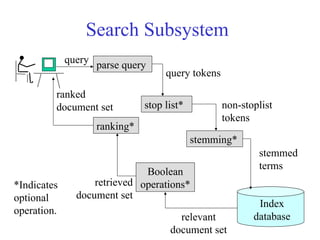
Search Subsystem
Index
database
query parsequery
stemming*
stemmed
terms
stop list* non-stoplist
tokens
query tokens
Boolean
operations*
ranking*
relevant
document set
ranked
document set
retrieved
document set
*Indicates
optional
operation.
7.
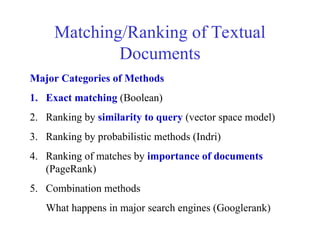
Matching/Ranking of Textual
Documents
MajorCategories of Methods
1. Exact matching (Boolean)
2. Ranking by similarity to query (vector space model)
3. Ranking by probabilistic methods (Indri)
4. Ranking of matches by importance of documents
(PageRank)
5. Combination methods
What happens in major search engines (Googlerank)
8.
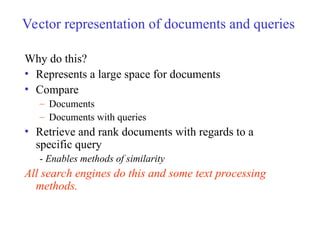
Vector representation ofdocuments and queries
Why do this?
• Represents a large space for documents
• Compare
– Documents
– Documents with queries
• Retrieve and rank documents with regards to a
specific query
- Enables methods of similarity
All search engines do this and some text processing
methods.
9.
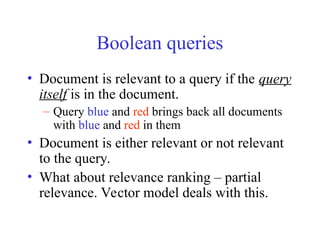
Boolean queries
• Documentis relevant to a query if the query
itself is in the document.
– Query blue and red brings back all documents
with blue and red in them
• Document is either relevant or not relevant
to the query.
• What about relevance ranking – partial
relevance. Vector model deals with this.
10.
Matching - similarity
Matchingwill be based on document
similarity
Define methods of similarity for documents
and queries
Use similarity for document scoring or
ranking
11.
Similarity (Scoring) Measuresand
Relevance
• Retrieve the most similar documents to a
query
• Equate similarity to relevance
– Most similar are the most relevant
• This measure is one of “text similarity”
– The matching of text or words
12.
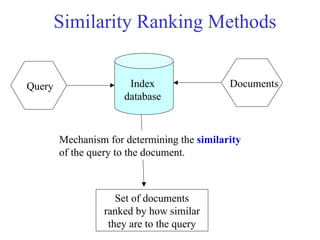
Similarity Ranking Methods
QueryDocuments
Index
database
Mechanism for determining the similarity
of the query to the document.
Set of documents
ranked by how similar
they are to the query
13.
Term Similarity: Example
Problem:Given two text documents, how similar are they?
[Methods that measure similarity do not assume exact
matches.]
Example (assume tokens converted to terms)
Here are three documents. How similar are they?
d1 ant ant bee
d2 dog bee dog hog dog ant dog
d3 cat gnu dog eel fox
Documents can be any length from one word to thousands.
A query is a special type of document.
14.
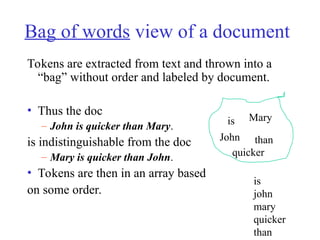
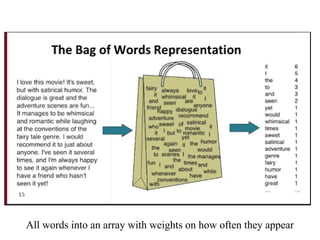
Bag of wordsview of a document
Tokens are extracted from text and thrown into a
“bag” without order and labeled by document.
• Thus the doc
– John is quicker than Mary.
is indistinguishable from the doc
– Mary is quicker than John.
• Tokens are then in an array based
on some order.
is
John
quicker
Mary
than
is
john
mary
quicker
than
15.
All words intoan array with weights on how often they appear
16.
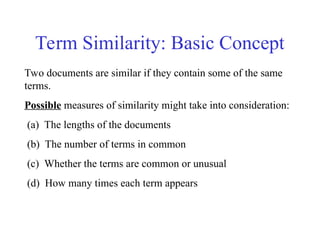
Two documents aresimilar if they contain some of the same
terms.
Possible measures of similarity might take into consideration:
(a) The lengths of the documents
(b) The number of terms in common
(c) Whether the terms are common or unusual
(d) How many times each term appears
Term Similarity: Basic Concept
17.
TERM VECTOR SPACE
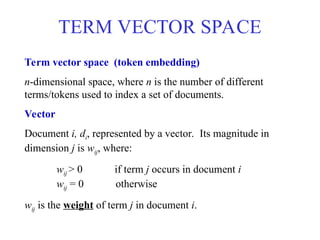
Termvector space (token embedding)
n-dimensional space, where n is the number of different
terms/tokens used to index a set of documents.
Vector
Document i, di, represented by a vector. Its magnitude in
dimension j is wij, where:
wij > 0 if term j occurs in document i
wij = 0 otherwise
wij is the weight of term j in document i.
18.
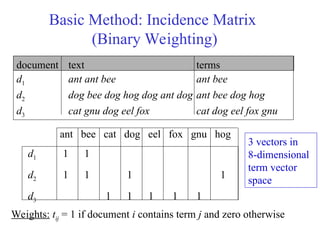
Basic Method: IncidenceMatrix
(Binary Weighting)
document text terms
d1 ant ant bee ant bee
d2 dog bee dog hog dog ant dog ant bee dog hog
d3 cat gnu dog eel fox cat dog eel fox gnu
ant bee cat dog eel fox gnu hog
d1 1 1
d2 1 1 1 1
d3 1 1 1 1 1
Weights: tij = 1 if document i contains term j and zero otherwise
3 vectors in
8-dimensional
term vector
space
19.
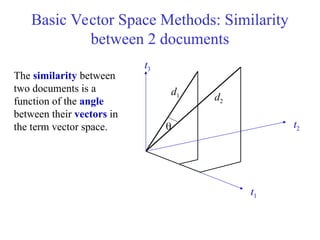
Basic Vector SpaceMethods: Similarity
between 2 documents
The similarity between
two documents is a
function of the angle
between their vectors in
the term vector space.
t1
t2
t3
d1 d2
20.
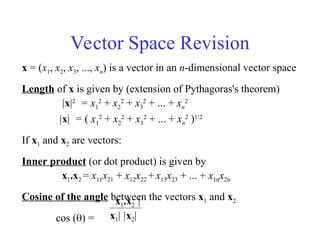
Vector Space Revision
x= (x1, x2, x3, ..., xn) is a vector in an n-dimensional vector space
Length of x is given by (extension of Pythagoras's theorem)
|x|2
= x1
2
+ x2
2
+ x3
2
+ ... + xn
2
|x| = ( x1
2
+ x2
2
+ x3
2
+ ... + xn
2
)1/2
If x1 and x2 are vectors:
Inner product (or dot product) is given by
x1.x2 = x11x21 + x12x22 +x13x23 + ... + x1nx2n
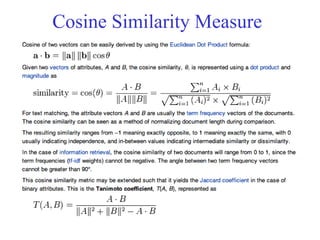
Cosine of the angle between the vectors x1 and x2:
cos () =
x1.x2 |
x1| |x2|
21.
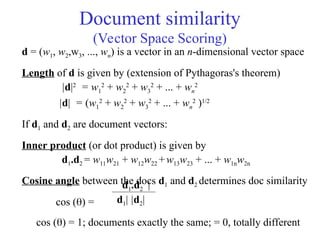
Document similarity
(Vector SpaceScoring)
d = (w1, w2,w3, ..., wn) is a vector in an n-dimensional vector space
Length of d is given by (extension of Pythagoras's theorem)
|d|2
= w1
2
+ w2
2
+ w3
2
+ ... + wn
2
|d| = (w1
2
+ w2
2
+ w3
2
+ ... + wn
2
)1/2
If d1 and d2 are document vectors:
Inner product (or dot product) is given by
d1.d2 = w11w21 + w12w22 +w13w23 + ... + w1nw2n
Cosine angle between the docs d1 and d2 determines doc similarity
cos () =
d1.d2 |
d1| |d2|
cos () = 1; documents exactly the same; = 0, totally different
22.
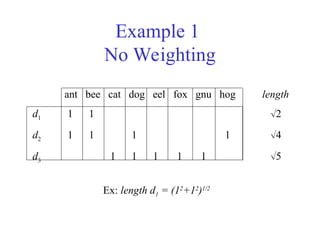
Example 1
No Weighting
antbee cat dog eel fox gnu hog length
d1 1 1 2
d2 1 1 1 1 4
d3 1 1 1 1 1 5
Ex: length d1 = (12
+12
)1/2
23.
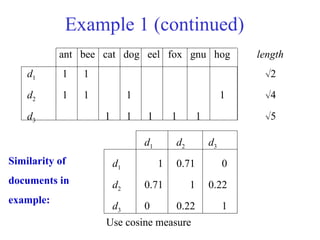
Example 1 (continued)
d1d2 d3
d1 1 0.71 0
d2 0.71 1 0.22
d3 0 0.22 1
Similarity of
documents in
example:
Use cosine measure
ant bee cat dog eel fox gnu hog length
d1 1 1 2
d2 1 1 1 1 4
d3 1 1 1 1 1 5
24.
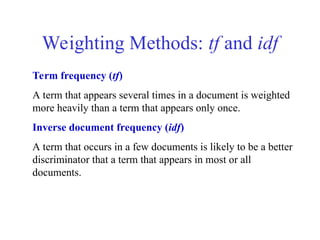
Weighting Methods: tfand idf
Term frequency (tf)
A term that appears several times in a document is weighted
more heavily than a term that appears only once.
Inverse document frequency (idf)
A term that occurs in a few documents is likely to be a better
discriminator that a term that appears in most or all
documents.
25.
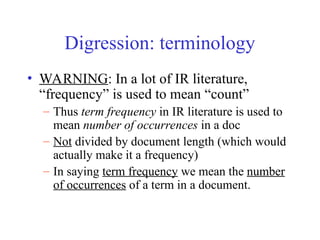
Digression: terminology
• WARNING:In a lot of IR literature,
“frequency” is used to mean “count”
– Thus term frequency in IR literature is used to
mean number of occurrences in a doc
– Not divided by document length (which would
actually make it a frequency)
– In saying term frequency we mean the number
of occurrences of a term in a document.
26.
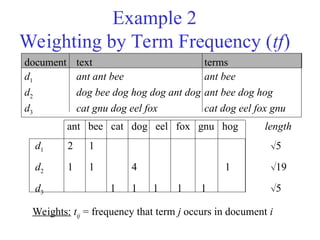
Example 2
Weighting byTerm Frequency (tf)
ant bee cat dog eel fox gnu hog length
d1 2 1 5
d2 1 1 4 1 19
d3 1 1 1 1 1 5
Weights: tij = frequency that term j occurs in document i
document text terms
d1 ant ant bee ant bee
d2 dog bee dog hog dog ant dog ant bee dog hog
d3 cat gnu dog eel fox cat dog eel fox gnu
27.
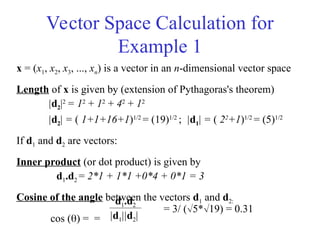
Vector Space Calculationfor
Example 1
x = (x1, x2, x3, ..., xn) is a vector in an n-dimensional vector space
Length of x is given by (extension of Pythagoras's theorem)
|d2|2
= 12
+ 12
+ 42
+ 12
|d2| = ( 1+1+16+1)1/2
= (19)1/2
; |d1| = ( 22
+1)1/2
= (5)1/2
If d1 and d2 are vectors:
Inner product (or dot product) is given by
d1.d2 = 2*1 + 1*1 +0*4 + 0*1 = 3
Cosine of the angle between the vectors d1 and d2:
cos () = =
d1.d2
|d1||d2|
= 3/ (5*19) = 0.31
28.
Example 2 (continued)
d1d2 d3
d1 1 0.31 0
d2 0.31 1 0.41
d3 0 0.41 1
Similarity of documents in example:
Similarity depends upon the weights given to the terms.
[Note differences in results from Example 1.]
29.
Summary: Vector Similarity
Computationwith Weights
Documents in a collection are assigned terms from a set of n terms
The term vector space W is defined as:
if term k does not occur in document di, wik = 0
if term k occurs in document di, wik is greater than zero
(wik is called the weight of term k in document di)
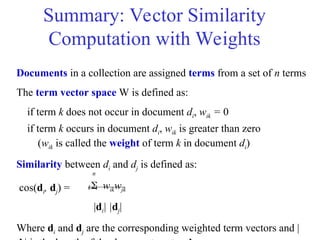
Similarity between di and dj is defined as:
wikwjk
|di| |dj|
Where di and dj are the corresponding weighted term vectors and |
k=1
n
cos(di, dj) =
30.
Summary: Vector Similarity
Computationwith Weights
Query as a “little” documents
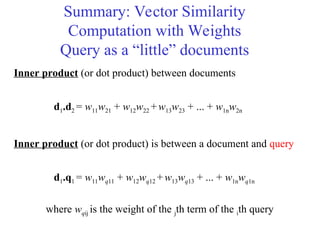
Inner product (or dot product) between documents
d1.d2 = w11w21 + w12w22 +w13w23 + ... + w1nw2n
Inner product (or dot product) is between a document and query
d1.q1 = w11wq11 + w12wq12 +w13wq13 + ... + w1nwq1n
where wqij is the weight of the jth term of the ith query
31.
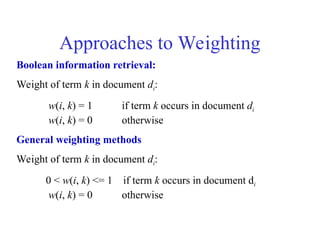
Approaches to Weighting
Booleaninformation retrieval:
Weight of term k in document di:
w(i, k) = 1 if term k occurs in document di
w(i, k) = 0 otherwise
General weighting methods
Weight of term k in document di:
0 < w(i, k) <= 1 if term k occurs in document di
w(i, k) = 0 otherwise
32.
Simple Uses ofVector Similarity
in Information Retrieval
Threshold
For query q, retrieve all documents with similarity
above a threshold, e.g., similarity > 0.50.
Ranking
For query q, return the n most similar documents ranked
in order of similarity.
[This is the standard practice.]
33.
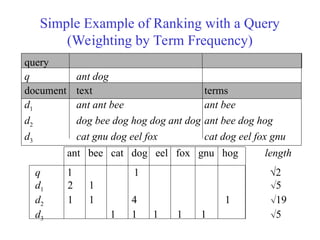
Simple Example ofRanking with a Query
(Weighting by Term Frequency)
ant bee cat dog eel fox gnu hog length
q 1 1 √2
d1 2 1 5
d2 1 1 4 1 19
d3 1 1 1 1 1 5
query
q ant dog
document text terms
d1 ant ant bee ant bee
d2 dog bee dog hog dog ant dog ant bee dog hog
d3 cat gnu dog eel fox cat dog eel fox gnu
34.
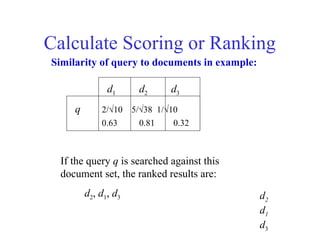
Calculate Scoring orRanking
d1 d2 d3
q 2/√10 5/√38 1/√10
0.63 0.81 0.32
Similarity of query to documents in example:
If the query q is searched against this
document set, the ranked results are:
d2, d1, d3 d2
d1
d3
35.
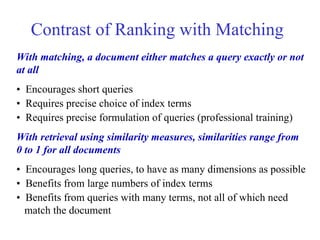
Contrast of Rankingwith Matching
With matching, a document either matches a query exactly or not
at all
• Encourages short queries
• Requires precise choice of index terms
• Requires precise formulation of queries (professional training)
With retrieval using similarity measures, similarities range from
0 to 1 for all documents
• Encourages long queries, to have as many dimensions as possible
• Benefits from large numbers of index terms
• Benefits from queries with many terms, not all of which need
match the document
36.
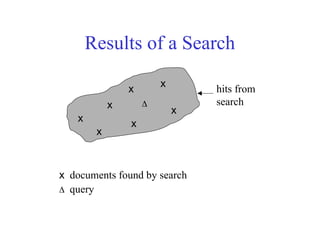
Results of aSearch
x x
x
x
x
x
x
hits from
search
x documents found by search
query
37.
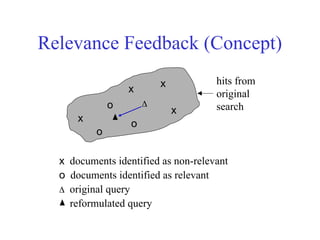
Relevance Feedback (Concept)
xx
x
x
o
o
o
hits from
original
search
x documents identified as non-relevant
o documents identified as relevant
original query
reformulated query
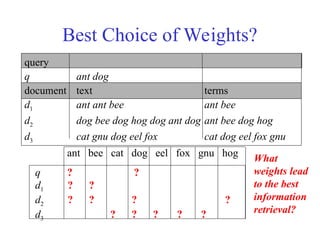
Best Choice ofWeights?
ant bee cat dog eel fox gnu hog
q ? ?
d1 ? ?
d2 ? ? ? ?
d3 ? ? ? ? ?
query
q ant dog
document text terms
d1 ant ant bee ant bee
d2 dog bee dog hog dog ant dog ant bee dog hog
d3 cat gnu dog eel fox cat dog eel fox gnu
What
weights lead
to the best
information
retrieval?
40.
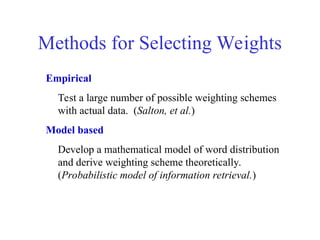
Methods for SelectingWeights
Empirical
Test a large number of possible weighting schemes
with actual data. (Salton, et al.)
Model based
Develop a mathematical model of word distribution
and derive weighting scheme theoretically.
(Probabilistic model of information retrieval.)
41.
Weighting
Term Frequency (tf)
Supposeterm j appears fij times in document i. What
weighting should be given to a term j?
Term Frequency: Concept
A term that appears many times within a document is
likely to be more important than a term that appears
only once.
42.
Term Frequency: Free-text
Document
Lengthof document
Simple method is to use wij as the term frequency.
...but, in free-text documents, terms are likely to
appear more often in long documents. Therefore wij
should be scaled by some variable related to
document length.
43.
Term Frequency: Free-textDocument
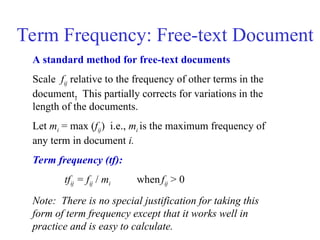
A standard method for free-text documents
Scale fij relative to the frequency of other terms in the
document. This partially corrects for variations in the
length of the documents.
Let mi = max (fij) i.e., mi is the maximum frequency of
any term in document i.
Term frequency (tf):
tfij = fij / mi whenfij > 0
Note: There is no special justification for taking this
form of term frequency except that it works well in
practice and is easy to calculate.
i
44.
Weighting
Inverse Document Frequency(idf)
Suppose term j appears fij times in document i. What
weighting should be given to a term j?
Inverse Document Frequency: Concept
A term that occurs in a few documents is likely to be a
better discriminator that a term that appears in most or
all documents.
45.
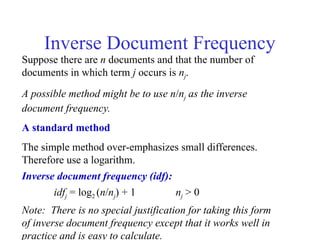
Inverse Document Frequency
Supposethere are n documents and that the number of
documents in which term j occurs is nj.
A possible method might be to use n/nj as the inverse
document frequency.
A standard method
The simple method over-emphasizes small differences.
Therefore use a logarithm.
Inverse document frequency (idf):
idfj = log2 (n/nj) + 1 nj > 0
Note: There is no special justification for taking this form
of inverse document frequency except that it works well in
practice and is easy to calculate.
46.
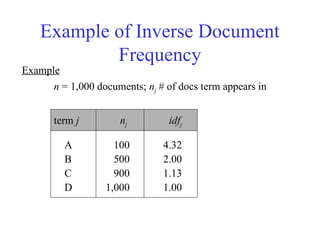
Example of InverseDocument
Frequency
Example
n = 1,000 documents; nj # of docs term appears in
term j nj idfj
A 100 4.32
B 500 2.00
C 900 1.13
D 1,000 1.00
47.
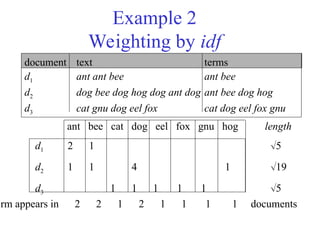
Example 2
Weighting byidf
ant bee cat dog eel fox gnu hog length
d1 2 1 5
d2 1 1 4 1 19
d3 1 1 1 1 1 5
document text terms
d1 ant ant bee ant bee
d2 dog bee dog hog dog ant dog ant bee dog hog
d3 cat gnu dog eel fox cat dog eel fox gnu
erm appears in 2 2 1 2 1 1 1 1 documents
48.
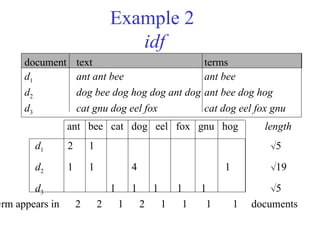
Example 2
idf
ant beecat dog eel fox gnu hog length
d1 2 1 5
d2 1 1 4 1 19
d3 1 1 1 1 1 5
document text terms
d1 ant ant bee ant bee
d2 dog bee dog hog dog ant dog ant bee dog hog
d3 cat gnu dog eel fox cat dog eel fox gnu
erm appears in 2 2 1 2 1 1 1 1 documents
49.
Inverse Document Frequency
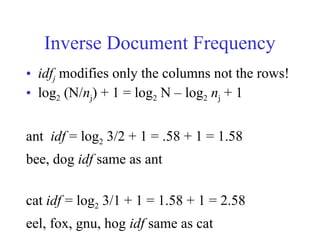
•idfj modifies only the columns not the rows!
• log2 (N/nj) + 1 = log2 N – log2 nj + 1
ant idf = log2 3/2 + 1 = .58 + 1 = 1.58
bee, dog idf same as ant
cat idf = log2 3/1 + 1 = 1.58 + 1 = 2.58
eel, fox, gnu, hog idf same as cat
50.
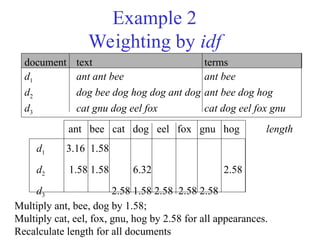
Example 2
Weighting byidf
ant bee cat dog eel fox gnu hog length
d1 3.16 1.58
d2 1.58 1.58 6.32 2.58
d3 2.58 1.58 2.58 2.58 2.58
document text terms
d1 ant ant bee ant bee
d2 dog bee dog hog dog ant dog ant bee dog hog
d3 cat gnu dog eel fox cat dog eel fox gnu
Multiply ant, bee, dog by 1.58;
Multiply cat, eel, fox, gnu, hog by 2.58 for all appearances.
Recalculate length for all documents
51.
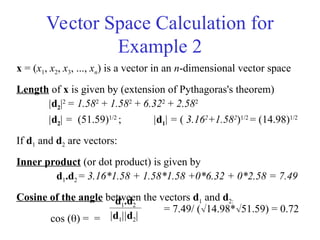
Vector Space Calculationfor
Example 2
x = (x1, x2, x3, ..., xn) is a vector in an n-dimensional vector space
Length of x is given by (extension of Pythagoras's theorem)
|d2|2
= 1.582
+ 1.582
+ 6.322
+ 2.582
|d2| = (51.59)1/2
; |d1| = ( 3.162
+1.582
)1/2
= (14.98)1/2
If d1 and d2 are vectors:
Inner product (or dot product) is given by
d1.d2 = 3.16*1.58 + 1.58*1.58 +0*6.32 + 0*2.58 = 7.49
Cosine of the angle between the vectors d1 and d2:
cos () = =
d1.d2
|d1||d2|
= 7.49/ (14.98*51.59) = 0.72
52.
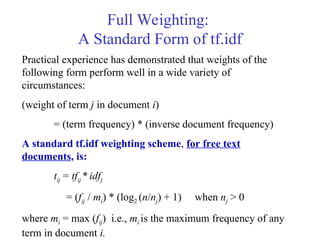
Full Weighting:
A StandardForm of tf.idf
Practical experience has demonstrated that weights of the
following form perform well in a wide variety of
circumstances:
(weight of term j in document i)
= (term frequency) * (inverse document frequency)
A standard tf.idf weighting scheme, for free text
documents, is:
tij = tfij *idfj
= (fij / mi) * (log2 (n/nj) + 1) when nj > 0
where mi = max (fij) i.e., mi is the maximum frequency of any
term in document i.
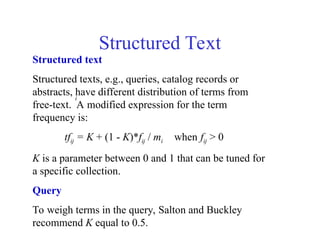
53.
Structured Text
Structured text
Structuredtexts, e.g., queries, catalog records or
abstracts, have different distribution of terms from
free-text. A modified expression for the term
frequency is:
tfij = K + (1 - K)*fij / mi when fij > 0
K is a parameter between 0 and 1 that can be tuned for
a specific collection.
Query
To weigh terms in the query, Salton and Buckley
recommend K equal to 0.5.
i
54.
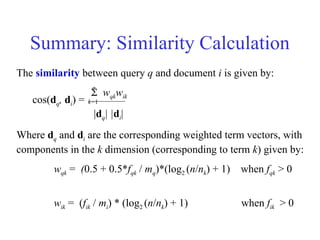
Summary: Similarity Calculation
Thesimilarity between query q and document i is given by:
wqkwik
|dq| |di|
Where dq and di are the corresponding weighted term vectors, with
components in the k dimension (corresponding to term k) given by:
wqk = (0.5 + 0.5*fqk / mq)*(log2 (n/nk) + 1) when fqk > 0
wik = (fik / mi) * (log2 (n/nk) + 1) when fik > 0
k=1
n
cos(dq, di) =
55.
Discussion of Similarity
Thechoice of similarity measure is widely used and works
well on a wide range of documents, but has no theoretical
basis.
1. There are several possible measures other that angle
between vectors
2. There is a choice of possible definitions of tf and idf
3. With fielded searching, there are various ways to adjust the
weight given to each field.
56.
Document & queryspace
• Documents are organized in some manner - exist as
points in a document space
• Documents treated as text, etc.
• Match query with document - approaches
– Query similar to document space
– Query not similar to document space and becomes a
characteristic function on the document space
• Documents most similar are the ones we retrieve
• Reduce this a computable measure of similarity
57.
Query similar todocument space
• Query is a point in document space
• Documents “near” to the query are the ones
we want.
• Near:
– Distance
– Lying in similar direction as other documents
– Others
58.
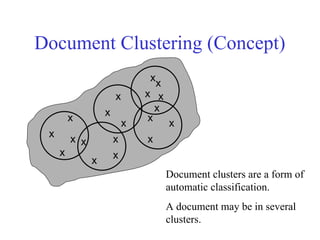
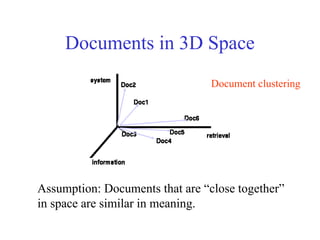
Documents in 3DSpace
Assumption: Documents that are “close together”
in space are similar in meaning.
Document clustering
59.
Assigning Weights
• tfidf measure:
– term frequency (tf)
– inverse document frequency (idf) -- a way to deal with the
problems of the Zipf distribution
• Goal: assign a tf idf weight to each term in each document
• A term occurring frequently in the document but rarely in
the rest of the collection is given high weight.
• Many other ways of determining term weights have been
proposed.
• Experimentally, tf-idf has been found to work well.
60.
TF x IDF(term frequency-inverse
document frequency)
• wij = weight of Term Tj in Document Di
• tfij = frequency of Term Tj in Document Di
• N = number of Documents in collection
• nj = number of Documents where term Tj occurs at least once
• Red text is the Inverse Document Frequency measure idfj
wij = tfij [log2 (N/nj) + 1]
61.
Document Similarity
• Witha query what do we want to retrieve?
• Relevant documents
• Similar documents
• Query should be similar to the document?
62.
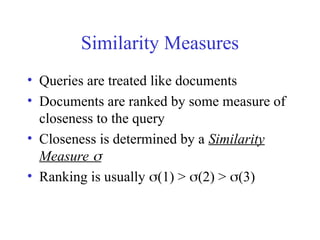
Similarity Measures
• Queriesare treated like documents
• Documents are ranked by some measure of
closeness to the query
• Closeness is determined by a Similarity
Measure
• Ranking is usually (1) > (2) > (3)
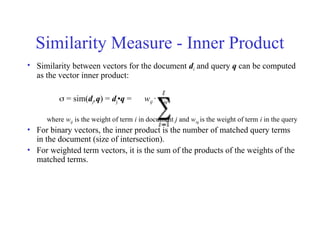
Similarity Measure -Inner Product
• Similarity between vectors for the document di and query q can be computed
as the vector inner product:
= sim(dj,q) = dj•q = wij · wiq
where wij is the weight of term i in document j and wiq is the weight of term i in the query
• For binary vectors, the inner product is the number of matched query terms
in the document (size of intersection).
• For weighted term vectors, it is the sum of the products of the weights of the
matched terms.
65.
Properties of InnerProduct
• The inner product is unbounded.
• Favors long documents with a large number of
unique terms.
• Measures how many terms matched but not how
many terms are not matched.
66.
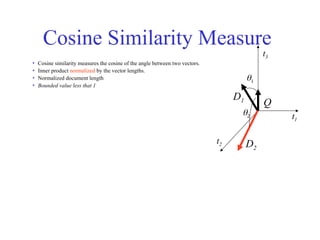
Cosine Similarity Measure
•Cosine similarity measures the cosine of the angle between two vectors.
• Inner product normalized by the vector lengths.
• Normalized document length
• Bounded value less that 1
t3
t1
t2
D1
D2
Q
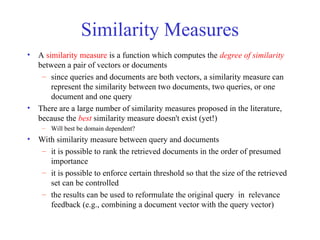
Similarity Measures
• Asimilarity measure is a function which computes the degree of similarity
between a pair of vectors or documents
– since queries and documents are both vectors, a similarity measure can
represent the similarity between two documents, two queries, or one
document and one query
• There are a large number of similarity measures proposed in the literature,
because the best similarity measure doesn't exist (yet!)
– Will best be domain dependent?
• With similarity measure between query and documents
– it is possible to rank the retrieved documents in the order of presumed
importance
– it is possible to enforce certain threshold so that the size of the retrieved
set can be controlled
– the results can be used to reformulate the original query in relevance
feedback (e.g., combining a document vector with the query vector)
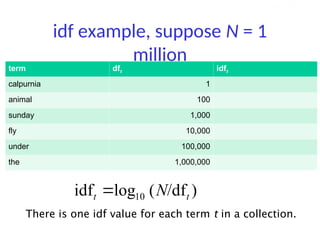
idf example, supposeN = 1
million
term dft idft
calpurnia 1
animal 100
sunday 1,000
fly 10,000
under 100,000
the 1,000,000
There is one idf value for each term t in a collection.
Sec. 6.2.1
)
/df
(
log
idf 10 t
t N
71.
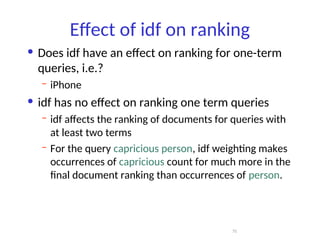
Effect of idfon ranking
• Does idf have an effect on ranking for one-term
queries, i.e.?
– iPhone
• idf has no effect on ranking one term queries
– idf affects the ranking of documents for queries with
at least two terms
– For the query capricious person, idf weighting makes
occurrences of capricious count for much more in the
final document ranking than occurrences of person.
75
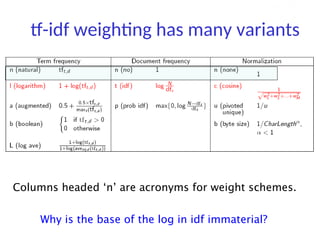
72.
tf-idf weighting hasmany variants
Columns headed ‘n’ are acronyms for weight schemes.
Why is the base of the log in idf immaterial?
Sec. 6.4
73.
Types of wordembeddings
• Frequency based Embedding:
– a. Count Vectors
– b. TF-IDF
– c. Co-Occurrence Matrix
• Prediction based Embedding(word2vec)
– a. CBOW
– b. Skip-Gram
• gloVe(Global Vector)
• BERT (local global)
74.
Types of wordembeddings
• Frequency based Embedding:
– a. Count Vectors
– b. TF-IDF
– c. Co-Occurrence Matrix
• Prediction based Embedding(word2vec)
– a. CBOW
– b. Skip-Gram
• gloVe(Global Vector)
• BERT (local global)
75.
What we covered
•Vector models of documents and queries
– Used everywhere
– Bag of words model
• Similarity measures
– Text similarity typically used for scoring documents
– Similarity is a measure of relevance (and ranking)
– Match query to document
– Rank is based on document score
• All stored and indexed before a query is matched.

![Term Similarity: Example
Problem: Given two text documents, how similar are they?
[Methods that measure similarity do not assume exact
matches.]
Example (assume tokens converted to terms)
Here are three documents. How similar are they?
d1 ant ant bee
d2 dog bee dog hog dog ant dog
d3 cat gnu dog eel fox
Documents can be any length from one word to thousands.
A query is a special type of document.](https://image.slidesharecdn.com/vector-processing-250515202201-7e6ea5d3/85/processing-of-vector-vector-analysis-modes-13-320.jpg)
![Example 2 (continued)
d1 d2 d3
d1 1 0.31 0
d2 0.31 1 0.41
d3 0 0.41 1
Similarity of documents in example:
Similarity depends upon the weights given to the terms.
[Note differences in results from Example 1.]](https://image.slidesharecdn.com/vector-processing-250515202201-7e6ea5d3/85/processing-of-vector-vector-analysis-modes-28-320.jpg)
![Simple Uses of Vector Similarity
in Information Retrieval
Threshold
For query q, retrieve all documents with similarity
above a threshold, e.g., similarity > 0.50.
Ranking
For query q, return the n most similar documents ranked
in order of similarity.
[This is the standard practice.]](https://image.slidesharecdn.com/vector-processing-250515202201-7e6ea5d3/85/processing-of-vector-vector-analysis-modes-32-320.jpg)
![TF x IDF (term frequency-inverse
document frequency)
• wij = weight of Term Tj in Document Di
• tfij = frequency of Term Tj in Document Di
• N = number of Documents in collection
• nj = number of Documents where term Tj occurs at least once
• Red text is the Inverse Document Frequency measure idfj
wij = tfij [log2 (N/nj) + 1]](https://image.slidesharecdn.com/vector-processing-250515202201-7e6ea5d3/85/processing-of-vector-vector-analysis-modes-60-320.jpg)