Researching the research:
the politics of producing, communicating and using knowledge
[to improve responses to migration and health in southern Africa]
Jo Vearey PhD
jovearey@gmail.com
#artsmethods
What is it about “the visual” that is allowing us / forcing us
to have these discussions?
– Are we reinforcing the idea / suggesting that there is
something “special” about “the visual”?
– What is “special” about “the visual”? Anything?
Why are these discussions not taking place in “other”
spaces?
– What should we do to be changing this?
– Within and outside “the academy”
The visual makes “it”* visible.
* I don’t know what “it” is
Research methods?
[what is appropriate v’s popular]
Partnerships; collaboration
Participatory?
(re)presentation?
What constitutes knowledge?
– Whose knowledge?
– How is knowledge
constructed?
ethics
methods
knowledge
production
power
politics of
knowledge
time
funding
precarity
What is data? [process? output? artefact?
engagement?]
• Who owns data?
• Does data have an impact?
Dissemination and sharing
• What is research translation?
• What should be communicated?
• How to communicate?
• Advocacy?
Who benefits?
involvement
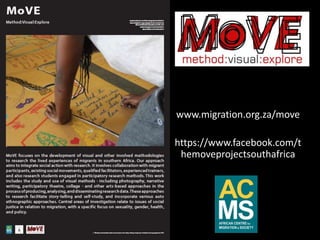
www.migration.org.za/move
https://www.facebook.com/t
hemoveprojectsouthafrica
Context
• identity, representations, power,
agency
• mobilities
• work: productive, reproductive
• determinants of health
• structural and direct violence
• inequalities and inequities
• social justice and social change
• dual imperative
• research translation
0.74
0.67
0.72
0.75
0.74
0.75
0.73
0.72 0.72
0.62
0.64
0.66
0.68
0.7
0.72
0.74
0.76
Bloem
fontein
C
apeTown
D
urbanEastLondon
EastR
andJohannesburg
Pieterm
aritzburgPortElizabeth
Pretoria
Ginicoefficient
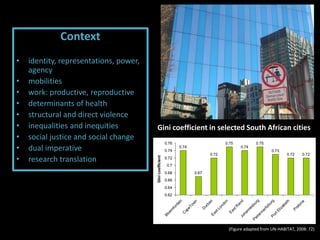
Gini coefficient in selected South African cities
(Figure adapted from UN-HABITAT, 2008: 72)
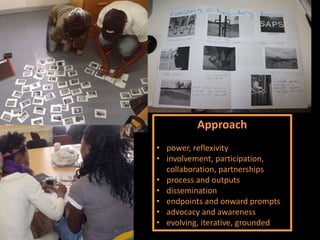
Approach
• power, reflexivity
• involvement, participation,
collaboration, partnerships
• process and outputs
• dissemination
• endpoints and onward prompts
• advocacy and awareness
• evolving, iterative, grounded
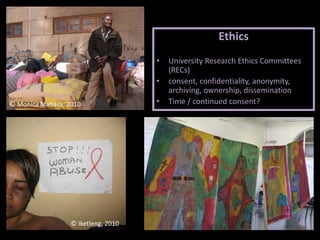
Ethics
• University Research Ethics Committees
(RECs)
• consent, confidentiality, anonymity,
archiving, ownership, dissemination
• Time / continued consent?© Monica Mabasa, 2010
© Iketleng, 2010
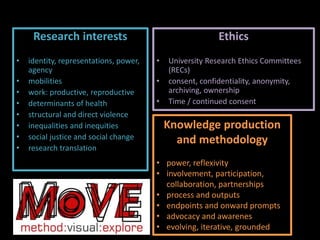
Research interests
• identity, representations, power,
agency
• mobilities
• work: productive, reproductive
• determinants of health
• structural and direct violence
• inequalities and inequities
• social justice and social change
• research translation
Ethics
• University Research Ethics Committees
(RECs)
• consent, confidentiality, anonymity,
archiving, ownership
• Time / continued consent
Knowledge production
and methodology
• power, reflexivity
• involvement, participation,
collaboration, partnerships
• process and outputs
• endpoints and onward prompts
• advocacy and awarenes
• evolving, iterative, grounded
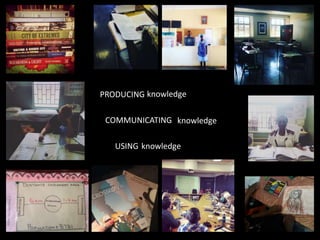
knowledgePRODUCING
COMMUNICATING
USING
knowledge
knowledge
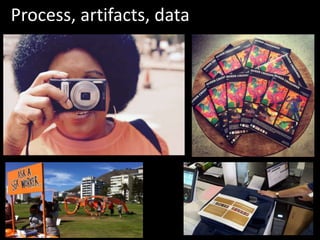
Process, artifacts, data
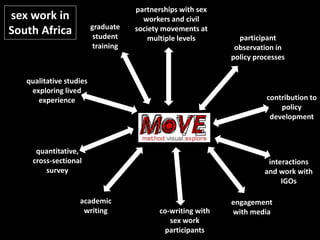
sex work in
South Africa
sex work in
South Africa
qualitative studies
exploring lived
experience
quantitative,
cross-sectional
survey
participant
observation in
policy processes
contribution to
policy
development
partnerships with sex
workers and civil
society movements at
multiple levels
engagement
with media
academic
writing co-writing with
sex work
participants
graduate
student
training
interactions
and work with
IGOs

Researching the research

  • 1.
    Researching the research: thepolitics of producing, communicating and using knowledge [to improve responses to migration and health in southern Africa] Jo Vearey PhD jovearey@gmail.com #artsmethods
  • 2.
    What is itabout “the visual” that is allowing us / forcing us to have these discussions? – Are we reinforcing the idea / suggesting that there is something “special” about “the visual”? – What is “special” about “the visual”? Anything? Why are these discussions not taking place in “other” spaces? – What should we do to be changing this? – Within and outside “the academy” The visual makes “it”* visible. * I don’t know what “it” is
  • 3.
    Research methods? [what isappropriate v’s popular] Partnerships; collaboration Participatory? (re)presentation? What constitutes knowledge? – Whose knowledge? – How is knowledge constructed? ethics methods knowledge production power politics of knowledge time funding precarity What is data? [process? output? artefact? engagement?] • Who owns data? • Does data have an impact? Dissemination and sharing • What is research translation? • What should be communicated? • How to communicate? • Advocacy? Who benefits? involvement
  • 4.
  • 5.
    Context • identity, representations,power, agency • mobilities • work: productive, reproductive • determinants of health • structural and direct violence • inequalities and inequities • social justice and social change • dual imperative • research translation 0.74 0.67 0.72 0.75 0.74 0.75 0.73 0.72 0.72 0.62 0.64 0.66 0.68 0.7 0.72 0.74 0.76 Bloem fontein C apeTown D urbanEastLondon EastR andJohannesburg Pieterm aritzburgPortElizabeth Pretoria Ginicoefficient Gini coefficient in selected South African cities (Figure adapted from UN-HABITAT, 2008: 72)
  • 6.
    Approach • power, reflexivity •involvement, participation, collaboration, partnerships • process and outputs • dissemination • endpoints and onward prompts • advocacy and awareness • evolving, iterative, grounded
  • 7.
    Ethics • University ResearchEthics Committees (RECs) • consent, confidentiality, anonymity, archiving, ownership, dissemination • Time / continued consent?© Monica Mabasa, 2010 © Iketleng, 2010
  • 8.
    Research interests • identity,representations, power, agency • mobilities • work: productive, reproductive • determinants of health • structural and direct violence • inequalities and inequities • social justice and social change • research translation Ethics • University Research Ethics Committees (RECs) • consent, confidentiality, anonymity, archiving, ownership • Time / continued consent Knowledge production and methodology • power, reflexivity • involvement, participation, collaboration, partnerships • process and outputs • endpoints and onward prompts • advocacy and awarenes • evolving, iterative, grounded
  • 9.
  • 10.
  • 11.
  • 12.
    sex work in SouthAfrica qualitative studies exploring lived experience quantitative, cross-sectional survey participant observation in policy processes contribution to policy development partnerships with sex workers and civil society movements at multiple levels engagement with media academic writing co-writing with sex work participants graduate student training interactions and work with IGOs