
www.migration.org.za
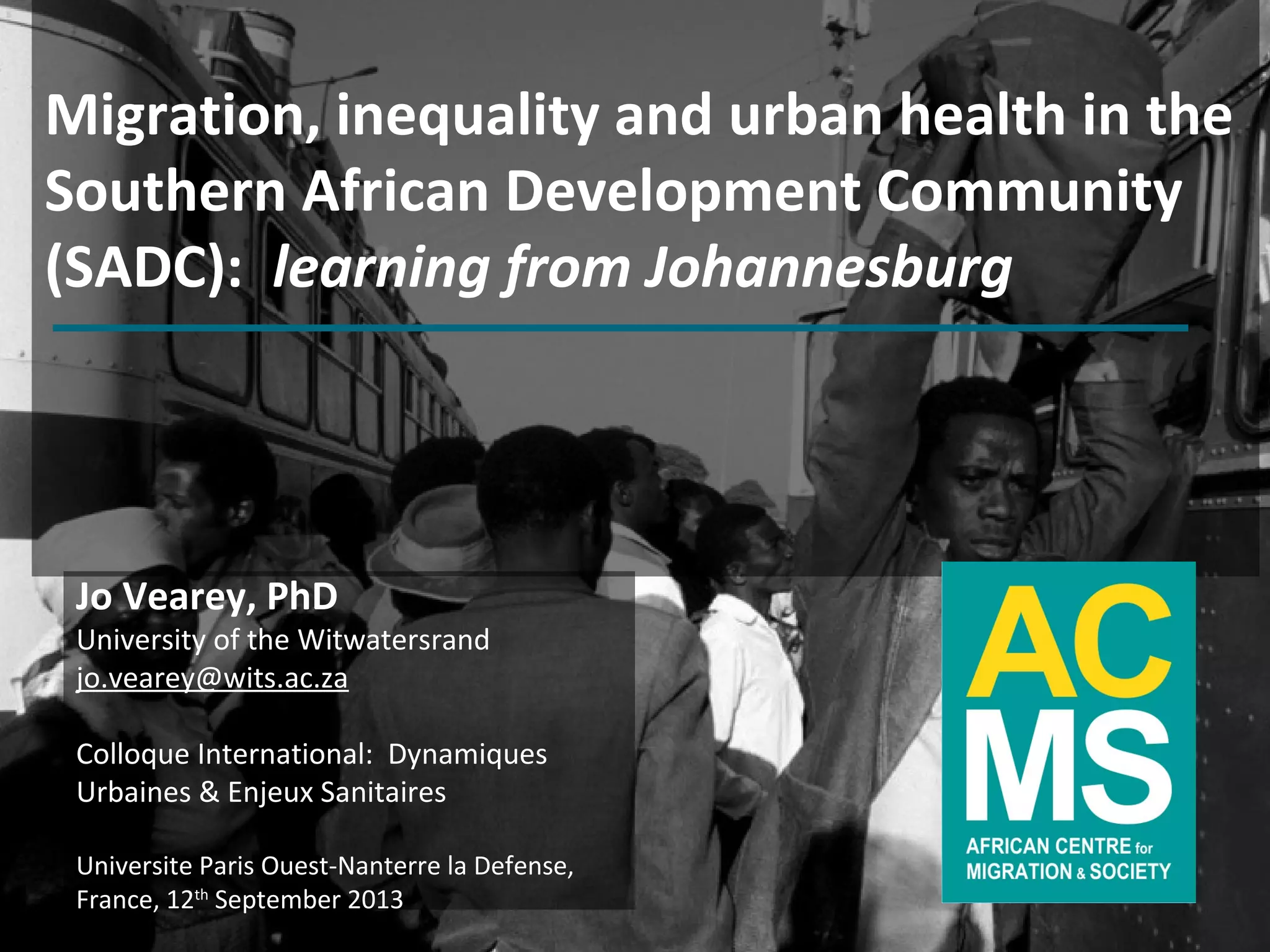
Migration, inequality and urban health in the
Southern African Development Community
(SADC): learning from Johannesburg
Jo Vearey, PhD
University of the Witwatersrand
jo.vearey@wits.ac.za
Colloque International: Dynamiques
Urbaines & Enjeux Sanitaires
Universite Paris Ouest-Nanterre la Defense,
France, 12th
September 2013
http://www.routledge.com/books/details/
9780415686853/
Vearey, J. (2013) Migration, urban
health and inequality in
Johannesburg.
In: Migration and Inequality. Bastia,
T. (ed). Routledge.
Today
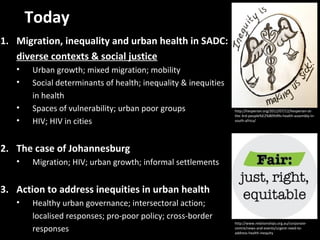
1. Migration, inequality and urban health in SADC:
diverse contexts & social justice
• Urban growth; mixed migration; mobility
• Social determinants of health; inequality & inequities
in health
• Spaces of vulnerability; urban poor groups
• HIV; HIV in cities
2. The case of Johannesburg
• Migration; HIV; urban growth; informal settlements
3. Action to address inequities in urban health
• Healthy urban governance; intersectoral action;
localised responses; pro-poor policy; cross-border
responses
http://hesperian.org/2012/07/12/hesperian-at-
the-3rd-people%E2%80%99s-health-assembly-in-
south-africa/
http://www.relationships.org.au/corporate-
centre/news-and-events/urgent-need-to-
address-health-inequity
(1) Migration, inequality and urban health
in SADC: diverse contexts & social justice
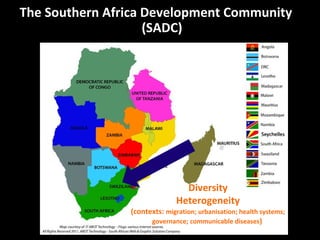
The Southern Africa Development Community
(SADC)
Diversity
Heterogeneity
(contexts: migration; urbanisation; health systems;
governance; communicable diseases)
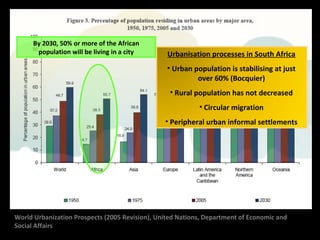
World Urbanization Prospects (2005 Revision), United Nations, Department of Economic and
Social Affairs
By 2030, 50% or more of the African
population will be living in a city Urbanisation processes in South Africa
• Urban population is stabilising at just
over 60% (Bocquier)
• Rural population has not decreased
• Circular migration
• Peripheral urban informal settlements
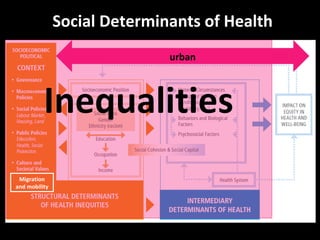
Social Determinants of Health
Inequalities
urban
Migration
and mobility
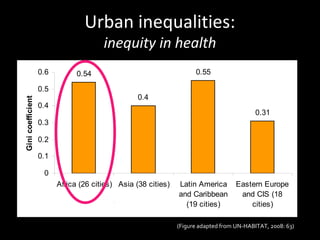
Urban inequalities:
inequity in health
0.54
0.4
0.55
0.31
0
0.1
0.2
0.3
0.4
0.5
0.6
Africa (26 cities) Asia (38 cities) Latin America
and Caribbean
(19 cities)
Eastern Europe
and CIS (18
cities)
Ginicoefficient
(Figure adapted from UN-HABITAT, 2008: 63)
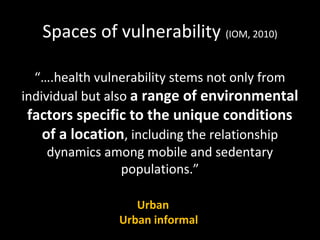
Spaces of vulnerability (IOM, 2010)
“….health vulnerability stems not only from
individual but also a range of environmental
factors specific to the unique conditions
of a location, including the relationship
dynamics among mobile and sedentary
populations.”
Urban
Urban informal
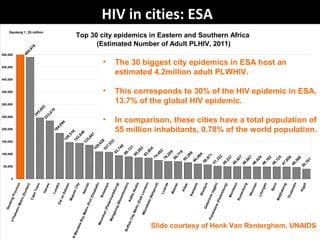
Top 30 city epidemics in Eastern and Southern Africa
(Estimated Number of Adult PLHIV, 2011)
489,978245,803233,870184,094146,516143,640135,667109,428107,533
93,746
89,131
85,202
83,804
74,492
70,259
69,719
65,286
60,094
56,671
51,332
49,237
49,427
48,667
48,429
48,182
48,125
47,856
46,588
39,781
0
50,000
100,000
150,000
200,000
250,000
300,000
350,000
400,000
450,000
500,000
GautengProvince
eThekwiniMetro(Durban)
CapeTown
Harare
LusakaDaresSalaam
MaputoCity
Nairobi
NMandelaBayMetro(PortElizabeth)
Bulawayo
Msunduzi(Pietermaritzburg)
Mangaung(Bloemfontein)
AddisAbaba
BuffaloCityMetro(EastLondon)
Mbombela(Nelspruit)
Luanda
Matola
Kitwe
Kampala
BlantyreGaborone(agglo)
Polokwane(Pietersburg)
Mombasa
Rustenburg
Nkomazi
Lilongwe
Beira
Matjhabeng
Thulamela
Kigali
Gauteng 1, 25 million
The 30 biggest city epidemics in Eastern and Southern Africa host
an estimated total of 4.2 million Adult PLHIV.
This corresponds to 30% of the HIV epidemic in Eastern and
Southern Africa and 13.7% of the global HIV epidemic.
In comparason these 30 cities have a total population of 55 million
inhabitants this is 0.78% of the world population.
Slide courtesy of Henk Van Renterghem, UNAIDS
HIV in cities: ESA
• The 30 biggest city epidemics in ESA host an
estimated 4.2million adult PLWHIV.
• This corresponds to 30% of the HIV epidemic in ESA,
13.7% of the global HIV epidemic.
• In comparison, these cities have a total population of
55 million inhabitants, 0.78% of the world population.
• The 30 biggest city epidemics in ESA host an
estimated 4.2million adult PLWHIV.
• This corresponds to 30% of the HIV epidemic in ESA,
13.7% of the global HIV epidemic.
• In comparison, these cities have a total population of
55 million inhabitants, 0.78% of the world population.
(2) The case of Johannesburg
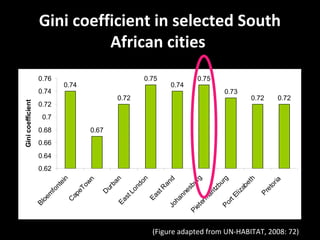
Gini coefficient in selected South
African cities
0.74
0.67
0.72
0.75
0.74
0.75
0.73
0.72 0.72
0.62
0.64
0.66
0.68
0.7
0.72
0.74
0.76
Bloem
fontein
C
apeTown
D
urbanEastLondon
EastR
andJohannesburg
Pieterm
aritzburgPortElizabeth
Pretoria
Ginicoefficient
(Figure adapted from UN-HABITAT, 2008: 72)
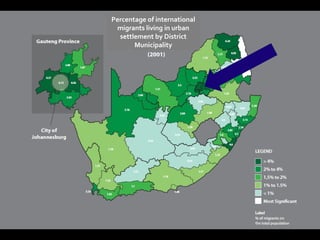
Percentage of international
migrants living in urban
settlement by District
Municipality
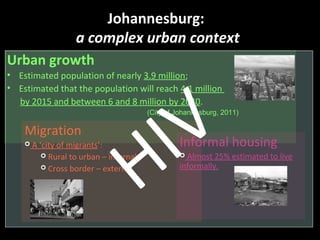
Urban growth
• Estimated population of nearly 3.9 million;
• Estimated that the population will reach 4.1 million
by 2015 and between 6 and 8 million by 2040.
Johannesburg:
a complex urban context
(City of Johannesburg, 2011)
Migration
 A ‘city of migrants’:
 Rural to urban – internal;
 Cross border – external.
Informal housing
 Almost 25% estimated to live
informally.
HIV
16
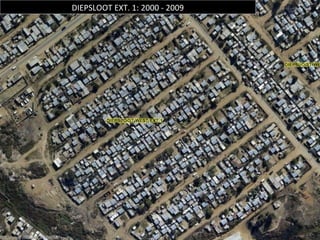
DIEPSLOOT EXT. 1: 2000 - 2009
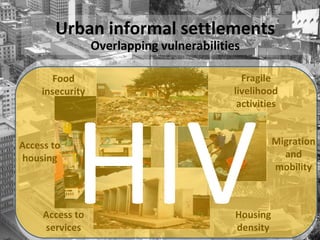
Urban informal settlements
Overlapping vulnerabilities
Food
insecurity
Access to
services
Fragile
livelihood
activities
Housing
density
Migration
and
mobility
Access to
housing
HIV
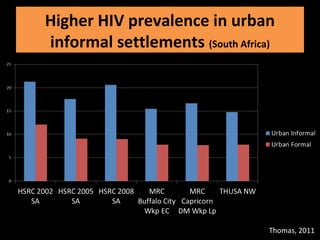
Higher HIV prevalence in urban
informal settlements (South Africa)
Thomas, 2011
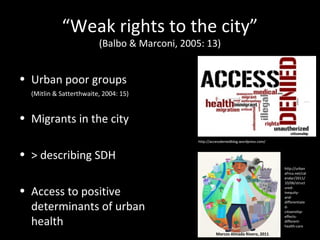
• Urban poor groups
(Mitlin & Satterthwaite, 2004: 15)
• Migrants in the city
• > describing SDH
• Access to positive
determinants of urban
health
http://accessdeniedblog.wordpress.com/
“Weak rights to the city”
(Balbo & Marconi, 2005: 13)
http://urban
africa.net/cal
endar/2011/
10/06/struct
ured-
inequity-
and-
differentiate
d-
citizenship-
effects-
different-
health-care
Marcos Almada Rivero, 2011
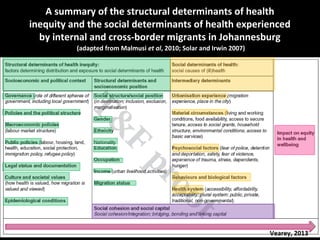
A summary of the structural determinants of health
inequity and the social determinants of health experienced
by internal and cross-border migrants in Johannesburg
(adapted from Malmusi et al, 2010; Solar and Irwin 2007)
Vearey, 2013
(3)Action to address inequities in urban health
• Healthy urban governance
• Intersectoral action
• Localised responses
• Pro-poor policy
• Cross-border responses
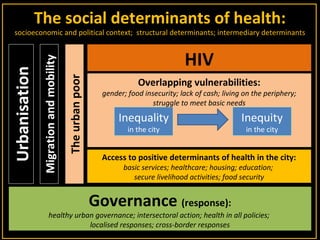
Overlapping vulnerabilities:
gender; food insecurity; lack of cash; living on the periphery;
struggle to meet basic needs
The social determinants of health:
socioeconomic and political context; structural determinants; intermediary determinants
Urbanisation
Migrationandmobility
Inequality
in the city
HIV
Governance (response):
healthy urban governance; intersectoral action; health in all policies;
localised responses; cross-border responses
Inequity
in the city
Access to positive determinants of health in the city:
basic services; healthcare; housing; education;
secure livelihood activities; food security
Theurbanpoor
Migration, inequality and urban health
in SADC: learning from Johannesburg
Jo Vearey, PhD
University of the Witwatersrand
jo.vearey@wits.ac.za
Colloque International: Dynamiques
Urbaines & Enjeux Sanitaires
Universite Paris Ouest-Nanterre la Defense,
France, 12th
September 2013

Migration, inequality and urban health in SADC: learning from Johannesburg

  • 1.
    www.migration.org.za Migration, inequality andurban health in the Southern African Development Community (SADC): learning from Johannesburg Jo Vearey, PhD University of the Witwatersrand jo.vearey@wits.ac.za Colloque International: Dynamiques Urbaines & Enjeux Sanitaires Universite Paris Ouest-Nanterre la Defense, France, 12th September 2013
  • 2.
    http://www.routledge.com/books/details/ 9780415686853/ Vearey, J. (2013)Migration, urban health and inequality in Johannesburg. In: Migration and Inequality. Bastia, T. (ed). Routledge.
  • 3.
    Today 1. Migration, inequalityand urban health in SADC: diverse contexts & social justice • Urban growth; mixed migration; mobility • Social determinants of health; inequality & inequities in health • Spaces of vulnerability; urban poor groups • HIV; HIV in cities 2. The case of Johannesburg • Migration; HIV; urban growth; informal settlements 3. Action to address inequities in urban health • Healthy urban governance; intersectoral action; localised responses; pro-poor policy; cross-border responses http://hesperian.org/2012/07/12/hesperian-at- the-3rd-people%E2%80%99s-health-assembly-in- south-africa/ http://www.relationships.org.au/corporate- centre/news-and-events/urgent-need-to- address-health-inequity
  • 4.
    (1) Migration, inequalityand urban health in SADC: diverse contexts & social justice
  • 5.
    The Southern AfricaDevelopment Community (SADC) Diversity Heterogeneity (contexts: migration; urbanisation; health systems; governance; communicable diseases)
  • 6.
    World Urbanization Prospects(2005 Revision), United Nations, Department of Economic and Social Affairs By 2030, 50% or more of the African population will be living in a city Urbanisation processes in South Africa • Urban population is stabilising at just over 60% (Bocquier) • Rural population has not decreased • Circular migration • Peripheral urban informal settlements
  • 7.
    Social Determinants ofHealth Inequalities urban Migration and mobility
  • 8.
    Urban inequalities: inequity inhealth 0.54 0.4 0.55 0.31 0 0.1 0.2 0.3 0.4 0.5 0.6 Africa (26 cities) Asia (38 cities) Latin America and Caribbean (19 cities) Eastern Europe and CIS (18 cities) Ginicoefficient (Figure adapted from UN-HABITAT, 2008: 63)
  • 9.
    Spaces of vulnerability(IOM, 2010) “….health vulnerability stems not only from individual but also a range of environmental factors specific to the unique conditions of a location, including the relationship dynamics among mobile and sedentary populations.” Urban Urban informal
  • 10.
    Top 30 cityepidemics in Eastern and Southern Africa (Estimated Number of Adult PLHIV, 2011) 489,978245,803233,870184,094146,516143,640135,667109,428107,533 93,746 89,131 85,202 83,804 74,492 70,259 69,719 65,286 60,094 56,671 51,332 49,237 49,427 48,667 48,429 48,182 48,125 47,856 46,588 39,781 0 50,000 100,000 150,000 200,000 250,000 300,000 350,000 400,000 450,000 500,000 GautengProvince eThekwiniMetro(Durban) CapeTown Harare LusakaDaresSalaam MaputoCity Nairobi NMandelaBayMetro(PortElizabeth) Bulawayo Msunduzi(Pietermaritzburg) Mangaung(Bloemfontein) AddisAbaba BuffaloCityMetro(EastLondon) Mbombela(Nelspruit) Luanda Matola Kitwe Kampala BlantyreGaborone(agglo) Polokwane(Pietersburg) Mombasa Rustenburg Nkomazi Lilongwe Beira Matjhabeng Thulamela Kigali Gauteng 1, 25 million The 30 biggest city epidemics in Eastern and Southern Africa host an estimated total of 4.2 million Adult PLHIV. This corresponds to 30% of the HIV epidemic in Eastern and Southern Africa and 13.7% of the global HIV epidemic. In comparason these 30 cities have a total population of 55 million inhabitants this is 0.78% of the world population. Slide courtesy of Henk Van Renterghem, UNAIDS HIV in cities: ESA • The 30 biggest city epidemics in ESA host an estimated 4.2million adult PLWHIV. • This corresponds to 30% of the HIV epidemic in ESA, 13.7% of the global HIV epidemic. • In comparison, these cities have a total population of 55 million inhabitants, 0.78% of the world population. • The 30 biggest city epidemics in ESA host an estimated 4.2million adult PLWHIV. • This corresponds to 30% of the HIV epidemic in ESA, 13.7% of the global HIV epidemic. • In comparison, these cities have a total population of 55 million inhabitants, 0.78% of the world population.
  • 11.
    (2) The caseof Johannesburg
  • 12.
    Gini coefficient inselected South African cities 0.74 0.67 0.72 0.75 0.74 0.75 0.73 0.72 0.72 0.62 0.64 0.66 0.68 0.7 0.72 0.74 0.76 Bloem fontein C apeTown D urbanEastLondon EastR andJohannesburg Pieterm aritzburgPortElizabeth Pretoria Ginicoefficient (Figure adapted from UN-HABITAT, 2008: 72)
  • 13.
    Percentage of international migrantsliving in urban settlement by District Municipality
  • 15.
    Urban growth • Estimatedpopulation of nearly 3.9 million; • Estimated that the population will reach 4.1 million by 2015 and between 6 and 8 million by 2040. Johannesburg: a complex urban context (City of Johannesburg, 2011) Migration  A ‘city of migrants’:  Rural to urban – internal;  Cross border – external. Informal housing  Almost 25% estimated to live informally. HIV
  • 16.
  • 17.
    Urban informal settlements Overlappingvulnerabilities Food insecurity Access to services Fragile livelihood activities Housing density Migration and mobility Access to housing HIV
  • 18.
    Higher HIV prevalencein urban informal settlements (South Africa) Thomas, 2011
  • 19.
    • Urban poorgroups (Mitlin & Satterthwaite, 2004: 15) • Migrants in the city • > describing SDH • Access to positive determinants of urban health http://accessdeniedblog.wordpress.com/ “Weak rights to the city” (Balbo & Marconi, 2005: 13) http://urban africa.net/cal endar/2011/ 10/06/struct ured- inequity- and- differentiate d- citizenship- effects- different- health-care Marcos Almada Rivero, 2011
  • 20.
    A summary ofthe structural determinants of health inequity and the social determinants of health experienced by internal and cross-border migrants in Johannesburg (adapted from Malmusi et al, 2010; Solar and Irwin 2007) Vearey, 2013
  • 21.
    (3)Action to addressinequities in urban health • Healthy urban governance • Intersectoral action • Localised responses • Pro-poor policy • Cross-border responses
  • 22.
    Overlapping vulnerabilities: gender; foodinsecurity; lack of cash; living on the periphery; struggle to meet basic needs The social determinants of health: socioeconomic and political context; structural determinants; intermediary determinants Urbanisation Migrationandmobility Inequality in the city HIV Governance (response): healthy urban governance; intersectoral action; health in all policies; localised responses; cross-border responses Inequity in the city Access to positive determinants of health in the city: basic services; healthcare; housing; education; secure livelihood activities; food security Theurbanpoor
  • 23.
    Migration, inequality andurban health in SADC: learning from Johannesburg Jo Vearey, PhD University of the Witwatersrand jo.vearey@wits.ac.za Colloque International: Dynamiques Urbaines & Enjeux Sanitaires Universite Paris Ouest-Nanterre la Defense, France, 12th September 2013

Editor's Notes

  • #20 Inadequate and often unstable income; Inadequate, unstable or risky asset base; Poor-quality and often insecure, hazardous and overcrowded housing; Inadequate provision of ‘public’ infrastructure (as this increases the health burden); Inadequate provision of basic services, including health services; Limited or no safety net, such as access to grants*; Inadequate protection of poorer groups’ rights through the law; and Poorer groups’ voicelessness and powerlessness within political systems and bureaucratic structures.