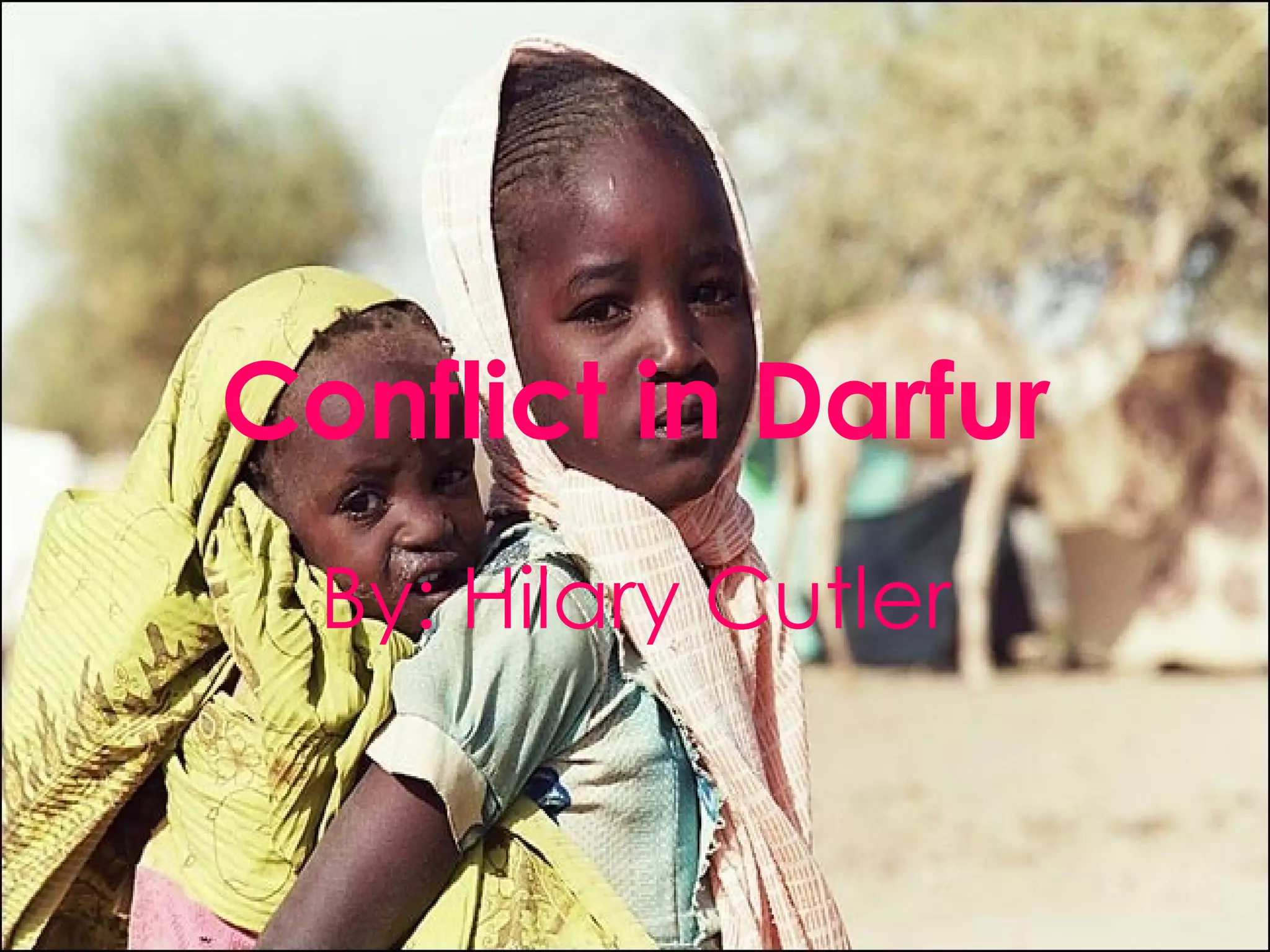
Conflict in Darfur By: Hilary Cutler
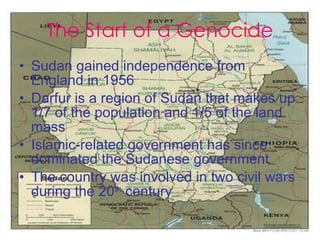
The Start of a Genocide Sudan gained independence from England in 1956 Darfur is a region of Sudan that makes up 1/7 of the population and 1/5 of the land mass Islamic-related government has since dominated the Sudanese government The country was involved in two civil wars during the 20 th  century
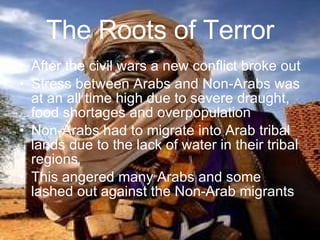
The Roots of Terror After the civil wars a new conflict broke out Stress between Arabs and Non-Arabs was at an all time high due to severe draught, food shortages and overpopulation Non-Arabs had to migrate into Arab tribal lands due to the lack of water in their tribal regions This angered many Arabs and some lashed out against the Non-Arab migrants
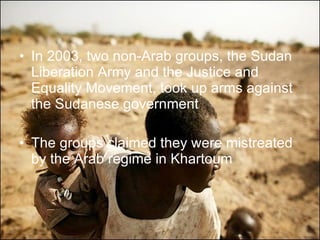
In 2003, two non-Arab groups, the Sudan Liberation Army and the Justice and Equality Movement, took up arms against the Sudanese government The groups claimed they were mistreated by the Arab regime in Khartoum
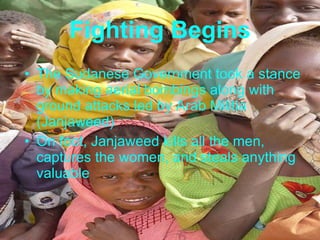
Fighting Begins The Sudanese Government took a stance by making aerial bombings along with ground attacks led by Arab Militia (Janjaweed) On foot, Janjaweed kills all the men, captures the women, and steals anything valuable
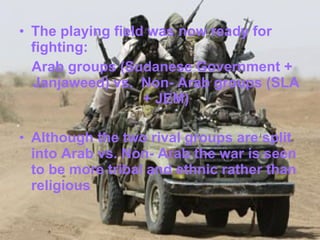
The playing field was now ready for fighting: Arab groups (Sudanese Government + Janjaweed) vs.  Non- Arab groups (SLA + JEM) Although the two rival groups are split into Arab vs. Non- Arab the war is seen to be more tribal and ethnic rather than religious
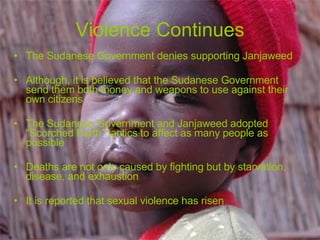
Violence Continues The Sudanese Government denies supporting Janjaweed Although, it is believed that the Sudanese Government send them both money and weapons to use against their own citizens The Sudanese Government and Janjaweed adopted “Scorched Earth” tactics to affect as many people as possible  Deaths are not only caused by fighting but by starvation, disease, and exhaustion  It is reported that sexual violence has risen
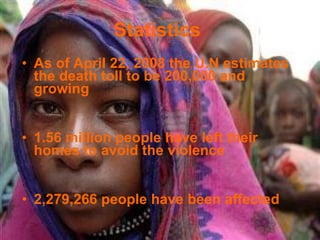
As of April 22, 2008 the U.N estimates the death toll to be 200,000 and growing 1.56 million people have left their homes to avoid the violence  2,279,266 people have been affected Statistics
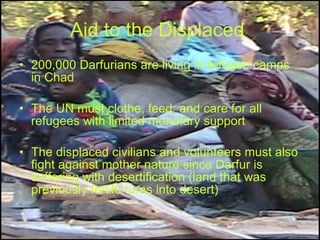
Aid to the Displaced   200,000 Darfurians are living in refugee camps in Chad  The UN must clothe, feed, and care for all refugees with limited monetary support The displaced civilians and volunteers must also fight against mother nature since Darfur is suffering with desertification (land that was previously fertile turns into desert)
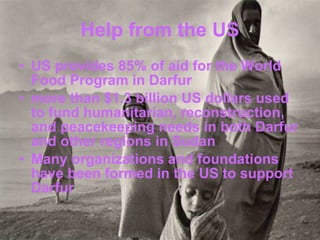
Help from the US US provides 85% of aid for the World Food Program in Darfur more than $1.3 billion US dollars used to fund humanitarian, reconstruction, and peacekeeping needs in both Darfur and other regions in Sudan  Many organizations and foundations have been formed in the US to support Darfur
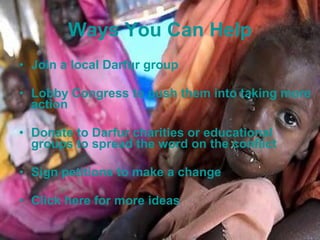
Ways You Can Help Join a local Darfur group Lobby Congress to push them into taking more action Donate to Darfur charities or educational groups to spread the word on the conflict Sign petitions to make a change Click here for more ideas

Conflict In Darfur

  • 1.
    Conflict in DarfurBy: Hilary Cutler
  • 2.
    The Start ofa Genocide Sudan gained independence from England in 1956 Darfur is a region of Sudan that makes up 1/7 of the population and 1/5 of the land mass Islamic-related government has since dominated the Sudanese government The country was involved in two civil wars during the 20 th century
  • 3.
    The Roots ofTerror After the civil wars a new conflict broke out Stress between Arabs and Non-Arabs was at an all time high due to severe draught, food shortages and overpopulation Non-Arabs had to migrate into Arab tribal lands due to the lack of water in their tribal regions This angered many Arabs and some lashed out against the Non-Arab migrants
  • 4.
    In 2003, twonon-Arab groups, the Sudan Liberation Army and the Justice and Equality Movement, took up arms against the Sudanese government The groups claimed they were mistreated by the Arab regime in Khartoum
  • 5.
    Fighting Begins TheSudanese Government took a stance by making aerial bombings along with ground attacks led by Arab Militia (Janjaweed) On foot, Janjaweed kills all the men, captures the women, and steals anything valuable
  • 6.
    The playing fieldwas now ready for fighting: Arab groups (Sudanese Government + Janjaweed) vs. Non- Arab groups (SLA + JEM) Although the two rival groups are split into Arab vs. Non- Arab the war is seen to be more tribal and ethnic rather than religious
  • 7.
    Violence Continues TheSudanese Government denies supporting Janjaweed Although, it is believed that the Sudanese Government send them both money and weapons to use against their own citizens The Sudanese Government and Janjaweed adopted “Scorched Earth” tactics to affect as many people as possible Deaths are not only caused by fighting but by starvation, disease, and exhaustion It is reported that sexual violence has risen
  • 8.
    As of April22, 2008 the U.N estimates the death toll to be 200,000 and growing 1.56 million people have left their homes to avoid the violence 2,279,266 people have been affected Statistics
  • 9.
    Aid to theDisplaced 200,000 Darfurians are living in refugee camps in Chad The UN must clothe, feed, and care for all refugees with limited monetary support The displaced civilians and volunteers must also fight against mother nature since Darfur is suffering with desertification (land that was previously fertile turns into desert)
  • 10.
    Help from theUS US provides 85% of aid for the World Food Program in Darfur more than $1.3 billion US dollars used to fund humanitarian, reconstruction, and peacekeeping needs in both Darfur and other regions in Sudan Many organizations and foundations have been formed in the US to support Darfur
  • 11.
    Ways You CanHelp Join a local Darfur group Lobby Congress to push them into taking more action Donate to Darfur charities or educational groups to spread the word on the conflict Sign petitions to make a change Click here for more ideas