Simplicity –  A Collaborative Innovation Project at PA Dr Julian Kucklich, MA Media Futures Associate Knowledge Transfer Project University of the Arts London / The Press Association 24 June 2008
Introduction Based on an initial diagnosis of PA’s structures, business models, technologies, and work environment, it seems obvious that all of them would  benefit greatly from simplification  in order to foster innovation – a key resource to meet the challenges of the digital age In his book  The Laws of Simplicity , John Maeda sums up simplicity as follows: “ Simplicity is about subtracting the obvious and adding the meaningful ” The most prominent obstacle for simplification at PA is the  lack of inter-departmental collaboration , coupled with a lack of free time, and communal space In order to address these issues, I suggest to set up a  collaborative project  among members of different departments, and work together on  fostering innovation and creativity at PA
Anamnesis Tradition  and  entrenched conservatism  are inhibitors of change at PA The obsession with speed at PA has entrapped the company in a “ dromological paradox ”: the faster production moves forward, the less sustainable the production process becomes A  lack of feedback channels  and focus on  top-down structures  means that innovation on lower levels of the corporate hierarchy (where most creative staff are located) cannot be harnessed On the management level, this is mirrored by a  lack of vision , and a limited framework for strategic thinking The  linear, centralized, stratified and masculine spatial structures  at PA are a further inhibitor to collaboration and change This is exacerbated by a  pronounced lack of diversity and heterogeneity , and a suppression of creative thinking Contextual factors such as  bland, uninspiring office design ,  lack of communal space , and  rigid time management , as well as  technophobia , an inability to engage with contemporary  ethical issues  around news production, and a reliance on  conservative intellectual property models  lead to a situation where the opportunities for PA to adapt to the challenges of the 21 st  century seem very limited
Method Instead of relying on established ways of developing new products, the Simplicity project will try to use a  range of heterogeneous methods for generating new ideas  – even when there is no short-term commercial benefit  By giving the members of the project  time and space to think , the project will act as a  nucleus for change  across the entire organisation By fostering  bottom-up structures  and  collaboration , the project will generate a model for encouraging much-needed creativity and innovation within PA By getting people with  diverse backgrounds and expertise  to work together, the project will encourage  diversity and creative thinking By enabling the members of the project team to  break out of the routine  of their everyday work,  visionary thinking  is promoted Some of the  contextual factors  suppressing change and innovation at PA may be addressed directly by the project, or might come into play at a later project stage
Team The  core project team  (6 members) will be composed of  1 member of the PA Editorial team  1 member of the PA Entertainment team 1 member of the Sales team 1 member of the Digital Development team 1 member of the IT team 1 member of the Communications team Depending on availability,  other project team members  may be recruited from  PA Photos, PA Sport, PA Business, PA Training, Listings, Meteogroup, etc. The project team should ideally have an  equal gender balance , and include members of staff from a  range of cultural backgrounds, age groups and levels of professional experience The members of the project team will be given one  full working day per week  to work on the project, and will be expected to attend  regular project team meetings
Recruitment Following approval of the project, a  call for expressions of interest  will be sent out to all members of staff Members of staff that have expressed frustration with the way innovation is suppressed at PA will be especially encouraged to send in proposals ( separate invitations ) All  channels of communication  will be used to market the project internally (intranet, newsletter, word-of-mouth, posters, etc.) In order to  maximise the return rate , the following aspects of the project will be emphasised The project will supply participants with  time and space to think The project is an opportunity for  personal and professional development The aim of the project is not primarily commercial, but to  improve internal structures If more than the required number of team members send in expressions of interest, their applications will be vetted by the  diversity guidelines  set forth previously
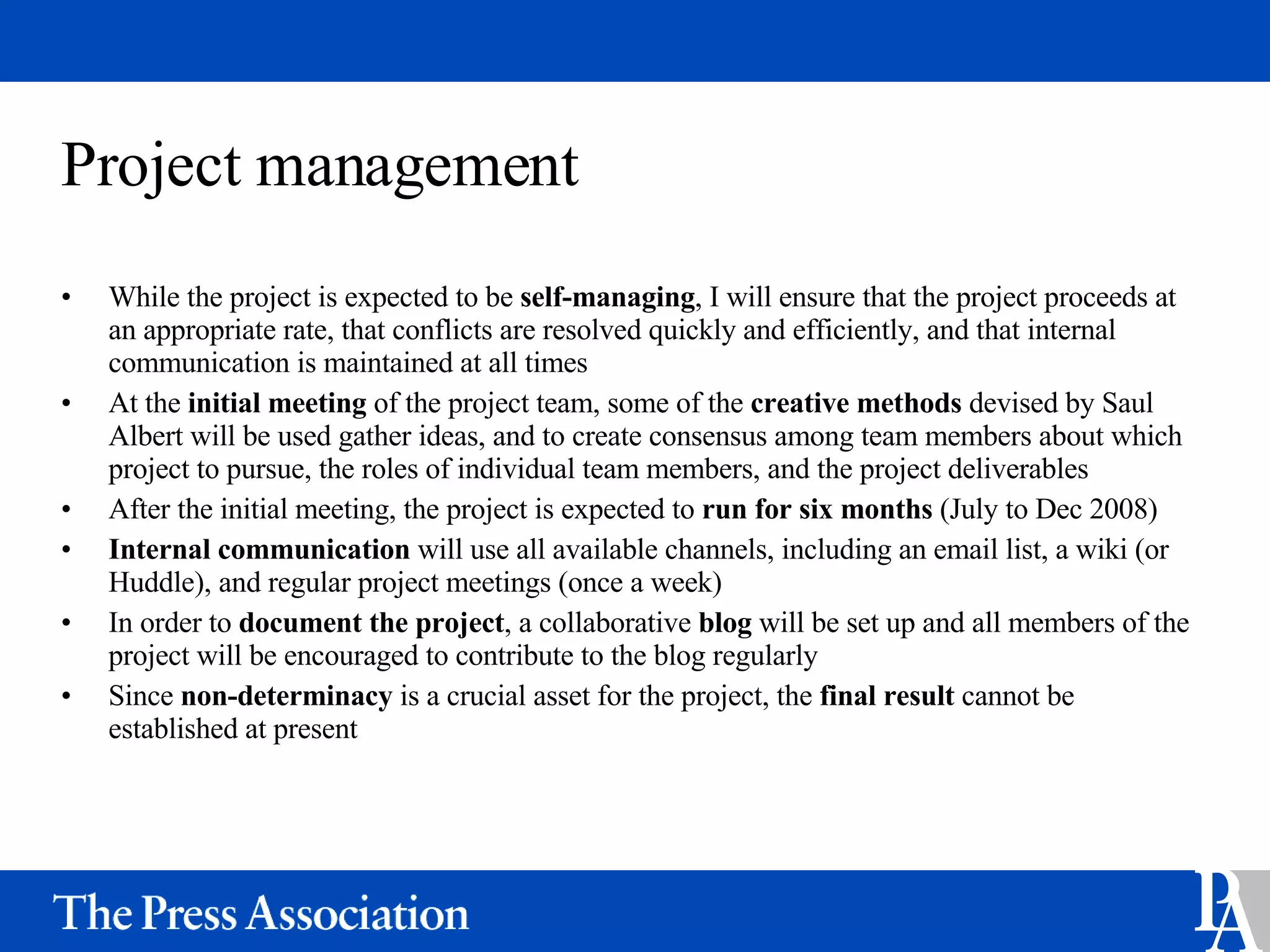
Project management While the project is expected to be  self-managing , I will ensure that the project proceeds at an appropriate rate, that conflicts are resolved quickly and efficiently, and that internal communication is maintained at all times At the  initial meeting  of the project team, some of the  creative methods  devised by Saul Albert will be used gather ideas, and to create consensus among team members about which project to pursue, the roles of individual team members, and the project deliverables After the initial meeting, the project is expected to  run for six months  (July to Dec 2008) Internal communication  will use all available channels, including an email list, a wiki (or Huddle), and regular project meetings (once a week) In order to  document the project , a collaborative  blog  will be set up and all members of the project will be encouraged to contribute to the blog regularly Since  non-determinacy  is a crucial asset for the project, the  final result  cannot be established at present
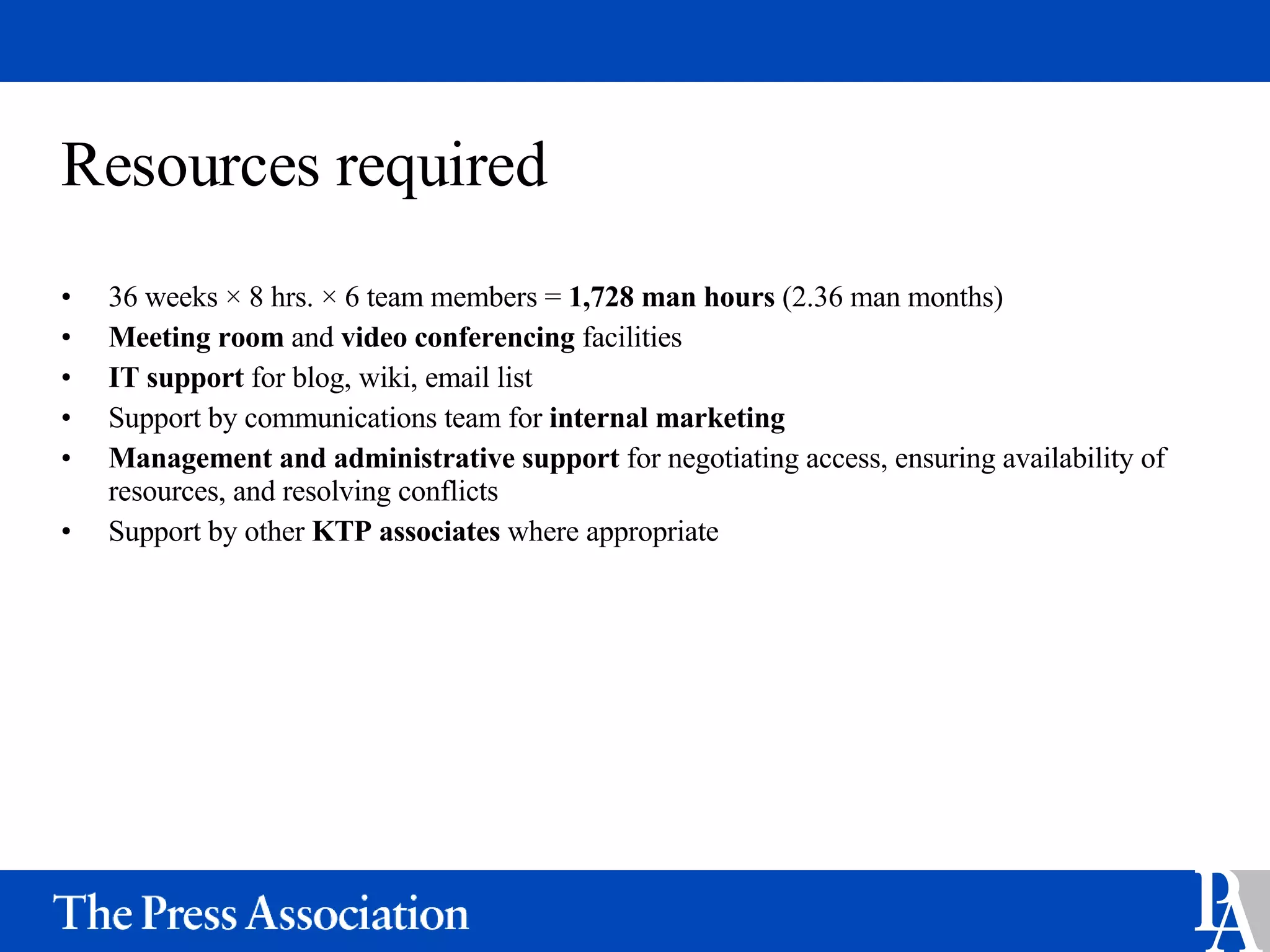
Resources required 36 weeks  × 8 hrs. × 6 team members =  1,728 man hours  (2.36 man months) Meeting room  and  video conferencing  facilities IT support  for blog, wiki, email list Support by communications team for  internal marketing  Management and administrative support  for negotiating access, ensuring availability of resources, and resolving conflicts  Support by other  KTP associates  where appropriate
Expected results The results of the Simplicity project are expected to be  intangible  and  without immediate commercial benefit However, the project is expected to have a wide-ranging impact on PA in terms of  fostering innovation and creativity ,  simplifying internal structures  and encouraging  cross-departmental collaboration The focus on  visionary thinking  is expected to enable PA staff to formulate elements of a  digital strategy , which will be developed further through the KTP project The project is expected to become a  nucleus for change , which will transform operations and structure of PA in the mid to long-term The way the project is managed will be developed into a  model for bottom-up cooperation   and innovation  within PA, and can be rolled out across the entire company in the future The project is also expected to yield insights into the ways in which PA can benefit from  new flexible time-share models , which will allow employees to pursue their own projects The project   will also address  contextual factors  (as outlined above) which impact the management of change and innovation at PA
Impact on other projects The project will be integrated seamlessly with the other research efforts of the KTP project. In particular, the following project strands will benefit from the collaboration of the team members by harnessing their expertise in various areas of PA operations New production technologies and methodologies (dis-integrated newsroom) New visualization technologies, including games technologies Web 2.0 technologies and user-generated content Database and archiving technologies  Metadata standards and semantic technologies New internal communication technologies (ambient intelligence) New delivery technologies (The Fibre) Improvement of spatial and temporal structures Understanding of new ethical challenges arising out of new technologies Structures, protocols and policies at PA New business models and markets Harnessing feedback systems and news prediction technologies

Simplicity

  • 1.
    Simplicity – A Collaborative Innovation Project at PA Dr Julian Kucklich, MA Media Futures Associate Knowledge Transfer Project University of the Arts London / The Press Association 24 June 2008
  • 2.
    Introduction Based onan initial diagnosis of PA’s structures, business models, technologies, and work environment, it seems obvious that all of them would benefit greatly from simplification in order to foster innovation – a key resource to meet the challenges of the digital age In his book The Laws of Simplicity , John Maeda sums up simplicity as follows: “ Simplicity is about subtracting the obvious and adding the meaningful ” The most prominent obstacle for simplification at PA is the lack of inter-departmental collaboration , coupled with a lack of free time, and communal space In order to address these issues, I suggest to set up a collaborative project among members of different departments, and work together on fostering innovation and creativity at PA
  • 3.
    Anamnesis Tradition and entrenched conservatism are inhibitors of change at PA The obsession with speed at PA has entrapped the company in a “ dromological paradox ”: the faster production moves forward, the less sustainable the production process becomes A lack of feedback channels and focus on top-down structures means that innovation on lower levels of the corporate hierarchy (where most creative staff are located) cannot be harnessed On the management level, this is mirrored by a lack of vision , and a limited framework for strategic thinking The linear, centralized, stratified and masculine spatial structures at PA are a further inhibitor to collaboration and change This is exacerbated by a pronounced lack of diversity and heterogeneity , and a suppression of creative thinking Contextual factors such as bland, uninspiring office design , lack of communal space , and rigid time management , as well as technophobia , an inability to engage with contemporary ethical issues around news production, and a reliance on conservative intellectual property models lead to a situation where the opportunities for PA to adapt to the challenges of the 21 st century seem very limited
  • 4.
    Method Instead ofrelying on established ways of developing new products, the Simplicity project will try to use a range of heterogeneous methods for generating new ideas – even when there is no short-term commercial benefit By giving the members of the project time and space to think , the project will act as a nucleus for change across the entire organisation By fostering bottom-up structures and collaboration , the project will generate a model for encouraging much-needed creativity and innovation within PA By getting people with diverse backgrounds and expertise to work together, the project will encourage diversity and creative thinking By enabling the members of the project team to break out of the routine of their everyday work, visionary thinking is promoted Some of the contextual factors suppressing change and innovation at PA may be addressed directly by the project, or might come into play at a later project stage
  • 5.
    Team The core project team (6 members) will be composed of 1 member of the PA Editorial team 1 member of the PA Entertainment team 1 member of the Sales team 1 member of the Digital Development team 1 member of the IT team 1 member of the Communications team Depending on availability, other project team members may be recruited from PA Photos, PA Sport, PA Business, PA Training, Listings, Meteogroup, etc. The project team should ideally have an equal gender balance , and include members of staff from a range of cultural backgrounds, age groups and levels of professional experience The members of the project team will be given one full working day per week to work on the project, and will be expected to attend regular project team meetings
  • 6.
    Recruitment Following approvalof the project, a call for expressions of interest will be sent out to all members of staff Members of staff that have expressed frustration with the way innovation is suppressed at PA will be especially encouraged to send in proposals ( separate invitations ) All channels of communication will be used to market the project internally (intranet, newsletter, word-of-mouth, posters, etc.) In order to maximise the return rate , the following aspects of the project will be emphasised The project will supply participants with time and space to think The project is an opportunity for personal and professional development The aim of the project is not primarily commercial, but to improve internal structures If more than the required number of team members send in expressions of interest, their applications will be vetted by the diversity guidelines set forth previously
  • 7.
    Project management Whilethe project is expected to be self-managing , I will ensure that the project proceeds at an appropriate rate, that conflicts are resolved quickly and efficiently, and that internal communication is maintained at all times At the initial meeting of the project team, some of the creative methods devised by Saul Albert will be used gather ideas, and to create consensus among team members about which project to pursue, the roles of individual team members, and the project deliverables After the initial meeting, the project is expected to run for six months (July to Dec 2008) Internal communication will use all available channels, including an email list, a wiki (or Huddle), and regular project meetings (once a week) In order to document the project , a collaborative blog will be set up and all members of the project will be encouraged to contribute to the blog regularly Since non-determinacy is a crucial asset for the project, the final result cannot be established at present
  • 8.
    Resources required 36weeks × 8 hrs. × 6 team members = 1,728 man hours (2.36 man months) Meeting room and video conferencing facilities IT support for blog, wiki, email list Support by communications team for internal marketing Management and administrative support for negotiating access, ensuring availability of resources, and resolving conflicts Support by other KTP associates where appropriate
  • 9.
    Expected results Theresults of the Simplicity project are expected to be intangible and without immediate commercial benefit However, the project is expected to have a wide-ranging impact on PA in terms of fostering innovation and creativity , simplifying internal structures and encouraging cross-departmental collaboration The focus on visionary thinking is expected to enable PA staff to formulate elements of a digital strategy , which will be developed further through the KTP project The project is expected to become a nucleus for change , which will transform operations and structure of PA in the mid to long-term The way the project is managed will be developed into a model for bottom-up cooperation and innovation within PA, and can be rolled out across the entire company in the future The project is also expected to yield insights into the ways in which PA can benefit from new flexible time-share models , which will allow employees to pursue their own projects The project will also address contextual factors (as outlined above) which impact the management of change and innovation at PA
  • 10.
    Impact on otherprojects The project will be integrated seamlessly with the other research efforts of the KTP project. In particular, the following project strands will benefit from the collaboration of the team members by harnessing their expertise in various areas of PA operations New production technologies and methodologies (dis-integrated newsroom) New visualization technologies, including games technologies Web 2.0 technologies and user-generated content Database and archiving technologies Metadata standards and semantic technologies New internal communication technologies (ambient intelligence) New delivery technologies (The Fibre) Improvement of spatial and temporal structures Understanding of new ethical challenges arising out of new technologies Structures, protocols and policies at PA New business models and markets Harnessing feedback systems and news prediction technologies