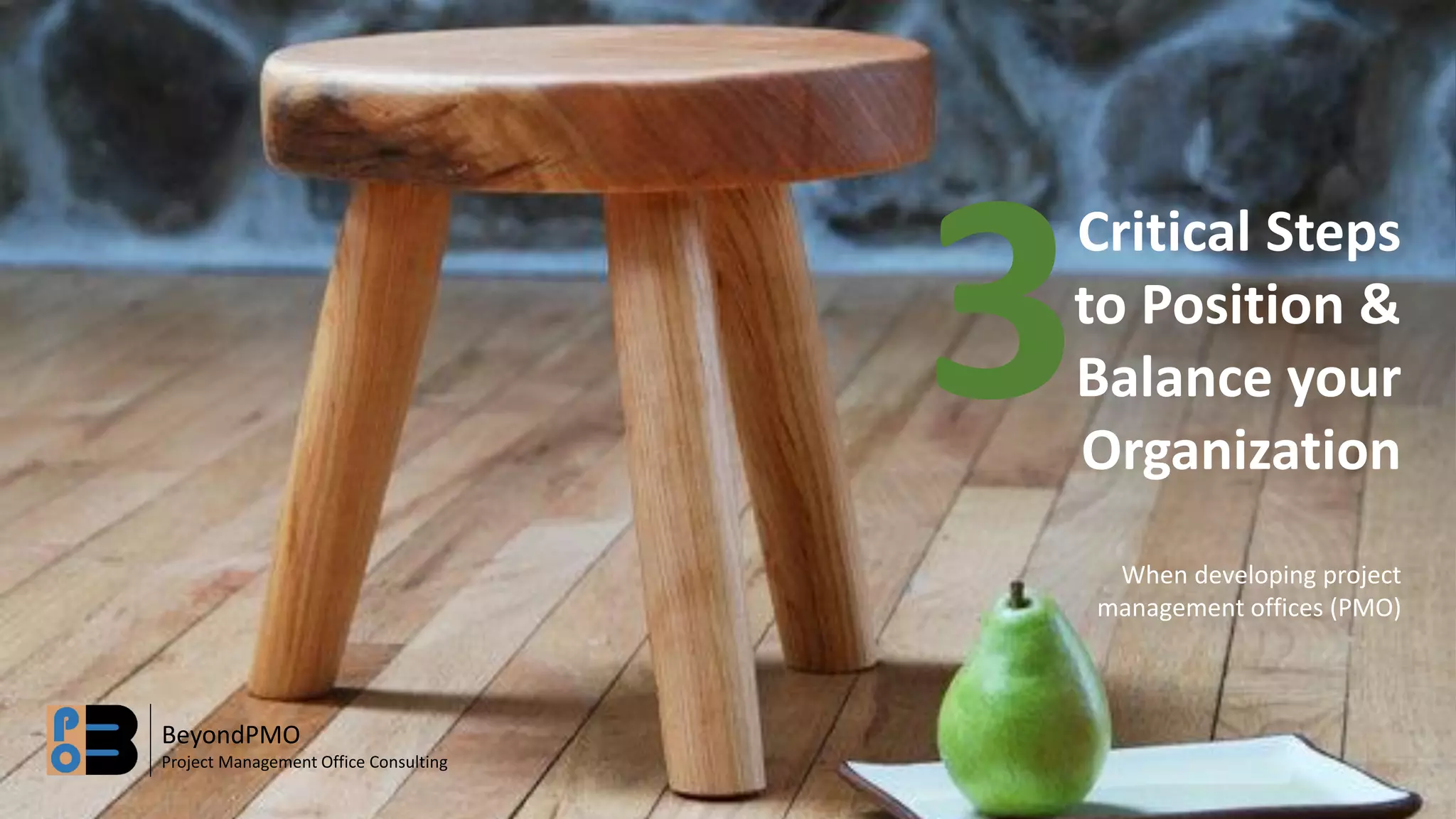
3Critical Steps
to Position &
Balance your
Organization
When developing project
management offices (PMO)
BeyondPMO
Project Management Office Consulting
A PMO or even an Enterprise PMO (EPMO) doesn’t empower an organization to deliver on strategic
initiatives. It is the other way around. The organization and its culture enables the PMO to get stuff done.
The term “Project Management” isn’t a new concept, but it isn’t necessarily understood either. It’s a
construct woven into the complex fabric of organizational growth. Its definition and how it is implemented
evolves with, and melds uniquely into the organization that embraces it.
Implementers know that before you make final decisions, you examine the current state and optimize it
whenever possible before overlaying new process or new technology. Launching a PMO is no different. Its
precursors are rooted in close examination of leadership strengths and knowledge as well as cultural fit.
There is a lot to consider, but this presentation covers three important steps to position and balance your
organization during PMO implementation lest your organization go by way of the common question,
“Why is my PMO not performing?”
They are…..
They are…..
Educate
They are…..
Educate
Build Structure
They are…..
Educate
Build Structure
Be Introspective
1. Teach principles, methods, and practices
Most departments are clearly
understood. There is no question about
Payroll, Finance, Human Resources, or
Operations. American business
embraced these concepts long ago in the
normal course of operation.
Departments like Human Resources are
well understood because of their specific
purpose. They operate somewhat
autonomously. Finance doesn’t need to
be efficient for Human Resources to do
its job and vice versa. This rings true for
most departments in a hierarchical
environment.
Why is Project Management different?
Project Management is unique because it
is often unstructured, not understood, and
almost never autonomous. Project
Management persists in many
organizations as a disconnected, undefined
concept. In small organizations, project
managers (let alone project management
structure) may not exist at all. Also, the
project/program manager role is realized
differently depending on the area under
which these professionals report even if
the company has a standard description. It
becomes an over-used title issued in the
absence of a better one.
For departments like Operations the
purpose of project management may
not be understood because the concept
has never been socialized or taught.
Methodology and bureaucracy in large
organizations can be complex,
inconsistent, or unclear.
Project Management can never be the same as Finance or Human Resources
because it’s fundamentals are woven into the organization as an intangible
mechanism.
It is all three working in tandem that enables
coordinated, cross-functional forward movement.
It is partly built on execution principles and methodologies, but at
its core are organizational PRACTICES.
So…….what do you want me to teach them?
Project Management can never be the same as Finance or Human Resources
because it’s fundamentals are woven into the organization as an intangible
mechanism.
It is all three working in tandem that enables
coordinated, cross-functional forward movement.
It is partly built on execution principles and methodologies, but at
its core are organizational PRACTICES.
Teach ALL professionals:
PM principles
Clearly defined methodologies
Clearly defined Project Management PRACTICES
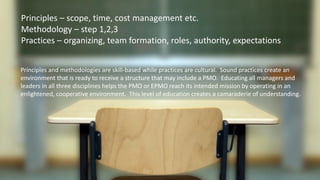
Principles and methodologies are skill-based while practices are cultural. Sound practices create an
environment that is ready to receive a structure that may include a PMO. Educating all managers and
leaders in all three disciplines helps the PMO or EPMO reach its intended mission by operating in an
enlightened, cooperative environment. This level of education creates a camaraderie of understanding.
Principles – scope, time, cost management etc.
Methodology – step 1,2,3
Practices – organizing, team formation, roles, authority, expectations
Project Management is a construct. It is built by design but
evolves with the organization. Its evolution is manifest in the
skills and strengths of the organization’s leaders. Leadership
must weave all three project management concepts into the
framework of management and leadership education.
Leaders that embrace and teach project management concepts
and enable the propagation of those concepts create an open,
balanced environment where PMOs and the cross-functional
departments for which they serve can better connect.
What else should you do
before you implement a
PMO?
Project Management is a construct. It is built by design but
evolves with the organization. Its evolution is manifest in the
skills and strengths of the organization’s leaders. Leadership
must weave all three project management concepts into the
framework of management and leadership education.
Leaders that embrace and teach project management concepts
and enable the propagation of those concepts create an open,
balanced environment where PMOs and the cross-functional
departments for which they serve can better connect.
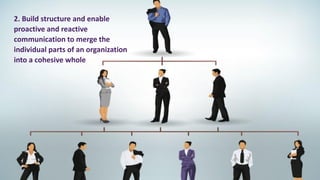
2. Build structure and enable
proactive and reactive
communication to merge the
individual parts of an organization
into a cohesive whole
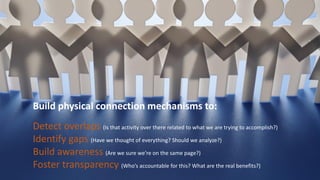
Build physical connection mechanisms to:
Detect overlaps (Is that activity over there related to what we are trying to accomplish?)
Identify gaps (Have we thought of everything? Should we analyze?)
Build awareness (Are we sure we’re on the same page?)
Foster transparency (Who’s accountable for this? What are the real benefits?)
Build retrievable
artifacts & make
sure people use
them
“Those unable to catalogue the
past are doomed to repeat it.”
Daniel Handler
Build retrievable
artifacts & make
sure people use
them
“Those unable to catalogue the
past are doomed to repeat it.”
Daniel Handler
What else is there to think about?
GO AFTER IT!
Everyone at every level
has creative ideas &
constructive feedback
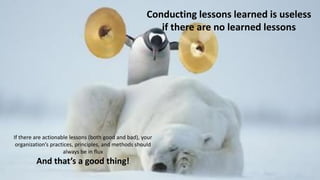
Conducting lessons learned is useless
if there are no learned lessons
If there are actionable lessons (both good and bad), your
organization’s practices, principles, and methods should
always be in flux
And that’s a good thing!
3. Be introspective; ask
and answer important
questions as you
contemplate a PMO
What are our current execution practices? Do we have any? How do we
get stuff done? How do we form teams? What about roles?
Accountability vs. Responsibility? Transparency? What’s a project
manager in this organization?
Do we really have a clearly defined plan that spans a number of years?
Do we know the
strengths and
limitations of our
leadership?
Do we hold them
accountable?
What is our project
management maturity?
Structured? Unstructured? Process? No process?
What do we want it to be?
What is our project
management maturity?
Structured? Unstructured? Process? No process?
What is the current culture of our organization?
What’s defined by the environment and what’s defined by leadership?
Are we too
bureaucratic?
The size of a company, Its funding processes, the
criteria it uses to make decisions, its IT processes,
and other bureaucratic details sometimes create
conflicts that lead to timing issues. Timing issues
lead to quality issues. Quality issues lead to
execution failure and bottom line impact.
What do your managers know about project
management?
When you give a directive to get something done, does it
happen?
A PMO or even an Enterprise PMO doesn’t empower an
organization to deliver on strategic initiatives. It is the other
way around
Project Management is unique because it isn’t autonomous and
is often unstructured
It is partly built on project/program execution principles and
methodologies, but at its core are organizational PRACTICES
Teach all professionals sound principles, methodologies, and
Practices
Incorporate them into your culture
Build structure that enables proactive and reactive
communication to merge the individual parts of an organization
into a cohesive whole
And remember to ask and answer key questions along the way
So let me just
reiterate,
Thank you for your time. If you like this
presentation I’d be happy to give it to your
leadership team. Read the full article on my
webpage at BeyondPMO.com. Best wishes
to you and your organization!!
http://www.beyondpmo.com/Portfolio
Let me know if I can help
Susan Graves, BeyondPMO
susan@beyondpmo.com
858-414-5465
www.linkedin.com/in/gravessusan
http://www.beyondpmo.comBeyondPMO
Project Management Office Consulting

3 Critical Steps to Project Management Office (PMO) Development

  • 1.
    3Critical Steps to Position& Balance your Organization When developing project management offices (PMO) BeyondPMO Project Management Office Consulting
  • 2.
    A PMO oreven an Enterprise PMO (EPMO) doesn’t empower an organization to deliver on strategic initiatives. It is the other way around. The organization and its culture enables the PMO to get stuff done. The term “Project Management” isn’t a new concept, but it isn’t necessarily understood either. It’s a construct woven into the complex fabric of organizational growth. Its definition and how it is implemented evolves with, and melds uniquely into the organization that embraces it. Implementers know that before you make final decisions, you examine the current state and optimize it whenever possible before overlaying new process or new technology. Launching a PMO is no different. Its precursors are rooted in close examination of leadership strengths and knowledge as well as cultural fit. There is a lot to consider, but this presentation covers three important steps to position and balance your organization during PMO implementation lest your organization go by way of the common question, “Why is my PMO not performing?”
  • 3.
  • 4.
  • 5.
  • 6.
  • 7.
    1. Teach principles,methods, and practices
  • 8.
    Most departments areclearly understood. There is no question about Payroll, Finance, Human Resources, or Operations. American business embraced these concepts long ago in the normal course of operation. Departments like Human Resources are well understood because of their specific purpose. They operate somewhat autonomously. Finance doesn’t need to be efficient for Human Resources to do its job and vice versa. This rings true for most departments in a hierarchical environment. Why is Project Management different?
  • 9.
    Project Management isunique because it is often unstructured, not understood, and almost never autonomous. Project Management persists in many organizations as a disconnected, undefined concept. In small organizations, project managers (let alone project management structure) may not exist at all. Also, the project/program manager role is realized differently depending on the area under which these professionals report even if the company has a standard description. It becomes an over-used title issued in the absence of a better one. For departments like Operations the purpose of project management may not be understood because the concept has never been socialized or taught. Methodology and bureaucracy in large organizations can be complex, inconsistent, or unclear.
  • 10.
    Project Management cannever be the same as Finance or Human Resources because it’s fundamentals are woven into the organization as an intangible mechanism. It is all three working in tandem that enables coordinated, cross-functional forward movement. It is partly built on execution principles and methodologies, but at its core are organizational PRACTICES.
  • 11.
    So…….what do youwant me to teach them? Project Management can never be the same as Finance or Human Resources because it’s fundamentals are woven into the organization as an intangible mechanism. It is all three working in tandem that enables coordinated, cross-functional forward movement. It is partly built on execution principles and methodologies, but at its core are organizational PRACTICES.
  • 12.
    Teach ALL professionals: PMprinciples Clearly defined methodologies Clearly defined Project Management PRACTICES
  • 13.
    Principles and methodologiesare skill-based while practices are cultural. Sound practices create an environment that is ready to receive a structure that may include a PMO. Educating all managers and leaders in all three disciplines helps the PMO or EPMO reach its intended mission by operating in an enlightened, cooperative environment. This level of education creates a camaraderie of understanding. Principles – scope, time, cost management etc. Methodology – step 1,2,3 Practices – organizing, team formation, roles, authority, expectations
  • 14.
    Project Management isa construct. It is built by design but evolves with the organization. Its evolution is manifest in the skills and strengths of the organization’s leaders. Leadership must weave all three project management concepts into the framework of management and leadership education. Leaders that embrace and teach project management concepts and enable the propagation of those concepts create an open, balanced environment where PMOs and the cross-functional departments for which they serve can better connect.
  • 15.
    What else shouldyou do before you implement a PMO? Project Management is a construct. It is built by design but evolves with the organization. Its evolution is manifest in the skills and strengths of the organization’s leaders. Leadership must weave all three project management concepts into the framework of management and leadership education. Leaders that embrace and teach project management concepts and enable the propagation of those concepts create an open, balanced environment where PMOs and the cross-functional departments for which they serve can better connect.
  • 16.
    2. Build structureand enable proactive and reactive communication to merge the individual parts of an organization into a cohesive whole
  • 17.
    Build physical connectionmechanisms to: Detect overlaps (Is that activity over there related to what we are trying to accomplish?) Identify gaps (Have we thought of everything? Should we analyze?) Build awareness (Are we sure we’re on the same page?) Foster transparency (Who’s accountable for this? What are the real benefits?)
  • 18.
    Build retrievable artifacts &make sure people use them “Those unable to catalogue the past are doomed to repeat it.” Daniel Handler
  • 19.
    Build retrievable artifacts &make sure people use them “Those unable to catalogue the past are doomed to repeat it.” Daniel Handler What else is there to think about?
  • 20.
    GO AFTER IT! Everyoneat every level has creative ideas & constructive feedback
  • 21.
    Conducting lessons learnedis useless if there are no learned lessons If there are actionable lessons (both good and bad), your organization’s practices, principles, and methods should always be in flux And that’s a good thing!
  • 22.
    3. Be introspective;ask and answer important questions as you contemplate a PMO
  • 23.
    What are ourcurrent execution practices? Do we have any? How do we get stuff done? How do we form teams? What about roles? Accountability vs. Responsibility? Transparency? What’s a project manager in this organization?
  • 24.
    Do we reallyhave a clearly defined plan that spans a number of years?
  • 25.
    Do we knowthe strengths and limitations of our leadership? Do we hold them accountable?
  • 26.
    What is ourproject management maturity? Structured? Unstructured? Process? No process?
  • 27.
    What do wewant it to be? What is our project management maturity? Structured? Unstructured? Process? No process?
  • 28.
    What is thecurrent culture of our organization? What’s defined by the environment and what’s defined by leadership?
  • 29.
    Are we too bureaucratic? Thesize of a company, Its funding processes, the criteria it uses to make decisions, its IT processes, and other bureaucratic details sometimes create conflicts that lead to timing issues. Timing issues lead to quality issues. Quality issues lead to execution failure and bottom line impact.
  • 30.
    What do yourmanagers know about project management? When you give a directive to get something done, does it happen?
  • 31.
    A PMO oreven an Enterprise PMO doesn’t empower an organization to deliver on strategic initiatives. It is the other way around Project Management is unique because it isn’t autonomous and is often unstructured It is partly built on project/program execution principles and methodologies, but at its core are organizational PRACTICES Teach all professionals sound principles, methodologies, and Practices Incorporate them into your culture Build structure that enables proactive and reactive communication to merge the individual parts of an organization into a cohesive whole And remember to ask and answer key questions along the way So let me just reiterate,
  • 32.
    Thank you foryour time. If you like this presentation I’d be happy to give it to your leadership team. Read the full article on my webpage at BeyondPMO.com. Best wishes to you and your organization!! http://www.beyondpmo.com/Portfolio Let me know if I can help Susan Graves, BeyondPMO susan@beyondpmo.com 858-414-5465 www.linkedin.com/in/gravessusan http://www.beyondpmo.comBeyondPMO Project Management Office Consulting