Vasculitides & Kidney Tx
Dr Alaleh Gheissari, MD
Pediatric Nephrologist
IUMS
2020
Vasculitides and kidney
 The kidneys are frequently affected by systemic vasculitides:
 Small vessel vasculitis such as: Microscopic PAN, HSP, Wegener
granulomatosis, Cryoglobulinemia mostly cause nephritis and renal failure.
 Medium sized necrotizing vasculitides such as: classic pan and Kawazaki
disease cause infarction, thrombosis and hemorrhage
 Large vessel vasculitides such as: Temporal arteritis and Takayasu rarely injure
the kidneys directly. They cause ischemia secondary to renal artery and Aorta
involvement.
ANCA associated vasculitis (AAV) on
KTx
 Recurrence rate of AAV on KTx: 17% (9-40%)
 Average time to relapse: 31 months
 Relapse rate is higher in under dialyzed patients compared to transplanted
patients: 0.09 Vs 0.02 episode per patient-year .
One major Unanswered Question
When is the optimal time for KTx in AAV?????
Time of kidney Transplantation in AAV
 AAV must be in remission.
 Some experts prefer to have patients in remission for at least one year.
 The relapse rate and mortality have been reported higher in patients that have
received KTx before one year of being in remission.
 Remission means to be in remission clinically not only sero-negativity.
 Sero-negativity is not essential for KTx.
 ANCA status at transplant does not appear to influence outcome.
Time of kidney Transplantation in AAV
 Renal Transplantation in Antineutrophil Cytoplasmic Antibody-Associated
Vasculitis: A Multicenter Experience. Transplantation. 2011
 The vasculitis relapse rate was 0.02 per patient-years. (total number of
participants: 85)
 Relapse rate was not influenced by disease category, ANCA subtype, or remission
duration before KTX.
 However, PR3 ANCA+ patients may be more likely to experience relapse post-
transplant.
KTX regimens in AAV relapses
 No prospective study has yielded a strategy for prevention or manage of
AAV relapse on KTx.
 All reported cases with cyclophosphamide –based regimen showed about
70% response rate
 Pulse methyl prednisolone was effective in relapse treatment.
 Rituximab has been reported effective in relapses of AAV on KTx
 Plasmapheresis has been recommended in AAV relapses.
KTX regimens in AAV
 Prednisolone, Azathioprine, Cyclosporine
 Relapse rate per patient-year: 0.02
 Adding cyclosporine to KTx regimen did not decrease relapse rate of AAV in comparison
with Azathioprine and prednisolone
 Prednisolone, Mycophenolate, Tacrolimus
 Relapse rate per patient –year: 0.005
OUTCOME of KTx after AAV
 Outcome of renal transplantation in patients with pauci-immune small vessel
vasculitis or anti-GBM disease. Clinical Nephrology 2003.
 No graft was lost due to recurrence of the underlying disease
 Survival rates were not significantly different from a matched control group of renal
transplant patients with other underlying diseases, 79% and 56%, respectively.
 Recurrence of pauci-immune SVV and anti-GBM disease after transplantation is
rare.
OUTCOME of KTx after AAV
 Recurrent ANCA-associated small vessel vasculitis after transplantation: A
pooled analysis. KI 1999.
 There is a substantial relapse rate in the ANCA-SVV population.
 Therapy with cyclosporine A does not protect against recurrent ANCA-SVV.
 The presence of a positive ANCA at the time of transplantation does not preclude
transplantation.
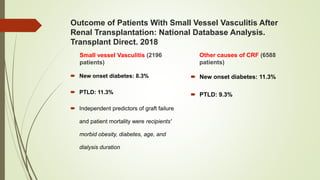
Outcome of Patients With Small Vessel Vasculitis After
Renal Transplantation: National Database Analysis.
Transplant Direct. 2018
Small vessel Vasculitis (2196
patients)
 New onset diabetes: 8.3%
 PTLD: 11.3%
 Independent predictors of graft failure
and patient mortality were recipients'
morbid obesity, diabetes, age, and
dialysis duration
Other causes of CRF (6588
patients)
 New onset diabetes: 11.3%
 PTLD: 9.3%
Prevention strategies before KTx
 Sirolimus lowers myeloperoxidase and p-ANCA titers in a pediatric patient
before kidney transplantation. AJKD 2002
 The authors described the case of a patient with p-ANCA vasculitis, in whom
rapamycin significantly reduced the antibody levels before kidney transplant and,
combined with calcineurin inhibitor therapy, contributed to their normalization.
Early Relapse of Autoimmune Glomerulonephritis After Kidney
Transplantation Despite Antibody Induction and Triple-Drug-Based
Immunosuppression. Transplantation: 2010
 A 34 year-old man, p- ANCA vasculitis
 Immunosuppression consisted of basiliximab induction (20 mg on days 1 and 4),
tacrolimus (2×1 mg/day), prednisone (20 mg/day), and mycophenolate mofetil (4×500
mg/day).
 A 65-year-old woman, p- ANCA vasculitis
 4-day-course of thymoglobulin (1.5 mg/kg/day) with tacrolimus (2×1 mg/day),
prednisone (20 g/day), mycophenolate mofetil (4×500 mg/day), one dose of rituximab
(375 mg/m2), followed by intravenous immune globulin (0.4 g/kg) on 5 consecutive days.
Hypothesis behind the early recurrence of
autoimmune diseases after KTx. Transplantation
2010
 The allo-immune responses have been postulated to enhance autoimmunity and to
contribute to organ damage and chronic rejection after lung transplantation.
 Passenger CD4 T cells have been shown to provide help to B cells’ recipient for
autoantibody generation in animal model of heart transplantation.
Hypothesis behind the early recurrence of
autoimmune diseases after KTx
 Finally, the implantation of a new kidney could have rapidly reactivated and
amplified the autoimmune disease because of the presence of new target tissue or
by other nonspecific mechanisms.
 Antibody induction, tacrolimus, prednisone, and mycophenolate mofetil strongly
inhibited T-cell function but were not efficient on the production of antibody.
Interestingly, in ANCA-associated vasculitis, immunosuppressive therapy
dissociates disease activity from ANCA levels.
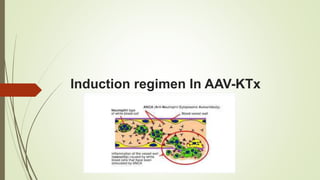
Induction regimen In AAV-KTx
Thymoglobulin, Mechanism of Action
 Deplete T-cells
 Modulates various lymphocyte surface antigens
 Interferes with the function of a number of different immune effector cells:
 B cells,
 Dendritic cells,
 Natural killer (NK) T cells,
 Regulatory T cells
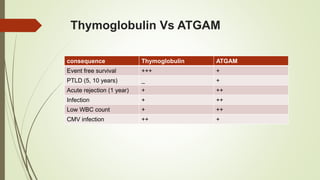
Thymoglobulin Vs ATGAM
consequence Thymoglobulin ATGAM
Event free survival +++ +
PTLD (5, 10 years) _ +
Acute rejection (1 year) + ++
Infection + ++
Low WBC count + ++
CMV infection ++ +
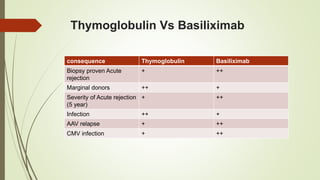
Thymoglobulin Vs Basiliximab
consequence Thymoglobulin Basiliximab
Biopsy proven Acute
rejection
+ ++
Marginal donors ++ +
Severity of Acute rejection
(5 year)
+ ++
Infection ++ +
AAV relapse + ++
CMV infection + ++
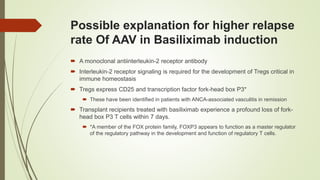
Possible explanation for higher relapse
rate Of AAV in Basiliximab induction
 A monoclonal antiinterleukin-2 receptor antibody
 Interleukin-2 receptor signaling is required for the development of Tregs critical in
immune homeostasis
 Tregs express CD25 and transcription factor fork-head box P3*
 These have been identified in patients with ANCA-associated vasculitis in remission
 Transplant recipients treated with basiliximab experience a profound loss of fork-
head box P3 T cells within 7 days.
 *A member of the FOX protein family, FOXP3 appears to function as a master regulator
of the regulatory pathway in the development and function of regulatory T cells.
References
 The Pathology of Vasculitis Involving the Kidney. AJKD 1994.
 Recurrence of ANCA-associated vasculitis following renal transplantation in
the modern era of immunosuppression. KI 2007.
 Renal transplantation in antineutrophil cytoplasmic antibody-associated
vasculitis. Current opinion in Rheumatology 2014.
 Sirolimus lowers myeloperoxidase and p-ANCA titers in a pediatric patient
before kidney transplantation. AJKD 2002
 Early Relapse of Autoimmune Glomerulonephritis After Kidney
Transplantation Despite Antibody Induction and Triple-Drug-Based
Immunosuppression. Transplantation: 2010
 Outcome of renal transplantation in patients with pauci-immune small vessel
vasculitis or anti-GBM disease. Clinical Nephrology 2003.
References
 Thymoglobulin – new approaches to optimal outcomes. Journal of Medicine
and Life 2009
 Relevance of ANCA positivity at the time of renal transplantation in ANCA
associated vasculitis. J Nephrol 2017
 De novo glomerular diseases after renal transplantation: How is it different
from recurrent glomerular diseases? World J Transplant 2017.

Vasculites and kidney

  • 1.
    Vasculitides & KidneyTx Dr Alaleh Gheissari, MD Pediatric Nephrologist IUMS 2020
  • 2.
    Vasculitides and kidney The kidneys are frequently affected by systemic vasculitides:  Small vessel vasculitis such as: Microscopic PAN, HSP, Wegener granulomatosis, Cryoglobulinemia mostly cause nephritis and renal failure.  Medium sized necrotizing vasculitides such as: classic pan and Kawazaki disease cause infarction, thrombosis and hemorrhage  Large vessel vasculitides such as: Temporal arteritis and Takayasu rarely injure the kidneys directly. They cause ischemia secondary to renal artery and Aorta involvement.
  • 3.
    ANCA associated vasculitis(AAV) on KTx  Recurrence rate of AAV on KTx: 17% (9-40%)  Average time to relapse: 31 months  Relapse rate is higher in under dialyzed patients compared to transplanted patients: 0.09 Vs 0.02 episode per patient-year .
  • 4.
    One major UnansweredQuestion When is the optimal time for KTx in AAV?????
  • 5.
    Time of kidneyTransplantation in AAV  AAV must be in remission.  Some experts prefer to have patients in remission for at least one year.  The relapse rate and mortality have been reported higher in patients that have received KTx before one year of being in remission.  Remission means to be in remission clinically not only sero-negativity.  Sero-negativity is not essential for KTx.  ANCA status at transplant does not appear to influence outcome.
  • 6.
    Time of kidneyTransplantation in AAV  Renal Transplantation in Antineutrophil Cytoplasmic Antibody-Associated Vasculitis: A Multicenter Experience. Transplantation. 2011  The vasculitis relapse rate was 0.02 per patient-years. (total number of participants: 85)  Relapse rate was not influenced by disease category, ANCA subtype, or remission duration before KTX.  However, PR3 ANCA+ patients may be more likely to experience relapse post- transplant.
  • 7.
    KTX regimens inAAV relapses  No prospective study has yielded a strategy for prevention or manage of AAV relapse on KTx.  All reported cases with cyclophosphamide –based regimen showed about 70% response rate  Pulse methyl prednisolone was effective in relapse treatment.  Rituximab has been reported effective in relapses of AAV on KTx  Plasmapheresis has been recommended in AAV relapses.
  • 8.
    KTX regimens inAAV  Prednisolone, Azathioprine, Cyclosporine  Relapse rate per patient-year: 0.02  Adding cyclosporine to KTx regimen did not decrease relapse rate of AAV in comparison with Azathioprine and prednisolone  Prednisolone, Mycophenolate, Tacrolimus  Relapse rate per patient –year: 0.005
  • 9.
    OUTCOME of KTxafter AAV  Outcome of renal transplantation in patients with pauci-immune small vessel vasculitis or anti-GBM disease. Clinical Nephrology 2003.  No graft was lost due to recurrence of the underlying disease  Survival rates were not significantly different from a matched control group of renal transplant patients with other underlying diseases, 79% and 56%, respectively.  Recurrence of pauci-immune SVV and anti-GBM disease after transplantation is rare.
  • 10.
    OUTCOME of KTxafter AAV  Recurrent ANCA-associated small vessel vasculitis after transplantation: A pooled analysis. KI 1999.  There is a substantial relapse rate in the ANCA-SVV population.  Therapy with cyclosporine A does not protect against recurrent ANCA-SVV.  The presence of a positive ANCA at the time of transplantation does not preclude transplantation.
  • 11.
    Outcome of PatientsWith Small Vessel Vasculitis After Renal Transplantation: National Database Analysis. Transplant Direct. 2018 Small vessel Vasculitis (2196 patients)  New onset diabetes: 8.3%  PTLD: 11.3%  Independent predictors of graft failure and patient mortality were recipients' morbid obesity, diabetes, age, and dialysis duration Other causes of CRF (6588 patients)  New onset diabetes: 11.3%  PTLD: 9.3%
  • 12.
    Prevention strategies beforeKTx  Sirolimus lowers myeloperoxidase and p-ANCA titers in a pediatric patient before kidney transplantation. AJKD 2002  The authors described the case of a patient with p-ANCA vasculitis, in whom rapamycin significantly reduced the antibody levels before kidney transplant and, combined with calcineurin inhibitor therapy, contributed to their normalization.
  • 13.
    Early Relapse ofAutoimmune Glomerulonephritis After Kidney Transplantation Despite Antibody Induction and Triple-Drug-Based Immunosuppression. Transplantation: 2010  A 34 year-old man, p- ANCA vasculitis  Immunosuppression consisted of basiliximab induction (20 mg on days 1 and 4), tacrolimus (2×1 mg/day), prednisone (20 mg/day), and mycophenolate mofetil (4×500 mg/day).  A 65-year-old woman, p- ANCA vasculitis  4-day-course of thymoglobulin (1.5 mg/kg/day) with tacrolimus (2×1 mg/day), prednisone (20 g/day), mycophenolate mofetil (4×500 mg/day), one dose of rituximab (375 mg/m2), followed by intravenous immune globulin (0.4 g/kg) on 5 consecutive days.
  • 14.
    Hypothesis behind theearly recurrence of autoimmune diseases after KTx. Transplantation 2010  The allo-immune responses have been postulated to enhance autoimmunity and to contribute to organ damage and chronic rejection after lung transplantation.  Passenger CD4 T cells have been shown to provide help to B cells’ recipient for autoantibody generation in animal model of heart transplantation.
  • 15.
    Hypothesis behind theearly recurrence of autoimmune diseases after KTx  Finally, the implantation of a new kidney could have rapidly reactivated and amplified the autoimmune disease because of the presence of new target tissue or by other nonspecific mechanisms.  Antibody induction, tacrolimus, prednisone, and mycophenolate mofetil strongly inhibited T-cell function but were not efficient on the production of antibody. Interestingly, in ANCA-associated vasculitis, immunosuppressive therapy dissociates disease activity from ANCA levels.
  • 16.
  • 17.
    Thymoglobulin, Mechanism ofAction  Deplete T-cells  Modulates various lymphocyte surface antigens  Interferes with the function of a number of different immune effector cells:  B cells,  Dendritic cells,  Natural killer (NK) T cells,  Regulatory T cells
  • 18.
    Thymoglobulin Vs ATGAM consequenceThymoglobulin ATGAM Event free survival +++ + PTLD (5, 10 years) _ + Acute rejection (1 year) + ++ Infection + ++ Low WBC count + ++ CMV infection ++ +
  • 19.
    Thymoglobulin Vs Basiliximab consequenceThymoglobulin Basiliximab Biopsy proven Acute rejection + ++ Marginal donors ++ + Severity of Acute rejection (5 year) + ++ Infection ++ + AAV relapse + ++ CMV infection + ++
  • 20.
    Possible explanation forhigher relapse rate Of AAV in Basiliximab induction  A monoclonal antiinterleukin-2 receptor antibody  Interleukin-2 receptor signaling is required for the development of Tregs critical in immune homeostasis  Tregs express CD25 and transcription factor fork-head box P3*  These have been identified in patients with ANCA-associated vasculitis in remission  Transplant recipients treated with basiliximab experience a profound loss of fork- head box P3 T cells within 7 days.  *A member of the FOX protein family, FOXP3 appears to function as a master regulator of the regulatory pathway in the development and function of regulatory T cells.
  • 21.
    References  The Pathologyof Vasculitis Involving the Kidney. AJKD 1994.  Recurrence of ANCA-associated vasculitis following renal transplantation in the modern era of immunosuppression. KI 2007.  Renal transplantation in antineutrophil cytoplasmic antibody-associated vasculitis. Current opinion in Rheumatology 2014.  Sirolimus lowers myeloperoxidase and p-ANCA titers in a pediatric patient before kidney transplantation. AJKD 2002  Early Relapse of Autoimmune Glomerulonephritis After Kidney Transplantation Despite Antibody Induction and Triple-Drug-Based Immunosuppression. Transplantation: 2010  Outcome of renal transplantation in patients with pauci-immune small vessel vasculitis or anti-GBM disease. Clinical Nephrology 2003.
  • 22.
    References  Thymoglobulin –new approaches to optimal outcomes. Journal of Medicine and Life 2009  Relevance of ANCA positivity at the time of renal transplantation in ANCA associated vasculitis. J Nephrol 2017  De novo glomerular diseases after renal transplantation: How is it different from recurrent glomerular diseases? World J Transplant 2017.