MANAGING ABMR
PATHOPHYSIOLOGY OF CHRONIC
REJECTION
NEWER DRUGS IN TRANSPLANT
BY DR MONIKA
RESIDENT – DM NEPHROLOGY, SAVEETHA MEDICAL COLLEGE
MD, MEDICINE
FELLOWSHIP IN DIALYSIS, BMJ- FORTIS
FELLOWSHIP IN DIALYSIS, MEDVERSITY, APOLLO INDRAPRASHTHA DELHI
PGDGM
• Rejection may occur at any time following transplantation
• Hyperacute - occurs within minutes of surgery
• Acute - occurs within days or months of the transplant
• Chronic - occurs months to years after transplantation.
• Rejection can be further classified as T-cell mediated, or
‘cellular’, and antibody mediated, or ‘humoral’, both of which
forms can occur simultaneously.
Certain factors correlate with an increased risk of rejection of the renal
allograft after the transplantation.
• Prior sensitization - high panel reactive antibodies
• Type of transplant: Deceased donor has a higher rejection than a living transplant
• Advanced age of the donor
• Prolonged cold ischemia time
• HLA mismatch
• Positive B cell crossmatch
• ABO incompatibility
• Recipient’s age: Younger recipients have more rejection than older ones
• Recipient’s race: African American race greater than White race
• Delayed Graft function
• Therapy non-compliance
• Previous episodes of rejections
• Inadequate immunosuppression
• HYPERACUTE - histopathology is characterized by features of
severe endothelial and arterial injury manifested as
arteritis(often transmural), interstitial edema, and severe
cortical necrosis, with almost all cases requiring allograft
nephrectomy
ACUTE ANTIBODY-MEDIATED REJECTION
(AMR)
• Occurs within the 1st weeks to years after Tx.
• most common mechanism – anamnestic Ab response that results
from prior antigenic exposure such as pregnancy, blood transfusions,
or prior transplants.
• Through both complement-mediated and independent mechanisms,
the interaction of these antibodies with the vascular endothelium
results in cell death, loss of vascular integrity, and subsequent
ischemic injury.
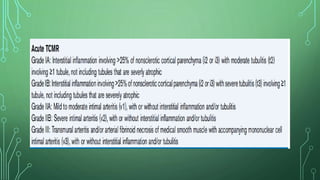
• Diagnosis using Banff criteria requires 3 features to be met
• morphologic changes including microvascular inflammation characterized by
neutrophils and mononuclear cells in glomeruli and peritubular capillaries,
acute tubular injury, thrombotic microangiopathy, or intimal or transmural
arteritis;
• evidence of complement activation by C4d deposition in the peritubular
H/P OF AMR
Histopathology - endothelial injury mediated by
antibodies but is less severe than that seen in
hyperacute
rejections.
endothelial cell swelling neutrophilic infiltration of
glomeruli and peritubular capillaries,
fibrin thrombi, interstitial edema, and
hemorrhage
In a minority of these rejections, ATN may be
the only feature observed
The identification of these AMRs has become
easier with the development of C4d-staining in
biopsies and improved methods
of antibody detection
• Acute ABMR may occur when high-risk, pre-sensitized recipients are transplanted
knowingly.
• In these cases, the recipient is often treated pre transplant (e.g. with plasmapheresis
to reduce the titre of antibody) and with a more intensive immunosuppressive regimen
post transplant.
• If rejection occurs, the antibody binds to HLAs on the endothelium of the glomeruli
and peritubular capillaries in the donor kidney.
• Activation of the microvascular endothelium results in the release of chemokines such
as CCL2 (MCP-1) and CX3CL1 (fractalkine), and cytokines, such as the interleukins 1α
and 8, that recruit leucocytes to the target sites resulting in glomerulitis and
peritubular capillaritis.
• Activation of complement by Ab bound to the microvascular endothelium triggers
further leucocyte recruitment via the chemoattractant complement components C3a
and C5a, while C5b activates the membrane-attack complex that may lead to
endothelial cell apoptosis, necrosis, and detachment from the basement membrane.
• C4d deposition in the peritubular capillaries may occur as a result of complement-
dependent endothelial injury.
• The injured endothelium may also release platelet pro-coagulants, such as VWF, which
may lead to platelet aggregation, thrombosis, and tissue infarction.
TREATMENT OF AMR
• less standardized and less effective.
1. plasmapheresis or immunoadsorption - critical role of DSAs and complement in the pathogenesis
of AMR,it is the fastest way to temporarily remove circulating DSAs and complement from the peripheral
blood.
Despite the efficacy of antibody removal with plasmapheresis, there is no inhibition of active antibody
synthesis and thus there is a risk for significant rebound.
• Adjuvant therapies -in conjunction with plasmapheresis, such as IVIG(100 mg/kg or high dose 2 gm/kg).
enhanced Ab clearance, inhibition of complement, and negative regulatory signals through Fc receptors.
• While plasmapheresis and IVIG aim to remove DSAs, other therapies target the production of new antibodies.
2. Rituximab - Following exposure to donor HLA antigens, CD20-positive lymphocytes present antigens
to helper T cells that release cytokines that allow B cells to differentiate into antibody-secreting plasma
cells.
• Rituximab may inhibit DSA production by depleting CD20- positive B cells.
• Rituximab also downregulates CD40 to inhibit interaction between B and T cells
3.Rescue therapies - eculizumab and bortezomib.
Bortezomib, a proteasome inhibitor.
The physiologic role of a proteasome is to break down misfolded
proteins when tagged by ubiquitin, and bortezomib inhibits this
process, leading to plasma cell apoptosis.
Recent evidence indicates that the use of proteasome inhibitors
may be ineffective in AMR due to rebound repopulation of lymphoid
germinal centers.
4. humanized monoclonal antibody against the IL-6R (tocilizumab)
5. Eculizumab is a humanized monoclonal IgG antibody that binds to
complement protein C5, inhibiting its cleavage to C5a and C5b and
blocking the generation of the terminal complement complex C5bC9
In a study, eculizumab was dosed at 1200 mg immediately prior to
transplantation, 600 mg on postoperative Day 1, and then 900 mg
weekly thereafter for 4 weeks;
patients with persistently high DSA continued treatment (1200 mg at
week 5 and every 2 weeks afterward) until the B flow crossmatch
channel shift fell below 200.
In this study, eculizumab does not appear to affect DSA levels, as the
percentage of patients who developed high levels of DSA
posttransplantation was similar among eculizumab-treated patients
and the control group.
Among patients with high DSA levels and C4d+ staining, significantly
6. C1-INH is a serine protease inhibitor that inactivates both C1r
and C1s
C1-INH regulates proteases in the classical and lectin
complement pathways and has major effects on regulation of the
coagulation cascade as well as vascular permeability and
inflammation by kinins
Berinert® (CSL Behring, Kankakee, IL, USA)84 and Cinryze® (Shire
ViroPharma Inc., Lexington, MA, USA)
7. IgG-degrading enzyme of Streptococcus pyogenes (IdeS)
CHRONIC AMR
• TG (also known as or chronic allograft glomerulopathy)
• Clinically, the manifestations range from asymptomatic in the early stages to having slow
and progressive decline in graft function, nephrotic range proteinuria, hypertension, and
allograft dysfunction in the advanced stages.
• Progression can sometimes be fairly rapid, especially with ongoing acute AMR, resulting
in graft failure within months
• Pre-existing or de novo DSAs deposit on the vascular endothelium, resulting in injury to
glomerular and peritubular capillaries.
• characterized by glomerular mesangial expansion cellular hypertrophy; subendothelial
deposition of fibrillary material; expansion and duplication of the GBM, seen as BM double
contouring or splitting, designated as transplant glomerulopathy; and complement
deposition.
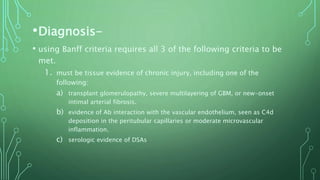
•Diagnosis-
• using Banff criteria requires all 3 of the following criteria to be
met.
1. must be tissue evidence of chronic injury, including one of the
following:
a) transplant glomerulopathy, severe multilayering of GBM, or new-onset
intimal arterial fibrosis.
b) evidence of Ab interaction with the vascular endothelium, seen as C4d
deposition in the peritubular capillaries or moderate microvascular
inflammation.
c) serologic evidence of DSAs
•T/T –
• no clear evidence supporting therapies for CAMR and practice
is based on observational studies and center experience. The
only treatment regimen with some reported success is a
combination of glucocorticoids, IVIG, and rituximab. A 2017
study
• showed that in 36 patients with CAMR for whom who IVIG and
rituximab had failed, tocilizumab, an anti–IL-6 monoclonal
antibody, stabilized kidney function, reduced DSAs, and
improved pathologic markers for CAMR.
• treatment adherence.
TRANSPLANT REJECTION:
T-HELPER CELL PARADIGM
• Acute rejection is thought to be solely an immunological response, whereas chronic rejection
involves both immunologic and non-immunologic mechanisms.
• Allorecognition - processing and presentation of graft Ag (alloantigen)
• two main subtypes: direct and indirect.
• DCs migrating from the graft initiate direct allorecognition, where recipient T cells recognise
allogeneic MHC plus associated peptides directly.
• Later, recipient APCs pick up fragments of donor MHC and present allogeneic peptides to
recipient T cells in association with self-HLA (indirect allorecognition).
• A third subtype, semidirect allorecognition, involving transfer of donor MHC to host cells, has
also been proposed.
• Naïve CD4+ T helper cells (nTh) are one of the first immune cells to be activated post-
transplant, playing a key role in rejection.
• Activated nTh develop into either Th1 (pro-inflammatory) or Th2 (anti-inflammatory) subtypes.
Each subtype orchestrates a characteristic, immune response profile (each being mutually
suppressive).
• In the presence of TGF-β and IL-6, nTh differentiate into Th17 cells, a novel subset of Th cells
that secrete IL-17 whose role in transplant immunology is still unclear.
• A Th1 response is correlated with acute rejection episodes with
the production of pro-inflammatory cytokines – IFNγ, IL-2, IL-
12, TNFα and GM-CSF.
• This cytokine profile activates macrophages, natural killer (NK)
cells and cytotoxic T cells (Tc) which are drawn to the graft.
• Tc attack by releasing perforin, which creates pores in the graft
endothelium; granzymes released from the Tc then enter the
cell, and activate caspases which induce cell apoptosis (cytolytic
granule exocytosis pathway).
• Activated NK cells have a number of effector functions at their disposal:
• cytolytic granule exocytosis, death receptor expression (FASL + TRAIL), ADCC and
cytokine secretion.
• Activated macrophages can orchestrate and maintain a localised pro-inflammatory
response against the graft via cytokine release (IFNγ and IL-12).
• An anti-inflammatory allogenic response predominantly sees a Th2 phenotype,
which has a strong correlation with chronic rejection.
• Th2 cells result in the activation of B cells.
• Cell-to-cell contact and cytokine exchange between both Th2 and B cell is required
for Ab production towards the graft.
• B cells express MHC class II, which present to Th2 cells (indirect), resulting in Th2
activation/proliferation.
• The resultant Th2 cells are specific for the alloantigen presented initially by the B
cell and secrete IL-2 for B-cell proliferation and IL-4 and -5 for Ab class switching.
• The bulk of activated B cells differentiate into Ab secreting plasma cells (mainly IgG
and IgM) with specificity towards the graft.
• Attachment of Ab to the graft endothelium eventually leads to the activation of
complement, resulting in cell lysis.
• Alternatively, B cells develop into memory cells and return to the bone marrow,
developing an immunological memory towards the graft.
PATHOPHYSIOLOGY OF CHRONIC ALLOGRAFT DAMAGE
• HT and proteinuria most important features of declining renal function
• At least 80% pts experience progressive loss of kidney function and start to exhibit
signs of CAN)
• At least 50% pts with renal transplant develop features of CAN within 10 years of their
transplant
• The major pathological features of CAN includes tubular atrophy, fibrous thickening of
the arteries, fibrosis of the kidney interstitium, and glomerulosclerosis
• Transplant vasculopathy is single most important feature of chronic renal transplant
rejection
• Vasculopathy not only affects the large arteries but can also involve small PTC
• thickening of the fibrointima of the blood vessels, infiltration of the vessel walls with
inflammatory cells, and breaks in the elastic layer of blood vessels.
• The subendothelial accumulation of smooth muscles in transplant vasculopathy was
previously thought to be the result of migration of donor myofibroblasts from the
media of the adjacent blood vessels.
• Transplant glomerulopathy - wrinkling of the glomerular tuft of
capillaries, focal glomerulosclerosis, hypertrophy of the
glomeruli, and expansion of the mesangial matrix
• can be distinguished from other forms of glomerulopathy like
MPGN, based on the results of electron and immune-
fluorescence testing.
• MPGN is characterized by electron-dense deposits, whereas the
deposits seen in transplant glomerulopathy are electron lucent.
• Moreover, the immune deposits seen in MPGN patients are
predominantly C3, whereas the main type of deposits in
patients with transplant glomerulopathy is of the IgM type
• Alloantigen-dependent and -independent factors act together to
initiate inflammatory reactions that eventually lead to tissue damage
with a loss of nephrons in the graft followed by fibrosis and tubular
atrophy (TA).
• This leads to graft dysfunction and eventually graft failure
• Alloantigen-independent factors such as age, gender, weight,
metabolic derangements, arterial hypertension, infections, CNI
cytotoxicity, genetic factors, brain death of the donor or
ischaemia/reperfusion (I/R) injury together with alloantigen-
dependent factors such as rejections, HLA mismatch or donor-
specific antibodies can influence the development of chronic graft
damage
• Initial damaging insults on the graft –
• An initial damaging insult on the graft tissue is mediated
through I/R or even before transplantation through the
cytokine release during the development of brain death
• This could cause an acute inflammation that further develops
into chronic inflammatory processes eventually leading to
chronic graft damage with graft dysfunction or even a complete
loss of function
• Furthermore, the disease or trauma responsible for the death of
the donor could have also induced graft damage either directly
or through a period of poor perfusion or oxygenation,
respectively, that could translate into acute/chronic
inflammatory processes within the graft after transplantation
• I/R injury as a consequence of the organ transfer from the donor to the
recipient can directly initiate graft damage by apoptosis/necrosis of renal
cells and inflammatory reactions
• In rat experiments, both I/R and mere surgery were proven to cause
damage to the grafted organ, resulting in a reduced graft survival
• I/R injury has also been shown to result in progressive fibrosis of renal
tissue and could be a link between alloantigen-independent damage and
alloantigen-dependent graft damage, thus, contributing to graft damage
also by the initiation of graft rejections
• Renal cells, particularly, tubular and endothelial cells become activated
after I/R and express MHC class II molecules after I/R ,which make them
more susceptible for alloantigen recognition and, thus, T-cell activation.
• Furthermore, molecules such as decay accelerating factor (DAF), which
protect cells from antibody binding, cannot be produced any longer
• Thus, cells are prone not only to recognition by T-cells but also to
antibody mediated damage.
• first event is the I/R due to transplantation itself.
• kidney mass transplanted does not equal the mass of one
healthy kidney, but is reduced depending on age, body weight,
cause of death and gender of the donor as well as tissue
damage in the wake of I/R and surgery.
• workload on the remaining nephrons is increased and
angiogenic hormones are produced.
• To initiate this production, a certain level of hypoxia is needed.
• This induces the production of vessels to facilitate the
transport of enough oxygen to the tubular system.
• Once a sufficient number of vessels have been formed, the
blood supply may be enough for the work needed and no
• This is a period of calmness within the graft.
• However, every infection or a very high uptake of proteins will
stimulate ischaemia anew.
• At a certain level, the supply of oxygen will not be sufficient any
longer for the tubular cells, at which stage a permanent activation of
the system will be present.
• This induces a vicious cycle of tubular activation, glomerular sclerosis
and alloantigen presentation, inflammation and TA/ IF, which is the
most likely order of events to cause chronic allograft damage.
• Following episodes of infection, mostly MHC class II molecules are
expressed while DAF-like molecules are still produced
• Under these circumstances, a T-cell-mediated rejection is likely to
occur.
• However, in isografts, albeit evident, this damage was not sufficient
to significantly reduce the lifespan of the grafts. Thus, it cannot be
•Reduced nephron mass
• in an animal model of kidney transplantation, nephron mass reduction and
kidney and animal survival were significantly reduced
• Differences in nephron mass of the graft in relation to the requirements of
the recipient could also explain differences in graft outcome with respect to
gender or donor/recipient age.
• The speed of chronic graft damage is somewhat similar to a 5/6
nephrectomy.
• One explanation may be the long-term consequences of episodes of acute
rejection with the initiation of chronic, also alloantigen-independent,
inflammatory processes.
• However, this falls short, as in all retrospective as well as in prospective
studies, the actual GFR predicts long-term survival, and, even under optimal
circumstances, this calculated survival is shorter than that of a living donor.
• Of course, this difference may be due to the fact that a living donor is
healthy while there is always a disease-causing kidney failure.
• ABMR considered to be a major force behind chronic graft deterioration.
• This is obviously true for vascular or accelerated forms of rejection where Ab are the primary cause of
almost immediate graft destruction
• However, antibody binding must not necessarily be harmful for the graft tissue.
• From experiments in xenotransplantation, we learnt that once the first period after transplantation is over
the mere presence of Ab against donor Ag does not predict graft outcome
• Antibody binding was detected in the graft which had even protective effects, which was named
accommodation.
• Even in living donation where the initial cross-match between a donor and a recipient was positive, when the
Ab had been removed and the first period was over, there was no evidence of an ongoing graft destruction
even in the presence of DSA.
• In some cases, the cross-match turned positive and there was still no sign of rejection
• In AB0-incompatible transplantation, basically all grafts stain positive for C4d without any other sign of
rejection and these grafts seem to last even longer than standard living grafts
• However, antibodies against isoagglutinines may have properties different from HLAspecific ones and the
recipients may be better monitored than the standard recipient.
• Even longer times after transplantation, mechanisms such as CMV, polyoma BK virus or bacterial infections
as well as non-compliance or withdrawal of immunosuppression exist that trigger rejection episodes and
lead to the generation of alloantibodies
• Therefore, a possible explanation for chronic alloantigen dependent graft damage would be a series of
rejection episodes
• Drug toxicity
• side effects of CNIs were accused of causing chronic allograft
damage
• At present, it cannot be distinguished between direct toxic
effects of the drugs and indirect effects such as HTN or
diabetes.
• in animal models, the changes appear even without the
presence of CNIs or any other drugs.
• Role for CNIs in the development of chronic graft damage is not
entirely clear, although some patients exist who have
substantial CNI toxicity with the respective consequences
regarding chronic graft damage
• Infections
• can induce rejection reactions
• can also independently induce graft damage.
• Repetitive UTI also with an accompanying PN of the graft may be harmful to long-term graft
proteinuria.
• Tubular cells of this nephron markedly enlarge to recover these proteins
• However, the fewer glomeruli that are available, the more enlarged the tubular system, and
the more pressure and blood flow is needed to supply the tubuli with oxygen.
• At a certain point, the tubular system is not able to recover all proteins in the urine anymore.
• At this point, proteinuria becomes overt, causing inflammatory processes in the glomeruli
and the interstitium, promoting glomerulosclerosis, IF and TA.
• Glomerular hyperfiltration contributing to the progressive loss of graft function is
proteinuria.
• However, reasons other than glomerular hyperfiltration for the development of significant
proteinuria in patients after renal transplantation must exist as patients with a single kidney
(i.e. living related kidney graft donors) do not necessarily develop chronic overt proteinuria.
• In living donors as well as in animal experiments, the loss of one kidney has no major impact
on overall survival
• Here, chronic antibodymediated rejections could play an important role for the development
of proteinuria. An association exists between the presence of donor-specific
• Dendritic cells are located around the tubular cells and process
all antigens present in the interstitium.
• In severe proteinuria, antigens enter the interstitium, which are
not present in the normal urine as they are too small to pass
the GBM.
• Once GBM is damaged, macromolecules enter the urine, are
back-filtered and presented in the interstitium.
• These antigens together with additional alloantigens may
activate DC and in the following cascade of events may trigger
a rejection
• In the development of chronic allograft damage, a combination
of initial insults together with continuously repeating (i.e. acute
rejections, infections) or lasting insults (i.e. donor-specific
antibody) will lead to chronic graft damage
• Altogether, a combination of alloantigen-dependent and -
independent factors on the basis of a reduced nephron mass
together with the failure of protection against antibodies
results in chronic allograft damage.
• overall pathways involved in development of fibrosis and tissue remodeling in
transplanted kidneys - TGF-ß play an important role in development of fibrosis in native
kidney disease
• However, it is well known that TGF-ß has both immunosuppressive and profibrotic
properties, and while the tolerance and immunosuppressive aspects of TGF-ß
production are desirable in transplantation, the remodeling and fibrosing are damaging.
• Recent data has shown that anti TGF-ß antibody in high doses can abrogate long-term
allograft survival induced by cyclosporine administration in a cardiac rat transplant
model, indicating the importance of TGF-ß in mediating the immunosuppressive
properties of cyclosporine.
• In the same model both high and low doses of anti–TGF-ß antibodies prevent
cyclosporine-related fibrotic renal injury.
• TGF-ß has also been shown to be crucial in the regulation of transplantation and other
forms of tolerance.
• Regulation of TGF-ß associated fibrosis has been achieved by a variety of inhibitors that
inhibit TGF-ß expression or signaling, including, decorin, pirfenidone, relaxin, and bone
morphogenetic protein-7 (Bmp7), or by agents that interfere with TGF-ß associated
profibrotic pathways including angiotensin II, endothelin-1, and connective tissue
growth factor (CTGF)
• Prevention of chronic allograft nephropathy –
• reduction or elimination of CNI-based immunosuppression protocols.
• use of IL-2R anti-B serum with MMF and steroids
• substitution of CNIs with mTOR inhibitors everolimus and sirolimus
• use of belatacept, a modified CTLA4-Ig fusion protein that blocks T
cell CD28 costimulation.
• However, because multiple factors have been shown to contribute to
the development of CAN, it is unlikely that the modification of one
cause of CAN, such as CNI-associated toxicity, will result in a
complete solution to this problem.
• Recently there has been growing evidence that the humoral response
plays an important role in the development of CAN.
EXPERIMENTAL OR FUTURE APPROACHES
• reduce the production or action of alloantibodies within the graft include - inhibition of Bcell proliferation by the
BAFF inhibitor
• reduction of plasma cells by proteasome inhibitors and the reduction of the antibody effects by the inhibition of the
complement cascade
• While bortezumib has been used in small observational patient series in acute ABMR, there are no observations so far
in chronic antibody-mediated rejection.
• Theoretically, it would also be possible to directly influence the process of fibrosis in the graft.
• 2 potential therapeutic options - effects of sex hormones and the effects of MPs that are important for the process of
interstitial matrix turnover.
• While estrogens cause beneficial effects, testosterone promotes the process of chronic graft damage.
• Dihydroandrosterone (DHT), a derivative of progesterone and testosterone, is likely to play a key role
• The level of DHT is correlated with the level of fibrosis and interventions aimed to reduce DHT levels ameliorate IF
• As a second option, a timely limited inhibition of MPs during the immediate period after transplantation significantly
ameliorated graft fibrosis
• Interestingly, a later MP inhibition remarkably increased chronic graft damage.
• This demonstrates that the time point of a specific intervention is crucial for its effects on chronic graft damage.
• However, as these findings are based on animal experiments, it is impossible to adapt them directly into a clinical
situation and, moreover, it is not clear what effects an inhibition of DHT or MPs would have in humans
TRANSPLANT REJECTION: T-HELPER CELL PARADIGM Transplant rejection:
T-helper cell paradigm
Summary of transplant rejection mechanisms
NEWER EMERGING THERAPY IN RENAL TRANSPLANT
TAKE HOME MESSAGE
• Fundamentally “fire storm” of allograft rejection doesn’t occur
in absence of T cell mediated immune response
• Innate immune response against tissue injury( such as
ischaemia) augments Ag specific immune response.
• Most striking difference between Allogenic Vs Conventional Ag
response – marked increased frequency of responding T cells in
allogenic response
• Because recipient T cells recognize intact allogenic MHC
molecules directly, they are stimulated maximally by high
density of MHC on the surface of Transplant cells
• Anti Class I ( HLA-A, HLA-B, HLA-C) reacts with both B & T
cells, but anti Class II only with B cells
• Poor long term outcome – 1 AR vs >1 AR (34.8% vs 8.9%)
• Single Late (>3mnth )AR vs early (<3 mnth) – RR of Allograft
failure 5.27 vs 3.07
• ICOS – Costimulatory pathway bind B7h, not constituitively
expressed, but CD 28 bind B7-1 & B7-2(CD 80-86)
constituitively expressed on all CD 4 & 50% of CD 8 peripheral
T Lymphocytes
THANK YOU

Abmr

  • 1.
    MANAGING ABMR PATHOPHYSIOLOGY OFCHRONIC REJECTION NEWER DRUGS IN TRANSPLANT BY DR MONIKA RESIDENT – DM NEPHROLOGY, SAVEETHA MEDICAL COLLEGE MD, MEDICINE FELLOWSHIP IN DIALYSIS, BMJ- FORTIS FELLOWSHIP IN DIALYSIS, MEDVERSITY, APOLLO INDRAPRASHTHA DELHI PGDGM
  • 2.
    • Rejection mayoccur at any time following transplantation • Hyperacute - occurs within minutes of surgery • Acute - occurs within days or months of the transplant • Chronic - occurs months to years after transplantation. • Rejection can be further classified as T-cell mediated, or ‘cellular’, and antibody mediated, or ‘humoral’, both of which forms can occur simultaneously.
  • 3.
    Certain factors correlatewith an increased risk of rejection of the renal allograft after the transplantation. • Prior sensitization - high panel reactive antibodies • Type of transplant: Deceased donor has a higher rejection than a living transplant • Advanced age of the donor • Prolonged cold ischemia time • HLA mismatch • Positive B cell crossmatch • ABO incompatibility • Recipient’s age: Younger recipients have more rejection than older ones • Recipient’s race: African American race greater than White race • Delayed Graft function • Therapy non-compliance • Previous episodes of rejections • Inadequate immunosuppression
  • 5.
    • HYPERACUTE -histopathology is characterized by features of severe endothelial and arterial injury manifested as arteritis(often transmural), interstitial edema, and severe cortical necrosis, with almost all cases requiring allograft nephrectomy
  • 6.
    ACUTE ANTIBODY-MEDIATED REJECTION (AMR) •Occurs within the 1st weeks to years after Tx. • most common mechanism – anamnestic Ab response that results from prior antigenic exposure such as pregnancy, blood transfusions, or prior transplants. • Through both complement-mediated and independent mechanisms, the interaction of these antibodies with the vascular endothelium results in cell death, loss of vascular integrity, and subsequent ischemic injury. • Diagnosis using Banff criteria requires 3 features to be met • morphologic changes including microvascular inflammation characterized by neutrophils and mononuclear cells in glomeruli and peritubular capillaries, acute tubular injury, thrombotic microangiopathy, or intimal or transmural arteritis; • evidence of complement activation by C4d deposition in the peritubular
  • 10.
    H/P OF AMR Histopathology- endothelial injury mediated by antibodies but is less severe than that seen in hyperacute rejections. endothelial cell swelling neutrophilic infiltration of glomeruli and peritubular capillaries, fibrin thrombi, interstitial edema, and hemorrhage In a minority of these rejections, ATN may be the only feature observed The identification of these AMRs has become easier with the development of C4d-staining in biopsies and improved methods of antibody detection
  • 11.
    • Acute ABMRmay occur when high-risk, pre-sensitized recipients are transplanted knowingly. • In these cases, the recipient is often treated pre transplant (e.g. with plasmapheresis to reduce the titre of antibody) and with a more intensive immunosuppressive regimen post transplant. • If rejection occurs, the antibody binds to HLAs on the endothelium of the glomeruli and peritubular capillaries in the donor kidney. • Activation of the microvascular endothelium results in the release of chemokines such as CCL2 (MCP-1) and CX3CL1 (fractalkine), and cytokines, such as the interleukins 1α and 8, that recruit leucocytes to the target sites resulting in glomerulitis and peritubular capillaritis. • Activation of complement by Ab bound to the microvascular endothelium triggers further leucocyte recruitment via the chemoattractant complement components C3a and C5a, while C5b activates the membrane-attack complex that may lead to endothelial cell apoptosis, necrosis, and detachment from the basement membrane. • C4d deposition in the peritubular capillaries may occur as a result of complement- dependent endothelial injury. • The injured endothelium may also release platelet pro-coagulants, such as VWF, which may lead to platelet aggregation, thrombosis, and tissue infarction.
  • 14.
    TREATMENT OF AMR •less standardized and less effective. 1. plasmapheresis or immunoadsorption - critical role of DSAs and complement in the pathogenesis of AMR,it is the fastest way to temporarily remove circulating DSAs and complement from the peripheral blood. Despite the efficacy of antibody removal with plasmapheresis, there is no inhibition of active antibody synthesis and thus there is a risk for significant rebound. • Adjuvant therapies -in conjunction with plasmapheresis, such as IVIG(100 mg/kg or high dose 2 gm/kg). enhanced Ab clearance, inhibition of complement, and negative regulatory signals through Fc receptors. • While plasmapheresis and IVIG aim to remove DSAs, other therapies target the production of new antibodies. 2. Rituximab - Following exposure to donor HLA antigens, CD20-positive lymphocytes present antigens to helper T cells that release cytokines that allow B cells to differentiate into antibody-secreting plasma cells. • Rituximab may inhibit DSA production by depleting CD20- positive B cells. • Rituximab also downregulates CD40 to inhibit interaction between B and T cells
  • 15.
    3.Rescue therapies -eculizumab and bortezomib. Bortezomib, a proteasome inhibitor. The physiologic role of a proteasome is to break down misfolded proteins when tagged by ubiquitin, and bortezomib inhibits this process, leading to plasma cell apoptosis. Recent evidence indicates that the use of proteasome inhibitors may be ineffective in AMR due to rebound repopulation of lymphoid germinal centers.
  • 16.
    4. humanized monoclonalantibody against the IL-6R (tocilizumab) 5. Eculizumab is a humanized monoclonal IgG antibody that binds to complement protein C5, inhibiting its cleavage to C5a and C5b and blocking the generation of the terminal complement complex C5bC9 In a study, eculizumab was dosed at 1200 mg immediately prior to transplantation, 600 mg on postoperative Day 1, and then 900 mg weekly thereafter for 4 weeks; patients with persistently high DSA continued treatment (1200 mg at week 5 and every 2 weeks afterward) until the B flow crossmatch channel shift fell below 200. In this study, eculizumab does not appear to affect DSA levels, as the percentage of patients who developed high levels of DSA posttransplantation was similar among eculizumab-treated patients and the control group. Among patients with high DSA levels and C4d+ staining, significantly
  • 17.
    6. C1-INH isa serine protease inhibitor that inactivates both C1r and C1s C1-INH regulates proteases in the classical and lectin complement pathways and has major effects on regulation of the coagulation cascade as well as vascular permeability and inflammation by kinins Berinert® (CSL Behring, Kankakee, IL, USA)84 and Cinryze® (Shire ViroPharma Inc., Lexington, MA, USA) 7. IgG-degrading enzyme of Streptococcus pyogenes (IdeS)
  • 18.
    CHRONIC AMR • TG(also known as or chronic allograft glomerulopathy) • Clinically, the manifestations range from asymptomatic in the early stages to having slow and progressive decline in graft function, nephrotic range proteinuria, hypertension, and allograft dysfunction in the advanced stages. • Progression can sometimes be fairly rapid, especially with ongoing acute AMR, resulting in graft failure within months • Pre-existing or de novo DSAs deposit on the vascular endothelium, resulting in injury to glomerular and peritubular capillaries. • characterized by glomerular mesangial expansion cellular hypertrophy; subendothelial deposition of fibrillary material; expansion and duplication of the GBM, seen as BM double contouring or splitting, designated as transplant glomerulopathy; and complement deposition.
  • 19.
    •Diagnosis- • using Banffcriteria requires all 3 of the following criteria to be met. 1. must be tissue evidence of chronic injury, including one of the following: a) transplant glomerulopathy, severe multilayering of GBM, or new-onset intimal arterial fibrosis. b) evidence of Ab interaction with the vascular endothelium, seen as C4d deposition in the peritubular capillaries or moderate microvascular inflammation. c) serologic evidence of DSAs
  • 20.
    •T/T – • noclear evidence supporting therapies for CAMR and practice is based on observational studies and center experience. The only treatment regimen with some reported success is a combination of glucocorticoids, IVIG, and rituximab. A 2017 study • showed that in 36 patients with CAMR for whom who IVIG and rituximab had failed, tocilizumab, an anti–IL-6 monoclonal antibody, stabilized kidney function, reduced DSAs, and improved pathologic markers for CAMR. • treatment adherence.
  • 21.
    TRANSPLANT REJECTION: T-HELPER CELLPARADIGM • Acute rejection is thought to be solely an immunological response, whereas chronic rejection involves both immunologic and non-immunologic mechanisms. • Allorecognition - processing and presentation of graft Ag (alloantigen) • two main subtypes: direct and indirect. • DCs migrating from the graft initiate direct allorecognition, where recipient T cells recognise allogeneic MHC plus associated peptides directly. • Later, recipient APCs pick up fragments of donor MHC and present allogeneic peptides to recipient T cells in association with self-HLA (indirect allorecognition). • A third subtype, semidirect allorecognition, involving transfer of donor MHC to host cells, has also been proposed. • Naïve CD4+ T helper cells (nTh) are one of the first immune cells to be activated post- transplant, playing a key role in rejection. • Activated nTh develop into either Th1 (pro-inflammatory) or Th2 (anti-inflammatory) subtypes. Each subtype orchestrates a characteristic, immune response profile (each being mutually suppressive). • In the presence of TGF-β and IL-6, nTh differentiate into Th17 cells, a novel subset of Th cells that secrete IL-17 whose role in transplant immunology is still unclear.
  • 23.
    • A Th1response is correlated with acute rejection episodes with the production of pro-inflammatory cytokines – IFNγ, IL-2, IL- 12, TNFα and GM-CSF. • This cytokine profile activates macrophages, natural killer (NK) cells and cytotoxic T cells (Tc) which are drawn to the graft. • Tc attack by releasing perforin, which creates pores in the graft endothelium; granzymes released from the Tc then enter the cell, and activate caspases which induce cell apoptosis (cytolytic granule exocytosis pathway).
  • 24.
    • Activated NKcells have a number of effector functions at their disposal: • cytolytic granule exocytosis, death receptor expression (FASL + TRAIL), ADCC and cytokine secretion. • Activated macrophages can orchestrate and maintain a localised pro-inflammatory response against the graft via cytokine release (IFNγ and IL-12). • An anti-inflammatory allogenic response predominantly sees a Th2 phenotype, which has a strong correlation with chronic rejection. • Th2 cells result in the activation of B cells. • Cell-to-cell contact and cytokine exchange between both Th2 and B cell is required for Ab production towards the graft. • B cells express MHC class II, which present to Th2 cells (indirect), resulting in Th2 activation/proliferation. • The resultant Th2 cells are specific for the alloantigen presented initially by the B cell and secrete IL-2 for B-cell proliferation and IL-4 and -5 for Ab class switching. • The bulk of activated B cells differentiate into Ab secreting plasma cells (mainly IgG and IgM) with specificity towards the graft. • Attachment of Ab to the graft endothelium eventually leads to the activation of complement, resulting in cell lysis. • Alternatively, B cells develop into memory cells and return to the bone marrow, developing an immunological memory towards the graft.
  • 26.
    PATHOPHYSIOLOGY OF CHRONICALLOGRAFT DAMAGE • HT and proteinuria most important features of declining renal function • At least 80% pts experience progressive loss of kidney function and start to exhibit signs of CAN) • At least 50% pts with renal transplant develop features of CAN within 10 years of their transplant • The major pathological features of CAN includes tubular atrophy, fibrous thickening of the arteries, fibrosis of the kidney interstitium, and glomerulosclerosis • Transplant vasculopathy is single most important feature of chronic renal transplant rejection • Vasculopathy not only affects the large arteries but can also involve small PTC • thickening of the fibrointima of the blood vessels, infiltration of the vessel walls with inflammatory cells, and breaks in the elastic layer of blood vessels. • The subendothelial accumulation of smooth muscles in transplant vasculopathy was previously thought to be the result of migration of donor myofibroblasts from the media of the adjacent blood vessels.
  • 27.
    • Transplant glomerulopathy- wrinkling of the glomerular tuft of capillaries, focal glomerulosclerosis, hypertrophy of the glomeruli, and expansion of the mesangial matrix • can be distinguished from other forms of glomerulopathy like MPGN, based on the results of electron and immune- fluorescence testing. • MPGN is characterized by electron-dense deposits, whereas the deposits seen in transplant glomerulopathy are electron lucent. • Moreover, the immune deposits seen in MPGN patients are predominantly C3, whereas the main type of deposits in patients with transplant glomerulopathy is of the IgM type
  • 33.
    • Alloantigen-dependent and-independent factors act together to initiate inflammatory reactions that eventually lead to tissue damage with a loss of nephrons in the graft followed by fibrosis and tubular atrophy (TA). • This leads to graft dysfunction and eventually graft failure • Alloantigen-independent factors such as age, gender, weight, metabolic derangements, arterial hypertension, infections, CNI cytotoxicity, genetic factors, brain death of the donor or ischaemia/reperfusion (I/R) injury together with alloantigen- dependent factors such as rejections, HLA mismatch or donor- specific antibodies can influence the development of chronic graft damage
  • 34.
    • Initial damaginginsults on the graft – • An initial damaging insult on the graft tissue is mediated through I/R or even before transplantation through the cytokine release during the development of brain death • This could cause an acute inflammation that further develops into chronic inflammatory processes eventually leading to chronic graft damage with graft dysfunction or even a complete loss of function • Furthermore, the disease or trauma responsible for the death of the donor could have also induced graft damage either directly or through a period of poor perfusion or oxygenation, respectively, that could translate into acute/chronic inflammatory processes within the graft after transplantation
  • 35.
    • I/R injuryas a consequence of the organ transfer from the donor to the recipient can directly initiate graft damage by apoptosis/necrosis of renal cells and inflammatory reactions • In rat experiments, both I/R and mere surgery were proven to cause damage to the grafted organ, resulting in a reduced graft survival • I/R injury has also been shown to result in progressive fibrosis of renal tissue and could be a link between alloantigen-independent damage and alloantigen-dependent graft damage, thus, contributing to graft damage also by the initiation of graft rejections • Renal cells, particularly, tubular and endothelial cells become activated after I/R and express MHC class II molecules after I/R ,which make them more susceptible for alloantigen recognition and, thus, T-cell activation. • Furthermore, molecules such as decay accelerating factor (DAF), which protect cells from antibody binding, cannot be produced any longer • Thus, cells are prone not only to recognition by T-cells but also to antibody mediated damage.
  • 36.
    • first eventis the I/R due to transplantation itself. • kidney mass transplanted does not equal the mass of one healthy kidney, but is reduced depending on age, body weight, cause of death and gender of the donor as well as tissue damage in the wake of I/R and surgery. • workload on the remaining nephrons is increased and angiogenic hormones are produced. • To initiate this production, a certain level of hypoxia is needed. • This induces the production of vessels to facilitate the transport of enough oxygen to the tubular system. • Once a sufficient number of vessels have been formed, the blood supply may be enough for the work needed and no
  • 37.
    • This isa period of calmness within the graft. • However, every infection or a very high uptake of proteins will stimulate ischaemia anew. • At a certain level, the supply of oxygen will not be sufficient any longer for the tubular cells, at which stage a permanent activation of the system will be present. • This induces a vicious cycle of tubular activation, glomerular sclerosis and alloantigen presentation, inflammation and TA/ IF, which is the most likely order of events to cause chronic allograft damage. • Following episodes of infection, mostly MHC class II molecules are expressed while DAF-like molecules are still produced • Under these circumstances, a T-cell-mediated rejection is likely to occur. • However, in isografts, albeit evident, this damage was not sufficient to significantly reduce the lifespan of the grafts. Thus, it cannot be
  • 38.
    •Reduced nephron mass •in an animal model of kidney transplantation, nephron mass reduction and kidney and animal survival were significantly reduced • Differences in nephron mass of the graft in relation to the requirements of the recipient could also explain differences in graft outcome with respect to gender or donor/recipient age. • The speed of chronic graft damage is somewhat similar to a 5/6 nephrectomy. • One explanation may be the long-term consequences of episodes of acute rejection with the initiation of chronic, also alloantigen-independent, inflammatory processes. • However, this falls short, as in all retrospective as well as in prospective studies, the actual GFR predicts long-term survival, and, even under optimal circumstances, this calculated survival is shorter than that of a living donor. • Of course, this difference may be due to the fact that a living donor is healthy while there is always a disease-causing kidney failure.
  • 39.
    • ABMR consideredto be a major force behind chronic graft deterioration. • This is obviously true for vascular or accelerated forms of rejection where Ab are the primary cause of almost immediate graft destruction • However, antibody binding must not necessarily be harmful for the graft tissue. • From experiments in xenotransplantation, we learnt that once the first period after transplantation is over the mere presence of Ab against donor Ag does not predict graft outcome • Antibody binding was detected in the graft which had even protective effects, which was named accommodation. • Even in living donation where the initial cross-match between a donor and a recipient was positive, when the Ab had been removed and the first period was over, there was no evidence of an ongoing graft destruction even in the presence of DSA. • In some cases, the cross-match turned positive and there was still no sign of rejection • In AB0-incompatible transplantation, basically all grafts stain positive for C4d without any other sign of rejection and these grafts seem to last even longer than standard living grafts • However, antibodies against isoagglutinines may have properties different from HLAspecific ones and the recipients may be better monitored than the standard recipient. • Even longer times after transplantation, mechanisms such as CMV, polyoma BK virus or bacterial infections as well as non-compliance or withdrawal of immunosuppression exist that trigger rejection episodes and lead to the generation of alloantibodies • Therefore, a possible explanation for chronic alloantigen dependent graft damage would be a series of rejection episodes
  • 41.
    • Drug toxicity •side effects of CNIs were accused of causing chronic allograft damage • At present, it cannot be distinguished between direct toxic effects of the drugs and indirect effects such as HTN or diabetes. • in animal models, the changes appear even without the presence of CNIs or any other drugs. • Role for CNIs in the development of chronic graft damage is not entirely clear, although some patients exist who have substantial CNI toxicity with the respective consequences regarding chronic graft damage
  • 42.
    • Infections • caninduce rejection reactions • can also independently induce graft damage. • Repetitive UTI also with an accompanying PN of the graft may be harmful to long-term graft proteinuria. • Tubular cells of this nephron markedly enlarge to recover these proteins • However, the fewer glomeruli that are available, the more enlarged the tubular system, and the more pressure and blood flow is needed to supply the tubuli with oxygen. • At a certain point, the tubular system is not able to recover all proteins in the urine anymore. • At this point, proteinuria becomes overt, causing inflammatory processes in the glomeruli and the interstitium, promoting glomerulosclerosis, IF and TA. • Glomerular hyperfiltration contributing to the progressive loss of graft function is proteinuria. • However, reasons other than glomerular hyperfiltration for the development of significant proteinuria in patients after renal transplantation must exist as patients with a single kidney (i.e. living related kidney graft donors) do not necessarily develop chronic overt proteinuria. • In living donors as well as in animal experiments, the loss of one kidney has no major impact on overall survival • Here, chronic antibodymediated rejections could play an important role for the development of proteinuria. An association exists between the presence of donor-specific
  • 43.
    • Dendritic cellsare located around the tubular cells and process all antigens present in the interstitium. • In severe proteinuria, antigens enter the interstitium, which are not present in the normal urine as they are too small to pass the GBM. • Once GBM is damaged, macromolecules enter the urine, are back-filtered and presented in the interstitium. • These antigens together with additional alloantigens may activate DC and in the following cascade of events may trigger a rejection
  • 44.
    • In thedevelopment of chronic allograft damage, a combination of initial insults together with continuously repeating (i.e. acute rejections, infections) or lasting insults (i.e. donor-specific antibody) will lead to chronic graft damage • Altogether, a combination of alloantigen-dependent and - independent factors on the basis of a reduced nephron mass together with the failure of protection against antibodies results in chronic allograft damage.
  • 45.
    • overall pathwaysinvolved in development of fibrosis and tissue remodeling in transplanted kidneys - TGF-ß play an important role in development of fibrosis in native kidney disease • However, it is well known that TGF-ß has both immunosuppressive and profibrotic properties, and while the tolerance and immunosuppressive aspects of TGF-ß production are desirable in transplantation, the remodeling and fibrosing are damaging. • Recent data has shown that anti TGF-ß antibody in high doses can abrogate long-term allograft survival induced by cyclosporine administration in a cardiac rat transplant model, indicating the importance of TGF-ß in mediating the immunosuppressive properties of cyclosporine. • In the same model both high and low doses of anti–TGF-ß antibodies prevent cyclosporine-related fibrotic renal injury. • TGF-ß has also been shown to be crucial in the regulation of transplantation and other forms of tolerance. • Regulation of TGF-ß associated fibrosis has been achieved by a variety of inhibitors that inhibit TGF-ß expression or signaling, including, decorin, pirfenidone, relaxin, and bone morphogenetic protein-7 (Bmp7), or by agents that interfere with TGF-ß associated profibrotic pathways including angiotensin II, endothelin-1, and connective tissue growth factor (CTGF)
  • 46.
    • Prevention ofchronic allograft nephropathy – • reduction or elimination of CNI-based immunosuppression protocols. • use of IL-2R anti-B serum with MMF and steroids • substitution of CNIs with mTOR inhibitors everolimus and sirolimus • use of belatacept, a modified CTLA4-Ig fusion protein that blocks T cell CD28 costimulation. • However, because multiple factors have been shown to contribute to the development of CAN, it is unlikely that the modification of one cause of CAN, such as CNI-associated toxicity, will result in a complete solution to this problem. • Recently there has been growing evidence that the humoral response plays an important role in the development of CAN.
  • 47.
    EXPERIMENTAL OR FUTUREAPPROACHES • reduce the production or action of alloantibodies within the graft include - inhibition of Bcell proliferation by the BAFF inhibitor • reduction of plasma cells by proteasome inhibitors and the reduction of the antibody effects by the inhibition of the complement cascade • While bortezumib has been used in small observational patient series in acute ABMR, there are no observations so far in chronic antibody-mediated rejection. • Theoretically, it would also be possible to directly influence the process of fibrosis in the graft. • 2 potential therapeutic options - effects of sex hormones and the effects of MPs that are important for the process of interstitial matrix turnover. • While estrogens cause beneficial effects, testosterone promotes the process of chronic graft damage. • Dihydroandrosterone (DHT), a derivative of progesterone and testosterone, is likely to play a key role • The level of DHT is correlated with the level of fibrosis and interventions aimed to reduce DHT levels ameliorate IF • As a second option, a timely limited inhibition of MPs during the immediate period after transplantation significantly ameliorated graft fibrosis • Interestingly, a later MP inhibition remarkably increased chronic graft damage. • This demonstrates that the time point of a specific intervention is crucial for its effects on chronic graft damage. • However, as these findings are based on animal experiments, it is impossible to adapt them directly into a clinical situation and, moreover, it is not clear what effects an inhibition of DHT or MPs would have in humans
  • 48.
    TRANSPLANT REJECTION: T-HELPERCELL PARADIGM Transplant rejection: T-helper cell paradigm Summary of transplant rejection mechanisms
  • 50.
    NEWER EMERGING THERAPYIN RENAL TRANSPLANT
  • 54.
    TAKE HOME MESSAGE •Fundamentally “fire storm” of allograft rejection doesn’t occur in absence of T cell mediated immune response • Innate immune response against tissue injury( such as ischaemia) augments Ag specific immune response. • Most striking difference between Allogenic Vs Conventional Ag response – marked increased frequency of responding T cells in allogenic response • Because recipient T cells recognize intact allogenic MHC molecules directly, they are stimulated maximally by high density of MHC on the surface of Transplant cells
  • 55.
    • Anti ClassI ( HLA-A, HLA-B, HLA-C) reacts with both B & T cells, but anti Class II only with B cells • Poor long term outcome – 1 AR vs >1 AR (34.8% vs 8.9%) • Single Late (>3mnth )AR vs early (<3 mnth) – RR of Allograft failure 5.27 vs 3.07 • ICOS – Costimulatory pathway bind B7h, not constituitively expressed, but CD 28 bind B7-1 & B7-2(CD 80-86) constituitively expressed on all CD 4 & 50% of CD 8 peripheral T Lymphocytes
  • 56.