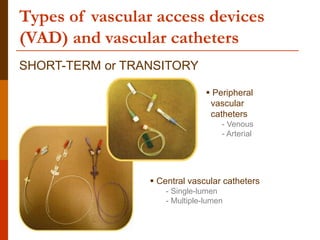
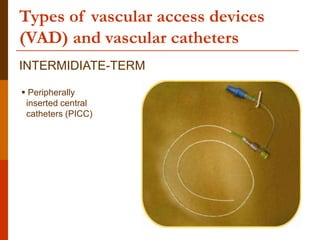
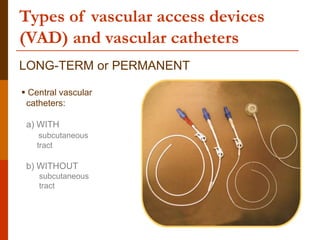
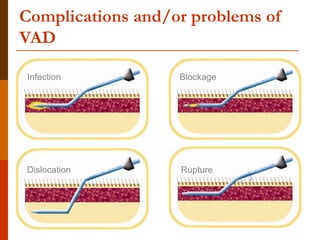
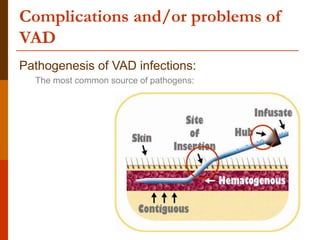
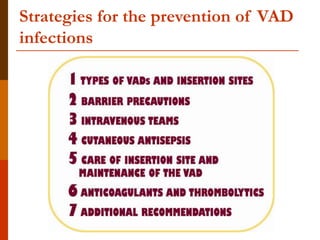
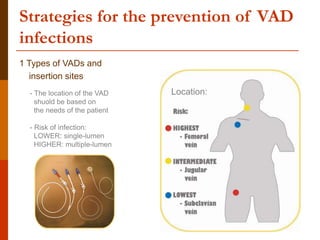
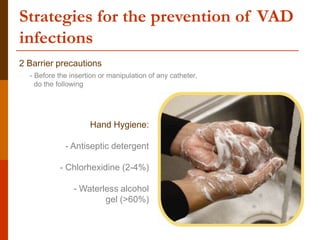
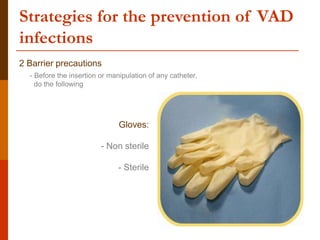
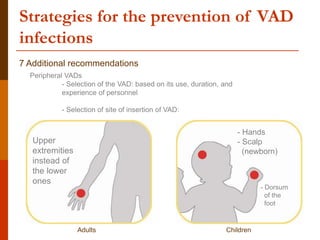
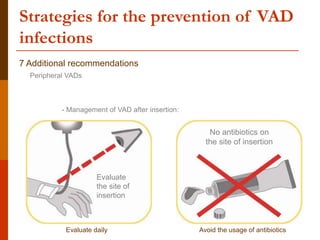
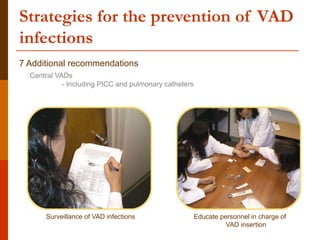
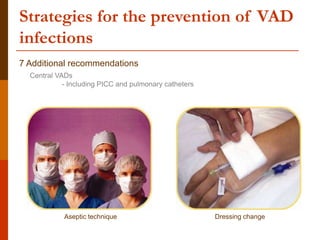
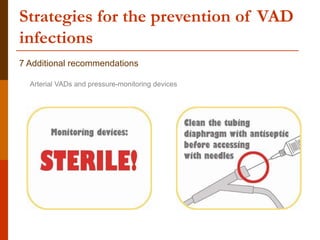
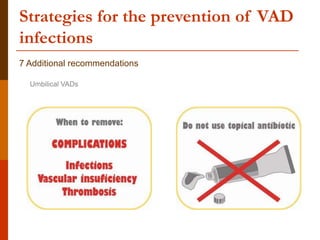
This document discusses strategies for preventing infections of vascular access devices (VADs). It begins by describing different types of VADs, including short-term, intermediate-term, and long-term catheters. It then discusses potential complications of VADs like infection, blockage, and dislocation. The main strategies discussed for preventing VAD infections include using proper barrier precautions during insertion and maintenance, optimal insertion site selection, antiseptic skin cleansing, dressing care and maintenance, and surveillance of infections. Additional recommendations are provided for managing peripheral, central, arterial, and umbilical VADs.


![For more information, consult the following references:
References
1. O’Grady N, et al. Guidelines for the Prevention of Intravascular
Catheter Related Infections. MMWR (2002;51[RR10]:1-26.
Online: www.shea-online.org/Assets/files/position_papers/hicpac_cather.pdf
2. Crnich CJ and Maki DG. Intravascular Device Infections. In: APIC.
APIC Text of Infection Control and Epidemiology, ed 2,
Washington, 2005, Association for Professionals in Infection
Control, pp 24-1 to 24-26.](https://image.slidesharecdn.com/vascularaccessenglishsmallpics1-230805121141-a36875f0/85/Vascular-Access_English_smallpics-1-ppt-25-320.jpg)


