1
Hemodynamic Monitoring
Part I
(ABP, CVP, Ao)
MICU Competencies
2006-2007
2
What is Hemodynamic Monitoring?
• Non-invasive = clinical assessment & NBP
• Direct measurement of arterial pressure
• Invasive hemodynamic monitoring
3
Noninvasive Hemodynamic Monitoring
• Noninvasive BP
• Heart Rate, pulses
• Mental Status
• Mottling (absent)
• Skin Temperature
• Capillary Refill
• Urine Output
4
Proper Fit of a Blood Pressure Cuff
• Width of bladder = 2/3 of upper arm
• Length of bladder encircles 80% arm
• Lower edge of cuff approximately 2.5 cm
above the antecubital space
5
Why A Properly Fitting Cuff?
• Too small causes false-high reading
• Too LARGE causes false-low reading
6
Indications for
Arterial Blood Pressure
• Frequent titration of vasoactive drips
• Unstable blood pressures
• Frequent ABGs or labs
• Unable to obtain Non-invasive BP
7
Supplies to Gather
• Arterial Catheter
• Pressure Tubing
• Pressure Cable
• Pressure Bag
• Flush – 500cc NS
8
Supplies to Gather
• Sterile Gown (2)
• Sterile Towels (3)
• Sterile Gloves
• Suture (silk 2.0)
• Chlorhexidine Swabs
• Mask
9
Leveling and Zeroing
• Leveling
– Before/after insertion
– If patient, bed or transducer move
• Zeroing
– Performed before insertion & readings
• Level and zero at the insertion site
10
Potential Complications
Associated With Arterial Lines
• Hemorrhage
• Air Emboli
• Infection
• Altered Skin Integrity
• Impaired Circulation
11
Documentation
• Insertion procedure note
• ABP readings as ordered
• Neurovascular checks every two hours
(in musculoskeletal assessment of HED)
• Pressure line flush amounts (3ml/hr)
• Tubing and dressing changes
12
Central Venous Pressure Assesses . . .
• Intravascular volume status
• Right ventricular function
• Patient response to drugs &/or fluids
13
Central Venous Pressure (CVP)
• Central line or pulmonary artery catheter
• Normal values = 2 – 8 mm Hg
• Low CVP = hypovolemia or ↓ venous return
• High CVP = over hydration, ↑ venous return,
or right-sided heart failure
14
Leveling and Zeroing
• Leveling
– Before/after insertion
– After patient, bed or transducer move
– Aligns transducer with catheter tip
• Zeroing
– Performed before insertion & readings
• Level and zero transducer at the phlebostatic
axis
15
Phlebostatic Axis
• 4th intercostal space, mid-axillary line
• Level of the atria
(Edwards Lifesciences, n.d.)
16
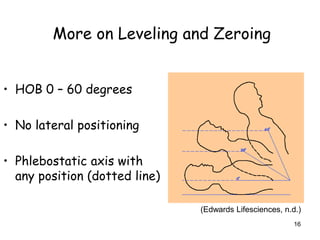
More on Leveling and Zeroing
• HOB 0 – 60 degrees
• No lateral positioning
• Phlebostatic axis with
any position (dotted line)
(Edwards Lifesciences, n.d.)
17
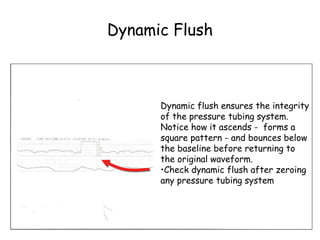
Dynamic Flush
Dynamic flush ensures the integrity
of the pressure tubing system.
Notice how it ascends - forms a
square pattern - and bounces below
the baseline before returning to
the original waveform.
•Check dynamic flush after zeroing
any pressure tubing system
18
System Maintenance
• Change tubing and fluid bag q 96hrs
• No pressors through CVP port
• Antibiotics, NS boluses, blood, & IV pushes
are allowed through the CVP line
19
Troubleshooting
• Improper set-up and equipment malfunction
are the primary causes for hemodynamic
monitoring problems
• Retracing the set-up process or tubing
(patient to monitor) may identify the problem
and solution quickly
• Use your staff resources: Help All, Charge
Nurse, Educator, Preceptors, MICU experts
20
Troubleshooting
Damped Waveforms
Pressure bag inflated to 300 mmHg
Reposition extremity or patient
Verify appropriate scale
Flush or aspirate line
Check or replace module or cable
21
Troubleshooting
Inability to obtain/zero waveform
Connections between cable & monitor
Position of stopcocks
Retry zeroing after above adjustments
22
Continuous Airway Pressure (Ao)
• Also known as Paw, Ao
• Purpose:
– Improves accuracy of hemodynamic
waveform measurements
– Identification of end-expiration
• Positive waveform deflections = positive
pressure ventilation
• Negative deflections = spontaneous
inspiratory effort
23
Supplies to Gather
• Pressure Cable
• Pressure Tubing
• Connector
(Edwards Lifesciences, n.d.)
24
Setting up the Ao
• Discard infusion spike end & cap port
• Connect pressure tubing to vent tubing
(using connector opposite heating cable)
• Connect cables
• Zero the tubing (leveling not necessary)
25
Troubleshooting Ao
• Do not prime tubing with fluids!
• Damping will occur with fluid or secretions
• To evacuate any fluids, disconnect pressure
tubing from vent tubing and push air through
the pressure tubing with a 10 ml syringe
connected at one end until fluid-free
26
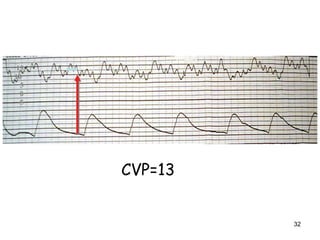
1) Record Ao and CVP on the same strip
2) Find end-expiration by drawing a vertical line with a
straight edge 200 ms prior to the rise or dip in Ao (1
large box) associated with a breath.
3) Draw a horizontal line through the visually assessed
average vascular pressure starting at end-expiration
going backward 200 ms (1 large box).
4) Read the pressure at the horizontal line.
Pressure Measurement
15
10
5
0
-5
CVP=13
27
200 ms
Assist-Control
Ao
CVP
{
200 ms
{
28
CPAP with Pressure Support
Ao
CVP
200 ms
{
200 ms
{
29
CPAP without Pressure Support
Ao
CVP
200 ms
{
200 ms
{
30
40
30
20
10
0
-10
Incorrect method!
This point was
identified as end-
expiration for a pt.
who did not have an
Ao set up.
Correct method!
30 sec after the above
tracing, Ao was added & true
end-expiration clearly
identified.
31
40
30
20
10
0
-10
Same patient 20 minutes later
40
30
20
10
0
-10
32
15
10
5
0
-5
CVP=13
33
Summary
•Record Ao with CVP
•Read mean CVP at end-expiration as
described. No need read vascular pressure at
any particular time in the cardiac cycle
34
Documentation of CVP
• Include on waveform strip
– Position of the HOB
– Vasopressors and rates
– Amount of PEEP
– Scale
– CVP measurement
– Signature of the nurse
(post in green chart behind graphics tab)
35
References & Resources
Burns, S. M. (2004). Continuous airway pressure monitoring. Critical Care Nurse, 24(6), 70-74.
Chulay, M., & Burns, S. M. (2006). AACN Essentials of critical care. McGraw-Hill: New York.
Edwards. (2006). Pulmonary Artery Catheter Educational Project. http://www.pacep.org
Edwards Lifesciences. (n.d.) Educational videos. www.edwards.com
MICU Routine Practice Guidelines. www.vanderbiltmicu.com
MICU Bedside Resource Books
MICU Education Kits (Red cart in conference room)
MICU Preceptors, Help All Nurses, & Charge Nurses
VUMC policies. http://vumcpolicies.mc.vanderbilt.edu

Hemodynamic_Monitoring_I_ABP_CVP_Ao.ppt

  • 1.
    1 Hemodynamic Monitoring Part I (ABP,CVP, Ao) MICU Competencies 2006-2007
  • 2.
    2 What is HemodynamicMonitoring? • Non-invasive = clinical assessment & NBP • Direct measurement of arterial pressure • Invasive hemodynamic monitoring
  • 3.
    3 Noninvasive Hemodynamic Monitoring •Noninvasive BP • Heart Rate, pulses • Mental Status • Mottling (absent) • Skin Temperature • Capillary Refill • Urine Output
  • 4.
    4 Proper Fit ofa Blood Pressure Cuff • Width of bladder = 2/3 of upper arm • Length of bladder encircles 80% arm • Lower edge of cuff approximately 2.5 cm above the antecubital space
  • 5.
    5 Why A ProperlyFitting Cuff? • Too small causes false-high reading • Too LARGE causes false-low reading
  • 6.
    6 Indications for Arterial BloodPressure • Frequent titration of vasoactive drips • Unstable blood pressures • Frequent ABGs or labs • Unable to obtain Non-invasive BP
  • 7.
    7 Supplies to Gather •Arterial Catheter • Pressure Tubing • Pressure Cable • Pressure Bag • Flush – 500cc NS
  • 8.
    8 Supplies to Gather •Sterile Gown (2) • Sterile Towels (3) • Sterile Gloves • Suture (silk 2.0) • Chlorhexidine Swabs • Mask
  • 9.
    9 Leveling and Zeroing •Leveling – Before/after insertion – If patient, bed or transducer move • Zeroing – Performed before insertion & readings • Level and zero at the insertion site
  • 10.
    10 Potential Complications Associated WithArterial Lines • Hemorrhage • Air Emboli • Infection • Altered Skin Integrity • Impaired Circulation
  • 11.
    11 Documentation • Insertion procedurenote • ABP readings as ordered • Neurovascular checks every two hours (in musculoskeletal assessment of HED) • Pressure line flush amounts (3ml/hr) • Tubing and dressing changes
  • 12.
    12 Central Venous PressureAssesses . . . • Intravascular volume status • Right ventricular function • Patient response to drugs &/or fluids
  • 13.
    13 Central Venous Pressure(CVP) • Central line or pulmonary artery catheter • Normal values = 2 – 8 mm Hg • Low CVP = hypovolemia or ↓ venous return • High CVP = over hydration, ↑ venous return, or right-sided heart failure
  • 14.
    14 Leveling and Zeroing •Leveling – Before/after insertion – After patient, bed or transducer move – Aligns transducer with catheter tip • Zeroing – Performed before insertion & readings • Level and zero transducer at the phlebostatic axis
  • 15.
    15 Phlebostatic Axis • 4thintercostal space, mid-axillary line • Level of the atria (Edwards Lifesciences, n.d.)
  • 16.
    16 More on Levelingand Zeroing • HOB 0 – 60 degrees • No lateral positioning • Phlebostatic axis with any position (dotted line) (Edwards Lifesciences, n.d.)
  • 17.
    17 Dynamic Flush Dynamic flushensures the integrity of the pressure tubing system. Notice how it ascends - forms a square pattern - and bounces below the baseline before returning to the original waveform. •Check dynamic flush after zeroing any pressure tubing system
  • 18.
    18 System Maintenance • Changetubing and fluid bag q 96hrs • No pressors through CVP port • Antibiotics, NS boluses, blood, & IV pushes are allowed through the CVP line
  • 19.
    19 Troubleshooting • Improper set-upand equipment malfunction are the primary causes for hemodynamic monitoring problems • Retracing the set-up process or tubing (patient to monitor) may identify the problem and solution quickly • Use your staff resources: Help All, Charge Nurse, Educator, Preceptors, MICU experts
  • 20.
    20 Troubleshooting Damped Waveforms Pressure baginflated to 300 mmHg Reposition extremity or patient Verify appropriate scale Flush or aspirate line Check or replace module or cable
  • 21.
    21 Troubleshooting Inability to obtain/zerowaveform Connections between cable & monitor Position of stopcocks Retry zeroing after above adjustments
  • 22.
    22 Continuous Airway Pressure(Ao) • Also known as Paw, Ao • Purpose: – Improves accuracy of hemodynamic waveform measurements – Identification of end-expiration • Positive waveform deflections = positive pressure ventilation • Negative deflections = spontaneous inspiratory effort
  • 23.
    23 Supplies to Gather •Pressure Cable • Pressure Tubing • Connector (Edwards Lifesciences, n.d.)
  • 24.
    24 Setting up theAo • Discard infusion spike end & cap port • Connect pressure tubing to vent tubing (using connector opposite heating cable) • Connect cables • Zero the tubing (leveling not necessary)
  • 25.
    25 Troubleshooting Ao • Donot prime tubing with fluids! • Damping will occur with fluid or secretions • To evacuate any fluids, disconnect pressure tubing from vent tubing and push air through the pressure tubing with a 10 ml syringe connected at one end until fluid-free
  • 26.
    26 1) Record Aoand CVP on the same strip 2) Find end-expiration by drawing a vertical line with a straight edge 200 ms prior to the rise or dip in Ao (1 large box) associated with a breath. 3) Draw a horizontal line through the visually assessed average vascular pressure starting at end-expiration going backward 200 ms (1 large box). 4) Read the pressure at the horizontal line. Pressure Measurement 15 10 5 0 -5 CVP=13
  • 27.
  • 28.
    28 CPAP with PressureSupport Ao CVP 200 ms { 200 ms {
  • 29.
    29 CPAP without PressureSupport Ao CVP 200 ms { 200 ms {
  • 30.
    30 40 30 20 10 0 -10 Incorrect method! This pointwas identified as end- expiration for a pt. who did not have an Ao set up. Correct method! 30 sec after the above tracing, Ao was added & true end-expiration clearly identified.
  • 31.
    31 40 30 20 10 0 -10 Same patient 20minutes later 40 30 20 10 0 -10
  • 32.
  • 33.
    33 Summary •Record Ao withCVP •Read mean CVP at end-expiration as described. No need read vascular pressure at any particular time in the cardiac cycle
  • 34.
    34 Documentation of CVP •Include on waveform strip – Position of the HOB – Vasopressors and rates – Amount of PEEP – Scale – CVP measurement – Signature of the nurse (post in green chart behind graphics tab)
  • 35.
    35 References & Resources Burns,S. M. (2004). Continuous airway pressure monitoring. Critical Care Nurse, 24(6), 70-74. Chulay, M., & Burns, S. M. (2006). AACN Essentials of critical care. McGraw-Hill: New York. Edwards. (2006). Pulmonary Artery Catheter Educational Project. http://www.pacep.org Edwards Lifesciences. (n.d.) Educational videos. www.edwards.com MICU Routine Practice Guidelines. www.vanderbiltmicu.com MICU Bedside Resource Books MICU Education Kits (Red cart in conference room) MICU Preceptors, Help All Nurses, & Charge Nurses VUMC policies. http://vumcpolicies.mc.vanderbilt.edu