E-cigarettes: An Evidence
Update
Dr Lynne Dawkins
Associate Professor
Centre for Addictive Behaviours Research
London South Bank University
dawkinl3@lsbu.ac.uk
@lynnedawkins
Disclosures
• Pharmaceutical industry: consultancy (2014; 2017)
• Law/Litigation: expert witness/consultant (2014)
• E-cigarette companies: research grants, honorarium
(2010-2013)
• Tobacco Industry: no funding
What I’m going to talk about:
• Brief introduction to E-cigarettes
• Regulation
• Who’s using them & why
• Nicotine & addiction
• Fires & explosions
• Potential harms & effects on health
• E-cigarettes and quitting smoking
• Gateway effects
• Summary & conclusions
Common myths &
concerns
Followed by research
evidence
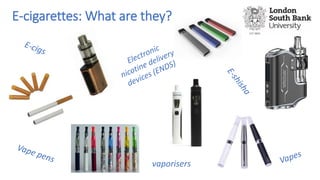
E-cigarettes: What are they?
vaporisers
“ We don’t know anything
about them”
“There’s been no research
on them”
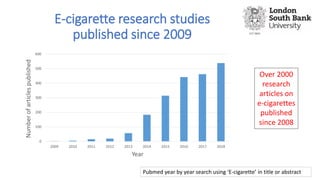
E-cigarette research studies
published since 2009
0
100
200
300
400
500
600
2009 2010 2011 2012 2013 2014 2015 2016 2017 2018
Numberofarticlespublished
Year
Over 2000
research
articles on
e-cigarettes
published
since 2008
Pubmed year by year search using ‘E-cigarette’ in title or abstract
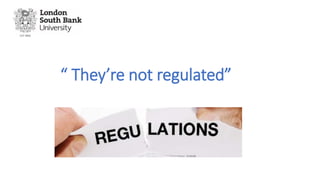
“ They’re not regulated”
UK E-Cig Policy
1. Consumer route
• Notification process
• Minimum standards for safety, quality,
nicotine and size limits
• Standard packaging & labelling
requirements
• Advertising regulations
• Yellow card system for side effects &
safety reporting
2. Medicinal licensing route
• Different standards for safety and
quality, higher nicotine levels
allowed
• Advertising allowed
• But none yet marketed
EU Tobacco Products Directive translated into UK law:
UK Tobacco and Related Product Regulations 2016
2 routes to market (Both overseen by Medicines Healthcare products
Regulatory Agency (MHRA):
Slide adapted from McNeill, Evidence review of e-cigarettes (SRNT-E
Munich 2018)
Source: https://www.gov.uk/government/collections/e-cigarettes-
and-vaping-policy-regulation-and-guidance
Some issues with E-cig regulations
• No advertising = less presence, less reach = more
smoking
• Addiction warning labels: intimidating message; may put
smokers off (Cox et al. 2018, Addict Beh Reports)
• Caps on nicotine content: may not relieve cravings for
the heaviest smokers; encourages more use &
compensatory puffing (Dawkins et al. 2016, Psychopharm)
• Limits on tanks and bottle sizes = more refills, more
hassle, more to remember = easier to smoke.
• US – limits on change to products = improvements
(including safety) restricted = unnecessary harm
THIS PRODUCT
CONTAINS
NICOTINE WHICH IS
A HIGHLY
ADDICTIVE
SUBSTANCE
“Young people
are using them”
“Non-smokers
are using them”
“Everyone’s
using them”
Who uses them?
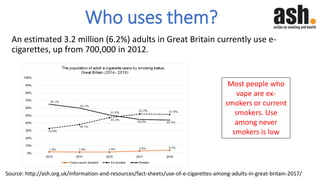
An estimated 3.2 million (6.2%) adults in Great Britain currently use e-
cigarettes, up from 700,000 in 2012.
Source: http://ash.org.uk/information-and-resources/fact-sheets/use-of-e-cigarettes-among-adults-in-great-britain-2017/
Most people who
vape are ex-
smokers or current
smokers. Use
among never
smokers is low
Nicotine use by never smokers and
long-term ex-smokers
12
E-cigarette use by
never smokers is
low and similar to
rates of NRT use
N=71732 never and long-term ex-smokers from Nov 2013
0
5
10
15
Percent
Never: E-cigs
Long-term ex: E-cigs
Never: NRT
Long-term ex: NRT
Source: www.smokinginengland.info
Why do people use them?
The main reason
given for using an e-
cigarette is to quit
smoking
Source: http://ash.org.uk/information-and-
resources/fact-sheets/use-of-e-cigarettes-
among-adults-in-great-britain-2017/
“They contain nicotine
so it’s just swapping one
addiction for another”
What’s wrong with nicotine?
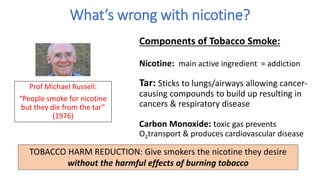
Prof Michael Russell:
“People smoke for nicotine
but they die from the tar”
(1976)
Components of Tobacco Smoke:
Nicotine: main active ingredient = addiction
Tar: Sticks to lungs/airways allowing cancer-
causing compounds to build up resulting in
cancers & respiratory disease
Carbon Monoxide: toxic gas prevents
O2transport & produces cardiovascular disease
TOBACCO HARM REDUCTION: Give smokers the nicotine they desire
without the harmful effects of burning tobacco
None or very small
8%
Some but well under half
the risk
18%
Around half the risk
20%
Much more than half the
risk
18%
Nearly all the risk
20%
Don't know
16%
Source: East et al. (2018). Drug, Alc Depend.
https://www.drugandalcoholdependence.com/article/
S0376-8716(18)30648-3/pdf
Public perceptions of nicotine harms
How much of the
harm from
smoking
cigarettes comes
from nicotine?
2,103 11-18 yr olds in
Great Britain in 2016
Is continued nicotine addiction a
problem?
• Long term use of Nicotine Replacement Therapy (NRT) not shown to be
harmful (Murray et al. 2009, Nicotine Tob Res)
• A problem for whom?
• Public health? – no as completely switching to vaping dramatically
reduces the risk of smoking-related disease
• The individual? - maybe if cost, others’ perceptions, enslavement etc. is
an issue
• Limited research but some evidence that nicotine via vaping is less
‘addictive’ than via smoking (e.g. Dawkins et al. 2013, Addiction; Foulds et al. 2017, Prev Med)
“My
wife/boss/friend/agony
aunt/dog etc. uses it
constantly. S/he must be
getting more nicotine ”
Nicotine delivery from smoking vs. vaping
• Smokers smoke
intermittently;
vapers ‘graze’
• Less efficient
nicotine delivery
from vaping
• Vapers puff more
with lower nicotine
strength liquids but
maintain a steady
nicotine intake (Soar
et al. 2018)
NRT Gum 2mg
Cigarette
Farsalinos et al, 2014 (Adapted)
“ They’re always
exploding”
“They catch fire”
Fires & explosions:
Like other portable electrical devices, e-cigs use lithium-ion batteries which can
fail and occasionally explode and cause fires
0
50
100
150
200
250
300
2015 2016 2017
(to August)
Total Fire False alarms
E-cig fires and false alarms recorded by 41 fire services in
England between 2015-2017
Call outs increased from
2015 – 2016 but mostly
due to false alarms.
24 casualties in total but no
fatalities
Similar numbers reported
from mobile phones
Slide adapted from Calder, SRNT-E Munich (2018)
Source: McNeill et al. (2018). Evidence review of E-
Cigarettes & heated tobacco products. A report
commissioned by Public Health England (PHE).
Chapter 8
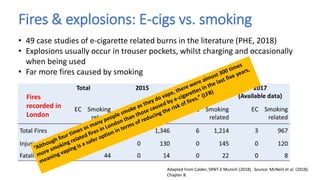
• 49 case studies of e-cigarette related burns in the literature (PHE, 2018)
• Explosions usually occur in trouser pockets, whilst charging and occasionally
when being used
• Far more fires caused by smoking
Fires
recorded in
London
Fires & explosions: E-cigs vs. smoking
Adapted from Calder, SRNT-E Munich (2018). Source: McNeill et al. (2018).
Chapter 8.
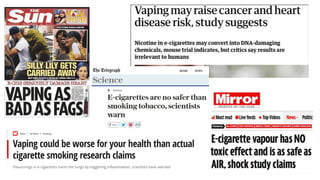
“They’re just as harmful as
smoking”
“We don’t know the long-
term effects”
“We used to
think smoking
was good for
us”
Harm perceptions in adults in Great Britain
0
5
10
15
20
25
30
35
40
45
More/equally harmful Less harmful Lot less harmful completely harmless don't know
2013 2014 2015 2016 2017 2018
A quarter of
adults currently
think e-cigarettes
are just as harmful
as smoking.
Almost another
quarter don’t
know.
Correct answer
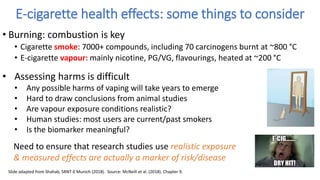
• Burning: combustion is key
• Cigarette smoke: 7000+ compounds, including 70 carcinogens burnt at ~800 °C
• E-cigarette vapour: mainly nicotine, PG/VG, flavourings, heated at ~200 °C
E-cigarette health effects: some things to consider
Need to ensure that research studies use realistic exposure
& measured effects are actually a marker of risk/disease
• Assessing harms is difficult
• Any possible harms of vaping will take years to emerge
• Hard to draw conclusions from animal studies
• Are vapour exposure conditions realistic?
• Human studies: most users are current/past smokers
• Is the biomarker meaningful?
Slide adapted from Shahab, SRNT-E Munich (2018). Source: McNeill et al. (2018). Chapter 9.
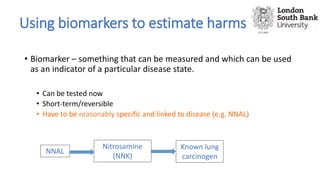
Using biomarkers to estimate harms
• Biomarker – something that can be measured and which can be used
as an indicator of a particular disease state.
• Can be tested now
• Short-term/reversible
• Have to be reasonably specific and linked to disease (e.g. NNAL)
NNAL
Nitrosamine
(NNK)
Known lung
carcinogen
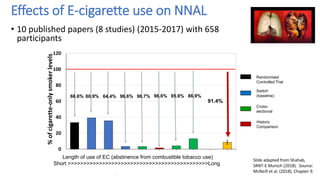
• 10 published papers (8 studies) (2015-2017) with 658
participants
Effects of E-cigarette use on NNAL
0
20
40
60
80
100
120
%ofcigarette-onlysmokerlevels
66.6%
Randomised
Controlled Trial
Switch
(baseline)
Cross-
sectional
Historic
Comparison
60.9% 64.4% 96.6% 96.7% 96.6% 95.8% 86.9%
91.4%
Length of use of EC (abstinence from combustible tobacco use)
Short >>>>>>>>>>>>>>>>>>>>>>>>>>>>>>>>>>>>>>>>>>>>>Long
Slide adapted from Shahab,
SRNT-E Munich (2018). Source:
McNeill et al. (2018). Chapter 9.
0
20
40
60
80
100
120
%ofcigarette-onlysmokerlevels
Effect of E-cigarette use on other biomarkers
Cross-
over
Switch
(baseline)
Cross-
sectional
Generally see similar levels to non-smokers
Pyrene (1-HOP)
Cancer
Acrolein (3-HPMA)
Respiratory Diseases
Carbon monoxide (expired air CO)
Cardiovascular Diseases
69.3% 84.9% 41.3% 67.3% 84.1% 89.6% 71.7%
Slide adapted from Shahab,
SRNT-E Munich (2018). Source:
McNeill et al. (2018). Chapter 9.
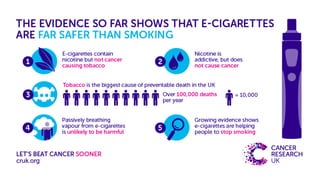
E-cigarettes are
far less harmful
than cigarette
smoking
“They don’t help smokers to stop
smoking”
Aids used in most recent quit attempt1
33
0
5
10
15
20
25
30
35
40
45
50
Percentofsmokerstryingtostop
E-cigs
NRT OTC
NRT Rx
Champix
Beh'l supp
N=13754 adults who smoke and tried to stop or who stopped in the past year; method is
coded as any (not exclusive) use
E-cigarette use for quitting has declined from a peak in
2016
E-cigarettes for quitting smoking: An overview of
published reviews
Since 2015: 7 reviews with meta-analysis. 3 different results
Review Finding
Rahman (2015) Nicotine E-cigs increased quitting
Hartmann-Boyce (2016) Nicotine E-cigs increased quitting
Khoudigian (2016) No effect of E-cigs on quitting
Vanderkam (2016) No effect of E-cigs on quitting
El Dib (2016) No effect of E-cigs on quitting
Malas (2016) No effect of E-cigs on quitting
Kalkhoran & Glantz (2016) E-cigs reduced quitting
Reasons for
inconsistencies:
• Types of studies
included
• Types of participants
included
• Types of outcomes
measured
Studies including only RCTs generally find positive results but
evolving E-cigs mean findings are out of date quickly
Slide adapted from Robson,
SRNT-E Munich (2018). Source:
McNeill et al. (2018). Chapter 7.
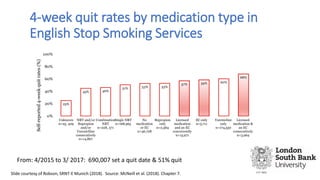
4-week quit rates by medication type in
English Stop Smoking Services
25%
45% 46%
51% 53% 53%
57% 59% 60%
68%
0%
20%
40%
60%
80%
100%
Unknown
n=25, 409
NRT and/or
Bupropion
and/or
Vareniciline
consecutively
n=14,867
Combination
NRT
n=228, 371
Single NRT
n=168,965
No
medication
or EC
n=46,728
Bupropion
only
n=2,584
Licensed
medication
and an EC
concurrently
n=15,971
EC only
n=5,711
Varenicline
only
n=174,530
Licensed
medication &
an EC
consecutively
n=3,964
Self-reported4-weekquitrates(%)
From: 4/2015 to 3/ 2017: 690,007 set a quit date & 51% quit
Slide courtesy of Robson, SRNT-E Munich (2018). Source: McNeill et al. (2018). Chapter 7.
Estimates of the impact of E-cig use on the
number of long-term quitters
Year Ref Estimated number of
additional long-term
quitters
Methods
2014 West et al.
(2016)
16,000 – 22,000 Indirect method
2015 Beard et al.
(2016)
18,000 Time series
analysis
2016 PHE (2018) 22,000 – 29,000 As West et al.
2016 PHE (2018) 27,000 – 57,000 Varying 2
assumptions
Slide adapted from Robson, SRNT-E Munich (2018). Source: McNeill et al. (2018). Chapter 7
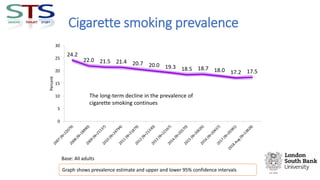
Cigarette smoking prevalence
24.2
22.0 21.5 21.4 20.7 20.0 19.3 18.5 18.7 18.0 17.2 17.5
0
5
10
15
20
25
30
Percent
37Graph shows prevalence estimate and upper and lower 95% confidence intervals
Base: All adults
The long-term decline in the prevalence of
cigarette smoking continues
“They may lead young
people to start smoking”
Surveys including over 60,000 young people:
Source: Bauld, L, MacKintosh, A, Eastwood, B, Ford, A, Moore, G, Dockrell, M, Arnott, D, Cheeseman, H, McNeill, A. (2017)
Int. J. Environ. Res. Public Health, 14, 973; doi:10.3390/ijerph14090973
Also see McNeill et al. (2018). Chapter 5
Regular e-
cigarette use
is confined
to those
who have
smoked
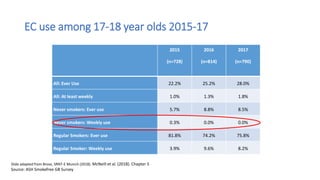
2015
(n=728)
2016
(n=814)
2017
(n=790)
All: Ever Use 22.2% 25.2% 28.0%
All: At least weekly 1.0% 1.3% 1.8%
Never smokers: Ever use 5.7% 8.8% 8.5%
Never smokers: Weekly use 0.3% 0.0% 0.0%
Regular Smokers: Ever use 81.8% 74.2% 75.8%
Regular Smoker: Weekly use 3.9% 9.6% 8.2%
EC use among 17-18 year olds 2015-17
Slide adapted from Brose, SRNT-E Munich (2018). McNeill et al. (2018). Chapter 5
Source: ASH Smokefree GB Survey
Pathways of use
• Two surveys from the UK and several US studies found that young
people who have never smoked but have tried an e-cigarette at the
beginning of the study are more likely to have gone on to try smoking
several months or years later.
• This suggests there may be an association but we cannot establish a
cause based on these findings
• ‘Common liability’ likely explains these findings (i.e risk taking
behaviour)
• Some data to suggest the opposite trend – i.e. that e-cigarettes may
be a route out of smoking for some young people
Slide adapted from Bauld, SRNT-E Munich (2018)
Take-up of smoking in young people
42
0
5
10
15
20
25
30
35
40
45
50
Percentwhoreporthavingever
smokedregularly
N=21889 people aged 16-24
Proportion of people aged 16-24 years who
have ever smoked regularly has slowly declined
No compelling evidence that EC are
attracting significant numbers of
young people who would not
otherwise have smoked.
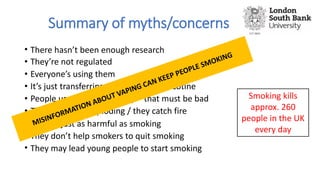
Summary of myths/concerns
• There hasn’t been enough research
• They’re not regulated
• Everyone’s using them
• It’s just transferring an addiction to nicotine
• People use them constantly – that must be bad
• They’re always exploding / they catch fire
• They’re just as harmful as smoking
• They don’t help smokers to quit smoking
• They may lead young people to start smoking
Smoking kills
approx. 260
people in the UK
every day
Acknowledgements
• Prof Linda Bauld
• Dr Leonie Brose
• Dr Jamie Brown
• Dr Robert Calder
• Dr Sharon Cox
• Prof Ann McNeill
• Dr Deborah Robson
• Dr Lion Shahab
• Prof Robert West
Thanks to the following for contributing their slides, images and data for this presentation:
Key Information Sources
• Smoking Toolkit Study: www.smokinginengland.info
• McNeil, A., Brose, LS., Calder, R., Bauld, L. & Robson, D. (2018): Evidence
review of e-cigarettes and heated tobacco products 2018. A report
commissioned by Public Health England:
https://www.gov.uk/government/publications/e-cigarettes-and-heated-
tobacco-products-evidence-review
• Gov.UK (2018): E-cigarettes & Vaping: Policy Regulations and Guidance:
https://www.gov.uk/government/collections/e-cigarettes-and-vaping-
policy-regulation-and-guidance
• Action on Smoking and Health. Use of E-cigarettes among adults in Great
Britain 2018: http://ash.org.uk/information-and-resources/fact-
sheets/use-of-e-cigarettes-among-adults-in-great-britain-2017/
Questions?

E-Cigarettes: An Evidence Update

  • 1.
    E-cigarettes: An Evidence Update DrLynne Dawkins Associate Professor Centre for Addictive Behaviours Research London South Bank University dawkinl3@lsbu.ac.uk @lynnedawkins
  • 2.
    Disclosures • Pharmaceutical industry:consultancy (2014; 2017) • Law/Litigation: expert witness/consultant (2014) • E-cigarette companies: research grants, honorarium (2010-2013) • Tobacco Industry: no funding
  • 3.
    What I’m goingto talk about: • Brief introduction to E-cigarettes • Regulation • Who’s using them & why • Nicotine & addiction • Fires & explosions • Potential harms & effects on health • E-cigarettes and quitting smoking • Gateway effects • Summary & conclusions Common myths & concerns Followed by research evidence
  • 4.
    E-cigarettes: What arethey? vaporisers
  • 5.
    “ We don’tknow anything about them” “There’s been no research on them”
  • 6.
    E-cigarette research studies publishedsince 2009 0 100 200 300 400 500 600 2009 2010 2011 2012 2013 2014 2015 2016 2017 2018 Numberofarticlespublished Year Over 2000 research articles on e-cigarettes published since 2008 Pubmed year by year search using ‘E-cigarette’ in title or abstract
  • 7.
    “ They’re notregulated”
  • 8.
    UK E-Cig Policy 1.Consumer route • Notification process • Minimum standards for safety, quality, nicotine and size limits • Standard packaging & labelling requirements • Advertising regulations • Yellow card system for side effects & safety reporting 2. Medicinal licensing route • Different standards for safety and quality, higher nicotine levels allowed • Advertising allowed • But none yet marketed EU Tobacco Products Directive translated into UK law: UK Tobacco and Related Product Regulations 2016 2 routes to market (Both overseen by Medicines Healthcare products Regulatory Agency (MHRA): Slide adapted from McNeill, Evidence review of e-cigarettes (SRNT-E Munich 2018) Source: https://www.gov.uk/government/collections/e-cigarettes- and-vaping-policy-regulation-and-guidance
  • 9.
    Some issues withE-cig regulations • No advertising = less presence, less reach = more smoking • Addiction warning labels: intimidating message; may put smokers off (Cox et al. 2018, Addict Beh Reports) • Caps on nicotine content: may not relieve cravings for the heaviest smokers; encourages more use & compensatory puffing (Dawkins et al. 2016, Psychopharm) • Limits on tanks and bottle sizes = more refills, more hassle, more to remember = easier to smoke. • US – limits on change to products = improvements (including safety) restricted = unnecessary harm THIS PRODUCT CONTAINS NICOTINE WHICH IS A HIGHLY ADDICTIVE SUBSTANCE
  • 10.
    “Young people are usingthem” “Non-smokers are using them” “Everyone’s using them”
  • 11.
    Who uses them? Anestimated 3.2 million (6.2%) adults in Great Britain currently use e- cigarettes, up from 700,000 in 2012. Source: http://ash.org.uk/information-and-resources/fact-sheets/use-of-e-cigarettes-among-adults-in-great-britain-2017/ Most people who vape are ex- smokers or current smokers. Use among never smokers is low

  • 12.
    Nicotine use bynever smokers and long-term ex-smokers 12 E-cigarette use by never smokers is low and similar to rates of NRT use N=71732 never and long-term ex-smokers from Nov 2013 0 5 10 15 Percent Never: E-cigs Long-term ex: E-cigs Never: NRT Long-term ex: NRT Source: www.smokinginengland.info
  • 13.
    Why do peopleuse them? The main reason given for using an e- cigarette is to quit smoking Source: http://ash.org.uk/information-and- resources/fact-sheets/use-of-e-cigarettes- among-adults-in-great-britain-2017/
  • 14.
    “They contain nicotine soit’s just swapping one addiction for another”
  • 15.
    What’s wrong withnicotine? Prof Michael Russell: “People smoke for nicotine but they die from the tar” (1976) Components of Tobacco Smoke: Nicotine: main active ingredient = addiction Tar: Sticks to lungs/airways allowing cancer- causing compounds to build up resulting in cancers & respiratory disease Carbon Monoxide: toxic gas prevents O2transport & produces cardiovascular disease TOBACCO HARM REDUCTION: Give smokers the nicotine they desire without the harmful effects of burning tobacco
  • 16.
    None or verysmall 8% Some but well under half the risk 18% Around half the risk 20% Much more than half the risk 18% Nearly all the risk 20% Don't know 16% Source: East et al. (2018). Drug, Alc Depend. https://www.drugandalcoholdependence.com/article/ S0376-8716(18)30648-3/pdf Public perceptions of nicotine harms How much of the harm from smoking cigarettes comes from nicotine? 2,103 11-18 yr olds in Great Britain in 2016
  • 17.
    Is continued nicotineaddiction a problem? • Long term use of Nicotine Replacement Therapy (NRT) not shown to be harmful (Murray et al. 2009, Nicotine Tob Res) • A problem for whom? • Public health? – no as completely switching to vaping dramatically reduces the risk of smoking-related disease • The individual? - maybe if cost, others’ perceptions, enslavement etc. is an issue • Limited research but some evidence that nicotine via vaping is less ‘addictive’ than via smoking (e.g. Dawkins et al. 2013, Addiction; Foulds et al. 2017, Prev Med)
  • 18.
    “My wife/boss/friend/agony aunt/dog etc. usesit constantly. S/he must be getting more nicotine ”
  • 19.
    Nicotine delivery fromsmoking vs. vaping • Smokers smoke intermittently; vapers ‘graze’ • Less efficient nicotine delivery from vaping • Vapers puff more with lower nicotine strength liquids but maintain a steady nicotine intake (Soar et al. 2018) NRT Gum 2mg Cigarette Farsalinos et al, 2014 (Adapted)
  • 20.
  • 21.
    Fires & explosions: Likeother portable electrical devices, e-cigs use lithium-ion batteries which can fail and occasionally explode and cause fires 0 50 100 150 200 250 300 2015 2016 2017 (to August) Total Fire False alarms E-cig fires and false alarms recorded by 41 fire services in England between 2015-2017 Call outs increased from 2015 – 2016 but mostly due to false alarms. 24 casualties in total but no fatalities Similar numbers reported from mobile phones Slide adapted from Calder, SRNT-E Munich (2018) Source: McNeill et al. (2018). Evidence review of E- Cigarettes & heated tobacco products. A report commissioned by Public Health England (PHE). Chapter 8
  • 22.
    • 49 casestudies of e-cigarette related burns in the literature (PHE, 2018) • Explosions usually occur in trouser pockets, whilst charging and occasionally when being used • Far more fires caused by smoking Fires recorded in London Fires & explosions: E-cigs vs. smoking Adapted from Calder, SRNT-E Munich (2018). Source: McNeill et al. (2018). Chapter 8.
  • 23.
    “They’re just asharmful as smoking” “We don’t know the long- term effects” “We used to think smoking was good for us”
  • 24.
    Harm perceptions inadults in Great Britain 0 5 10 15 20 25 30 35 40 45 More/equally harmful Less harmful Lot less harmful completely harmless don't know 2013 2014 2015 2016 2017 2018 A quarter of adults currently think e-cigarettes are just as harmful as smoking. Almost another quarter don’t know. Correct answer
  • 26.
    • Burning: combustionis key • Cigarette smoke: 7000+ compounds, including 70 carcinogens burnt at ~800 °C • E-cigarette vapour: mainly nicotine, PG/VG, flavourings, heated at ~200 °C E-cigarette health effects: some things to consider Need to ensure that research studies use realistic exposure & measured effects are actually a marker of risk/disease • Assessing harms is difficult • Any possible harms of vaping will take years to emerge • Hard to draw conclusions from animal studies • Are vapour exposure conditions realistic? • Human studies: most users are current/past smokers • Is the biomarker meaningful? Slide adapted from Shahab, SRNT-E Munich (2018). Source: McNeill et al. (2018). Chapter 9.
  • 27.
    Using biomarkers toestimate harms • Biomarker – something that can be measured and which can be used as an indicator of a particular disease state. • Can be tested now • Short-term/reversible • Have to be reasonably specific and linked to disease (e.g. NNAL) NNAL Nitrosamine (NNK) Known lung carcinogen
  • 28.
    • 10 publishedpapers (8 studies) (2015-2017) with 658 participants Effects of E-cigarette use on NNAL 0 20 40 60 80 100 120 %ofcigarette-onlysmokerlevels 66.6% Randomised Controlled Trial Switch (baseline) Cross- sectional Historic Comparison 60.9% 64.4% 96.6% 96.7% 96.6% 95.8% 86.9% 91.4% Length of use of EC (abstinence from combustible tobacco use) Short >>>>>>>>>>>>>>>>>>>>>>>>>>>>>>>>>>>>>>>>>>>>>Long Slide adapted from Shahab, SRNT-E Munich (2018). Source: McNeill et al. (2018). Chapter 9.
  • 29.
    0 20 40 60 80 100 120 %ofcigarette-onlysmokerlevels Effect of E-cigaretteuse on other biomarkers Cross- over Switch (baseline) Cross- sectional Generally see similar levels to non-smokers Pyrene (1-HOP) Cancer Acrolein (3-HPMA) Respiratory Diseases Carbon monoxide (expired air CO) Cardiovascular Diseases 69.3% 84.9% 41.3% 67.3% 84.1% 89.6% 71.7% Slide adapted from Shahab, SRNT-E Munich (2018). Source: McNeill et al. (2018). Chapter 9.
  • 30.
    E-cigarettes are far lessharmful than cigarette smoking
  • 32.
    “They don’t helpsmokers to stop smoking”
  • 33.
    Aids used inmost recent quit attempt1 33 0 5 10 15 20 25 30 35 40 45 50 Percentofsmokerstryingtostop E-cigs NRT OTC NRT Rx Champix Beh'l supp N=13754 adults who smoke and tried to stop or who stopped in the past year; method is coded as any (not exclusive) use E-cigarette use for quitting has declined from a peak in 2016
  • 34.
    E-cigarettes for quittingsmoking: An overview of published reviews Since 2015: 7 reviews with meta-analysis. 3 different results Review Finding Rahman (2015) Nicotine E-cigs increased quitting Hartmann-Boyce (2016) Nicotine E-cigs increased quitting Khoudigian (2016) No effect of E-cigs on quitting Vanderkam (2016) No effect of E-cigs on quitting El Dib (2016) No effect of E-cigs on quitting Malas (2016) No effect of E-cigs on quitting Kalkhoran & Glantz (2016) E-cigs reduced quitting Reasons for inconsistencies: • Types of studies included • Types of participants included • Types of outcomes measured Studies including only RCTs generally find positive results but evolving E-cigs mean findings are out of date quickly Slide adapted from Robson, SRNT-E Munich (2018). Source: McNeill et al. (2018). Chapter 7.
  • 35.
    4-week quit ratesby medication type in English Stop Smoking Services 25% 45% 46% 51% 53% 53% 57% 59% 60% 68% 0% 20% 40% 60% 80% 100% Unknown n=25, 409 NRT and/or Bupropion and/or Vareniciline consecutively n=14,867 Combination NRT n=228, 371 Single NRT n=168,965 No medication or EC n=46,728 Bupropion only n=2,584 Licensed medication and an EC concurrently n=15,971 EC only n=5,711 Varenicline only n=174,530 Licensed medication & an EC consecutively n=3,964 Self-reported4-weekquitrates(%) From: 4/2015 to 3/ 2017: 690,007 set a quit date & 51% quit Slide courtesy of Robson, SRNT-E Munich (2018). Source: McNeill et al. (2018). Chapter 7.
  • 36.
    Estimates of theimpact of E-cig use on the number of long-term quitters Year Ref Estimated number of additional long-term quitters Methods 2014 West et al. (2016) 16,000 – 22,000 Indirect method 2015 Beard et al. (2016) 18,000 Time series analysis 2016 PHE (2018) 22,000 – 29,000 As West et al. 2016 PHE (2018) 27,000 – 57,000 Varying 2 assumptions Slide adapted from Robson, SRNT-E Munich (2018). Source: McNeill et al. (2018). Chapter 7
  • 37.
    Cigarette smoking prevalence 24.2 22.021.5 21.4 20.7 20.0 19.3 18.5 18.7 18.0 17.2 17.5 0 5 10 15 20 25 30 Percent 37Graph shows prevalence estimate and upper and lower 95% confidence intervals Base: All adults The long-term decline in the prevalence of cigarette smoking continues
  • 38.
    “They may leadyoung people to start smoking”
  • 39.
    Surveys including over60,000 young people: Source: Bauld, L, MacKintosh, A, Eastwood, B, Ford, A, Moore, G, Dockrell, M, Arnott, D, Cheeseman, H, McNeill, A. (2017) Int. J. Environ. Res. Public Health, 14, 973; doi:10.3390/ijerph14090973 Also see McNeill et al. (2018). Chapter 5 Regular e- cigarette use is confined to those who have smoked
  • 40.
    2015 (n=728) 2016 (n=814) 2017 (n=790) All: Ever Use22.2% 25.2% 28.0% All: At least weekly 1.0% 1.3% 1.8% Never smokers: Ever use 5.7% 8.8% 8.5% Never smokers: Weekly use 0.3% 0.0% 0.0% Regular Smokers: Ever use 81.8% 74.2% 75.8% Regular Smoker: Weekly use 3.9% 9.6% 8.2% EC use among 17-18 year olds 2015-17 Slide adapted from Brose, SRNT-E Munich (2018). McNeill et al. (2018). Chapter 5 Source: ASH Smokefree GB Survey
  • 41.
    Pathways of use •Two surveys from the UK and several US studies found that young people who have never smoked but have tried an e-cigarette at the beginning of the study are more likely to have gone on to try smoking several months or years later. • This suggests there may be an association but we cannot establish a cause based on these findings • ‘Common liability’ likely explains these findings (i.e risk taking behaviour) • Some data to suggest the opposite trend – i.e. that e-cigarettes may be a route out of smoking for some young people Slide adapted from Bauld, SRNT-E Munich (2018)
  • 42.
    Take-up of smokingin young people 42 0 5 10 15 20 25 30 35 40 45 50 Percentwhoreporthavingever smokedregularly N=21889 people aged 16-24 Proportion of people aged 16-24 years who have ever smoked regularly has slowly declined
  • 43.
    No compelling evidencethat EC are attracting significant numbers of young people who would not otherwise have smoked.
  • 44.
    Summary of myths/concerns •There hasn’t been enough research • They’re not regulated • Everyone’s using them • It’s just transferring an addiction to nicotine • People use them constantly – that must be bad • They’re always exploding / they catch fire • They’re just as harmful as smoking • They don’t help smokers to quit smoking • They may lead young people to start smoking Smoking kills approx. 260 people in the UK every day
  • 45.
    Acknowledgements • Prof LindaBauld • Dr Leonie Brose • Dr Jamie Brown • Dr Robert Calder • Dr Sharon Cox • Prof Ann McNeill • Dr Deborah Robson • Dr Lion Shahab • Prof Robert West Thanks to the following for contributing their slides, images and data for this presentation:
  • 46.
    Key Information Sources •Smoking Toolkit Study: www.smokinginengland.info • McNeil, A., Brose, LS., Calder, R., Bauld, L. & Robson, D. (2018): Evidence review of e-cigarettes and heated tobacco products 2018. A report commissioned by Public Health England: https://www.gov.uk/government/publications/e-cigarettes-and-heated- tobacco-products-evidence-review • Gov.UK (2018): E-cigarettes & Vaping: Policy Regulations and Guidance: https://www.gov.uk/government/collections/e-cigarettes-and-vaping- policy-regulation-and-guidance • Action on Smoking and Health. Use of E-cigarettes among adults in Great Britain 2018: http://ash.org.uk/information-and-resources/fact- sheets/use-of-e-cigarettes-among-adults-in-great-britain-2017/
  • 47.

Editor's Notes