Treating Tobacco Dependence Stacy Seikel, MD Board Certified Addiction Medicine Board Certified Anesthesiology
Cigarettes Tobacco smoke – complex mixture of 4,000 chemicals with over 60 known carcinogens Cigarette smoking – responsible for 1 in 5 deaths in USA (>400,000 deaths/year) 1965 to 1999 – Decline in smoking rate, 41% to 22.8% Recent decrease in youth smoking
What Is Tobacco Dependence? Nicotine Dependence  ≠ Tobacco Dependence
Medical Consequences of Nicotine Dependence Negligible Chronic nicotine medication use after stopping tobacco use  likelihood of cardiac events
Medical Consequences of Tobacco Dependence Massively Overwhelming!!
Cigarette smoking is the chief avoidable cause of death in our society
Cigarettes Cause Lung Cancer COPD Heart Disease Other Cancers
The Cost of Smoking 442,000 deaths per years caused by smoking – 18%
Cigarette Smoking is NOT  a Habit
What Is Tobacco Dependence? It Is a CHRONIC MEDICAL DISEASE.
FDA Drug Abuse Advisory Committee – June 9, 1997 “Tobacco dependence is a…[serious,] chronic, relapsing, life-threatening illness, that requires…long-term medical management.” Curtis Wright, MD, PhD Deputy Director, Div. of anesthetics, Critical Care, & Addiction Drug Products Food & Drug Administration
 
FACTORS UNDERPINNING TOBACCO DEPENDENCE Psychological Dependency Nicotine Addiction
Factors that perpetuate smoking Cheap “high” Nicotine is a stimulant—releases HGH, epinephrine, serotonin, norepinephrine Intravenous nicotine is indistinguishable from amphetamine for the first 10 minutes Very rapid neuroadaptation (tolerance) to nicotine; smokers generally discount the stimulant effects
Factors that perpetuate smoking Withdrawal symptoms Irritability, agitation, anxiety, hunger, difficulty concentrating Relieved within a few seconds by smoking a cigarette Symptoms are constant, uncomfortable, socially disruptive Repeated episodes of withdrawal and relief of withdrawal induce avoidance of withdrawal
Factors that perpetuate smoking Relief of dysphoric feelings Nicotine affects the ventral tegmental area and mesolimbic system as do most other drugs of addiction Nicotine often substitutes for other (less socially acceptable) drugs Very rapid CNS effects due to inhalation Relief of withdrawal symptoms (anxiety) can be confused with relief of dysphoria (anxiety)
Factors that perpetuate smoking Conditioned responses (“triggers”): Smoking is associated with a wide range of activities Drinking alcohol, eating a meal, drinking coffee Sexual activity Completion of a project, escape from danger, end of the workday Celebrations Driving a car Waiting Seeing others smoke; smelling tobacco or smoke
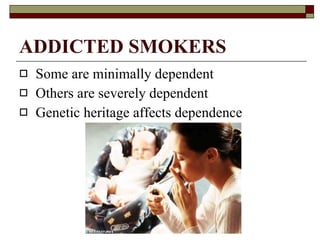
ADDICTED SMOKERS Some are minimally dependent Others are severely dependent Genetic heritage affects dependence
ADDICTION CIGARETTES 10% not dependent 90%  are dependent ALCOHOL 90%  not dependent 10% are dependent
Treating Tobacco Dependence Severe but treatable 70% of smokers visit a physician and 50% visit a dentist each year Most smokers want to stop and 46% try to stop each year Multicomponent therapy
Chronic Disease Nature of Tobacco Dependence Just like asthma, hypertension, or diabetes treatment, clinical deterioration is the rule  and to be expected , when tobacco-dependence pharmacotherpy is stopped.
Interventionists Counselor Nurse CD Counselor Respiratory Therapist Psychologist Physician Dentist Dental Hygienist Nurse Practitioner Physician Assistant Occupational Therapist
Clinical in Practice Guideline Major Conclusions/Recommendation Tobacco dependence is a chronic condition Effective treatments exist and all tobacco users should be offered treatment Healthcare systems must systematize identification, documentation, and treatment of every tobacco user Brief interventions are effective, but there is a strong dose response Counseling effective Pharmacotherapy is effective, and at least one should be prescribed Treatments are cost-effective
Treating Tobacco Dependence Principles of Treatment Behavioral Addictive disorders Pharmacologic Relapse prevention
Treating Tobacco Dependence Healthcare Professional’s Role Identify the smoker Personalize the risks of smoking and benefits of stopping Encourage patient to set stop date Provide and monitor pharmacologic therapy Follow-up and ongoing support Referral
FDA-Approved Tobacco-Dependence Medications CONTROLLER MEDICATIONS Bupropion SR ((Zyban,  Wellbutrin SR) Nicotine Patch – OTC Varenicline (Chantix) RELIEVER MEDICATIONS Nicotine Inhaler Nicotine Nasal Spray Nicotine Polacrilex Gum (Nicorette) – OTC Nicotine Polacrilex Lozenge (Commit) – OTC Nicotine-8-Cyclodextrin – OTC Sublingual tablet
NICOTINE MEDICATION SAFETY Nicotine does not cause lung cancer  Tobacco smoke does Nicotine does not cause COPD Tobacco smoke does Nicotine does not cause acute MI Tobacco smoke does Nicotine does not cause acute vascular injury Tobacco smoke does
Benefit of Prescribing  At Least One  Medication – Evidence-Based All FDA-approved medications suppress nicotine withdrawal signs and symptoms Any  one  medication  probability of stopping smoking 2-3 x  During medication treatment period 1 year after medication treatment-end
Benefit of Prescribing  Two  Medications – Evidence-Based Any pair of FDA-approved medications further  probability of stopping smoking 50-100%  over any  one , effective medication During medication treatment period 1 year after medication treatment-end Do not give Chantix with nicotine replacement therapy
Nicotine Liquid in its native state Distilled from burning tobacco and carried on tar droplets Free (unprotonated) nicotine crosses biological membranes, therefore pH dependent Inhalation  -> peak arterial concentrations 2-4 x venous concentrations Extensive first pass hepatic metabolism Half-life 120 minutes
Treatment Pharmacotherapy First line Nicotine gum Nicotine patches Nicotine nasal spray Nicotine inhaler Nicotine lozenge Bupropion Varenicline Second line Clonidine nortriptyline
Nicotine Patch Therapy Background Placebo-controlled trials show doubling of stop rates Growing literature showing a dose response -50% median replacement with standard dose Reduced smoking  while using nicotine patch
High Dose Patch Therapy Conclusions High dose patch therapy safe for heavy smokers Smoking rate or blood continue to estimate initial patch dose Assess adequacy of nicotine replacement by patient response or percent replacement More complete nicotine replacement improves withdrawal symptom relief Higher percent replacement may increase efficacy of nicotine patch therapy
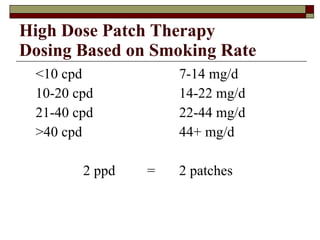
High Dose Patch Therapy Dosing Based on Smoking Rate <10 cpd 7-14 mg/d 10-20 cpd 14-22 mg/d 21-40 cpd 22-44 mg/d >40 cpd 44+ mg/d 2 ppd = 2 patches
Nicotine Patch Therapy Clinical Use Individualize the dose and duration Base initial dose on smoking rate or blood continine Usual length of therapy: 6-8 weeks Return visit or phone call at 1 or 2 week intervals Adjust dose and determine length of Rx based on response
Bupropion Background Monocyclic antidepressant Inhibits reuptake of norepinephrine and dopamine May inhibit nicotinic ACH receptor function Mechanism in helping smokers stop is not clear May attenuate weight gain in abstinent smokers
Bupropion for Relapse Prevention Results 58.8% smoking abstinence at week 7 Relapse rate lower in active group through weeks 12 and 24 but not thereafter Median time to relapse 156 d (active) vs. 65 d (placebo) Smoking abstinence 47.7% (active) vs. 37.7% (placebo) through week 78 Weight gain 3.8 and 4.1 kg (active) vs. 5.6 and 5.4 kg (placebo) at weeks 52 and 104
Bupropion Summary Dose response efficacy in treating smokers  Attenuates weight gain May be more effective than nicotine patch therapy Delays relapse to smoking Can be prescribed to diverse populations of smokers with expected comparable results
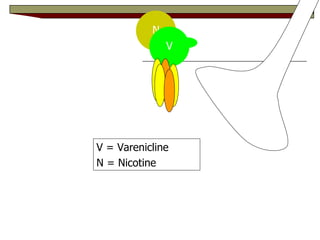
Medication strategies Partial receptor antagonist  Varenicline (Chantix)
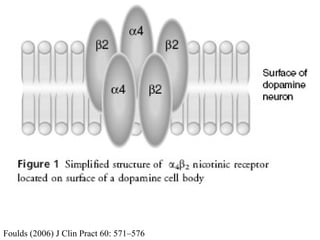
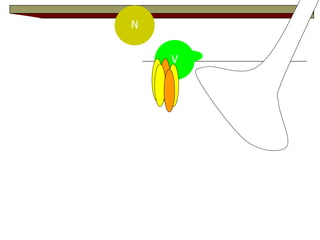
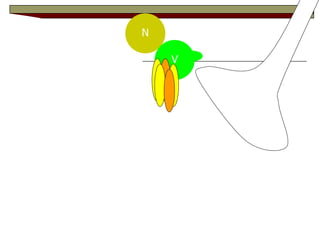
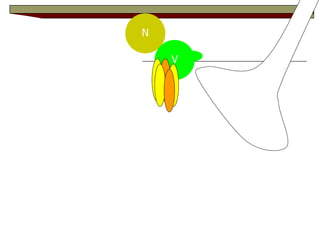
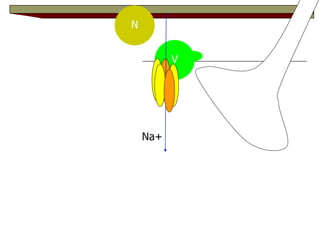
Varenicline  Approved May 11, 2006 by FDA (Pfizer) Partial agonist at the nicotine receptor High affinity for the  α 4 β 2 subtype nicotine receptor Trade name: Chantix Derived from natural chemical cytisine, found in the plant “false tobacco” Foulds (2006) The neurobiological basis for partial agonist treatment of nicotine dependence: varenicline. J Clin Pract 60: 571–576
Orbach et al (2006) Drug Metabolism and Distribution http://dmd.aspetjournals.org/cgi/content/abstract/34/1/121 T ½ excretion = 17 ± 3 hours
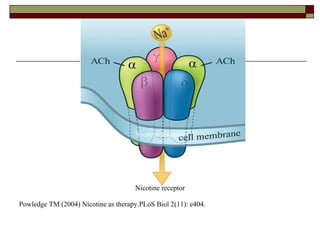
Nicotine receptor Nicotine receptor Powledge TM (2004) Nicotine as therapy.PLoS Biol 2(11): e404. Nicotine receptor
Foulds (2006) J Clin Pract 60: 571–576
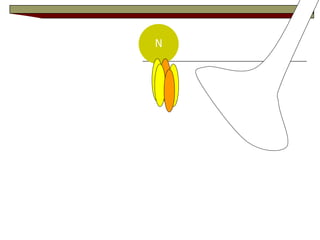
N N = Nicotine
N
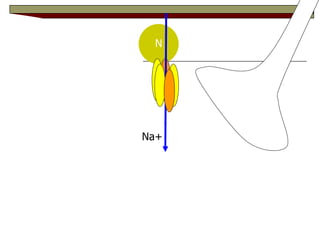
N Na+
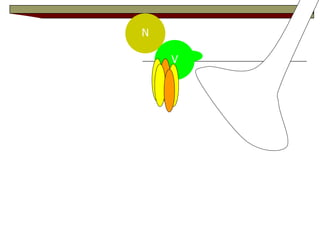
N V V = Varenicline N = Nicotine
N V
N V
N V
N V
N V
N V
N V Na+
Varenicline Partial agonist at the N-acetylcholine site—targets the  α 4 β 2  receptor Reduced craving and withdrawal symptoms The most common adverse effects included  nausea , headache, trouble sleeping, and abnormal dreams No documentation of serious adverse effects Pfizer: data on file
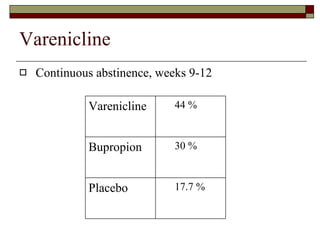
Varenicline Continuous abstinence, weeks 9-12  Gonzales. JAMA 296:47-55 Varenicline 44 %  Bupropion 30 % Placebo 17.7 %
Varenicline Abstinence at 12 months of treatment  Gonzales. JAMA 296:47-55 Varenicline 22.9%  Bupropion 16.1%  Placebo 8.4%
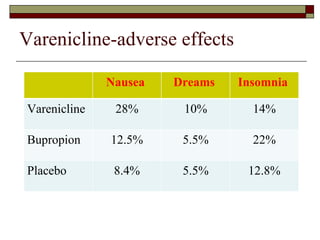
Varenicline-adverse effects Gonzales. JAMA 296:47-55 Nausea  Dreams  Insomnia  Varenicline 28% 10% 14% Bupropion 12.5% 5.5% 22% Placebo  8.4% 5.5% 12.8%
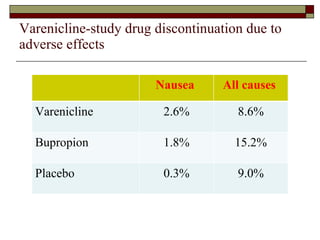
Varenicline-study drug discontinuation due to adverse effects Gonzales. JAMA 296:47-55 Nausea  All causes  Varenicline 2.6% 8.6% Bupropion 1.8% 15.2% Placebo  0.3% 9.0%
Varenicline-adverse effects One report: exacerbation of symptoms in a patient with schizophrenia One report: exacerbation of manic symptoms in a patient with bipolar disorder  One report: exacerbation of depression and psychosis in a patient with depression and a FH of bipolar disorder  One report: mixed episode and psychosis in a patient with depression  One report: cataracts
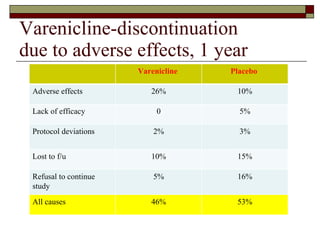
Varenicline-discontinuation  due to adverse effects, 1 year Williams. 23:793-801 Varenicline  Placebo  Adverse effects 26% 10% Lack of efficacy 0 5% Protocol deviations 2% 3% Lost to f/u 10% 15% Refusal to continue study 5% 16% All causes 46% 53%
Varenicline-adverse effects Williams. 23:793-801 Varenicline  Placebo  Nausea  40% 8% Dreams  23% 7% Insomnia  19% 9.5% Disgeusia  11% 2% Dizziness  8% 5% Any adverse effect 96% 83%
Varenicline-cessation Williams. 23:793-801 Varenicline  Placebo  Abstinence at week 52  37% 8%
Possible explanations for adverse psychiatric effects Varenicline is a dangerous drug
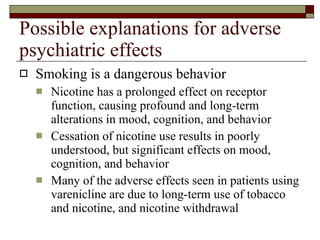
Possible explanations for adverse psychiatric effects Smoking is a dangerous behavior  Nicotine has a prolonged effect on receptor function, causing profound and long-term alterations in mood, cognition, and behavior  Cessation of nicotine use results in poorly understood, but significant effects on mood, cognition, and behavior Many of the adverse effects seen in patients using varenicline are due to long-term use of tobacco and nicotine, and nicotine withdrawal
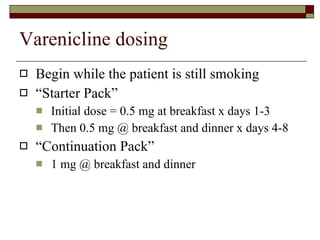
Varenicline dosing Begin while the patient is still smoking “ Starter Pack” Initial dose = 0.5 mg at breakfast x days 1-3 Then 0.5 mg @ breakfast and dinner x days 4-8 “ Continuation Pack” 1 mg @ breakfast and dinner
Varenicline dosing Since varenicline is a partial nicotine agonist, it is illogical to use a nicotine replacement product at the same time There is inadequate data to advise for or against the simultaneous use of bupropion of nortriptyline for smoking cessation Simultaneous use of antihypertensives, antidepressants, neuroleptics, and anticonvulsants appears safe
WHAT YOUR PATIENT NEEDS TO HEAR FROM YOU – 1 (At the Start of Treatment) Effective Treatment Takes Time Mean: 6-9 months Range: 6 weeks to many years 25-35% need lifetime treatment Goals of Treatment Stop smoking Suppress nicotine withdrawal symptoms
WHAT YOUR PATIENT NEEDS TO HEAR FROM YOU -2 (At the Start of Treatment) Goals of Tapering Continue to be tobacco-free Continue to blunt nicotine withdrawal symptoms Thus: Medication Tapering is NOT a Down Escalator Keep Communication Lines Open Call me, your doctor, if you even think you may be having a problem
Thank you.

Treating Tobacco Dependence Revised 2

  • 1.
    Treating Tobacco DependenceStacy Seikel, MD Board Certified Addiction Medicine Board Certified Anesthesiology
  • 2.
    Cigarettes Tobacco smoke– complex mixture of 4,000 chemicals with over 60 known carcinogens Cigarette smoking – responsible for 1 in 5 deaths in USA (>400,000 deaths/year) 1965 to 1999 – Decline in smoking rate, 41% to 22.8% Recent decrease in youth smoking
  • 3.
    What Is TobaccoDependence? Nicotine Dependence ≠ Tobacco Dependence
  • 4.
    Medical Consequences ofNicotine Dependence Negligible Chronic nicotine medication use after stopping tobacco use likelihood of cardiac events
  • 5.
    Medical Consequences ofTobacco Dependence Massively Overwhelming!!
  • 6.
    Cigarette smoking isthe chief avoidable cause of death in our society
  • 7.
    Cigarettes Cause LungCancer COPD Heart Disease Other Cancers
  • 8.
    The Cost ofSmoking 442,000 deaths per years caused by smoking – 18%
  • 9.
  • 10.
    What Is TobaccoDependence? It Is a CHRONIC MEDICAL DISEASE.
  • 11.
    FDA Drug AbuseAdvisory Committee – June 9, 1997 “Tobacco dependence is a…[serious,] chronic, relapsing, life-threatening illness, that requires…long-term medical management.” Curtis Wright, MD, PhD Deputy Director, Div. of anesthetics, Critical Care, & Addiction Drug Products Food & Drug Administration
  • 12.
  • 13.
    FACTORS UNDERPINNING TOBACCODEPENDENCE Psychological Dependency Nicotine Addiction
  • 14.
    Factors that perpetuatesmoking Cheap “high” Nicotine is a stimulant—releases HGH, epinephrine, serotonin, norepinephrine Intravenous nicotine is indistinguishable from amphetamine for the first 10 minutes Very rapid neuroadaptation (tolerance) to nicotine; smokers generally discount the stimulant effects
  • 15.
    Factors that perpetuatesmoking Withdrawal symptoms Irritability, agitation, anxiety, hunger, difficulty concentrating Relieved within a few seconds by smoking a cigarette Symptoms are constant, uncomfortable, socially disruptive Repeated episodes of withdrawal and relief of withdrawal induce avoidance of withdrawal
  • 16.
    Factors that perpetuatesmoking Relief of dysphoric feelings Nicotine affects the ventral tegmental area and mesolimbic system as do most other drugs of addiction Nicotine often substitutes for other (less socially acceptable) drugs Very rapid CNS effects due to inhalation Relief of withdrawal symptoms (anxiety) can be confused with relief of dysphoria (anxiety)
  • 17.
    Factors that perpetuatesmoking Conditioned responses (“triggers”): Smoking is associated with a wide range of activities Drinking alcohol, eating a meal, drinking coffee Sexual activity Completion of a project, escape from danger, end of the workday Celebrations Driving a car Waiting Seeing others smoke; smelling tobacco or smoke
  • 18.
    ADDICTED SMOKERS Someare minimally dependent Others are severely dependent Genetic heritage affects dependence
  • 19.
    ADDICTION CIGARETTES 10%not dependent 90% are dependent ALCOHOL 90% not dependent 10% are dependent
  • 20.
    Treating Tobacco DependenceSevere but treatable 70% of smokers visit a physician and 50% visit a dentist each year Most smokers want to stop and 46% try to stop each year Multicomponent therapy
  • 21.
    Chronic Disease Natureof Tobacco Dependence Just like asthma, hypertension, or diabetes treatment, clinical deterioration is the rule and to be expected , when tobacco-dependence pharmacotherpy is stopped.
  • 22.
    Interventionists Counselor NurseCD Counselor Respiratory Therapist Psychologist Physician Dentist Dental Hygienist Nurse Practitioner Physician Assistant Occupational Therapist
  • 23.
    Clinical in PracticeGuideline Major Conclusions/Recommendation Tobacco dependence is a chronic condition Effective treatments exist and all tobacco users should be offered treatment Healthcare systems must systematize identification, documentation, and treatment of every tobacco user Brief interventions are effective, but there is a strong dose response Counseling effective Pharmacotherapy is effective, and at least one should be prescribed Treatments are cost-effective
  • 24.
    Treating Tobacco DependencePrinciples of Treatment Behavioral Addictive disorders Pharmacologic Relapse prevention
  • 25.
    Treating Tobacco DependenceHealthcare Professional’s Role Identify the smoker Personalize the risks of smoking and benefits of stopping Encourage patient to set stop date Provide and monitor pharmacologic therapy Follow-up and ongoing support Referral
  • 26.
    FDA-Approved Tobacco-Dependence MedicationsCONTROLLER MEDICATIONS Bupropion SR ((Zyban, Wellbutrin SR) Nicotine Patch – OTC Varenicline (Chantix) RELIEVER MEDICATIONS Nicotine Inhaler Nicotine Nasal Spray Nicotine Polacrilex Gum (Nicorette) – OTC Nicotine Polacrilex Lozenge (Commit) – OTC Nicotine-8-Cyclodextrin – OTC Sublingual tablet
  • 27.
    NICOTINE MEDICATION SAFETYNicotine does not cause lung cancer Tobacco smoke does Nicotine does not cause COPD Tobacco smoke does Nicotine does not cause acute MI Tobacco smoke does Nicotine does not cause acute vascular injury Tobacco smoke does
  • 28.
    Benefit of Prescribing At Least One Medication – Evidence-Based All FDA-approved medications suppress nicotine withdrawal signs and symptoms Any one medication probability of stopping smoking 2-3 x During medication treatment period 1 year after medication treatment-end
  • 29.
    Benefit of Prescribing Two Medications – Evidence-Based Any pair of FDA-approved medications further probability of stopping smoking 50-100% over any one , effective medication During medication treatment period 1 year after medication treatment-end Do not give Chantix with nicotine replacement therapy
  • 30.
    Nicotine Liquid inits native state Distilled from burning tobacco and carried on tar droplets Free (unprotonated) nicotine crosses biological membranes, therefore pH dependent Inhalation -> peak arterial concentrations 2-4 x venous concentrations Extensive first pass hepatic metabolism Half-life 120 minutes
  • 31.
    Treatment Pharmacotherapy Firstline Nicotine gum Nicotine patches Nicotine nasal spray Nicotine inhaler Nicotine lozenge Bupropion Varenicline Second line Clonidine nortriptyline
  • 32.
    Nicotine Patch TherapyBackground Placebo-controlled trials show doubling of stop rates Growing literature showing a dose response -50% median replacement with standard dose Reduced smoking while using nicotine patch
  • 33.
    High Dose PatchTherapy Conclusions High dose patch therapy safe for heavy smokers Smoking rate or blood continue to estimate initial patch dose Assess adequacy of nicotine replacement by patient response or percent replacement More complete nicotine replacement improves withdrawal symptom relief Higher percent replacement may increase efficacy of nicotine patch therapy
  • 34.
    High Dose PatchTherapy Dosing Based on Smoking Rate <10 cpd 7-14 mg/d 10-20 cpd 14-22 mg/d 21-40 cpd 22-44 mg/d >40 cpd 44+ mg/d 2 ppd = 2 patches
  • 35.
    Nicotine Patch TherapyClinical Use Individualize the dose and duration Base initial dose on smoking rate or blood continine Usual length of therapy: 6-8 weeks Return visit or phone call at 1 or 2 week intervals Adjust dose and determine length of Rx based on response
  • 36.
    Bupropion Background Monocyclicantidepressant Inhibits reuptake of norepinephrine and dopamine May inhibit nicotinic ACH receptor function Mechanism in helping smokers stop is not clear May attenuate weight gain in abstinent smokers
  • 37.
    Bupropion for RelapsePrevention Results 58.8% smoking abstinence at week 7 Relapse rate lower in active group through weeks 12 and 24 but not thereafter Median time to relapse 156 d (active) vs. 65 d (placebo) Smoking abstinence 47.7% (active) vs. 37.7% (placebo) through week 78 Weight gain 3.8 and 4.1 kg (active) vs. 5.6 and 5.4 kg (placebo) at weeks 52 and 104
  • 38.
    Bupropion Summary Doseresponse efficacy in treating smokers Attenuates weight gain May be more effective than nicotine patch therapy Delays relapse to smoking Can be prescribed to diverse populations of smokers with expected comparable results
  • 39.
    Medication strategies Partialreceptor antagonist Varenicline (Chantix)
  • 40.
    Varenicline ApprovedMay 11, 2006 by FDA (Pfizer) Partial agonist at the nicotine receptor High affinity for the α 4 β 2 subtype nicotine receptor Trade name: Chantix Derived from natural chemical cytisine, found in the plant “false tobacco” Foulds (2006) The neurobiological basis for partial agonist treatment of nicotine dependence: varenicline. J Clin Pract 60: 571–576
  • 41.
    Orbach et al(2006) Drug Metabolism and Distribution http://dmd.aspetjournals.org/cgi/content/abstract/34/1/121 T ½ excretion = 17 ± 3 hours
  • 42.
    Nicotine receptor Nicotinereceptor Powledge TM (2004) Nicotine as therapy.PLoS Biol 2(11): e404. Nicotine receptor
  • 43.
    Foulds (2006) JClin Pract 60: 571–576
  • 44.
    N N =Nicotine
  • 45.
  • 46.
  • 47.
    N V V= Varenicline N = Nicotine
  • 48.
    N V V= Varenicline N = Nicotine
  • 49.
  • 50.
  • 51.
  • 52.
  • 53.
  • 54.
  • 55.
  • 56.
    Varenicline Partial agonistat the N-acetylcholine site—targets the α 4 β 2 receptor Reduced craving and withdrawal symptoms The most common adverse effects included nausea , headache, trouble sleeping, and abnormal dreams No documentation of serious adverse effects Pfizer: data on file
  • 57.
    Varenicline Continuous abstinence,weeks 9-12 Gonzales. JAMA 296:47-55 Varenicline 44 % Bupropion 30 % Placebo 17.7 %
  • 58.
    Varenicline Abstinence at12 months of treatment Gonzales. JAMA 296:47-55 Varenicline 22.9% Bupropion 16.1% Placebo 8.4%
  • 59.
    Varenicline-adverse effects Gonzales.JAMA 296:47-55 Nausea Dreams Insomnia Varenicline 28% 10% 14% Bupropion 12.5% 5.5% 22% Placebo 8.4% 5.5% 12.8%
  • 60.
    Varenicline-study drug discontinuationdue to adverse effects Gonzales. JAMA 296:47-55 Nausea All causes Varenicline 2.6% 8.6% Bupropion 1.8% 15.2% Placebo 0.3% 9.0%
  • 61.
    Varenicline-adverse effects Onereport: exacerbation of symptoms in a patient with schizophrenia One report: exacerbation of manic symptoms in a patient with bipolar disorder One report: exacerbation of depression and psychosis in a patient with depression and a FH of bipolar disorder One report: mixed episode and psychosis in a patient with depression One report: cataracts
  • 62.
    Varenicline-discontinuation dueto adverse effects, 1 year Williams. 23:793-801 Varenicline Placebo Adverse effects 26% 10% Lack of efficacy 0 5% Protocol deviations 2% 3% Lost to f/u 10% 15% Refusal to continue study 5% 16% All causes 46% 53%
  • 63.
    Varenicline-adverse effects Williams.23:793-801 Varenicline Placebo Nausea 40% 8% Dreams 23% 7% Insomnia 19% 9.5% Disgeusia 11% 2% Dizziness 8% 5% Any adverse effect 96% 83%
  • 64.
    Varenicline-cessation Williams. 23:793-801Varenicline Placebo Abstinence at week 52 37% 8%
  • 65.
    Possible explanations foradverse psychiatric effects Varenicline is a dangerous drug
  • 66.
    Possible explanations foradverse psychiatric effects Smoking is a dangerous behavior Nicotine has a prolonged effect on receptor function, causing profound and long-term alterations in mood, cognition, and behavior Cessation of nicotine use results in poorly understood, but significant effects on mood, cognition, and behavior Many of the adverse effects seen in patients using varenicline are due to long-term use of tobacco and nicotine, and nicotine withdrawal
  • 67.
    Varenicline dosing Beginwhile the patient is still smoking “ Starter Pack” Initial dose = 0.5 mg at breakfast x days 1-3 Then 0.5 mg @ breakfast and dinner x days 4-8 “ Continuation Pack” 1 mg @ breakfast and dinner
  • 68.
    Varenicline dosing Sincevarenicline is a partial nicotine agonist, it is illogical to use a nicotine replacement product at the same time There is inadequate data to advise for or against the simultaneous use of bupropion of nortriptyline for smoking cessation Simultaneous use of antihypertensives, antidepressants, neuroleptics, and anticonvulsants appears safe
  • 69.
    WHAT YOUR PATIENTNEEDS TO HEAR FROM YOU – 1 (At the Start of Treatment) Effective Treatment Takes Time Mean: 6-9 months Range: 6 weeks to many years 25-35% need lifetime treatment Goals of Treatment Stop smoking Suppress nicotine withdrawal symptoms
  • 70.
    WHAT YOUR PATIENTNEEDS TO HEAR FROM YOU -2 (At the Start of Treatment) Goals of Tapering Continue to be tobacco-free Continue to blunt nicotine withdrawal symptoms Thus: Medication Tapering is NOT a Down Escalator Keep Communication Lines Open Call me, your doctor, if you even think you may be having a problem
  • 71.