COLLABORATION
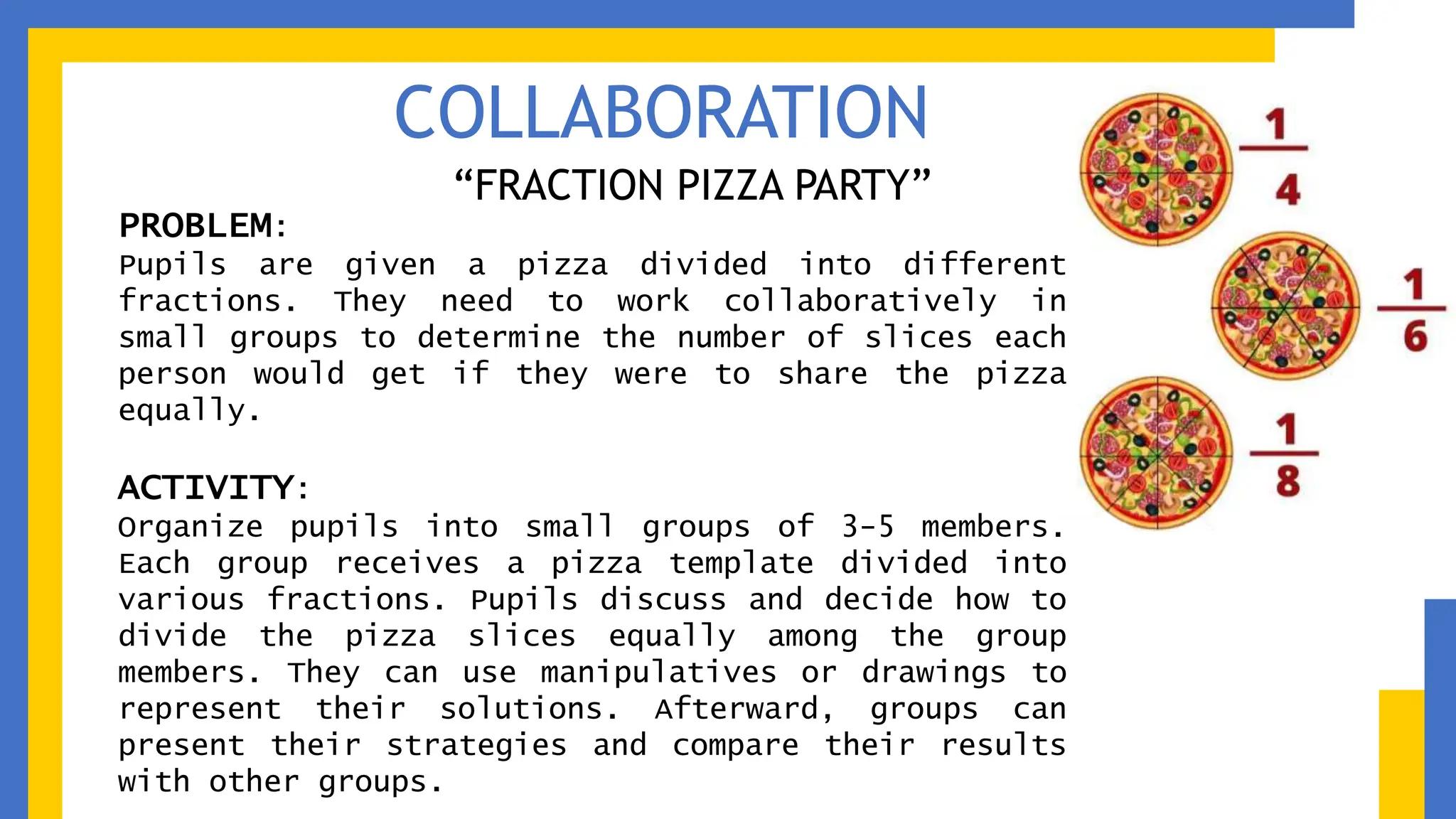
“FRACTION PIZZA PARTY”
PROBLEM:
Pupils are given a pizza divided into different
fractions. They need to work collaboratively in
small groups to determine the number of slices each
person would get if they were to share the pizza
equally.
ACTIVITY:
Organize pupils into small groups of 3-5 members.
Each group receives a pizza template divided into
various fractions. Pupils discuss and decide how to
divide the pizza slices equally among the group
members. They can use manipulatives or drawings to
represent their solutions. Afterward, groups can
present their strategies and compare their results
with other groups.
COLLABORATION
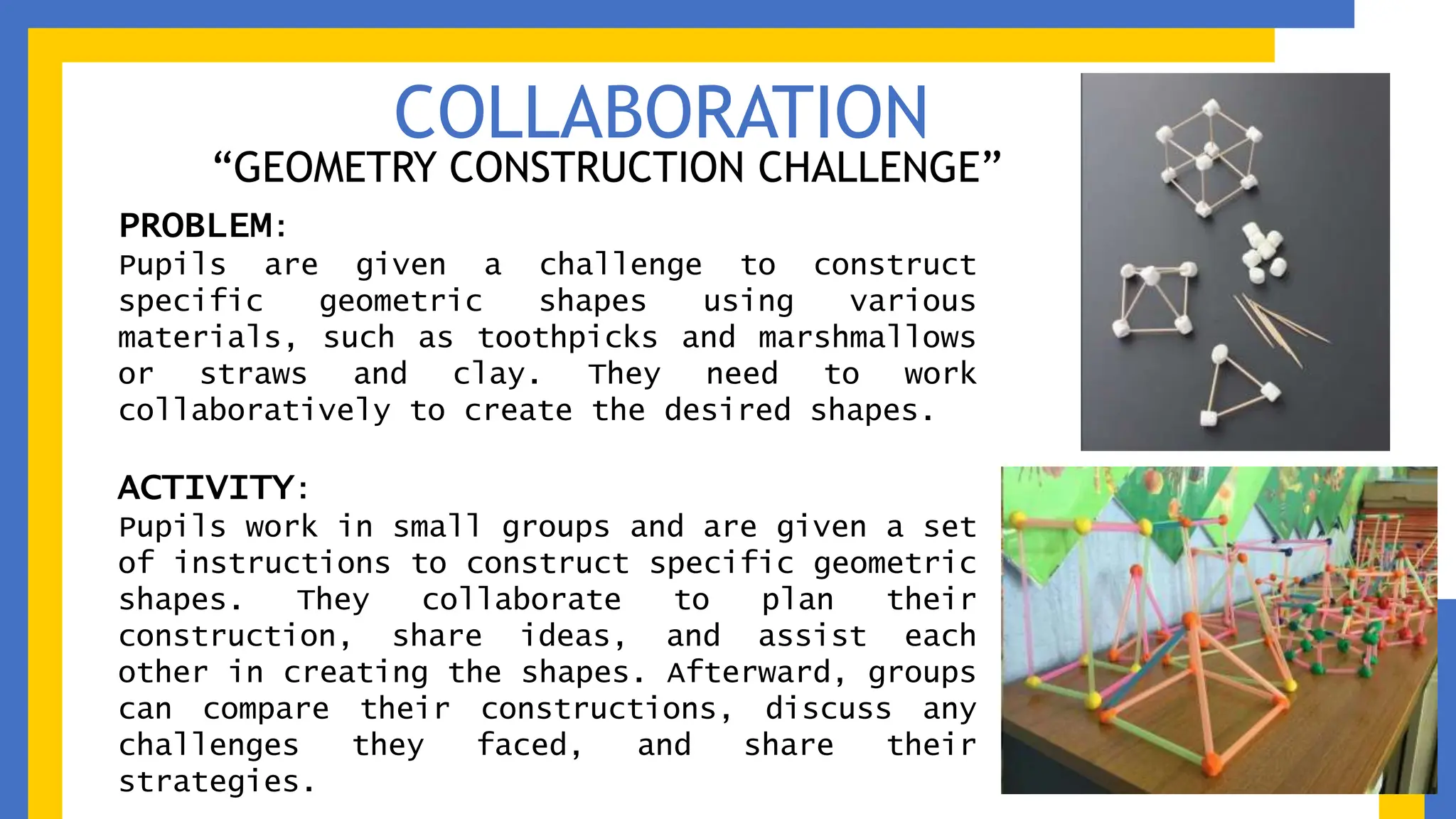
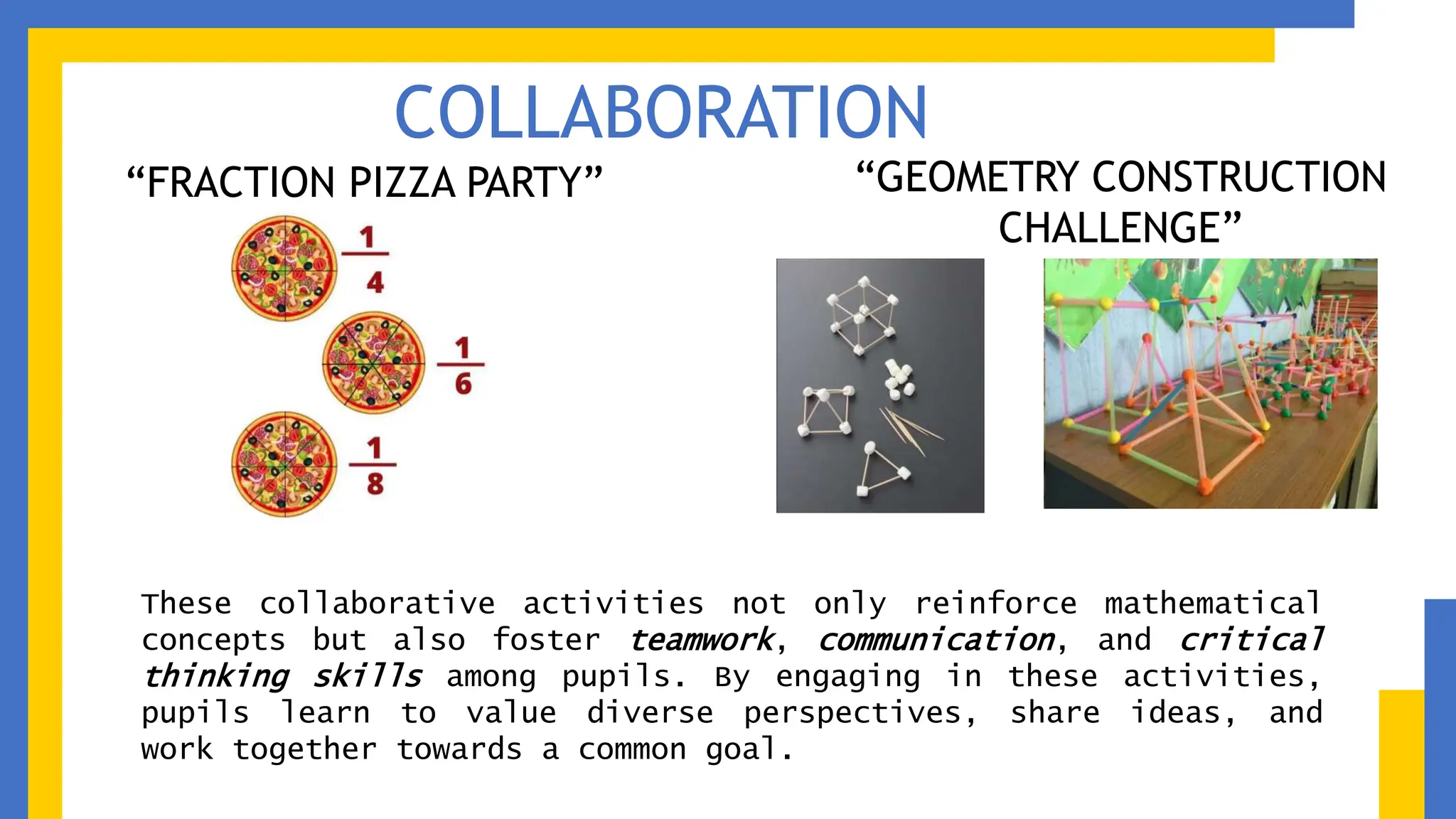
“GEOMETRY CONSTRUCTION CHALLENGE”
PROBLEM:
Pupils are given a challenge to construct
specific geometric shapes using various
materials, such as toothpicks and marshmallows
or straws and clay. They need to work
collaboratively to create the desired shapes.
ACTIVITY:
Pupils work in small groups and are given a set
of instructions to construct specific geometric
shapes. They collaborate to plan their
construction, share ideas, and assist each
other in creating the shapes. Afterward, groups
can compare their constructions, discuss any
challenges they faced, and share their
strategies.
COLLABORATION
“FRACTION PIZZA PARTY” “GEOMETRY CONSTRUCTION
CHALLENGE”
These collaborative activities not only reinforce mathematical
concepts but also foster teamwork, communication, and critical
thinking skills among pupils. By engaging in these activities,
pupils learn to value diverse perspectives, share ideas, and
work together towards a common goal.
CRITICAL THINKING
“PATTERN RECOGNITION”
PROBLEM:
Pupils are given a sequence of numbers or
shapes and asked to identify the pattern
and predict the next element in the
sequence.
ACTIVITY:
Pupils analyze the given sequence, look
for patterns, and discuss their
observations with their peers. They can
then use critical thinking skills to make
predictions and test their hypotheses.
CRITICAL THINKING
“SHAPE INVESTIGATION”
PROBLEM:
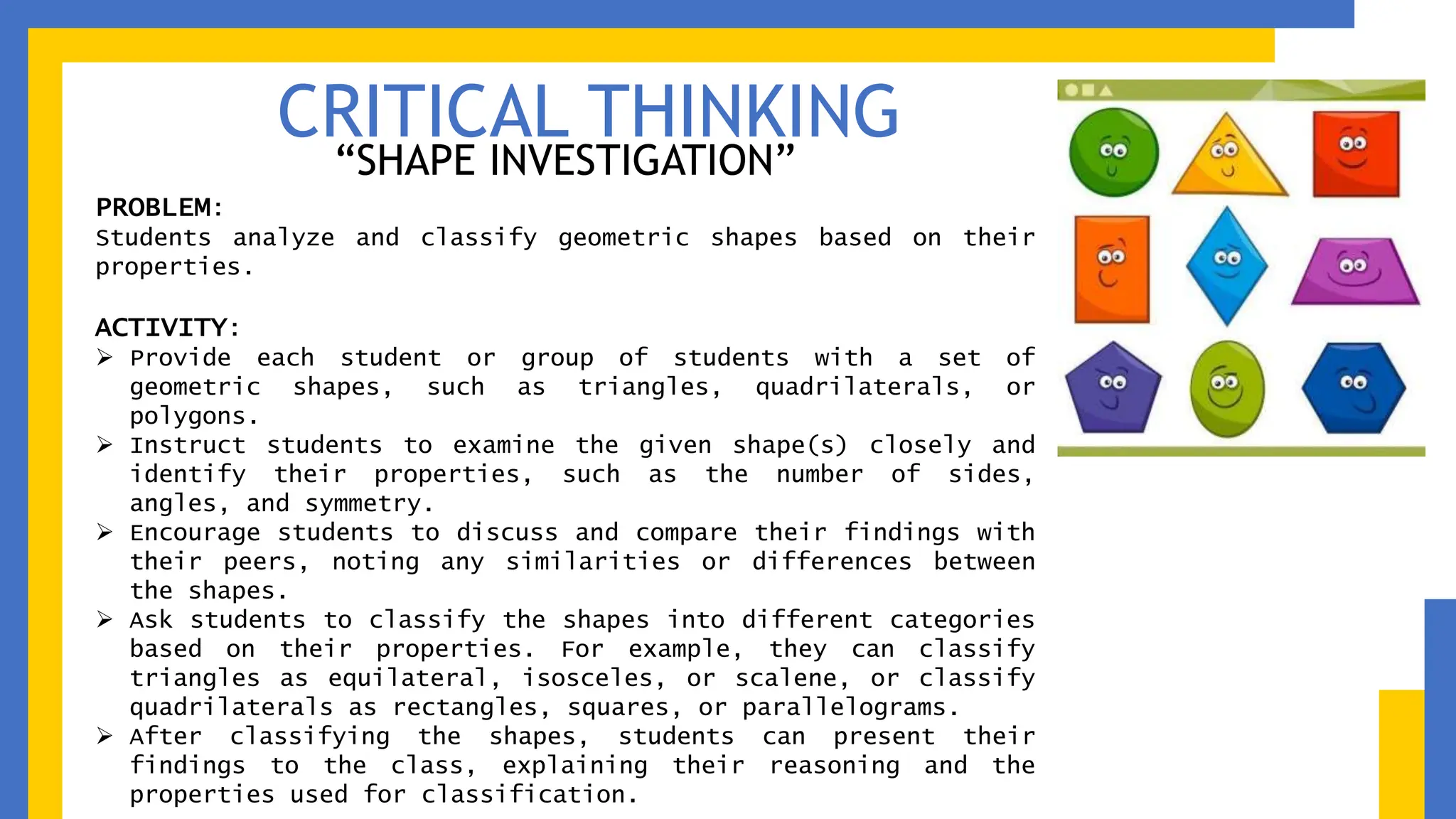
Students analyze and classify geometric shapes based on their
properties.
ACTIVITY:
 Provide each student or group of students with a set of
geometric shapes, such as triangles, quadrilaterals, or
polygons.
 Instruct students to examine the given shape(s) closely and
identify their properties, such as the number of sides,
angles, and symmetry.
 Encourage students to discuss and compare their findings with
their peers, noting any similarities or differences between
the shapes.
 Ask students to classify the shapes into different categories
based on their properties. For example, they can classify
triangles as equilateral, isosceles, or scalene, or classify
quadrilaterals as rectangles, squares, or parallelograms.
 After classifying the shapes, students can present their
findings to the class, explaining their reasoning and the
properties used for classification.
CRITICAL THINKING
“PATTERN RECOGNITION” “SHAPE INVESTIGATION”
Critical thinking skills are crucial in mathematics as they help
students develop logical reasoning, problem-solving abilities, and
the ability to analyze and evaluate mathematical concepts. By
engaging in critical thinking activities, students learn to think
independently, make connections, and develop a deeper understanding
of mathematical concepts.
CREATIVITY
“MATH ART”
PROBLEM:
Ask the pupils to create a picture/s using
geometric shapes and colors.
ACTIVITY:
Provide students with various shapes
(e.g., squares, triangles, circles) and
colored materials. Please encourage them
to arrange and combine the shapes to
create visually appealing patterns.
Students can explore shapes,
transformations, and color combinations
while expressing creativity.
Integrating creativity in math education allows students to explore
mathematical concepts visually and artistically. It encourages them to think
outside the box, experiment with different approaches, and develop their
unique problem-solving strategies. Creativity in math fosters a deeper
understanding of mathematical concepts and promotes a positive attitude
toward learning.
VALUES INTEGRATION IN TEACHING
MATHEMATICS
Teaching value integration in
mathematics involves
incorporating ethical, moral, and
societal values into the teaching
and learning of mathematical
concepts
Real-World Contexts
Connect mathematical concepts to real-world contexts
that involve ethical considerations. For instance, when
teaching about percentages, use examples related to
budgeting, taxes, or charitable giving to highlight the
importance of financial responsibility and fairness.
Problem-Solving Activities
Design problem-solving activities that require students
to consider ethical implications and make value-based
decisions. For example, present students with scenarios
where they must apply mathematical concepts to address
environmental challenges.
Teacher Modeling
Model ethical behavior and decision-making in your own
teaching practices. Demonstrate how mathematical concepts can
be applied ethically and responsibly in various contexts, and
highlight examples of mathematicians who have made positive
contributions to society.
ASSESSMENT
Assess students' understanding of both mathematical
concepts and ethical considerations through a variety of
assessment methods,
Reflective Activities
Incorporate reflective activities where
students can think critically about the ethical
dimensions of the mathematics they are learning.
This could involve journaling, group discussions, or
debriefing sessions after completing mathematical
tasks
Determination
“ Mathematical Maze Challenge”
Pupils will navigate through a
maze by solving math problems
at each intersection. Each correct
answer will lead them closer to
the exit.
“ The Mystery of the Missing Cookies."
A certain number of cookies have disappeared from the school
cafeteria, and it's up to the students to solve the mystery.
Problem:
During lunchtime, a baker placed a tray of cookies on the cafeteria
table. When he returned, he noticed that some of the cookies were
missing. He counted the remaining cookies and found that there
were only 15 left. The baker remembered that there were originally
30 cookies on the tray. How many cookies were taken?

VALUES-INTEGRATION-REVISION. .pptx

  • 1.
    COLLABORATION “FRACTION PIZZA PARTY” PROBLEM: Pupilsare given a pizza divided into different fractions. They need to work collaboratively in small groups to determine the number of slices each person would get if they were to share the pizza equally. ACTIVITY: Organize pupils into small groups of 3-5 members. Each group receives a pizza template divided into various fractions. Pupils discuss and decide how to divide the pizza slices equally among the group members. They can use manipulatives or drawings to represent their solutions. Afterward, groups can present their strategies and compare their results with other groups.
  • 2.
    COLLABORATION “GEOMETRY CONSTRUCTION CHALLENGE” PROBLEM: Pupilsare given a challenge to construct specific geometric shapes using various materials, such as toothpicks and marshmallows or straws and clay. They need to work collaboratively to create the desired shapes. ACTIVITY: Pupils work in small groups and are given a set of instructions to construct specific geometric shapes. They collaborate to plan their construction, share ideas, and assist each other in creating the shapes. Afterward, groups can compare their constructions, discuss any challenges they faced, and share their strategies.
  • 3.
    COLLABORATION “FRACTION PIZZA PARTY”“GEOMETRY CONSTRUCTION CHALLENGE” These collaborative activities not only reinforce mathematical concepts but also foster teamwork, communication, and critical thinking skills among pupils. By engaging in these activities, pupils learn to value diverse perspectives, share ideas, and work together towards a common goal.
  • 4.
    CRITICAL THINKING “PATTERN RECOGNITION” PROBLEM: Pupilsare given a sequence of numbers or shapes and asked to identify the pattern and predict the next element in the sequence. ACTIVITY: Pupils analyze the given sequence, look for patterns, and discuss their observations with their peers. They can then use critical thinking skills to make predictions and test their hypotheses.
  • 5.
    CRITICAL THINKING “SHAPE INVESTIGATION” PROBLEM: Studentsanalyze and classify geometric shapes based on their properties. ACTIVITY:  Provide each student or group of students with a set of geometric shapes, such as triangles, quadrilaterals, or polygons.  Instruct students to examine the given shape(s) closely and identify their properties, such as the number of sides, angles, and symmetry.  Encourage students to discuss and compare their findings with their peers, noting any similarities or differences between the shapes.  Ask students to classify the shapes into different categories based on their properties. For example, they can classify triangles as equilateral, isosceles, or scalene, or classify quadrilaterals as rectangles, squares, or parallelograms.  After classifying the shapes, students can present their findings to the class, explaining their reasoning and the properties used for classification.
  • 6.
    CRITICAL THINKING “PATTERN RECOGNITION”“SHAPE INVESTIGATION” Critical thinking skills are crucial in mathematics as they help students develop logical reasoning, problem-solving abilities, and the ability to analyze and evaluate mathematical concepts. By engaging in critical thinking activities, students learn to think independently, make connections, and develop a deeper understanding of mathematical concepts.
  • 7.
    CREATIVITY “MATH ART” PROBLEM: Ask thepupils to create a picture/s using geometric shapes and colors. ACTIVITY: Provide students with various shapes (e.g., squares, triangles, circles) and colored materials. Please encourage them to arrange and combine the shapes to create visually appealing patterns. Students can explore shapes, transformations, and color combinations while expressing creativity. Integrating creativity in math education allows students to explore mathematical concepts visually and artistically. It encourages them to think outside the box, experiment with different approaches, and develop their unique problem-solving strategies. Creativity in math fosters a deeper understanding of mathematical concepts and promotes a positive attitude toward learning.
  • 8.
    VALUES INTEGRATION INTEACHING MATHEMATICS Teaching value integration in mathematics involves incorporating ethical, moral, and societal values into the teaching and learning of mathematical concepts
  • 9.
    Real-World Contexts Connect mathematicalconcepts to real-world contexts that involve ethical considerations. For instance, when teaching about percentages, use examples related to budgeting, taxes, or charitable giving to highlight the importance of financial responsibility and fairness.
  • 10.
    Problem-Solving Activities Design problem-solvingactivities that require students to consider ethical implications and make value-based decisions. For example, present students with scenarios where they must apply mathematical concepts to address environmental challenges.
  • 11.
    Teacher Modeling Model ethicalbehavior and decision-making in your own teaching practices. Demonstrate how mathematical concepts can be applied ethically and responsibly in various contexts, and highlight examples of mathematicians who have made positive contributions to society.
  • 12.
    ASSESSMENT Assess students' understandingof both mathematical concepts and ethical considerations through a variety of assessment methods,
  • 13.
    Reflective Activities Incorporate reflectiveactivities where students can think critically about the ethical dimensions of the mathematics they are learning. This could involve journaling, group discussions, or debriefing sessions after completing mathematical tasks
  • 14.
    Determination “ Mathematical MazeChallenge” Pupils will navigate through a maze by solving math problems at each intersection. Each correct answer will lead them closer to the exit.
  • 15.
    “ The Mysteryof the Missing Cookies." A certain number of cookies have disappeared from the school cafeteria, and it's up to the students to solve the mystery. Problem: During lunchtime, a baker placed a tray of cookies on the cafeteria table. When he returned, he noticed that some of the cookies were missing. He counted the remaining cookies and found that there were only 15 left. The baker remembered that there were originally 30 cookies on the tray. How many cookies were taken?