Self Guided Lecture # 2 Strategic & Innovative Management  Cristin Howell-Vischer, MIM MANAGEMENT II – MAN 2600
The Value Chain
What is a Value Chain? A sequential process of value-creating activities A categorization of the generic value adding activities of an organization A concept  described and popularized by Michael Porter in his 1985 best-seller, “Competitive Advantage: Creating and Sustaining Superior Performance” It defines the organization’s activities as being either primary or support activities
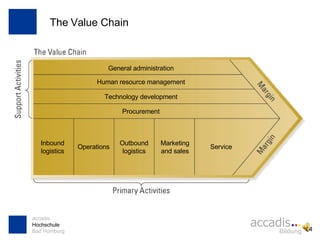
The Value Chain General administration Human resource management Technology development Procurement Inbound logistics Operations Outbound logistics Marketing and sales Service
Primary Activities Associated with receiving, storing and distributing inputs to the product Location of distribution facilities Material and inventory control systems Systems to reduce time to send “returns” to suppliers Warehouse layout and designs Inbound Logistics
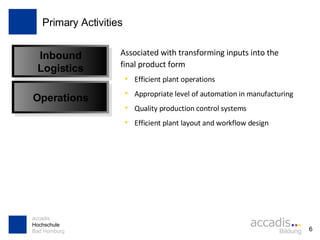
Primary Activities Associated with transforming inputs into the final product form Efficient plant operations Appropriate level of automation in manufacturing Quality production control systems Efficient plant layout and workflow design Inbound Logistics Operations
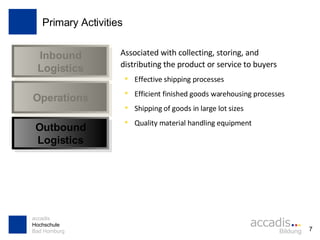
Primary Activities Associated with collecting, storing, and distributing the product or service to buyers Effective shipping processes Efficient finished goods warehousing processes Shipping of goods in large lot sizes Quality material handling equipment Inbound Logistics Operations Outbound Logistics
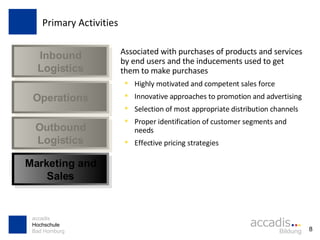
Primary Activities Associated with purchases of products and services by end users and the inducements used to get them to make purchases Highly motivated and competent sales force Innovative approaches to promotion and advertising Selection of most appropriate distribution channels Proper identification of customer segments and needs Effective pricing strategies Inbound Logistics Operations Outbound Logistics Marketing and Sales
Primary Activities Associated with providing service to enhance or maintain the value of the product Effective use of procedures to solicit customer feedback and to act on information Quick response to customer needs and emergencies Ability to furnish replacement parts Effective management of parts and equipment inventory Quality of service personnel and ongoing training Warranty and guarantee policies Inbound Logistics Operations Outbound Logistics Marketing and Sales Service
Support Activities Typically supports the entire value chain and not individual activities Effective planning systems Ability of top management to anticipate and act on key environmental trends and events Ability to obtain low-cost funds for capital expenditures and working capital Excellent relationships with diverse stakeholder groups Ability to coordinate and integrate activities across the value chain Highly visible to inculcate  (fix in people’s minds ) organizational culture, reputation, and values General Administration
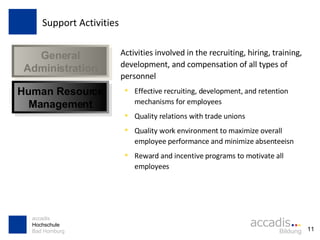
Support Activities Activities involved in the recruiting, hiring, training, development, and compensation of all types of personnel Effective recruiting, development, and retention mechanisms for employees Quality relations with trade unions Quality work environment to maximize overall employee performance and minimize absenteeisn Reward and incentive programs to motivate all employees General Administration Human Resource Management
Support Activities Related to a wide range of activities and those embodied in processes and equipment and the product itself  Effective R&D activities for process and product initiatives Positive collaborative relationships between R&D and other departments State-of-the art facilities and equipment Culture to enhance creativity and innovation Excellent professional qualifications of personnel Ability to meet critical deadlines General Administration Human Resource Management Technology Development
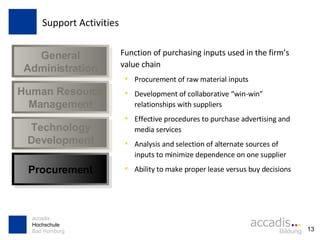
Support Activities Function of purchasing inputs used in the firm’s value chain Procurement of raw material inputs Development of collaborative “win-win” relationships with suppliers Effective procedures to purchase advertising and media services Analysis and selection of alternate sources of inputs to minimize dependence on one supplier Ability to make proper lease versus buy decisions General Administration Human Resource Management Technology Development Procurement
Resource-Based View of the Firm Two perspectives The internal analysis of phenomena within a company (SWOT) An external analysis of the industry and its competitive environment (PEST) Three key types of resources Tangible resources Intangible resources Organizational capabilities
Types of Resources Relatively easy to identify, and include physical and financial assets used to create value for customers Financial resources Firm’s cash accounts Firm’s capacity to raise equity Firm’s borrowing capacity Physical resources Modern plant and facilities Favorable manufacturing locations State-of-the-art machinery and equipment Tangible Resources
Technological resources Trade secrets Innovative production processes Patents, copyrights, trademarks Organizational resources Effective strategic planning processes Excellent evaluation and control systems Types of Resources Relatively easy to identify, and include physical and financial assets used to create value for customers Tangible Resources
Types of Resources Difficult for competitors (and the firm itself) to account for or imitate, typically embedded in unique routines and practices that have evolved over time Human Experience and capabilities of employees Trust Managerial skills Firm-specific practices and procedures Tangible Resources Intangible Resources
Types of Resources Innovation and creativity Technical and scientific skills Innovation capacities Reputation Effective strategic planning processes Excellent evaluation and control systems Difficult for competitors (and the firm itself) to account for or imitate, typically embedded in unique routines and practices that have evolved over time Tangible Resources Intangible Resources
Types of Resources Competencies or skills that a firm employs to transform inputs to outputs, and capacity to combine tangible and intangible resources to attain desired end Outstanding customer service Excellent product development capabilities Innovativeness of products and services Ability to hire, motivate, and retain human capital Tangible Resources Intangible Resources Organizational Capabilities
How Resources & Capabilities Lead to Advantages
Adding Value
Adding Value Adding value means making the customer feel like they are getting real value for their money.  This can happen by/through: understanding and being close to the customer committing to quality maintaining a high level of all around service reacting speedily to competitive opportunities and threats constant innovation
Examples of Adding Value warranties extra car features (rust filter) airlines (mix of offerings in seat choices) taking away features seen as a nuisance (handy features) services (grocery delivery) convenience packaging (salad in a bag) cleanliness, value, quality, service (formerly McDonalds) ambience/lifestyle (Starbucks)
Opportunities for Adding Value changes in industry regulation marketing (segmentation/globalization) operations (technology, cost reduction, service, quality) people (exploiting expertise, encouraging innovation) finance (globalization of financial markets, better use of assets) information (exploiting the potential of information technology) acquisition and restructuring strategies co-operation strategies
Ten Ways to Add Value to Your Business  According to Dr. David J. Skyrme Establish the Strategic Role of Information Identify Users Real Needs Segment Your Market Create a Unique Product Sales & Marketing Evaluation & Feedback Exploit Technology Selective Outsourcing Building Partnerships Develop Hybrid Skills

Value Chains And Adding Value

  • 1.
    Self Guided Lecture# 2 Strategic & Innovative Management Cristin Howell-Vischer, MIM MANAGEMENT II – MAN 2600
  • 2.
  • 3.
    What is aValue Chain? A sequential process of value-creating activities A categorization of the generic value adding activities of an organization A concept described and popularized by Michael Porter in his 1985 best-seller, “Competitive Advantage: Creating and Sustaining Superior Performance” It defines the organization’s activities as being either primary or support activities
  • 4.
    The Value ChainGeneral administration Human resource management Technology development Procurement Inbound logistics Operations Outbound logistics Marketing and sales Service
  • 5.
    Primary Activities Associatedwith receiving, storing and distributing inputs to the product Location of distribution facilities Material and inventory control systems Systems to reduce time to send “returns” to suppliers Warehouse layout and designs Inbound Logistics
  • 6.
    Primary Activities Associatedwith transforming inputs into the final product form Efficient plant operations Appropriate level of automation in manufacturing Quality production control systems Efficient plant layout and workflow design Inbound Logistics Operations
  • 7.
    Primary Activities Associatedwith collecting, storing, and distributing the product or service to buyers Effective shipping processes Efficient finished goods warehousing processes Shipping of goods in large lot sizes Quality material handling equipment Inbound Logistics Operations Outbound Logistics
  • 8.
    Primary Activities Associatedwith purchases of products and services by end users and the inducements used to get them to make purchases Highly motivated and competent sales force Innovative approaches to promotion and advertising Selection of most appropriate distribution channels Proper identification of customer segments and needs Effective pricing strategies Inbound Logistics Operations Outbound Logistics Marketing and Sales
  • 9.
    Primary Activities Associatedwith providing service to enhance or maintain the value of the product Effective use of procedures to solicit customer feedback and to act on information Quick response to customer needs and emergencies Ability to furnish replacement parts Effective management of parts and equipment inventory Quality of service personnel and ongoing training Warranty and guarantee policies Inbound Logistics Operations Outbound Logistics Marketing and Sales Service
  • 10.
    Support Activities Typicallysupports the entire value chain and not individual activities Effective planning systems Ability of top management to anticipate and act on key environmental trends and events Ability to obtain low-cost funds for capital expenditures and working capital Excellent relationships with diverse stakeholder groups Ability to coordinate and integrate activities across the value chain Highly visible to inculcate (fix in people’s minds ) organizational culture, reputation, and values General Administration
  • 11.
    Support Activities Activitiesinvolved in the recruiting, hiring, training, development, and compensation of all types of personnel Effective recruiting, development, and retention mechanisms for employees Quality relations with trade unions Quality work environment to maximize overall employee performance and minimize absenteeisn Reward and incentive programs to motivate all employees General Administration Human Resource Management
  • 12.
    Support Activities Relatedto a wide range of activities and those embodied in processes and equipment and the product itself Effective R&D activities for process and product initiatives Positive collaborative relationships between R&D and other departments State-of-the art facilities and equipment Culture to enhance creativity and innovation Excellent professional qualifications of personnel Ability to meet critical deadlines General Administration Human Resource Management Technology Development
  • 13.
    Support Activities Functionof purchasing inputs used in the firm’s value chain Procurement of raw material inputs Development of collaborative “win-win” relationships with suppliers Effective procedures to purchase advertising and media services Analysis and selection of alternate sources of inputs to minimize dependence on one supplier Ability to make proper lease versus buy decisions General Administration Human Resource Management Technology Development Procurement
  • 14.
    Resource-Based View ofthe Firm Two perspectives The internal analysis of phenomena within a company (SWOT) An external analysis of the industry and its competitive environment (PEST) Three key types of resources Tangible resources Intangible resources Organizational capabilities
  • 15.
    Types of ResourcesRelatively easy to identify, and include physical and financial assets used to create value for customers Financial resources Firm’s cash accounts Firm’s capacity to raise equity Firm’s borrowing capacity Physical resources Modern plant and facilities Favorable manufacturing locations State-of-the-art machinery and equipment Tangible Resources
  • 16.
    Technological resources Tradesecrets Innovative production processes Patents, copyrights, trademarks Organizational resources Effective strategic planning processes Excellent evaluation and control systems Types of Resources Relatively easy to identify, and include physical and financial assets used to create value for customers Tangible Resources
  • 17.
    Types of ResourcesDifficult for competitors (and the firm itself) to account for or imitate, typically embedded in unique routines and practices that have evolved over time Human Experience and capabilities of employees Trust Managerial skills Firm-specific practices and procedures Tangible Resources Intangible Resources
  • 18.
    Types of ResourcesInnovation and creativity Technical and scientific skills Innovation capacities Reputation Effective strategic planning processes Excellent evaluation and control systems Difficult for competitors (and the firm itself) to account for or imitate, typically embedded in unique routines and practices that have evolved over time Tangible Resources Intangible Resources
  • 19.
    Types of ResourcesCompetencies or skills that a firm employs to transform inputs to outputs, and capacity to combine tangible and intangible resources to attain desired end Outstanding customer service Excellent product development capabilities Innovativeness of products and services Ability to hire, motivate, and retain human capital Tangible Resources Intangible Resources Organizational Capabilities
  • 20.
    How Resources &Capabilities Lead to Advantages
  • 21.
  • 22.
    Adding Value Addingvalue means making the customer feel like they are getting real value for their money. This can happen by/through: understanding and being close to the customer committing to quality maintaining a high level of all around service reacting speedily to competitive opportunities and threats constant innovation
  • 23.
    Examples of AddingValue warranties extra car features (rust filter) airlines (mix of offerings in seat choices) taking away features seen as a nuisance (handy features) services (grocery delivery) convenience packaging (salad in a bag) cleanliness, value, quality, service (formerly McDonalds) ambience/lifestyle (Starbucks)
  • 24.
    Opportunities for AddingValue changes in industry regulation marketing (segmentation/globalization) operations (technology, cost reduction, service, quality) people (exploiting expertise, encouraging innovation) finance (globalization of financial markets, better use of assets) information (exploiting the potential of information technology) acquisition and restructuring strategies co-operation strategies
  • 25.
    Ten Ways toAdd Value to Your Business According to Dr. David J. Skyrme Establish the Strategic Role of Information Identify Users Real Needs Segment Your Market Create a Unique Product Sales & Marketing Evaluation & Feedback Exploit Technology Selective Outsourcing Building Partnerships Develop Hybrid Skills