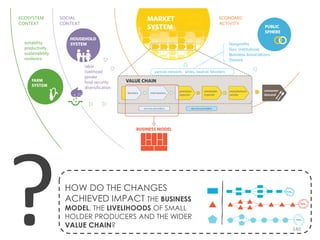
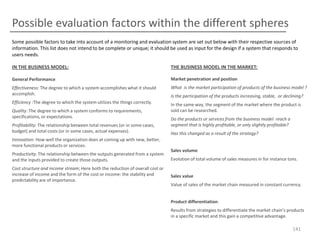
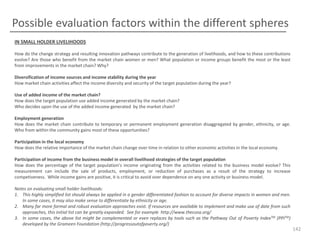
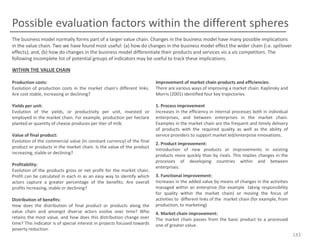
1
Centro Internacional de Agricultura Tropical
International Center for Tropical Agriculture
Apartado Aéreo 6713
Cali, Colombia
Phone: 57 2 4450000
Fax: 57 2 4450073
E-mail: m.lundy@cgiar.org
Website: www.ciat.cgiar.org
CIAT Publication No. 380
ISBN 978-958-694-114-3 (PDF)
November 2012
Lundy, Mark
LINK methodology: A participatory guide to business models that link smallholders to markets / Mark Lundy, Gertjan Becx, Nancy Zamierowski, Alexandra
Amrein, Jhon Jairo Hurtado, Erika Eliana Mosquera, Fernando Rodríguez. -- Cali, CO : Centro Internacional de Agricultura Tropical (CIAT), 2012.
171 p. -- (CIAT Publication No. 380)
ISBN 978-958-694-114-3 (PDF)

AGROVOC Descriptors in English:
1. Models. 2. Small enterprises. 3. Small scale farming. 4. Trade. 5. Markets. 6. Agricultural sector. 7. Sustainable livelihoods. 8. Stakeholders.
9. Farmers. 10. Participatory research. 11. Innovation adoption. 12. Networks. 13. Developing countries.
AGROVOC Descriptors in Spanish:
1. Modelos. 2. Empresas pequeñas. 3. Pequeñas explotaciones. 4. Comercio. 5. Mercados. 6. Sector agrario. 7. Medios de vida sostenibles.
8. Agentes interesados. 9. Agricultores. 10. Investigación participativa. 11. Adopción de innovaciones. 12. Redes. 13. Países en desarrollo.
AGRIS Subject Category: E20 Organization, administration, and management of agricultural enterprises or farms / Organización, administración y manejo de
empresas agrícolas o fincas

Copyright © CIAT 2010. Allrights reserved.
CIAT encourages wide dissemination of its printed and electronic publications for maximum public benefit. Thus, in most cases colleagues working in research
and development should feel free to use CIAT materials for noncommercial purposes. However, the Center prohibits modification of these materials, and we
expect to receive due credit. Though CIAT prepares its publications with considerable care, the Center does not guarantee their accuracy and completeness.

2
ACKNOWLEDGEMENTS
This toolkit has been prepared by Mark Lundy, Gertjan Becx, Nancy Zamierowski and Alexandra Amrein at the International Center for Tropical
Agriculture, CIAT. It has been field tested and improved by Jhon Jairo Hurtado, Erika Eliana Mosquera and Fernando Rodríguez at CIAT. The
initial draft has greatly benefited from the comments from Don Seville at the Sustainable Food Lab, Shaun Ferris at Catholic Relief Services, Abbi
Buxton and Bill Vorley at the International Institute for Environment and Development and Will Crosse at Rainforest Alliance.
The LINK Methodology was developed as part of the New Business Models for Sustainable Trading Relationships Project managed by the
Sustainable Food Lab in collaboration with Catholic Relief Services (CRS), the International Center for Tropical Agriculture (CIAT), the
International Institute for Environment and Development (IIED) and Rainforest Alliance (RA). This project was supported by a grant from the Bill
and Melinda Gates Foundation.
The guide is based on: a) experiences of research projects in several countries in Latin America and Africa; b) successful results of more than
twenty business model case studies which have proved to work for small-scale producers; and, c) the growing literature around business models
as a design/development tool to augment the effectiveness of business processes to fight poverty.
The suggested method was implemented in several countries in Latin America between June 2011 and May 2012. The present iteration of the
guide has been tested in Colombia, Panama, Ecuador and Nicaragua. The authors appreciate the support of all participants in the process of
testing and improving this guide in advance. Special thanks are due to the ACUA project funded by the International Fund for Agricultural
Development (IFAD) in Colombia, Ecuador and Panama; Catholic Relief Services and the ACORDAR project staff in Nicaragua; and, Fundamerca
in Colombia.

We invite both individuals and organizations to use this methodology to design and implement inclusive and sustainable business models linking
small scale producers in developing countries to markets.
The current version of this guide is a prototype and, therefore, subject to improvement and change. All users who apply these methodological
tools in their fieldwork should feel free to make the necessary adjustments and adaptations to this guide to make it as useful as possible
according to their conditions and needs. The authors greatly appreciate any feedback from field practitioners for improved and strengthened
iterations of this guide.
Let’s get started!

3
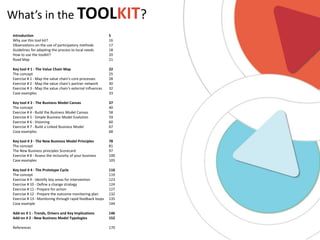
What’s in the TOOLKIT?
Introduction
Why use this tool kit?
Observations on the use of participatory methods
Guidelines for adapting the process to local needs
How to use the toolkit?
Road Map

5
16
17
18
20
21

Key tool # 1 - The Value Chain Map
The concept
Exercise # 1 - Map the value chain‘s core processes
Exercise # 2 - Map the value chain‘s partner network
Exercise # 3 - Map the value chain‘s external influences
Case examples

22
25
28
30
32
33

Key tool # 2 - The Business Model Canvas
The concept
Exercise # 4 - Build the Business Model Canvas
Exercise # 5 - Simple Business Model Evalution
Exercise # 6 - Visioning
Exercise # 7 - Build a Linked Business Model
Case examples

37
40
58
59
60
67
68

Key tool # 3 - The New Business Model Principles
The concept
The New Business principles Scorecard
Exercise # 8 - Assess the inclusivity of your business
Case examples

78
81
97
100
105

Key tool # 4 - The Prototype Cycle
The concept
Exercise # 9 - Identify key areas for intervention
Exercise # 10 - Define a change strategy
Exercise # 11 - Prepare for action
Exercise # 12 - Prepare the outcome monitoring plan
Exercise # 13 - Monitoring through rapid feedback loops
Case example

116
119
123
124
127
132
135
144

Add-on # 1 - Trends, Drivers and Key Implications
Add-on # 2 - New Business Model Typologies

146
152

References

170
THE GOAL OF THIS TOOLKIT
is to build inclusive and sustainable

TRADING
RELATIONSHIPS

linking small-scale producers to modern markets
The LINK methodology will help you understand the current functioning of the market chain and key business models,
design innovations that empower producer groups to engage more effectively and buyers to act in ways more amenable to
small holder farmers. At the end of the day, this method seeks to build bridges between the often disparate worlds of small
holder farming in the developing world and emerging market opportunities both in the global south as well as developed
economies.
5
INCLUSIVE BUSINESS
A profitable core business activity that also tangibly expands opportunities for the poor and
disadvantaged in developing countries. (BIF 2011)
An economically profitable, environmentally and socially responsible entrepreneurial initiative.
(WBCSD, SNV 2011)

Engage the poor as employees, suppliers, distributors, or consumers and expand their economic
opportunities in a wide variety of ways. (BIF 2011)
Inclusive Business models include the poor on the demand side as
clients and customers, and on the supply side as employees, producers and business owners at
various points in the value chain. (UNDP 2008)

INCLUSIVE TRADING RELATIONSHIPS
Inclusive trading relationships are the result of business models that do not leave behind small
holder farmers and in which the voices and needs of those actors in rural areas in developing
countries are recognized.
6
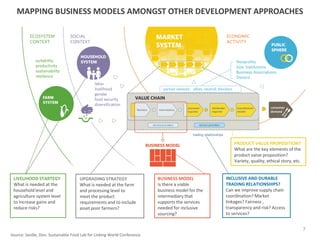
MAPPING BUSINESS MODELS AMONGST OTHER DEVELOPMENT APPROACHES

PRODUCT VALUE PROPOSITION?
What are the key elements of the
product value proposition?
Variety, quality, ethical story, etc.

LIVELIHOOD STARTEGY
What is needed at the
household level and
agriculture system level
to increase gains and
reduce risks?

UPGRADING STRATEGY
What is needed at the farm
and processing level to
meet the product
requirements and to include
asset poor farmers?

BUSINESS MODEL
Is there a viable
business model for the
intermediary that
supports the services
needed for inclusive
sourcing?

INCLUSIVE AND DURABLE
TRADING RELATIONSHIPS?
Can we improve supply chain
coordination? Market
linkages? Fairness ,
transparency and risk? Access
to services?

7
Source: Seville, Don. Sustainable Food Lab for Linking World Conference.
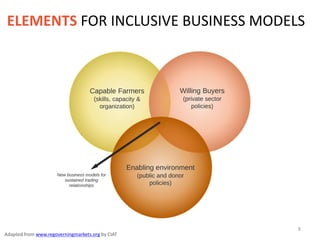
ELEMENTS FOR INCLUSIVE BUSINESS MODELS

Adapted from www.regoverningmarkets.org by CIAT

8
AGRICULTURE HAS SPECIAL POWERS IN
REDUCING POVERTY
SMALL-SCALE FARMERS, whose output supports a population of roughly 2.2 billion people, manage about
85% OF THE WORLD’S FARMS. Agriculture is a SOURCE OF LIVELIHOODS FOR AN ESTIMATED 86% OF
RURAL PEOPLE (2.5 billion people) and PROVIDES JOBS FOR 1.3 BILLION smallholders and landless
workers.
A more dynamic and inclusive agricultural sector could dramatically reduce rural poverty, helping countries meet the Millennium
Development Goal of halving poverty and hunger by 2015. Cross-country econometric estimates show that overall GDP growth
originating in agriculture is, on average, at least twice as effective in benefiting the poorest half of a country’s population as growth
generated in nonagricultural sectors. Beyond its direct contribution to growth, a number of features specific to the sector enhance its
contribution to pro-poor growth, including the concentration of the poor in the sector, the large size of its growth linkages to other
sectors, and the positive externalities from assuring food security and reducing food prices.
Donors, businesses, and civil society are in broad consensus on benefits of linking smallholders to modern markets. Sustainable
development is increasingly being integrated into business’ practices to improve the quality and security of raw material supply and to
contribute to the Millennium Development Goals (MDGs).
Making business more inclusive for small-scale suppliers is a way to enhance corporate reputation, gain legitimacy in local markets and
create ‘ethical’ products. Beyond these considerations, however, the authors of this guide sustain that inclusive business in an era of
tightening global supplies and natural resource limitations is simply good business. Farmers gain access to markets, knowledge,
technology and income while buyers are better able to source key raw materials, to their specifications at a competitive cost and, in
some cases, maintain access to higher quality raw materials. As markets shift from buyer-driven to supply constrained, farmers will
increasingly be able to choose from a number of ‘preferred buyers’ to sell their goods. Business models that are inclusive of
smallholders, provide economic and social development opportunities and more effectively link actors in a coherent and traceable way
constitute one way to adapt to a supply-constrained market.

9
CHALLENGES TO LINKING WORLDS
Linking smallholders to dynamic markets provides an
opportunity for more rapid poverty reduction but ensuring that
investment delivers both commercially viable products and
value to smallholder presents structural challenges. Decades of
underinvestment mean that small-scale producers in low- and
middle-income countries often operate in areas with
INADEQUATE INFRASTRUCTURE (roads, electricity, irrigation
and wholesale markets). They LACK ACCESS TO SERVICES
(training, credit, inputs) and are highly dependent on favorable
weather. HIGH PROCUREMENT COSTS associated with
collecting, grading and bulking products from DISPERSED
SUPPLIERS, along with problems of farmers ‘side selling’ to
traders, require creative solutions to aggregating production and
supplying the consistent QUALITY THAT FORMAL MARKETS
REQUIRE. Due to these challenges, buyers have been biased
towards the reliability and consistency of large farmers and
suppliers.
Singh, S. 2008. ‘Marketing channels and their implications for smallholder farmers in
India.’ In: McCullough, E., P. Pingali, and K. Stamoulis (eds.) The transformation of agrifood systems: globalisation, supply chains and smallholder famers. Earthscan: London.
World
Bank.
The
World
Development
Report.
http://siteresources.worldbank.org/SOUTHASIAEXT/Resources/2235461171488994713/3455847-1192738003272/Brief_AgPovRedctn_web.pdf

2008.

Ligon, Ethan, and Elisabeth Sadoulet. 2007. “Estimating the Effects of Aggregate
Agricultural Growth on the Distribution of Expenditures.” Background paper for the WDR
2008.
Byerlee, D. et. al, “Agriculture, Rural Development, and Pro-poor Growth.” The World
Bank. 2005.

Seville, D., Buxton, A.,Vorley, B. “Under what conditions are value chains effective tools
for pro-poor development? 2010.

10
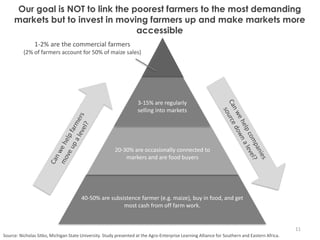
Our goal is NOT to link the poorest farmers to the most demanding
markets but to invest in moving farmers up and make markets more
accessible
1-2% are the commercial farmers
(2% of farmers account for 50% of maize sales)

3-15% are regularly
selling into markets

20-30% are occasionally connected to
markers and are food buyers

40-50% are subsistence farmer (e.g. maize), buy in food, and get
most cash from off farm work.

11
Source: Nicholas Sitko, Michigan State University. Study presented at the Agro-Enterprise Learning Alliance for Southern and Eastern Africa.
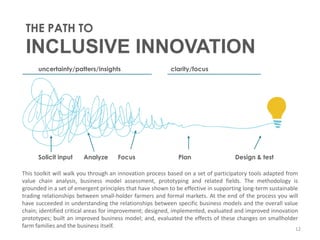
THE PATH TO

INCLUSIVE INNOVATION
uncertainty/patters/insights

Solicit input

Analyze

Focus

clarity/focus

Plan

Design & test

This toolkit will walk you through an innovation process based on a set of participatory tools adapted from
value chain analysis, business model assessment, prototyping and related fields. The methodology is
grounded in a set of emergent principles that have shown to be effective in supporting long-term sustainable
trading relationships between small-holder farmers and formal markets. At the end of the process you will
have succeeded in understanding the relationships between specific business models and the overall value
chain; identified critical areas for improvement; designed, implemented, evaluated and improved innovation
prototypes; built an improved business model; and, evaluated the effects of these changes on smallholder
farm families and the business itself.
12
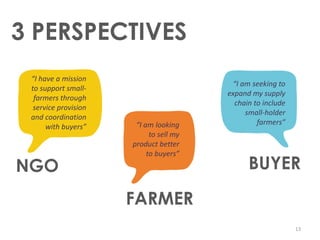
3 PERSPECTIVES
“I have a mission
to support smallfarmers through
service provision
and coordination
with buyers”

NGO

“I am looking
to sell my
product better
to buyers”

“I am seeking to
expand my supply
chain to include
small-holder
farmers”

BUYER

FARMER
13
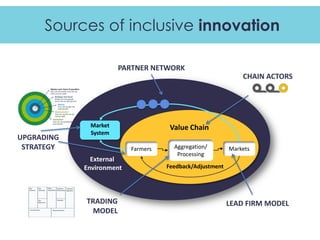
Sources of inclusive innovation
PARTNER NETWORK
CHAIN ACTORS

UPGRADING
STRATEGY

Market
System

Value Chain
Farmers

External
Environment

TRADING
MODEL

Aggregation/
Processing

Markets

Feedback/Adjustment

LEAD FIRM MODEL
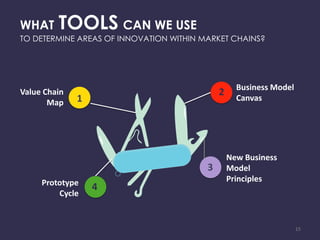
WHAT

TOOLS CAN WE USE

TO DETERMINE AREAS OF INNOVATION WITHIN MARKET CHAINS?

Value Chain
Map

2

1

3
Prototype
Cycle

4

Business Model
Canvas

New Business
Model
Principles

15
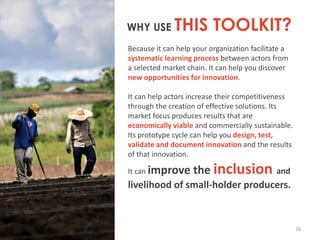
WHY USE

THIS TOOLKIT?

Because it can help your organization facilitate a
systematic learning process between actors from
a selected market chain. It can help you discover
new opportunities for innovation.
It can help actors increase their competitiveness
through the creation of effective solutions. Its
market focus produces results that are
economically viable and commercially sustainable.
Its prototype cycle can help you design, test,
validate and document innovation and the results
of that innovation.
It can improve

the inclusion

and

livelihood of small-holder producers.

16
Observations on the use of PARTICIPATORY

METHODS

This guide is based on participatory methods adapted from the school
of Participative Learning and Action (PLA). These methods, which
include focus groups, mapping, visualizations, and other forms of
facilitated reflection, seek to prioritize not only documented results, but
also the process of application. Although a concrete result is generated
at each stage in the process, i.e. A map, a matrix, a table etc., these
products are not the central purpose of the exercise. Of equal
importance and benefit to the participants is the time and space they
have invested in analysis and reflection around the methodological
tool. The discussion and agreements reached are generally more
important than the final tangible results of the method.
The use of participatory methods in this guide encourages members to
air their views and we aim to hear many voices speaking about a single
market chain or business model. These points of view will be quite
different – what a rural producers thinks is very different to what a city
buyer thinks – but all the viewpoints have important information
regarding the reality of the market chain or business model. To
understand the market chain and the individual business models, their
strengths and weaknesses, and the design of a shared strategy to build
stable, durable and profitable trading relationships, requires listening
to all voices equally. The role of the facilitator in this process is to
systematize and document the information and present it back to the
participants so that they can use this information to make more
informed decisions on what to do together to improve their economic
activity.
17
Guidelines for adapting the process to

LOCAL NEEDS
MARKET ORIENTATION

WORKING WITH THE PRIVATE SECTOR

An inclusive business model is a business tool, designed to
support enterprise activities that increase income and respond
to market demands and opportunities. Before designing a
strategy to improve trading relationships, the local facilitators
should have a clear idea of the strengths, weaknesses, and
potential for enterprise development in their local area and
have up-to-date information on the existing market
opportunities and the aim of the workshops participants.
Methods to gather this information can be found here:

An additional objective is the identification and development of synergies
among actors involved in the business model. The organization facilitating
the process should involve representatives of all relevant actors to highlight
their interdependence and the possibilities of improving their business
activities. This does not mean that all actors participate at all times in the
activities outlined in this guide. Most private sector representatives will not
attend long workshops and therefore the process facilitator may need to
interview some actors to capture their opinions and relay these ideas to
the group in the analysis or design phases. In all cases, private sector
representatives should review the analysis of the market chain and be key
participants in the final design of the business model prototypes. Despite
being less participative due to time constraints, these actors can often help
(or hinder) any proposed change in the market chain, and therefore must
be included.

http://dapa.ciat.cgiar.org/wp-content/uploads/2012/10/GoodPractice-Guide-2.pdf

http://dapa.ciat.cgiar.org/wp-content/uploads/2012/10/GoodPractice-Guide-3.pdf

COORDINATION AMONG DIFFERENT ACTORS TO IDENTIFY AND DEVELOP SYNERGIES
This methodology assumes that areas of common interest between diverse actors in the business model are not evident. For this reason, the
methodology seeks to incorporate and motivate a range of actors to define common objectives and strategies, thus permitting a coordinated
effort between them. In this approach, it is important to ensure that key actors are included in the process. The organization facilitating the
process should have working relations with the key informants or actors in the private sector including enterprises, supermarkets local, and
external traders and those offering business development services, etc. If this work is facilitated by a private firm, it may be useful to engage
relevant local development actors as well as farmer groups in this process. This sometimes complicated, given time limitations and the need
to develop rapport and trust. However, the ability to engage these actors is critical because of the information they manage regarding the
market system, rural development issues, business model and market potential and possible paths for innovation and improvement.

18
Guidelines for adapting the process to

LOCAL NEEDS

RESPECTING PEOPLE’S TIME, NEEDS, AND DIFFERENCES
Participant’s time is valuable and should not be wasted. In certain parts of this guide, it is better to separate actors so that their time
is used most effectively. Traders for example are busy people and do not appreciate time spent discussing other peoples business
that is not relevant to their area of activity. The facilitator should therefore evaluate whether certain actors are best interviewed
within a mixed group, or interviewed separately.
As the method moves from more general themes at the level of the market chain to focus on the specific business model to be
assessed and improved, it is critical to maintain the interest and momentum of the process with the participants. In some cases it
may be necessary to gather additional information to assess the feasibility of proposed changes to the business model. Rather than
stopping the entire group to conduct this assessment, the facilitation team may opt to identify one or two members of team (or
external support actors) who can assist in this process.

Each working session for this workshop should be clearly structured with objectives, proposed activities and expected results. The
use of participatory methods, noted for their flexibility, should not be seen as an excuse for inadequate workshop preparation or
organization. At the end of each session, participants should feel that they have gained understanding and insight into their market
chain and business model and are better able to communicate that information to peers and others. An indicator of a good
workshop is when all participants can clearly explain the current status of the business model as well as concrete ways that it might
be improved.
Finally, the process facilitation team should pay close attention to documenting and sharing results from this method early and often
with participants and any other key stakeholders identified. These results need not be professionally designed but they should be
complete, clear and readily understandable to all involved. For example, the analysis of the market chain might be communicated to
all through a picture of the chain map with a short description of the key discussion points.
The responsibility for setting and keeping a good rhythm, level of participation and documentation process lies with the facilitation
team. This team, while not a direct participant in the business model, is a critical element for the successful implementation of this
method and should not be overlooked.

19
How to use the TOOL
All the proposed tools aim to enhance inclusiveness for
small holder farmers by strengthening trading
relationships and performance of the market chain as a
interdependent system.
According to the specific context, needs, budget and
possible entry points, every tool kit “user” should apply
their own best judgment when selecting, using and
combining those tools in the way that results most
beneficial to your purpose.
4 key tools:
They are called ‘key’ because they form the basic
framework through which to start an innovation process
from scratch and end with an iterative functioning action
cycle that contributes to greater performance and benefit
for small holder farmers in the business system.
2 add-on tools:
Add-on’s are designed to offer additional support or
information to use when difficulties arise related to the
innovation process as such.
Neither the 4 key tools nor the 2 add-on tools are
obligatory or have to be implemented in the suggested
manner. Our experience has shown this to be one way to
achieve the desired outcome but please feel free to recombine, add or skip over tools.

KIT?
A PROTOTYPE ITSELF
This method is a prototype based on our best understanding of how to
facilitate inclusive and sustained trading relationships between small
holder farmers and their commercial partners. As such, users are invited
to innovate around these approaches, adapt and improve them to their
ends and add additional tools as needed.

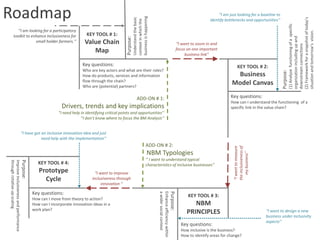
HOW TO READ THE ROADMAP
The following page shows a visual overview of the LINK Methodology.
•
•
•

Key questions: The critical questions that this guide aims to help you
answer
Purpose: The intended result of each key tool
Add-on’s: Complementary information that might be useful, in addition
to the key tools, to gain a deeper understanding of market dynamics
and the type of business model under study.

highlights the flow from one key tool to the next key tool
highlights possible direct entry points
suggests the use of the Add-ons

20
“I want to zoom in and
focus on one important
business link”

Key questions:

KEY TOOL # 2:

Who are key actors and what are their roles?
How do products, services and information
flow through the chain?
Who are (potential) partners?

Business
Model Canvas

(1) Analyze functioning of a specific
organization including up and
downstream connections
(2) Framework for a snapshot of today’s
situation and tomorrow’s vision.

Value Chain
Map

Purpose:

KEY TOOL # 1:

“I am just looking for a baseline to
identify bottlenecks and opportunities’’

Understand the basic
context in which the
business is happening

‘’I am looking for a participatory
toolkit to enhance inclusiveness for
small holder farmers.’’

Purpose:

Roadmap

Key questions:

ADD-ON # 1:

How can I understand the functioning of a
specific link in the value chain?

Drivers, trends and key implications
“I need help in identifying critical points and opportunities’’
‘’I don’t know where to focus the BM Analysis’’

ADD-ON # 2:

NBM Typologies
Purpose:

KEY TOOL # 4:

Prototype
Cycle

“I want to improve
inclusiveness through
innovation ”

How can I move from theory to action?
How can I incorporate innovation ideas in a
work plan?

Purpose:

Key questions:

Enhance efficiency within
a wider social context

Improve inclusiveness and performance
through rotative up-scaling

‘’ I want to understand typical
characteristics of inclusive businesses’’

“I want to measure
the inclusiveness of
my business’’

“I have got an inclusive innovation idea and just
need help with the implementation’’

KEY TOOL # 3:

NBM
PRINCIPLES
Key questions:
How inclusive is the business?
How to identify areas for change?

“I want to design a new
business under inclusivity
aspects’’
KEY TOOL #1

THE VALUE CHAIN MAP

22
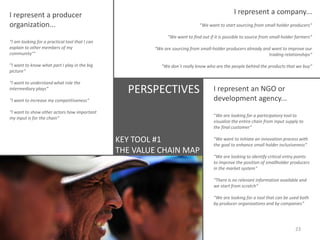
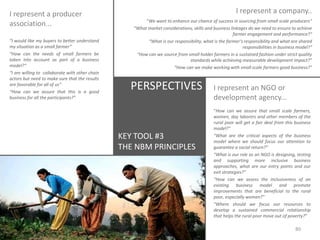
I represent a company...

I represent a producer
organization...
“I am looking for a practical tool that I can
explain to other members of my
community‘“
“I want to know what part I play in the big
picture“
“I want to understand what role the
intermediary plays“

“We want to start sourcing from small holder producers“
“We want to find out if it is possible to source from small holder farmers“

“We are sourcing from small-holder producers already and want to improve our
trading relationships“
“We don´t really know who are the people behind the products that we buy“

PERSPECTIVES

“I want to increase my competitiveness“
“I want to show other actors how important
my input is for the chain“

I represent an NGO or
development agency...
“We are looking for a participatory tool to
visualize the entire chain from input supply to
the final customer“

KEY TOOL #1
THE VALUE CHAIN MAP

“We want to initiate an innovation process with
the goal to enhance small holder inclusiveness“
“We are looking to identify critical entry points
to improve the position of smallholder producers
in the market system“
“There is no relevant information available and
we start from scratch“
“We are looking for a tool that can be used both
by producer organizations and by companies“

23
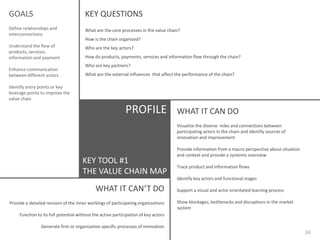
GOALS

KEY QUESTIONS

Define relationships and
interconnections

What are the core processes in the value chain?
How is the chain organized?

Understand the flow of
products, services,
information and payment
Enhance communication
between different actors

Who are the key actors?
How do products, payments, services and information flow through the chain?
Who are key partners?
What are the external influences that affect the performance of the chain?

Identify entry points or key
leverage points to improve the
value chain

PROFILE

WHAT IT CAN DO
Visualize the diverse roles and connections between
participating actors in the chain and identify sources of
innovation and improvement

KEY TOOL #1
THE VALUE CHAIN MAP

Provide information from a macro perspective about situation
and context and provide a systemic overview
Trace product and information flows
Identify key actors and functional stages

WHAT IT CAN‘T DO
Provide a detailed revision of the inner workings of participating organizations

Support a visual and actor orientated learning process
Show blockages, bottlenecks and disruptions in the market
system

Function to its full potential without the active participation of key actors
Generate firm or organization specific processes of innovation

24
THE CONCEPT
IN THEORY
AND

PRACTICE

KEY TOOL #1

A value chain is a connected
series of organizations,
resources and knowledge
streams involved in the
creation and delivery of value
to the end customer

THE VALUE CHAIN
25
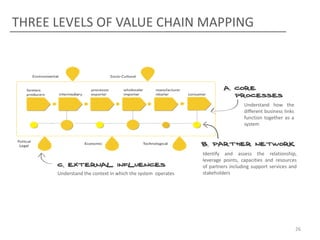
THREE LEVELS OF VALUE CHAIN MAPPING

Understand how the
different business links
function together as a
system

Understand the context in which the system operates

Identify and assess the relationship,
leverage points, capacities and resources
of partners including support services and
stakeholders

26
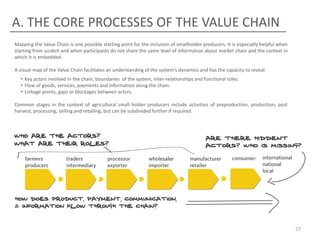
A. THE CORE PROCESSES OF THE VALUE CHAIN
Mapping the Value Chain is one possible starting point for the inclusion of smallholder producers. It is especially helpful when
SKETCH and MARKET CHAIN
starting from scratchTHE when participants do not share the same level of information about market chain and the context in
which it is embedded.
A visual map of the Value Chain facilitates an understanding of the system‘s dynamics and has the capacity to reveal:
• Key actors involved in the chain, boundaries of the system, inter-relationships and functional roles.
• Flow of goods, services, payments and information along the chain.
• Linkage points, gaps or blockages between actors.
Common stages in the context of agricultural small holder producers include activities of preproduction, production, post
harvest, processing, selling and retailing, but can be subdivided further if required.

27
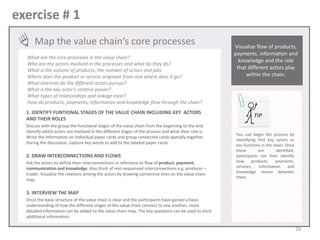
exercise # 1
Map the value chain‘s core processes
What are the core processes in the value chain?
Who are the actors involved in the processes and what do they do?
What is the volume of products, the number of actors and jobs
Where does the product or service originate from and where does it go?
What interests do the different actors pursue?
What is the key actor’s relative power?
What types of relationships and linkage exist?
How do products, payments, information and knowledge flow through the chain?
1. IDENTIFY FUNTIONAL STAGES OF THE VALUE CHAIN INCLUDING KEY ACTORS
AND THEIR ROLES
Discuss with the group the functional stages of the value chain from the beginning to the end.
Identify which actors are involved in the different stages of the process and what their role is.
Write the information on individual paper cards and group connected cards spatially together.
During the discussion, capture key words to add to the labeled paper cards.

2. DRAW INTERCONNECTIONS AND FLOWS
Ask the actors to define their interconnections in reference to flow of product, payment,
communication and knowledge. Also think of non-sequenced interconnections e.g. producer –
trader. Visualize the relations among the actors by drawing connective lines on the value chain
map.

Visualize flow of products,
payments, information and
knowledge and the role
that different actors play
within the chain.

TIP
You can begin the process by
identifying first key actors or
key functions in the chain. Once
these
are
identified,
participants can then identify
how
products,
payments,
services,
information
and
knowledge moves between
them.

3. INTERVIEW THE MAP
Once the basic structure of the value chain is clear and the participants have gained a basic
understanding of how the different stages of the value chain connect to one another, more
detailed information can be added to the value chain map. The key questions can be used to elicit
additional information.

28
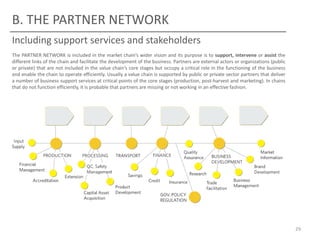
B. THE PARTNER NETWORK
Including support services and stakeholders
SKETCH THE MARKET CHAIN
The PARTNER NETWORK is included in the market chain’s wider vision and its purpose is to support, intervene or assist the
different links of the chain and facilitate the development of the business. Partners are external actors or organizations (public
or private) that are not included in the value chain’s core stages but occupy a critical role in the functioning of the business
and enable the chain to operate efficiently. Usually a value chain is supported by public or private sector partners that deliver
a number of business support services at critical points of the core stages (production, post-harvest and marketing). In chains
that do not function efficiently, it is probable that partners are missing or not working in an effective fashion.

29
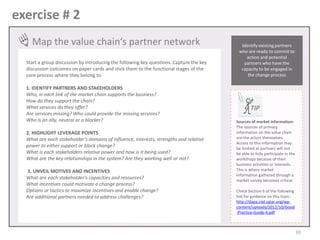
exercise # 2
Map the value chain‘s partner network
Start a group discussion by introducing the following key questions. Capture the key
discussion outcomes on paper cards and stick them to the functional stages of the
core process where they belong to.
1. IDENTIFY PARTNERS AND STAKEHOLDERS
Who, in each link of the market chain supports the business?
How do they support the chain?
What services do they offer?
Are services missing? Who could provide the missing services?
Who is an ally, neutral or a blocker?
2. HIGHLIGHT LEVERAGE POINTS
What are each stakeholder’s domains of influence, interests, strengths and relative
power to either support or block change?
What is each stakeholders relative power and how is it being used?
What are the key relationships in the system? Are they working well or not?
3. UNVEIL MOTIVES AND INCENTIVES
What are each stakeholder’s capacities and resources?
What incentives could motivate a change process?
Options or tactics to maximize incentives and enable change?
Are additional partners needed to address challenges?

Identify existing partners
who are ready to commit to
action and potential
partners who have the
capacity to be engaged in
the change process

TIP
Sources of market information:
The sources of primary
information on the value chain
are the actors themselves.
Access to this information may
be limited as partners will not
be able to fully participate in the
workshops because of their
business activities or interests.
This is where market
information gathered through a
market survey becomes critical.
Check Section 6 of the following
link for guidance on this topic:
http://dapa.ciat.cgiar.org/wpcontent/uploads/2012/10/Good
-Practice-Guide-4.pdf

30
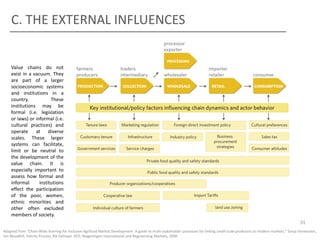
C. THE EXTERNAL INFLUENCES

Value chains do not
exist in a vacuum. They
are part of a larger
socioeconomic systems
and institutions in a
country.
These
institutions may be
formal (i.e. legislation
or laws) or informal (i.e.
cultural practices) and
operate at diverse
scales. These larger
systems can facilitate,
limit or be neutral to
the development of the
value chain. It is
especially important to
assess how formal and
informal
institutions
effect the participation
of the poor, women,
ethnic minorities and
other often excluded
members of society.
31
Adapted from “Chain-Wide learning for Inclusive Agrifood Market Development: A guide to multi-stakeholder processes for linking small-scale producers to modern markets.” Sonja Vermeulen,
Jim Woodhill, Felicity Proctor, Rik Delnoye. IIED, Wageningen International and Regoverning Markets, 2008
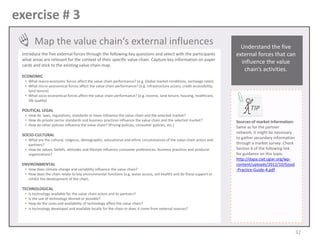
exercise # 3
Map the value chain‘s external influences
Introduce the five external forces through the following key questions and select with the participants
what areas are relevant for the context of their specific value chain. Capture key information on paper
cards and stick to the existing value chain map.

Understand the five
external forces that can
influence the value
chain’s activities.

ECONOMIC
• What macro-economic forces affect the value chain performance? (e.g. Global market conditions, exchange rates)
• What micro-economical forces affect the value chain performance? (e.g. infrastructure access, credit accessibility,
land tenure)
• What socio-economical forces affect the value chain performance? (e.g. income, land tenure, housing, healthcare,
life quality)

POLITICAL LEGAL
• How do laws, regulations, standards or taxes influence the value chain and the selected market?
• How do private sector standards and business practices influence the value chain and the selected market?
• How do other policies influence the value chain? (Pricing policies, consumer policies, etc.)

SOCIO-CULTURAL
• What are the cultural, religious, demographic, educational and ethnic circumstances of the value chain actors and
partners?
• How do values, beliefs, attitudes and lifestyle influence consumer preferences, business practices and producer
organizations?

ENVIRONMENTAL
• How does climate change and variability influence the value chain?
• How does the chain relate to key environmental functions (e.g. water access, soil health) and do these support or
inhibit the development of the chain.

TIP
Sources of market information:
Same as for the partner
network, it might be necessary
to gather secondary information
through a market survey. Check
Section 6 of the following link
for guidance on this topic:
http://dapa.ciat.cgiar.org/wpcontent/uploads/2012/10/Good
-Practice-Guide-4.pdf

TECHNOLOGICAL
•
•
•
•

Is technology available for the value chain actors and its partners?
Is the use of technology desired or possible?
How do the costs and availability of technology affect the value chain?
Is technology developed and available locally for the chain or does it come from external sources?

32
CASE
EXAMPLES
Strawberry Chain,
Mexico

KEY TOOL #1

THE VALUE CHAIN
33
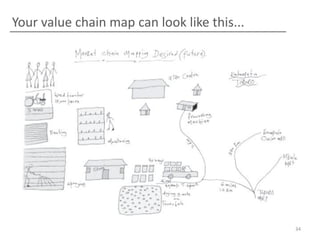
Your value chain map can look like this...

34
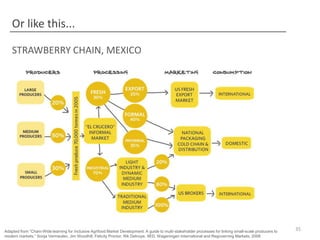
Or like this...
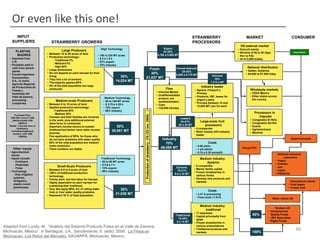
STRAWBERRY CHAIN, MEXICO

Adapted from “Chain-Wide learning for Inclusive Agrifood Market Development: A guide to multi-stakeholder processes for linking small-scale producers to
modern markets.” Sonja Vermeulen, Jim Woodhill, Felicity Proctor, Rik Delnoye. IIED, Wageningen International and Regoverning Markets, 2008

35
Or even like this one!
PLANTAS
MADRES
• Imported from
U.S.
• Royalties paid in
cash from parent
plants.
• Formal ImportersEurosemillas,
S.A., la Unión
Agrícola Regional
de Productores de
Fresas y
Hortalizas del
Valle de Zamora,
processing
companies.

Purchase Price
US$ 220 / box of 1.000
plants (royalty US$
150/box)
Needs: 1 box per acre of
strawberry.
Including freight and
nursery, cost. US$
1.000/Ha.

Other inputs
• Agrochemical
stores
• Inputs include:
- Fertilizers
- Pesticides
- Foliar
• Technology
- Drip irrigation
systems,
fertigation,
plastic mulch
greehouses

STRAWBERRY
PROCESSORS

STRAWBERRY GROWERS
Large Producers

• Between 12 to 50 acres of land
• 150 to 225 MT acres
• Production technology::
• $ 5 a 7.5 k
- Traditional 2%
• 67% export.
- Medium13%
• 33% Industry
- High 85%
• Large landowners
• Do not depend on each harvest for their
living.
20%
• They hire a lot of workers
14,024 MT
• The majority applies BPA
• 5% of the total population are large
producers

Medium-scale Producers
• Between 5 to 10 acres of land
• Applied production technology:
-Traditional 80%
- Medium 20%
- Farmers and their families are involved
in the work, plus additional external
labor force is contracted.
- Important income source to sustain
livelihood but farmer have other income
sources.
- Few application of BPA, for those who
do not have problems with water quality
- 60% of the total population are medium
scale producers .
- There numbers are stable.

Small-Scale Producers
• Between 0.8 to 5 acres of land
• 100% of traditional production
technology
• Family work, but hire labor for harvest.
• Highly dependent on each harvest for
sustaining their livelihood.
• Very few apply BPA, b/c of rolling water
hole or river water quality problems.
• Represent 35 % of total population

•
•
•
•

Traditional Technology
• 50 to 60 MT acres
• $ 5.6 a 7 k
• 10% export.
• 90% Industry

Leaders
53-61%
26 a 30 MT

National distributors
Informal
35%
7,312 a MT

• Agrana, Frexport y
Profusa.
• Products: IQF, bases for
yogurt y jams.
• Process between 10 and
12,000 MT/ ano for each.

• Gaitan, Gutiérrez
• 65,000 to 97,500 k/day

Industry
70%
49,085 MT

Wholesale markets
• CEDA México
• Other states across
the country

Processors in
Irapuato
Large-scale fruit
processors
• 5 companies
• Work closely with industry
leader

•
•
•
•
•

Congelador El Niño
Congelador del Río
Duarte
Agriamericana
Mexfruit.
Supermercados

Costs
• 0.69 p/kilo
• 1 p/k admin.
• 0.15 a 0.30 earned/k

Group GYC

Medium industry
dynamic
Dynamic
19-21%
9.5 a 10 MT

30%
21,036 MT

•
•
•
•
•

• 9 companies
• Mainly family capital
• Frozen strawberries in
various forms
• Develop new products and
markets

National industrial
customers
Yogurt
Cookies
Jam
Jugos
Paleterias
International clients
• Fruit bases
• Frozen fruit

Costs
• 4.47 /k processing
• Final costs 11.01/k

Other clients US

Medium industry
traditional
Tradicional
18-28%
9 a 14 MT

Adapted from Lundy, M. “Análisis del Sistema Producto Fresa en el Valle de Zamora,
Michoacán, México”, in Berdegué, J.A., Sanclemente, X. (eds). 2008. La Fresa en
Michoacan: Los Retos del Mercado. SAGARPA, Michoacán, Mexico.

Importation

Industry leader

Flow
• Informal Market
• Undifferentialted
product, not
sanitized(water).
• Cash
• 130,000 kilo/day

Medium Technology
85 to 100 MT acres.
$ 3.75 a 4.29 k
10% export.
90% Industry

50%
35,061 MT

• Driscoll mainly
• Window of 80 to 90 days
Nov to Feb.
• 44 to 5,000 k/daily

Formal National
28-42%
5,850 a 8,775 MT

Fresh
30%
21,037 MT

CONSUMER

MARKET
US external market

Export
23-28%
4,760 a 5,950 MT

High Technology

Production of strawberry (70,122 ton, 2005)

INPUT
SUPPLIERS

• 11 empresas
• Capital principally from
ejidal
• Frozen strawberries in
various presentations
• Traditional products and
markets

80%

100%

Brokers US
• Interamerican
Quality Foods
• JSO Associates
• Rigby Foods

36
KEY TOOL #2

THE BUSINESS MODEL
CANVAS

37
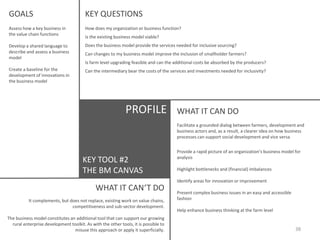
GOALS

KEY QUESTIONS

Assess how a key business in
the value chain functions

How does my organization or business function?

Develop a shared language to
describe and assess a business
model

Does the business model provide the services needed for inclusive sourcing?

Create a baseline for the
development of innovations in
the business model

Can the intermediary bear the costs of the services and investments needed for inclusivity?

Is the existing business model viable?
Can changes to my business model improve the inclusion of smallholder farmers?
Is farm level upgrading feasible and can the additional costs be absorbed by the producers?

PROFILE

WHAT IT CAN DO
Facilitate a grounded dialog between farmers, development and
business actors and, as a result, a clearer idea on how business
processes can support social development and vice versa

KEY TOOL #2
THE BM CANVAS

Provide a rapid picture of an organization‘s business model for
analysis
Highlight bottlenecks and (financial) imbalances
Identify areas for innovation or improvement

WHAT IT CAN‘T DO
It complements, but does not replace, existing work on value chains,
competitiveness and sub-sector development.
The business model constitutes an additional tool that can support our growing
rural enterprise development toolkit. As with the other tools, it is possible to
misuse this approach or apply it superficially.

Present complex business issues in an easy and accessible
fashion
Help enhance business thinking at the farm level

38
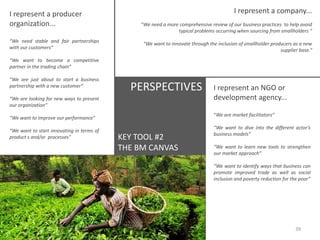
I represent a producer
organization...
“We need stable and fair partnerships
with our customers“

I represent a company...
“We need a more comprehensive review of our business practices to help avoid
typical problems occurring when sourcing from smallholders “
“We want to innovate through the inclusion of smallholder producers as a new
supplier base.“

“We want to become a competitive
partner in the trading chain“
“We are just about to start a business
partnership with a new customer“

PERSPECTIVES

“We are looking for new ways to present
our organization“

“We are market facilitators“

“We want to improve our performance“
“We want to start innovating in terms of
product s and/or processes”

I represent an NGO or
development agency...

KEY TOOL #2
THE BM CANVAS

“We want to dive into the different actor‘s
business models“
“We want to learn new tools to strengthen
our market approach“
“We want to identify ways that business can
promote improved trade as well as social
inclusion and poverty reduction for the poor”

39
THE CONCEPT
IN THEORY
AND

PRACTICE

“A business model describes
the rational of how an
individual firm creates,
captures and delivers value”
Alexander Osterwalder

KEY TOOL #2

THE BUSINESS MODEL
CANVAS
40
41
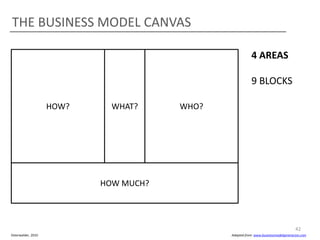
THE BUSINESS MODEL CANVAS
4 AREAS

9 BLOCKS
HOW?

WHAT?

WHO?

HOW MUCH?

42
Osterwalder, 2010

Adapted from: www.businessmodelgeneracion.com
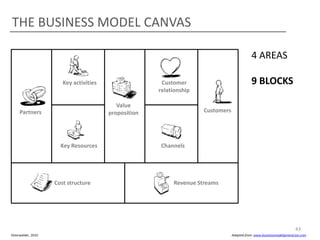
THE BUSINESS MODEL CANVAS
4 AREAS
Key activities

Value
proposition

Partners

Key Resources

Cost structure

9 BLOCKS

Customer
relationship
Customers

Channels

Revenue Streams

43
Osterwalder, 2010

Adapted from: www.businessmodelgeneracion.com
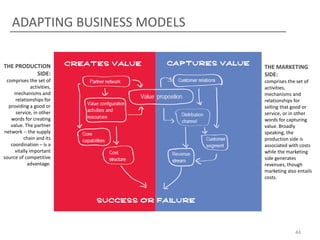
ADAPTING BUSINESS MODELS
THE PRODUCTION
SIDE:

THE MARKETING
SIDE:

comprises the set of
activities,
mechanisms and
relationships for
providing a good or
service, in other
words for creating
value. The partner
network -- the supply
chain and its
coordination – is a
vitally important
source of competitive
advantage.

comprises the set of
activities,
mechanisms and
relationships for
selling that good or
service, or in other
words for capturing
value. Broadly
speaking, the
production side is
associated with costs
while the marketing
side generates
revenues, though
marketing also entails
costs.

44
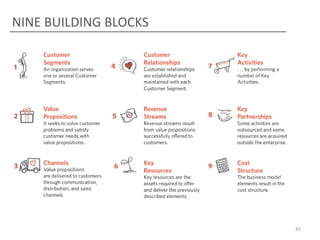
NINE BUILDING BLOCKS

45
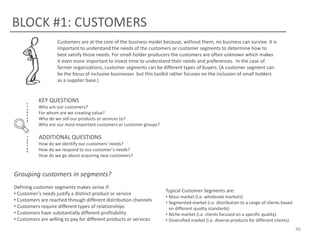
BLOCK #1: CUSTOMERS
Customers are at the core of the business model because, without them, no business can survive. It is
important to understand the needs of the customers or customer segments to determine how to
best satisfy those needs. For small holder producers the customers are often unknown which makes
it even more important to invest time to understand their needs and preferences. In the case of
farmer organizations, customer segments can be different types of buyers. (A customer segment can
be the focus of inclusive businesses but this toolkit rather focuses on the inclusion of small holders
as a supplier base.)

KEY QUESTIONS
Who are our customers?
For whom are we creating value?
Who do we sell our products or services to?
Who are our most important customers or customer groups?

ADDITIONAL QUESTIONS
How do we identify our customers’ needs?
How do we respond to our customer’s needs?
How do we go about acquiring new customers?

Grouping customers in segments?
Defining customer segments makes sense if:
• Customer’s needs justify a distinct product or service
• Customers are reached through different distribution channels
• Customers require different types of relationships
• Customers have substantially different profitability
• Customers are willing to pay for different products or services

Typical Customer Segments are:
• Mass market (i.e. wholesale markets)
• Segmented market (i.e. distribution to a range of clients based
on different quality standards)
• Niche market (i.e. clients focused on a specific quality)
• Diversified market (i.e. diverse products for different clients)

46
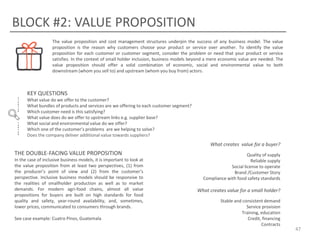
BLOCK #2: VALUE PROPOSITION
The value proposition and cost management structures underpin the success of any business model. The value
proposition is the reason why customers choose your product or service over another. To identify the value
proposition for each customer or customer segment, consider the problem or need that your product or service
satisfies. In the context of small holder inclusion, business models beyond a mere economic value are needed. The
value proposition should offer a solid combination of economic, social and environmental value to both
downstream (whom you sell to) and upstream (whom you buy from) actors.

KEY QUESTIONS
What value do we offer to the customer?
What bundles of products and services are we offering to each customer segment?
Which customer need is this satisfying?
What value does do we offer to upstream links e.g. supplier base?
What social and environmental value do we offer?
Which one of the customer’s problems are we helping to solve?
Does the company deliver additional value towards suppliers?

What creates value for a buyer?

THE DOUBLE-FACING VALUE PROPOSITION
In the case of inclusive business models, it is important to look at
the value proposition from at least two perspectives, (1) from
the producer’s point of view and (2) from the customer’s
perspective. Inclusive business models should be responsive to
the realities of smallholder production as well as to market
demands. For modern agri-food chains, almost all value
propositions for buyers are built on high standards for food
quality and safety, year-round availability, and, sometimes,
lower prices, communicated to consumers through brands.
See case example: Cuatro Pinos, Guatemala

Quality of supply
Reliable supply
Social license to operate
Brand /Customer Story
Compliance with food safety standards

What creates value for a small holder?
Stable and consistent demand
Service provision
Training, education
Credit, financing
Contracts

47
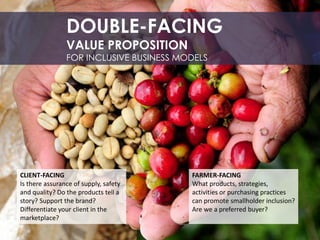
DOUBLE-FACING
VALUE PROPOSITION

FOR INCLUSIVE BUSINESS MODELS

CLIENT-FACING
Is there assurance of supply, safety
and quality? Do the products tell a
story? Support the brand?
Differentiate your client in the
marketplace?

FARMER-FACING
What products, strategies,
activities or purchasing practices
can promote smallholder inclusion?
Are we a preferred buyer?
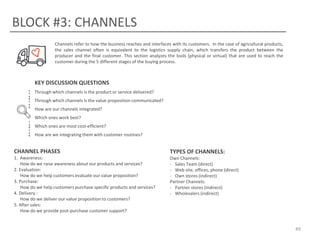
BLOCK #3: CHANNELS
Channels refer to how the business reaches and interfaces with its customers. In the case of agricultural products,
the sales channel often is equivalent to the logistics supply chain, which transfers the product between the
producer and the final customer. This section analyzes the tools (physical or virtual) that are used to reach the
customer during the 5 different stages of the buying process.

KEY DISCUSSION QUESTIONS
Through which channels is the product or service delivered?
Through which channels is the value proposition communicated?
How are our channels integrated?
Which ones work best?
Which ones are most cost-efficient?
How are we integrating them with customer routines?

CHANNEL PHASES

TYPES OF CHANNELS:

1. Awareness:
How do we raise awareness about our products and services?
2. Evaluation:
How do we help customers evaluate our value proposition?
3. Purchase:
How do we help customers purchase specific products and services?
4. Delivery :
How do we deliver our value proposition to customers?
5. After sales:
How do we provide post-purchase customer support?

Own Channels:
- Sales Team (direct)
- Web site, offices, phone (direct)
- Own stores (indirect)
Partner Channels:
- Partner stores (indirect)
- Wholesalers (indirect)

49
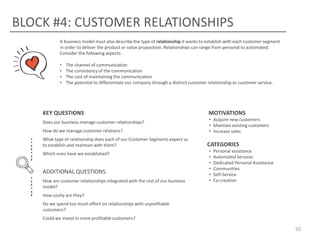
BLOCK #4: CUSTOMER RELATIONSHIPS
A business model must also describe the type of relationship it wants to establish with each customer segment
in order to deliver the product or value proposition. Relationships can range from personal to automated.
Consider the following aspects:
•
•
•
•

The channel of communication
The consistency of the communication
The cost of maintaining the communication
The potential to differentiate our company through a distinct customer relationship or customer service.

KEY QUESTIONS
Does our business manage customer relationships?
How do we manage customer relations?
What type of relationship does each of our Customer Segments expect us
to establish and maintain with them?
Which ones have we established?

ADDITIONAL QUESTIONS
How are customer relationships integrated with the rest of our business
model?

MOTIVATIONS
• Acquire new customers
• Maintain existing customers
• Increase sales

CATEGORIES
•
•
•
•
•
•

Personal assistance
Automated Services
Dedicated Personal Assistance
Communities
Self-Service
Co-creation

How costly are they?
Do we spend too much effort on relationships with unprofitable
customers?
Could we invest in more profitable customers?

50
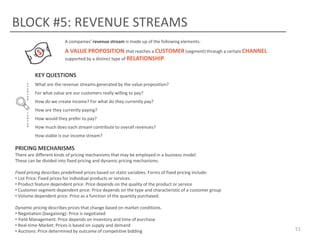
BLOCK #5: REVENUE STREAMS
A companies’ revenue stream is made up of the following elements:

A VALUE PROPOSITION that reaches a CUSTOMER (segment) through a certain CHANNEL
supported by a distinct type of RELATIONSHIP.
KEY QUESTIONS
What are the revenue streams generated by the value proposition?
For what value are our customers really willing to pay?
How do we create income? For what do they currently pay?
How are they currently paying?
How would they prefer to pay?
How much does each stream contribute to overall revenues?
How stable is our income stream?

PRICING MECHANISMS
There are different kinds of pricing mechanisms that may be employed in a business model.
These can be divided into fixed pricing and dynamic pricing mechanisms.
Fixed pricing describes predefined prices based on static variables. Forms of fixed pricing include:
• List Price: Fixed prices for individual products or services.
• Product feature dependent price: Price depends on the quality of the product or service
• Customer segment dependent price: Price depends on the type and characteristic of a customer group
• Volume dependent price: Price as a function of the quantity purchased.
Dynamic pricing describes prices that change based on market conditions.
• Negotiation (bargaining): Price is negotiated
• Yield Management: Price depends on inventory and time of purchase
• Real-time-Market: Prices is based on supply and demand
• Auctions: Price determined by outcome of competitive bidding

51
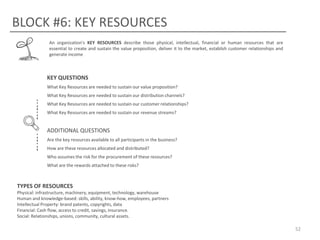
BLOCK #6: KEY RESOURCES
An organization's KEY RESOURCES describe those physical, intellectual, financial or human resources that are
essential to create and sustain the value proposition, deliver it to the market, establish customer relationships and
generate income

KEY QUESTIONS
What Key Resources are needed to sustain our value proposition?
What Key Resources are needed to sustain our distribution channels?

What Key Resources are needed to sustain our customer relationships?
What Key Resources are needed to sustain our revenue streams?

ADDITIONAL QUESTIONS
Are the key resources available to all participants in the business?
How are these resources allocated and distributed?
Who assumes the risk for the procurement of these resources?
What are the rewards attached to these risks?

TYPES OF RESOURCES
Physical: infrastructure, machinery, equipment, technology, warehouse
Human and knowledge-based: skills, ability, know-how, employees, partners
Intellectual Property: brand patents, copyrights, data
Financial: Cash flow, access to credit, savings, insurance.
Social: Relationships, unions, community, cultural assets.

52
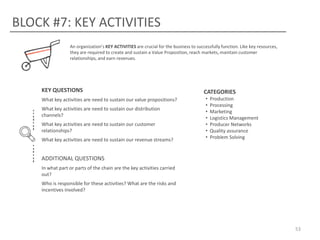
BLOCK #7: KEY ACTIVITIES
An organization’s KEY ACTIVITIES are crucial for the business to successfully function. Like key resources,
they are required to create and sustain a Value Proposition, reach markets, maintain customer
relationships, and earn revenues.

KEY QUESTIONS
What key activities are need to sustain our value propositions?

What key activities are need to sustain our distribution
channels?
What key activities are need to sustain our customer
relationships?
What key activities are need to sustain our revenue streams?

CATEGORIES
•
•
•
•
•
•
•

Production
Processing
Marketing
Logistics Management
Producer Networks
Quality assurance
Problem Solving

ADDITIONAL QUESTIONS
In what part or parts of the chain are the key activities carried
out?
Who is responsible for these activities? What are the risks and
incentives involved?

53
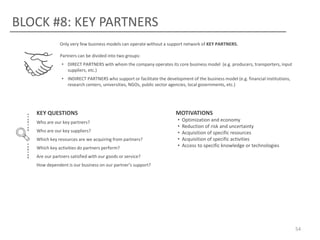
BLOCK #8: KEY PARTNERS
Only very few business models can operate without a support network of KEY PARTNERS.
Partners can be divided into two groups:
• DIRECT PARTNERS with whom the company operates its core business model (e.g. producers, transporters, input
suppliers, etc.)
• INDIRECT PARTNERS who support or facilitate the development of the business model (e.g. financial institutions,
research centers, universities, NGOs, public sector agencies, local governments, etc.)

KEY QUESTIONS
Who are our key partners?
Who are our key suppliers?
Which key resources are we acquiring from partners?
Which key activities do partners perform?

MOTIVATIONS
•
•
•
•
•

Optimization and economy
Reduction of risk and uncertainty
Acquisition of specific resources
Acquisition of specific activities
Access to specific knowledge or technologies

Are our partners satisfied with our goods or service?
How dependent is our business on our partner’s support?

54
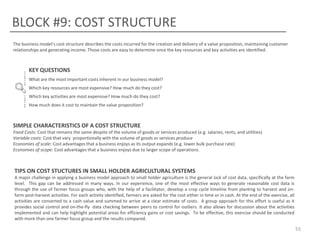
BLOCK #9: COST STRUCTURE
The business model’s cost structure describes the costs incurred for the creation and delivery of a value proposition, maintaining customer
relationships and generating income. Those costs are easy to determine once the key resources and key activities are identified.

KEY QUESTIONS
What are the most important costs inherent in our business model?
Which key resources are most expensive? How much do they cost?
Which key activities are most expensive? How much do they cost?
How much does it cost to maintain the value proposition?

SIMPLE CHARACTERISTICS OF A COST STRUCTURE
Fixed Costs: Cost that remains the same despite of the volume of goods or services produced (e.g. salaries, rents, and utilities)
Variable costs: Cost that vary proportionally with the volume of goods or services produce
Economies of scale: Cost advantages that a business enjoys as its output expands (e.g. lower bulk purchase rate)
Economies of scope: Cost advantages that a business enjoys due to larger scope of operations.

TIPS ON COST STUCTURES IN SMALL HOLDER AGRICULTURAL SYSTEMS
A major challenge in applying a business model approach to small holder agriculture is the general lack of cost data, specifically at the farm
level. This gap can be addressed in many ways. In our experience, one of the most effective ways to generate reasonable cost data is
through the use of farmer focus groups who, with the help of a facilitator, develop a crop cycle timeline from planting to harvest and onfarm post-harvest activities. For each activity identified, farmers are asked for the cost either in time or in cash. At the end of the exercise, all
activities are converted to a cash value and summed to arrive at a clear estimate of costs. A group approach for this effort is useful as it
provides social control and on-the-fly data checking between peers to control for outliers. It also allows for discussion about the activities
implemented and can help highlight potential areas for efficiency gains or cost savings. To be effective, this exercise should be conducted
with more than one farmer focus group and the results compared.

55
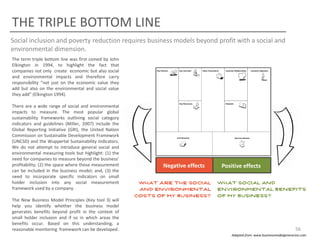
THE TRIPLE BOTTOM LINE
Social inclusion and poverty reduction requires business models beyond profit with a social and
environmental dimension.
The term triple bottom line was first coined by John
Elkington in 1994, to highlight the fact that
companies not only create economic but also social
and environmental impacts and therefore carry
responsibility “not just on the economic value they
add but also on the environmental and social value
they add” (Elkington 1994).
There are a wide range of social and environmental
impacts to measure. The most popular global
sustainability frameworks outlining social category
indicators and guidelines (Miller, 2007) include the
Global Reporting Initiative (GRI), the United Nation
Commission on Sustainable Development Framework
(UNCSD) and the Wuppertal Sustainability Indicators.
We do not attempt to introduce general social and
environmental measuring tools but highlight: (1) the
need for companies to measure beyond the business’
profitability; (2) the space where those measurement
can be included in the business model; and, (3) the
need to incorporate specific indicators on small
holder inclusion into any social measurement
framework used by a company.

Negative effects
What are the social

What social and

and environmental

environmental BENEFITS

COSTS of my business?

The New Business Model Principles (Key tool 3) will
help you identify whether the business model
generates benefits beyond profit in the context of
small holder inclusion and if so in which areas the
benefits occur. Based on this understanding, a
reasonable monitoring framework can be developed.

Positive effects

of my business?

56
Adapted from: www.businessmodelgeneracion.com
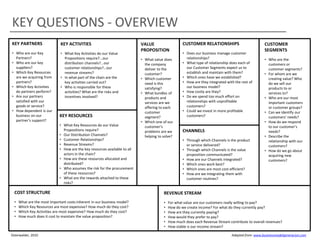
KEY QUESTIONS - OVERVIEW
KEY PARTNERS

KEY ACTIVITIES

• Who are our Key
Partners?
• Who are our key
suppliers?
• Which Key Resources
are we acquiring from
partners?
• Which Key Activities
do partners perform?
• Are our partners
satisfied with our
goods or service?
• How dependent is our
business on our
partner’s support?

• What Key Activities do our Value
Propositions require?...our
distribution channels?...our
customer relationships?…our
revenue streams?
• In what part of the chain are the
key activities carried out?
• Who is responsible for these
activities? What are the risks and
incentives involved?

KEY RESOURCES
• What Key Resources do our Value
Propositions require?
• Our Distribution Channels?
• Customer Relationships?
• Revenue Streams?
• How are the key resources available to all
actors in the chain?
• How are these resources allocated and
distributed?
• Who assumes the risk for the procurement
of these resources?
• What are the rewards attached to these
risks?

VALUE
PROPOSITION
• What value does
the company
deliver to the
customer?
• Which customer
need is this
satisfying?
• What bundles of
products and
services are we
offering to each
customer
segment?
• Which one of our
customer’s
problems are we
helping to solve?

CUSTOMER RELATIONSHIPS
• Does our business manage customer
relationships?
• What type of relationship does each of
our Customer Segments expect us to
establish and maintain with them?
• Which ones have we established?
• How are they integrated with the rest of
our business model?
• How costly are they?
• Do we spend too much effort on
relationships with unprofitable
customers?
• Could we invest in more profitable
customers?

CHANNELS
• Through which Channels is the product
or service delivered?
• Through which Channels is the value
proposition communicated?
• How are our Channels integrated?
• Which ones work best?
• Which ones are most cost-efficient?
• How are we integrating them with
customer routines?

COST STRUCTURE

•
•
•
•
•
•

• Who are the
customers or
customer segments?
• For whom are we
creating value? Who
do we sell our
products to or
services to?
• Who are our most
important customers
or customer groups?
• Can we identify our
customers’ needs?
• How do we respond
to our customer’s
needs?
• Describe the
relationship with our
customers?
• How do we go about
acquiring new
customers?

REVENUE STREAM

•
•
•
•

CUSTOMER
SEGMENTS

What are the most important costs inherent in our business model?
Which Key Resources are most expensive? How much do they cost?
Which Key Activities are most expensive? How much do they cost?
How much does it cost to maintain the value proposition?

Osterwalder, 2010

For what value are our customers really willing to pay?
How do we create income? For what do they currently pay?
How are they currently paying?
How would they prefer to pay?
How much does each Revenue Stream contribute to overall revenues?
How stable is our income stream?
Adapted from: www.businessmodelgeneracion.com
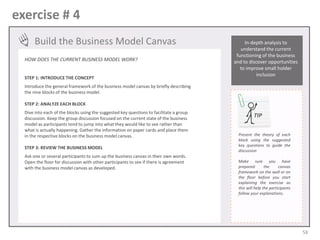
exercise # 4
Build the Business Model Canvas
HOW DOES THE CURRENT BUSINESS MODEL WORK?
STEP 1: INTRODUCE THE CONCEPT

In-depth analysis to
understand the current
functioning of the business
and to discover opportunities
to improve small holder
inclusion

Introduce the general framework of the business model canvas by briefly describing
the nine blocks of the business model.
STEP 2: ANALYZE EACH BLOCK
Dive into each of the blocks using the suggested key questions to facilitate a group
discussion. Keep the group discussion focused on the current state of the business
model as participants tend to jump into what they would like to see rather than
what is actually happening. Gather the information on paper cards and place them
in the respective blocks on the business model canvas.
STEP 3: REVIEW THE BUSINESS MODEL
Ask one or several participants to sum up the business canvas in their own words.
Open the floor for discussion with other participants to see if there is agreement
with the business model canvas as developed.

TIP
Present the theory of each
block using the suggested
key questions to guide the
discussion
Make sure you have
prepared
the
canvas
framework on the wall or on
the floor before you start
explaining the exercise as
this will help the participants
follow your explanations.

58
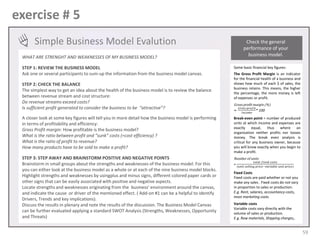
exercise # 5
Simple Business Model Evalution

Check the general
performance of your
business model.

WHAT ARE STRENGHT AND WEAKNESSES OF MY BUSINESS MODEL?
STEP 1: REVIEW THE BUSINESS MODEL
Ask one or several participants to sum-up the information from the business model canvas.
STEP 2: CHECK THE BALANCE
The simplest way to get an idea about the health of the business model is to review the balance
between revenue stream and cost structure:
Do revenue streams exceed costs?
Is sufficient profit generated to consider the business to be “attractive”?

Some basic financial key figures:
The Gross Profit Margin is an indicator
for the financial health of a business and
shows how much of each $ of sales, the
business retains. This means, the higher
the percentage, the more money is left
of expenses or profit.
Gross profit margin (%)

=

𝐺𝑟𝑜𝑠𝑠 𝑝𝑟𝑜𝑓𝑖𝑡
*
𝐼𝑛𝑐𝑜𝑚𝑒

100

A closer look at some key figures will tell you in more detail how the business model is performing
in terms of profitability and efficiency:
Gross Profit margin: How profitable is the business model?
What is the ratio between profit and “sunk” costs (=cost efficiency) ?
What is the ratio of profit to revenue?
How many products have to be sold to make a profit?

Break-even point = number of produced
units at which income and expenses are
exactly equal, thus where an
organization neither profits nor looses
money. The break even analysis is
critical for any business owner, because
you will know exactly when you begin to
make a profit.

STEP 3: STEP AWAY AND BRAINSTORM POSITIVE AND NEGATIVE POINTS
Brainstorm in small groups about the strengths and weaknesses of the business model. For this
you can either look at the business model as a whole or at each of the nine business model blocks.
Highlight strengths and weaknesses by usingplus and minus signs, different colored paper cards or
other signs that can be easily associated with positive and negative aspects.
Locate strengths and weaknesses originating from the business’ environment around the canvas,
and indicate the cause or driver of the mentioned effect. ( Add-on #1 can be a helpful to identify
Drivers, Trends and key implications).
Discuss the results in plenary and note the results of the discussion. The Business Model Canvas
can be further evaluated applying a standard SWOT Analysis (Strengths, Weaknesses, Opportunity
and Threats)

Number of units

=

𝑡𝑜𝑡𝑎𝑙 𝑓𝑖𝑥𝑒𝑑 𝑐𝑜𝑠𝑡𝑠
(𝑢𝑛𝑖𝑡 𝑠𝑒𝑙𝑙𝑖𝑛𝑔 𝑝𝑟𝑖𝑐𝑒−𝑣𝑎𝑟𝑖𝑎𝑏𝑙𝑒 𝑢𝑛𝑖𝑡 𝑝𝑟𝑖𝑐𝑒)

Fixed Costs
Fixed costs are paid whether or not you
make any sales . Fixed costs do not vary
in proportion to sales or production.
E.g. Rent, salaries, accountancy costs,
most marketing costs.
Variable costs
Variable costs vary directly with the
volume of sales or production.
E.g. Raw materials, Shipping charges,.

59
exercise # 6
Visioning
STEP 1: Review the current business model (developed in exercise # 4)
STEP 2: Build one or more future business models that incorporate the results
of the discussion from exercise #5

What do we want our business model to be in the future?
How would the proposed business model function?
What blocks will change?
What key elements within each block will change?
STEP 3: Bridge today’s and tomorrow business model
The “gaps” that exist between the two business models highlight possible areas
of change and innovation for your business model. Discuss and prioritize the
most critical interventions that have to be undertaken in order to achieve the
vision. This information can be fed into a action plan e.g. Key tool # 4 Prototype
cycle.

Set a vision, motivate the
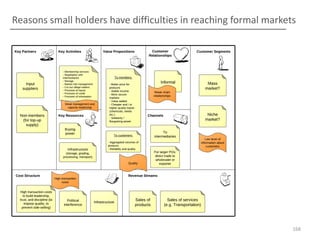
team and canalize action
to reach the target.

TIP
This exercise is useful to
explore how improvements can
be made in the business model
with special emphasis on small
holder inclusion.
There is no need to arrive at
one future business model.
Rather the exercise can be
used to explore different
possible business models.
Invite the participants to
explore both minor changes in
the existing business model as
well as radical changes.

60
INCLUSION STRATEGIES FOR NEW BUSINESS MODELS
farmers’ groups, associations and cooperatives for better market
access including relevant legal measures and capacity building (skills, financial management)
Foster the formation of

Form and organize commodity associations
Develop new

models of partnership between farmers and modern markets

Build and develop the infrastructure
remote areas

of procurement centers, warehouse, packaging, transport

extension agents

Re-vitalize the role and functions of
including
modern markets, production planning and good agricultural practice

including in

technical services geared to

Improve transportation infrastructure for small-farmer competitive
Increase understanding of
requirements

product quality along the value chain – share knowledge of market

Develop financial credit mechanisms that support farmers and farmer groups and that support farmer groups
linkages to modern supply chain
Develop

new models of farming including contract farming

Strengthen support to production
modernize farming methods

technology and research (including diversification and niche products) -

Address critical constraints to production e.g. water policy and water management and technology, land
and land access

Source: Regoverning Markets, Chain-wide Learning Synthesis Report. 2008

61
From Value Chains to the Business Models

“The value chain map
is the high level view
on the system and the
business model canvas
the close-up on one
organization with a
360° view.”

62
THE CHAIN WIDE BUSINESS MODEL
In a multi stakeholder process, especially with long trading chains, it is likely that an analysis of one individual
business model does not sufficiently represent trading partners located up and downstream in the chain.
Depending on the focus of the analysis, two different options of business model integration can be considered:

LINKED BUSINESS MODELS
The logic of this method is that, in a value chain, your
customer is another's supplier. Understanding these
linkages is critical for the quality of trade relationships
and are the focus of this exercise. Here we aim to
highlight the individual needs of each actor and how
the interlinked trade partners are responding to those
needs.

SYSTEM-WIDE BUSINESS MODEL
A system-wide business model integrates the value chain into
one business model canvas with a slightly adapted layout. This
exercise is only useful if the supply chain can be considered a
“value” chain, in the sense that there is significant cohesion
and collaboration between chain actors. A system-wide
business model implies that one specific value chain has been
selected (even though the same organizations offers different
products) and that all actors share a common vision.
63
BUSINESS MODEL CHAINS
Customer or supplier? - A question of perspective.

64
TWO STAGE BUSINESS MODEL
A two stages business model can represent
direct trade from producer to retailer

Key
activities

Customer
R/ships

Key
resources

Cost
structure

Channels

Revenue
stream

Customer
R/ships

Key
activities
Suppliers

Value
Proposition

Partners

Business Model B

Customers

c

Value
Proposition
Key
resources

Cost
structure

Customers
Channels

Revenue
stream

Business Model A
65
MUTLI STAGE BUSINESS MODEL
Business Model B

KA

CR

C

KA

CR

VP

P

CH

CS

KA

CR

RS

P

c

P

VP

KR

CH

CS

C

CH

VP

KR

c

C

RS

P

c

KR

CS

RS

c

Business Model C
Business Model A
66
exercise # 7
Build a Linked Business Model
After building the individual Business Model Canvas for each relevant (group of) actor(s), the
individual business models can be stitched together to form a chain.

Incorporate the multi actor
view of the value chain into
the Business Model Canvas
concept.

STEP 1: Identify Trade linkages
Recall the order of the Value chain’s core processes and make sure that the relevant
information about all the business models is available in their individual form. If the business
models are not available in a handy format from former exercises, ask each (group) of actors
to copy their business model on a large piece of paper, leaving in blank the block of customers
and partners.
STEP 2: Connect business models
In a trading relation, two independent organizations intersect on the outside blocks of the
business model canvas. The relevant blocks are the “customers” (including B2B activities) and
the “partners” (including suppliers). In this exercise it is important to focus on the specific links
that are established between two or more consecutive actors in the chain.
This exercise focuses on the “double value proposition” where a business model offers distinct
forms of value when facing customers (downstream) or when facing suppliers (upstream).
Identify and highlight the individual needs (social and commercial) of each actor and how the
respective trading partner responds to those needs. Gaps between existing needs and the
value proposition causes instability along the chain and may present a potential area for
change.

TIP
Its useful to have previously
finished a Value chain analysis
as described in Key tool 1.
See Case example Cuatro Pinos
in Guatemala to find out more
about the “Double value
proposition”

67
CASE
EXAMPLES
Alianza Hortofrutícola del
Sur, Colombia
Cuatro Pinos, Guatemala

Chiyangua, Colombia
APROCA, Ecuador

KEY TOOL #2

THE BUSINESS MODEL
CANVAS
68
Case Example – Alianza Hortofruticola ALSUR, Colombia
Double facing value proposition
The innovative business proposal of the social intermediary Alianza Hortofruticola ALSUR aims to connect producer organizations with a
portfolio of 25 products of fresh fruits and vegetables to customers (mainly urban supermarket in Cali region) lead by a shared goal to
develop stable and lucrative business processes and specialized channels that contribute to an improvement of livelihood.
In order to respond better to both stakeholder groups, Alianza Hortofruticola ALSUR, developed a specific value proposition for supplier
and for customers taking into account their individual needs.
Business mission:
• Establish direct partnerships between rural producers groups and customers in different market channels
• Improve income levels and assets of producers through stable trade schemes and long term relationships
• Provision of business development strategies (growth strategies, market penetration and development strategies, product development)
Key figures:
In 2012, ALSUR works with 155 partner producers organized in 8 farmer organizations Asocofradia, Asofruit, Renacer Agroecologico,
Aproborca, Coophsur, Grupo Asociativo San Jose, Asaais, Asociacion san Felipe Grupo Asociativo Yakupacha. For top-up supply ALSUR
works with 22 additional producers. In 2011, ALSUR traded 25 tons per week with an annual sales volume of US$ 603,799 .

69
70
71
Case Example – Cuatro Pinos, Guatemala
BACKGROUND - Contract agriculture with input and service provision
Cuatro Pinos is a successful Cooperative with nearly 30 years of experience in the vegetable export business. The cooperative has
evolved into what can be termed a “social intermediary” that performs a vital role in linking farmers to international markets. Cuatro
Pinos manages a diverse portfolio of vegetables supplied by approximately 7,000 smallholder farmers organized into more than 140
farmer groups including cooperatives, associations, lead farmer informal groups and NGO-led firms. Recently the Cooperative has
succeeded in opening large markets for several products in the US and has achieved an annual growth rate of 50% in vegetable exports
over the past three years. Much of its success is can be explained through attractive value propositions to both smallholder farmers and
buyer markets. For both groups, Cuatro Pinos offers a low-risk, high return way of engaging supplier and buyer through supply chain
coordination, transparent chain governance, stable market linkages and critically, access to services.

TWO PERSPECTIVES - THE DOUBLE FACING VALUE PROPOSITION.
Value Proposition for producers
Technical support,
input provision and
formal contracts

Cuatro Pinos manages its purchasing from small holders through formal contracts, specifying quantity, quality
and a production schedule as well as providing a fixed price for the product. This fixed price contract has been
shown to consistently return 7–10 per cent above the spot price market. Additionally Cuatro Pinos provides
in-kind credit for seeds and inputs, technical assistance, insurance and marketing services. Recently the
Cooperative has also accessed government supported weather insurance to help cover crop-related risks.

Value Proposition for buyers
Reliable supply and
Quality

To ensure supply, scalability, and product quality, Cuatro Pinos identifies existing farmer groups in favorable
environmental niches, works with them to test production schemes and then contracts those that show an
ability to meet quantity and quality targets. The cooperative is the only farmer organization in Guatemala that
has had both farm and processing level GlobalGAP certification as well as an on-site pesticide residue lab.

72
Case Example – Chiyangua, Colombia
Chiyangua was founded in 1994 in Guapi, a small village on
Colombian’s pacific coast line and is the result of the local effort of a
group of men and women, concerned with conservation of
traditional ethnical aspects of afro Colombian culture. Chiyangua put
farmer women in the centre of their activities.
Aromatic plants and condiments have always been a traditional part
of afro Colombian culture but with the time Chiyangua observed that
the traditional plants such as long leaved coriander more and more
disappeared from local dishes and were replaced by artificial food
enhancers that were introduced to the remote village by the city
people.

This concerning development was the beginning of a
countermovement of the local promotion to enhance the
consumption and use of traditional herbs and spices in food and
beverages. In addition, Chiyangua initiated their aromatic plant
production program for female farmers in the region. Supported by
national and international grants, Chiyangua introduced to farmers
an innovative production system adapted to the flood afflicted
region. Women in the Guapi region started the production of
aromatic plants in elevated beets (2x10m) made of wood. This
production system has an initial cost of US$ 100 and can deliver a
monthly income of up to US$ 200 with the advantage that aromatic
plants are relatively low time consuming and allow the women to
dedicate themselves to other income activates.
Chiyangua is locally well known and a very respected organization in
the community mainly providing inputs (seeds, know-how) and
technical assistance to currently 84 female farmers.

73
Business Model Canvas of Chiyangua, Colombia

74
Evaluation of Business Model Canvas of Chiyangua, Colombia

75
Case Example - APROCA, Ecuador
APROCA is a small holder cocoa producer organization
with 100 direct members and four sister organizations
(total 400 cocoa growers) located in the north-west of
Ecuador’s Pacific coast.
The association buys the finely selected national variety
of cocoa from its members in form of mucilaginous pulp
(called “baba”) which is then fermented, dried and
selected on-site with quality standards to meet the high
customer requirements. The traditional production
procedures (on farm and post harvest) guaranty chemical
free high quality cocoa.
APROCA’s work aims to strengthen the cocoa chain and
the associated cocoa farmers by promoting community
work, gender equality and the use of traditional afroEcuadorian knowledge and practices. APROCA and its 4
sister associations offer a gourmet Cacao that is certified
by FAIR TRADE and the USDA Organic label.

The association manages to pay prices higher than the
regional market prices to the associated farmers and
additionally provides technical assistance embedded in a
continuous quality improvement process.
APROCA has a yearly sales volume of about 900 quintals
of dried cocoa, whereof 40% goes to the export market.

76
Business Model of APROCA, Ecuador
Partners

Key activities

Technical assistance for
producers

APROCA support
associated farmers in
improving their
livelihood

Project management with
partner of international
cooperation

Clients

Clients pay an
appropriate price for
the product
Payments do not always happen
on the due date
Intense customer care

Without contracts
Pacari
Cacaoyere
Cofina

With contracts

Key resources

Unique characteristics in
terms of Cocoa quality and
environmental conditions
Process transparency and
product traceability

Technical equipment and
infrastructure

Channels
International and national
Chocolate fairs
Existing clients visit
APROCA “headquarter”

Know-how

Transmar

What do clients
demand?
High Quality
Constant quantity
Certifications
Fixed prices

Communication via mobile
phone and internet page

Cost structure

Cost for human
resources is partly
assumed by partners

Relations

APROCA= Registered brand

Marketing

Partners provide
support for:
Production
Infrastructure
Organization
Marketing
Financial

Value
proposition

Raw material
Transport
Fermentation
Drying process

>

Break even point:
2500 cwt/year

Revenue structure
Sales margin on Cocoa
Grants by partners

77
KEY TOOL #3

THE BUSINESS MODEL
PRINCIPLES

78
GOAL

KEY QUESTIONS

Promote the sustained
participation of smallholder
farmers through a set of
design and evaluation
principles for business
models.

How inclusive is our business model?
What are the options for better inclusion of small holder farmers?
Which strategies are appropriate under what conditions?
Where should we focus efforts on innovation in our business model?

PROFILE

WHAT IT CAN DO
• Focus the business model analysis on areas that are
critical to the sustained inclusion of small holder
farmers.

KEY TOOL #3
THE NBM PRINCIPLES

WHAT IT CAN‘T DO

• Assess the performance of the business model in
themes that are critical to the sustained inclusion of
small holder farmers.
• Help identify possible areas of innovation and
improvement in the selected business model.
• Provide inputs for the design of an improved business
model for the engagement of small holder famers.

The New Business Model principles are not a magic bullet to achieve
smallholder inclusion.
These principles should not be taken as a check-list but rather as
guideposts to assess and improve business models.
The principles will not give you a specific answer; they will help you
assess and think through solutions relevant to your business model.
79
I represent a producer
association...
“I would like my buyers to better understand
my situation as a small farmer“
“How can the needs of small farmers be
taken into account as part of a business
model?“
“I am willing to collaborate with other chain
actors but need to make sure that the results
are favorable for all of us“
“How can we assure that this is a good
business for all the participants?”

I represent a company..
“We want to enhance our chance of success in sourcing from small scale producers“
“What market considerations, skills and business linkages do we need to ensure to achieve
farmer engagement and performance?“
“What is our responsibility, what is the farmer‘s responsibility and what are shared
responsibilities in business model?“
“How can we source from small holder farmers in a sustained fashion under strict quality
standards while achieving measurable development impact?”
“How can we make working with small scale farmers good business?”

PERSPECTIVES

KEY TOOL #3
THE NBM PRINCIPLES

I represent an NGO or
development agency...
“How can we assure that small scale farmers,
women, day laborers and other members of the
rural poor will get a fair deal from this business
model?”
“What are the critical aspects of the business
model where we should focus our attention to
guarantee a social return?”
“What is our role as an NGO is designing, testing
and supporting more inclusive business
approaches, what are our entry points and our
exit strategies?”
“How can we assess the inclusiveness of an
existing business model and promote
improvements that are beneficial to the rural
poor, especially women?”
“Where should we focus our resources to
develop a sustained commercial relationship
that helps the rural poor move out of poverty?”

80
THE CONCEPT
IN THEORY
AND

PRACTICE

The new business model
principles are signposts for
inclusive and durable trading
relationships.

KEY TOOL #3

THE NEW BUSINESS
MODEL PRINCIPLES
81
WHY NBM PRINCIPLES AND HOW TO USE THEM?
The new Business Model Principles can help design solutions for small-scale farmers that are…

DURABLE - promote long-term, stable trading relationships
EQUITABLE - increase market access for smallholders with an equitable balance of risk,
responsibilities and benefits

EFFICIENT - improve financial sustainability
EFFECTIVE - strengthen purchaser access to consistent supplies
ADAPTABLE - enable flexibility to respond to changing market, social and environmental conditions
CREDIBLE - offer real benefits in the form of stable commercial relations that can be tracked and
reported on
The application of these principles is designed to be flexible. As a result we ask that practitioners apply their
best judgment to these principles. This means you are required to think about what each principle means inns
in your context and not merely copy other models.
Small-scale producers and farmers face a number of limiting factors which make them less attractive to work with in a modern agri-food
system. These include low and inconsistent production volumes, limited planning skills and opportunities, dispersed production, incipient
business organization, limited capacity to upgrade and meet formal market requirements, poor access to information, technology and finance,
and high transaction costs.
The Business Model Principles are designed to be used as critical success factors to guide the process of assessing a business model and
selecting areas of change. In the business model analysis, these principles act as lenses to help us review critical aspects of our business model,
prioritize among them and select promising areas for innovation and improvement. These principles are not normative but should be used to
deepen the analysis and discussion about how to improve the business model under review or design.
These principles are emergent in the sense that they are drawn from a range of case studies conducted on successful examples of inclusive
business in Africa, Asia and Latin America. The studies did not examine failed attempts at linkages nor did they seek to develop a series of
normative check-lists that must be achieved in order to develop an inclusive business model. Rather these principles should be taken as sign
posts that indicate issues and/or topics where care should be exercised when constructing an inclusive business model that links small holder
farmers with modern markets. Not all principles will be present in all cases and quite often one or several will be of critical importance while
others may be of lesser importance or missing entirely. We suggest that these ideas be applied as design principles accompanied with a large
dose of common sense, innovation and adaptation to make them useful to local conditions.

82

Source: B. Vorley, “Linking Worlds: New Business Models for Sustainable Trading Relations between smallholders and Formalized Markets. 2009.
THE NBM PRINCIPLES - AN OVERVIEW

1. CHAIN WIDE
COLLABORATION
______________

2. NEW MARKET
LINKAGES
_______________

The resolution of
problems, in both
the commercial and
social performance
of new business
models requires all
or most chain actors
SET SHARED GOALS
FOR
COLLABORATION.
The development of
a systemic view of
the chain recognizes
and values the
interdependence of
the actors. Reaching
and implementing
agreement often
involves
IDENTIFYING one or
more CHAMPIONS
along the chain to
lead the process.

For farmers and their
organizations, market
linkages should
provide a STABLE
MARKET with clear
quality, volume and
price signals as well as
access to key services
(Principle 4). These
linkages must
contribution to
improved livelihoods.
For buyers, solutions
must provide A
CONSISTENT SUPPLY
of safe, quality
products at a
competitive price.
The achievement of
both producer and
buyer goals in
practice requires the
delivering social and
commercial value up
and down the chain.

3. FAIR AND
TRANSPARENT
GOVERNANCE
______________

4. EQUITABLE
ACCESS TO
SERVICES
______________

Fair and transparent
governance refers to
the establishment and
enforcement of CLEAR
AND CONSISTENT
GRADES AND
STANDARDS, CLEAR
COMMITMENTS to
buy and sell certain
volumes of certain
grade products at
certain times, and
equitable processes of
RISK MANAGEMENT.

One of the special
challenges faced by
small-scale
producers is access
to services such as
finance, market
information, and
best agronomic
practices that could
improve quality,
yields, food safety,
and environment
performance.

Mutually
RECOGNIZED
INTERDEPENDENCY
between chain actors
is a key criteria.
Shared commercial
risk and insurance
against failure are
frequently cited as the
cement of successful
relationships.

Successful solutions
enable smallholders
to ACCESS CREDIT,
KNOWLEDGE,
TECHNOLOGY, and
develop incentives
that encourage
producers to invest
in their own
production based on
market needs.

5. INCLUSIVE
INNOVATION
______________

6. MEASUREMENT
OF OUTCOMES
_______________

New business
models PROMOTE
INNOVATION by
multiple actors along
the chain in
PRODUCTS and
SERVICES as well as
the PROCESSES that
underpin both.

The business axiom
states that you cannot
manage what you do
not measure. Our sixth
principle is to
incorporate TAILORED
INDICATORS AND
MONITORING PLANS
to assess the health of
the on-going trading
relationship as a forprofit business and
also its effectiveness
as a vehicle for
community
development.

Innovations should
be done ‘WITH’
SMALLHOLDER
FARMERS, rather
than ‘for’ them.
Inclusive access to
innovation provides a
means to remain
competitive in
dynamic markets;
build the commercial
value of goods and
services; and, share
innovation gains
among partners all of
which builds business
durability.

Constant monitoring
of the health of the
trading relationship
reduces the risk the
minor problems will
destroy the business.
THE NBM PRINCIPLES - KEY QUESTIONS

1. CHAIN WIDE
COLLABORATION
______________

2. NEW MARKET
LINKAGES
_______________

3. FAIR AND
TRANSPARENT
GOVERNANCE
______________

Are the goals to clear
to all actors in the
chain?

How easy or difficult is
it to buy (find product)
and sell (find buyer) in
this chain?

Are standards,
processes, prices
clear and consistent
across the chain?

How are sellers linked
to buyers? Are
linkages stable or
constantly changing?

Are risks (production,
commercial,
financial) understood
and shared
proportionately
along the chain?

Is there opportunity
for co-investment or
shared decision
making in the chain?
Are there structures
in place for
collaboration or
shared problem
solving?
Are there one or
more champions
who will lead the
process of coinnovation?

Do buyers know
where their product
comes from?
Do farmers know
where their product is
consumed?

Do all actors have
access to information
on quality standards?
Is there evidence of
formal or informal
contract adherence?
If so, why? If not,
under what
conditions do
contracts break
down?

4. EQUITABLE
ACCESS TO
SERVICES
______________

5. INCLUSIVE
INNOVATION
______________

6. MEASUREMENT
OF OUTCOMES
_______________

Do all actors have
timely access to
market information?

Is there evidence of
product or process
innovation?

Do all actors have
access to financial
and technical
support services?

If so, who
participates and
why?

Are economic and
developmental goals
and indicators known
and shared along the
chain?

Are there examples
of service provision
that goes beyond
basic production
services?

If innovation is
evident, who gains
from the results? Are
there profit-sharing
mechanisms in
place?
Is innovation
encouraged among
all actors in the
chain?
What are the
incentives?

What systems are in
place to effectively
measure or analyze
indicators?
How does the chain
deal with difficulties
and crisis
management?
Are there feedback
loops in place to
guarantee effective
chain-wide
management and
decision-making?
PRINCIPLE #1: Chain wide collaboration
SHARED GOALS
Do actors in the system pull the same way?
The development of a systemic view of the chain stretches the usual
boundaries of the business model, which has focused on the individual firm
and its internal processes, to one of chain-wide processes involving multiple
actors. A collaborative partner network is vital for perishable commodities
such as fresh vegetables, dairy and meat, which require traceability and have
higher food safety risk profiles. But collaboration is also key to upgrading a
commodity chain in terms of quality, sustainability or small holder inclusion.
This is increasingly visible in the growing number of certified products, such as
organics, Rainforest Alliance, Fairtrade and other certification-based systems.
Where critical elements of the supply chain add strong incentives for
articulation, such as food safety or quality, this creates an even stronger
collaboration vehicle for identification and resolution of problems.

KEY QUESTIONS
Are the commercial and developmental
goals to clear to all actors in the chain?
Is there opportunity for co-investment
and shared decision making in the chain?
Are there structures in place for
collaboration or shared problem solving?
Are there one or more champions who
will lead or facilitate the process of coinnovation?

IDENTIFIED CHAMPION OR CHAMPIONS
Who is leading the process of collaboration?
The term ‘collaboration’ should not be used to gloss over the fact that chain stakeholders may not have an interest in increasing
transparency and collaboration, or that the interests of smallholders differ from those of intermediaries and lead firms. Reaching and
implementing agreement often involves identifying one or more champions to lead the process. These champions may be from the lead
firm, from a dedicated wholesaler, from a facilitating NGO, or a motivated farmer, or co-operative manager and might be a single
individual or a group of people. Effective facilitation often requires building a group of champions drawn from different groups along the
chain.

85
PRINCIPLE #2: Effective market linkages
PARTNER NETWORKS
How can small-scale suppliers compete?
Partner networks, with co-investment and knowledge-sharing between producers,
suppliers, processors and retailers, are usually built around a small number of largescale preferred suppliers. Inclusive business models must therefore build on market
linkages that put small-scale suppliers on par with, or above, the competitiveness of
large-scale suppliers. In practice this means that the buyer interacts with the small
farmer organizations in the same way as he would interact with large suppliers.
For farmers and their organizations, these linkages should provide a stable market
with clear quality, volume and price signals as well as access to production support
(link to Principle 4) and contribute to improved livelihoods. For buyers, these
linkages must provide a consistent supply of safe, quality products at a competitive
price and with low transaction costs.

KEY QUESTIONS
• How easy or difficult is it to buy (find
products) and sell (find buyer) products in
this chain?
• How are sellers linked to buyers? Are
linkages stable or constantly changing?
• Do buyers know where their product comes
from?
• Do farmers know where their product is
consumed?

At its simplest, chain linkage can achieve direct trade between end customer and
primary producer, but the high level of transaction costs in direct market linkages
can be justified only for the most exclusive ‘boutique’ products and brands.

Where direct collaboration is not feasible or scalable, adapted business models are called for. From the producer side, group organization
increases farmers’ incentives to cooperate to compete as one single supplier, by restricting their opportunistic behavior and by mutual
control. This type of collective action saves costs for quality and quantity verification and testing.
Business models can take many forms and be led by different members of the chain. At the level of food manufacturers and retailers, this
principle could include a commitment to seek out these organizations of small-scale producers in order to incorporate them into the
supplier base – or for market-oriented NGOs, a commitment to assist in facilitating farmers to develop organizations where none
currently exist.
At the level of trading the principle could comprise the establishment of new trading organizations as ‘double specialized business
intermediaries’ with an integrated development mission, in addition to a clear business objective such as Hariyali Kisaan Bazaar (see case
example in Principle 4), or even a ‘franchisable’ social trader model.

86
PRINCIPLE #2: Effective market linkages
Case example: Market Facilitator NorminVeggies,
Philippines
Farmers of the Northern Mindanao Vegetable Producers’
Association, NorminVeggies, are able to successfully participate
in dynamic vegetable chains primarily because of the
organizational structure they chose in order to respond to the
market challenges. The association formed marketing clusters,
based on farmer’s capability, interest and capitalization. They
follow a quality assurance plan for each product, have training
for good agricultural practices, and designated lead farmers to
act as quality managers and coaches. Small farmers are clustered
with independent farmers who help jumpstart quality
production. Benefits and accountability for quality are shared
with all the cluster members. Products are traceable to the farm
and farmer who supplied each pack or crate of produce. Farmers
maintain ownership of their own products up to the institutional
market and therefore have a greater participation in the chain.
NormiVeggies supplies multiple market outlets – exports,
supermarkets, hotels, wholesale and local markets – spreading
risks and ensuring an outlet for all products. For these services,
NorminVeggies earns a market facilitation fee based on the value
of the sale and uses the income to cover the marketing
management overhead.
Source: Sylvia D. Concepcion, Larry Digal , Joan C. Uy (2007). Innovative Practice
Philippines: The case of NorminVeggies in the Philippines.
http://www.regoverningmarkets.org/en/resources/se_asia/innovative_practic
e_philippines_the_case_of_norminveggies_in_the_philippines

87
PRINCIPLE #3: Fair and transparent governance
TRANSPARENT AND CONSISTENT RULES
Does everyone understand the rules of the game?
Governance refers to the setting, monitoring and enforcement of formal and
informal rules along the chain. Rules pertain to terms of trade, including price
setting, payment terms, grades and standards and regularity of delivery, often
referred to as buying conditions. Specifically, fair and transparent governance
refers to the establishment and enforcement of clear and consistent grades
and standards, clear commitments to buy and sell certain volumes of certain
grade products at certain times, and equitable processes of risk management.
Mutually recognized interdependency between chain actors appears key.
Shared commercial risk and insurance against failure are frequently cited as
the cement of successful relationships. This can be achieved formally or
informally, but the guarantees must be transparent in ways that enable the
chain to be regularly monitored and rules enforced through an agreed
facilitator, chain self-regulation or other mechanisms down and up the chain.

KEY QUESTIONS
• Are standards, processes, and prices clear
and consistent across the chain?
• Are production, financial and commercial
risks understood and shared
proportionately along the chain?
• Is there evidence of formal or informal
contract adherence? If so, why? If not,
under what conditions do contracts break
down?

Accountability can be achieved through mechanisms such as co-development, management and consistent application of standards, use of
contracts to enhance predictability and transparency for producers, improved forecasting and planning, clear, consistent and known
guidelines for pricing, quality grades, among others.
New business models also seek to make incentives transparent and assist in their accrual to the actors responsible for positive change.
Examples from different models include incentives for meeting or exceeding quality and quantity goals, contracts that leverage access to
credit, access to reasonably priced inputs, etc. The key issue here is the need to align incentives with outcomes.
While it is not constructive to over-regulate chain activities and/or governance, it is important to have a minimum level of common
understanding on which to base decision making.

88
PRINCIPLE #3: Fair and transparent governance
Case example: Shared risk management between Los Angeles Salad and Cuatro Pinos cooperative
The business of exporting vegetables is
inherently risky. Losses due to damaged
products from shipping or other factors are
commonplace and often the result of difficulties
beyond the control of chain members. In
recognition of this fact, the exporter (Cuatro
Pinos cooperative) and wholesaler (LA Salad) for
a smallholder French bean chain developed a
novel way to manage this risk. Through an
informal agreement, 10% of the value of each
box of French beans sold is placed into a
settlement account. This account is jointly
managed by the cooperative and the wholesaler
in the US. Funds in this account are used to write
off damaged product, invest in technical
assistance on food safety and new product
development,
and
for
unforeseen
circumstances. Both parties have agreed that
first use of these funds is to guarantee payment
to farmers, with other expenses taking
secondary consideration. In the 2005-2006
production season, nearly US $230,000 were
used to write off loans issued to farmers who
lost their crops in Hurricane Stan. This fund is a
novel way to plan for, and respond to, risks
inherent to the export of fresh produce and is a
good example of shared risk management.

Find out more about Cuatro Pinos in the section ‘Case examples’ or
http://www.cuatropinos.com.gt/
Source: Lundy, M. 2006. Assessing smallholder participation in the French bean chain in
Guatemala: The Juan Francisco Project. Supply chain assessment carried out under the
umbrella of the Rural Livelihoods Program of the Sustainable Food Laboratory
(http://www.sustainablefoodlab.org).

89
PRINCIPLE #4: Equitable access to services
ACCESS TO PRODUCTION RELATED SERIVCES AND MARKET
INFORMATION
Access to services is a key ingredient to sustain smallholder participation in an
evolving market place. Services such as finance, market information, and best
practices can improve quality, yields, food safety, and environment performance
and are especially critical for smallholder farmers.
The double specialized intermediary
The need for service providers that can meet the rigorous food safety demands
of formal buyers and also meet the service needs of farmers has led to the
development of a new generation of private sector intermediaries that can bridge
the two worlds of smallholder farmers and formal companies. These double
specialized intermediaries can use their skills to improve or build supply chains
that enable smallholders to access credit, knowledge, technology, and develop
incentives that encourage producers to invest in their own production based on
market needs.

KEY QUESTIONS
• Do all actors have timely access to market
information?
• Do all actors have access to information on
quality standards?
• Do all actors have access to financial and
technical support services?
• Are there examples of service provision that
goes beyond basic production services?

The role of the partners
Finance, information and technology can be provided by the ‘downstream’ buyer, or by an agent of the buyer, by an NGO or NGObusiness partnership, or by a commercial arm of a producer organization, or by the producer organization itself. Due to the combination of
commercial and social goals, new business models that seek sustainable development frequently require additional inputs of non-chain
actors such as NGOs. To support the position of less endowed chain actors, the NGO often plays a catalytic or convening role, identifying
opportunities for smallholders and making investments in bringing chain actors together to discuss and agree on common commercial and
social goals.. Normally, this role is temporary and should be designed with clear exist strategies to avoid shocks to the system when
development funding dries up.
Sharing risk and rewards
New business models seek configurations in which intermediaries provide access to additional technical and financial services and share
risks with smallholder farmers. For farmers with small landholdings, a contract can be used as a guarantee for loans; there are a growing
number of finance providers, who are prepared to provide cash flow credit to smallholders who have secure contracts in place.

90
PRINCIPLES #4: Equitable access to services
Case Example: Hariyali Kisaan Bazaar
A new generation of commercial intermediary in India
is demonstrating that service provision can itself be a
profitable part of a business model focused on
inclusive growth.
The rural retailer, Hariyali Kisaan Bazaar, which is part
of the DSCL conglomerate, sells agri-inputs and
consumer goods through its chain of centres, which
also serve as a common platform for providers of
financial services, health services, etc. The Haryali
centres are procurement hubs for farm outputs,
providing buyback and warehousing, and thus creating
multiple revenue streams based on transparent and
effective participation in input as well as output value
chains. Each Hariyali store has a catchment radius of
20 to 25 km, comprising about 15-20,000 farming
families.
They aim to provide producers with ‘urban amenities
in rural areas,’ easy availability of quality products at
‘city-like’ fair prices and, through IT, provide
commodity prices and commodity futures, as well as
ATM access and weather forecasts.
On the procurement side, they create linkages
between producers and processors, exporters and
retailers.
Sources: Bell, D.E., Sanghavi, N., Fuller, V. and Shelman, M. (2007).
Hariyali Kisaan Bazaar: A Rural Business Initiative. Harvard
Business School Case Study, November 2007.

91
PRINCIPLE #5: Inclusive innovation
INNOVATION IN PRODUCTS AND SERVICES
How can we grow the value of goods and services from the
chain?
Effective new business models promote collaborative innovation by multiple
actors along the chain in products and services as well as the processes that
underpin both. Important innovations in supply chains range from new products,
development of best practices, development of standards, to development of
new supply chain organizational structures to entering new markets or servicing
more efficiently existing clients.
Too many development interventions are done ‘for’ smallholder farmers, rather
than ‘with’ them, failing to consult and incorporate perspectives and needs
throughout the chain. By way of example, it is one of the enduring ironies of
sustainable development that compliance with some certification schemes
introduced into the market in the name of ‘sustainability’ are proportionately
much more costly for smallholders, thus magnifying existing inequalities in the
rural economy.

KEY QUESTIONS
• Is there evidence of product or process
innovation? If so, who participates and why?
• If innovation is evident, who gains from the
results? Are there profit-sharing mechanisms
in place?
• Is innovation encouraged among all actors in
the chain?
• What are the incentives or disincentives for
innovation?

Innovation is important because it links directly to differentiation in the marketplace which is a prime driver for maintaining a competitive
position by retail firms and, indirectly, the business model. Traditionally, product and process innovation has occurred in-house with the
lead firm dominating the process and reaping the benefits. However, the entire chain can be engaged to achieve even greater gains in
product and process innovation than those available to the lead firm in the chain. This is especially critical when the innovation goals include
complex demands such as triple bottom line People-Planet-Profit gains or are based on product life-cycle analysis.
A systemic approach to innovation allows greater understanding of the interdependencies between actors as well as shared access to the
potential returns on coordination and joint activities. The end result is an improvement in the competitive position of the chain as a whole
rather than the accruement of additional value to one member or subset of members in the chain.
A chain that can grow the value of the goods and services it provides, is capable of having more constructive discussions about how to
adequately share those values among participants than one whose goods and services are static or declining in the market. Effective
business models fully engage all actors in the system to improve performance and are willing to share gains in a proportional way.

92
PRINCIPLE #5: Inclusive innovation
Case example: Gestores
de
Innovación
en
Agroindustria
In
Colombia,
the
Centro
Internacional
de
Agriculture
Tropical, (CIAT) has worked to
develop chain-wide innovation
methods
that
work
with
representatives along a chain. The
process entitled GIAR, Gestores
de Innovación en Agroindustria
Rural or ‘Leaders in Rural AgroIndustrial Innovation,’ is a toolbox
designed to build a team of
partners who focus on unmet
market opportunities in a specific
chain and then work to identify
and provide solutions to critical
bottlenecks in the market chain to
take advantage of the identified
opportunities. The team is
responsible
for
providing
innovation and solutions that
market chain partners can use to
upgrade their position in the
market. Success in this area is
critical where market forces tend
to favor procurement towards
those who can afford to innovate.

Case Example: Farmer-led innovation in the
Allanblackia chain in West Africa
Unilever has been developing a commercial supply chain for
seeds from the Allanblackia tree in West Africa since 2001.
One of the major limitations to scaling up the supply base
had been the time needed for seed germination. As the
Financial Times reported in September 2008, a surprising
source of innovation helped resolve this problem.
Scientists from Ghana's Forestry Research Institute had been
working to find a faster method of germination for the seeds
of the Allanblackia tree. But it was not until the team met a
farmer who was using plastic bags for seed germination that
part of the solution emerged. Meanwhile, another farmer
had found that removing the husks of the seeds also
hastened germination.
"We combined the two and, within three weeks, the roots
were growing,” says Samuel Henneh, operations manager at
Novel Development, which is developing the new oil supply
chain. "That success story was caused by two farmers. So
now we don't joke with the farmers - we behave as if we
know nothing and we ask them to tell us their stories.”
The source of this breakthrough reveals the importance of
learning from all partners including the beneficiaries for
companies involved in pro-poor commercial initiatives.
Source: Murray, S. 2008. Hard-nosed benefits for a different kind of
investor. Business and Development section. The Financial Times.
September 25. http://www.ft.com/reports/busanddev2008

93
PRINCIPLE #5: Inclusive innovation
Case example: Del Cabo, Mexico
Del Cabo was established in 1985 to bridge the gap
between small producers in Mexico and the need for
fresh, organic produce in the United States. Today Del
Cabo is a network of over 500 farmers in the US and
Mexico. Del Cabo offers a full line of warm weather
vegetable crops for the US market.
Del Cabo has a strong chain-wide innovation. This
occurs both on the farm side (innovating new crops and
varieties for farmers dealing with a range of issues
including legal, environmental, economic, etc) and on
the consumer side (identifying gaps in the market, the
need for new and improved products through sales
information, etc.).
Innovation occurs as a response to specific problems or
issues with Del Cabo farmers: (i) Del Cabo’s breeding
program identifies and cultivates new crops and
varieties for consumers and producers alike; (ii) research
by Del Cabo agronomists to identify common issues and
points of innovation, facilitate farmer knowledge to be
utilized throughout the chain and within other groups;
and, (iii) biological pest management integrates new
knowledge with producer groups and makes
recommendations for crops with the goal to eliminate
the need for any kind of spraying.
Source: Ricketts, K. 2009. Del Cabo New Business Model Study, CIAT, Cali,
Colombia: 12 p.

94
PRINCIPLE #6: Measurement of outcomes
TAILORED INDICATORS AND MONITORING PLANS
What should be measured, by whom and for whom?
Incorporating tailored indicators and monitoring plans helps to assess the health of
the trading relationship as a for-profit business and also its effects as a vehicle for
community development.
The 6th principle proposes measuring the effectiveness of the business model for all
involved in a continuous fashion. This has not to be complex – regular
communications, meetings and visits are valid mechanisms – but should clearly
focus on identifying and responding early to issues and problems before they
threaten the trading relationship. On the flip side, these tools can also help to
identify and take advantage of emerging opportunities either in chain upgrading,
new product development or new market engagement.

KEY QUESTIONS
• Are commercial and developmental goals and
indicators known and shared along the chain?
• What systems are in place to effectively
measure or analyze indicators?
• How does the chain deal with difficulties and
crisis management?
• Do improvements to chain activities benefit
all members of the chain? Why or why not?

The inclusive process measurements that involves chain actors can itself become a driver of much closer collaboration (Principle 1) and a
chain wide learning experience. Examples of inclusive process include regular, joint review of market trends and strategies to maintain or
improve market position and joint development of plans to upgrade product quality and quantities based on market conditions. Once the
trading relationship is functioning in a stable manner, we can begin to assess the effects of this relationship on broader development issues
such as smallholder livelihoods or even community development.
The simplest measure, the number of farmers linked to a new market, is only one part of the story. Linking small-scale producers to markets
does not automatically lead to development and improved livelihoods, although many claims in Corporate Social Responsibility (CSR) and
business development reports would suggest otherwise. A slightly more complete level of measurement is a simple cost-benefit analysis to
assure that participation in the chain is profitable for all, including small-scale producers. But measurement of ‘sustainable trading
relationships’ would most effectively probe a step further. Improvements in producer income from specialization for high-value markets may
be obtained at the expense of the resilience of the household economy, long-term food security, the position of women in the household, or
environmental resilience. So, measures of food security, gender relations and environmental aspects are additional dimensions for
measurement in areas where these are important issues. This information, especially well-documented evidence that shows developmental
impact, has a market value for the buyers (i.e. CSR reports).
It is insufficient however to only measure what is happening in the chain. Rather, a new business model requires both measurement and
action on what is found by those measurements. Actions may be positive – i.e. scaling up good experiences – or more focused on problem
solving – how can practices improve – but the critical factor is that the effects of the chain are measured, the results shared openly with chain
95
actors and decisions on how to improve taken in a collective fashion.
PRINCIPLE #6: Measurement of outcomes
Case Example: SABMiller Smallholder
Agriculture Programme
The brewery company SABMiller has made a
commitment to supporting local farming communities
in a number of countries where it operates: South
Africa, India, Uganda, Zambia and Tanzania, using insourcing and out-sourcing models and hybrid
‘partnership’ models. A hybrid partnership is defined
as specific activities outsourced to suppliers under
close control and supervision. SABMiller also
appreciated the need to evaluate socio-economic
benefits of its smallholder programmes, if scaling up
was to be successful. Through external reviews it could
measure the income benefits to farmers producing
sorghum in Eagle Lager’s value chain and measure the
number of farming families and dependents.
Participating farmers reported more stable prices and
a more stable, long-term market compared to other
local crops. But external evaluation also could show
where SABMiller could improve performance; where
payments to farmers were delayed, or there were
mismatches in supply and demand leading to
stockpiling and big variations in orders from year to
year (especially where lack of irrigation leads to big
variation in harvests), or where the outsourcing
company was reverting to supply from large
commercial farms.
Sources: Business Linkages: Lessons, Opportunities, and
Challenges. IFC

Case Example: Cuatro Pinos, Guatemala
Beyond the specific decisions made to-date regarding the French bean
chain in Guatemala, the process of working with supply chain actors to
assess the sustainability of their systems shows promise on several
fronts. First, increasing the visibility to all actors of their interdependence
and need for collective action has been a positive outcome. Greater
knowledge of the reach of each actor’s decisions, while not in itself a
guarantee of better decisions, helps generate more informed dialogue
about options and highlights the tradeoffs between short-term pressures
and long-term business sustainability. Second, increased access to shared
information supports more creative problem solving. Again while not a
cure for all ills, this information permits actors to better understand the
causes of difficulties and work together to identify solutions. Finally, a
process through which actors are shown their own system but not
provided with ready made solutions – of which few exist – seems
effective in promoting generative learning at the individual and collective
level and thus not only better solutions but better relationships and,
finally, a stronger supply chain.
“Going into this project I really did not know what to expect. Being a
buyer, we usually are just concerned with finding great quality products
that we can sell at a value. By working with everyone, I have come to
appreciate that with our increased volume in beans, many people in
Guatemala are finding ways to improve their lives. Today I see a bag of
French Beans are more than just French Beans in a bag. It is about a
quality of life we are offering.”
Dale Hollingsworth – Buyer, Fresh Foods.
Source: Lundy, 2007; Sustainable Food Lab Innovations for Healthy Value Chains

96
New Business Model Principles SCORECARD
Principle 2: Effective
market linkages

Principle 1: Chain
wide collaboration

#

Scoring criteria

1

Trading relations are stable

2

The trading relationships are profitable for all
actors

3

Each link adds (social or commercial) value to
the product

4

Producers generate a stable income from their
products

5

Actors have the capacity to identify new market
opportunities

6

Actors rapidly react to changing market
conditions

7

Intermediaries respond to needs of both,
suppliers and buyers, through a tailored double
value proposition

Interdependencies of actors along the chain
are recognized and valued

8

Up-stream actors are familiar with the product
delivered to the final customer

Processes are set chain-wide and are not
restricted on one individual actors

9

Down-stream actors are familiar with the
production system

Chain wide incentives are created to enhance
collaborative behavior

10

Intermediaries deliver social and commercial
value to suppliers and buyers

Champions, leading the collaboration process
are identified in different parts of the chain or
business model are identified

11

Farmers are formally or informally organized

12

The procurement system is stable

13

Complementary markets are reached for 2nd
and other products

#

Scoring criteria

1

Formal or informal flow processes between
actors are defined

2

Commercial goals are aligned among the
actors

4

Social goals are aligned among the actors

5

The chain can be described as a collaborative
partner network

6

Problems along the chain are easily identified

7

Chain actors are able to react rapidly to
upcoming problems

8

Fully
applies

Actors along the chain have the same vision
and follow the corresponding goals

3

Does not
apply at all

9

10

11

12

It is possible for the actors in the chain to
participate in decision making processes

Average Score
P. # 1: Chain wide collaboration

Average Score
P. # 2: Effective market linkages

Does not
apply at all

Fully
applies
New Business Model Principles SCORECARD
Principle 3: Fair and
transparent governance

Principle 4: Equitable
access to services

#

Scoring criteria

1

Does not
apply at all

Fully
applies

#

Scoring criteria

Grades and production standards are
consistent and known by all actors

1

Technical assistance for production is
available

2

The price formation in each link of the chain
is known by all actors

2

Production and post-harvest technology is
available

3

Producers know the quality requirements to
receive top prices

3

Transportation services are accessible

4

Incentives are transparent and aligned with
outcomes

4

Small holders have access to financial
services

5

There are clear commitments to buy and
sell certain volumes, of certain grade, at
certain times

5

Financial services are used by small holder
farmers

6

Risk sharing models include formal and
informal insurance schemes

Financial services are affordable for small
holders

7

Equitable processes of production risk
sharing are established

Input supply and dealer models are
established

8

Equitable processes of commercial risk
sharing are established

Services are provided by double specialized
intermediaries

9

Production related credit providers take
into account soft collateral (contract,
organization, potential)

10

All producers have timely access to market
information

11

All producers have access to information on
quality standards

6
7

8
9

Risks do not fall disproportionately on one
actor or group of actors

10

Trading terms are clear to all actors

11

Buying conditions are clear to all actors

12

Formal or informal contracts are concluded
with producers

13

Mechanisms are in place to ensure that fair
prices are established

Average Score
P. # 3: Fair & transparent governance

Average Score
P. # 4: Equitable access to services

Does not
apply at all

Fully
applies
New Business Model Principles SCORECARD
Principle 5 :
Inclusive Innovation
#

Principle 6:
Measurements of outcomes
Scoring criteria

1

Innovation is promoted by multiple actors
including producers

2

Innovations are clearly aligned with market
opportunities

Does not
apply at all

Fully
applies

#

Scoring criteria

1

Formal and informal feedback mechanisms
are established within and in-between
(groups of) actors

2

Decisions are based on assessment

3

Continued product and process
improvement takes place

3

Measurements are as simple and cost-neutral
as possible

4

The value chain actors are able to responds
to market tendencies

4

Measurements are designed and tested jointly

5

The perspective and needs of smallholder
farmers is incorporated in the innovation
process

5

The end user and the purpose of the measured
information is clear to all

6

6

Farmers led innovation processes are
encouraged

Participants have a role in guiding what
information is collected

7

Innovation happens regularly and in a
systemic approach

The generated information is shared and
discussed along the chain

8

Plans to upgrade product quality and
quantity are developed jointly

Key economic and performance indicators are
known and shared along the chain

9

Measurements lead to rapid action

7
8

9

Returns from innovation are shared fairly
among actors

10

Regular and consistent evaluation and
feedback processes are set in place

10

Development interventions are rather done
with smallholder farmers, than for them

11

11

The value chain is characterized by the
development of a differentiated value
proposition

Tailored indicators and monitoring plans are
established to assess the trading
relationships

12

Market trends and market position are jointly
reviewed on a regular base

13

Social and environmental factors are included
in the evaluation

Average Score
P. # 5: Inclusive innovation

Average Score
P. # 6: Measurement of outcomes

Does not
apply at all

Fully
applies
exercise # 8
Assess the inclusivity of your business model
STEP 1: Introduce the concept of the New Business Model Principles
These principles point to innovations that improve the efficiency of the chain in a way that is
inclusive, durable, equitable, effective, adaptive and credible.
Start this exercise by discussing key questions, practical guidelines and case examples that are
presented in this section. You can add on other principles that rise from the context of you
organization.
STEP 2: Compare your performance against each principle
The evaluation of your organization or value chain under inclusivity aspects, will help to identify
innovation areas.
The New Business Model Principles Scorecard is designed to
(1) facilitate the measure an organizations (or chain of organization) inclusivity
(2) to show precise activities that can have the potential to enhance the inclusivity process.
Through six different ranking levels from 0-5 you are invited to evaluate your organization’s
performance. There exist different ranking options:
Plenary ranking: Make the scorecard visible to all and agree on a group score for each criteria
through a plenary discussion. Calculate the score for each principle by calculating the average of
all criteria. Visualize the group’s result in a spider diagram.
Individual ranking: Hand out a scorecard to each participant. Every participant completes the form
individually. Participants then calculate their individual score for each principle. This score is later
added up with the other participants scores and an average is calculated which is visualized in a
spider diagram.
Free ranking: Another option to measure performance is a free ranking only guided by the
indicated key questions. This method requires a high understanding of the concept of the New
Business Model Principles. It is recommended to include a brief explanation for the motives
behind the taken decision which will help to avoid misunderstandings and delivers important
insights in how to improve performance.

Check how the existing
business model performs
under the criteria of
inclusivity and identify areas
of innovation.

TIP
The new business model
principles are not a magic bullet
nor a check-list for effective
small holder inclusion.
You need to apply your own
best judgment when using the
principles considering your
situation and wider context.
Not all principles will be
applicable in all situations and
some may be much more or less
important depending on your
context.

100
exercise # 8
Assess the inclusivity of your business model
STEP 3: Interpret results
Discuss the results in plenary and brainstorm about the reasons behind the group’s ranking result.
Why did we score the principle this way?
What does this tell us about our business model?
What areas reflect strengths and what areas reflect weaknesses? Why?
STEP 4: Prioritize and prepare for action
Discuss with the group where to focus immediate action. Especially in the beginning, try not to focus on too many areas but rather choose
one as a pilot and then repeat the innovation process in other areas after progress is observed and participants gain confidence in how to
improve the business model.
If a consensus cannot be reached in a plenary discussion or through direct voting, you can use a decision matrix including criteria such as:
implementation costs, expenditure of time for implementation, dependence on external actors for implementation, etc..
What aspects of our business model do we want to improve?
Where we want to start the innovation process?
Do key actors agree on this innovation area? Who is missing out and why?
What incentives are needed to guarantee the participation of key actors in the innovation process?
When selecting areas for business model innovation, keep in mind:
• Time and funding constraints: we need to be realistic about what it is feasible to accomplish within given time / budget limits.
• Power relationships are a key constraint for new business models. Sometimes it is easier to start with a relatively small innovation to
dispel distrust and/or fear prior to moving towards more transformative change.
• Alignment around a key, shared market goal or objective or, on the flip side, common threat can help promote collaboration.
While noting that…
• Trading relationships will always, by necessity, be a site of tension even when strongly collaborative. That’s where innovation comes
from.
• More important than designing a perfect solution is to start moving forward and learning together.

101
exercise # 8
Assess the inclusivity of your business model
A simple table can capture the scores and is especially handy when each participant ranks
individually

NBM principles

How are we now?

Check how the existing
business model performs
under the criteria of
inclusivity.

Why did we decide on this score?

Principle 1: Collaboration between the
chain actors
0

1

2

3

4

5

0

1

2

3

4

5

0

1

2

3

4

5

0

1

2

3

4

5

0

1

2

3

4

5

0

1

2

3

4

5

Principle 2: New market linkages

Principle 3: Fair and transparent consistent
governance
Principle 4: Equitable access to services

Principle 5: Inclusive innovation

Principle 6: Measurement of outcomes

102
8
Assess the inclusivity of your business model
Check how the existing
business model performs
under the criteria of
inclusivity.

The Spider diagram is a useful form of presentation for a group’s result after an individual
ranking through the scorecard, or a direct ranking in plenary.

1

3

2

103
Possible ways to RANK OPTIONS
Hard to implement
(+time & investment)

++ level of change

-- level of change

104
Easy to implement
(-time & investment)
CASE
EXAMPLES
Cuatro Pinos, Guatemala
Intelligentsia Coffee, US
HKB, India

KEY TOOL #3

THE NBM PRINCIPLES
105
CASE EXAMPLE: Cuatro Pinos, Guatemala
Cuatro Pinos
Cooperative

Two Producer
organizations

LA SALAD
Wholesaler

Exporter of fresh vegetable
Product flow

Agronomist support
Cooperative
members
562 families

• Founded in 1979
• Co-owned by 562 families
• Sales volume in 2008: 14
mio. US$
• 1200 women in packing
and sorting

Technical assistance

Fixed price contracts
NonCooperative
members
> 5000
families

Product flow

Health and education
services

Investment

c
Technical assistance

Business Mission:
• Increase family incomes
• Organize small producers
into cooperative model
• Provide programs of social
service to rural families

Product development

Risk sharing fund

106
Principle # 1: Chain-wide collaboration
Supply chain coordination, based principally on sales projections and actual sales data, flows from buyers back to the
Cooperative and from there to diverse farmer organizations. In the US, the wholesaler LA Salad also plays a role. Based on
projected sales, Cuatro Pinos develops production plans with partner organizations.

0

1

2

3

This system functions in a relatively informal manner with market information relayed to Cuatro Pinos either via e-mail or
fax but often via phone calls (with LA Salad for example). From there Cuatro Pinos formalizes the process with the
development of production plans and contracts with associated producers and producer associations.

Principle # 2: Effective market linkages
Cuatro pinos is the aggregating and contracting agent with the international buyers. It provides key systemic services both
to buyers (i.e. quality and consistency guarantees) as well as to farmer organizations.
Effective mechanism to recruit additional growers (clear value proposition) combined with willingness to work with broad
range of farmer organizations has enabled them to provide market access for a large number of farmers.
0

1

2

3

Principle # 3: Fair and transparent governance

0

1

2

3

Chain governance from Cuatro Pinos back to producer organizations and individual producers is clear, based on production
plans and backed with formal contracts. Recently these contracts have included weather-insurance coverage subsidized
partially by the Guatemalan State.
Discussions regarding product quality are still relatively common (suggesting clarity is still an issue)
Full transition to GlobalGAP is driven through the provision of price incentives to farmers who gain and maintain certification
Shared risk fund (between Cuatro Pinos and LA Salad) that allows the Cooperative to guarantee payment to farmers even
when product is not sold due to problems at the port of entry or logistics.

Principle # 4: Equitable access to services
Access to inputs on credit. The cooperative secures loans from commercial banks. Once the loan is received, the
Cooperative provides credit to producers based on the production schedule (planting and harvest times) and projected
volumes. The credit is discounted from the product received and the producer receives the balance.

0

1

2

3

Provision offer technical assistance through training and support of local extension agents and/or lead farmers linked to
producer associations

107
Agricultural insurance to cover the weather risks that farmers face (purchased as a block, invisible to the farmer)
Partner in development: During the 2005-2006 production season, the Cooperative successfully accessed 1.5m US in public
sector funds for investment in supplier organizations including packing sheds, irrigation facilities and rural housing
Currently the coop is developing a food security and nutrition program
Extensive social services for members (health, education, etc)
New foundation to support social services to non-members funded by a small percentage of the profits of each member of
the French bean supply chain which during its first full year of operation (2008) generated US $ 60,000

Principle # 5: Inclusive innovation
The central point of innovation in this case is the nexus between Cuatro Pinos, LA Salad and Wegman’s in the US.
Wegman’s and LA Salad identify potential niches for new products and/or new presentations of existing products and
transmit this information to Cuatro Pinos. Cuatro Pinos then employs field staff to engage with smallholder farmers to test
and adapt production systems to the market needs. Once the production systems are capable of meeting market needs in
terms of quality, the systems are rolled out to a wider number of farmers based on the sales projections received from the
final client.
0

1

2

3

chain wide
collaboration

Principle # 6: Measurement of outcomes

0

1

2

3

Measurement of outcomes occurs within
Cuatro Pinos following the cooperative model
(yearly meetings, internal accounting and
collective decision-making). The system works
well for cooperative members and is
complemented with informal feedback
activities – basically on-going visits and phone
calls – with non-cooperative member
organizations.
Recent household nutrition surveys show
troubling rates of malnourishment in 20% of
coop member families who are relatively
better off than non-member suppliers so
clearly market linkages (including credit) are
not enough to solve poverty on their own.

measurement of
outcomes

new market
linkages

inclusive
innovation

Fair and
transparent
goverance

equitable access
to services

108
CASE EXAMPLE: Intelligentsia Coffee, US
Two Supplier
Groups
40% are small scale
farmers

Coops with
processing
capacity

“A direct trade
model“
Green coffee

Transparency contract and quality pricing
premium

On farm quality assessment

Farms with
individual
processing
capacity

Intelligentsia Coffee
Coffee roasting company with
own coffee shops in three cities
•
•

Started in 1995
30 m US$ sales/year

Buying philosophy is driven by
intrinsic quality. They
believes that to get such
coffees they need to work
closely with producers,
Farmers that don’t get paid
well for their work don’t
change management, and
those who don’t respect their
land and the people who
work on the farm face a
constant uphill battle to
produce quality.

109
Principle # 1: Chain-wide collaboration
The principal mechanism is direct travel by Intelligentsia staff for face to face strategy meetings two or three months before
the harvest to outline the business goals with all partners. Besides the pre-harvest strategy meeting, Intelligentsia staff
attempts to also visit source during the harvest to monitor quality, and post-harvest to review, evaluate and celebrate
success
0

1

2

3

A new mechanism that is being implemented is the annual "Extraordinary Coffee Workshop” in which Intelligentsia brings
together farmers from different coffee origins to discuss issues related to quality, market trends and other relevant issues.

Principle # 2: Effective market linkages
Intelligentsia provides direct links to the final customer and directly identifies high quality producers. The quality based
business model requires Intelligentsia to make considerable up front investment to identify marketable products
Intelligentsia's quality based business model requires consumer integration for its success. Consumer education about
coffee production and sourcing processes and about coffee quality has a high priority for the firm.
0

1

2

3

Principle # 3: Fair and transparent governance
Transparency contract that defines and documents pricing, responsibilities, costs and profit across the chain of custody.
All the trade participants must agree to transparent disclosure of financial deliveries back to the individual farmers
Long term contracts: Contracts in the first and second year of the business relationship are for one year. In the third year,
given measurable success and tangible confidence, multiple year contracts (up to 3 years) are designed.

0

1

2

3

Pricing premium and clear pricing structure: The verifiable price in the Direct Trade Model to the grower or the local coop,
not simply the exporter, must be at least 25% above the Fairtrade price. The Intelligentsia Tiered Pricing System establishes a
sustainable base price and ensures there is a clear, tangible link between cup quality and coffee value.
The entire payments are made at the time of export.
Quality is measured through cupping. Cupping results are communicated to and discussed with farmers during the post
harvest field visits. Producers are often able to double their income within a few harvests. A number of actual examples show
base prices that have grown threefold.
Information management: Intelligentsia has created a system that allows producers access to the same information as the
millers and exporters (see www.cropster.org)

110
Principle # 4: Equitable access to services

chain wide
collaboration

Access to
expert taste
testing and access to results
database .
Support on obtaining preharvest financing (through
root capital).
0

1

2

Interestingly, Intelligentsia observes that
the incentive structures of the Tiered
Pricing System triggers innovations, mainly
based on the understanding by growers
that they can influence quality. Most
innovations tend to come out of medium
sized farms.
1

2

new market
linkages

inclusive
innovation

Fair and
transparent
goverance

3

Principle # 5: Inclusive innovation

0

measurement of
outcomes

3

equitable access
to services

Intelligentsia actively engages farmers in discussions about how
they might improve cup quality. In some cases experiments in
fermentation or drying are conducted with growers to assess
their effects on cup quality. When successful, Intelligentsia may
offer the coffee as a micro-lot and share the additional profits
with the farmer or cooperative involved.

Principle # 6: Measurement of outcomes
Intelligentsia has implemented an interesting way to ensure that the premiums paid are actually reaching producers.
Individual growers are deploying a peer control system: during the pre-harvest meetings it is clarified what individual
farmers will receive. Then, communication channels between Intelligentsia and individual farmers are set up. Producers
use these channels in case that their cooperative or the intermediary is not disbursing premiums as agreed upon I the
contract.
0

1

2

3

In some cases where coops are much larger, Intelligentsia also makes use of certification schemes such as Rainforest
Alliance and UTZ to track payments. Interestingly these certifications are not communicated to the final clients.

111
CASE EXAMPLE: Hariyali Kisaan Bazaar – India
SMALL
HOLDER
FARMERS
HKB procures
from 10,000
farmers and 2000
dairy farms
(2009). HKB
selects the
farmers it wants
to work with.
Farmers also
approach HKB
directly
themselves.

LARGE
FARMERS

“specialized
intermediary hub”

Grains delivered direct to hub

Technical assistance

HARIYALI KISAAN
BAZAAR
“ prosperity in
agriculture and
farmers market”

Inputs

Chain of 75 stores set up in
2007, now 300 stores.

Produce & Dairy pick up service

DSCL
Fertilizer and input
company

Commodity
markets,
specialty buyers,
etc

Mission: affordable inputs
and links to market with
buyback scheme

Seed purchases

112
Principle # 1: Chain-wide collaboration
Problems are voiced mainly through farmers’ visits to the outlets and their communications with agronomists.
The IT system logs farmers’ enquiries, so that problems are stored and can be fed back to centre. Rajesh Gupta,
president of Hariyali Kisaan Bazaar explains that “we always try and understand problems from the farmer’s
side – through our agronomists and the questions farmers ask in our retail stores”

0

1

2

3

Principle # 2: Effective market linkages
HKB has a ‘buy-back’ scheme that serves as a link between small-scale farmers and markets. HKB also procures
grains and basic crops from small-scale farmers in order to “move them up the value chain”. Farmers produce
seeds for HKB, which HKB then sells at its outlet. HKB processes the seeds and sell them under its own label.
HKB aggregate the produce for the farmers. It is collected from the farm level or from approximately 500
metres away from farmers’ fields at the village level.
0

1

2

3

Principle # 3: Fair and transparent governance
Pricing, information about pricing and timely payment are all vital for establishing trust. If farmers are offered
lower buy-back they will go elsewhere. Information is provided to farmers at a number of outlets. Mobile
phones are also used to announce bonuses and premiums to farmers for good quality seed, for example, preseason. Farmers are also made aware of the support price, which allows them to plan ahead and make decisions
more effectively. Written agreements are in place for farmers but “contracts are not enforceable”. A mutual
understanding or agreement is far more powerful
0

1

2

3

113
Principle # 4: Equitable access to services
Inputs/retailing/household goods
Technical advisory available at hub and through targeted group seminars (not one on one at field)
Credit or facilitation of credit (through partner bank)
Insurance – crop insurance and life insurance (need to probe more about crop insurance).
0

1

2

3

Market linkages – seed production (which has now expanded significantly), dairy, grain.
Fuelling stations with transparent pricing (cooking gas) are also at the outlets, as are demonstration plots for
training purposes.

Principle # 5: Inclusive innovation
HKB prides itself on high quality seed production. There is a degree of collaboration in order to ensure this high
quality is met. Farmers, for example, are given foundation seed to maximise quality and HKB has control of the
input material they give to farmers to ensure that genetic purity is maintained. Because of this, rejection rates of
seeds sold to HKB by farmers are very low. Gupta approximates that 90-95% of seeds are bought back from the
farmers. For seed HKB offers tech services to farmers to help them meet quality standards and have a continuous
engagement and dialogue with farmers.
0

1

2

3

Collaboration

Market
Linkages

Measurement

Principle # 6: Measurement of outcomes
In general, Gupta and Chhabra (head of retail
operations) , evaluated an outlet’s success
based on the percentage of total agri-input
market that HKB was able to capture in each
outlet’s catchment area.

0

1

2

3

Innovation

Governance

Services

114
CASE EXAMPLE: Sustainable Harvest, US
Sustainable Harvest is a specialty coffee importer that uses the Relationship Coffee model to bring
partners together in a sustainable supply chain that serves everyone involved — from the farmer
to the final consumer. This approach builds direct, transparent market linkages for coffee growers
while investing in training and management systems to improve their ability to produce high
quality coffee.

Let’s Talk Coffee

is an annual event hold by
Sustainable harvest and its partners along the value chain
that brings together hundreds of coffee roasters and growers
for direct conversations in an innovative and transparent
forum.
In an industry where it is often difficult for partners to meet
face-to-face, Let’s Talk Coffee provides a unique platform for
business partners to create and maintain open lines of
communication, humanizing their business relationships and
bringing the Relationship Coffee model to life.
Participants gather to gain an understanding of collective,
practical actions that can be taken to ensure a future of
specialty coffee. This years program focused on price risk
management, quality calibration, and farmer income
diversification.
In 2012 the event counted 379 participants including
producer organizations, coffee roasters, non-profit
organizations and financial institutions from 22 countries.
A direct result and benefit of the Let’s talk coffee forum are
11 million pounds of coffee sales that were
negotiated during meetings at the event.

Sustainable Harvest’s
annually organized
gathering of value
chain actors is an
example on how a
lead-firm fosters
direct
communication,
facilitates negotiation
between distant chain
actors, provides
access to critical
information that
matters especially to
small coffee growers
and encourages chain
actors to take mutual
action.
http://www.sustainableharves
t.com/relationship-coffee/let/

115
KEY TOOL #4

THE PROTOTYPE CYCLE

116
GOAL
Design, test and evaluate
one or more innovation
paths and learn what works
and what does not. Scale up
what proved to be
successful and redesign
where problems occurred.

KEY QUESTIONS
Where is our business model today?
Where do we want our business model to be in the future?
What has to change?
What would progress look like and how can we measure it?
What worked, what did not and how can we improve?

WHAT IT CAN DO

PROFILE

Provide a framework to move from the analysis of the
current business model to a process of iterative designtesting-evaluation to improve specific areas of the business
model.
Facilitate practical, learn-by-doing cycles that permit rapid
testing and learning to achieve faster results.

KEY TOOL #4
THE PROTOTYPE CYCLE
WHAT IT CAN‘T DO
Design a perfect solution to improve your business model right away

Identify ways to measure progress towards an improved
business model, highlight what is working well and what is
not working well and assist in reaching scalable
improvements.
Encourage the engagement of all members of the business
model in dialog and testing of improvements.

The prototype cycle is designed as an iterative learning process.
Learning will occur as we move forward towards our goals. Trying new
things is inherently risky with failure as possible. This tool does not
guarantee success but rather a process in which to ‘fail forward’.

117
I represent a producer
association...
“How
can
we
improve
the
communication with our buyers so
that they better understand both our
service needs and potential to help
them grow the business? “
“Our
farmers
are
constantly
experimenting but none of these
experiments are done in collaboration
with our buyers. How can we learn
together?”

I represent a company...
“How can we meet the recent sustainability targets set by our corporate headquarters while
at the same time engaging and expanding our smallholder sourcing program? “
“How can we develop novel products and stories that will help us differentiate ourselves in
an increasingly competitive marketplace?”
“Supplies are tight for our quality specifications for this product. Smallholder farmers might
be a good option to diversify our supply base. What can we do to make our company
attractive as a preferred buyer for smallholder farmers?”

PERSPECTIVES

I represent an NGO or
development agency...
“How can we move beyond value chain and
business model analysis to really achieve change
that benefits smallholder farmers in our target
region with their buyers?”

KEY TOOL #4
THE PROTOTYPE CYCLE

“Now we have an idea what needs to change,
but how do we go about facilitating changes in a
practical way that leads to lasting change?”
“Both the farmers and the buyers know that the
business model needs to be improved but aren’t
clear on how to do this. We would like to
facilitate this process but don’t know how”

118
THE CONCEPT
IN THEORY
AND

PRACTICE

“The prototype cycle is
an iterative learning
process to be
continuously tested and
improved on the fly”

KEY TOOL #4

THE PROTOTYPE CYCLE
119
A LEARNING MODEL FOR

CONTINUOUS
IMPROVEMENT
“Success is not defined
by sudden innovation or
airtight plans, but the
ability to execute more
effectively in the face of
unforeseeable obstacles
and difficulties.”
- Toyota Kata

Source: Rother, Mike. Toyota KATA: Managing People for Improvement, Adaptiveness and Superior Results.

120
NOW WHAT?

HOW DO WE NAVIGATE THROUGH
UNCLEAR TERRITORY AND OBSTACLES?

121
THE RAPID PROTOTYPE CYCLE

THE PROTOTYPE CYCLE METHODOLOGY
ADDRESSES THESE CHALLENGES:
MISSION AND VALUE PROPOSITION
Why we are here?
What do we offer and do well?

3-6 month
cycles

STRATEGY AND GOAL
Where we are going?
What are we aiming for?
MEANS
What do we need to get the work done?
MEASUREMENT
How do we tell we are doing well?
CORRECTION
How do we remediate, repair and improve?

122
exercise # 9
Identify key areas for intervention
STEP 1: Identify areas for innovation
Starting from the diagnostic information of previous exercises such as the Value Chain Map, the
Business Model Canvas or the New Business Model Principles Scorecard, the group is now asked
to identify specific areas where to develop a set of interventions through a prototype cycle.
A general question is put to the group to initiate discussion: e.g.
Where do we want to improve ?
Where did we identify opportunities?
Each participant writes down the up to 3 ideas (can be less, depending on group size). The ideas
are shared among all participants and common ideas are grouped together. At his point, if any of
the group members have additional ideas that are not adequately represented in the emerging
list; these can be shared and incorporated if necessary.
The result should be a list, not yet prioritized, of key areas of intervention, clearly defined and
written in a common language.

Generate a large
number of ideas and
possible concepts on
where to focus the
prototype cycle.

This exercise is not
necessary if you have
already identified one or
more areas of innovation
through the New Business
Model Principle Radar
Diagram in KEY TOOL #3.

STEP 2: Prioritize
Once the key areas of intervention have been identified and defined, the working group needs to
rank them by importance, feasibility, impact potential and/or required resources. Often all the
issues seems to be important and, as a result, we don’t know where to begin.
• When “Importance” is the prioritizing criteria, a pair wise ranking matrix can be helpful. Each
areas of change is placed both on the vertical and horizontal axis. Each pair of ideas is
compare only once, so the bottom half of the matrix is not used. Each pair of option is then
compared to decide which is more important to develop first. Keep track of the number of
times each idea ends up as best.
• When “Required resources” is the main prioritizing criteria, try a matrix placing all the areas
of change on the vertical axis and locate next to each area the required resources. Then tag if
those resources are available or not.

123
exercise # 10
Define a change strategy
STEP 1: Baseline diagnostic
Where are we today?
Where do we start?
What key elements do we wish to improve?
For each innovation area, formulate a brief diagnostic statement that summarizes the
essence of the current situation. Write out each statement on a separate piece of paper
and locate it on the left side of a wall. The baseline statement is underlined by the
current state of the business model canvas.
STEP 2: Vision statement
What is the desired outcome? What will success look like?
What do we plan to achieve?
How will the key elements identified above change?
What will be different in terms of knowledge, attitudes and practices?
For each area of change, formulate a brief vision for a desired future state using the
guiding questions above. Write out the vision statement on a piece of paper that you
locate on the right hand side of a wall in line with its respective baseline diagnosis.
Be sure to note the resulting discussion including any comments, questions, suggestions
or conflicts as they occur through out this process.

Outline the strategy
of change on a
macro level.

Note that each statement
emphasizes only one specific area
for innovation at a time. But if
inter-connections between
different areas of change become
visible at this point, cluster the
paper cards and or note their
relation with other areas of
change.
A vision is a short statement that
describes a desired future. The
vision’s language is energizing
and motivating to enhance
participation of the crucial actors.
At this level of planning, the key
actions can be simply described as
‘milestones’ and will be further
broken down when designing the
prototype cycle

124
10
Define a change strategy
STEP 4: Translate the vision into you business model canvas
Based on your current business model (baseline), use the instructions on how to build an
business model canvas from Key tool # 2 and build a potential future business model canvas.
You will be answering the following questions:

Outline the strategy
of change on a
macro level.

How do we want our business model to look like in the future?
How does our improved business model function?
What blocks will change?
What key elements within each block will change?

BASELINE

VISION

STEP 5: Areas for change – Link today’s and tomorrow business model
The “gaps” that exist between the two business models indicate possible areas of change and innovation for your business model. You will
need to answer the following questions:
What key actions are needed to reach the desired outcome?
What actors need to participate and how should they participate?
First pick one area of change to start with and draw a line from the baseline to the vision poster. Then list key actions (milestones) that are
crucial in order to reach the desired outcome. For each crucial action name actors that will be involved and describe briefly what their role
will be. One actor can be involved with many actions but be sure to involve everybody. Then discuss the key challenges that might come up
along the pathway. Finally write the information on separate paper cards an locate them in a logical order along the line.

125
10
Define a change strategy

Where will we start?
What existing factors do we hope to
change/improve?

What actions do we need to take
to reach our desired outcome?

What do we plan to
achieve?

How will we know we’ve achieved our goals?
What key elements will change?

126
11
Prepare for action
After having defined the baseline and the vision, you now can take a closer look and think about the
steps and activities that are necessary within each innovation area, their timelines, responsibilities,
progress indicators and required resources.

Write an action plan
including activities
timetable, responsibilities
and budget.

STEP 1: Get activities within each innovation area in a logical path (innovation pathway)
Focus on the set of activities that has to be implemented within each innovation area. Bring activities
in a logical sequence (steps). Repeat for each innovation area.
What actions do we need to take to reach the desired outcome?
How do these activities fit together and connect with each other?
Which are prerequisites for others? Which function in parallel?
STEP 2: Review connections between innovation pathways.
If you have identified more than one innovation area, you will have to create an action plan for each innovation area. Activities defined in each
pathway may interconnect with activities of another innovation area’s pathway.
How do the different innovation pathways connect?
Which pathway(s) is/are prerequisite(s) for each other and which function in parallel?
What sequential arrangement is best in order to leverage early gains for deeper change?
STEP 3: Build a work plan
Now construct an action plan with a timetable, clear responsibilities for planned activities along with resource needs, budget and
progress indicators.
What needs to be done? By whom? By when?
How much does it cost?
How will we know that we achieved our goal? When will we evaluate results? What indicators help measuring progress?
STEP 4: Describe expected changes in your Business Model
What blocks or elements of your business model will be influences by the innovation pathway?
How is each block or element expected to change over time?
What overall effect will this change have on you cost structure and income stream?

127
11
Prepare for action
PATHWAY FOR EACH INNOVATION AREA ON A MICRO LEVEL

128
11
Prepare for action
SUM OF INNOVATION PATHWAYS
What is the current
condition?

What action is required?
What are the desired process
characteristics and metrics?

What are the expected
results?

How do these elements connect? Which are
prerequisites for others? Which function in parallel?

How will key elements change? How will
we know we’ve achieved our goals?

129
11
Prepare for action
THE PROTOTYPE WORKPLAN

130
MONITORING – TRACKING PROGRESS
After having identified areas of innovation and having built a specific action plan for each innovation area, we are now moving on to the
implementation phase and need assessment that helps to reveal if we are on the right track or not.
OUTCOME MONITORING measures how an intervention influences behavior,
relationships and activities of the key actors involved in the intervention through a set a
graduated indicators. The collected information is reported in an outcome journal.
The central concept of outcome monitoring is that development is achieved through changes in
behavior, actions, relationships, and activities of people, groups, and organizations with which
an intervention works directly. Outcome monitoring does not belittle the importance of changes
in state (i.e. income increase) but instead argues that for each changes in state there are
correlating changes in behavior. If an innovation pathway’s goal is to increase income for small
holder producers, then what behavioral or organizational changes are required in order to
achieve this objective?
This change is described as the “outcome challenge” and refers to how the behavior,
relationships, activities, or actions of an individual, group, or institution will change if the
program is extremely successful. Outcome challenges are phrased in a way that emphasizes
behavioral change. To bring about this change, is described as the “challenge”.
The progress of meeting this challenge is measured with three graduated markers that
represent a set of graduated indicators of change. The idea behind the graduated progress
markers is that you will be able to trace what has been accomplished, while being reminded of
what still needs to be achieved.

PROGRESS MARKERS ARE GENERALLY FRAMED: WHO, IS DOING WHAT, HOW?
EXPECT TO SEE Refers to the minimal change that the innovation pathway should bring about.
“Expect to see” changes are relatively easy to achieve and often represent initial changes in the
behavior, actions, activities, or relationships of the value chain actors.
LIKE TO SEE Refers to a more complex change and involves a deeper learning experience.
LOVE TO SEE Represents a profound and transformative change in organization, structure
and behavior and should be sufficiently high and can derive directly from the objective.

Source: Outcome mapping - Builind learning and reflection into development programs, Earl, Carden, Smutylo (2001)

FEEDBACK LOOPS: Regular checks of
planned against actual results based on
the innovation pathway’s action plan
The process of plan-do-check-act leads the
group through an iterative process that
allows the action plan to evolve and develop
or hone skills. Measuring progress can
happen on different levels. In the rapid
learning cycle, we especially need timely
feedback during the implementation process
in order to benefit from the lessons learnt.
The most straightforward way to establish a
M&E plan, especially for periodically midintervention evaluations, is to base
evaluation on the innovation action plan
developed previously.
In this plan, the group defined key activities,
steps, responsibilities, dates and budgets.
Revisit each innovation pathway periodically
to assess how successfully this activity has
been carried out and what the results are.

The group assesses each innovation pathway
in four areas:
• results achieved
• lessons learned: what worked well and
what worked less well
• changes that need to be made to the work
plan based on the results to date
• level of satisfaction with the progress
made to date
131
12
Prepare the outcome monitoring plan
STEP 1: Describe outcome challenge for the objective within each innovation pathway
Encourage the group to think about how they can intentionally contribute to the most
profound transformation possible. To bring about those changes represents the “challenge”’.

Measuring change by
tailored and
graduated progress
indicators

STEP 2: Set graduated progress markers for each innovation pathway
Review each innovation pathway (baseline, objective, steps, responsibilities etc.) with the
group and think about the what changes in behavior, activities and relationships that
represent minimal changes as well as what changes represent a deep transformational
change. All the ideas are collected on individual paper cards and pinned to the wall.
How can we know when we are moving towards the desired outcome?
What milestones will mark the transformation process?
Next, select the cards that require minimal changes (expect to see), the ones that require a
more complex changes (like to see) and the ones that deep transformational changes (love to
see). Ideas that are mention double are eliminated and complimentary ideas can be grouped
together.
What changes would you expect to see achieved?
What changes would you like to see achieved?
What changes would you love to see achieved?
Ideally there should be no more than 15 progress markers in the list, otherwise the data
collection will be to difficult.
In the end the groups reviews each innovation pathway and the selected progress markers in
order to make sure that all participants agree and that there are no elements missing. It is
important that the progress markers capture the change of the major milestones.

132
Source: Outcome mapping - Builing learning and reflection into development programs, Earl, Carden, Smutylo (2001)
12
Prepare outcome monitoring plan
STEP 3: Prepare the monitoring plan
The progress of the innovation pathway will be measure periodically during implementation or
after the activities have been implemented. Either way it is important that the process of
collecting is well organized.
The following questions may help you to build a monitoring plan, with the indicators in the rows:

Measuring change by
tailored and
graduated progress
indicators

Who will use the information?
What is the purpose of the information?
When is the information needed?
Who will collect the information?
How often will the information be collected?
How will the information be collected?

133
12
Prepare outcome monitoring plan

134
exercise # 13
Monitoring through rapid feedback loops
Record progress based
on the action plan.

Key Questions:
What did we achieve so far?
Are we satisfied with the results?
What should be keep doing?
What should we drop in the future?
What do we need to change in order to improve?
What obstacles are preventing us from achieving the target?
How can we overcome the obstacle(s)?
What changes do we have to incorporate in the work plan?
STEP 1: Each person or group of people responsible for an innovation pathway presents a
short summary of work in this area focusing in results achieved, lessons learned (positive and
negative), and changes that need to be made based on results up to now. This information
then is discussed with the rest of the group.
STEP 2: Assess the level of satisfaction of the group with each activity. This information is
written on a flip chart prior to advancing to the next activity. The progress markers from the
previous exercise can deliver a helpful input.
How well are we doing?
Are we satisfied with the progress to date?
STEP 3: Once the activity has been reviewed and the level of satisfaction assessed, the group
decides on what changes need to be made to the existing action plan in terms of activities,
steps, dates, budgets, responsibilities or any other aspects. These changes are then noted
and incorporated into innovation pathway.
What should we continue doing? What should be give up?
What activities should we add?

When designing a monitoring
plan keep in mind the following
things:
•
•

•
•

Keep the system as simple and
straightforward as possible.
Base the system where
possible, on existing
information that can be
analyzed in new ways.
Incorporate the evaluation
plan into existing data
gathering exercises.
Be systematic in data
collection and analysis and
make use of locally relevant
tools for understanding
results.

135
Implementation
NOW, TAKE A
STEP!
It matters more that
you take a step
rather than trying to
determine what is
“the right” first step
to take.

At this stage in the process the diagnose and planning is complete and the groups need
to take the plunge into their new business ventures. As with all planning,
implementation often leads to the arrival of unexpected challenges that need to be
dealt with by the group and the facilitator as they arise. Success at this stage will
depend in the leadership of the group and the commitment of the team to take on
these new challenges and deal with them pragmatically.

As you move forward
the learning process
begins and you will
see further.

The trick improving
processes step by
step towards an
appropriate target
condition so you can
reach your desired
outcome.

136
Rapid cycles = Faster learning

137
EVALUATION – ASSESS THE EFFECTIVENESS OF THE STRATEGY
After one prototype
cycle including its
various innovation
pathways, has come to
an end, it is important to
find out how the wider
context has changed.

Evaluation can happen
on different levels. At
this stage we suggest to
translate the achieved
results back onto the
VALUE CHAIN MAP, and
BUSINESS MODEL
CANVAS and conduct a
rapid analysis of the
impact on LIVELIHOODS
of small holder
producers.

PLAN
DESIGN
TEST
CHECK
ADJUST
IMPLEMENT
MEASURE RESULTS
EVALUATE
DOCUMENT
REFLECT ON CHANGES

EXPAND?
TEST A NEW
PROTOTYPE
138
WHAT HAVE WE LEARNED?
What
changed?

What
worked?

Did we achieve
greater inclusion?

What can
be improved?

?
Innovation
area tested

Is the business model
more profitable,
feasible, desirable to
your customer?

Are the trading
relationships more
equitable, durable?
Improve existing
innovation area or
explore new areas.
HOW DO THE CHANGES
ACHIEVED IMPACT THE BUSINESS

MODEL, THE LIVELIHOODS OF SMALL
HOLDER PRODUCERS AND THE WIDER
VALUE CHAIN?

140
Possible evaluation factors within the different spheres
Some possible factors to take into account of a monitoring and evaluation system are set out below with their respective sources of
information. This list does not intend to be complete or unique; it should be used as input for the design if a system that responds to
users needs.
IN THE BUSINESS MODEL:

THE BUSINESS MODEL IN THE MARKET:

General Performance

Market penetration and position

Effectiveness: The degree to which a system accomplishes what it should
accomplish.

What is the market participation of products of the business model ?

Efficiency :The degree to which the system utilizes the things correctly.

In the same way, the segment of the market where the product is
sold can be researched.

Quality :The degree to which a system conforms to requirements,
specifications, or expectations.
Profitability: The relationship between total revenues (or in some cases,
budget) and total costs (or in some cases, actual expenses).

Is the participation of the products increasing, stable, or declining?

Do the products or services from the business model reach a
segment that is highly profitable, or only slightly profitable?
Has this changed as a result of the strategy?

Innovation: How well the organization does at coming up with new, better,
more functional products or services.
Productivity: The relationship between the outputs generated from a system
and the inputs provided to create those outputs.
Cost structure and income stream; Here both the reduction of overall cost or
increase of income and the form of the cost or income: the stability and
predictability are of importance.

Sales volume
Evolution of total volume of sales measures in for instance tons.
Sales value
Value of sales of the market chain measured in constant currency.
Product differentiation:
Results from strategies to differentiate the market chain’s products
in a specific market and this gain a competitive advantage.

141
Possible evaluation factors within the different spheres
IN SMALL HOLDER LIVELIHOODS
How do the change strategy and resulting innovation pathways contribute to the generation of livelihoods, and how to these contributions
evolve? Are those who benefit from the market chain women or men? What population or income groups benefit the most or the least
from improvements in the market chain? Why?

Diversification of income sources and income stability during the year
How market chain activities affect the income diversity and security of the target population during the year?
Use of added income of the market chain?
How does the target population use added income generated by the market chain?
Who decides upon the use of the added income generated by the market chain?
Employment generation
How does the market chain contribute to temporary or permanent employment generation disaggregated by gender, ethnicity, or age.
Who from within the community gains most of these opportunities?
Participation in the local economy
How does the relative importance of the market chain change over time in relation to other economic activities in the local economy.
Participation of income from the business model in overall livelihood strategies of the target population
How does the percentage of the target population’s income originating from the activities related to the business model evolve? This
measurement can include the sale of products, employment, or reduction of purchases as a result of the strategy to increase
competiveness. While income gains are positive, it is critical to avoid over dependence on any one activity or business model.
Notes on evaluating small holder livelihoods:
1. This highly simplified list should always be applied in a gender differentiated fashion to account for diverse impacts in women and men.
In some cases, it may also make sense to differentiate by ethnicity or age.
2. Many far more formal and robust evaluation approaches exist. If resources are available to implement and make use of date from such
approaches, this initial list can be greatly expanded. See for example http://www.thecosa.org/
3. In some cases, the above list might be complemented or even replaces by tools such as the Pathway Out of Poverty IndexTM (PPITM)
developed by the Grameen Foundation (http://progressoutofpoverty.org/)

142
Possible evaluation factors within the different spheres
The business model normally forms part of a larger value chain. Changes in the business model have many possible implications
in the value chain. Two we have found most useful: (a) how do changes in the business model effect the wider chain (i.e. spillover
effects); and, (b) how do changes in the business model differentiate their products and services vis a vis competitors. The
following incomplete list of potential groups of indicators may be useful to track these implications.
WITHIN THE VALUE CHAIN
Production costs:
Evolution of production costs in the market chain’s different links.
Are cost stable, increasing or declining?

Improvement of market chain products and efficiencies:
There are various ways of improving a market chain. Kaplinsky and
Morris (2001) identified four key trajectories.

Yields per unit:
Evolution of the yields, or productivity per unit, invested or
employed in the market chain. For example, production per hectare
planted or quantity of cheese produces per liter of milk.

1. Process improvement
Increases in the efficiency in internal processes both in individual
enterprises, and between enterprises in the market chain.
Examples in the market chain are the frequent and timely delivery
of products with the required quality as well as the ability of
service providers to support market led/enterprise innovations.

Value of final product:
Evolution of the commercial value (in constant currency) of the final
product or products in the market chain. Is the value of the product
increasing, stable or declining?
Profitability:
Evolution of the products gross or net profit for the market chain.
Profit can be calculated in each in as an easy way to identify which
actors capture a greater percentage of the benefits. Are overall
profits increasing, stable or declining?
Distribution of benefits:
How does the distribution of final product or products along the
value chain and amongst diverse actors evolve over time? Who
retains the most value, and how does this distribution change over
time? This indicator is of special interest in projects focused towards
poverty reduction.

2. Product improvement:
Introduction of new products or improvements in existing
products more quickly than by rivals. This implies changes in the
processes of developing countries within and between
enterprises.

3. Functional improvement:
Increases in the added value by means of changes in the activities
managed within an enterprise (for example taking responsibility
for quality within the market chain) or moving the focus of
activities to different links of the market chain (for example, from
production, to marketing)
4. Market chain improvement:
The market chain passes from the basic product to a processed
one of greater value.

143
CASE
EXAMPLE
HIVOS and ECOM,
Kenya

KEY TOOL #4

THE PROTOTYPE CYCLE
144
Bottom-up quality by Hivos and ECOM in Kenya
Hivos is a Dutch development organization guided by
humanist values. Hivos mission is to contribute to a fair,
free and sustainable world. Hivos has more than 20 years
of experience in the coffee sector, spending more than 2
million EUR a year to improve sustainability.
Together with the Kenyan non profit organization SMS
Limited (Sustainable Management Services), Hivos
developed the Leverage Quality Improvement (LQI)
model. It is a bottom-up approach that heavily relies on
the farmers to improve their situation by empowering
them to do so. Few smallholder farmers manage to be
significant more productive average with higher grade
crops. Those farmers can act as examples to others.
Farmers are organized in groups of 50. They select a male
and a female “promoter farmer” on criteria such as being
an opinion leader, being a native farmer, being available
for training and being able to read and write in English.
The promoter farmers are trained on agricultural
practices and record keeping and supported to train their
group. This train-to-trainer element makes the model
highly effective and cost efficient, requiring limited
resources for training and support and scales to tens of
thousands of smallholder farmers. The promoter farmers
are integrated in a continuous improvement process with
actors in the value chain. Based on ISO quality approach
the actors go through a plan-do-check-act cycle with
regular meetings, reporting, and prices assurance with
independent auditing. This process ensures that realistic,
attainable goals are set that lifts the chain up to a higher
quality level in every cycle. Farmers witness benefits in
the short term and stay committed to the process over
time.

The Leveraged Quality Improvement (LQI) model benefits all actors in the value chain. The
most direct benefit are seen by the farmers. These benefits include:
• INCREASED YIELD: The application of farming best practices leads to an increase of yield
per starting directly after implementation.
• INCREASED CROP GRADES: The application of best practices and information gathering and
feedback from actors in the value chain leads to increases in crop grades.
• INCOME INCREASE: Farmers income increases as a result of higher sales volume and higher
prices for higher grades. Higher sales volumes make farmers less vulnerable to price drops.

+

=

Results of the first pilot
SMS Limited and Hivos started the first pilot in the Nyeri region in Kenya in 2006. Total
investment was approximately EUR 295.000 (or ca. 45 EUR per farmer including investment in
cash and in kind). Hivos provided 75% of financing and knowledge and expertise through
consulting work. SMS provided technology, training and local project management.
By starting with 11.768 farmers in 4 cooperatives, the project reached a total of 58.435
farmer family members and the results were convincing. After 3 years, average yield per tree
had more than tripled from 1kg to 3,5 kg and the average share of premium grades increased
by 26% to 85% resulting in increased income by 69%
Other results are an increased level of trust, information and efficiency in the value chain as
well as additional income for promoter farmers, creation of stable farmer groups,
autonomous problem solving and improvement in the value chain through the plan-do-checkact cycle.

145
Add-on #1
DRIVERS, TRENDS & KEY IMPLICATIONS
146
GOALS

KEY QUESTIONS

Explore which trends and
drivers act in favor for or
limit the value chain by
leading to opportunities or
challenges.

What are the key factors that drive changes in markets, at international, national and local level?
In which direction do those drivers effect the market?
As a result of these drivers, what trends do we see in the market today?
Are those trends certain or uncertain?
Which business links are especially influenced by these trends?
What are the key issues and limitation that result for the value chain?
What opportunities result for each main actor or the entire business system from current trends

PROFILE

WHAT IT CAN DO
Understand forces that affect the development and
dynamics of the market system but that are primarily
beyond the direct control of the actors.

Add-on #1
DRIVERS, TRENDS &
KEY IMPLICATIONS
WHAT IT CAN‘T DO
Predict the future in a precise way

Provide participatory tools to demystify the implications,
both positive and negative, of drivers and their resultant
trends and thus incorporate them into strategies and
planning processes.
Identify differentiated implications of key drivers and
trends for different actors in the market system, especially
the rural poor, women and small holder farm families. This
allows the development of tailored strategies to take
advantage of or minimize the effects of the driver and
trend on selected populations.

Weight the drivers or trends by probability in a statistically valid manner
Remove all unknowns that have implications for small holder agriculture
147
THE CONCEPT
IN THEORY
AND

PRACTICE

Drivers are factors that
create changes, while trends
are the direction of change
caused by drivers.

KEY TOOL #1

DRIVERS, TRENDS &
KEY IMPLICATIONS
148
DRIVERS, TRENDS & KEY IMPLICATIONS
After picturing your market chain, partner network and external
influences as a rather static snapshot (Key Tool #1), we now seek to
animate the system by including pushing and pulling forces, defined as
key drivers and trends, and converting the static picture into a
dynamic system.
The interplay between drivers and trends is comparable to the domino
effect. Drivers are factors that create changes, while trends are the
direction of change caused by drivers.
Looking at key drivers, analyzing the trends created and combining
both with the value chain map, will help to anticipate the challenges
and opportunities for chain actors and stakeholders. Knowing if those
drivers and trends operate in favor of or against your business system
and the upcoming change process assists the planning of activities.

How do markets drivers and trends affect the different actors in the
market chain?
• The evaluation of key implications seeks to highlight those areas that
are positively influenced by current drivers and trends inasmuch they
may become an opportunity and facilitate the upcoming change
process.
• The other purpose is to emphasize areas that are negatively
influenced by drivers and trends insofar they may present
limitations, high risk or other challenges for the value chain and
hamper the change process in general.
Modern agri-food systems are exposed to a range of drivers at a global
and domestic scale. The identification of the trends created and their
implications for chain actors and stakeholders is especially important in
terms of small holder inclusion, and constitutes a useful task before
designing a change strategy (Key Tool # 4: The Prototype Cycle)

Examples of DRIVERS:
Changes in consumer demand
Globalization
Income growth
Population growth
Urbanization
Trade liberalization
Technology
Examples of TRENDS:
Increasing trade of high value foods
Rising consumer awareness in food quality and safety
Domination of modern retailers in the supply chain.
Increasing importance of food labels, certification and standards
Rise in contract farming
Increasing focus on sustainability in business and farming

Source: “Chain-Wide learning for Inclusive Agrifood Market Development: A guide to multi-stakeholder processes for linking small-scale producers to modern markets.”
Sonja Vermeulen, Jim Woodhill, Felicity Proctor, Rik Delnoye. IIED, Wageningen International and Regoverning Markets, 2008

149
DRIVERS, TRENDS & KEY IMPLICATIONS
How do markets drivers and trends affect
the different actors in the market chain?

Example of CHALLENGES FOR ACTORS
• High consumer quality demands and preference
• Lack of a conducive public policy environment that is
supportive of small-scale producers in the market including at
municipality level
• Farmers occupy a weak bargaining position in the markets and/
or producers organizations are too weak to engage with
modern markets
• Imbalance of market information
• Farmer quantities are small and non continuous in supply?
Need to improve productivity and lower production costs
including high cost of inputs
• Failure in the credit market to meet small-scale producers
needs including dependency on traditional credit

• The evaluation of key implications seeks to highlight
those areas that are positively influenced by current
drivers and trends inasmuch they may become an
opportunity and facilitate the upcoming change
process.
• The other purpose is to emphasize areas that are
negatively influenced by drivers and trends inasmuch
they may present limitations, high risk or other
challenges for the value chain and hamper the change
process in general.

Examples of OPPORTUNITIES FOR ACTORS
Adapting supply
chain structure &
relationships

Co-Investment in
“upgrading”

Farmers

Traders /
aggregators

Processor /
Exporter

Adapting buying
practices and product
proposition

Wholesaler /
Importer

Food manufacturer
/ retailer

150
DRIVERS, TRENDS & KEY IMPLICATIONS
Drivers, Trends and Challenges in the
diary value chain in India
Key Drivers:

Trends:
Scaling up- big to small
Exports and imports increasing
Increasing domestic market size
World prices increasing
Entry of private players
Increasing share of organized sector
Increasing emphasis on food safety and quality

Chain Actor:

Challenges:

Producers (small)

Access to market, technology, credit, inputs and services
Lack of bargaining power
Competition (large farms, imports)

Middlemen

Livelihood loss
Recovery of losses

Processors

Rising income- diet diversification
Increasing population
Quality consciousness
Trade liberalization
Comparative/competitive advantage
Instruments for poverty alleviation
Export opportunities/import threats
Government policies and incentives
Large vegetarian population

Competition (global, local)
Access to technologies, capital and markets
Supply of raw materials

Wholesalers and
retailers

Competition with modern chains
Logistics and supply chain management

Supermarkets

Raw material supplier (quality, quantity and prices)

Consumers

Food safety
Prices
Consistent availability

Source: “Chain-Wide learning for Inclusive Agrifood Market Development: A guide to multi-stakeholder processes for linking small-scale producers to modern markets.”
Sonja Vermeulen, Jim Woodhill, Felicity Proctor, Rik Delnoye. IIED, Wageningen International and Regoverning Markets, 2008

151
Add-on #2
THE BUSINESS MODEL TYPOLOGIES

152
GOAL

KEY QUESTIONS

Understand characteristics of
inclusive business models that
are typical for small-holder
inclusion depending on the
structure of the chain and
entry point of negotiation.

What options of small holder inclusion can be driven by producers, intermediaries or the lead-firm?
What limitations and benefits result for the actors involved?
What are implications of traditional dominated value chains?

PROFILE

WHAT IT CAN DO
Offer mechanisms to understand the position of small-scale
producers, of small and medium sized enterprises (SME’s) and of
buyers within a particular market chain

Add-on #2
THE BUSINESS MODEL
TYPOLOGIES
WHAT IT CAN‘T DO
Guarantee a shift in the existing power structure
Provide specific examples of all possible business models that you might
encounter

Assist in identifying points of leverage for greater efficiency and
market inclusion
Help understand the drivers and implications of typical
organization and trading relationships
Help understand entry points, limitations and options for change
within inclusive business models
Help see patterns and understand how other business models
with similar characteristics have been used to drive small holder
inclusion.

153
THE CONCEPT
IN THEORY
AND

PRACTICE

“ Business Model Typologies
distinguish the value chain
dynamics by the force who is
driving the small holder
inclusion process”

Add ON #2

THE BUSINESS MODEL
TYPOLOGIES
154
BM TYPOLOGIES: OVERVIEW
Evaluate Typology of Trading Relationships

To understand TYPICAL ORGANIZATION and TRADING
RELATIONSHIPS within inclusive business models, we discuss
various business TYPOLOGIES, their key implications, challenges,
and innovation opportunities within each type.

This section highlights some of the characteristics of inclusive
business models that are typical for small-holder producers
depending on the structure of the chain and entry point of
negotiation.
Where market linkages are initiated by existing actors, they tend
to build on informal structures in which traders or farmer-traders
play a critical role not only to connect farmers to markets but also
as de facto service providers. In many cases the trader is a
member of the rural community and has specialized knowledge,
information, assets and contacts to facilitate not only commercial
ties but also social support in times of crisis. Informal linkage
models are common throughout the world but little understood.

Regardless or not the model selected is based on existing actors
and skills or is induces, these module can be grouped depending
the entry point of negotiation.
Existing models tend to fall into four general categories:
• Those that are driven by producer
• Those that are driven by buyers
• Those that are driven by intermediation
• Those driven by an ethical agent

A more traditional approach is small-farmer organization induced
by external agents or a combination of external actors and small
farmers. Processes of induced organizations start from the
assumption that existing market linkages are not effective either in
terms of their functioning or in terms of equity and that new skills
and knowledge need to be developed to facilitate favourable
market linkages for smallholder farmers. These interventions are
often led by development organizations and supported by donors,
although examples of private sectors initiatives of induced
organization, such as contract farming and outgrower schemes,
also exist. Of critical importance is a clear and consistent focus on
the business case for the intervention as well as a timeline after
which external support will cease.

155
Implications of a traditional dominated market chain
The agri-food sector is traditionally built on an exclusively consumer facing value proposition, high standards in food quality and safety, low prices
and reliability of supply. This value proposition is often achieved despite the typical challenges faced by small holders such as numerous and
widely dispersed production units with diversified livelihoods, low access to services, limited finance and information and operating in an
informal economy. What are the implications of these typical market chains dominated by buyers and traders?
How does the power structure of different
models affect the innovation process?
• Decision making
• Negotiation
• Implementation
• Governance
• Information
• Prices
• Facilitation

Producer

The lead firm usually seeks a stable supply base of large volumes, standardized
procedures and minimal management requirements and, because many business
models have low flexibility, interventions must have low transaction costs that do
not compromise on quality, safety and legality. The main leverage point for change
is at the level of the buyer or first tier supplier or category managers, therefore
workable solutions should be at low cost and risk neutral. In view of lower
transaction costs, and the possibility of more effective capacity transfer, private
companies often prefer to work with organized farmers rather than individuals,
despite the increased bargaining power that groups can enjoy.

Intermediary

Lead-firm

In an intermediary dominated supply chain, actors such as, processors, transporters, or wholesalers tend to
have a great power over decision and implementation and governance and hold critical information about
both upstream and downstream activities. Despite the attractions of “cutting out the middleman” organizing
direct procurement can have high transaction costs for private players, and have mixed outcomes. Given
these costs, a business model that works with chain intermediaries, either traditional or new, can offer the
opportunity to be profitable in highly competitive, price sensitive markets.

156
Towards more inclusive business alternatives
Integrating small holder producers into value chains can have different entry points and the drivers of the chosen model
depend on the structure of the supply chain.

Producer Business Model

Intermediary Business Model

Lead-firm Business Model

PRODUCER-DRIVEN SMALLHOLDER
INCLUSION

INTERMEDIARY-DRIVEN
SMALLHOLDER INCLUSION

LEAD-FIRM DRIVEN SMALLHOLDER
INCLUSION

WHO?
Farmer owned businesses (cooperatives,
associations, corporations, etc.)

WHO?
New generation intermediary
(processors, exporters, service providers,
wholesalers, traders or a combination of
trade actors) with a strong interest in
forward and backward integration.

WHO?
Consumer or retail brands

WHY?
Market participation
Stable market position
Generate sustained income flows
HOW?
(1) Professionalize as an autonomous
organization
(2) Economically associate with your
buyer, trader or processor.

WHY?
To balance both the needs of small scale
farmers and the realities of modern
markets in terms of quality and volume.
HOW?
(1) Intermediary organizes production
(2) “Social intermediary”

WHY?
Assure supply, safety and quality
Corporate social responsibility
License to operate
HOW?
(1) Backward integration: Lead firm
organizes production
(2) Contract farming
(3) Direct trade

157
Towards more inclusive business alternatives
Producer Business Model

Intermediary Business Model

Lead-firm Business Model

“Ethical agent”
An ethical agent
engages both
sides of the chain
in the venture
and enables a
dialogue, whilst
simultaneously
recognizing the
abilities of the
supply base and
the demands of
the buyer.

An ethical agent’s PROFILE:
• Ethical agents need to have a chain-wide oversight and reach.
• Ethical agents need to understand the model and network of the supplier, as well as the
support and upgrading that may be necessary to supply to a more formalized and
demanding buyer
• The agents and upstream chain actors need to develop a competitive product
• An effective ethical agent is creative in finding solutions to problems
• Ethical agents often add value without handing the product (e.g. resolving day-to-day
issues, talking to actors regularly, meeting them face-to-face, and establishing critical)
routines, tools and methodologies
• Ethical agents should have both, commercial and development skills
• An ethical agents is not the only supplementary actor needed in an inclusive business
chain
• Interventions that use ethical agents need to plan in an exit strategy
LIMITATIONS:
• Costs: May require additional funding or subsidy
• Role of NGO is unclear.
• Still have to convince buyers or private actors of necessity

Ethical agents play a
mediation role facilitating
the process of chain
collaboration to get a product
or service to market. Agents
possess the skills, knowledge
and/or relationships
necessary to play this role.
They are usually industry
experts who understand the
particular market peculiarity
of the sector they are
operating in. Agents utilize
their networks within the
sector to garner information,
establish trust and build new
links between actors in the
industry – strong
relationships with key
contacts is crucial. Ethical
agents further have a strong
motivation to ensure a
positive development impact
within these new market
relationships. Although
agents do not handle the
product they are likely to
add value and assume some
risk. Threats to the agent are
likely to be reputational or
relationship-based, given the
risks involved in getting a
competitive product to
market and keeping it there.

158
Source: Buxton, Vorley, Homer & van Bragt, The role of ethical agents
Towards more inclusive business alternatives
What are incentives for small holder
inclusion?

FOR
SMALLHOLDER
PRODUCERS

FOR BUSINESS
SIDE
(intermediaries,
lead firm)

What are challenges for small holder
inclusion?

• Increased resilience (e.g. secure and stable markets
provided by modern markets)
• Revenue growth stemming from increasing access to
premiums for high quality, certified products and increased
productivity thanks to better agricultural practices
• Other incentives include: Geographical location (proximity
to buyers), membership to an association, access to water
and irrigation infrastructure, access to inputs, risk
management option and credit, access to information and
connection to exporters.

Smallholders will be included or excluded in the
value chain depending of their ability to undertake
the necessary technological, managerial and
organizational changes.
What is keeping them from reaching their full
potential?
• Limited knowledge and skills
• Lack of access to adequate financing
• Lack of market information
• Ineffective regulation
• Poor infrastructure

• Through secured supply increase productivity, react to
consumer’s pressure, reduce operational/reputational
risk.
• Brand differentiation, attract new customers
• Provide transparency and consistency of supply
• Take full advantage of processing facilities and sunk costs
in infrastructure.

Companies have to adapt their corporate culture to
the need of smallholder farmers.

Jenkins, Ishikawa (2012), Scaling up inclusive Business
Wegner, Wageningen UR Centre of Development innovation
Unilever Sustainability statement “Why inclusiveness matters for our business?”

What is preventing companies in moving closer to
farmers?
• Unrealistic expectation on time to reach scale
• Lack of access to adequate financing
• Difficulty in adapting the initial business model to
new geographies and scales of operation
• Lack of appropriate partners in new geographies
• Lack of internal buy-in within the firm
• Short term cost against long term benefits

159
Towards more inclusive business alternatives
A KEY STRATEGY: ORGANIZATION OF PRODUCTION
The organization of production is crucial to overcome the costs associated with dispersion of products, diseconomies of scale, poor access to
information technology and finance, inconsistent volume and quality, lack of traceability, and management of risk. Production may be
organized by the producers themselves, by the end customer companies, or by an intermediary (wholesaler, trader, exporter) or by an
external agent such as an NGO.

TYPE

DRIVERS

OBJECTIVES

Small scale producers
themselves
PRODUCERDRIVEN

New markets,
Higher prices for products,
Stabilize market position

Large farmers

Extra supply volumes

INTERMEDIARYDRIVEN

Processors, Wholesalers or
Exporters

Assure supply
Supply more discerning customers

LEAD FIRM-DRIVEN

Retail or consumer
brand

Assure supply

ETHICAL AGENTDRIVEN

NGO
External consultant

Make markets work for the poor
Regional development

Source: Business models that are inclusive of smallholder farmers, Vorley, Lundy, MacGregor

160
Towards more inclusive business alternatives
OTHER STRATEGIES: How can producers drive the small holder inclusion process?
Professionalize as an autonomous
economic organization
STRATEGY:
Producers organize supply and
intermediation is integrated into
producers business model
LIMITATIONS
High transaction costs
Weak management capacity
Low-level customer information
BENEFITS
Reduced costs for quality and quantity
verification
Improved negotiation
Improved resilience and adaptability.
Build leadership capacity and trust
Restrict opportunistic behavior

Economically associate with
downstream actors
(trader, wholesaler, retailer)
STRATEGY:
Outgrowing
Contract farming
Lead farmer models
LIMITATIONS
Low-level of information on
consumer, high transaction costs.

BENEFITS
Strengthened chain relations.
Build leadership capacity
Contracts and incentives prevent
side selling.
Impose quality control

Certification program
STRATEGY
Coordination, information sharing,
upgrading
LIMITATIONS
High license fee suitable for limited
number of products
Recurrent costs
Favors producers with assets
Issue of dependence: Does not necessarily
build technical capacity
Modest livelihood impacts
BENEFITS
Private sector investment in productivity
Improved management
Service provision
Improved information flow
Improved traceability
Facilitates measurement
Strong brand recognition
Potential gains in agricultural productivity
& environmental mgt.

161
Source: Business models that are inclusive of smallholder farmers, Vorley, Lundy, MacGregor
Towards smallholder inclusion
Possible strategies for intermediary-driven smallholder inclusion processes
Intermediary organizes
production
STRATEGY
Professionalize through
technical upgrading of
production network
LIMITATIONS
Organizing direct
procurement can have
high transaction costs,
mixed results,
weak management
capacity, high risk
BENEFITS
Efficiencies in the chain
to benefit processing or
retailing

Exporters directly
contract with producers
or out-growers
STRATEGY
Contracts
LIMITATIONS
Binding contracts when
market prices exceed
contract price
Low transparency
Weak management
capacity
High risk
Little vertical linkages
Little incentive to innovate
BENEFITS
Contracts remove risk of
periodic shortages and
volatile prices

Global partnerships

STRATEGY
Partnerships with a more
sophisticated global
intermediary
LIMITATIONS
Inflexible operating
procedures
Non-negotiable grades and
standards
Lack of transactional
transparency
BENEFITS
Logistical support
Increased efficiency
Incentives for product/process
upgrading and technical
services
Linkages to buyers
Market information

New generation
intermediary
STRATEGY
Double-facing business
model
LIMITATIONS:
Low flexibility, commercial
viability, needs to remain
cost and risk neutral
BENEFITS
Two-way flow of information
Certification with traceability
Institutional capacity
development

162
Towards smallholder inclusion
Possible strategies for lead firm-driven smallholder inclusion processes
Adaption of terms and/or
standards
STRATEGY
Preferential procurement from
small holders
Adapted procurement standards
(smaller volumes, timely
payment etc.)
Provision of monitoring systems
to facilitate communication and
measurement
LIMITATIONS
Can compromise bulk buying

BENEFITS
Easy to implement for lead firm

Lead firm organizes
production

Engagement with suppliers

STRATEGY
From supply push to demand pull

STRATEGY
First-tier suppliers lead program
development

LIMITATIONS
High transaction costs only justify
a lead-firm organized production
for high value products
Technically and logistically
demanding

LIMITATIONS
Must have low transaction costs
Must not compromise quality,
safety, legality

BENEFITS
Direct influence on production
practices and on farm
management
Potential access to high quality
products that others cannot
secure

BENEFITS
Assured supply
Easy to implement for the lead firm

163
CASE EXAMPLE: Intermediary-driven
Hortifruti in Central America
Hortifruti is the specialized wholesaler for fresh fruit
and vegetable for Wal-Mart in Central America.
Hortifruti works with a variety of suppliers for
vegetables in Honduras and Nicaragua and often
purchases product from existing farmer cooperatives.
However they have experienced significant difficulties
with these RPOs in terms of lengthy decision-making
processes.
As a result, Hortifruti Honduras has developed and
promoted a ‘lead farmer’ model of organization through
which they identify and build the capacity of farmers
who can meet its quality needs in a consistent fashion.
After demonstrating such capacity, lead farmers receive
larger orders for product or new products and are
invited to work with neighboring farmers to meet this
demand.
The lead farmer provides access to
technology, technical assistance and market access as
embedded services. The cost of these services is then
recouped via the sales margin. The expansion of this
model is organic and depends on the identification of
new lead farmers. It is low-cost, easily scalable and
sustainable.
Lundy, M. (2007). New Forms of Collective Action by SmallScale Growers. Input for the World Development Report
2008. Santiago, Chile: Rimisp.
(http://www.rimisp.org/getdoc.php?docid=9855).

164
CASE EXAMPLE: Producer driven
Cuatro Pinos, Guatemala
Cuatro Pinos is a successful cooperative with nearly 30 years of
experience in the vegetable export business. Recently the
cooperative has succeeded in opening large markets for several
fresh vegetable products in the US through an alliance with a
specialised wholesaler and several retailers. Existing demand
significantly outstrips the capacity of cooperative members,
requiring the integration of new producers, organisations and
geographies. To achieve this, Cuatro Pinos identifies existing
farmer groups, including associations, cooperatives and lead
farmer networks, in favourable environmental niches. It works
with them to test production schemes and then contracts those
that show an ability to meet quantity and quality targets. The
cooperative signs a legally binding contract with the producer
group, which specifies quantity, quality and a production
schedule as well as providing a fixed annual price for the product.
Credit in the form of inputs and technical assistance is provided.
This is later discounted from the first few product deliveries.
Cuatro Pinos provides business and organisational support to its
partner organizations to increase their efficiency and access
additional funding from diverse sources for development
activities. In 2006, Cuatro Pinos partners successfully raised US$
1.7 million for investments in irrigation, packing sheds, education
and housing. Through this model Cuatro Pinos has achieved an
annual growth rate of 50 per cent in vegetable exports over the
past three years and expanded from 560 member producers to a
network of more than 2,000 families. Nearly all the new
producers in the network are from regions with higher than
national- average poverty levels and with limited access to land.
Lundy, 2007

165
CASE EXAMPLE: Ethical Agent-driven
Fresh flowers business in Kenya
Wilmar Agro Limited, is a Kenyan company which aggregates flowers from 2500 contracted smallholder growers for the Dutch flower auctions, using a
highly inclusive out grower scheme. Although a profit-driven business, the business owner had a strong social mission and was investing in his growers’
wellbeing with a network of dedicated extension agents, bank accounts for each grower, and monthly producer group meetings.
Flower growing is relatively high value and, by comparison with flowers grown under cover on an industrial scale, the “summer” flowers grown within a
smallholder farmers system are relatively low risk and low cost. Smallholder growers need to dedicate just a quarter on an acre of their farm to flower
growing in order to reap the equivalent of more than two acres of tea, the next most profitable cash crop. For these reasons, an increasing number of
farmers had been keen to start growing flowers.
Wilmar’s development was, however, limited by their market. The Dutch auctions established prices based on supply and demand – more growers and
more volumes inevitably meant lower prices for all. Wilmar needed new markets. At this time ASDA, a UK supermarket chain, became interested in a
trading relationship with Wilmar.
This relationship was supported by three ethical agents: One retail expert, one flower value chain expert, and IIED, responsible for ensuring that
commercial decisions also considered the grower’s livelihood. To make the shift from supplying wholesale to supplying retail, an SME
aggregator/supplier like Wilmar must decide to innovate in both products and processes. Although Wilmar had built a strong capability to supply auction
markets, the company did not have the full capabilities needed to supply the retail market. This became evident in the 15-week pilot in 2010 . While very
successful in getting products into the stores and getting a consumer response, supply was hampered by a lack of systems and processes to properly
manage volume, quality and communication. With no product calendars, availability checks or full quality control, products did not always arrive on
time, in the right volume, or with consistent quality and maturity.
At each stage of the project, the ethical agents intervened to help align business models. Their main points of intervention were:
• Developing a unique product offer that was commercially viable and compatible with the smallholder-based business model of SME fairly sharing risks
and rewards and reflecting the business models of each.
• Increasing the capacities of the SME to respond to the business model of the retailer, with a long-term view towards exit of the ethical agents.
Specific interventions by the ethical agent specialized in flower supply chain:
• Managing transparency in communication
• Engaging in trust-building and relationship-building activities between buyer and supplier
• Providing access to market information that would otherwise be out of reach or prohibitively expensive
• Development of systems and logistics
• Identifying skills gaps and working to solve them internally
Wilmar set up another company called Africa Flowers to supply retail clients directly. This was an important way of ensuring staff and systems were
dedicated to this new market. In essence, this is the same business – with many staff drawn from Wilmar, and initially with the same business model.
With the support of ‘ethical agents’, Wilmar and the huge US cash-and-carry retailer Sam’s Club have succeeded in aligning their business models to the
extent that Wilmar supplied innovative flower products to over 100 US Sam’s Club stores starting in July 2011.

166
Typical business model of an autonomous producer organization
Producer
organizations:
THE BASICS
To compete in
coordinated quality
markets, production
from multiple small
farms must appear to a
buyer as that of one
large farm
Procurement from
small-scale producers is
plagued by high
transaction costs.
Related to demands of
quality, safety, integrity,
legality, reliability (incl.
side-selling), standards
for wage labour.
If not selling a standard
bulk commodity, linking
smallholders with
modern markets will
only work with
organised producers
The majority of smallscale producers are not
formally organised into
economic units

167
Reasons small holders have difficulties in reaching formal markets

168
This approach is, however,

NOT A MAGIC BULLET…
•

IT COMPLEMENTS, but does not replace,
existing work on value chains,
competitiveness and sub-sector
development.

•

It constitutes an additional set of methods
and tools that can support our growing rural
enterprise development toolkit. As with the
other tools, it is possible to misuse this
approach or apply it superficially.
References
Agropyme, Agencia Suiza para el Desarrollo y la Cooperación (COSUDE), Swisscontact , 2006, Innovaciones Organizacionales de Pequeños
productores de Vegetales para Participar en Canales de Comercialización Dinámicos en Honduras, Report prepared for the Regoverning Markets
Consortium, Honduras
Aramyan, L.H., Measuring Supply Chain Performance in the Agri-food sector, 2007
B. Vorley, 2009, Linking Worlds: New Business Models for Sustainable Trading Relations between smallholders and Formalized Markets
Baker, D., da Silva, C., 2007, Trends in Agrifood Systems Drivers. Changes, Impacts and Overall Assessment, FAO
Bell, D.E., Sanghavi, N., Fuller, V. and Shelman, M., 2007, Hariyali Kisaan Bazaar: A Rural Business Initiative, Harvard Business School Case Study
Biénabe, E., Berdergué, J., Peppelenbos,L., Belt,J., Reconnecting Markets: Innovative Global Practices in Connecting Small-Scale Producers with
Dynamic Food Markets, 2011, IIED
Buxton, A., Vorley, B., Homer, S., van Bragt, W., 2012, The role of ethical agents: Fresh Flowers in Kenya, Case Study
Byerlee, D. et. al, 2005, Agriculture, Rural Development, and Pro-poor Growth, The World Bank
Concepcion,S.D., Digal, L., Uy, J., 2007, Innovative Practice Philippines: The case of NorminVeggies in the Philippines
Cramb, R., Purcell, T., 2011, How to Monitor and Evaluate Impacts of Participatory Research Projects: A case study of the Forages for Smallholders
Project, CIAT , http://webapp.ciat.cgiar.org/asia/how-to/WHOLE.PDF
Earl, S., Carden, F., and Smutylo, T., 2001, Outcome mapping, IDRC
Ferris, S., Best, R., Lundy, M., Ostertag, C., Gottret, M.V., Wandschneider,T., 2006, Strategy Paper: A participatory and Are-based Approach to Rural
Agroenterprise Development, CIAT, http://dapa.ciat.cgiar.org/wp-content/uploads/2012/10/Good-Practice-Guide-1.pdf
Gradl,C., Knobloch, C., 2010, Inclusive Business Guide, Endeva

170
McCullough, E.B.,Pingali P.L., Stamoulis, K.G.,The Transformation of Agri-food Systems: Globalisation, Supply Chains and Smallholder Famers,
Earthscan, London
Jenkins,B., Ishikawa, E., 2010, Scaling up inclusive Business, IFC, Harvard Kennedy School
Kaplinsky and Morries, 2001, A Value Chain Handbook
Ligon, E., Sadoulet, E., 2007, Estimating the Effects of Aggregate Agricultural Growth on the Distribution of Expenditures. Background paper for
the WDR 2008
Lundy, M., Gottret,M.V., Ostertag, C., Best, R., Ferris,S., Participatory Market Chain Analysis for Smallholder producers 2007, CIAT,
http://dapa.ciat.cgiar.org/wp-content/uploads/2012/10/Good-Practice-Guide-4.pdf
Lundy,M., Gottret, M.V., Best, R., Ferris, S., 2007, A participatory Guide to Developing Partnerships, Area Resource Assessment and Planning
together, CIAT http://dapa.ciat.cgiar.org/wp-content/uploads/2012/10/Good-Practice-Guide-2.pdf
Making Value Chains work better for the poor: A tool book for practitioners of value chain Analysis, 2008, DFID
Mosse, R., Sontheimer, L.E., Performance Monitoring Indicators Handbook, 1996, World Bank Technical Paper No. 334
Murray, S., 2008, Hard-nosed benefits for a different kind of investor, The Financial Times, http://www.ft.com/cms/s/0/2a185e2c-8a9c-11dda76a-0000779fd18c.html#axzz2AhhV09r0
Ostertag, C., Lundy, M., Gottret, M.V., Best, R., Ferris,S., 2007, Identifying Market opportunities for Rural Smallholder Producers, CIAT,
http://dapa.ciat.cgiar.org/wp-content/uploads/2012/10/Good-Practice-Guide-3.pdf
Osterwalder, A., 2010, Business Model Generation
Regoverning Markets, Chain-wide Learning Synthesis Report, 2008
Regoverning Markets: Small scales producers in modern agrifood markets, IIED, http://www.regoverningmarkets.org/
Sartorious, R., Participatory Monitoring and Evaluation Systems,

171
Seville, D., Buxton, A.,Vorley, B., 2010, Under what conditions are value chains effective tools for pro-poor development, Sustainable Foodlab,
IIED
Singh, S. 2008. Marketing channels and their implications for smallholder farmers in India
Sitko, N., Study presented at the Agro-Enterprise Learning Alliance for Southern and Eastern Africa, Michigan State University

The World Development Report, 2008, The World Bank, http://siteresources.worldbank.org/SOUTHASIAEXT/Resources/2235461171488994713/3455847-1192738003272/Brief_AgPovRedctn_web.pdf
Vermeulen, Woodhill, Proctor, Delnoye, 2008, Chain-wide learning for Inclusive Agrifood Market Development, IIED
Vorley, B., (IIED),Lundy, M., (CIAT), MacGregor, J., (IIED), Paper 2008, Business models that are inclusive of small farmers
World Bank, 2012, Agricultural innovation Systems - An investment Sourcebook
Photo credits:
Neil Palmer, CIAT

172

Link Methodology

  • 1.
  • 2.
    Centro Internacional deAgricultura Tropical International Center for Tropical Agriculture Apartado Aéreo 6713 Cali, Colombia Phone: 57 2 4450000 Fax: 57 2 4450073 E-mail: m.lundy@cgiar.org Website: www.ciat.cgiar.org CIAT Publication No. 380 ISBN 978-958-694-114-3 (PDF) November 2012 Lundy, Mark LINK methodology: A participatory guide to business models that link smallholders to markets / Mark Lundy, Gertjan Becx, Nancy Zamierowski, Alexandra Amrein, Jhon Jairo Hurtado, Erika Eliana Mosquera, Fernando Rodríguez. -- Cali, CO : Centro Internacional de Agricultura Tropical (CIAT), 2012. 171 p. -- (CIAT Publication No. 380) ISBN 978-958-694-114-3 (PDF) AGROVOC Descriptors in English: 1. Models. 2. Small enterprises. 3. Small scale farming. 4. Trade. 5. Markets. 6. Agricultural sector. 7. Sustainable livelihoods. 8. Stakeholders. 9. Farmers. 10. Participatory research. 11. Innovation adoption. 12. Networks. 13. Developing countries. AGROVOC Descriptors in Spanish: 1. Modelos. 2. Empresas pequeñas. 3. Pequeñas explotaciones. 4. Comercio. 5. Mercados. 6. Sector agrario. 7. Medios de vida sostenibles. 8. Agentes interesados. 9. Agricultores. 10. Investigación participativa. 11. Adopción de innovaciones. 12. Redes. 13. Países en desarrollo. AGRIS Subject Category: E20 Organization, administration, and management of agricultural enterprises or farms / Organización, administración y manejo de empresas agrícolas o fincas Copyright © CIAT 2010. Allrights reserved. CIAT encourages wide dissemination of its printed and electronic publications for maximum public benefit. Thus, in most cases colleagues working in research and development should feel free to use CIAT materials for noncommercial purposes. However, the Center prohibits modification of these materials, and we expect to receive due credit. Though CIAT prepares its publications with considerable care, the Center does not guarantee their accuracy and completeness. 2
  • 3.
    ACKNOWLEDGEMENTS This toolkit hasbeen prepared by Mark Lundy, Gertjan Becx, Nancy Zamierowski and Alexandra Amrein at the International Center for Tropical Agriculture, CIAT. It has been field tested and improved by Jhon Jairo Hurtado, Erika Eliana Mosquera and Fernando Rodríguez at CIAT. The initial draft has greatly benefited from the comments from Don Seville at the Sustainable Food Lab, Shaun Ferris at Catholic Relief Services, Abbi Buxton and Bill Vorley at the International Institute for Environment and Development and Will Crosse at Rainforest Alliance. The LINK Methodology was developed as part of the New Business Models for Sustainable Trading Relationships Project managed by the Sustainable Food Lab in collaboration with Catholic Relief Services (CRS), the International Center for Tropical Agriculture (CIAT), the International Institute for Environment and Development (IIED) and Rainforest Alliance (RA). This project was supported by a grant from the Bill and Melinda Gates Foundation. The guide is based on: a) experiences of research projects in several countries in Latin America and Africa; b) successful results of more than twenty business model case studies which have proved to work for small-scale producers; and, c) the growing literature around business models as a design/development tool to augment the effectiveness of business processes to fight poverty. The suggested method was implemented in several countries in Latin America between June 2011 and May 2012. The present iteration of the guide has been tested in Colombia, Panama, Ecuador and Nicaragua. The authors appreciate the support of all participants in the process of testing and improving this guide in advance. Special thanks are due to the ACUA project funded by the International Fund for Agricultural Development (IFAD) in Colombia, Ecuador and Panama; Catholic Relief Services and the ACORDAR project staff in Nicaragua; and, Fundamerca in Colombia. We invite both individuals and organizations to use this methodology to design and implement inclusive and sustainable business models linking small scale producers in developing countries to markets. The current version of this guide is a prototype and, therefore, subject to improvement and change. All users who apply these methodological tools in their fieldwork should feel free to make the necessary adjustments and adaptations to this guide to make it as useful as possible according to their conditions and needs. The authors greatly appreciate any feedback from field practitioners for improved and strengthened iterations of this guide. Let’s get started! 3
  • 4.
    What’s in theTOOLKIT? Introduction Why use this tool kit? Observations on the use of participatory methods Guidelines for adapting the process to local needs How to use the toolkit? Road Map 5 16 17 18 20 21 Key tool # 1 - The Value Chain Map The concept Exercise # 1 - Map the value chain‘s core processes Exercise # 2 - Map the value chain‘s partner network Exercise # 3 - Map the value chain‘s external influences Case examples 22 25 28 30 32 33 Key tool # 2 - The Business Model Canvas The concept Exercise # 4 - Build the Business Model Canvas Exercise # 5 - Simple Business Model Evalution Exercise # 6 - Visioning Exercise # 7 - Build a Linked Business Model Case examples 37 40 58 59 60 67 68 Key tool # 3 - The New Business Model Principles The concept The New Business principles Scorecard Exercise # 8 - Assess the inclusivity of your business Case examples 78 81 97 100 105 Key tool # 4 - The Prototype Cycle The concept Exercise # 9 - Identify key areas for intervention Exercise # 10 - Define a change strategy Exercise # 11 - Prepare for action Exercise # 12 - Prepare the outcome monitoring plan Exercise # 13 - Monitoring through rapid feedback loops Case example 116 119 123 124 127 132 135 144 Add-on # 1 - Trends, Drivers and Key Implications Add-on # 2 - New Business Model Typologies 146 152 References 170
  • 5.
    THE GOAL OFTHIS TOOLKIT is to build inclusive and sustainable TRADING RELATIONSHIPS linking small-scale producers to modern markets The LINK methodology will help you understand the current functioning of the market chain and key business models, design innovations that empower producer groups to engage more effectively and buyers to act in ways more amenable to small holder farmers. At the end of the day, this method seeks to build bridges between the often disparate worlds of small holder farming in the developing world and emerging market opportunities both in the global south as well as developed economies. 5
  • 6.
    INCLUSIVE BUSINESS A profitablecore business activity that also tangibly expands opportunities for the poor and disadvantaged in developing countries. (BIF 2011) An economically profitable, environmentally and socially responsible entrepreneurial initiative. (WBCSD, SNV 2011) Engage the poor as employees, suppliers, distributors, or consumers and expand their economic opportunities in a wide variety of ways. (BIF 2011) Inclusive Business models include the poor on the demand side as clients and customers, and on the supply side as employees, producers and business owners at various points in the value chain. (UNDP 2008) INCLUSIVE TRADING RELATIONSHIPS Inclusive trading relationships are the result of business models that do not leave behind small holder farmers and in which the voices and needs of those actors in rural areas in developing countries are recognized. 6
  • 7.
    MAPPING BUSINESS MODELSAMONGST OTHER DEVELOPMENT APPROACHES PRODUCT VALUE PROPOSITION? What are the key elements of the product value proposition? Variety, quality, ethical story, etc. LIVELIHOOD STARTEGY What is needed at the household level and agriculture system level to increase gains and reduce risks? UPGRADING STRATEGY What is needed at the farm and processing level to meet the product requirements and to include asset poor farmers? BUSINESS MODEL Is there a viable business model for the intermediary that supports the services needed for inclusive sourcing? INCLUSIVE AND DURABLE TRADING RELATIONSHIPS? Can we improve supply chain coordination? Market linkages? Fairness , transparency and risk? Access to services? 7 Source: Seville, Don. Sustainable Food Lab for Linking World Conference.
  • 8.
    ELEMENTS FOR INCLUSIVEBUSINESS MODELS Adapted from www.regoverningmarkets.org by CIAT 8
  • 9.
    AGRICULTURE HAS SPECIALPOWERS IN REDUCING POVERTY SMALL-SCALE FARMERS, whose output supports a population of roughly 2.2 billion people, manage about 85% OF THE WORLD’S FARMS. Agriculture is a SOURCE OF LIVELIHOODS FOR AN ESTIMATED 86% OF RURAL PEOPLE (2.5 billion people) and PROVIDES JOBS FOR 1.3 BILLION smallholders and landless workers. A more dynamic and inclusive agricultural sector could dramatically reduce rural poverty, helping countries meet the Millennium Development Goal of halving poverty and hunger by 2015. Cross-country econometric estimates show that overall GDP growth originating in agriculture is, on average, at least twice as effective in benefiting the poorest half of a country’s population as growth generated in nonagricultural sectors. Beyond its direct contribution to growth, a number of features specific to the sector enhance its contribution to pro-poor growth, including the concentration of the poor in the sector, the large size of its growth linkages to other sectors, and the positive externalities from assuring food security and reducing food prices. Donors, businesses, and civil society are in broad consensus on benefits of linking smallholders to modern markets. Sustainable development is increasingly being integrated into business’ practices to improve the quality and security of raw material supply and to contribute to the Millennium Development Goals (MDGs). Making business more inclusive for small-scale suppliers is a way to enhance corporate reputation, gain legitimacy in local markets and create ‘ethical’ products. Beyond these considerations, however, the authors of this guide sustain that inclusive business in an era of tightening global supplies and natural resource limitations is simply good business. Farmers gain access to markets, knowledge, technology and income while buyers are better able to source key raw materials, to their specifications at a competitive cost and, in some cases, maintain access to higher quality raw materials. As markets shift from buyer-driven to supply constrained, farmers will increasingly be able to choose from a number of ‘preferred buyers’ to sell their goods. Business models that are inclusive of smallholders, provide economic and social development opportunities and more effectively link actors in a coherent and traceable way constitute one way to adapt to a supply-constrained market. 9
  • 10.
    CHALLENGES TO LINKINGWORLDS Linking smallholders to dynamic markets provides an opportunity for more rapid poverty reduction but ensuring that investment delivers both commercially viable products and value to smallholder presents structural challenges. Decades of underinvestment mean that small-scale producers in low- and middle-income countries often operate in areas with INADEQUATE INFRASTRUCTURE (roads, electricity, irrigation and wholesale markets). They LACK ACCESS TO SERVICES (training, credit, inputs) and are highly dependent on favorable weather. HIGH PROCUREMENT COSTS associated with collecting, grading and bulking products from DISPERSED SUPPLIERS, along with problems of farmers ‘side selling’ to traders, require creative solutions to aggregating production and supplying the consistent QUALITY THAT FORMAL MARKETS REQUIRE. Due to these challenges, buyers have been biased towards the reliability and consistency of large farmers and suppliers. Singh, S. 2008. ‘Marketing channels and their implications for smallholder farmers in India.’ In: McCullough, E., P. Pingali, and K. Stamoulis (eds.) The transformation of agrifood systems: globalisation, supply chains and smallholder famers. Earthscan: London. World Bank. The World Development Report. http://siteresources.worldbank.org/SOUTHASIAEXT/Resources/2235461171488994713/3455847-1192738003272/Brief_AgPovRedctn_web.pdf 2008. Ligon, Ethan, and Elisabeth Sadoulet. 2007. “Estimating the Effects of Aggregate Agricultural Growth on the Distribution of Expenditures.” Background paper for the WDR 2008. Byerlee, D. et. al, “Agriculture, Rural Development, and Pro-poor Growth.” The World Bank. 2005. Seville, D., Buxton, A.,Vorley, B. “Under what conditions are value chains effective tools for pro-poor development? 2010. 10
  • 11.
    Our goal isNOT to link the poorest farmers to the most demanding markets but to invest in moving farmers up and make markets more accessible 1-2% are the commercial farmers (2% of farmers account for 50% of maize sales) 3-15% are regularly selling into markets 20-30% are occasionally connected to markers and are food buyers 40-50% are subsistence farmer (e.g. maize), buy in food, and get most cash from off farm work. 11 Source: Nicholas Sitko, Michigan State University. Study presented at the Agro-Enterprise Learning Alliance for Southern and Eastern Africa.
  • 12.
    THE PATH TO INCLUSIVEINNOVATION uncertainty/patters/insights Solicit input Analyze Focus clarity/focus Plan Design & test This toolkit will walk you through an innovation process based on a set of participatory tools adapted from value chain analysis, business model assessment, prototyping and related fields. The methodology is grounded in a set of emergent principles that have shown to be effective in supporting long-term sustainable trading relationships between small-holder farmers and formal markets. At the end of the process you will have succeeded in understanding the relationships between specific business models and the overall value chain; identified critical areas for improvement; designed, implemented, evaluated and improved innovation prototypes; built an improved business model; and, evaluated the effects of these changes on smallholder farm families and the business itself. 12
  • 13.
    3 PERSPECTIVES “I havea mission to support smallfarmers through service provision and coordination with buyers” NGO “I am looking to sell my product better to buyers” “I am seeking to expand my supply chain to include small-holder farmers” BUYER FARMER 13
  • 14.
    Sources of inclusiveinnovation PARTNER NETWORK CHAIN ACTORS UPGRADING STRATEGY Market System Value Chain Farmers External Environment TRADING MODEL Aggregation/ Processing Markets Feedback/Adjustment LEAD FIRM MODEL
  • 15.
    WHAT TOOLS CAN WEUSE TO DETERMINE AREAS OF INNOVATION WITHIN MARKET CHAINS? Value Chain Map 2 1 3 Prototype Cycle 4 Business Model Canvas New Business Model Principles 15
  • 16.
    WHY USE THIS TOOLKIT? Becauseit can help your organization facilitate a systematic learning process between actors from a selected market chain. It can help you discover new opportunities for innovation. It can help actors increase their competitiveness through the creation of effective solutions. Its market focus produces results that are economically viable and commercially sustainable. Its prototype cycle can help you design, test, validate and document innovation and the results of that innovation. It can improve the inclusion and livelihood of small-holder producers. 16
  • 17.
    Observations on theuse of PARTICIPATORY METHODS This guide is based on participatory methods adapted from the school of Participative Learning and Action (PLA). These methods, which include focus groups, mapping, visualizations, and other forms of facilitated reflection, seek to prioritize not only documented results, but also the process of application. Although a concrete result is generated at each stage in the process, i.e. A map, a matrix, a table etc., these products are not the central purpose of the exercise. Of equal importance and benefit to the participants is the time and space they have invested in analysis and reflection around the methodological tool. The discussion and agreements reached are generally more important than the final tangible results of the method. The use of participatory methods in this guide encourages members to air their views and we aim to hear many voices speaking about a single market chain or business model. These points of view will be quite different – what a rural producers thinks is very different to what a city buyer thinks – but all the viewpoints have important information regarding the reality of the market chain or business model. To understand the market chain and the individual business models, their strengths and weaknesses, and the design of a shared strategy to build stable, durable and profitable trading relationships, requires listening to all voices equally. The role of the facilitator in this process is to systematize and document the information and present it back to the participants so that they can use this information to make more informed decisions on what to do together to improve their economic activity. 17
  • 18.
    Guidelines for adaptingthe process to LOCAL NEEDS MARKET ORIENTATION WORKING WITH THE PRIVATE SECTOR An inclusive business model is a business tool, designed to support enterprise activities that increase income and respond to market demands and opportunities. Before designing a strategy to improve trading relationships, the local facilitators should have a clear idea of the strengths, weaknesses, and potential for enterprise development in their local area and have up-to-date information on the existing market opportunities and the aim of the workshops participants. Methods to gather this information can be found here: An additional objective is the identification and development of synergies among actors involved in the business model. The organization facilitating the process should involve representatives of all relevant actors to highlight their interdependence and the possibilities of improving their business activities. This does not mean that all actors participate at all times in the activities outlined in this guide. Most private sector representatives will not attend long workshops and therefore the process facilitator may need to interview some actors to capture their opinions and relay these ideas to the group in the analysis or design phases. In all cases, private sector representatives should review the analysis of the market chain and be key participants in the final design of the business model prototypes. Despite being less participative due to time constraints, these actors can often help (or hinder) any proposed change in the market chain, and therefore must be included. http://dapa.ciat.cgiar.org/wp-content/uploads/2012/10/GoodPractice-Guide-2.pdf http://dapa.ciat.cgiar.org/wp-content/uploads/2012/10/GoodPractice-Guide-3.pdf COORDINATION AMONG DIFFERENT ACTORS TO IDENTIFY AND DEVELOP SYNERGIES This methodology assumes that areas of common interest between diverse actors in the business model are not evident. For this reason, the methodology seeks to incorporate and motivate a range of actors to define common objectives and strategies, thus permitting a coordinated effort between them. In this approach, it is important to ensure that key actors are included in the process. The organization facilitating the process should have working relations with the key informants or actors in the private sector including enterprises, supermarkets local, and external traders and those offering business development services, etc. If this work is facilitated by a private firm, it may be useful to engage relevant local development actors as well as farmer groups in this process. This sometimes complicated, given time limitations and the need to develop rapport and trust. However, the ability to engage these actors is critical because of the information they manage regarding the market system, rural development issues, business model and market potential and possible paths for innovation and improvement. 18
  • 19.
    Guidelines for adaptingthe process to LOCAL NEEDS RESPECTING PEOPLE’S TIME, NEEDS, AND DIFFERENCES Participant’s time is valuable and should not be wasted. In certain parts of this guide, it is better to separate actors so that their time is used most effectively. Traders for example are busy people and do not appreciate time spent discussing other peoples business that is not relevant to their area of activity. The facilitator should therefore evaluate whether certain actors are best interviewed within a mixed group, or interviewed separately. As the method moves from more general themes at the level of the market chain to focus on the specific business model to be assessed and improved, it is critical to maintain the interest and momentum of the process with the participants. In some cases it may be necessary to gather additional information to assess the feasibility of proposed changes to the business model. Rather than stopping the entire group to conduct this assessment, the facilitation team may opt to identify one or two members of team (or external support actors) who can assist in this process. Each working session for this workshop should be clearly structured with objectives, proposed activities and expected results. The use of participatory methods, noted for their flexibility, should not be seen as an excuse for inadequate workshop preparation or organization. At the end of each session, participants should feel that they have gained understanding and insight into their market chain and business model and are better able to communicate that information to peers and others. An indicator of a good workshop is when all participants can clearly explain the current status of the business model as well as concrete ways that it might be improved. Finally, the process facilitation team should pay close attention to documenting and sharing results from this method early and often with participants and any other key stakeholders identified. These results need not be professionally designed but they should be complete, clear and readily understandable to all involved. For example, the analysis of the market chain might be communicated to all through a picture of the chain map with a short description of the key discussion points. The responsibility for setting and keeping a good rhythm, level of participation and documentation process lies with the facilitation team. This team, while not a direct participant in the business model, is a critical element for the successful implementation of this method and should not be overlooked. 19
  • 20.
    How to usethe TOOL All the proposed tools aim to enhance inclusiveness for small holder farmers by strengthening trading relationships and performance of the market chain as a interdependent system. According to the specific context, needs, budget and possible entry points, every tool kit “user” should apply their own best judgment when selecting, using and combining those tools in the way that results most beneficial to your purpose. 4 key tools: They are called ‘key’ because they form the basic framework through which to start an innovation process from scratch and end with an iterative functioning action cycle that contributes to greater performance and benefit for small holder farmers in the business system. 2 add-on tools: Add-on’s are designed to offer additional support or information to use when difficulties arise related to the innovation process as such. Neither the 4 key tools nor the 2 add-on tools are obligatory or have to be implemented in the suggested manner. Our experience has shown this to be one way to achieve the desired outcome but please feel free to recombine, add or skip over tools. KIT? A PROTOTYPE ITSELF This method is a prototype based on our best understanding of how to facilitate inclusive and sustained trading relationships between small holder farmers and their commercial partners. As such, users are invited to innovate around these approaches, adapt and improve them to their ends and add additional tools as needed. HOW TO READ THE ROADMAP The following page shows a visual overview of the LINK Methodology. • • • Key questions: The critical questions that this guide aims to help you answer Purpose: The intended result of each key tool Add-on’s: Complementary information that might be useful, in addition to the key tools, to gain a deeper understanding of market dynamics and the type of business model under study. highlights the flow from one key tool to the next key tool highlights possible direct entry points suggests the use of the Add-ons 20
  • 21.
    “I want tozoom in and focus on one important business link” Key questions: KEY TOOL # 2: Who are key actors and what are their roles? How do products, services and information flow through the chain? Who are (potential) partners? Business Model Canvas (1) Analyze functioning of a specific organization including up and downstream connections (2) Framework for a snapshot of today’s situation and tomorrow’s vision. Value Chain Map Purpose: KEY TOOL # 1: “I am just looking for a baseline to identify bottlenecks and opportunities’’ Understand the basic context in which the business is happening ‘’I am looking for a participatory toolkit to enhance inclusiveness for small holder farmers.’’ Purpose: Roadmap Key questions: ADD-ON # 1: How can I understand the functioning of a specific link in the value chain? Drivers, trends and key implications “I need help in identifying critical points and opportunities’’ ‘’I don’t know where to focus the BM Analysis’’ ADD-ON # 2: NBM Typologies Purpose: KEY TOOL # 4: Prototype Cycle “I want to improve inclusiveness through innovation ” How can I move from theory to action? How can I incorporate innovation ideas in a work plan? Purpose: Key questions: Enhance efficiency within a wider social context Improve inclusiveness and performance through rotative up-scaling ‘’ I want to understand typical characteristics of inclusive businesses’’ “I want to measure the inclusiveness of my business’’ “I have got an inclusive innovation idea and just need help with the implementation’’ KEY TOOL # 3: NBM PRINCIPLES Key questions: How inclusive is the business? How to identify areas for change? “I want to design a new business under inclusivity aspects’’
  • 22.
    KEY TOOL #1 THEVALUE CHAIN MAP 22
  • 23.
    I represent acompany... I represent a producer organization... “I am looking for a practical tool that I can explain to other members of my community‘“ “I want to know what part I play in the big picture“ “I want to understand what role the intermediary plays“ “We want to start sourcing from small holder producers“ “We want to find out if it is possible to source from small holder farmers“ “We are sourcing from small-holder producers already and want to improve our trading relationships“ “We don´t really know who are the people behind the products that we buy“ PERSPECTIVES “I want to increase my competitiveness“ “I want to show other actors how important my input is for the chain“ I represent an NGO or development agency... “We are looking for a participatory tool to visualize the entire chain from input supply to the final customer“ KEY TOOL #1 THE VALUE CHAIN MAP “We want to initiate an innovation process with the goal to enhance small holder inclusiveness“ “We are looking to identify critical entry points to improve the position of smallholder producers in the market system“ “There is no relevant information available and we start from scratch“ “We are looking for a tool that can be used both by producer organizations and by companies“ 23
  • 24.
    GOALS KEY QUESTIONS Define relationshipsand interconnections What are the core processes in the value chain? How is the chain organized? Understand the flow of products, services, information and payment Enhance communication between different actors Who are the key actors? How do products, payments, services and information flow through the chain? Who are key partners? What are the external influences that affect the performance of the chain? Identify entry points or key leverage points to improve the value chain PROFILE WHAT IT CAN DO Visualize the diverse roles and connections between participating actors in the chain and identify sources of innovation and improvement KEY TOOL #1 THE VALUE CHAIN MAP Provide information from a macro perspective about situation and context and provide a systemic overview Trace product and information flows Identify key actors and functional stages WHAT IT CAN‘T DO Provide a detailed revision of the inner workings of participating organizations Support a visual and actor orientated learning process Show blockages, bottlenecks and disruptions in the market system Function to its full potential without the active participation of key actors Generate firm or organization specific processes of innovation 24
  • 25.
    THE CONCEPT IN THEORY AND PRACTICE KEYTOOL #1 A value chain is a connected series of organizations, resources and knowledge streams involved in the creation and delivery of value to the end customer THE VALUE CHAIN 25
  • 26.
    THREE LEVELS OFVALUE CHAIN MAPPING Understand how the different business links function together as a system Understand the context in which the system operates Identify and assess the relationship, leverage points, capacities and resources of partners including support services and stakeholders 26
  • 27.
    A. THE COREPROCESSES OF THE VALUE CHAIN Mapping the Value Chain is one possible starting point for the inclusion of smallholder producers. It is especially helpful when SKETCH and MARKET CHAIN starting from scratchTHE when participants do not share the same level of information about market chain and the context in which it is embedded. A visual map of the Value Chain facilitates an understanding of the system‘s dynamics and has the capacity to reveal: • Key actors involved in the chain, boundaries of the system, inter-relationships and functional roles. • Flow of goods, services, payments and information along the chain. • Linkage points, gaps or blockages between actors. Common stages in the context of agricultural small holder producers include activities of preproduction, production, post harvest, processing, selling and retailing, but can be subdivided further if required. 27
  • 28.
    exercise # 1 Mapthe value chain‘s core processes What are the core processes in the value chain? Who are the actors involved in the processes and what do they do? What is the volume of products, the number of actors and jobs Where does the product or service originate from and where does it go? What interests do the different actors pursue? What is the key actor’s relative power? What types of relationships and linkage exist? How do products, payments, information and knowledge flow through the chain? 1. IDENTIFY FUNTIONAL STAGES OF THE VALUE CHAIN INCLUDING KEY ACTORS AND THEIR ROLES Discuss with the group the functional stages of the value chain from the beginning to the end. Identify which actors are involved in the different stages of the process and what their role is. Write the information on individual paper cards and group connected cards spatially together. During the discussion, capture key words to add to the labeled paper cards. 2. DRAW INTERCONNECTIONS AND FLOWS Ask the actors to define their interconnections in reference to flow of product, payment, communication and knowledge. Also think of non-sequenced interconnections e.g. producer – trader. Visualize the relations among the actors by drawing connective lines on the value chain map. Visualize flow of products, payments, information and knowledge and the role that different actors play within the chain. TIP You can begin the process by identifying first key actors or key functions in the chain. Once these are identified, participants can then identify how products, payments, services, information and knowledge moves between them. 3. INTERVIEW THE MAP Once the basic structure of the value chain is clear and the participants have gained a basic understanding of how the different stages of the value chain connect to one another, more detailed information can be added to the value chain map. The key questions can be used to elicit additional information. 28
  • 29.
    B. THE PARTNERNETWORK Including support services and stakeholders SKETCH THE MARKET CHAIN The PARTNER NETWORK is included in the market chain’s wider vision and its purpose is to support, intervene or assist the different links of the chain and facilitate the development of the business. Partners are external actors or organizations (public or private) that are not included in the value chain’s core stages but occupy a critical role in the functioning of the business and enable the chain to operate efficiently. Usually a value chain is supported by public or private sector partners that deliver a number of business support services at critical points of the core stages (production, post-harvest and marketing). In chains that do not function efficiently, it is probable that partners are missing or not working in an effective fashion. 29
  • 30.
    exercise # 2 Mapthe value chain‘s partner network Start a group discussion by introducing the following key questions. Capture the key discussion outcomes on paper cards and stick them to the functional stages of the core process where they belong to. 1. IDENTIFY PARTNERS AND STAKEHOLDERS Who, in each link of the market chain supports the business? How do they support the chain? What services do they offer? Are services missing? Who could provide the missing services? Who is an ally, neutral or a blocker? 2. HIGHLIGHT LEVERAGE POINTS What are each stakeholder’s domains of influence, interests, strengths and relative power to either support or block change? What is each stakeholders relative power and how is it being used? What are the key relationships in the system? Are they working well or not? 3. UNVEIL MOTIVES AND INCENTIVES What are each stakeholder’s capacities and resources? What incentives could motivate a change process? Options or tactics to maximize incentives and enable change? Are additional partners needed to address challenges? Identify existing partners who are ready to commit to action and potential partners who have the capacity to be engaged in the change process TIP Sources of market information: The sources of primary information on the value chain are the actors themselves. Access to this information may be limited as partners will not be able to fully participate in the workshops because of their business activities or interests. This is where market information gathered through a market survey becomes critical. Check Section 6 of the following link for guidance on this topic: http://dapa.ciat.cgiar.org/wpcontent/uploads/2012/10/Good -Practice-Guide-4.pdf 30
  • 31.
    C. THE EXTERNALINFLUENCES Value chains do not exist in a vacuum. They are part of a larger socioeconomic systems and institutions in a country. These institutions may be formal (i.e. legislation or laws) or informal (i.e. cultural practices) and operate at diverse scales. These larger systems can facilitate, limit or be neutral to the development of the value chain. It is especially important to assess how formal and informal institutions effect the participation of the poor, women, ethnic minorities and other often excluded members of society. 31 Adapted from “Chain-Wide learning for Inclusive Agrifood Market Development: A guide to multi-stakeholder processes for linking small-scale producers to modern markets.” Sonja Vermeulen, Jim Woodhill, Felicity Proctor, Rik Delnoye. IIED, Wageningen International and Regoverning Markets, 2008
  • 32.
    exercise # 3 Mapthe value chain‘s external influences Introduce the five external forces through the following key questions and select with the participants what areas are relevant for the context of their specific value chain. Capture key information on paper cards and stick to the existing value chain map. Understand the five external forces that can influence the value chain’s activities. ECONOMIC • What macro-economic forces affect the value chain performance? (e.g. Global market conditions, exchange rates) • What micro-economical forces affect the value chain performance? (e.g. infrastructure access, credit accessibility, land tenure) • What socio-economical forces affect the value chain performance? (e.g. income, land tenure, housing, healthcare, life quality) POLITICAL LEGAL • How do laws, regulations, standards or taxes influence the value chain and the selected market? • How do private sector standards and business practices influence the value chain and the selected market? • How do other policies influence the value chain? (Pricing policies, consumer policies, etc.) SOCIO-CULTURAL • What are the cultural, religious, demographic, educational and ethnic circumstances of the value chain actors and partners? • How do values, beliefs, attitudes and lifestyle influence consumer preferences, business practices and producer organizations? ENVIRONMENTAL • How does climate change and variability influence the value chain? • How does the chain relate to key environmental functions (e.g. water access, soil health) and do these support or inhibit the development of the chain. TIP Sources of market information: Same as for the partner network, it might be necessary to gather secondary information through a market survey. Check Section 6 of the following link for guidance on this topic: http://dapa.ciat.cgiar.org/wpcontent/uploads/2012/10/Good -Practice-Guide-4.pdf TECHNOLOGICAL • • • • Is technology available for the value chain actors and its partners? Is the use of technology desired or possible? How do the costs and availability of technology affect the value chain? Is technology developed and available locally for the chain or does it come from external sources? 32
  • 33.
  • 34.
    Your value chainmap can look like this... 34
  • 35.
    Or like this... STRAWBERRYCHAIN, MEXICO Adapted from “Chain-Wide learning for Inclusive Agrifood Market Development: A guide to multi-stakeholder processes for linking small-scale producers to modern markets.” Sonja Vermeulen, Jim Woodhill, Felicity Proctor, Rik Delnoye. IIED, Wageningen International and Regoverning Markets, 2008 35
  • 36.
    Or even likethis one! PLANTAS MADRES • Imported from U.S. • Royalties paid in cash from parent plants. • Formal ImportersEurosemillas, S.A., la Unión Agrícola Regional de Productores de Fresas y Hortalizas del Valle de Zamora, processing companies. Purchase Price US$ 220 / box of 1.000 plants (royalty US$ 150/box) Needs: 1 box per acre of strawberry. Including freight and nursery, cost. US$ 1.000/Ha. Other inputs • Agrochemical stores • Inputs include: - Fertilizers - Pesticides - Foliar • Technology - Drip irrigation systems, fertigation, plastic mulch greehouses STRAWBERRY PROCESSORS STRAWBERRY GROWERS Large Producers • Between 12 to 50 acres of land • 150 to 225 MT acres • Production technology:: • $ 5 a 7.5 k - Traditional 2% • 67% export. - Medium13% • 33% Industry - High 85% • Large landowners • Do not depend on each harvest for their living. 20% • They hire a lot of workers 14,024 MT • The majority applies BPA • 5% of the total population are large producers Medium-scale Producers • Between 5 to 10 acres of land • Applied production technology: -Traditional 80% - Medium 20% - Farmers and their families are involved in the work, plus additional external labor force is contracted. - Important income source to sustain livelihood but farmer have other income sources. - Few application of BPA, for those who do not have problems with water quality - 60% of the total population are medium scale producers . - There numbers are stable. Small-Scale Producers • Between 0.8 to 5 acres of land • 100% of traditional production technology • Family work, but hire labor for harvest. • Highly dependent on each harvest for sustaining their livelihood. • Very few apply BPA, b/c of rolling water hole or river water quality problems. • Represent 35 % of total population • • • • Traditional Technology • 50 to 60 MT acres • $ 5.6 a 7 k • 10% export. • 90% Industry Leaders 53-61% 26 a 30 MT National distributors Informal 35% 7,312 a MT • Agrana, Frexport y Profusa. • Products: IQF, bases for yogurt y jams. • Process between 10 and 12,000 MT/ ano for each. • Gaitan, Gutiérrez • 65,000 to 97,500 k/day Industry 70% 49,085 MT Wholesale markets • CEDA México • Other states across the country Processors in Irapuato Large-scale fruit processors • 5 companies • Work closely with industry leader • • • • • Congelador El Niño Congelador del Río Duarte Agriamericana Mexfruit. Supermercados Costs • 0.69 p/kilo • 1 p/k admin. • 0.15 a 0.30 earned/k Group GYC Medium industry dynamic Dynamic 19-21% 9.5 a 10 MT 30% 21,036 MT • • • • • • 9 companies • Mainly family capital • Frozen strawberries in various forms • Develop new products and markets National industrial customers Yogurt Cookies Jam Jugos Paleterias International clients • Fruit bases • Frozen fruit Costs • 4.47 /k processing • Final costs 11.01/k Other clients US Medium industry traditional Tradicional 18-28% 9 a 14 MT Adapted from Lundy, M. “Análisis del Sistema Producto Fresa en el Valle de Zamora, Michoacán, México”, in Berdegué, J.A., Sanclemente, X. (eds). 2008. La Fresa en Michoacan: Los Retos del Mercado. SAGARPA, Michoacán, Mexico. Importation Industry leader Flow • Informal Market • Undifferentialted product, not sanitized(water). • Cash • 130,000 kilo/day Medium Technology 85 to 100 MT acres. $ 3.75 a 4.29 k 10% export. 90% Industry 50% 35,061 MT • Driscoll mainly • Window of 80 to 90 days Nov to Feb. • 44 to 5,000 k/daily Formal National 28-42% 5,850 a 8,775 MT Fresh 30% 21,037 MT CONSUMER MARKET US external market Export 23-28% 4,760 a 5,950 MT High Technology Production of strawberry (70,122 ton, 2005) INPUT SUPPLIERS • 11 empresas • Capital principally from ejidal • Frozen strawberries in various presentations • Traditional products and markets 80% 100% Brokers US • Interamerican Quality Foods • JSO Associates • Rigby Foods 36
  • 37.
    KEY TOOL #2 THEBUSINESS MODEL CANVAS 37
  • 38.
    GOALS KEY QUESTIONS Assess howa key business in the value chain functions How does my organization or business function? Develop a shared language to describe and assess a business model Does the business model provide the services needed for inclusive sourcing? Create a baseline for the development of innovations in the business model Can the intermediary bear the costs of the services and investments needed for inclusivity? Is the existing business model viable? Can changes to my business model improve the inclusion of smallholder farmers? Is farm level upgrading feasible and can the additional costs be absorbed by the producers? PROFILE WHAT IT CAN DO Facilitate a grounded dialog between farmers, development and business actors and, as a result, a clearer idea on how business processes can support social development and vice versa KEY TOOL #2 THE BM CANVAS Provide a rapid picture of an organization‘s business model for analysis Highlight bottlenecks and (financial) imbalances Identify areas for innovation or improvement WHAT IT CAN‘T DO It complements, but does not replace, existing work on value chains, competitiveness and sub-sector development. The business model constitutes an additional tool that can support our growing rural enterprise development toolkit. As with the other tools, it is possible to misuse this approach or apply it superficially. Present complex business issues in an easy and accessible fashion Help enhance business thinking at the farm level 38
  • 39.
    I represent aproducer organization... “We need stable and fair partnerships with our customers“ I represent a company... “We need a more comprehensive review of our business practices to help avoid typical problems occurring when sourcing from smallholders “ “We want to innovate through the inclusion of smallholder producers as a new supplier base.“ “We want to become a competitive partner in the trading chain“ “We are just about to start a business partnership with a new customer“ PERSPECTIVES “We are looking for new ways to present our organization“ “We are market facilitators“ “We want to improve our performance“ “We want to start innovating in terms of product s and/or processes” I represent an NGO or development agency... KEY TOOL #2 THE BM CANVAS “We want to dive into the different actor‘s business models“ “We want to learn new tools to strengthen our market approach“ “We want to identify ways that business can promote improved trade as well as social inclusion and poverty reduction for the poor” 39
  • 40.
    THE CONCEPT IN THEORY AND PRACTICE “Abusiness model describes the rational of how an individual firm creates, captures and delivers value” Alexander Osterwalder KEY TOOL #2 THE BUSINESS MODEL CANVAS 40
  • 41.
  • 42.
    THE BUSINESS MODELCANVAS 4 AREAS 9 BLOCKS HOW? WHAT? WHO? HOW MUCH? 42 Osterwalder, 2010 Adapted from: www.businessmodelgeneracion.com
  • 43.
    THE BUSINESS MODELCANVAS 4 AREAS Key activities Value proposition Partners Key Resources Cost structure 9 BLOCKS Customer relationship Customers Channels Revenue Streams 43 Osterwalder, 2010 Adapted from: www.businessmodelgeneracion.com
  • 44.
    ADAPTING BUSINESS MODELS THEPRODUCTION SIDE: THE MARKETING SIDE: comprises the set of activities, mechanisms and relationships for providing a good or service, in other words for creating value. The partner network -- the supply chain and its coordination – is a vitally important source of competitive advantage. comprises the set of activities, mechanisms and relationships for selling that good or service, or in other words for capturing value. Broadly speaking, the production side is associated with costs while the marketing side generates revenues, though marketing also entails costs. 44
  • 45.
  • 46.
    BLOCK #1: CUSTOMERS Customersare at the core of the business model because, without them, no business can survive. It is important to understand the needs of the customers or customer segments to determine how to best satisfy those needs. For small holder producers the customers are often unknown which makes it even more important to invest time to understand their needs and preferences. In the case of farmer organizations, customer segments can be different types of buyers. (A customer segment can be the focus of inclusive businesses but this toolkit rather focuses on the inclusion of small holders as a supplier base.) KEY QUESTIONS Who are our customers? For whom are we creating value? Who do we sell our products or services to? Who are our most important customers or customer groups? ADDITIONAL QUESTIONS How do we identify our customers’ needs? How do we respond to our customer’s needs? How do we go about acquiring new customers? Grouping customers in segments? Defining customer segments makes sense if: • Customer’s needs justify a distinct product or service • Customers are reached through different distribution channels • Customers require different types of relationships • Customers have substantially different profitability • Customers are willing to pay for different products or services Typical Customer Segments are: • Mass market (i.e. wholesale markets) • Segmented market (i.e. distribution to a range of clients based on different quality standards) • Niche market (i.e. clients focused on a specific quality) • Diversified market (i.e. diverse products for different clients) 46
  • 47.
    BLOCK #2: VALUEPROPOSITION The value proposition and cost management structures underpin the success of any business model. The value proposition is the reason why customers choose your product or service over another. To identify the value proposition for each customer or customer segment, consider the problem or need that your product or service satisfies. In the context of small holder inclusion, business models beyond a mere economic value are needed. The value proposition should offer a solid combination of economic, social and environmental value to both downstream (whom you sell to) and upstream (whom you buy from) actors. KEY QUESTIONS What value do we offer to the customer? What bundles of products and services are we offering to each customer segment? Which customer need is this satisfying? What value does do we offer to upstream links e.g. supplier base? What social and environmental value do we offer? Which one of the customer’s problems are we helping to solve? Does the company deliver additional value towards suppliers? What creates value for a buyer? THE DOUBLE-FACING VALUE PROPOSITION In the case of inclusive business models, it is important to look at the value proposition from at least two perspectives, (1) from the producer’s point of view and (2) from the customer’s perspective. Inclusive business models should be responsive to the realities of smallholder production as well as to market demands. For modern agri-food chains, almost all value propositions for buyers are built on high standards for food quality and safety, year-round availability, and, sometimes, lower prices, communicated to consumers through brands. See case example: Cuatro Pinos, Guatemala Quality of supply Reliable supply Social license to operate Brand /Customer Story Compliance with food safety standards What creates value for a small holder? Stable and consistent demand Service provision Training, education Credit, financing Contracts 47
  • 48.
    DOUBLE-FACING VALUE PROPOSITION FOR INCLUSIVEBUSINESS MODELS CLIENT-FACING Is there assurance of supply, safety and quality? Do the products tell a story? Support the brand? Differentiate your client in the marketplace? FARMER-FACING What products, strategies, activities or purchasing practices can promote smallholder inclusion? Are we a preferred buyer?
  • 49.
    BLOCK #3: CHANNELS Channelsrefer to how the business reaches and interfaces with its customers. In the case of agricultural products, the sales channel often is equivalent to the logistics supply chain, which transfers the product between the producer and the final customer. This section analyzes the tools (physical or virtual) that are used to reach the customer during the 5 different stages of the buying process. KEY DISCUSSION QUESTIONS Through which channels is the product or service delivered? Through which channels is the value proposition communicated? How are our channels integrated? Which ones work best? Which ones are most cost-efficient? How are we integrating them with customer routines? CHANNEL PHASES TYPES OF CHANNELS: 1. Awareness: How do we raise awareness about our products and services? 2. Evaluation: How do we help customers evaluate our value proposition? 3. Purchase: How do we help customers purchase specific products and services? 4. Delivery : How do we deliver our value proposition to customers? 5. After sales: How do we provide post-purchase customer support? Own Channels: - Sales Team (direct) - Web site, offices, phone (direct) - Own stores (indirect) Partner Channels: - Partner stores (indirect) - Wholesalers (indirect) 49
  • 50.
    BLOCK #4: CUSTOMERRELATIONSHIPS A business model must also describe the type of relationship it wants to establish with each customer segment in order to deliver the product or value proposition. Relationships can range from personal to automated. Consider the following aspects: • • • • The channel of communication The consistency of the communication The cost of maintaining the communication The potential to differentiate our company through a distinct customer relationship or customer service. KEY QUESTIONS Does our business manage customer relationships? How do we manage customer relations? What type of relationship does each of our Customer Segments expect us to establish and maintain with them? Which ones have we established? ADDITIONAL QUESTIONS How are customer relationships integrated with the rest of our business model? MOTIVATIONS • Acquire new customers • Maintain existing customers • Increase sales CATEGORIES • • • • • • Personal assistance Automated Services Dedicated Personal Assistance Communities Self-Service Co-creation How costly are they? Do we spend too much effort on relationships with unprofitable customers? Could we invest in more profitable customers? 50
  • 51.
    BLOCK #5: REVENUESTREAMS A companies’ revenue stream is made up of the following elements: A VALUE PROPOSITION that reaches a CUSTOMER (segment) through a certain CHANNEL supported by a distinct type of RELATIONSHIP. KEY QUESTIONS What are the revenue streams generated by the value proposition? For what value are our customers really willing to pay? How do we create income? For what do they currently pay? How are they currently paying? How would they prefer to pay? How much does each stream contribute to overall revenues? How stable is our income stream? PRICING MECHANISMS There are different kinds of pricing mechanisms that may be employed in a business model. These can be divided into fixed pricing and dynamic pricing mechanisms. Fixed pricing describes predefined prices based on static variables. Forms of fixed pricing include: • List Price: Fixed prices for individual products or services. • Product feature dependent price: Price depends on the quality of the product or service • Customer segment dependent price: Price depends on the type and characteristic of a customer group • Volume dependent price: Price as a function of the quantity purchased. Dynamic pricing describes prices that change based on market conditions. • Negotiation (bargaining): Price is negotiated • Yield Management: Price depends on inventory and time of purchase • Real-time-Market: Prices is based on supply and demand • Auctions: Price determined by outcome of competitive bidding 51
  • 52.
    BLOCK #6: KEYRESOURCES An organization's KEY RESOURCES describe those physical, intellectual, financial or human resources that are essential to create and sustain the value proposition, deliver it to the market, establish customer relationships and generate income KEY QUESTIONS What Key Resources are needed to sustain our value proposition? What Key Resources are needed to sustain our distribution channels? What Key Resources are needed to sustain our customer relationships? What Key Resources are needed to sustain our revenue streams? ADDITIONAL QUESTIONS Are the key resources available to all participants in the business? How are these resources allocated and distributed? Who assumes the risk for the procurement of these resources? What are the rewards attached to these risks? TYPES OF RESOURCES Physical: infrastructure, machinery, equipment, technology, warehouse Human and knowledge-based: skills, ability, know-how, employees, partners Intellectual Property: brand patents, copyrights, data Financial: Cash flow, access to credit, savings, insurance. Social: Relationships, unions, community, cultural assets. 52
  • 53.
    BLOCK #7: KEYACTIVITIES An organization’s KEY ACTIVITIES are crucial for the business to successfully function. Like key resources, they are required to create and sustain a Value Proposition, reach markets, maintain customer relationships, and earn revenues. KEY QUESTIONS What key activities are need to sustain our value propositions? What key activities are need to sustain our distribution channels? What key activities are need to sustain our customer relationships? What key activities are need to sustain our revenue streams? CATEGORIES • • • • • • • Production Processing Marketing Logistics Management Producer Networks Quality assurance Problem Solving ADDITIONAL QUESTIONS In what part or parts of the chain are the key activities carried out? Who is responsible for these activities? What are the risks and incentives involved? 53
  • 54.
    BLOCK #8: KEYPARTNERS Only very few business models can operate without a support network of KEY PARTNERS. Partners can be divided into two groups: • DIRECT PARTNERS with whom the company operates its core business model (e.g. producers, transporters, input suppliers, etc.) • INDIRECT PARTNERS who support or facilitate the development of the business model (e.g. financial institutions, research centers, universities, NGOs, public sector agencies, local governments, etc.) KEY QUESTIONS Who are our key partners? Who are our key suppliers? Which key resources are we acquiring from partners? Which key activities do partners perform? MOTIVATIONS • • • • • Optimization and economy Reduction of risk and uncertainty Acquisition of specific resources Acquisition of specific activities Access to specific knowledge or technologies Are our partners satisfied with our goods or service? How dependent is our business on our partner’s support? 54
  • 55.
    BLOCK #9: COSTSTRUCTURE The business model’s cost structure describes the costs incurred for the creation and delivery of a value proposition, maintaining customer relationships and generating income. Those costs are easy to determine once the key resources and key activities are identified. KEY QUESTIONS What are the most important costs inherent in our business model? Which key resources are most expensive? How much do they cost? Which key activities are most expensive? How much do they cost? How much does it cost to maintain the value proposition? SIMPLE CHARACTERISTICS OF A COST STRUCTURE Fixed Costs: Cost that remains the same despite of the volume of goods or services produced (e.g. salaries, rents, and utilities) Variable costs: Cost that vary proportionally with the volume of goods or services produce Economies of scale: Cost advantages that a business enjoys as its output expands (e.g. lower bulk purchase rate) Economies of scope: Cost advantages that a business enjoys due to larger scope of operations. TIPS ON COST STUCTURES IN SMALL HOLDER AGRICULTURAL SYSTEMS A major challenge in applying a business model approach to small holder agriculture is the general lack of cost data, specifically at the farm level. This gap can be addressed in many ways. In our experience, one of the most effective ways to generate reasonable cost data is through the use of farmer focus groups who, with the help of a facilitator, develop a crop cycle timeline from planting to harvest and onfarm post-harvest activities. For each activity identified, farmers are asked for the cost either in time or in cash. At the end of the exercise, all activities are converted to a cash value and summed to arrive at a clear estimate of costs. A group approach for this effort is useful as it provides social control and on-the-fly data checking between peers to control for outliers. It also allows for discussion about the activities implemented and can help highlight potential areas for efficiency gains or cost savings. To be effective, this exercise should be conducted with more than one farmer focus group and the results compared. 55
  • 56.
    THE TRIPLE BOTTOMLINE Social inclusion and poverty reduction requires business models beyond profit with a social and environmental dimension. The term triple bottom line was first coined by John Elkington in 1994, to highlight the fact that companies not only create economic but also social and environmental impacts and therefore carry responsibility “not just on the economic value they add but also on the environmental and social value they add” (Elkington 1994). There are a wide range of social and environmental impacts to measure. The most popular global sustainability frameworks outlining social category indicators and guidelines (Miller, 2007) include the Global Reporting Initiative (GRI), the United Nation Commission on Sustainable Development Framework (UNCSD) and the Wuppertal Sustainability Indicators. We do not attempt to introduce general social and environmental measuring tools but highlight: (1) the need for companies to measure beyond the business’ profitability; (2) the space where those measurement can be included in the business model; and, (3) the need to incorporate specific indicators on small holder inclusion into any social measurement framework used by a company. Negative effects What are the social What social and and environmental environmental BENEFITS COSTS of my business? The New Business Model Principles (Key tool 3) will help you identify whether the business model generates benefits beyond profit in the context of small holder inclusion and if so in which areas the benefits occur. Based on this understanding, a reasonable monitoring framework can be developed. Positive effects of my business? 56 Adapted from: www.businessmodelgeneracion.com
  • 57.
    KEY QUESTIONS -OVERVIEW KEY PARTNERS KEY ACTIVITIES • Who are our Key Partners? • Who are our key suppliers? • Which Key Resources are we acquiring from partners? • Which Key Activities do partners perform? • Are our partners satisfied with our goods or service? • How dependent is our business on our partner’s support? • What Key Activities do our Value Propositions require?...our distribution channels?...our customer relationships?…our revenue streams? • In what part of the chain are the key activities carried out? • Who is responsible for these activities? What are the risks and incentives involved? KEY RESOURCES • What Key Resources do our Value Propositions require? • Our Distribution Channels? • Customer Relationships? • Revenue Streams? • How are the key resources available to all actors in the chain? • How are these resources allocated and distributed? • Who assumes the risk for the procurement of these resources? • What are the rewards attached to these risks? VALUE PROPOSITION • What value does the company deliver to the customer? • Which customer need is this satisfying? • What bundles of products and services are we offering to each customer segment? • Which one of our customer’s problems are we helping to solve? CUSTOMER RELATIONSHIPS • Does our business manage customer relationships? • What type of relationship does each of our Customer Segments expect us to establish and maintain with them? • Which ones have we established? • How are they integrated with the rest of our business model? • How costly are they? • Do we spend too much effort on relationships with unprofitable customers? • Could we invest in more profitable customers? CHANNELS • Through which Channels is the product or service delivered? • Through which Channels is the value proposition communicated? • How are our Channels integrated? • Which ones work best? • Which ones are most cost-efficient? • How are we integrating them with customer routines? COST STRUCTURE • • • • • • • Who are the customers or customer segments? • For whom are we creating value? Who do we sell our products to or services to? • Who are our most important customers or customer groups? • Can we identify our customers’ needs? • How do we respond to our customer’s needs? • Describe the relationship with our customers? • How do we go about acquiring new customers? REVENUE STREAM • • • • CUSTOMER SEGMENTS What are the most important costs inherent in our business model? Which Key Resources are most expensive? How much do they cost? Which Key Activities are most expensive? How much do they cost? How much does it cost to maintain the value proposition? Osterwalder, 2010 For what value are our customers really willing to pay? How do we create income? For what do they currently pay? How are they currently paying? How would they prefer to pay? How much does each Revenue Stream contribute to overall revenues? How stable is our income stream? Adapted from: www.businessmodelgeneracion.com
  • 58.
    exercise # 4 Buildthe Business Model Canvas HOW DOES THE CURRENT BUSINESS MODEL WORK? STEP 1: INTRODUCE THE CONCEPT In-depth analysis to understand the current functioning of the business and to discover opportunities to improve small holder inclusion Introduce the general framework of the business model canvas by briefly describing the nine blocks of the business model. STEP 2: ANALYZE EACH BLOCK Dive into each of the blocks using the suggested key questions to facilitate a group discussion. Keep the group discussion focused on the current state of the business model as participants tend to jump into what they would like to see rather than what is actually happening. Gather the information on paper cards and place them in the respective blocks on the business model canvas. STEP 3: REVIEW THE BUSINESS MODEL Ask one or several participants to sum up the business canvas in their own words. Open the floor for discussion with other participants to see if there is agreement with the business model canvas as developed. TIP Present the theory of each block using the suggested key questions to guide the discussion Make sure you have prepared the canvas framework on the wall or on the floor before you start explaining the exercise as this will help the participants follow your explanations. 58
  • 59.
    exercise # 5 SimpleBusiness Model Evalution Check the general performance of your business model. WHAT ARE STRENGHT AND WEAKNESSES OF MY BUSINESS MODEL? STEP 1: REVIEW THE BUSINESS MODEL Ask one or several participants to sum-up the information from the business model canvas. STEP 2: CHECK THE BALANCE The simplest way to get an idea about the health of the business model is to review the balance between revenue stream and cost structure: Do revenue streams exceed costs? Is sufficient profit generated to consider the business to be “attractive”? Some basic financial key figures: The Gross Profit Margin is an indicator for the financial health of a business and shows how much of each $ of sales, the business retains. This means, the higher the percentage, the more money is left of expenses or profit. Gross profit margin (%) = 𝐺𝑟𝑜𝑠𝑠 𝑝𝑟𝑜𝑓𝑖𝑡 * 𝐼𝑛𝑐𝑜𝑚𝑒 100 A closer look at some key figures will tell you in more detail how the business model is performing in terms of profitability and efficiency: Gross Profit margin: How profitable is the business model? What is the ratio between profit and “sunk” costs (=cost efficiency) ? What is the ratio of profit to revenue? How many products have to be sold to make a profit? Break-even point = number of produced units at which income and expenses are exactly equal, thus where an organization neither profits nor looses money. The break even analysis is critical for any business owner, because you will know exactly when you begin to make a profit. STEP 3: STEP AWAY AND BRAINSTORM POSITIVE AND NEGATIVE POINTS Brainstorm in small groups about the strengths and weaknesses of the business model. For this you can either look at the business model as a whole or at each of the nine business model blocks. Highlight strengths and weaknesses by usingplus and minus signs, different colored paper cards or other signs that can be easily associated with positive and negative aspects. Locate strengths and weaknesses originating from the business’ environment around the canvas, and indicate the cause or driver of the mentioned effect. ( Add-on #1 can be a helpful to identify Drivers, Trends and key implications). Discuss the results in plenary and note the results of the discussion. The Business Model Canvas can be further evaluated applying a standard SWOT Analysis (Strengths, Weaknesses, Opportunity and Threats) Number of units = 𝑡𝑜𝑡𝑎𝑙 𝑓𝑖𝑥𝑒𝑑 𝑐𝑜𝑠𝑡𝑠 (𝑢𝑛𝑖𝑡 𝑠𝑒𝑙𝑙𝑖𝑛𝑔 𝑝𝑟𝑖𝑐𝑒−𝑣𝑎𝑟𝑖𝑎𝑏𝑙𝑒 𝑢𝑛𝑖𝑡 𝑝𝑟𝑖𝑐𝑒) Fixed Costs Fixed costs are paid whether or not you make any sales . Fixed costs do not vary in proportion to sales or production. E.g. Rent, salaries, accountancy costs, most marketing costs. Variable costs Variable costs vary directly with the volume of sales or production. E.g. Raw materials, Shipping charges,. 59
  • 60.
    exercise # 6 Visioning STEP1: Review the current business model (developed in exercise # 4) STEP 2: Build one or more future business models that incorporate the results of the discussion from exercise #5 What do we want our business model to be in the future? How would the proposed business model function? What blocks will change? What key elements within each block will change? STEP 3: Bridge today’s and tomorrow business model The “gaps” that exist between the two business models highlight possible areas of change and innovation for your business model. Discuss and prioritize the most critical interventions that have to be undertaken in order to achieve the vision. This information can be fed into a action plan e.g. Key tool # 4 Prototype cycle. Set a vision, motivate the team and canalize action to reach the target. TIP This exercise is useful to explore how improvements can be made in the business model with special emphasis on small holder inclusion. There is no need to arrive at one future business model. Rather the exercise can be used to explore different possible business models. Invite the participants to explore both minor changes in the existing business model as well as radical changes. 60
  • 61.
    INCLUSION STRATEGIES FORNEW BUSINESS MODELS farmers’ groups, associations and cooperatives for better market access including relevant legal measures and capacity building (skills, financial management) Foster the formation of Form and organize commodity associations Develop new models of partnership between farmers and modern markets Build and develop the infrastructure remote areas of procurement centers, warehouse, packaging, transport extension agents Re-vitalize the role and functions of including modern markets, production planning and good agricultural practice including in technical services geared to Improve transportation infrastructure for small-farmer competitive Increase understanding of requirements product quality along the value chain – share knowledge of market Develop financial credit mechanisms that support farmers and farmer groups and that support farmer groups linkages to modern supply chain Develop new models of farming including contract farming Strengthen support to production modernize farming methods technology and research (including diversification and niche products) - Address critical constraints to production e.g. water policy and water management and technology, land and land access Source: Regoverning Markets, Chain-wide Learning Synthesis Report. 2008 61
  • 62.
    From Value Chainsto the Business Models “The value chain map is the high level view on the system and the business model canvas the close-up on one organization with a 360° view.” 62
  • 63.
    THE CHAIN WIDEBUSINESS MODEL In a multi stakeholder process, especially with long trading chains, it is likely that an analysis of one individual business model does not sufficiently represent trading partners located up and downstream in the chain. Depending on the focus of the analysis, two different options of business model integration can be considered: LINKED BUSINESS MODELS The logic of this method is that, in a value chain, your customer is another's supplier. Understanding these linkages is critical for the quality of trade relationships and are the focus of this exercise. Here we aim to highlight the individual needs of each actor and how the interlinked trade partners are responding to those needs. SYSTEM-WIDE BUSINESS MODEL A system-wide business model integrates the value chain into one business model canvas with a slightly adapted layout. This exercise is only useful if the supply chain can be considered a “value” chain, in the sense that there is significant cohesion and collaboration between chain actors. A system-wide business model implies that one specific value chain has been selected (even though the same organizations offers different products) and that all actors share a common vision. 63
  • 64.
    BUSINESS MODEL CHAINS Customeror supplier? - A question of perspective. 64
  • 65.
    TWO STAGE BUSINESSMODEL A two stages business model can represent direct trade from producer to retailer Key activities Customer R/ships Key resources Cost structure Channels Revenue stream Customer R/ships Key activities Suppliers Value Proposition Partners Business Model B Customers c Value Proposition Key resources Cost structure Customers Channels Revenue stream Business Model A 65
  • 66.
    MUTLI STAGE BUSINESSMODEL Business Model B KA CR C KA CR VP P CH CS KA CR RS P c P VP KR CH CS C CH VP KR c C RS P c KR CS RS c Business Model C Business Model A 66
  • 67.
    exercise # 7 Builda Linked Business Model After building the individual Business Model Canvas for each relevant (group of) actor(s), the individual business models can be stitched together to form a chain. Incorporate the multi actor view of the value chain into the Business Model Canvas concept. STEP 1: Identify Trade linkages Recall the order of the Value chain’s core processes and make sure that the relevant information about all the business models is available in their individual form. If the business models are not available in a handy format from former exercises, ask each (group) of actors to copy their business model on a large piece of paper, leaving in blank the block of customers and partners. STEP 2: Connect business models In a trading relation, two independent organizations intersect on the outside blocks of the business model canvas. The relevant blocks are the “customers” (including B2B activities) and the “partners” (including suppliers). In this exercise it is important to focus on the specific links that are established between two or more consecutive actors in the chain. This exercise focuses on the “double value proposition” where a business model offers distinct forms of value when facing customers (downstream) or when facing suppliers (upstream). Identify and highlight the individual needs (social and commercial) of each actor and how the respective trading partner responds to those needs. Gaps between existing needs and the value proposition causes instability along the chain and may present a potential area for change. TIP Its useful to have previously finished a Value chain analysis as described in Key tool 1. See Case example Cuatro Pinos in Guatemala to find out more about the “Double value proposition” 67
  • 68.
    CASE EXAMPLES Alianza Hortofrutícola del Sur,Colombia Cuatro Pinos, Guatemala Chiyangua, Colombia APROCA, Ecuador KEY TOOL #2 THE BUSINESS MODEL CANVAS 68
  • 69.
    Case Example –Alianza Hortofruticola ALSUR, Colombia Double facing value proposition The innovative business proposal of the social intermediary Alianza Hortofruticola ALSUR aims to connect producer organizations with a portfolio of 25 products of fresh fruits and vegetables to customers (mainly urban supermarket in Cali region) lead by a shared goal to develop stable and lucrative business processes and specialized channels that contribute to an improvement of livelihood. In order to respond better to both stakeholder groups, Alianza Hortofruticola ALSUR, developed a specific value proposition for supplier and for customers taking into account their individual needs. Business mission: • Establish direct partnerships between rural producers groups and customers in different market channels • Improve income levels and assets of producers through stable trade schemes and long term relationships • Provision of business development strategies (growth strategies, market penetration and development strategies, product development) Key figures: In 2012, ALSUR works with 155 partner producers organized in 8 farmer organizations Asocofradia, Asofruit, Renacer Agroecologico, Aproborca, Coophsur, Grupo Asociativo San Jose, Asaais, Asociacion san Felipe Grupo Asociativo Yakupacha. For top-up supply ALSUR works with 22 additional producers. In 2011, ALSUR traded 25 tons per week with an annual sales volume of US$ 603,799 . 69
  • 70.
  • 71.
  • 72.
    Case Example –Cuatro Pinos, Guatemala BACKGROUND - Contract agriculture with input and service provision Cuatro Pinos is a successful Cooperative with nearly 30 years of experience in the vegetable export business. The cooperative has evolved into what can be termed a “social intermediary” that performs a vital role in linking farmers to international markets. Cuatro Pinos manages a diverse portfolio of vegetables supplied by approximately 7,000 smallholder farmers organized into more than 140 farmer groups including cooperatives, associations, lead farmer informal groups and NGO-led firms. Recently the Cooperative has succeeded in opening large markets for several products in the US and has achieved an annual growth rate of 50% in vegetable exports over the past three years. Much of its success is can be explained through attractive value propositions to both smallholder farmers and buyer markets. For both groups, Cuatro Pinos offers a low-risk, high return way of engaging supplier and buyer through supply chain coordination, transparent chain governance, stable market linkages and critically, access to services. TWO PERSPECTIVES - THE DOUBLE FACING VALUE PROPOSITION. Value Proposition for producers Technical support, input provision and formal contracts Cuatro Pinos manages its purchasing from small holders through formal contracts, specifying quantity, quality and a production schedule as well as providing a fixed price for the product. This fixed price contract has been shown to consistently return 7–10 per cent above the spot price market. Additionally Cuatro Pinos provides in-kind credit for seeds and inputs, technical assistance, insurance and marketing services. Recently the Cooperative has also accessed government supported weather insurance to help cover crop-related risks. Value Proposition for buyers Reliable supply and Quality To ensure supply, scalability, and product quality, Cuatro Pinos identifies existing farmer groups in favorable environmental niches, works with them to test production schemes and then contracts those that show an ability to meet quantity and quality targets. The cooperative is the only farmer organization in Guatemala that has had both farm and processing level GlobalGAP certification as well as an on-site pesticide residue lab. 72
  • 73.
    Case Example –Chiyangua, Colombia Chiyangua was founded in 1994 in Guapi, a small village on Colombian’s pacific coast line and is the result of the local effort of a group of men and women, concerned with conservation of traditional ethnical aspects of afro Colombian culture. Chiyangua put farmer women in the centre of their activities. Aromatic plants and condiments have always been a traditional part of afro Colombian culture but with the time Chiyangua observed that the traditional plants such as long leaved coriander more and more disappeared from local dishes and were replaced by artificial food enhancers that were introduced to the remote village by the city people. This concerning development was the beginning of a countermovement of the local promotion to enhance the consumption and use of traditional herbs and spices in food and beverages. In addition, Chiyangua initiated their aromatic plant production program for female farmers in the region. Supported by national and international grants, Chiyangua introduced to farmers an innovative production system adapted to the flood afflicted region. Women in the Guapi region started the production of aromatic plants in elevated beets (2x10m) made of wood. This production system has an initial cost of US$ 100 and can deliver a monthly income of up to US$ 200 with the advantage that aromatic plants are relatively low time consuming and allow the women to dedicate themselves to other income activates. Chiyangua is locally well known and a very respected organization in the community mainly providing inputs (seeds, know-how) and technical assistance to currently 84 female farmers. 73
  • 74.
    Business Model Canvasof Chiyangua, Colombia 74
  • 75.
    Evaluation of BusinessModel Canvas of Chiyangua, Colombia 75
  • 76.
    Case Example -APROCA, Ecuador APROCA is a small holder cocoa producer organization with 100 direct members and four sister organizations (total 400 cocoa growers) located in the north-west of Ecuador’s Pacific coast. The association buys the finely selected national variety of cocoa from its members in form of mucilaginous pulp (called “baba”) which is then fermented, dried and selected on-site with quality standards to meet the high customer requirements. The traditional production procedures (on farm and post harvest) guaranty chemical free high quality cocoa. APROCA’s work aims to strengthen the cocoa chain and the associated cocoa farmers by promoting community work, gender equality and the use of traditional afroEcuadorian knowledge and practices. APROCA and its 4 sister associations offer a gourmet Cacao that is certified by FAIR TRADE and the USDA Organic label. The association manages to pay prices higher than the regional market prices to the associated farmers and additionally provides technical assistance embedded in a continuous quality improvement process. APROCA has a yearly sales volume of about 900 quintals of dried cocoa, whereof 40% goes to the export market. 76
  • 77.
    Business Model ofAPROCA, Ecuador Partners Key activities Technical assistance for producers APROCA support associated farmers in improving their livelihood Project management with partner of international cooperation Clients Clients pay an appropriate price for the product Payments do not always happen on the due date Intense customer care Without contracts Pacari Cacaoyere Cofina With contracts Key resources Unique characteristics in terms of Cocoa quality and environmental conditions Process transparency and product traceability Technical equipment and infrastructure Channels International and national Chocolate fairs Existing clients visit APROCA “headquarter” Know-how Transmar What do clients demand? High Quality Constant quantity Certifications Fixed prices Communication via mobile phone and internet page Cost structure Cost for human resources is partly assumed by partners Relations APROCA= Registered brand Marketing Partners provide support for: Production Infrastructure Organization Marketing Financial Value proposition Raw material Transport Fermentation Drying process > Break even point: 2500 cwt/year Revenue structure Sales margin on Cocoa Grants by partners 77
  • 78.
    KEY TOOL #3 THEBUSINESS MODEL PRINCIPLES 78
  • 79.
    GOAL KEY QUESTIONS Promote thesustained participation of smallholder farmers through a set of design and evaluation principles for business models. How inclusive is our business model? What are the options for better inclusion of small holder farmers? Which strategies are appropriate under what conditions? Where should we focus efforts on innovation in our business model? PROFILE WHAT IT CAN DO • Focus the business model analysis on areas that are critical to the sustained inclusion of small holder farmers. KEY TOOL #3 THE NBM PRINCIPLES WHAT IT CAN‘T DO • Assess the performance of the business model in themes that are critical to the sustained inclusion of small holder farmers. • Help identify possible areas of innovation and improvement in the selected business model. • Provide inputs for the design of an improved business model for the engagement of small holder famers. The New Business Model principles are not a magic bullet to achieve smallholder inclusion. These principles should not be taken as a check-list but rather as guideposts to assess and improve business models. The principles will not give you a specific answer; they will help you assess and think through solutions relevant to your business model. 79
  • 80.
    I represent aproducer association... “I would like my buyers to better understand my situation as a small farmer“ “How can the needs of small farmers be taken into account as part of a business model?“ “I am willing to collaborate with other chain actors but need to make sure that the results are favorable for all of us“ “How can we assure that this is a good business for all the participants?” I represent a company.. “We want to enhance our chance of success in sourcing from small scale producers“ “What market considerations, skills and business linkages do we need to ensure to achieve farmer engagement and performance?“ “What is our responsibility, what is the farmer‘s responsibility and what are shared responsibilities in business model?“ “How can we source from small holder farmers in a sustained fashion under strict quality standards while achieving measurable development impact?” “How can we make working with small scale farmers good business?” PERSPECTIVES KEY TOOL #3 THE NBM PRINCIPLES I represent an NGO or development agency... “How can we assure that small scale farmers, women, day laborers and other members of the rural poor will get a fair deal from this business model?” “What are the critical aspects of the business model where we should focus our attention to guarantee a social return?” “What is our role as an NGO is designing, testing and supporting more inclusive business approaches, what are our entry points and our exit strategies?” “How can we assess the inclusiveness of an existing business model and promote improvements that are beneficial to the rural poor, especially women?” “Where should we focus our resources to develop a sustained commercial relationship that helps the rural poor move out of poverty?” 80
  • 81.
    THE CONCEPT IN THEORY AND PRACTICE Thenew business model principles are signposts for inclusive and durable trading relationships. KEY TOOL #3 THE NEW BUSINESS MODEL PRINCIPLES 81
  • 82.
    WHY NBM PRINCIPLESAND HOW TO USE THEM? The new Business Model Principles can help design solutions for small-scale farmers that are… DURABLE - promote long-term, stable trading relationships EQUITABLE - increase market access for smallholders with an equitable balance of risk, responsibilities and benefits EFFICIENT - improve financial sustainability EFFECTIVE - strengthen purchaser access to consistent supplies ADAPTABLE - enable flexibility to respond to changing market, social and environmental conditions CREDIBLE - offer real benefits in the form of stable commercial relations that can be tracked and reported on The application of these principles is designed to be flexible. As a result we ask that practitioners apply their best judgment to these principles. This means you are required to think about what each principle means inns in your context and not merely copy other models. Small-scale producers and farmers face a number of limiting factors which make them less attractive to work with in a modern agri-food system. These include low and inconsistent production volumes, limited planning skills and opportunities, dispersed production, incipient business organization, limited capacity to upgrade and meet formal market requirements, poor access to information, technology and finance, and high transaction costs. The Business Model Principles are designed to be used as critical success factors to guide the process of assessing a business model and selecting areas of change. In the business model analysis, these principles act as lenses to help us review critical aspects of our business model, prioritize among them and select promising areas for innovation and improvement. These principles are not normative but should be used to deepen the analysis and discussion about how to improve the business model under review or design. These principles are emergent in the sense that they are drawn from a range of case studies conducted on successful examples of inclusive business in Africa, Asia and Latin America. The studies did not examine failed attempts at linkages nor did they seek to develop a series of normative check-lists that must be achieved in order to develop an inclusive business model. Rather these principles should be taken as sign posts that indicate issues and/or topics where care should be exercised when constructing an inclusive business model that links small holder farmers with modern markets. Not all principles will be present in all cases and quite often one or several will be of critical importance while others may be of lesser importance or missing entirely. We suggest that these ideas be applied as design principles accompanied with a large dose of common sense, innovation and adaptation to make them useful to local conditions. 82 Source: B. Vorley, “Linking Worlds: New Business Models for Sustainable Trading Relations between smallholders and Formalized Markets. 2009.
  • 83.
    THE NBM PRINCIPLES- AN OVERVIEW 1. CHAIN WIDE COLLABORATION ______________ 2. NEW MARKET LINKAGES _______________ The resolution of problems, in both the commercial and social performance of new business models requires all or most chain actors SET SHARED GOALS FOR COLLABORATION. The development of a systemic view of the chain recognizes and values the interdependence of the actors. Reaching and implementing agreement often involves IDENTIFYING one or more CHAMPIONS along the chain to lead the process. For farmers and their organizations, market linkages should provide a STABLE MARKET with clear quality, volume and price signals as well as access to key services (Principle 4). These linkages must contribution to improved livelihoods. For buyers, solutions must provide A CONSISTENT SUPPLY of safe, quality products at a competitive price. The achievement of both producer and buyer goals in practice requires the delivering social and commercial value up and down the chain. 3. FAIR AND TRANSPARENT GOVERNANCE ______________ 4. EQUITABLE ACCESS TO SERVICES ______________ Fair and transparent governance refers to the establishment and enforcement of CLEAR AND CONSISTENT GRADES AND STANDARDS, CLEAR COMMITMENTS to buy and sell certain volumes of certain grade products at certain times, and equitable processes of RISK MANAGEMENT. One of the special challenges faced by small-scale producers is access to services such as finance, market information, and best agronomic practices that could improve quality, yields, food safety, and environment performance. Mutually RECOGNIZED INTERDEPENDENCY between chain actors is a key criteria. Shared commercial risk and insurance against failure are frequently cited as the cement of successful relationships. Successful solutions enable smallholders to ACCESS CREDIT, KNOWLEDGE, TECHNOLOGY, and develop incentives that encourage producers to invest in their own production based on market needs. 5. INCLUSIVE INNOVATION ______________ 6. MEASUREMENT OF OUTCOMES _______________ New business models PROMOTE INNOVATION by multiple actors along the chain in PRODUCTS and SERVICES as well as the PROCESSES that underpin both. The business axiom states that you cannot manage what you do not measure. Our sixth principle is to incorporate TAILORED INDICATORS AND MONITORING PLANS to assess the health of the on-going trading relationship as a forprofit business and also its effectiveness as a vehicle for community development. Innovations should be done ‘WITH’ SMALLHOLDER FARMERS, rather than ‘for’ them. Inclusive access to innovation provides a means to remain competitive in dynamic markets; build the commercial value of goods and services; and, share innovation gains among partners all of which builds business durability. Constant monitoring of the health of the trading relationship reduces the risk the minor problems will destroy the business.
  • 84.
    THE NBM PRINCIPLES- KEY QUESTIONS 1. CHAIN WIDE COLLABORATION ______________ 2. NEW MARKET LINKAGES _______________ 3. FAIR AND TRANSPARENT GOVERNANCE ______________ Are the goals to clear to all actors in the chain? How easy or difficult is it to buy (find product) and sell (find buyer) in this chain? Are standards, processes, prices clear and consistent across the chain? How are sellers linked to buyers? Are linkages stable or constantly changing? Are risks (production, commercial, financial) understood and shared proportionately along the chain? Is there opportunity for co-investment or shared decision making in the chain? Are there structures in place for collaboration or shared problem solving? Are there one or more champions who will lead the process of coinnovation? Do buyers know where their product comes from? Do farmers know where their product is consumed? Do all actors have access to information on quality standards? Is there evidence of formal or informal contract adherence? If so, why? If not, under what conditions do contracts break down? 4. EQUITABLE ACCESS TO SERVICES ______________ 5. INCLUSIVE INNOVATION ______________ 6. MEASUREMENT OF OUTCOMES _______________ Do all actors have timely access to market information? Is there evidence of product or process innovation? Do all actors have access to financial and technical support services? If so, who participates and why? Are economic and developmental goals and indicators known and shared along the chain? Are there examples of service provision that goes beyond basic production services? If innovation is evident, who gains from the results? Are there profit-sharing mechanisms in place? Is innovation encouraged among all actors in the chain? What are the incentives? What systems are in place to effectively measure or analyze indicators? How does the chain deal with difficulties and crisis management? Are there feedback loops in place to guarantee effective chain-wide management and decision-making?
  • 85.
    PRINCIPLE #1: Chainwide collaboration SHARED GOALS Do actors in the system pull the same way? The development of a systemic view of the chain stretches the usual boundaries of the business model, which has focused on the individual firm and its internal processes, to one of chain-wide processes involving multiple actors. A collaborative partner network is vital for perishable commodities such as fresh vegetables, dairy and meat, which require traceability and have higher food safety risk profiles. But collaboration is also key to upgrading a commodity chain in terms of quality, sustainability or small holder inclusion. This is increasingly visible in the growing number of certified products, such as organics, Rainforest Alliance, Fairtrade and other certification-based systems. Where critical elements of the supply chain add strong incentives for articulation, such as food safety or quality, this creates an even stronger collaboration vehicle for identification and resolution of problems. KEY QUESTIONS Are the commercial and developmental goals to clear to all actors in the chain? Is there opportunity for co-investment and shared decision making in the chain? Are there structures in place for collaboration or shared problem solving? Are there one or more champions who will lead or facilitate the process of coinnovation? IDENTIFIED CHAMPION OR CHAMPIONS Who is leading the process of collaboration? The term ‘collaboration’ should not be used to gloss over the fact that chain stakeholders may not have an interest in increasing transparency and collaboration, or that the interests of smallholders differ from those of intermediaries and lead firms. Reaching and implementing agreement often involves identifying one or more champions to lead the process. These champions may be from the lead firm, from a dedicated wholesaler, from a facilitating NGO, or a motivated farmer, or co-operative manager and might be a single individual or a group of people. Effective facilitation often requires building a group of champions drawn from different groups along the chain. 85
  • 86.
    PRINCIPLE #2: Effectivemarket linkages PARTNER NETWORKS How can small-scale suppliers compete? Partner networks, with co-investment and knowledge-sharing between producers, suppliers, processors and retailers, are usually built around a small number of largescale preferred suppliers. Inclusive business models must therefore build on market linkages that put small-scale suppliers on par with, or above, the competitiveness of large-scale suppliers. In practice this means that the buyer interacts with the small farmer organizations in the same way as he would interact with large suppliers. For farmers and their organizations, these linkages should provide a stable market with clear quality, volume and price signals as well as access to production support (link to Principle 4) and contribute to improved livelihoods. For buyers, these linkages must provide a consistent supply of safe, quality products at a competitive price and with low transaction costs. KEY QUESTIONS • How easy or difficult is it to buy (find products) and sell (find buyer) products in this chain? • How are sellers linked to buyers? Are linkages stable or constantly changing? • Do buyers know where their product comes from? • Do farmers know where their product is consumed? At its simplest, chain linkage can achieve direct trade between end customer and primary producer, but the high level of transaction costs in direct market linkages can be justified only for the most exclusive ‘boutique’ products and brands. Where direct collaboration is not feasible or scalable, adapted business models are called for. From the producer side, group organization increases farmers’ incentives to cooperate to compete as one single supplier, by restricting their opportunistic behavior and by mutual control. This type of collective action saves costs for quality and quantity verification and testing. Business models can take many forms and be led by different members of the chain. At the level of food manufacturers and retailers, this principle could include a commitment to seek out these organizations of small-scale producers in order to incorporate them into the supplier base – or for market-oriented NGOs, a commitment to assist in facilitating farmers to develop organizations where none currently exist. At the level of trading the principle could comprise the establishment of new trading organizations as ‘double specialized business intermediaries’ with an integrated development mission, in addition to a clear business objective such as Hariyali Kisaan Bazaar (see case example in Principle 4), or even a ‘franchisable’ social trader model. 86
  • 87.
    PRINCIPLE #2: Effectivemarket linkages Case example: Market Facilitator NorminVeggies, Philippines Farmers of the Northern Mindanao Vegetable Producers’ Association, NorminVeggies, are able to successfully participate in dynamic vegetable chains primarily because of the organizational structure they chose in order to respond to the market challenges. The association formed marketing clusters, based on farmer’s capability, interest and capitalization. They follow a quality assurance plan for each product, have training for good agricultural practices, and designated lead farmers to act as quality managers and coaches. Small farmers are clustered with independent farmers who help jumpstart quality production. Benefits and accountability for quality are shared with all the cluster members. Products are traceable to the farm and farmer who supplied each pack or crate of produce. Farmers maintain ownership of their own products up to the institutional market and therefore have a greater participation in the chain. NormiVeggies supplies multiple market outlets – exports, supermarkets, hotels, wholesale and local markets – spreading risks and ensuring an outlet for all products. For these services, NorminVeggies earns a market facilitation fee based on the value of the sale and uses the income to cover the marketing management overhead. Source: Sylvia D. Concepcion, Larry Digal , Joan C. Uy (2007). Innovative Practice Philippines: The case of NorminVeggies in the Philippines. http://www.regoverningmarkets.org/en/resources/se_asia/innovative_practic e_philippines_the_case_of_norminveggies_in_the_philippines 87
  • 88.
    PRINCIPLE #3: Fairand transparent governance TRANSPARENT AND CONSISTENT RULES Does everyone understand the rules of the game? Governance refers to the setting, monitoring and enforcement of formal and informal rules along the chain. Rules pertain to terms of trade, including price setting, payment terms, grades and standards and regularity of delivery, often referred to as buying conditions. Specifically, fair and transparent governance refers to the establishment and enforcement of clear and consistent grades and standards, clear commitments to buy and sell certain volumes of certain grade products at certain times, and equitable processes of risk management. Mutually recognized interdependency between chain actors appears key. Shared commercial risk and insurance against failure are frequently cited as the cement of successful relationships. This can be achieved formally or informally, but the guarantees must be transparent in ways that enable the chain to be regularly monitored and rules enforced through an agreed facilitator, chain self-regulation or other mechanisms down and up the chain. KEY QUESTIONS • Are standards, processes, and prices clear and consistent across the chain? • Are production, financial and commercial risks understood and shared proportionately along the chain? • Is there evidence of formal or informal contract adherence? If so, why? If not, under what conditions do contracts break down? Accountability can be achieved through mechanisms such as co-development, management and consistent application of standards, use of contracts to enhance predictability and transparency for producers, improved forecasting and planning, clear, consistent and known guidelines for pricing, quality grades, among others. New business models also seek to make incentives transparent and assist in their accrual to the actors responsible for positive change. Examples from different models include incentives for meeting or exceeding quality and quantity goals, contracts that leverage access to credit, access to reasonably priced inputs, etc. The key issue here is the need to align incentives with outcomes. While it is not constructive to over-regulate chain activities and/or governance, it is important to have a minimum level of common understanding on which to base decision making. 88
  • 89.
    PRINCIPLE #3: Fairand transparent governance Case example: Shared risk management between Los Angeles Salad and Cuatro Pinos cooperative The business of exporting vegetables is inherently risky. Losses due to damaged products from shipping or other factors are commonplace and often the result of difficulties beyond the control of chain members. In recognition of this fact, the exporter (Cuatro Pinos cooperative) and wholesaler (LA Salad) for a smallholder French bean chain developed a novel way to manage this risk. Through an informal agreement, 10% of the value of each box of French beans sold is placed into a settlement account. This account is jointly managed by the cooperative and the wholesaler in the US. Funds in this account are used to write off damaged product, invest in technical assistance on food safety and new product development, and for unforeseen circumstances. Both parties have agreed that first use of these funds is to guarantee payment to farmers, with other expenses taking secondary consideration. In the 2005-2006 production season, nearly US $230,000 were used to write off loans issued to farmers who lost their crops in Hurricane Stan. This fund is a novel way to plan for, and respond to, risks inherent to the export of fresh produce and is a good example of shared risk management. Find out more about Cuatro Pinos in the section ‘Case examples’ or http://www.cuatropinos.com.gt/ Source: Lundy, M. 2006. Assessing smallholder participation in the French bean chain in Guatemala: The Juan Francisco Project. Supply chain assessment carried out under the umbrella of the Rural Livelihoods Program of the Sustainable Food Laboratory (http://www.sustainablefoodlab.org). 89
  • 90.
    PRINCIPLE #4: Equitableaccess to services ACCESS TO PRODUCTION RELATED SERIVCES AND MARKET INFORMATION Access to services is a key ingredient to sustain smallholder participation in an evolving market place. Services such as finance, market information, and best practices can improve quality, yields, food safety, and environment performance and are especially critical for smallholder farmers. The double specialized intermediary The need for service providers that can meet the rigorous food safety demands of formal buyers and also meet the service needs of farmers has led to the development of a new generation of private sector intermediaries that can bridge the two worlds of smallholder farmers and formal companies. These double specialized intermediaries can use their skills to improve or build supply chains that enable smallholders to access credit, knowledge, technology, and develop incentives that encourage producers to invest in their own production based on market needs. KEY QUESTIONS • Do all actors have timely access to market information? • Do all actors have access to information on quality standards? • Do all actors have access to financial and technical support services? • Are there examples of service provision that goes beyond basic production services? The role of the partners Finance, information and technology can be provided by the ‘downstream’ buyer, or by an agent of the buyer, by an NGO or NGObusiness partnership, or by a commercial arm of a producer organization, or by the producer organization itself. Due to the combination of commercial and social goals, new business models that seek sustainable development frequently require additional inputs of non-chain actors such as NGOs. To support the position of less endowed chain actors, the NGO often plays a catalytic or convening role, identifying opportunities for smallholders and making investments in bringing chain actors together to discuss and agree on common commercial and social goals.. Normally, this role is temporary and should be designed with clear exist strategies to avoid shocks to the system when development funding dries up. Sharing risk and rewards New business models seek configurations in which intermediaries provide access to additional technical and financial services and share risks with smallholder farmers. For farmers with small landholdings, a contract can be used as a guarantee for loans; there are a growing number of finance providers, who are prepared to provide cash flow credit to smallholders who have secure contracts in place. 90
  • 91.
    PRINCIPLES #4: Equitableaccess to services Case Example: Hariyali Kisaan Bazaar A new generation of commercial intermediary in India is demonstrating that service provision can itself be a profitable part of a business model focused on inclusive growth. The rural retailer, Hariyali Kisaan Bazaar, which is part of the DSCL conglomerate, sells agri-inputs and consumer goods through its chain of centres, which also serve as a common platform for providers of financial services, health services, etc. The Haryali centres are procurement hubs for farm outputs, providing buyback and warehousing, and thus creating multiple revenue streams based on transparent and effective participation in input as well as output value chains. Each Hariyali store has a catchment radius of 20 to 25 km, comprising about 15-20,000 farming families. They aim to provide producers with ‘urban amenities in rural areas,’ easy availability of quality products at ‘city-like’ fair prices and, through IT, provide commodity prices and commodity futures, as well as ATM access and weather forecasts. On the procurement side, they create linkages between producers and processors, exporters and retailers. Sources: Bell, D.E., Sanghavi, N., Fuller, V. and Shelman, M. (2007). Hariyali Kisaan Bazaar: A Rural Business Initiative. Harvard Business School Case Study, November 2007. 91
  • 92.
    PRINCIPLE #5: Inclusiveinnovation INNOVATION IN PRODUCTS AND SERVICES How can we grow the value of goods and services from the chain? Effective new business models promote collaborative innovation by multiple actors along the chain in products and services as well as the processes that underpin both. Important innovations in supply chains range from new products, development of best practices, development of standards, to development of new supply chain organizational structures to entering new markets or servicing more efficiently existing clients. Too many development interventions are done ‘for’ smallholder farmers, rather than ‘with’ them, failing to consult and incorporate perspectives and needs throughout the chain. By way of example, it is one of the enduring ironies of sustainable development that compliance with some certification schemes introduced into the market in the name of ‘sustainability’ are proportionately much more costly for smallholders, thus magnifying existing inequalities in the rural economy. KEY QUESTIONS • Is there evidence of product or process innovation? If so, who participates and why? • If innovation is evident, who gains from the results? Are there profit-sharing mechanisms in place? • Is innovation encouraged among all actors in the chain? • What are the incentives or disincentives for innovation? Innovation is important because it links directly to differentiation in the marketplace which is a prime driver for maintaining a competitive position by retail firms and, indirectly, the business model. Traditionally, product and process innovation has occurred in-house with the lead firm dominating the process and reaping the benefits. However, the entire chain can be engaged to achieve even greater gains in product and process innovation than those available to the lead firm in the chain. This is especially critical when the innovation goals include complex demands such as triple bottom line People-Planet-Profit gains or are based on product life-cycle analysis. A systemic approach to innovation allows greater understanding of the interdependencies between actors as well as shared access to the potential returns on coordination and joint activities. The end result is an improvement in the competitive position of the chain as a whole rather than the accruement of additional value to one member or subset of members in the chain. A chain that can grow the value of the goods and services it provides, is capable of having more constructive discussions about how to adequately share those values among participants than one whose goods and services are static or declining in the market. Effective business models fully engage all actors in the system to improve performance and are willing to share gains in a proportional way. 92
  • 93.
    PRINCIPLE #5: Inclusiveinnovation Case example: Gestores de Innovación en Agroindustria In Colombia, the Centro Internacional de Agriculture Tropical, (CIAT) has worked to develop chain-wide innovation methods that work with representatives along a chain. The process entitled GIAR, Gestores de Innovación en Agroindustria Rural or ‘Leaders in Rural AgroIndustrial Innovation,’ is a toolbox designed to build a team of partners who focus on unmet market opportunities in a specific chain and then work to identify and provide solutions to critical bottlenecks in the market chain to take advantage of the identified opportunities. The team is responsible for providing innovation and solutions that market chain partners can use to upgrade their position in the market. Success in this area is critical where market forces tend to favor procurement towards those who can afford to innovate. Case Example: Farmer-led innovation in the Allanblackia chain in West Africa Unilever has been developing a commercial supply chain for seeds from the Allanblackia tree in West Africa since 2001. One of the major limitations to scaling up the supply base had been the time needed for seed germination. As the Financial Times reported in September 2008, a surprising source of innovation helped resolve this problem. Scientists from Ghana's Forestry Research Institute had been working to find a faster method of germination for the seeds of the Allanblackia tree. But it was not until the team met a farmer who was using plastic bags for seed germination that part of the solution emerged. Meanwhile, another farmer had found that removing the husks of the seeds also hastened germination. "We combined the two and, within three weeks, the roots were growing,” says Samuel Henneh, operations manager at Novel Development, which is developing the new oil supply chain. "That success story was caused by two farmers. So now we don't joke with the farmers - we behave as if we know nothing and we ask them to tell us their stories.” The source of this breakthrough reveals the importance of learning from all partners including the beneficiaries for companies involved in pro-poor commercial initiatives. Source: Murray, S. 2008. Hard-nosed benefits for a different kind of investor. Business and Development section. The Financial Times. September 25. http://www.ft.com/reports/busanddev2008 93
  • 94.
    PRINCIPLE #5: Inclusiveinnovation Case example: Del Cabo, Mexico Del Cabo was established in 1985 to bridge the gap between small producers in Mexico and the need for fresh, organic produce in the United States. Today Del Cabo is a network of over 500 farmers in the US and Mexico. Del Cabo offers a full line of warm weather vegetable crops for the US market. Del Cabo has a strong chain-wide innovation. This occurs both on the farm side (innovating new crops and varieties for farmers dealing with a range of issues including legal, environmental, economic, etc) and on the consumer side (identifying gaps in the market, the need for new and improved products through sales information, etc.). Innovation occurs as a response to specific problems or issues with Del Cabo farmers: (i) Del Cabo’s breeding program identifies and cultivates new crops and varieties for consumers and producers alike; (ii) research by Del Cabo agronomists to identify common issues and points of innovation, facilitate farmer knowledge to be utilized throughout the chain and within other groups; and, (iii) biological pest management integrates new knowledge with producer groups and makes recommendations for crops with the goal to eliminate the need for any kind of spraying. Source: Ricketts, K. 2009. Del Cabo New Business Model Study, CIAT, Cali, Colombia: 12 p. 94
  • 95.
    PRINCIPLE #6: Measurementof outcomes TAILORED INDICATORS AND MONITORING PLANS What should be measured, by whom and for whom? Incorporating tailored indicators and monitoring plans helps to assess the health of the trading relationship as a for-profit business and also its effects as a vehicle for community development. The 6th principle proposes measuring the effectiveness of the business model for all involved in a continuous fashion. This has not to be complex – regular communications, meetings and visits are valid mechanisms – but should clearly focus on identifying and responding early to issues and problems before they threaten the trading relationship. On the flip side, these tools can also help to identify and take advantage of emerging opportunities either in chain upgrading, new product development or new market engagement. KEY QUESTIONS • Are commercial and developmental goals and indicators known and shared along the chain? • What systems are in place to effectively measure or analyze indicators? • How does the chain deal with difficulties and crisis management? • Do improvements to chain activities benefit all members of the chain? Why or why not? The inclusive process measurements that involves chain actors can itself become a driver of much closer collaboration (Principle 1) and a chain wide learning experience. Examples of inclusive process include regular, joint review of market trends and strategies to maintain or improve market position and joint development of plans to upgrade product quality and quantities based on market conditions. Once the trading relationship is functioning in a stable manner, we can begin to assess the effects of this relationship on broader development issues such as smallholder livelihoods or even community development. The simplest measure, the number of farmers linked to a new market, is only one part of the story. Linking small-scale producers to markets does not automatically lead to development and improved livelihoods, although many claims in Corporate Social Responsibility (CSR) and business development reports would suggest otherwise. A slightly more complete level of measurement is a simple cost-benefit analysis to assure that participation in the chain is profitable for all, including small-scale producers. But measurement of ‘sustainable trading relationships’ would most effectively probe a step further. Improvements in producer income from specialization for high-value markets may be obtained at the expense of the resilience of the household economy, long-term food security, the position of women in the household, or environmental resilience. So, measures of food security, gender relations and environmental aspects are additional dimensions for measurement in areas where these are important issues. This information, especially well-documented evidence that shows developmental impact, has a market value for the buyers (i.e. CSR reports). It is insufficient however to only measure what is happening in the chain. Rather, a new business model requires both measurement and action on what is found by those measurements. Actions may be positive – i.e. scaling up good experiences – or more focused on problem solving – how can practices improve – but the critical factor is that the effects of the chain are measured, the results shared openly with chain 95 actors and decisions on how to improve taken in a collective fashion.
  • 96.
    PRINCIPLE #6: Measurementof outcomes Case Example: SABMiller Smallholder Agriculture Programme The brewery company SABMiller has made a commitment to supporting local farming communities in a number of countries where it operates: South Africa, India, Uganda, Zambia and Tanzania, using insourcing and out-sourcing models and hybrid ‘partnership’ models. A hybrid partnership is defined as specific activities outsourced to suppliers under close control and supervision. SABMiller also appreciated the need to evaluate socio-economic benefits of its smallholder programmes, if scaling up was to be successful. Through external reviews it could measure the income benefits to farmers producing sorghum in Eagle Lager’s value chain and measure the number of farming families and dependents. Participating farmers reported more stable prices and a more stable, long-term market compared to other local crops. But external evaluation also could show where SABMiller could improve performance; where payments to farmers were delayed, or there were mismatches in supply and demand leading to stockpiling and big variations in orders from year to year (especially where lack of irrigation leads to big variation in harvests), or where the outsourcing company was reverting to supply from large commercial farms. Sources: Business Linkages: Lessons, Opportunities, and Challenges. IFC Case Example: Cuatro Pinos, Guatemala Beyond the specific decisions made to-date regarding the French bean chain in Guatemala, the process of working with supply chain actors to assess the sustainability of their systems shows promise on several fronts. First, increasing the visibility to all actors of their interdependence and need for collective action has been a positive outcome. Greater knowledge of the reach of each actor’s decisions, while not in itself a guarantee of better decisions, helps generate more informed dialogue about options and highlights the tradeoffs between short-term pressures and long-term business sustainability. Second, increased access to shared information supports more creative problem solving. Again while not a cure for all ills, this information permits actors to better understand the causes of difficulties and work together to identify solutions. Finally, a process through which actors are shown their own system but not provided with ready made solutions – of which few exist – seems effective in promoting generative learning at the individual and collective level and thus not only better solutions but better relationships and, finally, a stronger supply chain. “Going into this project I really did not know what to expect. Being a buyer, we usually are just concerned with finding great quality products that we can sell at a value. By working with everyone, I have come to appreciate that with our increased volume in beans, many people in Guatemala are finding ways to improve their lives. Today I see a bag of French Beans are more than just French Beans in a bag. It is about a quality of life we are offering.” Dale Hollingsworth – Buyer, Fresh Foods. Source: Lundy, 2007; Sustainable Food Lab Innovations for Healthy Value Chains 96
  • 97.
    New Business ModelPrinciples SCORECARD Principle 2: Effective market linkages Principle 1: Chain wide collaboration # Scoring criteria 1 Trading relations are stable 2 The trading relationships are profitable for all actors 3 Each link adds (social or commercial) value to the product 4 Producers generate a stable income from their products 5 Actors have the capacity to identify new market opportunities 6 Actors rapidly react to changing market conditions 7 Intermediaries respond to needs of both, suppliers and buyers, through a tailored double value proposition Interdependencies of actors along the chain are recognized and valued 8 Up-stream actors are familiar with the product delivered to the final customer Processes are set chain-wide and are not restricted on one individual actors 9 Down-stream actors are familiar with the production system Chain wide incentives are created to enhance collaborative behavior 10 Intermediaries deliver social and commercial value to suppliers and buyers Champions, leading the collaboration process are identified in different parts of the chain or business model are identified 11 Farmers are formally or informally organized 12 The procurement system is stable 13 Complementary markets are reached for 2nd and other products # Scoring criteria 1 Formal or informal flow processes between actors are defined 2 Commercial goals are aligned among the actors 4 Social goals are aligned among the actors 5 The chain can be described as a collaborative partner network 6 Problems along the chain are easily identified 7 Chain actors are able to react rapidly to upcoming problems 8 Fully applies Actors along the chain have the same vision and follow the corresponding goals 3 Does not apply at all 9 10 11 12 It is possible for the actors in the chain to participate in decision making processes Average Score P. # 1: Chain wide collaboration Average Score P. # 2: Effective market linkages Does not apply at all Fully applies
  • 98.
    New Business ModelPrinciples SCORECARD Principle 3: Fair and transparent governance Principle 4: Equitable access to services # Scoring criteria 1 Does not apply at all Fully applies # Scoring criteria Grades and production standards are consistent and known by all actors 1 Technical assistance for production is available 2 The price formation in each link of the chain is known by all actors 2 Production and post-harvest technology is available 3 Producers know the quality requirements to receive top prices 3 Transportation services are accessible 4 Incentives are transparent and aligned with outcomes 4 Small holders have access to financial services 5 There are clear commitments to buy and sell certain volumes, of certain grade, at certain times 5 Financial services are used by small holder farmers 6 Risk sharing models include formal and informal insurance schemes Financial services are affordable for small holders 7 Equitable processes of production risk sharing are established Input supply and dealer models are established 8 Equitable processes of commercial risk sharing are established Services are provided by double specialized intermediaries 9 Production related credit providers take into account soft collateral (contract, organization, potential) 10 All producers have timely access to market information 11 All producers have access to information on quality standards 6 7 8 9 Risks do not fall disproportionately on one actor or group of actors 10 Trading terms are clear to all actors 11 Buying conditions are clear to all actors 12 Formal or informal contracts are concluded with producers 13 Mechanisms are in place to ensure that fair prices are established Average Score P. # 3: Fair & transparent governance Average Score P. # 4: Equitable access to services Does not apply at all Fully applies
  • 99.
    New Business ModelPrinciples SCORECARD Principle 5 : Inclusive Innovation # Principle 6: Measurements of outcomes Scoring criteria 1 Innovation is promoted by multiple actors including producers 2 Innovations are clearly aligned with market opportunities Does not apply at all Fully applies # Scoring criteria 1 Formal and informal feedback mechanisms are established within and in-between (groups of) actors 2 Decisions are based on assessment 3 Continued product and process improvement takes place 3 Measurements are as simple and cost-neutral as possible 4 The value chain actors are able to responds to market tendencies 4 Measurements are designed and tested jointly 5 The perspective and needs of smallholder farmers is incorporated in the innovation process 5 The end user and the purpose of the measured information is clear to all 6 6 Farmers led innovation processes are encouraged Participants have a role in guiding what information is collected 7 Innovation happens regularly and in a systemic approach The generated information is shared and discussed along the chain 8 Plans to upgrade product quality and quantity are developed jointly Key economic and performance indicators are known and shared along the chain 9 Measurements lead to rapid action 7 8 9 Returns from innovation are shared fairly among actors 10 Regular and consistent evaluation and feedback processes are set in place 10 Development interventions are rather done with smallholder farmers, than for them 11 11 The value chain is characterized by the development of a differentiated value proposition Tailored indicators and monitoring plans are established to assess the trading relationships 12 Market trends and market position are jointly reviewed on a regular base 13 Social and environmental factors are included in the evaluation Average Score P. # 5: Inclusive innovation Average Score P. # 6: Measurement of outcomes Does not apply at all Fully applies
  • 100.
    exercise # 8 Assessthe inclusivity of your business model STEP 1: Introduce the concept of the New Business Model Principles These principles point to innovations that improve the efficiency of the chain in a way that is inclusive, durable, equitable, effective, adaptive and credible. Start this exercise by discussing key questions, practical guidelines and case examples that are presented in this section. You can add on other principles that rise from the context of you organization. STEP 2: Compare your performance against each principle The evaluation of your organization or value chain under inclusivity aspects, will help to identify innovation areas. The New Business Model Principles Scorecard is designed to (1) facilitate the measure an organizations (or chain of organization) inclusivity (2) to show precise activities that can have the potential to enhance the inclusivity process. Through six different ranking levels from 0-5 you are invited to evaluate your organization’s performance. There exist different ranking options: Plenary ranking: Make the scorecard visible to all and agree on a group score for each criteria through a plenary discussion. Calculate the score for each principle by calculating the average of all criteria. Visualize the group’s result in a spider diagram. Individual ranking: Hand out a scorecard to each participant. Every participant completes the form individually. Participants then calculate their individual score for each principle. This score is later added up with the other participants scores and an average is calculated which is visualized in a spider diagram. Free ranking: Another option to measure performance is a free ranking only guided by the indicated key questions. This method requires a high understanding of the concept of the New Business Model Principles. It is recommended to include a brief explanation for the motives behind the taken decision which will help to avoid misunderstandings and delivers important insights in how to improve performance. Check how the existing business model performs under the criteria of inclusivity and identify areas of innovation. TIP The new business model principles are not a magic bullet nor a check-list for effective small holder inclusion. You need to apply your own best judgment when using the principles considering your situation and wider context. Not all principles will be applicable in all situations and some may be much more or less important depending on your context. 100
  • 101.
    exercise # 8 Assessthe inclusivity of your business model STEP 3: Interpret results Discuss the results in plenary and brainstorm about the reasons behind the group’s ranking result. Why did we score the principle this way? What does this tell us about our business model? What areas reflect strengths and what areas reflect weaknesses? Why? STEP 4: Prioritize and prepare for action Discuss with the group where to focus immediate action. Especially in the beginning, try not to focus on too many areas but rather choose one as a pilot and then repeat the innovation process in other areas after progress is observed and participants gain confidence in how to improve the business model. If a consensus cannot be reached in a plenary discussion or through direct voting, you can use a decision matrix including criteria such as: implementation costs, expenditure of time for implementation, dependence on external actors for implementation, etc.. What aspects of our business model do we want to improve? Where we want to start the innovation process? Do key actors agree on this innovation area? Who is missing out and why? What incentives are needed to guarantee the participation of key actors in the innovation process? When selecting areas for business model innovation, keep in mind: • Time and funding constraints: we need to be realistic about what it is feasible to accomplish within given time / budget limits. • Power relationships are a key constraint for new business models. Sometimes it is easier to start with a relatively small innovation to dispel distrust and/or fear prior to moving towards more transformative change. • Alignment around a key, shared market goal or objective or, on the flip side, common threat can help promote collaboration. While noting that… • Trading relationships will always, by necessity, be a site of tension even when strongly collaborative. That’s where innovation comes from. • More important than designing a perfect solution is to start moving forward and learning together. 101
  • 102.
    exercise # 8 Assessthe inclusivity of your business model A simple table can capture the scores and is especially handy when each participant ranks individually NBM principles How are we now? Check how the existing business model performs under the criteria of inclusivity. Why did we decide on this score? Principle 1: Collaboration between the chain actors 0 1 2 3 4 5 0 1 2 3 4 5 0 1 2 3 4 5 0 1 2 3 4 5 0 1 2 3 4 5 0 1 2 3 4 5 Principle 2: New market linkages Principle 3: Fair and transparent consistent governance Principle 4: Equitable access to services Principle 5: Inclusive innovation Principle 6: Measurement of outcomes 102
  • 103.
    8 Assess the inclusivityof your business model Check how the existing business model performs under the criteria of inclusivity. The Spider diagram is a useful form of presentation for a group’s result after an individual ranking through the scorecard, or a direct ranking in plenary. 1 3 2 103
  • 104.
    Possible ways toRANK OPTIONS Hard to implement (+time & investment) ++ level of change -- level of change 104 Easy to implement (-time & investment)
  • 105.
    CASE EXAMPLES Cuatro Pinos, Guatemala IntelligentsiaCoffee, US HKB, India KEY TOOL #3 THE NBM PRINCIPLES 105
  • 106.
    CASE EXAMPLE: CuatroPinos, Guatemala Cuatro Pinos Cooperative Two Producer organizations LA SALAD Wholesaler Exporter of fresh vegetable Product flow Agronomist support Cooperative members 562 families • Founded in 1979 • Co-owned by 562 families • Sales volume in 2008: 14 mio. US$ • 1200 women in packing and sorting Technical assistance Fixed price contracts NonCooperative members > 5000 families Product flow Health and education services Investment c Technical assistance Business Mission: • Increase family incomes • Organize small producers into cooperative model • Provide programs of social service to rural families Product development Risk sharing fund 106
  • 107.
    Principle # 1:Chain-wide collaboration Supply chain coordination, based principally on sales projections and actual sales data, flows from buyers back to the Cooperative and from there to diverse farmer organizations. In the US, the wholesaler LA Salad also plays a role. Based on projected sales, Cuatro Pinos develops production plans with partner organizations. 0 1 2 3 This system functions in a relatively informal manner with market information relayed to Cuatro Pinos either via e-mail or fax but often via phone calls (with LA Salad for example). From there Cuatro Pinos formalizes the process with the development of production plans and contracts with associated producers and producer associations. Principle # 2: Effective market linkages Cuatro pinos is the aggregating and contracting agent with the international buyers. It provides key systemic services both to buyers (i.e. quality and consistency guarantees) as well as to farmer organizations. Effective mechanism to recruit additional growers (clear value proposition) combined with willingness to work with broad range of farmer organizations has enabled them to provide market access for a large number of farmers. 0 1 2 3 Principle # 3: Fair and transparent governance 0 1 2 3 Chain governance from Cuatro Pinos back to producer organizations and individual producers is clear, based on production plans and backed with formal contracts. Recently these contracts have included weather-insurance coverage subsidized partially by the Guatemalan State. Discussions regarding product quality are still relatively common (suggesting clarity is still an issue) Full transition to GlobalGAP is driven through the provision of price incentives to farmers who gain and maintain certification Shared risk fund (between Cuatro Pinos and LA Salad) that allows the Cooperative to guarantee payment to farmers even when product is not sold due to problems at the port of entry or logistics. Principle # 4: Equitable access to services Access to inputs on credit. The cooperative secures loans from commercial banks. Once the loan is received, the Cooperative provides credit to producers based on the production schedule (planting and harvest times) and projected volumes. The credit is discounted from the product received and the producer receives the balance. 0 1 2 3 Provision offer technical assistance through training and support of local extension agents and/or lead farmers linked to producer associations 107
  • 108.
    Agricultural insurance tocover the weather risks that farmers face (purchased as a block, invisible to the farmer) Partner in development: During the 2005-2006 production season, the Cooperative successfully accessed 1.5m US in public sector funds for investment in supplier organizations including packing sheds, irrigation facilities and rural housing Currently the coop is developing a food security and nutrition program Extensive social services for members (health, education, etc) New foundation to support social services to non-members funded by a small percentage of the profits of each member of the French bean supply chain which during its first full year of operation (2008) generated US $ 60,000 Principle # 5: Inclusive innovation The central point of innovation in this case is the nexus between Cuatro Pinos, LA Salad and Wegman’s in the US. Wegman’s and LA Salad identify potential niches for new products and/or new presentations of existing products and transmit this information to Cuatro Pinos. Cuatro Pinos then employs field staff to engage with smallholder farmers to test and adapt production systems to the market needs. Once the production systems are capable of meeting market needs in terms of quality, the systems are rolled out to a wider number of farmers based on the sales projections received from the final client. 0 1 2 3 chain wide collaboration Principle # 6: Measurement of outcomes 0 1 2 3 Measurement of outcomes occurs within Cuatro Pinos following the cooperative model (yearly meetings, internal accounting and collective decision-making). The system works well for cooperative members and is complemented with informal feedback activities – basically on-going visits and phone calls – with non-cooperative member organizations. Recent household nutrition surveys show troubling rates of malnourishment in 20% of coop member families who are relatively better off than non-member suppliers so clearly market linkages (including credit) are not enough to solve poverty on their own. measurement of outcomes new market linkages inclusive innovation Fair and transparent goverance equitable access to services 108
  • 109.
    CASE EXAMPLE: IntelligentsiaCoffee, US Two Supplier Groups 40% are small scale farmers Coops with processing capacity “A direct trade model“ Green coffee Transparency contract and quality pricing premium On farm quality assessment Farms with individual processing capacity Intelligentsia Coffee Coffee roasting company with own coffee shops in three cities • • Started in 1995 30 m US$ sales/year Buying philosophy is driven by intrinsic quality. They believes that to get such coffees they need to work closely with producers, Farmers that don’t get paid well for their work don’t change management, and those who don’t respect their land and the people who work on the farm face a constant uphill battle to produce quality. 109
  • 110.
    Principle # 1:Chain-wide collaboration The principal mechanism is direct travel by Intelligentsia staff for face to face strategy meetings two or three months before the harvest to outline the business goals with all partners. Besides the pre-harvest strategy meeting, Intelligentsia staff attempts to also visit source during the harvest to monitor quality, and post-harvest to review, evaluate and celebrate success 0 1 2 3 A new mechanism that is being implemented is the annual "Extraordinary Coffee Workshop” in which Intelligentsia brings together farmers from different coffee origins to discuss issues related to quality, market trends and other relevant issues. Principle # 2: Effective market linkages Intelligentsia provides direct links to the final customer and directly identifies high quality producers. The quality based business model requires Intelligentsia to make considerable up front investment to identify marketable products Intelligentsia's quality based business model requires consumer integration for its success. Consumer education about coffee production and sourcing processes and about coffee quality has a high priority for the firm. 0 1 2 3 Principle # 3: Fair and transparent governance Transparency contract that defines and documents pricing, responsibilities, costs and profit across the chain of custody. All the trade participants must agree to transparent disclosure of financial deliveries back to the individual farmers Long term contracts: Contracts in the first and second year of the business relationship are for one year. In the third year, given measurable success and tangible confidence, multiple year contracts (up to 3 years) are designed. 0 1 2 3 Pricing premium and clear pricing structure: The verifiable price in the Direct Trade Model to the grower or the local coop, not simply the exporter, must be at least 25% above the Fairtrade price. The Intelligentsia Tiered Pricing System establishes a sustainable base price and ensures there is a clear, tangible link between cup quality and coffee value. The entire payments are made at the time of export. Quality is measured through cupping. Cupping results are communicated to and discussed with farmers during the post harvest field visits. Producers are often able to double their income within a few harvests. A number of actual examples show base prices that have grown threefold. Information management: Intelligentsia has created a system that allows producers access to the same information as the millers and exporters (see www.cropster.org) 110
  • 111.
    Principle # 4:Equitable access to services chain wide collaboration Access to expert taste testing and access to results database . Support on obtaining preharvest financing (through root capital). 0 1 2 Interestingly, Intelligentsia observes that the incentive structures of the Tiered Pricing System triggers innovations, mainly based on the understanding by growers that they can influence quality. Most innovations tend to come out of medium sized farms. 1 2 new market linkages inclusive innovation Fair and transparent goverance 3 Principle # 5: Inclusive innovation 0 measurement of outcomes 3 equitable access to services Intelligentsia actively engages farmers in discussions about how they might improve cup quality. In some cases experiments in fermentation or drying are conducted with growers to assess their effects on cup quality. When successful, Intelligentsia may offer the coffee as a micro-lot and share the additional profits with the farmer or cooperative involved. Principle # 6: Measurement of outcomes Intelligentsia has implemented an interesting way to ensure that the premiums paid are actually reaching producers. Individual growers are deploying a peer control system: during the pre-harvest meetings it is clarified what individual farmers will receive. Then, communication channels between Intelligentsia and individual farmers are set up. Producers use these channels in case that their cooperative or the intermediary is not disbursing premiums as agreed upon I the contract. 0 1 2 3 In some cases where coops are much larger, Intelligentsia also makes use of certification schemes such as Rainforest Alliance and UTZ to track payments. Interestingly these certifications are not communicated to the final clients. 111
  • 112.
    CASE EXAMPLE: HariyaliKisaan Bazaar – India SMALL HOLDER FARMERS HKB procures from 10,000 farmers and 2000 dairy farms (2009). HKB selects the farmers it wants to work with. Farmers also approach HKB directly themselves. LARGE FARMERS “specialized intermediary hub” Grains delivered direct to hub Technical assistance HARIYALI KISAAN BAZAAR “ prosperity in agriculture and farmers market” Inputs Chain of 75 stores set up in 2007, now 300 stores. Produce & Dairy pick up service DSCL Fertilizer and input company Commodity markets, specialty buyers, etc Mission: affordable inputs and links to market with buyback scheme Seed purchases 112
  • 113.
    Principle # 1:Chain-wide collaboration Problems are voiced mainly through farmers’ visits to the outlets and their communications with agronomists. The IT system logs farmers’ enquiries, so that problems are stored and can be fed back to centre. Rajesh Gupta, president of Hariyali Kisaan Bazaar explains that “we always try and understand problems from the farmer’s side – through our agronomists and the questions farmers ask in our retail stores” 0 1 2 3 Principle # 2: Effective market linkages HKB has a ‘buy-back’ scheme that serves as a link between small-scale farmers and markets. HKB also procures grains and basic crops from small-scale farmers in order to “move them up the value chain”. Farmers produce seeds for HKB, which HKB then sells at its outlet. HKB processes the seeds and sell them under its own label. HKB aggregate the produce for the farmers. It is collected from the farm level or from approximately 500 metres away from farmers’ fields at the village level. 0 1 2 3 Principle # 3: Fair and transparent governance Pricing, information about pricing and timely payment are all vital for establishing trust. If farmers are offered lower buy-back they will go elsewhere. Information is provided to farmers at a number of outlets. Mobile phones are also used to announce bonuses and premiums to farmers for good quality seed, for example, preseason. Farmers are also made aware of the support price, which allows them to plan ahead and make decisions more effectively. Written agreements are in place for farmers but “contracts are not enforceable”. A mutual understanding or agreement is far more powerful 0 1 2 3 113
  • 114.
    Principle # 4:Equitable access to services Inputs/retailing/household goods Technical advisory available at hub and through targeted group seminars (not one on one at field) Credit or facilitation of credit (through partner bank) Insurance – crop insurance and life insurance (need to probe more about crop insurance). 0 1 2 3 Market linkages – seed production (which has now expanded significantly), dairy, grain. Fuelling stations with transparent pricing (cooking gas) are also at the outlets, as are demonstration plots for training purposes. Principle # 5: Inclusive innovation HKB prides itself on high quality seed production. There is a degree of collaboration in order to ensure this high quality is met. Farmers, for example, are given foundation seed to maximise quality and HKB has control of the input material they give to farmers to ensure that genetic purity is maintained. Because of this, rejection rates of seeds sold to HKB by farmers are very low. Gupta approximates that 90-95% of seeds are bought back from the farmers. For seed HKB offers tech services to farmers to help them meet quality standards and have a continuous engagement and dialogue with farmers. 0 1 2 3 Collaboration Market Linkages Measurement Principle # 6: Measurement of outcomes In general, Gupta and Chhabra (head of retail operations) , evaluated an outlet’s success based on the percentage of total agri-input market that HKB was able to capture in each outlet’s catchment area. 0 1 2 3 Innovation Governance Services 114
  • 115.
    CASE EXAMPLE: SustainableHarvest, US Sustainable Harvest is a specialty coffee importer that uses the Relationship Coffee model to bring partners together in a sustainable supply chain that serves everyone involved — from the farmer to the final consumer. This approach builds direct, transparent market linkages for coffee growers while investing in training and management systems to improve their ability to produce high quality coffee. Let’s Talk Coffee is an annual event hold by Sustainable harvest and its partners along the value chain that brings together hundreds of coffee roasters and growers for direct conversations in an innovative and transparent forum. In an industry where it is often difficult for partners to meet face-to-face, Let’s Talk Coffee provides a unique platform for business partners to create and maintain open lines of communication, humanizing their business relationships and bringing the Relationship Coffee model to life. Participants gather to gain an understanding of collective, practical actions that can be taken to ensure a future of specialty coffee. This years program focused on price risk management, quality calibration, and farmer income diversification. In 2012 the event counted 379 participants including producer organizations, coffee roasters, non-profit organizations and financial institutions from 22 countries. A direct result and benefit of the Let’s talk coffee forum are 11 million pounds of coffee sales that were negotiated during meetings at the event. Sustainable Harvest’s annually organized gathering of value chain actors is an example on how a lead-firm fosters direct communication, facilitates negotiation between distant chain actors, provides access to critical information that matters especially to small coffee growers and encourages chain actors to take mutual action. http://www.sustainableharves t.com/relationship-coffee/let/ 115
  • 116.
    KEY TOOL #4 THEPROTOTYPE CYCLE 116
  • 117.
    GOAL Design, test andevaluate one or more innovation paths and learn what works and what does not. Scale up what proved to be successful and redesign where problems occurred. KEY QUESTIONS Where is our business model today? Where do we want our business model to be in the future? What has to change? What would progress look like and how can we measure it? What worked, what did not and how can we improve? WHAT IT CAN DO PROFILE Provide a framework to move from the analysis of the current business model to a process of iterative designtesting-evaluation to improve specific areas of the business model. Facilitate practical, learn-by-doing cycles that permit rapid testing and learning to achieve faster results. KEY TOOL #4 THE PROTOTYPE CYCLE WHAT IT CAN‘T DO Design a perfect solution to improve your business model right away Identify ways to measure progress towards an improved business model, highlight what is working well and what is not working well and assist in reaching scalable improvements. Encourage the engagement of all members of the business model in dialog and testing of improvements. The prototype cycle is designed as an iterative learning process. Learning will occur as we move forward towards our goals. Trying new things is inherently risky with failure as possible. This tool does not guarantee success but rather a process in which to ‘fail forward’. 117
  • 118.
    I represent aproducer association... “How can we improve the communication with our buyers so that they better understand both our service needs and potential to help them grow the business? “ “Our farmers are constantly experimenting but none of these experiments are done in collaboration with our buyers. How can we learn together?” I represent a company... “How can we meet the recent sustainability targets set by our corporate headquarters while at the same time engaging and expanding our smallholder sourcing program? “ “How can we develop novel products and stories that will help us differentiate ourselves in an increasingly competitive marketplace?” “Supplies are tight for our quality specifications for this product. Smallholder farmers might be a good option to diversify our supply base. What can we do to make our company attractive as a preferred buyer for smallholder farmers?” PERSPECTIVES I represent an NGO or development agency... “How can we move beyond value chain and business model analysis to really achieve change that benefits smallholder farmers in our target region with their buyers?” KEY TOOL #4 THE PROTOTYPE CYCLE “Now we have an idea what needs to change, but how do we go about facilitating changes in a practical way that leads to lasting change?” “Both the farmers and the buyers know that the business model needs to be improved but aren’t clear on how to do this. We would like to facilitate this process but don’t know how” 118
  • 119.
    THE CONCEPT IN THEORY AND PRACTICE “Theprototype cycle is an iterative learning process to be continuously tested and improved on the fly” KEY TOOL #4 THE PROTOTYPE CYCLE 119
  • 120.
    A LEARNING MODELFOR CONTINUOUS IMPROVEMENT “Success is not defined by sudden innovation or airtight plans, but the ability to execute more effectively in the face of unforeseeable obstacles and difficulties.” - Toyota Kata Source: Rother, Mike. Toyota KATA: Managing People for Improvement, Adaptiveness and Superior Results. 120
  • 121.
    NOW WHAT? HOW DOWE NAVIGATE THROUGH UNCLEAR TERRITORY AND OBSTACLES? 121
  • 122.
    THE RAPID PROTOTYPECYCLE THE PROTOTYPE CYCLE METHODOLOGY ADDRESSES THESE CHALLENGES: MISSION AND VALUE PROPOSITION Why we are here? What do we offer and do well? 3-6 month cycles STRATEGY AND GOAL Where we are going? What are we aiming for? MEANS What do we need to get the work done? MEASUREMENT How do we tell we are doing well? CORRECTION How do we remediate, repair and improve? 122
  • 123.
    exercise # 9 Identifykey areas for intervention STEP 1: Identify areas for innovation Starting from the diagnostic information of previous exercises such as the Value Chain Map, the Business Model Canvas or the New Business Model Principles Scorecard, the group is now asked to identify specific areas where to develop a set of interventions through a prototype cycle. A general question is put to the group to initiate discussion: e.g. Where do we want to improve ? Where did we identify opportunities? Each participant writes down the up to 3 ideas (can be less, depending on group size). The ideas are shared among all participants and common ideas are grouped together. At his point, if any of the group members have additional ideas that are not adequately represented in the emerging list; these can be shared and incorporated if necessary. The result should be a list, not yet prioritized, of key areas of intervention, clearly defined and written in a common language. Generate a large number of ideas and possible concepts on where to focus the prototype cycle. This exercise is not necessary if you have already identified one or more areas of innovation through the New Business Model Principle Radar Diagram in KEY TOOL #3. STEP 2: Prioritize Once the key areas of intervention have been identified and defined, the working group needs to rank them by importance, feasibility, impact potential and/or required resources. Often all the issues seems to be important and, as a result, we don’t know where to begin. • When “Importance” is the prioritizing criteria, a pair wise ranking matrix can be helpful. Each areas of change is placed both on the vertical and horizontal axis. Each pair of ideas is compare only once, so the bottom half of the matrix is not used. Each pair of option is then compared to decide which is more important to develop first. Keep track of the number of times each idea ends up as best. • When “Required resources” is the main prioritizing criteria, try a matrix placing all the areas of change on the vertical axis and locate next to each area the required resources. Then tag if those resources are available or not. 123
  • 124.
    exercise # 10 Definea change strategy STEP 1: Baseline diagnostic Where are we today? Where do we start? What key elements do we wish to improve? For each innovation area, formulate a brief diagnostic statement that summarizes the essence of the current situation. Write out each statement on a separate piece of paper and locate it on the left side of a wall. The baseline statement is underlined by the current state of the business model canvas. STEP 2: Vision statement What is the desired outcome? What will success look like? What do we plan to achieve? How will the key elements identified above change? What will be different in terms of knowledge, attitudes and practices? For each area of change, formulate a brief vision for a desired future state using the guiding questions above. Write out the vision statement on a piece of paper that you locate on the right hand side of a wall in line with its respective baseline diagnosis. Be sure to note the resulting discussion including any comments, questions, suggestions or conflicts as they occur through out this process. Outline the strategy of change on a macro level. Note that each statement emphasizes only one specific area for innovation at a time. But if inter-connections between different areas of change become visible at this point, cluster the paper cards and or note their relation with other areas of change. A vision is a short statement that describes a desired future. The vision’s language is energizing and motivating to enhance participation of the crucial actors. At this level of planning, the key actions can be simply described as ‘milestones’ and will be further broken down when designing the prototype cycle 124
  • 125.
    10 Define a changestrategy STEP 4: Translate the vision into you business model canvas Based on your current business model (baseline), use the instructions on how to build an business model canvas from Key tool # 2 and build a potential future business model canvas. You will be answering the following questions: Outline the strategy of change on a macro level. How do we want our business model to look like in the future? How does our improved business model function? What blocks will change? What key elements within each block will change? BASELINE VISION STEP 5: Areas for change – Link today’s and tomorrow business model The “gaps” that exist between the two business models indicate possible areas of change and innovation for your business model. You will need to answer the following questions: What key actions are needed to reach the desired outcome? What actors need to participate and how should they participate? First pick one area of change to start with and draw a line from the baseline to the vision poster. Then list key actions (milestones) that are crucial in order to reach the desired outcome. For each crucial action name actors that will be involved and describe briefly what their role will be. One actor can be involved with many actions but be sure to involve everybody. Then discuss the key challenges that might come up along the pathway. Finally write the information on separate paper cards an locate them in a logical order along the line. 125
  • 126.
    10 Define a changestrategy Where will we start? What existing factors do we hope to change/improve? What actions do we need to take to reach our desired outcome? What do we plan to achieve? How will we know we’ve achieved our goals? What key elements will change? 126
  • 127.
    11 Prepare for action Afterhaving defined the baseline and the vision, you now can take a closer look and think about the steps and activities that are necessary within each innovation area, their timelines, responsibilities, progress indicators and required resources. Write an action plan including activities timetable, responsibilities and budget. STEP 1: Get activities within each innovation area in a logical path (innovation pathway) Focus on the set of activities that has to be implemented within each innovation area. Bring activities in a logical sequence (steps). Repeat for each innovation area. What actions do we need to take to reach the desired outcome? How do these activities fit together and connect with each other? Which are prerequisites for others? Which function in parallel? STEP 2: Review connections between innovation pathways. If you have identified more than one innovation area, you will have to create an action plan for each innovation area. Activities defined in each pathway may interconnect with activities of another innovation area’s pathway. How do the different innovation pathways connect? Which pathway(s) is/are prerequisite(s) for each other and which function in parallel? What sequential arrangement is best in order to leverage early gains for deeper change? STEP 3: Build a work plan Now construct an action plan with a timetable, clear responsibilities for planned activities along with resource needs, budget and progress indicators. What needs to be done? By whom? By when? How much does it cost? How will we know that we achieved our goal? When will we evaluate results? What indicators help measuring progress? STEP 4: Describe expected changes in your Business Model What blocks or elements of your business model will be influences by the innovation pathway? How is each block or element expected to change over time? What overall effect will this change have on you cost structure and income stream? 127
  • 128.
    11 Prepare for action PATHWAYFOR EACH INNOVATION AREA ON A MICRO LEVEL 128
  • 129.
    11 Prepare for action SUMOF INNOVATION PATHWAYS What is the current condition? What action is required? What are the desired process characteristics and metrics? What are the expected results? How do these elements connect? Which are prerequisites for others? Which function in parallel? How will key elements change? How will we know we’ve achieved our goals? 129
  • 130.
    11 Prepare for action THEPROTOTYPE WORKPLAN 130
  • 131.
    MONITORING – TRACKINGPROGRESS After having identified areas of innovation and having built a specific action plan for each innovation area, we are now moving on to the implementation phase and need assessment that helps to reveal if we are on the right track or not. OUTCOME MONITORING measures how an intervention influences behavior, relationships and activities of the key actors involved in the intervention through a set a graduated indicators. The collected information is reported in an outcome journal. The central concept of outcome monitoring is that development is achieved through changes in behavior, actions, relationships, and activities of people, groups, and organizations with which an intervention works directly. Outcome monitoring does not belittle the importance of changes in state (i.e. income increase) but instead argues that for each changes in state there are correlating changes in behavior. If an innovation pathway’s goal is to increase income for small holder producers, then what behavioral or organizational changes are required in order to achieve this objective? This change is described as the “outcome challenge” and refers to how the behavior, relationships, activities, or actions of an individual, group, or institution will change if the program is extremely successful. Outcome challenges are phrased in a way that emphasizes behavioral change. To bring about this change, is described as the “challenge”. The progress of meeting this challenge is measured with three graduated markers that represent a set of graduated indicators of change. The idea behind the graduated progress markers is that you will be able to trace what has been accomplished, while being reminded of what still needs to be achieved. PROGRESS MARKERS ARE GENERALLY FRAMED: WHO, IS DOING WHAT, HOW? EXPECT TO SEE Refers to the minimal change that the innovation pathway should bring about. “Expect to see” changes are relatively easy to achieve and often represent initial changes in the behavior, actions, activities, or relationships of the value chain actors. LIKE TO SEE Refers to a more complex change and involves a deeper learning experience. LOVE TO SEE Represents a profound and transformative change in organization, structure and behavior and should be sufficiently high and can derive directly from the objective. Source: Outcome mapping - Builind learning and reflection into development programs, Earl, Carden, Smutylo (2001) FEEDBACK LOOPS: Regular checks of planned against actual results based on the innovation pathway’s action plan The process of plan-do-check-act leads the group through an iterative process that allows the action plan to evolve and develop or hone skills. Measuring progress can happen on different levels. In the rapid learning cycle, we especially need timely feedback during the implementation process in order to benefit from the lessons learnt. The most straightforward way to establish a M&E plan, especially for periodically midintervention evaluations, is to base evaluation on the innovation action plan developed previously. In this plan, the group defined key activities, steps, responsibilities, dates and budgets. Revisit each innovation pathway periodically to assess how successfully this activity has been carried out and what the results are. The group assesses each innovation pathway in four areas: • results achieved • lessons learned: what worked well and what worked less well • changes that need to be made to the work plan based on the results to date • level of satisfaction with the progress made to date 131
  • 132.
    12 Prepare the outcomemonitoring plan STEP 1: Describe outcome challenge for the objective within each innovation pathway Encourage the group to think about how they can intentionally contribute to the most profound transformation possible. To bring about those changes represents the “challenge”’. Measuring change by tailored and graduated progress indicators STEP 2: Set graduated progress markers for each innovation pathway Review each innovation pathway (baseline, objective, steps, responsibilities etc.) with the group and think about the what changes in behavior, activities and relationships that represent minimal changes as well as what changes represent a deep transformational change. All the ideas are collected on individual paper cards and pinned to the wall. How can we know when we are moving towards the desired outcome? What milestones will mark the transformation process? Next, select the cards that require minimal changes (expect to see), the ones that require a more complex changes (like to see) and the ones that deep transformational changes (love to see). Ideas that are mention double are eliminated and complimentary ideas can be grouped together. What changes would you expect to see achieved? What changes would you like to see achieved? What changes would you love to see achieved? Ideally there should be no more than 15 progress markers in the list, otherwise the data collection will be to difficult. In the end the groups reviews each innovation pathway and the selected progress markers in order to make sure that all participants agree and that there are no elements missing. It is important that the progress markers capture the change of the major milestones. 132 Source: Outcome mapping - Builing learning and reflection into development programs, Earl, Carden, Smutylo (2001)
  • 133.
    12 Prepare outcome monitoringplan STEP 3: Prepare the monitoring plan The progress of the innovation pathway will be measure periodically during implementation or after the activities have been implemented. Either way it is important that the process of collecting is well organized. The following questions may help you to build a monitoring plan, with the indicators in the rows: Measuring change by tailored and graduated progress indicators Who will use the information? What is the purpose of the information? When is the information needed? Who will collect the information? How often will the information be collected? How will the information be collected? 133
  • 134.
  • 135.
    exercise # 13 Monitoringthrough rapid feedback loops Record progress based on the action plan. Key Questions: What did we achieve so far? Are we satisfied with the results? What should be keep doing? What should we drop in the future? What do we need to change in order to improve? What obstacles are preventing us from achieving the target? How can we overcome the obstacle(s)? What changes do we have to incorporate in the work plan? STEP 1: Each person or group of people responsible for an innovation pathway presents a short summary of work in this area focusing in results achieved, lessons learned (positive and negative), and changes that need to be made based on results up to now. This information then is discussed with the rest of the group. STEP 2: Assess the level of satisfaction of the group with each activity. This information is written on a flip chart prior to advancing to the next activity. The progress markers from the previous exercise can deliver a helpful input. How well are we doing? Are we satisfied with the progress to date? STEP 3: Once the activity has been reviewed and the level of satisfaction assessed, the group decides on what changes need to be made to the existing action plan in terms of activities, steps, dates, budgets, responsibilities or any other aspects. These changes are then noted and incorporated into innovation pathway. What should we continue doing? What should be give up? What activities should we add? When designing a monitoring plan keep in mind the following things: • • • • Keep the system as simple and straightforward as possible. Base the system where possible, on existing information that can be analyzed in new ways. Incorporate the evaluation plan into existing data gathering exercises. Be systematic in data collection and analysis and make use of locally relevant tools for understanding results. 135
  • 136.
    Implementation NOW, TAKE A STEP! Itmatters more that you take a step rather than trying to determine what is “the right” first step to take. At this stage in the process the diagnose and planning is complete and the groups need to take the plunge into their new business ventures. As with all planning, implementation often leads to the arrival of unexpected challenges that need to be dealt with by the group and the facilitator as they arise. Success at this stage will depend in the leadership of the group and the commitment of the team to take on these new challenges and deal with them pragmatically. As you move forward the learning process begins and you will see further. The trick improving processes step by step towards an appropriate target condition so you can reach your desired outcome. 136
  • 137.
    Rapid cycles =Faster learning 137
  • 138.
    EVALUATION – ASSESSTHE EFFECTIVENESS OF THE STRATEGY After one prototype cycle including its various innovation pathways, has come to an end, it is important to find out how the wider context has changed. Evaluation can happen on different levels. At this stage we suggest to translate the achieved results back onto the VALUE CHAIN MAP, and BUSINESS MODEL CANVAS and conduct a rapid analysis of the impact on LIVELIHOODS of small holder producers. PLAN DESIGN TEST CHECK ADJUST IMPLEMENT MEASURE RESULTS EVALUATE DOCUMENT REFLECT ON CHANGES EXPAND? TEST A NEW PROTOTYPE 138
  • 139.
    WHAT HAVE WELEARNED? What changed? What worked? Did we achieve greater inclusion? What can be improved? ? Innovation area tested Is the business model more profitable, feasible, desirable to your customer? Are the trading relationships more equitable, durable? Improve existing innovation area or explore new areas.
  • 140.
    HOW DO THECHANGES ACHIEVED IMPACT THE BUSINESS MODEL, THE LIVELIHOODS OF SMALL HOLDER PRODUCERS AND THE WIDER VALUE CHAIN? 140
  • 141.
    Possible evaluation factorswithin the different spheres Some possible factors to take into account of a monitoring and evaluation system are set out below with their respective sources of information. This list does not intend to be complete or unique; it should be used as input for the design if a system that responds to users needs. IN THE BUSINESS MODEL: THE BUSINESS MODEL IN THE MARKET: General Performance Market penetration and position Effectiveness: The degree to which a system accomplishes what it should accomplish. What is the market participation of products of the business model ? Efficiency :The degree to which the system utilizes the things correctly. In the same way, the segment of the market where the product is sold can be researched. Quality :The degree to which a system conforms to requirements, specifications, or expectations. Profitability: The relationship between total revenues (or in some cases, budget) and total costs (or in some cases, actual expenses). Is the participation of the products increasing, stable, or declining? Do the products or services from the business model reach a segment that is highly profitable, or only slightly profitable? Has this changed as a result of the strategy? Innovation: How well the organization does at coming up with new, better, more functional products or services. Productivity: The relationship between the outputs generated from a system and the inputs provided to create those outputs. Cost structure and income stream; Here both the reduction of overall cost or increase of income and the form of the cost or income: the stability and predictability are of importance. Sales volume Evolution of total volume of sales measures in for instance tons. Sales value Value of sales of the market chain measured in constant currency. Product differentiation: Results from strategies to differentiate the market chain’s products in a specific market and this gain a competitive advantage. 141
  • 142.
    Possible evaluation factorswithin the different spheres IN SMALL HOLDER LIVELIHOODS How do the change strategy and resulting innovation pathways contribute to the generation of livelihoods, and how to these contributions evolve? Are those who benefit from the market chain women or men? What population or income groups benefit the most or the least from improvements in the market chain? Why? Diversification of income sources and income stability during the year How market chain activities affect the income diversity and security of the target population during the year? Use of added income of the market chain? How does the target population use added income generated by the market chain? Who decides upon the use of the added income generated by the market chain? Employment generation How does the market chain contribute to temporary or permanent employment generation disaggregated by gender, ethnicity, or age. Who from within the community gains most of these opportunities? Participation in the local economy How does the relative importance of the market chain change over time in relation to other economic activities in the local economy. Participation of income from the business model in overall livelihood strategies of the target population How does the percentage of the target population’s income originating from the activities related to the business model evolve? This measurement can include the sale of products, employment, or reduction of purchases as a result of the strategy to increase competiveness. While income gains are positive, it is critical to avoid over dependence on any one activity or business model. Notes on evaluating small holder livelihoods: 1. This highly simplified list should always be applied in a gender differentiated fashion to account for diverse impacts in women and men. In some cases, it may also make sense to differentiate by ethnicity or age. 2. Many far more formal and robust evaluation approaches exist. If resources are available to implement and make use of date from such approaches, this initial list can be greatly expanded. See for example http://www.thecosa.org/ 3. In some cases, the above list might be complemented or even replaces by tools such as the Pathway Out of Poverty IndexTM (PPITM) developed by the Grameen Foundation (http://progressoutofpoverty.org/) 142
  • 143.
    Possible evaluation factorswithin the different spheres The business model normally forms part of a larger value chain. Changes in the business model have many possible implications in the value chain. Two we have found most useful: (a) how do changes in the business model effect the wider chain (i.e. spillover effects); and, (b) how do changes in the business model differentiate their products and services vis a vis competitors. The following incomplete list of potential groups of indicators may be useful to track these implications. WITHIN THE VALUE CHAIN Production costs: Evolution of production costs in the market chain’s different links. Are cost stable, increasing or declining? Improvement of market chain products and efficiencies: There are various ways of improving a market chain. Kaplinsky and Morris (2001) identified four key trajectories. Yields per unit: Evolution of the yields, or productivity per unit, invested or employed in the market chain. For example, production per hectare planted or quantity of cheese produces per liter of milk. 1. Process improvement Increases in the efficiency in internal processes both in individual enterprises, and between enterprises in the market chain. Examples in the market chain are the frequent and timely delivery of products with the required quality as well as the ability of service providers to support market led/enterprise innovations. Value of final product: Evolution of the commercial value (in constant currency) of the final product or products in the market chain. Is the value of the product increasing, stable or declining? Profitability: Evolution of the products gross or net profit for the market chain. Profit can be calculated in each in as an easy way to identify which actors capture a greater percentage of the benefits. Are overall profits increasing, stable or declining? Distribution of benefits: How does the distribution of final product or products along the value chain and amongst diverse actors evolve over time? Who retains the most value, and how does this distribution change over time? This indicator is of special interest in projects focused towards poverty reduction. 2. Product improvement: Introduction of new products or improvements in existing products more quickly than by rivals. This implies changes in the processes of developing countries within and between enterprises. 3. Functional improvement: Increases in the added value by means of changes in the activities managed within an enterprise (for example taking responsibility for quality within the market chain) or moving the focus of activities to different links of the market chain (for example, from production, to marketing) 4. Market chain improvement: The market chain passes from the basic product to a processed one of greater value. 143
  • 144.
    CASE EXAMPLE HIVOS and ECOM, Kenya KEYTOOL #4 THE PROTOTYPE CYCLE 144
  • 145.
    Bottom-up quality byHivos and ECOM in Kenya Hivos is a Dutch development organization guided by humanist values. Hivos mission is to contribute to a fair, free and sustainable world. Hivos has more than 20 years of experience in the coffee sector, spending more than 2 million EUR a year to improve sustainability. Together with the Kenyan non profit organization SMS Limited (Sustainable Management Services), Hivos developed the Leverage Quality Improvement (LQI) model. It is a bottom-up approach that heavily relies on the farmers to improve their situation by empowering them to do so. Few smallholder farmers manage to be significant more productive average with higher grade crops. Those farmers can act as examples to others. Farmers are organized in groups of 50. They select a male and a female “promoter farmer” on criteria such as being an opinion leader, being a native farmer, being available for training and being able to read and write in English. The promoter farmers are trained on agricultural practices and record keeping and supported to train their group. This train-to-trainer element makes the model highly effective and cost efficient, requiring limited resources for training and support and scales to tens of thousands of smallholder farmers. The promoter farmers are integrated in a continuous improvement process with actors in the value chain. Based on ISO quality approach the actors go through a plan-do-check-act cycle with regular meetings, reporting, and prices assurance with independent auditing. This process ensures that realistic, attainable goals are set that lifts the chain up to a higher quality level in every cycle. Farmers witness benefits in the short term and stay committed to the process over time. The Leveraged Quality Improvement (LQI) model benefits all actors in the value chain. The most direct benefit are seen by the farmers. These benefits include: • INCREASED YIELD: The application of farming best practices leads to an increase of yield per starting directly after implementation. • INCREASED CROP GRADES: The application of best practices and information gathering and feedback from actors in the value chain leads to increases in crop grades. • INCOME INCREASE: Farmers income increases as a result of higher sales volume and higher prices for higher grades. Higher sales volumes make farmers less vulnerable to price drops. + = Results of the first pilot SMS Limited and Hivos started the first pilot in the Nyeri region in Kenya in 2006. Total investment was approximately EUR 295.000 (or ca. 45 EUR per farmer including investment in cash and in kind). Hivos provided 75% of financing and knowledge and expertise through consulting work. SMS provided technology, training and local project management. By starting with 11.768 farmers in 4 cooperatives, the project reached a total of 58.435 farmer family members and the results were convincing. After 3 years, average yield per tree had more than tripled from 1kg to 3,5 kg and the average share of premium grades increased by 26% to 85% resulting in increased income by 69% Other results are an increased level of trust, information and efficiency in the value chain as well as additional income for promoter farmers, creation of stable farmer groups, autonomous problem solving and improvement in the value chain through the plan-do-checkact cycle. 145
  • 146.
    Add-on #1 DRIVERS, TRENDS& KEY IMPLICATIONS 146
  • 147.
    GOALS KEY QUESTIONS Explore whichtrends and drivers act in favor for or limit the value chain by leading to opportunities or challenges. What are the key factors that drive changes in markets, at international, national and local level? In which direction do those drivers effect the market? As a result of these drivers, what trends do we see in the market today? Are those trends certain or uncertain? Which business links are especially influenced by these trends? What are the key issues and limitation that result for the value chain? What opportunities result for each main actor or the entire business system from current trends PROFILE WHAT IT CAN DO Understand forces that affect the development and dynamics of the market system but that are primarily beyond the direct control of the actors. Add-on #1 DRIVERS, TRENDS & KEY IMPLICATIONS WHAT IT CAN‘T DO Predict the future in a precise way Provide participatory tools to demystify the implications, both positive and negative, of drivers and their resultant trends and thus incorporate them into strategies and planning processes. Identify differentiated implications of key drivers and trends for different actors in the market system, especially the rural poor, women and small holder farm families. This allows the development of tailored strategies to take advantage of or minimize the effects of the driver and trend on selected populations. Weight the drivers or trends by probability in a statistically valid manner Remove all unknowns that have implications for small holder agriculture 147
  • 148.
    THE CONCEPT IN THEORY AND PRACTICE Driversare factors that create changes, while trends are the direction of change caused by drivers. KEY TOOL #1 DRIVERS, TRENDS & KEY IMPLICATIONS 148
  • 149.
    DRIVERS, TRENDS &KEY IMPLICATIONS After picturing your market chain, partner network and external influences as a rather static snapshot (Key Tool #1), we now seek to animate the system by including pushing and pulling forces, defined as key drivers and trends, and converting the static picture into a dynamic system. The interplay between drivers and trends is comparable to the domino effect. Drivers are factors that create changes, while trends are the direction of change caused by drivers. Looking at key drivers, analyzing the trends created and combining both with the value chain map, will help to anticipate the challenges and opportunities for chain actors and stakeholders. Knowing if those drivers and trends operate in favor of or against your business system and the upcoming change process assists the planning of activities. How do markets drivers and trends affect the different actors in the market chain? • The evaluation of key implications seeks to highlight those areas that are positively influenced by current drivers and trends inasmuch they may become an opportunity and facilitate the upcoming change process. • The other purpose is to emphasize areas that are negatively influenced by drivers and trends insofar they may present limitations, high risk or other challenges for the value chain and hamper the change process in general. Modern agri-food systems are exposed to a range of drivers at a global and domestic scale. The identification of the trends created and their implications for chain actors and stakeholders is especially important in terms of small holder inclusion, and constitutes a useful task before designing a change strategy (Key Tool # 4: The Prototype Cycle) Examples of DRIVERS: Changes in consumer demand Globalization Income growth Population growth Urbanization Trade liberalization Technology Examples of TRENDS: Increasing trade of high value foods Rising consumer awareness in food quality and safety Domination of modern retailers in the supply chain. Increasing importance of food labels, certification and standards Rise in contract farming Increasing focus on sustainability in business and farming Source: “Chain-Wide learning for Inclusive Agrifood Market Development: A guide to multi-stakeholder processes for linking small-scale producers to modern markets.” Sonja Vermeulen, Jim Woodhill, Felicity Proctor, Rik Delnoye. IIED, Wageningen International and Regoverning Markets, 2008 149
  • 150.
    DRIVERS, TRENDS &KEY IMPLICATIONS How do markets drivers and trends affect the different actors in the market chain? Example of CHALLENGES FOR ACTORS • High consumer quality demands and preference • Lack of a conducive public policy environment that is supportive of small-scale producers in the market including at municipality level • Farmers occupy a weak bargaining position in the markets and/ or producers organizations are too weak to engage with modern markets • Imbalance of market information • Farmer quantities are small and non continuous in supply? Need to improve productivity and lower production costs including high cost of inputs • Failure in the credit market to meet small-scale producers needs including dependency on traditional credit • The evaluation of key implications seeks to highlight those areas that are positively influenced by current drivers and trends inasmuch they may become an opportunity and facilitate the upcoming change process. • The other purpose is to emphasize areas that are negatively influenced by drivers and trends inasmuch they may present limitations, high risk or other challenges for the value chain and hamper the change process in general. Examples of OPPORTUNITIES FOR ACTORS Adapting supply chain structure & relationships Co-Investment in “upgrading” Farmers Traders / aggregators Processor / Exporter Adapting buying practices and product proposition Wholesaler / Importer Food manufacturer / retailer 150
  • 151.
    DRIVERS, TRENDS &KEY IMPLICATIONS Drivers, Trends and Challenges in the diary value chain in India Key Drivers: Trends: Scaling up- big to small Exports and imports increasing Increasing domestic market size World prices increasing Entry of private players Increasing share of organized sector Increasing emphasis on food safety and quality Chain Actor: Challenges: Producers (small) Access to market, technology, credit, inputs and services Lack of bargaining power Competition (large farms, imports) Middlemen Livelihood loss Recovery of losses Processors Rising income- diet diversification Increasing population Quality consciousness Trade liberalization Comparative/competitive advantage Instruments for poverty alleviation Export opportunities/import threats Government policies and incentives Large vegetarian population Competition (global, local) Access to technologies, capital and markets Supply of raw materials Wholesalers and retailers Competition with modern chains Logistics and supply chain management Supermarkets Raw material supplier (quality, quantity and prices) Consumers Food safety Prices Consistent availability Source: “Chain-Wide learning for Inclusive Agrifood Market Development: A guide to multi-stakeholder processes for linking small-scale producers to modern markets.” Sonja Vermeulen, Jim Woodhill, Felicity Proctor, Rik Delnoye. IIED, Wageningen International and Regoverning Markets, 2008 151
  • 152.
    Add-on #2 THE BUSINESSMODEL TYPOLOGIES 152
  • 153.
    GOAL KEY QUESTIONS Understand characteristicsof inclusive business models that are typical for small-holder inclusion depending on the structure of the chain and entry point of negotiation. What options of small holder inclusion can be driven by producers, intermediaries or the lead-firm? What limitations and benefits result for the actors involved? What are implications of traditional dominated value chains? PROFILE WHAT IT CAN DO Offer mechanisms to understand the position of small-scale producers, of small and medium sized enterprises (SME’s) and of buyers within a particular market chain Add-on #2 THE BUSINESS MODEL TYPOLOGIES WHAT IT CAN‘T DO Guarantee a shift in the existing power structure Provide specific examples of all possible business models that you might encounter Assist in identifying points of leverage for greater efficiency and market inclusion Help understand the drivers and implications of typical organization and trading relationships Help understand entry points, limitations and options for change within inclusive business models Help see patterns and understand how other business models with similar characteristics have been used to drive small holder inclusion. 153
  • 154.
    THE CONCEPT IN THEORY AND PRACTICE “Business Model Typologies distinguish the value chain dynamics by the force who is driving the small holder inclusion process” Add ON #2 THE BUSINESS MODEL TYPOLOGIES 154
  • 155.
    BM TYPOLOGIES: OVERVIEW EvaluateTypology of Trading Relationships To understand TYPICAL ORGANIZATION and TRADING RELATIONSHIPS within inclusive business models, we discuss various business TYPOLOGIES, their key implications, challenges, and innovation opportunities within each type. This section highlights some of the characteristics of inclusive business models that are typical for small-holder producers depending on the structure of the chain and entry point of negotiation. Where market linkages are initiated by existing actors, they tend to build on informal structures in which traders or farmer-traders play a critical role not only to connect farmers to markets but also as de facto service providers. In many cases the trader is a member of the rural community and has specialized knowledge, information, assets and contacts to facilitate not only commercial ties but also social support in times of crisis. Informal linkage models are common throughout the world but little understood. Regardless or not the model selected is based on existing actors and skills or is induces, these module can be grouped depending the entry point of negotiation. Existing models tend to fall into four general categories: • Those that are driven by producer • Those that are driven by buyers • Those that are driven by intermediation • Those driven by an ethical agent A more traditional approach is small-farmer organization induced by external agents or a combination of external actors and small farmers. Processes of induced organizations start from the assumption that existing market linkages are not effective either in terms of their functioning or in terms of equity and that new skills and knowledge need to be developed to facilitate favourable market linkages for smallholder farmers. These interventions are often led by development organizations and supported by donors, although examples of private sectors initiatives of induced organization, such as contract farming and outgrower schemes, also exist. Of critical importance is a clear and consistent focus on the business case for the intervention as well as a timeline after which external support will cease. 155
  • 156.
    Implications of atraditional dominated market chain The agri-food sector is traditionally built on an exclusively consumer facing value proposition, high standards in food quality and safety, low prices and reliability of supply. This value proposition is often achieved despite the typical challenges faced by small holders such as numerous and widely dispersed production units with diversified livelihoods, low access to services, limited finance and information and operating in an informal economy. What are the implications of these typical market chains dominated by buyers and traders? How does the power structure of different models affect the innovation process? • Decision making • Negotiation • Implementation • Governance • Information • Prices • Facilitation Producer The lead firm usually seeks a stable supply base of large volumes, standardized procedures and minimal management requirements and, because many business models have low flexibility, interventions must have low transaction costs that do not compromise on quality, safety and legality. The main leverage point for change is at the level of the buyer or first tier supplier or category managers, therefore workable solutions should be at low cost and risk neutral. In view of lower transaction costs, and the possibility of more effective capacity transfer, private companies often prefer to work with organized farmers rather than individuals, despite the increased bargaining power that groups can enjoy. Intermediary Lead-firm In an intermediary dominated supply chain, actors such as, processors, transporters, or wholesalers tend to have a great power over decision and implementation and governance and hold critical information about both upstream and downstream activities. Despite the attractions of “cutting out the middleman” organizing direct procurement can have high transaction costs for private players, and have mixed outcomes. Given these costs, a business model that works with chain intermediaries, either traditional or new, can offer the opportunity to be profitable in highly competitive, price sensitive markets. 156
  • 157.
    Towards more inclusivebusiness alternatives Integrating small holder producers into value chains can have different entry points and the drivers of the chosen model depend on the structure of the supply chain. Producer Business Model Intermediary Business Model Lead-firm Business Model PRODUCER-DRIVEN SMALLHOLDER INCLUSION INTERMEDIARY-DRIVEN SMALLHOLDER INCLUSION LEAD-FIRM DRIVEN SMALLHOLDER INCLUSION WHO? Farmer owned businesses (cooperatives, associations, corporations, etc.) WHO? New generation intermediary (processors, exporters, service providers, wholesalers, traders or a combination of trade actors) with a strong interest in forward and backward integration. WHO? Consumer or retail brands WHY? Market participation Stable market position Generate sustained income flows HOW? (1) Professionalize as an autonomous organization (2) Economically associate with your buyer, trader or processor. WHY? To balance both the needs of small scale farmers and the realities of modern markets in terms of quality and volume. HOW? (1) Intermediary organizes production (2) “Social intermediary” WHY? Assure supply, safety and quality Corporate social responsibility License to operate HOW? (1) Backward integration: Lead firm organizes production (2) Contract farming (3) Direct trade 157
  • 158.
    Towards more inclusivebusiness alternatives Producer Business Model Intermediary Business Model Lead-firm Business Model “Ethical agent” An ethical agent engages both sides of the chain in the venture and enables a dialogue, whilst simultaneously recognizing the abilities of the supply base and the demands of the buyer. An ethical agent’s PROFILE: • Ethical agents need to have a chain-wide oversight and reach. • Ethical agents need to understand the model and network of the supplier, as well as the support and upgrading that may be necessary to supply to a more formalized and demanding buyer • The agents and upstream chain actors need to develop a competitive product • An effective ethical agent is creative in finding solutions to problems • Ethical agents often add value without handing the product (e.g. resolving day-to-day issues, talking to actors regularly, meeting them face-to-face, and establishing critical) routines, tools and methodologies • Ethical agents should have both, commercial and development skills • An ethical agents is not the only supplementary actor needed in an inclusive business chain • Interventions that use ethical agents need to plan in an exit strategy LIMITATIONS: • Costs: May require additional funding or subsidy • Role of NGO is unclear. • Still have to convince buyers or private actors of necessity Ethical agents play a mediation role facilitating the process of chain collaboration to get a product or service to market. Agents possess the skills, knowledge and/or relationships necessary to play this role. They are usually industry experts who understand the particular market peculiarity of the sector they are operating in. Agents utilize their networks within the sector to garner information, establish trust and build new links between actors in the industry – strong relationships with key contacts is crucial. Ethical agents further have a strong motivation to ensure a positive development impact within these new market relationships. Although agents do not handle the product they are likely to add value and assume some risk. Threats to the agent are likely to be reputational or relationship-based, given the risks involved in getting a competitive product to market and keeping it there. 158 Source: Buxton, Vorley, Homer & van Bragt, The role of ethical agents
  • 159.
    Towards more inclusivebusiness alternatives What are incentives for small holder inclusion? FOR SMALLHOLDER PRODUCERS FOR BUSINESS SIDE (intermediaries, lead firm) What are challenges for small holder inclusion? • Increased resilience (e.g. secure and stable markets provided by modern markets) • Revenue growth stemming from increasing access to premiums for high quality, certified products and increased productivity thanks to better agricultural practices • Other incentives include: Geographical location (proximity to buyers), membership to an association, access to water and irrigation infrastructure, access to inputs, risk management option and credit, access to information and connection to exporters. Smallholders will be included or excluded in the value chain depending of their ability to undertake the necessary technological, managerial and organizational changes. What is keeping them from reaching their full potential? • Limited knowledge and skills • Lack of access to adequate financing • Lack of market information • Ineffective regulation • Poor infrastructure • Through secured supply increase productivity, react to consumer’s pressure, reduce operational/reputational risk. • Brand differentiation, attract new customers • Provide transparency and consistency of supply • Take full advantage of processing facilities and sunk costs in infrastructure. Companies have to adapt their corporate culture to the need of smallholder farmers. Jenkins, Ishikawa (2012), Scaling up inclusive Business Wegner, Wageningen UR Centre of Development innovation Unilever Sustainability statement “Why inclusiveness matters for our business?” What is preventing companies in moving closer to farmers? • Unrealistic expectation on time to reach scale • Lack of access to adequate financing • Difficulty in adapting the initial business model to new geographies and scales of operation • Lack of appropriate partners in new geographies • Lack of internal buy-in within the firm • Short term cost against long term benefits 159
  • 160.
    Towards more inclusivebusiness alternatives A KEY STRATEGY: ORGANIZATION OF PRODUCTION The organization of production is crucial to overcome the costs associated with dispersion of products, diseconomies of scale, poor access to information technology and finance, inconsistent volume and quality, lack of traceability, and management of risk. Production may be organized by the producers themselves, by the end customer companies, or by an intermediary (wholesaler, trader, exporter) or by an external agent such as an NGO. TYPE DRIVERS OBJECTIVES Small scale producers themselves PRODUCERDRIVEN New markets, Higher prices for products, Stabilize market position Large farmers Extra supply volumes INTERMEDIARYDRIVEN Processors, Wholesalers or Exporters Assure supply Supply more discerning customers LEAD FIRM-DRIVEN Retail or consumer brand Assure supply ETHICAL AGENTDRIVEN NGO External consultant Make markets work for the poor Regional development Source: Business models that are inclusive of smallholder farmers, Vorley, Lundy, MacGregor 160
  • 161.
    Towards more inclusivebusiness alternatives OTHER STRATEGIES: How can producers drive the small holder inclusion process? Professionalize as an autonomous economic organization STRATEGY: Producers organize supply and intermediation is integrated into producers business model LIMITATIONS High transaction costs Weak management capacity Low-level customer information BENEFITS Reduced costs for quality and quantity verification Improved negotiation Improved resilience and adaptability. Build leadership capacity and trust Restrict opportunistic behavior Economically associate with downstream actors (trader, wholesaler, retailer) STRATEGY: Outgrowing Contract farming Lead farmer models LIMITATIONS Low-level of information on consumer, high transaction costs. BENEFITS Strengthened chain relations. Build leadership capacity Contracts and incentives prevent side selling. Impose quality control Certification program STRATEGY Coordination, information sharing, upgrading LIMITATIONS High license fee suitable for limited number of products Recurrent costs Favors producers with assets Issue of dependence: Does not necessarily build technical capacity Modest livelihood impacts BENEFITS Private sector investment in productivity Improved management Service provision Improved information flow Improved traceability Facilitates measurement Strong brand recognition Potential gains in agricultural productivity & environmental mgt. 161 Source: Business models that are inclusive of smallholder farmers, Vorley, Lundy, MacGregor
  • 162.
    Towards smallholder inclusion Possiblestrategies for intermediary-driven smallholder inclusion processes Intermediary organizes production STRATEGY Professionalize through technical upgrading of production network LIMITATIONS Organizing direct procurement can have high transaction costs, mixed results, weak management capacity, high risk BENEFITS Efficiencies in the chain to benefit processing or retailing Exporters directly contract with producers or out-growers STRATEGY Contracts LIMITATIONS Binding contracts when market prices exceed contract price Low transparency Weak management capacity High risk Little vertical linkages Little incentive to innovate BENEFITS Contracts remove risk of periodic shortages and volatile prices Global partnerships STRATEGY Partnerships with a more sophisticated global intermediary LIMITATIONS Inflexible operating procedures Non-negotiable grades and standards Lack of transactional transparency BENEFITS Logistical support Increased efficiency Incentives for product/process upgrading and technical services Linkages to buyers Market information New generation intermediary STRATEGY Double-facing business model LIMITATIONS: Low flexibility, commercial viability, needs to remain cost and risk neutral BENEFITS Two-way flow of information Certification with traceability Institutional capacity development 162
  • 163.
    Towards smallholder inclusion Possiblestrategies for lead firm-driven smallholder inclusion processes Adaption of terms and/or standards STRATEGY Preferential procurement from small holders Adapted procurement standards (smaller volumes, timely payment etc.) Provision of monitoring systems to facilitate communication and measurement LIMITATIONS Can compromise bulk buying BENEFITS Easy to implement for lead firm Lead firm organizes production Engagement with suppliers STRATEGY From supply push to demand pull STRATEGY First-tier suppliers lead program development LIMITATIONS High transaction costs only justify a lead-firm organized production for high value products Technically and logistically demanding LIMITATIONS Must have low transaction costs Must not compromise quality, safety, legality BENEFITS Direct influence on production practices and on farm management Potential access to high quality products that others cannot secure BENEFITS Assured supply Easy to implement for the lead firm 163
  • 164.
    CASE EXAMPLE: Intermediary-driven Hortifrutiin Central America Hortifruti is the specialized wholesaler for fresh fruit and vegetable for Wal-Mart in Central America. Hortifruti works with a variety of suppliers for vegetables in Honduras and Nicaragua and often purchases product from existing farmer cooperatives. However they have experienced significant difficulties with these RPOs in terms of lengthy decision-making processes. As a result, Hortifruti Honduras has developed and promoted a ‘lead farmer’ model of organization through which they identify and build the capacity of farmers who can meet its quality needs in a consistent fashion. After demonstrating such capacity, lead farmers receive larger orders for product or new products and are invited to work with neighboring farmers to meet this demand. The lead farmer provides access to technology, technical assistance and market access as embedded services. The cost of these services is then recouped via the sales margin. The expansion of this model is organic and depends on the identification of new lead farmers. It is low-cost, easily scalable and sustainable. Lundy, M. (2007). New Forms of Collective Action by SmallScale Growers. Input for the World Development Report 2008. Santiago, Chile: Rimisp. (http://www.rimisp.org/getdoc.php?docid=9855). 164
  • 165.
    CASE EXAMPLE: Producerdriven Cuatro Pinos, Guatemala Cuatro Pinos is a successful cooperative with nearly 30 years of experience in the vegetable export business. Recently the cooperative has succeeded in opening large markets for several fresh vegetable products in the US through an alliance with a specialised wholesaler and several retailers. Existing demand significantly outstrips the capacity of cooperative members, requiring the integration of new producers, organisations and geographies. To achieve this, Cuatro Pinos identifies existing farmer groups, including associations, cooperatives and lead farmer networks, in favourable environmental niches. It works with them to test production schemes and then contracts those that show an ability to meet quantity and quality targets. The cooperative signs a legally binding contract with the producer group, which specifies quantity, quality and a production schedule as well as providing a fixed annual price for the product. Credit in the form of inputs and technical assistance is provided. This is later discounted from the first few product deliveries. Cuatro Pinos provides business and organisational support to its partner organizations to increase their efficiency and access additional funding from diverse sources for development activities. In 2006, Cuatro Pinos partners successfully raised US$ 1.7 million for investments in irrigation, packing sheds, education and housing. Through this model Cuatro Pinos has achieved an annual growth rate of 50 per cent in vegetable exports over the past three years and expanded from 560 member producers to a network of more than 2,000 families. Nearly all the new producers in the network are from regions with higher than national- average poverty levels and with limited access to land. Lundy, 2007 165
  • 166.
    CASE EXAMPLE: EthicalAgent-driven Fresh flowers business in Kenya Wilmar Agro Limited, is a Kenyan company which aggregates flowers from 2500 contracted smallholder growers for the Dutch flower auctions, using a highly inclusive out grower scheme. Although a profit-driven business, the business owner had a strong social mission and was investing in his growers’ wellbeing with a network of dedicated extension agents, bank accounts for each grower, and monthly producer group meetings. Flower growing is relatively high value and, by comparison with flowers grown under cover on an industrial scale, the “summer” flowers grown within a smallholder farmers system are relatively low risk and low cost. Smallholder growers need to dedicate just a quarter on an acre of their farm to flower growing in order to reap the equivalent of more than two acres of tea, the next most profitable cash crop. For these reasons, an increasing number of farmers had been keen to start growing flowers. Wilmar’s development was, however, limited by their market. The Dutch auctions established prices based on supply and demand – more growers and more volumes inevitably meant lower prices for all. Wilmar needed new markets. At this time ASDA, a UK supermarket chain, became interested in a trading relationship with Wilmar. This relationship was supported by three ethical agents: One retail expert, one flower value chain expert, and IIED, responsible for ensuring that commercial decisions also considered the grower’s livelihood. To make the shift from supplying wholesale to supplying retail, an SME aggregator/supplier like Wilmar must decide to innovate in both products and processes. Although Wilmar had built a strong capability to supply auction markets, the company did not have the full capabilities needed to supply the retail market. This became evident in the 15-week pilot in 2010 . While very successful in getting products into the stores and getting a consumer response, supply was hampered by a lack of systems and processes to properly manage volume, quality and communication. With no product calendars, availability checks or full quality control, products did not always arrive on time, in the right volume, or with consistent quality and maturity. At each stage of the project, the ethical agents intervened to help align business models. Their main points of intervention were: • Developing a unique product offer that was commercially viable and compatible with the smallholder-based business model of SME fairly sharing risks and rewards and reflecting the business models of each. • Increasing the capacities of the SME to respond to the business model of the retailer, with a long-term view towards exit of the ethical agents. Specific interventions by the ethical agent specialized in flower supply chain: • Managing transparency in communication • Engaging in trust-building and relationship-building activities between buyer and supplier • Providing access to market information that would otherwise be out of reach or prohibitively expensive • Development of systems and logistics • Identifying skills gaps and working to solve them internally Wilmar set up another company called Africa Flowers to supply retail clients directly. This was an important way of ensuring staff and systems were dedicated to this new market. In essence, this is the same business – with many staff drawn from Wilmar, and initially with the same business model. With the support of ‘ethical agents’, Wilmar and the huge US cash-and-carry retailer Sam’s Club have succeeded in aligning their business models to the extent that Wilmar supplied innovative flower products to over 100 US Sam’s Club stores starting in July 2011. 166
  • 167.
    Typical business modelof an autonomous producer organization Producer organizations: THE BASICS To compete in coordinated quality markets, production from multiple small farms must appear to a buyer as that of one large farm Procurement from small-scale producers is plagued by high transaction costs. Related to demands of quality, safety, integrity, legality, reliability (incl. side-selling), standards for wage labour. If not selling a standard bulk commodity, linking smallholders with modern markets will only work with organised producers The majority of smallscale producers are not formally organised into economic units 167
  • 168.
    Reasons small holdershave difficulties in reaching formal markets 168
  • 169.
    This approach is,however, NOT A MAGIC BULLET… • IT COMPLEMENTS, but does not replace, existing work on value chains, competitiveness and sub-sector development. • It constitutes an additional set of methods and tools that can support our growing rural enterprise development toolkit. As with the other tools, it is possible to misuse this approach or apply it superficially.
  • 170.
    References Agropyme, Agencia Suizapara el Desarrollo y la Cooperación (COSUDE), Swisscontact , 2006, Innovaciones Organizacionales de Pequeños productores de Vegetales para Participar en Canales de Comercialización Dinámicos en Honduras, Report prepared for the Regoverning Markets Consortium, Honduras Aramyan, L.H., Measuring Supply Chain Performance in the Agri-food sector, 2007 B. Vorley, 2009, Linking Worlds: New Business Models for Sustainable Trading Relations between smallholders and Formalized Markets Baker, D., da Silva, C., 2007, Trends in Agrifood Systems Drivers. Changes, Impacts and Overall Assessment, FAO Bell, D.E., Sanghavi, N., Fuller, V. and Shelman, M., 2007, Hariyali Kisaan Bazaar: A Rural Business Initiative, Harvard Business School Case Study Biénabe, E., Berdergué, J., Peppelenbos,L., Belt,J., Reconnecting Markets: Innovative Global Practices in Connecting Small-Scale Producers with Dynamic Food Markets, 2011, IIED Buxton, A., Vorley, B., Homer, S., van Bragt, W., 2012, The role of ethical agents: Fresh Flowers in Kenya, Case Study Byerlee, D. et. al, 2005, Agriculture, Rural Development, and Pro-poor Growth, The World Bank Concepcion,S.D., Digal, L., Uy, J., 2007, Innovative Practice Philippines: The case of NorminVeggies in the Philippines Cramb, R., Purcell, T., 2011, How to Monitor and Evaluate Impacts of Participatory Research Projects: A case study of the Forages for Smallholders Project, CIAT , http://webapp.ciat.cgiar.org/asia/how-to/WHOLE.PDF Earl, S., Carden, F., and Smutylo, T., 2001, Outcome mapping, IDRC Ferris, S., Best, R., Lundy, M., Ostertag, C., Gottret, M.V., Wandschneider,T., 2006, Strategy Paper: A participatory and Are-based Approach to Rural Agroenterprise Development, CIAT, http://dapa.ciat.cgiar.org/wp-content/uploads/2012/10/Good-Practice-Guide-1.pdf Gradl,C., Knobloch, C., 2010, Inclusive Business Guide, Endeva 170
  • 171.
    McCullough, E.B.,Pingali P.L.,Stamoulis, K.G.,The Transformation of Agri-food Systems: Globalisation, Supply Chains and Smallholder Famers, Earthscan, London Jenkins,B., Ishikawa, E., 2010, Scaling up inclusive Business, IFC, Harvard Kennedy School Kaplinsky and Morries, 2001, A Value Chain Handbook Ligon, E., Sadoulet, E., 2007, Estimating the Effects of Aggregate Agricultural Growth on the Distribution of Expenditures. Background paper for the WDR 2008 Lundy, M., Gottret,M.V., Ostertag, C., Best, R., Ferris,S., Participatory Market Chain Analysis for Smallholder producers 2007, CIAT, http://dapa.ciat.cgiar.org/wp-content/uploads/2012/10/Good-Practice-Guide-4.pdf Lundy,M., Gottret, M.V., Best, R., Ferris, S., 2007, A participatory Guide to Developing Partnerships, Area Resource Assessment and Planning together, CIAT http://dapa.ciat.cgiar.org/wp-content/uploads/2012/10/Good-Practice-Guide-2.pdf Making Value Chains work better for the poor: A tool book for practitioners of value chain Analysis, 2008, DFID Mosse, R., Sontheimer, L.E., Performance Monitoring Indicators Handbook, 1996, World Bank Technical Paper No. 334 Murray, S., 2008, Hard-nosed benefits for a different kind of investor, The Financial Times, http://www.ft.com/cms/s/0/2a185e2c-8a9c-11dda76a-0000779fd18c.html#axzz2AhhV09r0 Ostertag, C., Lundy, M., Gottret, M.V., Best, R., Ferris,S., 2007, Identifying Market opportunities for Rural Smallholder Producers, CIAT, http://dapa.ciat.cgiar.org/wp-content/uploads/2012/10/Good-Practice-Guide-3.pdf Osterwalder, A., 2010, Business Model Generation Regoverning Markets, Chain-wide Learning Synthesis Report, 2008 Regoverning Markets: Small scales producers in modern agrifood markets, IIED, http://www.regoverningmarkets.org/ Sartorious, R., Participatory Monitoring and Evaluation Systems, 171
  • 172.
    Seville, D., Buxton,A.,Vorley, B., 2010, Under what conditions are value chains effective tools for pro-poor development, Sustainable Foodlab, IIED Singh, S. 2008. Marketing channels and their implications for smallholder farmers in India Sitko, N., Study presented at the Agro-Enterprise Learning Alliance for Southern and Eastern Africa, Michigan State University The World Development Report, 2008, The World Bank, http://siteresources.worldbank.org/SOUTHASIAEXT/Resources/2235461171488994713/3455847-1192738003272/Brief_AgPovRedctn_web.pdf Vermeulen, Woodhill, Proctor, Delnoye, 2008, Chain-wide learning for Inclusive Agrifood Market Development, IIED Vorley, B., (IIED),Lundy, M., (CIAT), MacGregor, J., (IIED), Paper 2008, Business models that are inclusive of small farmers World Bank, 2012, Agricultural innovation Systems - An investment Sourcebook Photo credits: Neil Palmer, CIAT 172