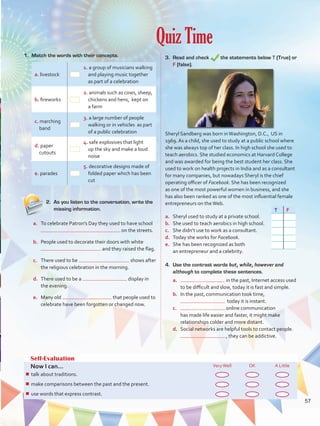
FREE COPY
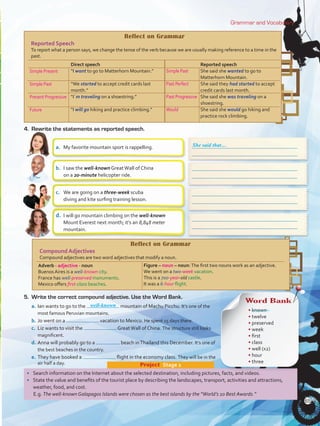
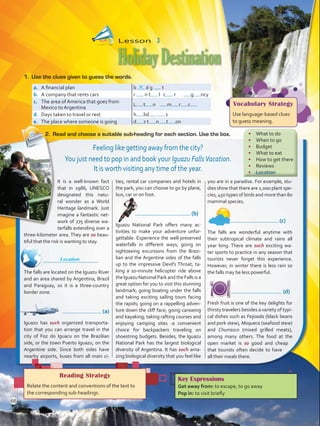
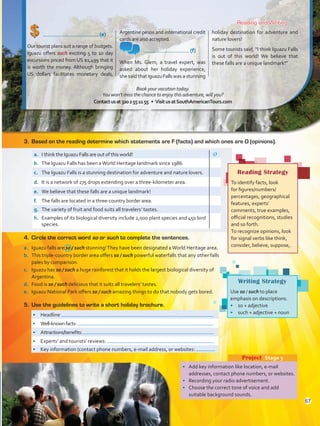
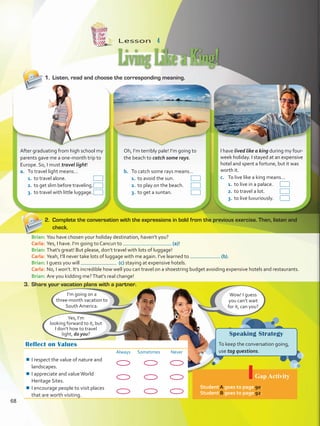
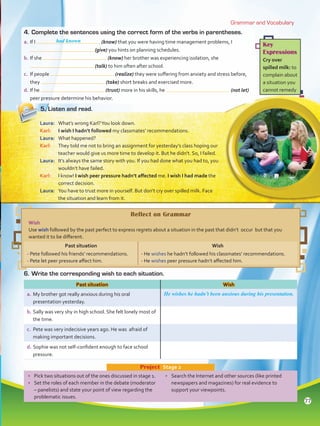
NOT FOR SALESTUDENT´S BOOK
Level
ENGLISH
B1.1
Bachillerato General Unificado
ENGLISH-B1.1-BGU
PRESIDENTE DE LA REPÚBLICA
Rafael Correa Delgado
MINISTRO DE EDUCACIÓN
Augusto Espinosa Andrade
Viceministro de Educación
Freddy Peñafiel Larrea
Viceministra de Gestión Educativa
DaysiValentina Rivadeneira Zambrano
Subsecretario de Fundamentos Educativos (E)
Miguel Ángel Herrera Pavo
Subsecretaria de Administración Escolar
Mirian Maribel Guerrero Segovia
Directora Nacional de Currículo (S)
María Cristina Espinosa Salas
Directora Nacional de Operaciones y Logística
Ada Leonora ChamorroVásquez
© Ministerio de Educación del Ecuador, 2016
Av. Amazonas N34-451 y Atahualpa
Quito, Ecuador
www.educacion.gob.ec
La reproducción parcial o total de esta publicación,
en cualquier forma y en cualquier medio mecánico o
electrónico, está permitida siempre y cuando sea autorizada
por los editores y se cite correctamente la fuente.
English B1.1,
Student’s Book
Authors
Claudia Marcela Chapetón Castro,
Astrid Núñez Pardo, Mark Forbes
Editor-in-Chief
Javier AndrésTibaquirá Pinto
Editor
Carlos Sanabria Páez
Proofreaders
Andrea Peña, Margarita Orbegozo
Consulting Reviewers
Randall Barfield, Mark Forbes
Audio Producer
Juan Carlos Jaramillo
Art Director
Gloria EsperanzaVásquez
Designers
Leonardo Rivas, Libardo Mahecha,
Clara Inés Angarita, Juan CarlosVera,
Nohora Betancourt
Illustrators
Miguel Jiménez, José Luis Jiménez,
Juan Carlos Baena, Mery Laura Hernández
Photography
Shutterstock ®
© Grupo Editorial Norma SA
Avenida Isaac Albéniz E3-154,Wolfgang Mozart
Quito, Ecuador
ISBN
Primera impresión:
Impreso en Ecuador por: ElTelégrafo E.P.
To Our Students
The textbook that you have in your hands is a very important tool that will help
you learn in the best way possible. A textbook should not be your only source of
study and discovery; however, it will always be a good friend that will allow you to
discover for yourself the wonder of learning.
The Ministry of Education has made a curricular adjustment with the goal of
providing better opportunities for all students in the country as part of a project
that promotes full personal development and integration into a society that is
guided by the principles of Good Living, democratic participation and harmonious
coexistence.
To accompany the launching of this educational initiative, we have prepared
several resources according to age and years of schooling. Children in first grade
will receive a textbook that integrates stories and activities appropriate for their
age and that will help to develop the holistic curriculum designed for this Subnivel
de Educación General Básica. Teachers will receive a CD with songs in order to use
music to familiarize students with their first words in English as a complementary
material. From then on, until they complete the Bachillerato General Unificado,
students will receive textbooks, audio CDs and extra resources that will contribute
to the development of their learning in the areas of Science, Social Sciences,
Language and Literature, Mathematics and Foreign Language-English.Itisalso importanttoknowthatteacherswill receiveteachingguides(teacher’s
books) that will enhance the teaching-learning approach of the student book,
thereby allowing teachers to develop students’ research and learning outside the
classroom.
This resource should be considered a support for the teaching-learning
approach that must be guided by teachers and carried out by students in
order to achieve its goal.
We hope that this adventure of knowledge will be the pathto achieving Good Living.
Ministry of Education
2016
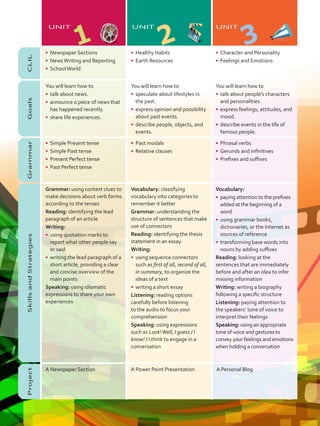
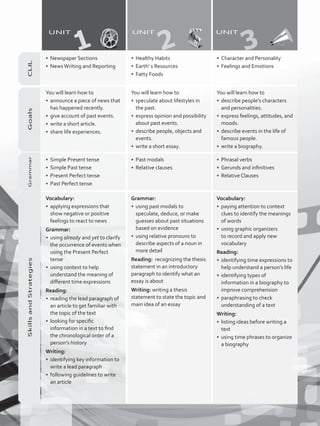
CLIL
•	 Newspaper Sections
•	 NewsWriting and Reporting
•	 SchoolWorld
•	 Healthy Habits
•	 Earth Resources
•	 Character and Personality
•	 Feelings and Emotions
Goals
You will learn how to
•	 talk about news.
•	 announce a piece of news that
has happened recently.
•	 share life experiences.
You will learn how to
•	 speculate about lifestyles in
the past.
•	 express opinion and possibility
about past events.
•	 describe people, objects, and
events.
You will learn how to
•	 talk about people’s characters
and personalities.
•	 express feelings, attitudes, and
mood.
•	 describe events in the life of
famous people.
Grammar
•	 Simple Present tense
•	 Simple Past tense
•	 Present Perfect tense
•	 Past Perfect tense
•	 Past modals
•	 Relative clauses
•	 Phrasal verbs
•	 Gerunds and infinitives
•	 Prefixes and suffixes
SkillsandStrategies
Grammar: using context clues to
make decisions about verb forms
according to the tenses
Reading: identifying the lead
paragraph of an article
Writing:
•	 using quotation marks to
report what other people say
or said
•	 writing the lead paragraph of a
short article, providing a clear
and concise overview of the
main points
Speaking: using idiomatic
expressions to share your own
experiences
Vocabulary: classifying
vocabulary into categories to
remember it better
Grammar: understanding the
structure of sentences that make
use of connectors
Reading: identifying the thesis
statement in an essay
Writing:
•	 using sequence connectors
such as first of all, second of all,
in summary, to organize the
ideas of a text
•	 writing a short essay
Listening: reading options
carefully before listening
to the audio to focus your
comprehension
Speaking: using expressions
such as Look!Well, I guess / I
know! / I think to engage in a
conversation
Vocabulary:
•	 paying attention to the prefixes
added at the beginning of a
word
•	 using grammar books,
dictionaries, or the Internet as
sources of reference
•	 transforming base words into
nouns by adding suffixes
Reading: looking at the
sentences that are immediately
before and after an idea to infer
missing information
Writing: writing a biography
following a specific structure
Listening: paying attention to
the speakers’ tone of voice to
interpret their feelings
Speaking: using an appropriate
tone of voice and gestures to
convey your feelings and emotions
when holding a conversation
Project
A Newspaper Section A Power Point Presentation A Personal Blog
UNIT
1
UNIT
2
UNIT
3
VP5Preliminares.indd 4 19/05/2016 02:35:20 p.m.
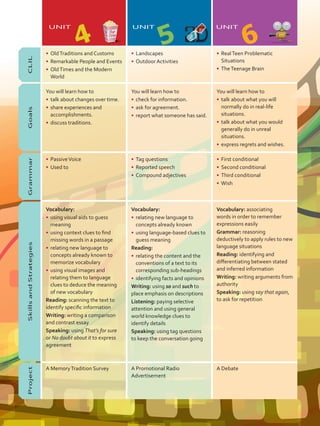
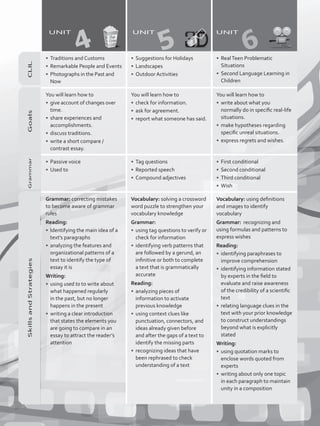
CLIL
•	 OldTraditions and Customs
•	 Remarkable People and Events
•	 OldTimes and the Modern
World
•	 Landscapes
•	 Outdoor Activities
•	 RealTeen Problematic
Situations
•	 TheTeenage Brain
Goals
You will learn how to
•	 talk about changes over time.
•	 share experiences and
accomplishments.
•	 discuss traditions.
You will learn how to
•	 check for information.
•	 ask for agreement.
•	 report what someone has said.
You will learn how to
•	 talk about what you will
normally do in real-life
situations.
•	 talk about what you would
generally do in unreal
situations.
•	 express regrets and wishes.
Grammar
•	 PassiveVoice
•	 Used to
•	 Tag questions
•	 Reported speech
•	 Compound adjectives
•	 First conditional
•	 Second conditional
•	 Third conditional
•	 Wish
SkillsandStrategies
Vocabulary:
•	 using visual aids to guess
meaning
•	 using context clues to find
missing words in a passage
•	 relating new language to
concepts already known to
memorize vocabulary
•	 using visual images and
relating them to language
clues to deduce the meaning
of new vocabulary
Reading: scanning the text to
identify specific information
Writing: writing a comparison
and contrast essay
Speaking: using That’s for sure
or No doubt about it to express
agreement
Vocabulary:
•	 relating new language to
concepts already known
•	 using language-based clues to
guess meaning
Reading:
•	 relating the content and the
conventions of a text to its
corresponding sub-headings
•	 identifying facts and opinions
Writing: using so and such to
place emphasis on descriptions
Listening: paying selective
attention and using general
world knowledge clues to
identify details
Speaking: using tag questions
to keep the conversation going
Vocabulary: associating
words in order to remember
expressions easily
Grammar: reasoning
deductively to apply rules to new
language situations
Reading: identifying and
differentiating between stated
and inferred information
Writing: writing arguments from
authority
Speaking: using say that again,
to ask for repetition
Project
A MemoryTradition Survey A Promotional Radio
Advertisement
A Debate
UNIT
4
UNIT
5
UNIT
6
VP5Preliminares.indd 5 19/05/2016 02:35:21 p.m.
Review
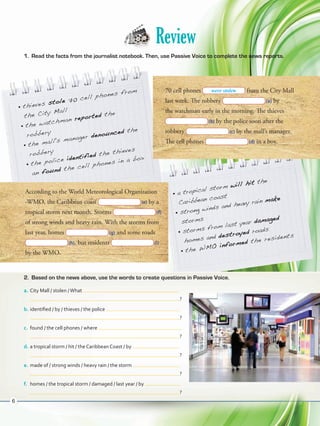
1.	 Read the facts from the journalist notebook. Then, use Passive Voice to complete the news reports.
•	 thieves stole 70 cell phones from
the City Mall
•	 the watchman reported the
robbery
•	 the mall's manager denounced the
robbery
•	 the police identified the thieves
an found the cell phones in a box
70 cell phones from the City Mall
last week. The robbery  (a) by
the watchman early in the morning. The thieves
 (b) by the police soon after the
robbery  (c) by the mall’s manager.
The cell phones  (d) in a box.
According to the World Meteorological Organization
-WMO, the Caribbean coast  (e) by a
tropical storm next month. Storms  (f)
of strong winds and heavy rain. With the storms from
last year, homes  (g) and some roads
 (h), but residents  (i)
by the WMO.
•	 a tropical storm will hit the
Caribbean coast
•	 strong winds and heavy rain make
storms
•	 storms from last year damaged
homes and destroyed roads
•	 the WMO informed the residents
2.	 Based on the news above, use the words to create questions in Passive Voice.
a.	City Mall / stolen /What
 ?
b.	identified / by / thieves / the police
 ?
c.	 found / the cell phones / where
 ?
d.	a tropical storm / hit / the Caribbean Coast / by
 ?
e.	made of / strong winds / heavy rain / the storm
 ?
f.	 homes / the tropical storm / damaged / last year / by
 ?
were stolen
6
VP5ReviewUnit.indd 6 23/03/2016 07:55:53 a.m.
3.	 Circle the correct verb form to complete the conversation. Circle
both when either the gerund or the infinitive can be used.
Sam:	 That was a great performance, congratulations.
Lily:	 Thanks, I needed (to win / winning / both) this school contest to get a
scholarship.
Sam:	 Do you plan (a. to become / becoming / both) a professional musician
and continue (b. to play / playing / both) the violin when you finish
(c. to study / studying / both)?
Lily:	 Yes, I want (d. to play / playing / both) for the best orchestras in the
world.
Sam:	 Wow! Keep (e. to practice / practicing / both) and you’ll certainly be the
best.
Lily:	 I hope so.What about you?What would you like (f. to be / being / both)?
Sam:	 Well, I desire (g. to be / being / both) a famous tennis player. In fact, I’m
going (h. to train / training / both) with the best coach in the country,
Mr. Nadal.
Lily:	 Wow!When will you start (i. to train / training / both) with him?
Sam:	 Next week, I’m so excited!
4.	 Read and complete the text below. Use the given verbs in Simple Past or Past Perfect.
I (see) Miss. Lee somewhere before, I (a. know) it. She read
mystery books to me in first grade. Miss. Lee was my language teacher.
She wanted me to give her back a book she (b. lend) me, but I
(c. not find) it. I was always late for school and generally the reading sessions
(d. already start) when I (e. arrive). Before I (f. get ) to school
on the last day of class, I (g. already lose) the book. I didn’t know what to tell her or
what to do. I never (h. discover) what (i. happen)
to the book. It was a mystery!
5.	 Match the if clauses with the result clauses.
a.	If someone sweeps over your feet,
b.	If you walk under a ladder,
c.	 If you find a four-leaf clover,
d.	If you have an itchy palm,
 1.	…it will bring you good luck.
 2.	…money will come your way.
 3.	…you’ll have bad luck.
 4.	…you’ll never get married.
had seen
7
VP5ReviewUnit.indd 7 23/03/2016 07:55:54 a.m.
6.	 Read and complete the text. Find the missing
words in the Word Bank.
What would you do if… you
your
partner
you	 	 (a. be) a famous trend-setter?
you	 	 (b. have) an extraordinary talent?
you	 	 (c. be) a prince/princes?
a fairy	 	 (d. grant) you a wish?
there	 	 (e. be) a natural disaster?
you	 	 (f. find) a piece of asteroid?
you	 	 (g. find) a bag with $300,000 in it in a taxi?
you	 	 (h. see) a thief stealing a cell phone?
yo	 	 (i. buy) the latest smartphone?
you	 	 (j. cannot) control your online time?
The world of information and communication  ,
best known as ICTs, is definitely changing our lives. They can be valuable
instruments for education, business, and entertainment.These technological
tools include computers, the (a), smartphones, radio and
television.
For example, people can do many different things with smartphones, which
are like small computers that keep you online. People can take pictures,
(b) and receive instant messages, surf the web, check their
email, (c) apps, and even make (d)
calls. Everybody wishes they had a smartphone at hand.
But, can people really control their online time? Most people today
(e) their computers in the morning and (f)
all night.They (g) their headphones and (h) to the net to enjoy
all sorts of Internet resources. It is difficult for them to ( i ) the computer and take a
nice walk. It may be time to unplug the computer and enjoy the fresh air!
7.	 Complete the survey using the second conditional. Then, write your answers and
interview a partner.
Word Bank
•	download
•	hook up
•	Internet
•	put on
•	send
•	stay up
•	technologies
•	turn on
•	turn off
•	video
technologies
8
VP5ReviewUnit.indd 8 23/03/2016 07:55:55 a.m.
BreakingNews
UNIT
1
uuGeneral Objective
	 You will be able to talk about events that have
happened recently and share experiences of your school
community.
uuCommunication Goals
	 You will learn how to
•	 	talk about news.
•	 	announce a piece of news that
has happened recently.
•	 	share life experiences.
uuCLIL
•	 	Newspaper Sections
•	 	NewsWriting and Reporting
•	 SchoolWorld
	Vocabulary
•	 	Sections of a Newspaper
•	 	Words related to news writing and reporting
	Grammar
•	 	Simple Present and Simple Past tenses
•	 Present Perfect and Past Perfect tenses
uuIdioms and Colloquial Expressions
•	 	To hit the headlines
•	 That’s breaking news
•	 To cover the story
uu	Project
	 A Newspaper Section
	 You will create a newspaper section to narrate
recent news and key stories of your school
Discuss:
•	 Is there a newspaper at your school?
•	 What is the most famous newspaper
in your town and country?
U1_VP5 21 x 28.indd 9 5/19/16 2:42 PM
Lesson  1
HaveYouReadtheNews?
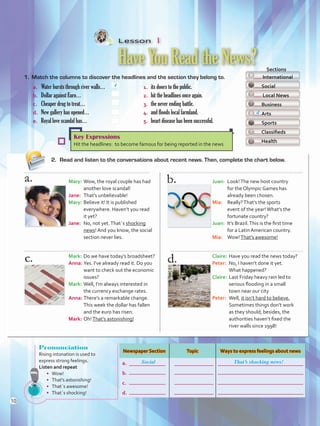
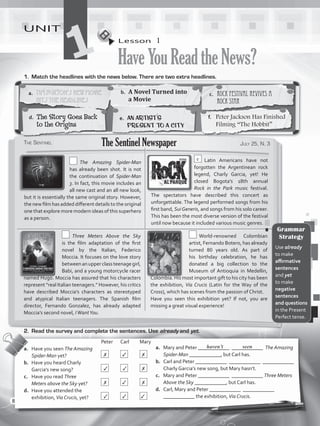
1.	 Match the columns to discover the headlines and the section they belong to.
2.	 Read and listen to the conversations about recent news. Then, complete the chart below.
a. 	 Water bursts through river walls…	 1.	 its doors to the public.
b.	 Dollar against Euro…	 2.	 hit the headlines once again.
c. 	 Cheaper drug to treat…	 3.	 the never ending battle.
d.	 New gallery has opened…	 4.	 and floods local farmland.
e. 	 Royal love scandal has…	 5.	 heart disease has been successful.
4
  Sections
International
Social
Local News
Business
Arts
Sports
Classifieds
Health
Key Expressions
Hit the headlines: to become famous for being reported in the news
Mary:	Wow, the royal couple has had
another love scandal!
Jane:	 That’s unbelievable!
Mary:	Believe it! It is published
everywhere. Haven’t you read
it yet?
Jane:	 No, not yet.That´s shocking
news! And you know, the social
section never lies.
Mark:	Do we have today’s broadsheet?
Anna:	Yes. I’ve already read it. Do you
want to check out the economic
issues?
Mark:	Well, I’m always interested in
the currency exchange rates.
Anna:	There’s a remarkable change.
This week the dollar has fallen
and the euro has risen.
Mark:	Oh!That’s astonishing!
Juan:	 Look!The new host country
for the Olympic Games has
already been chosen.
Mia:	 Really?That’s the sports
event of the year!What’s the
fortunate country?
Juan:	 It’s Brazil.This is the first time
for a Latin American country.
Mia:	 Wow!That’s awesome!
Claire:	Have you read the news today?
Peter:	 No, I haven’t done it yet.
What happened?
Claire:	Last Friday heavy rain led to
serious flooding in a small
town near our city
Peter:	 Well, it isn’t hard to believe.
Sometimes things don’t work
as they should; besides, the
authorities haven’t fixed the
river walls since 1998!
d
Pronunciation
Rising intonation is used to
express strong feelings.
Listen and repeat
•	 Wow!
•	 That’s astonishing!
•	 That´s awesome!
•	 That´s shocking!
Newspaper Section Topic Ways to express feelings about news
a.
b.
c.
d.
Social That’s shocking news!
10
U1_VP5 21 x 28.indd 10 4/19/16 11:49 AM
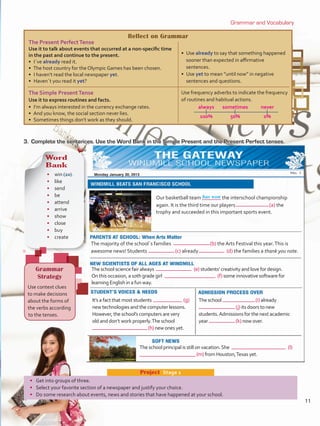
Reflect on Grammar
The Present PerfectTense
Use it to talk about events that occurred at a non-specific time
in the past and continue to the present.
• I´ve already read it.
•  The host country for the Olympic Games has been chosen.
•  I haven’t read the local newspaper yet.
•  Haven´t you read it yet?
•  Use already to say that something happened
sooner than expected in affirmative
sentences.
•  Use yet to mean “until now” in negative
sentences and questions.
The Simple PresentTense
Use it to express routines and facts.
•  I’m always interested in the currency exchange rates.
•  And you know, the social section never lies.
•  Sometimes things don’t work as they should.
Use frequency adverbs to indicate the frequency
of routines and habitual actions.
	always	 sometimes	 never
	100%	 50%	 0%
has won
Grammar and Vocabulary
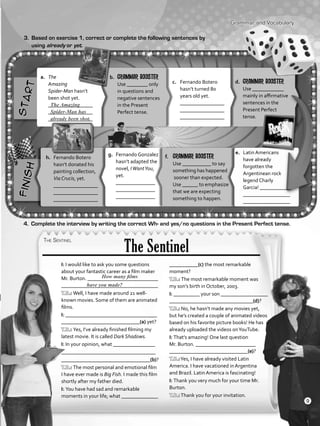
3.	 Complete the sentences. Use the Word Bank in the Simple Present and the Present Perfect tenses.
Word
Bank
•	 win (2x)
•	like
•	 send
•	 be
•	 attend
•	 arrive
•	 show
•	 close
•	 buy
•	 create
Grammar
Strategy
Use context clues
to make decisions
about the forms of
the verbs according
to the tenses.
Our basketball team	 the interschool championship
again. It is the third time our players	 (a) the
trophy and succeeded in this important sports event.
The majority of the school´s families 	 (b) the Arts Festival this year.This is
awesome news! Students 	 (c) already 	 (d) the families a thank you note.
The school science fair always 	 (e) students’ creativity and love for design.
On this occasion, a 10th grade girl 	 (f) some innovative software for
learning English in a fun way.
It’s a fact that most students 	 (g)
new technologies and the computer lessons.
However, the school’s computers are very
old and don’t work properly.The school
	 (h) new ones yet.
The school 	 (i) already
	(j) its doors to new
students.Admissions for the next academic
year	 (k) now over.
The school principal is still on vacation.She 	 (l)
	(m) from Houston,Texas yet.
•	 Get into groups of three.
•	 Select your favorite section of a newspaper and justify your choice.
•	 Do some research about events, news and stories that have happened at your school.
Project  Stage 1
Monday January 30, 2013
11
U1_VP5 21 x 28.indd 11 3/30/16 8:35 AM
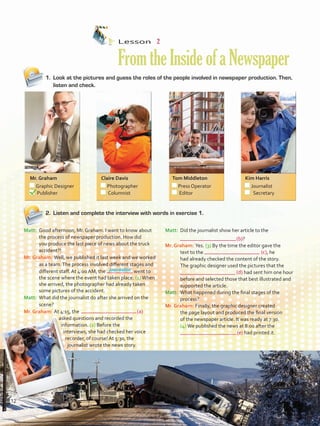
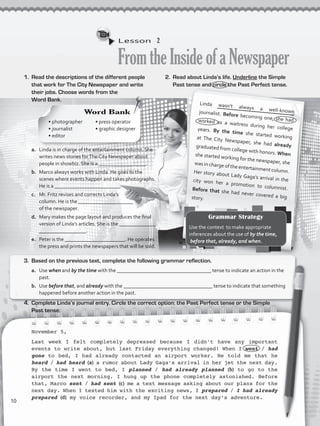
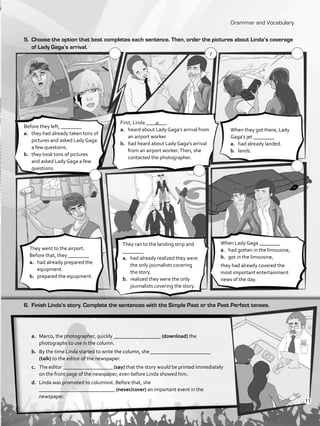
1.	 Look at the pictures and guess the roles of the people involved in newspaper production. Then,
listen and check.
2.	 Listen and complete the interview with words in exercise 1.
Lesson  2
FromtheInsideofaNewspaper
Matt:	 Good afternoon, Mr. Graham. I want to know about
the process of newspaper production. How did
you produce the last piece of news about the truck
accident?!
Mr. Graham:	Well, we published it last week and we worked
as a team.The process involved different stages and
different staff. At 4:00 AM, the 	 went to
the scene where the event had taken place. (1)When
she arrived, the photographer had already taken
some pictures of the accident.
Matt:	 What did the journalist do after she arrived on the
scene?
Mr. Graham:	At 4:15, the 	 (a)
asked questions and recorded the
information. (2) Before the
interviews, she had checked her voice
recorder, of course! At 5:30, the
journalist wrote the news story.
Matt:	 Did the journalist show her article to the
	 (b)?
Mr. Graham:	Yes. (3) By the time the editor gave the
text to the 	 (c), he
had already checked the content of the story.
The graphic designer used the pictures that the
	 (d) had sent him one hour
	 before and selected those that best illustrated and
supported the article.
Matt:	 What happened during the final stages of the
process?
Mr. Graham:	Finally, the graphic designer created
the page layout and produced the final version
of the newspaper article. It was ready at 7:30.
(4) We published the news at 8:00 after the
		 (e) had printed it.
journalist
Mr. Graham
	 Graphic Designer
	 Publisher
Claire Davis
	Photographer
	 Columnist
Tom Middleton
	 Press Operator
	 Editor
Kim Harris
	Journalist
	 Secretary
12
U1_VP5 21 x 28.indd 12 3/30/16 8:35 AM
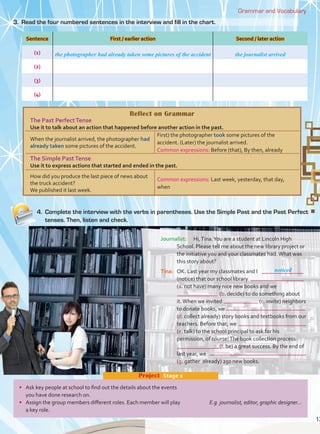
4. Complete the interview with the verbs in parentheses. Use the Simple Past and the Past Perfect
tenses. Then, listen and check.
Grammar and Vocabulary
Journalist: Hi,Tina.You are a student at Lincoln High
School. Please tell me about the new library project or
the initiative you and your classmates had.What was
this story about?
Tina: OK. Last year my classmates and I
(notice) that our school library
(a. not have) many nice new books and we
(b. decide) to do something about
it.When we invited (c. invite) neighbors
to donate books, we
(d. collect already) story books and textbooks from our
teachers. Before that, we
(e. talk) to the school principal to ask for his
permission, of course!The book collection process
(f. be) a great success. By the end of
last year, we
(g. gather already) 250 new books.
noticed
Sentence First / earlier action Second / later action
(1)
(2)
(3)
(4)
the photographer had already taken some pictures of the accident the journalist arrived
•
you have done research on.
• E.g. journalist, editor, graphic designer...
a key role.
Project Stage 2
3. Read the four numbered sentences in the interview and fill in the chart.
Reflect on Grammar
The Past PerfectTense
Use it to talk about an action that happened before another action in the past.
When the journalist arrived, the photographer had
already taken some pictures of the accident.
First) the photographer took some pictures of the
accident. (Later) the journalist arrived.
Common expressions: Before (that), By then, already
The Simple PastTense
Use it to express actions that started and ended in the past.
How did you produce the last piece of news about
the truck accident?
We published it last week.
Common expressions: Last week, yesterday, that day,
when
13
Lesson  3
1.	 Match the concepts with their definitions.
a. 	Headline	 1. 	The key or main information of an article
b.	 By-line	 2.	 The title of an article
c.	 Lead paragraph 	 3. 	The body or secondary ideas of an article
d.	 Supporting details	4.	Line that gives the writer´s name
2.	 Read the headlines of the article below and predict the topic.
The article is about theWilliams sisters’ life after ten years of practice.
The article is about the success of theWilliams sisters over the last ten years.
3.	 Read the article and complete the diagram on page 15.
HittheHeadlines
Reading Strategy
The lead paragraph of an article
is always the first lines of it.
Writing Strategy
•	 Use quotation marks “ ” to report what other people say or said.
•	 E.g. “We also eat very healthy food and if we get an injury, we take
good care of it until recovery,” saidVenus.
In professional women’s tennis around
the world there are two sisters who
have already made history since their
debut in 1994. They are Venus and
Serena Williams. They were born in the
United States, in the 80’s, and they live
in Florida with their family.TheWilliams
sisters have played in professional
tennis matches since the 1990’s and by
the year 2003 both had become No. 1 in
the world.
They have hit the headlines several
times and have made history for
various reasons. First, the Women’s
Tennis Association (WTA) has ranked
the Williams sisters World No. 1 in
singles on various occasions. Second,
they became the first black women
to accomplish this goal in the history
of tennis. Third, they have won more
Olympic gold medals than any other
female tennis player. “We play with our
hearts and souls for our country and
for all the women we represent in the
world,” saidVenus.
But what makes the Williams sisters
such outstanding tennis players? “We
train really hard every day and keep
our bodies fit to build an aggressive
style,” said Serena. It is noticeable
that it takes discipline and great
physical effort on their part. “We also
eat very healthy food and if we get
an injury, we take good care of it until
recovery,” said Venus. But mental and
emotional aspects also play a key role.
“Sometimes, they can get nervous
when they get near the finish line in a
key set,” said Richard Williams, their
father, best friend and mentor. They
love each other and have strong family
bonds.
a
14
U1_VP5 21 x 28.indd 14 5/23/16 4:28 PM
•	 Use key questions to interview two members of the school community.
Record the interviews and take pictures, too.
•	 Write short narrations of the news you discovered.
•	 Create a nice design using the texts and the pictures.
Project  Stage 3
Writing Strategy
Write the lead of a newspaper
article by providing a clear and
concise overview of the main
points: who, what, when, where,
how and why.
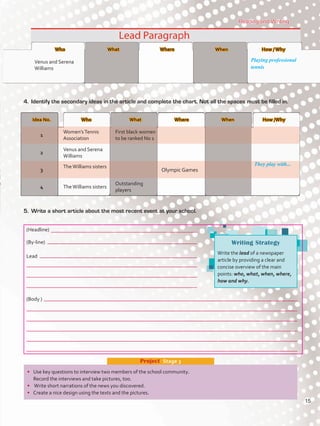
Reading and Writing
Playing professional
tennis
They play with...
(Headline)
(By-line)
Lead
(Body )
5.	 Write a short article about the most recent event at your school.
4.	 Identify the secondary ideas in the article and complete the chart. Not all the spaces must be filled in.
Who	 What	 Where	 When	 How / Why
Venus and Serena
Williams
Idea No. Who What Where When How /Why
1
Women’sTennis
Association
First black women
to be ranked No 1
2
Venus and Serena
Williams
3
TheWilliams sisters
Olympic Games
4 TheWilliams sisters
Outstanding
players
15
U1_VP5 21 x 28.indd 15 3/30/16 8:35 AM
Lesson  4
HotNews
Reflect on Values
Always Sometimes Never

¾¾ I read the newspaper to learn about
local and world events.
¾¾ I am curious about everyday happenings
and events.
¾¾ I talk about the news I read and express
my feelings about it.
Gap Activity
Student A goes to page 87.
Student B goes to page 89.
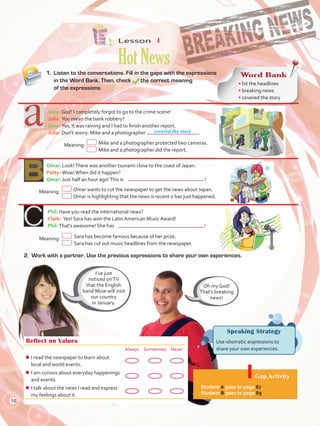
1.	 Listen to the conversations. Fill in the gaps with the expressions
in the Word Bank. Then, check 	 the correct meaning
of the expressions
Joey:	God! I completely forgot to go to the crime scene!
Julia:	You mean the bank robbery?
Joey:	Yes, it was raining and I had to finish another report.
Julia:	Don’t worry. Mike and a photographer	 .
	Meaning:	Mike and a photographer protected two cameras.
		 Mike and a photographer did the report.
Omar:	Look!There was another tsunami close to the coast of Japan.
Patty:	Wow!When did it happen?
Omar:	Just half an hour ago!This is	 !
Phil:	Have you read the international news?
Clark:  Yes! Sara has won the Latin American Music Award!
Phil:	That’s awesome! She has 	 !
Speaking Strategy
Use idiomatic expressions to
share your own experiences.
Word Bank
• hit the headlines
• breaking news
• covered the story
I’ve just
noticed onTV
that the English
band Muse will visit
our country
in January.
Oh my God!
That’s breaking
news!
covered the story
	Meaning:	 Omar wants to cut the newspaper to get the news about Japan.
			 Omar is highlighting that the news is recent o has just happened.
Meaning:	 Sara has become famous because of her prize.
			 Sara has cut out music headlines from the newspaper.
2.	 Work with a partner. Use the previous expressions to share your own experiences.
16
U1_VP5 21 x 28.indd 16 3/30/16 8:36 AM
Give your Presentation
•	 Introduce the members of your team.
•	 Mention the roles played by each one.
•	 Mention the section you have designed.
•	 Talk about the stories and the information you gathered
about the key, current events at your school.
•	 Talk about the people you interviewed and the sources
of your information.
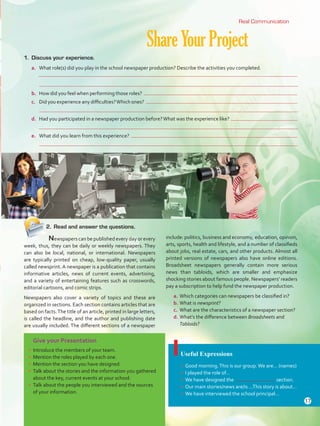
ShareYourProject
Useful Expressions
•	 Good morning.This is our group.We are… (names)
•	 I played the role of…
•	 We have designed the section.
•	 Our main stories/news are/is …This story is about…
•	 We have interviewed the school principal…
1.	 Discuss your experience.
a.	 What role(s) did you play in the school newspaper production? Describe the activities you completed.
	
	
b.	 How did you feel when performing those roles?
c.	 Did you experience any difficulties?Which ones?
	
d.	 Had you participated in a newspaper production before?What was the experience like?
	
e.	 What did you learn from this experience?
	
	 Newspapers can be published every day or every
week, thus, they can be daily or weekly newspapers. They
can also be local, national, or international. Newspapers
are typically printed on cheap, low-quality paper, usually
called newsprint. A newspaper is a publication that contains
informative articles, news of current events, advertising,
and a variety of entertaining features such as crosswords,
editorial cartoons, and comic strips.
Newspapers also cover a variety of topics and these are
organized in sections. Each section contains articles that are
based on facts.The title of an article, printed in large letters,
is called the headline, and the author and publishing date
are usually included. The different sections of a newspaper
include: politics, business and economy, education, opinion,
arts, sports, health and lifestyle, and a number of classifieds
about jobs, real estate, cars, and other products. Almost all
printed versions of newspapers also have online editions.
Broadsheet newspapers generally contain more serious
news than tabloids, which are smaller and emphasize
shocking stories about famous people. Newspapers’ readers
pay a subscription to help fund the newspaper production.
a.	Which categories can newspapers be classified in?
b.	What is newsprint?
c.	 What are the characteristics of a newspaper section?
d.	What’s the difference between Broadsheets and
Tabloids?
Real Communication
2.	 Read and answer the questions.
17
U1_VP5 21 x 28.indd 17 4/19/16 11:51 AM
Comic
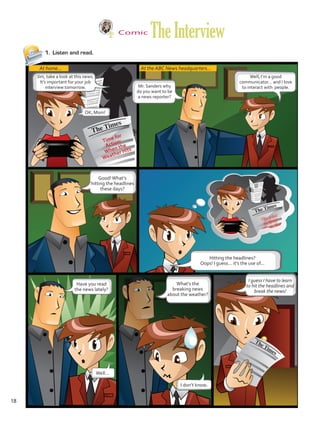
TheInterview
1.	 Listen and read.
At home... At the ABC News headquarters...
Jim, take a look at this news.
It’s important for your job
interview tomorrow.
OK, Mom!
Mr. Sanders why
do you want to be
a news reporter?
Well, I’m a good
communicator… and I love
to interact with people.
Good!What’s
hitting the headlines
these days?
Hitting the headlines?
Oops! I guess… it’s the use of...
Have you read
the news lately?
Well…
I don’t know.
What’s the
breaking news
about the weather?
I guess I have to learn
to hit the headlines and
break the news!
Time for
Action:
When the
Weather Hits
18
U1_VP5 21 x 28.indd 18 3/30/16 8:36 AM
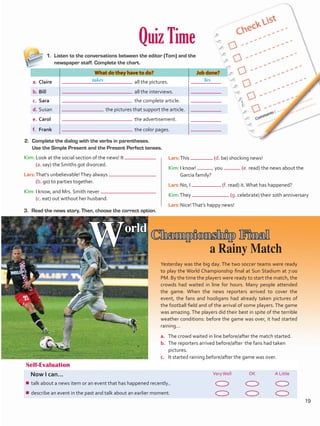
Quiz Time
2.	 Complete the dialog with the verbs in parentheses.
Use the Simple Present and the Present Perfect tenses.
3.	 Read the news story. Then, choose the correct option.
1.	 Listen to the conversations between the editor (Tom) and the
newspaper staff. Complete the chart.
Self-Evaluation
Now I can... VeryWell OK A Little
¾¾ talk about a news item or an event that has happened recently..
¾¾ describe an event in the past and talk about an earlier moment.
What do they have to do? Job done?
a.	Claire all the pictures.
b.	Bill all the interviews.
c.	 Sara the complete article.
d.	Susan the pictures that support the article.
e.	Carol the advertisement.
f.	 Frank the color pages.
World
Championship Final
Yesterday was the big day. The two soccer teams were ready
to play the World Championship final at Sun Stadium at 7:00
PM. By the time the players were ready to start the match, the
crowds had waited in line for hours. Many people attended
the game. When the news reporters arrived to cover the
event, the fans and hooligans had already taken pictures of
the football field and of the arrival of some players. The game
was amazing. The players did their best in spite of the terrible
weather conditions: before the game was over, it had started
raining…
a.	 The crowd waited in line before/after the match started.
b.	 The reporters arrived before/after the fans had taken
pictures.
c.	 It started raining before/after the game was over.
Kim:	Look at the social section of the news! It
(a. say) the Smiths got divorced.
Lars:	That’s unbelievable!They always
(b. go) to parties together.
Kim:	I know, and Mrs. Smith never
(c. eat) out without her husband.
Lars:	This (d. be) shocking news!
Kim:	I know! you (e. read) the news about the
Garcia family?
Lars:	No, I (f. read) it.What has happened?
Kim:They (g. celebrate) their 10th anniversary
Lars:	Nice!That’s happy news!
takes Yes
a Rainy Match
19
U1_VP5 21 x 28.indd 19 4/19/16 11:54 AM
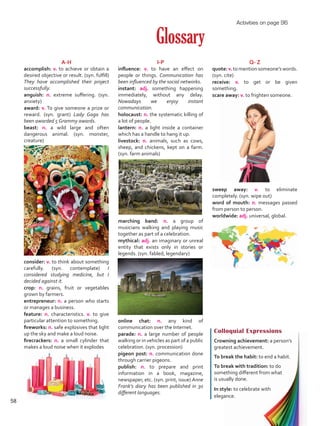
Glossary
A – E
astonishing: adj. very surprising. This
is astonishing news!
award: n. a reward someone gets
when he/she has achieved something.
(syn. prize)
awesome: adj. extremely good and
sometimes very impressive. (ant.
awful)
bond: n. in relationships, a reason
to love each other or feel they have
a connection to each other. Happy
families have strong bonds.
broadsheet: n. a newspaper that
publishes serious news. It is usually
printed on large sheets of paper.
burst: v. when the walls built round a
body of water break because water
levels have exceeded them.
columnist: n. a journalist who writes a
regular series of stories for a magazine
or newspaper and expresses his/
her opinions and comments about
recent news. Mr. Akerman is a famous
newspaper columnist.
currency: n. the type of money used in
a particular country or region. Japan’s
currency is the yen.
debut: n. the first time that a sports
person or performer appears in a
Colloquial Expressions
Breaking news: recent news that
is reported or revealed at the
moment.
Hit the headlines: to become
famous by being reported in the
news.
Cover the story: to report on an
event or recent happening.
public or some remarkable event.
Shakira made her debut when she was
a little girl.
E – H
editor: n. the person who has overall
responsibility for the publication of
articles in a newspaper or magazine.
exchange rate: n. the value of the
money of one country in relation to the
value of the money of another country.
fact: n. a statement that people can
prove. (ant. opinion or comment)
People read the news to find out recent
facts.
flood: v. to be covered with water. A
pipe burst and the water flooded the
first floor of the house.
graphic designer: n. the person who
creatively designs the layout of a
newspaper page, book, leaflet, etc.
headline: n. the title of a news story. It
is usually large in size and catches the
reader’s attention.
headquarters: n. the place where a
company has its main offices. CNN has
its headquarters in Atlanta.
highlight: v. to emphasize something
so that people notice it and think about
it.
host: n. the place and people who
organize a special event. Brazil is the
host for the 2016 Olympic Games.
I – R
layout: n. the position of articles,
photographs, graphics, and
advertisements on a page.
lead: n. The beginning of the news
story. It tells the essentials of any
story: who, what, when, where, why,
and how.
match: n. game or contest in which
two or more people or teams compete
with each other.
mentor: n. an experienced person
who helps, supports, and motivates
someone who has less experience,
especially in their career. (syn. advisor,
tutor)
obituary: n. the newspaper section
which publishes someone’s death and
gives a short description of their life
and accomplishments.
outstanding: adj. extremely good or
impressive. (syn. superior, excellent;
ant. inferior, bad.)
record: v. to put images and/or sounds
onto a CD or DVD.
reporter: n. the person who researches
and writes newspaper articles. (syn. a
journalist)
S – Z
set: n. a series of games in tennis and
some other sports.
shocking: adj. when feeling extremely
surprised. (syn. outrageous; ant.
calming, comforting)
soft news: n. news that deals with
human interest stories which are not
that serious. (ant. hard news)
staff: n. the group of people who work
for a specific company or institution.
thank you note: n. a short piece
of writing to express gratitude to
someone. I sent a thank you note to
Fanny for dinner last week.
Activities on page 93
20
U1_VP5 21 x 28.indd 20 4/19/16 12:09 PM
HealthyLife,HealthyWorld
UNIT
HealthyLife,HealthyWorld
2
uuGeneral Objective
	 You will be able to talk about lifestyles and
speculate about habits and customs of the past.
uuCommunication Goals
	 You will learn how to
•	 	speculate about lifestyles in the past.
•	 	express opinion and possibility about past
events.
•	 	describe people, objects, and events.
uuCLIL
•	 	Healthy Habits
•	 Earth Resources
	 Vocabulary
•	 	Words related to healthy habits, earth resources,
and environmental degradation
	Grammar
•	 	Past Modals: must / could / might /
•	 	Relative clauses: who / where / that
uuIdioms and Colloquial Expressions
•	 To be fit as a fiddle
•	 To be in bad shape
•	 To be in murky waters
•	 To move heaven and earth
uuProject
	 A PowerPoint Presentation
	 You will create a PowerPoint presentation about
lifestyles to share problematic situations you
identify in your community, as well as actions
people can take to protect the environment.
Discuss:
•	 	Do you have a healthy lifestyle?
•	 Do you and your community take
care of our natural resources?
VP5 U2.indd 21 19/05/2016 02:50:42 p.m.
Useful Expressions
•	 Use I know! to show agreement with what someone says.
•	 Use I guess to express your opinion about something you are
not sure about.
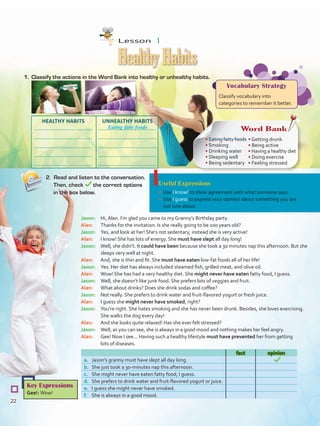
1.	 Classify the actions in the Word Bank into healthy or unhealthy habits.
HealthyHabits
2. Read and listen to the conversation.
Then, check the correct options
in the box below.
Key Expressions
Gee!: Wow!
fact opinion
a.	 Jason’s granny must have slept all day long.
b.	 She just took a 30-minutes nap this afternoon.
c.	 She might never have eaten fatty food, I guess.
d.	 She prefers to drink water and fruit-flavored yogurt or juice.
e.	 I guess she might never have smoked.
f.	 She is always in a good mood.
Vocabulary Strategy
Classify vocabulary into
categories to remember it better.
Jason:	 Hi, Alan. I’m glad you came to my Granny’s Birthday party.
Alan:	 Thanks for the invitation. Is she really going to be 100 years old?
Jason:	 Yes, and look at her! She‘s not sedentary, instead she is very active!
Alan: 	 I know! She has lots of energy. She must have slept all day long!
Jason:	 Well, she didn’t. It could have been because she took a 30 minutes nap this afternoon. But she
sleeps very well at night.
Alan:	 And, she is thin and fit. She must have eaten low-fat foods all of her life!
Jason:	 Yes. Her diet has always included steamed fish, grilled meat, and olive oil.
Alan:	 Wow! She has had a very healthy diet. She might never have eaten fatty food, I guess.
Jason:	 Well, she doesn’t like junk food. She prefers lots of veggies and fruit.
Alan:	 What about drinks? Does she drink sodas and coffee?
Jason:	 Not really. She prefers to drink water and fruit-flavored yogurt or fresh juice.
Alan:	 I guess she might never have smoked, right?
Jason:	 You’re right. She hates smoking and she has never been drunk. Besides, she loves exercising.
She walks the dog every day!
Alan:	 And she looks quite relaxed! Has she ever felt stressed?
Jason:	 Well, as you can see, she is always in a good mood and nothing makes her feel angry.
Alan:	 Gee! Now I see... Having such a healthy lifestyle must have prevented her from getting
lots of diseases.
Word Bank
• Eating fatty foods
• Smoking
• Drinking water
• Sleeping well
• Being sedentary
• Getting drunk
• Being active
• Having a healthy diet
• Doing exercise
• Feeling stressed
UNHEALTHY HABITSHEALTHY HABITS
Eating fatty foods
Lesson  1
22
VP5 U2.indd 22 23/03/2016 08:20:20 a.m.
Grammar and Vocabulary
•	 Work by pairs.Think of an unhealthy habit that is present in your community today.
•	 Prepare a PowerPoint presentation describing how this unhealthy habit is a problem for the community.
•	 Speculate about the origins of this bad habit.
Project  Stage 1
Reflect on Grammar
Past Modals
Use Past Modals to speculate, deduce, or make guesses about past
situations based on evidence.
• She must have slept all day long.
• It could have been because she took a nap.
• She might never have eaten fatty food.
Structure
Subject + (must/could/might) + have + past participle + complement
Degrees of certainty about
the past
a.-	Kenneth has lost a lot of weight
recently.
-	He
a very healthy diet.
c.-	Dorothy came to the gym after
work every night last week.
- She
stressed.
b.-	Why is Sarah so tired today?
- I’m not sure. She
very badly last
night.
d.-	Where’s my salad? I left it here!
- Edward
it.
He loves veggies!
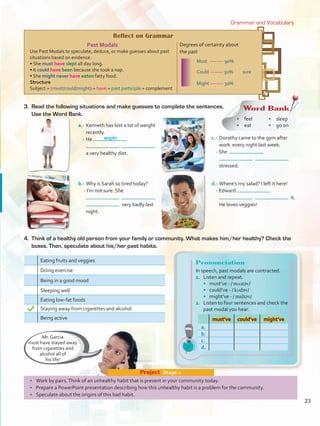
3.	 Read the following situations and make guesses to complete the sentences.
Use the Word Bank.
4.	 Think of a healthy old person from your family or community. What makes him/her healthy? Check the
boxes. Then, speculate about his/her past habits.
Word Bank
•	 feel
•	 eat
•	 sleep
•	 go on
must’ve could’ve might’ve
a.
b.
c.
d.
Pronunciation
In speech, past modals are contracted.
1.	 Listen and repeat.
•	 must’ve - / mʌstǝv/
•	 could’ve - / kʊdǝv/
•	 might’ve - / maItǝv/
2.	 Listen to four sentences and check the
past modal you hear.
Eating fruits and veggies
Doing exercise
Being in a good mood
Sleeping well
Eating low-fat foods
Staying away from cigarettes and alcohol
Being active
Mr. Garcia
must have stayed away
from cigarettes and
alcohol all of
his life!
Must -------- 90%
Could -------- 50%
Might -------- 30%
sure
might
23
VP5 U2.indd 23 23/03/2016 08:20:22 a.m.
Lesson  2
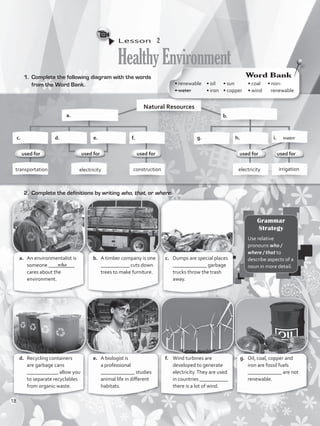
HealthyEnvironment
2.	 Read and listen to the conversation.
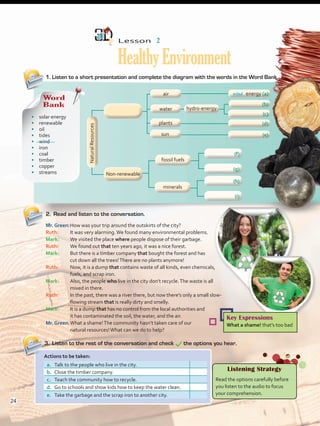
1. Listen to a short presentation and complete the diagram with the words in the Word Bank.
a.	 Talk to the people who live in the city.
b.	 Close the timber company.
c.	 Teach the community how to recycle.
d.	 Go to schools and show kids how to keep the water clean.
e.	 Take the garbage and the scrap iron to another city.
3.	 Listen to the rest of the conversation and check the options you hear.
Mr. Green:	How was your trip around the outskirts of the city?
Ruth: 	 It was very alarming.We found many environmental problems.
Mark: 	 We visited the place where people dispose of their garbage.
Ruth: 	 We found out that ten years ago, it was a nice forest.
Mark: 	 But there is a timber company that bought the forest and has
cut down all the trees!There are no plants anymore!
Ruth: 	 Now, it is a dump that contains waste of all kinds, even chemicals,
fuels, and scrap iron.
Mark: 	 Also, the people who live in the city don’t recycle.The waste is all
mixed in there.
Ruth: 	 In the past, there was a river there, but now there’s only a small slow-
flowing stream that is really dirty and smelly.
Mark: 	 It is a dump that has no control from the local authorities and
it has contaminated the soil, the water, and the air.
Mr. Green:	What a shame!The community hasn’t taken care of our
natural resources!What can we do to help?
Listening Strategy
Read the options carefully before
you listen to the audio to focus
your comprehension.
Word
Bank
•	 solar energy
•	 renewable
•	 oil
•	 tides
•	 wind
•	 iron
•	 coal
•	 timber
•	 copper
•	 streams
NaturalResources
Non-renewable
(a)
(d)
(e)
(b)
(c)
fossil fuels
minerals
energy
(f)
(g)
(h)
(i)
air
plants
Key Expressions
What a shame! that’s too bad
Actions to be taken:
water
sun
hydro-energy
wind
24
VP5 U2.indd 24 23/03/2016 08:20:23 a.m.
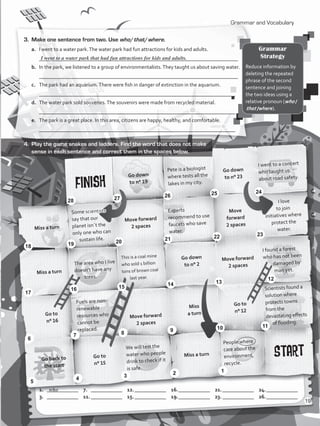
Grammar and Vocabulary
•	 Think of an environmental problem that is present in your city today.
•	 Prepare a new slide for your PowerPoint presentation describing how this environmental problem is causing damage to
the city.Write short descriptions speculating about the origins of this environmental problem.
Project  Stage 2
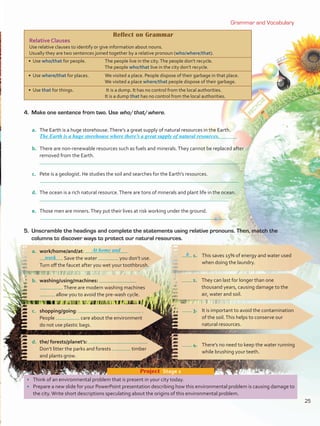
4.	 Make one sentence from two. Use who/that/where.
a.	 The Earth is a huge storehouse.There’s a great supply of natural resources in the Earth.
	
b.	 There are non-renewable resources such as fuels and minerals.They cannot be replaced after
removed from the Earth.
c.	 Pete is a geologist. He studies the soil and searches for the Earth’s resources.
	
d.	 The ocean is a rich natural resource.There are tons of minerals and plant life in the ocean.
e.	 Those men are miners.They put their lives at risk working under the ground.
1.	 This saves 15% of energy and water used
when doing the laundry.
a.	 work/home/and/at:
	 . Save the water you don’t use.
Turn off the faucet after you wet your toothbrush.
b.	 washing/using/machines:
.There are modern washing machines
allow you to avoid the pre-wash cycle.
2.	 They can last for longer than one
thousand years, causing damage to the
air, water and soil.
3.	 It is important to avoid the contamination
of the soil.This helps to conserve our
natural resources.
c.	 shopping/going: .
People care about the environment
do not use plastic bags.
4.	 There’s no need to keep the water running
while brushing your teeth.
d.	 the/ forests/planet’s: .
Don’t litter the parks and forests timber
and plants grow.
5.	 Unscramble the headings and complete the statements using relative pronouns. Then, match the
columns to discover ways to protect our natural resources.
Reflect on Grammar
Relative Clauses
Use relative clauses to identify or give information about nouns.
Usually they are two sentences joined together by a relative pronoun (who/where/that).
• Use who/that for people. The people live in the city.The people don’t recycle.
The people who/that live in the city don’t recycle.
• Use where/that for places. We visited a place. People dispose of their garbage in that place.
We visited a place where/that people dispose of their garbage.
• Use that for things. It is a dump. It has no control from the local authorities.
It is a dump that has no control from the local authorities.
The Earth is a huge storehouse where there’s a great supply of natural resources.
b
At home and
work
25
VP5 U2.indd 25 23/03/2016 08:20:25 a.m.
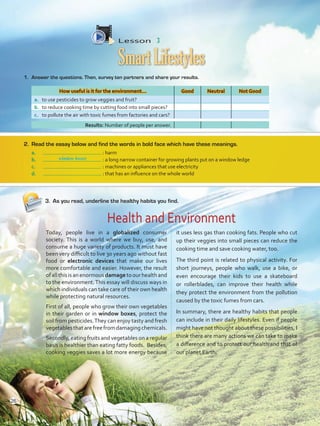
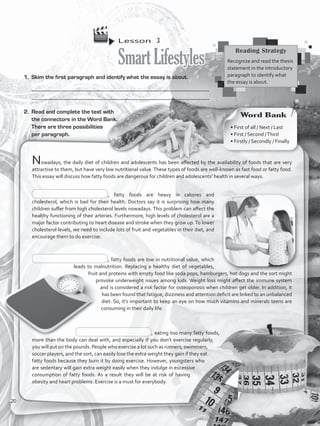
Lesson  3
SmartLifestyles
3.	 As you read, underline the healthy habits you find.
1.	 Answer the questions. Then, survey ten partners and share your results.
How useful is it for the environment… Good Neutral Not Good
a.	 to use pesticides to grow veggies and fruit?
b.	 to reduce cooking time by cutting food into small pieces?
c.	 to pollute the air with toxic fumes from factories and cars?
Today, people live in a globalized consumer
society. This is a world where we buy, use, and
consume a huge variety of products. It must have
been very difficult to live 30 years ago without fast
food or electronic devices that make our lives
more comfortable and easier. However, the result
ofallthisisanenormousdamagetoourhealthand
to the environment.This essay will discuss ways in
which individuals can take care of their own health
while protecting natural resources.
First of all, people who grow their own vegetables
in their garden or in window boxes, protect the
soil from pesticides.They can enjoy tasty and fresh
vegetablesthatarefreefromdamagingchemicals.
Secondly, eating fruits and vegetables on a regular
basis is healthier than eating fatty foods. Besides,
cooking veggies saves a lot more energy because
it uses less gas than cooking fats. People who cut
up their veggies into small pieces can reduce the
cooking time and save cooking water, too.
The third point is related to physical activity. For
short journeys, people who walk, use a bike, or
even encourage their kids to use a skateboard
or rollerblades, can improve their health while
they protect the environment from the pollution
caused by the toxic fumes from cars.
In summary, there are healthy habits that people
can include in their daily lifestyles. Even if people
might have not thought about these possibilities, I
think there are many actions we can take to make
a difference and to protect our health and that of
our planet Earth.
2.	 Read the essay below and find the words in bold face which have these meanings.
a.	 : harm
b.	 : a long narrow container for growing plants put on a window ledge
c.	 : machines or appliances that use electricity
d.	 : that has an influence on the whole world
Results: Number of people per answer.
Health and Environment
window boxes
26
VP5 U2.indd 26 23/03/2016 08:20:26 a.m.
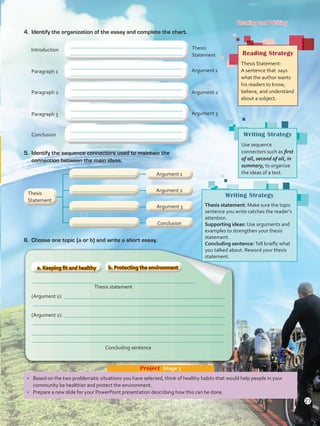
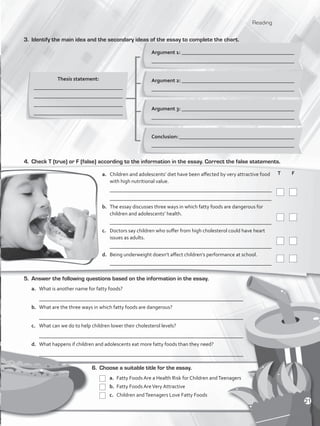
Reading and Writing
•	 Based on the two problematic situations you have selected, think of healthy habits that would help people in your
community be healthier and protect the environment.
•	 Prepare a new slide for your PowerPoint presentation describing how this can be done.
Project  Stage 3
4.	 Identify the organization of the essay and complete the chart.
Writing Strategy
Use sequence
connectors such as first
of all, second of all, in
summary, to organize
the ideas of a text.
Writing Strategy
Thesis statement: Make sure the topic
sentence you write catches the reader’s
attention.
Supporting ideas: Use arguments and
examples to strengthen your thesis
statement.
Concluding sentence:Tell briefly what
you talked about. Reword your thesis
statement.
Introduction
5.	 Identify the sequence connectors used to maintain the
connection between the main ideas.
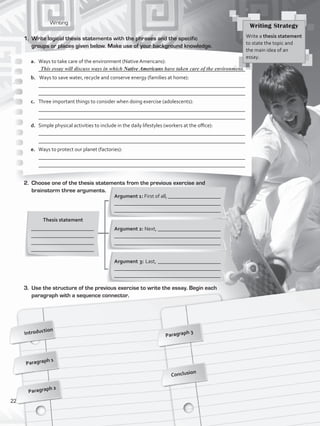
6.	 Choose one topic (a or b) and write a short essay.
Reading Strategy
Thesis Statement:
A sentence that says
what the author wants
his readers to know,
believe, and understand
about a subject.
Argument 1
Argument 2
Argument 3
Conclusion
Thesis
Statement
Thesis
Statement
Paragraph 1
Paragraph 2
Paragraph 3
Argument 1
Argument 2
Argument 3
Conclusion
a. Keeping fit and healthy b. Protecting the environment
Thesis statement
Concluding sentence
(Argument 1):
(Argument 2):
27
VP5 U2.indd 27 23/03/2016 08:20:27 a.m.
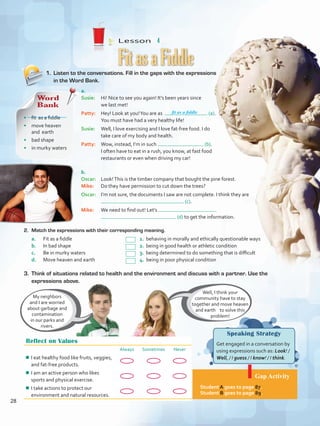
Lesson  4
Speaking Strategy
Get engaged in a conversation by
using expressions such as: Look! /
Well, / I guess / I know! / I think.
Gap Activity
Student A goes to page 87.
Student B goes to page 89.
1.	 Listen to the conversations. Fill in the gaps with the expressions
in the Word Bank.
2.	 Match the expressions with their corresponding meaning.
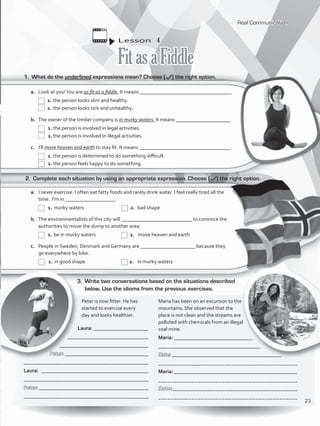
a.	 Fit as a fiddle				 1. behaving in morally and ethically questionable ways
b.	 In bad shape				 2. being in good health or athletic condition
c.	 Be in murky waters			 3. being determined to do something that is difficult
d.	 Move heaven and earth			 4. being in poor physical condition
FitasaFiddle
Reflect on Values
Always Sometimes Never
¾¾ I eat healthy food like fruits, veggies,
and fat-free products.
¾¾ I am an active person who likes
sports and physical exercise.
¾¾ I take actions to protect our
environment and natural resources.
Well, I think your
community have to stay
together and move heaven
and earth to solve this
problem!
My neighbors
and I are worried
about garbage and
contamination
in our parks and
rivers.
a.	
Susie: 	 Hi! Nice to see you again! It’s been years since
we last met!
Patty: 	 Hey! Look at you!You are as (a).
You must have had a very healthy life!
Susie: 	 Well, I love exercising and I love fat-free food. I do
take care of my body and health.
Patty: 	 Wow, instead, I’m in such (b).
I often have to eat in a rush, you know, at fast food
restaurants or even when driving my car!
b.	
Oscar: 	 Look!This is the timber company that bought the pine forest.
Mike: 	 Do they have permission to cut down the trees?
Oscar: 	 I’m not sure, the documents I saw are not complete. I think they are
(c).
Mike: 	 We need to find out! Let’s
(d) to get the information.
3. 	Think of situations related to health and the environment and discuss with a partner. Use the
expressions above.
Word
Bank
•	 fit as a fiddle
•	 move heaven
and earth
•	 bad shape
•	 in murky waters
fit as a fiddle
28
VP5 U2.indd 28 19/04/2016 10:24:43 a.m.
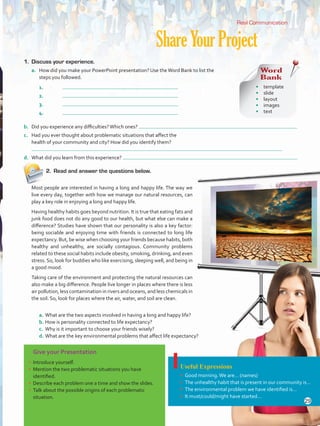
ShareYourProject
Give your Presentation
•	 Introduce yourself.
•	 Mention the two problematic situations you have
identified.
•	 Describe each problem one a time and show the slides.
•	 Talk about the possible origins of each problematic
situation.
Useful Expressions
•	 Good morning.We are… (names)
•	 The unhealthy habit that is present in our community is…
•	 The environmental problem we have identified is…
•	 It must/could/might have started…
2.	 Read and answer the questions below.
Real Communication
1.	 Discuss your experience.
a.	 How did you make your PowerPoint presentation? Use theWord Bank to list the
steps you followed.
1.	
2.	
3.	
4.	
b.	 Did you experience any difficulties?Which ones?
c.	 Had you ever thought about problematic situations that affect the
health of your community and city? How did you identify them?
d.	 What did you learn from this experience?
Word
Bank
•	 template
•	 slide	
•	 layout
•	 images
•	 text
a.	What are the two aspects involved in having a long and happy life?
b.	How is personality connected to life expectancy?
c.	 Why is it important to choose your friends wisely?
d.	What are the key environmental problems that affect life expectancy?
Most people are interested in having a long and happy life. The way we
live every day, together with how we manage our natural resources, can
play a key role in enjoying a long and happy life.
Having healthy habits goes beyond nutrition. It is true that eating fats and
junk food does not do any good to our health, but what else can make a
difference? Studies have shown that our personality is also a key factor:
being sociable and enjoying time with friends is connected to long life
expectancy. But, be wise when choosing your friends because habits, both
healthy and unhealthy, are socially contagious. Community problems
related to these social habits include obesity, smoking, drinking, and even
stress. So, look for buddies who like exercising, sleeping well, and being in
a good mood.
Taking care of the environment and protecting the natural resources can
also make a big difference. People live longer in places where there is less
air pollution, less contamination in rivers and oceans, and less chemicals in
the soil. So, look for places where the air, water, and soil are clean.
29
VP5 U2.indd 29 23/03/2016 08:20:30 a.m.
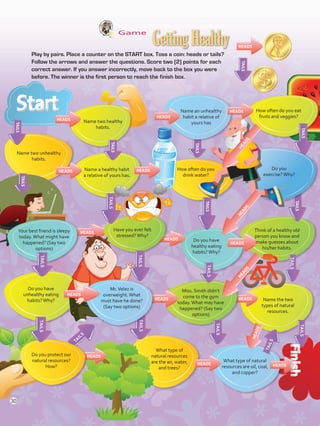
Game
	 Play by pairs. Place a counter on the START box. Toss a coin: heads or tails?
Follow the arrows and answer the questions. Score two (2) points for each
correct answer. If you answer incorrectly, move back to the box you were
before. The winner is the first person to reach the finish box.
Name two healthy
habits.
Name an unhealthy
habit a relative of
yours has
How often do you eat
fruits and veggies?
TAILS
TAILS
TAILS
TAILS
TAILS
TAILS
TAILS
TAILS
TAILS
TAILS
TAILS
TAILSTAILS
TAILS
TAILS
TAILS
TAILS
TAILS
Name two unhealthy
habits.
Name a healthy habit
a relative of yours has.
How often do you
drink water?
Do you
exercise?Why?
HEADS
HEADS HEADS
HEADS
HEADS
HEADS
HEADS
HEADS HEADS
HEADS HEADS
HEADS
HEADS
HEADS
HEADS
Your best friend is sleepy
today.What might have
happened? (Say two
options)
Have you ever felt
stressed?Why?
Do you have
healthy eating
habits?Why?
Think of a healthy old
person you know and
make guesses about
his/her habits.
Do you have
unhealthy eating
habits?Why?
Mr.Velez is
overweight.What
must have he done?
(Say two options)
Miss. Smith didn’t
come to the gym
today.What may have
happened? (Say two
options)
Name the two
types of natural
resources.
What type of natural
resources are oil, coal,
and copper?
What type of
natural resources
are the air, water,
and trees?
Do you protect our
natural resources?
How?
GettingHealthy
HEADS
HEADS
HEADS
HEADS
TAILS
30
VP5 U2.indd 30 23/03/2016 08:20:31 a.m.
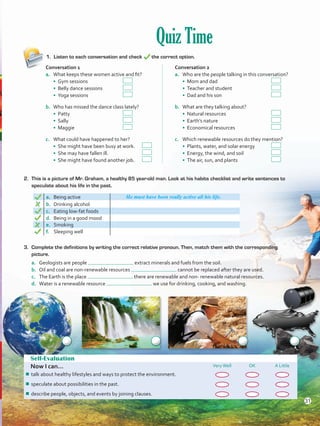
Quiz Time
1.	 Listen to each conversation and check the correct option.
Self-Evaluation
Now I can... VeryWell OK A Little
¾¾ talk about healthy lifestyles and ways to protect the environment.
¾¾ speculate about possibilities in the past.
¾¾ describe people, objects, and events by joining clauses.
2. 	This is a picture of Mr. Graham, a healthy 85 year-old man. Look at his habits checklist and write sentences to
speculate about his life in the past.
a. Being active He must have been really active all his life.
b.	 Drinking alcohol
c.	 Eating low-fat foods
d.	 Being in a good mood
e.	 Smoking
f.	 Sleeping well
Conversation 1
a.	 What keeps these women active and fit?
• Gym sessions 	 	
• Belly dance sessions 	
• Yoga sessions		
b.	 Who has missed the dance class lately?
• Patty 	 		
• Sally 	 		
• Maggie			
c.	 What could have happened to her?
• She might have been busy at work.	
• She may have fallen ill. 	 	
• She might have found another job.	
Conversation 2
a.	 Who are the people talking in this conversation?
• Mom and dad			
• Teacher and student 	 	
• Dad and his son			
b.	 What are they talking about?
• Natural resources 	 		
• Earth’s nature 	 		
• Economical resources		
c.	 Which renewable resources do they mention?
• Plants, water, and solar energy	
• Energy, the wind, and soil 		
• The air, sun, and plants		
3.	 Complete the definitions by writing the correct relative pronoun. Then, match them with the corresponding
picture.
a.	 Geologists are people extract minerals and fuels from the soil.
b.	 Oil and coal are non-renewable resources cannot be replaced after they are used.
c.	 The Earth is the place there are renewable and non- renewable natural resources.
d.	 Water is a renewable resource we use for drinking, cooking, and washing.
31
VP5 U2.indd 31 23/03/2016 08:20:33 a.m.
L-Q
layout: n. the design and organiza-
tion of pictures and text on a page or
PowerPoint slide. (syn. design, format,
setup)
litter: v. to leave pieces of trash in pub-
lic places or the outdoors and not in a
trash can. People shouldn’t litter.
nap: n. short, light sleep during the
day. (syn. kip, siesta)
natural resources: n. substances or
materials such as oil or wood that are
found in nature. Water is a natural re-
source.
oil: n. athick,darkliquidobtainedfrom
mineral deposits that is used as fuel.
outskirts: n. the areas surrounding the
center of a town or city. (ant. down-
town)
R-S
renewable: adj. possible to be re-
placed or renewed indefinitely. (ant.
non-renewable)
scrap: n. waste material, especially
metals suitable for reprocessing. We
can recycle scrap metal.
sedentary: adj. sitting most of the
time and not exercising a lot. (ant.
moving, active)
Glossary
A-K
buddy: n. (informal) friend. (ant. en-
emy)
coal: n. a hard black rock that is found
in the ground and is used as a fuel to
provide heat. In the past many trains
ran on coal.
copper: n. a red-brown metal used to
make wire or pipes that conduct elec-
tricity or heat.
dig: v. to make a hole in sand or soil.
(syn. burrow)
disease: n.  a condition of a living thing
or of one of its parts that impairs nor-
mal functioning and is manifested by
certain symptoms. (syn. illness, sick-
ness)
dump: n. a place where waste material
and garbage is left. The dump was re-
ally dirty and smelly.
faucet: n. a tap on the bath or sink that
controls the flow of water. (syn. tap,
spigot)
flowing: adj. a stream of water that
moves along. (ant. stagnant, still)
fossil fuel: n. fuels formed from the re-
mains of plants and animals that lived
in an earlier era.
iron: n. a hard, silvery heavy metal that
is abundant in the earth and is used to
make building structures. The gates are
made of iron.
junk food: n. food that is unhealthy as
it contains lots of fat, sugar, or salt. Tim
eats too much junk food.
Colloquial Expressions
Be as fit as a fiddle: be in good
health.
Be in bad shape: be in a poor
physical condition.
Be in murky waters: behave
in morally and ethically
questionable ways.
Move heaven and earth:
be determined to do or get
something that is difficult.
slide: n. the page of a PowerPoint pre-
sentation that contains pictures and
text.
soil: n. the surface layer of the Earth,
the ground. (syn. dirt, earth)
storehouse: n. a place where things
are kept in large quantities. (syn. ware-
house)
stream: n. a natural flow of water nar-
rower than a river.
T-Z
template: n. a computer document
with a basic format you can use and
adapt.
tide: n. the way the ocean waters fall
and rise during the day. (syn. current)
timber: n. wood used for building.
(syn. wood, logs)
tired: adj. being weak and in the need
of rest and sleep. (ant. energetic)
veggies: n. (informal) vegetables. My
veggie garden is small.
weight: n. a measurement that says
how heavy something is. (syn. heavi-
ness)
wise: adj. intelligent and able to make
good choices and decisions. (syn. per-
ceptive)
Activities on page 94
32
VP5 U2.indd 32 23/03/2016 08:20:33 a.m.
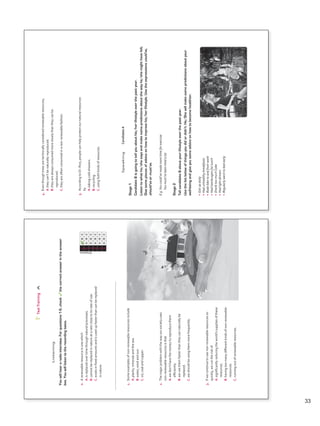
Listening
Youwillheararadiointerview.Forquestions1-5,checkthecorrectanswerintheanswer
box.Youwilllistentotherecordingtwice.
Answers
0ABC
1ABC
2ABC
3ABC
4ABC
5ABC
TestTrainingA
0.Arenewableresourceisonewhich
A.isreplacedovertimethroughnaturalprocesses.
B.cannotbereplacedinnatureatarateclosetoitsrateofuse.
C.existsinfixedamountsandisusedupfasterthancanbereplaced
innature.
1.Someexamplesofnon-renewableresourcesinclude
A.plants,mineralsandthesea.
B.water,windandsun.
C.oil,coalandcopper.
2.Themajorproblemwiththewayoursocietyuses
non-renewableresourcesisthat
A.wedon’thavethemoneytoreproducethem
efficiently.
B.weusethemfasterthantheycannaturallybe
replaced.
C.weshouldbeusingthemmorefrequently.
3.Ifwecontinuetousenon-renewableresourcesso
quickly,weruntheriskof
A.significantlyreducingtheworld’ssuppliesofthese
resources.
B.havingtoomanydifferentkindsofnon-renewable
resources.
C.runningoutofrenewableresources.
VP5_TestTraining_A.indd5923/03/201607:59:34a.m.
SpeakingCandidateA
Stage1
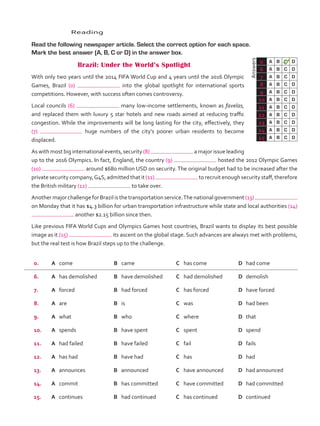
CandidateBisgoingtotellyouabouthis/herlifestyleoverthepastyear.
Listentowhathe/shesaysandmakesomepredictionsaboutthewayhe/shemighthavefelt.
Givesomepiecesofadviceonhowtoimprovehis/herlifestyle.Usetheexpressionscould’ve,
should’veormust’ve.
E.g.Youcould’vemademoretimeforexercise.
Youmust’vebeentiredalot.
Stage2
TellcandidateBaboutyourlifestyleoverthepastyear.
Usethelistbelowofthingsyoudidordidn’t.He/Shewillmakesomepredictionsaboutyour
well-beingandgiveyousomeadviceonhowtobecomehealthier.
•Gotupearly
•Hadunhealthybreakfasts
•Rodebiketoandfromwork
•Hadhamburgersforlunch
•DranktoomuchCoke
•Hadlightdinners
•Regularlywenttobedearly
4.Eventhoughtreesaretechnicallyconsideredrenewableresources,
A.theycan’tbenaturallyreproduced.
B.theyarealwaysconsumedmoreslowlythantheycanbe
reproduced.
C.theyareoftenconsumedinanon-renewablefashion.
5.AccordingtoDr.Rice,peoplecanhelpprotectournaturalresources
by
A.takingcoldshowers.
B.recycling.
C.usingbothkindsofresources.
VP5_TestTraining_A.indd6023/03/201607:58:54a.m.
33
VP5 TestTra A montaje.indd 33 3/30/16 9:42 AM
0.AcomeBcameChascomeDhadcome
6.AhasdemolishedBhavedemolishedChaddemolishedDdemolish
7.AforcedBhadforcedChasforcedDhaveforced
8.AareBisCwasDhadbeen
9.AwhatBwhoCwhereDthat
10.AspendsBhavespentCspentDspend
11.AhadfailedBhavefailedCfailDfails
12.AhashadBhavehadChasDhad
13.AannouncesBannouncedChaveannouncedDhadannounced
14.AcommitBhascommittedChavecommittedDhadcommitted
15.AcontinuesBhadcontinuedChascontinuedDcontinued
Answers
0ABCD
6ABCD
7ABCD
8ABCD
9ABCD
10ABCD
11ABCD
12ABCD
13ABCD
14ABCD
15ABCD
Reading
Readthefollowingnewspaperarticle.Selectthecorrectoptionforeachspace.
Markthebestanswer(A,B,CorD)intheanswerbox.
Brazil:UndertheWorld’sSpotlight
Withonlytwoyearsuntilthe2014FIFAWorldCupand4yearsuntilthe2016Olympic
Games,Brazil(0)intotheglobalspotlightforinternationalsports
competitions.However,withsuccessoftencomescontroversy.
Localcouncils(6)manylow-incomesettlements,knownasfavelas,
andreplacedthemwithluxury5starhotelsandnewroadsaimedatreducingtraffic
congestion.Whiletheimprovementswillbelonglastingforthecity,effectively,they
(7)hugenumbersofthecity’spoorerurbanresidentstobecome
displaced.
Aswithmostbiginternationalevents,security(8)amajorissueleading
uptothe2016Olympics.Infact,England,thecountry(9)hostedthe2012OlympicGames
(10)around$680millionUSDonsecurity.Theoriginalbudgethadtobeincreasedafterthe
privatesecuritycompany,G4S,admittedthatit(11)torecruitenoughsecuritystaff,therefore
theBritishmilitary(12)totakeover.
AnothermajorchallengeforBrazilisthetransportationservice.Thenationalgovernment(13)
onMondaythatithas$4.3billionforurbantransportationinfrastructurewhilestateandlocalauthorities(14)
another$2.15billionsincethen.
LikepreviousFIFAWorldCupsandOlympicsGameshostcountries,Brazilwantstodisplayitsbestpossible
imageasit(15)itsascentontheglobalstage.Suchadvancesarealwaysmetwithproblems,
buttherealtestishowBrazilstepsuptothechallenge.
VP5_TestTraining_A.indd6123/03/201607:59:35a.m.
Writing
FrenchwomanJeanneCalment,whodiedin1997atage122,hadthelongestdocumented
humanlifespan.
Speculateaboutherlifestyleandwhatshemusthave,mighthaveormayhavedoneinorderto
havelivedforsuchalongtime.
Writebetween30and45words.
SpeakingCandidateB
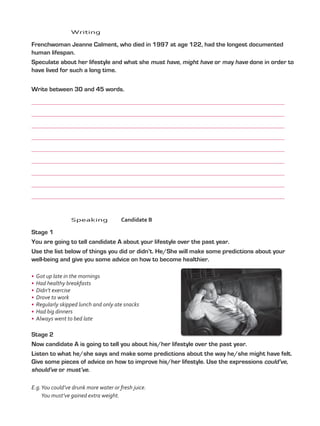
Stage1
YouaregoingtotellcandidateAaboutyourlifestyleoverthepastyear.
Usethelistbelowofthingsyoudidordidn’t.He/Shewillmakesomepredictionsaboutyour
well-beingandgiveyousomeadviceonhowtobecomehealthier.
•Gotuplateinthemornings
•Hadhealthybreakfasts
•Didn’texercise
•Drovetowork
•Regularlyskippedlunchandonlyatesnacks
•Hadbigdinners
•Alwayswenttobedlate
Stage2
NowcandidateAisgoingtotellyouabouthis/herlifestyleoverthepastyear.
Listentowhathe/shesaysandmakesomepredictionsaboutthewayhe/shemighthavefelt.
Givesomepiecesofadviceonhowtoimprovehis/herlifestyle.Usetheexpressionscould’ve,
should’veormust’ve.
E.g.Youcould’vedrunkmorewaterorfreshjuice.
Youmust’vegainedextraweight.
VP5_TestTraining_A.indd6223/03/201607:59:36a.m.
34
VP5 TestTra A montaje.indd 34 3/30/16 9:42 AM
UNIT
WhatLiesWithinUs
3
uuGeneral Objective
	 You will be able to describe people’s characters,
feelings and emotions.
uuCommunication Goals
	 You will learn how to
•	 	talk about people’s characters and personalities.
•	 	express feelings, attitudes, and mood.
•	 	describe events in the life of famous people.
uuCLIL
•	 	Character and Personality
•	 	Feelings and Emotions
	 Vocabulary
•	 	Descriptors of character and personality
•	 	Words related to feelings and emotions
	Grammar
•	 	Phrasal verbs
•	 	Gerunds and infinitives
•	 	Prefixes and suffixes
uuIdioms and Colloquial Expressions
•	 Grin from ear to ear
•	 Head over heels in love
•	 	Make your blood boil
•	 	Your heart sinks
uuProject
	 A Personal Blog
	 You will design a personal blog to show
and share your feelings about someone’s
personality and key life events.
Discuss:
•	 What do you like about your personality
and character?What don’t you like?
•	 What do you like about the personality
and character of other people?What
don’t you like?
•	 Is it easy or difficult for you to express
your feelings and emotions?
VP5 U3.indd 35 19/05/2016 02:52:03 p.m.
Libra personality traits Virgo personality traits
•They get on well with people.
•They use common sense.
•They’re proud and expect admiration.
•They do not accept delay calmly.
• You can trust them.
• They look into things deeply.
• They don’t make decisions easily.
• They don’t think they are better than others.
Leo Pisces
• They eagerly want wealth and fame.
• You never know what they are going to do.
• They love to find out people’s private
information.
• They hate to lose.
• They become angry or upset easily.
• They tend to hold back their feelings.
• They don’t care about the consequences of
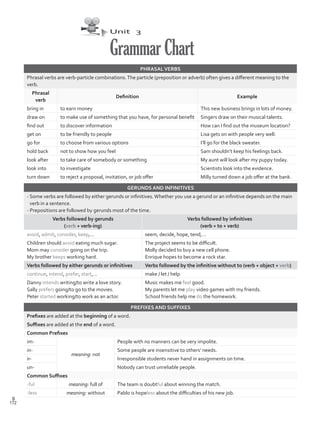
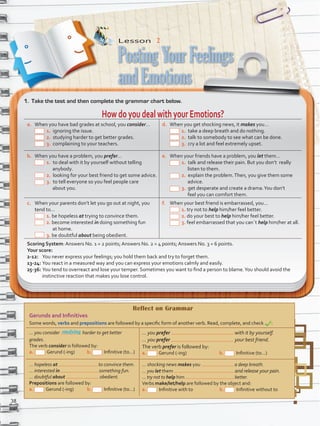
their actions.
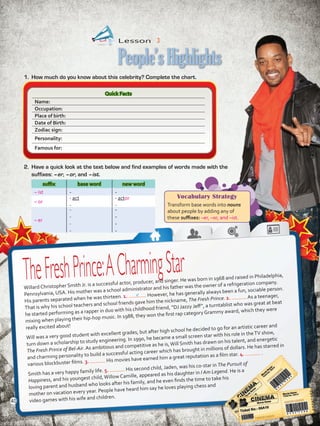
Lesson  1
CharacterandPersonalityTraits
1.	 Look at the pictures. What do you know about this artist?
2.	 Listen to the conversation and check the correct options.
4.	 Read and discover the character and personality traits for each sign. Use the Word Bank. Then,
listen to the second part of the radio show and confirm.
sociable
Name Nickname Age Personality
What is true about Paulina Rubio?
a.	 She is from .	 Spain	 Mexico 	 Miami
b.	 She has a personality.	 friendly	 shy	 vain
c.	 She has been a successful .	 model	 singer	 writer
3.	 Listen again and circle the best option to complete the
statements.
a.	 Well, I’ll go the female singer.
• on	 • for	 • with
b.	 She looked her friend’s baby for a whole weekend!
• after	 • into	 • for
c.	 She draws her talent to make all her projects a success.
• up	 • in	 • on
d.	 Her various businesses have brought thousands of dollars.
• up	 • on	 • in
e.	 She even turned a proposal to play the lead role in a film.
• down	 • out	 • away
Listening Strategy
Read the statements and the
given options before listening
to predict what you will hear.
Vocabulary Strategy
Pay attention to the prefixes
added at the beginning of a
word. Im-, In-, Ir-, and Un-,
are prefixes which mean NOT.
Impatient = not patient
Word Bank
• ambitious
• analytical
• competitive
• humble
• impatient
• indecisive
•	 irresponsible
•	 reliable
•	 reserved
•	 sensible
•	 sensitive
•	 sociable
•	 curious
•	 unpredictable
•	 vain
(a)
(b)
(c)
(d)
(e)
(g)
(f)
(h)
(i)
(j)
(k)
(l)
(m)
(n)
36
VP5 U3.indd 36 19/04/2016 12:26:15 p.m.
Grammar and Vocabulary
Pronunciation
In phrasal verbs, the particle is emphasized.
Listen and complete.Then practice.
a.	 Actors often their own life experiences.
b.	 I well with my school friends.
c.	 The police will the bank robbery.
d.	 People shouldn’t their feelings.
e.	 Mom has a job offer abroad.
a.	 A:Which dessert does Sam want, the bitter or the sweet one? 	
B:	Better ask him.You never know which option Sam will . 	
b.	 A:Who can the baby while we go out?
B:	Mary. She is a great nanny and I trust her.
c.	 A: IsTom in Hollywood now?
B:	Sure! He loves that movie project. It’ll a
thousand dollars a week.
d.	 A: Who solved the last crime case?Was it CatherineWillows?
B:	Yes, she examined the evidence until she who
committed the crime.
e.	 A:What has made John so anxious?
B:	Well, his girlfriend her feelings towards him.
a.	 sensitive c.	 happy
tolerant reliable
b.	 mature d.	 rational
polite resistible
a
go for
Sam is .
Mary is .
Tom is .
John is .
Cath is .
•	 In pairs, choose a famous person from the world of
sports, fashion,TV, movies, arts, or music.
•	 Look for information about this person on the Internet.
•	 Write a description of his/her character and personality.
Project  Stage 1
(E.g. date of birth, zodiac sign, etc.)
5.	 Match the phrasal verbs with their meanings.
a.	 bring in	 	 have a good relation with
b.	 find out	 	choose
c.	 get on	 	discover
d.	 go for 	 	 earn money
e.	 hold back 	 	investigate
f.	 look after 	 	 not to show how you feel
g.	 look into 	 	reject
h.	 turn down 	 	 take care of somebody
i.	 draw on	 	 make use of something
6.	 Form the opposite of the following words by
using the appropriate prefix: Im-, In-, Ir-, and Un-.
Reflect on Grammar
PhrasalVerbs
Phrasal verbs are verb-particle combinations.The particle gives a special meaning to the verb.
• She looks after her baby. (Meaning: to take care of somebody/something)
• They look into things deeply. (Meaning: to investigate)
7.	 Fill in the gaps with the correct form of the phrasal verbs from exercise 5. Then, describe
each person’s character using the words from the Word Bank in exercise 4.
8.	 Think of your own character and personality.
Has it changed over the years?
How? Discuss with a partner.
In the past,
I was very shy. Now,
I get on with people
very well. I’m a
sociable person.
In
impatient
37
VP5 U3.indd 37 23/03/2016 08:31:26 a.m.
Reflect on Grammar
Gerunds and Infinitives
Some words, verbs and prepositions are followed by a specific form of another verb. Read, complete, and check :
... you consider harder to get better
grades.
The verb consider is followed by:
a. Gerund (-ing) b.   Infinitive (to…)
... you prefer with it by yourself.
... you prefer your best friend.
The verb prefer is followed by:
a. Gerund (-ing) b.   Infinitive (to…)
... hopeless at to convince them.
... interested in something fun.
... doubtful about obedient.
Prepositions are followed by:
a. Gerund (-ing) b.   Infinitive (to…)
... shocking news makes you a deep breath.
... you let them and release your pain.
... try not to help him better.
Verbs make/let/help are followed by the object and:
a.   Infinitive with to                          b.   Infinitive without to
Lesson  2
1.	 Take the test and then complete the grammar chart below.
HowdoyoudealwithyourEmotions?
a.	 When you have bad grades at school, you consider…
1. ignoring the issue.
2. studying harder to get better grades.
3. complaining to your teachers.
d.	 When you get shocking news, it makes you…
1. take a deep breath and do nothing.
2. talk to somebody to see what can be done.
3. cry a lot and feel extremely upset.
b.	 When you have a problem, you prefer…
1. to deal with it by yourself without telling
anybody.
2. looking for your best friend to get some advice.
3. to tell everyone so you feel people care
about you.
e.	 When your friends have a problem, you let them…
1. talk and release their pain. But you don’t really
listen to them.
2. explain the problem.Then, you give them some
advice.
3. get desperate and create a drama.You don’t
feel you can comfort them.
c.	 When your parents don’t let you go out at night, you
tend to…
1. be hopeless at trying to convince them.
2. become interested in doing something fun
at home.
3. be doubtful about being obedient.
f.	 When your best friend is embarrassed, you…
1. try not to help him/her feel better.
2. do your best to help him/her feel better.
3. feel embarrassed that you can´t help him/her at all.
Scoring System: Answers No. 1 = 2 points; Answers No. 2 = 4 points; Answers No. 3 = 6 points.
Your score:
2-12: You never express your feelings; you hold them back and try to forget them.
13-24: You react in a measured way and you can express your emotions calmly and easily.
25-36: You tend to overreact and lose your temper. Sometimes you want to find a person to blame.You should avoid the
instinctive reaction that makes you lose control.
studying
PostingYourFeelings
andEmotions
38
VP5 U3.indd 38 23/03/2016 08:31:28 a.m.
Vocabulary Strategy
Use grammar books, dictionaries, or
the Internet as sources of reference.
Grammar and Vocabulary
2.	 Classify the verbs in the Word Bank into the appropriate categories.
•	 Choose one important event in which your famous person was
the protagonist.
•	 Write a description of his/her feelings and emotions related to
the event.
•	 Write your own feelings, emotions, and reactions about both
the famous person and the event.
Project  Stage 2
Paris Hilton and her productive career
People may be tired of hearing news about Paris Hilton, but her professional success seems (be) improving.
She has never avoided (a. talk) about her many products and she has even admitted working hard on each
project: “I decided (b. get) involved in my various businesses and products and I’ll continue (c. do)
so”. She also claims that her many stores, perfumes, and product lines have helped her (d. earn) over $1billion
in revenue for the last 8 years. She has plans to keep (e. grow): “I intend (f. open) a new Beach Club
Chain in the USA and I’ll also start (g. produce) a new album which I hope (h. have) ready next year”.
Posted:24hoursago
Mike Smith Kuljangilovy DJJP
Verbs followed by
Gerunds
Verbs followed by
Infinitives
Verbs followed by
Gerunds or Infinitives
avoid
to be
3.	 Read the news posted in this personal blog. Fill in the gaps with the
correct form of the verbs in parentheses. Then, listen and check.
4.	 How do people react? Read the bloggers’ entries and write the
way they feel. Use the Word Bank.
37Comments Showing3comments
Word Bank
•	 continue
•	 decide
•	 hope
•	 avoid
•	 intend
•	 keep
•	 seem
•	 start
•	 enjoy
Mike Smith	 Dallas,Texas	 6 hours ago
I find it hard to believe that Paris has managed to earn
so much money. She may need help with her math.
Kuljangilovy	 Milano, Italy	 10 hours ago
Wow!! A beach club chain in the USA! Can she open
one here in Italy? It’d be great!!
DJJP	 Cancun, Mexico		 17 hours ago
I cannot imagine another album.What a nightmare!
Word Bank
•	 annoyed
•	 disappointed
•	 doubtful
•	 excited
•	 hopeless
•	 interested
•	 pleased
•	 resistant
•	 skeptical
doubtful
Vocabulary Strategy
Make nouns into adjectives by adding a suffix at the
end of a word:
Doubtful: full of doubt; Hopeful: full of hope.
Doubtless: without doubt; Hopeless: without hope.
39
VP5 U3.indd 39 23/03/2016 08:31:29 a.m.
Lesson  3
People’sHighlights
Quick Facts
Name:
Occupation:
Place of birth:
Date of Birth:
Zodiac sign:
Personality:
Famous for:
1.	 How much do you know about this celebrity? Complete the chart.
2.	 Have a quick look at the text below and find examples of words made with the
suffixes: –er, –or, and –ist.
suffix base word new word
– ist - -
– or
- act
-
- actor
-
– er
-
-
-
-
-
-
-
-
TheFreshPrince:ACharmingStar
Willard Christopher Smith Jr. is a successful actor, producer, and singer. He was born in 1968 and raised in Philadelphia,
Pennsylvania, USA. His mother was a school administrator and his father was the owner of a refrigeration company.
His parents separated when he was thirteen. 1. However, he has generally always been a fun, sociable person.
That is why his school teachers and school friends gave him the nickname, The Fresh Prince. 2. As a teenager,
he started performing as a rapper in duo with his childhood friend, “DJ Jazzy Jeff”, a turntablist who was great at beat
mixing when playing their hip-hop music. In 1988, they won the first rap category Grammy award, which they were
really excited about!
Will was a very good student with excellent grades, but after high school he decided to go for an artistic career and
turn down a scholarship to study engineering. In 1990, he became a small screen star with his role in theTV show,
The Fresh Prince of Bel-Air. As ambitious and competitive as he is,Will Smith has drawn on his talent, and energetic
and charming personality to build a successful acting career which has brought in millions of dollars. He has starred in
various blockbuster films. 3. His movies have earned him a great reputation as a film star. 4. .
Smith has a very happy family life. 5. His second child, Jaden, was his co-star in The Pursuit of
Happiness, and his youngest child,Willow Camille, appeared as his daughter in I Am Legend. He is a
loving parent and husband who looks after his family, and he even finds the time to take his
mother on vacation every year. People have heard him say he loves playing chess and
video games with his wife and children.
Vocabulary Strategy
Transform base words into nouns
about people by adding any of
these suffixes: –er, –or, and –ist.
c
40
VP5 U3.indd 40 23/03/2016 08:31:30 a.m.
Reading and Writing
Factual information Anecdotal information Key events in life
•	 Continue reading about your celebrity and write a short biography.
•	 Organize the information previously written and the recordings and pictures you collected to create and design your
personal blog.
•	 Upload all the information and create an attractive design using the texts, pictures, and videos.
Project  Stage 3
Will was born in 1968 and raised in
Philadelphia, Pennsylvania, USA.
a.	 These include Independence Day, Men in Black, and I Robot.
b.	 His achievements include awards and nominations for being an
outstanding actor, producer, and rapper.
c.	 He felt gloomy and depressed in those days.
d.	 He has been married twice and has three children.
e.	 It later became his stage name.
3.	 These five sentences have been taken from the text. Read the text again and use content clues
to place them in the right gap. Then, listen and check.
Reading Strategy
Look at the sentences that are
inmediately before and after an
idea to infer missing information.
4.	 Make a synopsis of the text by identifying the key content. Find at least two examples for each group.
a.	
b.
a.	
b.
a.	
b.
a.	
b.
a.	
b.
a.	
b.
Main professional achievements Character and personality Private family life
5.	 Write a short biography about a famous person.
(Title)
(1st Paragraph: Introduction and early life):
(2nd Paragraph: Professional career):
(3rd Paragraph: Private family life):
Writing Strategy
How to write a biography
-	 Organize the paragraphs by
Topics (See the given layout).
-	 For each paragraph/topic,
include both factual and
interesting Anecdotal
information.
-	 Use third-person point of view
by using the pronouns he or she.
-	 Include descriptions of his/her
character and personality.
-	 Write about the key events in
the person’s life in order and
mention his/her feelings or
reactions toward them.
41
VP5 U3.indd 41 23/03/2016 08:31:32 a.m.
Lesson  4
Speaking Strategy
Use an appropriate tone of
voice and gestures to convey
your feelings and emotions
when holding a conversation.
1.	 Listen and complete the expressions in bold using the Word Bank. Then,
match them with their meaning.
GrinningFromEartoEar
Reflect on Values
Always Sometimes Never
¾¾ I respect people’s characters and
personalities.
¾¾ I am tolerant of people’s feelings
and emotions.
¾¾ I avoid overreacting and hurting
people’s feelings.
Gap Activity
Student A goes to page 88.
Student B goes to page 91.
Many people’s
(c)
when they heard that Michael
Jackson had died.
Natalie Portman was
(a)
when she won her Oscar Award
for best Actress in “Black Swan”
It my (d)
when my neighbors are noisy and
I am trying to have a good night’s
sleep.
PrinceWilliam and Kate
(b)
for each other when they were
college students in England.
Someone’s cell
phone ringing when I
watching a movie at the
cinema makes my
blood boil.
What makes
your blood boil?
Have you ever
grinned from
ear to ear?
a. My wife and I met in 2001 and we fell over heels in love! 	 1. feeling angry
b. Adam was grinning from ear to . He passed the final test. 	 2. feeling in love
c. My sank when my parents got divorced last year. 		 3. feeling happy
d. It made my boil when Jim’s boss yelled at him. 		 4. feeling sad
3.	 Talk to a partner about situations in which your feelings and reactions come to play an important role.
Listening Strategy
Pay attention to the speakers’ tone of voice to interpret their feelings.
2.	 Use the previous idiomatic
expressions in the situations below.
Sure!
Once, I was…  
Word
Bank
•	 head
•	 ear
•	 blood
•	 heart
head
42
VP5 U3.indd 42 23/03/2016 08:31:33 a.m.
ShareYourProject
2.	 Listen and read. Then, answer the questions.
Real CommunicationReal Communication
Give your Presentation
•	 Give a presentation of your personal blog.
•	 Use power point slides showing screenshots of the blog you
have created.
•	 Show the main content of your blog and read the biography
you’ve written about the famous person you selected.
•	 Invite your teacher and classmates to visit your blog and make
constructive comments.
Useful Expressions
•	 This is my Personal Blog.You can find it on the
Internet at http//name. …
•	 Here you will find the following sections/
content…
•	 The famous person I selected is…
•	 I wrote a biography entitled: …
1.	 Discuss your experience.
a.	How did you feel working on this project by yourself?
b.	What traits of your personality helped you to successfully work on the project?
	
c.	 What traits of your personality and character did not help?
d.	What did you like the most about your Personal Blog?
A blog is a personal website published on the World Wide Web. It can include a range of sections
and contents. It is usually designed by an individual to show his/her main interests, likes, dislikes,
feelings, or opinions about different topics and events. It might also include descriptions of his/her
personal life as well as accounts of the life of famous people who are of interest to the blog owner.
The texts on a blog are called “entries”, “blog posts” or “posts”.The person who creates the blog is
called a “blogger” and the act of posting texts, maintaining the blog, and updating the information
is called “blogging”.
A blog can also include pictures, videos, hypertexts, and even links to other web pages or
websites. This makes a blog an interactive tool where visitors can explore its content and leave
their comments. Bloggers usually react to the blog posts and expect responses from other visitors.
This interactivity distinguishes a blog from other static websites.Thus, blogging is a type of social
networking where bloggers can build up social relationships and make new friends.
Answer:
•	 What are the characteristics of a blog?
•	 What’s the difference between “blogging”, “blogger” and “blog posts”?
•	 What makes blogs interactive?
43
VP5 U3.indd 43 19/04/2016 10:51:31 a.m.
Comic
Read and listen.
Hey, I’ve decided to sell mood
bracelets. I’m sure I’m gonna
make a fortune with this!
Don’t you believe me?Why
don’t you try one?Which
one would you go for?
Not at all.These mood bracelets
are defective. I’m grinning from
ear to ear these days!
Gee! It’s glowing kind
of black and gray.
That means you have
to pay me!
OK. Let’s see what
happens with the
last one.You’re really
curious, right?
TheMoodyBracelets
Huh! Sure!This new
business will bring in
thousands of dollars!
Well, I’m sure none
of these really work.
But, let’s try this one.
It means you secretly
love somebody.
Let’s try another one.
I hope that this one
will work properly.
Wow!You see! It
started shining
red! It’s amazing!
No, I think this
bracelet is broken.
He can’t find out that I’ve
fallen head over heels in
love with his sister!
Huh, precisely now
that I’m jobless.
Look! It’s flashing yellow. It
means you are impatient or
maybe very sad these days!
What does
that mean?
Not really. But,
OK, let’s see.
Ahh! Sure! Is there a
bracelet for feeling
skeptical and tricked?
44
VP5 U3.indd 44 23/03/2016 08:31:35 a.m.
Quiz Time
1.	 Complete the text with the appropriate phrasal verbs. Use the Word Bank.
2.	 Listen to the conversation. Choose only four words from
the Word Bank that describe Paul’s personality.
Self-Evaluation
Now I can... VeryWell OK A Little
¾¾ use phrasal verbs and verb patterns with gerunds and infinitives.
¾¾ talk about people’s characters and personalities.
¾¾ describe events in the life of famous people and celebrities.
go for
I have to admit (be) exhausted after my last tour, but it was worth
it.We had a blast! As soon as I started (a. sing) and
(b. dance), I felt the passion of my fans from all over the world.Thanks for
(c. join) me and (d. enjoy) my show. 	
I will keep (e. work) on my new album. I’ve decided (f.
work) with three collaborating singers. I’m interested in (g. produce)
new sounds and remixes. I intend (h. have) it ready by the end of the
year. I do hope (i. hear) comments from all my fans.
being
I never thought I was going to an artistic career.
Ten years ago, I was a babysitter; I (a) babies in
a foreign country. In those days, I wanted to (b) what
to do with my life.Then, one night, I was with my friends at a bar
and we sang some karaoke. It was fun.While I was singing, I noticed
that a man was looking at me. He was a DJ. A few minutes later, he
made me a job proposal I couldn’t (c). Soon, I started
singing at big shows; I had to (d) my feelings and deal
with the stage fright. I (e) my talent and voice to open
new doors; I’ve collaborated with David Guetta (Titanium), Christina
Aguilera, and Flo Rida.
Paul is...	 ,
and, .
3.	 Complete the Facebook entry with the correct form of the verbs given. Use gerunds and infinitives.
Word Bank
• drew on • find out    • go for • hold back • looked after • turn down
Word Bank
•	 ambitious
•	 analytical
•	 competitive
•	 humble
•	 impatient
•	 sociable
Sia
45
VP5 U3.indd 45 23/03/2016 08:31:36 a.m.
find out: v. to discover information.
I found out he was in Peru.
get on: v. to have a friendly relation
with people.
go for: v. to choose from various
options or possibilities.
H-I
hold back: v. not to tell or show how
you feel.
hopeless: adj. showing or feeling no
hope. (syn. desperate)
humble: adj. not thinking you are
better than others.(syn. modest)
impatient: adj. having no patience;
unable to wait. (ant. patient)
indecisive: adj. having difficulty to
make decisions. (ant. decisive)
irresponsible: adj. not having or
showing any care for the consequences
of personal actions. (ant. responsible)
K-R
look after: v. to take care of somebody
or something.
look into: v. to investigate.
polite: adj. being kind and behaving in
an educated way. (ant. impolite)
Glossary
Colloquial Expressions
Grin from ear to ear: feeling very
happy.
Head over heels in love: falling in
love with someone.
Make your blood boil: feeling very
angry.
Your heart sinks: feeling
very sad.
Activities on page 95
A-G
ambitious: adj. having a strong desire
to be rich, successful, or famous.
analytical: adj. involving analysis. She
is an analytical person.
annoyed: adj. feeling angry or
impatient. (ant. pleased)
bring in: v. to earn money.
competitive: adj. wanting to be better
or achieve more than others. Jason is a
competitive person.
disappointed: adj. feeling unhappy
because something that you hoped for
did not happen.
doubtful: adj. when someone does
not feel sure about something.
draw on: v. to make use of something
thatyouhaveforyourpersonalbenefit.
excited: adj. feeling very happy and
enthusiastic. (syn. enthusiastic)
reliable: adj. someone or something
you can trust. (ant. unreliable)
S-V
sensible: adj. a person who is
reasonable and practical; showing
good reasoning and judgment.
sensitive: adj. feeling easily offended
or annoyed and reacting quickly or
strongly to something.
skeptical: adj. having doubts about
something; not believing what others
think is true.
turn down: v. to reject or refuse a
proposal, invitation, or job offer. (syn.
reject)
unpredictable: adj. a person who
changes his/her behavior or mind
easily. (ant. predictable)
vain: adj. being very proud and
thinking you are very attractive or
special.
46
VP5 U3.indd 46 23/03/2016 08:31:49 a.m.
UNIT
4
uuGeneral Objective
	 You will be able to talk about old traditions and remarkable
people’s achievements.
uuCommunication Goals
	 You will learn how to
•	 talk about changes over time.
•	 share experiences and accomplishments.
•	 discuss traditions.
uuCLIL
•	 OldTraditions and Customs
•	 Remarkable People and Events
•	 OldTimes and the ModernWorld
	 Vocabulary
•	 Words related to customs, traditions, remarkable
experiences and accomplishments
	Grammar
•	 PassiveVoice
•	 Used to
uuIdioms and Colloquial Expressions
•	 In style
•	 To break with tradition
•	 A crowning achievement
•	 To break the habit
uuProject:
	 A Memory andTradition Survey
	 You will carry out a survey about memories of past traditions,
finding out what is done today, and asking what used to be
done in the past.
ForOldTimes’Sake
Discuss:
•	 Who are the people in the pictures?
•	 Do you think they are remarkable?
•	 How have technology and communication
means changed over time?
VP5 U4.indd 47 19/05/2016 02:54:56 p.m.
1.	 Look and label the pictures with the words in the
Word Bank. Then, listen and repeat.
AppealofTraditions!
2.	 Fill in the blanks with words from the previous exercise. Then, listen and check.
Key Expressions
In style: to celebrate with
elegance
Vocabulary Strategy
Use context clues to find missing words.
Vocabulary Strategy
Use visual aids to guess
meaning.
KeepingTraditionsAliveFireworks are an American tradition on the Fourth of
July. On that day in 1776, the thirteen colonies declared
their independence from Great Britain. It was a historic
moment that eventually led to the USA’s independence.
That is why this day is known as Independence Day and
Americans celebrate the birthday of their country with
on the streets, floats and extraordinary
(a) that light up the sky.
Even though fireworks were invented in China in the 7th
century and were used to scare away evil spirits, today
they are seen as spectacular displays that are out of this
world and make people happy, not only on Independence
Day, but also on New Year’s Eve, at Christmas, as well
as during important ceremonies in many countries
worldwide!
Word Bank
a.	 parade
b.	 livestock
c.	 crops
d.	 beast
e.	 lantern
f.	 fireworks
g.	 envelope
h.	 spring
The Chinese New Year is also known as the Spring Festival.
This old tradition marks the end of winter and the beginning
of (b), a time when there is heavy rain
and lots of flowers blossom. Originally, the Spring Festival
was celebrated to defend their villages from the mythical
evil (c) the Nian, who came to eat
(d) like cows and horses, as well as fruit,
vegetable crops and children. It was believed that putting
food in front of their doors at the beginning of every year and
wearing red clothes would prevent the Nian from attacking
people. Nowadays, several customs are observed during this
special celebration.
TheChinese celebrate in style by buying gifts, food, clothing,
and decorations. Houses are decorated with red paper
cutouts, red (e) to illuminate the village,
and scrolls with poems about fortune and happiness.The day
before the Chinese New Year, people have a family dinner,
visit friends and relatives, give red (f) filled
with money and finish the night with firecrackers that make
a loud noise when they explode.
a
parades
Lesson  1
48
VP5 U4.indd 48 23/03/2016 08:42:43 a.m.
Grammar and Vocabulary
•	 In pairs, search for information about your family’s, neighborhood’s and hometown’s memories of past remarkable
events. E.g. Christmas Eve/ NewYear’s Eve.
•	 Look at your family’s photo albums to list traditions and activities celebrated and the people and places involved in
them. E.g.The Christmas tree is decorated with lights.
Project  Stage 1
Reflect on Grammar
PassiveVoice
Use the PassiveVoice to emphasize actions or when the doer of the action is not important or unknown.
To form PassiveVoice sentences, use the auxiliary verb and the form of the main verb.
Simple Present Statements
Houses are with red paper.
Interrogative
How houses ?
Simple Past Fireworks invented in China to scare
away evil spirits.
Where were fireworks invented?
Why fireworks invented?
Note:To introduce the doer or performer of the action in PassiveVoice sentences use the preposition by:
Fireworks were invented by the Chinese in the 7th Century.
Where are
these traditions
celebrated?
What traditions
are celebrated in
your family?
3. 	Complete the sentences using the past participle form of the verbs in parentheses. Then, check T
(true) or F (false).
T F
5.	 Change the paragraph below from active into Passive Voice.
Every year, Peruvians celebrate the Festival of the Sun on June 24th.The Spanish conquerors prohibited this
Incan Festival in the 16th century. However, in the 1940’s the writings of “El Inca”, a half-conqueror, half-Incan
poet, revived and reconstructed the Festival of the Sun and its traditions.Today, the festival offers colorful
exhibitions, live concerts, traditional dances, and activities where actors and singers bring the past alive.This is
the second biggest festival in Latin America, after the Rio Carnival.
a.	The conflict between the colonies and Great Britain was (finish) on July 4th, 1778.
b.	The Chinese NewYear is also (know) as the Spring Festival.
c.	 The USA’s birthday isn’t (celebrate) with colorful parades and fireworks.
d.	Red envelopes with money are (give) to children on the Chinese NewYear’s Eve.
6.	 Talk with a partner about traditions.
4.	 Complete the grammar chart.
finished
decorated
49
VP5 U4.indd 49 23/03/2016 08:42:43 a.m.
Reflect on Grammar
PassiveVoice inThe Present PerfectTense
Use the Present Perfect Passive to describe something that was done in the past, especially when you might not know
when or by whom the action was done.
- Anne Frank’s diary has been published in 30 languages.
- Martin Luther King Jr., and Nelson Mandela have been
honored with the Nobel Peace Prize.
-The iPad has been considered Apple’s greatest invention.
Contractions:
- I’ve been given an iPad.
- He’s been portrayed as the symbolical leader of African-
Americans.
Lesson  2
PastEchoinginthePresent
2.	 Listen and complete with verbs from the previous exercise.
1.	 Match the verbs (a - f) with their synonyms.
3.	 Complete the statements using the Present Perfect Passive.
a.	 The Civil Rights to protect individuals’ freedom.
b.	 The ideal of giving everybody equal opportunities for years.
c.	 High-tech gadgets to education lately.
d.	 There are few leaders who as benefactors of humanity.
a.	 thought quoted d.	 used considered
b.	 cited created e.	 invented applied
c.	 printed portrayed f.	 described published
d.	 The Civil Rights Movement leader, Martin Luther King Jr., has been as
the symbolic leader of African-Americans. He won the Nobel Peace Prize in 1964.
c.	 Apple’s current CEO (Chief Executive Officer) has been as saying, “the iPad is the
most important thing we’ve ever done,” when asked about his company’s greatest invention.
b.	 Nelson Mandela has been a symbol of the human struggle for justice and
equality. He was an anti-apartheid activist who became president in the first democratic
elections in South Africa in 1994.
a.	 Anne Frank’s diary has been all over the world in 30 different languages. Her
literary legacy has helped people understand the terror and anguish of the Holocaust through
the eyes of a child.
Vocabulary Strategy
Relate new language to concepts
already known to memorize
vocabulary.
published
create
consider
apply
portray
a
50
VP5 U4.indd 50 23/03/2016 08:42:44 a.m.
Grammar and Vocabulary
•	 Select two remarkable events from the past that call your attention the most.
•	 Write questions to find out what is done today to remember them and what
used to be done in the past.
Project  Stage 2
Host: 	Thank you for being with us here on “Famous
Guest Stars”.
LG: 	 It’s a pleasure to be here.
Host: 	Could you tell us about your early years?
LG: 	 Sure. As a child, I (study)
at a religious school. I was a good student and
got high grades.
Host: 	Did you use to be happy at school? 	
LG: 	 Well, I (a. not be) happy
because my classmates
(b. make) fun of me for being eccentric in the
theater roles I
(c. perform in). Also, I (d. be)
a victim of bullying. But, it isn’t a problem
anymore. I’m surrounded by open-minded
people at work now.
Host: 	How did you (e. deal with)
that situation?
LG: 	 I had to deal with it by myself. Now I am more
open about how I feel, but I
(f. not tell) anyone about my feelings.
Host: 	I understand you have created a
foundation for young people, haven’t you?
LG: 	 That’s right. Since I
(g. not feel) safe at school, I want the children
and teens of today to develop into loving and
open-minded people.
Host: 	That’s great news!
5.	 Complete the dialog. Use the verbs in parentheses with used to. Then, listen and check.
4.	 Read and check the statements below T (true) or F (false).
Communication has been influenced by Facebook, the social network created by Mark Zuckerberg.
This creation was the result of his computer hobby. As a child he used to create computer games
and small software applications. As a teenager, he used to have computer lessons with a private
tutor. Today he is managing his company and has been considered one of the most successful
entrepreneurs of our time.
Angela Merkel is the chancellor of Germany. She has been chosen as the world’s most powerful
woman by Forbes magazine, for being “the head of the one real global economy in Europe.” As
a student, she used to be a member of the Socialist Youth Movement. She studied physics and
received a doctorate in Quantum Chemistry. When Merkel was younger, she didn’t use to work in
politics, like she does today, but as a researcher at the Central Institute for Physical Chemistry.
a.	Angela Merkel used to work in politics after finishing university.
b.	Mark Zuckerberg used to be interested business when he was a child.
c.	 Angela Merkel didn’t use to be part of any political movement at University.
d.	As a child, Mark Zuckerberg used to have a private tutor.
Reflect on Grammar
Used to
Use it to talk about what happened regularly in the past but no longer happens in the present (a habit or a situation).
Affirmative As a child he used to create computer games and small software applications.
Negative She didn’t use to work in politics but as a researcher.
Interrogative Did she use to work as a politician?
T F
What traditions are celebrated in your
neighborhood?
What activities are done to celebrate it?
used to study
51
VP5 U4.indd 51 23/03/2016 08:42:45 a.m.
Lesson  3
OldTimesandModernWorld
2.	 Read the essay and circle the words that show contrast among ideas.
1.	 Going back in time lets us see how people used to
communicate in contrast to nowadays. It is undeniable
that the reasons why humans beings communicate
remain the same (to share news, contact friends, do
business, send warnings and so forth), but the ways they
do so are different.While in the past people used to send
smoke signals, word of mouth messages, pigeon post,
or letters and cards, today most people send e-mails,
make calls on their cell phones, send text messages, chat
online, or useTwitter to communicate.
2.	 When using old methods of communication, messages
took a long time to both be sent and replied.
However, with modern communication the message
is received immediately, without having to wait too
long for the answer.This means that today we enjoy
instant communication, even with friends, relatives
or colleagues who live in different towns, cities and
countries.
3.	 Technology has contributed to the development of
communication, which has become incorporated into
daily life. In fact, online communication has been created
to facilitate communication. Although in the past, it was
difficult to transmit news and messages because of a lack
of technology in distant regions, nowadays technology
is more widely available and has been incorporated into
people’s daily lives. People can use it everywhere and
find it hard to imagine their lives without it.
4.	 Inventions in communication have changed the way
people socialize. Long ago, people used to meet for a
coffee, stop by friends’ houses or pick up the phone and
call, but modern communication has decreased face-
to-face interaction, which some people think damages
relationships. So, while some think that socializing online
may be positive, others consider this change negative.
5.	 Communication has been one of the greatest
achievements of humankind. Its evolution over time,
the speed at which it works, the influence of technology
in it, and its impact on human interaction have made
communication possible for billions of people around the
world that used to be out of touch!
a.	 text c.	 pigeon e.	 fire
b.	 video d.	 word of f.	 online
KeepinginTouch
1.	 Fill in the blanks using the Word Bank. Then, classify the communication means
into (M) modern or (A) ancient. Word
Bank
•	 signals
•	 post
•	 mouth
•	 messaging
•	 chat
•	 conference
Vocabulary Strategy
Use visual images and
relate them to the
language clues to deduce
the meaning of new
vocabulary.
messaging
M
52
VP5 U4.indd 52 23/03/2016 08:42:46 a.m.
Reading and Writing
3.	 Complete the chart below.
Writing Strategy
•	 State that you want to discuss the
differences between two topics.
•	 Present and contrast one difference
at a time (e.g. place, modern and
ancient inventions, speed, access,
type of interaction, etc.)
•	 Make sure you use words like but,
while, however and although to
contrast the ideas.
•	 Conclude by rephrasing what you
mentioned in previous lines.
Paragraph topic Past present
1
Ways of
communicating
2
Messages took a long time to both be
sent and replied
3
4
Online interaction / virtual
interaction
Introduction:
First difference:
Second difference:
Third difference:
Conclusion:
4.	 Complete the sentences using the words in the Word Bank.
a.	 In the past, people used to send smoke signals, now they use online
communication.
b.	 in the past people sent letters and cards, today they send text
messages to friends and relatives.
c.	 many years ago the telephone and the radio modernized the world,
nowadays it is Facebook andTwitter that have revolutionized and made people’s lives
easier and faster.
d.	 Dorothy used to write letters and send telegrams. , today she emails
everybody.
Reading Strategy
Scan the text to identify specific information.
5.	 Write a comparison and contrast essay about the ways your
family used to communicate in the past and nowadays.
•	 Use the questions you wrote in Project Stage 2 to design the MemoryTradition Survey.
E.g.What traditions did you use to celebrate in your neighborhood?
•	 Conduct the Memory andTradition Survey and organize the data into pie graphs or bar charts.
•	 Write a report of the data collected and then show the data gathered in charts and figures.
Project  Stage 3
Word
Bank
• but
• while
• however
• although
but
53
VP5 U4.indd 53 19/04/2016 10:56:44 a.m.
Lesson  4
Speaking Strategy
	 Use that’s for sure or no doubt
about it to express agreement.
1.	 Listen and complete the conversations
with the expressions in the Word Bank.
Breakingwith…
Organizing the
fundraising party at
school was my crowning
achievement!We raised
a lot of money for
charity.
Reflect on Values
Always Sometimes Never
¾¾ I respect and value different ways
of celebrating traditions.
¾¾ I value traditional and new ways of
communication.
2.	Check the correct meaning.
No doubt
about it.
a.	 Secretary: Congratulations on
winning the elections.
	Mayor: Thanks. It’s definitely the
in my life.
	Secretary: Sure! It’s not every day
that your community elects you as
their mayor.
b.	 Mom: I guess your brother won’t
be with us on Christmas Day.
	Sally: Don’t worry mom, I’m sure
he won’t ,
even if he only comes for a short
while.
c.	Principal: Darren, when are you
going to stop your bad habit of
texting your friends while you are in
class?You know it is prohibited here.
	 Student: I’m sorry ma’am. I promise
I’ll soon.
	 Principal: I hope so!
3.	 Think of situations in which you can make use of the expressions above.
a. To break with tradition
	 to do something similar
to what is usually done
	 to do something different from
what is usually done
b. A crowning achievement 	 a good performance 	 a great accomplishment
c. To break the habit 	 to end a habit 	 to change a habit
Gap Activity
Student A goes to page 88.
Student B goes to page 91.
• crowning achievement • break with tradition • break the habit
Word Bank
crowning achievement
54
VP5 U4.indd 54 23/03/2016 08:42:47 a.m.
ShareYourProject
2.	 Read and answer the questions below.
Real Communication
Give your Presentation
•	 Greet the audience and present the
purpose of your report.
•	 Mention the way the data was
gathered.
•	 Describe the type of survey you
conducted.
•	 Show the graphs and charts used to
describe your findings.
•	 Ask the audience if they have any
questions.
Useful Expressions
To begin your presentation
•	 Today we want to show the findings of a survey we conducted to learn
about …
To refer to the way the data was gathered
•	 The population sample was chosen taking into account…
To describe the type of survey conducted
•	 A sample of (number of families or neighbors) was surveyed.
•	 We compared what used to be done in the past with what is done today
to celebrate…
To show the findings or results
•	 This graph illustrates that in the past people used to …, but now they…
•	 As can be seen, a percentage of the population used to…, percentage
used to…
1.	 Discuss you experience.
Check what you learned while working on the project.
The word survey is used to describe a method to collect or
gather information from a group of people (a population
sample) in order to learn about their opinions, attitudes,
and personal information.
They are characterized by the standardized questions
used to collect data, which means that every person
responds to the same question.The size of the sample
varies, and this depends on what it needs to be used for.
This means that while some findings are made public,
others are kept as private.
Surveys are classified into three types: First, by their
dimension, which refers to the size and type of the sample
population (e.g. all the children in a country, students
in public schools, political leaders, or consumers of a
particular product or service). Second, they are classified
by their method of data collection (e.g. telephone surveys,
mail surveys, and interview surveys).Third, they are
classified by their content.While some surveys focus
on opinions and attitudes towards an issue (like virtual
communication or past traditions), others are related to
factual characteristics, behaviors, memories and so forth
(e.g. study habits, eating habits, traditions).
Finally, to show the results of a survey in a visual way,
we can use a pie graph or a bar chart.While a pie graph
is a circle divided into segments or slices to represent
a proportion of the data, a bar chart is a chart with
rectangular bars that show the frequency of the results.
To interpret the information in a graph, we should identify
the purpose of the graph, recognize its variables and
see the relation between labels, colors and numbers by
looking at its title.
Answer these questions.
a.	What is a survey?
b.	What characterizes a survey?
c.	What are the different types of surveys?
a.	 To respect and value different ways of celebrating traditions. 	
b.	 To listen to others’ experiences attentively. 	
c.	 To collect information, present it visually and report it briefly. 	
d.	 To value the results of group work. 	
55
VP5 U4.indd 55 23/03/2016 08:42:48 a.m.
Game
•	 Ask each other about a family tradition. Describe the activities done, the people involved, the food
prepared, and the clothes worn to celebrate.
•	 Work in pairs. Roll the dice, move your marker and take turns to ask and answer the questions.
•	 If you answer correctly, stay in that square until your next roll. If your answer is incorrect, move
back one square and stay there until your next roll. The winner is the first player to reach the box
“you win”.
1.	 What special traditions are celebrated in your
family?
2.	 What activities are done to celebrate NewYear’s
Eve?
3.	 Who is involved in the activities done on New
Year’s Eve?
4.	 What food is prepared to celebrate NewYear’s
Eve?
5.	 What clothes are worn to celebrate NewYear’s
Eve?
6.	 How long do you spend celebrating NewYear’s
Eve?
7.	 What activities are done to celebrate Christmas?
8.	 What cultural activities are done to
celebrate Christmas?
9.	 Where do people gather to celebrate
Christmas?
10.	What type of house decoration is used to
celebrate Christmas?
11.	What clothes are worn to celebrate Christmas?
12.	What activities are done to celebrate your
birthday?
13.	What are to
celebrate ? (ask a free question)
14.	What
? (ask a free question)
TalkAboutTraditions
56
VP5 U4.indd 56 23/03/2016 08:42:49 a.m.
Quiz Time
Self-Evaluation
Now I can... VeryWell OK A Little
¾¾ talk about healthy lifestyles and ways to protect the environment.
¾¾ speculate about possibilities in the past.
¾¾ describe people, objects, and events by joining clauses.
Self-Evaluation
Now I can... VeryWell OK A Little
¾¾ talk about traditions.
¾¾ make comparisons between the past and the present.
¾¾ use words that express contrast.
1.	 Match the words with their concepts.
a. livestock
1. a group of musicians walking
and playing music together
as part of a celebration
b. fireworks
2. animals such as cows, sheep,
chickens and hens, kept on
a farm
c. marching
band
3. a large number of people
walking or in vehicles as part
of a public celebration
d. paper
cutouts
4. safe explosives that light
up the sky and make a loud
noise
e. parades
5. decorative designs made of
folded paper which has been
cut
4.	 Use the contrast words but, while, however and
although to complete these sentences.
a.	 in the past, Internet access used
to be difficult and slow, today it is fast and simple.
b.	 In the past, communication took time,
today it is instant.
c.	 online communication
has made life easier and faster, it might make
relationships colder and more distant.
d.	 Social networks are helpful tools to contact people.
, they can be addictive.
3.	 Read and check the statements below T (True) or
F (false).
Sheryl Sandberg was born inWashington, D.C., US in
1969. As a child, she used to study at a public school where
she was always top of her class. In high school she used to
teach aerobics. She studied economics at Harvard College
and was awarded for being the best student her class. She
used to work on health projects in India and as a consultant
for many companies, but nowadays Sheryl is the chief
operating officer of Facebook. She has been recognized
as one of the most powerful women in business, and she
has also been ranked as one of the most influential female
entrepreneurs on theWeb.
a.	 Sheryl used to study at a private school.
b.	 She used to teach aerobics in high school.
c.	 She didn’t use to work as a consultant.
d.	 Today she works for Facebook.
e.	 She has been recognized as both
an entrepreneur and a celebrity.
2.	 As you listen to the conversation, write the
missing information.
a.	 To celebrate Patron’s Day they used to have school
on the streets.
b.	 People used to decorate their doors with white
and they raised the flag.
c.	 There used to be shows after
the religious celebration in the morning.
d.	 There used to be a display in
the evening.
e.	 Many old that people used to
celebrate have been forgotten or changed now.
T F
57
VP5 U4.indd 57 23/03/2016 08:42:49 a.m.
I-P
influence: v. to have an effect on
people or things. Communication has
been influenced by the social networks.
instant: adj. something happening
immediately, without any delay.
Nowadays we enjoy instant
communication.
holocaust: n. the systematic killing of
a lot of people.
lantern: n. a light inside a container
which has a handle to hang it up.
livestock: n. animals, such as cows,
sheep, and chickens, kept on a farm.
(syn. farm animals)
marching band: n. a group of
musicians walking and playing music
together as part of a celebration.
mythical: adj. an imaginary or unreal
entity that exists only in stories or
legends. (syn. fabled, legendary)
online chat: n. any kind of
communication over the Internet.
parade: n. a large number of people
walking or in vehicles as part of a public
celebration. (syn. procession)
pigeon post: n. communication done
through carrier pigeons.
publish: n. to prepare and print
information in a book, magazine,
newspaper, etc. (syn. print, issue) Anne
Frank’s diary has been published in 30
different languages.
Glossary
A-H
accomplish: v. to achieve or obtain a
desired objective or result. (syn. fulfill)
They have accomplished their project
successfully.
anguish: n. extreme suffering. (syn.
anxiety)
award: v. To give someone a prize or
reward. (syn. grant) Lady Gaga has
been awarded 5 Grammy awards.
beast: n. a wild large and often
dangerous animal. (syn. monster,
creature)
consider: v. to think about something
carefully. (syn. contemplate) I
considered studying medicine, but I
decided against it.
crop: n. grains, fruit or vegetables
grown by farmers.
entrepreneur: n. a person who starts
or manages a business.
feature: n. characteristics. v. to give
particular attention to something.
fireworks: n. safe explosives that light
up the sky and make a loud noise.
firecrackers: n. a small cylinder that
makes a loud noise when it explodes
Colloquial Expressions
Crowning achievement: a person’s
greatest achievement.
To break the habit: to end a habit.
To break with tradition: to do
something different from what
is usually done.
In style: to celebrate with
elegance.
Q- Z
quote:v.tomentionsomeone’swords.
(syn. cite)
receive: v. to get or be given
something.
scare away: v. to frighten someone.
sweep away: v. to eliminate
completely. (syn. wipe out)
word of mouth: n. messages passed
from person to person.
worldwide: adj. universal, global.
Activities on page 96
58
VP5 U4.indd 58 23/03/2016 08:42:58 a.m.
Listening
Youwillhearsomeonetalkingaboutpeople’spersonalitytraitsandfeelings.Forquestions1-5,
checkthecorrectanswerintheanswerbox.Youwilllistentotherecordingtwice.
Answers
0ABC
1ABC
2ABC
3ABC
4ABC
5ABC
TestTrainingB
0.Thetopicoftheradioprogramisaboutthelinkbetween
A.personalityandself-esteem.
B.personalityandprofession.
C.personalityandcommunication.
1.Beingawareofpeople’spersonalitytraitsmaybenefitrelationships
becauseit
A.helpspeoplesolveindividualcommunicationproblems.
B.letspeopleinteracteffectivelywithothers.
C.allowspeopletogetmorefriends.
2.Competitivepeoplecanberecognizedbecausetheytendto
A.keepalowprofile.
B.haveagreatsenseofhumor.
C.lookforrecognition.
3.Tointeractwithcompetitivepeopleinamoreeffectiveway,it’s
advisableto
A.recognizetheirdisciplinetoachievegoals.
B.criticizetheirpersonality.
C.listenattentivelytowhattheysay.
VP5_TestTraining_B.indd5923/03/201608:01:34a.m.
SpeakingCandidateA
Stage1
uuTalkaboutcelebrationswithcandidateB.
uuChooseoneofthefollowingcelebrationsandusetheguidelines.
4.Reservedpeoplecanberecognizedbecausetheytendto
A.besociable.
B.beambitious.
C.beshy.
5.Tointeractwithreservedpeopleinamoreeffectiveway,it’s
advisableto
A.bepolite.
B.beagoodlistener.
C.beindifferent.
•Whatcelebration/talkabout/goingto?
•When/celebrated?
•Whatactivities/done/tocelebrateit?
•redenvelopes
•fireworks
•familyreunion
•specialdinner
•lanterns
•parades
TheChineseNewYearIndependenceDayinyourcountry
•militaryparades
•liveconcerts
•other…
Stage2
uuFindoutcandidateB’scelebration.
uuAskhim/herquestionsusingtheguidelinesontheright.
VP5_TestTraining_B.indd6023/03/201608:01:36a.m.
59
VP5 TestTra B montaje.indd 59 3/30/16 10:05 AM
Answers
0ABCD
6ABCD
7ABCD
8ABCD
9ABCD
10ABCD
11ABCD
12ABCD
13ABCD
14ABCD
15ABCD
Reading
Readthebiographybelowandchoosethecorrectwordorwordsforeachspace.
Forquestions6to15,markthebestoption(A,B,CorD)foreachspace.
TheUnstoppableShiningCelebrity
OprahWinfreyisa(0)NorthAmericanactress,producer,TVtalk
showhost,businesswoman,politicalactivist,humanitarianandwriter.Shewasbornon
January29thin1954andraisedinKosciusko,Mississippi,USA.She(6)
calledthemostinfluentialwomanintheworld.Herworldwidehumanitarianefforts
(7)recognizedbytheAcademyofMotionPictureArtsandSciences
withtheJeanHersholtHumanitarianAward.Asachild,she(8)a
happygirlbecausehermotherdidn’t(9)herproperly.However,ata
veryearlyage,sheusedtoreadaloudandrecitesermonsinherchurch.Herfameand
fortunestartedinhighschoolwhenshe(10)workasapart-time
radionewsbroadcaster.Attheageofnineteen,shestartedtoworkasreporterfora
radiostation(11)Nashvilleandthenshestudiedacareerinradioand
televisionbroadcastingatTennesseeStateUniversity.Then,she(12)
ontolocalTVnews,andafterthat,tothefamousTheOprahWinfreyShowthatwas
broadcastnationally,andverysoonbecamethenumberonetalkshowinthecountry.
In1985,Winfrey(13)foranAcademyAwardforbestperformancein
StevenSpielberg’sfilmTheColorPurple.Hertalkshow(14)awarded
threeDaytimeEmmyAwardsinthecategoriesofOutstandingHost,OutstandingTalk/
ServiceProgramandOutstandingDirection,andOprahherself(15)the
InternationalRadioandTelevisionSociety’sBroadcasteroftheYearaward.
0.ApatientBsuccessfulCcuriousDambitious
6.AhasBhavebeenChasbeenDhadbeen
7.AhavebeenBhadbeenChasbeenDwere
8.Ahasn’tbeenBisn’tChadn’tbeenDwasn’t
9.AlookafterBlookedafterClookintoDlookedinto
10.AusedBdidn’tuseCusedtoDuse
11.AatBinConDfrom
12.AmovesBmoveChasmovedDmoved
13.AwasnominatedBisnominatedCwerenominatedDhasbeennominated
14.AhavebeenBhadbeenChasbeenDwasbeing
15.AhavereceivedBhasreceivedChadreceivedDreceived
VP5_TestTraining_B.indd6123/03/201608:01:37a.m.
Writing
Writeashortbiographyaboutafamousperson.UsetheQuickFactschartbelowfor
brainstorming.
QuickFacts
Name
Occupation
Placeanddateofbirth
Earlychildhood(habitsorsituationsthatwere
trueinthepast)
Remarkableachievements
SpeakingCandidateB
Stage1
uuTalkaboutcelebrationswithcandidateA.
uuFindoutcandidateA’scelebration.
uuAskhim/herquestionsusingtheguidelinesontheright.
•Whatcelebration/talkabout/goingto?
•When/celebrated?
•Whatactivities/done/tocelebrateit?
•marchingbands
•fireworks
•sportingevents
•bar-b-ques
USAIndependenceDayChristmasathome
•gifts/presents
•Christmastree
•church
•other...,
Stage2
uuChooseoneofthecelebrationsyouwanttotalkaboutandusetheguidelines.
uuAnswerstudentA’squestions.
VP5_TestTraining_B.indd6223/03/201608:01:39a.m.
60
VP5 TestTra B montaje.indd 60 3/30/16 10:05 AM
UNIT
GettingAway
5
uuGeneral Objective
	 You will be able to talk about activities and
places visited while on vacation.
uuCommunication Goals
	 You will learn how to
•	 check for information.
•	 ask for agreement.
•	 report what someone has said.
uuCLIL
•	 Landscapes • Outdoor Activities
	 Vocabulary
•	 	Words related to holiday destinations,
weather, typical food, activities and
attractions
	Grammar
•	 	Tag questions
•	 	Reported speech
•	 	Compound adjectives
uuIdioms and Colloquial Expressions
•	 To look forward to
•	 Travel on a shoestring
•	 To catch some rays
•	 To live like a king
•	 To travel light
uuProject
	 A Promotional Radio Advertisement
	 You will create and record a radio
advertisement to promote
a holiday destination.
Discuss:
•	 Have you planned your vacation already?
•	 Have you chosen your holiday destination?
•	 What places are worth visiting?
•	 What activities can you do there?
•	 What’s the weather like there?
•	 What’s the typical food like?
VP5 U5.indd 61 19/05/2016 02:58:02 p.m.
Joan:	 Ron, you will book the hotel
reservation, ? (c)
Ron: 	 Yes. I’ll make it for two weeks.
Joan:	 But we will be back before
our daughter’s birthday,
? (d)
Ron:	 Yeah, we couldn’t afford more
days at that expensive hotel.
Joan: 	 Oh, I can’t wait for the vibrant
city of Los Angeles!
Ron: 	 That’s true, L.A., is a dazzling
city!
Liz: 	 Oh Albert, I’m looking forward
to our vacation in Spain!
Albert:	 You´re booking the flight,
? (e)
Liz:	 Yes, I’m looking for cheap
flights on the Internet.
Albert:	 And do not forget that
we’re not staying at a hotel,
? (f)
Liz: 	 Yeah, I haven’t forgotten.We
have to travel on little money.
Tina:	 Emily enjoys traveling,
?
Tim: 	 Yes, she loves it!
Tina: 	 But, she hasn’t chosen her
holiday destination yet,
? (a)
Tim: 	 Yes, she has, she’s going to
Dubai!
Tina:	 Wow! But she hates traveling
by plane, ? (b)
Tim: 	 Yeah, but she’ll have to do it.
Harold:	You have planned everything for
your holiday, ? (g)
Diane:	 Yes, I have. I’m going to the exotic
beaches of Krabi and Phuket in
Thailand.
Harold:	That’s interesting!There you can
enjoy many water sports!
Diane:	 Yes, I know.
Harold:	But you haven’t packed yet,
? (h)
Diane:	 No, I haven’t found the suitcases yet!
Harold:	Gosh!You must hurry up!
Lesson  1
GoingonVacation
1.	 Listen and complete the conversations with the words you hear.
Then, match each conversation with its corresponding picture.
doesn’t she
Pronunciation
•	 Use falling intonation
to check information.
Eileen likes city tours,
doesn’t she?
•	 Use rising intonation
to ask for something
you don’t know or
you’re not sure of.
You haven’t packed
yet, have you?
a.	 To book 	 1.To be able to pay for something.
b.	 To afford 	 2.To arrange for tickets in advance.
c.	 To look for 	 3.To put things into a suitcase.
d.	 To stay 	 4.To search for or seek something.
e.	 To pack 	 5.To inhabit a place temporarily.
Key Expressions
To look forward: to
expect something
with pleasure
Hurry up!: to make
someone move faster
Vocabulary Strategy
Relatenewlanguagetoconcepts
alreadyknown.
2.	 Match the expressions with their definitions based on the previous conversations.
a
a
62
VP5 U5.indd 62 23/03/2016 09:37:19 a.m.
Grammar and Vocabulary
•	 In groups, think of a tourist place you consider worth visiting and write it secretly on a piece of paper.
•	 State three attractions and benefits of their selected holiday destinations. E.g. The Galapagos Islands are located to
the west of the Ecuadorian coast.
•	 Brainstorm words and ideas to create a motto that gets the promotional message across. E.g.The Galapagos Islands
are the perfect holiday destination for lovers!
Project  Stage 1
Reflect on Grammar
Tag Questions
Tag questions turn statements into questions and are used to check or to ask for information. Notice the use of the
corresponding auxiliary verb of the sentence’s tense and subject pronoun.
Simple Present tense
He travels on little money, he?
They travel by plane, they?
She likes city tours, ?
Present Progressive tense
She is booking the flight, ?
He is ordering the meal for us, ?
We’re not traveling tomorrow morning, ?
Future tense
Hewillmakethehotelreservation, ?
Wewillbebackinthreeweeks, ?
Theywon’tstayatahotel, ?
Present Perfect tense
Shehasboughtthetickets, ?
Ithasbeenourbestholidaydestination, ?
Theyhaven’tbeentoLondon, ?
3.	 Finish the questions in column A. Then, match them with the corresponding answers in column B.
5.	 Listen and check if people are
checking or asking for information.
A B
a.	 She loves sunny beaches, ? 1. No, I won’t. I can’t afford it.
b.	 He is making the hotel reservation, ? 2. Yes, they have already bought them.
c.	 You won’t stay at an expensive hotel, ? 3. No, we haven’t been there yet.
d.	 They have bought the tickets, ? 4. No, he isn’t. He is booking the flight only.
e.	 We haven’t been to Beijing yet, ? 5. Yes, it is. It offers dazzling landmarks.
f.	 Spain is worth visiting, ? 6. Yes, she enjoys sunbathing.a
4.	 Listen and complete the details.
Atwo-week (g)
forUS$ (h)
(e) and (f) seafood
A unique experience, not to be
missed by fans!beach
Enjoy snorkeling, scuba (a),
(b), kite (c), water-
skiing, (d), and rappelling.
The well-preserved Phuket Island
on the southwest coast ofThailand.
Listening Strategy
To identify details, pay selective attention
and use general world knowledge clues.
asking for
information
checking
information
a.	 Janet
b.	 Paul
c.	 Harold
d.	 Sara
e.	 Annie
doesn’t
63
VP5 U5.indd 63 23/03/2016 09:37:20 a.m.
Lesson  2
AmazingThingstoDo
2.	 Listen and complete the conversation with words from the previous exercise.
a.	 kite surfing
b.	 snowboarding
c.	 scuba diving
d.	 surfing
e.	 rappelling
f.	 rock climbing	
g.	 kayaking
h.	 mountain biking
i.	 hiking
j.	 snorkeling
k.	 tobogganing
l.	 helicopter rides
Beth Agent
a.	 She said that she wanted to go to the Matterhorn Mountain in
Switzerland.
b.	 ShesaidthattheMatterhorn was a 4,478metermountainwith
365daysofsnow.
c.	 She said that she would be able to practice lots of sports.
d.	 She said that she was traveling on a shoestring.
e.	 She said that they had started to accept credit cards.
Beth: 	 I want to go to the Matterhorn
Mountain in Switzerland on vacation.
Can you give me some information
about it?
Agent:	Sure!The well-known Matterhorn is
a 4,478 meter mountain with 365
days of snow; something you can
only find in Zermatt!
Beth: 	 Wow! I will be able to practice lots of
sports, won’t I?
Agent: 	Yes, you will be able to go
(a), and practice
(b),
(c), and (d) there.
Beth: 	 Great!There is lots to do.
Agent: Besides those previously mentioned,
you can also go (e).
Beth: 	 Oh, I can’t wait for this adventure!
What about cheap hotels and tickets?
Agent: 	You’re traveling on little money,
aren’t you?
Beth: 	 Yeah, I’m traveling on a shoestring
this time.
Agent:	Then, you can stay in
accommodations for backpackers
and get a second-class ticket.
Beth:	 Great!You accept credit cards,
	 don’t you?
Agent: 	Yes, we started to accept all
	 of them last month.
1.	 Label the pictures.
3.	 Go back to the dialog and check who said the statements below.
Key Expressions
Travel on a shoestring:
to travel on little money
a
64
VP5 U5.indd 64 23/03/2016 09:37:22 a.m.
5.	 Write the correct compound adjective. Use the Word Bank.
a.	Ian wants to go to the mountain of Machu Picchu. It’s one of the
most famous Peruvian mountains.
b.	Jo went on a vacation to Mexico. He spent 15 days there.
c.	 Liz wants to visit the GreatWall of China. The structure still looks
magnificent.
d.	Anna will probably go to a beach inThailand this December. It’s one of
the best beaches in the country.
e.	They have booked a flight in the economy class. They will be in the
air half a day.
Grammar and Vocabulary
•	 Search information on the Internet about the selected destination, including pictures, facts, and videos.
•	 State the value and benefits of the tourist place by describing the landscapes, transport, activities and attractions,
weather, food, and cost.
E.g. The well-known Galapagos Islands were chosen as the best islands by the “World’s 10 Best Awards.”
Project  Stage 2
Reflect on Grammar
Reported Speech
To report what a person says, we change the tense of the verb because we are usually making reference to a time in the
past.
Simple Present
Simple Past
Present Progressive
Future
Direct speech
“I want to go to Matterhorn Mountain.”
“We started to accept credit cards last
month.”
“I´m traveling on a shoestring.”
“I will go hiking and practice climbing.”
Simple Past
Past Perfect
Past Progressive
Would
Reported speech
She said she wanted to go to
Matterhorn Mountain.
She said they had started to accept
credit cards last month.
She said she was traveling on a
shoestring.
She said she would go hiking and
practice rock climbing.
a.	 My favorite mountain sport is rappelling.
b.	 I saw the well-known GreatWall of China
on a 20-minute helicopter ride.
c.	 We are going on a three-week scuba
diving and kite surfing training lesson.
d.	 I will go mountain climbing on the well-known
Mount Everest next month; it’s an 8,848 meter
mountain.
4.	 Rewrite the statements as reported speech.
She said that…
Reflect on Grammar
Compound Adjectives
Compound adjectives are two word adjectives that modify a noun.
Adverb - adjective - noun
Buenos Aires is a well-known city.
France has well-preserved monuments.
Mexico offers first-class beaches.
Figure – noun – noun:The first two nouns work as an adjective.
We went on a two-week vacation.
This is a 700-year-old castle.
It was a 6-hour flight.
Word Bank
• known	
• twelve	
• preserved	
• week	
• first	
• class	
• well (x2)
• hour
• three
well-known
65
VP5 U5.indd 65 19/04/2016 11:06:22 a.m.
It is a well-known fact
that in 1986, UNESCO
designated this natu-
ral wonder as a World
Heritage landmark. Just
imagine a fantastic net-
work of 275 diverse wa-
terfalls extending over a
three-kilometer area. They are so beau-
tiful that the risk is wanting to stay.
	
The falls are located on the Iguazu River
and an area shared by Argentina, Brazil
and Paraguay, so it is a three-country
border zone.
	       (a)
Iguazu has such organized transporta-
tion that you can arrange travel in the
city of Foz do Iguacu on the Brazilian
side, or the town Puerto Iguazu, on the
Argentine side. Since both sides have
nearby airports, buses from all main ci-
ties, rental car companies and hotels in
the park, you can choose to go by plane,
bus, car or on foot.
	 (b)
Iguazu National Park offers many ac-
tivities to make your adventure unfor-
gettable. Experience the well-preserved
waterfalls in different ways; going on
sightseeing excursions from the Brazi-
lian and the Argentine sides of the falls
up to the impressive Devil’s Throat; ta-
king a 10-minute helicopter ride above
theIguazu National Park and the Falls is a
great option for you to visit this stunning
landmark; going boating under the falls
and taking exciting sailing tours facing
the rapids; going on a rappelling adven-
ture down the cliff face; going canoeing
and kayaking; taking rafting courses and
enjoying camping sites -a convenient
choice for backpackers traveling on
shoestring budgets. Besides, the Iguazu
National Park has the largest biological
diversity of Argentina. It has such ama-
zing biological diversity that you feel like
you are in a paradise. For example, stu-
dies show that there are 2,000 plant spe-
cies, 450 types of birds and more than 80
mammal species.
	 (c)
The falls are wonderful anytime with
their subtropical climate and rains all
year long. There are such exciting wa-
ter sports to practice in any season that
tourists never forget this experience.
However, in winter there is less rain so
the falls may be less powerful.
	 (d)
Fresh fruit is one of the key delights for
thirsty travelers besides a variety of typi-
cal dishes such as Feijoada (black beans
and pork stew), Moqueca (seafood stew)
and Churrasco (mixed grilled meats),
among many others. The food at the
open market is so good and cheap
that tourists often decide to have
all their meals there.
Lesson  3
HolidayDestination
Reading Strategy
Relate the content and conventions of the text to
the corresponding sub-headings.
a.	 A financial plan b d g t
b.	 A company that rents cars r n t l c r g ncy
c.	 The area of America that goes from
Mexico to Argentina
L t n m r c
d.	 Days taken to travel or rest h lid s
e.	 The place where someone is going d s t n t on
1.	 Use the clues given to guess the words.
2.	 Read and choose a suitable sub-heading for each section. Use the box.
Key Expressions
Get away from: to escape, to go away
Pop in: to visit briefly
u
Vocabulary Strategy
Use language-based clues
to guess meaning.
Feeling like getting away from the city?
You just need to pop in and book your Iguazu FallsVacation.
It is worth visiting any time of the year.
•	 What to do
•	 When to go
•	 Budget
•	 What to eat
•	 How to get there
•	 Reviews
•	 Location
Location
66
VP5 U5.indd 66 23/03/2016 09:37:25 a.m.
(e)
Our tourist plans suit a range of budgets.
Iguazu offers such exciting 5 to 10 day
excursions priced from US $1,499 that it
is worth the money. Although bringing
US dollars facilitates monetary deals,
Argentine pesos and international credit
cards are also accepted.
	 (f)
When Ms. Glem, a travel expert, was
asked about her holiday experience,
she said thatIguazuFallswas a stunning
holiday destination for adventure and
nature lovers!
Some tourists said, “I think Iguazu Falls
is out of this world! We believe that
these falls are a unique landmark!”
Reading and Writing
•	 Add key information like location, e-mail
addresses, contact phone numbers, or websites.
•	 Recording your radio advertisement.
•	 Choose the correct tone of voice and add
suitable background sounds.
Project  Stage 3
Writing Strategy
Use so / such to place
emphasis on descriptions.
•	 so + adjective
•	 such + adjective + noun
3.	 Based on the reading determine which statements are F (facts) and which ones are O (opinions).
•	 Headline
•	 Well-knownfacts:
•	 Attractions/benefits:
•	 Experts’ and tourists’ reviews:
•	 Key information (contact phone numbers, e-mail address, or websites:
a.	 I think the Iguazu Falls are out of this world! O
b.	 The Iguazu Falls has been aWorld Heritage landmark since 1986.
c.	 The Iguazu Falls is a stunning destination for adventure and nature lovers.
d.	 It is a network of 275 drops extending over a three-kilometer area.
e.	 We believe that these falls are a unique landmark!
f.	 The falls are located in a three-country border area.
g.	 The variety of fruit and food suits all travelers’ tastes.
h.	 Examples of its biological diversity include 2,000 plant species and 450 bird
species.
4.	 Circle the correct word so or such to complete the sentences.
a.	 Iguazu falls are so / such stunning!They have been designated aWorld Heritage area.
b.	 This triple-country border area offers so / such powerful waterfalls that any other falls
pales by comparison.
c.	 Iguazu has so / such a huge rainforest that it holds the largest biological diversity of
Argentina.
d.	 Food is so / such delicious that it suits all travelers’ tastes.
e.	 Iguazu National Park offers so / such amazing things to do that nobody gets bored.
5.	 Use the guidelines to write a short holiday brochure.
Reading Strategy
To identify facts, look
for figures/numbers/
percentages, geographical
features, experts’
comments, true examples,
official recognitions, studies
and so forth.
To recognize opinions, look
for signal verbs like think,
consider, believe, suppose,.
Book your vacation today.
You won’t miss the chance to enjoy this adventure, will you?
Contactusat3202551155 • VisitusatSouthAmericanTours.com
67
VP5 U5.indd 67 23/03/2016 09:37:26 a.m.
Lesson  4
Speaking Strategy
To keep the conversation going,
use tag questions.
LivingLikeaKing!
Reflect on Values
Always Sometimes Never
¾¾ I respect the value of nature and
landscapes.
¾¾ I appreciate and valueWorld
Heritage Sites.
¾¾ I encourage people to visit places
that are worth visiting.
Gap Activity
Student A goes to page 90.
Student B goes to page 92.
Wow! I guess
you can’t wait
for it, can you?
I’m going on a
three-month vacation to
South America.
1.	 Listen, read and choose the corresponding meaning.
2.	 Complete the conversation with the expressions in bold from the previous exercise. Then, listen and
check.
After graduating from high school my
parents gave me a one-month trip to
Europe. So, I must travel light!
Oh, I’m terribly pale! I’m going to
the beach to catch some rays.
I have lived like a king during my four-
week holiday. I stayed at an expensive
hotel and spent a fortune, but it was
worth it.
c.	 To live like a king means…
1.	to live in a palace.
2.	to travel a lot.
3.	to live luxuriously.
b.	 To catch some rays means…
1.	to avoid the sun.
2.	to play on the beach.
3.	to get a suntan.
a.	 To travel light means…
1.	 to travel alone.
2.	 to get slim before traveling.
3.	 to travel with little luggage.
3.	 Share your vacation plans with a partner.
Yes, I’m
looking forward to it, but
I don’t how to travel
light, do you?
Brian:	You have chosen your holiday destination, haven’t you?
Carla: 	Yes, I have. I’m going to Cancun to (a)!
Brian: 	That’s great! But please, don’t travel with lots of luggage!
Carla: 	Yeah, I’ll never take lots of luggage with me again. I’ve learned to (b).
Brian:	I guess you will (c) staying at expensive hotels.
Carla: 	No, I won’t. It’s incredible how well you can travel on a shoestring budget avoiding expensive hotels and restaurants.
Brian:	Are you kidding me?That’s real change!
68
VP5 U5.indd 68 23/03/2016 09:37:29 a.m.
ShareYourProject
Real CommunicationReal Communication
Give your Presentation
•	 Introduce the place of interest your radio ad
promotes.
•	 Talk about the type of radio ad and the
information you included.
•	 Release your radio ad.
•	 Say if you enjoyed creating the radio ad.
Useful Expressions
Begin your presentation
•	 Good morning/afternoon, our radio ad promotes...
•	 The characterization of this well-known landmark includes
information about … and ...
•	 Now, we leave you with the following radio spot/commercial.
•	 This has been an experience because in your opinion...
Although many people think that the
radio is a less popular medium than the television or
the Internet, it is still a popular communication means
to advertise. It penetrates areas of our daily lives that
other mass media cannot because the listeners can
listen to the radio in their cars, taxis, waiting rooms,
cafeterias, restaurants, grocery stores and so forth.
A radio advertisement or a spot is a radio
commercial that captures the listeners’ attention for
30 or 60 seconds that promote products or services.
The commercial usually records a voice reading
the advertising copy or the text of a product with
background music playing. The person who creates
the advertising copy is the copywriter. He/She should
be careful with the words they choose for the text to
make sure it captures the listener’s attention: The spot
may start with a motto or catchphrase that expresses
a belief or purpose to get people’s attention, and
include the benefits that make the product or service
worth getting. The ad or spot can also give and repeat
key information like location, address, contact phone
numbers, or available websites.
The two main types of radio ads are live reads
and produced spots. In live reads an announcer reads
the spot from a copy, fact page or personal previous
knowledge. In a produced spot the radio studio or an
advertising agency records it for the customer and it
can have diverse formats such as a straight read with
sound effects or background music, a dialog, or a
monolog.
Keep in mind two advertising strategies for an
effective spot: First, define the clear target audience
(E.g. families, children, teenagers, adults, workers, etc.)
you want to invite to take action. Second, include a
short attractive motto. Third, keep your message easy
to understand, including the benefits and the value of
your product, emphasizing the features and inviting
the listener to make a decision.
1.	 Discuss your experience.
Check what you learned while working on the project.
2.	 Read and listen.
a.	 To look for key information
about common places of interest
that are worth visiting.
r
c.	 To collectively create the
full text of a recorded radio
advertisement.
r
b.	 To consider others’ ideas to
write a motto that will capture
the listener’s attention.
r
d.	 To identify others’ abilities
and work together to achieve
a common goal.
r
3.	 Answer the following questions.
•	 What is a radio advertisement?
•	 What information should go in a radio ad?
•	 What are the types of radio ads?
69
VP5 U5.indd 69 23/03/2016 09:37:30 a.m.
Comic
Listen and read.
Yeah, I’ve just arrived from Europe.
Next week, I’ll be in the USA.
ATripParadox
Paris, FrancePisa, Italy Niagara Falls, Canada
Second day in Canada...
Have you
traveled a
lot?
Oh,Yeah. Iguazu.
That place is in
my country.
Hmm,…To be
honest, I haven’t
been there yet.
The Niagara Falls are
the most amazing
waterfalls I’ve ever seen.
Oh, how interesting!
You know other
places better than
your own homeland.
Really!You’re
very lucky.You can
go there anytime
you want.
Well... I think the Iguazu Falls are
the best.The place is colorful and
the nature is simply beautiful.
70
VP5 U5.indd 70 23/03/2016 09:37:35 a.m.
Quiz Time
Self-Evaluation
Now I can... VeryWell OK A Little
¾¾ talk about holiday destinations.
¾¾ check if something is true and ask for information.
¾¾ report what someone has said.
a.	 Our favorite school excursion
is the stunning diving course
in the Galapagos Islands.
b.	 I saw the impressive
Niagara Falls on a 15-minute
helicopter ride.
c.	 I’m going on an exotic cruise
to Phuket Island.
d.	 We will visit the magnificent
Saint Peter’s Basilica in
Rome next summer.
e.	 My favorite landmarks are
well-preserved monuments.
Ann: 	 What are you doing with that suitcase?
Bob: 	 I’m (a). I’m going on a three-week
vacation to Mexico.
Ann: 	 Wow!That’s wonderful. Have you already
(b) the flight?
Bob: 	 Yes, I have booked a cheap flight and made the hotel
reservation.
Ann: 	 Are you (c) at an expensive hotel?
Bob: 	 No, I couldn’t (d) it; you know I´m
traveling on a shoestring budget.
Ann: 	 You have (e) exotic beaches, haven’t
you?
Bob: 	 Yes, I have. I can´t wait to swim in the sea and feel
the sun rays.
Ann: 	 When are you traveling?
Bob: 	 Tomorrow morning.
Ann: 	 Gosh!You must hurry up!
1.	 Fill in the blanks with the correct form of the verbs.
Use the Word Bank.
Word Bank
• look for • afford • stay • book • pack
a.	 They don’t like helicopter rides, ?
b.	 She is taking a course, ?
c.	 We will try snowboarding this winter, ?
d.	 He doesn’t practice rappelling, ?
e.	 She hasn’t surfed this week, ?
f.	 We won’t go kayaking, ?
g.	 You won’t miss the diving excursion, ?
2.	 Write the correct tag question.
3.	 Rewrite the statements in reported speech.
71
VP5 U5.indd 71 23/03/2016 09:37:37 a.m.
landmark: n. place of interest for
tourists to visit due to its attractive
physical characteristics, historical
importance. The Great Barrier Reef is
an Australian landmark.
M-S
motto: n. short sentence or phrase
that expresses a belief or purpose.
mountain biking: n. to ride on hills/
mountains and rough grounds.
mountain climbing: n. a mountain
sport consisting of climbing elevated
points for sport, pleasure and research.
pack: v. to put things into a suitcase or
bag. I haven’t packed for my vacation
yet.
R-Z
rappelling: n. to descend or move
down a vertical surface like a cliff or
wall.
rental car agency: n. a company that
rents cars.
reservation: n. an arraignment to get
to have something like a room in a
hotel or a seat on a plane in the future.
(syn. booking)
Glossary
A - L
afford: v. to be able to pay for
something. I can´t afford staying at an
expensive hotel.
beach: n. a sandy and sunny area near
the sea. (syn. seaside)
book: v. to arrange for tickets in
advance. (syn. reserve)
budget: n. a financial plan.
canoeing: n. to travel in a canoe. Let’s
go canoeing.
cliff: n. a rock face.
destination: n. the place where
someone is going.
heritage: n. the cultural value of a
place, thing or person. Stonehenge is a
World Heritage site.
hiking:n.anoutdooractivityconsisting
of taking a walk in mountains or fields.
holidays: n. a period taken to travel,
rest or relax. (syn. vacation, break)
kayaking: n. a water sport that
requires a boat and a paddle to move
across water.
kite surfing: n. an extreme water sport
that combines surfing, windsurfing,
wakeboarding, paragliding and
gymnastics.
Colloquial Expressions
To catch some rays: to get a suntan.
To live like a king: to live in a
luxurious way.
To look forward to: to expect
something with pleasure.
To travel light: to travel with little
luggage.
To travel on a shoestring: to
travel on little money.
rock climbing: n. the outdoor sport of
climbing rock faces using specialized
techniques and equipment.
scuba diving: n. a water sport
consisting of swimming and diving
deep underwater with oxygen tanks. It
feels like you’re floating in space when
you go scuba diving.
snorkel: n. a tube swimmers hold in
their mouth to help them breath if
their faces are under the water.
snorkeling: n. a water sport consisting
of swimming and using a snorkel. 	
snowboarding: n. an outdoor sport
consisting of moving over snow using
a snowboard.
stay: v. to remain in a place.We stayed
at Monffit Hotel in London.
surfing: n. a water sport consisting of
riding on a wave on a board.
suitcase: n. a rectangular bag with
a handle for carrying clothes and
toiletries.
tobogganing: n. a winter sport
consisting of sitting on a board and
sliding over snow or ice.
waterfall: n. a stream or river that falls
over a cliff.
Activities on page 97
72
VP5 U5.indd 72 5/23/16 4:33 PM
TeenageMatters
uuGeneral Objective
	 You will be able to talk about teen
problematic situations.
uuCommunication Goals
	 You will learn how to
•	 talk about what you will normally
do in real-life situations.
•	 	talk about what you would
generally do in unreal situations.
•	 	express regrets and wishes.
uuCLIL
•	 RealTeen Problematic Situations
•	 TheTeenage Brain
	Vocabulary
•	 	Words related to teen life events
	Grammar
•	 	First and second conditional
•	 	Third conditional
•	 	Wish
uuIdioms and Colloquial Expressions
•	 A thorny issue
•	 Make your blood
run cold
•	 Can’t stand the pace
•	 Cry over spilled milk
•	 To give the
heebie-jeebies
•	 To kick oneself
•	 Your wish is my
command
uuProject
	 A Debate
	 You will set up a debate to discuss
real-life problematic situations that
teenagers face.
UNIT
6
Discuss:
•	 What real-life problematic situations
have you been through?
•	 Have you ever been a victim of
bullying?
•	 Are you currently under pressure at
school?
•	 Can brain changes justify teens’ real-
life problems?
VP5 Unidad 6.indd 73 19/05/2016 03:01:33 p.m.
Lesson  1
1.	Fill in the blanks using the Word Bank. Then, listen and check.
2.	Read the conversations and identify the problem in each situation.
Meg:	 You’ve dealt with a thorny issue, haven’t you?
Bob:	 Yes, my son Bill has been bullied continuously at school.
Meg:	 Oh dear, those bullying incidents make your blood
run cold!
Bob:	 If he continues being bullied, I’ll report it to the police.
Meg:	 Wait! If you informed the school principal and teachers
first, they would stop the bullies.
Meg:	 Why has Lina failed? Last year she did very well at
school.
Anna:	Yeah, but this year there were so many school
projects and extracurricular activities that she
couldn’t stand the pace.
Meg:	 Maybe that’s true, but if you give her a second
chance, she will succeed. So don’t worry.
Mike:	Hey Meg, I’m in trouble! My parents know I
procrastinate on my homework.
Meg:	 Yes, Mike, they are right; we should do our homework
as soon as we get home.
Mike:	And they also tell me what to study.
Meg:	 If your parents tell you what to study, you have to tell
them not to push you!
Mike:	Yeah, their comments make me fear facing my future.
Meg:	 If I were you, I would tell them I don’t want to make
decisions that conflict with my own skills and interests.
3.	Check the statements below as T (true)
or F (false).
	 		 T	 F
a.	Bill has bullying incidents at school.  
b.	Mike puts homework off until the last minute.  
c.	 Lina has experienced school pressure.  
d.	Meg tells Mike how to deal with parental
pressure.  
e.	Lina can overcome school pressure.  
a. homework
b. school d. bullying f. parental g. body
c. identity e. rejection
procrastination
Vocabulary Strategy
Associate words in order to
remember expressions easily.
Key Expressions
A thorny issue: to deal with a difficult problem
Make your blood run cold: something scary
Can’t stand the pace: to be unable to do well under a lot of pressure
Word
Bank
•	 pressure (x2)
•	 image
•	 search
•	 feelings
•	 incidents
•	 procrastination
Dealing with Difficult Situations
a.	 c.	
b.	
School pressure
74
VP5 Unidad 6.indd 74 23/03/2016 10:42:35 a.m.
4.	Based on the previous exercises, complete the grammar chart.
Grammar and Vocabulary
Reflect on Grammar
First conditional
Use it to talk about what you will normally do in real-life situations.
If clause (condition)
If + subject + simple present
If you her a second chance,
Result clause
subject +will + verb
she .
Second Conditional
Use it to talk about what you would generally do in imaginary or hypothetical situations.
If clause (condition)
If + subject + simple past
- If you the school principal and teachers first,
- IfIwereyou,
Result clause
subject + would + verb
they the bullies.
I them I don’t want…
Note: Use were for all the pronouns in second conditional.
I would inform the school staff if I were you.
She would succeed if she were given a second chance.
Questions: Wh-word + would + subject + infinitive verb + if clause?
What would you do to stop school conflicts if you were the school principal?
6.	Listen and match each person with his/her
corresponding wish.
a.	Thomas  1.	She wishes there were effective negotiation
strategies and mediation procedures for
solving school conflicts.
b.	Pamela  2.	He wishes his parents didn’t decide on his
future studies.
c.	 Karla  3.	I wish we didn’t put homework off until the
last minute.
d.	Brenda  4.	I wish they didn’t have too many
extracurricular activities.
e.	Bill  5.	He wishes he weren’t rejected by his partners.
•	 In groups of 4, brainstorm real-life problematic
situations that have happened to people your age.
E.g. Being a victim of bullying at school; having rejection
feelings at home; procrastinating on homework;
struggling with body image, etc.
Project  Stage 1
Reflect on Grammar
Wish
Use wish followed by a verb in the
past tense to express what you
want to be true or real now, but that
is not.
Real situation:
•	 Bill has been bullied at school.
•	 Lina has experienced school
pressure.
Wish:
•	 Bill wishes he weren’t bullied at
school.
•	 Lina wishes she didn’t experience
school pressure.
5.	Complete Meg’s pieces of advice by circling the correct option.
Grammar Strategy
Reason deductively to apply rules to new language situations.
a.	If you stop homework procrastination, you will / would learn and succeed.
b.	If I were you, I will / would use reconciliation strategies for conflict resolution.
c.	 We won’t / wouldn’t have so many bullying incidents if people were more tolerant.
d.	If teens feel rejected, they will / would do anything for identity search.
e.	If teens related their own skills with their fields of interest, they won’t / wouldn’t
doubt what to study.
f.	 If teenagers have a good self-esteem, they will / would accept and value their body
image.
a
75
VP5 Unidad 6.indd 75 23/03/2016 10:42:36 a.m.
Lesson  2
WhatWouldYouHaveDoneIf…?
1.	Which situations are the most difficult to deal with? Number them from 1 to 8, with 1 being the
most difficult and 8 the easiest.
decision making
anxiety
procrastination	
time management	
family issues	
isolation	
school grades	
peer pressure	
2.	Read and listen to the debate.
Reflect on Grammar
Third Conditional
Use it to talk about possible or hypothetical situations in the past that wouldn’t have happened if the given circumstances
had been different.
If clause (condition)
If	+	subject	 +	 Past Perfect ...,
If		 Ian	 	 had learned to plan his routine,
If		 they	 	 had realized Ian was facing this situation,
Result clause
Subject	+	 would	 +	 present perfect
he		wouldn’t		have done wrong at school.
they		would		have helped him.
3.	Match the condition with the corresponding result.
 1.	he’d have improved his grades.
 2.	he’d have learned to manage his time better.
 3.	he wouldn’t have had problems with time
management.
 4.	he’d have done well at school.
a.	If Ian hadn’t procrastinated when it came to school homework,…
b.	If Ian had received support in his elementary school,…
c.	 If Ian had been conscious about the things that distracted him
from his school duties,…
d.	If Ian’s parents had helped him to plan his daily routine,…
Meg: Hello.The topic for today’s show is time management with the case of Ian, a boy who failed the
school year because of procrastination.We have invited Mrs. Smith, a family specialist, and Mr.Wilkinson,
a school principal, to discuss Ian’s problem. Good afternoon and welcome to our program.
Mrs. Smith - Mr. Wilkinson: Good afternoon, Meg.Thanks for your invitation.
Meg: According to Ian’s mother, Ian procrastinates and rarely finishes his school assignments. Mrs. Smith,
what’s your opinion?
Mrs. Smith: In my opinion, if Ian had learned to plan his daily routine, he wouldn’t have done
wrong at school.This is something you have to learn in elementary school with the help of
parents and teachers. Probably, if Ian’s parents had realized he was facing this situation
before, they would have helped him by implementing schedules or set goals for every day.
Meg:Thanks Mrs. Smith. Now, let’s listen to Mr.Wilkinson.
Mr. Wilkinson: Thank you. I totally agree with Mrs. Smith. Still, I’d like to add that there
are other factors that affect time management such as lack of concentration and decision
making. To my mind, Ian would have dealt with procrastination if he had kept himself away
from the things that easily distract him. For example, it’s very common seeing people working
on their computers while checking their Facebook accounts, watching videos, chatting and so
forth. Doing this affects both performance and concentration dramatically.
Mrs. Smith:Well, I disagree a little bit with Mr.Wilkinson because today people are multitasking. I
mean they can do many things at the same time.
a
76
VP5 Unidad 6.indd 76 23/03/2016 10:42:38 a.m.
Grammar and Vocabulary
Key
Expressions
Cry over
spilled milk: to
complain about
a situation you
cannot remedy
•	 Pick two situations out of the ones discussed in stage 1.
•	 Set the roles of each member in the debate (moderator
– panelists) and state your point of view regarding the
problematic issues.
•	 Search the Internet and other sources (like printed
newspapers and magazines) for real evidence to
support your viewpoints.
Project  Stage 2
4.	Complete the sentences using the correct form of the verbs in parentheses.
a.	If I (know) that you were having time management problems, I
(give) you hints on planning schedules.
b.	If she (know) her brother was experiencing isolation, she
(talk) to him often after school.
c.	 If people (realize) they were suffering from anxiety and stress before,
they (take) short breaks and exercised more.
d.	If he (trust) more in his skills, he (not let)
peer pressure determine his behavior.
5.	Listen and read.
Laura:	 What’s wrong Karl?You look down.
Karl:	 I wish I hadn’t followed my classmates’ recommendations.
Laura:	 What happened?
Karl:	 They told me not to bring an assignment for yesterday’s class hoping our
teacher would give us more time to develop it. But he didn’t. So, I failed.
Laura:	 It’s always the same story with you. If you had done what you had to, you
wouldn’t have failed.
Karl:	 I know! I wish peer pressure hadn’t affected me. I wish I had made the
correct decision.
Laura:	 You have to trust more in yourself. But don’t cry over spilled milk. Face
the situation and learn from it.
6.	Write the corresponding wish to each situation.
Past situation Wish
a.	My brother got really anxious during his oral
presentation yesterday.
He wishes he hadn’t been anxious during his presentation.
b.	Sally was very shy in high school. She felt lonely most of
the time.
c.	 Pete was very indecisive years ago. He was afraid of
making important decisions.
d.	Sophie was not self-confident enough to face school
pressure.
Reflect on Grammar
Wish
Use wish followed by the past perfect to express regrets about a situation in the past that didn’t occur but that you
wanted it to be different.
Past situation Wish
- Pete followed his friends’ recommendations.
- Pete let peer pressure affect him.
- He wishes he hadn’t followed his classmates’ recommendations.
- He wishes peer pressure hadn’t affected him.
had known
77
VP5 Unidad 6.indd 77 23/03/2016 10:42:39 a.m.
Lesson  3
TheTeenageBrain
1.	Discuss the questions below with your partners.
a.	Do you think a teenage brain is equal to an adult brain?Why?
b.	Are teenagers more emotional than rational?Why?
c.	 Why do you think teens’ behavior and decisions are sometimes
considered unreasonable?
The Teenage Brain
Understanding Teens’ Behavior
Teenagers’ behavior is generally believed to stress
families. Parents even think that adolescence is the
most challenging period they have to face while
bringing up their children. However, families may
alleviate the worry this issue raises by getting to
know the biological, mental and gender features of
the teenage brain in relation to its development.
The first question to be posed is: What makes the
teenage brain unique? According to Dr. Frances
Jensen, an expert in Epilepsy Research, most people
have considered the teenage brain to be an adult
brain, ignoring that in biological terms, it differs a lot
from it.Quoting her words, what makes it different is
the fact that “The teenage brain has a different level
of ability to learn, but still has some vulnerabilities
hidden.” This double-fold feature happens because
the intermediate zone of the teenage brain is not
completely developed at the point of adulthood, and
researchers have not fully looked into this issue yet.
So far, neuroscience research has shown that during
adolescence the brain grows and changes while
its different areas connect to each other to ensure
the development of mental, physical, and sensorial
functions. Such process is known as the brain’s
connectivity system.
The second aspect to consider has to do with mental
health.Understandingthebrainconnectivitysystem’s
pace sheds light on teens’ mental health: Why do
teenagers seem to be so reckless or irresponsible
in determined situations? To this respect, Dr. Jay
Giedd mentions that “The greatest changes to the
parts of the brain that are responsible for impulse-
control, judgment, decision making, planning, and
organization occur in adolescence.” Additionally, he
statesthatthe“thinkingpartofthebraincontinuesto
thicken throughout childhood as the brain itself gets
extra connections; it is much like a tree growing extra
branches, twists and roots.” Because the teenage
brain is not completely developed, teenagers lack
the ability to control emotions and make responsible
decisions. Dr. Jensen adds that “As we get older we
develop better and stronger connections between
our different regions of the brain.”
The third issue refers to the differences in brain
development for girls and boys. Dr. Jensen affirms
that “girls’ brains seem to reach maturity two or
three years earlier than boys’.” Regarding this
process it is believed that for girls it takes until the
end of the teenage years while for boys until their
early twenties, which leads to what some experts
have called gender-based learning differences.
A last concern worth mentioning deals with being
aware of the teenage brain vulnerabilities to injury
fromalcoholabuseandaddictionwhich,accordingto
Dr. Jensen, “uses the same system as when learning
a task.” As addiction is a kind of formal learning, the
more teens are exposed to consumption, the more
attraction they feel for it. Studies
have shown that a teenage
brain is more vulnerable
than an adult’s and can
get addicted faster and
stronger. The life-long
problem they may have
2.	Read an article about the teenage brain. Circle
the expressions that make reference to an expert
or authority in this field of research.
10.
20.
30.
40.
50.
60.
78
VP5 Unidad 6.indd 78 23/03/2016 10:42:40 a.m.
Reading and Writing
3.	Based on the text, determine which of the following ideas are S (explicitly stated) and which
ones are I (inferred). Write down the lines of the text where you identify the information.
in trying to give up alcohol is the worst thing they
can face.
In sum, by being aware of the biological differences
between a teenage and an adult brain, the ability
girls’brainshavetomaturesoonerthanboys’,andthe
irreversible impact of alcohol addiction on teenage
brain growth, we will better understand and prevent
teens’ unreasonable decision making and risky
behaviors. Further scientific research on the teenage
brain will give high school students new information
about school subject learning and sources of
vulnerability, which will benefit them in refining their
own decision making and behavior tools.
•	 Elaborate authoritative arguments to support your
viewpoint and express what you would have done in
such a situation.
E.g. Bullying incidents affect the school’s peaceful
coexistence. According to Psychologist Benson, “most
bullying incidents originate in…”
Project  Stage 3
Key Expressions
Shed light on: to make
something clearer
4.	 Write an informative article about the problem you have been working on
in project stages 1 and 2. Make use of arguments from authority.
Writing Strategy
• Arguments from authority
come from knowledgeable
experts that have looked
into the field of study and
their ideas must be quoted
using quotation marks.
•To introduce authoritative
quotes or citations,
use - Quoting Dr. “…”;
”According to, “…”; He
mentions that ”…”; In her
book/article she states
that “…”; etc.
Reading Strategy
The information that
explicitly appears in the
text is called stated.
The information that
has to be found out by
making logical guesses
is called inferred.
S / I Line
Most people ignore the fact that biologically a teenage brain
differs from an adult one.
S 12
Thinking that the brain is fully developed by the end of
childhood is a misconception.
17
A teen’s late childhood brain explains why teens often do
not make the most responsible and reasonable decisions.
38
Brain connectivity is in charge of impulse-control judgment
and decision making.
31
Girls’ brain ability to mature sooner than boys’ may lead to
high school curriculum considerations.
46
A teenage brain is more vulnerable to substance abuse and
addiction than an adult one.
60
Neuroscience research has contributed to the
understanding of teens’ social and educational behavior.
73


70.
79
VP5 Unidad 6.indd 79 23/03/2016 10:42:42 a.m.
a.	 b.	 c.	
Reflect on Values
Always Sometimes Never
¾¾ I show respect for others’ regrets.
¾¾ I am tolerant of people’s fears.
¾¾ I understand individuals’ wishes.
Lesson  4
YourWishIsMyCommand!
1.	Label these pictures with the corresponding idiomatic expression. Use the Word Bank.
4.	 Think of situations that you experienced to complete the sentences below. Then discuss with a partner.
Speaking Strategy
Use say that again, to ask
for repetition.
a.	I felt like kicking myself when
 .
b.	
gave me the heebie-jeebies.
Pete has
for flunking math.
Sorry, can you
say that again?
I said that Pete has
been kicking himself
for failing math.
been kicking himself
Your wish is my
Word
Bank
•	 To kick oneself
•	 To give the
heebie-jeebies
•	 Your wish is my
command
a.	The heebie-jeebies
b.	To kick oneself
c.	 Your wish is my command
 To say that you will do whatever the
other person asks.
 To have strong feelings of fear,
worry, nervousness or anxiety.
 To regret something you did or an
opportunity that you missed.
3.	Match the expressions with their meanings.
2.	Listen to three conversations and match the corresponding excerpts.
a.	Please, don’t start talking about ghosts and evil phantoms.
b.	Your wish is my command.
c.	 I explained it to her, but she didn’t trust me.
 1.	Whatever you ask me to do, I’ll do for you.
 2.	Oh, I felt like kicking myself! I ruined it all.
 3.	You know, they give me the heebie-jeebies.
command
Gap Activity
Student A goes to page 90.
Student B goes to page 92.
80
VP5 Unidad 6.indd 80 19/04/2016 11:16:24 a.m.
Give your Presentation
Moderator
•	 Introduce the problematic situation to be
discussed.
•	 Introduce the panelists of your group.
•	 Invite the panelists to start up the
discussion.
Panelists
•	 State your point of view about the
situation described.
•	 Express agreement or disagreement with
your partners’ arguments.
•	 Invite the group members to express their
arguments for and against the issue and
say what you would have done in such a
situation.
Moderator
•	 Wrap up the debate by summarizing the
main points of the discussion.
Useful Expressions
Moderator
•	 Today we will discuss a problematic
situation that…
•	 We have invited three panelists…
(your partners’ names)
•	 I’d like to hear our first panelist…
Panelists
•	 I think that… / I consider that… /
I believe that…
•	 I agree / don’t agree with…
Moderator
•	 In conclusion…
ShareYourProject1.	Discuss your experience.
	 Check what you learned while working on the project.
Real Communication
Answer:
a.	What skills are promoted by debates?
b.	What is an argument?
c.	 What should be kept in mind when elaborating an argument?
d.	What is one mode of argumentation?
A debate is originated in the communication about a
given topic that people establish among themselves in a
particular environment. It promotes research skills, critical
thinking, elaboration of arguments, problem resolution, and
communicative abilities. Quoting Bruner (2000), “the concepts
of interaction, solidarity, collective aims, dialogue and inclusion
are part of students’ communication that develops their critical
thinking skills.”
The ability to elaborate arguments for a position in favor
of or against a controversial issue may be exploitable through
debates, as part of the development that every person should
have. Formal debates include a moderator who maintains the
focus and controls the flow of the debate by posing questions
to both the panelists and the audience, and at least two
panelists or experts who assume opposed positions on the topic
discussed.To participate in debates of real-life problematic and
controversial situations, we should be able to build arguments
either in favor of or against the topic being discussed.
To elaborate an argument, we should first state our point
of view and support it with real evidence, which allows the
participant to debate using solid foundations or statements.
One important mode of argumentation is the argument of
authority which comes from qualified, knowledgeable experts
or researchers who have looked into the topic in question or
the issue being discussed. For an authoritative argument to be
used, sources must be cited or quoted, which means that we
need to use quotation marks.
 Tolookintoteens’
reallifeproblematic
situationsusing
differentsources.
2.	Read and answer the questions below.
 Toassumeaposition,listen
toothers,andprovide
ideaswhendebating
problematicissues.
 Toworkforthe
achievementof
individualandgroup
objectives/targets.
81
VP5 Unidad 6.indd 81 23/03/2016 10:42:45 a.m.
9.
What result
would you have
gotten if you
had studied
harder for your
English test?
Game
WhatTroublesTeens?•	 Talk about your attitude when facing problems.
•	 Work in pairs. Roll the dice, move your marker and take turns asking and answering the questions.
•	 If you answer correctly, stay on that square until your next roll. If you answer incorrectly, move back
one square and stay there until your next roll. The winner is the first player to reach the finish box.
10.
What will you
do if your
best friend is
facing alcohol
abuse?
11.
What would
you do if
you were
suffering from
a body image
problem?
12.
Miss a turn
13.
What would
you have done
if you had
been asked
to prepare
today’s English
lesson?
8.
What would
you do if you
were under so
much parental
pressure?
7.
What will
happen if you
are not able
to manage
stress?
6.
Miss a turn
5.
What would
you do if you
were under so
much school
pressure?
4.
What will your
parents do if
you fail the
school year?
3.
What would
you have
done if you
hadn’t been
accepted by
your peers?
2.
What would
you do if
you didn’t
have a good
relationship
with your
parents?
1.
What will
happen if you
get involved
in a school
conflict?
26.
Free
question
25.
What would
you do if you
felt rejected
by your
classmates?
24.
What would
you do if you
didn’t have
the chance to
express your
arguments in a
class debate?
23.
What would
you say if
you were
asked to give
hints on time
management?
22.
Miss a turn
21.
What will you
do if your
best friend is
facing school
pressure?
20.
What would
you do to
reduce school
conflicts if you
were the school
principal?
19.
What would
you do if your
best friend
were having
identity
problems?
18.
What will
happen if you
procrastinate
on your
homework?
17.
Go two spaces
forward!
16.
What would
have happened
if your parents
hadn’t allowed
you to join the
school leisure
activities?
15.
What would
your parents
do if you were
a school bully?
14.
What would
you say to your
best friend if he
didn’t want to
come back to
school?
82
VP5 Unidad 6.indd 82 23/03/2016 10:42:46 a.m.
Quiz Time
Self-Evaluation
Now I can... VeryWell OK A Little
¾¾ talk about what I would do in hypothetical situations.
¾¾ express wishes and regrets.
¾¾ identify inferred and stated information.
1.	 Label each group of signs or symptoms. Use the box.
risky behavior (RB)   time management (TM)   family tension (FT)   stress management (SM)
  a.	People taking a test, being sick, or facing the death of a relative
  b.	People’s reckless conduct, poor judgment, unreasonable decisions and alcohol abuse
  c.	 People’s emotional problems, parents’ divorce and dysfunctional families
  d.	People’s procrastination, lack of planning and prioritizing skills and lack of organization
2.	 Complete the sentences using the correct verbal form of the verbs in parentheses.
a.	If we hadn’t procrastinated, we (succeed) in the school project.
b.	If he hadn’t been bullied, he (not run away) from school.
c.	 School conflicts (increase) much more if the school staff hadn’t launched an effective
campaign for peaceful coexistence.
d.	Students (waste) valuable time for school homework and extracurricular activities if
they had known how to manage time efficiently.
3.	 Read and then label the statements below as I (inferred) or S (stated).
Scientific research suggests that while adults engage in rational thinking when facing emotional decisions, teenagers
are not ready to reason in the same way. Since the adolescent brain is not completely developed, they lack ability to
control emotions, impulses, distinguish right and wrong, and establish cause-effect relationships in the way adults
do. Quoting Dr. Yurgelun-Todd, “Good judgment is learned, but you can’t learn it if you don’t have the necessary
hardware.” This indicates that teens need support to make rational decisions when dealing with emotional impulses. It
is evident that the teen brain is a work in progress, and that parents and educators can help this progress through open
communication.
  a.	Teenage brain reasoning needs maturation to deal with emotional decisions.
 b.	Research may help teens suffering from behavioral or emotional problems.
 c.	Parents and educators can facilitate quality decision-making processes in teenagers.
 d.	Teens’ brains’ lack of full development can explain their reckless behavior.
4.	 Read the present and past situations and express wishes and regrets.
a.	 Tina feels rejected because she doesn’t behave as others do. She wishes she (not behave)
differently so she would be accepted by her classmates.
b.	 Daniel is under too much tension. He wishes he (not have) any arguments with his girlfriend.
c.	 Ingrid’s parents didn’t allow her to study a music career. She wishes her parents (allow) her to
study a music career.
d.	 Michael suffered an accident. He wishes he (not take) the risky decision of practicing extreme
board skating.
83
VP5 Unidad 6.indd 83 23/03/2016 10:42:47 a.m.
A-I
ability: n. a skill that enables beings to
perform tasks. (syn. skill)
abuse: n. the act of exceeding use or
consumption. (syn. misuse) Alcohol
abuse
argument: n. a viewpoint supported
by real evidence. She gave arguments
in favor and against.
behavior: n. a conduct that
characterizes living beings and
organisms. (syn. conduct)
bullying: n. the act of hurting or
frightening someone smaller or less
powerful.
conflict: n. a disagreement, difference
or quarrel among people. (ant.
harmony)
debate: n. a formal discussion of an
issue in a given context. Let’s have a
class debate.
feeling: n. an emotion towards a
person or thing. (syn. emotion)
incident: n. a given event, happening
or situation. The incident happened at
10 pm.
J-P
judgment: n. a decision derived from a
particular issue. (syn. conclusion)
lonely: adj. characterized by being
alone, without companionship. (ant.
accompanied)
management: n. the ability to
organize, administrate or supervise
processes. (syn. administration)
parental: adj. related to mothers
and fathers. Parental guardianship is
obligatory.
poor: adj. characterized by being of
low quality or without money.
pressure: n. a type of tension, stress,
or anxiety that interferes with well-
being. (syn. strain)
prioritize: v. to set immediate
objectives and procedures. I need to
prioritize my tasks.
procrastinate:v.delayorputthingsoff
until the last minute. To procrastinate is
a waste of time.
Q-Z
rejection: n. when someone refuses
to accept or believe someone or
something. (ant. acceptance)
relative: n. a member of the family. My
cousins are my relatives.
risky: adj. characterized by being
dangerous or unsafe. Risky behavior
search: n. an act of looking for
something. (syn. hunt)
tension: n. stress that affects well-
being. (syn. anxiety)
unreasonable: adj. characterized by
lack of being rational.
Glossary
Colloquial Expressions
A thorny issue: to deal with a
difficult problem.
Can’t stand the pace: to be unable
to do well under a lot of pressure.
Cry over spilled milk: to complain
about a situation you cannot
remedy.
Make your blood run cold:
something scary.
To give the heebie-jeebies: to
have strong feelings of fear, worry,
nervousness or anxiety.
To kick oneself: to regret
something you did or an
opportunity that you missed.
Your wish is my command:
to say that you will do
whatever the other
person asks.
Activities on page 98
84
VP5 Unidad 6.indd 84 23/03/2016 10:42:48 a.m.
Reading
Readthefollowingsentencesaboutlandmarks.Readthedescriptions
belowtodecideifeachsentence(1-10)iscorrectorincorrect.Ifitis
correct,checkboxA.Ifitisincorrect,checkboxB.
0.TheseholidaydestinationsarelocatedinEurope.
1.Theseholidaydestinationsareforpeoplewholikepeaceandquiet.
2.Theseholidaydestinationsareforpeoplewholikeadventureandsports.
3.Manydifferentactivitiesandsportsareofferedattheseholidaydestinations.
4.Oneofthesedestinationsoffersactivitiesthatrequirebeingphysicallyfit.
5.Alltheselandmarkshavehistoricandarchitecturalvalue.
6.OneofthesedestinationsislocatedinSouthAmerica.
7.Intwoofthesedestinations,variouswatersportscanbepracticed.
8.Alldestinationshavebeenrecognizedfortheirnaturalrichness.
9.Twoofthesedestinationsareconsiderednaturalwondersoftheworld.
10.ThreeoftheseholidaydestinationsareonWorldHeritagelistings.
Answers
0AB
1AB
2AB
3AB
4AB
5AB
6AB
7AB
8AB
9AB
10AB
TestTrainingC
ExploringLandmarks!
I’vehadtheopportunitytotravelandexplorethehistoric,naturalandarchitecturalfeatures
ofdifferentlandmarksaroundtheworld.Mostofthemarewell-knownworld-wideand
haveeitherafunctionalorsymbolicsignificance.Iwouldsaythatthefollowingholiday
destinationsshouldnotbemissed.
TheGreatWallofChina,oneofthegreatestwondersoftheworld,waslistedasaWorld
HeritagesitebyUNESCOin1987.TheGreatWallgoesup,downandacrossmountains,
grasslands,andflatterrains,extending8,851.8kilometersfromeasttowestChina.
Althoughsomeofthesectionsareinruins,itisstilloneoftheworld’smostappealing
attractionsduetoitsarchitecturalmagnificence,spectacularviewsandhistoricalworth.
Visitingthislandmarkisanunforgettableexperienceforhistorylovers!
MountEverestisthehighestmountainintheworld,measuring8,848metersabove
sealevel,andlocatedontheborderbetweenNepalandChina.Itisalsoconsidereda
naturalwonderoftheworld.Togomountainclimbing,mountainbiking,hiking,androck
climbing,touristsneedtobephysicallypreparedandfollowspecificroutes.Duringwinter
peoplecanevengosnowboarding.Thisisauniqueexperiencethatshouldn’tbemissedby
adventurelovers!
VP5_TestTraining_C.indd8523/03/201608:04:11a.m.
TheCoffeeTriangleofColombiawasofficiallyinauguratedintotheUNESCOWorld
HeritageLandscapelistingsonJune25th,2011.Itscentenarytraditionofgrowing
coffeemakesthissiteanexampleofaproductiveculturallandscapeworthvisiting
anytimeoftheyear.Thisuniqueandpopulartouristdestinationoffersthemeparks
liketheNationalCoffeePark,wherevisitorslearnabouttheprocessofmakingcoffee,
andPanacaPark,wherepeoplecaninteractwithfarmanimals.Theregionalsooffers
adventuresportslikehorsebackriding,canoeing,raftingandparaglidingaswellas
delicioustypicalfoodtosuitallsortsoftastes.Thepeopleareveryfriendlyandthe
pricesaresoreasonablethattheriskiswantingtostay.
TheGreatBarrierReefisoneofthesevennaturalwondersoftheworldandis
locatedinAustralia.Itsnaturalbeautymakesitanextraordinarydestinationwhere
visitorscanseediversemarinewildlifewhileswimmingwiththefishandadmiring
theamazingcolorsofthecoralreef.Ithassuchwonderfulbiologicaldiversitythatit
isascubadivingparadise.Itoffersislanddaytripsandscubadivingintheouterreef.
Avisittothisuniquenaturalwonderisamustforanyholiday!
Card1
MatterhornMountain
Switzerland
•BasicInfo:4,478mmountainwithsnow365daysof
theyear.AplaceyoucanonlyfindinZermatt!
•Activities:Hiking,mountainclimbing,rock
climbing,snowboardingandtobogganing
•Accommodation:Low-pricedhotelsand
economicalhostelsforbackpackers
Card2
MachuPicchu
Peru
•BasicInfo:ListedasaWorldHeritagesite
byUNESCOin1983.Themostspectacular
achievementoftheIncaEmpire
•Activities:Hiking,walkingtheIncatrailand
climbingtheHuaynaPicchu’ssummit.Explore
thewell-knownarcheologicalIncaruins,enjoythe
amazingmountainlandscape,andtasteavarietyof
typicaldishes!
•Accommodation:Low-pricedhotelsand
economicalhostelsforbackpackers
Stage2
uuYouareapotentialtourist.
uuChooseonedestination:TheGreatWallofChinaorTheIguazuFalls
uuAskcandidateB(thetravelagent)questionsabouttheplaceyouwanttogo.Findoutinformation
aboutthelocation,activities,food,andaccommodation.
SpeakingCandidateA
Stage1
uuYouareatravelagent.GivecandidateB(apotentialtourist)informationabouttheplacewherehe/she
wantstogo(oneoftheplacesbelow).
uuUsetheguidelinesincards1and2toanswercandidateB’squestions.
VP5_TestTraining_C.indd8623/03/201608:04:12a.m.
85
VP5 TestTra C montaje.indd 85 3/30/16 10:30 AM
Listening
Youwilllistentoaradiointerview.Forquestions11-15,checkthe
correctanswerintheanswerbox.Youwilllistentotherecordingtwice.
Answers
0ABC
11ABC
12ABC
13ABC
14ABC
15ABC
0.Bullyingisathornyissuebecauseit
A.affectspeople’swell-being.
B.canbeeasilysolved.
C.involvesmanypeople.
11.Bullyingisunderstoodastheactof
A.helpingsomeonewhoissmallerorlessskillful.
B.persuadingsomeonetodosomethingtheydonotwanttodo.
C.beingphysicallyorverballyaggressivetosomeonewhoislesspowerful.
12.Theprincipalconsequencesforapersonwhoisavictimofbullyingare
A.highacademicachievementandactiveparticipationincurricularactivities.
B.poorschoolperformanceandfeelingsofrejectionandisolation.
C.toomuchfamilyandschoolpressure,aswellasconfusionandconflict.
13.arenecessarytofindsolutionstobullying
incidents.
A.Individual-isolatedactions
B.Actionsfromthewholeschoolcommunity
C.Actionsfromthewidercommunity
14.shouldhelppreventbullying.
A.Studentsandteachers
B.Teachersandparents
C.Thewholeschoolcommunity
15.Topreventbullyingincidents,youngstersshouldbeguidedin
A.dealingwithemotionaldecisionsandimpulses,aswellastakingcareoftheir
friends’problems.
B.listeningtotheirfriends’problemsandgivingadvice.
C.controllingimpulsesandestablishingcause-effectrelationships.
VP5_TestTraining_C.indd8723/03/201608:04:12a.m.
Card1
TheGreatWallofChina
•Basicinfo:ClosetoBeijing,itextends8,851.8
kilometersfromeasttowestChina.ListedasaWorld
HeritagesitebyUNESCOin1987.Knownasoneof
thegreatestwondersoftheworld
•Activities:TheMutianyusectionisoneofthemost
amazingattractionsforitsarchitecturalmagnificence.
Contemplatethearchitectureandbeautifulmountain
scenery.Tastearangeoftypicalfoodlikefriedrice,
noodlesoup,dumplingsandfriedvegetables
•Accommodation:Stayinlow-pricedhotelsorhostels
forbackpackers
Card2
IguazuFalls
•BasicInfo:Anaturalwonderthatwaslistedasa
WorldHeritagelandmarkin1984.Thefallsare
dividedbetween3countries:Argentina,Braziland
Paraguay
•Activities:Sight-seeingexcursions,helicopter
rides,boating,canoeing,rappelling,kayakingand
rafting.Tastefreshfruitandtypicaldishessuchas
Paraguayancake,galetoandrapadura
•Accommodation:Stayinlow-pricedhotelsor
hostelsforbackpackers
SpeakingCandidateB
Stage1
uuYouareapotentialtourist.
uuChooseonedestination:MatterhornMountaininSwitzerlandorthehistoricsanctuaryofMachuPicchu,
Peru.
uuAskcandidateA(thetravelagent)questionsabouttheplaceyouwanttogo.Findoutinformationabout
thelocation,activities,food,andaccommodation.
Stage2
uuYouareatravelagent.GivecandidateA(apotentialtourist)informationabouttheplacewherehe/she
wantstogo(oneoftheplacesbelow).
uuUsetheinformationincards1and2asguidelinestoanswercandidateA’squestions.
Writing
Writeashortdescriptionaboutaplacethatyouwouldrecommendforavacation.Keepinmind
thefollowingaspects.
uuDescriptionoftheplace
uuAttractions
uuActivitiestodothere
VP5_TestTraining_C.indd8823/03/201608:04:14a.m.
86
VP5 TestTra C montaje.indd 86 3/30/16 10:30 AM
STUDENT A
•	 This is an article published in the education section of a school newspaper.You need to complete the missing
information.
•	 Use the clues below to ask questions that will help you get the information from student B.
Ask about:
•	(a)The complete headline of the article (what)
•	(b)  (c)The key places (where)
•	(d)The key moments in time (when)
•	(e)The key people (who)
•	(f)The key events (what)
STUDENT A
GapActivity Unit  1
Unit  2
Are (a) Flopping?
Science fairs at schools have been very fashionable.The
origins of school science fairs can be traced back to the
1950s when they first became popular in the
(b). Last month, there was a regional science fair where
contestants from twenty seven (c) presented
their science and technology projects. Students designed
spellbinding display boards and models to show the
projects they had created.
However, participation among high school students seems to be declining. In the year (d), for
instance, a total of fifty-six schools gathered and presented their projects - half the number that had participated
the year before.Why is this happening? Mrs. Martinez, (e), said that “the process of elimination
is an aspect that discourages students from being interested in participating. It seems that there is too much
attention paid to competition.” Another factor can be related to (f) that science teachers must do.
“Teachers find themselves helping students with the research as well as having to collect the money for medals
and judges,” said Mr. Scott, president of the regional science fair.
87
1.	 This is a picture of how farming was in the past. Describe it
and speculate about the lifestyles of farmers in the past so
that your partner can draw a similar picture.
	 Farmers’ lifestyles in the past:
• Eating habits:
• Everyday lifestyles/habits:
•Their use of natural resources:
•Ways they took care of the environment:
2.	 Then, listen to your partner talking about mining and draw
the corresponding picture on a piece of paper.
3.	 Finally, exchange pictures and discuss how farming uses
natural resources today.
VP5 Gap U1-U6.indd 87 23/03/2016 07:38:09 a.m.
88
STUDENT A
STUDENT A
	 Complete the interview. Ask student B for missing information.
GapActivity Unit  3
Unit  4
	 In the passage below about online communication, some information is missing.
	 You need to complete it by asking questions. Use the clues below to ask questions that will help you get the
information from student B.
•	 The first computer for home usage / introduced
•	 Internet access / today
•	 Online video conferences / let people
	 Before 1990 people didn’t use to have computers at home to communicate with others; the first computer
for home usage was introduced by IBM in (a). While in the past Internet access
used to be complex and slow, today it is (b)
everywhere and this has increased the speed of communication.
Although, in the mid-1990’s people used to communicate with
those living abroad through e-mails and instant messaging,
at the present they speak through online video conferences in
real time. Recent findings have been revealed about people’s
preferences for online video conferences: they have become
more popular than instant messaging and e-mails, and let
people (c) in real time.
In general, online video conferences offer more benefits
thane-mailsorinstantmessagingbecauseitgives
people better communication opportunities
than those they used to have in the past.
Journalist:	Adele, it’s a pleasure to have you here with us today.Thanks for
coming. So, you were born inTottenham, right?
Adele:	 Yes, I was born and raised in (a).
Journalist:	You started singing at age 4, but when did you decide to
become a professional singer?
Adele:	 Well, I really wanted to go for an artistic career
(b). I quickly I found out
that I had the aptitude to be a (c).
Journalist:	Sure, and you have certainly drawn on your talent and
beautiful voice to win several awards.You’re definitely an
amazing artist; the best these days!
Adele:	 Oh!Thank you! But I don’t think I’m the best. I just love
(d)!
Journalist:	Wow! I see you are a humble and charming person, too.That’s
why we love you so much.Thanks for the great music and
songs you’ve given us.
VP5 Gap U1-U6.indd 88 5/23/16 4:39 PM
GapActivity Unit  1
89
STUDENT B
•	 This is an article published in the education section of a school newspaper.You need to complete it. Student A
has the missing information.
•	 Use the clues below to ask questions that will help you get the information.
Ask about:
•	(a)The key places (where)
•	(b)The key moments in time (when)
•	(c)  (d)The key people (who)
•	(e)The key events (what)
Are School Science Fairs Flopping?
Science fairs at (a) have been very
fashionable.The origins of school science fairs can be
traced back to the (b) when they first became
popular in the United States. Last month, there was a
regional science fair where contestants from twenty seven
high schools presented their science and technology
projects. (c) designed spellbinding display
boards and models to show the projects they had created.
However, participation among high school students seems to be declining. In the year 2011, for instance, a total
of fifty-six schools gathered and presented their projects - half the number that had participated the year before.
Why is this happening? Mrs. Martinez, a science teacher, said that “the process of (d) is an aspect
that discourages students from being interested in participating. It seems that there is too much attention paid
to competition.” Another factor can be related to the extra work that science teachers must do. “Teachers find
themselves helping students with the research as well as having to collect the money for medals and judges,”
said Mr. Scott, (e).
STUDENT B
Unit  2
1.	 Listen to your partner’s description and draw the
corresponding picture on a piece of paper.
2.	 This is a picture of how mining was in the past. Describe
it and speculate about the lifestyles of miners in the past
so that your partner can draw a similar picture.
	 Miners’ lifestyles in the past: 	
•	 Eating habits:
•	 Everyday lifestyles/habits:
•	 Their use of natural resources:
•	 Ways they took care of the environment:
3.	 Finally, exchange pictures and discuss how mining uses
natural resources today.
VP5 Gap U1-U6.indd 89 23/03/2016 07:38:19 a.m.
STUDENT A
	 You work for a travel agency. Student B is a potential tourist. He/She will ask you questions about the Mount
Everest. Use the information below to answer his/her questions.
STUDENT A
GapActivity Unit  5
Unit  6
90
Stage 1
You are a parent who is facing a difficult situation with
his/her son.You are talking to a counselor (student B)
to get some possible solutions to your problem.
•	 Choose one of the following problems and use the
guidelines to describe it to student B. Listen to
student B’s pieces of advice to solve it.
Bullying behavior: lack of peaceful discussion
skills, not accepting others’ ideas, teasing and
fighting with classmates, yelling at classmates,
thinking that one is always right.
Decision making: poor judgment, unreasonable
decisions, inability to control emotions, impulses,
distinguish right from wrong, and establish cause-
effect relationships.
Stage 2
You are a school counselor who is listening to a parent
(student B) looking for some piece of advice.
•	 Listen to student B’s description of the problem
and guess what it is.
•	 Use the guidelines below to give student B possible
solutions to solve his/her problem.
Facts:
•	 The well-known landmark Mount Everest is an 8,848 meter
mountain, the highest in the world. Here you can go hiking and
walking, mountain climbing, mountain biking, rock climbing, and
camping; during winter people can go snowboarding.
•	 The mountain bike route that includes the Mount Everest Base
Camp is 10km long and includes a vertical climb which is greater
than 200m, and the final 1000m is covered on foot, so tourists need
to be fit and well-trained before attempting to join any excursion.
•	 There are tourist plans that suit a range of budgets. Mount Everest
offers very exciting 5 to 10-day excursions priced from US$2,999.
It’s worth the money!
Problem Possible solutions
Identity search
- Talk to him/her every chance you
have.
- Don’t judge his/her likes. Instead, try
to understand why he/she likes and
dislikes certain things.
- Try to meet his/her friends from time
to time by allowing them to spend
some time at your home.
Homework
procrastination
- He/She has to accept that he/she is
procrastinating.
- Break large tasks into smaller
ones. -Start with the simplest and
shortest assignments.
- Get down to work and gather a
working pace.
- Set specific goals and schedules.
- Praise him/her.
VP5 Gap U1-U6.indd 90 23/03/2016 07:38:26 a.m.
GapActivity Unit  3
STUDENT B
91
STUDENT B
	 Complete the interview. Ask student A for missing information.
Unit  4
	 In the passage below about online communication, some information is missing.
	 You need to complete it by asking questions. Use the clues below to ask questions that will help you get the
information from student A.
•	 Internet access/past
•	 People used to communicate with those living abroad / in the mid-90’s
•	 People communicate with those living abroad / today
	 Before 1990 people didn’t use to have computers at home to communicate with others; the first computer
for home usage was introduced by IBM in the early 1980’s. While in the past Internet access used to be
(a), today it is simple and fast everywhere
and this has increased the speed of communication.
Although, in the mid-1990’s people used to communicate
with those living abroad through
(b) and instant messaging, at the present they speak
(c).
Recent findings have been reveled about people’s preferences
foron-linevideoconferences:theyhavebecomemorepopular
than instant messaging and e-mails, and let people give
speeches, hold meetings and do business transactions
in real time. In general, online video conferences
offer more benefits than e-mails or instant
messaging because it gives people better
communication opportunities than those
they used to have in the past.
Journalist:	Adele, it’s a pleasure to have you here with us today.Thanks
for coming. So, you were born on (a).
Adele: 	 Yes, I was born and raised in the UK.
Journalist:	You started singing at age 4, but when did you decide to
become a (b)?
Adele: 	 Well, I really wanted to go for an artistic career when I was a
teenager. I quickly found out that I had the aptitude to be a
composer and singer.
Journalist:	Sure, and you have certainly drawn on your
(c) to win several awards.You’re
definitely an amazing artist; the best these days!
Adele: 	 Oh!Thank you! But I don’t think I’m the best. I just love to sing!
Journalist:	Wow! I see you are a (d)
person, too.That’s why we love you so much.Thanks for the
great music and songs you’ve given us.
VP5 Gap U1-U6.indd 91 5/23/16 4:44 PM
92
GapActivity Unit  5
STUDENT B
	 You are a potential tourist at a travel agency.You are looking for a holiday destination that fits your interests.
You plan to go to Mount Everest. Ask student A about your preferences and financial possibilities. Use the
guidelines below to ask him/her questions.
STUDENT B
Unit  6
Stage 1
You are a school counselor who is listening to a parent
(student A) looking for some advice.
•	 Listen to student A’s description of the problem
and guess what it is.
•	 Use the guidelines below to give student A possible
solutions to solve his/her problem.
Problem Possible solutions
Bullying
behavior
- Talk to him/her a lot after school.
- Show him/her that the things he/she
does are important.
- Violence is not the solution.
Give arguments and strong points of
view.
- One is not always right. Respect others’
point of view.
Decision
making
- Work on building his/her self-confidence.
- Listen carefully to his/her problems and
try to get different possibilities for a
solution.
- Tell him/her not to let emotions affect
his/her decisions.
Facts:
•	 I want to go to Mount Everest. Can you tell me about the
attractions and activities?
•	 Are there any specific physical requirements to join the mountain
and rock climbing excursions?
•	 How about flights and low-priced hotels?
Stage 2
You are a parent who is facing a difficult situation with
his/her son.You are talking to a counselor (student A)
to get some possible solutions to your problem.
•	 Choose one of the following problems and use the
guidelines to describe it to student A. Listen to
student A’s pieces of advice it to solve.
Identity search: feels insecure about his/her body
image, wears different types of clothes, listens to
noisy music, most of the time is with his/her friends
or prefers to be alone.
Homework procrastination: lack of planning skills
and organization, not handing in homework
on time, bad grades, waste of
time on the computer and the
phone, going to bed late.
VP5 Gap U1-U6.indd 92 23/03/2016 07:38:39 a.m.
1.	 Match column A with column B to make complete sentences.
Column A Column B
1.	 I highlighted the important parts…  a.	in Atlanta, USA.
2.	 Newspapers publish obituaries when…  b.	she was a child.
3.	 CNN headquarters is…  c.	so you don’t have to read the whole article.
4.	 Shakira made her debut when…  d.	onto a CD.
5.	 I want to record all this music…  e.	someone dies.
2.	 Replace the words in bold face with a synonymous word from the glossary.
a.	After heavy rains, many towns were inundated with water.
	            
b.	The newspapers title immediately caught my attention.
	              
c.	 The newspaper’s design was very confusing.
	          
d.	Brazil won the football game against Italy.
	        
e.	The company’s employees are working on a new solution to the problem.
	        
f.	 The journalist is interviewing the health minister as we speak.
	              
Unit  1
GlossaryActivities
3.	 Unscramble the words and then use them to complete the conversation.
a.	o h s k n i g c	
b.	e i o d t r	
c.	 r m e n o t	
d.	g s t a n n d i o u t	
e.	d l a e	
f.	 s t f a c	
g.	d w a r a	
h.	s t o h	
Paul:	HeyTammy, did I tell you that the newspaper’s (1) won an (2) for
(3) work?
Tammy:	No you didn’t. I think that’s great. He really deserves it. He always writes about (4) and
never includes his personal opinions.
Paul:	I know. Did you read his article on London as the (5) city for the 2012 Olympics?
Tammy:	Well, actually I only had time to read the (6) paragraph. But it looked interesting!
Paul:	Yeah, it was really interesting and a little (7) too. I can’t believe that they are having so
many security problems just days before the Olympics are due to start.
Tammy:	I guess that as a junior editor, your boss is also your (8) , isn’t he?
Paul:	 He sure is. I have learned a lot working with him.
93
VP5Glossary Activities.indd 93 23/03/2016 07:44:54 a.m.
1.	 Answer the crossword puzzle.
Unit  2
GlossaryActivities
2.	 Circle the most appropriate word or expression to complete each sentence.
a.	 My dad is a very man. I always ask him for advice when I have a problem.
1.	tired	 2.	wise	 3.	sedentary	 4.	flowing
b.	 like petroleum and natural gasses are formed from the remains of plants and animals from
previous eras.
1.	Junk food	 2.	Veggies	 3.	Diseases	 4.	Fossil fuels
c.	 A well-balanced diet includes lots of fruit and  .
1.	junk food	 2.	scraps	 3.	veggies	 4.	diseases
d.	 We have many different colors in our  .
1.	storehouse	 2.	dump	 3.	outskirts	 4.	layout
Across:
a.	 a hard, silvery heavy metal that is abundant in the earth and
is used to make building structures
b.	 a place where waste material and garbage is left
c.	 a hard black rock that is found in the ground and is used as a
fuel to provide heat
d.	 waste material, especially metals suitable for reprocessing
e.	 a measurement that says how heavy something is
f.	 wood used for building
Down:
g.	 a red-brown metal used to make wire or pipes that conduct
electricity or heat
h.	 the way the ocean waters fall and rise during the day
i.	 a short, light sleep during the day
j.	 a thick, dark liquid obtained from mineral deposits that is
used as fuel
k.	 the surface layer of the Earth
l.	 a sickness or an illness


f
l
h
g
j
c
b
d
a
k
i
e
3.	 Find words in the glossary that are antonyms to
the following words.
4.	 Match the colloquial expressions with their
meanings.
Glossary Word Antonym
a. downtown
b. enemy
c. energetic
d. moving
e. non-renewable
f. stagnant
Colloquial Expression Definition
a.	be in murky
waters
 be in a poor physical
condition
b.	be in bad shape   be in good health
c.	 move heaven and
earth
 behave in morally and
ethically questionable
ways
d.	be as fit as a fiddle  be determined to do or get
something that is difficult
94
VP5Glossary Activities.indd 94 23/03/2016 07:44:55 a.m.
1.	 Match the verbs with their particles to make phrasal verbs. Then, match the phrasal verbs with their
definitions.
Verb Particle PhrasalVerb Definition
a.	 draw  for   1.	 to investigate
b.	 hold  after   2.	 to reject, refuse
c.	 bring  out   3.	 to make use of something
d.	 turn   in   4.	 not to show how you feel
e.	 find   on   5.	 to choose from various options
f.	 look  down   6.	 to earn money
g.	 go  into   7.	 to take care of somebody
h.	 look  back   8.	 to discover information
Unit  3
GlossaryActivities
3.	 Write antonyms using the prefixes in the box.
a.	 Head over heels in love b.	 Your heart sinks c.	 Grin from ear to ear d.	 Make your blood boil
4.	 Match the colloquial expressions with their corresponding pictures.
Im-  In-  Ir-  Un-
a.	 sensitive
b.	 happy
c.	 rational
d.	 patient
e.	 responsible
f.	 decisive
g.	 predictable
h.	 reliable
a draw on 3
PaulDJ: Hi Amy.Welcome to our radio contest.Today, you have to (a) who the artist of the week is.
You have two options: a male singer or a female actress.Who do you want to select?
Amy:Well, I’ll (b) the male singer.
PaulDJ:OK.Great! Here is the first clue: he is a very friendly person; he gets on very well with people and fans. In his songs, he
is very honest and never (c) his feelings about the world. He even expresses his religious feelings.
Amy:Wow!That’s interesting. Is he a Latin American singer?
PaulDJ:Yes, he is. He (d) his talent as a musician to mix his pop style with merengue, bolero and
bachata. He likes to (e) the preferences of people to please them with his songs.
Amy:What about his records? Has he sold many of them?
PaulDJ: Yes, he has sold over 30 million.This has (f)
millions of dollars. His music is very popular and well-known in different countries.
He sings in Spanish and English. He (g) a proposal to sing
in Portuguese, what a shame!
Amy: OK, now I guess I can tell who this is! Is he Juan Luis Guerra?
PaulDJ:You’re right. Congratulations, you’ve found out our artist of the week.
2.	 Choose seven phrasal verbs from exercise 1 to complete the conversation.
95
VP5Glossary Activities.indd 95 23/03/2016 07:45:08 a.m.
1.	 Unscramble the words and then match them with their definitions.
Word Definition
a.	 k o f i r e w s r	  1.	a light inside a container which has a candle to hang it up
b.	 p o r c	  2.	something happening immediately, without any delay
c.	 r r p n n e r e e u e t	  3.	explosives that light up the sky and make a loud noise
d.	 e t u f e a r	  4.	the systematic killing of a lot of people
e.	 s c h o o l u t a	  5.	a person who starts or manages a business
f.	 n t s t i a n	  6.	grains, fruits or vegetables grown by farmers
g.	 n r e l a n t	  7.	to give particular attention to something
Unit  4
GlossaryActivities
3.	 Match each illustration with a colloquial expression. Then, use the expressions to complete the
sentences.
1.	 Winning a gold medal at the Olympics was my biggest success. It was definitely
a in my life.
2.	 It wasn’t easy, but I finally of eating too
much sugar when I am nervous.
3.	 If Brazil is organizing the opening ceremony for the 2016 Olympic Games, you
know that, as always, it will be done  .
	 crowning achievement
	 in style
	 break the habit
a.	 b.	
2.	 Replace the words in bold face with a synonymous word from the glossary.
a.	The farmer makes his money by selling his livestock.
	
b.	The beast was the ugliest looking thing that I have ever seen.
	
c.	 The little girl was in a state of anguish when she couldn’t find her parents in the supermarket.
	
d.	The search for a cure for cancer is a worldwide effort.
	
e.	In China, dragons are mythical creatures.
	
c.	
96
VP5Glossary Activities.indd 96 23/03/2016 07:45:12 a.m.
1.	 Unscramble the names of different sports.
Unit  5
GlossaryActivities
2.	 Complete the dialog with the words from the previous exercise.
Presenter: Good evening Marcus, and welcome to our program, Adventure Sports Live.Tell us, what sports would you
consider to be the most extreme?
Marcus:Well, there are three sports that I consider really extreme: the first is (a), which is where
people climb flat cliff faces; the second is (b), where a single person uses a small kayak or boat to
move through the rapids in the water, and the third one is (c).This sport combines various different
water and air sports like surfing and paragliding. It is a must for anyone who wants a real adrenaline rush!
Presenter:Wow, they sound fun and dangerous!Tell me Marcus, what extreme water sport would you suggest for
someone who loves the water?
Marcus: I would definitely have to say (d).The feeling you get when you are diving deep under the
sea and breathing threw an oxygen tank is absolutely amazing. And of course, for the less adventurous water lover there
is always (e).This is similar to scuba diving, but with a snorkel instead of an oxygen tank.
Presenter: And you Marcus, what is your favorite adventure sport?
Marcus: That’s easy. (f) is my passion. I just love riding those waves on my board.
3.	 Circle the word that best completes each sentence.
a.	We can’t book / afford / pack to stay in 5 star hotels.They are too expensive!
b.	We are traveling on a very small budget / cliff / suitcase of $15 a day.
c.	 The Colosseum in Rome is one of Italy’s most famous cliffs / landmarks / beaches.
d.	The Pyramids of Giza in Egypt are a world snorkeling / motto / heritage site.
e.	My motto / holiday / waterfall is, “never say never!”
4.	 Complete the sentences with the correct colloquial expression.
a.	I don’t spend a lot of money when going abroad. I like to
 .
b.	We are going on vacation. It is going to
be so much fun!
c.	 When going on vacation, Pete likes to  .
He stays in the most luxurious hotels
d.	Let’s  . I really want to go home with a
suntan.
e.	I like to  . I only have a very small
backpack.
rock climbinga.	c o r k m i b n i g l c	
b.	t k e i g r u s f n i	
c.	 b a s u c g v i d n i	
d.	i a y k a n g k	
e.	s f u r n g i	
f.	 k l g s n o r e i n	
97
VP5Glossary Activities.indd 97 23/03/2016 07:45:14 a.m.
1.	 Use the glossary to find the synonyms of the words in the Word Bank.
Unit  6
GlossaryActivities
M R C M W O S J B R B D C P E
B N O I T A R T S I N I M D A
A M N S K K D V V N R J C V Y
T U D U N E I E Z R Y C V U J
W C U S M M I W A T N U H U G
H T C E E X T T T M J X F K N
E Z T L P S I Z S D K O K U O
E M O T I O N S N I A R T S Y
U W P G N W G G S T Y Y L O R
P W Q A N X I E T Y C B A O L
H Y L O C W G N I L U R X U B
Q E G S S K I L L V Q A T T E
Word
Bank
• ability
• abuse
• behavior
• feelings
• judgment
• management
• pressure
• search
• tension
• unreasonable
2.	 Check the most appropriate word or expression to complete each sentence.
a.	 If the school community stands up to  (1), there will be less  (2) in the school.
1.	   debate 	   bullying 	  management
2.	   ability	   image 	   conflict
b.	 If John hadn’t  (1) so much when studying, he might not have had such  (2) grades.
1.	   procrastinated 	   prioritized 	  searched
2.	   lonely	  poor	  dysfunctional
c.	 They would have won the  (1) if the team’s  (2) had been stronger.
1.	   debate	   judgment	  bullying
2.	   rejection	   incident	  arguments
d.	 I would call a  (1) to talk if I were  (2).
1.	   incident	  relative	  image
2.	   dysfunctional	  lonely	  poor
3.	 Complete the email using colloquial expressions from the glossary.
Hi Susan, how are you?
You won’t believe what happened to me last week!
I was reading a horror book which  (a). It was about a man who lived alone in the countryside.
Apparently, when he was a young man, he (b) of society and felt under a lot of pressure so he
decided to move to the country.
Anyway, a few months later he started to see images like shadows on the walls. Originally he thought he was going crazy, but
he soon realized that the images were actually ghosts.There was one ghost in particular that  (c).
It was the angry ghost of a lonely old lady who was planning the man’s death. Even though the book scared me a lot, I couldn’t
put it down!
And then, (you are not going to believe what happened next!); before I could read the end of the book, I accidentally spilled
wet paint on it, making it unreadable. I was (d) when it happened, but now I know that it isn’t
worth (e) and that’s why I am going to the bookstore this afternoon to look for another copy so I
can finish the story.
I know that you love good horror stories, so I will lend you the book when I finished it.
Take care,
Peter.
98
VP5Glossary Activities.indd 98 23/03/2016 07:45:15 a.m.
Listening
	 You will hear a radio interview. For questions 1-5, check the correct answer in the answer
box. You will listen to the recording twice.
	Answers
0 A B C
1 A B C
2 A B C
3 A B C
4 A B C
5 A B C
Test Training A
(Units 1-2)
0.	 A renewable resource is one which
A.	is replaced over time through natural processes.
B.	cannot be replaced in nature at a rate close to its rate of use.
C.	exists in fixed amounts and is used up faster than can be replaced
in nature.
1.	 Some examples of non-renewable resources include
A.	plants, minerals and the sea.
B.	water, wind and sun.
C.	oil, coal and copper.
2.	 The major problem with the way our society uses
non-renewable resources is that
A.	we don’t have the money to reproduce them
efficiently.
B.	we use them faster than they can naturally be
replaced.
C.	we should be using them more frequently.
3.	 If we continue to use non-renewable resources so
quickly, we run the risk of
A.	significantly reducing the world’s supplies of these
resources.
B.	having too many different kinds of non-renewable
resources.
C.	running out of renewable resources.
VP5_TestTraining_A.indd 59 19/05/2016 03:10:55 p.m.
Speaking	Candidate A
	 Stage 1
	 Candidate B is going to tell you about his/her lifestyle over the past year.
	 Listen to what he/she says and make some predictions about the way he/she might have felt.
Give some pieces of advice on how to improve his/her lifestyle. Use the expressions could’ve,
should’ve or must’ve.
E.g.You could’ve made more time for exercise.
You must’ve been tired a lot.
	 Stage 2
	 Tell candidate B about your lifestyle over the past year.
	 Use the list below of things you did or didn’t. He/She will make some predictions about your
well-being and give you some advice on how to become healthier.
•	 Got up early
•	 Had unhealthy breakfasts
•	 Rode bike to and from work
•	 Had hamburgers for lunch
•	 Drank too much Coke
•	 Had light dinners
•	 Regularly went to bed early
4.	 Even though trees are technically considered renewable resources,
A.	they can’t be naturally reproduced.
B.	they are always consumed more slowly than they can be
reproduced.
C.	they are often consumed in a non-renewable fashion.
5.	 According to Dr. Rice, people can help protect our natural resources
by
A.	taking cold showers.
B.	recycling.
C.	using both kinds of resources.
VP5_TestTraining_A.indd 60 23/03/2016 07:59:35 a.m.
0. A	 come B	 came C	 has come D	 had come
6. A	 has demolished B	 have demolished C	 had demolished D	 demolish
7. A	 forced B	 had forced C	 has forced D	 have forced
8. A	 are B	 is C	 was D	 had been
9. A	 what B	 who C	 where D	 that
10. A	 spends B	 have spent C	 spent D	 spend
11. A	 had failed B	 have failed C	 fail D	 fails
12. A	 has had B	 have had C	 has D	 had
13. A	 announces B	 announced C	 have announced D	 had announced
14. A	 commit B	 has committed C	 have committed D	 had committed
15. A	 continues B	 had continued C	 has continued D	 continued
	Answers
0 A B C D
6 A B C D
7 A B C D
8 A B C D
9 A B C D
10 A B C D
11 A B C D
12 A B C D
13 A B C D
14 A B C D
15 A B C D
	Reading
	 Read the following newspaper article. Select the correct option for each space.
Mark the best answer (A, B, C or D) in the answer box.
Brazil: Under the World’s Spotlight
	 With only two years until the 2014 FIFA World Cup and 4 years until the 2016 Olympic
Games, Brazil (0) into the global spotlight for international sports
competitions. However, with success often comes controversy.
	 Local councils (6) many low-income settlements, known as favelas,
and replaced them with luxury 5 star hotels and new roads aimed at reducing traffic
congestion. While the improvements will be long lasting for the city, effectively, they
(7) huge numbers of the city’s poorer urban residents to become
displaced.
	 As with most big international events, security (8) a major issue leading
up to the 2016 Olympics. In fact, England, the country (9) hosted the 2012 Olympic Games
(10) around $680 million USD on security. The original budget had to be increased after the
private security company,G4S, admitted that it (11) to recruit enough security staff, therefore
the British military (12) to take over.
	 Another major challenge for Brazil is the transportation service.The national government (13)
on Monday that it has $4.3 billion for urban transportation infrastructure while state and local authorities (14)
another $2.15 billion since then.
	 Like previous FIFA World Cups and Olympics Games host countries, Brazil wants to display its best possible
image as it (15) its ascent on the global stage. Such advances are always met with problems,
but the real test is how Brazil steps up to the challenge.
VP5_TestTraining_A.indd 61 23/03/2016 07:59:35 a.m.
Writing
	 Frenchwoman Jeanne Calment, who died in 1997 at age 122, had the longest documented
human lifespan.
	 Speculate about her lifestyle and what she must have, might have or may have done in order to
have lived for such a long time.
	 Write between 30 and 45 words.


	Speaking	Candidate B
	 Stage 1
	 You are going to tell candidate A about your lifestyle over the past year.
	 Use the list below of things you did or didn’t. He/She will make some predictions about your
well-being and give you some advice on how to become healthier.
•	 Got up late in the mornings
•	 Had healthy breakfasts
•	 Didn’t exercise
•	 Drove to work
•	 Regularly skipped lunch and only ate snacks
•	 Had big dinners
•	 Always went to bed late
	 Stage 2
	 Now candidate A is going to tell you about his/her lifestyle over the past year.
	 Listen to what he/she says and make some predictions about the way he/she might have felt.
Give some pieces of advice on how to improve his/her lifestyle. Use the expressions could’ve,
should’ve or must’ve.
E.g.You could’ve drunk more water or fresh juice.
You must’ve gained extra weight.
VP5_TestTraining_A.indd 62 23/03/2016 07:59:36 a.m.
Listening
	 You will hear someone talking about people’s personality traits and feelings. For questions 1-5,
check the correct answer in the answer box. You will listen to the recording twice.
	Answers
0 A B C
1 A B C
2 A B C
3 A B C
4 A B C
5 A B C
Test Training B
(Units 3-4)
0.	 The topic of the radio program is about the link between
A.	personality and self-esteem.
B.	personality and profession.
C.	personality and communication.
1.	 Being aware of people’s personality traits may benefit relationships
because it
A.	helps people solve individual communication problems.
B.	lets people interact effectively with others.
C.	allows people to get more friends.
2.	 Competitive people can be recognized because they tend to
A.	keep a low profile.	
B.	have a great sense of humor.
C.	look for recognition.
3.	 To interact with competitive people in a more effective way, it’s
advisable to
A.	recognize their discipline to achieve goals.
B.	criticize their personality.
C.	listen attentively to what they say.
VP5_TestTraining_B.indd 59 19/05/2016 03:11:27 p.m.
Speaking	Candidate A
Stage1
uu Talk about celebrations with candidate B.
uu Choose one of the following celebrations and use the guidelines.
4.	 Reserved people can be recognized because they tend to
A.	be sociable.
B.	be ambitious.
C.	be shy.
5.	 To interact with reserved people in a more effective way, it’s
advisable to
A.	be polite.
B.	be a good listener.
C.	be indifferent.
•	 What celebration/talk about/going to?
•	 When/celebrated?
•	 What activities/done/to celebrate it?
•	 red envelopes
•	 fireworks
•	 family reunion
•	 special dinner
•	 lanterns
•	 parades
The Chinese New Year Independence Day in your country
•	 military parades
•	 live concerts
•	 other…
Stage 2
uu Find out candidate B’s celebration.
uu Ask him/her questions using the guidelines on the right.
VP5_TestTraining_B.indd 60 23/03/2016 08:01:36 a.m.
Answers
0 A B C D
6 A B C D
7 A B C D
8 A B C D
9 A B C D
10 A B C D
11 A B C D
12 A B C D
13 A B C D
14 A B C D
15 A B C D
	Reading
	 Read the biography below and choose the correct word or words for each space.
For questions 6 to 15, mark the best option (A, B, C or D) for each space.
The Unstoppable Shining Celebrity
Oprah Winfrey is a (0) North American actress, producer, TV talk
show host, businesswoman, political activist, humanitarian and writer. She was born on
January 29th in 1954 and raised in Kosciusko, Mississippi, USA. She (6)
called the most influential woman in the world. Her worldwide humanitarian efforts
(7) recognized by the Academy of Motion Picture Arts and Sciences
with the Jean Hersholt Humanitarian Award. As a child, she (8) a
happy girl because her mother didn’t (9) her properly. However, at a
very early age, she used to read aloud and recite sermons in her church. Her fame and
fortune started in high school when she (10) work as a part-time
radio news broadcaster. At the age of nineteen, she started to work as reporter for a
radio station (11) Nashville and then she studied a career in radio and
television broadcasting at Tennessee State University. Then, she (12)
on to local TV news, and after that, to the famous The Oprah Winfrey Show that was
broadcast nationally, and very soon became the number one talk show in the country.
In 1985, Winfrey (13) for an Academy Award for best performance in
Steven Spielberg’s film The Color Purple. Her talk show (14) awarded
three Daytime Emmy Awards in the categories of Outstanding Host, Outstanding Talk/
Service Program and Outstanding Direction, and Oprah herself (15) the
International Radio andTelevision Society’s Broadcaster of theYear award.
0. A	 patient B	 successful C	 curious D	 ambitious
6. A	 has B	 have been C	 has been D	 had been
7. A	 have been B	 had been C	 has been D	 were
8. A	 hasn’t been B	 isn’t C	 hadn’t been D	 wasn’t
9. A	 look after B	 looked after C	 look into D	 looked into
10. A	 used B	 didn’t use C	 used to D	 use
11. A	 at B	 in C	 on D	 from
12. A	 moves B	 move C	 has moved D	 moved
13. A	 was nominated B	 is nominated C	 were nominated D	 has been nominated
14. A	 have been B	 had been C	 has been D	 was being
15. A	 have received B	 has received C	 had received D	 received
VP5_TestTraining_B.indd 61 23/03/2016 08:01:37 a.m.
Writing
	 Write a short biography about a famous person. Use the Quick Facts chart below for
brainstorming.
Quick Facts
Name
Occupation
Place and date of birth
Early childhood (habits or situations that were
true in the past)
Remarkable achievements


	Speaking	Candidate B
Stage 1
uu Talk about celebrations with candidate A.
uu Find out candidate A’s celebration.
uu Ask him/her questions using the guidelines on the right.
•	 What celebration/talk about/going to?
•	 When/celebrated?
•	 What activities/done/to celebrate it?
•	 marching bands
•	 fireworks
•	 sporting events
•	 bar-b-ques
USA Independence Day Christmas at home
•	 gifts/presents
•	 Christmas tree
•	 church
•	 other...,
Stage 2
uu Choose one of the celebrations you want to talk about and use the guidelines.
uu Answer student A’s questions.
VP5_TestTraining_B.indd 62 23/03/2016 08:01:39 a.m.
Reading
	 Read the following sentences about landmarks. Read the descriptions
below to decide if each sentence (1-10) is correct or incorrect. If it is
correct, check box A. If it is incorrect, check box B.
0.	 These holiday destinations are located in Europe.
1.	 These holiday destinations are for people who like peace and quiet.
2.	 These holiday destinations are for people who like adventure and sports.
3.	 Many different activities and sports are offered at these holiday destinations.
4.	 One of these destinations offers activities that require being physically fit.
5.	 All these landmarks have historic and architectural value.
6.	 One of these destinations is located in South America.
7.	 In two of these destinations, various water sports can be practiced.
8.	 All destinations have been recognized for their natural richness.
9.	 Two of these destinations are considered natural wonders of the world.
10.	 Three of these holiday destinations are onWorld Heritage listings.
	Answers
0 A B
1 A B
2 A B
3 A B
4 A B
5 A B
6 A B
7 A B
8 A B
9 A B
10 A B
Test Training C
Exploring Landmarks!
I’ve had the opportunity to travel and explore the historic, natural and architectural features
of different landmarks around the world. Most of them are well-known world-wide and
have either a functional or symbolic significance. I would say that the following holiday
destinations should not be missed.
The Great Wall of China, one of the greatest wonders of the world, was listed as a World
Heritage site by UNESCO in 1987. The Great Wall goes up, down and across mountains,
grasslands, and flat terrains, extending 8,851.8 kilometers from east to west China.
Although some of the sections are in ruins, it is still one of the world’s most appealing
attractions due to its architectural magnificence, spectacular views and historical worth.
Visiting this landmark is an unforgettable experience for history lovers!
Mount Everest is the highest mountain in the world, measuring 8,848 meters above
sea level, and located on the border between Nepal and China. It is also considered a
natural wonder of the world. To go mountain climbing, mountain biking, hiking, and rock
climbing, tourists need to be physically prepared and follow specific routes. During winter
people can even go snowboarding.This is a unique experience that shouldn’t be missed by
adventure lovers!
(Units 5-6)
VP5_TestTraining_C.indd 85 19/05/2016 03:11:53 p.m.
The Coffee Triangle of Colombia was officially inaugurated into the UNESCO World
Heritage Landscape listings on June 25th, 2011. Its centenary tradition of growing
coffee makes this site an example of a productive cultural landscape worth visiting
any time of the year. This unique and popular tourist destination offers theme parks
like the NationalCoffee Park, where visitors learn about the process of making coffee,
and Panaca Park, where people can interact with farm animals.The region also offers
adventure sports like horseback riding, canoeing, rafting and paragliding as well as
delicious typical food to suit all sorts of tastes. The people are very friendly and the
prices are so reasonable that the risk is wanting to stay.
The Great Barrier Reef is one of the seven natural wonders of the world and is
located in Australia. Its natural beauty makes it an extraordinary destination where
visitors can see diverse marine wildlife while swimming with the fish and admiring
the amazing colors of the coral reef. It has such wonderful biological diversity that it
is a scuba diving paradise. It offers island day trips and scuba diving in the outer reef.
A visit to this unique natural wonder is a must for any holiday!
Card 1
Matterhorn Mountain
Switzerland
•	 Basic Info: 4,478m mountain with snow 365 days of
the year. A place you can only find in Zermatt!
•	 Activities: Hiking, mountain climbing, rock
climbing, snowboarding and tobogganing
•	 Accommodation: Low-priced hotels and
economical hostels for backpackers
Card 2
Machu Picchu
Peru
•	 Basic Info: Listed as aWorld Heritage site
by UNESCO in 1983.The most spectacular
achievement of the Inca Empire
•	 Activities: Hiking, walking the Inca trail and
climbing the Huayna Picchu’s summit. Explore
the well-known archeological Inca ruins, enjoy the
amazing mountain landscape, and taste a variety of
typical dishes!
•	 Accommodation: Low-priced hotels and
economical hostels for backpackers
Stage 2
uu You are a potential tourist.
uu Choose one destination:The GreatWall of China orThe Iguazu Falls
uu Ask candidate B (the travel agent) questions about the place you want to go. Find out information
about the location, activities, food, and accommodation.
	Speaking	Candidate A
Stage 1
uu You are a travel agent. Give candidate B (a potential tourist) information about the place where he/she
wants to go (one of the places below).
uu Use the guidelines in cards 1 and 2 to answer candidate B’s questions.
VP5_TestTraining_C.indd 86 23/03/2016 08:04:12 a.m.
Listening
	 You will listen to a radio interview. For questions 11-15, check the
correct answer in the answer box. You will listen to the recording twice.
	Answers
0 A B C
11 A B C
12 A B C
13 A B C
14 A B C
15 A B C
0.	 Bullying is a thorny issue because it
A.	affects people’s well-being.
B.	can be easily solved.
C.	involves many people.
11.	Bullying is understood as the act of
A.	helping someone who is smaller or less skillful.
B.	persuading someone to do something they do not want to do.
C.	being physically or verbally aggressive to someone who is less powerful.
12.	The principal consequences for a person who is a victim of bullying are
A.	high academic achievement and active participation in curricular activities.
B.	poor school performance and feelings of rejection and isolation.
C.	too much family and school pressure, as well as confusion and conflict.
13.	 are necessary to find solutions to bullying
incidents.
A.	Individual-isolated actions
B.	Actions from the whole school community
C.	Actions from the wider community
14.	 should help prevent bullying.
A.	Students and teachers
B.	Teachers and parents
C.	The whole school community
15.	To prevent bullying incidents, youngsters should be guided in
A.	dealing with emotional decisions and impulses, as well as taking care of their
friends’ problems.
B.	listening to their friends’ problems and giving advice.
C.	controlling impulses and establishing cause-effect relationships.
VP5_TestTraining_C.indd 87 23/03/2016 08:04:12 a.m.
Card 1
The Great Wall of China
•	 Basic info: Close to Beijing, it extends 8,851.8
kilometers from east to west China. Listed as aWorld
Heritage site by UNESCO in 1987. Known as one of
the greatest wonders of the world
•	 Activities:The Mutianyu section is one of the most
amazing attractions for its architectural magnificence.
Contemplate the architecture and beautiful mountain
scenery.Taste a range of typical food like fried rice,
noodle soup, dumplings and fried vegetables
•	 Accommodation: Stay in low-priced hotels or hostels
for backpackers
Card 2
Iguazu Falls
•	 Basic Info: A natural wonder that was listed as a
World Heritage landmark in 1984.The falls are
divided between 3 countries: Argentina, Brazil and
Paraguay
•	 Activities: Sight-seeing excursions, helicopter
rides, boating, canoeing, rappelling, kayaking and
rafting.Taste fresh fruit and typical dishes such as
Paraguayan cake, galeto and rapadura
•	 Accommodation: Stay in low-priced hotels or
hostels for backpackers
	Speaking	Candidate B
Stage 1
uu You are a potential tourist.
uu Choose one destination: Matterhorn Mountain in Switzerland or the historic sanctuary of Machu Picchu,
Peru.
uu Ask candidate A (the travel agent) questions about the place you want to go. Find out information about
the location, activities, food, and accommodation.
Stage 2
uu You are a travel agent. Give candidate A (a potential tourist) information about the place where he/she
wants to go (one of the places below).
uu Use the information in cards 1 and 2 as guidelines to answer candidate A’s questions.
	Writing
	 Write a short description about a place that you would recommend for a vacation. Keep in mind
the following aspects.
uu Description of the place
uu Attractions
uu Activities to do there


VP5_TestTraining_C.indd 88 23/03/2016 08:04:14 a.m.
WORKBOOK
Level
ENGLISH
B1.1
Bachillerato General Unificado
PRESIDENTE DE LA REPÚBLICA
Rafael Correa Delgado
MINISTRO DE EDUCACIÓN
Augusto Espinosa Andrade
Viceministro de Educación
Freddy Peñafiel Larrea
Viceministra de Gestión Educativa
DaysiValentina Rivadeneira Zambrano
Subsecretario de Fundamentos Educativos (E)
Miguel Ángel Herrera Pavo
Subsecretaria de Administración Escolar
Mirian Maribel Guerrero Segovia
Directora Nacional de Currículo (S)
María Cristina Espinosa Salas
Directora Nacional de Operaciones y Logística
Ada Leonora ChamorroVásquez
© Ministerio de Educación del Ecuador, 2016
Av. Amazonas N34-451 y Atahualpa
Quito, Ecuador
www.educacion.gob.ec
La reproducción parcial o total de esta publicación,
en cualquier forma y en cualquier medio mecánico o
electrónico, está permitida siempre y cuando sea autorizada
por los editores y se cite correctamente la fuente.
English B1.1,
Workbook
Author
Judith Castellanos Jaimes
Editor-in-Chief
Javier AndrésTibaquirá Pinto
Editors
Carlos Sanabria Páez, Shirley Duque
Proofreaders
Claudia Prieto, Nicolás Romero,
Andrea Peña, Randall Barfield
Consulting Reviewers
Thomas Francis Frederick, Mark Forbes
Art Director
Gloria EsperanzaVásquez
Designers
Libardo Mahecha, Alexandra Romero,
Nohora Betancourt
Illustrators
Diego Delgado, Gisela Bohórquez
Photography
Shutterstock ®
© Grupo Editorial Norma SA
Avenida Isaac Albéniz E3-154,Wolfgang Mozart
Quito, Ecuador
ADVERTENCIA
Un objetivo manifiesto del Ministerio de Educación es combatir el sexismo y la discriminación de género en la sociedad
ecuatoriana y promover, a través del sistema educativo, la equidad entre mujeres y hombres. Para alcanzar este objetivo,
promovemos el uso de un lenguaje que no reproduzca esquemas sexistas, y de conformidad con esta práctica preferimos
emplearennuestrosdocumentosoficialespalabrasneutras,talescomolaspersonas(enlugardeloshombres)oelprofesorado
(en lugar de los profesores), etc. Sólo en los casos en que tales expresiones no existan, se usará la forma masculina como
genérica tanto para hacer referencia a las personas del sexo femenino como masculino. Esta práctica comunicativa, que es
recomendada por la RealAcademia Española en su Diccionario Panhispánico de Dudas, obedece a dos razones: (a) en español
es posible referirse a colectivos mixtos a través del género gramatical masculino, y (b) es preferible aplicar la ley lingüísti-
ca de la economía expresiva para así evitar el abultamiento gráfico y la consiguiente ilegibilidad que ocurriría en caso de
utilizar expresiones como las y los, os/as y otras fórmulas que buscan visibilizar la presencia de ambos sexos.
To Our Students
The textbook that you have in your hands is a very important tool that will help
you learn in the best way possible. A textbook should not be your only source of
study and discovery; however, it will always be a good friend that will allow you to
discover for yourself the wonder of learning.
The Ministry of Education has made a curricular adjustment with the goal of
providing better opportunities for all students in the country as part of a project
that promotes full personal development and integration into a society that is
guided by the principles of Good Living, democratic participation and harmonious
coexistence.
To accompany the launching of this educational initiative, we have prepared
several resources according to age and years of schooling. Children in first grade
will receive a textbook that integrates stories and activities appropriate for their
age and that will help to develop the holistic curriculum designed for this Subnivel
de Educación General Básica. Teachers will receive a CD with songs in order to use
music to familiarize students with their first words in English as a complementary
material. From then on, until they complete the Bachillerato General Unificado,
students will receive textbooks, audio CDs and extra resources that will contribute
to the development of their learning in the areas of Science, Social Sciences,
Language and Literature, Mathematics and Foreign Language-English.Itisalso importanttoknowthatteacherswill receiveteachingguides(teacher’s
books) that will enhance the teaching-learning approach of the student book,
thereby allowing teachers to develop students’ research and learning outside the
classroom.
This resource should be considered a support for the teaching-learning
approach that must be guided by teachers and carried out by students in
order to achieve its goal.
We hope that this adventure of knowledge will be the pathto achieving Good Living.
Ministry of Education
2016
CLIL
•	 Newspaper Sections
•	 NewsWriting and Reporting
•	 Healthy Habits
•	 Earth’ s Resources
•	 Fatty Foods
•	 Character and Personality
•	 Feelings and Emotions
Goals
You will learn how to
•	 announce a piece of news that
has happened recently.
•	 give account of past events.
•	 write a short article.
•	 share life experiences.
You will learn how to
•	 speculate about lifestyles in
the past.
•	 express opinion and possibility
about past events.
•	 describe people, objects and
events.
•	 write a short essay.
You will learn how to
•	 describe people’s characters
and personalities.
•	 express feelings, attitudes, and
moods.
•	 describe events in the life of
famous people.
•	 write a biography.
Grammar
•	 Simple Present tense
•	 Simple Past tense
•	 Present Perfect tense
•	 Past Perfect tense
•	 Past modals
•	 Relative clauses
•	 Phrasal verbs
•	 Gerunds and infinitives
•	 Relative Clauses
SkillsandStrategies
Vocabulary:
•	 applying expressions that
show negative or positive
feelings to react to news
Grammar:
•	 using already and yet to clarify
the occurrence of events when
using the Present Perfect
tense
•	 using context to help
understand the meaning of
different time expressions
Reading:
•	 reading the lead paragraph of
an article to get familiar with
the topic of the text
•	 looking for specific
information in a text to find
the chronological order of a
person’s history
Writing:
•	 identifying key information to
write a lead paragraph
•	 following guidelines to write
an article
Grammar:
•	 using past modals to
speculate, deduce, or make
guesses about past situations
based on evidence
•	 using relative pronouns to
describe aspects of a noun in
more detail
Reading: recognizing the thesis
statement in an introductory
paragraph to identify what an
essay is about
Writing: writing a thesis
statement to state the topic and
main idea of an essay
Vocabulary:
•	 paying attention to context
clues to identify the meanings
of words
•	 using graphic organizers
to record and apply new
vocabulary
Reading:
•	 identifying time expressions to
help understand a person’s life
•	 identifying types of
information in a biography to
improve comprehension
•	 paraphrasing to check
understanding of a text
Writing:
•	 listing ideas before writing a
text
•	 using time phrases to organize
a biography
UNIT
1
UNIT
2
UNIT
3
VP5_WB_Preliminares.indd 4 19/05/2016 03:23:25 p.m.
CLIL
•	 Traditions and Customs
•	 Remarkable People and Events
•	 Photographs in the Past and
Now
•	 Suggestions for Holidays
•	 Landscapes
•	 Outdoor Activities
•	 RealTeen Problematic
Situations
•	 Second Language Learning in
Children
Goals
You will learn how to
•	 give account of changes over
time.
•	 share experiences and
accomplishments.
•	 discuss traditions.
•	 write a short compare /
contrast essay.
You will learn how to
•	 check for information.
•	 ask for agreement.
•	 report what someone has said.
You will learn how to
•	 write about what you
normally do in specific real-life
situations.
•	 make hypotheses regarding
specific unreal situations.
•	 express regrets and wishes.
Grammar
•	 Passive voice
•	 Used to
•	 Tag questions
•	 Reported speech
•	 Compound adjectives
•	 First conditional
•	 Second conditional
•	 Third conditional
•	 Wish
SkillsandStrategies
Grammar: correcting mistakes
to become aware of grammar
rules
Reading:
•	 Identifying the main idea of a
text’s paragraphs
•	 analyzing the features and
organizational patterns of a
text to identify the type of
essay it is
Writing:
•	 using used to to write about
what happened regularly
in the past, but no longer
happens in the present
•	 writing a clear introduction
that states the elements you
are going to compare in an
essay to attract the reader’s
attention
Vocabulary: solving a crossword
word puzzle to strengthen your
vocabulary knowledge
Grammar:
•	 using tag questions to verify or
check for information
•	 identifying verb patterns that
are followed by a gerund, an
infinitive or both to complete
a text that is grammatically
accurate
Reading:
•	 analyzing pieces of
information to activate
previous knowledge
•	 using context clues like
punctuation, connectors, and
ideas already given before
and after the gaps of a text to
identify the missing parts
•	 recognizing ideas that have
been rephrased to check
understanding of a text
Vocabulary: using definitions
and images to identify
vocabulary
Grammar: recognizing and
using formulas and patterns to
express wishes
Reading:
•	 identifying paraphrases to
improve comprehension
•	 identifying information stated
by experts in the field to
evaluate and raise awareness
of the credibility of a scientific
text
•	 relating language clues in the
text with your prior knowledge
to construct understandings
beyond what is explicitly
stated
Writing:
•	 using quotation marks to
enclose words quoted from
experts
•	 writing about only one topic
in each paragraph to maintain
unity in a composition
UNIT
4
UNIT
5
UNIT
6
VP5_WB_Preliminares.indd 5 19/05/2016 03:23:26 p.m.
Review
UNIT
1.	 Complete using the passive voice in the Simple Past tense. Then,
number from 1 to 6 Mr. Smith’s replies to organize the dialog.
Reporter: What __________________(steal) Mr. Smith?
	 	Mr. Smith: Everybody __________________(a. keep) in the main
office while the robbery happened.
Reporter:	 __________________ anyone __________________(b. injure)?
	 	Mr. Smith: An emergency call signal _____________________
(c. detect).The police immediately identified the location.
Reporter:	 Where __________________ the employees and clients
__________________(d. take) during the robbery?
	 	Mr. Smith: Fortunately not. Everybody ____________________
(e. rescue) safely.
Reporter:	 How _____________ the hostages ____________________
(f. rescue)?
	 	Mr. Smith:Yes they were.The robbers _____________________
(g. catch) three hours later while they were hiding in a farm house outside
the city.
Reporter:	 _______________ the thieves ____________________(h. catch)?
	 	Mr. Smith: Approximately a billion dollars in notes and gold
_____________________(i. steal).
Reporter:	 How __________________ they __________________(j. find)?
	 	Mr. Smith: A ransom _____________________(k. give) in exchange for the
employees and clients.
2.	 Write a news report for the morning paper. Use the passive voice
and the information in exercise 1.
Band ofThieves Caught after Billionaire Bank Robbery
Yesterday, The National Bank was robbed by a band of five thieves. Mr.
Smith, the president of the bank, witnessed the robbery and told us that a
billion dollars in notes and gold…
_______________________________________________________________
_____________________________________________________________
____________________________________________________________
___________________________________________________________
__________________________________________________________
__________________________________________________________
___________________________________________________________
________________________________________________________________
________________________________________________________________
Writing Strategy
Use the passive voice to help you
write a short news report. Include
the main points of the story: who,
what, when, where, how and why.
1
6
VP5_WB_Review.indd 6 3/22/16 4:51 PM
Grammar and Vocabulary
3.	 Complete the text using a gerund or an infinitive. Write both when either the gerund
or the infinitive can be used.
PeterVesterbacka,CMO Rovio Company
Niklas Hed:The Brain behindAngry Birds
When I was a child, I enjoyed __________________________(a. talk) about games
and ____________________(b. try) to come up with ideas for computer animations.
I was very interested in ____________________(c. create) physics games and I began
____________________(d. code) in Pascal, a computer programming language. When I
was 12, I decided ____________________(e. design) a ball that moved and it worked! I
enrolled ____________________(f. study) computer science at Helsinki University. In 2003
two of my friends and I entered a competition held by Nokia and HP to create a mobile
multiplayer game on one of the very first smartphones. We won and became tech-savvy.
When I graduated, I was already interested in ____________________(g. open) my own
company so I joined forces with my cousin Mikael and created Rovio in 2004. Later,
Peter Vesterbacka started ________________________(h. work) with us. We wanted
____________________(i. create) a game for smartphones because
we believed they would become hugely popular. We were close
to bankruptcy when we finally launched Angry Birds in 2009.
We would like ____________________(j. explore) potential
partnerships and continue ________________________(k. grow).
Today, Angry Birds is more than a smartphone application: it is a
brand.
4.	 Unscramble the words in bold below to complete the interview with Peter Vesterbacka.
Tim: Are there any anecdotes you can share with us about
the creation of Angry Birds?
PV: I remember the moment we saw the first grumpy
cartoon sketch. ___________________________________
saw / this / people / picture (a) and it was just magical.
_____________________________ we / seen / had / never
(b) anything like it before!
Tim: Did you use test players?
PV: Of course.The test players liked the game but _______
_________________________ didn’t / they / understand (c)
why the birds were so angry.
Tim: How did you explain this to them?
PV:We invented a back story!We told them that
_______________________________ pigs / had / the /
stolen (d) the birds’ eggs.
Tim: How clever! How about family members? Did they
love the game?
PV: Oh yes! Niklas knew _____________________________
had / cracked / we / it (e) when ________________________
_____________________ mother / his / burned / a / turkey /
Christmas (f) because she was so distracted with the game.
Tim:That’s a funny story and a great indicator that the
game is entertaining.Thank you Peter for sharing this story
with our readers.
5.	 Find and correct the mistakes in the use of the first and second conditional in the
sentences below.
a.	If you had the ability to create
something and you strengthen it, you
master it.
	 _________________________________
b.	If you will dare to be competitive and
creative, you would prosper in what you
want to do.
	 _________________________________
c.	 If you want your product or idea to
succeed, you would have to be patient
and make several attempts.
	 _________________________________
d.	If you desire to have a solid company,
you had to explore potential
partnerships.
	 _________________________________
7
VP5_WB_Review.indd 7 3/22/16 4:51 PM
Lesson  1
HaveYouReadtheNews?
UNIT
11.	 Match the headlines with the news below. There are two extra headlines.
a.	 Mary and Peter ____________ ____________ The Amazing
Spider-Man ____________, but Carl has.
b.	 Carl and Peter ____________ ____________ ____________
Charly Garcia’s new song, but Mary hasn’t.
c.	 Mary and Peter ____________ ____________ Three Meters
Above the Sky ____________, but Carl has.
d.	 Carl, Mary and Peter ____________ ____________
____________ the exhibition, Via Crucis.
				Peter	Carl	Mary
a.	 Have you seen The Amazing
Spider-Man yet?		 	 	
b.	 Have you heard Charly
Garcia’s new song?		 	 	
c.	 Have you read Three
Meters above the Sky yet?	 	 	
d.	 Have you attended the
exhibition, Via Crucis, yet?	 	 	
haven’t seen
2.	 Read the survey and complete the sentences. Use already and yet.
a.	 Tim Burton’s New Movie
Hits the Headlines
b.	 A Novel Turned into
a Movie
c.	 Rock Festival Revives a
Rock Star
d.	 The Story Goes Back
to the Origins
e.	 An Artist’s
Present to a City
f.	 Peter Jackson Has Finished
Filming “The Hobbit”
The Sentinel July 25, N. 3The Sentinel Newspaper
  The Amazing Spider-Man
has already been shot. It is not
the continuation of Spider-Man
3. In fact, this movie includes an
all new cast and an all new look,
but it is essentially the same original story. However,
the new film has added different details to the original
one that explore more modern ideas of this superhero
as a person.
c  Latin Americans have not
forgotten the Argentinean rock
legend, Charly Garcia, yet! He
closed Bogota’s 18th annual
Rock in the Park music festival.
The spectators have described this concert as
unforgettable. The legend performed songs from his
first band, SuiGeneris, and songs from his solo career.
This has been the most diverse version of the festival
until now because it included various music genres.
  Three Meters Above the Sky
is  the  film  adaptation of the first
novel by the Italian, Federico
Moccia. It focuses on the love story
betweenanupperclassteenagegirl,
Babi, and a young motorcycle racer
named Hugo. Moccia has assured that his characters
represent “real Italian teenagers.” However, his critics
have described Moccia’s characters as stereotyped
and atypical Italian teenagers. The Spanish film
director, Fernando Gonzalez, has already adapted
Moccia’s second novel, IWantYou.
 World-renowned Colombian
artist, Fernando Botero, has already
turned 80 years old. As part of
his birthday celebration, he has
donated a big collection to the
Museum of Antioquia in Medellin,
Colombia. His most important gift to his city has been
the exhibition, Via Crucis (Latin for the Way of the
Cross), which has scenes from the passion of Christ.
Have you seen this exhibition yet? If not, you are
missing a great visual experience!
Grammar
Strategy
Use already
to make
affirmative
sentences
and yet
to make
negative
sentences
and questions
in the Present
Perfect tense.
✗ ✓ ✗
✓ ✓ ✗
✗ ✓ ✗
✓ ✓ ✓
8
VP5_WB_UNIT_1.indd 8 3/23/16 8:57 AM
The Sentinel
a.	 The
Amazing
Spider-Man hasn’t
been shot yet.
	 _________________
	 _________________
	 _________________
Grammar and Vocabulary
3.	 Based on exercise 1, correct or complete the following sentences by
using already or yet.
The Amazing
Spider-Man has
already been shot.
4.	 Complete the interview by writing the correct Wh- and yes/no questions in the Present Perfect tense.
b.	 Grammar booster
	 Use ________ only
in questions and
negative sentences
in the Present
Perfect tense.
c.	 Fernando Botero
hasn’t turned 80
years old yet.		
_________________
	 _________________
	 _________________
d.	 Grammar booster
	 Use ____________
mainly in affirmative
sentences in the
Present Perfect
tense.
e.	 Latin Americans
have already
forgotten the
Argentinean rock
legend Charly
Garcia! ____________
	 __________________
	 __________________
f.	 Grammar booster
Use ___________ to say
something has happened
sooner than expected.
Use ______ to emphasize
that we are expecting
something to happen.
g.	 Fernando Gonzalez
hasn’t adapted the
novel, IWantYou,
yet.
	 _______________
	 _______________
	 _______________
h.	 Fernando Botero
hasn’t donated his
painting collection,
Via Crucis, yet.
	 _________________
	 _________________
	 _________________
I: I would like to ask you some questions
about your fantastic career as a film maker
Mr. Burton. ___________________________
_____________________________________
T.B.: Well, I have made around 21 well-
known movies. Some of them are animated
films.
I: ___________________________________
______________________________(a) yet?
T.B.: Yes, I’ve already finished filming my
latest movie. It is called Dark Shadows.
I: In your opinion, what ________________
____________________________________
__________________________________(b)?
T.B.: The most personal and emotional film
I have ever made is Big Fish. I made this film
shortly after my father died.
I: You have had sad and remarkable
moments in your life; what ______________
___________(c) the most remarkable
moment?
T.B.: The most remarkable moment was
my son’s birth in October, 2003.
I: __________ your son __________________
________________________________(d)?
T.B.: No, he hasn’t made any movies yet,
but he’s created a couple of animated videos
based on his favorite picture books! He has
already uploaded the videos onYouTube.
I: That’s amazing! One last question
Mr. Burton. _______________________
______________________________(e)?
T.B.:Yes, I have already visited Latin
America. I have vacationed in Argentina
and Brazil. Latin America is fascinating!
I: Thank you very much for your time Mr.
Burton.
T.B.:Thank you for your invitation.
How many films
have you made?
9
VP5_WB_UNIT_1.indd 9 3/23/16 8:57 AM
Lesson  2
FromtheInsideofaNewspaper
1.	 Read the descriptions of the different people
that work for The City Newspaper and write
their jobs. Choose words from the
Word Bank.
Linda wasn’t always a well-knownjournalist. Before becoming one, she hadworked as a waitress during her collegeyears. By the time she started workingat The City Newspaper, she had alreadygraduated from college with honors. Whenshe started working for the newspaper, shewas in charge of the entertainment column.Her story about Lady Gaga’s arrival in thecity won her a promotion to columnist.Before that she had never covered a bigstory.
a.	 Linda is in charge of the entertainment column. She
writes news stories forThe City Newspaper about
people in showbiz. She is a __________________.
b.	 Marco always works with Linda. He goes to the
scenes where events happen and takes photographs.
He is a _________________________.
c.	 Mr. Fritz revises and corrects Linda’s
column. He is the _____________________
of the newspaper.
d.	 Mary makes the page layout and produces the final
version of Linda’s articles. She is the ______________
__________________.
e.	 Peter is the _______________________. He operates
the press and prints the newspapers that will be sold.
November 5,
Last week I felt completely depressed because I didn’t have any important
events to write about, but last Friday everything changed! When I went / had
gone to bed, I had already contacted an airport worker. He told me that he
heard / had heard (a) a rumor about Lady Gaga’s arrival in her jet the next day.
By the time I went to bed, I planned / had already planned (b) to go to the
airport the next morning. I hung up the phone completely astonished. Before
that, Marco sent / had sent (c) me a text message asking about our plans for the
next day. When I texted him with the exciting news, I prepared / I had already
prepared (d) my voice recorder, and my Ipad for the next day’s adventure.
2.	 Read about Linda’s life. Underline the Simple
Past tense and circle the Past Perfect tense.
3.	 Based on the previous text, complete the following grammar reflection.
a.	 Use when and by the time with the ____________________________________ tense to indicate an action in the
past.
b.	 Use before that, and already with the __________________________________ tense to indicate that something
happened before another action in the past.
4.	 Complete Linda’s journal entry. Circle the correct option: the Past Perfect tense or the Simple
Past tense.
Word Bank
• photographer
• journalist 	
• editor 		
• press operator
• graphic designer
Grammar Strategy
Use the context to make appropriate
inferences about the use of by the time,
before that, already, and when.
10
VP5_WB_UNIT_1.indd 10 4/21/16 9:47 AM
Grammar and Vocabulary
5.	 Choose the option that best completes each sentence. Then, order the pictures about Linda’s coverage
of Lady Gaga’s arrival.
a.	 Marco, the photographer, quickly __________________ (download) the
photographs to use in the column.
b.	 By the time Linda started to write the column, she _______________________
(talk) to the editor of the newspaper.
c.	 The editor ___________________ (say) that the story would be printed immediately
on the front page of the newspaper, even before Linda showed him.
d.	 Linda was promoted to columnist. Before that, she
_____________________________ (never/cover) an important event in the
newspaper.
Before they left, ________
a.	 they had already taken tons of
pictures and asked Lady Gaga
a few questions.
b.	 they took tons of pictures
and asked Lady Gaga a few
questions.
First, Linda ________
a.	 heard about Lady Gaga’s arrival from
an airport worker.
b.	 had heard about Lady Gaga’s arrival
from an airport worker.Then, she
contacted the photographer.
When they got there, Lady
Gaga’s jet ________
a.	 had already landed.
b.	 lands.
They went to the airport.
Before that, they ________
a.	 had already prepared the
equipment.
b.	 prepared the equipment.
They ran to the landing strip and
________
a.	 had already realized they were
the only journalists covering
the story.
b.	 realized they were the only
journalists covering the story.
When Lady Gaga ________
a.	 had gotten in the limousine,
b.	 got in the limousine,
they had already covered the
most important entertainment
news of the day.
6.	 Finish Linda’s story. Complete the sentences with the Simple Past or the Past Perfect tenses.
a
1
11
VP5_WB_UNIT_1.indd 11 3/23/16 8:57 AM
Lesson  3
HittheHeadlines
1.	 Read the lead paragraph of the article. Then, write the correct Wh-word in each box.
2.	 Read the article and complete the timelines. Use the Simple Past or the Past Perfect.
Fabio Leguizamo is an “Incredible Teacher”.
He founded Incredible Productions in the 90s,
a Brazilian company that produces educational
presentations that Fabio designs to train, motivate
and inspire both young and old people.
He is the only child of two teachers. By the
time he started school, Fabio had already
learned to read. By first grade, he had
taught other children how to read.
The stimulating adventure of
reading led him to search the school
library for books on different topics. 
Particularly, he enjoyed reading
about tricks, puzzles, science projects,
jokes and riddles, puppets, drama and
storytelling.
When Fabio finished second grade, he had
already written, directed and acted in his class
Christmas production. By sixth grade, he had
earned his first salary performing his tricks and
puppet shows for elementary
schools and churches near his
home in Brazilia.
As a youngster, Fabio participated
and won several performing arts
contests at local, state and regional
levels. During college he polished
his presentation skills by leading and directing
teams of college students. The teams traveled
throughout Brazil presenting encouraging
messages to people of all ages. As a
graduate student, Fabio worked performing
shows for different institutions like day care
centers, schools, libraries, camps and
business corporations.
He has worked as a professor for
more than 30 years. He has combined
education and entertainment, which
is called edutainment, in the college
classroom.  Now, with Incredible
Productions he has traveled around
Latin America and North America.
In his presentations, he ingeniously
communicates important educational
messages for children. Fabio keeps on
making learning fun everywhere he goes
by using tricks, illusions, drama, puppetry,
stories, and music.
I asked him about the key to his success and he
said to me: “Do what you want to do, and do it
as well as you can if you want to be successful.”
But being passionate about what you do is not
enough. “I also counted on two amazing people
in my life that supported my crazy ideas: My
parents,” said Fabio.
Fabio Leguizamo: The Incredible Teacher
By Alexandra Luna
Reading Strategy
Read the lead paragraph
of an article to get familiar
with the topic of the text.
a.	 	 b.	 	 c.		 d.	
with educational
presentations to
train, motivate and
inspire young and
old people
he founded
Incredible
Productions
Fabio Leguizamo in Brazil in the 90s
local news
How
12
VP5_WB_UNIT_1.indd 12 3/23/16 8:57 AM
_____________________
_____________________
_____________________
_____________________
_____________________
_____________________
_____________________
_____________________
_____________________
_____________________
_____________________
__________________
Reading
History of Fabio Leguizamo
He had already earned
his first salary.
3.	 Check (3) true (T) or false (F). Correct the false statements about Fabio Leguizamo.
During the past twenty-five years with Incredible Productions, Fabio has given more than __________________
_____________________________________________________________________________________________
______________________________________________________________________________________________
______________________________________________________________________________________________
_____________________________________________________________________________________________
______________________________________________________________________________________________
______________________________________________________________________________________________
4.	 Create the last paragraph of the article. Take into account the
content of the previous text. The first sentence is given.
_____________________
_____________________
_____________________
_____________________
_____________________
_____________________
T	 F
a.	 By the time he started school, Fabio had already learned to read.
	 ___________________________________________________________________
b.	 By third grade, he had taught other children how to read.
	 ___________________________________________________________________
c.	 When he finished second grade, Fabio had already written, directed and acted in a
Broadway production.
	 ___________________________________________________________________
d.	 By second grade, he had earned his first salary.
	 ___________________________________________________________________
1st
grade 2nd
grade 6th
grade as a youngster
in college the past 30 years now
_____________________
_____________________
_____________________
Reading
Strategy
Look for specific
information in a
text to find the
chronological
order of a
person’s history.
13
VP5_WB_UNIT_1.indd 13 3/23/16 8:57 AM
Writing
	 1.	 Since her debut in the sitcom Modern Family
	 2.	 SofiaVergara
	 3.	 Playing the role of Gloria Delgado-Pritchett
	 4.	 In Hollywood
	 5.	 Has had her big break
	 Sofia’s Latest Film	 	 Sofia’s Big Scandal	 	 Sofia’s Big Break in Hollywood
Lead __________________________________________________________________________________
______________________________________________________________________________________
______________________________________________________________________________________
____________________________________________________________________________________
Her first acting
job in English
Recent filmsAward
nominations
____________________________________________________________________________________________________
____________________________________________________________________________________________________
_____________________________________________________________________________________________________
___________________________________________________________________________________________________
_____________________________________________________________________________________________________
___________________________________________________________________________________________________
1.	 Read the bits of information of an article’s lead paragraph about Sofia Vergara and match them
with the correct Wh-word.
a. 	 Who
b.	 What	
c.	 Where
d.	 How
e.	 When
2.	 Select a title for the article.
3.	 Organize the previous information and write the leading
paragraph of an article about Sofia Vergara.
4.	 Look for information about Sofia Vergara and complete
the following list of supporting ideas to
write the body paragraph for an article.
5.	 Write the body paragraph. Use the supporting ideas from the previous exercise.
Heading	
By-line	
Writing Strategy
Identify key information
to write a lead paragraph.
Writing Strategy
Follow a process to write a
body paragraph of an article.
______________________________
______________________________
______________________________
______________________________
______________________________
______________________________
______________________________
______________________________
______________________________
14
VP5_WB_UNIT_1.indd 14 3/23/16 8:57 AM
Lesson  4
HotNews
1.	 Organize the following expressions into negative or positive feelings or reactions.
Use the Word Bank.
That’s hard to believe / awesome news!
That’s the most awesome / horrible iPhone yet!
That’s awesome / shocking news!
That’s hard to believe / awesome!
2.	 Circle the most suitable reaction
to each news heading. Use the
faces.
a.	 New Michael Jackson’s songs have been
released
b.	 TheAppleCompanyhascreatedanew
iPhone.
c.	 Tsunami hits Japan
again.
d.	 Biz Stone, founder of Twitter has
quit.
3.	 Circle the best reply in the following conversation.
Paula:Twitter hits the headlines again!
Bob: Really?What’s that? /That’s
shocking! (a)
Paula: Biz Stone has decided to quit
Twitter.
Bob:That’s awesome / hard to believe!
(b) He has gained masses of popularity.
Besides, he’s the one keeping the site
afloat.
Paula: I know. But he wants to find
the next “big thing” on the internet.
Bob:That’s horrible! / amazing! (c)
His genius never rests.
Vocabulary Strategy
Make replies to express negative and positive feelings in a conversation.
Vocabulary
Strategy
Apply expressions
that show negative
or positive feelings
to react to news.
Positive feelings or reactions
____________________________________
____________________________________
____________________________________
Negative feelings or reactions
____________________________________
____________________________________
____________________________________
Word
Bank
•  That’s shocking!
•  That’s awesome!
•  That’s horrible!
•  That’s hard to believe!
Real Communication
15
VP5_WB_UNIT_1.indd 15 4/21/16 9:51 AM
Lesson  1
HealthyHabits
UNIT
21.	 Unscramble the words and identify healthy and unhealthy habits. Then, check (√) the ones you see in
your community.
a.	 ngaeti/ttyfa/soodf e.	 sominkg
b.	 drkining/weatr f.	 dinog/ercxseie
c.	 bgein/sendartey g.	 hanvig/a/haltehy/deti
d.	 dinnkrig/sdoa/ppso h.	 slenepig/wlel
2.	 Complete the hypotheses with the habits from exercise 1 using the correct form of the verbs. Then,
match them with the problems.
Only watch TV and play computer
games for one hour in the
afternoons
Nights are for sleeping and resting
Fruit and veggies
keep you active and
in a good mood
You will find a
great variety
in our
cafeteria
The recess is for having fun
Join in the different sports on offer
Mon  Wed: Volleyball
Tue  Thu: Basketball
Fri: Soccer
Problems Hypotheses
a.	 Some of our classmates arrived late to
class and looked very tired.
1. 	They must not have ____________
enough _______________ before the
physical education class.
b.	 Some partners have gained extra
weight. Obesity is now more evident
in our school.
2. 	 They might not have ___________
_______________ at night after
watchingTV or using the computer.
c.	 Some classmates got really tired
during physical education class and
had difficulty doing the aerobics
exercises.
3. 	 They could have ______________
___________________ when they
were children and now they do not
like doing any physical activity.
d.	 The older students do not enjoy
participating in any sports or doing
exercise on weekends.
4. 	 The children must have _________
_________________ with their lunch
instead of water, milk or fruit juice.
e.	 Primary school teachers said that
children were very hyperactive in class
and couldn’t concentrate.
5.	 They might have ______________
______________ like hamburgers,
potato chips and sodas.
3.	 For big problems, there are big solutions. Read the following posters. What healthy habits
are the students encouraging?
a.	 ___________________ b. ___________________ c. ____________________
eating fatty foods
b eaten
Unhealthy Habits at Franklin High
fatty foods
16
VP5_WB_UNIT_2.indd 16 3/23/16 9:09 AM
a.	 The children probably ate veggies in their lunch.
	 __________________________________________________________________________
b.	 The school principal went to the gym after school yesterday. He probably felt stressed.
	 __________________________________________________________________________
c.	 The students are sweating. It could be that they played volleyball during the break.
	 __________________________________________________________________________
d.	 The English teacher was in a good mood. It’s very likely that the students practiced their
presentation at home.
	 __________________________________________________________________________
e.	 Most children were eating fruit. It’s possible that the cafeteria had healthy options.
	 __________________________________________________________________________
Grammar and Vocabulary
4.	 Jane Fonda is in her early 70s and still is a very fit person. Use
the pictures and the Word Bank to speculate why she is still fit.
5.	 Complete the following conversations by using the modal that best suits. Use the Word Bank.
6.	 Rewrite the sentences by substituting the
underlined words for a modal verb.
Use the information in the Word Bank.
They must have eaten veggies in their lunch.
Grammar
Strategy
Use Past Modals must
have / could have /
might have + verb
in past participle, to
speculate, deduce, or
make guesses about
past situations based
on evidence.
• stay away
• be active
• sleep well
• eat healthy
food
Word
Bank
a.	 _______________________	 c.	_______________________
b.	 _______________________	 d. _______________________
a.	 Why does Philip look tired? He sometimes exercises
in between classes. He ___________________ have
played soccer during the break.
b.	 I never thoughtTina worried much about her
appearance, but she has lost a few pounds! She
___________________ have felt overweight.
She must have been active.
d.	 I sat with my friends Carol and
Mike during the break. I went to
grab some water and when I came
back my candy bar was gone.
	 Mike loves candy but Carol
doesn’t. Mike _________________
have taken it.
e.	 Lina is not usually very active in class. But today she was
very full of life and didn’t fall asleep in any class!
	 Well, she watchesTV until midnight every day. Last
night, she ___________________ have gone to bed early.
c.	 Mary has arrived early for once! It’s
unbelievable!
	 Her parents bought her a new bike,
so she ___________________ have
biked to school.
• Must-90%
• Might-50%
Word
Bank
Word Bank
must
•  Probably = must have
•  It’s very likely that = must have
•  It could be that= could have
•  It’s possible = might have
17
VP5_WB_UNIT_2.indd 17 4/21/16 9:54 AM
Lesson  2
HealthyEnvironment
1.	 Complete the following diagram with the words
from the Word Bank.
Natural Resources
b.	a.	
c. d. e. f.	
electricity constructiontransportation electricity irrigation
used for used for
a.	 An environmentalist is
someone __________
cares about the
environment.
b.	 A timber company is one
___________ cuts down
trees to make furniture.
c.	 Dumps are special places
_____________ garbage
trucks throw the trash
away.
d.	 Recycling containers
are garbage cans
____________ allow you
to separate recyclables
from organic waste.
e.	 A biologist is
a professional
_____________ studies
animal life in different
habitats.
f.	 Wind turbines are
developed to generate
electricity.They are used
in countries ___________
there is a lot of wind.
g.	 Oil, coal, copper and
iron are fossil fuels
_____________ are not
renewable.
2.	 Complete the definitions by writing who, that, or where.
g. h.	 i.
who
water
used for
Word Bank
• renewable	
• water	
• oil	
• iron	
• sun	
• copper	
• coal	
• wind
• non-
renewable
Grammar
Strategy
Use relative
pronouns who /
where / that to
describe aspects of a
noun in more detail.
used for used for
18
VP5_WB_UNIT_2.indd 18 3/23/16 9:09 AM
Grammar and Vocabulary
1.	 ____________
3.	 ____________
7.	 ____________
11.	____________
12.	____________
15.	____________
16.	____________
19.	____________
21.	____________
23.	____________
24.	____________
26.	____________
3.	 Make one sentence from two. Use who/that/where.
a.	 I went to a water park.The water park had fun attractions for kids and adults.
	 ____________________________________________________________________________
b.	 In the park, we listened to a group of environmentalists.They taught us about saving water.
	 ____________________________________________________________________________
c.	 The park had an aquarium.There were fish in danger of extinction in the aquarium.
	 ___________________________________________________________________________
d.	 The water park sold souvenirs.The souvenirs were made from recycled material.
	 ___________________________________________________________________________
e.	 The park is a great place. In this area, citizens are happy, healthy, and comfortable.
	 ___________________________________________________________________________
I went to a water park that had fun attractions for kids and adults.
4.	 Play the game snakes and ladders. Find the word that does not make
sense in each sentence and correct them in the spaces below.
Finish
Go down
to n° 19
Pete is a biologist
where tests all the
lakes in my city.
Go down
to n° 23
I went to a concert
who taught us
about road safety.
Miss a turn
Some scientists
say that our
planet isn´t the
only one who can
sustain life.
Move forward
2 spaces
Experts
recommend to use
faucets who save
water.
Move
forward
2 spaces
I love
to join
initiatives where
protect the
water.
Miss a turn
The area who I live
doesn’t have any
trees.
This is a coal mine
who sold 1 billion
tons of brown coal
last year.
Go down
to n° 2
Move forward
2 spaces
I found a forest
who has not been
damaged by
man yet.
Go to
n° 16
Fuels are non-
renewable
resources who
cannot be
replaced.
Move forward
2 spaces
Miss
a turn
Go to
n° 12
Scientists found a
solution where
protects towns
from the
devastating effects
of flooding.
Go back to
the start
Go to
n° 15
We will test the
water who people
drink to check if it
is safe.
Miss a turn
People where
care about the
environment,
recycle.
Start
28 27 26 25 24
Grammar
Strategy
Reduce information by
deleting the repeated
phrase of the second
sentence and joining
the two ideas using a
relative pronoun (who /
that /where).
19 20 21 22 23
16 15 14 13
12
18
17
11
7 8 9 10
6
4 3 2 1
5
who
19
VP5_WB_UNIT_2.indd 19 3/23/16 9:09 AM
Lesson  3
SmartLifestyles
1.	 Skim the first paragraph and identify what the essay is about.
___________________________________________________________________
__________________________________________________________________
Nowadays, the daily diet of children and adolescents has been affected by the availability of foods that are very
attractive to them, but have very low nutritional value.These types of foods are well-known as fast food or fatty food.
This essay will discuss how fatty foods are dangerous for children and adolescents’ health in several ways.
, fatty foods are heavy in calories and
cholesterol, which is bad for their health. Doctors say it is surprising how many
children suffer from high cholesterol levels nowadays. This problem can affect the
healthy functioning of their arteries. Furthermore, high levels of cholesterol are a
major factor contributing to heart disease and stroke when they grow up. To lower
cholesterol levels, we need to include lots of fruit and vegetables in their diet, and
encourage them to do exercise.
, fatty foods are low in nutritional value, which
leads to malnutrition. Replacing a healthy diet of vegetables,
fruit and proteins with empty food like soda pops, hamburgers, hot dogs and the sort might
provoke underweight issues among kids. Weight loss might affect the immune system
and is considered a risk factor for osteoporosis when children get older. In addition, it
has been found that fatigue, dizziness and attention deficit are linked to an unbalanced
diet. So, it’s important to keep an eye on how much vitamins and minerals teens are
consuming in their daily life.
, eating too many fatty foods,
more than the body can deal with, and especially if you don’t exercise regularly,
you will put on the pounds. People who exercise a lot such as runners, swimmers,
soccer players, and the sort, can easily lose the extra weight they gain if they eat
fatty foods because they burn it by doing exercise. However, youngsters who
are sedentary will gain extra weight easily when they indulge in excessive
consumption of fatty foods. As a result they will be at risk of having
obesity and heart problems. Exercise is a must for everybody.
2.	 Read and complete the text with
the connectors in the Word Bank.
There are three possibilities
per paragraph.
Reading Strategy
Recognize and read the thesis
statement in the introductory
paragraph to identify what
the essay is about.
Word Bank
• First of all / Next / Last
• First / Second /Third
• Firstly / Secondly / Finally
20
VP5_WB_UNIT_2.indd 20 3/23/16 9:09 AM
Reading
3.	 Identify the main idea and the secondary ideas of the essay to complete the chart.
Thesis statement:
_________________________________
_________________________________
_________________________________
_________________________________
Argument 1: ___________________________________________
_____________________________________________________
6.	 Choose a suitable title for the essay.
	a.	Fatty Foods Are a Health Risk for Children andTeenagers
	 b. 	Fatty Foods AreVery Attractive
	c.	Children andTeenagers Love Fatty Foods
	T	 F


5.	 Answer the following questions based on the information in the essay.
a.	 What is another name for fatty foods?
	 ______________________________________________________________________________
b.	 What are the three ways in which fatty foods are dangerous?
	 ______________________________________________________________________________
c.	 What can we do to help children lower their cholesterol levels?
	 ______________________________________________________________________________
d.	 What happens if children and adolescents eat more fatty foods than they need?
	 ______________________________________________________________________________
4.	 Check T (true) or F (false) according to the information in the essay. Correct the false statements.
a.	 Children and adolescents’ diet have been affected by very attractive food
with high nutritional value.
	 _____________________________________________________________
	 _____________________________________________________________
b.	 The essay discusses three ways in which fatty foods are dangerous for
children and adolescents’ health.
	 _____________________________________________________________
c.	 Doctors say children who suffer from high cholesterol could have heart
issues as adults.
	 _____________________________________________________________
d.	 Being underweight doesn’t affect children’s performance at school.
	 _____________________________________________________________
Argument 2: ___________________________________________
_____________________________________________________
Argument 3: ___________________________________________
_____________________________________________________
Conclusion: ____________________________________________
_____________________________________________________
21
VP5_WB_UNIT_2.indd 21 3/23/16 9:09 AM
Writing
2.	 Choose one of the thesis statements from the previous exercise and
brainstorm three arguments.
Introduction
Paragraph 1
Paragraph 3
Conclusion
1.	 Write logical thesis statements with the phrases and the specific
groups or places given below. Make use of your background knowledge.
Thesis statement
________________________
________________________
________________________
________________________
Argument 1: First of all, ____________________
________________________________________
________________________________________
Argument 2: Next, ________________________
________________________________________
________________________________________
Argument 3: Last, ________________________
________________________________________
________________________________________
3.	 Use the structure of the previous exercise to write the essay. Begin each
paragraph with a sequence connector.
Writing Strategy
Write a thesis statement
to state the topic and
the main idea of an
essay.
a.	 Ways to take care of the environment (Native Americans):
	 _______________________________________________________________________________
b.	 Ways to save water, recycle and conserve energy (families at home):
	 _______________________________________________________________________________
	 _______________________________________________________________________________
c.	 Three important things to consider when doing exercise (adolescents):
	 _______________________________________________________________________________
	 _______________________________________________________________________________
d.	 Simple physical activities to include in the daily lifestyles (workers at the office):
	 _______________________________________________________________________________
	 _______________________________________________________________________________
e.	 Ways to protect our planet (factories):
	 _______________________________________________________________________________
	 _______________________________________________________________________________
This essay will discuss ways in which Native Americans have taken care of the environment.
Paragraph 2
22
VP5_WB_UNIT_2.indd 22 3/23/16 9:09 AM
Lesson  4
FitasaFiddle
1.	 What do the underlined expressions mean? Choose ( ) the right option.
2.	 Complete each situation by using an appropriate expression. Choose ( ) the right option.
3.	 Write two conversations based on the situations described
below. Use the idioms from the previous exercises.
a.	 Look at you!You are as fit as a fiddle. It means ___________________________________
	1.	the person looks slim and healthy.
	2.	the person looks sick and unhealthy.
b.	 The owner of the timber company is in murky waters. It means _____________________
	1.	the person is involved in legal activities.
	2.	the person is involved in illegal activities.
c.	 I’ll move heaven and earth to stay fit. It means ___________________________________
	1.	the person is determined to do something difficult.
	2.	the person feels happy to do something.
a.	 I never exercise. I often eat fatty foods and rarely drink water. I feel really tired all the
time. I’m in ___________________.
	1.	murky waters 	 	 2.	 bad shape
b.	 The environmentalists of this city will ___________________________ to convince the
authorities to move the dump to another area.
	1.	be in murky waters	 	 2.	 move heaven and earth
c.	 People in Sweden, Denmark and Germany are _____________________ because they
go everywhere by bike.
	1.	in good shape	 	 2.	 in murky waters
	 Peter is now fitter. He has 		
	 started to exercise every
	 day and looks healthier.
Laura: _____________________
_______________________________
__________________________________
Peter: ________________________________
____________________________________________
Laura: _________________________________________
____________________________________________
Peter: __________________________________________
____________________________________________
Maria has been on an excursion to the
mountains. She observed that the
place is not clean and the streams are
polluted with chemicals from an illegal
coal mine.
Maria: ______________________________
_______________________________________
Kate: __________________________________________
______________________________________________
Maria: _______________________________________________
______________________________________________
Kate:___________________________________________
______________________________________________
Real Communication
23
VP5_WB_UNIT_2.indd 23 3/23/16 9:09 AM
Word Bank
• humble
• sociable
• vain	
•  ambitious
• curious
• competitive
Lesson  1
CharacterandPersonalityTraits
UNIT
31.	 Complete with an appropriate adjective. Use the clues in each
sentence and the Word Bank. There is an extra word you do not
need to use.
Jane: Thank you for introducing me to
Mike. Do you know if he likes me? He’s very
reserved. I’ll never __________________(a)
anything from him!
Paul: He’s very attracted to you, Jane.
I know because he doesn’t stop talking
about you.
Jane: Oh! Really? I think Mike and I are
opposites! However, we ______________(b)
well.
a.	 Jane has a good relation with her cousin Paul.They have been best friends for almost 10 years.
 1.	gets on	   2.	 gets out	   3.	 gets off
b.	 Jane likes to meet new people, so she didn’t reject the idea of meeting Mike.
 1.	turn out	   2.	 turn off	   3.	 turn down
c.	 This year, Jane’s family company earned a lot of money thanks to their great job.
 1.	brought in	   2.	 brought down	   3.	 brought up
d.	 Mike wonders if Jane likes pop or rock music. Should he choose FUN’s or U2’s DVD?
 1.	go on 	   2.	 go for	   3.	 go off
e.	 Mike has to investigate her personality.
  1.	 look for	   2.	 look after	   3.	 look into
f.	 Mike always hides his feelings.You never know if he is happy or upset about something.
  1.	 holds on	   2.	 holds back	   3.	 holds in
Vocabulary Strategy
Pay attention to context
clues to identify the
meanings of words.
Jane
Mike
3.	Use find, turn, get, go and the prepositions down, out, on, for to complete the conversation.
Paul: I’m chatting with my cousin Jane.
She’s really special.You should meet her.
Mike:What’s she like?
Paul: She’s always making plans for her
future. She’s really __________________.
Just like you.
Mike: Really? I like that quality in a girl.
What kind of guy does she like? I am quite
_______________(a) because I always like
to win. And sometimes I don’t usually care
about the consequences of my actions,
you know. Do you think she will turn me
down for that?
find out
ambitious
2.	 Find out more about Jane and Mike. Choose the phrasal verb that is closest in meaning to the
underlined words.
Paul: Oh, I don’t think so. She gets on
well with all kinds of people. She’s very
_____________________(b).
Mike:You know what I really admire in
a girl? I like it when a girl never thinks
she’s better than others. She should be a
_____________________(c) woman.
Paul: Oh, Jane is definitely so. Also, she’s
not too proud of herself and never expects
admiration for her achievements. She’s
not ____________________(d) at all.
Mike: I like her already!When can I meet
her Paul?
Paul: Don’t worry about that! Opposites
attract!Why don’t we all go out?
Jane:That’s a terrific idea Paul. Maybe we
could all go together to a concert.
Paul:Which concert would you like to go to?
Jane: I’ll __________________(c) Don
Omar’s concert. Is that OK for you?
Paul: Sure. I’ll call Mike and invite him.
Jane: I hope he doesn’t ____________
_____________(d) our invitation.
24
VP5_WB_UNIT_3.indd 24 4/21/16 10:31 AM
Dear Jane,
I was very ____sensitive today at lunch. I was trying to be funny, but I was very ___polite (a)
and ____mature (b) when I made fun of the food. You acted quite well, though. Did I make you
____happy (c)? Please do not hold back your feelings. I appreciate you not being ____tolerant (d)
with me when I act ____rationally (e)! I promise I won’t embarrass you anymore in front of your
parents by being ____reliable (f) or ____predictable (g). Please send my regards to your
parents and my deepest apologies for my attitude. Let me know if we can still be friends.
Let’s go out sometime again. Please do not turn down my invitation. I look forward to
hearing from you. Please forgive me.
Love,
Mike
Grammar and Vocabulary
4.	 There are some blanks in the following e-mail. Read it and add the appropriate prefix im-, in-, ir-,
and un- to the incomplete words.
synonym
antonym arrogant
modest
in
5.	 Choose six words from exercises 1 to 4 and make graphic organizers.
Include all the elements that are in the model (definition, synonym,
antonym and a sentence).
Vocabulary Strategy
Use graphic organizers
to record and apply new
vocabulary.
wordhumble
definition:
Not to think that you are better than others.
sentence:
My mom is a humble person.
a.	 definition:
b.	 definition:
sentence:
c.	 definition:
d.	 definition:
e.	 definition:
sentence: sentence:
sentence: sentence:
25
VP5_WB_UNIT_3.indd 25 3/23/16 9:43 AM
Lesson  2
PostingYourFeelingsandEmotions
2.	 Write the appropriate form of the verbs in parentheses to complete the interview script.
Honey, it’s been a year since we split up,
but our love has proven to be true even
through the worst of times. Every single
day I thank God because he lets us be /
being (f) together. I love you more than
you could ever imagine. I’m hopeless
at to stop / stopping (g) it. Baby, you
mean the universe to me. I’m not at
all doubtful about loving / to love you
(h). Our love is what keeps me smiling
/ smile (i). I know that you care and will
always be there.
OK, boys.This is too cheesy.
Hahaha…
Bono, from U2, is my favorite artist. Why is that? It’s simple: he’s an amazing singer and a tireless activist.
I must confess that I was skeptical. Not many famous artists consider ____________(help) people in need.
1.	 Read the following advice column in an online magazine for teenagers. Circle the correct verb form.
Then, make a comment about the text.
The Net’s Inquirer
What Are You Posting on Your Wall?
Social networks and personal blogs are full of emotional posts or
comments.It seems that people prefer express / to express just their
feelings,instead of stating a serious point of view.This may have pros
and cons.On the one hand,you could make a person feel / to feel (a)
better by showing sympathy or support if he or she is in a difficult
situation. On the other hand, there are other contexts in which
posting feelings will make you looking / look (b) foolish or expose
you to mockery.Take a look at the following post on a Facebook wall:
This message makes me wondering / wonder (c) why the sender
decidedmaking /tomake(d) thisletterpublic?Wouldyouletanyone
post / to post (e) something like this on your public page?Apparently,
today’s society is looking for a second kind of recognition, a virtual
one. Some psychologists have studied this phenomenon and found
out that our self-esteem is being affected. Tell me what you think.
Dr. Castañeda
Interviewer: I’m really pleased and excited to
have you here today.When did you join U2?
Bono:Wow!That’s ancient history … in
October 1976 while I was still in high school.
By then we only hoped ________________(a. play) in bars
and be loved in our hometown.
I: Oh, but look what you have accomplished!You are
international stars.
B:We aren’t disappointed or annoyed with that result, I’ll
tell you that.
I: But you didn’t want to be a common star, did you?When
did you decide ______________(b. become) an activist?
B: In the mid-eighties I was inspired by Live Aid, and I
traveled to Ethiopia to work in a feeding camp with my
wife Ali and the charityWorldVision. Since then, I have
been interested in ______________(c. use) my fame to
call attention to global problems, including world
poverty, and AIDS.
I:Will you continue _________________(d. use)
your music to raise people’s consciousness of these
problems?
B: Definitely, I will keep
_______________(e. work) hard
to generate awareness of many
global problems.
I:You certainly seem
________________(f. be)
doubtless about your plans and are
determined to make them work.
B: Absolutely. My passion is to
entertain, but my mission is to help
others, be useful to society, you know.
Comments:__________________________________________________________________________________________
helping
26
VP5_WB_UNIT_3.indd 26 3/23/16 9:43 AM
Grammar and Vocabulary
a.	 ______________
_____________________________________________
_____________________________________________
b.	 ______________
_____________________________________________
_____________________________________________
c.	 ______________
_____________________________________________
_____________________________________________
d.	 ______________
_____________________________________________
_____________________________________________
e.	 ______________
_____________________________________________
_____________________________________________
3.	 Complete the chart to form adjectives with the suffix –less and –ful.
Root -less Meaning -ful Meaning
use useless without use(s) useful full of use(s)
without hope/cure hopeful
doubt
without help
care full of care
fearful
colorless
4.	 Complete the comments about Bono’s interview. Use the Word Bank.
Thank you for posting Bono’s interview. I heard about this band from my mom! It’s funny to like the
same music your parents like (LOL). Mom says she got really inspired to open her own company
with social responsibility in mind because of Bono. Now she’s very _______________(a) with money
because she’s saving to open her new business and bring in some income to the family. She feels
______________(b) and her eyes light up when she talks about her plan to involve women who are
single parents in the business.
Myoldestcousinisa_______________(c)fan.Sheisincurable!ShehasallU2’srecordsandDVD’s.
I think she is really obsessed.One anecdote!She went toU2’s concert in MexicoCity in 1997 when
she was in her 20’s and she still wears the same pair of jeans she wore to the concert. She always
says, “these are my lucky jeans! They are _______________(d) from using and washing them a
lot, but I will always wear them.”
It’s nice to find a post that is not gibberish or nonsense. This is ______________(e)
information for my social studies class because we are discussing current world leaders
and inspirational people. I’ll definitely talk about Bono in my class. Thank you for your
post!
5.	Add -d or -ed to the verbs in each tip of the star. Write the resulting adjective to complete the list. Then,
make sentences using each word expressing how you felt about comments you have received on your
wall.
annoy
-d
-ed
please
love disappoint
excite
Once I posted photos of my 15th birthday party and I felt
disappointed because my friends made fun of my hairdo and my dress.
Disappointed
Word Bank
• hopeful • colorless • careful • cheerful • useful
27
VP5_WB_UNIT_3.indd 27 4/21/16 10:41 AM
Lesson  3
People’sHighlights
1.	 Read the following extract of an interview with Kristen Stewart and circle the right
answer.
Interviewer: You started when you were nine years old.You wanted to act, right? It wasn’t like you
were forced into it because your parents were in the industry?
Kristen: No. Not at all. My parents are crew.They were both confused when they found out that I
wanted to act. But they have supported anything that my brothers and I have wanted to do. It was
something I thought was fun because I grew up on sets.
Interviewer: Does it bother you to see yourself in the tabloids?
Kristen: There’s nothing you can do about it, to be honest. I don’t leave my hotel room—literally,
I don’t. I don’t talk to anybody about my personal life, and maybe that perpetuates it, too. But it’s
really important to own what you want and keep it to yourself.
a.	She started acting as a kid / teenager.
b.	Her parents influenced / did not influence her decision to become an actress.
c.	 She is annoyed / indifferent about the tabloids.
d.	Kristen Steward is reserved / open about her personal life.
• Early life
•	Professional
career
•	Private life
2.	 Put the following biography in order by writing A, B, and C in the correct
place. Then, write the topic for each paragraph using the options given in
the box on the right.
Nowadays, Kristen lives in Los Angeles. Apart from acting, she is also interested in attending
college in the near future to study literature. She wants to be a writer.” Since meeting on the set of
Twilight in 2008, Kristen and co-star Robert Pattinson have been romantically linked and many rumours
about their relationship have included both a break-up and a marriage proposal. She is very quiet about
her personal life; she says: “I’m selfish. I always say to myself I’m never going to give anything away
because there’s never any point or benefit for me.”She affirms that if she ever gets married or has a baby
she will not reveal her kid’s name for a long time. Kristen is also an animal lover. She has one cat and
three dogs, and adores looking after them. Her real-life hobbies include reading books and writing. She
draws on her life experiences to write imaginary stories.
She became an artist at a very early age. Her acting career began at the age of nine, after an agent
saw her perform in her elementary school’s Christmas play. One year later, she had her first role in a
movie. It was a small nonspeaking part in the Disney Channel original film TheThirteenthYear. After that,
she had several small parts in movies and even a starring role, but it wasn’t until 2008 that she became
famous for her starring role as Bella Swan in The Twilight Saga. Because of these films, Kristen Stewart
has already earned a place in the magazines of pop-culture history. In 2012, Kristen was the highest paid
actress in Hollywood, earning millions of dollars for the Twilight series, including royalties. Some of the
critics have said she is a tremendous actress and her performance in the saga was mesmerizing while
others find her role in the saga unconvincing. She is truly an enigmatic actress and it is difficult to say what
exactly her charisma is. One magazine writer said: “It’s the unwritten nature of Stewart’s own story now,
with its surreal subplots and recent twists and turns, that makes her compelling to watch.”
Adapted from http://www.interviewmagazine.com/film/kristen-stewart-1/#page3
Reading
Strategy
Identify time
expressions to
help you to
understand a
person’s life events
in a biography:
nowadays, …at a
very early age, one
year later, and the
sort.
28
VP5_WB_UNIT_3.indd 28 3/23/16 9:43 AM
Reading
Kristen Jaymes Stewart is an American actress. She was born on April 9th
, 1990 in Los Angeles, California, USA.
She is best known for playing Bella Swan in The Twilight Saga. Her father is a stage manager and television producer
and her mother is an Australian script supervisor. Kristen has an older brother and an adopted brother. As a child
she was a hard-working student, and would panic if she didn’t turn her homework in. But her stay in school was
short because she attended until the seventh grade and then continued her education by correspondence until she
completed high school. Everybody thinks Kristen’s personality is like the character Bella in The Twilight, but it is
not. Kristen described herself as shy and lonely as a kid. She is extremely mature and serious, a trait associated with
introverts. She defines herself as a logical thinker, making sure that each step rests firmly on previous knowledge;
she is like a scientist in that sense.
3.	 Go back to the text and classify the information below. Use the chart on the left.
Information Type
a.	 Kristen was born on April 9th
, 1990 in Los Angeles,
California, USA.
b.	 An agent saw her perform in her elementary school’s
Christmas play.
c.	 One of her brothers is adopted.
d.	 She is extremely mature and serious.
e.	 She and co-star Robert Pattinson have been romantically
linked.
f.	 In 2012, Kristen was the highest paid actress in Hollywood.
g.	 There are many stories about Kristen and Rob written
in the press, including rumours about a break-up and a
marriage proposal.
Type of
Information
Abbr.
Anecdotal A
Factual F
Personality P
Private Pr
Key Event K
4.	 Search for the answers to the following questions in the biography.
a.	 What is Kristen best known for? ________________________________________________
b.	 When did she have her first role in a movie? _______________________________________
c.	 What is TheThirteen Year? _____________________________________________________
d.	 Where was she born? ________________________________________________________
e.	 Why is she reserved about her personal life? ______________________________________
f.	 When did she become famous? _________________________________________________
a.	Kristen Stewart is an animal lover.
	 This means that __________________________________________________________
b.	As a child she was a hard-working student.
	 In other words, ___________________________________________________________
c.	 She is very quiet about her personal life.
	 That is to say that ________________________________________________________
d.	She defines herself as a logical thinker.
	 This means that __________________________________________________________
e.	I’m always say to myself I’m never going to give anything away because there’s never
any point or benefit for me.”
	 In other words, ___________________________________________________________
she likes animals very much. Reading Strategy
Paraphrase (describe
a word or phrase using
different words) to check
understanding of the text.
Use expressions such as:
•	 In other words…
•	 That is to say that…
•	 This means that…
5.	 Describe the meaning of the following sentences from the biography using your own words.
F Reading Strategy
Identify types of
information in a
biography to improve
comprehension.
Key Events in Life:
Information that
talks about a decisive
experience in a
person’s life.
Anecdotal Information:
Information that is not
based on careful study.
Factual Information:
Information that is real,
it tells the truth and
talks about something
that actually exists.
29
VP5_WB_UNIT_3.indd 29 3/23/16 9:43 AM
Writing
1.	 Read the following tips on writing a biography and match the headings of each one with the
corresponding explanation.
Factual Information
Early life: _________________________________
_________________________________________
_________________________________________
Professional life: ___________________________
_________________________________________
_________________________________________
Private / Family: ____________________________
_________________________________________
________________________________________
Keyevents:________________________________
_______________________________________
_______________________________________
Anecdotal Information
Name: _________________________________
Earlylife:_______________________________
_______________________________________
_______________________________________
Professionallife: _________________________
_______________________________________
_______________________________________
Private/Family:__________________________
_______________________________________
_______________________________________
Introduction
and Early Life
Private Family
Life
Professional
Career
_______________________________________________
_______________________________________________
_______________________________________________
______________________________________________
2.	 Follow the previous tips and then list ideas about a well-known person who interests you.
Write only key words or short phrases.
3.	 Write a short biography of the person you have chosen. Use the information from the previous list.
1.	 Organize the story of a person’s life in chronological order. It allows the
reader to trace the subject’s life from beginning to present day.
2.	 You should mention personal achievements and how these have affected
a person’s life.You can also incorporate any personal influences.
3.	 It is very important that you confirm the information to be accurate.
If you obtain information from sources on the net, make sure these sites
are trustworthy.
4.	 Obtain essential information about the individual: the person’s full name,
date and place of birth and family background.
a.	 Get basic information about
the person.
b.	 List achievements and
influences.
c.	 Arrange information.
d. 	 Verify information.
Writing
Strategy
List ideas before
writing a text.
Writing Strategy
Use time phrases to
organize a biography:
•	 She / He was born…
•	 As a child / kid /
teenager...
• 	After high school /
college / graduating...
• 	When she / he was…
• 	She / He became a…
• 	At a very early age / at
the age of….
_______________________________________________
_______________________________________________
_______________________________________________
______________________________________________
_______________________________________________
_______________________________________________
_______________________________________________
______________________________________________
Tips Explanations
30
VP5_WB_UNIT_3.indd 30 3/23/16 9:43 AM
Lesson  4
GrinningfromEartoEar
3.	 Answer the following questions about times when your emotions have
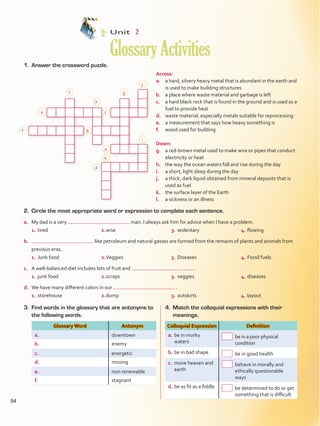
come into play.
a.	When was the last time your heart sank? _______________________________
	 _________________________________________________________________
b.	Have you recently fallen head over heels in love for a person? ____________
________________________________________________________________
c.	 What or who makes you grin from ear to ear? ___________________________
	 _______________________________________________________________
@The Brit singer, Adele, continues collecting awards! She is unstoppable. Overall, Adele has
received 103 awards from 186 nominations since she released her first album in 2008.
@DJ SOD
Awesome news! I still remember how she grinned from ear to aer _________________(a)
when receiving her 6th
Grammy award in 2012.
@BritProducer
Soon as I heard her for the first time, I fell hdae ________________(b) over heels in love for
her voice. She’s the for best.
@KellyOzz
She is often criticized for being a big-sized woman!This makes my boold _______________(c)
boil. I know what it’s like because I used to struggle with my weight. But I say down with those
comments.Adele is a terrific artist.Your weight does not define who you are, your talent does!
@AdeleFanForever
Adele had a very difficult break up with her boyfriend. Her album 21 is inspired entirely by
that event. My hraet _______________(d) sunk when I listened to her song
“someone like you.” It is really sad and beautiful at the same time.
1.	 Read the following news from a social network and some responses from followers. Unscramble
the words in bold to complete the idiomatic expressions.
2.	 Choose the most appropriate idiomatic expression from the Word Bank to
complete the conversations. Put the verbs in the correct tense.
A: 	I just read that Adele has a serious vocal
cord surgery. I was really surprised about it.
B: 	Oh, that is a tragedy. My _____________
_______________(a) too when I read the
news I hope she recovers 100%.
A: 	Have you heard Adele’s new song?
B:	Of course, I bought it on iTunes today.
After I heard it, I immediately _________
_________________________(b) with it.
A: 	Look at this wonderful photograph of
Adele. She’s _______________________
__________(c).
B: 	This is definitely a photo to remember her
by. She looks absolutely stunning!
Word Bank
• your heart sinks
• grin from ear to ear
• make your blood boil
• fall head over heels in love
| June 19
| June 19
| June 20
| June 20
| June 20
Reply | Retweet
Reply | Retweet
Reply | Retweet
Reply | Retweet
Reply | Retweet
31
VP5_WB_UNIT_3.indd 31 3/23/16 9:43 AM
Lesson  1
AppealofTraditions!
UNIT
4
b.	 In this country, for nine days before
Christmas, posada or lodging processions
pass through the streets.The figures of
Mary and Joseph are ____________
to a friend’s house, where a carol is
_____________, asking for lodging
for the Holy Family.
	 1.	 Panama
	 2.	 Guatemala
	 3.	 Argentina
c.	 What carnival is _________________
for having people who paint their
faces black one day and white the
following day?
	 1.	 The Carnival in Pasto,
Colombia
	 2.	 The Carnival in Rio de
Janeiro, Brazil
	 3.	 The Carnival in Oruro,
Bolivia
a.	 In this country people celebrate their
birthday twice: on their birth date and
on their name day. For the second
celebration, everyone who has the
name of a saint who is ____________
by the church, celebrates their
birthday on that saint’s day, too.
	 1.	 France
	 2.	 Italy
	 3.	 Greece
d.	 He was _________________ as the
patron saint of a country. On his day,
millions of people wear green and
celebrate with parades and good
cheer.
	 1.	 St. Patrick of Ireland
	 2.	 St. Paul of the Cross
	 3.	 St. Peter Claver
1.	 Use the Word Bank to complete the trivia about traditional
celebrations around the world. Then, answer it.
TRIVIA
2.	 Complete the following conversations. Use the passive form of the verbs in parentheses in the Simple
Present or Simple Past tense.
Andy: Why ________ you _________________ in green? (dress up)
Kathy:Today is St. Patrick’s Day. It is an Irish tradition to wear green!
Ioanna:Whose name day ____________ ________________ today, mom? (a. celebrate)
Adela: Mine!Thank you for remembering it. Let’s make Greek dishes and invite some
friends.
Laura: Dear family, it is our turn for the eighth posada tomorrow.
Pedro:When ______________ we ______________? (b. choose)
Laura: We were chosen by the priest during mass yesterday.
Pedro: Great! I’ll take out the saints.Where ____________ they _________________
(c. put away) last year?
Cristina: Where ___________ the black paint ______________(d. keep)?
Patricia: On the top shelf, but what do you need black paint for?
Cristina: Oh, it’s black day at the Carnival today.We are all going to the plaza with our
faces painted black.You __________ _________(e. invite) to join us. Come on, it’ll be fun!
are dressed up
Word Bank
• honored	 • carried	 • recognized	
• renowned	 • sung
honored
32
VP5_WB_UNIT_4.indd 32 4/22/16 4:18 PM
Grammar and Vocabulary
3.	 Read the story of Mary and Joseph going to Bethlehem. Circle eight mistakes in the use of the
passive voice. Write the correct form in the spaces below.
Not many details are knew about Mary and Joseph’s trip to Bethlehem, but their
story is celebrate all around the world and the scene of the manger is exhibit by
millions of Christians during Christmas time. Moreover, historians, theologians and
scientists are fascinate by this topic. The most accepted story says that Mary and
Joseph used to live in a land that was governed by the Roman Empire. It happened
that the Emperor Augustus wanted to have a list of all the people in the empire and
make sure they paid their taxes. Everyone was order to return to the town where
their families originally came from.There was a register or census where their names
were record. The trip from Nazareth to Bethlehem is known to have been long and
arduous; therefore, Mary and Joseph traveled very slowly because Jesus was due to
be born soon. When they reached Bethlehem they were faced with a problem: so
many people had come for the census that every inn was full and there weren’t any
rooms left. Therefore, they wasn’t given a proper bed to rest in, but a stable with
livestock. In this poor place Jesus, the Son of God, was born. There wasn’t a cradle
available for baby Jesus, so where was baby Jesus lay down? Jesus’ bed was the
manger that the animals ate their hay from.
a.	 __________________
b.	 __________________
c.	 __________________
d.	 __________________
e.	 __________________
f.	 __________________
g.	 __________________
h.	 __________________
known
4.	 Unscramble the sentences and check (3) if they are T (true) or F (false).
a.	renowned / Mary and Joseph’s trip / by / is / all around / Christians / the / world /.		
	 ___________________________________________________________________________
b.	Roman Empire / the / was / by / ruled / the Emperor Herod /.				
	 ___________________________________________________________________________
c.	 was / Everyone / to / ordered / return to / the / in / land / used / they / to live /.	
	 ___________________________________________________________________________
d.	Mary and Joseph’s names / weren’t / the / census / entered / in /. 				
	 ___________________________________________________________________________
e.	were / they / normal / given / accommodation / the /night / for /.			
	 ___________________________________________________________________________
f.	 Jesus / baby / was / to sleep / put / in / a / bed / comfortable /.				
	 ___________________________________________________________________________
5.	 Read the text below and choose between passive or active voice.
Santiago: Where did you put away / were put away the Christmas decorations last
year?
David: I put them on the top shelf of my closet. Do you want me to take them out, Dad?
Santiago: Yes, please. Are they damaged / Do they damage them? (a)
David: The decorations look fine / are looked fine (b), but the lights are burnt out.
Santiago: Already?They bought / were bought (c) last year. I guess we’ll have to
buy new ones.
David: Can I come?You chose them / were chosen (d) last time. I want to
choose this year…
T	 F
Mary and Joseph’s trip is renowned by Christians all around the world.
33
VP5_WB_UNIT_4.indd 33 3/23/16 10:14 AM
Lesson  2
PastEchoinginthePresent
1.	 Choose the best option to complete the dialog in passive voice in the Present Perfect tense.
2.	 Complete the text with the appropriate verb in the Word Bank.
Use the passive voice in the Present Perfect tense. Then match
the pictures with the corresponding text
3.	 Search the web and find examples of people in the 21st
century associated with the following topics.
Topics
a.	 Advanced cancer
treatment
b.	 Women’s
equality
c.	 World poverty d.	 Children’s
rights
e.	 Space travel
Name James Watson
Action
Research that shows it is
wrong for advanced cancer
patients to take multivitamins
The first lab-grown organ to be
implanted in a human _____________
_______________ at theWake Forest
Institute for Regenerative Medicine.
The Institute____________________
____________(a) by Dr. Anthony Atala
since 2004. He has made a significant
contribution to science by growing
human tissues and organs like livers,
kidneys and bladders. His work will
save thousands of lives.
Sonia Ghandi ___________________(b)
President of the Indian National
Congress. She came into politics after the
demise of her late husband Rajiv Gandhi,
Ex-Prime Minister of India. Great fame in
terms of position and influence in Indian
politics ____________________(c) by this
politician. She _____________________
__________(d) twice by world magazines
like Forbes andTimes as one of the most
influential women of the year.
Only one woman _________________
__________________(e) with a Nobel
Prize in the field of Economics. Elinor
Ostrom was the recipient of this prize
in 2009 for her analysis of economic
governance of common property like
air, water and public spaces.These
______________________________(f)
the world’s most urgent problems
that require collective action.
a.
Word Bank
• develop	
• gain	
• honor
• nominate	
• direct	
• elect	
• consider
b. c.
Teacher: Good morning everybody.Today’s topic
is about remarkable people of the 21st
century and
their contributions. Can you mention any examples?
Janet:Well, I read that a significant contribution
to science have been made / has been made by Dr.
Anthony Atala.
Teacher: Great, what have been his contribution /
has been his contribution (a)?
Janet: He’s a scientist who has created human
organs at theWake Forest Institute for
Regenerative Medicine.
Teacher: That is a fine example Janet.
Thank you for your contribution. Anybody else?
Gabriel: How about women, has they been honored
/ have they been honored (b) with the Nobel Prize?
Norman: Yes, in fact, one of them is Elinor Ostrom.
Thanks to her research, the use of natural resources
like air and water has been considered / have been
considered (c) an important issue.
Teacher: Thank you Gabriel and Norman. She is
also a fine example for today’s class.
has been
developed
34
VP5_WB_UNIT_4.indd 34 4/21/16 10:52 AM
Grammar and Vocabulary
4.	 Match columns A and B to form sentences with used to.
A B
a.	 Dave Eggers used to live in Chicago,
but
1.	 presently he is a writer,
publishing entrepreneur and
activist.
b.	 He used to work for a local
newspaper, but
2.	 nowadays his works have
received critical acclaim.
c.	 When he was a boy he didn’t use to
write, but
3.	 after his parents died
he moved to Berkeley,
California.
d.	 He used to be an unknown writer,
but
4.	 now writing is his passion.
e.	 He used to write about his personal
life and local politics, but
5.	 over time his writing topics
have become more universal
and social oriented.
5.	 Read the chart and fill in the blanks using used to. Then, match the three columns
based on the product they describe.
Dave Eggers
a. Mobile phones
b. Hamburgers
c. Blue jeans
Product Past Present
1.	 In 1885, a young American called Charlie Nagreen
_______________(sell) meatballs. He realized that
they could be put between two pieces of bread so
people could have this meal to go.That is one of the
stories of how this fast food dish was born.
How much did it _________________(a. cost)?
Only a few cents!
Today this fashion item has become
the world’s most popular garment.The
clothing industry continues to develop
this item of clothing in more fabrics and
styles than ever before.
2.	 In 1873 Levi Strauss invented this garment. At that
time it was only worn by men who worked in US gold
mines. Did women ___________________(b. wear)
it? No, they didn’t __________________(c. wear) it.
It started being worn by women in the 1950s.Teens
first, and then, by the 60s, everyone
was wearing it.
Today, restaurants around the world try
to create really expensive versions of this
dish. One restaurant in NewYork sells
Le Burger Extravagant and costs around
$300 dollars. How much
would you pay for it?
3.	 In the last century, only a few people
_______________(d. have) them.Why did it
_______________(e. be) so exclusive? Some
experts say that once technology is mass produced,
it becomes accessible and less expensive for
everyone.
In this century, they are used by many
people and are considered one of the
world’s most important inventions in the
field of communication in the modern
times.
used to sell
a
b
35
VP5_WB_UNIT_4.indd 35 3/23/16 10:14 AM
Lesson  3
OldTimesandModernWorld
1.	 Read the description of each camera. Then, identify their corresponding picture.
2.	 Read the essay and mark the paraphrases below each paragraph as TS (topic sentence) or
SS (supporting sentence).
200 YearsofPhotographs
Photos are our memories of
people, places, trips and parties.
Today, our lives are documented
on Facebook, Twitter and
Instagram. However, it didn’t
use to be like this; we simply used
to keep photos in our shoeboxes or albums. It is said that
the oldest picture is less than 200 years old. So, who used to
take photos and why and how did they use to take them?
How different is it nowadays?
	a.	 Photographs can be seen as tangible projections
of our memory.
	b.	 The earliest picture was taken two centuries ago.
In the past, very few people were able to shoot photos, while
today, most people can.The camera obscura, invented in the
10th centuryA.D., is considered the first type of camera, and
is used as a sketching aid by artists.With the first commercial
camera in the 19th Century, only inventors, photographers
and photojournalists used
to take photos. The Kodak’s
Brownie cameras, invented in
the 1900s, became available for people who could afford
to buy one. Hence, amateurs could begin to explore their
own ideas and creativity. Soon after, cameras found their
way into most households, so people could keep memories
of important dates and celebrations. Because technology
has flourished in the 21st century, now anybody can take
photos, at any time and any place.
	c.	 One invention that can be considered as a kind of
early camera was used to make drawings.
	d.	 Only a few professionals could afford a camera
and take pictures.
The reasons why we shoot photos nowadays is different.
These days, every party, birthday, sports game and concert
is documented in detail so that people can remember the
event. In the past however, the reasons were very different.
Kodak’s Brownie was
produced from 1900 until
1960. It became a cheap
camera for bringing
photography to the masses.
It was developed in 1948 and
consisted of a sandwich of
chemicals and paper which
could self-develop the photos
in a few minutes.
It is believed to be the first
commercially produced
camera. It was introduced
to the world in 1839.
a.	 Brownie Camera b.	 Polaroid Camera c.	 Daguerreotype
TS
SS
36
VP5_WB_UNIT_4.indd 36 3/23/16 10:14 AM
Reading
For example, with the initiation of
photography in the Victorian era, an
uncommon practice was developed:
the dead were photographed. It
is well known that mortality rates
were high, so when loved ones
died, the Victorians immortalized
them in photographs. Post-
mortem photographs were the
only photograph a family had of the
deceased because photos used to be very expensive and
most families didn’t use to own a camera.
	e.	The present purposes of taking photos differ from
the ones in the past.
	f.	 Households did not have a camera and
photographs were costly.
The way in which we shoot photos has
changed drastically. In the past, only
physical (analog) photos were taken: first in
black and white and later in color. They were
usually developed and stored in shoeboxes or
in albums.
The 20th century was the golden age of analog
photography: It’s been estimated that around
85 billion physical photos were taken in the year
2000, this means a rate of 2,500 photos per
second. In contrast, in the new millennium, any
activity that a person does might be documented
digitally. New gadgets like the tablet and the cell
phone have built-in cameras that make photos and
high definition videos. People share photos on Facebook,
Twitter and Instagram directly from their phones. Every two
minutes today we shoot as many photos as the whole of
humanity did in the 1800s.
	g.	The communication tools that we use today
include applications for photos and videos.
	h.	 The manner in which we take photos has
undergone considerable changes.
In sum, it has been almost 200 hundred years since
the first photograph was taken. Diverse purposes,
numerous types of cameras, and different kinds
of photos underlie this ancient practice. Although
analog pictures have almost disappeared, the
growth of photos continues.
3.	 Based on the text, check (√) the best answer.
a.	 The primary purpose of the essay is to:
	State the advantages and disadvantages of different types
of cameras and photos.
	Discuss the history of photography and cameras.
	Compare and contrast past and present usage of photos.
b.	 According to the essay, which of the following is true about
Victorians:
	They used to photograph the living.
	They used to photograph dead animals.
	They used to pay a reasonable price for the post-mortem
photos.
c.	 The essay mentions each of the following, EXCEPT:
	People have had different reasons to shoot photos
throughout the years.
	Shooting photos was a popular activity afterWorldWar II.
	Analog pictures have almost disappeared due to the
invention of the digital camera.
4.	 Read the text again and identify the
organization of the essay. Circle the
correct information.
a.	The essay begins with an introduction to
attract / turn down the reader.
b.	The essay presents the pros and cons / a
comparison and contrast of the topic.
c.	 Each body paragraph has one idea stated in
the topic sentence / supporting sentence.
d.	Each body paragraph contains true
examples / statistics / facts / all of them to
support the topic sentence.
e.	The last paragraph is a summary of
the body paragraphs / presents new
comparisons.
Reading Strategy
Locate the information required by each question in the
correct paragraph to choose the best response.
Reading Strategy
Analyze the features of the text and find
organizational patterns to identify the type
of essay.
37
VP5_WB_UNIT_4.indd 37 3/23/16 10:14 AM
Writing
________________________________________________________________________
________________________________________________________________________
________________________________________________________________________
________________________________________________________________________
________________________________________________________________________
______________________________________________________________________
Paragraph 1 ______________________________________________________________________________
________________________________________________________________________________________
________________________________________________________________________________________
Paragraph 2 ______________________________________________________________________________
________________________________________________________________________________________
________________________________________________________________________________________
Conclusion _______________________________________________________________________________
________________________________________________________________________________________
________________________________________________________________________________________
1.	 Investigate the following celebrations and traditions in the given countries
and complete the descriptions comparing and contrasting such
celebrations in the past and the present.
a.	 Christmas in the USA
1.	In the past, for Christmas dinner, people had pork and vegetables which were
grown in the house’s vegetable garden, while now ______________________
_____________________________________________________________.
2.	Before, in the Christmas stocking, there would be an orange, sweets and
nuts and maybe a book. However, at present ________________________
______________________________________________________________.
3.	Although children used to play games on Christmas Eve, nowadays ______
_______________________________________________________________.
b.	 Easter in Colombia
1.	Although _______________________________________________________,
at the present time, society has taken Easter and commercialized it so that most
people think of having big meals with fish instead of the importance of Christ’s
Resurrection.
2.	While in the past __________________________________________________,
nowadays, the whole of HolyWeek is often a holiday used for traveling and
tourism.
3.	Earlier, on Palm Sunday, most people went to mass, bringing palm leaves and
branches to be blessed by the priest, but ________________________________
__________________________________________________________________.
2.	 Choose one of the celebrations from the previous exercise and write
the introductory paragraph of a comparison and contrast essay.
3.	 Develop two body paragraphs and the conclusion of the essay. Use the three differences you
wrote about the topic in exercise one.
Writing Strategy
In an introduction, write
something interesting about
the topic as a hook to attract
the reader’s attention.Then,
state directly what you
are going to compare and
contrast in the essay.
Writing Strategy
Use used to to write
about what happened
regularly in the past, but
no longer happens in
the present.
38
VP5_WB_UNIT_4.indd 38 3/23/16 10:14 AM
Lesson  4
Breakingwith…
1.	 Read the summary of an episode of the American sitcom The Big
Bang Theory and underline three colloquial expressions.
4.	 Read about the tradition of New Year’s resolutions and complete the ideas with your own information.
Oh, Penny! I will never
______________________
______________________.
When will you
______________________
of using only facts?
Well, I dispute that claim.
It was Leibniz, not Newton
who invented calculus.
Why don’t you believe it was
Sir Isaac Newton who invented
calculus?That was one of his
__________________________.
SheldonChangesChristmastoNewton-mas
In this episode, the Christmas tree is decorated by Penny and Leonard. Sheldon
does not want to participate because he does not celebrate Christmas. He says
that Jesus was not born on December 25th
, but in the summer. As usual, Sheldon
refuses to break the habit of using scientific facts. He claims that Jesus’
birthday was changed to winter time to replace a pagan festivity.
However, Sir Isaac Newton is very Christmassy because he was born
on December 25th, 1642; his crowning achievement, according to
Sheldon, was the invention of calculus. Sheldon makes everybody
uncomfortable trying to break with tradition by renaming
Christmas “Newton-mas” and trying to put the bust of Newton on
top of the Christmas tree.
Real Communication
2.	 Answer the questions based on the previous text.
a.	What habit does Sheldon refuse to break? _____________________________________________________________
b.	What is Sir Isaac Newton’s crowning achievement?_____________________________________________________
c.	 What tradition is Sheldon trying to break?_____________________________________________________________
3.	 Complete the following conversations. Use the Word Bank.
For New Year…
a.	I’ll break the habit of _________________________________________________________________________________.
b.	My crowning achievement will be ______________________________________________________________________.
c.	 I won’t _________________________________________________________________; for sure, I’ll break with tradition!
On NewYear’s Eve, Americans write NewYear’s resolutions. A NewYear’s resolution is a commitment that a person
makes to achieve one or more personal goals or projects, or the reforming of a habit.
•	 break the habit
•	 crowning achievement
•	 break with tradition
Word Bank
39
VP5_WB_UNIT_4.indd 39 3/23/16 10:14 AM
Lesson  1
GoingonVacation
UNIT
51.	 Answer the survey and discuss with a partner.
2.	 Complete the conversations about holiday preferences with the appropriate tag question.
Mary: Our vacations are around the corner,
_____________?
Pedro: Oh yeah!We should start planning.
Actually in this survey there are a couple of ideas.
Mary:You are not looking forward to any
adventure activities or nightlife, ___________(a)?
Pedro: Not really, I just want to relax.You like
going to little towns, _____________(b)? How
about the Cultural Coffee Landscape in Colombia.
Mary: Oh I’d love to go there! It’d be
the perfect place to relax, _____________(c)?
Pedro: Let’s look for a place to stay.This web
page shows some farms that are for rent.
Mary: Look at that one; it’s so pretty,
_____________(d)?
Pedro: It sure is. It has a private pool and a sauna!
We can afford it, _____________(e)?
Mary:Yeah! Let’s call immediately and book it!
Travel agent: Please fill out this survey and I will be
with you in a moment.
Mike:Thanks. Let’s see…We’d prefer to go on a
beach holiday.That’d be great, _______________(f)?
Patty:Yes! And you could go snorkeling,
______________________(g)?
Mike: Of course.We could go shopping, sightseeing,
and enjoy the nightlife!
Patty: But we can’t afford it, ________________(h)?
Mike: I guess not.
Travel agent: Hi, again, I overheard that
you have doubts about going on a beach holiday,
______________________(i)?
Patty: Yes, we think it could be too expensive unless
we stay in hostels for backpackers.We don’t want
that, ___________________(j)?
Mike: Of course not!We dream of a nice all-inclusive
hotel on a paradise beach.
Travel agent: Well, I think I have the perfect place
at the right price. Give me a minute…
aren’t they
Grammar
Strategy
Use tag questions
to verify or check
for information.
A positive
statement is
followed by a
negative tag,
and a negative
statement is
followed by a
positive tag.
What are your holiday preferences?
a.	 On vacation you prefer…
	 	going back to places you have visited before.
	 	going to a new destination.
	 	staying at home.
b.	 I go on vacation…
	 	every six months.
	 	once a year.
	 	not even once.
c.	 Who would you like to go with to the following
destinations?
	 	 beach 	 safari	 luxury spa	 cruise
	 my dad	 	 	 	
	 my mom	 	 	 	
	 my sibling 	 	 	 	
	 my couple	 	 	 	 	
d.	 The top three holiday destinations in
your country are…
1.	_______________________________
2.	_______________________________
3.	_______________________________
e.	 You would like to go to…
	 Canada	 Mexico
	 France	 Italy
	 Bahamas	 Other _____________
f.	 Which of the following activities do you
look forward to on a vacation?
	 snorkeling	 scuba diving
	 kite surfing	 waterskiing
	 just relaxing	 sightseeing
	 sunbathing	 shopping
	 Other _____________________
40
VP5_WB_UNIT_5.indd 40 3/23/16 10:48 AM
Grammar and Vocabulary
3.	 Mike and Patty are discussing the final details of their trip. Write the correct tag question.
They will serve breakfast
at 8 AM by the pool,
_________________(j)?	
4.	 Complete the following email with the verbs in the Word Bank.
Use the infinitive or the–ing forms when needed.
Dear Mr. and Ms. Ramirez,
According to the conversation we had on the phone, you said that you wanted
to travel to the coffee growing region of Colombia with your wife and daughter,
didn’t you?You also said that you wanted to rent a farm. Before I continue
___________________________ (a) some farms for rent, I would like to ask you some
other questions.Would you like _____________(b) a farm with recreational areas like a
pool and a barbecue?What kind of farm would you and your family like, old fashioned
or modern? Near or far from any sights, recreation, nightlife or shopping? How about
the weather, would you like a hot place or would you prefer a cooler location? How
long would you like _____________(c)? And finally, what is your budget?This is a really
important question because I will be able to choose options that you can afford. If you
get back to me soon, I will find the perfect destination and you and your family will be
able _____________(d) your suitcases for a wonderful trip!
Sincerely,
Johan Salamanca
Trans AmericanTravel Agency
1565 Folsom St. Boulder, CO 80302
Phone: +46 (0)45 220 04 39
5.	 Look at the chart of preferences sent by the Ramirez family. Check ( ) the picture that best suits them.
Swimming pool
Barbecue
Far from sightseeing places,
recreation, nightlife and shopping
Modern
Old fashioned
Hot place
Cold place
START
FINISH
Patty, you made
the hotel reservation,
_______________(a)?
Mike, you did the
online check-in,
_______________(b)?
We have
finished packing our
suitcases,
_______________(c)?
The hotel looks
fantastic,
_______________(d)?
The flight is
not delayed,
_______________(e)?
The taxi will pick
us up at 8 o’clock,
_______________(f)?
The flight tickets and
the passports are in
our carry-on bags,
______________(g)?
We booked a room with
a view of the beach,
_______________(h)?
Meals are not
included in the plan,
_______________(i)?
Word Bank
• book	 • stay	
• look for	 • pack
a. b. c.
Grammar Strategy
Identify verb patterns that
are followed by a gerund, an
infinitive or both to make a text
grammatically accurate.
41
VP5_WB_UNIT_5.indd 41 4/21/16 10:57 AM
Lesson  2
AmazingThingstoDo
1.	 Complete the crossword puzzle about sports and adventure
activities people often do on holiday. Across
a.	 Moving across snow on a board
b.	 Riding on the crest or along the
tunnel of a wave
c.	 Descending a vertical surface, such
as a cliff or wall, by sliding down
with a rope
d.	 Racing in a lightweight canoe
e.	 Cycling off-road, on a trail or on dirt
f.	 Going down a hill or other slope for
recreation using a simple sled or
toboggan
Down
g.	 Diving using a snorkel
h. 	 Climbing rock surfaces using
specialized techniques and
equipment
i. 	 Underwater swimming using a tank
and a special suit
j. 	 Going on an extended walk for
pleasure or exercise
2.	 Rephrase the underlined parts of the following sentences by writing
compound adjectives.
a.	 Chileans enjoy skiing in the mountains close to the city of Santiago.
	 Everybody knows about these mountains. _______________________________________
	 ___________________________________________________________________________
b.	 We went on a mountain bike adventure in Guatemala for two weeks.
	 We went on a ________________________________________________________________
c.	 Nassau preserves its coral reefs very well.
	 Nassau has ____________________________________________________________________
d.	 The slopes for snowboarding in Austria are first class.
	 Austria offers _______________________________________________________________
e.	 Pilgrims that take theWay of St. James in Spain have to walk 100 km.
	 St. James is a _____________________________________________________________
f.	 The tradition of walking theWay of St. James is about 1,500 years old.
	 Walking theWay of St. James is a _____________________________________________
Chileans enjoy skiing in the well-known
Grammar Strategy
Some adjectives consist of two words, e.g. well
known.They are often connected with a hyphen
before nouns so that you can clearly see it is one
adjective, e.g. a well-known person.
mountains close to the city of Santiago.
a
b
c
d
e
f
g
h
i
j
42
VP5_WB_UNIT_5.indd 42 3/23/16 10:48 AM
Grammar and Vocabulary
3.	 Read each of the reported speech sentences below. Then, check ( ) the option that contains the
original message.
4.	 Report the answers given by the interviewees. Change the tense when necessary.
The sister said that _____________
_____________________________
_____________________________
_____________________________
_____________________________
Iker said that __________________
_____________________________
_____________________________
_____________________________
_____________________________
She said that __________________
_____________________________
_____________________________
_____________________________
_____________________________
a.	Reporter: Sister, tell us about
your experience this holiday.
..................................................
Sister: We walked theWay of St.
James in Spain.We were traveling
with little money so we had to ask
for food from the locals. It was an
interesting experience. 	
b.	Reporter: Here comes Iker
Casillas. Where did you go last
holiday?
.................................................
Iker: I went snorkeling in Nassau.
I really loved the coral reefs there.
I will never forget such a great
time!
	
c.	Reporter: Where are you
coming from?
.................................................
Woman: I took a spa-holiday
in Samui island in
Thailand. It’s a well-known
place to relax. I feel
completely refreshed!
a.	 She said that approximately 100,000 people would
arrive from destinations abroad.
 1.	 “Approximately 100,000 people arrive from
destinations abroad.”
 2.	 “Approximately 100,000 people will arrive
from destinations abroad.”
 3.	 “Approximately 100,000 people are arriving
from destinations abroad.”
b.	 The local news broadcaster said that 300,000
people were arriving in the city returning from their
holiday vacation.
 1.	 “300,000 people are arriving in the city
returning from their holiday vacation.”
 2.	 “300,000 people were arriving in the city
returning from their holiday vacation.”
 3.	 “300,000 people arrived in the city returning
from their holiday vacation.”
c.	 She said that it was the busiest vacation in the last decade.
 1.	 “It was the busiest vacation in the last decade.”
 2.	 “It will be the busiest vacation in the last decade.”
 3.	 “It is the busiest
vacation in the last
decade.”
d.	 She said that this phenomenon
was affecting traffic in the city.
 1.	 “This phenomenon is
affecting traffic in the
city.”
 2.	 “This phenomenon was
affecting traffic in the
city.”
 3.	 “This phenomenon
will be affecting traffic in
the city.”
43
VP5_WB_UNIT_5.indd 43 3/23/16 10:48 AM
Lesson  3
HolidayDestination
1.	 Examine the title of the flyer. List the ideas that come to mind about this title.
a.	 __________________________
b.	 __________________________
Do not miss out on what Mother Nature has to offer…
Visit Machu Picchu, Peru, and be prepared to be blown away!
c.	 __________________________
d.	 __________________________
e.	 __________________________
2.	 Seven sentences have been removed. As you read, choose the sentences [a-h] to complete the text.
There is one extra sentence which you do not need to use.
An old saying goes “beauty is in the eye of the beholder,” but when visiting Machu Picchu in
Peru, all will undoubtedly see beauty so stunning that it will fill the eye and warm the heart.
The name ‘Machu Picchu’ means ‘Old Peak,” and it is one of the most mysterious ancient sites
in the world. Machu Picchu, according to legend, used to be considered a sacred place a
long time ago. The creation of the astonishing city is attributed to the Inca people. The Incas
started building it around 1400 AD, but abandoned it a century later at the time of the
Spanish Conquest. ____________(1) It was the North American historian Hiram Bingham,
who rediscovered the ruins in 1911.
Today, there are well-preserved baths, temples,
palaces, and about 150 houses. These gray granite
structures are so perfect that they are quite simply works
of architectural genius.
Reading
Strategy
Analyze pieces
of information
to activate
your previous
knowledge.
a.	 It has to be booked well in advance.
b.	 One way is by taking the train from nearby Cusco.
c.	 Some of the most extraordinary ones, for example,
are the Ruins of Intipata, the Gate of the Sun, and
the mountain ofWayna Picchu.
d.	 Although it remained well known locally, it was
unknown to the outer world.
e.	 Other routes are open, but roads may be closed
suddenly because of landslides and flooding.
f.	 Do not miss the chance to try all kinds of spicy food.
g.	 However, the best
Peruvian specialties
are mainly found in the
countryside.
Reading Strategy
Use context clues like
punctuation, connectors, and the
ideas already given, before and
after the gap, to identify where
missing parts fit.
Location
The city was built 2,430m above the Urubamba River,
in the middle of a tropical mountain forest.
d
44
VP5_WB_UNIT_5.indd 44 3/23/16 10:48 AM
Reading
3.	Use so or such to complete the sentences. Then, check ( ) T (true) or F(false) according to the text.
a	 Machu Picchu’s constructions are ______________ magnificent structures
that they are considered a work of art.	
b	 When you take the train you can observe ______________ astonishing
scenery that you will be amazed.		
c	 July and August are ______________ rainy that it is not recommended to
visit Machu Picchu during this time.		
d	 The Inca trail is ______________ dangerous in February that it is closed in
order to prevent accidents.		
e	 Peru has ____________ a great variety of dishes that you won’t be able to
try them all.
How to get there
There are three main ways to get to Machu Picchu.
____________(2) The train trip, which is four hours long, takes
passengers through such magnificent scenery that time will fly.
This is the most popular way among tourists who are not fit
enough to hike the Inca Trail, the second way to get there.
The trail is a 28-mile long and takes you through old villages,
forests, valleys, and mountains. ____________(3) Finally, a
shorter train journey to Machu Picchu is from Ollantaytambo,
also home to some impressive ruins.
What to do there
Adventurous travelers can hike all the way to
Machu Picchu. Others can combine an Inca
Trail walk with visits to Cusco and Machu
Picchu by taking a Sacred Valley tour
if they have a week to spend in the
area. There are about 15 attractions
in Machu Picchu that travelers can visit.
____________(4)
When to go
January and February are the rainiest
months in this area, so it is not recommended
to go there during this time. If you are tempted to travel to
Machu Picchu during the heaviest part of the rainy season,
there are a few things to consider. The Inca Trail is closed in
February because of dangerous conditions. ____________(5)
The peak tourist season is during the dry season in July and
August because the nights are cool and the days are usually
dry. Buy tickets well in advance for travel during this season to
avoid being turned away from transportation. However, many
people visit the site in November and April to
avoid the crowds.
What to eat
Peru has one of the world’s finest
cuisines. Many people around the
world are familiar with quinoa, a
type of seed used in different dishes,
and pisco sour cocktails. ____________
(6) There is such a great variety of Peruvian specialties to try
when you go to Machu Picchu that the time will not be enough.
Try for example ceviche, a preparation of raw fish marinated
in citrus juice and a traditional causa, a type of casserole with
layers of potatoes and avocados. These dishes are supposed
to be good enough to die for.
Budget
Our travel agents can help you customize your trip according
to your availability, tastes and preferences. There are plans that
suit a range of budgets. There are 1-day to 30-day tours from
US $300. Do not hesitate to contact us.
Contact us at +0051-84-254341
info@machupicchu.com • machupicchutours@gmail.com
like us on Facebook follow us on twitter
Reading Strategy
Recognize ideas that
have been written
in different words to
check understanding
of the text.
T	 F
* Landslides: when dirt and rocks slide down a mountain.
* Flooding: to cover with liquid, usually water
45
VP5_WB_UNIT_5.indd 45 3/23/16 10:48 AM
Writing
1.	 Identify the main features of the brochure below. Underline the content and match it with the
corresponding feature.
Turks and Caicos Islands:
A dream destination for divers
The attractive color of the sea around this group of islands
in the South Bahamas will make you want to bathe in its
waters and explore its undersea world forever. The Resort of
Blue Waters is in Grace Bay, which is in the north-east of the
main island.
Colorful chalets blend with the palm trees along the sandy
beach.
This resort is for active seniors who know how to keep the
good times rolling with activities for the body, mind, and
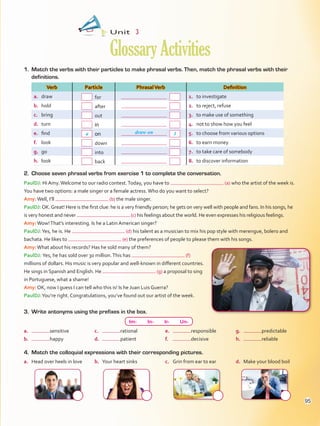
spirit. Spend your days in fitness classes, social gatherings,
and attend seminars on healthy living. Go fishing, biking or
boating. Try ball dancing or zumba gold, a high-energy Latin-
inspired dance workout for seniors. Mr. and Ms. Frey from
Canada said: “We believe we certainly visited the most stunning
site in the world.” They consider that the travel agents were
polite and patient responding to all the emails they sent with
thousands of questions about the trip.
Booknow!
www.holidays4fun.com
US and Canada + 1-866-930-7358
International +1-626-399-8688
(Place): _______________________________________________________________
______________________________________________________________________
______________________________________________________________________
It is ___________________________________________________________________
______________________________________________________________________
______________________________________________________________________
There you can _________________________________________________________
______________________________________________________________________
Mr. _____________ said that ______________________________________________
Contact us! ____________________________________________________________
Create a catchy headline
Include interesting facts
Present some attractions
Write a vivid description
2.	 Write a short holiday brochure. Use some of the features that you identified in exercise 1.
Write a positive review
Add contact information
a.	A catchy
headline
b. Interesting facts
c.	 Some attractions
e.	Contact
information
d.	Positive
reviews
46
VP5_WB_UNIT_5.indd 46 3/23/16 10:48 AM
Lesson  4
LivingLikeaKing!
1.	 Read the following situation and answer the questions below.
Well, I believe the best accommodation
and food are not in the most expensive
hotels and restaurants.
a.	 What does the woman in number 1 mean?
 1.	 She really wanted to have a holiday vacation.
 2.	 She wasn’t interested in a holiday vacation.
b.	 What does the man in number 2 mean?
 1.	 He will take the family to a luxurious hotel and
expensive restaurants.
 2.	 He will avoid taking the family to a luxurious
hotel and expensive restaurants.
c.	 What does the girl in number 3 mean?
 1.	 She thinks they will stay in a luxurious place.
 2.	 She believes they are a rich family.
d.	 What does the woman in number 4 mean?
 1.	 She believes they will have a luxurious
vacation.
 2.	 She realizes they have little money to spend
on their vacations.
2. 	Complete the expressions with the words that best complete the statements.
a.	 Backpackers usually take long trips to faraway places. Maybe that’s why they travel king / light / rays.
b.	 Don’t miss out on the chance to catch some king / light / rays on these pearl-like beaches.
c.	 I saved money all year long just to live like a light / rays / king for a few days in Barbados.
d.	 I wonder if I could ever go to Australia. I usually travel / go / spend on a shoestring budget and Sydney is really far
away and expensive.
e.	 Last weekend, we were enjoying a relaxing time on our farm when suddenly 15 relatives popped over / in / up to say
hello.We were completely surprised.
3.	 Replace the underlined parts of the conversations with the appropriate idiomatic expression.
a.	 Sarah: After graduating, I’ll
spend a month traveling
around Egypt.
Felipe:Wow!That’s great but
you’ll have to travel with little
luggage.
	 ____________________________
b.	 David: Laura, you look so
tanned. Have you been
sunbathing?
Laura: Yes! I’ve been to the
beach.
	 ____________________________
c.	 Val: Is that a cruise to the
Caribbean?
Juliana: Aha! I’m going to be
living luxuriously for the next 15
days!
	 ____________________________
Real Communication
2.
Finally, we are going to
live like kings for a while!
I can’t believe we’re here! I was so
looking forward to this holiday!
3.
1.
5.
You have to
be kidding!
Oh no!This means we are
traveling on a shoestring
again, aren’t we?
4.
47
VP5_WB_UNIT_5.indd 47 4/21/16 11:21 AM
Lesson  1
DealingwithDifficultSituations
UNIT
61.	 Find the words in the puzzle related to problems that teens often have.
Use the definitions to find the words.
a.	 To delay action (v).
b.	 The state of being unaccepted (n).
c.	 The act of harassing or intimidating
others (n).
d.	 The impression a person gives to
the public (n).
e.	 To make someone else do
something by arguing or
persuading (v).
f.	 The self or individuality of a person
that distinguishes his/her from
others (n).
p r o c r a s t i n a t e f n
i i m p p o r t a n y o f f e
d m a r r r o a d i n a m o s
e a n e e d r e j e c t i o n
n g i o s e a m a c i b e n w
t e p c s a t e c e n t u r u
i e o u u n b u l l y i n g j
t n l p r o b e e y e t m u u
y t a o e r e d e m p c i o n
2.	 Read and complete the conversations with some of the words above. Then, check (✔) the word
that is not a synonym of the word you wrote.
Tina: Oh, no! It’sTuesday and I
haven’t done my math assignment.
It’s due tomorrow.
Raj:Why do you _______________?
If you want, I’ll give you a hand with
the assignment but promise me you’ll
keep up your work in the future.
  bring forward   postpone   delay
Lin: Look at these models.They
are so skinny! Oh, I’m so envious.
What do you think, Leva?
Ieva:That’s not pretty Lin!They
look ill. I’m not so concerned
about my _____________________
to starve myself like that.What matters for me is
to stay healthy and feel happy with myself.
  interior   appearance   looks
Jose: You are a homeroom
teacher, aren’t you?What’s that
like?
Valerie: Oh, my teens are great!
I love them so much but lately one
of them has been __________________
other teens. I am working hard on stopping it.
  intimidating maltreating supporting
Fabio: Ugh!There’s so much
to study. I can’t stand the
_____________________ of school!
Judy: Don’t worry! Come and study
with us!We have a study group. If
someone has difficulties, we help each
other.
  stress   relaxation   tension
Vocabulary
Strategy
Use definitions
and images
to identify
vocabulary.
a.
b.
c.
d.
procrastinate
48
VP5_WB_UNIT_6.indd 48 3/23/16 10:58 AM
3.	 Choose the word that best completes the ideas on the left.
Then, match them to their corresponding paraphrase.
a.	 If I exercise / exercised 30 minutes a
day, I’ll feel happy and improve my
mood, according to a research study.
b.	 If I were a victim of someone who
posted a fake profile on a social
network, I would / will report it to site
monitors.That’s what they advise you
to do.
c.	 If a person intimidates / intimidated
me, I will talk to someone about it and
make sure that they help to make it
stop.The school psychologist once
advised me that.
d.	 If I am / were you, I wouldn’t let failing
a test take control of my life because
that would make me fail more!
1.	 It is my responsibility to let
someone know I’m being bullied
so he/she can do something to
end it.
2.	 I would inform the web-site
administrators about imposters
on the internet, in case they
caused me any harm.
3.	 If I let one failure take over my
mind, it would make me think
negatively about my future
tests and I might fail them too.
4.	 It is a good idea to have a daily
physical activity to do for half
an hour because it helps you to
stay in a good mood.
4.	 Complete the dialogue. Use the Word Bank and
put the verbs in the correct tense to form
the second conditional.
Mia:Wu, are you surfing the net
again?What would you do if the
internet __________________?
Beth: Oh, I ________________
(a) bored all the time if that
_________________________(b). I know I’m addicted to
the internet and that can be a problem.
Mia: Maybe you would be more creative with your free
time.Try imagining what you would do.
Beth: OK, let’s see…oh, I _________________________(c)
exercising more; I like riding bikes. Also, ______________
___________________ (d) a hobby like painting, creative
writing or robotics. How about you, Mia.What would you
do if you couldn’t _________________ (e) social networks
or email?
Mia: Oh that’s a hard one. Maybe I would ____________(f)
my friends more often. If we didn’t _________ time to
meet, we’d probably______________ letters to each other
to catch up; that’s what our grandparents used to do.
5.	 Read each situation and write the corresponding
wish or desirable situation.
a.	 Jim has to choose between two extra-curricular
activities: robotics and environment. He likes
them both very much.
	 _________________________________________	
________________________________________
b.	 Sandra loves exercising but there aren’t enough
hours for physical education at school.
	 She wishes _______________________________	
	 ________________________________________
c.	 Jim can’t go out tonight because he has soccer
practice early in the morning.
	 He_______________________________________
	 ________________________________________
d.	 Daniel isn’t communicating with his parents very
well.
	 He_______________________________________
	 ________________________________________
e.	 Jim’s friends aren’t very supportive.
	 He wishes ________________________________
	 ________________________________________
He wishes he didn’t have to choose between
robotics and environment.
Reading Strategy
Identify paraphrase to improve comprehension
and be able to interpret, understand, learn, and
use a text you have read.
c.
c.
c.
c.
Grammar and Vocabulary
Grammar Strategy
Recognize and use formulas and patterns to
express what you want to be true or real.
• start
• disappear
• take up
Word Bank
• write
• have
• happen
• be
• use
• visit
disappeared
49
VP5_WB_UNIT_6.indd 49 3/23/16 10:58 AM
Lesson  2
WhatWouldYouHaveDoneif…?
1.	 Match the pictures with the phrases in the Word Bank. Then organize the pictures from 1 to 6 to
determine the sequence of events.
Mario’s Chain Reaction
2. Use the ideas above and the Word Bank to reflect on Mario’s story. Use the third conditional.
a.	If Mario hadn’t used Facebook until midnight, he ____________________ to bed early.
b.	If he hadn’t woken up late, he ___________________________ to class on time.
c.	 If he hadn’t arrived late to class, he _________________________ the teacher’s explanation.
d.	If he hadn’t missed the teacher’s explanation, he ____________________ his own notes in class.
e.	If he hadn’t forgotten to take notes from his classmates, ___________________________ them
for the test.
f.	 If he had studied for the test, __________________________________ it.
3.	 Identify and circle the mistakes in the following regrets. Then, correct them.
a.	If I had pass the test, I would have obtained a higher grade in the subject.
b.	If I had obtained a higher grade, I would have apply for an internship in a
multinational company.
c.	 If I did that internship, I would have been accepted toThe University of
Japan.
d.	If I had been accepted toThe University of Japan, I would have study
Asian Studies.
e.	If I had studied Asian Studies, my biggest dreams would have came true.
a.	 missing the
teacher’s
explanation
b.	 arriving late to
class
c.	 failing a test
d.	 not being
able to study
without class
notes
e.	 waking up late
f.	 using Facebook
until midnight
Word
Bank
Word
Bank
would have gone
__________
__________
__________
__________
__________
passed
c.
c.
c.
c.
c.
c.
1
c.c.
c.c.
c.c.
c.c.
c.c.
c.c.
f
• hear
• get
• go
• fail
• take
• review
50
VP5_WB_UNIT_6.indd 50 4/21/16 11:24 AM
Grammar and Vocabulary
5.	 What would you have done in the situation
described above?
a.	If I had been in Julia’s shoes,
I would have __________________________
	 _____________________________________
b.	If I had been Martha,
	 I _____________________________________
	 ______________________________________
c.	 If I had been in the teacher’s place,
	 I _____________________________________
	 ______________________________________
d.	If I had had to solve the situation,
	 I _____________________________________
	 ______________________________________
4.	 Complete the following conversation. Use the verbs in
parentheses.
Teacher:You look worried.What’s wrong Simone?
Simone: It’s just that I wish I _______________ (not keep) quiet about a
bully in my class.
Teacher:Why?
Simone: If I __________ ____________ (a. tell) you that my friend Julia’s
homework was stolen, she wouldn’t ___________ ____________(b. get)
a bad grade.
Teacher: That’s terrible Simone.
Simone: I wish I ___________ ___________(c. make) the right decision.
Teacher: I think it’s never too late to tell the truth. Besides, you have to
denounce bullies because we can do something to stop it.
Simone:Thanks for listening Ms. Castro.
Teacher: Julia and Martha, I have asked you to come to try to solve things.
Martha: I appreciate that teacher. I know I acted terribly wrong and I’m sorry for
that.
Julia: I appreciate it, too; I think that if we really try, we _____________________
(d. can) make up and start fresh. I wish this ___________ ________________
(e. not happen). I still can’t understand why you stole my homework, Martha.
Martha: I apologize for doing that Julia. I wish I ____________ ____________
(f. not do) so. I was desperate! I couldn’t understand the assignment and I really
needed a good grade. It won’t happen again.
Teacher: I’m glad you regret having done it.
Julia: I am glad too. I forgive you Martha and in the future you should ask for help
when you don’t understand something. If you ______________(g. need) my help,
I _________ ___________(h. explain) the tough topics to you.You can count on me.
Martha: Oh, that would be great Julia. I’m very good at chemistry, so I offer my help
to you, too.Thank you very much Ms. Castro for helping us reconcile.
Teacher: I think you two have reached an agreement. Now, how about a hand shake
and a hug?
6.	 Paraphrase the following ideas using wish
followed by the Past Perfect tense.
a.	Pablo feels sad that he didn’t attend his
painting classes.
	 He _____________________________________
	 ________________________________________
b.	Laura regrets that she didn’t have private
tuition to help with her English class.
	 ________________________________________
	 ________________________________________
c.	 Paul is sorry he spent his money on running
shoes.
	 ________________________________________
	 ________________________________________
hadn’t kept
51
VP5_WB_UNIT_6.indd 51 3/23/16 10:58 AM
Lesson  3
TheTeenageBrain
1.	 Can you read this?
Aoccdrnig to rseearch ta Cmabrigde Uinervtisy, it deosn’t
mttaer ni waht oredr the ltteers in a wrod are, eth olny
iprmoatnt tihng is taht the frist and lsat ltteer are in the
rghit pclae. The rset can be a toatl mses and you can sitll
raed it wouthit a porbelm.Tihs is bcuseae the huamn mnid
deos not raedervey lteterby istlef, butthe wrod as a wlohe.
1.	 The Wernicke’s area is the
region of the brain involved
in the comprehension of
speech.
2.	 In most people (97%), both
Broca’s area andWernicke’s
area are found in only the left
hemisphere of the brain.
3.	 The Broca’s area is the region
of the brain involved in the
production of speech.
3.	 Match the statements (a, b, c) with the
corresponding pieces of information below.
a.	 This area allows you to speak a language.
b.	 This area allows you to understand a language.
c.	 This is the hemisphere in which you find language processes.
4.	 Read the following interview and identify the introductory
statements that make reference to scientific information.
the lantern
Special Report
Early Age and Second Language Learning
For this special issue of our school’s newspaper, our student-reporter interviewed
Prof. Sanchez, PhD in Second Language Acquisition from the University of
Salamanca, about second language learning in children who are very young.
Reading Strategy
Identify scientific information stated
by experts to raise awareness of the
credibility in a scientific text.
2. Answer the questions.
a.	Did you know your brain could read mixed-up words?
	 _____________________________________________
	 _____________________________________________
b. 	Can you write a short sentence with mixed-up words?
	 What is the trick?
	 _____________________________________________
	 _____________________________________________
	 _____________________________________________
frontal
lobe
Broca’s
area
spinal
cord
cerebellum
auditory
cortex
Wernicke’s
area
parietal
lobe
52
VP5_WB_UNIT_6.indd 52 3/23/16 10:58 AM
Reading
5.	 Read each idea and decide which one is stated explicitly (S) in the text and which one is (I) inferred.
a.	 The critical age period:
 1.		 The critical age period occurs between birth
and teenage years making it the ideal time to
learn a second language.
 2.		 It is better to learn a language when children
are very young.
b.	 L2 and brain processes:
 1.		 Early learners store the L2 more efficiently
than late learners.
 2.		 The early learner’s brain stores a significant
amount of information about the L1 and L2 in
the same areas.
c.	 Age and learning:
 1.		 Learners between 3 and 6 years old don’t
face many difficulties with pronunciation.
 2.		 Older learners are more likely to speak their
L2 with a foreign accent.
d.	 Girls and boys:
 1.		 Gender is not an indicator of successful
second language learning.
 2.		 Before puberty, girls learn with more
precision than boys at the beginning of the
process.
Reading Strategy
Connect the language clues in the text with your prior knowledge to
construct understandings beyond what is explicitly stated in the text.
Reporter: Prof. Sanchez, is there an ideal age to learn a
second language?
Prof.Sanchez:AccordingtosomelinguistslikePenfield
and Roberts in 1959, children have ideal conditions to
acquire a second language (L2) before puberty. They
called it the critical age period. They assert that there
is a vital stage between birth and puberty to learn a
second language.
Reporter: In what sense is this period ideal or vital?
Prof. Sanchez: It has been proved that early learners
–between 3 and 6 years old– find it easier to control
over the grammar, accent and rhythm of the language.
For example, they will imitate the sounds of the
second language much more accurately than those
who start learning after puberty. These discoveries
were shown by linguists such as Johnson, Newport
and Krashen.
Reporter: How is this possible?Why is it easier?
Prof. Sanchez: To understand this you have to
compare the brain processes of early learners and
late learners. When an L2 is learned during the critical
period, it shares some regions used by the mother
tongue (L1). Under this condition the brain works
faster by recognizing linguistic patterns between the
two languages and storing them. Functional magnetic
resonances (scans showing electromagnetic energy)
have shown that Broca’s area is heavily involved in this
process. If the language is learned at a later period,
the L1 is already strongly established and it therefore
interferes with the learning of the L2.
Reporter: Amazing! What about gender. Is it easier for
boys to learn an L2 than girls?
Prof. Sanchez: In fact, it may be the other way
around. According to Dr. Liaño Martinez, a researcher
and lecturer, there is a tendency for early language
acquisition to be more precise in girls than in boys,
suggesting that girls will be better at acquiring a
second learning in the beginning than boys. However,
the differences will disappear once their brains develop
completely.
Reporter: So, studying a second language at an early
age in schools can be advantageous for children
because their brains have the flexibility to do so. Also,
children can imitate the new language sounds better.
Prof. Sanchez: That’s correct. Furthermore , academic
achievement increases when children learn a second
language in their first years of schooling. However, they
may forget it easily if they do not use the language.
Reporter: Thank you Prof. Sanchez for your
observations about second language learning.
Adapted from: Language Development, Critical period.The Newport.
Report of the Rochester University, NewYork, USA.
53
VP5_WB_UNIT_6.indd 53 3/23/16 10:58 AM
Writing
One advantage is:
____________________
____________________
____________________
________________
According to __________________________,
“___________________________________
__________________________________”
Studies show that ______________________
____________________________________.Learning
Languages with
Video Games
2.	 Use your ideas from the previous activity and
write a short scientific article.
Another advantage is:
____________________
____________________
____________________
_______________
Prof. / Dr. ____________________ states that
“___________________________________
__________________________________”
Studies show that ______________________
____________________________________
Writing Strategy
Use quotation marks “…” to enclose words quoted from
experts. Do not include them when you use synonyms and
different grammar to summarize what they said.
1.	 Carry out some research about the topic of
Learning languages with Video Games, and
complete the following outline below.
Writing Strategy
Write about only one topic in each paragraph to
maintain unity in a composition. Use transition signals
to achieve coherence in the composition: In fact, also,
secondly, indeed, finally, most convincingly, in sum.
Learning Languages withVideo Games
Introduction (complete the thesis statement with the two advantages)
Learning a language can be difficult, but with the aid of a playful element the experience can be very positive.
Therefore, learning languages with video games can be advantageous for children because _____________________
________________________________________ and _____________________________________________________
_________________________________________________________________________________________________
First paragraph (write the 1st advantage and support it with an argument from authority, a study or a statistic)
In fact, ___________________________________________________________________________________________
_________________________________________________________________________________________________
_______________________________________________________________________________________________
Secondparagraph(writethe2ndadvantageandsupportitwithanargumentfromauthority,astudyorastatistic)
Also, ____________________________________________________________________________________
_________________________________________________________________________________________
________________________________________________________________________________________
Conclusion (restate the two advantages using different words)
In sum ____________________________________________________________________________
___________________________________________________________________________
__________________________________________________________________________
54
VP5_WB_UNIT_6.indd 54 3/23/16 10:58 AM
Lesson  4
YourWishIsMyCommand!
1.	 Complete the conversations using the expressions
in the Word Bank. Use the correct form of the
verbs.
A: Did you hear the children’s
story about a big spider in their
class?
B: Yes, my son told me it!
It ________________________
__________________________
_________________________
2.	 Complete the texts with the idiomatic expressions above.
Then, match them with the correct pictures.
a.	When I asked my parents to buy me a tablet I was hoping they would say “son, _____________
______________________________,” but instead they told me to earn it by being responsible
in my school duties, being a good son, and helping around the house.
b.	I explained to my class the rules of a game called amnesiacs, but when I finished, one of
my students said “teacher we did that last week.” I felt really embarrassed and wanted
______________________________, but then we all laughed and had a good anecdote to tell.
c.	 We read The Black Cat by Edgar Allan Poe in our English class.The story ___________________
_________________ because it is really spooky! However, I enjoyed it a lot.
3.	 Complete with personal information.
a.	What book or movie gave you the heebie-jeebies? ________________________
___________________________________________________________________
b.	When did you really want to kick yourself about something? _______________
__________________________________________________________________
c.	 When was the last time you made someone’s wishes your command? What did
you do for her / him? ________________________________________________
__________________________________________________________________
A: Honey,What’s wrong?
B: Dad, today I left my
homework at home and I got a
poor grade.
__________________________
__________________________
_________________________
A: Ms. Johnson, can we decide
what to do for the talent
show?
B: Of course!
__________________________
__________________________
_________________________
Real Communication
•	 To give the heebie-jeebies
•	 To kick oneself
Word Bank
•	 Your wish is my
command
c.c.
c.c.
c.c.
1.
2.
3.
55
VP5_WB_UNIT_6.indd 55 3/23/16 10:58 AM
Dictionary M - P
Q - T
U - Z
A - D
E - H
I - L
168
S
VP5_WB_Dictionary-2016.indd 168 3/23/16 12:06 PM
SuggestedOnlineResources Unit 1
*	 StartYour Own Newspaper
http://www.newspaper-info.com/
*	 Cheating vs.Values and Ethics: High School Sports
http://www.gracepointwellness.org/28-child-adolescent-development-overview/article/15297-
cheating-vs-values-and-ethics-high-school-sports
Unit 2
*	 HealthTopics
http://www.cyh.com/healthtopics/healthtopicdetails.aspx?p=243id=2162np=292
*	 Story of Stuff
http://storyofstuff.org/
*	 FoodWaste
http://www.worldfooddayusa.org/food_waste_the_facts
Unit 3
*	 The Marks of Maturity
https://www.psychologytoday.com/blog/artificial-maturity/201211/the-marks-maturity
*	 What is Personality?
http://www.livescience.com/41313-personality-traits.html
Unit 4
*	 The Impact of Social Media in the 21st Century
http://wpmu.mah.se/nmict141group4/2014/03/11/the-impact-of-social-media-in-the-21st-century/
*	 Are Social Networking Sites Good for Our Society?
http://socialnetworking.procon.org/
*	 Social Media
https://www.youtube.com/watch?v=Iibedok4Bvo
Unit 5
*	 The Negative Impacts ofTourism
http://green.hotelscombined.com/Rtg-Negative-Impacts-of-Tourism.php
*	 SustainableTourism
http://www.sustainabletourism.net/
*	 Stats and Facts aboutVacation andTraveling
http://www.ineedmotivation.com/blog/2015/06/interesting-stats-and-facts-about-vacations-and-
traveling-infographic/
Unit 6
*	 The Importance of Outdoor Activities
http://www.myhealthylivingcoach.com/why-sports-and-outdoor-activities-are-important-for-kids/
*	 What are Extreme Sports?
http://kinooze.com/what-are-extreme-sports/
*	 The Risks of Extreme Sports
http://www.bbc.com/future/story/20120302-extreme-sports-a-risky-business
*	 Handling Difficult Situations
http://www.wikihow.com/Tackle-Difficult-Situations
169
S
VP2 BGU_WB_Dictionary-2016.indd 169 01/04/2016 11:03:54 a.m.
Unit 1
GrammarChart
THE SIMPLE PRESENTTENSE
It is used to express facts, routines, and give instructions or directions.
Affirmative Negative AuxiliaryVerb
I/We/You/They drink water. I/We/You/They don’t drink water. Do you drink water?
He/She/It drinks water. He/She/It doesn’t drink water. Does she drink water?
THE PRESENT PERFECTTENSE
It describes actions that started in the past and haven’t ended, or are relevant in the present.
Affirmative Negative Questions
I have eaten
Chinese
food.
I haven’t eaten
Chinese
food.
Have I eaten
Chinese
food?
He
has eaten
He
hasn’t eaten Has
he
eatenShe She she
It It it
We
have eaten
We
haven’t eaten Have
we
eatenYou You you
They They they
THE PAST PERFECTTENSE
It is used to describe an event that occurred before another action in the past.
Affirmative Negative Questions
I
had eaten dinner
before I
went to
bed.
I
hadn’t eaten dinner
before I
went to
bed.
Had
I
eaten dinner
before I
went to
bed?
He He he
She She she
It It it
We
had cooked
We
hadn’t cooked
we
cookedYou You you
They They they
THE SIMPLE PASTTENSE
It is used to describe actions that started and ended in the past.The time of occurrence is usually known.
Affirmative Negative AuxiliaryVerb
I/We/You/They drank water. I/We/You/They didn’t drink water.
Did they drink water?
He/She/It drank water. He/She/It didn’t drink water.
Note 1: Use already to say that something happened sooner than expected in affirmative sentences. It can go between
the auxiliary verb have and the main verb or at the end of the sentence to make it stronger.
You have already eaten Chinese food. /They have eaten Chinese food already.
Note 2: Use yet to mean “until now” in negative sentences. It can go between the auxiliary verb have and the main verb
or at the end of the sentence to make it stronger.
He hasn’t yet eaten Chinese food. /We haven’t eaten Chinese food yet.
Note 1:We use already to emphasize that something had happened before the second event took place in affirmative
sentences. She had already eaten dinner before I went to bed.
170
S
VP5Grammar Chart.indd 170 23/03/2016 07:50:36 a.m.
Unit 2
GrammarChart
PAST MODAL VERBS
Use past modal verbs to make hypotheses regarding past situations based on evidence.There are different degrees of
certainty, possibility, obligation and necessity that can be expressed depending on the modal used.
Structure: Subject + (modal verb) + have + past participle + complement
Past ModalVerb Use Example
could have /
couldn’t have
to show past ability
a.	I could have answered the question, but my friend answered
it first.
b.	The thief couldn’t have entered the house through the door
because it was locked.
should have /
shouldn’t have
to talk about something which
was a good idea that you did
or didn’t do; or about a moral
obligation
a.	You should have bought a new car because second hand cars
are really unreliable.
b.	Peter shouldn’t have bought a car because now he has no
money.
would have /
wouldn’t have
to talk about a past condition
or situation
a.	I would have helped you but you didn’t wait for me.
b.	I wouldn’t have gone if I had known it was going to rain.
may have /
may not have
to show past possibility
a.	My grandfather may have used this typewriter when he was
a young man, but I am not sure.
b.	Paul may not have invited you to the party if he had known
that you ate his lunch.
might have /
might not have
to show past possibility
a.	Her father might have given her the money for the concert if
she had asked him.
b.	Her mother might not have allowed her to come to the party
if she hadn’t asked for permission.
must have /
must not have
to show past probability,
indicating that something
probably did or didn’t happen
in the past
a.	Jim got the highest grade on the exam. He must have
studied really hard.
b.	Tim is working at the supermarket. He must not have gotten
the engineering job he applied for.
Degrees of necessity Degrees of certainty
100 % must have 100 % must have
80 % should have 80 % should have / would have
60 % could have 60 %
could have
might have
40 % may have 40 % may have
171
S
VP5Grammar Chart.indd 171 23/03/2016 07:50:36 a.m.
Unit 3
GrammarChart
PHRASALVERBS
Phrasal verbs are verb-particle combinations.The particle (preposition or adverb) often gives a different meaning to the
verb.
Phrasal
verb
Definition Example
bring in to earn money This new business brings in lots of money.
draw on to make use of something that you have, for personal benefit Singers draw on their musical talents.
find out to discover information How can I find out the museum location?
get on to be friendly to people Lisa gets on with people very well.
go for to choose from various options I’ll go for the black sweater.
hold back not to show how you feel Sam shouldn’t keep his feelings back.
look after to take care of somebody or something My aunt will look after my puppy today.
look into to investigate Scientists look into the evidence.
turn down to reject a proposal, invitation, or job offer Milly turned down a job offer at the bank.
GERUNDS AND INFINITIVES
- Some verbs are followed by either gerunds or infinitives.Whether you use a gerund or an infinitive depends on the main
verb in a sentence.
- Prepositions are followed by gerunds most of the time.
Verbs followed by gerunds
(verb + verb-ing)
Verbs followed by infinitives
(verb + to + verb)
avoid, admit, consider, keep,… seem, decide, hope, tend,…
Children should avoid eating much sugar.
Mom may consider going on the trip.
My brother keeps working hard.
The project seems to be difficult.
Molly decided to buy a new cell phone.
Enrique hopes to become a rock star.
Verbs followed by either gerunds or infinitives Verbs followed by the infinitive without to (verb + object + verb)
continue, intend, prefer, start,… make / let / help
Danny intends writing/to write a love story.
Sally prefers going/to go to the movies.
Peter started working/to work as an actor.
Music makes me feel good.
My parents let me play video games with my friends.
School friends help me do the homework.
PREFIXES AND SUFFIXES
Prefixes are added at the beginning of a word.
Suffixes are added at the end of a word.
Common Prefixes
im-
meaning: not
People with no manners can be very impolite.
in- Some people are insensitive to others’ needs.
ir- Irresponsible students never hand in assignments on time.
un- Nobody can trust unreliable people.
Common Suffixes
-ful meaning: full of The team is doubtful about winning the match.
-less meaning: without Pablo is hopeless about the difficulties of his new job.
172
S
VP5Grammar Chart.indd 172 23/03/2016 07:50:36 a.m.
Unit 4
GrammarChart
PASSIVEVOICE
Use it to place emphasis on the action instead of the subject or performer because it is unknown, obvious or not the key
focus of attention.
Tense Structure Statements Interrogative
Simple
Present
subject + am / is / are +
past participle + complement
a.	 Houses are decorated with red
paper.
b.	 The Chinese NewYear isn’t
celebrated on a specific date.
a.	 Are houses decorated with red
paper?
b.	 Is the Chinese NewYear
celebrated on a specific date?
Simple
Past
subject + was / were +
past participle + complement
a.	 Fireworks were invented in
China.
b.	 The Festival of the Sun was
prohibited in the 16th century.
a.	 Were fireworks invented in
China?
b.	 When was the Festival of the
Sun prohibited?
Present
Perfect
subject + has / have + been +
past participle + complement
a.	 Red envelopes have been given
to the kids.
b.	 The Nian hasn’t been
considered a good spirit.
a.	 Have red envelopes been given
to the kids?
b.	 Has the Nian been considered a
good spirit?
Note: Use by when mentioning the performer of the action.
The Nian hasn’t been considered an evil spirit by the Chinese.
USEDTO
Use it to talk about past habits or past situations that no longer happen in the present.
Affirmative Negative Interrogative
I used to play soccer when I was a
child.
I didn’t use to play soccer when I
was a child.
Did you use to play soccer when you were
a child?
Note: Used to is not commonly used in negative sentences.
BE / GET USEDTO
If you are used to something, you are accustomed to it.
If you get used to something, you are becoming accustomed to it (it was strange, but now it’s not so strange).
Both be used to and get used to are followed by a noun (or pronoun) or the gerund form of a verb.
Affirmative Negative Interrogative
They are used to speaking Spanish.
They aren’t used to speaking
Spanish.
Are they used to speaking Spanish?
She is getting used to the cold
weather.
She isn’t getting used to the cold
weather.
Is she getting used to the cold weather?
173
S
VP5Grammar Chart.indd 173 23/03/2016 07:50:36 a.m.
REPORTED SPEECH
It is also known as Indirect Speech. Use it to report or rephrase what someone has said.
Tense
Direct
Speech
Reported
Speech
Direct Speech (original statement) Reported Speech
Simple
Present
Simple
Past
Tim: “I go rock climbing every
weekend.”
Tim said that he went rock climbing every weekend.
Simple
Past
Past
Perfect
Susie: “Jason loved kayaking when he
was younger.”
Susie said that Jason had loved kayaking when he
was younger.
Present
Continuous
Past
Continuous
Julie: “They are eating dinner.” Julie said that they were eating dinner.
Future
(will)
would
Hudson family: “We will go surfing
while on vacation.”
The Hudson family said that they would go surfing
while on vacation.
Note 1: If reporting a general truth, the present tense can be retained. E.g. The teacher said that Bogota has cold weather.
2:With reported speech, the word that is optional after said.
Unit 5
GrammarChart
TAG QUESTIONS
Tags questions come at the end of sentences.They are frequently used in spoken English to either check or ask for
information.
Negative tag questions: Tag questions are negative when the sentences
they refer to are positive.
She’s happy, isn’t she?
John works from home, doesn’t he?
Positive tag questionsTag questions are positive when the sentences they
refer to are negative.
Pete is not in the city, is he?
Clara doesn’t study French, does she?
AuxiliaryVerbs: If there is an auxiliary verb (have - be) in the sentence, then
the tag question uses the same auxiliary verb.
We have spent all our money, haven’t we?
This isn’t working, is it?
With ModalVerbs: If the sentence has a modal verb, the tag question uses
the same modal verb.
We should go, shouldn’t we?
The baby won’t cry, will he?
You could help me, couldn’t you?
Exception - I am: If the sentence starts with I am, the tag question is, aren’t I? I’m the winner, aren’t I?
Intonation: Use rising intonation when asking for information.
Use falling intonation when checking for information or looking for agreement.
Direct Speech Reported Speech
now then
tomorrow the next day
yesterday the day before
this (week) that (week)
last (year) the (year) before
Time Expressions
Change time expressions when referring to the present, past or future in
order to match the moment of speaking.
• Direct Speech:Tim: “I want to go home now.”
Reported Speech:Tim said he wanted to go home then.
• Direct Speech: Sally: “We were in India last year.”
Reported Speech: Sally said that they had been in India the year before.
Pronouns: Change the pronouns to match the subject of the sentence.
Direct Speech Indirect Speech
Paul: “I want to take my girlfriend hiking.” Paul said he wanted to take his girlfriend hiking.
Betty: “I am cooking for your parents.” Betty said that she was cooking for my parents.
174
S
VP5Grammar Chart.indd 174 23/03/2016 07:50:37 a.m.
Unit 6
GrammarChart
FIRST CONDITIONAL
The first conditional is used to talk about situations which are realistically possible in the present or the future — things
which may happen.
If clause Result clause
If + subject
Verb
(Simple Present)
Complement Subject Will
Verb
(base form)
Complement
If John studies harder, he will succeed at school.
(I know John very well and I know that he can be very disciplined. So I think it is very probable that sooner or later he will get
good grades.)
SECOND CONDITIONAL
The second conditional is used to talk about ideal conditions (imagined or impossible) in the present or the future.
Conditions which are unlikely to happen.
If clause Result clause
If + subject
Verb
(Simple Past)
Complement Subject
Would/Could/
Might
Verb
(base form)
Complement
If Pete had time, he would study something else.
(I know Pete very well and I know that he is a very busy person. He would like to study, but he doesn’t have enough time to do it.)
THIRD CONDITIONAL
The third conditional is used to talk about unreal situations or conditions which are impossible to fulfill because they
occurred in the past.We can just imagine what would have happened if the situation had been different. It is often used to
express criticism or regret.
If clause Result clause
If + subject
Verb
(Past Perfect)
Complement Subject
Would/Could/
Might
Verb
(Present Perfect)
Complement
If Sally had won the lottery, she would have traveled to Europe.
(Sally didn’t win the lottery. I know she hasn’t been to Europe, but she wants to.)
Notes:
a.	 When the Result clause comes before the “If clause” no comma is used.
	 John will succeed at school if he studies harder.
b.	 For the second conditional the word “would” can be changed for other modal verbs like could or might.
	 If John had the money, he could fly around the world.
c.	 When using the verb to be with the second conditional, were is used for all pronouns.
	 If I were John I would travel to Europe.
d.	 When making negative sentences, either a clause or both clauses can be negative.
	 If John has the money, he won’t buy a car.
	 If John hadn’t had the money, he wouldn’t have bought a car.
WISH
Use wish to talk about things and situations you want to be true in the present, but they are not.
Wish Clause
Subject Verb (wish) Subject Verb (Simple Past) Complement
Sally wishes she were older.
(Sally is currently only 14 years old, but she wants to be older.)
Note:
•	 When using the verb to be, were is used for all pronouns.
175
S
VP5Grammar Chart.indd 175 23/03/2016 07:50:37 a.m.
References
Most texts included in this book are the result of the authors’ creativity and academic background. In
specific cases, the texts were based on the following online sources:
STUDENT’S BOOK
Unit 1
*	 How Newspapers work. Retrieved from: http://people.howstuffworks.com/newspaper5.htm
*	 Williams SistersWrite their Own Story. Retrieved from: http://www.nytimes.com/2009/08/31/sports/
tennis/31williams.html?_r=0
Unit 2
*	 The Collaborative on Health and Environment. Retrieved from: http://www.healthandenvironment.org/
*	 Government of South Australia. SA Health. Retrieved from: http://www.sahealth.sa.gov.au/wps/wcm/connect/
public+content/sa+health+internet/healthy+living
*	 The Phrase Finder. Retrieved from: http://www.phrases.org.uk/meanings/40250.html
Unit 3
*	 Quora. Retrieved from: https://www.quora.com/unanswered/How-smart-Paris-Hilton-about-her-lifestyle.
*	 Biographies. Retrieved from: http://www.biography.com/people/will-smith-9542165#film-roles
Unit 4
*	 Famous People Lessons. Retrieved from: http://www.famouspeoplelessons.com/
*	 Biographies. Retrieved from: http://www.biography.com/people/mark-zuckerberg-507402
*	 Forbes. Retrieved from: http://www.forbes.com/profile/angela-merkel/
Unit 5
*	 Outdoor Sport and Leisure. Retrieved from: http://www.outdoor-sport-leisure.net/
*	 Active Outdoors. Retrieved from: http://www.activeoutdoors.info/outdoor-activities-list/
*	 The Free Dictionary. Retrieved from: http://idioms.thefreedictionary.com/on+a+shoestring
Unit 6
*	 AreTeenage Brains Really Different From Adult Brains? Retrieved from: http://science.howstuffworks.com/life/
inside-the-mind/human-brain/teenage-brain1.htm
*	 The Adolescent Brain. Retrieved from: http://www.edinformatics.com/news/teenage_brains.htm
WORKBOOK
Unit 1
*	 How to Stay at Number One. Retrieved from: http://www.inc.com/magazine/201107/how-i-did-it-niklas-hed-
angry-birds.html
*	 SofiaVergara’s Biography. http://www.biography.com/people/sofia-vergara-20880633#synopsis
Unit 2
*	 Healthy Habits for Kids,Teens, and Families. Retrieved from: https://intermountainhealthcare.org/ext/
Dcmnt?ncid=520289779
*	 Staying at a HealthyWeight. Retrieved from: http://kidshealth.org/en/teens/healthy-weight.html
Unit 3
*	 Describing People’s Personalities. Retrieved from: http://www.esolcourses.com/content/exercises/grammar/
adjectives/personality/more-words-for-describing-personality.html
*	 Kristen Stewart’s Biography. Retrieved from: http://www.biography.com/people/kristen-stewart-487988#early-
film-roles
Unit 4
*	 ChristmasTraditions. Retrieved from: http://www.whychristmas.com/customs/
*	 History of PhotographyTimeline. Retrieved from: http://photo.net/history/timeline
Unit 5
*	 Planning a GreenVacation. Retrieved from: http://livinggreenmag.com/2013/04/01/lifestyle-choices/planning-a-
green-vacation/
*	 Natural Life Magazine. Retrieved from: http://www.life.ca/naturallife/0706/green-vacation.htm
Unit 6
*	 Communicating in Difficult Situations. Retrieved from: http://www.skillsyouneed.com/ips/communication-
difficult-situations.html
*	 What’s Going on in theTeenage Brain? Retrieved from: https://www.healthychildren.org/English/ages-stages/
teen/Pages/Whats-Going-On-in-the-Teenage-Brain.aspx
176
S
VP2 BGU_WB_Dictionary-2016.indd 176 01/04/2016 11:03:55 a.m.

English book 2 student 2016 - 2017 (Level 5 b1.1)

  • 1.
    FREE COPY NOT FORSALESTUDENT´S BOOK Level ENGLISH B1.1 Bachillerato General Unificado ENGLISH-B1.1-BGU
  • 2.
    PRESIDENTE DE LAREPÚBLICA Rafael Correa Delgado MINISTRO DE EDUCACIÓN Augusto Espinosa Andrade Viceministro de Educación Freddy Peñafiel Larrea Viceministra de Gestión Educativa DaysiValentina Rivadeneira Zambrano Subsecretario de Fundamentos Educativos (E) Miguel Ángel Herrera Pavo Subsecretaria de Administración Escolar Mirian Maribel Guerrero Segovia Directora Nacional de Currículo (S) María Cristina Espinosa Salas Directora Nacional de Operaciones y Logística Ada Leonora ChamorroVásquez © Ministerio de Educación del Ecuador, 2016 Av. Amazonas N34-451 y Atahualpa Quito, Ecuador www.educacion.gob.ec La reproducción parcial o total de esta publicación, en cualquier forma y en cualquier medio mecánico o electrónico, está permitida siempre y cuando sea autorizada por los editores y se cite correctamente la fuente. English B1.1, Student’s Book Authors Claudia Marcela Chapetón Castro, Astrid Núñez Pardo, Mark Forbes Editor-in-Chief Javier AndrésTibaquirá Pinto Editor Carlos Sanabria Páez Proofreaders Andrea Peña, Margarita Orbegozo Consulting Reviewers Randall Barfield, Mark Forbes Audio Producer Juan Carlos Jaramillo Art Director Gloria EsperanzaVásquez Designers Leonardo Rivas, Libardo Mahecha, Clara Inés Angarita, Juan CarlosVera, Nohora Betancourt Illustrators Miguel Jiménez, José Luis Jiménez, Juan Carlos Baena, Mery Laura Hernández Photography Shutterstock ® © Grupo Editorial Norma SA Avenida Isaac Albéniz E3-154,Wolfgang Mozart Quito, Ecuador ISBN Primera impresión: Impreso en Ecuador por: ElTelégrafo E.P.
  • 3.
    To Our Students Thetextbook that you have in your hands is a very important tool that will help you learn in the best way possible. A textbook should not be your only source of study and discovery; however, it will always be a good friend that will allow you to discover for yourself the wonder of learning. The Ministry of Education has made a curricular adjustment with the goal of providing better opportunities for all students in the country as part of a project that promotes full personal development and integration into a society that is guided by the principles of Good Living, democratic participation and harmonious coexistence. To accompany the launching of this educational initiative, we have prepared several resources according to age and years of schooling. Children in first grade will receive a textbook that integrates stories and activities appropriate for their age and that will help to develop the holistic curriculum designed for this Subnivel de Educación General Básica. Teachers will receive a CD with songs in order to use music to familiarize students with their first words in English as a complementary material. From then on, until they complete the Bachillerato General Unificado, students will receive textbooks, audio CDs and extra resources that will contribute to the development of their learning in the areas of Science, Social Sciences, Language and Literature, Mathematics and Foreign Language-English.Itisalso importanttoknowthatteacherswill receiveteachingguides(teacher’s books) that will enhance the teaching-learning approach of the student book, thereby allowing teachers to develop students’ research and learning outside the classroom. This resource should be considered a support for the teaching-learning approach that must be guided by teachers and carried out by students in order to achieve its goal. We hope that this adventure of knowledge will be the pathto achieving Good Living. Ministry of Education 2016
  • 4.
    CLIL • Newspaper Sections • NewsWriting and Reporting • SchoolWorld • Healthy Habits • Earth Resources • Character and Personality • Feelings and Emotions Goals You will learn how to • talk about news. • announce a piece of news that has happened recently. • share life experiences. You will learn how to • speculate about lifestyles in the past. • express opinion and possibility about past events. • describe people, objects, and events. You will learn how to • talk about people’s characters and personalities. • express feelings, attitudes, and mood. • describe events in the life of famous people. Grammar • Simple Present tense • Simple Past tense • Present Perfect tense • Past Perfect tense • Past modals • Relative clauses • Phrasal verbs • Gerunds and infinitives • Prefixes and suffixes SkillsandStrategies Grammar: using context clues to make decisions about verb forms according to the tenses Reading: identifying the lead paragraph of an article Writing: • using quotation marks to report what other people say or said • writing the lead paragraph of a short article, providing a clear and concise overview of the main points Speaking: using idiomatic expressions to share your own experiences Vocabulary: classifying vocabulary into categories to remember it better Grammar: understanding the structure of sentences that make use of connectors Reading: identifying the thesis statement in an essay Writing: • using sequence connectors such as first of all, second of all, in summary, to organize the ideas of a text • writing a short essay Listening: reading options carefully before listening to the audio to focus your comprehension Speaking: using expressions such as Look!Well, I guess / I know! / I think to engage in a conversation Vocabulary: • paying attention to the prefixes added at the beginning of a word • using grammar books, dictionaries, or the Internet as sources of reference • transforming base words into nouns by adding suffixes Reading: looking at the sentences that are immediately before and after an idea to infer missing information Writing: writing a biography following a specific structure Listening: paying attention to the speakers’ tone of voice to interpret their feelings Speaking: using an appropriate tone of voice and gestures to convey your feelings and emotions when holding a conversation Project A Newspaper Section A Power Point Presentation A Personal Blog UNIT 1 UNIT 2 UNIT 3 VP5Preliminares.indd 4 19/05/2016 02:35:20 p.m.
  • 5.
    CLIL • OldTraditions andCustoms • Remarkable People and Events • OldTimes and the Modern World • Landscapes • Outdoor Activities • RealTeen Problematic Situations • TheTeenage Brain Goals You will learn how to • talk about changes over time. • share experiences and accomplishments. • discuss traditions. You will learn how to • check for information. • ask for agreement. • report what someone has said. You will learn how to • talk about what you will normally do in real-life situations. • talk about what you would generally do in unreal situations. • express regrets and wishes. Grammar • PassiveVoice • Used to • Tag questions • Reported speech • Compound adjectives • First conditional • Second conditional • Third conditional • Wish SkillsandStrategies Vocabulary: • using visual aids to guess meaning • using context clues to find missing words in a passage • relating new language to concepts already known to memorize vocabulary • using visual images and relating them to language clues to deduce the meaning of new vocabulary Reading: scanning the text to identify specific information Writing: writing a comparison and contrast essay Speaking: using That’s for sure or No doubt about it to express agreement Vocabulary: • relating new language to concepts already known • using language-based clues to guess meaning Reading: • relating the content and the conventions of a text to its corresponding sub-headings • identifying facts and opinions Writing: using so and such to place emphasis on descriptions Listening: paying selective attention and using general world knowledge clues to identify details Speaking: using tag questions to keep the conversation going Vocabulary: associating words in order to remember expressions easily Grammar: reasoning deductively to apply rules to new language situations Reading: identifying and differentiating between stated and inferred information Writing: writing arguments from authority Speaking: using say that again, to ask for repetition Project A MemoryTradition Survey A Promotional Radio Advertisement A Debate UNIT 4 UNIT 5 UNIT 6 VP5Preliminares.indd 5 19/05/2016 02:35:21 p.m.
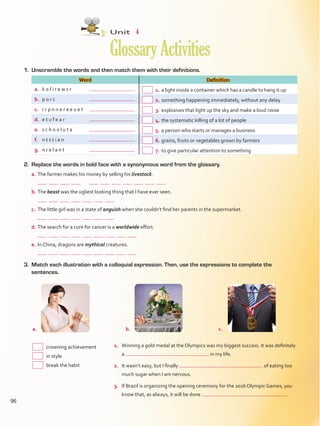
  • 6.
    Review 1. Read thefacts from the journalist notebook. Then, use Passive Voice to complete the news reports. • thieves stole 70 cell phones from the City Mall • the watchman reported the robbery • the mall's manager denounced the robbery • the police identified the thieves an found the cell phones in a box 70 cell phones from the City Mall last week. The robbery  (a) by the watchman early in the morning. The thieves  (b) by the police soon after the robbery  (c) by the mall’s manager. The cell phones  (d) in a box. According to the World Meteorological Organization -WMO, the Caribbean coast  (e) by a tropical storm next month. Storms  (f) of strong winds and heavy rain. With the storms from last year, homes  (g) and some roads  (h), but residents  (i) by the WMO. • a tropical storm will hit the Caribbean coast • strong winds and heavy rain make storms • storms from last year damaged homes and destroyed roads • the WMO informed the residents 2. Based on the news above, use the words to create questions in Passive Voice. a. City Mall / stolen /What  ? b. identified / by / thieves / the police  ? c. found / the cell phones / where  ? d. a tropical storm / hit / the Caribbean Coast / by  ? e. made of / strong winds / heavy rain / the storm  ? f. homes / the tropical storm / damaged / last year / by  ? were stolen 6 VP5ReviewUnit.indd 6 23/03/2016 07:55:53 a.m.
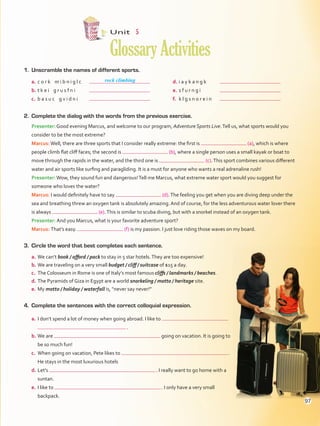
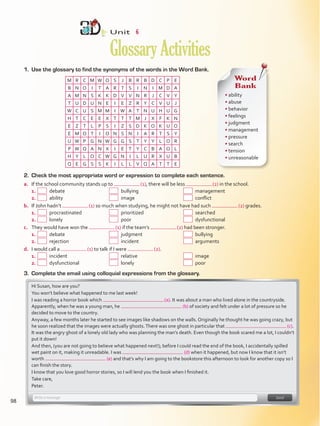
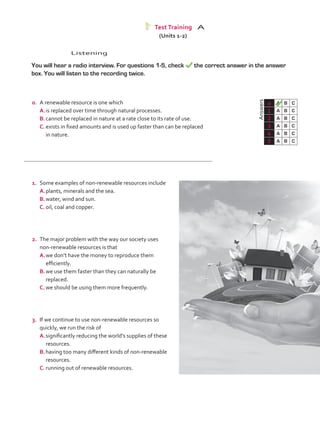
  • 7.
    3. Circle thecorrect verb form to complete the conversation. Circle both when either the gerund or the infinitive can be used. Sam: That was a great performance, congratulations. Lily: Thanks, I needed (to win / winning / both) this school contest to get a scholarship. Sam: Do you plan (a. to become / becoming / both) a professional musician and continue (b. to play / playing / both) the violin when you finish (c. to study / studying / both)? Lily: Yes, I want (d. to play / playing / both) for the best orchestras in the world. Sam: Wow! Keep (e. to practice / practicing / both) and you’ll certainly be the best. Lily: I hope so.What about you?What would you like (f. to be / being / both)? Sam: Well, I desire (g. to be / being / both) a famous tennis player. In fact, I’m going (h. to train / training / both) with the best coach in the country, Mr. Nadal. Lily: Wow!When will you start (i. to train / training / both) with him? Sam: Next week, I’m so excited! 4. Read and complete the text below. Use the given verbs in Simple Past or Past Perfect. I (see) Miss. Lee somewhere before, I (a. know) it. She read mystery books to me in first grade. Miss. Lee was my language teacher. She wanted me to give her back a book she (b. lend) me, but I (c. not find) it. I was always late for school and generally the reading sessions (d. already start) when I (e. arrive). Before I (f. get ) to school on the last day of class, I (g. already lose) the book. I didn’t know what to tell her or what to do. I never (h. discover) what (i. happen) to the book. It was a mystery! 5. Match the if clauses with the result clauses. a. If someone sweeps over your feet, b. If you walk under a ladder, c. If you find a four-leaf clover, d. If you have an itchy palm,  1. …it will bring you good luck.  2. …money will come your way.  3. …you’ll have bad luck.  4. …you’ll never get married. had seen 7 VP5ReviewUnit.indd 7 23/03/2016 07:55:54 a.m.
  • 8.
    6. Read andcomplete the text. Find the missing words in the Word Bank. What would you do if… you your partner you (a. be) a famous trend-setter? you (b. have) an extraordinary talent? you (c. be) a prince/princes? a fairy (d. grant) you a wish? there (e. be) a natural disaster? you (f. find) a piece of asteroid? you (g. find) a bag with $300,000 in it in a taxi? you (h. see) a thief stealing a cell phone? yo (i. buy) the latest smartphone? you (j. cannot) control your online time? The world of information and communication  , best known as ICTs, is definitely changing our lives. They can be valuable instruments for education, business, and entertainment.These technological tools include computers, the (a), smartphones, radio and television. For example, people can do many different things with smartphones, which are like small computers that keep you online. People can take pictures, (b) and receive instant messages, surf the web, check their email, (c) apps, and even make (d) calls. Everybody wishes they had a smartphone at hand. But, can people really control their online time? Most people today (e) their computers in the morning and (f) all night.They (g) their headphones and (h) to the net to enjoy all sorts of Internet resources. It is difficult for them to ( i ) the computer and take a nice walk. It may be time to unplug the computer and enjoy the fresh air! 7. Complete the survey using the second conditional. Then, write your answers and interview a partner. Word Bank • download • hook up • Internet • put on • send • stay up • technologies • turn on • turn off • video technologies 8 VP5ReviewUnit.indd 8 23/03/2016 07:55:55 a.m.
  • 9.
    BreakingNews UNIT 1 uuGeneral Objective Youwill be able to talk about events that have happened recently and share experiences of your school community. uuCommunication Goals You will learn how to • talk about news. • announce a piece of news that has happened recently. • share life experiences. uuCLIL • Newspaper Sections • NewsWriting and Reporting • SchoolWorld Vocabulary • Sections of a Newspaper • Words related to news writing and reporting Grammar • Simple Present and Simple Past tenses • Present Perfect and Past Perfect tenses uuIdioms and Colloquial Expressions • To hit the headlines • That’s breaking news • To cover the story uu Project A Newspaper Section You will create a newspaper section to narrate recent news and key stories of your school Discuss: • Is there a newspaper at your school? • What is the most famous newspaper in your town and country? U1_VP5 21 x 28.indd 9 5/19/16 2:42 PM
  • 10.
    Lesson  1 HaveYouReadtheNews? 1. Matchthe columns to discover the headlines and the section they belong to. 2. Read and listen to the conversations about recent news. Then, complete the chart below. a. Water bursts through river walls… 1. its doors to the public. b. Dollar against Euro… 2. hit the headlines once again. c. Cheaper drug to treat… 3. the never ending battle. d. New gallery has opened… 4. and floods local farmland. e. Royal love scandal has… 5. heart disease has been successful. 4   Sections International Social Local News Business Arts Sports Classifieds Health Key Expressions Hit the headlines: to become famous for being reported in the news Mary: Wow, the royal couple has had another love scandal! Jane: That’s unbelievable! Mary: Believe it! It is published everywhere. Haven’t you read it yet? Jane: No, not yet.That´s shocking news! And you know, the social section never lies. Mark: Do we have today’s broadsheet? Anna: Yes. I’ve already read it. Do you want to check out the economic issues? Mark: Well, I’m always interested in the currency exchange rates. Anna: There’s a remarkable change. This week the dollar has fallen and the euro has risen. Mark: Oh!That’s astonishing! Juan: Look!The new host country for the Olympic Games has already been chosen. Mia: Really?That’s the sports event of the year!What’s the fortunate country? Juan: It’s Brazil.This is the first time for a Latin American country. Mia: Wow!That’s awesome! Claire: Have you read the news today? Peter: No, I haven’t done it yet. What happened? Claire: Last Friday heavy rain led to serious flooding in a small town near our city Peter: Well, it isn’t hard to believe. Sometimes things don’t work as they should; besides, the authorities haven’t fixed the river walls since 1998! d Pronunciation Rising intonation is used to express strong feelings. Listen and repeat • Wow! • That’s astonishing! • That´s awesome! • That´s shocking! Newspaper Section Topic Ways to express feelings about news a. b. c. d. Social That’s shocking news! 10 U1_VP5 21 x 28.indd 10 4/19/16 11:49 AM
  • 11.
    Reflect on Grammar ThePresent PerfectTense Use it to talk about events that occurred at a non-specific time in the past and continue to the present. • I´ve already read it. •  The host country for the Olympic Games has been chosen. •  I haven’t read the local newspaper yet. •  Haven´t you read it yet? •  Use already to say that something happened sooner than expected in affirmative sentences. •  Use yet to mean “until now” in negative sentences and questions. The Simple PresentTense Use it to express routines and facts. •  I’m always interested in the currency exchange rates. •  And you know, the social section never lies. •  Sometimes things don’t work as they should. Use frequency adverbs to indicate the frequency of routines and habitual actions. always sometimes never 100% 50% 0% has won Grammar and Vocabulary 3. Complete the sentences. Use the Word Bank in the Simple Present and the Present Perfect tenses. Word Bank • win (2x) • like • send • be • attend • arrive • show • close • buy • create Grammar Strategy Use context clues to make decisions about the forms of the verbs according to the tenses. Our basketball team the interschool championship again. It is the third time our players (a) the trophy and succeeded in this important sports event. The majority of the school´s families (b) the Arts Festival this year.This is awesome news! Students (c) already (d) the families a thank you note. The school science fair always (e) students’ creativity and love for design. On this occasion, a 10th grade girl (f) some innovative software for learning English in a fun way. It’s a fact that most students (g) new technologies and the computer lessons. However, the school’s computers are very old and don’t work properly.The school (h) new ones yet. The school (i) already (j) its doors to new students.Admissions for the next academic year (k) now over. The school principal is still on vacation.She (l) (m) from Houston,Texas yet. • Get into groups of three. • Select your favorite section of a newspaper and justify your choice. • Do some research about events, news and stories that have happened at your school. Project  Stage 1 Monday January 30, 2013 11 U1_VP5 21 x 28.indd 11 3/30/16 8:35 AM
  • 12.
    1. Look atthe pictures and guess the roles of the people involved in newspaper production. Then, listen and check. 2. Listen and complete the interview with words in exercise 1. Lesson  2 FromtheInsideofaNewspaper Matt: Good afternoon, Mr. Graham. I want to know about the process of newspaper production. How did you produce the last piece of news about the truck accident?! Mr. Graham: Well, we published it last week and we worked as a team.The process involved different stages and different staff. At 4:00 AM, the went to the scene where the event had taken place. (1)When she arrived, the photographer had already taken some pictures of the accident. Matt: What did the journalist do after she arrived on the scene? Mr. Graham: At 4:15, the (a) asked questions and recorded the information. (2) Before the interviews, she had checked her voice recorder, of course! At 5:30, the journalist wrote the news story. Matt: Did the journalist show her article to the (b)? Mr. Graham: Yes. (3) By the time the editor gave the text to the (c), he had already checked the content of the story. The graphic designer used the pictures that the (d) had sent him one hour before and selected those that best illustrated and supported the article. Matt: What happened during the final stages of the process? Mr. Graham: Finally, the graphic designer created the page layout and produced the final version of the newspaper article. It was ready at 7:30. (4) We published the news at 8:00 after the (e) had printed it. journalist Mr. Graham Graphic Designer Publisher Claire Davis Photographer Columnist Tom Middleton Press Operator Editor Kim Harris Journalist Secretary 12 U1_VP5 21 x 28.indd 12 3/30/16 8:35 AM
  • 13.
    4. Complete theinterview with the verbs in parentheses. Use the Simple Past and the Past Perfect tenses. Then, listen and check. Grammar and Vocabulary Journalist: Hi,Tina.You are a student at Lincoln High School. Please tell me about the new library project or the initiative you and your classmates had.What was this story about? Tina: OK. Last year my classmates and I (notice) that our school library (a. not have) many nice new books and we (b. decide) to do something about it.When we invited (c. invite) neighbors to donate books, we (d. collect already) story books and textbooks from our teachers. Before that, we (e. talk) to the school principal to ask for his permission, of course!The book collection process (f. be) a great success. By the end of last year, we (g. gather already) 250 new books. noticed Sentence First / earlier action Second / later action (1) (2) (3) (4) the photographer had already taken some pictures of the accident the journalist arrived • you have done research on. • E.g. journalist, editor, graphic designer... a key role. Project Stage 2 3. Read the four numbered sentences in the interview and fill in the chart. Reflect on Grammar The Past PerfectTense Use it to talk about an action that happened before another action in the past. When the journalist arrived, the photographer had already taken some pictures of the accident. First) the photographer took some pictures of the accident. (Later) the journalist arrived. Common expressions: Before (that), By then, already The Simple PastTense Use it to express actions that started and ended in the past. How did you produce the last piece of news about the truck accident? We published it last week. Common expressions: Last week, yesterday, that day, when 13
  • 14.
    Lesson  3 1. Matchthe concepts with their definitions. a. Headline 1. The key or main information of an article b. By-line 2. The title of an article c. Lead paragraph 3. The body or secondary ideas of an article d. Supporting details 4. Line that gives the writer´s name 2. Read the headlines of the article below and predict the topic. The article is about theWilliams sisters’ life after ten years of practice. The article is about the success of theWilliams sisters over the last ten years. 3. Read the article and complete the diagram on page 15. HittheHeadlines Reading Strategy The lead paragraph of an article is always the first lines of it. Writing Strategy • Use quotation marks “ ” to report what other people say or said. • E.g. “We also eat very healthy food and if we get an injury, we take good care of it until recovery,” saidVenus. In professional women’s tennis around the world there are two sisters who have already made history since their debut in 1994. They are Venus and Serena Williams. They were born in the United States, in the 80’s, and they live in Florida with their family.TheWilliams sisters have played in professional tennis matches since the 1990’s and by the year 2003 both had become No. 1 in the world. They have hit the headlines several times and have made history for various reasons. First, the Women’s Tennis Association (WTA) has ranked the Williams sisters World No. 1 in singles on various occasions. Second, they became the first black women to accomplish this goal in the history of tennis. Third, they have won more Olympic gold medals than any other female tennis player. “We play with our hearts and souls for our country and for all the women we represent in the world,” saidVenus. But what makes the Williams sisters such outstanding tennis players? “We train really hard every day and keep our bodies fit to build an aggressive style,” said Serena. It is noticeable that it takes discipline and great physical effort on their part. “We also eat very healthy food and if we get an injury, we take good care of it until recovery,” said Venus. But mental and emotional aspects also play a key role. “Sometimes, they can get nervous when they get near the finish line in a key set,” said Richard Williams, their father, best friend and mentor. They love each other and have strong family bonds. a 14 U1_VP5 21 x 28.indd 14 5/23/16 4:28 PM
  • 15.
    • Use keyquestions to interview two members of the school community. Record the interviews and take pictures, too. • Write short narrations of the news you discovered. • Create a nice design using the texts and the pictures. Project  Stage 3 Writing Strategy Write the lead of a newspaper article by providing a clear and concise overview of the main points: who, what, when, where, how and why. Reading and Writing Playing professional tennis They play with... (Headline) (By-line) Lead (Body ) 5. Write a short article about the most recent event at your school. 4. Identify the secondary ideas in the article and complete the chart. Not all the spaces must be filled in. Who What Where When How / Why Venus and Serena Williams Idea No. Who What Where When How /Why 1 Women’sTennis Association First black women to be ranked No 1 2 Venus and Serena Williams 3 TheWilliams sisters Olympic Games 4 TheWilliams sisters Outstanding players 15 U1_VP5 21 x 28.indd 15 3/30/16 8:35 AM
  • 16.
    Lesson  4 HotNews Reflect onValues Always Sometimes Never ¾¾ I read the newspaper to learn about local and world events. ¾¾ I am curious about everyday happenings and events. ¾¾ I talk about the news I read and express my feelings about it. Gap Activity Student A goes to page 87. Student B goes to page 89. 1. Listen to the conversations. Fill in the gaps with the expressions in the Word Bank. Then, check the correct meaning of the expressions Joey: God! I completely forgot to go to the crime scene! Julia: You mean the bank robbery? Joey: Yes, it was raining and I had to finish another report. Julia: Don’t worry. Mike and a photographer . Meaning: Mike and a photographer protected two cameras. Mike and a photographer did the report. Omar: Look!There was another tsunami close to the coast of Japan. Patty: Wow!When did it happen? Omar: Just half an hour ago!This is ! Phil: Have you read the international news? Clark:  Yes! Sara has won the Latin American Music Award! Phil: That’s awesome! She has ! Speaking Strategy Use idiomatic expressions to share your own experiences. Word Bank • hit the headlines • breaking news • covered the story I’ve just noticed onTV that the English band Muse will visit our country in January. Oh my God! That’s breaking news! covered the story Meaning: Omar wants to cut the newspaper to get the news about Japan. Omar is highlighting that the news is recent o has just happened. Meaning: Sara has become famous because of her prize. Sara has cut out music headlines from the newspaper. 2. Work with a partner. Use the previous expressions to share your own experiences. 16 U1_VP5 21 x 28.indd 16 3/30/16 8:36 AM
  • 17.
    Give your Presentation • Introduce the members of your team. • Mention the roles played by each one. • Mention the section you have designed. • Talk about the stories and the information you gathered about the key, current events at your school. • Talk about the people you interviewed and the sources of your information. ShareYourProject Useful Expressions • Good morning.This is our group.We are… (names) • I played the role of… • We have designed the section. • Our main stories/news are/is …This story is about… • We have interviewed the school principal… 1. Discuss your experience. a. What role(s) did you play in the school newspaper production? Describe the activities you completed. b. How did you feel when performing those roles? c. Did you experience any difficulties?Which ones? d. Had you participated in a newspaper production before?What was the experience like? e. What did you learn from this experience? Newspapers can be published every day or every week, thus, they can be daily or weekly newspapers. They can also be local, national, or international. Newspapers are typically printed on cheap, low-quality paper, usually called newsprint. A newspaper is a publication that contains informative articles, news of current events, advertising, and a variety of entertaining features such as crosswords, editorial cartoons, and comic strips. Newspapers also cover a variety of topics and these are organized in sections. Each section contains articles that are based on facts.The title of an article, printed in large letters, is called the headline, and the author and publishing date are usually included. The different sections of a newspaper include: politics, business and economy, education, opinion, arts, sports, health and lifestyle, and a number of classifieds about jobs, real estate, cars, and other products. Almost all printed versions of newspapers also have online editions. Broadsheet newspapers generally contain more serious news than tabloids, which are smaller and emphasize shocking stories about famous people. Newspapers’ readers pay a subscription to help fund the newspaper production. a. Which categories can newspapers be classified in? b. What is newsprint? c. What are the characteristics of a newspaper section? d. What’s the difference between Broadsheets and Tabloids? Real Communication 2. Read and answer the questions. 17 U1_VP5 21 x 28.indd 17 4/19/16 11:51 AM
  • 18.
    Comic TheInterview 1. Listen andread. At home... At the ABC News headquarters... Jim, take a look at this news. It’s important for your job interview tomorrow. OK, Mom! Mr. Sanders why do you want to be a news reporter? Well, I’m a good communicator… and I love to interact with people. Good!What’s hitting the headlines these days? Hitting the headlines? Oops! I guess… it’s the use of... Have you read the news lately? Well… I don’t know. What’s the breaking news about the weather? I guess I have to learn to hit the headlines and break the news! Time for Action: When the Weather Hits 18 U1_VP5 21 x 28.indd 18 3/30/16 8:36 AM
  • 19.
    Quiz Time 2. Completethe dialog with the verbs in parentheses. Use the Simple Present and the Present Perfect tenses. 3. Read the news story. Then, choose the correct option. 1. Listen to the conversations between the editor (Tom) and the newspaper staff. Complete the chart. Self-Evaluation Now I can... VeryWell OK A Little ¾¾ talk about a news item or an event that has happened recently.. ¾¾ describe an event in the past and talk about an earlier moment. What do they have to do? Job done? a. Claire all the pictures. b. Bill all the interviews. c. Sara the complete article. d. Susan the pictures that support the article. e. Carol the advertisement. f. Frank the color pages. World Championship Final Yesterday was the big day. The two soccer teams were ready to play the World Championship final at Sun Stadium at 7:00 PM. By the time the players were ready to start the match, the crowds had waited in line for hours. Many people attended the game. When the news reporters arrived to cover the event, the fans and hooligans had already taken pictures of the football field and of the arrival of some players. The game was amazing. The players did their best in spite of the terrible weather conditions: before the game was over, it had started raining… a. The crowd waited in line before/after the match started. b. The reporters arrived before/after the fans had taken pictures. c. It started raining before/after the game was over. Kim: Look at the social section of the news! It (a. say) the Smiths got divorced. Lars: That’s unbelievable!They always (b. go) to parties together. Kim: I know, and Mrs. Smith never (c. eat) out without her husband. Lars: This (d. be) shocking news! Kim: I know! you (e. read) the news about the Garcia family? Lars: No, I (f. read) it.What has happened? Kim:They (g. celebrate) their 10th anniversary Lars: Nice!That’s happy news! takes Yes a Rainy Match 19 U1_VP5 21 x 28.indd 19 4/19/16 11:54 AM
  • 20.
    Glossary A – E astonishing:adj. very surprising. This is astonishing news! award: n. a reward someone gets when he/she has achieved something. (syn. prize) awesome: adj. extremely good and sometimes very impressive. (ant. awful) bond: n. in relationships, a reason to love each other or feel they have a connection to each other. Happy families have strong bonds. broadsheet: n. a newspaper that publishes serious news. It is usually printed on large sheets of paper. burst: v. when the walls built round a body of water break because water levels have exceeded them. columnist: n. a journalist who writes a regular series of stories for a magazine or newspaper and expresses his/ her opinions and comments about recent news. Mr. Akerman is a famous newspaper columnist. currency: n. the type of money used in a particular country or region. Japan’s currency is the yen. debut: n. the first time that a sports person or performer appears in a Colloquial Expressions Breaking news: recent news that is reported or revealed at the moment. Hit the headlines: to become famous by being reported in the news. Cover the story: to report on an event or recent happening. public or some remarkable event. Shakira made her debut when she was a little girl. E – H editor: n. the person who has overall responsibility for the publication of articles in a newspaper or magazine. exchange rate: n. the value of the money of one country in relation to the value of the money of another country. fact: n. a statement that people can prove. (ant. opinion or comment) People read the news to find out recent facts. flood: v. to be covered with water. A pipe burst and the water flooded the first floor of the house. graphic designer: n. the person who creatively designs the layout of a newspaper page, book, leaflet, etc. headline: n. the title of a news story. It is usually large in size and catches the reader’s attention. headquarters: n. the place where a company has its main offices. CNN has its headquarters in Atlanta. highlight: v. to emphasize something so that people notice it and think about it. host: n. the place and people who organize a special event. Brazil is the host for the 2016 Olympic Games. I – R layout: n. the position of articles, photographs, graphics, and advertisements on a page. lead: n. The beginning of the news story. It tells the essentials of any story: who, what, when, where, why, and how. match: n. game or contest in which two or more people or teams compete with each other. mentor: n. an experienced person who helps, supports, and motivates someone who has less experience, especially in their career. (syn. advisor, tutor) obituary: n. the newspaper section which publishes someone’s death and gives a short description of their life and accomplishments. outstanding: adj. extremely good or impressive. (syn. superior, excellent; ant. inferior, bad.) record: v. to put images and/or sounds onto a CD or DVD. reporter: n. the person who researches and writes newspaper articles. (syn. a journalist) S – Z set: n. a series of games in tennis and some other sports. shocking: adj. when feeling extremely surprised. (syn. outrageous; ant. calming, comforting) soft news: n. news that deals with human interest stories which are not that serious. (ant. hard news) staff: n. the group of people who work for a specific company or institution. thank you note: n. a short piece of writing to express gratitude to someone. I sent a thank you note to Fanny for dinner last week. Activities on page 93 20 U1_VP5 21 x 28.indd 20 4/19/16 12:09 PM
  • 21.
    HealthyLife,HealthyWorld UNIT HealthyLife,HealthyWorld 2 uuGeneral Objective Youwill be able to talk about lifestyles and speculate about habits and customs of the past. uuCommunication Goals You will learn how to • speculate about lifestyles in the past. • express opinion and possibility about past events. • describe people, objects, and events. uuCLIL • Healthy Habits • Earth Resources Vocabulary • Words related to healthy habits, earth resources, and environmental degradation Grammar • Past Modals: must / could / might / • Relative clauses: who / where / that uuIdioms and Colloquial Expressions • To be fit as a fiddle • To be in bad shape • To be in murky waters • To move heaven and earth uuProject A PowerPoint Presentation You will create a PowerPoint presentation about lifestyles to share problematic situations you identify in your community, as well as actions people can take to protect the environment. Discuss: • Do you have a healthy lifestyle? • Do you and your community take care of our natural resources? VP5 U2.indd 21 19/05/2016 02:50:42 p.m.
  • 22.
    Useful Expressions • UseI know! to show agreement with what someone says. • Use I guess to express your opinion about something you are not sure about. 1. Classify the actions in the Word Bank into healthy or unhealthy habits. HealthyHabits 2. Read and listen to the conversation. Then, check the correct options in the box below. Key Expressions Gee!: Wow! fact opinion a. Jason’s granny must have slept all day long. b. She just took a 30-minutes nap this afternoon. c. She might never have eaten fatty food, I guess. d. She prefers to drink water and fruit-flavored yogurt or juice. e. I guess she might never have smoked. f. She is always in a good mood. Vocabulary Strategy Classify vocabulary into categories to remember it better. Jason: Hi, Alan. I’m glad you came to my Granny’s Birthday party. Alan: Thanks for the invitation. Is she really going to be 100 years old? Jason: Yes, and look at her! She‘s not sedentary, instead she is very active! Alan: I know! She has lots of energy. She must have slept all day long! Jason: Well, she didn’t. It could have been because she took a 30 minutes nap this afternoon. But she sleeps very well at night. Alan: And, she is thin and fit. She must have eaten low-fat foods all of her life! Jason: Yes. Her diet has always included steamed fish, grilled meat, and olive oil. Alan: Wow! She has had a very healthy diet. She might never have eaten fatty food, I guess. Jason: Well, she doesn’t like junk food. She prefers lots of veggies and fruit. Alan: What about drinks? Does she drink sodas and coffee? Jason: Not really. She prefers to drink water and fruit-flavored yogurt or fresh juice. Alan: I guess she might never have smoked, right? Jason: You’re right. She hates smoking and she has never been drunk. Besides, she loves exercising. She walks the dog every day! Alan: And she looks quite relaxed! Has she ever felt stressed? Jason: Well, as you can see, she is always in a good mood and nothing makes her feel angry. Alan: Gee! Now I see... Having such a healthy lifestyle must have prevented her from getting lots of diseases. Word Bank • Eating fatty foods • Smoking • Drinking water • Sleeping well • Being sedentary • Getting drunk • Being active • Having a healthy diet • Doing exercise • Feeling stressed UNHEALTHY HABITSHEALTHY HABITS Eating fatty foods Lesson  1 22 VP5 U2.indd 22 23/03/2016 08:20:20 a.m.
  • 23.
    Grammar and Vocabulary • Work by pairs.Think of an unhealthy habit that is present in your community today. • Prepare a PowerPoint presentation describing how this unhealthy habit is a problem for the community. • Speculate about the origins of this bad habit. Project  Stage 1 Reflect on Grammar Past Modals Use Past Modals to speculate, deduce, or make guesses about past situations based on evidence. • She must have slept all day long. • It could have been because she took a nap. • She might never have eaten fatty food. Structure Subject + (must/could/might) + have + past participle + complement Degrees of certainty about the past a.- Kenneth has lost a lot of weight recently. - He a very healthy diet. c.- Dorothy came to the gym after work every night last week. - She stressed. b.- Why is Sarah so tired today? - I’m not sure. She very badly last night. d.- Where’s my salad? I left it here! - Edward it. He loves veggies! 3. Read the following situations and make guesses to complete the sentences. Use the Word Bank. 4. Think of a healthy old person from your family or community. What makes him/her healthy? Check the boxes. Then, speculate about his/her past habits. Word Bank • feel • eat • sleep • go on must’ve could’ve might’ve a. b. c. d. Pronunciation In speech, past modals are contracted. 1. Listen and repeat. • must’ve - / mʌstǝv/ • could’ve - / kʊdǝv/ • might’ve - / maItǝv/ 2. Listen to four sentences and check the past modal you hear. Eating fruits and veggies Doing exercise Being in a good mood Sleeping well Eating low-fat foods Staying away from cigarettes and alcohol Being active Mr. Garcia must have stayed away from cigarettes and alcohol all of his life! Must -------- 90% Could -------- 50% Might -------- 30% sure might 23 VP5 U2.indd 23 23/03/2016 08:20:22 a.m.
  • 24.
    Lesson  2 HealthyEnvironment 2. Readand listen to the conversation. 1. Listen to a short presentation and complete the diagram with the words in the Word Bank. a. Talk to the people who live in the city. b. Close the timber company. c. Teach the community how to recycle. d. Go to schools and show kids how to keep the water clean. e. Take the garbage and the scrap iron to another city. 3. Listen to the rest of the conversation and check the options you hear. Mr. Green: How was your trip around the outskirts of the city? Ruth: It was very alarming.We found many environmental problems. Mark: We visited the place where people dispose of their garbage. Ruth: We found out that ten years ago, it was a nice forest. Mark: But there is a timber company that bought the forest and has cut down all the trees!There are no plants anymore! Ruth: Now, it is a dump that contains waste of all kinds, even chemicals, fuels, and scrap iron. Mark: Also, the people who live in the city don’t recycle.The waste is all mixed in there. Ruth: In the past, there was a river there, but now there’s only a small slow- flowing stream that is really dirty and smelly. Mark: It is a dump that has no control from the local authorities and it has contaminated the soil, the water, and the air. Mr. Green: What a shame!The community hasn’t taken care of our natural resources!What can we do to help? Listening Strategy Read the options carefully before you listen to the audio to focus your comprehension. Word Bank • solar energy • renewable • oil • tides • wind • iron • coal • timber • copper • streams NaturalResources Non-renewable (a) (d) (e) (b) (c) fossil fuels minerals energy (f) (g) (h) (i) air plants Key Expressions What a shame! that’s too bad Actions to be taken: water sun hydro-energy wind 24 VP5 U2.indd 24 23/03/2016 08:20:23 a.m.
  • 25.
    Grammar and Vocabulary • Think of an environmental problem that is present in your city today. • Prepare a new slide for your PowerPoint presentation describing how this environmental problem is causing damage to the city.Write short descriptions speculating about the origins of this environmental problem. Project  Stage 2 4. Make one sentence from two. Use who/that/where. a. The Earth is a huge storehouse.There’s a great supply of natural resources in the Earth. b. There are non-renewable resources such as fuels and minerals.They cannot be replaced after removed from the Earth. c. Pete is a geologist. He studies the soil and searches for the Earth’s resources. d. The ocean is a rich natural resource.There are tons of minerals and plant life in the ocean. e. Those men are miners.They put their lives at risk working under the ground. 1. This saves 15% of energy and water used when doing the laundry. a. work/home/and/at: . Save the water you don’t use. Turn off the faucet after you wet your toothbrush. b. washing/using/machines: .There are modern washing machines allow you to avoid the pre-wash cycle. 2. They can last for longer than one thousand years, causing damage to the air, water and soil. 3. It is important to avoid the contamination of the soil.This helps to conserve our natural resources. c. shopping/going: . People care about the environment do not use plastic bags. 4. There’s no need to keep the water running while brushing your teeth. d. the/ forests/planet’s: . Don’t litter the parks and forests timber and plants grow. 5. Unscramble the headings and complete the statements using relative pronouns. Then, match the columns to discover ways to protect our natural resources. Reflect on Grammar Relative Clauses Use relative clauses to identify or give information about nouns. Usually they are two sentences joined together by a relative pronoun (who/where/that). • Use who/that for people. The people live in the city.The people don’t recycle. The people who/that live in the city don’t recycle. • Use where/that for places. We visited a place. People dispose of their garbage in that place. We visited a place where/that people dispose of their garbage. • Use that for things. It is a dump. It has no control from the local authorities. It is a dump that has no control from the local authorities. The Earth is a huge storehouse where there’s a great supply of natural resources. b At home and work 25 VP5 U2.indd 25 23/03/2016 08:20:25 a.m.
  • 26.
    Lesson  3 SmartLifestyles 3. Asyou read, underline the healthy habits you find. 1. Answer the questions. Then, survey ten partners and share your results. How useful is it for the environment… Good Neutral Not Good a. to use pesticides to grow veggies and fruit? b. to reduce cooking time by cutting food into small pieces? c. to pollute the air with toxic fumes from factories and cars? Today, people live in a globalized consumer society. This is a world where we buy, use, and consume a huge variety of products. It must have been very difficult to live 30 years ago without fast food or electronic devices that make our lives more comfortable and easier. However, the result ofallthisisanenormousdamagetoourhealthand to the environment.This essay will discuss ways in which individuals can take care of their own health while protecting natural resources. First of all, people who grow their own vegetables in their garden or in window boxes, protect the soil from pesticides.They can enjoy tasty and fresh vegetablesthatarefreefromdamagingchemicals. Secondly, eating fruits and vegetables on a regular basis is healthier than eating fatty foods. Besides, cooking veggies saves a lot more energy because it uses less gas than cooking fats. People who cut up their veggies into small pieces can reduce the cooking time and save cooking water, too. The third point is related to physical activity. For short journeys, people who walk, use a bike, or even encourage their kids to use a skateboard or rollerblades, can improve their health while they protect the environment from the pollution caused by the toxic fumes from cars. In summary, there are healthy habits that people can include in their daily lifestyles. Even if people might have not thought about these possibilities, I think there are many actions we can take to make a difference and to protect our health and that of our planet Earth. 2. Read the essay below and find the words in bold face which have these meanings. a. : harm b. : a long narrow container for growing plants put on a window ledge c. : machines or appliances that use electricity d. : that has an influence on the whole world Results: Number of people per answer. Health and Environment window boxes 26 VP5 U2.indd 26 23/03/2016 08:20:26 a.m.
  • 27.
    Reading and Writing • Based on the two problematic situations you have selected, think of healthy habits that would help people in your community be healthier and protect the environment. • Prepare a new slide for your PowerPoint presentation describing how this can be done. Project  Stage 3 4. Identify the organization of the essay and complete the chart. Writing Strategy Use sequence connectors such as first of all, second of all, in summary, to organize the ideas of a text. Writing Strategy Thesis statement: Make sure the topic sentence you write catches the reader’s attention. Supporting ideas: Use arguments and examples to strengthen your thesis statement. Concluding sentence:Tell briefly what you talked about. Reword your thesis statement. Introduction 5. Identify the sequence connectors used to maintain the connection between the main ideas. 6. Choose one topic (a or b) and write a short essay. Reading Strategy Thesis Statement: A sentence that says what the author wants his readers to know, believe, and understand about a subject. Argument 1 Argument 2 Argument 3 Conclusion Thesis Statement Thesis Statement Paragraph 1 Paragraph 2 Paragraph 3 Argument 1 Argument 2 Argument 3 Conclusion a. Keeping fit and healthy b. Protecting the environment Thesis statement Concluding sentence (Argument 1): (Argument 2): 27 VP5 U2.indd 27 23/03/2016 08:20:27 a.m.
  • 28.
    Lesson  4 Speaking Strategy Getengaged in a conversation by using expressions such as: Look! / Well, / I guess / I know! / I think. Gap Activity Student A goes to page 87. Student B goes to page 89. 1. Listen to the conversations. Fill in the gaps with the expressions in the Word Bank. 2. Match the expressions with their corresponding meaning. a. Fit as a fiddle 1. behaving in morally and ethically questionable ways b. In bad shape 2. being in good health or athletic condition c. Be in murky waters 3. being determined to do something that is difficult d. Move heaven and earth 4. being in poor physical condition FitasaFiddle Reflect on Values Always Sometimes Never ¾¾ I eat healthy food like fruits, veggies, and fat-free products. ¾¾ I am an active person who likes sports and physical exercise. ¾¾ I take actions to protect our environment and natural resources. Well, I think your community have to stay together and move heaven and earth to solve this problem! My neighbors and I are worried about garbage and contamination in our parks and rivers. a. Susie: Hi! Nice to see you again! It’s been years since we last met! Patty: Hey! Look at you!You are as (a). You must have had a very healthy life! Susie: Well, I love exercising and I love fat-free food. I do take care of my body and health. Patty: Wow, instead, I’m in such (b). I often have to eat in a rush, you know, at fast food restaurants or even when driving my car! b. Oscar: Look!This is the timber company that bought the pine forest. Mike: Do they have permission to cut down the trees? Oscar: I’m not sure, the documents I saw are not complete. I think they are (c). Mike: We need to find out! Let’s (d) to get the information. 3. Think of situations related to health and the environment and discuss with a partner. Use the expressions above. Word Bank • fit as a fiddle • move heaven and earth • bad shape • in murky waters fit as a fiddle 28 VP5 U2.indd 28 19/04/2016 10:24:43 a.m.
  • 29.
    ShareYourProject Give your Presentation • Introduce yourself. • Mention the two problematic situations you have identified. • Describe each problem one a time and show the slides. • Talk about the possible origins of each problematic situation. Useful Expressions • Good morning.We are… (names) • The unhealthy habit that is present in our community is… • The environmental problem we have identified is… • It must/could/might have started… 2. Read and answer the questions below. Real Communication 1. Discuss your experience. a. How did you make your PowerPoint presentation? Use theWord Bank to list the steps you followed. 1. 2. 3. 4. b. Did you experience any difficulties?Which ones? c. Had you ever thought about problematic situations that affect the health of your community and city? How did you identify them? d. What did you learn from this experience? Word Bank • template • slide • layout • images • text a. What are the two aspects involved in having a long and happy life? b. How is personality connected to life expectancy? c. Why is it important to choose your friends wisely? d. What are the key environmental problems that affect life expectancy? Most people are interested in having a long and happy life. The way we live every day, together with how we manage our natural resources, can play a key role in enjoying a long and happy life. Having healthy habits goes beyond nutrition. It is true that eating fats and junk food does not do any good to our health, but what else can make a difference? Studies have shown that our personality is also a key factor: being sociable and enjoying time with friends is connected to long life expectancy. But, be wise when choosing your friends because habits, both healthy and unhealthy, are socially contagious. Community problems related to these social habits include obesity, smoking, drinking, and even stress. So, look for buddies who like exercising, sleeping well, and being in a good mood. Taking care of the environment and protecting the natural resources can also make a big difference. People live longer in places where there is less air pollution, less contamination in rivers and oceans, and less chemicals in the soil. So, look for places where the air, water, and soil are clean. 29 VP5 U2.indd 29 23/03/2016 08:20:30 a.m.
  • 30.
    Game Play bypairs. Place a counter on the START box. Toss a coin: heads or tails? Follow the arrows and answer the questions. Score two (2) points for each correct answer. If you answer incorrectly, move back to the box you were before. The winner is the first person to reach the finish box. Name two healthy habits. Name an unhealthy habit a relative of yours has How often do you eat fruits and veggies? TAILS TAILS TAILS TAILS TAILS TAILS TAILS TAILS TAILS TAILS TAILS TAILSTAILS TAILS TAILS TAILS TAILS TAILS Name two unhealthy habits. Name a healthy habit a relative of yours has. How often do you drink water? Do you exercise?Why? HEADS HEADS HEADS HEADS HEADS HEADS HEADS HEADS HEADS HEADS HEADS HEADS HEADS HEADS HEADS Your best friend is sleepy today.What might have happened? (Say two options) Have you ever felt stressed?Why? Do you have healthy eating habits?Why? Think of a healthy old person you know and make guesses about his/her habits. Do you have unhealthy eating habits?Why? Mr.Velez is overweight.What must have he done? (Say two options) Miss. Smith didn’t come to the gym today.What may have happened? (Say two options) Name the two types of natural resources. What type of natural resources are oil, coal, and copper? What type of natural resources are the air, water, and trees? Do you protect our natural resources? How? GettingHealthy HEADS HEADS HEADS HEADS TAILS 30 VP5 U2.indd 30 23/03/2016 08:20:31 a.m.
  • 31.
    Quiz Time 1. Listento each conversation and check the correct option. Self-Evaluation Now I can... VeryWell OK A Little ¾¾ talk about healthy lifestyles and ways to protect the environment. ¾¾ speculate about possibilities in the past. ¾¾ describe people, objects, and events by joining clauses. 2. This is a picture of Mr. Graham, a healthy 85 year-old man. Look at his habits checklist and write sentences to speculate about his life in the past. a. Being active He must have been really active all his life. b. Drinking alcohol c. Eating low-fat foods d. Being in a good mood e. Smoking f. Sleeping well Conversation 1 a. What keeps these women active and fit? • Gym sessions • Belly dance sessions • Yoga sessions b. Who has missed the dance class lately? • Patty • Sally • Maggie c. What could have happened to her? • She might have been busy at work. • She may have fallen ill. • She might have found another job. Conversation 2 a. Who are the people talking in this conversation? • Mom and dad • Teacher and student • Dad and his son b. What are they talking about? • Natural resources • Earth’s nature • Economical resources c. Which renewable resources do they mention? • Plants, water, and solar energy • Energy, the wind, and soil • The air, sun, and plants 3. Complete the definitions by writing the correct relative pronoun. Then, match them with the corresponding picture. a. Geologists are people extract minerals and fuels from the soil. b. Oil and coal are non-renewable resources cannot be replaced after they are used. c. The Earth is the place there are renewable and non- renewable natural resources. d. Water is a renewable resource we use for drinking, cooking, and washing. 31 VP5 U2.indd 31 23/03/2016 08:20:33 a.m.
  • 32.
    L-Q layout: n. thedesign and organiza- tion of pictures and text on a page or PowerPoint slide. (syn. design, format, setup) litter: v. to leave pieces of trash in pub- lic places or the outdoors and not in a trash can. People shouldn’t litter. nap: n. short, light sleep during the day. (syn. kip, siesta) natural resources: n. substances or materials such as oil or wood that are found in nature. Water is a natural re- source. oil: n. athick,darkliquidobtainedfrom mineral deposits that is used as fuel. outskirts: n. the areas surrounding the center of a town or city. (ant. down- town) R-S renewable: adj. possible to be re- placed or renewed indefinitely. (ant. non-renewable) scrap: n. waste material, especially metals suitable for reprocessing. We can recycle scrap metal. sedentary: adj. sitting most of the time and not exercising a lot. (ant. moving, active) Glossary A-K buddy: n. (informal) friend. (ant. en- emy) coal: n. a hard black rock that is found in the ground and is used as a fuel to provide heat. In the past many trains ran on coal. copper: n. a red-brown metal used to make wire or pipes that conduct elec- tricity or heat. dig: v. to make a hole in sand or soil. (syn. burrow) disease: n.  a condition of a living thing or of one of its parts that impairs nor- mal functioning and is manifested by certain symptoms. (syn. illness, sick- ness) dump: n. a place where waste material and garbage is left. The dump was re- ally dirty and smelly. faucet: n. a tap on the bath or sink that controls the flow of water. (syn. tap, spigot) flowing: adj. a stream of water that moves along. (ant. stagnant, still) fossil fuel: n. fuels formed from the re- mains of plants and animals that lived in an earlier era. iron: n. a hard, silvery heavy metal that is abundant in the earth and is used to make building structures. The gates are made of iron. junk food: n. food that is unhealthy as it contains lots of fat, sugar, or salt. Tim eats too much junk food. Colloquial Expressions Be as fit as a fiddle: be in good health. Be in bad shape: be in a poor physical condition. Be in murky waters: behave in morally and ethically questionable ways. Move heaven and earth: be determined to do or get something that is difficult. slide: n. the page of a PowerPoint pre- sentation that contains pictures and text. soil: n. the surface layer of the Earth, the ground. (syn. dirt, earth) storehouse: n. a place where things are kept in large quantities. (syn. ware- house) stream: n. a natural flow of water nar- rower than a river. T-Z template: n. a computer document with a basic format you can use and adapt. tide: n. the way the ocean waters fall and rise during the day. (syn. current) timber: n. wood used for building. (syn. wood, logs) tired: adj. being weak and in the need of rest and sleep. (ant. energetic) veggies: n. (informal) vegetables. My veggie garden is small. weight: n. a measurement that says how heavy something is. (syn. heavi- ness) wise: adj. intelligent and able to make good choices and decisions. (syn. per- ceptive) Activities on page 94 32 VP5 U2.indd 32 23/03/2016 08:20:33 a.m.
  • 33.
    Listening Youwillheararadiointerview.Forquestions1-5,checkthecorrectanswerintheanswer box.Youwilllistentotherecordingtwice. Answers 0ABC 1ABC 2ABC 3ABC 4ABC 5ABC TestTrainingA 0.Arenewableresourceisonewhich A.isreplacedovertimethroughnaturalprocesses. B.cannotbereplacedinnatureatarateclosetoitsrateofuse. C.existsinfixedamountsandisusedupfasterthancanbereplaced innature. 1.Someexamplesofnon-renewableresourcesinclude A.plants,mineralsandthesea. B.water,windandsun. C.oil,coalandcopper. 2.Themajorproblemwiththewayoursocietyuses non-renewableresourcesisthat A.wedon’thavethemoneytoreproducethem efficiently. B.weusethemfasterthantheycannaturallybe replaced. C.weshouldbeusingthemmorefrequently. 3.Ifwecontinuetousenon-renewableresourcesso quickly,weruntheriskof A.significantlyreducingtheworld’ssuppliesofthese resources. B.havingtoomanydifferentkindsofnon-renewable resources. C.runningoutofrenewableresources. VP5_TestTraining_A.indd5923/03/201607:59:34a.m. SpeakingCandidateA Stage1 CandidateBisgoingtotellyouabouthis/herlifestyleoverthepastyear. Listentowhathe/shesaysandmakesomepredictionsaboutthewayhe/shemighthavefelt. Givesomepiecesofadviceonhowtoimprovehis/herlifestyle.Usetheexpressionscould’ve, should’veormust’ve. E.g.Youcould’vemademoretimeforexercise. Youmust’vebeentiredalot. Stage2 TellcandidateBaboutyourlifestyleoverthepastyear. Usethelistbelowofthingsyoudidordidn’t.He/Shewillmakesomepredictionsaboutyour well-beingandgiveyousomeadviceonhowtobecomehealthier. •Gotupearly •Hadunhealthybreakfasts •Rodebiketoandfromwork •Hadhamburgersforlunch •DranktoomuchCoke •Hadlightdinners •Regularlywenttobedearly 4.Eventhoughtreesaretechnicallyconsideredrenewableresources, A.theycan’tbenaturallyreproduced. B.theyarealwaysconsumedmoreslowlythantheycanbe reproduced. C.theyareoftenconsumedinanon-renewablefashion. 5.AccordingtoDr.Rice,peoplecanhelpprotectournaturalresources by A.takingcoldshowers. B.recycling. C.usingbothkindsofresources. VP5_TestTraining_A.indd6023/03/201607:58:54a.m. 33 VP5 TestTra Amontaje.indd 33 3/30/16 9:42 AM
  • 34.
    0.AcomeBcameChascomeDhadcome 6.AhasdemolishedBhavedemolishedChaddemolishedDdemolish 7.AforcedBhadforcedChasforcedDhaveforced 8.AareBisCwasDhadbeen 9.AwhatBwhoCwhereDthat 10.AspendsBhavespentCspentDspend 11.AhadfailedBhavefailedCfailDfails 12.AhashadBhavehadChasDhad 13.AannouncesBannouncedChaveannouncedDhadannounced 14.AcommitBhascommittedChavecommittedDhadcommitted 15.AcontinuesBhadcontinuedChascontinuedDcontinued Answers 0ABCD 6ABCD 7ABCD 8ABCD 9ABCD 10ABCD 11ABCD 12ABCD 13ABCD 14ABCD 15ABCD Reading Readthefollowingnewspaperarticle.Selectthecorrectoptionforeachspace. Markthebestanswer(A,B,CorD)intheanswerbox. Brazil:UndertheWorld’sSpotlight Withonlytwoyearsuntilthe2014FIFAWorldCupand4yearsuntilthe2016Olympic Games,Brazil(0)intotheglobalspotlightforinternationalsports competitions.However,withsuccessoftencomescontroversy. Localcouncils(6)manylow-incomesettlements,knownasfavelas, andreplacedthemwithluxury5starhotelsandnewroadsaimedatreducingtraffic congestion.Whiletheimprovementswillbelonglastingforthecity,effectively,they (7)hugenumbersofthecity’spoorerurbanresidentstobecome displaced. Aswithmostbiginternationalevents,security(8)amajorissueleading uptothe2016Olympics.Infact,England,thecountry(9)hostedthe2012OlympicGames (10)around$680millionUSDonsecurity.Theoriginalbudgethadtobeincreasedafterthe privatesecuritycompany,G4S,admittedthatit(11)torecruitenoughsecuritystaff,therefore theBritishmilitary(12)totakeover. AnothermajorchallengeforBrazilisthetransportationservice.Thenationalgovernment(13) onMondaythatithas$4.3billionforurbantransportationinfrastructurewhilestateandlocalauthorities(14) another$2.15billionsincethen. LikepreviousFIFAWorldCupsandOlympicsGameshostcountries,Brazilwantstodisplayitsbestpossible imageasit(15)itsascentontheglobalstage.Suchadvancesarealwaysmetwithproblems, buttherealtestishowBrazilstepsuptothechallenge. VP5_TestTraining_A.indd6123/03/201607:59:35a.m. Writing FrenchwomanJeanneCalment,whodiedin1997atage122,hadthelongestdocumented humanlifespan. Speculateaboutherlifestyleandwhatshemusthave,mighthaveormayhavedoneinorderto havelivedforsuchalongtime. Writebetween30and45words. SpeakingCandidateB Stage1 YouaregoingtotellcandidateAaboutyourlifestyleoverthepastyear. Usethelistbelowofthingsyoudidordidn’t.He/Shewillmakesomepredictionsaboutyour well-beingandgiveyousomeadviceonhowtobecomehealthier. •Gotuplateinthemornings •Hadhealthybreakfasts •Didn’texercise •Drovetowork •Regularlyskippedlunchandonlyatesnacks •Hadbigdinners •Alwayswenttobedlate Stage2 NowcandidateAisgoingtotellyouabouthis/herlifestyleoverthepastyear. Listentowhathe/shesaysandmakesomepredictionsaboutthewayhe/shemighthavefelt. Givesomepiecesofadviceonhowtoimprovehis/herlifestyle.Usetheexpressionscould’ve, should’veormust’ve. E.g.Youcould’vedrunkmorewaterorfreshjuice. Youmust’vegainedextraweight. VP5_TestTraining_A.indd6223/03/201607:59:36a.m. 34 VP5 TestTra Amontaje.indd 34 3/30/16 9:42 AM
  • 35.
    UNIT WhatLiesWithinUs 3 uuGeneral Objective Youwill be able to describe people’s characters, feelings and emotions. uuCommunication Goals You will learn how to • talk about people’s characters and personalities. • express feelings, attitudes, and mood. • describe events in the life of famous people. uuCLIL • Character and Personality • Feelings and Emotions Vocabulary • Descriptors of character and personality • Words related to feelings and emotions Grammar • Phrasal verbs • Gerunds and infinitives • Prefixes and suffixes uuIdioms and Colloquial Expressions • Grin from ear to ear • Head over heels in love • Make your blood boil • Your heart sinks uuProject A Personal Blog You will design a personal blog to show and share your feelings about someone’s personality and key life events. Discuss: • What do you like about your personality and character?What don’t you like? • What do you like about the personality and character of other people?What don’t you like? • Is it easy or difficult for you to express your feelings and emotions? VP5 U3.indd 35 19/05/2016 02:52:03 p.m.
  • 36.
    Libra personality traitsVirgo personality traits •They get on well with people. •They use common sense. •They’re proud and expect admiration. •They do not accept delay calmly. • You can trust them. • They look into things deeply. • They don’t make decisions easily. • They don’t think they are better than others. Leo Pisces • They eagerly want wealth and fame. • You never know what they are going to do. • They love to find out people’s private information. • They hate to lose. • They become angry or upset easily. • They tend to hold back their feelings. • They don’t care about the consequences of their actions. Lesson  1 CharacterandPersonalityTraits 1. Look at the pictures. What do you know about this artist? 2. Listen to the conversation and check the correct options. 4. Read and discover the character and personality traits for each sign. Use the Word Bank. Then, listen to the second part of the radio show and confirm. sociable Name Nickname Age Personality What is true about Paulina Rubio? a. She is from . Spain Mexico Miami b. She has a personality. friendly shy vain c. She has been a successful . model singer writer 3. Listen again and circle the best option to complete the statements. a. Well, I’ll go the female singer. • on • for • with b. She looked her friend’s baby for a whole weekend! • after • into • for c. She draws her talent to make all her projects a success. • up • in • on d. Her various businesses have brought thousands of dollars. • up • on • in e. She even turned a proposal to play the lead role in a film. • down • out • away Listening Strategy Read the statements and the given options before listening to predict what you will hear. Vocabulary Strategy Pay attention to the prefixes added at the beginning of a word. Im-, In-, Ir-, and Un-, are prefixes which mean NOT. Impatient = not patient Word Bank • ambitious • analytical • competitive • humble • impatient • indecisive • irresponsible • reliable • reserved • sensible • sensitive • sociable • curious • unpredictable • vain (a) (b) (c) (d) (e) (g) (f) (h) (i) (j) (k) (l) (m) (n) 36 VP5 U3.indd 36 19/04/2016 12:26:15 p.m.
  • 37.
    Grammar and Vocabulary Pronunciation Inphrasal verbs, the particle is emphasized. Listen and complete.Then practice. a. Actors often their own life experiences. b. I well with my school friends. c. The police will the bank robbery. d. People shouldn’t their feelings. e. Mom has a job offer abroad. a. A:Which dessert does Sam want, the bitter or the sweet one? B: Better ask him.You never know which option Sam will . b. A:Who can the baby while we go out? B: Mary. She is a great nanny and I trust her. c. A: IsTom in Hollywood now? B: Sure! He loves that movie project. It’ll a thousand dollars a week. d. A: Who solved the last crime case?Was it CatherineWillows? B: Yes, she examined the evidence until she who committed the crime. e. A:What has made John so anxious? B: Well, his girlfriend her feelings towards him. a. sensitive c. happy tolerant reliable b. mature d. rational polite resistible a go for Sam is . Mary is . Tom is . John is . Cath is . • In pairs, choose a famous person from the world of sports, fashion,TV, movies, arts, or music. • Look for information about this person on the Internet. • Write a description of his/her character and personality. Project  Stage 1 (E.g. date of birth, zodiac sign, etc.) 5. Match the phrasal verbs with their meanings. a. bring in have a good relation with b. find out choose c. get on discover d. go for earn money e. hold back investigate f. look after not to show how you feel g. look into reject h. turn down take care of somebody i. draw on make use of something 6. Form the opposite of the following words by using the appropriate prefix: Im-, In-, Ir-, and Un-. Reflect on Grammar PhrasalVerbs Phrasal verbs are verb-particle combinations.The particle gives a special meaning to the verb. • She looks after her baby. (Meaning: to take care of somebody/something) • They look into things deeply. (Meaning: to investigate) 7. Fill in the gaps with the correct form of the phrasal verbs from exercise 5. Then, describe each person’s character using the words from the Word Bank in exercise 4. 8. Think of your own character and personality. Has it changed over the years? How? Discuss with a partner. In the past, I was very shy. Now, I get on with people very well. I’m a sociable person. In impatient 37 VP5 U3.indd 37 23/03/2016 08:31:26 a.m.
  • 38.
    Reflect on Grammar Gerundsand Infinitives Some words, verbs and prepositions are followed by a specific form of another verb. Read, complete, and check : ... you consider harder to get better grades. The verb consider is followed by: a. Gerund (-ing) b. Infinitive (to…) ... you prefer with it by yourself. ... you prefer your best friend. The verb prefer is followed by: a. Gerund (-ing) b. Infinitive (to…) ... hopeless at to convince them. ... interested in something fun. ... doubtful about obedient. Prepositions are followed by: a. Gerund (-ing) b. Infinitive (to…) ... shocking news makes you a deep breath. ... you let them and release your pain. ... try not to help him better. Verbs make/let/help are followed by the object and: a. Infinitive with to b. Infinitive without to Lesson  2 1. Take the test and then complete the grammar chart below. HowdoyoudealwithyourEmotions? a. When you have bad grades at school, you consider… 1. ignoring the issue. 2. studying harder to get better grades. 3. complaining to your teachers. d. When you get shocking news, it makes you… 1. take a deep breath and do nothing. 2. talk to somebody to see what can be done. 3. cry a lot and feel extremely upset. b. When you have a problem, you prefer… 1. to deal with it by yourself without telling anybody. 2. looking for your best friend to get some advice. 3. to tell everyone so you feel people care about you. e. When your friends have a problem, you let them… 1. talk and release their pain. But you don’t really listen to them. 2. explain the problem.Then, you give them some advice. 3. get desperate and create a drama.You don’t feel you can comfort them. c. When your parents don’t let you go out at night, you tend to… 1. be hopeless at trying to convince them. 2. become interested in doing something fun at home. 3. be doubtful about being obedient. f. When your best friend is embarrassed, you… 1. try not to help him/her feel better. 2. do your best to help him/her feel better. 3. feel embarrassed that you can´t help him/her at all. Scoring System: Answers No. 1 = 2 points; Answers No. 2 = 4 points; Answers No. 3 = 6 points. Your score: 2-12: You never express your feelings; you hold them back and try to forget them. 13-24: You react in a measured way and you can express your emotions calmly and easily. 25-36: You tend to overreact and lose your temper. Sometimes you want to find a person to blame.You should avoid the instinctive reaction that makes you lose control. studying PostingYourFeelings andEmotions 38 VP5 U3.indd 38 23/03/2016 08:31:28 a.m.
  • 39.
    Vocabulary Strategy Use grammarbooks, dictionaries, or the Internet as sources of reference. Grammar and Vocabulary 2. Classify the verbs in the Word Bank into the appropriate categories. • Choose one important event in which your famous person was the protagonist. • Write a description of his/her feelings and emotions related to the event. • Write your own feelings, emotions, and reactions about both the famous person and the event. Project  Stage 2 Paris Hilton and her productive career People may be tired of hearing news about Paris Hilton, but her professional success seems (be) improving. She has never avoided (a. talk) about her many products and she has even admitted working hard on each project: “I decided (b. get) involved in my various businesses and products and I’ll continue (c. do) so”. She also claims that her many stores, perfumes, and product lines have helped her (d. earn) over $1billion in revenue for the last 8 years. She has plans to keep (e. grow): “I intend (f. open) a new Beach Club Chain in the USA and I’ll also start (g. produce) a new album which I hope (h. have) ready next year”. Posted:24hoursago Mike Smith Kuljangilovy DJJP Verbs followed by Gerunds Verbs followed by Infinitives Verbs followed by Gerunds or Infinitives avoid to be 3. Read the news posted in this personal blog. Fill in the gaps with the correct form of the verbs in parentheses. Then, listen and check. 4. How do people react? Read the bloggers’ entries and write the way they feel. Use the Word Bank. 37Comments Showing3comments Word Bank • continue • decide • hope • avoid • intend • keep • seem • start • enjoy Mike Smith Dallas,Texas 6 hours ago I find it hard to believe that Paris has managed to earn so much money. She may need help with her math. Kuljangilovy Milano, Italy 10 hours ago Wow!! A beach club chain in the USA! Can she open one here in Italy? It’d be great!! DJJP Cancun, Mexico 17 hours ago I cannot imagine another album.What a nightmare! Word Bank • annoyed • disappointed • doubtful • excited • hopeless • interested • pleased • resistant • skeptical doubtful Vocabulary Strategy Make nouns into adjectives by adding a suffix at the end of a word: Doubtful: full of doubt; Hopeful: full of hope. Doubtless: without doubt; Hopeless: without hope. 39 VP5 U3.indd 39 23/03/2016 08:31:29 a.m.
  • 40.
    Lesson  3 People’sHighlights Quick Facts Name: Occupation: Placeof birth: Date of Birth: Zodiac sign: Personality: Famous for: 1. How much do you know about this celebrity? Complete the chart. 2. Have a quick look at the text below and find examples of words made with the suffixes: –er, –or, and –ist. suffix base word new word – ist - - – or - act - - actor - – er - - - - - - - - TheFreshPrince:ACharmingStar Willard Christopher Smith Jr. is a successful actor, producer, and singer. He was born in 1968 and raised in Philadelphia, Pennsylvania, USA. His mother was a school administrator and his father was the owner of a refrigeration company. His parents separated when he was thirteen. 1. However, he has generally always been a fun, sociable person. That is why his school teachers and school friends gave him the nickname, The Fresh Prince. 2. As a teenager, he started performing as a rapper in duo with his childhood friend, “DJ Jazzy Jeff”, a turntablist who was great at beat mixing when playing their hip-hop music. In 1988, they won the first rap category Grammy award, which they were really excited about! Will was a very good student with excellent grades, but after high school he decided to go for an artistic career and turn down a scholarship to study engineering. In 1990, he became a small screen star with his role in theTV show, The Fresh Prince of Bel-Air. As ambitious and competitive as he is,Will Smith has drawn on his talent, and energetic and charming personality to build a successful acting career which has brought in millions of dollars. He has starred in various blockbuster films. 3. His movies have earned him a great reputation as a film star. 4. . Smith has a very happy family life. 5. His second child, Jaden, was his co-star in The Pursuit of Happiness, and his youngest child,Willow Camille, appeared as his daughter in I Am Legend. He is a loving parent and husband who looks after his family, and he even finds the time to take his mother on vacation every year. People have heard him say he loves playing chess and video games with his wife and children. Vocabulary Strategy Transform base words into nouns about people by adding any of these suffixes: –er, –or, and –ist. c 40 VP5 U3.indd 40 23/03/2016 08:31:30 a.m.
  • 41.
    Reading and Writing Factualinformation Anecdotal information Key events in life • Continue reading about your celebrity and write a short biography. • Organize the information previously written and the recordings and pictures you collected to create and design your personal blog. • Upload all the information and create an attractive design using the texts, pictures, and videos. Project  Stage 3 Will was born in 1968 and raised in Philadelphia, Pennsylvania, USA. a. These include Independence Day, Men in Black, and I Robot. b. His achievements include awards and nominations for being an outstanding actor, producer, and rapper. c. He felt gloomy and depressed in those days. d. He has been married twice and has three children. e. It later became his stage name. 3. These five sentences have been taken from the text. Read the text again and use content clues to place them in the right gap. Then, listen and check. Reading Strategy Look at the sentences that are inmediately before and after an idea to infer missing information. 4. Make a synopsis of the text by identifying the key content. Find at least two examples for each group. a. b. a. b. a. b. a. b. a. b. a. b. Main professional achievements Character and personality Private family life 5. Write a short biography about a famous person. (Title) (1st Paragraph: Introduction and early life): (2nd Paragraph: Professional career): (3rd Paragraph: Private family life): Writing Strategy How to write a biography - Organize the paragraphs by Topics (See the given layout). - For each paragraph/topic, include both factual and interesting Anecdotal information. - Use third-person point of view by using the pronouns he or she. - Include descriptions of his/her character and personality. - Write about the key events in the person’s life in order and mention his/her feelings or reactions toward them. 41 VP5 U3.indd 41 23/03/2016 08:31:32 a.m.
  • 42.
    Lesson  4 Speaking Strategy Usean appropriate tone of voice and gestures to convey your feelings and emotions when holding a conversation. 1. Listen and complete the expressions in bold using the Word Bank. Then, match them with their meaning. GrinningFromEartoEar Reflect on Values Always Sometimes Never ¾¾ I respect people’s characters and personalities. ¾¾ I am tolerant of people’s feelings and emotions. ¾¾ I avoid overreacting and hurting people’s feelings. Gap Activity Student A goes to page 88. Student B goes to page 91. Many people’s (c) when they heard that Michael Jackson had died. Natalie Portman was (a) when she won her Oscar Award for best Actress in “Black Swan” It my (d) when my neighbors are noisy and I am trying to have a good night’s sleep. PrinceWilliam and Kate (b) for each other when they were college students in England. Someone’s cell phone ringing when I watching a movie at the cinema makes my blood boil. What makes your blood boil? Have you ever grinned from ear to ear? a. My wife and I met in 2001 and we fell over heels in love! 1. feeling angry b. Adam was grinning from ear to . He passed the final test. 2. feeling in love c. My sank when my parents got divorced last year. 3. feeling happy d. It made my boil when Jim’s boss yelled at him. 4. feeling sad 3. Talk to a partner about situations in which your feelings and reactions come to play an important role. Listening Strategy Pay attention to the speakers’ tone of voice to interpret their feelings. 2. Use the previous idiomatic expressions in the situations below. Sure! Once, I was… Word Bank • head • ear • blood • heart head 42 VP5 U3.indd 42 23/03/2016 08:31:33 a.m.
  • 43.
    ShareYourProject 2. Listen andread. Then, answer the questions. Real CommunicationReal Communication Give your Presentation • Give a presentation of your personal blog. • Use power point slides showing screenshots of the blog you have created. • Show the main content of your blog and read the biography you’ve written about the famous person you selected. • Invite your teacher and classmates to visit your blog and make constructive comments. Useful Expressions • This is my Personal Blog.You can find it on the Internet at http//name. … • Here you will find the following sections/ content… • The famous person I selected is… • I wrote a biography entitled: … 1. Discuss your experience. a. How did you feel working on this project by yourself? b. What traits of your personality helped you to successfully work on the project? c. What traits of your personality and character did not help? d. What did you like the most about your Personal Blog? A blog is a personal website published on the World Wide Web. It can include a range of sections and contents. It is usually designed by an individual to show his/her main interests, likes, dislikes, feelings, or opinions about different topics and events. It might also include descriptions of his/her personal life as well as accounts of the life of famous people who are of interest to the blog owner. The texts on a blog are called “entries”, “blog posts” or “posts”.The person who creates the blog is called a “blogger” and the act of posting texts, maintaining the blog, and updating the information is called “blogging”. A blog can also include pictures, videos, hypertexts, and even links to other web pages or websites. This makes a blog an interactive tool where visitors can explore its content and leave their comments. Bloggers usually react to the blog posts and expect responses from other visitors. This interactivity distinguishes a blog from other static websites.Thus, blogging is a type of social networking where bloggers can build up social relationships and make new friends. Answer: • What are the characteristics of a blog? • What’s the difference between “blogging”, “blogger” and “blog posts”? • What makes blogs interactive? 43 VP5 U3.indd 43 19/04/2016 10:51:31 a.m.
  • 44.
    Comic Read and listen. Hey,I’ve decided to sell mood bracelets. I’m sure I’m gonna make a fortune with this! Don’t you believe me?Why don’t you try one?Which one would you go for? Not at all.These mood bracelets are defective. I’m grinning from ear to ear these days! Gee! It’s glowing kind of black and gray. That means you have to pay me! OK. Let’s see what happens with the last one.You’re really curious, right? TheMoodyBracelets Huh! Sure!This new business will bring in thousands of dollars! Well, I’m sure none of these really work. But, let’s try this one. It means you secretly love somebody. Let’s try another one. I hope that this one will work properly. Wow!You see! It started shining red! It’s amazing! No, I think this bracelet is broken. He can’t find out that I’ve fallen head over heels in love with his sister! Huh, precisely now that I’m jobless. Look! It’s flashing yellow. It means you are impatient or maybe very sad these days! What does that mean? Not really. But, OK, let’s see. Ahh! Sure! Is there a bracelet for feeling skeptical and tricked? 44 VP5 U3.indd 44 23/03/2016 08:31:35 a.m.
  • 45.
    Quiz Time 1. Completethe text with the appropriate phrasal verbs. Use the Word Bank. 2. Listen to the conversation. Choose only four words from the Word Bank that describe Paul’s personality. Self-Evaluation Now I can... VeryWell OK A Little ¾¾ use phrasal verbs and verb patterns with gerunds and infinitives. ¾¾ talk about people’s characters and personalities. ¾¾ describe events in the life of famous people and celebrities. go for I have to admit (be) exhausted after my last tour, but it was worth it.We had a blast! As soon as I started (a. sing) and (b. dance), I felt the passion of my fans from all over the world.Thanks for (c. join) me and (d. enjoy) my show. I will keep (e. work) on my new album. I’ve decided (f. work) with three collaborating singers. I’m interested in (g. produce) new sounds and remixes. I intend (h. have) it ready by the end of the year. I do hope (i. hear) comments from all my fans. being I never thought I was going to an artistic career. Ten years ago, I was a babysitter; I (a) babies in a foreign country. In those days, I wanted to (b) what to do with my life.Then, one night, I was with my friends at a bar and we sang some karaoke. It was fun.While I was singing, I noticed that a man was looking at me. He was a DJ. A few minutes later, he made me a job proposal I couldn’t (c). Soon, I started singing at big shows; I had to (d) my feelings and deal with the stage fright. I (e) my talent and voice to open new doors; I’ve collaborated with David Guetta (Titanium), Christina Aguilera, and Flo Rida. Paul is... , and, . 3. Complete the Facebook entry with the correct form of the verbs given. Use gerunds and infinitives. Word Bank • drew on • find out • go for • hold back • looked after • turn down Word Bank • ambitious • analytical • competitive • humble • impatient • sociable Sia 45 VP5 U3.indd 45 23/03/2016 08:31:36 a.m.
  • 46.
    find out: v.to discover information. I found out he was in Peru. get on: v. to have a friendly relation with people. go for: v. to choose from various options or possibilities. H-I hold back: v. not to tell or show how you feel. hopeless: adj. showing or feeling no hope. (syn. desperate) humble: adj. not thinking you are better than others.(syn. modest) impatient: adj. having no patience; unable to wait. (ant. patient) indecisive: adj. having difficulty to make decisions. (ant. decisive) irresponsible: adj. not having or showing any care for the consequences of personal actions. (ant. responsible) K-R look after: v. to take care of somebody or something. look into: v. to investigate. polite: adj. being kind and behaving in an educated way. (ant. impolite) Glossary Colloquial Expressions Grin from ear to ear: feeling very happy. Head over heels in love: falling in love with someone. Make your blood boil: feeling very angry. Your heart sinks: feeling very sad. Activities on page 95 A-G ambitious: adj. having a strong desire to be rich, successful, or famous. analytical: adj. involving analysis. She is an analytical person. annoyed: adj. feeling angry or impatient. (ant. pleased) bring in: v. to earn money. competitive: adj. wanting to be better or achieve more than others. Jason is a competitive person. disappointed: adj. feeling unhappy because something that you hoped for did not happen. doubtful: adj. when someone does not feel sure about something. draw on: v. to make use of something thatyouhaveforyourpersonalbenefit. excited: adj. feeling very happy and enthusiastic. (syn. enthusiastic) reliable: adj. someone or something you can trust. (ant. unreliable) S-V sensible: adj. a person who is reasonable and practical; showing good reasoning and judgment. sensitive: adj. feeling easily offended or annoyed and reacting quickly or strongly to something. skeptical: adj. having doubts about something; not believing what others think is true. turn down: v. to reject or refuse a proposal, invitation, or job offer. (syn. reject) unpredictable: adj. a person who changes his/her behavior or mind easily. (ant. predictable) vain: adj. being very proud and thinking you are very attractive or special. 46 VP5 U3.indd 46 23/03/2016 08:31:49 a.m.
  • 47.
    UNIT 4 uuGeneral Objective Youwill be able to talk about old traditions and remarkable people’s achievements. uuCommunication Goals You will learn how to • talk about changes over time. • share experiences and accomplishments. • discuss traditions. uuCLIL • OldTraditions and Customs • Remarkable People and Events • OldTimes and the ModernWorld Vocabulary • Words related to customs, traditions, remarkable experiences and accomplishments Grammar • PassiveVoice • Used to uuIdioms and Colloquial Expressions • In style • To break with tradition • A crowning achievement • To break the habit uuProject: A Memory andTradition Survey You will carry out a survey about memories of past traditions, finding out what is done today, and asking what used to be done in the past. ForOldTimes’Sake Discuss: • Who are the people in the pictures? • Do you think they are remarkable? • How have technology and communication means changed over time? VP5 U4.indd 47 19/05/2016 02:54:56 p.m.
  • 48.
    1. Look andlabel the pictures with the words in the Word Bank. Then, listen and repeat. AppealofTraditions! 2. Fill in the blanks with words from the previous exercise. Then, listen and check. Key Expressions In style: to celebrate with elegance Vocabulary Strategy Use context clues to find missing words. Vocabulary Strategy Use visual aids to guess meaning. KeepingTraditionsAliveFireworks are an American tradition on the Fourth of July. On that day in 1776, the thirteen colonies declared their independence from Great Britain. It was a historic moment that eventually led to the USA’s independence. That is why this day is known as Independence Day and Americans celebrate the birthday of their country with on the streets, floats and extraordinary (a) that light up the sky. Even though fireworks were invented in China in the 7th century and were used to scare away evil spirits, today they are seen as spectacular displays that are out of this world and make people happy, not only on Independence Day, but also on New Year’s Eve, at Christmas, as well as during important ceremonies in many countries worldwide! Word Bank a. parade b. livestock c. crops d. beast e. lantern f. fireworks g. envelope h. spring The Chinese New Year is also known as the Spring Festival. This old tradition marks the end of winter and the beginning of (b), a time when there is heavy rain and lots of flowers blossom. Originally, the Spring Festival was celebrated to defend their villages from the mythical evil (c) the Nian, who came to eat (d) like cows and horses, as well as fruit, vegetable crops and children. It was believed that putting food in front of their doors at the beginning of every year and wearing red clothes would prevent the Nian from attacking people. Nowadays, several customs are observed during this special celebration. TheChinese celebrate in style by buying gifts, food, clothing, and decorations. Houses are decorated with red paper cutouts, red (e) to illuminate the village, and scrolls with poems about fortune and happiness.The day before the Chinese New Year, people have a family dinner, visit friends and relatives, give red (f) filled with money and finish the night with firecrackers that make a loud noise when they explode. a parades Lesson  1 48 VP5 U4.indd 48 23/03/2016 08:42:43 a.m.
  • 49.
    Grammar and Vocabulary • In pairs, search for information about your family’s, neighborhood’s and hometown’s memories of past remarkable events. E.g. Christmas Eve/ NewYear’s Eve. • Look at your family’s photo albums to list traditions and activities celebrated and the people and places involved in them. E.g.The Christmas tree is decorated with lights. Project  Stage 1 Reflect on Grammar PassiveVoice Use the PassiveVoice to emphasize actions or when the doer of the action is not important or unknown. To form PassiveVoice sentences, use the auxiliary verb and the form of the main verb. Simple Present Statements Houses are with red paper. Interrogative How houses ? Simple Past Fireworks invented in China to scare away evil spirits. Where were fireworks invented? Why fireworks invented? Note:To introduce the doer or performer of the action in PassiveVoice sentences use the preposition by: Fireworks were invented by the Chinese in the 7th Century. Where are these traditions celebrated? What traditions are celebrated in your family? 3. Complete the sentences using the past participle form of the verbs in parentheses. Then, check T (true) or F (false). T F 5. Change the paragraph below from active into Passive Voice. Every year, Peruvians celebrate the Festival of the Sun on June 24th.The Spanish conquerors prohibited this Incan Festival in the 16th century. However, in the 1940’s the writings of “El Inca”, a half-conqueror, half-Incan poet, revived and reconstructed the Festival of the Sun and its traditions.Today, the festival offers colorful exhibitions, live concerts, traditional dances, and activities where actors and singers bring the past alive.This is the second biggest festival in Latin America, after the Rio Carnival. a. The conflict between the colonies and Great Britain was (finish) on July 4th, 1778. b. The Chinese NewYear is also (know) as the Spring Festival. c. The USA’s birthday isn’t (celebrate) with colorful parades and fireworks. d. Red envelopes with money are (give) to children on the Chinese NewYear’s Eve. 6. Talk with a partner about traditions. 4. Complete the grammar chart. finished decorated 49 VP5 U4.indd 49 23/03/2016 08:42:43 a.m.
  • 50.
    Reflect on Grammar PassiveVoiceinThe Present PerfectTense Use the Present Perfect Passive to describe something that was done in the past, especially when you might not know when or by whom the action was done. - Anne Frank’s diary has been published in 30 languages. - Martin Luther King Jr., and Nelson Mandela have been honored with the Nobel Peace Prize. -The iPad has been considered Apple’s greatest invention. Contractions: - I’ve been given an iPad. - He’s been portrayed as the symbolical leader of African- Americans. Lesson  2 PastEchoinginthePresent 2. Listen and complete with verbs from the previous exercise. 1. Match the verbs (a - f) with their synonyms. 3. Complete the statements using the Present Perfect Passive. a. The Civil Rights to protect individuals’ freedom. b. The ideal of giving everybody equal opportunities for years. c. High-tech gadgets to education lately. d. There are few leaders who as benefactors of humanity. a. thought quoted d. used considered b. cited created e. invented applied c. printed portrayed f. described published d. The Civil Rights Movement leader, Martin Luther King Jr., has been as the symbolic leader of African-Americans. He won the Nobel Peace Prize in 1964. c. Apple’s current CEO (Chief Executive Officer) has been as saying, “the iPad is the most important thing we’ve ever done,” when asked about his company’s greatest invention. b. Nelson Mandela has been a symbol of the human struggle for justice and equality. He was an anti-apartheid activist who became president in the first democratic elections in South Africa in 1994. a. Anne Frank’s diary has been all over the world in 30 different languages. Her literary legacy has helped people understand the terror and anguish of the Holocaust through the eyes of a child. Vocabulary Strategy Relate new language to concepts already known to memorize vocabulary. published create consider apply portray a 50 VP5 U4.indd 50 23/03/2016 08:42:44 a.m.
  • 51.
    Grammar and Vocabulary • Select two remarkable events from the past that call your attention the most. • Write questions to find out what is done today to remember them and what used to be done in the past. Project  Stage 2 Host: Thank you for being with us here on “Famous Guest Stars”. LG: It’s a pleasure to be here. Host: Could you tell us about your early years? LG: Sure. As a child, I (study) at a religious school. I was a good student and got high grades. Host: Did you use to be happy at school? LG: Well, I (a. not be) happy because my classmates (b. make) fun of me for being eccentric in the theater roles I (c. perform in). Also, I (d. be) a victim of bullying. But, it isn’t a problem anymore. I’m surrounded by open-minded people at work now. Host: How did you (e. deal with) that situation? LG: I had to deal with it by myself. Now I am more open about how I feel, but I (f. not tell) anyone about my feelings. Host: I understand you have created a foundation for young people, haven’t you? LG: That’s right. Since I (g. not feel) safe at school, I want the children and teens of today to develop into loving and open-minded people. Host: That’s great news! 5. Complete the dialog. Use the verbs in parentheses with used to. Then, listen and check. 4. Read and check the statements below T (true) or F (false). Communication has been influenced by Facebook, the social network created by Mark Zuckerberg. This creation was the result of his computer hobby. As a child he used to create computer games and small software applications. As a teenager, he used to have computer lessons with a private tutor. Today he is managing his company and has been considered one of the most successful entrepreneurs of our time. Angela Merkel is the chancellor of Germany. She has been chosen as the world’s most powerful woman by Forbes magazine, for being “the head of the one real global economy in Europe.” As a student, she used to be a member of the Socialist Youth Movement. She studied physics and received a doctorate in Quantum Chemistry. When Merkel was younger, she didn’t use to work in politics, like she does today, but as a researcher at the Central Institute for Physical Chemistry. a. Angela Merkel used to work in politics after finishing university. b. Mark Zuckerberg used to be interested business when he was a child. c. Angela Merkel didn’t use to be part of any political movement at University. d. As a child, Mark Zuckerberg used to have a private tutor. Reflect on Grammar Used to Use it to talk about what happened regularly in the past but no longer happens in the present (a habit or a situation). Affirmative As a child he used to create computer games and small software applications. Negative She didn’t use to work in politics but as a researcher. Interrogative Did she use to work as a politician? T F What traditions are celebrated in your neighborhood? What activities are done to celebrate it? used to study 51 VP5 U4.indd 51 23/03/2016 08:42:45 a.m.
  • 52.
    Lesson  3 OldTimesandModernWorld 2. Readthe essay and circle the words that show contrast among ideas. 1. Going back in time lets us see how people used to communicate in contrast to nowadays. It is undeniable that the reasons why humans beings communicate remain the same (to share news, contact friends, do business, send warnings and so forth), but the ways they do so are different.While in the past people used to send smoke signals, word of mouth messages, pigeon post, or letters and cards, today most people send e-mails, make calls on their cell phones, send text messages, chat online, or useTwitter to communicate. 2. When using old methods of communication, messages took a long time to both be sent and replied. However, with modern communication the message is received immediately, without having to wait too long for the answer.This means that today we enjoy instant communication, even with friends, relatives or colleagues who live in different towns, cities and countries. 3. Technology has contributed to the development of communication, which has become incorporated into daily life. In fact, online communication has been created to facilitate communication. Although in the past, it was difficult to transmit news and messages because of a lack of technology in distant regions, nowadays technology is more widely available and has been incorporated into people’s daily lives. People can use it everywhere and find it hard to imagine their lives without it. 4. Inventions in communication have changed the way people socialize. Long ago, people used to meet for a coffee, stop by friends’ houses or pick up the phone and call, but modern communication has decreased face- to-face interaction, which some people think damages relationships. So, while some think that socializing online may be positive, others consider this change negative. 5. Communication has been one of the greatest achievements of humankind. Its evolution over time, the speed at which it works, the influence of technology in it, and its impact on human interaction have made communication possible for billions of people around the world that used to be out of touch! a. text c. pigeon e. fire b. video d. word of f. online KeepinginTouch 1. Fill in the blanks using the Word Bank. Then, classify the communication means into (M) modern or (A) ancient. Word Bank • signals • post • mouth • messaging • chat • conference Vocabulary Strategy Use visual images and relate them to the language clues to deduce the meaning of new vocabulary. messaging M 52 VP5 U4.indd 52 23/03/2016 08:42:46 a.m.
  • 53.
    Reading and Writing 3. Complete the chart below. Writing Strategy • State that you want to discuss the differences between two topics. • Present and contrast one difference at a time (e.g. place, modern and ancient inventions, speed, access, type of interaction, etc.) • Make sure you use words like but, while, however and although to contrast the ideas. • Conclude by rephrasing what you mentioned in previous lines. Paragraph topic Past present 1 Ways of communicating 2 Messages took a long time to both be sent and replied 3 4 Online interaction / virtual interaction Introduction: First difference: Second difference: Third difference: Conclusion: 4. Complete the sentences using the words in the Word Bank. a. In the past, people used to send smoke signals, now they use online communication. b. in the past people sent letters and cards, today they send text messages to friends and relatives. c. many years ago the telephone and the radio modernized the world, nowadays it is Facebook andTwitter that have revolutionized and made people’s lives easier and faster. d. Dorothy used to write letters and send telegrams. , today she emails everybody. Reading Strategy Scan the text to identify specific information. 5. Write a comparison and contrast essay about the ways your family used to communicate in the past and nowadays. • Use the questions you wrote in Project Stage 2 to design the MemoryTradition Survey. E.g.What traditions did you use to celebrate in your neighborhood? • Conduct the Memory andTradition Survey and organize the data into pie graphs or bar charts. • Write a report of the data collected and then show the data gathered in charts and figures. Project  Stage 3 Word Bank • but • while • however • although but 53 VP5 U4.indd 53 19/04/2016 10:56:44 a.m.
  • 54.
    Lesson  4 Speaking Strategy Use that’s for sure or no doubt about it to express agreement. 1. Listen and complete the conversations with the expressions in the Word Bank. Breakingwith… Organizing the fundraising party at school was my crowning achievement!We raised a lot of money for charity. Reflect on Values Always Sometimes Never ¾¾ I respect and value different ways of celebrating traditions. ¾¾ I value traditional and new ways of communication. 2. Check the correct meaning. No doubt about it. a. Secretary: Congratulations on winning the elections. Mayor: Thanks. It’s definitely the in my life. Secretary: Sure! It’s not every day that your community elects you as their mayor. b. Mom: I guess your brother won’t be with us on Christmas Day. Sally: Don’t worry mom, I’m sure he won’t , even if he only comes for a short while. c. Principal: Darren, when are you going to stop your bad habit of texting your friends while you are in class?You know it is prohibited here. Student: I’m sorry ma’am. I promise I’ll soon. Principal: I hope so! 3. Think of situations in which you can make use of the expressions above. a. To break with tradition to do something similar to what is usually done to do something different from what is usually done b. A crowning achievement a good performance a great accomplishment c. To break the habit to end a habit to change a habit Gap Activity Student A goes to page 88. Student B goes to page 91. • crowning achievement • break with tradition • break the habit Word Bank crowning achievement 54 VP5 U4.indd 54 23/03/2016 08:42:47 a.m.
  • 55.
    ShareYourProject 2. Read andanswer the questions below. Real Communication Give your Presentation • Greet the audience and present the purpose of your report. • Mention the way the data was gathered. • Describe the type of survey you conducted. • Show the graphs and charts used to describe your findings. • Ask the audience if they have any questions. Useful Expressions To begin your presentation • Today we want to show the findings of a survey we conducted to learn about … To refer to the way the data was gathered • The population sample was chosen taking into account… To describe the type of survey conducted • A sample of (number of families or neighbors) was surveyed. • We compared what used to be done in the past with what is done today to celebrate… To show the findings or results • This graph illustrates that in the past people used to …, but now they… • As can be seen, a percentage of the population used to…, percentage used to… 1. Discuss you experience. Check what you learned while working on the project. The word survey is used to describe a method to collect or gather information from a group of people (a population sample) in order to learn about their opinions, attitudes, and personal information. They are characterized by the standardized questions used to collect data, which means that every person responds to the same question.The size of the sample varies, and this depends on what it needs to be used for. This means that while some findings are made public, others are kept as private. Surveys are classified into three types: First, by their dimension, which refers to the size and type of the sample population (e.g. all the children in a country, students in public schools, political leaders, or consumers of a particular product or service). Second, they are classified by their method of data collection (e.g. telephone surveys, mail surveys, and interview surveys).Third, they are classified by their content.While some surveys focus on opinions and attitudes towards an issue (like virtual communication or past traditions), others are related to factual characteristics, behaviors, memories and so forth (e.g. study habits, eating habits, traditions). Finally, to show the results of a survey in a visual way, we can use a pie graph or a bar chart.While a pie graph is a circle divided into segments or slices to represent a proportion of the data, a bar chart is a chart with rectangular bars that show the frequency of the results. To interpret the information in a graph, we should identify the purpose of the graph, recognize its variables and see the relation between labels, colors and numbers by looking at its title. Answer these questions. a. What is a survey? b. What characterizes a survey? c. What are the different types of surveys? a. To respect and value different ways of celebrating traditions. b. To listen to others’ experiences attentively. c. To collect information, present it visually and report it briefly. d. To value the results of group work. 55 VP5 U4.indd 55 23/03/2016 08:42:48 a.m.
  • 56.
    Game • Ask eachother about a family tradition. Describe the activities done, the people involved, the food prepared, and the clothes worn to celebrate. • Work in pairs. Roll the dice, move your marker and take turns to ask and answer the questions. • If you answer correctly, stay in that square until your next roll. If your answer is incorrect, move back one square and stay there until your next roll. The winner is the first player to reach the box “you win”. 1. What special traditions are celebrated in your family? 2. What activities are done to celebrate NewYear’s Eve? 3. Who is involved in the activities done on New Year’s Eve? 4. What food is prepared to celebrate NewYear’s Eve? 5. What clothes are worn to celebrate NewYear’s Eve? 6. How long do you spend celebrating NewYear’s Eve? 7. What activities are done to celebrate Christmas? 8. What cultural activities are done to celebrate Christmas? 9. Where do people gather to celebrate Christmas? 10. What type of house decoration is used to celebrate Christmas? 11. What clothes are worn to celebrate Christmas? 12. What activities are done to celebrate your birthday? 13. What are to celebrate ? (ask a free question) 14. What ? (ask a free question) TalkAboutTraditions 56 VP5 U4.indd 56 23/03/2016 08:42:49 a.m.
  • 57.
    Quiz Time Self-Evaluation Now Ican... VeryWell OK A Little ¾¾ talk about healthy lifestyles and ways to protect the environment. ¾¾ speculate about possibilities in the past. ¾¾ describe people, objects, and events by joining clauses. Self-Evaluation Now I can... VeryWell OK A Little ¾¾ talk about traditions. ¾¾ make comparisons between the past and the present. ¾¾ use words that express contrast. 1. Match the words with their concepts. a. livestock 1. a group of musicians walking and playing music together as part of a celebration b. fireworks 2. animals such as cows, sheep, chickens and hens, kept on a farm c. marching band 3. a large number of people walking or in vehicles as part of a public celebration d. paper cutouts 4. safe explosives that light up the sky and make a loud noise e. parades 5. decorative designs made of folded paper which has been cut 4. Use the contrast words but, while, however and although to complete these sentences. a. in the past, Internet access used to be difficult and slow, today it is fast and simple. b. In the past, communication took time, today it is instant. c. online communication has made life easier and faster, it might make relationships colder and more distant. d. Social networks are helpful tools to contact people. , they can be addictive. 3. Read and check the statements below T (True) or F (false). Sheryl Sandberg was born inWashington, D.C., US in 1969. As a child, she used to study at a public school where she was always top of her class. In high school she used to teach aerobics. She studied economics at Harvard College and was awarded for being the best student her class. She used to work on health projects in India and as a consultant for many companies, but nowadays Sheryl is the chief operating officer of Facebook. She has been recognized as one of the most powerful women in business, and she has also been ranked as one of the most influential female entrepreneurs on theWeb. a. Sheryl used to study at a private school. b. She used to teach aerobics in high school. c. She didn’t use to work as a consultant. d. Today she works for Facebook. e. She has been recognized as both an entrepreneur and a celebrity. 2. As you listen to the conversation, write the missing information. a. To celebrate Patron’s Day they used to have school on the streets. b. People used to decorate their doors with white and they raised the flag. c. There used to be shows after the religious celebration in the morning. d. There used to be a display in the evening. e. Many old that people used to celebrate have been forgotten or changed now. T F 57 VP5 U4.indd 57 23/03/2016 08:42:49 a.m.
  • 58.
    I-P influence: v. tohave an effect on people or things. Communication has been influenced by the social networks. instant: adj. something happening immediately, without any delay. Nowadays we enjoy instant communication. holocaust: n. the systematic killing of a lot of people. lantern: n. a light inside a container which has a handle to hang it up. livestock: n. animals, such as cows, sheep, and chickens, kept on a farm. (syn. farm animals) marching band: n. a group of musicians walking and playing music together as part of a celebration. mythical: adj. an imaginary or unreal entity that exists only in stories or legends. (syn. fabled, legendary) online chat: n. any kind of communication over the Internet. parade: n. a large number of people walking or in vehicles as part of a public celebration. (syn. procession) pigeon post: n. communication done through carrier pigeons. publish: n. to prepare and print information in a book, magazine, newspaper, etc. (syn. print, issue) Anne Frank’s diary has been published in 30 different languages. Glossary A-H accomplish: v. to achieve or obtain a desired objective or result. (syn. fulfill) They have accomplished their project successfully. anguish: n. extreme suffering. (syn. anxiety) award: v. To give someone a prize or reward. (syn. grant) Lady Gaga has been awarded 5 Grammy awards. beast: n. a wild large and often dangerous animal. (syn. monster, creature) consider: v. to think about something carefully. (syn. contemplate) I considered studying medicine, but I decided against it. crop: n. grains, fruit or vegetables grown by farmers. entrepreneur: n. a person who starts or manages a business. feature: n. characteristics. v. to give particular attention to something. fireworks: n. safe explosives that light up the sky and make a loud noise. firecrackers: n. a small cylinder that makes a loud noise when it explodes Colloquial Expressions Crowning achievement: a person’s greatest achievement. To break the habit: to end a habit. To break with tradition: to do something different from what is usually done. In style: to celebrate with elegance. Q- Z quote:v.tomentionsomeone’swords. (syn. cite) receive: v. to get or be given something. scare away: v. to frighten someone. sweep away: v. to eliminate completely. (syn. wipe out) word of mouth: n. messages passed from person to person. worldwide: adj. universal, global. Activities on page 96 58 VP5 U4.indd 58 23/03/2016 08:42:58 a.m.
  • 59.
    Listening Youwillhearsomeonetalkingaboutpeople’spersonalitytraitsandfeelings.Forquestions1-5, checkthecorrectanswerintheanswerbox.Youwilllistentotherecordingtwice. Answers 0ABC 1ABC 2ABC 3ABC 4ABC 5ABC TestTrainingB 0.Thetopicoftheradioprogramisaboutthelinkbetween A.personalityandself-esteem. B.personalityandprofession. C.personalityandcommunication. 1.Beingawareofpeople’spersonalitytraitsmaybenefitrelationships becauseit A.helpspeoplesolveindividualcommunicationproblems. B.letspeopleinteracteffectivelywithothers. C.allowspeopletogetmorefriends. 2.Competitivepeoplecanberecognizedbecausetheytendto A.keepalowprofile. B.haveagreatsenseofhumor. C.lookforrecognition. 3.Tointeractwithcompetitivepeopleinamoreeffectiveway,it’s advisableto A.recognizetheirdisciplinetoachievegoals. B.criticizetheirpersonality. C.listenattentivelytowhattheysay. VP5_TestTraining_B.indd5923/03/201608:01:34a.m. SpeakingCandidateA Stage1 uuTalkaboutcelebrationswithcandidateB. uuChooseoneofthefollowingcelebrationsandusetheguidelines. 4.Reservedpeoplecanberecognizedbecausetheytendto A.besociable. B.beambitious. C.beshy. 5.Tointeractwithreservedpeopleinamoreeffectiveway,it’s advisableto A.bepolite. B.beagoodlistener. C.beindifferent. •Whatcelebration/talkabout/goingto? •When/celebrated? •Whatactivities/done/tocelebrateit? •redenvelopes •fireworks •familyreunion •specialdinner •lanterns •parades TheChineseNewYearIndependenceDayinyourcountry •militaryparades •liveconcerts •other… Stage2 uuFindoutcandidateB’scelebration. uuAskhim/herquestionsusingtheguidelinesontheright. VP5_TestTraining_B.indd6023/03/201608:01:36a.m. 59 VP5 TestTra Bmontaje.indd 59 3/30/16 10:05 AM
  • 60.
    Answers 0ABCD 6ABCD 7ABCD 8ABCD 9ABCD 10ABCD 11ABCD 12ABCD 13ABCD 14ABCD 15ABCD Reading Readthebiographybelowandchoosethecorrectwordorwordsforeachspace. Forquestions6to15,markthebestoption(A,B,CorD)foreachspace. TheUnstoppableShiningCelebrity OprahWinfreyisa(0)NorthAmericanactress,producer,TVtalk showhost,businesswoman,politicalactivist,humanitarianandwriter.Shewasbornon January29thin1954andraisedinKosciusko,Mississippi,USA.She(6) calledthemostinfluentialwomanintheworld.Herworldwidehumanitarianefforts (7)recognizedbytheAcademyofMotionPictureArtsandSciences withtheJeanHersholtHumanitarianAward.Asachild,she(8)a happygirlbecausehermotherdidn’t(9)herproperly.However,ata veryearlyage,sheusedtoreadaloudandrecitesermonsinherchurch.Herfameand fortunestartedinhighschoolwhenshe(10)workasapart-time radionewsbroadcaster.Attheageofnineteen,shestartedtoworkasreporterfora radiostation(11)Nashvilleandthenshestudiedacareerinradioand televisionbroadcastingatTennesseeStateUniversity.Then,she(12) ontolocalTVnews,andafterthat,tothefamousTheOprahWinfreyShowthatwas broadcastnationally,andverysoonbecamethenumberonetalkshowinthecountry. In1985,Winfrey(13)foranAcademyAwardforbestperformancein StevenSpielberg’sfilmTheColorPurple.Hertalkshow(14)awarded threeDaytimeEmmyAwardsinthecategoriesofOutstandingHost,OutstandingTalk/ ServiceProgramandOutstandingDirection,andOprahherself(15)the InternationalRadioandTelevisionSociety’sBroadcasteroftheYearaward. 0.ApatientBsuccessfulCcuriousDambitious 6.AhasBhavebeenChasbeenDhadbeen 7.AhavebeenBhadbeenChasbeenDwere 8.Ahasn’tbeenBisn’tChadn’tbeenDwasn’t 9.AlookafterBlookedafterClookintoDlookedinto 10.AusedBdidn’tuseCusedtoDuse 11.AatBinConDfrom 12.AmovesBmoveChasmovedDmoved 13.AwasnominatedBisnominatedCwerenominatedDhasbeennominated 14.AhavebeenBhadbeenChasbeenDwasbeing 15.AhavereceivedBhasreceivedChadreceivedDreceived VP5_TestTraining_B.indd6123/03/201608:01:37a.m. Writing Writeashortbiographyaboutafamousperson.UsetheQuickFactschartbelowfor brainstorming. QuickFacts Name Occupation Placeanddateofbirth Earlychildhood(habitsorsituationsthatwere trueinthepast) Remarkableachievements SpeakingCandidateB Stage1 uuTalkaboutcelebrationswithcandidateA. uuFindoutcandidateA’scelebration. uuAskhim/herquestionsusingtheguidelinesontheright. •Whatcelebration/talkabout/goingto? •When/celebrated? •Whatactivities/done/tocelebrateit? •marchingbands •fireworks •sportingevents •bar-b-ques USAIndependenceDayChristmasathome •gifts/presents •Christmastree •church •other..., Stage2 uuChooseoneofthecelebrationsyouwanttotalkaboutandusetheguidelines. uuAnswerstudentA’squestions. VP5_TestTraining_B.indd6223/03/201608:01:39a.m. 60 VP5 TestTra Bmontaje.indd 60 3/30/16 10:05 AM
  • 61.
    UNIT GettingAway 5 uuGeneral Objective Youwill be able to talk about activities and places visited while on vacation. uuCommunication Goals You will learn how to • check for information. • ask for agreement. • report what someone has said. uuCLIL • Landscapes • Outdoor Activities Vocabulary • Words related to holiday destinations, weather, typical food, activities and attractions Grammar • Tag questions • Reported speech • Compound adjectives uuIdioms and Colloquial Expressions • To look forward to • Travel on a shoestring • To catch some rays • To live like a king • To travel light uuProject A Promotional Radio Advertisement You will create and record a radio advertisement to promote a holiday destination. Discuss: • Have you planned your vacation already? • Have you chosen your holiday destination? • What places are worth visiting? • What activities can you do there? • What’s the weather like there? • What’s the typical food like? VP5 U5.indd 61 19/05/2016 02:58:02 p.m.
  • 62.
    Joan: Ron, youwill book the hotel reservation, ? (c) Ron: Yes. I’ll make it for two weeks. Joan: But we will be back before our daughter’s birthday, ? (d) Ron: Yeah, we couldn’t afford more days at that expensive hotel. Joan: Oh, I can’t wait for the vibrant city of Los Angeles! Ron: That’s true, L.A., is a dazzling city! Liz: Oh Albert, I’m looking forward to our vacation in Spain! Albert: You´re booking the flight, ? (e) Liz: Yes, I’m looking for cheap flights on the Internet. Albert: And do not forget that we’re not staying at a hotel, ? (f) Liz: Yeah, I haven’t forgotten.We have to travel on little money. Tina: Emily enjoys traveling, ? Tim: Yes, she loves it! Tina: But, she hasn’t chosen her holiday destination yet, ? (a) Tim: Yes, she has, she’s going to Dubai! Tina: Wow! But she hates traveling by plane, ? (b) Tim: Yeah, but she’ll have to do it. Harold: You have planned everything for your holiday, ? (g) Diane: Yes, I have. I’m going to the exotic beaches of Krabi and Phuket in Thailand. Harold: That’s interesting!There you can enjoy many water sports! Diane: Yes, I know. Harold: But you haven’t packed yet, ? (h) Diane: No, I haven’t found the suitcases yet! Harold: Gosh!You must hurry up! Lesson  1 GoingonVacation 1. Listen and complete the conversations with the words you hear. Then, match each conversation with its corresponding picture. doesn’t she Pronunciation • Use falling intonation to check information. Eileen likes city tours, doesn’t she? • Use rising intonation to ask for something you don’t know or you’re not sure of. You haven’t packed yet, have you? a. To book 1.To be able to pay for something. b. To afford 2.To arrange for tickets in advance. c. To look for 3.To put things into a suitcase. d. To stay 4.To search for or seek something. e. To pack 5.To inhabit a place temporarily. Key Expressions To look forward: to expect something with pleasure Hurry up!: to make someone move faster Vocabulary Strategy Relatenewlanguagetoconcepts alreadyknown. 2. Match the expressions with their definitions based on the previous conversations. a a 62 VP5 U5.indd 62 23/03/2016 09:37:19 a.m.
  • 63.
    Grammar and Vocabulary • In groups, think of a tourist place you consider worth visiting and write it secretly on a piece of paper. • State three attractions and benefits of their selected holiday destinations. E.g. The Galapagos Islands are located to the west of the Ecuadorian coast. • Brainstorm words and ideas to create a motto that gets the promotional message across. E.g.The Galapagos Islands are the perfect holiday destination for lovers! Project  Stage 1 Reflect on Grammar Tag Questions Tag questions turn statements into questions and are used to check or to ask for information. Notice the use of the corresponding auxiliary verb of the sentence’s tense and subject pronoun. Simple Present tense He travels on little money, he? They travel by plane, they? She likes city tours, ? Present Progressive tense She is booking the flight, ? He is ordering the meal for us, ? We’re not traveling tomorrow morning, ? Future tense Hewillmakethehotelreservation, ? Wewillbebackinthreeweeks, ? Theywon’tstayatahotel, ? Present Perfect tense Shehasboughtthetickets, ? Ithasbeenourbestholidaydestination, ? Theyhaven’tbeentoLondon, ? 3. Finish the questions in column A. Then, match them with the corresponding answers in column B. 5. Listen and check if people are checking or asking for information. A B a. She loves sunny beaches, ? 1. No, I won’t. I can’t afford it. b. He is making the hotel reservation, ? 2. Yes, they have already bought them. c. You won’t stay at an expensive hotel, ? 3. No, we haven’t been there yet. d. They have bought the tickets, ? 4. No, he isn’t. He is booking the flight only. e. We haven’t been to Beijing yet, ? 5. Yes, it is. It offers dazzling landmarks. f. Spain is worth visiting, ? 6. Yes, she enjoys sunbathing.a 4. Listen and complete the details. Atwo-week (g) forUS$ (h) (e) and (f) seafood A unique experience, not to be missed by fans!beach Enjoy snorkeling, scuba (a), (b), kite (c), water- skiing, (d), and rappelling. The well-preserved Phuket Island on the southwest coast ofThailand. Listening Strategy To identify details, pay selective attention and use general world knowledge clues. asking for information checking information a. Janet b. Paul c. Harold d. Sara e. Annie doesn’t 63 VP5 U5.indd 63 23/03/2016 09:37:20 a.m.
  • 64.
    Lesson  2 AmazingThingstoDo 2. Listenand complete the conversation with words from the previous exercise. a. kite surfing b. snowboarding c. scuba diving d. surfing e. rappelling f. rock climbing g. kayaking h. mountain biking i. hiking j. snorkeling k. tobogganing l. helicopter rides Beth Agent a. She said that she wanted to go to the Matterhorn Mountain in Switzerland. b. ShesaidthattheMatterhorn was a 4,478metermountainwith 365daysofsnow. c. She said that she would be able to practice lots of sports. d. She said that she was traveling on a shoestring. e. She said that they had started to accept credit cards. Beth: I want to go to the Matterhorn Mountain in Switzerland on vacation. Can you give me some information about it? Agent: Sure!The well-known Matterhorn is a 4,478 meter mountain with 365 days of snow; something you can only find in Zermatt! Beth: Wow! I will be able to practice lots of sports, won’t I? Agent: Yes, you will be able to go (a), and practice (b), (c), and (d) there. Beth: Great!There is lots to do. Agent: Besides those previously mentioned, you can also go (e). Beth: Oh, I can’t wait for this adventure! What about cheap hotels and tickets? Agent: You’re traveling on little money, aren’t you? Beth: Yeah, I’m traveling on a shoestring this time. Agent: Then, you can stay in accommodations for backpackers and get a second-class ticket. Beth: Great!You accept credit cards, don’t you? Agent: Yes, we started to accept all of them last month. 1. Label the pictures. 3. Go back to the dialog and check who said the statements below. Key Expressions Travel on a shoestring: to travel on little money a 64 VP5 U5.indd 64 23/03/2016 09:37:22 a.m.
  • 65.
    5. Write thecorrect compound adjective. Use the Word Bank. a. Ian wants to go to the mountain of Machu Picchu. It’s one of the most famous Peruvian mountains. b. Jo went on a vacation to Mexico. He spent 15 days there. c. Liz wants to visit the GreatWall of China. The structure still looks magnificent. d. Anna will probably go to a beach inThailand this December. It’s one of the best beaches in the country. e. They have booked a flight in the economy class. They will be in the air half a day. Grammar and Vocabulary • Search information on the Internet about the selected destination, including pictures, facts, and videos. • State the value and benefits of the tourist place by describing the landscapes, transport, activities and attractions, weather, food, and cost. E.g. The well-known Galapagos Islands were chosen as the best islands by the “World’s 10 Best Awards.” Project  Stage 2 Reflect on Grammar Reported Speech To report what a person says, we change the tense of the verb because we are usually making reference to a time in the past. Simple Present Simple Past Present Progressive Future Direct speech “I want to go to Matterhorn Mountain.” “We started to accept credit cards last month.” “I´m traveling on a shoestring.” “I will go hiking and practice climbing.” Simple Past Past Perfect Past Progressive Would Reported speech She said she wanted to go to Matterhorn Mountain. She said they had started to accept credit cards last month. She said she was traveling on a shoestring. She said she would go hiking and practice rock climbing. a. My favorite mountain sport is rappelling. b. I saw the well-known GreatWall of China on a 20-minute helicopter ride. c. We are going on a three-week scuba diving and kite surfing training lesson. d. I will go mountain climbing on the well-known Mount Everest next month; it’s an 8,848 meter mountain. 4. Rewrite the statements as reported speech. She said that… Reflect on Grammar Compound Adjectives Compound adjectives are two word adjectives that modify a noun. Adverb - adjective - noun Buenos Aires is a well-known city. France has well-preserved monuments. Mexico offers first-class beaches. Figure – noun – noun:The first two nouns work as an adjective. We went on a two-week vacation. This is a 700-year-old castle. It was a 6-hour flight. Word Bank • known • twelve • preserved • week • first • class • well (x2) • hour • three well-known 65 VP5 U5.indd 65 19/04/2016 11:06:22 a.m.
  • 66.
    It is awell-known fact that in 1986, UNESCO designated this natu- ral wonder as a World Heritage landmark. Just imagine a fantastic net- work of 275 diverse wa- terfalls extending over a three-kilometer area. They are so beau- tiful that the risk is wanting to stay. The falls are located on the Iguazu River and an area shared by Argentina, Brazil and Paraguay, so it is a three-country border zone. (a) Iguazu has such organized transporta- tion that you can arrange travel in the city of Foz do Iguacu on the Brazilian side, or the town Puerto Iguazu, on the Argentine side. Since both sides have nearby airports, buses from all main ci- ties, rental car companies and hotels in the park, you can choose to go by plane, bus, car or on foot. (b) Iguazu National Park offers many ac- tivities to make your adventure unfor- gettable. Experience the well-preserved waterfalls in different ways; going on sightseeing excursions from the Brazi- lian and the Argentine sides of the falls up to the impressive Devil’s Throat; ta- king a 10-minute helicopter ride above theIguazu National Park and the Falls is a great option for you to visit this stunning landmark; going boating under the falls and taking exciting sailing tours facing the rapids; going on a rappelling adven- ture down the cliff face; going canoeing and kayaking; taking rafting courses and enjoying camping sites -a convenient choice for backpackers traveling on shoestring budgets. Besides, the Iguazu National Park has the largest biological diversity of Argentina. It has such ama- zing biological diversity that you feel like you are in a paradise. For example, stu- dies show that there are 2,000 plant spe- cies, 450 types of birds and more than 80 mammal species. (c) The falls are wonderful anytime with their subtropical climate and rains all year long. There are such exciting wa- ter sports to practice in any season that tourists never forget this experience. However, in winter there is less rain so the falls may be less powerful. (d) Fresh fruit is one of the key delights for thirsty travelers besides a variety of typi- cal dishes such as Feijoada (black beans and pork stew), Moqueca (seafood stew) and Churrasco (mixed grilled meats), among many others. The food at the open market is so good and cheap that tourists often decide to have all their meals there. Lesson  3 HolidayDestination Reading Strategy Relate the content and conventions of the text to the corresponding sub-headings. a. A financial plan b d g t b. A company that rents cars r n t l c r g ncy c. The area of America that goes from Mexico to Argentina L t n m r c d. Days taken to travel or rest h lid s e. The place where someone is going d s t n t on 1. Use the clues given to guess the words. 2. Read and choose a suitable sub-heading for each section. Use the box. Key Expressions Get away from: to escape, to go away Pop in: to visit briefly u Vocabulary Strategy Use language-based clues to guess meaning. Feeling like getting away from the city? You just need to pop in and book your Iguazu FallsVacation. It is worth visiting any time of the year. • What to do • When to go • Budget • What to eat • How to get there • Reviews • Location Location 66 VP5 U5.indd 66 23/03/2016 09:37:25 a.m.
  • 67.
    (e) Our tourist planssuit a range of budgets. Iguazu offers such exciting 5 to 10 day excursions priced from US $1,499 that it is worth the money. Although bringing US dollars facilitates monetary deals, Argentine pesos and international credit cards are also accepted. (f) When Ms. Glem, a travel expert, was asked about her holiday experience, she said thatIguazuFallswas a stunning holiday destination for adventure and nature lovers! Some tourists said, “I think Iguazu Falls is out of this world! We believe that these falls are a unique landmark!” Reading and Writing • Add key information like location, e-mail addresses, contact phone numbers, or websites. • Recording your radio advertisement. • Choose the correct tone of voice and add suitable background sounds. Project  Stage 3 Writing Strategy Use so / such to place emphasis on descriptions. • so + adjective • such + adjective + noun 3. Based on the reading determine which statements are F (facts) and which ones are O (opinions). • Headline • Well-knownfacts: • Attractions/benefits: • Experts’ and tourists’ reviews: • Key information (contact phone numbers, e-mail address, or websites: a. I think the Iguazu Falls are out of this world! O b. The Iguazu Falls has been aWorld Heritage landmark since 1986. c. The Iguazu Falls is a stunning destination for adventure and nature lovers. d. It is a network of 275 drops extending over a three-kilometer area. e. We believe that these falls are a unique landmark! f. The falls are located in a three-country border area. g. The variety of fruit and food suits all travelers’ tastes. h. Examples of its biological diversity include 2,000 plant species and 450 bird species. 4. Circle the correct word so or such to complete the sentences. a. Iguazu falls are so / such stunning!They have been designated aWorld Heritage area. b. This triple-country border area offers so / such powerful waterfalls that any other falls pales by comparison. c. Iguazu has so / such a huge rainforest that it holds the largest biological diversity of Argentina. d. Food is so / such delicious that it suits all travelers’ tastes. e. Iguazu National Park offers so / such amazing things to do that nobody gets bored. 5. Use the guidelines to write a short holiday brochure. Reading Strategy To identify facts, look for figures/numbers/ percentages, geographical features, experts’ comments, true examples, official recognitions, studies and so forth. To recognize opinions, look for signal verbs like think, consider, believe, suppose,. Book your vacation today. You won’t miss the chance to enjoy this adventure, will you? Contactusat3202551155 • VisitusatSouthAmericanTours.com 67 VP5 U5.indd 67 23/03/2016 09:37:26 a.m.
  • 68.
    Lesson  4 Speaking Strategy Tokeep the conversation going, use tag questions. LivingLikeaKing! Reflect on Values Always Sometimes Never ¾¾ I respect the value of nature and landscapes. ¾¾ I appreciate and valueWorld Heritage Sites. ¾¾ I encourage people to visit places that are worth visiting. Gap Activity Student A goes to page 90. Student B goes to page 92. Wow! I guess you can’t wait for it, can you? I’m going on a three-month vacation to South America. 1. Listen, read and choose the corresponding meaning. 2. Complete the conversation with the expressions in bold from the previous exercise. Then, listen and check. After graduating from high school my parents gave me a one-month trip to Europe. So, I must travel light! Oh, I’m terribly pale! I’m going to the beach to catch some rays. I have lived like a king during my four- week holiday. I stayed at an expensive hotel and spent a fortune, but it was worth it. c. To live like a king means… 1. to live in a palace. 2. to travel a lot. 3. to live luxuriously. b. To catch some rays means… 1. to avoid the sun. 2. to play on the beach. 3. to get a suntan. a. To travel light means… 1. to travel alone. 2. to get slim before traveling. 3. to travel with little luggage. 3. Share your vacation plans with a partner. Yes, I’m looking forward to it, but I don’t how to travel light, do you? Brian: You have chosen your holiday destination, haven’t you? Carla: Yes, I have. I’m going to Cancun to (a)! Brian: That’s great! But please, don’t travel with lots of luggage! Carla: Yeah, I’ll never take lots of luggage with me again. I’ve learned to (b). Brian: I guess you will (c) staying at expensive hotels. Carla: No, I won’t. It’s incredible how well you can travel on a shoestring budget avoiding expensive hotels and restaurants. Brian: Are you kidding me?That’s real change! 68 VP5 U5.indd 68 23/03/2016 09:37:29 a.m.
  • 69.
    ShareYourProject Real CommunicationReal Communication Giveyour Presentation • Introduce the place of interest your radio ad promotes. • Talk about the type of radio ad and the information you included. • Release your radio ad. • Say if you enjoyed creating the radio ad. Useful Expressions Begin your presentation • Good morning/afternoon, our radio ad promotes... • The characterization of this well-known landmark includes information about … and ... • Now, we leave you with the following radio spot/commercial. • This has been an experience because in your opinion... Although many people think that the radio is a less popular medium than the television or the Internet, it is still a popular communication means to advertise. It penetrates areas of our daily lives that other mass media cannot because the listeners can listen to the radio in their cars, taxis, waiting rooms, cafeterias, restaurants, grocery stores and so forth. A radio advertisement or a spot is a radio commercial that captures the listeners’ attention for 30 or 60 seconds that promote products or services. The commercial usually records a voice reading the advertising copy or the text of a product with background music playing. The person who creates the advertising copy is the copywriter. He/She should be careful with the words they choose for the text to make sure it captures the listener’s attention: The spot may start with a motto or catchphrase that expresses a belief or purpose to get people’s attention, and include the benefits that make the product or service worth getting. The ad or spot can also give and repeat key information like location, address, contact phone numbers, or available websites. The two main types of radio ads are live reads and produced spots. In live reads an announcer reads the spot from a copy, fact page or personal previous knowledge. In a produced spot the radio studio or an advertising agency records it for the customer and it can have diverse formats such as a straight read with sound effects or background music, a dialog, or a monolog. Keep in mind two advertising strategies for an effective spot: First, define the clear target audience (E.g. families, children, teenagers, adults, workers, etc.) you want to invite to take action. Second, include a short attractive motto. Third, keep your message easy to understand, including the benefits and the value of your product, emphasizing the features and inviting the listener to make a decision. 1. Discuss your experience. Check what you learned while working on the project. 2. Read and listen. a. To look for key information about common places of interest that are worth visiting. r c. To collectively create the full text of a recorded radio advertisement. r b. To consider others’ ideas to write a motto that will capture the listener’s attention. r d. To identify others’ abilities and work together to achieve a common goal. r 3. Answer the following questions. • What is a radio advertisement? • What information should go in a radio ad? • What are the types of radio ads? 69 VP5 U5.indd 69 23/03/2016 09:37:30 a.m.
  • 70.
    Comic Listen and read. Yeah,I’ve just arrived from Europe. Next week, I’ll be in the USA. ATripParadox Paris, FrancePisa, Italy Niagara Falls, Canada Second day in Canada... Have you traveled a lot? Oh,Yeah. Iguazu. That place is in my country. Hmm,…To be honest, I haven’t been there yet. The Niagara Falls are the most amazing waterfalls I’ve ever seen. Oh, how interesting! You know other places better than your own homeland. Really!You’re very lucky.You can go there anytime you want. Well... I think the Iguazu Falls are the best.The place is colorful and the nature is simply beautiful. 70 VP5 U5.indd 70 23/03/2016 09:37:35 a.m.
  • 71.
    Quiz Time Self-Evaluation Now Ican... VeryWell OK A Little ¾¾ talk about holiday destinations. ¾¾ check if something is true and ask for information. ¾¾ report what someone has said. a. Our favorite school excursion is the stunning diving course in the Galapagos Islands. b. I saw the impressive Niagara Falls on a 15-minute helicopter ride. c. I’m going on an exotic cruise to Phuket Island. d. We will visit the magnificent Saint Peter’s Basilica in Rome next summer. e. My favorite landmarks are well-preserved monuments. Ann: What are you doing with that suitcase? Bob: I’m (a). I’m going on a three-week vacation to Mexico. Ann: Wow!That’s wonderful. Have you already (b) the flight? Bob: Yes, I have booked a cheap flight and made the hotel reservation. Ann: Are you (c) at an expensive hotel? Bob: No, I couldn’t (d) it; you know I´m traveling on a shoestring budget. Ann: You have (e) exotic beaches, haven’t you? Bob: Yes, I have. I can´t wait to swim in the sea and feel the sun rays. Ann: When are you traveling? Bob: Tomorrow morning. Ann: Gosh!You must hurry up! 1. Fill in the blanks with the correct form of the verbs. Use the Word Bank. Word Bank • look for • afford • stay • book • pack a. They don’t like helicopter rides, ? b. She is taking a course, ? c. We will try snowboarding this winter, ? d. He doesn’t practice rappelling, ? e. She hasn’t surfed this week, ? f. We won’t go kayaking, ? g. You won’t miss the diving excursion, ? 2. Write the correct tag question. 3. Rewrite the statements in reported speech. 71 VP5 U5.indd 71 23/03/2016 09:37:37 a.m.
  • 72.
    landmark: n. placeof interest for tourists to visit due to its attractive physical characteristics, historical importance. The Great Barrier Reef is an Australian landmark. M-S motto: n. short sentence or phrase that expresses a belief or purpose. mountain biking: n. to ride on hills/ mountains and rough grounds. mountain climbing: n. a mountain sport consisting of climbing elevated points for sport, pleasure and research. pack: v. to put things into a suitcase or bag. I haven’t packed for my vacation yet. R-Z rappelling: n. to descend or move down a vertical surface like a cliff or wall. rental car agency: n. a company that rents cars. reservation: n. an arraignment to get to have something like a room in a hotel or a seat on a plane in the future. (syn. booking) Glossary A - L afford: v. to be able to pay for something. I can´t afford staying at an expensive hotel. beach: n. a sandy and sunny area near the sea. (syn. seaside) book: v. to arrange for tickets in advance. (syn. reserve) budget: n. a financial plan. canoeing: n. to travel in a canoe. Let’s go canoeing. cliff: n. a rock face. destination: n. the place where someone is going. heritage: n. the cultural value of a place, thing or person. Stonehenge is a World Heritage site. hiking:n.anoutdooractivityconsisting of taking a walk in mountains or fields. holidays: n. a period taken to travel, rest or relax. (syn. vacation, break) kayaking: n. a water sport that requires a boat and a paddle to move across water. kite surfing: n. an extreme water sport that combines surfing, windsurfing, wakeboarding, paragliding and gymnastics. Colloquial Expressions To catch some rays: to get a suntan. To live like a king: to live in a luxurious way. To look forward to: to expect something with pleasure. To travel light: to travel with little luggage. To travel on a shoestring: to travel on little money. rock climbing: n. the outdoor sport of climbing rock faces using specialized techniques and equipment. scuba diving: n. a water sport consisting of swimming and diving deep underwater with oxygen tanks. It feels like you’re floating in space when you go scuba diving. snorkel: n. a tube swimmers hold in their mouth to help them breath if their faces are under the water. snorkeling: n. a water sport consisting of swimming and using a snorkel. snowboarding: n. an outdoor sport consisting of moving over snow using a snowboard. stay: v. to remain in a place.We stayed at Monffit Hotel in London. surfing: n. a water sport consisting of riding on a wave on a board. suitcase: n. a rectangular bag with a handle for carrying clothes and toiletries. tobogganing: n. a winter sport consisting of sitting on a board and sliding over snow or ice. waterfall: n. a stream or river that falls over a cliff. Activities on page 97 72 VP5 U5.indd 72 5/23/16 4:33 PM
  • 73.
    TeenageMatters uuGeneral Objective Youwill be able to talk about teen problematic situations. uuCommunication Goals You will learn how to • talk about what you will normally do in real-life situations. • talk about what you would generally do in unreal situations. • express regrets and wishes. uuCLIL • RealTeen Problematic Situations • TheTeenage Brain Vocabulary • Words related to teen life events Grammar • First and second conditional • Third conditional • Wish uuIdioms and Colloquial Expressions • A thorny issue • Make your blood run cold • Can’t stand the pace • Cry over spilled milk • To give the heebie-jeebies • To kick oneself • Your wish is my command uuProject A Debate You will set up a debate to discuss real-life problematic situations that teenagers face. UNIT 6 Discuss: • What real-life problematic situations have you been through? • Have you ever been a victim of bullying? • Are you currently under pressure at school? • Can brain changes justify teens’ real- life problems? VP5 Unidad 6.indd 73 19/05/2016 03:01:33 p.m.
  • 74.
    Lesson  1 1. Fill inthe blanks using the Word Bank. Then, listen and check. 2. Read the conversations and identify the problem in each situation. Meg: You’ve dealt with a thorny issue, haven’t you? Bob: Yes, my son Bill has been bullied continuously at school. Meg: Oh dear, those bullying incidents make your blood run cold! Bob: If he continues being bullied, I’ll report it to the police. Meg: Wait! If you informed the school principal and teachers first, they would stop the bullies. Meg: Why has Lina failed? Last year she did very well at school. Anna: Yeah, but this year there were so many school projects and extracurricular activities that she couldn’t stand the pace. Meg: Maybe that’s true, but if you give her a second chance, she will succeed. So don’t worry. Mike: Hey Meg, I’m in trouble! My parents know I procrastinate on my homework. Meg: Yes, Mike, they are right; we should do our homework as soon as we get home. Mike: And they also tell me what to study. Meg: If your parents tell you what to study, you have to tell them not to push you! Mike: Yeah, their comments make me fear facing my future. Meg: If I were you, I would tell them I don’t want to make decisions that conflict with my own skills and interests. 3. Check the statements below as T (true) or F (false). T F a. Bill has bullying incidents at school.   b. Mike puts homework off until the last minute.   c. Lina has experienced school pressure.   d. Meg tells Mike how to deal with parental pressure.   e. Lina can overcome school pressure.   a. homework b. school d. bullying f. parental g. body c. identity e. rejection procrastination Vocabulary Strategy Associate words in order to remember expressions easily. Key Expressions A thorny issue: to deal with a difficult problem Make your blood run cold: something scary Can’t stand the pace: to be unable to do well under a lot of pressure Word Bank • pressure (x2) • image • search • feelings • incidents • procrastination Dealing with Difficult Situations a. c. b. School pressure 74 VP5 Unidad 6.indd 74 23/03/2016 10:42:35 a.m.
  • 75.
    4. Based on theprevious exercises, complete the grammar chart. Grammar and Vocabulary Reflect on Grammar First conditional Use it to talk about what you will normally do in real-life situations. If clause (condition) If + subject + simple present If you her a second chance, Result clause subject +will + verb she . Second Conditional Use it to talk about what you would generally do in imaginary or hypothetical situations. If clause (condition) If + subject + simple past - If you the school principal and teachers first, - IfIwereyou, Result clause subject + would + verb they the bullies. I them I don’t want… Note: Use were for all the pronouns in second conditional. I would inform the school staff if I were you. She would succeed if she were given a second chance. Questions: Wh-word + would + subject + infinitive verb + if clause? What would you do to stop school conflicts if you were the school principal? 6. Listen and match each person with his/her corresponding wish. a. Thomas  1. She wishes there were effective negotiation strategies and mediation procedures for solving school conflicts. b. Pamela  2. He wishes his parents didn’t decide on his future studies. c. Karla  3. I wish we didn’t put homework off until the last minute. d. Brenda  4. I wish they didn’t have too many extracurricular activities. e. Bill  5. He wishes he weren’t rejected by his partners. • In groups of 4, brainstorm real-life problematic situations that have happened to people your age. E.g. Being a victim of bullying at school; having rejection feelings at home; procrastinating on homework; struggling with body image, etc. Project  Stage 1 Reflect on Grammar Wish Use wish followed by a verb in the past tense to express what you want to be true or real now, but that is not. Real situation: • Bill has been bullied at school. • Lina has experienced school pressure. Wish: • Bill wishes he weren’t bullied at school. • Lina wishes she didn’t experience school pressure. 5. Complete Meg’s pieces of advice by circling the correct option. Grammar Strategy Reason deductively to apply rules to new language situations. a. If you stop homework procrastination, you will / would learn and succeed. b. If I were you, I will / would use reconciliation strategies for conflict resolution. c. We won’t / wouldn’t have so many bullying incidents if people were more tolerant. d. If teens feel rejected, they will / would do anything for identity search. e. If teens related their own skills with their fields of interest, they won’t / wouldn’t doubt what to study. f. If teenagers have a good self-esteem, they will / would accept and value their body image. a 75 VP5 Unidad 6.indd 75 23/03/2016 10:42:36 a.m.
  • 76.
    Lesson  2 WhatWouldYouHaveDoneIf…? 1. Which situationsare the most difficult to deal with? Number them from 1 to 8, with 1 being the most difficult and 8 the easiest. decision making anxiety procrastination time management family issues isolation school grades peer pressure 2. Read and listen to the debate. Reflect on Grammar Third Conditional Use it to talk about possible or hypothetical situations in the past that wouldn’t have happened if the given circumstances had been different. If clause (condition) If + subject + Past Perfect ..., If Ian had learned to plan his routine, If they had realized Ian was facing this situation, Result clause Subject + would + present perfect he wouldn’t have done wrong at school. they would have helped him. 3. Match the condition with the corresponding result.  1. he’d have improved his grades.  2. he’d have learned to manage his time better.  3. he wouldn’t have had problems with time management.  4. he’d have done well at school. a. If Ian hadn’t procrastinated when it came to school homework,… b. If Ian had received support in his elementary school,… c. If Ian had been conscious about the things that distracted him from his school duties,… d. If Ian’s parents had helped him to plan his daily routine,… Meg: Hello.The topic for today’s show is time management with the case of Ian, a boy who failed the school year because of procrastination.We have invited Mrs. Smith, a family specialist, and Mr.Wilkinson, a school principal, to discuss Ian’s problem. Good afternoon and welcome to our program. Mrs. Smith - Mr. Wilkinson: Good afternoon, Meg.Thanks for your invitation. Meg: According to Ian’s mother, Ian procrastinates and rarely finishes his school assignments. Mrs. Smith, what’s your opinion? Mrs. Smith: In my opinion, if Ian had learned to plan his daily routine, he wouldn’t have done wrong at school.This is something you have to learn in elementary school with the help of parents and teachers. Probably, if Ian’s parents had realized he was facing this situation before, they would have helped him by implementing schedules or set goals for every day. Meg:Thanks Mrs. Smith. Now, let’s listen to Mr.Wilkinson. Mr. Wilkinson: Thank you. I totally agree with Mrs. Smith. Still, I’d like to add that there are other factors that affect time management such as lack of concentration and decision making. To my mind, Ian would have dealt with procrastination if he had kept himself away from the things that easily distract him. For example, it’s very common seeing people working on their computers while checking their Facebook accounts, watching videos, chatting and so forth. Doing this affects both performance and concentration dramatically. Mrs. Smith:Well, I disagree a little bit with Mr.Wilkinson because today people are multitasking. I mean they can do many things at the same time. a 76 VP5 Unidad 6.indd 76 23/03/2016 10:42:38 a.m.
  • 77.
    Grammar and Vocabulary Key Expressions Cryover spilled milk: to complain about a situation you cannot remedy • Pick two situations out of the ones discussed in stage 1. • Set the roles of each member in the debate (moderator – panelists) and state your point of view regarding the problematic issues. • Search the Internet and other sources (like printed newspapers and magazines) for real evidence to support your viewpoints. Project  Stage 2 4. Complete the sentences using the correct form of the verbs in parentheses. a. If I (know) that you were having time management problems, I (give) you hints on planning schedules. b. If she (know) her brother was experiencing isolation, she (talk) to him often after school. c. If people (realize) they were suffering from anxiety and stress before, they (take) short breaks and exercised more. d. If he (trust) more in his skills, he (not let) peer pressure determine his behavior. 5. Listen and read. Laura: What’s wrong Karl?You look down. Karl: I wish I hadn’t followed my classmates’ recommendations. Laura: What happened? Karl: They told me not to bring an assignment for yesterday’s class hoping our teacher would give us more time to develop it. But he didn’t. So, I failed. Laura: It’s always the same story with you. If you had done what you had to, you wouldn’t have failed. Karl: I know! I wish peer pressure hadn’t affected me. I wish I had made the correct decision. Laura: You have to trust more in yourself. But don’t cry over spilled milk. Face the situation and learn from it. 6. Write the corresponding wish to each situation. Past situation Wish a. My brother got really anxious during his oral presentation yesterday. He wishes he hadn’t been anxious during his presentation. b. Sally was very shy in high school. She felt lonely most of the time. c. Pete was very indecisive years ago. He was afraid of making important decisions. d. Sophie was not self-confident enough to face school pressure. Reflect on Grammar Wish Use wish followed by the past perfect to express regrets about a situation in the past that didn’t occur but that you wanted it to be different. Past situation Wish - Pete followed his friends’ recommendations. - Pete let peer pressure affect him. - He wishes he hadn’t followed his classmates’ recommendations. - He wishes peer pressure hadn’t affected him. had known 77 VP5 Unidad 6.indd 77 23/03/2016 10:42:39 a.m.
  • 78.
    Lesson  3 TheTeenageBrain 1. Discuss thequestions below with your partners. a. Do you think a teenage brain is equal to an adult brain?Why? b. Are teenagers more emotional than rational?Why? c. Why do you think teens’ behavior and decisions are sometimes considered unreasonable? The Teenage Brain Understanding Teens’ Behavior Teenagers’ behavior is generally believed to stress families. Parents even think that adolescence is the most challenging period they have to face while bringing up their children. However, families may alleviate the worry this issue raises by getting to know the biological, mental and gender features of the teenage brain in relation to its development. The first question to be posed is: What makes the teenage brain unique? According to Dr. Frances Jensen, an expert in Epilepsy Research, most people have considered the teenage brain to be an adult brain, ignoring that in biological terms, it differs a lot from it.Quoting her words, what makes it different is the fact that “The teenage brain has a different level of ability to learn, but still has some vulnerabilities hidden.” This double-fold feature happens because the intermediate zone of the teenage brain is not completely developed at the point of adulthood, and researchers have not fully looked into this issue yet. So far, neuroscience research has shown that during adolescence the brain grows and changes while its different areas connect to each other to ensure the development of mental, physical, and sensorial functions. Such process is known as the brain’s connectivity system. The second aspect to consider has to do with mental health.Understandingthebrainconnectivitysystem’s pace sheds light on teens’ mental health: Why do teenagers seem to be so reckless or irresponsible in determined situations? To this respect, Dr. Jay Giedd mentions that “The greatest changes to the parts of the brain that are responsible for impulse- control, judgment, decision making, planning, and organization occur in adolescence.” Additionally, he statesthatthe“thinkingpartofthebraincontinuesto thicken throughout childhood as the brain itself gets extra connections; it is much like a tree growing extra branches, twists and roots.” Because the teenage brain is not completely developed, teenagers lack the ability to control emotions and make responsible decisions. Dr. Jensen adds that “As we get older we develop better and stronger connections between our different regions of the brain.” The third issue refers to the differences in brain development for girls and boys. Dr. Jensen affirms that “girls’ brains seem to reach maturity two or three years earlier than boys’.” Regarding this process it is believed that for girls it takes until the end of the teenage years while for boys until their early twenties, which leads to what some experts have called gender-based learning differences. A last concern worth mentioning deals with being aware of the teenage brain vulnerabilities to injury fromalcoholabuseandaddictionwhich,accordingto Dr. Jensen, “uses the same system as when learning a task.” As addiction is a kind of formal learning, the more teens are exposed to consumption, the more attraction they feel for it. Studies have shown that a teenage brain is more vulnerable than an adult’s and can get addicted faster and stronger. The life-long problem they may have 2. Read an article about the teenage brain. Circle the expressions that make reference to an expert or authority in this field of research. 10. 20. 30. 40. 50. 60. 78 VP5 Unidad 6.indd 78 23/03/2016 10:42:40 a.m.
  • 79.
    Reading and Writing 3. Basedon the text, determine which of the following ideas are S (explicitly stated) and which ones are I (inferred). Write down the lines of the text where you identify the information. in trying to give up alcohol is the worst thing they can face. In sum, by being aware of the biological differences between a teenage and an adult brain, the ability girls’brainshavetomaturesoonerthanboys’,andthe irreversible impact of alcohol addiction on teenage brain growth, we will better understand and prevent teens’ unreasonable decision making and risky behaviors. Further scientific research on the teenage brain will give high school students new information about school subject learning and sources of vulnerability, which will benefit them in refining their own decision making and behavior tools. • Elaborate authoritative arguments to support your viewpoint and express what you would have done in such a situation. E.g. Bullying incidents affect the school’s peaceful coexistence. According to Psychologist Benson, “most bullying incidents originate in…” Project  Stage 3 Key Expressions Shed light on: to make something clearer 4. Write an informative article about the problem you have been working on in project stages 1 and 2. Make use of arguments from authority. Writing Strategy • Arguments from authority come from knowledgeable experts that have looked into the field of study and their ideas must be quoted using quotation marks. •To introduce authoritative quotes or citations, use - Quoting Dr. “…”; ”According to, “…”; He mentions that ”…”; In her book/article she states that “…”; etc. Reading Strategy The information that explicitly appears in the text is called stated. The information that has to be found out by making logical guesses is called inferred. S / I Line Most people ignore the fact that biologically a teenage brain differs from an adult one. S 12 Thinking that the brain is fully developed by the end of childhood is a misconception. 17 A teen’s late childhood brain explains why teens often do not make the most responsible and reasonable decisions. 38 Brain connectivity is in charge of impulse-control judgment and decision making. 31 Girls’ brain ability to mature sooner than boys’ may lead to high school curriculum considerations. 46 A teenage brain is more vulnerable to substance abuse and addiction than an adult one. 60 Neuroscience research has contributed to the understanding of teens’ social and educational behavior. 73 70. 79 VP5 Unidad 6.indd 79 23/03/2016 10:42:42 a.m.
  • 80.
    a. b. c. Reflecton Values Always Sometimes Never ¾¾ I show respect for others’ regrets. ¾¾ I am tolerant of people’s fears. ¾¾ I understand individuals’ wishes. Lesson  4 YourWishIsMyCommand! 1. Label these pictures with the corresponding idiomatic expression. Use the Word Bank. 4. Think of situations that you experienced to complete the sentences below. Then discuss with a partner. Speaking Strategy Use say that again, to ask for repetition. a. I felt like kicking myself when  . b. gave me the heebie-jeebies. Pete has for flunking math. Sorry, can you say that again? I said that Pete has been kicking himself for failing math. been kicking himself Your wish is my Word Bank • To kick oneself • To give the heebie-jeebies • Your wish is my command a. The heebie-jeebies b. To kick oneself c. Your wish is my command  To say that you will do whatever the other person asks.  To have strong feelings of fear, worry, nervousness or anxiety.  To regret something you did or an opportunity that you missed. 3. Match the expressions with their meanings. 2. Listen to three conversations and match the corresponding excerpts. a. Please, don’t start talking about ghosts and evil phantoms. b. Your wish is my command. c. I explained it to her, but she didn’t trust me.  1. Whatever you ask me to do, I’ll do for you.  2. Oh, I felt like kicking myself! I ruined it all.  3. You know, they give me the heebie-jeebies. command Gap Activity Student A goes to page 90. Student B goes to page 92. 80 VP5 Unidad 6.indd 80 19/04/2016 11:16:24 a.m.
  • 81.
    Give your Presentation Moderator • Introduce the problematic situation to be discussed. • Introduce the panelists of your group. • Invite the panelists to start up the discussion. Panelists • State your point of view about the situation described. • Express agreement or disagreement with your partners’ arguments. • Invite the group members to express their arguments for and against the issue and say what you would have done in such a situation. Moderator • Wrap up the debate by summarizing the main points of the discussion. Useful Expressions Moderator • Today we will discuss a problematic situation that… • We have invited three panelists… (your partners’ names) • I’d like to hear our first panelist… Panelists • I think that… / I consider that… / I believe that… • I agree / don’t agree with… Moderator • In conclusion… ShareYourProject1. Discuss your experience. Check what you learned while working on the project. Real Communication Answer: a. What skills are promoted by debates? b. What is an argument? c. What should be kept in mind when elaborating an argument? d. What is one mode of argumentation? A debate is originated in the communication about a given topic that people establish among themselves in a particular environment. It promotes research skills, critical thinking, elaboration of arguments, problem resolution, and communicative abilities. Quoting Bruner (2000), “the concepts of interaction, solidarity, collective aims, dialogue and inclusion are part of students’ communication that develops their critical thinking skills.” The ability to elaborate arguments for a position in favor of or against a controversial issue may be exploitable through debates, as part of the development that every person should have. Formal debates include a moderator who maintains the focus and controls the flow of the debate by posing questions to both the panelists and the audience, and at least two panelists or experts who assume opposed positions on the topic discussed.To participate in debates of real-life problematic and controversial situations, we should be able to build arguments either in favor of or against the topic being discussed. To elaborate an argument, we should first state our point of view and support it with real evidence, which allows the participant to debate using solid foundations or statements. One important mode of argumentation is the argument of authority which comes from qualified, knowledgeable experts or researchers who have looked into the topic in question or the issue being discussed. For an authoritative argument to be used, sources must be cited or quoted, which means that we need to use quotation marks.  Tolookintoteens’ reallifeproblematic situationsusing differentsources. 2. Read and answer the questions below.  Toassumeaposition,listen toothers,andprovide ideaswhendebating problematicissues.  Toworkforthe achievementof individualandgroup objectives/targets. 81 VP5 Unidad 6.indd 81 23/03/2016 10:42:45 a.m.
  • 82.
    9. What result would youhave gotten if you had studied harder for your English test? Game WhatTroublesTeens?• Talk about your attitude when facing problems. • Work in pairs. Roll the dice, move your marker and take turns asking and answering the questions. • If you answer correctly, stay on that square until your next roll. If you answer incorrectly, move back one square and stay there until your next roll. The winner is the first player to reach the finish box. 10. What will you do if your best friend is facing alcohol abuse? 11. What would you do if you were suffering from a body image problem? 12. Miss a turn 13. What would you have done if you had been asked to prepare today’s English lesson? 8. What would you do if you were under so much parental pressure? 7. What will happen if you are not able to manage stress? 6. Miss a turn 5. What would you do if you were under so much school pressure? 4. What will your parents do if you fail the school year? 3. What would you have done if you hadn’t been accepted by your peers? 2. What would you do if you didn’t have a good relationship with your parents? 1. What will happen if you get involved in a school conflict? 26. Free question 25. What would you do if you felt rejected by your classmates? 24. What would you do if you didn’t have the chance to express your arguments in a class debate? 23. What would you say if you were asked to give hints on time management? 22. Miss a turn 21. What will you do if your best friend is facing school pressure? 20. What would you do to reduce school conflicts if you were the school principal? 19. What would you do if your best friend were having identity problems? 18. What will happen if you procrastinate on your homework? 17. Go two spaces forward! 16. What would have happened if your parents hadn’t allowed you to join the school leisure activities? 15. What would your parents do if you were a school bully? 14. What would you say to your best friend if he didn’t want to come back to school? 82 VP5 Unidad 6.indd 82 23/03/2016 10:42:46 a.m.
  • 83.
    Quiz Time Self-Evaluation Now Ican... VeryWell OK A Little ¾¾ talk about what I would do in hypothetical situations. ¾¾ express wishes and regrets. ¾¾ identify inferred and stated information. 1. Label each group of signs or symptoms. Use the box. risky behavior (RB)   time management (TM)   family tension (FT)   stress management (SM)   a. People taking a test, being sick, or facing the death of a relative   b. People’s reckless conduct, poor judgment, unreasonable decisions and alcohol abuse   c. People’s emotional problems, parents’ divorce and dysfunctional families   d. People’s procrastination, lack of planning and prioritizing skills and lack of organization 2. Complete the sentences using the correct verbal form of the verbs in parentheses. a. If we hadn’t procrastinated, we (succeed) in the school project. b. If he hadn’t been bullied, he (not run away) from school. c. School conflicts (increase) much more if the school staff hadn’t launched an effective campaign for peaceful coexistence. d. Students (waste) valuable time for school homework and extracurricular activities if they had known how to manage time efficiently. 3. Read and then label the statements below as I (inferred) or S (stated). Scientific research suggests that while adults engage in rational thinking when facing emotional decisions, teenagers are not ready to reason in the same way. Since the adolescent brain is not completely developed, they lack ability to control emotions, impulses, distinguish right and wrong, and establish cause-effect relationships in the way adults do. Quoting Dr. Yurgelun-Todd, “Good judgment is learned, but you can’t learn it if you don’t have the necessary hardware.” This indicates that teens need support to make rational decisions when dealing with emotional impulses. It is evident that the teen brain is a work in progress, and that parents and educators can help this progress through open communication.   a. Teenage brain reasoning needs maturation to deal with emotional decisions.  b. Research may help teens suffering from behavioral or emotional problems.  c. Parents and educators can facilitate quality decision-making processes in teenagers.  d. Teens’ brains’ lack of full development can explain their reckless behavior. 4. Read the present and past situations and express wishes and regrets. a. Tina feels rejected because she doesn’t behave as others do. She wishes she (not behave) differently so she would be accepted by her classmates. b. Daniel is under too much tension. He wishes he (not have) any arguments with his girlfriend. c. Ingrid’s parents didn’t allow her to study a music career. She wishes her parents (allow) her to study a music career. d. Michael suffered an accident. He wishes he (not take) the risky decision of practicing extreme board skating. 83 VP5 Unidad 6.indd 83 23/03/2016 10:42:47 a.m.
  • 84.
    A-I ability: n. askill that enables beings to perform tasks. (syn. skill) abuse: n. the act of exceeding use or consumption. (syn. misuse) Alcohol abuse argument: n. a viewpoint supported by real evidence. She gave arguments in favor and against. behavior: n. a conduct that characterizes living beings and organisms. (syn. conduct) bullying: n. the act of hurting or frightening someone smaller or less powerful. conflict: n. a disagreement, difference or quarrel among people. (ant. harmony) debate: n. a formal discussion of an issue in a given context. Let’s have a class debate. feeling: n. an emotion towards a person or thing. (syn. emotion) incident: n. a given event, happening or situation. The incident happened at 10 pm. J-P judgment: n. a decision derived from a particular issue. (syn. conclusion) lonely: adj. characterized by being alone, without companionship. (ant. accompanied) management: n. the ability to organize, administrate or supervise processes. (syn. administration) parental: adj. related to mothers and fathers. Parental guardianship is obligatory. poor: adj. characterized by being of low quality or without money. pressure: n. a type of tension, stress, or anxiety that interferes with well- being. (syn. strain) prioritize: v. to set immediate objectives and procedures. I need to prioritize my tasks. procrastinate:v.delayorputthingsoff until the last minute. To procrastinate is a waste of time. Q-Z rejection: n. when someone refuses to accept or believe someone or something. (ant. acceptance) relative: n. a member of the family. My cousins are my relatives. risky: adj. characterized by being dangerous or unsafe. Risky behavior search: n. an act of looking for something. (syn. hunt) tension: n. stress that affects well- being. (syn. anxiety) unreasonable: adj. characterized by lack of being rational. Glossary Colloquial Expressions A thorny issue: to deal with a difficult problem. Can’t stand the pace: to be unable to do well under a lot of pressure. Cry over spilled milk: to complain about a situation you cannot remedy. Make your blood run cold: something scary. To give the heebie-jeebies: to have strong feelings of fear, worry, nervousness or anxiety. To kick oneself: to regret something you did or an opportunity that you missed. Your wish is my command: to say that you will do whatever the other person asks. Activities on page 98 84 VP5 Unidad 6.indd 84 23/03/2016 10:42:48 a.m.
  • 85.
    Reading Readthefollowingsentencesaboutlandmarks.Readthedescriptions belowtodecideifeachsentence(1-10)iscorrectorincorrect.Ifitis correct,checkboxA.Ifitisincorrect,checkboxB. 0.TheseholidaydestinationsarelocatedinEurope. 1.Theseholidaydestinationsareforpeoplewholikepeaceandquiet. 2.Theseholidaydestinationsareforpeoplewholikeadventureandsports. 3.Manydifferentactivitiesandsportsareofferedattheseholidaydestinations. 4.Oneofthesedestinationsoffersactivitiesthatrequirebeingphysicallyfit. 5.Alltheselandmarkshavehistoricandarchitecturalvalue. 6.OneofthesedestinationsislocatedinSouthAmerica. 7.Intwoofthesedestinations,variouswatersportscanbepracticed. 8.Alldestinationshavebeenrecognizedfortheirnaturalrichness. 9.Twoofthesedestinationsareconsiderednaturalwondersoftheworld. 10.ThreeoftheseholidaydestinationsareonWorldHeritagelistings. Answers 0AB 1AB 2AB 3AB 4AB 5AB 6AB 7AB 8AB 9AB 10AB TestTrainingC ExploringLandmarks! I’vehadtheopportunitytotravelandexplorethehistoric,naturalandarchitecturalfeatures ofdifferentlandmarksaroundtheworld.Mostofthemarewell-knownworld-wideand haveeitherafunctionalorsymbolicsignificance.Iwouldsaythatthefollowingholiday destinationsshouldnotbemissed. TheGreatWallofChina,oneofthegreatestwondersoftheworld,waslistedasaWorld HeritagesitebyUNESCOin1987.TheGreatWallgoesup,downandacrossmountains, grasslands,andflatterrains,extending8,851.8kilometersfromeasttowestChina. Althoughsomeofthesectionsareinruins,itisstilloneoftheworld’smostappealing attractionsduetoitsarchitecturalmagnificence,spectacularviewsandhistoricalworth. Visitingthislandmarkisanunforgettableexperienceforhistorylovers! MountEverestisthehighestmountainintheworld,measuring8,848metersabove sealevel,andlocatedontheborderbetweenNepalandChina.Itisalsoconsidereda naturalwonderoftheworld.Togomountainclimbing,mountainbiking,hiking,androck climbing,touristsneedtobephysicallypreparedandfollowspecificroutes.Duringwinter peoplecanevengosnowboarding.Thisisauniqueexperiencethatshouldn’tbemissedby adventurelovers! VP5_TestTraining_C.indd8523/03/201608:04:11a.m. TheCoffeeTriangleofColombiawasofficiallyinauguratedintotheUNESCOWorld HeritageLandscapelistingsonJune25th,2011.Itscentenarytraditionofgrowing coffeemakesthissiteanexampleofaproductiveculturallandscapeworthvisiting anytimeoftheyear.Thisuniqueandpopulartouristdestinationoffersthemeparks liketheNationalCoffeePark,wherevisitorslearnabouttheprocessofmakingcoffee, andPanacaPark,wherepeoplecaninteractwithfarmanimals.Theregionalsooffers adventuresportslikehorsebackriding,canoeing,raftingandparaglidingaswellas delicioustypicalfoodtosuitallsortsoftastes.Thepeopleareveryfriendlyandthe pricesaresoreasonablethattheriskiswantingtostay. TheGreatBarrierReefisoneofthesevennaturalwondersoftheworldandis locatedinAustralia.Itsnaturalbeautymakesitanextraordinarydestinationwhere visitorscanseediversemarinewildlifewhileswimmingwiththefishandadmiring theamazingcolorsofthecoralreef.Ithassuchwonderfulbiologicaldiversitythatit isascubadivingparadise.Itoffersislanddaytripsandscubadivingintheouterreef. Avisittothisuniquenaturalwonderisamustforanyholiday! Card1 MatterhornMountain Switzerland •BasicInfo:4,478mmountainwithsnow365daysof theyear.AplaceyoucanonlyfindinZermatt! •Activities:Hiking,mountainclimbing,rock climbing,snowboardingandtobogganing •Accommodation:Low-pricedhotelsand economicalhostelsforbackpackers Card2 MachuPicchu Peru •BasicInfo:ListedasaWorldHeritagesite byUNESCOin1983.Themostspectacular achievementoftheIncaEmpire •Activities:Hiking,walkingtheIncatrailand climbingtheHuaynaPicchu’ssummit.Explore thewell-knownarcheologicalIncaruins,enjoythe amazingmountainlandscape,andtasteavarietyof typicaldishes! •Accommodation:Low-pricedhotelsand economicalhostelsforbackpackers Stage2 uuYouareapotentialtourist. uuChooseonedestination:TheGreatWallofChinaorTheIguazuFalls uuAskcandidateB(thetravelagent)questionsabouttheplaceyouwanttogo.Findoutinformation aboutthelocation,activities,food,andaccommodation. SpeakingCandidateA Stage1 uuYouareatravelagent.GivecandidateB(apotentialtourist)informationabouttheplacewherehe/she wantstogo(oneoftheplacesbelow). uuUsetheguidelinesincards1and2toanswercandidateB’squestions. VP5_TestTraining_C.indd8623/03/201608:04:12a.m. 85 VP5 TestTra Cmontaje.indd 85 3/30/16 10:30 AM
  • 86.
    Listening Youwilllistentoaradiointerview.Forquestions11-15,checkthe correctanswerintheanswerbox.Youwilllistentotherecordingtwice. Answers 0ABC 11ABC 12ABC 13ABC 14ABC 15ABC 0.Bullyingisathornyissuebecauseit A.affectspeople’swell-being. B.canbeeasilysolved. C.involvesmanypeople. 11.Bullyingisunderstoodastheactof A.helpingsomeonewhoissmallerorlessskillful. B.persuadingsomeonetodosomethingtheydonotwanttodo. C.beingphysicallyorverballyaggressivetosomeonewhoislesspowerful. 12.Theprincipalconsequencesforapersonwhoisavictimofbullyingare A.highacademicachievementandactiveparticipationincurricularactivities. B.poorschoolperformanceandfeelingsofrejectionandisolation. C.toomuchfamilyandschoolpressure,aswellasconfusionandconflict. 13.arenecessarytofindsolutionstobullying incidents. A.Individual-isolatedactions B.Actionsfromthewholeschoolcommunity C.Actionsfromthewidercommunity 14.shouldhelppreventbullying. A.Studentsandteachers B.Teachersandparents C.Thewholeschoolcommunity 15.Topreventbullyingincidents,youngstersshouldbeguidedin A.dealingwithemotionaldecisionsandimpulses,aswellastakingcareoftheir friends’problems. B.listeningtotheirfriends’problemsandgivingadvice. C.controllingimpulsesandestablishingcause-effectrelationships. VP5_TestTraining_C.indd8723/03/201608:04:12a.m. Card1 TheGreatWallofChina •Basicinfo:ClosetoBeijing,itextends8,851.8 kilometersfromeasttowestChina.ListedasaWorld HeritagesitebyUNESCOin1987.Knownasoneof thegreatestwondersoftheworld •Activities:TheMutianyusectionisoneofthemost amazingattractionsforitsarchitecturalmagnificence. Contemplatethearchitectureandbeautifulmountain scenery.Tastearangeoftypicalfoodlikefriedrice, noodlesoup,dumplingsandfriedvegetables •Accommodation:Stayinlow-pricedhotelsorhostels forbackpackers Card2 IguazuFalls •BasicInfo:Anaturalwonderthatwaslistedasa WorldHeritagelandmarkin1984.Thefallsare dividedbetween3countries:Argentina,Braziland Paraguay •Activities:Sight-seeingexcursions,helicopter rides,boating,canoeing,rappelling,kayakingand rafting.Tastefreshfruitandtypicaldishessuchas Paraguayancake,galetoandrapadura •Accommodation:Stayinlow-pricedhotelsor hostelsforbackpackers SpeakingCandidateB Stage1 uuYouareapotentialtourist. uuChooseonedestination:MatterhornMountaininSwitzerlandorthehistoricsanctuaryofMachuPicchu, Peru. uuAskcandidateA(thetravelagent)questionsabouttheplaceyouwanttogo.Findoutinformationabout thelocation,activities,food,andaccommodation. Stage2 uuYouareatravelagent.GivecandidateA(apotentialtourist)informationabouttheplacewherehe/she wantstogo(oneoftheplacesbelow). uuUsetheinformationincards1and2asguidelinestoanswercandidateA’squestions. Writing Writeashortdescriptionaboutaplacethatyouwouldrecommendforavacation.Keepinmind thefollowingaspects. uuDescriptionoftheplace uuAttractions uuActivitiestodothere VP5_TestTraining_C.indd8823/03/201608:04:14a.m. 86 VP5 TestTra Cmontaje.indd 86 3/30/16 10:30 AM
  • 87.
    STUDENT A • Thisis an article published in the education section of a school newspaper.You need to complete the missing information. • Use the clues below to ask questions that will help you get the information from student B. Ask about: • (a)The complete headline of the article (what) • (b) (c)The key places (where) • (d)The key moments in time (when) • (e)The key people (who) • (f)The key events (what) STUDENT A GapActivity Unit  1 Unit  2 Are (a) Flopping? Science fairs at schools have been very fashionable.The origins of school science fairs can be traced back to the 1950s when they first became popular in the (b). Last month, there was a regional science fair where contestants from twenty seven (c) presented their science and technology projects. Students designed spellbinding display boards and models to show the projects they had created. However, participation among high school students seems to be declining. In the year (d), for instance, a total of fifty-six schools gathered and presented their projects - half the number that had participated the year before.Why is this happening? Mrs. Martinez, (e), said that “the process of elimination is an aspect that discourages students from being interested in participating. It seems that there is too much attention paid to competition.” Another factor can be related to (f) that science teachers must do. “Teachers find themselves helping students with the research as well as having to collect the money for medals and judges,” said Mr. Scott, president of the regional science fair. 87 1. This is a picture of how farming was in the past. Describe it and speculate about the lifestyles of farmers in the past so that your partner can draw a similar picture. Farmers’ lifestyles in the past: • Eating habits: • Everyday lifestyles/habits: •Their use of natural resources: •Ways they took care of the environment: 2. Then, listen to your partner talking about mining and draw the corresponding picture on a piece of paper. 3. Finally, exchange pictures and discuss how farming uses natural resources today. VP5 Gap U1-U6.indd 87 23/03/2016 07:38:09 a.m.
  • 88.
    88 STUDENT A STUDENT A Complete the interview. Ask student B for missing information. GapActivity Unit  3 Unit  4 In the passage below about online communication, some information is missing. You need to complete it by asking questions. Use the clues below to ask questions that will help you get the information from student B. • The first computer for home usage / introduced • Internet access / today • Online video conferences / let people Before 1990 people didn’t use to have computers at home to communicate with others; the first computer for home usage was introduced by IBM in (a). While in the past Internet access used to be complex and slow, today it is (b) everywhere and this has increased the speed of communication. Although, in the mid-1990’s people used to communicate with those living abroad through e-mails and instant messaging, at the present they speak through online video conferences in real time. Recent findings have been revealed about people’s preferences for online video conferences: they have become more popular than instant messaging and e-mails, and let people (c) in real time. In general, online video conferences offer more benefits thane-mailsorinstantmessagingbecauseitgives people better communication opportunities than those they used to have in the past. Journalist: Adele, it’s a pleasure to have you here with us today.Thanks for coming. So, you were born inTottenham, right? Adele: Yes, I was born and raised in (a). Journalist: You started singing at age 4, but when did you decide to become a professional singer? Adele: Well, I really wanted to go for an artistic career (b). I quickly I found out that I had the aptitude to be a (c). Journalist: Sure, and you have certainly drawn on your talent and beautiful voice to win several awards.You’re definitely an amazing artist; the best these days! Adele: Oh!Thank you! But I don’t think I’m the best. I just love (d)! Journalist: Wow! I see you are a humble and charming person, too.That’s why we love you so much.Thanks for the great music and songs you’ve given us. VP5 Gap U1-U6.indd 88 5/23/16 4:39 PM
  • 89.
    GapActivity Unit  1 89 STUDENTB • This is an article published in the education section of a school newspaper.You need to complete it. Student A has the missing information. • Use the clues below to ask questions that will help you get the information. Ask about: • (a)The key places (where) • (b)The key moments in time (when) • (c) (d)The key people (who) • (e)The key events (what) Are School Science Fairs Flopping? Science fairs at (a) have been very fashionable.The origins of school science fairs can be traced back to the (b) when they first became popular in the United States. Last month, there was a regional science fair where contestants from twenty seven high schools presented their science and technology projects. (c) designed spellbinding display boards and models to show the projects they had created. However, participation among high school students seems to be declining. In the year 2011, for instance, a total of fifty-six schools gathered and presented their projects - half the number that had participated the year before. Why is this happening? Mrs. Martinez, a science teacher, said that “the process of (d) is an aspect that discourages students from being interested in participating. It seems that there is too much attention paid to competition.” Another factor can be related to the extra work that science teachers must do. “Teachers find themselves helping students with the research as well as having to collect the money for medals and judges,” said Mr. Scott, (e). STUDENT B Unit  2 1. Listen to your partner’s description and draw the corresponding picture on a piece of paper. 2. This is a picture of how mining was in the past. Describe it and speculate about the lifestyles of miners in the past so that your partner can draw a similar picture. Miners’ lifestyles in the past: • Eating habits: • Everyday lifestyles/habits: • Their use of natural resources: • Ways they took care of the environment: 3. Finally, exchange pictures and discuss how mining uses natural resources today. VP5 Gap U1-U6.indd 89 23/03/2016 07:38:19 a.m.
  • 90.
    STUDENT A Youwork for a travel agency. Student B is a potential tourist. He/She will ask you questions about the Mount Everest. Use the information below to answer his/her questions. STUDENT A GapActivity Unit  5 Unit  6 90 Stage 1 You are a parent who is facing a difficult situation with his/her son.You are talking to a counselor (student B) to get some possible solutions to your problem. • Choose one of the following problems and use the guidelines to describe it to student B. Listen to student B’s pieces of advice to solve it. Bullying behavior: lack of peaceful discussion skills, not accepting others’ ideas, teasing and fighting with classmates, yelling at classmates, thinking that one is always right. Decision making: poor judgment, unreasonable decisions, inability to control emotions, impulses, distinguish right from wrong, and establish cause- effect relationships. Stage 2 You are a school counselor who is listening to a parent (student B) looking for some piece of advice. • Listen to student B’s description of the problem and guess what it is. • Use the guidelines below to give student B possible solutions to solve his/her problem. Facts: • The well-known landmark Mount Everest is an 8,848 meter mountain, the highest in the world. Here you can go hiking and walking, mountain climbing, mountain biking, rock climbing, and camping; during winter people can go snowboarding. • The mountain bike route that includes the Mount Everest Base Camp is 10km long and includes a vertical climb which is greater than 200m, and the final 1000m is covered on foot, so tourists need to be fit and well-trained before attempting to join any excursion. • There are tourist plans that suit a range of budgets. Mount Everest offers very exciting 5 to 10-day excursions priced from US$2,999. It’s worth the money! Problem Possible solutions Identity search - Talk to him/her every chance you have. - Don’t judge his/her likes. Instead, try to understand why he/she likes and dislikes certain things. - Try to meet his/her friends from time to time by allowing them to spend some time at your home. Homework procrastination - He/She has to accept that he/she is procrastinating. - Break large tasks into smaller ones. -Start with the simplest and shortest assignments. - Get down to work and gather a working pace. - Set specific goals and schedules. - Praise him/her. VP5 Gap U1-U6.indd 90 23/03/2016 07:38:26 a.m.
  • 91.
    GapActivity Unit  3 STUDENTB 91 STUDENT B Complete the interview. Ask student A for missing information. Unit  4 In the passage below about online communication, some information is missing. You need to complete it by asking questions. Use the clues below to ask questions that will help you get the information from student A. • Internet access/past • People used to communicate with those living abroad / in the mid-90’s • People communicate with those living abroad / today Before 1990 people didn’t use to have computers at home to communicate with others; the first computer for home usage was introduced by IBM in the early 1980’s. While in the past Internet access used to be (a), today it is simple and fast everywhere and this has increased the speed of communication. Although, in the mid-1990’s people used to communicate with those living abroad through (b) and instant messaging, at the present they speak (c). Recent findings have been reveled about people’s preferences foron-linevideoconferences:theyhavebecomemorepopular than instant messaging and e-mails, and let people give speeches, hold meetings and do business transactions in real time. In general, online video conferences offer more benefits than e-mails or instant messaging because it gives people better communication opportunities than those they used to have in the past. Journalist: Adele, it’s a pleasure to have you here with us today.Thanks for coming. So, you were born on (a). Adele: Yes, I was born and raised in the UK. Journalist: You started singing at age 4, but when did you decide to become a (b)? Adele: Well, I really wanted to go for an artistic career when I was a teenager. I quickly found out that I had the aptitude to be a composer and singer. Journalist: Sure, and you have certainly drawn on your (c) to win several awards.You’re definitely an amazing artist; the best these days! Adele: Oh!Thank you! But I don’t think I’m the best. I just love to sing! Journalist: Wow! I see you are a (d) person, too.That’s why we love you so much.Thanks for the great music and songs you’ve given us. VP5 Gap U1-U6.indd 91 5/23/16 4:44 PM
  • 92.
    92 GapActivity Unit  5 STUDENTB You are a potential tourist at a travel agency.You are looking for a holiday destination that fits your interests. You plan to go to Mount Everest. Ask student A about your preferences and financial possibilities. Use the guidelines below to ask him/her questions. STUDENT B Unit  6 Stage 1 You are a school counselor who is listening to a parent (student A) looking for some advice. • Listen to student A’s description of the problem and guess what it is. • Use the guidelines below to give student A possible solutions to solve his/her problem. Problem Possible solutions Bullying behavior - Talk to him/her a lot after school. - Show him/her that the things he/she does are important. - Violence is not the solution. Give arguments and strong points of view. - One is not always right. Respect others’ point of view. Decision making - Work on building his/her self-confidence. - Listen carefully to his/her problems and try to get different possibilities for a solution. - Tell him/her not to let emotions affect his/her decisions. Facts: • I want to go to Mount Everest. Can you tell me about the attractions and activities? • Are there any specific physical requirements to join the mountain and rock climbing excursions? • How about flights and low-priced hotels? Stage 2 You are a parent who is facing a difficult situation with his/her son.You are talking to a counselor (student A) to get some possible solutions to your problem. • Choose one of the following problems and use the guidelines to describe it to student A. Listen to student A’s pieces of advice it to solve. Identity search: feels insecure about his/her body image, wears different types of clothes, listens to noisy music, most of the time is with his/her friends or prefers to be alone. Homework procrastination: lack of planning skills and organization, not handing in homework on time, bad grades, waste of time on the computer and the phone, going to bed late. VP5 Gap U1-U6.indd 92 23/03/2016 07:38:39 a.m.
  • 93.
    1. Match columnA with column B to make complete sentences. Column A Column B 1. I highlighted the important parts…  a. in Atlanta, USA. 2. Newspapers publish obituaries when…  b. she was a child. 3. CNN headquarters is…  c. so you don’t have to read the whole article. 4. Shakira made her debut when…  d. onto a CD. 5. I want to record all this music…  e. someone dies. 2. Replace the words in bold face with a synonymous word from the glossary. a. After heavy rains, many towns were inundated with water.             b. The newspapers title immediately caught my attention.               c. The newspaper’s design was very confusing.           d. Brazil won the football game against Italy.         e. The company’s employees are working on a new solution to the problem.         f. The journalist is interviewing the health minister as we speak.               Unit  1 GlossaryActivities 3. Unscramble the words and then use them to complete the conversation. a. o h s k n i g c b. e i o d t r c. r m e n o t d. g s t a n n d i o u t e. d l a e f. s t f a c g. d w a r a h. s t o h Paul: HeyTammy, did I tell you that the newspaper’s (1) won an (2) for (3) work? Tammy: No you didn’t. I think that’s great. He really deserves it. He always writes about (4) and never includes his personal opinions. Paul: I know. Did you read his article on London as the (5) city for the 2012 Olympics? Tammy: Well, actually I only had time to read the (6) paragraph. But it looked interesting! Paul: Yeah, it was really interesting and a little (7) too. I can’t believe that they are having so many security problems just days before the Olympics are due to start. Tammy: I guess that as a junior editor, your boss is also your (8) , isn’t he? Paul: He sure is. I have learned a lot working with him. 93 VP5Glossary Activities.indd 93 23/03/2016 07:44:54 a.m.
  • 94.
    1. Answer thecrossword puzzle. Unit  2 GlossaryActivities 2. Circle the most appropriate word or expression to complete each sentence. a. My dad is a very man. I always ask him for advice when I have a problem. 1. tired 2. wise 3. sedentary 4. flowing b. like petroleum and natural gasses are formed from the remains of plants and animals from previous eras. 1. Junk food 2. Veggies 3. Diseases 4. Fossil fuels c. A well-balanced diet includes lots of fruit and  . 1. junk food 2. scraps 3. veggies 4. diseases d. We have many different colors in our  . 1. storehouse 2. dump 3. outskirts 4. layout Across: a. a hard, silvery heavy metal that is abundant in the earth and is used to make building structures b. a place where waste material and garbage is left c. a hard black rock that is found in the ground and is used as a fuel to provide heat d. waste material, especially metals suitable for reprocessing e. a measurement that says how heavy something is f. wood used for building Down: g. a red-brown metal used to make wire or pipes that conduct electricity or heat h. the way the ocean waters fall and rise during the day i. a short, light sleep during the day j. a thick, dark liquid obtained from mineral deposits that is used as fuel k. the surface layer of the Earth l. a sickness or an illness                     f l h g j c b d a k i e 3. Find words in the glossary that are antonyms to the following words. 4. Match the colloquial expressions with their meanings. Glossary Word Antonym a. downtown b. enemy c. energetic d. moving e. non-renewable f. stagnant Colloquial Expression Definition a. be in murky waters  be in a poor physical condition b. be in bad shape   be in good health c. move heaven and earth  behave in morally and ethically questionable ways d. be as fit as a fiddle  be determined to do or get something that is difficult 94 VP5Glossary Activities.indd 94 23/03/2016 07:44:55 a.m.
  • 95.
    1. Match theverbs with their particles to make phrasal verbs. Then, match the phrasal verbs with their definitions. Verb Particle PhrasalVerb Definition a. draw  for   1. to investigate b. hold  after   2. to reject, refuse c. bring  out   3. to make use of something d. turn   in   4. not to show how you feel e. find   on   5. to choose from various options f. look  down   6. to earn money g. go  into   7. to take care of somebody h. look  back   8. to discover information Unit  3 GlossaryActivities 3. Write antonyms using the prefixes in the box. a. Head over heels in love b. Your heart sinks c. Grin from ear to ear d. Make your blood boil 4. Match the colloquial expressions with their corresponding pictures. Im-  In-  Ir-  Un- a. sensitive b. happy c. rational d. patient e. responsible f. decisive g. predictable h. reliable a draw on 3 PaulDJ: Hi Amy.Welcome to our radio contest.Today, you have to (a) who the artist of the week is. You have two options: a male singer or a female actress.Who do you want to select? Amy:Well, I’ll (b) the male singer. PaulDJ:OK.Great! Here is the first clue: he is a very friendly person; he gets on very well with people and fans. In his songs, he is very honest and never (c) his feelings about the world. He even expresses his religious feelings. Amy:Wow!That’s interesting. Is he a Latin American singer? PaulDJ:Yes, he is. He (d) his talent as a musician to mix his pop style with merengue, bolero and bachata. He likes to (e) the preferences of people to please them with his songs. Amy:What about his records? Has he sold many of them? PaulDJ: Yes, he has sold over 30 million.This has (f) millions of dollars. His music is very popular and well-known in different countries. He sings in Spanish and English. He (g) a proposal to sing in Portuguese, what a shame! Amy: OK, now I guess I can tell who this is! Is he Juan Luis Guerra? PaulDJ:You’re right. Congratulations, you’ve found out our artist of the week. 2. Choose seven phrasal verbs from exercise 1 to complete the conversation. 95 VP5Glossary Activities.indd 95 23/03/2016 07:45:08 a.m.
  • 96.
    1. Unscramble thewords and then match them with their definitions. Word Definition a. k o f i r e w s r  1. a light inside a container which has a candle to hang it up b. p o r c  2. something happening immediately, without any delay c. r r p n n e r e e u e t  3. explosives that light up the sky and make a loud noise d. e t u f e a r  4. the systematic killing of a lot of people e. s c h o o l u t a  5. a person who starts or manages a business f. n t s t i a n  6. grains, fruits or vegetables grown by farmers g. n r e l a n t  7. to give particular attention to something Unit  4 GlossaryActivities 3. Match each illustration with a colloquial expression. Then, use the expressions to complete the sentences. 1. Winning a gold medal at the Olympics was my biggest success. It was definitely a in my life. 2. It wasn’t easy, but I finally of eating too much sugar when I am nervous. 3. If Brazil is organizing the opening ceremony for the 2016 Olympic Games, you know that, as always, it will be done  . crowning achievement in style break the habit a. b. 2. Replace the words in bold face with a synonymous word from the glossary. a. The farmer makes his money by selling his livestock. b. The beast was the ugliest looking thing that I have ever seen. c. The little girl was in a state of anguish when she couldn’t find her parents in the supermarket. d. The search for a cure for cancer is a worldwide effort. e. In China, dragons are mythical creatures. c. 96 VP5Glossary Activities.indd 96 23/03/2016 07:45:12 a.m.
  • 97.
    1. Unscramble thenames of different sports. Unit  5 GlossaryActivities 2. Complete the dialog with the words from the previous exercise. Presenter: Good evening Marcus, and welcome to our program, Adventure Sports Live.Tell us, what sports would you consider to be the most extreme? Marcus:Well, there are three sports that I consider really extreme: the first is (a), which is where people climb flat cliff faces; the second is (b), where a single person uses a small kayak or boat to move through the rapids in the water, and the third one is (c).This sport combines various different water and air sports like surfing and paragliding. It is a must for anyone who wants a real adrenaline rush! Presenter:Wow, they sound fun and dangerous!Tell me Marcus, what extreme water sport would you suggest for someone who loves the water? Marcus: I would definitely have to say (d).The feeling you get when you are diving deep under the sea and breathing threw an oxygen tank is absolutely amazing. And of course, for the less adventurous water lover there is always (e).This is similar to scuba diving, but with a snorkel instead of an oxygen tank. Presenter: And you Marcus, what is your favorite adventure sport? Marcus: That’s easy. (f) is my passion. I just love riding those waves on my board. 3. Circle the word that best completes each sentence. a. We can’t book / afford / pack to stay in 5 star hotels.They are too expensive! b. We are traveling on a very small budget / cliff / suitcase of $15 a day. c. The Colosseum in Rome is one of Italy’s most famous cliffs / landmarks / beaches. d. The Pyramids of Giza in Egypt are a world snorkeling / motto / heritage site. e. My motto / holiday / waterfall is, “never say never!” 4. Complete the sentences with the correct colloquial expression. a. I don’t spend a lot of money when going abroad. I like to  . b. We are going on vacation. It is going to be so much fun! c. When going on vacation, Pete likes to  . He stays in the most luxurious hotels d. Let’s  . I really want to go home with a suntan. e. I like to  . I only have a very small backpack. rock climbinga. c o r k m i b n i g l c b. t k e i g r u s f n i c. b a s u c g v i d n i d. i a y k a n g k e. s f u r n g i f. k l g s n o r e i n 97 VP5Glossary Activities.indd 97 23/03/2016 07:45:14 a.m.
  • 98.
    1. Use theglossary to find the synonyms of the words in the Word Bank. Unit  6 GlossaryActivities M R C M W O S J B R B D C P E B N O I T A R T S I N I M D A A M N S K K D V V N R J C V Y T U D U N E I E Z R Y C V U J W C U S M M I W A T N U H U G H T C E E X T T T M J X F K N E Z T L P S I Z S D K O K U O E M O T I O N S N I A R T S Y U W P G N W G G S T Y Y L O R P W Q A N X I E T Y C B A O L H Y L O C W G N I L U R X U B Q E G S S K I L L V Q A T T E Word Bank • ability • abuse • behavior • feelings • judgment • management • pressure • search • tension • unreasonable 2. Check the most appropriate word or expression to complete each sentence. a. If the school community stands up to  (1), there will be less  (2) in the school. 1.   debate   bullying  management 2.   ability   image   conflict b. If John hadn’t  (1) so much when studying, he might not have had such  (2) grades. 1.   procrastinated   prioritized  searched 2.   lonely  poor  dysfunctional c. They would have won the  (1) if the team’s  (2) had been stronger. 1.   debate   judgment  bullying 2.   rejection   incident  arguments d. I would call a  (1) to talk if I were  (2). 1.   incident  relative  image 2.   dysfunctional  lonely  poor 3. Complete the email using colloquial expressions from the glossary. Hi Susan, how are you? You won’t believe what happened to me last week! I was reading a horror book which  (a). It was about a man who lived alone in the countryside. Apparently, when he was a young man, he (b) of society and felt under a lot of pressure so he decided to move to the country. Anyway, a few months later he started to see images like shadows on the walls. Originally he thought he was going crazy, but he soon realized that the images were actually ghosts.There was one ghost in particular that  (c). It was the angry ghost of a lonely old lady who was planning the man’s death. Even though the book scared me a lot, I couldn’t put it down! And then, (you are not going to believe what happened next!); before I could read the end of the book, I accidentally spilled wet paint on it, making it unreadable. I was (d) when it happened, but now I know that it isn’t worth (e) and that’s why I am going to the bookstore this afternoon to look for another copy so I can finish the story. I know that you love good horror stories, so I will lend you the book when I finished it. Take care, Peter. 98 VP5Glossary Activities.indd 98 23/03/2016 07:45:15 a.m.
  • 99.
    Listening You willhear a radio interview. For questions 1-5, check the correct answer in the answer box. You will listen to the recording twice. Answers 0 A B C 1 A B C 2 A B C 3 A B C 4 A B C 5 A B C Test Training A (Units 1-2) 0. A renewable resource is one which A. is replaced over time through natural processes. B. cannot be replaced in nature at a rate close to its rate of use. C. exists in fixed amounts and is used up faster than can be replaced in nature. 1. Some examples of non-renewable resources include A. plants, minerals and the sea. B. water, wind and sun. C. oil, coal and copper. 2. The major problem with the way our society uses non-renewable resources is that A. we don’t have the money to reproduce them efficiently. B. we use them faster than they can naturally be replaced. C. we should be using them more frequently. 3. If we continue to use non-renewable resources so quickly, we run the risk of A. significantly reducing the world’s supplies of these resources. B. having too many different kinds of non-renewable resources. C. running out of renewable resources. VP5_TestTraining_A.indd 59 19/05/2016 03:10:55 p.m.
  • 100.
    Speaking Candidate A Stage1 Candidate B is going to tell you about his/her lifestyle over the past year. Listen to what he/she says and make some predictions about the way he/she might have felt. Give some pieces of advice on how to improve his/her lifestyle. Use the expressions could’ve, should’ve or must’ve. E.g.You could’ve made more time for exercise. You must’ve been tired a lot. Stage 2 Tell candidate B about your lifestyle over the past year. Use the list below of things you did or didn’t. He/She will make some predictions about your well-being and give you some advice on how to become healthier. • Got up early • Had unhealthy breakfasts • Rode bike to and from work • Had hamburgers for lunch • Drank too much Coke • Had light dinners • Regularly went to bed early 4. Even though trees are technically considered renewable resources, A. they can’t be naturally reproduced. B. they are always consumed more slowly than they can be reproduced. C. they are often consumed in a non-renewable fashion. 5. According to Dr. Rice, people can help protect our natural resources by A. taking cold showers. B. recycling. C. using both kinds of resources. VP5_TestTraining_A.indd 60 23/03/2016 07:59:35 a.m.
  • 101.
    0. A comeB came C has come D had come 6. A has demolished B have demolished C had demolished D demolish 7. A forced B had forced C has forced D have forced 8. A are B is C was D had been 9. A what B who C where D that 10. A spends B have spent C spent D spend 11. A had failed B have failed C fail D fails 12. A has had B have had C has D had 13. A announces B announced C have announced D had announced 14. A commit B has committed C have committed D had committed 15. A continues B had continued C has continued D continued Answers 0 A B C D 6 A B C D 7 A B C D 8 A B C D 9 A B C D 10 A B C D 11 A B C D 12 A B C D 13 A B C D 14 A B C D 15 A B C D Reading Read the following newspaper article. Select the correct option for each space. Mark the best answer (A, B, C or D) in the answer box. Brazil: Under the World’s Spotlight With only two years until the 2014 FIFA World Cup and 4 years until the 2016 Olympic Games, Brazil (0) into the global spotlight for international sports competitions. However, with success often comes controversy. Local councils (6) many low-income settlements, known as favelas, and replaced them with luxury 5 star hotels and new roads aimed at reducing traffic congestion. While the improvements will be long lasting for the city, effectively, they (7) huge numbers of the city’s poorer urban residents to become displaced. As with most big international events, security (8) a major issue leading up to the 2016 Olympics. In fact, England, the country (9) hosted the 2012 Olympic Games (10) around $680 million USD on security. The original budget had to be increased after the private security company,G4S, admitted that it (11) to recruit enough security staff, therefore the British military (12) to take over. Another major challenge for Brazil is the transportation service.The national government (13) on Monday that it has $4.3 billion for urban transportation infrastructure while state and local authorities (14) another $2.15 billion since then. Like previous FIFA World Cups and Olympics Games host countries, Brazil wants to display its best possible image as it (15) its ascent on the global stage. Such advances are always met with problems, but the real test is how Brazil steps up to the challenge. VP5_TestTraining_A.indd 61 23/03/2016 07:59:35 a.m.
  • 102.
    Writing Frenchwoman JeanneCalment, who died in 1997 at age 122, had the longest documented human lifespan. Speculate about her lifestyle and what she must have, might have or may have done in order to have lived for such a long time. Write between 30 and 45 words. Speaking Candidate B Stage 1 You are going to tell candidate A about your lifestyle over the past year. Use the list below of things you did or didn’t. He/She will make some predictions about your well-being and give you some advice on how to become healthier. • Got up late in the mornings • Had healthy breakfasts • Didn’t exercise • Drove to work • Regularly skipped lunch and only ate snacks • Had big dinners • Always went to bed late Stage 2 Now candidate A is going to tell you about his/her lifestyle over the past year. Listen to what he/she says and make some predictions about the way he/she might have felt. Give some pieces of advice on how to improve his/her lifestyle. Use the expressions could’ve, should’ve or must’ve. E.g.You could’ve drunk more water or fresh juice. You must’ve gained extra weight. VP5_TestTraining_A.indd 62 23/03/2016 07:59:36 a.m.
  • 103.
    Listening You willhear someone talking about people’s personality traits and feelings. For questions 1-5, check the correct answer in the answer box. You will listen to the recording twice. Answers 0 A B C 1 A B C 2 A B C 3 A B C 4 A B C 5 A B C Test Training B (Units 3-4) 0. The topic of the radio program is about the link between A. personality and self-esteem. B. personality and profession. C. personality and communication. 1. Being aware of people’s personality traits may benefit relationships because it A. helps people solve individual communication problems. B. lets people interact effectively with others. C. allows people to get more friends. 2. Competitive people can be recognized because they tend to A. keep a low profile. B. have a great sense of humor. C. look for recognition. 3. To interact with competitive people in a more effective way, it’s advisable to A. recognize their discipline to achieve goals. B. criticize their personality. C. listen attentively to what they say. VP5_TestTraining_B.indd 59 19/05/2016 03:11:27 p.m.
  • 104.
    Speaking Candidate A Stage1 uu Talkabout celebrations with candidate B. uu Choose one of the following celebrations and use the guidelines. 4. Reserved people can be recognized because they tend to A. be sociable. B. be ambitious. C. be shy. 5. To interact with reserved people in a more effective way, it’s advisable to A. be polite. B. be a good listener. C. be indifferent. • What celebration/talk about/going to? • When/celebrated? • What activities/done/to celebrate it? • red envelopes • fireworks • family reunion • special dinner • lanterns • parades The Chinese New Year Independence Day in your country • military parades • live concerts • other… Stage 2 uu Find out candidate B’s celebration. uu Ask him/her questions using the guidelines on the right. VP5_TestTraining_B.indd 60 23/03/2016 08:01:36 a.m.
  • 105.
    Answers 0 A BC D 6 A B C D 7 A B C D 8 A B C D 9 A B C D 10 A B C D 11 A B C D 12 A B C D 13 A B C D 14 A B C D 15 A B C D Reading Read the biography below and choose the correct word or words for each space. For questions 6 to 15, mark the best option (A, B, C or D) for each space. The Unstoppable Shining Celebrity Oprah Winfrey is a (0) North American actress, producer, TV talk show host, businesswoman, political activist, humanitarian and writer. She was born on January 29th in 1954 and raised in Kosciusko, Mississippi, USA. She (6) called the most influential woman in the world. Her worldwide humanitarian efforts (7) recognized by the Academy of Motion Picture Arts and Sciences with the Jean Hersholt Humanitarian Award. As a child, she (8) a happy girl because her mother didn’t (9) her properly. However, at a very early age, she used to read aloud and recite sermons in her church. Her fame and fortune started in high school when she (10) work as a part-time radio news broadcaster. At the age of nineteen, she started to work as reporter for a radio station (11) Nashville and then she studied a career in radio and television broadcasting at Tennessee State University. Then, she (12) on to local TV news, and after that, to the famous The Oprah Winfrey Show that was broadcast nationally, and very soon became the number one talk show in the country. In 1985, Winfrey (13) for an Academy Award for best performance in Steven Spielberg’s film The Color Purple. Her talk show (14) awarded three Daytime Emmy Awards in the categories of Outstanding Host, Outstanding Talk/ Service Program and Outstanding Direction, and Oprah herself (15) the International Radio andTelevision Society’s Broadcaster of theYear award. 0. A patient B successful C curious D ambitious 6. A has B have been C has been D had been 7. A have been B had been C has been D were 8. A hasn’t been B isn’t C hadn’t been D wasn’t 9. A look after B looked after C look into D looked into 10. A used B didn’t use C used to D use 11. A at B in C on D from 12. A moves B move C has moved D moved 13. A was nominated B is nominated C were nominated D has been nominated 14. A have been B had been C has been D was being 15. A have received B has received C had received D received VP5_TestTraining_B.indd 61 23/03/2016 08:01:37 a.m.
  • 106.
    Writing Write ashort biography about a famous person. Use the Quick Facts chart below for brainstorming. Quick Facts Name Occupation Place and date of birth Early childhood (habits or situations that were true in the past) Remarkable achievements Speaking Candidate B Stage 1 uu Talk about celebrations with candidate A. uu Find out candidate A’s celebration. uu Ask him/her questions using the guidelines on the right. • What celebration/talk about/going to? • When/celebrated? • What activities/done/to celebrate it? • marching bands • fireworks • sporting events • bar-b-ques USA Independence Day Christmas at home • gifts/presents • Christmas tree • church • other..., Stage 2 uu Choose one of the celebrations you want to talk about and use the guidelines. uu Answer student A’s questions. VP5_TestTraining_B.indd 62 23/03/2016 08:01:39 a.m.
  • 107.
    Reading Read thefollowing sentences about landmarks. Read the descriptions below to decide if each sentence (1-10) is correct or incorrect. If it is correct, check box A. If it is incorrect, check box B. 0. These holiday destinations are located in Europe. 1. These holiday destinations are for people who like peace and quiet. 2. These holiday destinations are for people who like adventure and sports. 3. Many different activities and sports are offered at these holiday destinations. 4. One of these destinations offers activities that require being physically fit. 5. All these landmarks have historic and architectural value. 6. One of these destinations is located in South America. 7. In two of these destinations, various water sports can be practiced. 8. All destinations have been recognized for their natural richness. 9. Two of these destinations are considered natural wonders of the world. 10. Three of these holiday destinations are onWorld Heritage listings. Answers 0 A B 1 A B 2 A B 3 A B 4 A B 5 A B 6 A B 7 A B 8 A B 9 A B 10 A B Test Training C Exploring Landmarks! I’ve had the opportunity to travel and explore the historic, natural and architectural features of different landmarks around the world. Most of them are well-known world-wide and have either a functional or symbolic significance. I would say that the following holiday destinations should not be missed. The Great Wall of China, one of the greatest wonders of the world, was listed as a World Heritage site by UNESCO in 1987. The Great Wall goes up, down and across mountains, grasslands, and flat terrains, extending 8,851.8 kilometers from east to west China. Although some of the sections are in ruins, it is still one of the world’s most appealing attractions due to its architectural magnificence, spectacular views and historical worth. Visiting this landmark is an unforgettable experience for history lovers! Mount Everest is the highest mountain in the world, measuring 8,848 meters above sea level, and located on the border between Nepal and China. It is also considered a natural wonder of the world. To go mountain climbing, mountain biking, hiking, and rock climbing, tourists need to be physically prepared and follow specific routes. During winter people can even go snowboarding.This is a unique experience that shouldn’t be missed by adventure lovers! (Units 5-6) VP5_TestTraining_C.indd 85 19/05/2016 03:11:53 p.m.
  • 108.
    The Coffee Triangleof Colombia was officially inaugurated into the UNESCO World Heritage Landscape listings on June 25th, 2011. Its centenary tradition of growing coffee makes this site an example of a productive cultural landscape worth visiting any time of the year. This unique and popular tourist destination offers theme parks like the NationalCoffee Park, where visitors learn about the process of making coffee, and Panaca Park, where people can interact with farm animals.The region also offers adventure sports like horseback riding, canoeing, rafting and paragliding as well as delicious typical food to suit all sorts of tastes. The people are very friendly and the prices are so reasonable that the risk is wanting to stay. The Great Barrier Reef is one of the seven natural wonders of the world and is located in Australia. Its natural beauty makes it an extraordinary destination where visitors can see diverse marine wildlife while swimming with the fish and admiring the amazing colors of the coral reef. It has such wonderful biological diversity that it is a scuba diving paradise. It offers island day trips and scuba diving in the outer reef. A visit to this unique natural wonder is a must for any holiday! Card 1 Matterhorn Mountain Switzerland • Basic Info: 4,478m mountain with snow 365 days of the year. A place you can only find in Zermatt! • Activities: Hiking, mountain climbing, rock climbing, snowboarding and tobogganing • Accommodation: Low-priced hotels and economical hostels for backpackers Card 2 Machu Picchu Peru • Basic Info: Listed as aWorld Heritage site by UNESCO in 1983.The most spectacular achievement of the Inca Empire • Activities: Hiking, walking the Inca trail and climbing the Huayna Picchu’s summit. Explore the well-known archeological Inca ruins, enjoy the amazing mountain landscape, and taste a variety of typical dishes! • Accommodation: Low-priced hotels and economical hostels for backpackers Stage 2 uu You are a potential tourist. uu Choose one destination:The GreatWall of China orThe Iguazu Falls uu Ask candidate B (the travel agent) questions about the place you want to go. Find out information about the location, activities, food, and accommodation. Speaking Candidate A Stage 1 uu You are a travel agent. Give candidate B (a potential tourist) information about the place where he/she wants to go (one of the places below). uu Use the guidelines in cards 1 and 2 to answer candidate B’s questions. VP5_TestTraining_C.indd 86 23/03/2016 08:04:12 a.m.
  • 109.
    Listening You willlisten to a radio interview. For questions 11-15, check the correct answer in the answer box. You will listen to the recording twice. Answers 0 A B C 11 A B C 12 A B C 13 A B C 14 A B C 15 A B C 0. Bullying is a thorny issue because it A. affects people’s well-being. B. can be easily solved. C. involves many people. 11. Bullying is understood as the act of A. helping someone who is smaller or less skillful. B. persuading someone to do something they do not want to do. C. being physically or verbally aggressive to someone who is less powerful. 12. The principal consequences for a person who is a victim of bullying are A. high academic achievement and active participation in curricular activities. B. poor school performance and feelings of rejection and isolation. C. too much family and school pressure, as well as confusion and conflict. 13. are necessary to find solutions to bullying incidents. A. Individual-isolated actions B. Actions from the whole school community C. Actions from the wider community 14. should help prevent bullying. A. Students and teachers B. Teachers and parents C. The whole school community 15. To prevent bullying incidents, youngsters should be guided in A. dealing with emotional decisions and impulses, as well as taking care of their friends’ problems. B. listening to their friends’ problems and giving advice. C. controlling impulses and establishing cause-effect relationships. VP5_TestTraining_C.indd 87 23/03/2016 08:04:12 a.m.
  • 110.
    Card 1 The GreatWall of China • Basic info: Close to Beijing, it extends 8,851.8 kilometers from east to west China. Listed as aWorld Heritage site by UNESCO in 1987. Known as one of the greatest wonders of the world • Activities:The Mutianyu section is one of the most amazing attractions for its architectural magnificence. Contemplate the architecture and beautiful mountain scenery.Taste a range of typical food like fried rice, noodle soup, dumplings and fried vegetables • Accommodation: Stay in low-priced hotels or hostels for backpackers Card 2 Iguazu Falls • Basic Info: A natural wonder that was listed as a World Heritage landmark in 1984.The falls are divided between 3 countries: Argentina, Brazil and Paraguay • Activities: Sight-seeing excursions, helicopter rides, boating, canoeing, rappelling, kayaking and rafting.Taste fresh fruit and typical dishes such as Paraguayan cake, galeto and rapadura • Accommodation: Stay in low-priced hotels or hostels for backpackers Speaking Candidate B Stage 1 uu You are a potential tourist. uu Choose one destination: Matterhorn Mountain in Switzerland or the historic sanctuary of Machu Picchu, Peru. uu Ask candidate A (the travel agent) questions about the place you want to go. Find out information about the location, activities, food, and accommodation. Stage 2 uu You are a travel agent. Give candidate A (a potential tourist) information about the place where he/she wants to go (one of the places below). uu Use the information in cards 1 and 2 as guidelines to answer candidate A’s questions. Writing Write a short description about a place that you would recommend for a vacation. Keep in mind the following aspects. uu Description of the place uu Attractions uu Activities to do there VP5_TestTraining_C.indd 88 23/03/2016 08:04:14 a.m.
  • 111.
  • 112.
    PRESIDENTE DE LAREPÚBLICA Rafael Correa Delgado MINISTRO DE EDUCACIÓN Augusto Espinosa Andrade Viceministro de Educación Freddy Peñafiel Larrea Viceministra de Gestión Educativa DaysiValentina Rivadeneira Zambrano Subsecretario de Fundamentos Educativos (E) Miguel Ángel Herrera Pavo Subsecretaria de Administración Escolar Mirian Maribel Guerrero Segovia Directora Nacional de Currículo (S) María Cristina Espinosa Salas Directora Nacional de Operaciones y Logística Ada Leonora ChamorroVásquez © Ministerio de Educación del Ecuador, 2016 Av. Amazonas N34-451 y Atahualpa Quito, Ecuador www.educacion.gob.ec La reproducción parcial o total de esta publicación, en cualquier forma y en cualquier medio mecánico o electrónico, está permitida siempre y cuando sea autorizada por los editores y se cite correctamente la fuente. English B1.1, Workbook Author Judith Castellanos Jaimes Editor-in-Chief Javier AndrésTibaquirá Pinto Editors Carlos Sanabria Páez, Shirley Duque Proofreaders Claudia Prieto, Nicolás Romero, Andrea Peña, Randall Barfield Consulting Reviewers Thomas Francis Frederick, Mark Forbes Art Director Gloria EsperanzaVásquez Designers Libardo Mahecha, Alexandra Romero, Nohora Betancourt Illustrators Diego Delgado, Gisela Bohórquez Photography Shutterstock ® © Grupo Editorial Norma SA Avenida Isaac Albéniz E3-154,Wolfgang Mozart Quito, Ecuador ADVERTENCIA Un objetivo manifiesto del Ministerio de Educación es combatir el sexismo y la discriminación de género en la sociedad ecuatoriana y promover, a través del sistema educativo, la equidad entre mujeres y hombres. Para alcanzar este objetivo, promovemos el uso de un lenguaje que no reproduzca esquemas sexistas, y de conformidad con esta práctica preferimos emplearennuestrosdocumentosoficialespalabrasneutras,talescomolaspersonas(enlugardeloshombres)oelprofesorado (en lugar de los profesores), etc. Sólo en los casos en que tales expresiones no existan, se usará la forma masculina como genérica tanto para hacer referencia a las personas del sexo femenino como masculino. Esta práctica comunicativa, que es recomendada por la RealAcademia Española en su Diccionario Panhispánico de Dudas, obedece a dos razones: (a) en español es posible referirse a colectivos mixtos a través del género gramatical masculino, y (b) es preferible aplicar la ley lingüísti- ca de la economía expresiva para así evitar el abultamiento gráfico y la consiguiente ilegibilidad que ocurriría en caso de utilizar expresiones como las y los, os/as y otras fórmulas que buscan visibilizar la presencia de ambos sexos.
  • 113.
    To Our Students Thetextbook that you have in your hands is a very important tool that will help you learn in the best way possible. A textbook should not be your only source of study and discovery; however, it will always be a good friend that will allow you to discover for yourself the wonder of learning. The Ministry of Education has made a curricular adjustment with the goal of providing better opportunities for all students in the country as part of a project that promotes full personal development and integration into a society that is guided by the principles of Good Living, democratic participation and harmonious coexistence. To accompany the launching of this educational initiative, we have prepared several resources according to age and years of schooling. Children in first grade will receive a textbook that integrates stories and activities appropriate for their age and that will help to develop the holistic curriculum designed for this Subnivel de Educación General Básica. Teachers will receive a CD with songs in order to use music to familiarize students with their first words in English as a complementary material. From then on, until they complete the Bachillerato General Unificado, students will receive textbooks, audio CDs and extra resources that will contribute to the development of their learning in the areas of Science, Social Sciences, Language and Literature, Mathematics and Foreign Language-English.Itisalso importanttoknowthatteacherswill receiveteachingguides(teacher’s books) that will enhance the teaching-learning approach of the student book, thereby allowing teachers to develop students’ research and learning outside the classroom. This resource should be considered a support for the teaching-learning approach that must be guided by teachers and carried out by students in order to achieve its goal. We hope that this adventure of knowledge will be the pathto achieving Good Living. Ministry of Education 2016
  • 114.
    CLIL • Newspaper Sections • NewsWriting and Reporting • Healthy Habits • Earth’ s Resources • Fatty Foods • Character and Personality • Feelings and Emotions Goals You will learn how to • announce a piece of news that has happened recently. • give account of past events. • write a short article. • share life experiences. You will learn how to • speculate about lifestyles in the past. • express opinion and possibility about past events. • describe people, objects and events. • write a short essay. You will learn how to • describe people’s characters and personalities. • express feelings, attitudes, and moods. • describe events in the life of famous people. • write a biography. Grammar • Simple Present tense • Simple Past tense • Present Perfect tense • Past Perfect tense • Past modals • Relative clauses • Phrasal verbs • Gerunds and infinitives • Relative Clauses SkillsandStrategies Vocabulary: • applying expressions that show negative or positive feelings to react to news Grammar: • using already and yet to clarify the occurrence of events when using the Present Perfect tense • using context to help understand the meaning of different time expressions Reading: • reading the lead paragraph of an article to get familiar with the topic of the text • looking for specific information in a text to find the chronological order of a person’s history Writing: • identifying key information to write a lead paragraph • following guidelines to write an article Grammar: • using past modals to speculate, deduce, or make guesses about past situations based on evidence • using relative pronouns to describe aspects of a noun in more detail Reading: recognizing the thesis statement in an introductory paragraph to identify what an essay is about Writing: writing a thesis statement to state the topic and main idea of an essay Vocabulary: • paying attention to context clues to identify the meanings of words • using graphic organizers to record and apply new vocabulary Reading: • identifying time expressions to help understand a person’s life • identifying types of information in a biography to improve comprehension • paraphrasing to check understanding of a text Writing: • listing ideas before writing a text • using time phrases to organize a biography UNIT 1 UNIT 2 UNIT 3 VP5_WB_Preliminares.indd 4 19/05/2016 03:23:25 p.m.
  • 115.
    CLIL • Traditions andCustoms • Remarkable People and Events • Photographs in the Past and Now • Suggestions for Holidays • Landscapes • Outdoor Activities • RealTeen Problematic Situations • Second Language Learning in Children Goals You will learn how to • give account of changes over time. • share experiences and accomplishments. • discuss traditions. • write a short compare / contrast essay. You will learn how to • check for information. • ask for agreement. • report what someone has said. You will learn how to • write about what you normally do in specific real-life situations. • make hypotheses regarding specific unreal situations. • express regrets and wishes. Grammar • Passive voice • Used to • Tag questions • Reported speech • Compound adjectives • First conditional • Second conditional • Third conditional • Wish SkillsandStrategies Grammar: correcting mistakes to become aware of grammar rules Reading: • Identifying the main idea of a text’s paragraphs • analyzing the features and organizational patterns of a text to identify the type of essay it is Writing: • using used to to write about what happened regularly in the past, but no longer happens in the present • writing a clear introduction that states the elements you are going to compare in an essay to attract the reader’s attention Vocabulary: solving a crossword word puzzle to strengthen your vocabulary knowledge Grammar: • using tag questions to verify or check for information • identifying verb patterns that are followed by a gerund, an infinitive or both to complete a text that is grammatically accurate Reading: • analyzing pieces of information to activate previous knowledge • using context clues like punctuation, connectors, and ideas already given before and after the gaps of a text to identify the missing parts • recognizing ideas that have been rephrased to check understanding of a text Vocabulary: using definitions and images to identify vocabulary Grammar: recognizing and using formulas and patterns to express wishes Reading: • identifying paraphrases to improve comprehension • identifying information stated by experts in the field to evaluate and raise awareness of the credibility of a scientific text • relating language clues in the text with your prior knowledge to construct understandings beyond what is explicitly stated Writing: • using quotation marks to enclose words quoted from experts • writing about only one topic in each paragraph to maintain unity in a composition UNIT 4 UNIT 5 UNIT 6 VP5_WB_Preliminares.indd 5 19/05/2016 03:23:26 p.m.
  • 116.
    Review UNIT 1. Complete usingthe passive voice in the Simple Past tense. Then, number from 1 to 6 Mr. Smith’s replies to organize the dialog. Reporter: What __________________(steal) Mr. Smith? Mr. Smith: Everybody __________________(a. keep) in the main office while the robbery happened. Reporter: __________________ anyone __________________(b. injure)? Mr. Smith: An emergency call signal _____________________ (c. detect).The police immediately identified the location. Reporter: Where __________________ the employees and clients __________________(d. take) during the robbery? Mr. Smith: Fortunately not. Everybody ____________________ (e. rescue) safely. Reporter: How _____________ the hostages ____________________ (f. rescue)? Mr. Smith:Yes they were.The robbers _____________________ (g. catch) three hours later while they were hiding in a farm house outside the city. Reporter: _______________ the thieves ____________________(h. catch)? Mr. Smith: Approximately a billion dollars in notes and gold _____________________(i. steal). Reporter: How __________________ they __________________(j. find)? Mr. Smith: A ransom _____________________(k. give) in exchange for the employees and clients. 2. Write a news report for the morning paper. Use the passive voice and the information in exercise 1. Band ofThieves Caught after Billionaire Bank Robbery Yesterday, The National Bank was robbed by a band of five thieves. Mr. Smith, the president of the bank, witnessed the robbery and told us that a billion dollars in notes and gold… _______________________________________________________________ _____________________________________________________________ ____________________________________________________________ ___________________________________________________________ __________________________________________________________ __________________________________________________________ ___________________________________________________________ ________________________________________________________________ ________________________________________________________________ Writing Strategy Use the passive voice to help you write a short news report. Include the main points of the story: who, what, when, where, how and why. 1 6 VP5_WB_Review.indd 6 3/22/16 4:51 PM
  • 117.
    Grammar and Vocabulary 3. Complete the text using a gerund or an infinitive. Write both when either the gerund or the infinitive can be used. PeterVesterbacka,CMO Rovio Company Niklas Hed:The Brain behindAngry Birds When I was a child, I enjoyed __________________________(a. talk) about games and ____________________(b. try) to come up with ideas for computer animations. I was very interested in ____________________(c. create) physics games and I began ____________________(d. code) in Pascal, a computer programming language. When I was 12, I decided ____________________(e. design) a ball that moved and it worked! I enrolled ____________________(f. study) computer science at Helsinki University. In 2003 two of my friends and I entered a competition held by Nokia and HP to create a mobile multiplayer game on one of the very first smartphones. We won and became tech-savvy. When I graduated, I was already interested in ____________________(g. open) my own company so I joined forces with my cousin Mikael and created Rovio in 2004. Later, Peter Vesterbacka started ________________________(h. work) with us. We wanted ____________________(i. create) a game for smartphones because we believed they would become hugely popular. We were close to bankruptcy when we finally launched Angry Birds in 2009. We would like ____________________(j. explore) potential partnerships and continue ________________________(k. grow). Today, Angry Birds is more than a smartphone application: it is a brand. 4. Unscramble the words in bold below to complete the interview with Peter Vesterbacka. Tim: Are there any anecdotes you can share with us about the creation of Angry Birds? PV: I remember the moment we saw the first grumpy cartoon sketch. ___________________________________ saw / this / people / picture (a) and it was just magical. _____________________________ we / seen / had / never (b) anything like it before! Tim: Did you use test players? PV: Of course.The test players liked the game but _______ _________________________ didn’t / they / understand (c) why the birds were so angry. Tim: How did you explain this to them? PV:We invented a back story!We told them that _______________________________ pigs / had / the / stolen (d) the birds’ eggs. Tim: How clever! How about family members? Did they love the game? PV: Oh yes! Niklas knew _____________________________ had / cracked / we / it (e) when ________________________ _____________________ mother / his / burned / a / turkey / Christmas (f) because she was so distracted with the game. Tim:That’s a funny story and a great indicator that the game is entertaining.Thank you Peter for sharing this story with our readers. 5. Find and correct the mistakes in the use of the first and second conditional in the sentences below. a. If you had the ability to create something and you strengthen it, you master it. _________________________________ b. If you will dare to be competitive and creative, you would prosper in what you want to do. _________________________________ c. If you want your product or idea to succeed, you would have to be patient and make several attempts. _________________________________ d. If you desire to have a solid company, you had to explore potential partnerships. _________________________________ 7 VP5_WB_Review.indd 7 3/22/16 4:51 PM
  • 118.
    Lesson  1 HaveYouReadtheNews? UNIT 11. Matchthe headlines with the news below. There are two extra headlines. a. Mary and Peter ____________ ____________ The Amazing Spider-Man ____________, but Carl has. b. Carl and Peter ____________ ____________ ____________ Charly Garcia’s new song, but Mary hasn’t. c. Mary and Peter ____________ ____________ Three Meters Above the Sky ____________, but Carl has. d. Carl, Mary and Peter ____________ ____________ ____________ the exhibition, Via Crucis. Peter Carl Mary a. Have you seen The Amazing Spider-Man yet? b. Have you heard Charly Garcia’s new song? c. Have you read Three Meters above the Sky yet? d. Have you attended the exhibition, Via Crucis, yet? haven’t seen 2. Read the survey and complete the sentences. Use already and yet. a. Tim Burton’s New Movie Hits the Headlines b. A Novel Turned into a Movie c. Rock Festival Revives a Rock Star d. The Story Goes Back to the Origins e. An Artist’s Present to a City f. Peter Jackson Has Finished Filming “The Hobbit” The Sentinel July 25, N. 3The Sentinel Newspaper   The Amazing Spider-Man has already been shot. It is not the continuation of Spider-Man 3. In fact, this movie includes an all new cast and an all new look, but it is essentially the same original story. However, the new film has added different details to the original one that explore more modern ideas of this superhero as a person. c  Latin Americans have not forgotten the Argentinean rock legend, Charly Garcia, yet! He closed Bogota’s 18th annual Rock in the Park music festival. The spectators have described this concert as unforgettable. The legend performed songs from his first band, SuiGeneris, and songs from his solo career. This has been the most diverse version of the festival until now because it included various music genres.   Three Meters Above the Sky is  the  film  adaptation of the first novel by the Italian, Federico Moccia. It focuses on the love story betweenanupperclassteenagegirl, Babi, and a young motorcycle racer named Hugo. Moccia has assured that his characters represent “real Italian teenagers.” However, his critics have described Moccia’s characters as stereotyped and atypical Italian teenagers. The Spanish film director, Fernando Gonzalez, has already adapted Moccia’s second novel, IWantYou.  World-renowned Colombian artist, Fernando Botero, has already turned 80 years old. As part of his birthday celebration, he has donated a big collection to the Museum of Antioquia in Medellin, Colombia. His most important gift to his city has been the exhibition, Via Crucis (Latin for the Way of the Cross), which has scenes from the passion of Christ. Have you seen this exhibition yet? If not, you are missing a great visual experience! Grammar Strategy Use already to make affirmative sentences and yet to make negative sentences and questions in the Present Perfect tense. ✗ ✓ ✗ ✓ ✓ ✗ ✗ ✓ ✗ ✓ ✓ ✓ 8 VP5_WB_UNIT_1.indd 8 3/23/16 8:57 AM
  • 119.
    The Sentinel a. The Amazing Spider-Manhasn’t been shot yet. _________________ _________________ _________________ Grammar and Vocabulary 3. Based on exercise 1, correct or complete the following sentences by using already or yet. The Amazing Spider-Man has already been shot. 4. Complete the interview by writing the correct Wh- and yes/no questions in the Present Perfect tense. b. Grammar booster Use ________ only in questions and negative sentences in the Present Perfect tense. c. Fernando Botero hasn’t turned 80 years old yet. _________________ _________________ _________________ d. Grammar booster Use ____________ mainly in affirmative sentences in the Present Perfect tense. e. Latin Americans have already forgotten the Argentinean rock legend Charly Garcia! ____________ __________________ __________________ f. Grammar booster Use ___________ to say something has happened sooner than expected. Use ______ to emphasize that we are expecting something to happen. g. Fernando Gonzalez hasn’t adapted the novel, IWantYou, yet. _______________ _______________ _______________ h. Fernando Botero hasn’t donated his painting collection, Via Crucis, yet. _________________ _________________ _________________ I: I would like to ask you some questions about your fantastic career as a film maker Mr. Burton. ___________________________ _____________________________________ T.B.: Well, I have made around 21 well- known movies. Some of them are animated films. I: ___________________________________ ______________________________(a) yet? T.B.: Yes, I’ve already finished filming my latest movie. It is called Dark Shadows. I: In your opinion, what ________________ ____________________________________ __________________________________(b)? T.B.: The most personal and emotional film I have ever made is Big Fish. I made this film shortly after my father died. I: You have had sad and remarkable moments in your life; what ______________ ___________(c) the most remarkable moment? T.B.: The most remarkable moment was my son’s birth in October, 2003. I: __________ your son __________________ ________________________________(d)? T.B.: No, he hasn’t made any movies yet, but he’s created a couple of animated videos based on his favorite picture books! He has already uploaded the videos onYouTube. I: That’s amazing! One last question Mr. Burton. _______________________ ______________________________(e)? T.B.:Yes, I have already visited Latin America. I have vacationed in Argentina and Brazil. Latin America is fascinating! I: Thank you very much for your time Mr. Burton. T.B.:Thank you for your invitation. How many films have you made? 9 VP5_WB_UNIT_1.indd 9 3/23/16 8:57 AM
  • 120.
    Lesson  2 FromtheInsideofaNewspaper 1. Readthe descriptions of the different people that work for The City Newspaper and write their jobs. Choose words from the Word Bank. Linda wasn’t always a well-knownjournalist. Before becoming one, she hadworked as a waitress during her collegeyears. By the time she started workingat The City Newspaper, she had alreadygraduated from college with honors. Whenshe started working for the newspaper, shewas in charge of the entertainment column.Her story about Lady Gaga’s arrival in thecity won her a promotion to columnist.Before that she had never covered a bigstory. a. Linda is in charge of the entertainment column. She writes news stories forThe City Newspaper about people in showbiz. She is a __________________. b. Marco always works with Linda. He goes to the scenes where events happen and takes photographs. He is a _________________________. c. Mr. Fritz revises and corrects Linda’s column. He is the _____________________ of the newspaper. d. Mary makes the page layout and produces the final version of Linda’s articles. She is the ______________ __________________. e. Peter is the _______________________. He operates the press and prints the newspapers that will be sold. November 5, Last week I felt completely depressed because I didn’t have any important events to write about, but last Friday everything changed! When I went / had gone to bed, I had already contacted an airport worker. He told me that he heard / had heard (a) a rumor about Lady Gaga’s arrival in her jet the next day. By the time I went to bed, I planned / had already planned (b) to go to the airport the next morning. I hung up the phone completely astonished. Before that, Marco sent / had sent (c) me a text message asking about our plans for the next day. When I texted him with the exciting news, I prepared / I had already prepared (d) my voice recorder, and my Ipad for the next day’s adventure. 2. Read about Linda’s life. Underline the Simple Past tense and circle the Past Perfect tense. 3. Based on the previous text, complete the following grammar reflection. a. Use when and by the time with the ____________________________________ tense to indicate an action in the past. b. Use before that, and already with the __________________________________ tense to indicate that something happened before another action in the past. 4. Complete Linda’s journal entry. Circle the correct option: the Past Perfect tense or the Simple Past tense. Word Bank • photographer • journalist • editor • press operator • graphic designer Grammar Strategy Use the context to make appropriate inferences about the use of by the time, before that, already, and when. 10 VP5_WB_UNIT_1.indd 10 4/21/16 9:47 AM
  • 121.
    Grammar and Vocabulary 5. Choose the option that best completes each sentence. Then, order the pictures about Linda’s coverage of Lady Gaga’s arrival. a. Marco, the photographer, quickly __________________ (download) the photographs to use in the column. b. By the time Linda started to write the column, she _______________________ (talk) to the editor of the newspaper. c. The editor ___________________ (say) that the story would be printed immediately on the front page of the newspaper, even before Linda showed him. d. Linda was promoted to columnist. Before that, she _____________________________ (never/cover) an important event in the newspaper. Before they left, ________ a. they had already taken tons of pictures and asked Lady Gaga a few questions. b. they took tons of pictures and asked Lady Gaga a few questions. First, Linda ________ a. heard about Lady Gaga’s arrival from an airport worker. b. had heard about Lady Gaga’s arrival from an airport worker.Then, she contacted the photographer. When they got there, Lady Gaga’s jet ________ a. had already landed. b. lands. They went to the airport. Before that, they ________ a. had already prepared the equipment. b. prepared the equipment. They ran to the landing strip and ________ a. had already realized they were the only journalists covering the story. b. realized they were the only journalists covering the story. When Lady Gaga ________ a. had gotten in the limousine, b. got in the limousine, they had already covered the most important entertainment news of the day. 6. Finish Linda’s story. Complete the sentences with the Simple Past or the Past Perfect tenses. a 1 11 VP5_WB_UNIT_1.indd 11 3/23/16 8:57 AM
  • 122.
    Lesson  3 HittheHeadlines 1. Readthe lead paragraph of the article. Then, write the correct Wh-word in each box. 2. Read the article and complete the timelines. Use the Simple Past or the Past Perfect. Fabio Leguizamo is an “Incredible Teacher”. He founded Incredible Productions in the 90s, a Brazilian company that produces educational presentations that Fabio designs to train, motivate and inspire both young and old people. He is the only child of two teachers. By the time he started school, Fabio had already learned to read. By first grade, he had taught other children how to read. The stimulating adventure of reading led him to search the school library for books on different topics.  Particularly, he enjoyed reading about tricks, puzzles, science projects, jokes and riddles, puppets, drama and storytelling. When Fabio finished second grade, he had already written, directed and acted in his class Christmas production. By sixth grade, he had earned his first salary performing his tricks and puppet shows for elementary schools and churches near his home in Brazilia. As a youngster, Fabio participated and won several performing arts contests at local, state and regional levels. During college he polished his presentation skills by leading and directing teams of college students. The teams traveled throughout Brazil presenting encouraging messages to people of all ages. As a graduate student, Fabio worked performing shows for different institutions like day care centers, schools, libraries, camps and business corporations. He has worked as a professor for more than 30 years. He has combined education and entertainment, which is called edutainment, in the college classroom.  Now, with Incredible Productions he has traveled around Latin America and North America. In his presentations, he ingeniously communicates important educational messages for children. Fabio keeps on making learning fun everywhere he goes by using tricks, illusions, drama, puppetry, stories, and music. I asked him about the key to his success and he said to me: “Do what you want to do, and do it as well as you can if you want to be successful.” But being passionate about what you do is not enough. “I also counted on two amazing people in my life that supported my crazy ideas: My parents,” said Fabio. Fabio Leguizamo: The Incredible Teacher By Alexandra Luna Reading Strategy Read the lead paragraph of an article to get familiar with the topic of the text. a. b. c. d. with educational presentations to train, motivate and inspire young and old people he founded Incredible Productions Fabio Leguizamo in Brazil in the 90s local news How 12 VP5_WB_UNIT_1.indd 12 3/23/16 8:57 AM
  • 123.
    _____________________ _____________________ _____________________ _____________________ _____________________ _____________________ _____________________ _____________________ _____________________ _____________________ _____________________ __________________ Reading History of FabioLeguizamo He had already earned his first salary. 3. Check (3) true (T) or false (F). Correct the false statements about Fabio Leguizamo. During the past twenty-five years with Incredible Productions, Fabio has given more than __________________ _____________________________________________________________________________________________ ______________________________________________________________________________________________ ______________________________________________________________________________________________ _____________________________________________________________________________________________ ______________________________________________________________________________________________ ______________________________________________________________________________________________ 4. Create the last paragraph of the article. Take into account the content of the previous text. The first sentence is given. _____________________ _____________________ _____________________ _____________________ _____________________ _____________________ T F a. By the time he started school, Fabio had already learned to read. ___________________________________________________________________ b. By third grade, he had taught other children how to read. ___________________________________________________________________ c. When he finished second grade, Fabio had already written, directed and acted in a Broadway production. ___________________________________________________________________ d. By second grade, he had earned his first salary. ___________________________________________________________________ 1st grade 2nd grade 6th grade as a youngster in college the past 30 years now _____________________ _____________________ _____________________ Reading Strategy Look for specific information in a text to find the chronological order of a person’s history. 13 VP5_WB_UNIT_1.indd 13 3/23/16 8:57 AM
  • 124.
    Writing 1. Sinceher debut in the sitcom Modern Family 2. SofiaVergara 3. Playing the role of Gloria Delgado-Pritchett 4. In Hollywood 5. Has had her big break Sofia’s Latest Film Sofia’s Big Scandal Sofia’s Big Break in Hollywood Lead __________________________________________________________________________________ ______________________________________________________________________________________ ______________________________________________________________________________________ ____________________________________________________________________________________ Her first acting job in English Recent filmsAward nominations ____________________________________________________________________________________________________ ____________________________________________________________________________________________________ _____________________________________________________________________________________________________ ___________________________________________________________________________________________________ _____________________________________________________________________________________________________ ___________________________________________________________________________________________________ 1. Read the bits of information of an article’s lead paragraph about Sofia Vergara and match them with the correct Wh-word. a. Who b. What c. Where d. How e. When 2. Select a title for the article. 3. Organize the previous information and write the leading paragraph of an article about Sofia Vergara. 4. Look for information about Sofia Vergara and complete the following list of supporting ideas to write the body paragraph for an article. 5. Write the body paragraph. Use the supporting ideas from the previous exercise. Heading By-line Writing Strategy Identify key information to write a lead paragraph. Writing Strategy Follow a process to write a body paragraph of an article. ______________________________ ______________________________ ______________________________ ______________________________ ______________________________ ______________________________ ______________________________ ______________________________ ______________________________ 14 VP5_WB_UNIT_1.indd 14 3/23/16 8:57 AM
  • 125.
    Lesson  4 HotNews 1. Organizethe following expressions into negative or positive feelings or reactions. Use the Word Bank. That’s hard to believe / awesome news! That’s the most awesome / horrible iPhone yet! That’s awesome / shocking news! That’s hard to believe / awesome! 2. Circle the most suitable reaction to each news heading. Use the faces. a. New Michael Jackson’s songs have been released b. TheAppleCompanyhascreatedanew iPhone. c. Tsunami hits Japan again. d. Biz Stone, founder of Twitter has quit. 3. Circle the best reply in the following conversation. Paula:Twitter hits the headlines again! Bob: Really?What’s that? /That’s shocking! (a) Paula: Biz Stone has decided to quit Twitter. Bob:That’s awesome / hard to believe! (b) He has gained masses of popularity. Besides, he’s the one keeping the site afloat. Paula: I know. But he wants to find the next “big thing” on the internet. Bob:That’s horrible! / amazing! (c) His genius never rests. Vocabulary Strategy Make replies to express negative and positive feelings in a conversation. Vocabulary Strategy Apply expressions that show negative or positive feelings to react to news. Positive feelings or reactions ____________________________________ ____________________________________ ____________________________________ Negative feelings or reactions ____________________________________ ____________________________________ ____________________________________ Word Bank •  That’s shocking! •  That’s awesome! •  That’s horrible! •  That’s hard to believe! Real Communication 15 VP5_WB_UNIT_1.indd 15 4/21/16 9:51 AM
  • 126.
    Lesson  1 HealthyHabits UNIT 21. Unscramblethe words and identify healthy and unhealthy habits. Then, check (√) the ones you see in your community. a. ngaeti/ttyfa/soodf e. sominkg b. drkining/weatr f. dinog/ercxseie c. bgein/sendartey g. hanvig/a/haltehy/deti d. dinnkrig/sdoa/ppso h. slenepig/wlel 2. Complete the hypotheses with the habits from exercise 1 using the correct form of the verbs. Then, match them with the problems. Only watch TV and play computer games for one hour in the afternoons Nights are for sleeping and resting Fruit and veggies keep you active and in a good mood You will find a great variety in our cafeteria The recess is for having fun Join in the different sports on offer Mon Wed: Volleyball Tue Thu: Basketball Fri: Soccer Problems Hypotheses a. Some of our classmates arrived late to class and looked very tired. 1. They must not have ____________ enough _______________ before the physical education class. b. Some partners have gained extra weight. Obesity is now more evident in our school. 2. They might not have ___________ _______________ at night after watchingTV or using the computer. c. Some classmates got really tired during physical education class and had difficulty doing the aerobics exercises. 3. They could have ______________ ___________________ when they were children and now they do not like doing any physical activity. d. The older students do not enjoy participating in any sports or doing exercise on weekends. 4. The children must have _________ _________________ with their lunch instead of water, milk or fruit juice. e. Primary school teachers said that children were very hyperactive in class and couldn’t concentrate. 5. They might have ______________ ______________ like hamburgers, potato chips and sodas. 3. For big problems, there are big solutions. Read the following posters. What healthy habits are the students encouraging? a. ___________________ b. ___________________ c. ____________________ eating fatty foods b eaten Unhealthy Habits at Franklin High fatty foods 16 VP5_WB_UNIT_2.indd 16 3/23/16 9:09 AM
  • 127.
    a. The childrenprobably ate veggies in their lunch. __________________________________________________________________________ b. The school principal went to the gym after school yesterday. He probably felt stressed. __________________________________________________________________________ c. The students are sweating. It could be that they played volleyball during the break. __________________________________________________________________________ d. The English teacher was in a good mood. It’s very likely that the students practiced their presentation at home. __________________________________________________________________________ e. Most children were eating fruit. It’s possible that the cafeteria had healthy options. __________________________________________________________________________ Grammar and Vocabulary 4. Jane Fonda is in her early 70s and still is a very fit person. Use the pictures and the Word Bank to speculate why she is still fit. 5. Complete the following conversations by using the modal that best suits. Use the Word Bank. 6. Rewrite the sentences by substituting the underlined words for a modal verb. Use the information in the Word Bank. They must have eaten veggies in their lunch. Grammar Strategy Use Past Modals must have / could have / might have + verb in past participle, to speculate, deduce, or make guesses about past situations based on evidence. • stay away • be active • sleep well • eat healthy food Word Bank a. _______________________ c. _______________________ b. _______________________ d. _______________________ a. Why does Philip look tired? He sometimes exercises in between classes. He ___________________ have played soccer during the break. b. I never thoughtTina worried much about her appearance, but she has lost a few pounds! She ___________________ have felt overweight. She must have been active. d. I sat with my friends Carol and Mike during the break. I went to grab some water and when I came back my candy bar was gone. Mike loves candy but Carol doesn’t. Mike _________________ have taken it. e. Lina is not usually very active in class. But today she was very full of life and didn’t fall asleep in any class! Well, she watchesTV until midnight every day. Last night, she ___________________ have gone to bed early. c. Mary has arrived early for once! It’s unbelievable! Her parents bought her a new bike, so she ___________________ have biked to school. • Must-90% • Might-50% Word Bank Word Bank must •  Probably = must have •  It’s very likely that = must have •  It could be that= could have •  It’s possible = might have 17 VP5_WB_UNIT_2.indd 17 4/21/16 9:54 AM
  • 128.
    Lesson  2 HealthyEnvironment 1. Completethe following diagram with the words from the Word Bank. Natural Resources b. a. c. d. e. f. electricity constructiontransportation electricity irrigation used for used for a. An environmentalist is someone __________ cares about the environment. b. A timber company is one ___________ cuts down trees to make furniture. c. Dumps are special places _____________ garbage trucks throw the trash away. d. Recycling containers are garbage cans ____________ allow you to separate recyclables from organic waste. e. A biologist is a professional _____________ studies animal life in different habitats. f. Wind turbines are developed to generate electricity.They are used in countries ___________ there is a lot of wind. g. Oil, coal, copper and iron are fossil fuels _____________ are not renewable. 2. Complete the definitions by writing who, that, or where. g. h. i. who water used for Word Bank • renewable • water • oil • iron • sun • copper • coal • wind • non- renewable Grammar Strategy Use relative pronouns who / where / that to describe aspects of a noun in more detail. used for used for 18 VP5_WB_UNIT_2.indd 18 3/23/16 9:09 AM
  • 129.
    Grammar and Vocabulary 1. ____________ 3. ____________ 7. ____________ 11. ____________ 12. ____________ 15. ____________ 16. ____________ 19. ____________ 21. ____________ 23. ____________ 24. ____________ 26. ____________ 3. Make one sentence from two. Use who/that/where. a. I went to a water park.The water park had fun attractions for kids and adults. ____________________________________________________________________________ b. In the park, we listened to a group of environmentalists.They taught us about saving water. ____________________________________________________________________________ c. The park had an aquarium.There were fish in danger of extinction in the aquarium. ___________________________________________________________________________ d. The water park sold souvenirs.The souvenirs were made from recycled material. ___________________________________________________________________________ e. The park is a great place. In this area, citizens are happy, healthy, and comfortable. ___________________________________________________________________________ I went to a water park that had fun attractions for kids and adults. 4. Play the game snakes and ladders. Find the word that does not make sense in each sentence and correct them in the spaces below. Finish Go down to n° 19 Pete is a biologist where tests all the lakes in my city. Go down to n° 23 I went to a concert who taught us about road safety. Miss a turn Some scientists say that our planet isn´t the only one who can sustain life. Move forward 2 spaces Experts recommend to use faucets who save water. Move forward 2 spaces I love to join initiatives where protect the water. Miss a turn The area who I live doesn’t have any trees. This is a coal mine who sold 1 billion tons of brown coal last year. Go down to n° 2 Move forward 2 spaces I found a forest who has not been damaged by man yet. Go to n° 16 Fuels are non- renewable resources who cannot be replaced. Move forward 2 spaces Miss a turn Go to n° 12 Scientists found a solution where protects towns from the devastating effects of flooding. Go back to the start Go to n° 15 We will test the water who people drink to check if it is safe. Miss a turn People where care about the environment, recycle. Start 28 27 26 25 24 Grammar Strategy Reduce information by deleting the repeated phrase of the second sentence and joining the two ideas using a relative pronoun (who / that /where). 19 20 21 22 23 16 15 14 13 12 18 17 11 7 8 9 10 6 4 3 2 1 5 who 19 VP5_WB_UNIT_2.indd 19 3/23/16 9:09 AM
  • 130.
    Lesson  3 SmartLifestyles 1. Skimthe first paragraph and identify what the essay is about. ___________________________________________________________________ __________________________________________________________________ Nowadays, the daily diet of children and adolescents has been affected by the availability of foods that are very attractive to them, but have very low nutritional value.These types of foods are well-known as fast food or fatty food. This essay will discuss how fatty foods are dangerous for children and adolescents’ health in several ways. , fatty foods are heavy in calories and cholesterol, which is bad for their health. Doctors say it is surprising how many children suffer from high cholesterol levels nowadays. This problem can affect the healthy functioning of their arteries. Furthermore, high levels of cholesterol are a major factor contributing to heart disease and stroke when they grow up. To lower cholesterol levels, we need to include lots of fruit and vegetables in their diet, and encourage them to do exercise. , fatty foods are low in nutritional value, which leads to malnutrition. Replacing a healthy diet of vegetables, fruit and proteins with empty food like soda pops, hamburgers, hot dogs and the sort might provoke underweight issues among kids. Weight loss might affect the immune system and is considered a risk factor for osteoporosis when children get older. In addition, it has been found that fatigue, dizziness and attention deficit are linked to an unbalanced diet. So, it’s important to keep an eye on how much vitamins and minerals teens are consuming in their daily life. , eating too many fatty foods, more than the body can deal with, and especially if you don’t exercise regularly, you will put on the pounds. People who exercise a lot such as runners, swimmers, soccer players, and the sort, can easily lose the extra weight they gain if they eat fatty foods because they burn it by doing exercise. However, youngsters who are sedentary will gain extra weight easily when they indulge in excessive consumption of fatty foods. As a result they will be at risk of having obesity and heart problems. Exercise is a must for everybody. 2. Read and complete the text with the connectors in the Word Bank. There are three possibilities per paragraph. Reading Strategy Recognize and read the thesis statement in the introductory paragraph to identify what the essay is about. Word Bank • First of all / Next / Last • First / Second /Third • Firstly / Secondly / Finally 20 VP5_WB_UNIT_2.indd 20 3/23/16 9:09 AM
  • 131.
    Reading 3. Identify themain idea and the secondary ideas of the essay to complete the chart. Thesis statement: _________________________________ _________________________________ _________________________________ _________________________________ Argument 1: ___________________________________________ _____________________________________________________ 6. Choose a suitable title for the essay. a. Fatty Foods Are a Health Risk for Children andTeenagers b. Fatty Foods AreVery Attractive c. Children andTeenagers Love Fatty Foods T F 5. Answer the following questions based on the information in the essay. a. What is another name for fatty foods? ______________________________________________________________________________ b. What are the three ways in which fatty foods are dangerous? ______________________________________________________________________________ c. What can we do to help children lower their cholesterol levels? ______________________________________________________________________________ d. What happens if children and adolescents eat more fatty foods than they need? ______________________________________________________________________________ 4. Check T (true) or F (false) according to the information in the essay. Correct the false statements. a. Children and adolescents’ diet have been affected by very attractive food with high nutritional value. _____________________________________________________________ _____________________________________________________________ b. The essay discusses three ways in which fatty foods are dangerous for children and adolescents’ health. _____________________________________________________________ c. Doctors say children who suffer from high cholesterol could have heart issues as adults. _____________________________________________________________ d. Being underweight doesn’t affect children’s performance at school. _____________________________________________________________ Argument 2: ___________________________________________ _____________________________________________________ Argument 3: ___________________________________________ _____________________________________________________ Conclusion: ____________________________________________ _____________________________________________________ 21 VP5_WB_UNIT_2.indd 21 3/23/16 9:09 AM
  • 132.
    Writing 2. Choose oneof the thesis statements from the previous exercise and brainstorm three arguments. Introduction Paragraph 1 Paragraph 3 Conclusion 1. Write logical thesis statements with the phrases and the specific groups or places given below. Make use of your background knowledge. Thesis statement ________________________ ________________________ ________________________ ________________________ Argument 1: First of all, ____________________ ________________________________________ ________________________________________ Argument 2: Next, ________________________ ________________________________________ ________________________________________ Argument 3: Last, ________________________ ________________________________________ ________________________________________ 3. Use the structure of the previous exercise to write the essay. Begin each paragraph with a sequence connector. Writing Strategy Write a thesis statement to state the topic and the main idea of an essay. a. Ways to take care of the environment (Native Americans): _______________________________________________________________________________ b. Ways to save water, recycle and conserve energy (families at home): _______________________________________________________________________________ _______________________________________________________________________________ c. Three important things to consider when doing exercise (adolescents): _______________________________________________________________________________ _______________________________________________________________________________ d. Simple physical activities to include in the daily lifestyles (workers at the office): _______________________________________________________________________________ _______________________________________________________________________________ e. Ways to protect our planet (factories): _______________________________________________________________________________ _______________________________________________________________________________ This essay will discuss ways in which Native Americans have taken care of the environment. Paragraph 2 22 VP5_WB_UNIT_2.indd 22 3/23/16 9:09 AM
  • 133.
    Lesson  4 FitasaFiddle 1. Whatdo the underlined expressions mean? Choose ( ) the right option. 2. Complete each situation by using an appropriate expression. Choose ( ) the right option. 3. Write two conversations based on the situations described below. Use the idioms from the previous exercises. a. Look at you!You are as fit as a fiddle. It means ___________________________________ 1. the person looks slim and healthy. 2. the person looks sick and unhealthy. b. The owner of the timber company is in murky waters. It means _____________________ 1. the person is involved in legal activities. 2. the person is involved in illegal activities. c. I’ll move heaven and earth to stay fit. It means ___________________________________ 1. the person is determined to do something difficult. 2. the person feels happy to do something. a. I never exercise. I often eat fatty foods and rarely drink water. I feel really tired all the time. I’m in ___________________. 1. murky waters 2. bad shape b. The environmentalists of this city will ___________________________ to convince the authorities to move the dump to another area. 1. be in murky waters 2. move heaven and earth c. People in Sweden, Denmark and Germany are _____________________ because they go everywhere by bike. 1. in good shape 2. in murky waters Peter is now fitter. He has started to exercise every day and looks healthier. Laura: _____________________ _______________________________ __________________________________ Peter: ________________________________ ____________________________________________ Laura: _________________________________________ ____________________________________________ Peter: __________________________________________ ____________________________________________ Maria has been on an excursion to the mountains. She observed that the place is not clean and the streams are polluted with chemicals from an illegal coal mine. Maria: ______________________________ _______________________________________ Kate: __________________________________________ ______________________________________________ Maria: _______________________________________________ ______________________________________________ Kate:___________________________________________ ______________________________________________ Real Communication 23 VP5_WB_UNIT_2.indd 23 3/23/16 9:09 AM
  • 134.
    Word Bank • humble • sociable • vain •  ambitious • curious • competitive Lesson 1 CharacterandPersonalityTraits UNIT 31. Complete with an appropriate adjective. Use the clues in each sentence and the Word Bank. There is an extra word you do not need to use. Jane: Thank you for introducing me to Mike. Do you know if he likes me? He’s very reserved. I’ll never __________________(a) anything from him! Paul: He’s very attracted to you, Jane. I know because he doesn’t stop talking about you. Jane: Oh! Really? I think Mike and I are opposites! However, we ______________(b) well. a. Jane has a good relation with her cousin Paul.They have been best friends for almost 10 years.  1. gets on   2. gets out   3. gets off b. Jane likes to meet new people, so she didn’t reject the idea of meeting Mike.  1. turn out   2. turn off   3. turn down c. This year, Jane’s family company earned a lot of money thanks to their great job.  1. brought in   2. brought down   3. brought up d. Mike wonders if Jane likes pop or rock music. Should he choose FUN’s or U2’s DVD?  1. go on   2. go for   3. go off e. Mike has to investigate her personality.   1. look for   2. look after   3. look into f. Mike always hides his feelings.You never know if he is happy or upset about something.   1. holds on   2. holds back   3. holds in Vocabulary Strategy Pay attention to context clues to identify the meanings of words. Jane Mike 3. Use find, turn, get, go and the prepositions down, out, on, for to complete the conversation. Paul: I’m chatting with my cousin Jane. She’s really special.You should meet her. Mike:What’s she like? Paul: She’s always making plans for her future. She’s really __________________. Just like you. Mike: Really? I like that quality in a girl. What kind of guy does she like? I am quite _______________(a) because I always like to win. And sometimes I don’t usually care about the consequences of my actions, you know. Do you think she will turn me down for that? find out ambitious 2. Find out more about Jane and Mike. Choose the phrasal verb that is closest in meaning to the underlined words. Paul: Oh, I don’t think so. She gets on well with all kinds of people. She’s very _____________________(b). Mike:You know what I really admire in a girl? I like it when a girl never thinks she’s better than others. She should be a _____________________(c) woman. Paul: Oh, Jane is definitely so. Also, she’s not too proud of herself and never expects admiration for her achievements. She’s not ____________________(d) at all. Mike: I like her already!When can I meet her Paul? Paul: Don’t worry about that! Opposites attract!Why don’t we all go out? Jane:That’s a terrific idea Paul. Maybe we could all go together to a concert. Paul:Which concert would you like to go to? Jane: I’ll __________________(c) Don Omar’s concert. Is that OK for you? Paul: Sure. I’ll call Mike and invite him. Jane: I hope he doesn’t ____________ _____________(d) our invitation. 24 VP5_WB_UNIT_3.indd 24 4/21/16 10:31 AM
  • 135.
    Dear Jane, I wasvery ____sensitive today at lunch. I was trying to be funny, but I was very ___polite (a) and ____mature (b) when I made fun of the food. You acted quite well, though. Did I make you ____happy (c)? Please do not hold back your feelings. I appreciate you not being ____tolerant (d) with me when I act ____rationally (e)! I promise I won’t embarrass you anymore in front of your parents by being ____reliable (f) or ____predictable (g). Please send my regards to your parents and my deepest apologies for my attitude. Let me know if we can still be friends. Let’s go out sometime again. Please do not turn down my invitation. I look forward to hearing from you. Please forgive me. Love, Mike Grammar and Vocabulary 4. There are some blanks in the following e-mail. Read it and add the appropriate prefix im-, in-, ir-, and un- to the incomplete words. synonym antonym arrogant modest in 5. Choose six words from exercises 1 to 4 and make graphic organizers. Include all the elements that are in the model (definition, synonym, antonym and a sentence). Vocabulary Strategy Use graphic organizers to record and apply new vocabulary. wordhumble definition: Not to think that you are better than others. sentence: My mom is a humble person. a. definition: b. definition: sentence: c. definition: d. definition: e. definition: sentence: sentence: sentence: sentence: 25 VP5_WB_UNIT_3.indd 25 3/23/16 9:43 AM
  • 136.
    Lesson  2 PostingYourFeelingsandEmotions 2. Writethe appropriate form of the verbs in parentheses to complete the interview script. Honey, it’s been a year since we split up, but our love has proven to be true even through the worst of times. Every single day I thank God because he lets us be / being (f) together. I love you more than you could ever imagine. I’m hopeless at to stop / stopping (g) it. Baby, you mean the universe to me. I’m not at all doubtful about loving / to love you (h). Our love is what keeps me smiling / smile (i). I know that you care and will always be there. OK, boys.This is too cheesy. Hahaha… Bono, from U2, is my favorite artist. Why is that? It’s simple: he’s an amazing singer and a tireless activist. I must confess that I was skeptical. Not many famous artists consider ____________(help) people in need. 1. Read the following advice column in an online magazine for teenagers. Circle the correct verb form. Then, make a comment about the text. The Net’s Inquirer What Are You Posting on Your Wall? Social networks and personal blogs are full of emotional posts or comments.It seems that people prefer express / to express just their feelings,instead of stating a serious point of view.This may have pros and cons.On the one hand,you could make a person feel / to feel (a) better by showing sympathy or support if he or she is in a difficult situation. On the other hand, there are other contexts in which posting feelings will make you looking / look (b) foolish or expose you to mockery.Take a look at the following post on a Facebook wall: This message makes me wondering / wonder (c) why the sender decidedmaking /tomake(d) thisletterpublic?Wouldyouletanyone post / to post (e) something like this on your public page?Apparently, today’s society is looking for a second kind of recognition, a virtual one. Some psychologists have studied this phenomenon and found out that our self-esteem is being affected. Tell me what you think. Dr. Castañeda Interviewer: I’m really pleased and excited to have you here today.When did you join U2? Bono:Wow!That’s ancient history … in October 1976 while I was still in high school. By then we only hoped ________________(a. play) in bars and be loved in our hometown. I: Oh, but look what you have accomplished!You are international stars. B:We aren’t disappointed or annoyed with that result, I’ll tell you that. I: But you didn’t want to be a common star, did you?When did you decide ______________(b. become) an activist? B: In the mid-eighties I was inspired by Live Aid, and I traveled to Ethiopia to work in a feeding camp with my wife Ali and the charityWorldVision. Since then, I have been interested in ______________(c. use) my fame to call attention to global problems, including world poverty, and AIDS. I:Will you continue _________________(d. use) your music to raise people’s consciousness of these problems? B: Definitely, I will keep _______________(e. work) hard to generate awareness of many global problems. I:You certainly seem ________________(f. be) doubtless about your plans and are determined to make them work. B: Absolutely. My passion is to entertain, but my mission is to help others, be useful to society, you know. Comments:__________________________________________________________________________________________ helping 26 VP5_WB_UNIT_3.indd 26 3/23/16 9:43 AM
  • 137.
    Grammar and Vocabulary a. ______________ _____________________________________________ _____________________________________________ b. ______________ _____________________________________________ _____________________________________________ c. ______________ _____________________________________________ _____________________________________________ d. ______________ _____________________________________________ _____________________________________________ e. ______________ _____________________________________________ _____________________________________________ 3. Complete the chart to form adjectives with the suffix –less and –ful. Root -less Meaning -ful Meaning use useless without use(s) useful full of use(s) without hope/cure hopeful doubt without help care full of care fearful colorless 4. Complete the comments about Bono’s interview. Use the Word Bank. Thank you for posting Bono’s interview. I heard about this band from my mom! It’s funny to like the same music your parents like (LOL). Mom says she got really inspired to open her own company with social responsibility in mind because of Bono. Now she’s very _______________(a) with money because she’s saving to open her new business and bring in some income to the family. She feels ______________(b) and her eyes light up when she talks about her plan to involve women who are single parents in the business. Myoldestcousinisa_______________(c)fan.Sheisincurable!ShehasallU2’srecordsandDVD’s. I think she is really obsessed.One anecdote!She went toU2’s concert in MexicoCity in 1997 when she was in her 20’s and she still wears the same pair of jeans she wore to the concert. She always says, “these are my lucky jeans! They are _______________(d) from using and washing them a lot, but I will always wear them.” It’s nice to find a post that is not gibberish or nonsense. This is ______________(e) information for my social studies class because we are discussing current world leaders and inspirational people. I’ll definitely talk about Bono in my class. Thank you for your post! 5. Add -d or -ed to the verbs in each tip of the star. Write the resulting adjective to complete the list. Then, make sentences using each word expressing how you felt about comments you have received on your wall. annoy -d -ed please love disappoint excite Once I posted photos of my 15th birthday party and I felt disappointed because my friends made fun of my hairdo and my dress. Disappointed Word Bank • hopeful • colorless • careful • cheerful • useful 27 VP5_WB_UNIT_3.indd 27 4/21/16 10:41 AM
  • 138.
    Lesson  3 People’sHighlights 1. Readthe following extract of an interview with Kristen Stewart and circle the right answer. Interviewer: You started when you were nine years old.You wanted to act, right? It wasn’t like you were forced into it because your parents were in the industry? Kristen: No. Not at all. My parents are crew.They were both confused when they found out that I wanted to act. But they have supported anything that my brothers and I have wanted to do. It was something I thought was fun because I grew up on sets. Interviewer: Does it bother you to see yourself in the tabloids? Kristen: There’s nothing you can do about it, to be honest. I don’t leave my hotel room—literally, I don’t. I don’t talk to anybody about my personal life, and maybe that perpetuates it, too. But it’s really important to own what you want and keep it to yourself. a. She started acting as a kid / teenager. b. Her parents influenced / did not influence her decision to become an actress. c. She is annoyed / indifferent about the tabloids. d. Kristen Steward is reserved / open about her personal life. • Early life • Professional career • Private life 2. Put the following biography in order by writing A, B, and C in the correct place. Then, write the topic for each paragraph using the options given in the box on the right. Nowadays, Kristen lives in Los Angeles. Apart from acting, she is also interested in attending college in the near future to study literature. She wants to be a writer.” Since meeting on the set of Twilight in 2008, Kristen and co-star Robert Pattinson have been romantically linked and many rumours about their relationship have included both a break-up and a marriage proposal. She is very quiet about her personal life; she says: “I’m selfish. I always say to myself I’m never going to give anything away because there’s never any point or benefit for me.”She affirms that if she ever gets married or has a baby she will not reveal her kid’s name for a long time. Kristen is also an animal lover. She has one cat and three dogs, and adores looking after them. Her real-life hobbies include reading books and writing. She draws on her life experiences to write imaginary stories. She became an artist at a very early age. Her acting career began at the age of nine, after an agent saw her perform in her elementary school’s Christmas play. One year later, she had her first role in a movie. It was a small nonspeaking part in the Disney Channel original film TheThirteenthYear. After that, she had several small parts in movies and even a starring role, but it wasn’t until 2008 that she became famous for her starring role as Bella Swan in The Twilight Saga. Because of these films, Kristen Stewart has already earned a place in the magazines of pop-culture history. In 2012, Kristen was the highest paid actress in Hollywood, earning millions of dollars for the Twilight series, including royalties. Some of the critics have said she is a tremendous actress and her performance in the saga was mesmerizing while others find her role in the saga unconvincing. She is truly an enigmatic actress and it is difficult to say what exactly her charisma is. One magazine writer said: “It’s the unwritten nature of Stewart’s own story now, with its surreal subplots and recent twists and turns, that makes her compelling to watch.” Adapted from http://www.interviewmagazine.com/film/kristen-stewart-1/#page3 Reading Strategy Identify time expressions to help you to understand a person’s life events in a biography: nowadays, …at a very early age, one year later, and the sort. 28 VP5_WB_UNIT_3.indd 28 3/23/16 9:43 AM
  • 139.
    Reading Kristen Jaymes Stewartis an American actress. She was born on April 9th , 1990 in Los Angeles, California, USA. She is best known for playing Bella Swan in The Twilight Saga. Her father is a stage manager and television producer and her mother is an Australian script supervisor. Kristen has an older brother and an adopted brother. As a child she was a hard-working student, and would panic if she didn’t turn her homework in. But her stay in school was short because she attended until the seventh grade and then continued her education by correspondence until she completed high school. Everybody thinks Kristen’s personality is like the character Bella in The Twilight, but it is not. Kristen described herself as shy and lonely as a kid. She is extremely mature and serious, a trait associated with introverts. She defines herself as a logical thinker, making sure that each step rests firmly on previous knowledge; she is like a scientist in that sense. 3. Go back to the text and classify the information below. Use the chart on the left. Information Type a. Kristen was born on April 9th , 1990 in Los Angeles, California, USA. b. An agent saw her perform in her elementary school’s Christmas play. c. One of her brothers is adopted. d. She is extremely mature and serious. e. She and co-star Robert Pattinson have been romantically linked. f. In 2012, Kristen was the highest paid actress in Hollywood. g. There are many stories about Kristen and Rob written in the press, including rumours about a break-up and a marriage proposal. Type of Information Abbr. Anecdotal A Factual F Personality P Private Pr Key Event K 4. Search for the answers to the following questions in the biography. a. What is Kristen best known for? ________________________________________________ b. When did she have her first role in a movie? _______________________________________ c. What is TheThirteen Year? _____________________________________________________ d. Where was she born? ________________________________________________________ e. Why is she reserved about her personal life? ______________________________________ f. When did she become famous? _________________________________________________ a. Kristen Stewart is an animal lover. This means that __________________________________________________________ b. As a child she was a hard-working student. In other words, ___________________________________________________________ c. She is very quiet about her personal life. That is to say that ________________________________________________________ d. She defines herself as a logical thinker. This means that __________________________________________________________ e. I’m always say to myself I’m never going to give anything away because there’s never any point or benefit for me.” In other words, ___________________________________________________________ she likes animals very much. Reading Strategy Paraphrase (describe a word or phrase using different words) to check understanding of the text. Use expressions such as: • In other words… • That is to say that… • This means that… 5. Describe the meaning of the following sentences from the biography using your own words. F Reading Strategy Identify types of information in a biography to improve comprehension. Key Events in Life: Information that talks about a decisive experience in a person’s life. Anecdotal Information: Information that is not based on careful study. Factual Information: Information that is real, it tells the truth and talks about something that actually exists. 29 VP5_WB_UNIT_3.indd 29 3/23/16 9:43 AM
  • 140.
    Writing 1. Read thefollowing tips on writing a biography and match the headings of each one with the corresponding explanation. Factual Information Early life: _________________________________ _________________________________________ _________________________________________ Professional life: ___________________________ _________________________________________ _________________________________________ Private / Family: ____________________________ _________________________________________ ________________________________________ Keyevents:________________________________ _______________________________________ _______________________________________ Anecdotal Information Name: _________________________________ Earlylife:_______________________________ _______________________________________ _______________________________________ Professionallife: _________________________ _______________________________________ _______________________________________ Private/Family:__________________________ _______________________________________ _______________________________________ Introduction and Early Life Private Family Life Professional Career _______________________________________________ _______________________________________________ _______________________________________________ ______________________________________________ 2. Follow the previous tips and then list ideas about a well-known person who interests you. Write only key words or short phrases. 3. Write a short biography of the person you have chosen. Use the information from the previous list. 1. Organize the story of a person’s life in chronological order. It allows the reader to trace the subject’s life from beginning to present day. 2. You should mention personal achievements and how these have affected a person’s life.You can also incorporate any personal influences. 3. It is very important that you confirm the information to be accurate. If you obtain information from sources on the net, make sure these sites are trustworthy. 4. Obtain essential information about the individual: the person’s full name, date and place of birth and family background. a. Get basic information about the person. b. List achievements and influences. c. Arrange information. d. Verify information. Writing Strategy List ideas before writing a text. Writing Strategy Use time phrases to organize a biography: • She / He was born… • As a child / kid / teenager... • After high school / college / graduating... • When she / he was… • She / He became a… • At a very early age / at the age of…. _______________________________________________ _______________________________________________ _______________________________________________ ______________________________________________ _______________________________________________ _______________________________________________ _______________________________________________ ______________________________________________ Tips Explanations 30 VP5_WB_UNIT_3.indd 30 3/23/16 9:43 AM
  • 141.
    Lesson  4 GrinningfromEartoEar 3. Answerthe following questions about times when your emotions have come into play. a. When was the last time your heart sank? _______________________________ _________________________________________________________________ b. Have you recently fallen head over heels in love for a person? ____________ ________________________________________________________________ c. What or who makes you grin from ear to ear? ___________________________ _______________________________________________________________ @The Brit singer, Adele, continues collecting awards! She is unstoppable. Overall, Adele has received 103 awards from 186 nominations since she released her first album in 2008. @DJ SOD Awesome news! I still remember how she grinned from ear to aer _________________(a) when receiving her 6th Grammy award in 2012. @BritProducer Soon as I heard her for the first time, I fell hdae ________________(b) over heels in love for her voice. She’s the for best. @KellyOzz She is often criticized for being a big-sized woman!This makes my boold _______________(c) boil. I know what it’s like because I used to struggle with my weight. But I say down with those comments.Adele is a terrific artist.Your weight does not define who you are, your talent does! @AdeleFanForever Adele had a very difficult break up with her boyfriend. Her album 21 is inspired entirely by that event. My hraet _______________(d) sunk when I listened to her song “someone like you.” It is really sad and beautiful at the same time. 1. Read the following news from a social network and some responses from followers. Unscramble the words in bold to complete the idiomatic expressions. 2. Choose the most appropriate idiomatic expression from the Word Bank to complete the conversations. Put the verbs in the correct tense. A: I just read that Adele has a serious vocal cord surgery. I was really surprised about it. B: Oh, that is a tragedy. My _____________ _______________(a) too when I read the news I hope she recovers 100%. A: Have you heard Adele’s new song? B: Of course, I bought it on iTunes today. After I heard it, I immediately _________ _________________________(b) with it. A: Look at this wonderful photograph of Adele. She’s _______________________ __________(c). B: This is definitely a photo to remember her by. She looks absolutely stunning! Word Bank • your heart sinks • grin from ear to ear • make your blood boil • fall head over heels in love | June 19 | June 19 | June 20 | June 20 | June 20 Reply | Retweet Reply | Retweet Reply | Retweet Reply | Retweet Reply | Retweet 31 VP5_WB_UNIT_3.indd 31 3/23/16 9:43 AM
  • 142.
    Lesson  1 AppealofTraditions! UNIT 4 b. Inthis country, for nine days before Christmas, posada or lodging processions pass through the streets.The figures of Mary and Joseph are ____________ to a friend’s house, where a carol is _____________, asking for lodging for the Holy Family. 1. Panama 2. Guatemala 3. Argentina c. What carnival is _________________ for having people who paint their faces black one day and white the following day? 1. The Carnival in Pasto, Colombia 2. The Carnival in Rio de Janeiro, Brazil 3. The Carnival in Oruro, Bolivia a. In this country people celebrate their birthday twice: on their birth date and on their name day. For the second celebration, everyone who has the name of a saint who is ____________ by the church, celebrates their birthday on that saint’s day, too. 1. France 2. Italy 3. Greece d. He was _________________ as the patron saint of a country. On his day, millions of people wear green and celebrate with parades and good cheer. 1. St. Patrick of Ireland 2. St. Paul of the Cross 3. St. Peter Claver 1. Use the Word Bank to complete the trivia about traditional celebrations around the world. Then, answer it. TRIVIA 2. Complete the following conversations. Use the passive form of the verbs in parentheses in the Simple Present or Simple Past tense. Andy: Why ________ you _________________ in green? (dress up) Kathy:Today is St. Patrick’s Day. It is an Irish tradition to wear green! Ioanna:Whose name day ____________ ________________ today, mom? (a. celebrate) Adela: Mine!Thank you for remembering it. Let’s make Greek dishes and invite some friends. Laura: Dear family, it is our turn for the eighth posada tomorrow. Pedro:When ______________ we ______________? (b. choose) Laura: We were chosen by the priest during mass yesterday. Pedro: Great! I’ll take out the saints.Where ____________ they _________________ (c. put away) last year? Cristina: Where ___________ the black paint ______________(d. keep)? Patricia: On the top shelf, but what do you need black paint for? Cristina: Oh, it’s black day at the Carnival today.We are all going to the plaza with our faces painted black.You __________ _________(e. invite) to join us. Come on, it’ll be fun! are dressed up Word Bank • honored • carried • recognized • renowned • sung honored 32 VP5_WB_UNIT_4.indd 32 4/22/16 4:18 PM
  • 143.
    Grammar and Vocabulary 3. Read the story of Mary and Joseph going to Bethlehem. Circle eight mistakes in the use of the passive voice. Write the correct form in the spaces below. Not many details are knew about Mary and Joseph’s trip to Bethlehem, but their story is celebrate all around the world and the scene of the manger is exhibit by millions of Christians during Christmas time. Moreover, historians, theologians and scientists are fascinate by this topic. The most accepted story says that Mary and Joseph used to live in a land that was governed by the Roman Empire. It happened that the Emperor Augustus wanted to have a list of all the people in the empire and make sure they paid their taxes. Everyone was order to return to the town where their families originally came from.There was a register or census where their names were record. The trip from Nazareth to Bethlehem is known to have been long and arduous; therefore, Mary and Joseph traveled very slowly because Jesus was due to be born soon. When they reached Bethlehem they were faced with a problem: so many people had come for the census that every inn was full and there weren’t any rooms left. Therefore, they wasn’t given a proper bed to rest in, but a stable with livestock. In this poor place Jesus, the Son of God, was born. There wasn’t a cradle available for baby Jesus, so where was baby Jesus lay down? Jesus’ bed was the manger that the animals ate their hay from. a. __________________ b. __________________ c. __________________ d. __________________ e. __________________ f. __________________ g. __________________ h. __________________ known 4. Unscramble the sentences and check (3) if they are T (true) or F (false). a. renowned / Mary and Joseph’s trip / by / is / all around / Christians / the / world /. ___________________________________________________________________________ b. Roman Empire / the / was / by / ruled / the Emperor Herod /. ___________________________________________________________________________ c. was / Everyone / to / ordered / return to / the / in / land / used / they / to live /. ___________________________________________________________________________ d. Mary and Joseph’s names / weren’t / the / census / entered / in /. ___________________________________________________________________________ e. were / they / normal / given / accommodation / the /night / for /. ___________________________________________________________________________ f. Jesus / baby / was / to sleep / put / in / a / bed / comfortable /. ___________________________________________________________________________ 5. Read the text below and choose between passive or active voice. Santiago: Where did you put away / were put away the Christmas decorations last year? David: I put them on the top shelf of my closet. Do you want me to take them out, Dad? Santiago: Yes, please. Are they damaged / Do they damage them? (a) David: The decorations look fine / are looked fine (b), but the lights are burnt out. Santiago: Already?They bought / were bought (c) last year. I guess we’ll have to buy new ones. David: Can I come?You chose them / were chosen (d) last time. I want to choose this year… T F Mary and Joseph’s trip is renowned by Christians all around the world. 33 VP5_WB_UNIT_4.indd 33 3/23/16 10:14 AM
  • 144.
    Lesson  2 PastEchoinginthePresent 1. Choosethe best option to complete the dialog in passive voice in the Present Perfect tense. 2. Complete the text with the appropriate verb in the Word Bank. Use the passive voice in the Present Perfect tense. Then match the pictures with the corresponding text 3. Search the web and find examples of people in the 21st century associated with the following topics. Topics a. Advanced cancer treatment b. Women’s equality c. World poverty d. Children’s rights e. Space travel Name James Watson Action Research that shows it is wrong for advanced cancer patients to take multivitamins The first lab-grown organ to be implanted in a human _____________ _______________ at theWake Forest Institute for Regenerative Medicine. The Institute____________________ ____________(a) by Dr. Anthony Atala since 2004. He has made a significant contribution to science by growing human tissues and organs like livers, kidneys and bladders. His work will save thousands of lives. Sonia Ghandi ___________________(b) President of the Indian National Congress. She came into politics after the demise of her late husband Rajiv Gandhi, Ex-Prime Minister of India. Great fame in terms of position and influence in Indian politics ____________________(c) by this politician. She _____________________ __________(d) twice by world magazines like Forbes andTimes as one of the most influential women of the year. Only one woman _________________ __________________(e) with a Nobel Prize in the field of Economics. Elinor Ostrom was the recipient of this prize in 2009 for her analysis of economic governance of common property like air, water and public spaces.These ______________________________(f) the world’s most urgent problems that require collective action. a. Word Bank • develop • gain • honor • nominate • direct • elect • consider b. c. Teacher: Good morning everybody.Today’s topic is about remarkable people of the 21st century and their contributions. Can you mention any examples? Janet:Well, I read that a significant contribution to science have been made / has been made by Dr. Anthony Atala. Teacher: Great, what have been his contribution / has been his contribution (a)? Janet: He’s a scientist who has created human organs at theWake Forest Institute for Regenerative Medicine. Teacher: That is a fine example Janet. Thank you for your contribution. Anybody else? Gabriel: How about women, has they been honored / have they been honored (b) with the Nobel Prize? Norman: Yes, in fact, one of them is Elinor Ostrom. Thanks to her research, the use of natural resources like air and water has been considered / have been considered (c) an important issue. Teacher: Thank you Gabriel and Norman. She is also a fine example for today’s class. has been developed 34 VP5_WB_UNIT_4.indd 34 4/21/16 10:52 AM
  • 145.
    Grammar and Vocabulary 4. Match columns A and B to form sentences with used to. A B a. Dave Eggers used to live in Chicago, but 1. presently he is a writer, publishing entrepreneur and activist. b. He used to work for a local newspaper, but 2. nowadays his works have received critical acclaim. c. When he was a boy he didn’t use to write, but 3. after his parents died he moved to Berkeley, California. d. He used to be an unknown writer, but 4. now writing is his passion. e. He used to write about his personal life and local politics, but 5. over time his writing topics have become more universal and social oriented. 5. Read the chart and fill in the blanks using used to. Then, match the three columns based on the product they describe. Dave Eggers a. Mobile phones b. Hamburgers c. Blue jeans Product Past Present 1. In 1885, a young American called Charlie Nagreen _______________(sell) meatballs. He realized that they could be put between two pieces of bread so people could have this meal to go.That is one of the stories of how this fast food dish was born. How much did it _________________(a. cost)? Only a few cents! Today this fashion item has become the world’s most popular garment.The clothing industry continues to develop this item of clothing in more fabrics and styles than ever before. 2. In 1873 Levi Strauss invented this garment. At that time it was only worn by men who worked in US gold mines. Did women ___________________(b. wear) it? No, they didn’t __________________(c. wear) it. It started being worn by women in the 1950s.Teens first, and then, by the 60s, everyone was wearing it. Today, restaurants around the world try to create really expensive versions of this dish. One restaurant in NewYork sells Le Burger Extravagant and costs around $300 dollars. How much would you pay for it? 3. In the last century, only a few people _______________(d. have) them.Why did it _______________(e. be) so exclusive? Some experts say that once technology is mass produced, it becomes accessible and less expensive for everyone. In this century, they are used by many people and are considered one of the world’s most important inventions in the field of communication in the modern times. used to sell a b 35 VP5_WB_UNIT_4.indd 35 3/23/16 10:14 AM
  • 146.
    Lesson  3 OldTimesandModernWorld 1. Readthe description of each camera. Then, identify their corresponding picture. 2. Read the essay and mark the paraphrases below each paragraph as TS (topic sentence) or SS (supporting sentence). 200 YearsofPhotographs Photos are our memories of people, places, trips and parties. Today, our lives are documented on Facebook, Twitter and Instagram. However, it didn’t use to be like this; we simply used to keep photos in our shoeboxes or albums. It is said that the oldest picture is less than 200 years old. So, who used to take photos and why and how did they use to take them? How different is it nowadays? a. Photographs can be seen as tangible projections of our memory. b. The earliest picture was taken two centuries ago. In the past, very few people were able to shoot photos, while today, most people can.The camera obscura, invented in the 10th centuryA.D., is considered the first type of camera, and is used as a sketching aid by artists.With the first commercial camera in the 19th Century, only inventors, photographers and photojournalists used to take photos. The Kodak’s Brownie cameras, invented in the 1900s, became available for people who could afford to buy one. Hence, amateurs could begin to explore their own ideas and creativity. Soon after, cameras found their way into most households, so people could keep memories of important dates and celebrations. Because technology has flourished in the 21st century, now anybody can take photos, at any time and any place. c. One invention that can be considered as a kind of early camera was used to make drawings. d. Only a few professionals could afford a camera and take pictures. The reasons why we shoot photos nowadays is different. These days, every party, birthday, sports game and concert is documented in detail so that people can remember the event. In the past however, the reasons were very different. Kodak’s Brownie was produced from 1900 until 1960. It became a cheap camera for bringing photography to the masses. It was developed in 1948 and consisted of a sandwich of chemicals and paper which could self-develop the photos in a few minutes. It is believed to be the first commercially produced camera. It was introduced to the world in 1839. a. Brownie Camera b. Polaroid Camera c. Daguerreotype TS SS 36 VP5_WB_UNIT_4.indd 36 3/23/16 10:14 AM
  • 147.
    Reading For example, withthe initiation of photography in the Victorian era, an uncommon practice was developed: the dead were photographed. It is well known that mortality rates were high, so when loved ones died, the Victorians immortalized them in photographs. Post- mortem photographs were the only photograph a family had of the deceased because photos used to be very expensive and most families didn’t use to own a camera. e. The present purposes of taking photos differ from the ones in the past. f. Households did not have a camera and photographs were costly. The way in which we shoot photos has changed drastically. In the past, only physical (analog) photos were taken: first in black and white and later in color. They were usually developed and stored in shoeboxes or in albums. The 20th century was the golden age of analog photography: It’s been estimated that around 85 billion physical photos were taken in the year 2000, this means a rate of 2,500 photos per second. In contrast, in the new millennium, any activity that a person does might be documented digitally. New gadgets like the tablet and the cell phone have built-in cameras that make photos and high definition videos. People share photos on Facebook, Twitter and Instagram directly from their phones. Every two minutes today we shoot as many photos as the whole of humanity did in the 1800s. g. The communication tools that we use today include applications for photos and videos. h. The manner in which we take photos has undergone considerable changes. In sum, it has been almost 200 hundred years since the first photograph was taken. Diverse purposes, numerous types of cameras, and different kinds of photos underlie this ancient practice. Although analog pictures have almost disappeared, the growth of photos continues. 3. Based on the text, check (√) the best answer. a. The primary purpose of the essay is to: State the advantages and disadvantages of different types of cameras and photos. Discuss the history of photography and cameras. Compare and contrast past and present usage of photos. b. According to the essay, which of the following is true about Victorians: They used to photograph the living. They used to photograph dead animals. They used to pay a reasonable price for the post-mortem photos. c. The essay mentions each of the following, EXCEPT: People have had different reasons to shoot photos throughout the years. Shooting photos was a popular activity afterWorldWar II. Analog pictures have almost disappeared due to the invention of the digital camera. 4. Read the text again and identify the organization of the essay. Circle the correct information. a. The essay begins with an introduction to attract / turn down the reader. b. The essay presents the pros and cons / a comparison and contrast of the topic. c. Each body paragraph has one idea stated in the topic sentence / supporting sentence. d. Each body paragraph contains true examples / statistics / facts / all of them to support the topic sentence. e. The last paragraph is a summary of the body paragraphs / presents new comparisons. Reading Strategy Locate the information required by each question in the correct paragraph to choose the best response. Reading Strategy Analyze the features of the text and find organizational patterns to identify the type of essay. 37 VP5_WB_UNIT_4.indd 37 3/23/16 10:14 AM
  • 148.
    Writing ________________________________________________________________________ ________________________________________________________________________ ________________________________________________________________________ ________________________________________________________________________ ________________________________________________________________________ ______________________________________________________________________ Paragraph 1 ______________________________________________________________________________ ________________________________________________________________________________________ ________________________________________________________________________________________ Paragraph2 ______________________________________________________________________________ ________________________________________________________________________________________ ________________________________________________________________________________________ Conclusion _______________________________________________________________________________ ________________________________________________________________________________________ ________________________________________________________________________________________ 1. Investigate the following celebrations and traditions in the given countries and complete the descriptions comparing and contrasting such celebrations in the past and the present. a. Christmas in the USA 1. In the past, for Christmas dinner, people had pork and vegetables which were grown in the house’s vegetable garden, while now ______________________ _____________________________________________________________. 2. Before, in the Christmas stocking, there would be an orange, sweets and nuts and maybe a book. However, at present ________________________ ______________________________________________________________. 3. Although children used to play games on Christmas Eve, nowadays ______ _______________________________________________________________. b. Easter in Colombia 1. Although _______________________________________________________, at the present time, society has taken Easter and commercialized it so that most people think of having big meals with fish instead of the importance of Christ’s Resurrection. 2. While in the past __________________________________________________, nowadays, the whole of HolyWeek is often a holiday used for traveling and tourism. 3. Earlier, on Palm Sunday, most people went to mass, bringing palm leaves and branches to be blessed by the priest, but ________________________________ __________________________________________________________________. 2. Choose one of the celebrations from the previous exercise and write the introductory paragraph of a comparison and contrast essay. 3. Develop two body paragraphs and the conclusion of the essay. Use the three differences you wrote about the topic in exercise one. Writing Strategy In an introduction, write something interesting about the topic as a hook to attract the reader’s attention.Then, state directly what you are going to compare and contrast in the essay. Writing Strategy Use used to to write about what happened regularly in the past, but no longer happens in the present. 38 VP5_WB_UNIT_4.indd 38 3/23/16 10:14 AM
  • 149.
    Lesson  4 Breakingwith… 1. Readthe summary of an episode of the American sitcom The Big Bang Theory and underline three colloquial expressions. 4. Read about the tradition of New Year’s resolutions and complete the ideas with your own information. Oh, Penny! I will never ______________________ ______________________. When will you ______________________ of using only facts? Well, I dispute that claim. It was Leibniz, not Newton who invented calculus. Why don’t you believe it was Sir Isaac Newton who invented calculus?That was one of his __________________________. SheldonChangesChristmastoNewton-mas In this episode, the Christmas tree is decorated by Penny and Leonard. Sheldon does not want to participate because he does not celebrate Christmas. He says that Jesus was not born on December 25th , but in the summer. As usual, Sheldon refuses to break the habit of using scientific facts. He claims that Jesus’ birthday was changed to winter time to replace a pagan festivity. However, Sir Isaac Newton is very Christmassy because he was born on December 25th, 1642; his crowning achievement, according to Sheldon, was the invention of calculus. Sheldon makes everybody uncomfortable trying to break with tradition by renaming Christmas “Newton-mas” and trying to put the bust of Newton on top of the Christmas tree. Real Communication 2. Answer the questions based on the previous text. a. What habit does Sheldon refuse to break? _____________________________________________________________ b. What is Sir Isaac Newton’s crowning achievement?_____________________________________________________ c. What tradition is Sheldon trying to break?_____________________________________________________________ 3. Complete the following conversations. Use the Word Bank. For New Year… a. I’ll break the habit of _________________________________________________________________________________. b. My crowning achievement will be ______________________________________________________________________. c. I won’t _________________________________________________________________; for sure, I’ll break with tradition! On NewYear’s Eve, Americans write NewYear’s resolutions. A NewYear’s resolution is a commitment that a person makes to achieve one or more personal goals or projects, or the reforming of a habit. • break the habit • crowning achievement • break with tradition Word Bank 39 VP5_WB_UNIT_4.indd 39 3/23/16 10:14 AM
  • 150.
    Lesson  1 GoingonVacation UNIT 51. Answerthe survey and discuss with a partner. 2. Complete the conversations about holiday preferences with the appropriate tag question. Mary: Our vacations are around the corner, _____________? Pedro: Oh yeah!We should start planning. Actually in this survey there are a couple of ideas. Mary:You are not looking forward to any adventure activities or nightlife, ___________(a)? Pedro: Not really, I just want to relax.You like going to little towns, _____________(b)? How about the Cultural Coffee Landscape in Colombia. Mary: Oh I’d love to go there! It’d be the perfect place to relax, _____________(c)? Pedro: Let’s look for a place to stay.This web page shows some farms that are for rent. Mary: Look at that one; it’s so pretty, _____________(d)? Pedro: It sure is. It has a private pool and a sauna! We can afford it, _____________(e)? Mary:Yeah! Let’s call immediately and book it! Travel agent: Please fill out this survey and I will be with you in a moment. Mike:Thanks. Let’s see…We’d prefer to go on a beach holiday.That’d be great, _______________(f)? Patty:Yes! And you could go snorkeling, ______________________(g)? Mike: Of course.We could go shopping, sightseeing, and enjoy the nightlife! Patty: But we can’t afford it, ________________(h)? Mike: I guess not. Travel agent: Hi, again, I overheard that you have doubts about going on a beach holiday, ______________________(i)? Patty: Yes, we think it could be too expensive unless we stay in hostels for backpackers.We don’t want that, ___________________(j)? Mike: Of course not!We dream of a nice all-inclusive hotel on a paradise beach. Travel agent: Well, I think I have the perfect place at the right price. Give me a minute… aren’t they Grammar Strategy Use tag questions to verify or check for information. A positive statement is followed by a negative tag, and a negative statement is followed by a positive tag. What are your holiday preferences? a. On vacation you prefer… going back to places you have visited before. going to a new destination. staying at home. b. I go on vacation… every six months. once a year. not even once. c. Who would you like to go with to the following destinations? beach safari luxury spa cruise my dad my mom my sibling my couple d. The top three holiday destinations in your country are… 1. _______________________________ 2. _______________________________ 3. _______________________________ e. You would like to go to… Canada Mexico France Italy Bahamas Other _____________ f. Which of the following activities do you look forward to on a vacation? snorkeling scuba diving kite surfing waterskiing just relaxing sightseeing sunbathing shopping Other _____________________ 40 VP5_WB_UNIT_5.indd 40 3/23/16 10:48 AM
  • 151.
    Grammar and Vocabulary 3. Mike and Patty are discussing the final details of their trip. Write the correct tag question. They will serve breakfast at 8 AM by the pool, _________________(j)? 4. Complete the following email with the verbs in the Word Bank. Use the infinitive or the–ing forms when needed. Dear Mr. and Ms. Ramirez, According to the conversation we had on the phone, you said that you wanted to travel to the coffee growing region of Colombia with your wife and daughter, didn’t you?You also said that you wanted to rent a farm. Before I continue ___________________________ (a) some farms for rent, I would like to ask you some other questions.Would you like _____________(b) a farm with recreational areas like a pool and a barbecue?What kind of farm would you and your family like, old fashioned or modern? Near or far from any sights, recreation, nightlife or shopping? How about the weather, would you like a hot place or would you prefer a cooler location? How long would you like _____________(c)? And finally, what is your budget?This is a really important question because I will be able to choose options that you can afford. If you get back to me soon, I will find the perfect destination and you and your family will be able _____________(d) your suitcases for a wonderful trip! Sincerely, Johan Salamanca Trans AmericanTravel Agency 1565 Folsom St. Boulder, CO 80302 Phone: +46 (0)45 220 04 39 5. Look at the chart of preferences sent by the Ramirez family. Check ( ) the picture that best suits them. Swimming pool Barbecue Far from sightseeing places, recreation, nightlife and shopping Modern Old fashioned Hot place Cold place START FINISH Patty, you made the hotel reservation, _______________(a)? Mike, you did the online check-in, _______________(b)? We have finished packing our suitcases, _______________(c)? The hotel looks fantastic, _______________(d)? The flight is not delayed, _______________(e)? The taxi will pick us up at 8 o’clock, _______________(f)? The flight tickets and the passports are in our carry-on bags, ______________(g)? We booked a room with a view of the beach, _______________(h)? Meals are not included in the plan, _______________(i)? Word Bank • book • stay • look for • pack a. b. c. Grammar Strategy Identify verb patterns that are followed by a gerund, an infinitive or both to make a text grammatically accurate. 41 VP5_WB_UNIT_5.indd 41 4/21/16 10:57 AM
  • 152.
    Lesson  2 AmazingThingstoDo 1. Completethe crossword puzzle about sports and adventure activities people often do on holiday. Across a. Moving across snow on a board b. Riding on the crest or along the tunnel of a wave c. Descending a vertical surface, such as a cliff or wall, by sliding down with a rope d. Racing in a lightweight canoe e. Cycling off-road, on a trail or on dirt f. Going down a hill or other slope for recreation using a simple sled or toboggan Down g. Diving using a snorkel h. Climbing rock surfaces using specialized techniques and equipment i. Underwater swimming using a tank and a special suit j. Going on an extended walk for pleasure or exercise 2. Rephrase the underlined parts of the following sentences by writing compound adjectives. a. Chileans enjoy skiing in the mountains close to the city of Santiago. Everybody knows about these mountains. _______________________________________ ___________________________________________________________________________ b. We went on a mountain bike adventure in Guatemala for two weeks. We went on a ________________________________________________________________ c. Nassau preserves its coral reefs very well. Nassau has ____________________________________________________________________ d. The slopes for snowboarding in Austria are first class. Austria offers _______________________________________________________________ e. Pilgrims that take theWay of St. James in Spain have to walk 100 km. St. James is a _____________________________________________________________ f. The tradition of walking theWay of St. James is about 1,500 years old. Walking theWay of St. James is a _____________________________________________ Chileans enjoy skiing in the well-known Grammar Strategy Some adjectives consist of two words, e.g. well known.They are often connected with a hyphen before nouns so that you can clearly see it is one adjective, e.g. a well-known person. mountains close to the city of Santiago. a b c d e f g h i j 42 VP5_WB_UNIT_5.indd 42 3/23/16 10:48 AM
  • 153.
    Grammar and Vocabulary 3. Read each of the reported speech sentences below. Then, check ( ) the option that contains the original message. 4. Report the answers given by the interviewees. Change the tense when necessary. The sister said that _____________ _____________________________ _____________________________ _____________________________ _____________________________ Iker said that __________________ _____________________________ _____________________________ _____________________________ _____________________________ She said that __________________ _____________________________ _____________________________ _____________________________ _____________________________ a. Reporter: Sister, tell us about your experience this holiday. .................................................. Sister: We walked theWay of St. James in Spain.We were traveling with little money so we had to ask for food from the locals. It was an interesting experience. b. Reporter: Here comes Iker Casillas. Where did you go last holiday? ................................................. Iker: I went snorkeling in Nassau. I really loved the coral reefs there. I will never forget such a great time! c. Reporter: Where are you coming from? ................................................. Woman: I took a spa-holiday in Samui island in Thailand. It’s a well-known place to relax. I feel completely refreshed! a. She said that approximately 100,000 people would arrive from destinations abroad.  1. “Approximately 100,000 people arrive from destinations abroad.”  2. “Approximately 100,000 people will arrive from destinations abroad.”  3. “Approximately 100,000 people are arriving from destinations abroad.” b. The local news broadcaster said that 300,000 people were arriving in the city returning from their holiday vacation.  1. “300,000 people are arriving in the city returning from their holiday vacation.”  2. “300,000 people were arriving in the city returning from their holiday vacation.”  3. “300,000 people arrived in the city returning from their holiday vacation.” c. She said that it was the busiest vacation in the last decade.  1. “It was the busiest vacation in the last decade.”  2. “It will be the busiest vacation in the last decade.”  3. “It is the busiest vacation in the last decade.” d. She said that this phenomenon was affecting traffic in the city.  1. “This phenomenon is affecting traffic in the city.”  2. “This phenomenon was affecting traffic in the city.”  3. “This phenomenon will be affecting traffic in the city.” 43 VP5_WB_UNIT_5.indd 43 3/23/16 10:48 AM
  • 154.
    Lesson  3 HolidayDestination 1. Examinethe title of the flyer. List the ideas that come to mind about this title. a. __________________________ b. __________________________ Do not miss out on what Mother Nature has to offer… Visit Machu Picchu, Peru, and be prepared to be blown away! c. __________________________ d. __________________________ e. __________________________ 2. Seven sentences have been removed. As you read, choose the sentences [a-h] to complete the text. There is one extra sentence which you do not need to use. An old saying goes “beauty is in the eye of the beholder,” but when visiting Machu Picchu in Peru, all will undoubtedly see beauty so stunning that it will fill the eye and warm the heart. The name ‘Machu Picchu’ means ‘Old Peak,” and it is one of the most mysterious ancient sites in the world. Machu Picchu, according to legend, used to be considered a sacred place a long time ago. The creation of the astonishing city is attributed to the Inca people. The Incas started building it around 1400 AD, but abandoned it a century later at the time of the Spanish Conquest. ____________(1) It was the North American historian Hiram Bingham, who rediscovered the ruins in 1911. Today, there are well-preserved baths, temples, palaces, and about 150 houses. These gray granite structures are so perfect that they are quite simply works of architectural genius. Reading Strategy Analyze pieces of information to activate your previous knowledge. a. It has to be booked well in advance. b. One way is by taking the train from nearby Cusco. c. Some of the most extraordinary ones, for example, are the Ruins of Intipata, the Gate of the Sun, and the mountain ofWayna Picchu. d. Although it remained well known locally, it was unknown to the outer world. e. Other routes are open, but roads may be closed suddenly because of landslides and flooding. f. Do not miss the chance to try all kinds of spicy food. g. However, the best Peruvian specialties are mainly found in the countryside. Reading Strategy Use context clues like punctuation, connectors, and the ideas already given, before and after the gap, to identify where missing parts fit. Location The city was built 2,430m above the Urubamba River, in the middle of a tropical mountain forest. d 44 VP5_WB_UNIT_5.indd 44 3/23/16 10:48 AM
  • 155.
    Reading 3. Use so orsuch to complete the sentences. Then, check ( ) T (true) or F(false) according to the text. a Machu Picchu’s constructions are ______________ magnificent structures that they are considered a work of art. b When you take the train you can observe ______________ astonishing scenery that you will be amazed. c July and August are ______________ rainy that it is not recommended to visit Machu Picchu during this time. d The Inca trail is ______________ dangerous in February that it is closed in order to prevent accidents. e Peru has ____________ a great variety of dishes that you won’t be able to try them all. How to get there There are three main ways to get to Machu Picchu. ____________(2) The train trip, which is four hours long, takes passengers through such magnificent scenery that time will fly. This is the most popular way among tourists who are not fit enough to hike the Inca Trail, the second way to get there. The trail is a 28-mile long and takes you through old villages, forests, valleys, and mountains. ____________(3) Finally, a shorter train journey to Machu Picchu is from Ollantaytambo, also home to some impressive ruins. What to do there Adventurous travelers can hike all the way to Machu Picchu. Others can combine an Inca Trail walk with visits to Cusco and Machu Picchu by taking a Sacred Valley tour if they have a week to spend in the area. There are about 15 attractions in Machu Picchu that travelers can visit. ____________(4) When to go January and February are the rainiest months in this area, so it is not recommended to go there during this time. If you are tempted to travel to Machu Picchu during the heaviest part of the rainy season, there are a few things to consider. The Inca Trail is closed in February because of dangerous conditions. ____________(5) The peak tourist season is during the dry season in July and August because the nights are cool and the days are usually dry. Buy tickets well in advance for travel during this season to avoid being turned away from transportation. However, many people visit the site in November and April to avoid the crowds. What to eat Peru has one of the world’s finest cuisines. Many people around the world are familiar with quinoa, a type of seed used in different dishes, and pisco sour cocktails. ____________ (6) There is such a great variety of Peruvian specialties to try when you go to Machu Picchu that the time will not be enough. Try for example ceviche, a preparation of raw fish marinated in citrus juice and a traditional causa, a type of casserole with layers of potatoes and avocados. These dishes are supposed to be good enough to die for. Budget Our travel agents can help you customize your trip according to your availability, tastes and preferences. There are plans that suit a range of budgets. There are 1-day to 30-day tours from US $300. Do not hesitate to contact us. Contact us at +0051-84-254341 info@machupicchu.com • machupicchutours@gmail.com like us on Facebook follow us on twitter Reading Strategy Recognize ideas that have been written in different words to check understanding of the text. T F * Landslides: when dirt and rocks slide down a mountain. * Flooding: to cover with liquid, usually water 45 VP5_WB_UNIT_5.indd 45 3/23/16 10:48 AM
  • 156.
    Writing 1. Identify themain features of the brochure below. Underline the content and match it with the corresponding feature. Turks and Caicos Islands: A dream destination for divers The attractive color of the sea around this group of islands in the South Bahamas will make you want to bathe in its waters and explore its undersea world forever. The Resort of Blue Waters is in Grace Bay, which is in the north-east of the main island. Colorful chalets blend with the palm trees along the sandy beach. This resort is for active seniors who know how to keep the good times rolling with activities for the body, mind, and spirit. Spend your days in fitness classes, social gatherings, and attend seminars on healthy living. Go fishing, biking or boating. Try ball dancing or zumba gold, a high-energy Latin- inspired dance workout for seniors. Mr. and Ms. Frey from Canada said: “We believe we certainly visited the most stunning site in the world.” They consider that the travel agents were polite and patient responding to all the emails they sent with thousands of questions about the trip. Booknow! www.holidays4fun.com US and Canada + 1-866-930-7358 International +1-626-399-8688 (Place): _______________________________________________________________ ______________________________________________________________________ ______________________________________________________________________ It is ___________________________________________________________________ ______________________________________________________________________ ______________________________________________________________________ There you can _________________________________________________________ ______________________________________________________________________ Mr. _____________ said that ______________________________________________ Contact us! ____________________________________________________________ Create a catchy headline Include interesting facts Present some attractions Write a vivid description 2. Write a short holiday brochure. Use some of the features that you identified in exercise 1. Write a positive review Add contact information a. A catchy headline b. Interesting facts c. Some attractions e. Contact information d. Positive reviews 46 VP5_WB_UNIT_5.indd 46 3/23/16 10:48 AM
  • 157.
    Lesson  4 LivingLikeaKing! 1. Readthe following situation and answer the questions below. Well, I believe the best accommodation and food are not in the most expensive hotels and restaurants. a. What does the woman in number 1 mean?  1. She really wanted to have a holiday vacation.  2. She wasn’t interested in a holiday vacation. b. What does the man in number 2 mean?  1. He will take the family to a luxurious hotel and expensive restaurants.  2. He will avoid taking the family to a luxurious hotel and expensive restaurants. c. What does the girl in number 3 mean?  1. She thinks they will stay in a luxurious place.  2. She believes they are a rich family. d. What does the woman in number 4 mean?  1. She believes they will have a luxurious vacation.  2. She realizes they have little money to spend on their vacations. 2. Complete the expressions with the words that best complete the statements. a. Backpackers usually take long trips to faraway places. Maybe that’s why they travel king / light / rays. b. Don’t miss out on the chance to catch some king / light / rays on these pearl-like beaches. c. I saved money all year long just to live like a light / rays / king for a few days in Barbados. d. I wonder if I could ever go to Australia. I usually travel / go / spend on a shoestring budget and Sydney is really far away and expensive. e. Last weekend, we were enjoying a relaxing time on our farm when suddenly 15 relatives popped over / in / up to say hello.We were completely surprised. 3. Replace the underlined parts of the conversations with the appropriate idiomatic expression. a. Sarah: After graduating, I’ll spend a month traveling around Egypt. Felipe:Wow!That’s great but you’ll have to travel with little luggage. ____________________________ b. David: Laura, you look so tanned. Have you been sunbathing? Laura: Yes! I’ve been to the beach. ____________________________ c. Val: Is that a cruise to the Caribbean? Juliana: Aha! I’m going to be living luxuriously for the next 15 days! ____________________________ Real Communication 2. Finally, we are going to live like kings for a while! I can’t believe we’re here! I was so looking forward to this holiday! 3. 1. 5. You have to be kidding! Oh no!This means we are traveling on a shoestring again, aren’t we? 4. 47 VP5_WB_UNIT_5.indd 47 4/21/16 11:21 AM
  • 158.
    Lesson  1 DealingwithDifficultSituations UNIT 61. Findthe words in the puzzle related to problems that teens often have. Use the definitions to find the words. a. To delay action (v). b. The state of being unaccepted (n). c. The act of harassing or intimidating others (n). d. The impression a person gives to the public (n). e. To make someone else do something by arguing or persuading (v). f. The self or individuality of a person that distinguishes his/her from others (n). p r o c r a s t i n a t e f n i i m p p o r t a n y o f f e d m a r r r o a d i n a m o s e a n e e d r e j e c t i o n n g i o s e a m a c i b e n w t e p c s a t e c e n t u r u i e o u u n b u l l y i n g j t n l p r o b e e y e t m u u y t a o e r e d e m p c i o n 2. Read and complete the conversations with some of the words above. Then, check (✔) the word that is not a synonym of the word you wrote. Tina: Oh, no! It’sTuesday and I haven’t done my math assignment. It’s due tomorrow. Raj:Why do you _______________? If you want, I’ll give you a hand with the assignment but promise me you’ll keep up your work in the future.   bring forward   postpone   delay Lin: Look at these models.They are so skinny! Oh, I’m so envious. What do you think, Leva? Ieva:That’s not pretty Lin!They look ill. I’m not so concerned about my _____________________ to starve myself like that.What matters for me is to stay healthy and feel happy with myself.   interior   appearance   looks Jose: You are a homeroom teacher, aren’t you?What’s that like? Valerie: Oh, my teens are great! I love them so much but lately one of them has been __________________ other teens. I am working hard on stopping it.   intimidating maltreating supporting Fabio: Ugh!There’s so much to study. I can’t stand the _____________________ of school! Judy: Don’t worry! Come and study with us!We have a study group. If someone has difficulties, we help each other.   stress   relaxation   tension Vocabulary Strategy Use definitions and images to identify vocabulary. a. b. c. d. procrastinate 48 VP5_WB_UNIT_6.indd 48 3/23/16 10:58 AM
  • 159.
    3. Choose theword that best completes the ideas on the left. Then, match them to their corresponding paraphrase. a. If I exercise / exercised 30 minutes a day, I’ll feel happy and improve my mood, according to a research study. b. If I were a victim of someone who posted a fake profile on a social network, I would / will report it to site monitors.That’s what they advise you to do. c. If a person intimidates / intimidated me, I will talk to someone about it and make sure that they help to make it stop.The school psychologist once advised me that. d. If I am / were you, I wouldn’t let failing a test take control of my life because that would make me fail more! 1. It is my responsibility to let someone know I’m being bullied so he/she can do something to end it. 2. I would inform the web-site administrators about imposters on the internet, in case they caused me any harm. 3. If I let one failure take over my mind, it would make me think negatively about my future tests and I might fail them too. 4. It is a good idea to have a daily physical activity to do for half an hour because it helps you to stay in a good mood. 4. Complete the dialogue. Use the Word Bank and put the verbs in the correct tense to form the second conditional. Mia:Wu, are you surfing the net again?What would you do if the internet __________________? Beth: Oh, I ________________ (a) bored all the time if that _________________________(b). I know I’m addicted to the internet and that can be a problem. Mia: Maybe you would be more creative with your free time.Try imagining what you would do. Beth: OK, let’s see…oh, I _________________________(c) exercising more; I like riding bikes. Also, ______________ ___________________ (d) a hobby like painting, creative writing or robotics. How about you, Mia.What would you do if you couldn’t _________________ (e) social networks or email? Mia: Oh that’s a hard one. Maybe I would ____________(f) my friends more often. If we didn’t _________ time to meet, we’d probably______________ letters to each other to catch up; that’s what our grandparents used to do. 5. Read each situation and write the corresponding wish or desirable situation. a. Jim has to choose between two extra-curricular activities: robotics and environment. He likes them both very much. _________________________________________ ________________________________________ b. Sandra loves exercising but there aren’t enough hours for physical education at school. She wishes _______________________________ ________________________________________ c. Jim can’t go out tonight because he has soccer practice early in the morning. He_______________________________________ ________________________________________ d. Daniel isn’t communicating with his parents very well. He_______________________________________ ________________________________________ e. Jim’s friends aren’t very supportive. He wishes ________________________________ ________________________________________ He wishes he didn’t have to choose between robotics and environment. Reading Strategy Identify paraphrase to improve comprehension and be able to interpret, understand, learn, and use a text you have read. c. c. c. c. Grammar and Vocabulary Grammar Strategy Recognize and use formulas and patterns to express what you want to be true or real. • start • disappear • take up Word Bank • write • have • happen • be • use • visit disappeared 49 VP5_WB_UNIT_6.indd 49 3/23/16 10:58 AM
  • 160.
    Lesson  2 WhatWouldYouHaveDoneif…? 1. Matchthe pictures with the phrases in the Word Bank. Then organize the pictures from 1 to 6 to determine the sequence of events. Mario’s Chain Reaction 2. Use the ideas above and the Word Bank to reflect on Mario’s story. Use the third conditional. a. If Mario hadn’t used Facebook until midnight, he ____________________ to bed early. b. If he hadn’t woken up late, he ___________________________ to class on time. c. If he hadn’t arrived late to class, he _________________________ the teacher’s explanation. d. If he hadn’t missed the teacher’s explanation, he ____________________ his own notes in class. e. If he hadn’t forgotten to take notes from his classmates, ___________________________ them for the test. f. If he had studied for the test, __________________________________ it. 3. Identify and circle the mistakes in the following regrets. Then, correct them. a. If I had pass the test, I would have obtained a higher grade in the subject. b. If I had obtained a higher grade, I would have apply for an internship in a multinational company. c. If I did that internship, I would have been accepted toThe University of Japan. d. If I had been accepted toThe University of Japan, I would have study Asian Studies. e. If I had studied Asian Studies, my biggest dreams would have came true. a. missing the teacher’s explanation b. arriving late to class c. failing a test d. not being able to study without class notes e. waking up late f. using Facebook until midnight Word Bank Word Bank would have gone __________ __________ __________ __________ __________ passed c. c. c. c. c. c. 1 c.c. c.c. c.c. c.c. c.c. c.c. f • hear • get • go • fail • take • review 50 VP5_WB_UNIT_6.indd 50 4/21/16 11:24 AM
  • 161.
    Grammar and Vocabulary 5. What would you have done in the situation described above? a. If I had been in Julia’s shoes, I would have __________________________ _____________________________________ b. If I had been Martha, I _____________________________________ ______________________________________ c. If I had been in the teacher’s place, I _____________________________________ ______________________________________ d. If I had had to solve the situation, I _____________________________________ ______________________________________ 4. Complete the following conversation. Use the verbs in parentheses. Teacher:You look worried.What’s wrong Simone? Simone: It’s just that I wish I _______________ (not keep) quiet about a bully in my class. Teacher:Why? Simone: If I __________ ____________ (a. tell) you that my friend Julia’s homework was stolen, she wouldn’t ___________ ____________(b. get) a bad grade. Teacher: That’s terrible Simone. Simone: I wish I ___________ ___________(c. make) the right decision. Teacher: I think it’s never too late to tell the truth. Besides, you have to denounce bullies because we can do something to stop it. Simone:Thanks for listening Ms. Castro. Teacher: Julia and Martha, I have asked you to come to try to solve things. Martha: I appreciate that teacher. I know I acted terribly wrong and I’m sorry for that. Julia: I appreciate it, too; I think that if we really try, we _____________________ (d. can) make up and start fresh. I wish this ___________ ________________ (e. not happen). I still can’t understand why you stole my homework, Martha. Martha: I apologize for doing that Julia. I wish I ____________ ____________ (f. not do) so. I was desperate! I couldn’t understand the assignment and I really needed a good grade. It won’t happen again. Teacher: I’m glad you regret having done it. Julia: I am glad too. I forgive you Martha and in the future you should ask for help when you don’t understand something. If you ______________(g. need) my help, I _________ ___________(h. explain) the tough topics to you.You can count on me. Martha: Oh, that would be great Julia. I’m very good at chemistry, so I offer my help to you, too.Thank you very much Ms. Castro for helping us reconcile. Teacher: I think you two have reached an agreement. Now, how about a hand shake and a hug? 6. Paraphrase the following ideas using wish followed by the Past Perfect tense. a. Pablo feels sad that he didn’t attend his painting classes. He _____________________________________ ________________________________________ b. Laura regrets that she didn’t have private tuition to help with her English class. ________________________________________ ________________________________________ c. Paul is sorry he spent his money on running shoes. ________________________________________ ________________________________________ hadn’t kept 51 VP5_WB_UNIT_6.indd 51 3/23/16 10:58 AM
  • 162.
    Lesson  3 TheTeenageBrain 1. Canyou read this? Aoccdrnig to rseearch ta Cmabrigde Uinervtisy, it deosn’t mttaer ni waht oredr the ltteers in a wrod are, eth olny iprmoatnt tihng is taht the frist and lsat ltteer are in the rghit pclae. The rset can be a toatl mses and you can sitll raed it wouthit a porbelm.Tihs is bcuseae the huamn mnid deos not raedervey lteterby istlef, butthe wrod as a wlohe. 1. The Wernicke’s area is the region of the brain involved in the comprehension of speech. 2. In most people (97%), both Broca’s area andWernicke’s area are found in only the left hemisphere of the brain. 3. The Broca’s area is the region of the brain involved in the production of speech. 3. Match the statements (a, b, c) with the corresponding pieces of information below. a. This area allows you to speak a language. b. This area allows you to understand a language. c. This is the hemisphere in which you find language processes. 4. Read the following interview and identify the introductory statements that make reference to scientific information. the lantern Special Report Early Age and Second Language Learning For this special issue of our school’s newspaper, our student-reporter interviewed Prof. Sanchez, PhD in Second Language Acquisition from the University of Salamanca, about second language learning in children who are very young. Reading Strategy Identify scientific information stated by experts to raise awareness of the credibility in a scientific text. 2. Answer the questions. a. Did you know your brain could read mixed-up words? _____________________________________________ _____________________________________________ b. Can you write a short sentence with mixed-up words? What is the trick? _____________________________________________ _____________________________________________ _____________________________________________ frontal lobe Broca’s area spinal cord cerebellum auditory cortex Wernicke’s area parietal lobe 52 VP5_WB_UNIT_6.indd 52 3/23/16 10:58 AM
  • 163.
    Reading 5. Read eachidea and decide which one is stated explicitly (S) in the text and which one is (I) inferred. a. The critical age period:  1. The critical age period occurs between birth and teenage years making it the ideal time to learn a second language.  2. It is better to learn a language when children are very young. b. L2 and brain processes:  1. Early learners store the L2 more efficiently than late learners.  2. The early learner’s brain stores a significant amount of information about the L1 and L2 in the same areas. c. Age and learning:  1. Learners between 3 and 6 years old don’t face many difficulties with pronunciation.  2. Older learners are more likely to speak their L2 with a foreign accent. d. Girls and boys:  1. Gender is not an indicator of successful second language learning.  2. Before puberty, girls learn with more precision than boys at the beginning of the process. Reading Strategy Connect the language clues in the text with your prior knowledge to construct understandings beyond what is explicitly stated in the text. Reporter: Prof. Sanchez, is there an ideal age to learn a second language? Prof.Sanchez:AccordingtosomelinguistslikePenfield and Roberts in 1959, children have ideal conditions to acquire a second language (L2) before puberty. They called it the critical age period. They assert that there is a vital stage between birth and puberty to learn a second language. Reporter: In what sense is this period ideal or vital? Prof. Sanchez: It has been proved that early learners –between 3 and 6 years old– find it easier to control over the grammar, accent and rhythm of the language. For example, they will imitate the sounds of the second language much more accurately than those who start learning after puberty. These discoveries were shown by linguists such as Johnson, Newport and Krashen. Reporter: How is this possible?Why is it easier? Prof. Sanchez: To understand this you have to compare the brain processes of early learners and late learners. When an L2 is learned during the critical period, it shares some regions used by the mother tongue (L1). Under this condition the brain works faster by recognizing linguistic patterns between the two languages and storing them. Functional magnetic resonances (scans showing electromagnetic energy) have shown that Broca’s area is heavily involved in this process. If the language is learned at a later period, the L1 is already strongly established and it therefore interferes with the learning of the L2. Reporter: Amazing! What about gender. Is it easier for boys to learn an L2 than girls? Prof. Sanchez: In fact, it may be the other way around. According to Dr. Liaño Martinez, a researcher and lecturer, there is a tendency for early language acquisition to be more precise in girls than in boys, suggesting that girls will be better at acquiring a second learning in the beginning than boys. However, the differences will disappear once their brains develop completely. Reporter: So, studying a second language at an early age in schools can be advantageous for children because their brains have the flexibility to do so. Also, children can imitate the new language sounds better. Prof. Sanchez: That’s correct. Furthermore , academic achievement increases when children learn a second language in their first years of schooling. However, they may forget it easily if they do not use the language. Reporter: Thank you Prof. Sanchez for your observations about second language learning. Adapted from: Language Development, Critical period.The Newport. Report of the Rochester University, NewYork, USA. 53 VP5_WB_UNIT_6.indd 53 3/23/16 10:58 AM
  • 164.
    Writing One advantage is: ____________________ ____________________ ____________________ ________________ Accordingto __________________________, “___________________________________ __________________________________” Studies show that ______________________ ____________________________________.Learning Languages with Video Games 2. Use your ideas from the previous activity and write a short scientific article. Another advantage is: ____________________ ____________________ ____________________ _______________ Prof. / Dr. ____________________ states that “___________________________________ __________________________________” Studies show that ______________________ ____________________________________ Writing Strategy Use quotation marks “…” to enclose words quoted from experts. Do not include them when you use synonyms and different grammar to summarize what they said. 1. Carry out some research about the topic of Learning languages with Video Games, and complete the following outline below. Writing Strategy Write about only one topic in each paragraph to maintain unity in a composition. Use transition signals to achieve coherence in the composition: In fact, also, secondly, indeed, finally, most convincingly, in sum. Learning Languages withVideo Games Introduction (complete the thesis statement with the two advantages) Learning a language can be difficult, but with the aid of a playful element the experience can be very positive. Therefore, learning languages with video games can be advantageous for children because _____________________ ________________________________________ and _____________________________________________________ _________________________________________________________________________________________________ First paragraph (write the 1st advantage and support it with an argument from authority, a study or a statistic) In fact, ___________________________________________________________________________________________ _________________________________________________________________________________________________ _______________________________________________________________________________________________ Secondparagraph(writethe2ndadvantageandsupportitwithanargumentfromauthority,astudyorastatistic) Also, ____________________________________________________________________________________ _________________________________________________________________________________________ ________________________________________________________________________________________ Conclusion (restate the two advantages using different words) In sum ____________________________________________________________________________ ___________________________________________________________________________ __________________________________________________________________________ 54 VP5_WB_UNIT_6.indd 54 3/23/16 10:58 AM
  • 165.
    Lesson  4 YourWishIsMyCommand! 1. Completethe conversations using the expressions in the Word Bank. Use the correct form of the verbs. A: Did you hear the children’s story about a big spider in their class? B: Yes, my son told me it! It ________________________ __________________________ _________________________ 2. Complete the texts with the idiomatic expressions above. Then, match them with the correct pictures. a. When I asked my parents to buy me a tablet I was hoping they would say “son, _____________ ______________________________,” but instead they told me to earn it by being responsible in my school duties, being a good son, and helping around the house. b. I explained to my class the rules of a game called amnesiacs, but when I finished, one of my students said “teacher we did that last week.” I felt really embarrassed and wanted ______________________________, but then we all laughed and had a good anecdote to tell. c. We read The Black Cat by Edgar Allan Poe in our English class.The story ___________________ _________________ because it is really spooky! However, I enjoyed it a lot. 3. Complete with personal information. a. What book or movie gave you the heebie-jeebies? ________________________ ___________________________________________________________________ b. When did you really want to kick yourself about something? _______________ __________________________________________________________________ c. When was the last time you made someone’s wishes your command? What did you do for her / him? ________________________________________________ __________________________________________________________________ A: Honey,What’s wrong? B: Dad, today I left my homework at home and I got a poor grade. __________________________ __________________________ _________________________ A: Ms. Johnson, can we decide what to do for the talent show? B: Of course! __________________________ __________________________ _________________________ Real Communication • To give the heebie-jeebies • To kick oneself Word Bank • Your wish is my command c.c. c.c. c.c. 1. 2. 3. 55 VP5_WB_UNIT_6.indd 55 3/23/16 10:58 AM
  • 166.
    Dictionary M -P Q - T U - Z A - D E - H I - L 168 S VP5_WB_Dictionary-2016.indd 168 3/23/16 12:06 PM
  • 167.
    SuggestedOnlineResources Unit 1 * StartYour Own Newspaper http://www.newspaper-info.com/ * Cheating vs.Values and Ethics: High School Sports http://www.gracepointwellness.org/28-child-adolescent-development-overview/article/15297- cheating-vs-values-and-ethics-high-school-sports Unit 2 * HealthTopics http://www.cyh.com/healthtopics/healthtopicdetails.aspx?p=243id=2162np=292 * Story of Stuff http://storyofstuff.org/ * FoodWaste http://www.worldfooddayusa.org/food_waste_the_facts Unit 3 * The Marks of Maturity https://www.psychologytoday.com/blog/artificial-maturity/201211/the-marks-maturity * What is Personality? http://www.livescience.com/41313-personality-traits.html Unit 4 * The Impact of Social Media in the 21st Century http://wpmu.mah.se/nmict141group4/2014/03/11/the-impact-of-social-media-in-the-21st-century/ * Are Social Networking Sites Good for Our Society? http://socialnetworking.procon.org/ * Social Media https://www.youtube.com/watch?v=Iibedok4Bvo Unit 5 * The Negative Impacts ofTourism http://green.hotelscombined.com/Rtg-Negative-Impacts-of-Tourism.php * SustainableTourism http://www.sustainabletourism.net/ * Stats and Facts aboutVacation andTraveling http://www.ineedmotivation.com/blog/2015/06/interesting-stats-and-facts-about-vacations-and- traveling-infographic/ Unit 6 * The Importance of Outdoor Activities http://www.myhealthylivingcoach.com/why-sports-and-outdoor-activities-are-important-for-kids/ * What are Extreme Sports? http://kinooze.com/what-are-extreme-sports/ * The Risks of Extreme Sports http://www.bbc.com/future/story/20120302-extreme-sports-a-risky-business * Handling Difficult Situations http://www.wikihow.com/Tackle-Difficult-Situations 169 S VP2 BGU_WB_Dictionary-2016.indd 169 01/04/2016 11:03:54 a.m.
  • 168.
    Unit 1 GrammarChart THE SIMPLE PRESENTTENSE Itis used to express facts, routines, and give instructions or directions. Affirmative Negative AuxiliaryVerb I/We/You/They drink water. I/We/You/They don’t drink water. Do you drink water? He/She/It drinks water. He/She/It doesn’t drink water. Does she drink water? THE PRESENT PERFECTTENSE It describes actions that started in the past and haven’t ended, or are relevant in the present. Affirmative Negative Questions I have eaten Chinese food. I haven’t eaten Chinese food. Have I eaten Chinese food? He has eaten He hasn’t eaten Has he eatenShe She she It It it We have eaten We haven’t eaten Have we eatenYou You you They They they THE PAST PERFECTTENSE It is used to describe an event that occurred before another action in the past. Affirmative Negative Questions I had eaten dinner before I went to bed. I hadn’t eaten dinner before I went to bed. Had I eaten dinner before I went to bed? He He he She She she It It it We had cooked We hadn’t cooked we cookedYou You you They They they THE SIMPLE PASTTENSE It is used to describe actions that started and ended in the past.The time of occurrence is usually known. Affirmative Negative AuxiliaryVerb I/We/You/They drank water. I/We/You/They didn’t drink water. Did they drink water? He/She/It drank water. He/She/It didn’t drink water. Note 1: Use already to say that something happened sooner than expected in affirmative sentences. It can go between the auxiliary verb have and the main verb or at the end of the sentence to make it stronger. You have already eaten Chinese food. /They have eaten Chinese food already. Note 2: Use yet to mean “until now” in negative sentences. It can go between the auxiliary verb have and the main verb or at the end of the sentence to make it stronger. He hasn’t yet eaten Chinese food. /We haven’t eaten Chinese food yet. Note 1:We use already to emphasize that something had happened before the second event took place in affirmative sentences. She had already eaten dinner before I went to bed. 170 S VP5Grammar Chart.indd 170 23/03/2016 07:50:36 a.m.
  • 169.
    Unit 2 GrammarChart PAST MODAL VERBS Usepast modal verbs to make hypotheses regarding past situations based on evidence.There are different degrees of certainty, possibility, obligation and necessity that can be expressed depending on the modal used. Structure: Subject + (modal verb) + have + past participle + complement Past ModalVerb Use Example could have / couldn’t have to show past ability a. I could have answered the question, but my friend answered it first. b. The thief couldn’t have entered the house through the door because it was locked. should have / shouldn’t have to talk about something which was a good idea that you did or didn’t do; or about a moral obligation a. You should have bought a new car because second hand cars are really unreliable. b. Peter shouldn’t have bought a car because now he has no money. would have / wouldn’t have to talk about a past condition or situation a. I would have helped you but you didn’t wait for me. b. I wouldn’t have gone if I had known it was going to rain. may have / may not have to show past possibility a. My grandfather may have used this typewriter when he was a young man, but I am not sure. b. Paul may not have invited you to the party if he had known that you ate his lunch. might have / might not have to show past possibility a. Her father might have given her the money for the concert if she had asked him. b. Her mother might not have allowed her to come to the party if she hadn’t asked for permission. must have / must not have to show past probability, indicating that something probably did or didn’t happen in the past a. Jim got the highest grade on the exam. He must have studied really hard. b. Tim is working at the supermarket. He must not have gotten the engineering job he applied for. Degrees of necessity Degrees of certainty 100 % must have 100 % must have 80 % should have 80 % should have / would have 60 % could have 60 % could have might have 40 % may have 40 % may have 171 S VP5Grammar Chart.indd 171 23/03/2016 07:50:36 a.m.
  • 170.
    Unit 3 GrammarChart PHRASALVERBS Phrasal verbs areverb-particle combinations.The particle (preposition or adverb) often gives a different meaning to the verb. Phrasal verb Definition Example bring in to earn money This new business brings in lots of money. draw on to make use of something that you have, for personal benefit Singers draw on their musical talents. find out to discover information How can I find out the museum location? get on to be friendly to people Lisa gets on with people very well. go for to choose from various options I’ll go for the black sweater. hold back not to show how you feel Sam shouldn’t keep his feelings back. look after to take care of somebody or something My aunt will look after my puppy today. look into to investigate Scientists look into the evidence. turn down to reject a proposal, invitation, or job offer Milly turned down a job offer at the bank. GERUNDS AND INFINITIVES - Some verbs are followed by either gerunds or infinitives.Whether you use a gerund or an infinitive depends on the main verb in a sentence. - Prepositions are followed by gerunds most of the time. Verbs followed by gerunds (verb + verb-ing) Verbs followed by infinitives (verb + to + verb) avoid, admit, consider, keep,… seem, decide, hope, tend,… Children should avoid eating much sugar. Mom may consider going on the trip. My brother keeps working hard. The project seems to be difficult. Molly decided to buy a new cell phone. Enrique hopes to become a rock star. Verbs followed by either gerunds or infinitives Verbs followed by the infinitive without to (verb + object + verb) continue, intend, prefer, start,… make / let / help Danny intends writing/to write a love story. Sally prefers going/to go to the movies. Peter started working/to work as an actor. Music makes me feel good. My parents let me play video games with my friends. School friends help me do the homework. PREFIXES AND SUFFIXES Prefixes are added at the beginning of a word. Suffixes are added at the end of a word. Common Prefixes im- meaning: not People with no manners can be very impolite. in- Some people are insensitive to others’ needs. ir- Irresponsible students never hand in assignments on time. un- Nobody can trust unreliable people. Common Suffixes -ful meaning: full of The team is doubtful about winning the match. -less meaning: without Pablo is hopeless about the difficulties of his new job. 172 S VP5Grammar Chart.indd 172 23/03/2016 07:50:36 a.m.
  • 171.
    Unit 4 GrammarChart PASSIVEVOICE Use it toplace emphasis on the action instead of the subject or performer because it is unknown, obvious or not the key focus of attention. Tense Structure Statements Interrogative Simple Present subject + am / is / are + past participle + complement a. Houses are decorated with red paper. b. The Chinese NewYear isn’t celebrated on a specific date. a. Are houses decorated with red paper? b. Is the Chinese NewYear celebrated on a specific date? Simple Past subject + was / were + past participle + complement a. Fireworks were invented in China. b. The Festival of the Sun was prohibited in the 16th century. a. Were fireworks invented in China? b. When was the Festival of the Sun prohibited? Present Perfect subject + has / have + been + past participle + complement a. Red envelopes have been given to the kids. b. The Nian hasn’t been considered a good spirit. a. Have red envelopes been given to the kids? b. Has the Nian been considered a good spirit? Note: Use by when mentioning the performer of the action. The Nian hasn’t been considered an evil spirit by the Chinese. USEDTO Use it to talk about past habits or past situations that no longer happen in the present. Affirmative Negative Interrogative I used to play soccer when I was a child. I didn’t use to play soccer when I was a child. Did you use to play soccer when you were a child? Note: Used to is not commonly used in negative sentences. BE / GET USEDTO If you are used to something, you are accustomed to it. If you get used to something, you are becoming accustomed to it (it was strange, but now it’s not so strange). Both be used to and get used to are followed by a noun (or pronoun) or the gerund form of a verb. Affirmative Negative Interrogative They are used to speaking Spanish. They aren’t used to speaking Spanish. Are they used to speaking Spanish? She is getting used to the cold weather. She isn’t getting used to the cold weather. Is she getting used to the cold weather? 173 S VP5Grammar Chart.indd 173 23/03/2016 07:50:36 a.m.
  • 172.
    REPORTED SPEECH It isalso known as Indirect Speech. Use it to report or rephrase what someone has said. Tense Direct Speech Reported Speech Direct Speech (original statement) Reported Speech Simple Present Simple Past Tim: “I go rock climbing every weekend.” Tim said that he went rock climbing every weekend. Simple Past Past Perfect Susie: “Jason loved kayaking when he was younger.” Susie said that Jason had loved kayaking when he was younger. Present Continuous Past Continuous Julie: “They are eating dinner.” Julie said that they were eating dinner. Future (will) would Hudson family: “We will go surfing while on vacation.” The Hudson family said that they would go surfing while on vacation. Note 1: If reporting a general truth, the present tense can be retained. E.g. The teacher said that Bogota has cold weather. 2:With reported speech, the word that is optional after said. Unit 5 GrammarChart TAG QUESTIONS Tags questions come at the end of sentences.They are frequently used in spoken English to either check or ask for information. Negative tag questions: Tag questions are negative when the sentences they refer to are positive. She’s happy, isn’t she? John works from home, doesn’t he? Positive tag questionsTag questions are positive when the sentences they refer to are negative. Pete is not in the city, is he? Clara doesn’t study French, does she? AuxiliaryVerbs: If there is an auxiliary verb (have - be) in the sentence, then the tag question uses the same auxiliary verb. We have spent all our money, haven’t we? This isn’t working, is it? With ModalVerbs: If the sentence has a modal verb, the tag question uses the same modal verb. We should go, shouldn’t we? The baby won’t cry, will he? You could help me, couldn’t you? Exception - I am: If the sentence starts with I am, the tag question is, aren’t I? I’m the winner, aren’t I? Intonation: Use rising intonation when asking for information. Use falling intonation when checking for information or looking for agreement. Direct Speech Reported Speech now then tomorrow the next day yesterday the day before this (week) that (week) last (year) the (year) before Time Expressions Change time expressions when referring to the present, past or future in order to match the moment of speaking. • Direct Speech:Tim: “I want to go home now.” Reported Speech:Tim said he wanted to go home then. • Direct Speech: Sally: “We were in India last year.” Reported Speech: Sally said that they had been in India the year before. Pronouns: Change the pronouns to match the subject of the sentence. Direct Speech Indirect Speech Paul: “I want to take my girlfriend hiking.” Paul said he wanted to take his girlfriend hiking. Betty: “I am cooking for your parents.” Betty said that she was cooking for my parents. 174 S VP5Grammar Chart.indd 174 23/03/2016 07:50:37 a.m.
  • 173.
    Unit 6 GrammarChart FIRST CONDITIONAL The firstconditional is used to talk about situations which are realistically possible in the present or the future — things which may happen. If clause Result clause If + subject Verb (Simple Present) Complement Subject Will Verb (base form) Complement If John studies harder, he will succeed at school. (I know John very well and I know that he can be very disciplined. So I think it is very probable that sooner or later he will get good grades.) SECOND CONDITIONAL The second conditional is used to talk about ideal conditions (imagined or impossible) in the present or the future. Conditions which are unlikely to happen. If clause Result clause If + subject Verb (Simple Past) Complement Subject Would/Could/ Might Verb (base form) Complement If Pete had time, he would study something else. (I know Pete very well and I know that he is a very busy person. He would like to study, but he doesn’t have enough time to do it.) THIRD CONDITIONAL The third conditional is used to talk about unreal situations or conditions which are impossible to fulfill because they occurred in the past.We can just imagine what would have happened if the situation had been different. It is often used to express criticism or regret. If clause Result clause If + subject Verb (Past Perfect) Complement Subject Would/Could/ Might Verb (Present Perfect) Complement If Sally had won the lottery, she would have traveled to Europe. (Sally didn’t win the lottery. I know she hasn’t been to Europe, but she wants to.) Notes: a. When the Result clause comes before the “If clause” no comma is used. John will succeed at school if he studies harder. b. For the second conditional the word “would” can be changed for other modal verbs like could or might. If John had the money, he could fly around the world. c. When using the verb to be with the second conditional, were is used for all pronouns. If I were John I would travel to Europe. d. When making negative sentences, either a clause or both clauses can be negative. If John has the money, he won’t buy a car. If John hadn’t had the money, he wouldn’t have bought a car. WISH Use wish to talk about things and situations you want to be true in the present, but they are not. Wish Clause Subject Verb (wish) Subject Verb (Simple Past) Complement Sally wishes she were older. (Sally is currently only 14 years old, but she wants to be older.) Note: • When using the verb to be, were is used for all pronouns. 175 S VP5Grammar Chart.indd 175 23/03/2016 07:50:37 a.m.
  • 174.
    References Most texts includedin this book are the result of the authors’ creativity and academic background. In specific cases, the texts were based on the following online sources: STUDENT’S BOOK Unit 1 * How Newspapers work. Retrieved from: http://people.howstuffworks.com/newspaper5.htm * Williams SistersWrite their Own Story. Retrieved from: http://www.nytimes.com/2009/08/31/sports/ tennis/31williams.html?_r=0 Unit 2 * The Collaborative on Health and Environment. Retrieved from: http://www.healthandenvironment.org/ * Government of South Australia. SA Health. Retrieved from: http://www.sahealth.sa.gov.au/wps/wcm/connect/ public+content/sa+health+internet/healthy+living * The Phrase Finder. Retrieved from: http://www.phrases.org.uk/meanings/40250.html Unit 3 * Quora. Retrieved from: https://www.quora.com/unanswered/How-smart-Paris-Hilton-about-her-lifestyle. * Biographies. Retrieved from: http://www.biography.com/people/will-smith-9542165#film-roles Unit 4 * Famous People Lessons. Retrieved from: http://www.famouspeoplelessons.com/ * Biographies. Retrieved from: http://www.biography.com/people/mark-zuckerberg-507402 * Forbes. Retrieved from: http://www.forbes.com/profile/angela-merkel/ Unit 5 * Outdoor Sport and Leisure. Retrieved from: http://www.outdoor-sport-leisure.net/ * Active Outdoors. Retrieved from: http://www.activeoutdoors.info/outdoor-activities-list/ * The Free Dictionary. Retrieved from: http://idioms.thefreedictionary.com/on+a+shoestring Unit 6 * AreTeenage Brains Really Different From Adult Brains? Retrieved from: http://science.howstuffworks.com/life/ inside-the-mind/human-brain/teenage-brain1.htm * The Adolescent Brain. Retrieved from: http://www.edinformatics.com/news/teenage_brains.htm WORKBOOK Unit 1 * How to Stay at Number One. Retrieved from: http://www.inc.com/magazine/201107/how-i-did-it-niklas-hed- angry-birds.html * SofiaVergara’s Biography. http://www.biography.com/people/sofia-vergara-20880633#synopsis Unit 2 * Healthy Habits for Kids,Teens, and Families. Retrieved from: https://intermountainhealthcare.org/ext/ Dcmnt?ncid=520289779 * Staying at a HealthyWeight. Retrieved from: http://kidshealth.org/en/teens/healthy-weight.html Unit 3 * Describing People’s Personalities. Retrieved from: http://www.esolcourses.com/content/exercises/grammar/ adjectives/personality/more-words-for-describing-personality.html * Kristen Stewart’s Biography. Retrieved from: http://www.biography.com/people/kristen-stewart-487988#early- film-roles Unit 4 * ChristmasTraditions. Retrieved from: http://www.whychristmas.com/customs/ * History of PhotographyTimeline. Retrieved from: http://photo.net/history/timeline Unit 5 * Planning a GreenVacation. Retrieved from: http://livinggreenmag.com/2013/04/01/lifestyle-choices/planning-a- green-vacation/ * Natural Life Magazine. Retrieved from: http://www.life.ca/naturallife/0706/green-vacation.htm Unit 6 * Communicating in Difficult Situations. Retrieved from: http://www.skillsyouneed.com/ips/communication- difficult-situations.html * What’s Going on in theTeenage Brain? Retrieved from: https://www.healthychildren.org/English/ages-stages/ teen/Pages/Whats-Going-On-in-the-Teenage-Brain.aspx 176 S VP2 BGU_WB_Dictionary-2016.indd 176 01/04/2016 11:03:55 a.m.