























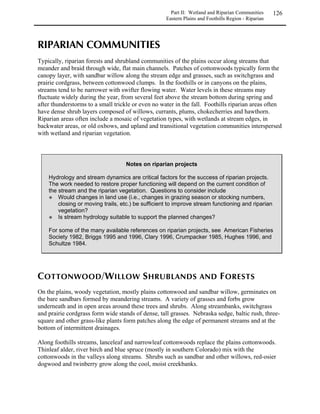
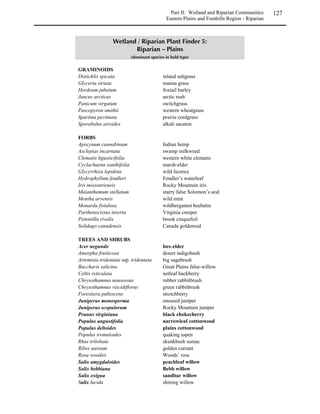
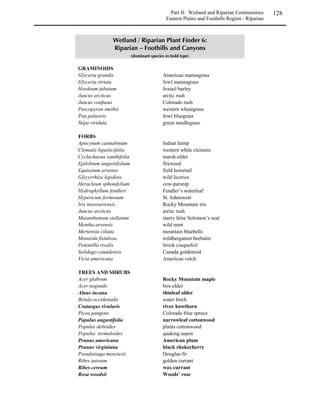
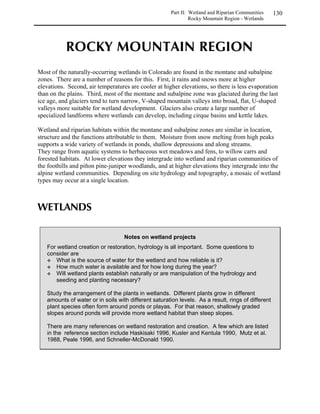


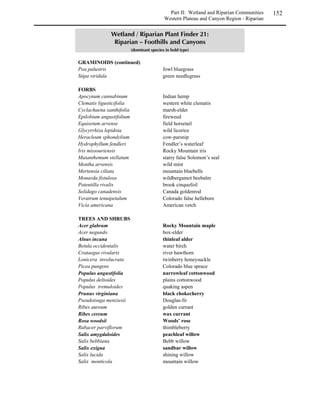






















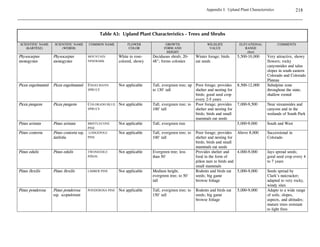
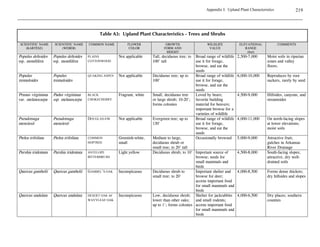
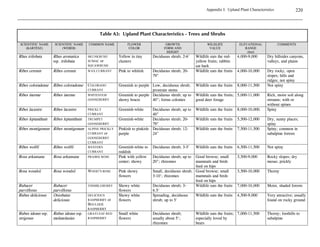
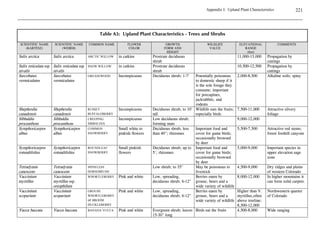













Table Of Contents                     iii
ACKNOWLEDGMENTS .......................................................................................................... vii

INTRODUCTION......................................................................................................................... 1
    What Are “Native” Species? .................................................................................................................................... 1
    Objective and Scope of this Guide ........................................................................................................................... 3
    Before You Begin .................................................................................................................................................... 4
    How To Use This Guide........................................................................................................................................... 5
    Plant Names ............................................................................................................................................................. 6
PLANT BASICS............................................................................................................................ 7
    Life Cycles ............................................................................................................................................................... 8
    Growth Forms .......................................................................................................................................................... 8
    Reproductive Strategies............................................................................................................................................ 9
    Seasonal Growth ...................................................................................................................................................... 9
NATURAL COMMUNITIES .................................................................................................... 11

FLORISTIC REGIONS OF COLORADO .............................................................................. 13

PART I: UPLAND COMMUNITIES ..................................................................................... 15

EASTERN PLAINS AND FOOTHILLS REGION................................................................. 15
GRASSLANDS ...............................................................................................................................................17
    Short-grass Prairie.................................................................................................................................................. 18
    Mid-grass Prairie.................................................................................................................................................... 20
    Tall-grass Prairie .................................................................................................................................................... 21
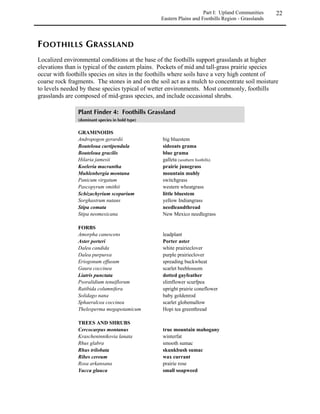
    Foothills Grassland................................................................................................................................................. 22
SHRUBLANDS ...............................................................................................................................................23
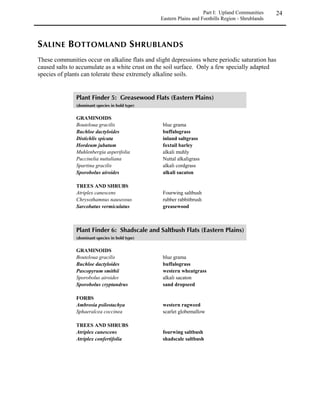
    Saline Bottomland Shrublands ............................................................................................................................... 24
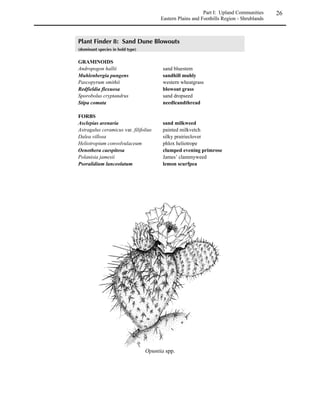
    Sand Sagebrush Prairie........................................................................................................................................... 25
    Mixed Foothills Shrubland..................................................................................................................................... 27
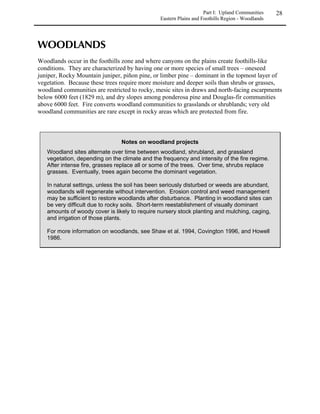
WOODLANDS ...............................................................................................................................................28
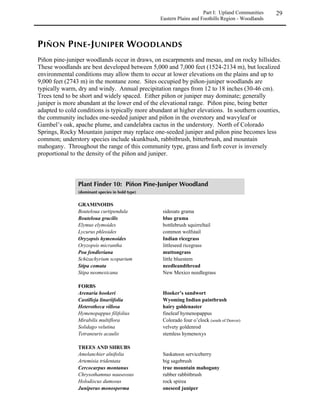
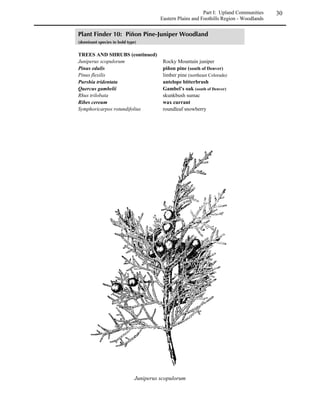
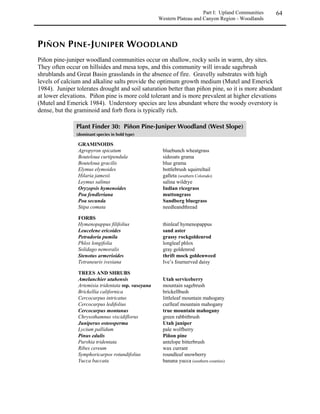
    Piñon Pine-Juniper Woodlands .............................................................................................................................. 29
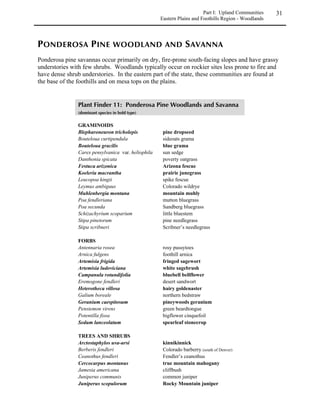
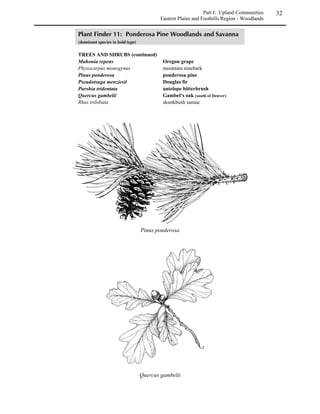
    Ponderosa Pine woodland and Savanna ................................................................................................................. 31
ROCKY MOUNTAIN REGION ............................................................................................... 33
GRASSLANDS ...............................................................................................................................................35
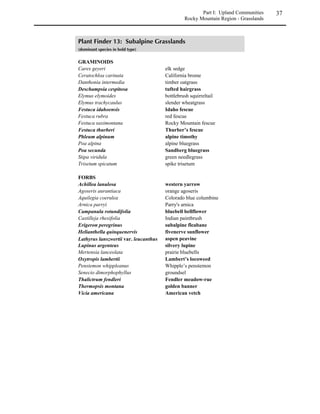
    Montane and Subalpine Grasslands ....................................................................................................................... 36
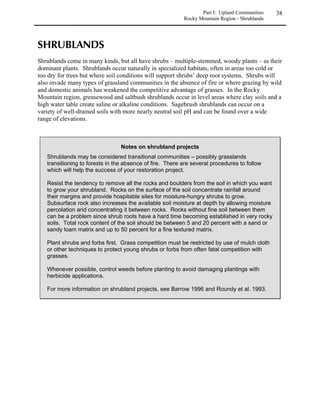
SHRUBLANDS ...............................................................................................................................................38
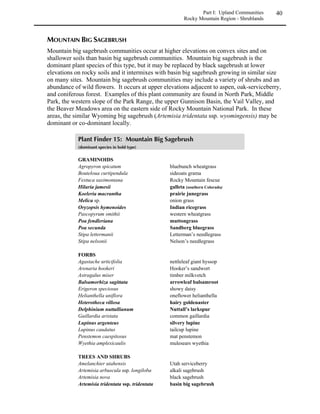
    Sagebrush Shrublands ............................................................................................................................................ 39
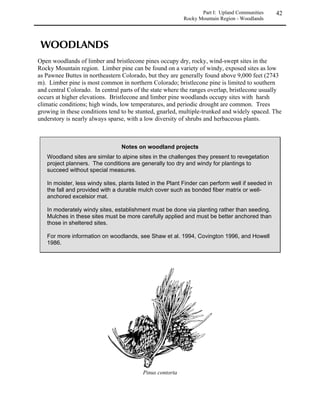
WOODLANDS ...............................................................................................................................................42
FORESTS ......................................................................................................................................................44
    Douglas-fir Forests................................................................................................................................................. 45
    Lodgepole Pine Forests .......................................................................................................................................... 47
    Aspen Forests ......................................................................................................................................................... 48
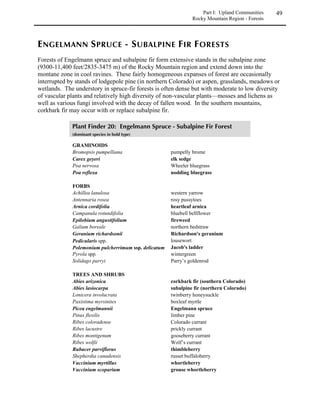
    Engelmann Spruce - Subalpine Fir Forests ............................................................................................................ 49
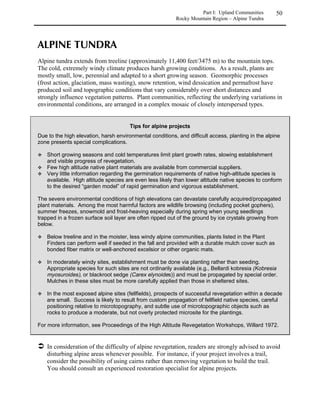
ALPINE TUNDRA ..........................................................................................................................................50
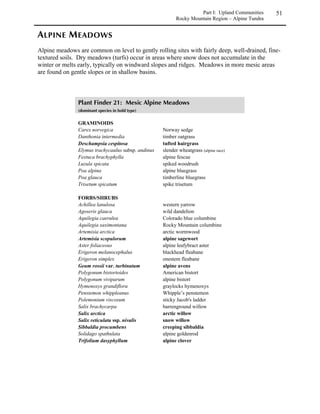
    Alpine Meadows .................................................................................................................................................... 51
Table Of Contents                     iv


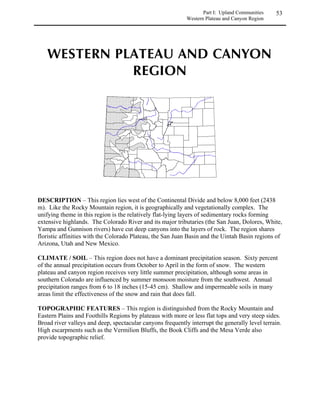
WESTERN PLATEAU AND CANYON REGION ................................................................. 53
GRASSLANDS ...............................................................................................................................................55
SHRUBLANDS ...............................................................................................................................................57
    Mat Saltbush Shrublands........................................................................................................................................ 58
    Saline Bottomland Shrublands ............................................................................................................................... 58
    Sagebrush Shrublands ............................................................................................................................................ 60
    Mixed Mountain Shrubland ................................................................................................................................... 62
WOODLANDS ...............................................................................................................................................63
    Piñon Pine-Juniper Woodland................................................................................................................................ 64
    Pine Woodlands ..................................................................................................................................................... 65
REVEGETATION TECHNIQUES........................................................................................... 67
STEP 1: PLANNING YOUR PROJECT .............................................................................................................67
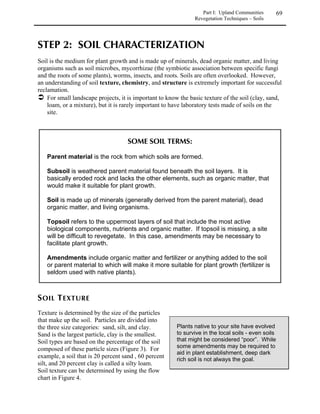
STEP 2: SOIL CHARACTERIZATION .............................................................................................................69
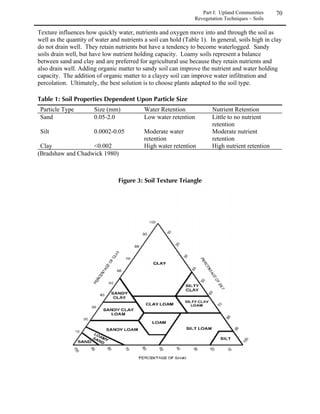
    Soil Texture............................................................................................................................................................ 69
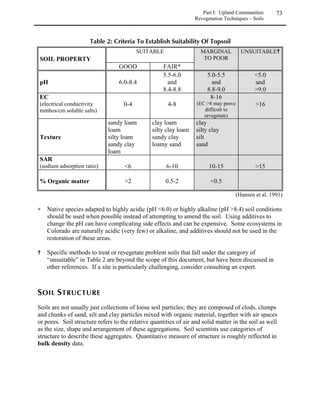
    Soil Chemistry........................................................................................................................................................ 72
    Soil Structure.......................................................................................................................................................... 73
STEP 3: SITE PREPARATION ........................................................................................................................75
    Topsoil Salvage...................................................................................................................................................... 75
    Development of Substitute Soil.............................................................................................................................. 76
    Seedbed Preparation............................................................................................................................................... 77
    Soil Amendments ................................................................................................................................................... 78
STEP 4: SEEDING AND PLANTING ...............................................................................................................81
  SEEDING ..................................................................................................................................................81
        Collecting Seed.................................................................................................................................................. 82
        Purchasing Seed ................................................................................................................................................ 83
        Testing Seed ...................................................................................................................................................... 87
        Seeding Techniques........................................................................................................................................... 89
        Post Seeding Techniques................................................................................................................................... 91
    PLANTING ................................................................................................................................................95
        Plant Materials................................................................................................................................................... 95
        Planting Techniques ........................................................................................................................................ 100
STEP 5: MONITORING  STEWARDSHIP ...................................................................................................103
MONITORING .............................................................................................................................................103
    Potential Problems ............................................................................................................................................... 103
    Techniques and Frequency................................................................................................................................... 104
    Assessment of Problems and Stewardship Activities........................................................................................... 104
STEWARDSHIP............................................................................................................................................105
    Developing a Stewardship Plan............................................................................................................................ 105
    Techniques ........................................................................................................................................................... 105
WEED MANAGEMENT ......................................................................................................... 107
INTEGRATED WEED MANAGEMENT ..........................................................................................................107
PREVENTION ..............................................................................................................................................108
ERADICATION ............................................................................................................................................109
CONTROL ...................................................................................................................................................109
    Biological Control................................................................................................................................................ 109
    Chemical Control ................................................................................................................................................. 110
    Cultural Control ................................................................................................................................................... 110
    Mechanical Control.............................................................................................................................................. 110
PART II: WETLAND  RIPARIAN HABITATS................................................................ 111

INTRODUCTION..................................................................................................................... 111
HOW TO USE THIS SECTION ......................................................................................................................111
WETLAND AND RIPARIAN DEFINED ..........................................................................................................113
Table Of Contents                       v
    Wetland ................................................................................................................................................................ 113
    Riparian................................................................................................................................................................ 113
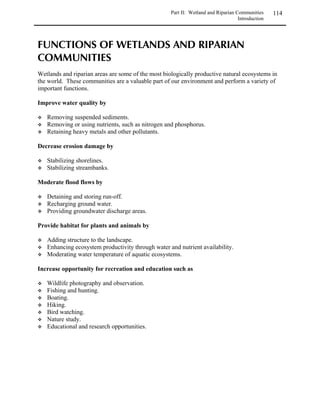
FUNCTIONS OF WETLANDS AND RIPARIAN COMMUNITIES .......................................................................114
IMPORTANT POLICIES AND REGULATIONS ................................................................................................115
    Federal.................................................................................................................................................................. 115
    State...................................................................................................................................................................... 115
    County  Local.................................................................................................................................................... 116
WETLAND DELINEATION ...........................................................................................................................116
    Diagnostic Characteristics of Wetlands ............................................................................................................... 117
    Technical Approach: Delineation of Wetlands .................................................................................................... 118
WETLAND AND RIPARIAN COMMUNITIES IN COLORADO..................................... 119

EASTERN PLAINS AND FOOTHILLS REGION............................................................... 121
WETLANDS ................................................................................................................................................121
    Marshes ................................................................................................................................................................ 121
    Playas ................................................................................................................................................................... 122
    Meadows .............................................................................................................................................................. 123
RIPARIAN COMMUNITIES...........................................................................................................................126
    Cottonwood/Willow Shrublands and Forests....................................................................................................... 126
ROCKY MOUNTAIN REGION ............................................................................................. 130
WETLANDS ................................................................................................................................................130
    Marshes ................................................................................................................................................................ 131
    Playas ................................................................................................................................................................... 131
    Meadows .............................................................................................................................................................. 133
    Fens ...................................................................................................................................................................... 135
RIPARIAN COMMUNITIES...........................................................................................................................139
    Willow Carrs ........................................................................................................................................................ 140
    Riparian Forests ................................................................................................................................................... 142
    Alpine Riparian Communities.............................................................................................................................. 144
WESTERN PLATEAU AND CANYON REGION ............................................................... 145
WETLANDS ................................................................................................................................................145
    Marshes ................................................................................................................................................................ 145
    Meadows .............................................................................................................................................................. 147
RIPARIAN COMMUNITIES...........................................................................................................................150
    Cottonwood/Willow Forests ................................................................................................................................ 150
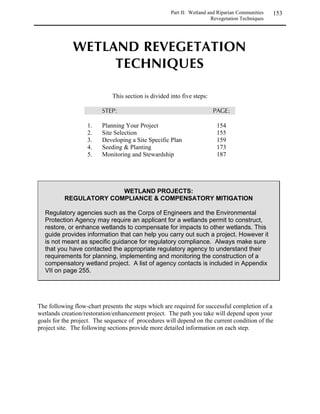
WETLAND REVEGETATION TECHNIQUES................................................................... 153
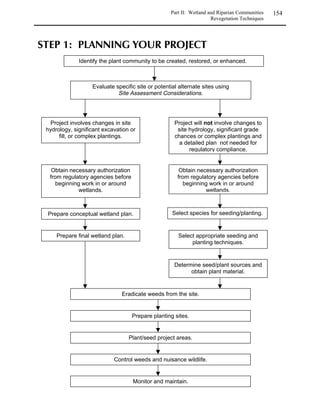
STEP 1: PLANNING YOUR PROJECT ..........................................................................................................154
STEP 2: SITE SELECTION...........................................................................................................................155
    Site Assessment Considerations........................................................................................................................... 155
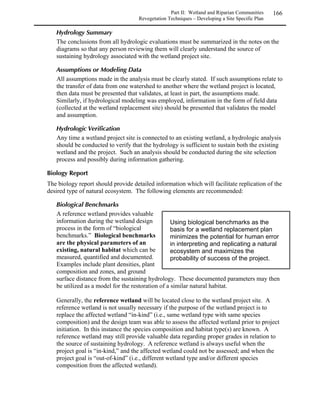
STEP 3: DEVELOPING A SITE SPECIFIC PLAN ...........................................................................................159
    Setting Your Goals: Creation, Restoration or Enhancement ................................................................................ 159
    The Conceptual Wetland Plan.............................................................................................................................. 160
    Final Wetland Construction Plans........................................................................................................................ 162
STEP 4: SEEDING AND PLANTING .............................................................................................................173
    Wetland and Riparian Seeding ............................................................................................................................. 173
    General Considerations for Planting .................................................................................................................... 174
    Plant Materials and Techniques ........................................................................................................................... 174
    Acceptability of Plant Materials........................................................................................................................... 183
    Comparison of Plant Materials............................................................................................................................. 183
    Field Collection of Plant Materials ...................................................................................................................... 184
    Fertilizer and Other Soil Amendments................................................................................................................. 187
STEP 5: MONITORING AND STEWARDSHIP ................................................................................................187
REFERENCES AND SUGGESTED READING ................................................................... 189
Table Of Contents                 vi

APPENDIX I: UPLAND PLANT CHARACTERISTICS .................................................... 197
GRAMINOIDS .............................................................................................................................................197
FORBS ........................................................................................................................................................205
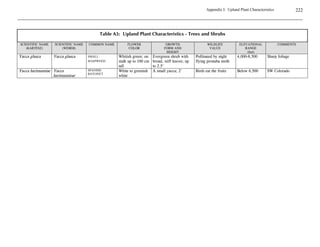
TREES AND SHRUBS...................................................................................................................................213
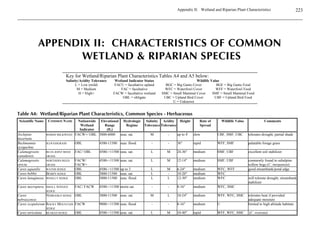
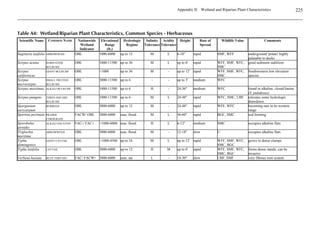
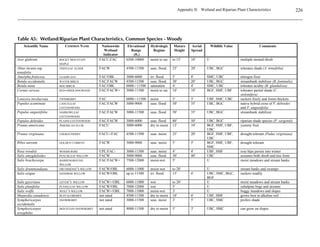
APPENDIX II: CHARACTERISTICS OF WETLAND  RIPARIAN SPECIES........... 223

APPENDIX III: WEED LISTS................................................................................................ 227
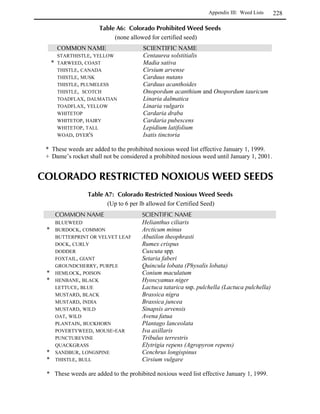
COLORADO PROHIBITED NOXIOUS WEED SEEDS ......................................................................................227
COLORADO RESTRICTED NOXIOUS WEED SEEDS .....................................................................................228
PLANTS TO AVOID .....................................................................................................................................229
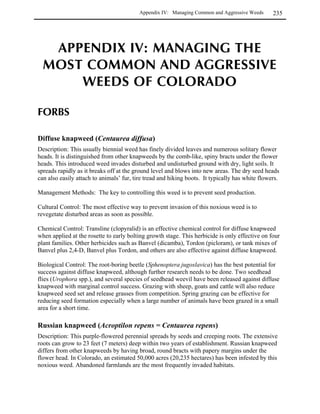
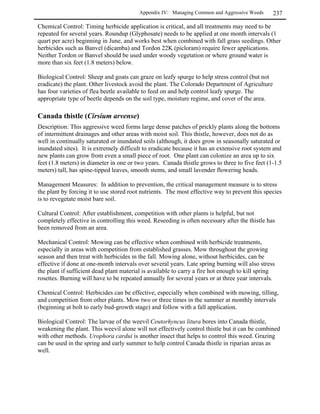
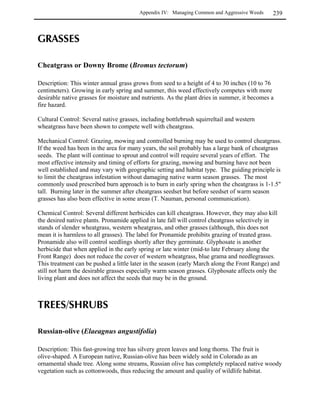
APPENDIX IV: MANAGING COMMON AND AGGRESSIVE WEEDS ........................ 235
FORBS ........................................................................................................................................................235
GRASSES ....................................................................................................................................................239
TREES/SHRUBS ..........................................................................................................................................239
APPENDIX V: REGIONAL VENDORS OF PLANT MATERIALS ................................. 241

APPENDIX VI: EROSION CONTROL PRODUCTS AND SUPPLIERS ......................... 253

APPENDIX VII: FEDERAL AGENCY CONTACTS .......................................................... 255

APPENDIX VIII: INDEX OF PLANT LISTS AND TABLES............................................ 257
UPLAND PLANT FINDERS...........................................................................................................................257
WETLAND  RIPARIAN PLANT FINDERS ...................................................................................................257
OTHER TABLES ..........................................................................................................................................258
Acknowledgments
                                                                                                         vii
!
This guide is the result of several years work by a large number of dedicated natural resource
professionals. These people and the agencies that have supported them in the development of this guide
represent a variety of approaches to the protection of natural values in Colorado and beyond. The
Colorado Natural Areas Program extends its appreciation to all who have contributed to the guide; we
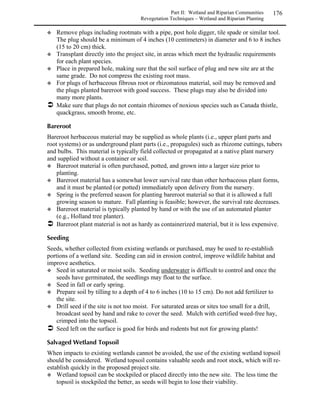
appreciate your help.

The Colorado Natural Areas Program would like to specifically acknowledge the following contributors,
and to apologize in advance if any have been inadvertently omitted.


   This guide is dedicated to Jim Von Loh. Jim conceived of this guide while he was the Director of
            the Colorado Natural Areas Program. We wish to recognize and thank Jim for:
   • his vision about the importance and usefulness of this guide
   • his technical knowledge firmly based in experience throughout the state,
   • his competence which provided leadership for the project's many cooperators, and
   • his willingness to place an emphasis on the use of native plants in revegetation projects.


Rex A. Seiple and Dina Clark laid the groundwork for this document by soliciting input and staffing
workshops. They assembled the preliminary drafts of the guide. Rex Seiple deserves special credit for
pulling together many, many comments and writing the first drafts. Subsequent work was provided by
staff of the Colorado Natural Areas Program: Kathy Carsey, Janet Coles, Karin Decker, and Mark
Gershman.

The document has undergone rigorous review, however some errors may have gone undetected. The
Colorado Natural Areas Program assumes responsibility for these (but please let us know so that we can
correct future editions).

Base funding for the development of this guide was provided by:

                                                                                The Colorado Natural
                                                                                   Areas Program

Funding for publication and distribution was provided by:

The National Fish and Wildlife Foundation
The United States Bureau of Land Management


Truax Company, Inc., Minneapolis, Minnesota
Colorado State Forest Service, Fort Collins, Colorado
Sharp Brothers Seed Company, Inc., Greeley, Colorado
James Trammell, Littleton, Colorado
Dr. Ruth L. Willey, Gunnison, Colorado

The views and conclusions contained in this document are those of the authors and should not be interpreted
  as representing the opinions or policies of the U.S. Government. Mention of trade names or commercial
      products does not constitute their endorsement by the U.S. Government or the State of Colorado.
Acknowledgments
                                                                                                      viii
We would like to thank the following contributing writers who invested many hours of their valuable time
preparing sections of the guide.


       David Buckner          ESCO Associates, Inc.
                              1077 South Cherryvale Rd.
                              Boulder, CO 80303

       Claire DeLeo           Boulder County Parks and Open Space
                              P.O. Box 471
                              Boulder, CO 80306

       Grant Gurneé           Aquatic and Wetland Company
                              1830 17th Street, Suite 100
                              Boulder, CO 80302

       Cathy Halm             Colorado Department of Transportation
                              4201 E. Arkansas Ave.
                              Denver, CO 80222

       Don Hijar              Pawnee Buttes Seed Inc.
                              P.O. Box 1604
                              605 25th Street
                              Greeley, CO 80632

       Eric Lane              Colorado State Dept. of Agriculture
                              Division of Plant Industry
                              700 Kipling St., Suite 4000
                              Lakewood, CO 80215-5894

       Denise Larson          ERO Resources
                              1846 Clarkson
                              Denver, CO 80218

       Randy Mandel           Rocky Mountain Native Plants Co.
                              3780 Silt Mesa Road
                              Rifle, CO 81650
                              970-625-3276 fax
                              native@aspeninfo.com

       Cindy Owsley           Boulder County Weed District
                              P.O. Box 471
                              Boulder, CO 80306

       Ed Spence


       Jim Von Loh
Acknowledgments
                                                                                                            ix
Thanks also to all those who contributed by attending meetings, participating in working groups,
reviewing and editing draft editions of this document, or providing any of the other types of information
and support we have received. Your input was greatly appreciated, thank you.


    Gay Austin                   USDA Forest Service
                                 216 N. Iowa
                                 Gunnison, CO 81230

    Roy Bell                     City of Boulder Open Space
                                 66 South Cherryvale Rd.
                                 Boulder, CO 80303

    Richard Brune                Botanical Consultant
                                 2060 Garland
                                 Lakewood, CO 80215-1630

    Bob Carlson                  Colorado State Parks
                                 361-32 Road
                                 Clifton, CO 81520

    Anita Culp                   US Army Corps of Engineers
                                 Southern Colorado Project Office
                                 720 N. Main St., Rm. 205
                                 Pueblo, CO 81003-3046

    Carol Dawson                 Denver Botanic Gardens
                                 909 York St.
                                 Denver, CO 80206

    Lois Dworshak                Upper Colorado Environmental Plant Center
                                 P.O. Box 448
                                 Meeker, CO 81641

    Jill Easley                  Colorado Department of Transportation
                                 4201 E. Arkansas
                                 Denver, CO 80222

    Barbara Fahey                CSU Cooperative Extension
                                 Jefferson County Extension Office
                                 15200 West 6th Avenue
                                 Golden, CO 80401-5018

    Deborah B. Keammerer         Keammerer Ecological Consultants, Inc.
                                 5858 Woodbourne Hollow Rd.
                                 Boulder, CO 80301

    Andy Kratz                   USDA-FS-Region 2
                                 P.O. Box 25127
                                 Lakewood, CO 80225

    Jim Lance                    Colorado Department of Transportation
                                 222 S. 6th St., Room 317
                                 Grand Junction, CO 81502

    Ivo Lindauer                 University of Northern Colorado
                                 Biology Department
                                 Greeley, CO 80639
Acknowledgments
                                                                                                      x
    Jan McKee                   USDI-FWS
                                P.O. Box 25486 - Denver Federal Center
                                Denver, CO 80225-0207

    Randy Moench                Colorado State Forest Service
                                CSU - Foothills Campus
                                Building 1060
                                Fort Collins, CO 80523

    Tamara Naumann              Dinosaur National Monument
                                4545 Highway 40
                                Dinosaur, CO 81610

    John Oram                   Colorado Forestry Association
                                5130 Meade St.
                                Denver, CO 80221-1036

    Terry Ruiter                Gannett Fleming, Inc.
                                999 18th Street, Suite 2520
                                Denver, CO 80202

    Susan Spackman              Colorado Natural Heritage Program
                                254 General Services Building
                                Fort Collins, CO 80523

    Carol Spurrier              USDI-BLM
                                2850 Youngfield St.
                                Lakewood, CO 80215

    Susan Trumble               Roxborough State Park
                                4751 N. Roxborough Dr.
                                Littleton, CO 80125

    Dave Weber                  CDOW - North Region
                                6060 Broadway
                                Denver, CO 80216


Finally, the Colorado Natural Areas Program would like to acknowledge the following individuals for
their special contributions to this guide:

                      Ben Berlinger                   Mary Powell
                      Jim Borland                     Neil Sperandeo
                      Casey Davenhill                 Harvey Sprock
                      Gary Finstad                    Lisa Tasker
                      Alice Guthrie                   Jeff Woods
                      Charlie Holcomb
Introduction       1
Every day portions of Colorado's landscape are disturbed as roads and trails are constructed,
trenches for utility lines are excavated, and fields are plowed or graded in anticipation of a new
crop or new building. Natural disturbances occur too, including flood, fire, wind erosion,
avalanches and landslides. Eventually most of these disturbances will be revegetated. But with
what and when? Without special effort, it may be decades before plants become established. In
other areas soil loss may occur before any plants can successfully colonize the disturbance,
further lowering the chance for revegetation—even in the long term. In more moderate climates,
and on sites with better soils, plants may begin to grow as soon as the disturbance ends—but
these may not be native species. Some will be noxious weeds, which will use the disturbed zone
as a staging area to spread into adjacent healthy landscapes where they will be difficult to
control. Others may be well-adapted to grow in barren landscapes, but will not persist.

For decades, land management agencies have been developing reclamation plans for reseeding
and replanting disturbances. The historic focus was on providing vegetation to stabilize eroding
areas and to heal unsightly scars on the landscape. Many of the plants used historically were
readily available, inexpensive, fast growing, and aggressive agronomic species—just the strategy
for quick and effective revegetation. However most were not native species. In recent years
more agencies and landowners have become interested in propagating attractive and diverse
plant communities by using native species for revegetation projects. This guide is intended to
assist them in successfully planning and implementing such projects.


 #  $  %
When settlers first made their way to Colorado in the early 1800’s, they brought with them seeds
of plants from all over the world. Some were seeds planted in the Old World for food crops,
windbreaks, landscaping, erosion control, and livestock forage. Many other seeds arrived
accidentally, mixed with crop seeds, animal feed, or even in the ballast of ships. These came
westward with shipments of agricultural goods, or they were dispersed along irrigation ditches,
railroad tracks, wagon roads, and cattle trails. Today, either by accident or design, the
introduction of nonnative plants to Colorado continues. Because of past and present human
activities, Colorado’s landscape is replete with “nonnative” species.

But what is a native plant? The contributors and reviewers of this guide spent a great deal of
time wrestling with this question. In the end, it was easiest to start by defining which plants were
nonnative. Although there are other perspectives, the group decided to use the definition from
Colorado's Weed Management Act. The act defines a nonnative plant species as:
   “. . . a plant species which is not indigenous to the state of Colorado, nor to the native plant
   community in which it is found.” Title 35, Colorado Revised Statutes: Colorado Weed
   Management Act.

This latter definition will be used in this guide. Conversely, a native species is defined as: “A
plant species which is indigenous to the state of Colorado, or to the natural plant community in
which it is found.”
Introduction     2


The terms alien, nonnative, exotic, and adventive are all expressions used to describe
plants that have been introduced to Colorado. To keep things simple, this guide uses
“nonnative” throughout.
%

Many, but not all, nonnative plants spread rapidly and outcompete native species for water, light
and soil nutrients. Native plant species have evolved with local herbivores and diseases that
regulate population numbers. In contrast, nonnative species frequently have no local predators
acting to keep population sizes in check. Many nonnative agronomic species were bred in the
Old World for rapid growth, prolific reproduction, and ability to tolerate both disease and a wide
range of soil, moisture, and light conditions. Nonnative weeds have often had several thousand
years evolution in the presence of human disturbances, resulting in enhanced growth,
reproduction, and environmental tolerance, similar to what was purposedly bred into agronomic
species of the Old World. While these characteristics are valuable for agricultural crops, they
enable nonnative species to become aggressive invaders of native ecosystems. If left
uncontrolled, these species often form extensive single-species stands where once there were
diverse and productive native communities.

Nonnative species cover bare ground with dense greenery and sometimes with showy flowers,
but may provide little in the way of habitat values or plant community diversity and structure.
For example, a marsh full of purple loosestrife in bloom makes a beautiful impression from a
distance. However, closer observation will reveal a lack of other plant species and a dearth of
animal life. The same observation can be made about areas where knapweeds, thistles, leafy
spurge and other nonnative plants have become established.

Plants such as knapweed and leafy spurge release toxins into the soil which inhibit the
germination of native species. In addition, many nonnative species are not palatable to most
North American animals. Such characteristics enable nonnative plant species to establish large
monotypic stands that deplete the soil moisture and shade the ground, eliminating chances that
native plants will germinate and grow.
%
The impacts from infestations of aggressive nonnative plants are widespread and far reaching:

   Land infested by nonnative plants has low value for hunting, photography, or wildlife
    watching (Cook, 1991).
   Waterfowl habitat across North America has badly deteriorated due to purple loosestrife
    infestation. The dense stands reduce biotic diversity in wetlands by replacing native plant
    species, thereby eliminating the natural foods and cover essential to wetland wildlife
    (Malecki et al. 1993).
   Although planting Russian-olive as wildlife habitat has been encouraged for many years by
    public land managers, its presence actually degrades wildlife habitat. Studies reveal that this
Introduction       3

   species displaces native cottonwoods. The displacement of native trees has caused more than
   a 30 percent decline in nesting bird species (USFWS 1989). Furthermore, the small limbs
   and hard wood of Russian-olive are not appealing to cavity-nesters, and the trees do not
   support the insects that many birds require for food (Cook 1991).
!
!
Approximately 3.7 million acres (1.5 million hectares) of range and pasture land in the western
United States are infested with knapweeds and leafy spurge infests over 2.5 million acres (1
million hectares) in North America (Steele 1991). Most domestic or wild animals cannot eat
these species and knapweed is actually toxic to horses. In Montana and Wyoming, some areas
are so completely covered with knapweed that the land has been abandoned and taken off tax
rolls (Steele 1991). In North Dakota, mortgage companies will not lend on agricultural property
infested with leafy spurge (Cook 1991).

In Colorado, leafy spurge has become thoroughly established in Larimer, Weld and Douglas
counties, and is moving southward. Weed scientists predict that leafy spurge will soon be a
dominant upland and lowland plant throughout the northern foothills and plains. The damage
caused by nonnative plants includes degraded wildlife habitat, devalued crop and rangeland,
injured or dead livestock, decreased water quality, lost tax revenue, diminished recreational
experiences and the loss of irreplaceable native ecosystems.

The State of Colorado has recognized that nonnative species pose threats to natural landscapes
and the economy. Title 35, Colorado Weed Management Act contends that it is the “duty of all
persons to . . . manage undesirable plants . . .” and mandates that counties and municipalities
adopt “undesirable plant management plans”. This act further declares that the management
plans apply to both state and privately owned lands.

!
'
One way to combat the problem of invasive nonnative species is to use native plants for
landscaping, revegetation, and reclamation. Using native plants for these projects decreases the
introduction of nonnative plants into Colorado and maintains the integrity of native communities.
Because they are adapted to the region, native plants often require less labor and expense to
maintain once established. Native plants also provide many other benefits, including wildlife
habitat, opportunities for environmental education, and a greater variety of scenery. The
Colorado Native Plant Society Education Committee (1991) encourages the use of native species
“both because of their adaptability and because we like the idea of Colorado looking like
Colorado with a unique regional horticulture which sets us apart from other parts of the country”.
Colorado has a profusion of beautiful native grasses, wildflowers, shrubs, and trees which can be
used for all planting purposes.
(
This guide provides information on how to select, plant and maintain Colorado native plant
species for a wide range of landscaping, revegetation and reclamation needs. It includes
information on important ecological considerations for the variety of Colorado landscape types
and natural communities in both upland and wetland habitats. Instructions for the design,
planning, execution, and maintenance of revegetation projects are also presented. In addition to
the information provided in the text, additional resources are provided in the appendices. Other
Introduction        4

useful references and resources, including federal and state agencies, are dispersed throughout
the document.

This guide does not contain suggestions for every possible revegetation situation or suggest a use
for every plant species native to Colorado (there are more than 2500!). The emphasis instead is
on providing a basic understanding of the range of natural communities in Colorado and the
processes involved in establishing native species in those communities. Knowledge of this
subject will continue to increase over time through implementation of these strategies and
continued experimentation. It is our hope that this guide serves as a good place to begin and that
updated editions result from the perfection of these or other techniques.


    !
Used to identify important components of a definition, technique, or other topic.

    · Warning! This symbol indicates common pitfalls or disadvantages of a restoration
        technique.
This guide is intended to serve as a resource for choosing native tree, shrub, forb and grass
species for reclamation, revegetation and landscape projects. However, your best reference
guide is the local landscape. The landscape can tell you which native species occur, how they
are distributed, what soils they prefer, and what conditions they can tolerate. The local landscape
also provides an important potential source of seed for revegetation projects.

There are several ways local resources can be used for revegetation projects. One is to salvage the
vegetation that was on the site before the onset of the disturbance. If you know in advance that a
project is going to disturb the landscape and will require revegetation after its completion, try
preserving some of the existing plants and seeds so they can be used in the revegetation process.
For instance, while a pipeline trench is being excavated, blocks of the existing native sod can be
removed and set aside to be replanted after the work is complete. If the native sod cannot be
preserved for later use, it may be helpful to spread the topsoil that contains root systems and seeds
on the area.

Another way to use existing local resources for revegetation projects is to use seed from native
plants that occur near the reclamation site. (See collecting guidelines on page 82). Seeds can be
collected by hand from plants near the area to be revegetated. This method requires some
planning in terms of allowing time for seed collection, but it offers many benefits, including:

   Germination success and plant hardiness may be increased because the seed source is local,
    and therefore, well-adapted to local environmental conditions.
   This type of project promotes community service and “hands-on” involvement of the public
    in resource conservation issues.
   This method of seed acquisition is relatively inexpensive, requiring only the time needed for
    volunteer organization, seed collecting, and soil preparation.
   This method preserves local native gene pools and ecotypes.
Introduction       5
What is the purpose of your planting project? The answer to this question will
  *
             determine your choice of plant species, planting techniques, and methods for long
term maintenance of the area.


                   POSSIBLE REASONS TO ESTABLISH NATIVE PLANTINGS


               Designing an aesthetic landscape for a home, business or park
                              Reclaiming a heavily disturbed site
                 Blending a utility line trench with an otherwise natural setting
                       Planting an area that will sustain heavy foot traffic
                        Planting for weed control near a reservoir edge
                    Restoring the vegetation along newly constructed trail
                                   Planting to prevent erosion


              Read the Plant Basics section (beginning on page 7) which defines terms used
 +*      throughout this manual. Understanding these terms will help you decide what
kinds of plants and growth forms to select for specific projects and will help you discuss your
project with experts.

              Proceed to the Natural Communities section (beginning on page 11).
 )*

   1. Determine your site’s geographic                          VEGETATION TYPES
      setting. Choose from: Eastern               Grasslands (and Meadows) – Graminoids (grasses,
      Plains and Foothill Region, Rocky           rushes, and sedges) are the most common and
      Mountain Region, or Western                 obvious vegetation. Forbs (wildflowers) and a few
      Plateau and Canyon Region.                  shrubs or trees may be present.
   2. Under the appropriate section,              Shrublands - Shrubs are the most common and the
      determine the vegetation type that          most obvious vegetation. Graminoids, forbs or bare
      best describes the site. Choose             ground may cover the understory. There may be a
      from grassland, shrubland,                  few trees present.
      woodland, forest, riparian, or              Woodlands – Trees are the most obvious vegetation,
      wetland (see box).                          but they are widely spaced. Canopy cover is usually
                                                  less than 40 percent. Graminoids, forbs or shrubs
   3. Finally, select the appropriate
                                                  may be present in the understory.
      natural community, such as                  Forests – Trees are the most obvious vegetation.
      shortgrass prairie, mixed foothills         They are closely spaced, and canopy cover is greater
      shrubland, or piñon-juniper                 than 40 percent. Graminoids, forbs or shrubs make
      woodland.                                   up the understory.
                                                  Wetland – The site has or is adjacent to standing
 Some habitat types are especially               water or has soils that are wet all or most of the year.
   challenging for revegetation projects.         Riparian – The site is along the banks of a stream or
   If your project is in or near alpine           river.
Introduction       6

  tundra or fens read the cautionary notes on pages 50 and 135.
 If you are carrying out a project in or near what you believe is a wetland or riparian habitat,
  be sure to read the Wetland and Riparian Habitats sections (beginning on page 111).


               Choose plant species from the Plant Finder lists located in the Natural
 ,*
               Communities section (beginning on page 11). Common species are listed for each
natural community under the categories of graminoids, forbs and trees/shrubs, with the most
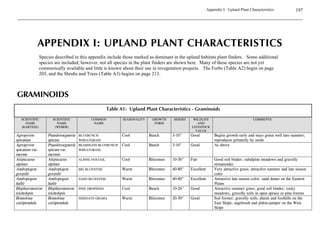
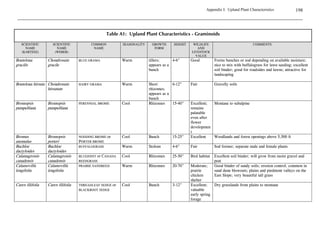
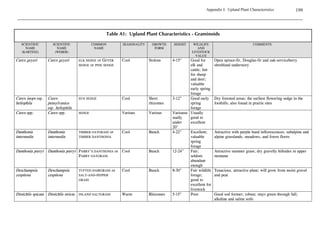
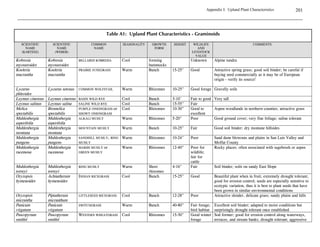
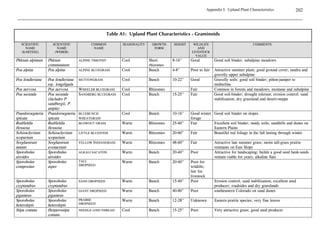
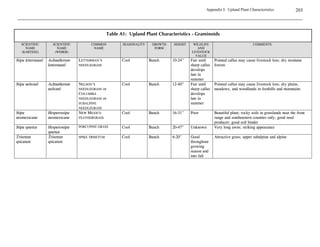
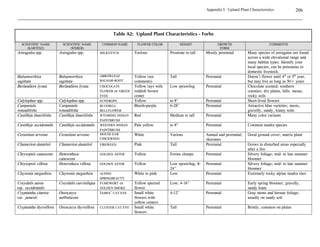
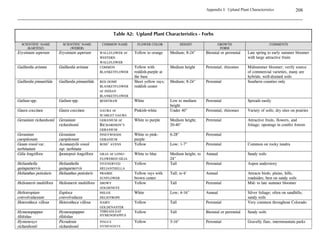
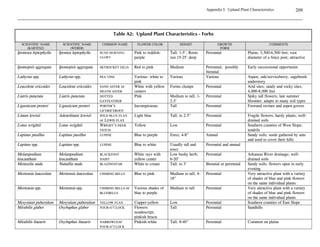
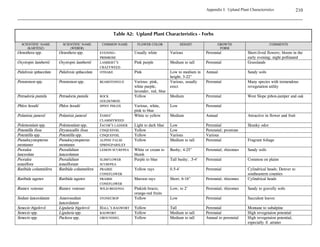
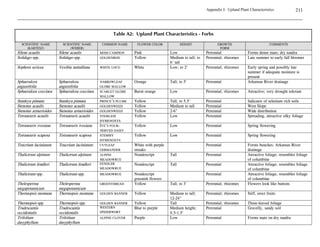
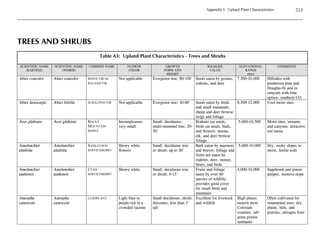
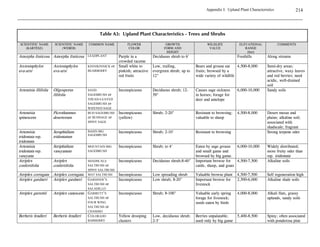
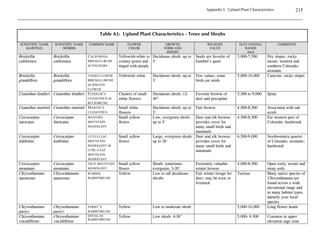
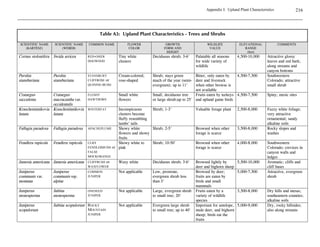
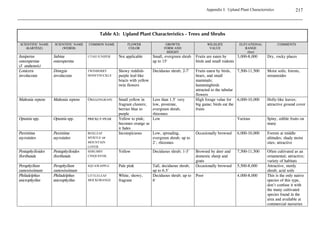
common species in bold print. The Upland Plant Characteristics Tables in Appendix I (page
197) will help you determine which species are appropriate for your circumstances. They list
characteristics for each species such as height, growth form, wildlife value, flower color, and
maturity rate. In addition to using Appendix I, it is always important to look at natural
communities of the type you are trying to establish to get an idea of the relative abundance
and arrangement of different species. Some of the plants listed in the Plant Finder may not be
commercially available, however, such species can still be used by collecting native seed /plant
material or by contracting with a nursery to grow certain plants.


              Read the Revegetation Techniques section (beginning on page 81). This section
 -*      contains detailed information on planning and executing a revegetation project,
including sources of plant material, seeding and planting methods and other advice. Not all of
this information will be needed for every project. If your project is small (of the “backyard”
variety) you will not need to read the entire section in detail. Instead, use the subject
headings to locate topics of interest and information appropriate to the scale of your project.


 	  !
Common names are generally used in the text to make it easier for the reader, however, for the
sake of accuracy, we have included scientific names in tables and lists. Appendix I (page 197)
lists common names of major species from the Upland Plant Finder lists.

Some plants have more than one scientific name. This document uses Kartesz (1994) and the
Kartez-based USDA-NRCS database (1997) as the primary source of scientific nomenclature,
and Weber (1996a, 1996b) as the secondary source. Tables in the appendices list both names.
Plant Basics     7


The Plant Kingdom is extremely diverse. There are well over 200,000 different species of plants
living today. Taxonomists divide these species into a variety of groups and sub-groups on the basis
of shared characteristics. Plants discussed in this guide all belong to the large category of plants
which reproduce by means of seeds. Plants which do NOT reproduce by seeds include ferns,
mosses, and lichens; these plants are not included in this manual.

Two broadly defined groups of seed plants mentioned in this manual are gymnosperms and
angiosperms.


    Gymnosperms
       Woody plants with needle-like or scale-like (imbricate, overlapping) leaves.
       Do not produce flowers.
       Have fruits which are cones or berry-like cones. (The blue “berries” on junipers
        are really modified cones!)
       Includes pines, firs, Douglas-fir, spruces, junipers, and some that do not
        resemble the other taxa, e.g., Mormon-tea (Ephedra sp.).

    Angiosperms
       Plants that produce flowers.
       Include species with obvious flowers such as wild rose and columbine, as
        well as those that are not so obvious, like grasses, bulrushes, and sedges.


Both gymnosperms and angiosperms may be either deciduous or evergreen


    Deciduous
       Bears leaves only through the growing season, dropping them in the fall.
        Deciduous plants are bare during the winter.
       Quaking aspen, Rocky Mountain maple, and mountain mahogany are examples
        of deciduous plants.

    Evergreen
       Bears green leaves throughout the winter.
       Pines, junipers, Oregon grape, and kinnikinnick are examples of evergreen
        plants.


Gymnosperms and angiosperms can be further categorized by life cycle, growth form,
reproductive strategy, maturity rate, and other descriptive terms.
Plant Basics      8


This manual uses only the general life cycle terms annual, biennial and perennial; more detailed and
complicated descriptions of life cycles may be used by specialists.

Annual plants live for only one growing season. For annual species, the emphasis of growth is
placed on production of seeds. Aboveground growth is rapid because the plant must flower and
produce seed before it dies at the end of the season. As a consequence, annual species can be
recognized by their relatively small root systems. Often annual plants are seeded at locations that
need to be vegetated quickly, such as highly erosive slopes. While annuals grow quickly and
provide cover, they do not provide a long-term solution to the challenge of revegetation.
Furthermore, the seed that they produce may be stored in the soil. These plants will continue to
appear, competing for nutrients, water and sunlight, long after the area has been planted with species
that are more permanent and desirable. Many weeds and crop plants are annuals.

Biennial plants live for two years. During the first year they typically produce rosettes of basal
leaves and store energy. They send up flowering stalks the second year, produce seeds and die.
Native biennials are relatively uncommon, however, many invasive weeds are biennials, including
musk thistle, scotch thistle, and some knapweed species.

Perennial plants live for many years. Normally they do not flower or reproduce until they are
several years old. Perennials can afford to direct more energy to long-term establishment and
typically have more extensive root systems. These species are usually the most desirable for
native plantings.
!
Woody plants do not die back to ground level each winter as forbs, grasses, and grass-like plants
do. On woody plants, buds are borne above ground level, giving these plants a “head start” to larger
stature each spring. Trees and shrubs are woody plants.

Trees are woody perennial plants with a single main stem or trunk and radiating branches on the
upper portion of the plant. They usually stand over 13 feet (4 m) tall at maturity.

Shrubs are woody perennials lacking a main stem, instead having several to many branches arising
at ground level. They are usually less than 10 to 13 feet (3 to 4 m) tall.

Graminoids include grasses and grass-like plants such as sedges and rushes. Sedges resemble
grasses but have solid stems which are often triangular. Rushes resemble grasses but have
round, pliant, hollow, or pithy stems lacking joints.

Grasses have jointed, hollow stems and clusters of small membranous flowers arranged in
spikelets

Forbs are broad-leaved herbaceous plants that die back to the ground each year and are generally
known as wildflowers.
Plant Basics        9
Seed reproduction is found in all groups of gymnosperms and angiosperms. Seeds may be
spread by wind, water, animals, or humans. Some seeds may require special treatment or
conditions such as fire, freezing temperatures, or passage through the gut of animals in order to
germinate.

Vegetative reproduction Many shrubs, grasses and a few trees, including quaking aspen,
spread by root shoots or points on the roots from which new stems or trunks can emerge. Many
aspen, even in groves that stretch for miles, are actually sprouting from the same root system!
Often the parent plant must be cut, burned, or injured in some way before the root shoots will
sprout. Most forbs and graminoids reproduce by seed, however, many perennials have
developed additional strategies for propagation.

                                                   
                     Rhizomatous forbs and graminoids        Rhizomatous graminoids are ideal for
                     have underground stems and              erosion control because their
                     branches that spread in linear          extensive networks of underground
                     patterns. New plants grow from these    stems retain soil.
                     rhizomes.

                     Bunch forming forbs and                 Bunch plants are recommended for
                     graminoids grow in clusters and         aesthetic plantings because they
                     appear as round tufts on the            provide visual interest and variety on
                     landscape. New sprouts (tillers)        the landscape.
                     grow only from the base of the plant,
                     increasing the width of the bunch
                     over time.

                     Stoloniferous forbs and graminoids      Stoloniferous graminoids are useful
                     have aboveground stems that spread,     for heavy-use areas and erosion
                     root and sprout new individuals.        control because they form durable
                                                             sods.
Seasonal growth patterns are important considerations, especially for grass plantings. Two general
patterns are recognized – cool season and warm season.

Cool season graminoids begin their growth in late winter and        Planting a mixture of both warm
early spring and bloom in the early summer. They may enter             and cool season grasses
dormancy during summer heat and resume growth or even               provides robust year-long cover
bloom again in the fall if adequate moisture is available.           and visual interest from spring
                                                                                  to fall.
Warm season graminoids begin their growth in late spring or
early summer and bloom in late summer or early fall, usually entering dormancy with the onset of
winter.
Plant Basics   10
Natural Communities     11
!!

In the broadest sense, a community can be defined as all the plants and animals living in a
particular area. Plant communities are usually named for their most prominent and/or abundant
members. Community classifications can range from general descriptions such as “grassland” or
“forest” to more detailed designations which include species names. The term “natural
communities” as used in this manual, refers to those plant species and communities which
occurred in Colorado before European settlement and which retain the capability of maintaining
themselves without human interference.

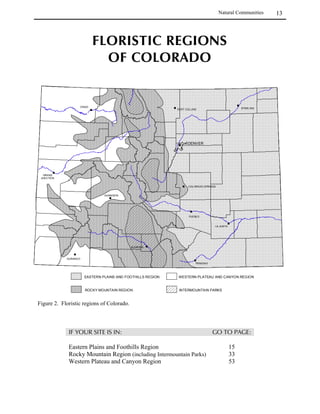
For the purposes of this guide, the state is divided into three floristic regions based on geography,
elevation and climate (see Figure 2 on page 13). The Eastern Plains and Foothills Region
occurs on the eastern side of the state below 8,000 feet (2438 m). The Rocky Mountain Region
occurs in the center of the state on either side of the Continental Divide and includes the
intermontane valleys (North Park, Middle Park, South Park and the San Luis Valley). The
Western Plateau and Canyon Region occurs on the western side of the state below 8,000 feet
(2438 m). Each region is divided into dominant vegetation types (grasslands, shrublands,
woodlands and forests). Within each vegetation type, several natural plant communities are
listed (for example, short-grass prairie or sagebrush shrubland). Vegetation types and natural
communities have been generalized for this guide in order to emphasize the characteristic species
which will help determine the environmental setting of your site. On the landscape, these types
vary considerably in species composition and are too numerous to include in this document. The
native landscape that surrounds your project site will be the best source of information for
determining how to fine tune your revegetation project.


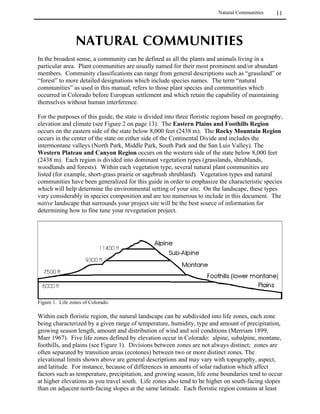
Figure 1. Life zones of Colorado.

Within each floristic region, the natural landscape can be subdivided into life zones, each zone
being characterized by a given range of temperature, humidity, type and amount of precipitation,
growing season length, amount and distribution of wind and soil conditions (Merriam 1899,
Marr 1967). Five life zones defined by elevation occur in Colorado: alpine, subalpine, montane,
foothills, and plains (see Figure 1). Divisions between zones are not always distinct; zones are
often separated by transition areas (ecotones) between two or more distinct zones. The
elevational limits shown above are general descriptions and may vary with topography, aspect,
and latitude. For instance, because of differences in amounts of solar radiation which affect
factors such as temperature, precipitation, and growing season, life zone boundaries tend to occur
at higher elevations as you travel south. Life zones also tend to be higher on south-facing slopes
than on adjacent north-facing slopes at the same latitude. Each floristic region contains at least
Natural Communities    12

one life zone, and each life zone generally includes several natural communities. A few natural
communities (wetland and riparian communities in particular) may cross life zones.

Natural communities tend to occur in predictable patterns on the landscape. The distribution of
flora and fauna is for the most part determined by local resources and conditions. Important
factors include water and nutrient availability, temperature, light, disturbance, and the presence
of other organisms. Descriptive terms for habitats are frequently based on one or more of these
factors. For instance, according to water availability, habitats may be characterized as “xeric”
(dry) or “mesic” (moist). Or, depending on type and frequency of disturbance, communities may
be classified as “successional or seral” (gradually changing in species composition) or “persistent
or climax” (maintaining the same species composition over time in the absence of disturbance).
Most other community characterizations are self-explanatory. Individual populations of a
particular species may, over many generations, become genetically adapted to extremely
localized conditions within a habitat type; these differentiated populations are known as
“ecotypes”. The ecotype concept is important when discussing revegetation, because it points
out that not all populations of a species are identical. For example, seeds of ponderosa pine
adapted to the volcanic soils and high, dry conditions of Arizona's Colorado Plateau may not
germinate or thrive when planted on coarse granitic soils of the Front Range, and adult trees may
not possess the cold and wind tolerance needed on the east slope of the Front Range.

Natural community revegetation information in this manual is arranged as follows: Part I covers
upland habitats, i.e. those communities occurring on ground which is not subject to regular
flooding or saturation. Part II covers wetland and riparian communities, considered as a separate
type within the surrounding upland community type. Each section also discusses appropriate
methods and techniques for revegetation projects in specific communities. Plant community
descriptions are taken largely from Marr 1967, Mutel and Emerick 1984, Galatowitsch 1988, and
Benedict 1991.
Natural Communities         13
CRAIG                                                                                   STERLING
                                                                FORT COLLINS


                                                                        DENVER


  GRAND
 JUN CTION


                                                                        COLORADO SPRINGS


                                 GUNNISON


                                                                         PUEBLO

                                                                                                    
                                                                                         LA JUNTA


                                            ALAMOSA   

                
             DURANGO
                                                                              
                                                                              TRINIDAD


                       EASTERN PLAINS AND FOOTHILLS REGION       WESTERN PLATEAU AND CANYON REGION


                       ROCKY MOUNTAIN REGION                      INTERMOUNTAIN PARKS


Figure 2. Floristic regions of Colorado.


              !                                                         

             Eastern Plains and Foothills Region                                                    15
             Rocky Mountain Region (including Intermountain Parks)                                  33
             Western Plateau and Canyon Region                                                      53
Natural Communities   14
*
!!
Part I: Upland Communities     15
                                                              Eastern Plains and Foothills Region
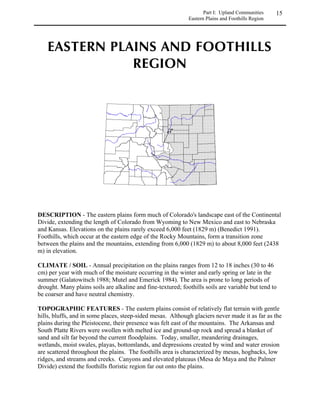
DESCRIPTION - The eastern plains form much of Colorado's landscape east of the Continental
Divide, extending the length of Colorado from Wyoming to New Mexico and east to Nebraska
and Kansas. Elevations on the plains rarely exceed 6,000 feet (1829 m) (Benedict 1991).
Foothills, which occur at the eastern edge of the Rocky Mountains, form a transition zone
between the plains and the mountains, extending from 6,000 (1829 m) to about 8,000 feet (2438
m) in elevation.

CLIMATE / SOIL - Annual precipitation on the plains ranges from 12 to 18 inches (30 to 46
cm) per year with much of the moisture occurring in the winter and early spring or late in the
summer (Galatowitsch 1988; Mutel and Emerick 1984). The area is prone to long periods of
drought. Many plains soils are alkaline and fine-textured; foothills soils are variable but tend to
be coarser and have neutral chemistry.

TOPOGRAPHIC FEATURES - The eastern plains consist of relatively flat terrain with gentle
hills, bluffs, and in some places, steep-sided mesas. Although glaciers never made it as far as the
plains during the Pleistocene, their presence was felt east of the mountains. The Arkansas and
South Platte Rivers were swollen with melted ice and ground-up rock and spread a blanket of
sand and silt far beyond the current floodplains. Today, smaller, meandering drainages,
wetlands, moist swales, playas, bottomlands, and depressions created by wind and water erosion
are scattered throughout the plains. The foothills area is characterized by mesas, hogbacks, low
ridges, and streams and creeks. Canyons and elevated plateaus (Mesa de Maya and the Palmer
Divide) extend the foothills floristic region far out onto the plains.
Part I: Upland Communities     16
                                                                Eastern Plains and Foothills Region

VEGETATION – The eastern plains are dominated by grasslands. Shrublands and woodlands
occupy small areas on the plains but are much more common in foothills areas. Although
precipitation in the foothills region is very similar to that of the plains, the greater prevalence of
rocky, moisture-retaining soils and irregular topography allow the dominance of woody plants.
The impacts of fires in the foothills have been greatly reduced since intensive settlement of this
region in the late 1800’s. Consequently, the extent and density of many of the woody plant
communities that were formerly thinned by fire have increased.

                 !                                       

                Grasslands                                                     17
                Shrublands                                                    23
                Woodlands                                                      28
                Wetland / Riparian                                            121
Part I: Upland Communities     17
                                                   Eastern Plains and Foothills Region - Grasslands


Grasslands (or prairies) are the most common vegetation type on the eastern plains of Colorado.
The Great Plains region that once covered central North America between the Rocky Mountains
and central Iowa had three main components arranged in irregular north-south trending bands
from southern Canada to central Texas (Sims et al. 1978). As precipitation decreases from east
to west, height and species composition of the dominant prairie grasses changes. Tall-grass
prairie covered the eastern band from 95º-100º west longitude; mid-grass prairie dominated the
middle section between 100º and 105º west longitude, and short-grass prairie typified the arid
western region between 105º and 110º west longitude. The plains of Colorado are in the short-
grass zone, but fingers of mid-grass prairie extend into the short-grass prairie, and patches of tall
grasses occur in riparian areas where conditions are sufficiently moist year-round.


                                  Notes on grassland projects
   True restoration of the prairie that once covered hundreds of thousands of square miles
   and sustained the complex interactions of hundreds of species is probably impossible on
   the small parcels that are available today. However, where native grasslands do occur,
   they can be maintained and their condition improved. Small created prairies can
   preserve native prairie plants and give visitors a feel for the former native prairie.

   Depending on the degree of past disturbance, rehabilitation may be accomplished by
   removing grazing, introducing fire, interplanting native grasses and forbs, and/or
   removing aggressive nonnative plants.

   Planting a prairie from scratch is a long-term project. It may take 3 to 5 years for the
   prairie to look like the vision you have of it.

   Transplanting from the wild is difficult because many prairie plants have developed long,
   deep roots to promote survival during drought. Try salvaging plants from sites that are
   scheduled for development rather than trying to move plants from intact native prairies.

   Mow prairie plantings the first year after planting to prevent weeds from going to seed.

   If possible, burn occasionally to reduce litter accumulations and prevent invasion by
   shrubs and trees. Burning only a part of the prairie in any year will leave the remainder
   as a refuge for creatures living there.

   For more information on prairie planting or restoration, see Brune 1991, Roundy et al.
   1993, and Schramp 1978.
Part I: Upland Communities     18
                                                      Eastern Plains and Foothills Region - Grasslands
. 


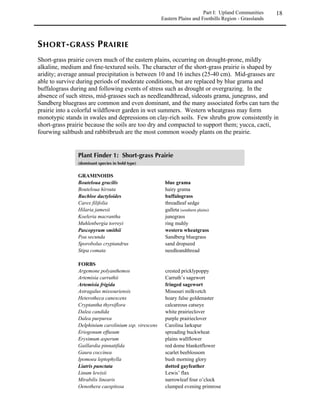
Short-grass prairie covers much of the eastern plains, occurring on drought-prone, mildly
alkaline, medium and fine-textured soils. The character of the short-grass prairie is shaped by
aridity; average annual precipitation is between 10 and 16 inches (25-40 cm). Mid-grasses are
able to survive during periods of moderate conditions, but are replaced by blue grama and
buffalograss during and following events of stress such as drought or overgrazing. In the
absence of such stress, mid-grasses such as needleandthread, sideoats grama, junegrass, and
Sandberg bluegrass are common and even dominant, and the many associated forbs can turn the
prairie into a colorful wildflower garden in wet summers. Western wheatgrass may form
monotypic stands in swales and depressions on clay-rich soils. Few shrubs grow consistently in
short-grass prairie because the soils are too dry and compacted to support them; yucca, cacti,
fourwing saltbush and rabbitbrush are the most common woody plants on the prairie.


               /0102*3.4/55/11
               6210/05715102879


               GRAMINOIDS
               Bouteloua gracilis                      blue grama
               Bouteloua hirsuta                       hairy grama
               Buchloe dactyloides                     buffalograss
               Carex filifolia                         threadleaf sedge
               Hilaria jamesii                         galleta (southern plains)
               Koeleria macrantha                      junegrass
               Muhlenbergia torreyi                    ring muhly
               Pascopyrum smithii                      western wheatgrass
               Poa secunda                             Sandberg bluegrass
               Sporobolus cryptandrus                  sand dropseed
               Stipa comata                            needleandthread

               FORBS
               Argemone polyanthemos                   crested pricklypoppy
               Artemisia carruthii                     Carruth’s sagewort
               Artemisia frigida                       fringed sagewort
               Astragalus missouriensis                Missouri milkvetch
               Heterotheca canescens                   hoary false goldenaster
               Cryptantha thyrsiflora                  calcareous catseye
               Dalea candida                           white prairieclover
               Dalea purpurea                          purple prairieclover
               Delphinium carolinium ssp. virescens    Carolina larkspur
               Eriogonum effusum                       spreading buckwheat
               Erysimum asperum                        plains wallflower
               Gaillardia pinnatifida                  red dome blanketflower
               Gaura coccinea                          scarlet beeblossom
               Ipomoea leptophylla                     bush morning glory
               Liatris punctata                        dotted gayfeather
               Linum lewisii                           Lewis’ flax
               Mirabilis linearis                      narrowleaf four o’clock
               Oenothera caespitosa                    clumped evening primrose
Part I: Upland Communities     19
                                        Eastern Plains and Foothills Region - Grasslands


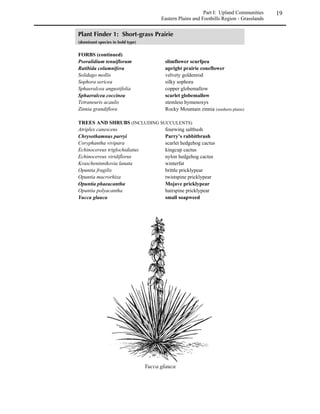
/0102*3.4/55/11
6210/05715102879


FORBS (continued)
Psoralidium tenuiflorum                  slimflower scurfpea
Ratibida columnifera                     upright prairie coneflower
Solidago mollis                          velvety goldenrod
Sophora sericea                          silky sophora
Sphaeralcea angustifolia                 copper globemallow
Sphaeralcea coccinea                     scarlet globemallow
Tetraneuris acaulis                      stemless hymenoxys
Zinnia grandiflora                       Rocky Mountain zinnia (southern plains)

TREES AND SHRUBS (INCLUDING SUCCULENTS)
Atriplex canescens            fourwing saltbush
Chrysothamnus parryi          Parry’s rabbitbrush
Coryphantha vivipara          scarlet hedgehog cactus
Echinocereus triglochidiatus  kingcup cactus
Echinocereus viridiflorus     nylon hedgehog cactus
Krascheninnikovia lanata      winterfat
Opuntia fragilis              brittle pricklypear
Opuntia macrorhiza            twistspine pricklypear
Opuntia phaeacantha           Mojave pricklypear
Opuntia polyacantha           hairspine pricklypear
Yucca glauca                  small soapweed


                                  Yucca glauca
Part I: Upland Communities     20
                                                  Eastern Plains and Foothills Region - Grasslands


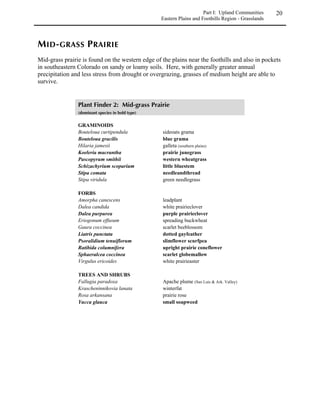
!  . 


Mid-grass prairie is found on the western edge of the plains near the foothills and also in pockets
in southeastern Colorado on sandy or loamy soils. Here, with generally greater annual
precipitation and less stress from drought or overgrazing, grasses of medium height are able to
survive.


                /0102+*!12.4/55/11
                6210/05715102879


                GRAMINOIDS
                Bouteloua curtipendula            sideoats grama
                Bouteloua gracilis                blue grama
                Hilaria jamesii                   galleta (southern plains)
                Koeleria macrantha                prairie junegrass
                Pascopyrum smithii                western wheatgrass
                Schizachyrium scoparium           little bluestem
                Stipa comata                      needleandthread
                Stipa viridula                    green needlegrass

                FORBS
                Amorpha canescens                 leadplant
                Dalea candida                     white prairieclover
                Dalea purpurea                    purple prairieclover
                Eriogonum effusum                 spreading buckwheat
                Gaura coccinea                    scarlet beeblossom
                Liatris punctata                  dotted gayfeather
                Psoralidium tenuiflorum           slimflower scurfpea
                Ratibida columnifera              upright prairie coneflower
                Sphaeralcea coccinea              scarlet globemallow
                Virgulus ericoides                white prairieaster

                TREES AND SHRUBS
                Fallugia paradoxa                 Apache plume (San Luis  Ark. Valley)
                Krascheninnikovia lanata          winterfat
                Rosa arkansana                    prairie rose
                Yucca glauca                      small soapweed
Part I: Upland Communities     21
                                                   Eastern Plains and Foothills Region - Grasslands


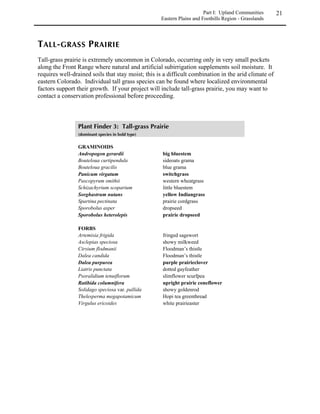
 		 . 


Tall-grass prairie is extremely uncommon in Colorado, occurring only in very small pockets
along the Front Range where natural and artificial subirrigation supplements soil moisture. It
requires well-drained soils that stay moist; this is a difficult combination in the arid climate of
eastern Colorado. Individual tall grass species can be found where localized environmental
factors support their growth. If your project will include tall-grass prairie, you may want to
contact a conservation professional before proceeding.


                /0102)*/.4/55/11
                6210/05715102879


                GRAMINOIDS
                Andropogon gerardii                 big bluestem
                Bouteloua curtipendula              sideoats grama
                Bouteloua gracilis                  blue grama
                Panicum virgatum                    switchgrass
                Pascopyrum smithii                  western wheatgrass
                Schizachyrium scoparium             little bluestem
                Sorghastrum nutans                  yellow Indiangrass
                Spartina pectinata                  prairie cordgrass
                Sporobolus asper                    dropseed
                Sporobolus heterolepis              prairie dropseed

                FORBS
                Artemisia frigida                   fringed sagewort
                Asclepias speciosa                  showy milkweed
                Cirsium flodmanii                   Floodman’s thistle
                Dalea candida                       Floodman’s thistle
                Dalea purpurea                      purple prairieclover
                Liatris punctata                    dotted gayfeather
                Psoralidium tenuiflorum             slimflower scurfpea
                Ratibida columnifera                upright prairie coneflower
                Solidago speciosa var. pallida      showy goldenrod
                Thelesperma megapotamicum           Hopi tea greenthread
                Virgulus ericoides                  white prairieaster
Part I: Upland Communities     22
                                                  Eastern Plains and Foothills Region - Grasslands
Localized environmental conditions at the base of the foothills support grasslands at higher
elevations than is typical of the eastern plains. Pockets of mid and tall-grass prairie species
occur with foothills species on sites in the foothills where soils have a very high content of
coarse rock fragments. The stones in and on the soil act as a mulch to concentrate soil moisture
to levels needed by these species typical of wetter environments. Most commonly, foothills
grasslands are composed of mid-grass species, and include occasional shrubs.

                /0102,*315/55/02
                6210/05715102879


                GRAMINOIDS
                Andropogon gerardii               big bluestem
                Bouteloua curtipendula            sideoats grama
                Bouteloua gracilis                blue grama
                Hilaria jamesii                   galleta (southern foothills)
                Koeleria macrantha                prairie junegrass
                Muhlenbergia montana              mountain muhly
                Panicum virgatum                  switchgrass
                Pascopyrum smithii                western wheatgrass
                Schizachyrium scoparium           little bluestem
                Sorghastrum nutans                yellow Indiangrass
                Stipa comata                      needleandthread
                Stipa neomexicana                 New Mexico needlegrass

                FORBS
                Amorpha canescens                 leadplant
                Aster porteri                     Porter aster
                Dalea candida                     white prairieclover
                Dalea purpurea                    purple prairieclover
                Eriogonum effusum                 spreading buckwheat
                Gaura coccinea                    scarlet beeblossom
                Liatris punctata                  dotted gayfeather
                Psoralidium tenuiflorum           slimflower scurfpea
                Ratibida columnifera              upright prairie coneflower
                Solidago nana                     baby goldenrod
                Sphaeralcea coccinea              scarlet globemallow
                Thelesperma megapotamicum         Hopi tea greenthread

                TREES AND SHRUBS
                Cercocarpus montanus              true mountain mahogany
                Krascheninnikovia lanata          winterfat
                Rhus glabra                       smooth sumac
                Rhus trilobata                    skunkbush sumac
                Ribes cereum                      wax currant
                Rosa arkansana                    prairie rose
                Yucca glauca                      small soapweed
Part I: Upland Communities     23
                                                 Eastern Plains and Foothills Region - Shrublands


Shrublands come in many kinds, but all have shrubs – multiple-stemmed, woody plants – as their
dominant plants. Shrublands occur naturally in specialized habitats, often in areas too cold or
too dry for trees but where soil conditions will support shrubs’ deep root systems. Shrubs will
also invade many types of grassland communities in the absence of fire or where grazing by wild
and domestic animals has weakened the competitive ability of grasses. In eastern Colorado,
greasewood and saltbush shrublands occur in alkaline depressions with clayey soils and a high
water table (“flats”). Deep sandy soils support sand sage shrublands, and rocky hillsides and
foothills support mixed shrubland communities.


                                 Notes on shrubland projects
   Shrublands may be considered transitional communities – possibly grasslands
   transitioning to forests in the absence of fire. There are still some procedures to follow
   which will help the success of your restoration project.

   Resist the tendency to remove all the rocks and boulders from the soil in which you want
   to grow your shrubland. Rocks on the surface of the soil concentrate rainfall around
   their margins and provide hospitable sites for moisture-hungry shrubs to grow.
   Subsurface rock also increases the available soil moisture at depth by allowing moisture
   percolation and concentrating it between rocks. Rocks without fine soil between them
   can be a problem, since shrub roots have a hard time becoming established in very
   rocky soils. Total rock content of the soil should be between 5 and 20 percent with a
   sand or sandy loam matrix and up to 50 percent for a fine textured matrix.

   Plant shrubs and forbs first. Grass competition must be restricted by use of mulch cloth
   or other techniques to protect young shrubs or forbs from often fatal competition with
   grasses.

   Whenever possible, control weeds before planting to avoid damaging plantings with
   herbicide applications.

   For more information on shrubland projects, see Barrow 1996 and Roundy et al. 1993.
Part I: Upland Communities     24
                                                 Eastern Plains and Foothills Region - Shrublands
!	  

	
These communities occur on alkaline flats and slight depressions where periodic saturation has
caused salts to accumulate as a white crust on the soil surface. Only a few specially adapted
species of plants can tolerate these extremely alkaline soils.


               /0102-*/5:2/56/50/1059
               6210/05715102879


               GRAMINOIDS
               Bouteloua gracilis                blue grama
               Buchloe dactyloides               buffalograss
               Distichlis spicata                inland saltgrass
               Hordeum jubatum                   foxtail barley
               Muhlenbergia asperifolia          alkali muhly
               Puccinelia nuttaliana             Nuttal alkaligrass
               Spartina gracilis                 alkali cordgrass
               Sporobolus airoides               alkali sacaton

               TREES AND SHRUBS
               Atriplex canescens                Fourwing saltbush
               Chrysothamnus nauseosus           rubber rabbitbrush
               Sarcobatus vermiculatus           greasewood


               /0102;*3/25//02/53/56/50/1059
               6210/05715102879


               GRAMINOIDS
               Bouteloua gracilis                blue grama
               Buchloe dactyloides               buffalograss
               Pascopyrum smithii                western wheatgrass
               Sporobolus airoides               alkali sacaton
               Sporobolus cryptandrus            sand dropseed

               FORBS
               Ambrosia psilostachya             western ragweed
               Sphaeralcea coccinea              scarlet globemallow

               TREES AND SHRUBS
               Atriplex canescens                fourwing saltbush
               Atriplex confertifolia            shadscale saltbush
Part I: Upland Communities     25
                                                  Eastern Plains and Foothills Region - Shrublands


Sand sagebrush prairie occupies sandy soils of the plains, primarily in the northeastern and
southeastern corners of the state but also in other isolated areas where sandy soils occur. The
porous nature of sand allows deeper water infiltration, giving deep-rooted shrubs the opportunity
to grow more abundantly here. Unlike most prairies which are named for the dominant grasses,
this prairie type is named for the most obvious species, sand sagebrush (Artemisia filifolia).
Taller bunch grasses are common in this community, although they tend to drop out in heavily
grazed areas. Wind erosion is common, often resulting in localized depressions or “blowouts”.
These blowouts are usually sparsely vegetated due to constantly shifting sands. Where
vegetation occurs, it is composed of grass species with roots and rhizomes long enough to
stabilize the sand.

                /0102*/02/453/11
                6210/05715102879


                GRAMINOIDS
                Andropogon hallii                 sand bluestem
                Bouteloua curtipendula            sideoats grama
                Bouteloua gracilis                blue grama
                Bouteloua hirsuta                 hairy grama
                Calamovilfa longifolia            prairie sandreed
                Muhlenbergia pungens              sandhill muhly
                Oryzopsis hymenoides              Indian ricegrass
                Redfieldia flexuosa               blowout grass
                Schizachyrium scoparium           little bluestem
                Sporobolus cryptandrus            sand dropseed
                Stipa comata                      needleandthread

                FORBS
                Heterotheca villosa               hairy goldenaster
                Corydalis aurea                   scrambledeggs
                Cymopterus acaulis                plains springparsley
                Dalea villosa                     silky prairieclover
                Eriogonum annuum                  annual buckwheat
                Gilia longiflora                  flaxflowered gilia
                Helianthus petiolaris             prairie sunflower
                Ipomoea leptophylla               bush morning glory
                Mentzelia nuda                    bractless blazingstar
                Mirabilis glaber                  four-o'clock
                Psoralidium lanceolatum           lemon scurfpea
                Rumex venosus                     veiny dock
                Tradescantia occidentalis         prairie spiderwort

                TREES AND SHRUBS
                Artemisia filifolia               sand sagebrush
                Opuntia phaeacantha               Mojave pricklypear
                Yucca glauca                      small soapweed
Part I: Upland Communities     26
                                        Eastern Plains and Foothills Region - Shrublands


/0102*/020:5
6210/05715102879


GRAMINOIDS
Andropogon hallii                        sand bluestem
Muhlenbergia pungens                     sandhill muhly
Pascopyrum smithii                       western wheatgrass
Redfieldia flexuosa                      blowout grass
Sporobolus cryptandrus                   sand dropseed
Stipa comata                             needleandthread

FORBS
Asclepias arenaria                       sand milkweed
Astragalus ceramicus var. filifolius     painted milkvetch
Dalea villosa                            silky prairieclover
Heliotropium convolvulaceum              phlox heliotrope
Oenothera caespitosa                     clumped evening primrose
Polanisia jamesii                        James’ clammyweed
Psoralidium lanceolatum                  lemon scurfpea


                                  Opuntia spp.
Part I: Upland Communities     27
                                                    Eastern Plains and Foothills Region - Shrublands


! =
These mixed shrublands occur on canyon slopes and on hillsides in the foothills zone. In the
northern counties, shrublands consist primarily of skunkbush sumac (Rhus trilobata), mountain
mahogany (Cercocarpus montanus), currant (Ribes cereum), and in some places bitterbrush
(Purshia tridentata). In the southern counties, the composition of the shrublands changes, and
Gambel's oak (Quercus gambelii) becomes the dominant component.


               /0102*3/025
               6210/05715102879


               GRAMINOIDS
               Andropogon gerardii                  big bluestem
               Bouteloua curtipendula               sideoats grama
               Bouteloua gracilis                   blue grama
               Carex pensylvanica var. heliophila   sun sedge
               Danthonia parryi                     Parry oatgrass
               Muhlenbergia montana                 mountain muhly
               Pascopyrum smithii                   western wheatgrass
               Schizachyrium scoparium              little bluestem
               Stipa comata                         needleandthread
               Stipa neomexicana                    New Mexico needlegrass

               FORBS
               Artemisia frigida                    fringed sagewort
               Erigeron flagellaris                 trailing fleabane
               Liatris punctata                     dotted gayfeather
               Solidago velutina                    velvety goldenrod

               TREES AND SHRUBS
               Brickellia californica               brickellbush
               Cercocarpus montanus                 true mountain mahogany
               Chrysothamnus viscidiflorus          green rabbitbrush
               Prunus virginiana                    black chokecherry
               Ptelea trifoliata                    common hoptree (Arkansas Valley only)
               Purshia tridentata                   antelope bitterbrush
               Quercus gambelii                     Gambel’s oak (south of Denver)
               Rhus trilobata                       skunkbush sumac
               Ribes cereum                         wax currant
               Rosa woodsii                         Wood’s rose
               Symphoricarpos rotundifolius         roundleaf snowberry
Part I: Upland Communities    28
                                               Eastern Plains and Foothills Region - Woodlands
Woodlands occur in the foothills zone and where canyons on the plains create foothills-like
conditions. They are characterized by having one or more species of small trees – oneseed
juniper, Rocky Mountain juniper, piñon pine, or limber pine – dominant in the topmost layer of
vegetation. Because these trees require more moisture and deeper soils than shrubs or grasses,
woodland communities are restricted to rocky, mesic sites in draws and north-facing escarpments
below 6000 feet (1829 m), and dry slopes among ponderosa pine and Douglas-fir communities
above 6000 feet. Fire converts woodland communities to grasslands or shrublands; very old
woodland communities are rare except in rocky areas which are protected from fire.


                                Notes on woodland projects
   Woodland sites alternate over time between woodland, shrubland, and grassland
   vegetation, depending on the climate and the frequency and intensity of the fire regime.
   After intense fire, grasses replace all or some of the trees. Over time, shrubs replace
   grasses. Eventually, trees again become the dominant vegetation.

   In natural settings, unless the soil has been seriously disturbed or weeds are abundant,
   woodlands will regenerate without intervention. Erosion control and weed management
   may be sufficient to restore woodlands after disturbance. Planting in woodland sites can
   be very difficult due to rocky soils. Short-term reestablishment of visually dominant
   amounts of woody cover is likely to require nursery stock planting and mulching, caging,
   and irrigation of those plants.

   For more information on woodlands, see Shaw et al. 1994, Covington 1996, and Howell
   1986.
Part I: Upland Communities    29
                                                      Eastern Plains and Foothills Region - Woodlands
.(
Piñon pine-juniper woodlands occur in draws, on escarpments and mesas, and on rocky hillsides.
These woodlands are best developed between 5,000 and 7,000 feet (1524-2134 m), but localized
environmental conditions may allow them to occur at lower elevations on the plains and up to
9,000 feet (2743 m) in the montane zone. Sites occupied by piñon-juniper woodlands are
typically warm, dry and windy. Annual precipitation ranges from 12 to 18 inches (30-46 cm).
Trees tend to be short and widely spaced. Either piñon or juniper may dominate; generally
juniper is more abundant at the lower end of the elevational range. Piñon pine, being better
adapted to cold conditions is typically more abundant at higher elevations. In southern counties,
the community includes one-seeded juniper and piñon in the overstory and wavyleaf or
Gambel’s oak, apache plume, and candelabra cactus in the understory. North of Colorado
Springs, Rocky Mountain juniper may replace one-seeded juniper and piñon pine becomes less
common; understory species include skunkbush, rabbitbrush, bitterbrush, and mountain
mahogany. Throughout the range of this community type, grass and forb cover is inversely
proportional to the density of the piñon and juniper.


                /0102?*1@010.(017 2/02
                6210/05715102879


                GRAMINOIDS
                Bouteloua curtipendula                 sideoats grama
                Bouteloua gracilis                     blue grama
                Elymus elymoides                       bottlebrush squirreltail
                Lycurus phleoides                      common wolfstail
                Oryzopsis hymenoides                   Indian ricegrass
                Oryzopsis micrantha                    littleseed ricegrass
                Poa fendleriana                        muttongrass
                Schizachyrium scoparium                little bluestem
                Stipa comata                           needleandthread
                Stipa neomexicana                      New Mexico needlegrass

                FORBS
                Arenaria hookeri                       Hooker’s sandwort
                Castilleja linariifolia                Wyoming Indian paintbrush
                Heterotheca villosa                    hairy goldenaster
                Hymenopappus filifolius                fineleaf hymenopappus
                Mirabilis multiflora                   Colorado four o’clock (south of Denver)
                Solidago velutina                      velvety goldenrod
                Tetraneuris acaulis                    stemless hymenoxys

                TREES AND SHRUBS
                Amelanchier alnifolia                  Saskatoon serviceberry
                Artemisia tridentata                   big sagebrush
                Cercocarpus montanus                   true mountain mahogany
                Chrysothamnus nauseosus                rubber rabbitbrush
                Holodiscus dumosus                     rock spirea
                Juniperus monosperma                   oneseed juniper
Part I: Upland Communities    30
                                        Eastern Plains and Foothills Region - Woodlands


/0102?*1@010.(017 2/02
6210/05715102879


TREES AND SHRUBS (continued)
Juniperus scopulorum                     Rocky Mountain juniper
Pinus edulis                             piñon pine (south of Denver)
Pinus flexilis                           limber pine (northeast Colorado)
Purshia tridentata                       antelope bitterbrush
Quercus gambelii                         Gambel’s oak (south of Denver)
Rhus trilobata                           skunkbush sumac
Ribes cereum                             wax currant
Symphoricarpos rotundifolius             roundleaf snowberry


                              Juniperus scopulorum
Part I: Upland Communities    31
                                                    Eastern Plains and Foothills Region - Woodlands
Ponderosa pine savannas occur primarily on dry, fire-prone south-facing slopes and have grassy
understories with few shrubs. Woodlands typically occur on rockier sites less prone to fire and
have dense shrub understories. In the eastern part of the state, these communities are found at
the base of the foothills and on mesa tops on the plains.


               /0102*025/10 2/025/02/A/00/
               6210/05715102879


               GRAMINOIDS
               Blepharoneuron tricholepis            pine dropseed
               Bouteloua curtipendula                sideoats grama
               Bouteloua gracilis                    blue grama
               Carex pensylvanica var. heliophila    sun sedge
               Danthonia spicata                     poverty oatgrass
               Festuca arizonica                     Arizona fescue
               Koeleria macrantha                    prairie junegrass
               Leucopoa kingii                       spike fescue
               Leymus ambiguus                       Colorado wildrye
               Muhlenbergia montana                  mountain muhly
               Poa fendleriana                       mutton bluegrass
               Poa secunda                           Sandberg bluegrass
               Schizachyrium scoparium               little bluestem
               Stipa pinetorum                       pine needlegrass
               Stipa scribneri                       Scribner’s needlegrass

               FORBS
               Antennaria rosea                      rosy pussytoes
               Arnica fulgens                        foothill arnica
               Artemisia frigida                     fringed sagewort
               Artemisia ludoviciana                 white sagebrush
               Campanula rotundifolia                bluebell bellflower
               Eremogone fendleri                    desert sandwort
               Heterotheca villosa                   hairy goldenaster
               Galium boreale                        northern bedstraw
               Geranium caespitosum                  pineywoods geranium
               Penstemon virens                      green beardtongue
               Potentilla fissa                      bigflower cinquefoil
               Sedum lanceolatum                     spearleaf stonecrop

               TREES AND SHRUBS
               Arctostaphylos uva-ursi               kinnikinnick
               Berberis fendleri                     Colorado barberry (south of Denver)
               Ceanothus fendleri                    Fendler’s ceanothus
               Cercocarpus montanus                  true mountain mahogany
               Jamesia americana                     cliffbush
               Juniperus communis                    common juniper
               Juniperus scopulorum                  Rocky Mountain juniper
Part I: Upland Communities    32
                                          Eastern Plains and Foothills Region - Woodlands


/0102*025/10 2/025/02/A/00/
6210/05715102879


TREES AND SHRUBS (continued)
Mahonia repens                             Oregon grape
Physocarpus monogynus                      mountain ninebark
Pinus ponderosa                            ponderosa pine
Pseudotsuga menziesii                      Douglas fir
Purshia tridentata                         antelope bitterbrush
Quercus gambelii                           Gambel’s oak (south of Denver)
Rhus trilobata                             skunkbush sumac


                                  Pinus ponderosa


                                  Quercus gambelii
Part I: Upland Communities     33
                                                                        Rocky Mountain Region
!
DESCRIPTION – This region lies between the plains and foothills to the east and the plateaus,
canyons and lowlands to the west. The southern Rocky Mountains of Colorado are a complex
group of well-defined ranges which have been carved by glaciers and eroded by streams to form
steep, rugged canyons and ridges. This section also describes the vegetation of the great
intermountain basins or “parks” (North Park, Middle Park, South Park) and the San Luis Valley,
which are geographically part of the mountain region, but which may also share climatic and
floristic characteristics with the eastern and western regions of Colorado.

CLIMATE / SOIL – Annual precipitation in the Colorado Rocky Mountains ranges from 18 to
over 40 inches (45 to 100 cm) per year, with the high elevations of the Park Range and San Juan
Mountains receiving the most moisture. At least 40 percent of the annual precipitation originates
with Pacific air masses and falls in the form of snow. Soils are variable, depending on geologic
substrate, precipitation, aspect and slope, and contribute to the diversity of plant communities
found in the region. In general, soils developed from granitic and metamorphic rocks are coarser
than soils developed from the less extensive sedimentary rocks in the region. The steeper slopes
and higher precipitation in this region result in higher rates of erosion, keeping soils generally
younger and shallower than is the case east or west of the region.

TOPOGRAPHIC FEATURES – Vertical relief characterizes the Rocky Mountain region of
Colorado. Colorado’s average elevation is 6,800 feet (2073 m); the state contains 54 peaks
higher than 14,000 feet (4267 m) and more than 1000 peaks over 10,000 feet (3048 m) high,
three elevated plateaus and more than 20 named mountain ranges. Most of the mountain ranges
were glaciated during the Pleistocene, which put the finishing touches on peaks and valleys
already millions of years in the making. Four of North America's great rivers (the Colorado, the
Platte, the Rio Grande and the Arkansas) originate within these mountains.

Steep slopes are the rule in the Rocky Mountain region, with three exceptions. Glaciers
broadened the bottoms of many mountain valleys a thick layer of river deposits leveled them.
The four great parks within the region (North, Middle, and South Park and the San Luis Valley)
also have relatively flat floors. Surprisingly, a good deal of gentle terrain is also found at upper
Part I: Upland Communities   34
                                                                       Rocky Mountain Region

elevations and even at the tops of the mountains, a reminder that at various times since the
current Rocky Mountains were uplifted, erosional planing created surfaces later elevated,
dissected by streams, broken by faults, and carved by glaciers. Broad summits at various
elevations in the Front and Rampart ranges are examples of these ancient surfaces.

VEGETATION – The topographic diversity which defines the Rocky Mountain region gives
rise to a parallel diversity of vegetation. Mountain environments are characterized primarily by
coniferous forests: Ponderosa pine forests, Douglas-fir, and Engelmann spruce and subalpine fir
forests. Aspen forests cover large areas where conifers have been removed by wind, landslide,
avalanche or fire. Pockets of grassland often persist on deep soils and shrublands are found
where warm, shallow soils are inhospitable to tree establishment. At the highest elevations,
treeless alpine tundra and bare rock form the landscape. The Rocky Mountain region is also
where most of the naturally-occurring wetlands of Colorado are found.


                !                                    

               Grasslands                                                 35
               Shrublands                                                38
               Woodlands                                                  42
               Forests                                                    44
               Alpine Tundras                                            50
               Wetland / Riparian                                        130
Part I: Upland Communities     35
                                                          Rocky Mountain Region - Grasslands


Grasslands are a minor but important part of the Rocky Mountain region's vegetation. They
occupy specialized habitats where the climate is too cold or dry and/or the soils are too shallow
to support the growth of trees and shrubs. In general, grasslands are small, providing openings
within the forested zone, but the entire floor of South Park is a montane grassland. Two major
types of grasslands have been distinguished on the basis of elevation. Montane grasslands occur
between approximately 8,000 and 10,000 feet (2438-3048 m) and subalpine grasslands occupy
favorable habitats between approximately 10,000 feet and treeline.


                                 Notes on grassland projects
   Many mountain grasslands in Colorado have been altered by over a century of use and
   fire suppression. Restoration can increase the diversity of plants, animals and
   community types in a given area.

   Depending on the degree of past disturbance, restoration may be as simple as
   removing grazing and introducing fire. In more disturbed situations, interplanting missing
   native grasses and forbs, and/or removing aggressive nonnative plants may also be
   necessary.

   Transplanting from the wild is difficult because mountain envirmonments are stressful on
   plants weakened by relocation. Grassland plants have developed long, deep roots to
   promote survival during drought. Try salvaging plants from sites that are scheduled for
   development rather than trying to move plants from intact native grasslands.

   Where possible, burn occasionally to reduce litter accumulations and prevent invasion
   by shrubs and trees. Burning only a part of the grassland in any year will leave the
   remainder as a refuge for creatures living there.

   For more information on grassland planting or restoration, see Brune 1991, and Roundy
   et al. 1993.
Part I: Upland Communities    36
                                                          Rocky Mountain Region - Grasslands


!
Small mountain grasslands and meadows are interspersed between the various forest
communities and occur primarily on flat or gently sloping terrain with shallow to deep fine-
grained soils. Large expanses of grassland or meadow communities are concentrated in parts of
North, Middle, and South parks, the Wet Mountain Valley, the perimeter of the San Luis Valley
and parts of the upper Rio Grande Basin (Benedict 1991). These grasslands range from moist to
dry depending on exposure, their proximity to the water table and soil characteristics. Meadows
with seasonally or permanently saturated soils or standing water are discussed in the wetland
section (beginning on page 111). Mountain grasslands are usually dominated by bunch grasses
such as fescues, oatgrass, Junegrass and mountain muhly, but wildflowers are abundant and
diverse, making Colorado's grasslands the state's most photogenic plant community. Because
mountain grasslands occur under conditions (including cold sinks or shallow soils) which do not
favor the growth of woody plants, trees and shrubs are not recommended for revegetation
projects.

               /0102+*!0/0/55/025
               6210/05715102879


               GRAMINOIDS
               Bouteloua gracilis                blue grama
               Carex geyeri                      elk sedge
               Danthonia parryi                  Parry’s oatgrass
               Festuca arizonica                 Arizona fescue
               Festuca idahoensis                Idaho fescue
               Koeleria macrantha                prairie junegrass
               Muhlenbergia montana              mountain muhly
               Poa fendleriana                   muttongrass
               Stipa lettermanii                 Letterman’s needlegrass

               FORBS
               Achillea lanulosa                 western yarrow
               Antennaria umbrinella             umber pussytoes
               Arnica parryi                     Parry's arnica
               Artemisia frigida                 fringed sagewort
               Erigeron flagellaris              trailing fleabane
               Geranium richardsonii             Richardson's geranium
               Heterotheca villosa               hairy goldenaster
               Hymenoxys richardsonii            pingue hymenoxys
               Ipomopsis aggregata               skyrocket gilia
               Linum lewisii                     Lewis’ flax
               Oxytropis lambertii               Lambert's locoweed
               Penstemon strictus                Rocky Mountain penstemon
               Potentilla pulcherrima            beautiful cinquefoil
               Senecio neomexicanus              New Mexico groundsel
Part I: Upland Communities    37
                                                Rocky Mountain Region - Grasslands


/0102)*/710/55/025
6210/05715102879


GRAMINOIDS
Carex geyeri                           elk sedge
Ceratochloa carinata                   California brome
Danthonia intermedia                   timber oatgrass
Deschampsia cespitosa                  tufted hairgrass
Elymus elymoides                       bottlebrush squirreltail
Elymus trachycaulus                    slender wheatgrass
Festuca idahoensis                     Idaho fescue
Festuca rubra                          red fescue
Festuca saximontana                    Rocky Mountain fescue
Festuca thurberi                       Thurber’s fescue
Phleum alpinum                         alpine timothy
Poa alpina                             alpine bluegrass
Poa secunda                            Sandberg bluegrass
Stipa viridula                         green needlegrass
Trisetum spicatum                      spike trisetum

FORBS
Achillea lanulosa                      western yarrow
Agoseris aurantiaca                    orange agoseris
Aquilegia coerulea                     Colorado blue columbine
Arnica parryi                          Parry's arnica
Campanula rotundifolia                 bluebell bellflower
Castilleja rhexifolia                  Indian paintbrush
Erigeron peregrinus                    subalpine fleabane
Helianthella quinquenervis             fivenerve sunflower
Lathyrus lanszwertii var. leucanthus   aspen peavine
Lupinus argenteus                      silvery lupine
Mertensia lanceolata                   prairie bluebells
Oxytropis lambertii                    Lambert’s locoweed
Penstemon whippleanus                  Whipple’s penstemon
Senecio dimorphophyllus                groundsel
Thalictrum fendleri                    Fendler meadow-rue
Thermopsis montana                     golden banner
Vicia americana                        American vetch
Part I: Upland Communities    38
                                                          Rocky Mountain Region - Shrublands


Shrublands come in many kinds, but all have shrubs – multiple-stemmed, woody plants – as their
dominant plants. Shrublands occur naturally in specialized habitats, often in areas too cold or
too dry for trees but where soil conditions will support shrubs’ deep root systems. Shrubs will
also invade many types of grassland communities in the absence of fire or where grazing by wild
and domestic animals has weakened the competitive advantage of grasses. In the Rocky
Mountain region, greasewood and saltbush shrublands occur in level areas where clay soils and a
high water table create saline or alkaline conditions. Sagebrush shrublands can occur on a
variety of well-drained soils with more nearly neutral soil pH and can be found over a wide
range of elevations.


                                 Notes on shrubland projects
   Shrublands may be considered transitional communities – possibly grasslands
   transitioning to forests in the absence of fire. There are several procedures to follow
   which will help the success of your restoration project.

   Resist the tendency to remove all the rocks and boulders from the soil in which you want
   to grow your shrubland. Rocks on the surface of the soil concentrate rainfall around
   their margins and provide hospitable sites for moisture-hungry shrubs to grow.
   Subsurface rock also increases the available soil moisture at depth by allowing moisture
   percolation and concentrating it between rocks. Rocks without fine soil between them
   can be a problem since shrub roots have a hard time becoming established in very rocky
   soils. Total rock content of the soil should be between 5 and 20 percent with a sand or
   sandy loam matrix and up to 50 percent for a fine textured matrix.

   Plant shrubs and forbs first. Grass competition must be restricted by use of mulch cloth
   or other techniques to protect young shrubs or forbs from often fatal competition with
   grasses.

   Whenever possible, control weeds before planting to avoid damaging plantings with
   herbicide applications.

   For more information on shrubland projects, see Barrow 1996 and Roundy et al. 1993.
Part I: Upland Communities    39
                                                                 Rocky Mountain Region - Shrublands


Sagebrush shrublands are most extensive in western Colorado, but also cover certain areas of the
Rocky Mountain region. Two major types may be distinguished on the basis of elevation and
soils.


   Basin big sagebrush shrublands occur at lower elevations on deep soils of floodplains and
   arroyos; they occur throughout western and southern Colorado. This type is dominated by
   basin big sagebrush (Artemisia tridentata ssp. tridentata), a tall shrub up to seven feet (2 m)
   in height. Understory vegetation tends to be sparse but other shrub species are common
   associates.


               /0102,*/51014/453
               6210/05715102879


               GRAMINOIDS
               Bouteloua curtipendula                   sideoats grama
               Hilaria jamesii                          galleta (southern Colorado)
               Leymus cinereus                          Great basin wildrye
               Oryzopsis hymenoides                     Indian ricegrass
               Pascopyrum smithii                       western wheatgrass
               Poa fendleriana                          muttongrass
               Poa secunda                              Sandberg bluegrass
               Sporobolus cryptandrus                   sand dropseed

               FORBS
               Arenaria hookeri                         Hooker’s sandwort
               Balsamorhiza sagittata                   arrowleaf balsamroot
               Heterotheca villosa                      hairy goldenaster
               Gaillardia aristata                      common gaillardia
               Sphaeralcea coccinea                     scarlet globemallow
               Wyethia amplexicaulis                    mulesears wyethia

               TREES AND SHRUBS
               Artemisia tridentata ssp. tridentata     basin big sagebrush
               Artemisia tridentata ssp. wyomingensis   Wyoming big sagebrush
               Atriplex canescens                       fourwing saltbush
               Chrysothamnus nauseosus                  rubber rabbitbrush
               Chrysothamnus viscidiflorus              green rabbitbrush
               Sarcobatus vermiculatus                  greasewood
Part I: Upland Communities    40
                                                          Rocky Mountain Region - Shrublands


!
Mountain big sagebrush communities occur at higher elevations on convex sites and on
shallower soils than basin big sagebrush communities. Mountain big sagebrush is the
dominant plant species of this type, but it may be replaced by black sagebrush at lower
elevations on rocky soils and it intermixes with basin big sagebrush growing in similar size
on many sites. Mountain big sagebrush communities may include a variety of shrubs and an
abundance of wild flowers. It occurs at upper elevations adjacent to aspen, oak-serviceberry,
and coniferous forest. Examples of this plant community are found in North Park, Middle
Park, the western slope of the Park Range, the upper Gunnison Basin, the Vail Valley, and
the Beaver Meadows area on the eastern side of Rocky Mountain National Park. In these
areas, the similar Wyoming big sagebrush (Artemisia tridentata ssp. wyomingensis) may be
dominant or co-dominant locally.

            /0102-*!0/1014/453
            6210/05715102879


            GRAMINOIDS
            Agropyron spicatum                     bluebunch wheatgrass
            Bouteloua curtipendula                 sideoats grama
            Festuca saximontana                    Rocky Mountain fescue
            Hilaria jamesii                        galleta (southern Colorado)
            Koeleria macrantha                     prairie junegrass
            Melica sp.                             onion grass
            Oryzopsis hymenoides                   Indian ricegrass
            Pascopyrum smithii                     western wheatgrass
            Poa fendleriana                        muttongrass
            Poa secunda                            Sandberg bluegrass
            Stipa lettermanii                      Letterman’s needlegrass
            Stipa nelsonii                         Nelson’s needlegrass

            FORBS
            Agastache urticifolia                  nettleleaf giant hyssop
            Arenaria hookeri                       Hooker’s sandwort
            Astragalus miser                       timber milkvetch
            Balsamorhiza sagittata                 arrowleaf balsamroot
            Erigeron speciosus                     showy daisy
            Helianthella uniflora                  oneflower helianthella
            Heterotheca villosa                    hairy goldenaster
            Delphinium nuttallianum                Nuttall’s larkspur
            Gaillardia aristata                    common gaillardia
            Lupinus argenteus                      silvery lupine
            Lupinus caudatus                       tailcup lupine
            Penstemon caespitosus                  mat penstemon
            Wyethia amplexicaulis                  mulesears wyethia

            TREES AND SHRUBS
            Amelanchier utahensis                  Utah serviceberry
            Artemisia arbuscula ssp. longiloba     alkali sagebrush
            Artemisia nova                         black sagebrush
            Artemisia tridentata ssp. tridentata   basin big sagebrush
Part I: Upland Communities    41
                                              Rocky Mountain Region - Shrublands


/0102-*!0/1014/453
6210/05715102879


TREES AND SHRUBS (continued)
Artemisia tridentata ssp. vaseyana       mountain big sagebrush
Artemisia tridentata ssp. wyomingensis   Wyoming big sagebrush
Atriplex confertifolia                   shadscale saltbush
Chrysothamnus parryi                     Parry rabbitbrush
Purshia tridentata                       antelope bitterbrush
Symphoricarpos rotundifolius             roundleaf snowberry
Tetradymia canescens                     spineless horsebrush
Part I: Upland Communities       42
                                                           Rocky Mountain Region - Woodlands
Open woodlands of limber and bristlecone pines occupy dry, rocky, wind-swept sites in the
Rocky Mountain region. Limber pine can be found on a variety of windy, exposed sites as low
as Pawnee Buttes in northeastern Colorado, but they are generally found above 9,000 feet (2743
m). Limber pine is most common in northern Colorado; bristlecone pine is limited to southern
and central Colorado. In central parts of the state where the ranges overlap, bristlecone usually
occurs at higher elevations. Bristlecone and limber pine woodlands occupy sites with harsh
climatic conditions; high winds, low temperatures, and periodic drought are common. Trees
growing in these conditions tend to be stunted, gnarled, multiple-trunked and widely spaced. The
understory is nearly always sparse, with a low diversity of shrubs and herbaceous plants.


                                 Notes on woodland projects
   Woodland sites are similar to alpine sites in the challenges they present to revegetation
   project planners. The conditions are generally too dry and windy for plantings to
   succeed without special measures.

   In moister, less windy sites, plants listed in the Plant Finder can perform well if seeded in
   the fall and provided with a durable mulch cover such as bonded fiber matrix or well-
   anchored excelsior mat.

   In moderately windy sites, establishment must be done via planting rather than seeding.
   Mulches in these sites must be more carefully applied and must be better anchored than
   those in sheltered sites.

   For more information on woodlands, see Shaw et al. 1994, Covington 1996, and Howell
   1986.


                                          Pinus contorta
Part I: Upland Communities   43
                                                      Rocky Mountain Region - Woodlands


/0102;*	1/0215010 2/025
6210/05715102879


GRAMINOIDS
Danthonia intermedia                       timber oatgrass
Festuca arizonica                          Arizona fescue
Festuca thurberi                           Thurber’s fescue
Poa alpina                                 alpine bluegrass
Trisetum spicatum                          spike trisetum

FORBS
Cilaria austromontana                      matted saxifrage
Erysimum capitatum                         sanddune wallflower
Heuchera parvifolia                        littleleaf alumroot
Sedum lanceolatum                          spearleaf stonecrop
Trifolium attenuatum                       Rocky Mountain clover
Trifolium dasyphyllum                      alpine clover

TREES AND SHRUBS
Arctostaphylos uva-ursi                    kinnikinnick
Juniperus communis                         common juniper
Pinus aristata                             bristlecone pine
Pinus flexilis                             limber pine
Ribes montigenum                           gooseberry currant


                                  Sedum lanceolatum
Part I: Upland Communities     44
                                                              Rocky Mountain Region - Forests
Forest communities are the principal vegetation type in the Rocky Mountain region, occurring on
all slopes, aspects and soil types. The upper and lower elevational limits (upper and lower
“treeline”) of forests in Colorado are defined primarily by climatic factors. At upper treeline,
trees give way to tundra because the growing season is too short and the soils too cold to support
woody plant growth. Lower treeline is defined by a variety of factors, including precipitation
and the presence of cold air sinks. Between upper and lower treeline, most of Colorado's forests
are coniferous; that is, dominated by pine, spruce, and/or fir trees. Several distinct types of
coniferous forest have been defined on the basis of elevation. Douglas-fir forest occurs at lower
elevations; spruce-fir forest at higher elevations. Aspen forest occupies smaller areas throughout
the region, usually on mesic soils where catastrophic disturbance (fire, avalanche, blowdown)
has removed the conifers, while lodgepole forest takes over after disturbance on dry soils.


                                                         Notes on forest projects
                                                In natural settings, forests will regenerate
                                                after disturbance without intervention if soil
                                                erosion or weed infestation are not severe.
                                                Erosion control and weed management may
                                                be sufficient to promote natural
                                                regeneration.

                                                The complex vertical structure of forests
                                                may affect the type of equipment that can
                                                be used for forest projects.

                                                Forests require many decades of growth
                                                before maturing. As a result, forest
                                                restoration projects may require long-term
                                                monitoring.

                                                For more information on forest projects, see
                                                Alexander 1987, Shaw et al. 1994, Crane
                                                1982, and Covington 1996.


Pinus aristata
Part I: Upland Communities    45
                                                                     Rocky Mountain Region - Forests
.
Forests dominated by Douglas-fir are found from 6,000 to 9,500 feet (1829-2896 m) throughout
Colorado. In the foothills, Douglas-fir forests are confined to rocky soils on cool north-facing
slopes and in shaded canyons, but in the montane zone, they may be found on slopes of all
aspects. Tree canopy density varies with site temperature and moisture availability. Dense
forests often permit only diffuse light to reach the forest floor. As a consequence, understory
vegetation is sparse and consists of scattered shade-tolerant shrubs, forbs and graminoids.

In northern Colorado, Douglas-fir may occur in pure stands or share the canopy with a few
ponderosa pine, Rocky Mountain juniper, or Engelmann spruce. In southern Colorado the forest
is much more mixed; Douglas-fir, white fir, southwestern white pine, ponderosa pine, and
Engelmann spruce may vie for dominance in these middle-elevation forests.


                /0102*4/5.B15
                6210/05715102879


                GRAMINOIDS
                Bromopsis porteri                      nodding brome
                Carex geyeri                           elk sedge
                Festuca arizonica                      Arizona fescue
                Koeleria macrantha                     prairie junegrass
                Leucopoa kingii                        spike fescue
                Muhlenbergia montana                   mountain muhly
                Poa nervosa                            Wheeler bluegrass

                FORBS
                Antennaria rosea                       rosy pussytoes
                Arnica cordifolia                      heartleaf arnica
                Artemisia franserioides                ragweed sagebrush
                Campanula rotundifolia                 bluebell bellflower
                Cerastium strictum                     mouseears chickweed
                Geranium viscosissimum                 sticky geranium
                Mertensia lanceolata                   prairie bluebells
                Potentilla concinna                    red cinquefoil
                Senecio eremophilus var. kingii        King's groundsel
                Solidago spathulata var. neomexicana   New Mexico goldenrod

                TREES AND SHRUBS
                Abies concolor                         white fir (southern counties)
                Acer glabrum                           Rocky Mountain maple
                Amelanchier alnifolia                  Saskatoon serviceberry
                Arctostaphylos uva-ursi                kinnikinnick
                Jamesia americana                      cliffbush
                Juniperus communis                     common juniper
                Juniperus scopulorum                   Rocky Mountain juniper
                Mahonia repens                         Oregon grape
                Paxistima myrsinites                   boxleaf myrtle
                Physocarpus monogynus                  mountain ninebark
Part I: Upland Communities    46
                                               Rocky Mountain Region - Forests


/0102*4/5.B15
6210/05715102879


TREES AND SHRUBS (continued)
Pinus ponderosa                   ponderosa pine
Pinus strobiformis                southwestern white pine (southerncounties)
Pseudotsuga menziesii             Douglas fir
Ribes cereum                      wax currant
Rosa woodsii                      Wood’s rose
Rubus deliciosus                  delicious raspberry
Rubus idaeus                      grayleaf red raspberry
Symphoricarpos rotundifolius      roundleaf snowberry
Part I: Upland Communities    47
                                                                Rocky Mountain Region - Forests
In Colorado, lodgepole pine is an upper montane and subalpine species whose range overlaps
that of Engelmann spruce and subalpine fir, except that lodgepole pine does not occur naturally
west of the Sangre de Cristo Mountains and south of the Gunnison River (Crane 1982). In
general lodgepole pine replaces Engelmann spruce and subalpine fir after catastrophic fires on
dry sites, where it forms dense stands. Few herbaceous plants and shrubs are able to tolerate the
deep shade of these “doghair thickets”. Because lodgepole pine does not reproduce in the shade
of existing forest, it usually gives way over time to spruce and fir. Lodgepole pine can persist
indefinitely, however, on cold sites with thin, extremely dry soils.


                /0102*	247105
                6210/05715102879


                GRAMINOIDS
                Carex geyeri                      elk sedge
                Koeleria macrantha                prairie junegrass
                Poa lettermanii                   Letterman’s bluegrass
                Trisetum spicatum                 spike trisetum

                FORBS
                Arnica cordifolia                 heartleaf arnica
                Campanula rotundifolia            bluebell bellflower
                Epilobium angustifolium           fireweed
                Lupinus argenteus                 silvery lupine
                Potentilla diversifolia           varileaf cinquefoil

                TREES AND SHRUBS
                Abies lasiocarpa                  subalpine fir
                Arctostaphylos uva-ursi           kinnikinnick
                Juniperus communis                common juniper
                Mahonia repens                    Oregon grape
                Picea engelmannii                 Engelmann spruce
                Pinus contorta                    lodgepole pine
                Pseudotsuga menziesii             Douglas fir
                Rosa woodsii                      Wood’s rose
                Salix scouleriana                 Scouler’s willow
                Shepherdia canadensis             russet buffaloberry
                Vaccinium myrtillus               whortleberry
                Vaccinium scoparium               grouse whortleberry
Part I: Upland Communities    48
                                                                    Rocky Mountain Region - Forests
Aspen forests are distributed on moist deep soils and scattered shallow soils in all mountain
zones except the alpine. At lower elevations, aspen forests reach into the upper foothills zone
along ravines where conditions are cool and moist; in the montane and subalpine, aspen may
form large groves on slopes and narrow borders on valley bottoms. Aspen are typically seral
species that become established on sites disturbed by fires, floods, avalanches, landslides or
human activity. Persistent aspen stands are found in northern Colorado, in South Park, and west
of the continental divide. Moist aspen groves typically have a rich diversity and a dense cover of
herbaceous and shrub species in the understory. Drier sites have a grassy understory of Thurber
fescue, slender wheatgrass, and blue wild rye.

                /0102*5705
                6210/05715102879


                GRAMINOIDS
                Bromopsis porteri                      nodding brome
                Bromopsis pumpelliana                  pumpelly brome
                Carex geyeri                           elk sedge
                Elymus glaucus                         blue wildrye
                Elymus trachycaulus                    slender wheatgrass
                Festuca thurberi                       Thurber’s fescue

                FORBS
                Achillea lanulosa                      western yarrow
                Agastache urticifolia                  nettleleaf giant hyssop
                Arnica cordifolia                      heartleaf arnica
                Aster engelmannii                      Engelmann’s aster
                Delphinium barbeyi                     tall larkspur
                Galium boreale                         northern bedstraw
                Geranium richardsonii                  Richardson’s geranium
                Heracleum sphondylium                  cow parsnip
                Lathyrus lanszwertii var. leucanthus   aspen peavine
                Ligusticum porteri                     Porter’s licoriceroot
                Osmorhiza chilensis                    sweet cicely
                Senecio serra                          tall ragwort
                Thalictrum fendleri                    Fendler’s meadowrue
                Thermopsis montana                     golden banner
                Vicia americana                        American vetch

                TREES AND SHRUBS
                Amelanchier alnifolia                  Saskatoon serviceberry
                Juniperus communis                     common juniper
                Mahonia repens                         Oregongrape
                Populus tremuloides                    quaking aspen
                Prunus virginianus                     black chokecherry
                Rubacer parviflorus                    thimbleberry
                Symphoricarpos rotundifolius           roundleaf snowberry
Part I: Upland Communities    49
                                                               Rocky Mountain Region - Forests


 	!  

 .
Forests of Engelmann spruce and subalpine fir form extensive stands in the subalpine zone
(9300-11,400 feet/2835-3475 m) of the Rocky Mountain region and extend down into the
montane zone in cool ravines. These fairly homogeneous expanses of forest are occasionally
interrupted by stands of lodgepole pine (in northern Colorado) or aspen, grasslands, meadows or
wetlands. The understory in spruce-fir forests is often dense but with moderate to low diversity
of vascular plants and relatively high diversity of non-vascular plants—mosses and lichens as
well as various fungi involved with the decay of fallen wood. In the southern mountains,
corkbark fir may occur with or replace subalpine fir.

             /0102+?*04/007./71015
             6210/05715102879

             GRAMINOIDS
             Bromopsis pumpelliana                    pumpelly brome
             Carex geyeri                             elk sedge
             Poa nervosa                              Wheeler bluegrass
             Poa reflexa                              nodding bluegrass

             FORBS
             Achillea lanulosa                        western yarrow
             Antennaria rosea                         rosy pussytoes
             Arnica cordifolia                        heartleaf arnica
             Campanula rotundifolia                   bluebell bellflower
             Epilobium angustifolium                  fireweed
             Galium boreale                           northern bedstraw
             Geranium richardsonii                    Richardson's geranium
             Pedicularis spp.                         lousewort
             Polemonium pulcherrimum ssp. delicatum   Jacob's ladder
             Pyrola spp.                              wintergreen
             Solidago parryi                          Parry’s goldenrod

             TREES AND SHRUBS
             Abies arizonica                          corkbark fir (southern Colorado)
             Abies lasiocarpa                         subalpine fir (northern Colorado)
             Lonicera involucrata                     twinberry honeysuckle
             Paxistima myrsinites                     boxleaf myrtle
             Picea engelmannii                        Engelmann spruce
             Pinus flexilis                           limber pine
             Ribes coloradense                        Colorado currant
             Ribes lacustre                           prickly currant
             Ribes montigenum                         gooseberry currant
             Ribes wolfii                             Wolf’s currant
             Rubacer parviflorus                      thimbleberry
             Shepherdia canadensis                    russet buffaloberry
             Vaccinium myrtillus                      whortleberry
             Vaccinium scoparium                      grouse whortleberry
Part I: Upland Communities       50
                                                          Rocky Mountain Region – Alpine Tundra


Alpine tundra extends from treeline (approximately 11,400 feet/3475 m) to the mountain tops.
The cold, extremely windy climate produces harsh growing conditions. As a result, plants are
mostly small, low, perennial and adapted to a short growing season. Geomorphic processes
(frost action, glaciation, mass wasting), snow retention, wind dessication and permafrost have
produced soil and topographic conditions that vary considerably over short distances and
strongly influence vegetation patterns. Plant communities, reflecting the underlying variations in
environmental conditions, are arranged in a complex mosaic of closely interspersed types.


                                       Tips for alpine projects
Due to the high elevation, harsh environmental conditions, and difficult access, planting in the alpine
zone presents special complications.

 Short growing seasons and cold temperatures limit plant growth rates, slowing establishment
  and visible progress of revegetation.
 Few high altitude native plant materials are available from commercial suppliers.
 Very little information regarding the germination requirements of native high-altitude species is
  available. High altitude species are even less likely than lower altitude native species to conform
  to the desired “garden model” of rapid germination and vigorous establishment.

The severe environmental conditions of high elevations can devastate carefully acquired/propagated
plant materials. Among the most harmful factors are wildlife browsing (including pocket gophers),
summer freezes, snowmold and frost-heaving especially during spring when young seedlings
trapped in a frozen surface soil layer are often ripped out of the ground by ice crystals growing from
below.

   Below treeline and in the moister, less windy alpine communities, plants listed in the Plant
    Finders can perform well if seeded in the fall and provided with a durable mulch cover such as
    bonded fiber matrix or well-anchored excelsior or other organic mats.

   In moderately windy sites, establishment must be done via planting rather than seeding.
    Appropriate species for such sites are not ordinarily available (e.g., Bellardi kobresia (Kobresia
    myosuroides), or blackroot sedge (Carex elynoides)) and must be propagated by special order.
    Mulches in these sites must be more carefully applied than those in sheltered sites.

   In the most exposed alpine sites (fellfields), prospects of successful revegetation within a decade
    are small. Success is likely to result from custom propagation of fellfield native species, careful
    positioning relative to microtopography, and subtle use of microtopographic objects such as
    rocks to produce a moderate, but not overly protected microsite for the plantings.

For more information, see Proceedings of the High Altitude Revegetation Workshops, Willard 1972.


 In consideration of the difficulty of alpine revegetation, readers are strongly advised to avoid
    disturbing alpine areas whenever possible. For instance, if your project involves a trail,
    consider the possibility of using cairns rather than removing vegetation to build the trail.
    You should consult an experienced restoration specialist for alpine projects.
Part I: Upland Communities    51
                                                           Rocky Mountain Region – Alpine Tundra


 	 !
Alpine meadows are common on level to gently rolling sites with fairly deep, well-drained, fine-
textured soils. Dry meadows (turfs) occur in areas where snow does not accumulate in the
winter or melts early, typically on windward slopes and ridges. Meadows in more mesic areas
are found on gentle slopes or in shallow basins.


                /0102+*!51710!/2:5
                6210/05715102879


                GRAMINOIDS
                Carex norvegica                      Norway sedge
                Danthonia intermedia                 timber oatgrass
                Deschampsia cespitosa                tufted hairgrass
                Elymus trachycaulus subsp. andinus   slender wheatgrass (alpine race)
                Festuca brachyphylla                 alpine fescue
                Luzula spicata                       spiked woodrush
                Poa alpina                           alpine bluegrass
                Poa glauca                           timberline bluegrass
                Trisetum spicatum                    spike trisetum

                FORBS/SHRUBS
                Achillea lanulosa                    western yarrow
                Agoseris glauca                      wild dandelion
                Aquilegia caerulea                   Colorado blue columbine
                Aquilegia saximontana                Rocky Mountain columbine
                Artemisia arctica                    arctic wormwood
                Artemisia scopulorum                 alpine sagewort
                Aster foliaceous                     alpine leafybract aster
                Erigeron melanocephalus              blackhead fleabane
                Erigeron simplex                     onestem fleabane
                Geum rossii var. turbinatum          alpine avens
                Polygonum bistortoides               American bistort
                Polygonum viviparum                  alpine bistort
                Hymenoxys grandiflora                graylocks hymenoxys
                Penstemon whippleanus                Whipple’s penstemon
                Polemonium viscosum                  sticky Jacob's ladder
                Salix brachycarpa                    barrenground willow
                Salix arctica                        arctic willow
                Salix reticulata ssp. nivalis        snow willow
                Sibbaldia procumbens                 creeping sibbaldia
                Solidago spathulata                  alpine goldenrod
                Trifolium dasyphyllum                alpine clover
Part I: Upland Communities    52
                                       Rocky Mountain Region – Alpine Tundra


/0102++*8710!/2:5
6210/05715102879


GRAMINOIDS
Carex elynoides                   blackroot sedge
Carex rupestris                   Drummond sedge
Danthonia intermedia              timber oatgrass
Elymus scribneri                  spreading wheatgrass
Festuca brachyphylla              Colorado fescue
Kobresia myosuroides              Bellardi kobresia
Phleum commutatum                 alpine timothy
Poa alpina                        alpine bluegrass
Poa glauca                        timberline bluegrass

FORBS
Campanula uniflora                arctic bellflower
Castilleja occidentalis           western Indian paintbrush
Claytonia megarhiza               alpine springbeauty
Dryas octopetala                  mountain dryad
Erigeron pinnatisectus            featherleaf fleabane
Eritrichum aretioides             alpine forget-me-not
Hymenoxys grandiflora             old man of the mountain
Mertensia lanceolata              prairie bluebells
Oreoxis alpina                    alpine oreoxis
Primula angustifolia              alpine primrose
Silene acaulis                    moss campion
Thalictrum alpinum                alpine meadowrue
Part I: Upland Communities   53
                                                            Western Plateau and Canyon Region
DESCRIPTION – This region lies west of the Continental Divide and below 8,000 feet (2438
m). Like the Rocky Mountain region, it is geographically and vegetationally complex. The
unifying theme in this region is the relatively flat-lying layers of sedimentary rocks forming
extensive highlands. The Colorado River and its major tributaries (the San Juan, Dolores, White,
Yampa and Gunnison rivers) have cut deep canyons into the layers of rock. The region shares
floristic affinities with the Colorado Plateau, the San Juan Basin and the Uintah Basin regions of
Arizona, Utah and New Mexico.

CLIMATE / SOIL – This region does not have a dominant precipitation season. Sixty percent
of the annual precipitation occurs from October to April in the form of snow. The western
plateau and canyon region receives very little summer precipitation, although some areas in
southern Colorado are influenced by summer monsoon moisture from the southwest. Annual
precipitation ranges from 6 to 18 inches (15-45 cm). Shallow and impermeable soils in many
areas limit the effectiveness of the snow and rain that does fall.

TOPOGRAPHIC FEATURES – This region is distinguished from the Rocky Mountain and
Eastern Plains and Foothills Regions by plateaus with more or less flat tops and very steep sides.
Broad river valleys and deep, spectacular canyons frequently interrupt the generally level terrain.
High escarpments such as the Vermilion Bluffs, the Book Cliffs and the Mesa Verde also
provide topographic relief.
Part I: Upland Communities   54
                                                           Western Plateau and Canyon Region

VEGETATION – The combination of dry climate and shallow, impermeable soils on slopes
that are often steep imposes severe limitations on plant growth. The perennial vegetation of the
region is generally very sparse, though weedy annuals can form a dense understory. Major
communities include bunchgrass grasslands, saline bottomland shrublands, sagebrush
shrublands, mixed mountain shrublands, and piñon-juniper and pine woodlands.


                !                                   

               Grasslands                                                55
               Shrublands                                               56
               Forests and Woodlands                                     63
               Wetland / Riparian                                       145
Part I: Upland Communities   55
                                               Western Plateau and Canyon Region - Grasslands


Grasslands and meadows occur primarily on fine-grained or deep soils on moderate to low slopes
or on steeply sloping sites, and may be small patches interspersed among shrubland, woodland or
forest communities. These areas range from mesic to dry depending on soil characteristics and
the availability of ground water.

Grasslands on rocky, windswept mesa sides above 6,500 feet (1981 m) are dominated by
bunchgrasses, especially bluebunch wheatgrass, Indian ricegrass, and Junegrass. Shrub cover is
generally minimal. Other grasslands typically occur on flat sandstone benches below 6,500 feet
(1981 m). Galleta, Indian ricegrass, needleandthread grass, Indian ricegrass and blue grama are
the most common species.


                                Notes on grassland projects

   Depending on the degree of past disturbance, rehabilitation may be accomplished by
   removing grazing, introducing fire, interplanting native grasses and forbs, and/or
   removing aggressive nonnative plants.

   Transplanting from the wild is difficult because many grassland plants have developed
   long, deep roots to promote survival during drought. Try salvaging plants from sites that
   are scheduled for development rather than trying to move plants from intact native
   grasslands.

   Mow grasslands the first year after planting to prevent weeds from going to seed.

   Western slope grasslands evolved without frequent fire or intense grazing. Burn these
   grasslands only often enough to prevent invasion by shrubs and trees.

   For more information on grassland projects, see Brune 1991, Roundy et al. 1993, and
   Schramp 1978.
Part I: Upland Communities   56
                                          Western Plateau and Canyon Region - Grasslands


/0102+)*/55/0256 579
6210/05715102879


GRAMINOIDS
Agropyron spicatum                          bluebunch wheatgrass
Agropyron spicatum var. inerme              beardless bluebunch wheatgrass
Bouteloua gracilis                          blue grama
Hilaria jamesii                             galleta (southern Colorado)
Koeleria macrantha                          prairie junegrass
Leymus ambiguus                             Colorado wildrye
Oryzopsis hymenoides                        Indian ricegrass
Stipa comata                                needleandthread
Stipa nelsonii                              Nelson needlegrass

FORBS
Ipomopsis aggregata                         skyrocket gilia
Lupinus brevicaulis                         shortstem lupine
Oxytropis sericea                           silvery locoweed
Phlox hoodii                                spiny phlox

SHRUBS
Chrysothamnus viscidiflorus                 green rabbitbrush
Gutierrezia sarothrae                       broom snakeweed
Krascheninnikovia lanata                    winterfat
Tetradymia canescens                        spineless horsebrush
Yucca harrimaniae                           Spanish bayonet


                                  Bouteloua gracilis
Part I: Upland Communities   57
                                                Western Plateau and Canyon Region - Shrublands


Shrublands come in many kinds, but all have shrubs – multiple-stemmed, woody plants – as their
dominant plants. Shrublands occur naturally in specialized habitats, often in areas too cold or
too dry for trees but where soil conditions will support shrubs’deep root systems. Shrubs will
also invade many types of grassland communities in the absence of fire or where grazing by wild
and domestic animals has weakened the competitive ability of grasses. In western Colorado,
shrubland communities separate out by elevation and soil type. The “adobe badlands” so
common at the lowest elevations near Grand Junction and in the northwestern and southwestern
corners of the state support mat saltbush shrublands. Greasewood and fourwing saltbush
shrublands occur in alkaline depressions with clayey soils and a high water table (“flats”) in the
same areas. Deeper, coarser soils at middle elevations support sagebrush shrublands, and
hillsides near lower treeline support mixed mountain shrubland communities.


                                 Notes on shrubland projects
   Shrublands may be considered transitional communities – possibly grasslands
   transitioning to forests in the absence of fire. There are several procedures to follow
   which will help the success of your restoration project.

   Resist the tendency to remove all the rocks and boulders from the soil in which you want
   to grow your shrubland. Rocks on the surface of the soil concentrate rainfall around
   their margins and provide hospitable sites for moisture-hungry shrubs to grow.
   Subsurface rock also increases the available soil moisture at depth by allowing moisture
   percolation and concentrating it between rocks. Rocks without fine soil between them
   can be a problem since shrub roots have a hard time becoming established in very rocky
   soils. Total rock content of the soil should be between 5 and 20 percent with a sand or
   sandy loam matrix and up to 50 percent for a fine textured matrix.

   Plant shrubs and forbs first. Grass competition must be restricted by use of mulch cloth
   or other techniques to protect young shrubs or forbs from often fatal competition with
   grasses.

   Whenever possible, control weeds before planting to avoid damaging plantings with
   herbicide applications.

   For more information on shrubland projects, see Barrow 1996 and Roundy et al. 1993.
Part I: Upland Communities   58
                                                  Western Plateau and Canyon Region - Shrublands


!   	


Mat saltbush shrubland usually occurs on the driest sites below 6,000 feet (1829 m), usually on
soils derived from shales of the Mancos and Green River formations. It is sometimes hard to
recognize this community because the total vegetation cover often does not exceed 10 percent.
The soils are heavy clays rich in calcium sulfate, selenium and sodium, and create conditions
outside the tolerance limits of most plants. Gardner’s and mat saltbush seem best adapted to
these harsh growing conditions.


                /0102+,*!//533/025
                6210/05715102879


                GRAMINOIDS
                Hilaria jamesii                    galleta (southern Colorado)
                Leymus salinus                     saline wildrye
                Oryzopsis hymenoides               Indian ricegrass
                Sporobolus airoides                alkali sacaton

                FORBS
                Gilia ophthalmoides                eyed gilia
                Phacelia splendens                 patch scorpionweed
                Sphaeralcea coccinea               scarlet globemallow
                Stanleya pinnata                   pinnate princesplume

                TREES AND SHRUBS
                Atriplex corrugata                 mat saltbush
                Atriplex gardneri                  Gardner’s saltbush
                Frankenia jamesii                  James’ seaheath (southern Colorado)
                Krascheninnikovia lanata           winterfat
!	  

	
Saline bottomland shrubland usually occurs below 7,500 feet (2286 m); it is common on broad
valley floors from Wyoming to the New Mexico border and west into Utah. On moist alkaline
soils developed from stream deposits, greasewood forms pure stands. As alkalinity and depth of
alluvium decrease, greasewood is found with shadscale and other saltbush species (Benedict
1991; Mutel and Emerick 1984). Shadscale saltbush is found primarily on elevated moderately
coarse, moderately alkaline alluvium. Other species of saltbush, primarily Gardner’s and mat,
occur on more alkaline soils, often developed from shales.

                /0102+-*/5:2/56 579
                6210/05715102879


                GRAMINOIDS
                Bouteloua gracilis                 blue grama
                Distichlis spicata                 inland saltgrass
Part I: Upland Communities   59
                                  Western Plateau and Canyon Region - Shrublands


/0102+-*/5:2/56 579
6210/05715102879


GRAMINOIDS (continued)
Hordeum jubatum                    foxtail barley
Leymus cinereus                    basin wildrye
Muhlenbergia asperifolia           alkali muhly
Pascopyron smithii                 western wheat
Puccinelia nuttaliana              Nuttall’s alkaligrass
Sporobolus airoides                alkali sacaton

SHRUBS
Atriplex canescens                 fourwing saltbush
Chrysothamnus nauseosus            rubber rabbitbrush
Chrysothamnus viscidiflorus        green rabbitbrush
Sarcobatus vermiculatus            greasewood


/0102+;*3/25/3/025

GRAMINOIDS
Hilaria jamesii                    galleta (southern Colorado)
Leymus salinus                     Salina wildrye
Muhlenbergia asperifolia           alkali muhly
Oryzopsis hymenoides               Indian ricegrass
Pascopyrum smithii                 western wheatgrass (northwestern Colorado)
Sporobolus airoides                alkali sacaton

FORBS
Sphaeralcea cocinnea               scarlet globemallow
Stanleya pinnata                   pinnate princesplume

TREES AND SHRUBS
Artemisia spinescens               bud sagebush
Atriplex canescens                 fourwing saltbush
Atriplex confertifolia             shadscale saltbush
Atriplex gardneri                  Gardner’s saltbush
Krascheninnikovia lanata           winterfat
Sarcobatus vermiculatus            greasewood
Part I: Upland Communities   60
                                                      Western Plateau and Canyon Region - Shrublands


Sagebrush shrublands are one of the most extensive vegetation types in western Colorado. Two
major types can be distinguished on the basis of elevation and soils.


   Basin big sagebrush shrublands occur at lower elevations on deep soils of floodplains and
   arroyos; they are especially well developed in the Piceance Basin. This type is dominated by
   big sagebrush (Artemisia tridentata), a tall shrub up to eight feet (2.5 m) in height.
   Understory vegetation tends to be sparse, but other shrub species are common associates.


               /0102+*/51014/4536 579
               6210/05715102879


               GRAMINOIDS
               Bouteloua curtipendula                  sideoats grama
               Elymus elymoides                        bottlebrush squirreltail
               Hilaria jamesii                         galleta (southern Colorado)
               Leymus cinereus                         basin wildrye
               Oryzopsis hymenoides                    Indian ricegrass
               Pascopyrum smithii                      western wheatgrass
               Poa fendleriana                         muttongrass
               Poa secunda                             Sandberg bluegrass
               Sporobolus cryptandrus                  sand dropseed

               FORBS
               Arenaria hookeri                        Hooker’s sandwort
               Balsamorhiza sagittata                  arrowleaf balsamroot
               Heterotheca villosa                     hairy goldenaster
               Gaillardia aristata                     common gaillardia
               Petradoria pumila                       grassy rockgoldenrod
               Tetraneuris ivesiana                    Ive's fournerved daisy

               TREES AND SHRUBS
               Artemisia tridentata ssp. tridentata    big sagebrush
               Atriplex canescens                      fourwing saltbush
               Chrysothamnus nauseosus                 rubber rabbitbrush
               Sarcobatus vermiculatus                 greasewood
Part I: Upland Communities   61
                                                Western Plateau and Canyon Region - Shrublands


!
Mountain sagebrush communities occur at higher elevations and on shallower soils than
Basin big sagebrush communities. Mountain big sagebrush is the dominant plant species of
this type, but it may be replaced by black sagebrush at lower elevations on rocky soils or by
alkali sagebrush on heavy clay soils. Mountain sagebrush communities may include a
variety of shrubs and an abundance of wildflowers. This type is widespread in northwestern
Colorado, the Gunnison Basin and Glade Park.

            /0102+*!0/1014/4536 579
            6210/05715102879

            GRAMINOIDS
            Agropyron spicatum                      bluebunch wheatgrass
            Bouteloua curtipendula                  sideoats grama
            Elymus trachycaulus                     slender wheatgrass
            Festuca saximontana                     Rocky Mountain fescue
            Hilaria jamesii                         galleta (southern Colorado)
            Koeleria macrantha                      prairie junegrass
            Oryzopsis hymenoides                    Indian ricegrass
            Pascopyrum smithii                      western wheatgrass
            Poa fendleriana                         muttongrass
            Poa secunda                             Sandberg bluegrass
            Stipa lettermanii                       Letterman’s needlegrass

            FORBS
            Arenaria hookeri                        Hooker’s sandwort
            Astragalus miser                        timber milkvetch
            Balsamorhiza sagittata                  arrowleaf balsamroot
            Delphinium nuttallianum                 Nuttall’s larkspur
            Helianthella uniflora                   onestem helianthella
            Heterotheca villosa                     hairy goldenaster
            Lupinus caudatus                        tailcup lupine
            Penstemon caespitosus                   mat penstemon
            Phlox hoodii                            spiny phlox
            Tetraneuris acaulis                     stemless hymenoxys
            Wyethia amplexicaulis                   mulesears wyethia

            TREES AND SHRUBS
            Amelanchier utahensis                   Utah serviceberry
            Artemisis arbuscula ssp. longiloba      alkali sagebrush
            Artemisia nova                          black sagebrush
            Artemisa tridentata ssp. tridentata     basin big sagebrush
            Artemisia tridentata ssp. vaseyana      mountain sagebrush
            Artemisia tridentata ssp.wyomingensis   Wyoming big sagebrush
            Chrysothamnus viscidiflorus             green rabbitbrush
            Prunus virginiana                       black chokecherry
            Purshia tridentata                      antelope bitterbrush
            Quercus gambelii                        Gambel’s oak
            Symphoricarpos rotundifolius            snowberry
            Tetradymia canescens                    spineless horsebrush
Part I: Upland Communities   62
                                                      Western Plateau and Canyon Region - Shrublands


! = !
Mixed mountain shrublands occur at elevations between the piñon pine-juniper woodland and
upper montane coniferous forest communities. The shrubland consists of Gambel’s oak growing
either in pure stands or with mountain mahogany, serviceberry and/or snowberry. The shrubs
form a dense canopy restricting the understory to relatively few shade tolerant graminoids and
forbs.


               /0102+*!1C2!0/103/0256 579
               6210/05715102879


               GRAMINOIDS
               Carex geyeri                            elk sedge
               Carex pensylvanica var. heliophila      sun sedge
               Stipa nelsonii                          Nelson’s needlegrass

               FORBS
               Lathyrus lanszwertii var. leucanthus    aspen peavine
               Mertensia fusiformis                    spindleroot bluebells
               Petradoria pumila                       grassy rockgoldenrod
               Solidago missouriensis                  Missouri goldenrod
               Stenotus acaulis                        stemless mock goldenweed

               TREES AND SHRUBS
               Amelanchier alnifolia                   Saskatoon serviceberry
               Amelanchier utahensis                   Utah serviceberry
               Arctostaphylos patula                   greenleaf manzanita (northwestern Colorado)
               Arctostaphylos uva-ursi                 kinnikinnick
               Ceanothus martinii                      Martin’s ceanothus (northwestern Colorado)
               Cercocarpus montanus                    true mountain mahogany
               Fendlera rupicola                       cliff fendlerbush
               Peraphyllum ramosissimum                squaw apple (southern counties)
               Quercus gambelii                        Gambel’s oak (southern counties)
               Rhus trilobata                          skunkbush sumac
               Symphoricarpos rotundifolius            roundleaf snowberry
Part I: Upland Communities     63
                                                Western Plateau and Canyon Region - Woodlands
Woodlands occur on rocky hillsides at middle elevations and often define lower treeline. They
are characterized by having one or more species of small trees – Utah juniper, Rocky Mountain
juniper or piñon pine – dominant in the topmost layer of vegetation. Because these trees require
more moisture and deeper soils than shrubs or grasses do, woodland communities are restricted
to rocky, mesic sites in draws and north-facing escarpments below 6,000 feet (1829 m), and dry
slopes among ponderosa pine and Douglas-fir communities above 6,000 feet. Fire converts
woodland communities to grasslands or shrublands; very old woodland communities are rare
except in rocky areas which are protected from fire. Conversely, fire suppression over the past
150 years of settlement has resulted in the spread of piñon-juniper woodlands over vast areas of
the West formerly occupied by grasslands and shrublands.


                                 Notes on woodland projects
   Woodland sites are similar to alpine sites in the challenges they present to revegetation
   project planners. The conditions are generally too dry and windy for plantings to
   succeed without special measures.

   In moister, less windy sites, plants listed in the Plant Finder can perform well if seeded in
   the fall and provided with a durable mulch cover such as bonded fiber matrix or well-
   anchored excelsior mat.

   In moderately windy sites, establishment must be done via planting rather than seeding.
   Mulches in these sites must be more carefully applied and must be better anchored than
   those in sheltered sites.

   For more information on woodlands, see Shaw et al. 1994, Covington 1996, and Howell
   1986.
Part I: Upland Communities   64
                                                     Western Plateau and Canyon Region - Woodlands
.(
Piñon pine-juniper woodland communities occur on shallow, rocky soils in warm, dry sites.
They often occur on hillsides and mesa tops, and this community will invade sagebrush
shrublands and Great Basin grasslands in the absence of fire. Gravelly substrates with high
levels of calcium and alkaline salts provide the optimum growth medium (Mutel and Emerick
1984). Juniper tolerates drought and soil saturation better than piñon pine, so it is more abundant
at lower elevations. Piñon pine is more cold tolerant and is more prevalent at higher elevations
(Mutel and Emerick 1984). Understory species are less abundant where the woody overstory is
dense, but the graminoid and forb flora is typically rich.

               /0102)?*1@010.(017 2/026 579
               6210/05715102879

                GRAMINOIDS
                Agropyron spicatum                    bluebunch wheatgrass
                Bouteloua curtipendula                sideoats grama
                Bouteloua gracilis                    blue grama
                Elymus elymoides                      bottlebrush squirreltail
                Hilaria jamesii                       galleta (southern Colorado)
                Leymus salinus                        salina wildrye
                Oryzopsis hymenoides                  Indian ricegrass
                Poa fendleriana                       muttongrass
                Poa secunda                           Sandberg bluegrass
                Stipa comata                          needleandthread

                FORBS
                Hymenopappus filifolius               thinleaf hymenopappus
                Leucelene ericoides                   sand aster
                Petradoria pumila                     grassy rockgoldenrod
                Phlox longifolia                      longleaf phlox
                Solidago nemoralis                    gray goldenrod
                Stenotus armerioides                  thrift mock goldenweed
                Tetraneuris ivesiana                  Ive’s fournerved daisy

                TREES AND SHRUBS
                Amelanchier utahensis                 Utah serviceberry
                Artemisia tridentata ssp. vaseyana    mountain sagebrush
                Brickellia californica                brickellbush
                Cercocarpus intricatus                littleleaf mountain mahogany
                Cercocarpus ledifolius                curlleaf mountain mahogany
                Cercocarpus montanus                  true mountain mahogany
                Chrysothamnus viscidiflorus           green rabbitbrush
                Juniperus osteosperma                 Utah juniper
                Lycium pallidum                       pale wolfberry
                Pinus edulis                          Piñon pine
                Purshia tridentata                    antelope bitterbrush
                Ribes cereum                          wax currant
                Symphoricarpos rotundifolius          roundleaf snowberry
                Yucca baccata                         banana yucca (southern counties)
Part I: Upland Communities   65
                                                 Western Plateau and Canyon Region - Woodlands
Pine woodlands are composed predominately of ponderosa pine. They typically consist of open
stands on dry south-facing slopes with a shrub and herbaceous understory. These woodlands
form the ecotone between the Rocky Mountain region and the Western Plateau and Canyon
region, except in northwestern Colorado, where they are absent and replaced by pure stands of
Douglas-fir and aspen. These communities are similar to the pine woodlands in the foothills east
of the Rocky Mountain region.

               /0102)*10 2/025
               6210/05715102879

               GRAMINOIDS
               Blepharoneuron tricholepis         pine dropseed
               Bouteloua gracilis                 blue grama
               Carex geyeri                       elk sedge
               Festuca arizonica                  Arizona fescue
               Festuca saximontana                Rocky Mountain fescue
               Muhlenbergia montana               mountain muhly
               Poa fendleriana                    muttongrass
               Poa secunda                        Sandberg bluegrass
               Stipa nelsonii                     Nelson’s needlegrass
               Stipa pinetorum                    pine needlegrass

               FORBS
               Antennaria rosea                   rosy pussytoes
               Artemisia ludoviciana              white sagebrush
               Astragalus lonchocarpus            Hamilton’s milkvetch
               Brickellia grandiflora             tasselflower brickelbush
               Campanula rotundifolia             bluebell bellflower
               Gaillardia aristata                common gaillardia
               Geranium caespitosum               pineywoods geranium
               Ipomopsis aggregata                skyrocket gilia
               Lotus wrightii                     Wright’s deervetch (southern counties)
               Penstemon caespitosus              mat penstemon
               Petradoria pumila                  grassy rockgoldenrod

               TREES AND SHRUBS
               Arctostaphylos uva-ursi            kinnikinnick
               Berberis fendleri                  Colorado barberry
               Ceanothus fendleri                 Fendler’s ceanothus
               Juniperus communis                 common juniper
               Juniperus osteosperma              Utah juniper
               Mahonia repens                     Oregon grape
               Paxistima myrsinites               boxleaf myrtle
               Physocarpus monogynus              mountain ninebark
               Pinus flexilis                     limber pine
               Pinus ponderosa                    ponderosa pine
               Pseudotsuga menziesii              Douglas-fir
               Purshia tridentata                 antelope bitterbrush
               Quercus gambelii                   Gambel’s oak
               Ribes inerme                       whitestem gooseberry
Part I: Upland Communities   66
Western Plateau and Canyon Region - Woodlands
Part I: Upland Communities     67
                                                 Revegetation Techniques – Planning Your Project
D

                              This section is divided into five steps:


                 1.   Planning Your Project                                   67
                 2.   Soil Characterizaton and Identification                 69
                 3.   Site Preparation                                        75
                 4.   Seeding and/or Planting                                 81
                 5.   Monitoring and Stewardship                             103


                        WHEN TO CONSULT A PROFESSIONAL

   The following sections will provide general guidelines for carrying out your
   project, however, this guide cannot include detailed information for every
   scenario. For large projects, or for those in particularly challenging
   environments, we advise working with experts. You may choose to work with a
   local resource agency or a private consultant. In either case, you should be as
   informed as possible about the techniques and plant species which will be used
   in your project.


*
(
The flow-chart on the following page presents the steps which are required for successful
completion of a revegetation project. The sequence will depend on the purpose of the project
and the current condition of the site to be revegetated. The following sections provide more
detailed information on each step.
Part I: Upland Communities     68
                                             Revegetation Techniques – Planning Your Project


                            Identify the natural community.
              Can the project can be planned before the site is disturbed?
                    YES                                          NO

   Identify and characterize soils.                      Identify soil and soil needs.


                   Is the site currently occupied by native vegetation?
                     YES                                          NO

    Identify native plants on site.                         Identify means of removing
                                                                nonnative species.

Identify native plants to salvage, and
      identify additional needs.
                                                      Select species for seeding/planting.

           Salvage plants.
                                                      Select appropriate seeding/planting
                                                                 techniques.
          Salvage topsoil
     and subsoil if appropriate.

                                                       Determine seed/plant sources and
DISTURB LAND AS LITTLE AS POSSIBLE                           obtain plant material.
      DURING CONSTRUCTION,
    EXCAVATION, ROAD OR TRAIL
          MAKING, ETC.


            Regrade site;
    relieve residual compaction.


     Replace salvaged topsoil.


     Amend soil as necessary.


                       Eradicate/control weeds if they are present.


                 Prepare seedbed/plantbed (soil ammendments, etc.).


 Replant salvaged plants and any
   additional plants or seeds.                                     Seed / plant.


                                Mulch and control erosion.

                                      Control weeds.

                                   Maintain and monitor .
Part I: Upland Communities        69
                                                               Revegetation Techniques – Soils


+*
E
Soil is the medium for plant growth and is made up of minerals, dead organic matter, and living
organisms such as soil microbes, mycorrhizae (the symbiotic association between specific fungi
and the roots of some plants), worms, insects, and roots. Soils are often overlooked. However,
an understanding of soil texture, chemistry, and structure is extremely important for successful
reclamation.
 For small landscape projects, it is important to know the basic texture of the soil (clay, sand,
    loam, or a mixture), but it is rarely important to have laboratory tests made of soils on the
    site.
!
!*

   Parent material is the rock from which soils are formed.

   Subsoil is weathered parent material found beneath the soil layers. It is
   basically eroded rock and lacks the other elements, such as organic matter, that
   would make it suitable for plant growth.

   Soil is made up of minerals (generally derived from the parent material), dead
   organic matter, and living organisms.

   Topsoil refers to the uppermost layers of soil that include the most active
   biological components, nutrients and organic matter. If topsoil is missing, a site
   will be difficult to revegetate. In this case, amendments may be necessary to
   facilitate plant growth.

   Amendments include organic matter and fertilizer or anything added to the soil
   or parent material to which will make it more suitable for plant growth (fertilizer is
   seldom used with native plants).
=

Texture is determined by the size of the particles
that make up the soil. Particles are divided into
the three size categories: sand, silt, and clay.       Plants native to your site have evolved
Sand is the largest particle, clay is the smallest.    to survive in the local soils - even soils
Soil types are based on the percentage of the soil     that might be considered “poor”. While
                                                       some amendments may be required to
composed of these particle sizes (Figure 3). For
                                                       aid in plant establishment, deep dark
example, a soil that is 20 percent sand , 60 percent   rich soil is not always the goal.
silt, and 20 percent clay is called a silty loam.
Soil texture can be determined by using the flow
chart in Figure 4.
Part I: Upland Communities     70
                                                                 Revegetation Techniques – Soils

Texture influences how quickly water, nutrients and oxygen move into and through the soil as
well as the quantity of water and nutrients a soil can hold (Table 1). In general, soils high in clay
do not drain well. They retain nutrients but have a tendency to become waterlogged. Sandy
soils drain well, but have low nutrient holding capacity. Loamy soils represent a balance
between sand and clay and are preferred for agricultural use because they retain nutrients and
also drain well. Adding organic matter to sandy soil can improve the nutrient and water holding
capacity. The addition of organic matter to a clayey soil can improve water infiltration and
percolation. Ultimately, the best solution is to choose plants adapted to the soil type.

/*17157020
70/11F
 Particle Type         Size (mm)            Water Retention             Nutrient Retention
 Sand                  0.05-2.0             Low water retention         Little to no nutrient
                                                                        retention
 Silt                  0.0002-0.05          Moderate water              Moderate nutrient
                                            retention                   retention
 Clay              0.002                   High water retention        High nutrient retention
(Bradshaw and Chadwick 1980)


                                 14)*1C1/04
Part I: Upland Communities     71
                                              Revegetation Techniques – Soils


14,*:3/101041C6/B3109
Part I: Upland Communities     72
                                                                  Revegetation Techniques – Soils
!

Four chemical properties of soil should be considered before a revegetation project is
implemented. These are pH, electrical conductivity, sodium adsorption ratio and percent
organic matter. These chemical properties are important because they greatly influence the
suitability of the soil for plant survival and growth. The easiest way to determine the chemical
properties of a soil is to have it tested.

Soil tests are reasonably priced and worth the investment. A soil test will not only aid in the
selection of species best suited for your site, but will also identify potential toxicity problems and
suggest soil amendments. A basic soil test will provide information on the four soil properties
listed above as well as give a more precise soil texture reading compared to what can be done in
the field. A test can also give details on the macronutrients (nitrogen, phosphorus, and
potassium) and micronutrients (copper, iron, magnesium, and zinc) present in the soil. In some
cases, other tests may be necessary for measuring the quantities of salts and heavy metals, as
well as other physical properties.


   Any soil testing facility can provide specific directions on how to collect a soil
   sample for analysis at their lab, but we have included a general description of
   how it is done. Most labs will recommend a composite soil sample.

   1. Collect several samples (5 to 20) from an area using a consistent sampling
      method, and mix them together to form a composite.
   2. Take a sample from this composite.
   3. Lable the sample with the date and location of collection and keep it on ice in
      a cooler or frozen until submitted to the laboratory.
   4. Send the soil samples to the laboratory as soon as possible after collection to
      ensure accurate results.

   You may make several composite samples representing different soil depths, but
   at least one composite sample should be taken from the soil surface, at a depth
   of 0 to 6 inches (0 to 15 cm). For small areas, testing one composite soil sample
   will be sufficient. For larger areas, several composite soil samples may be
   necessary. Samples may be removed with a soil corer or a shovel, as long as the
   sampling method is consistent and the tool is not contaminated with soil from
   another site. Although perhaps obvious, composited soils should be as similar
   as possible. If obvious soil differences are ignored, analysis of a composite
   sample will characterize an average or intermediate soil that does not exist.


Some laboratories offer assistance in interpreting test results. Recommendations given for soil
amendments are usually based on agricultural standards, however, and may not always be
applicable to native plant growth. The use of fertilizer will be discussed later in the manual, but
in general, fertilizer should be used sparingly as native plants, unlike horticultural or agricultural
plants, rarely require fertilizer. Table 2 on page 73 offers some guidelines for determining the
quality of the topsoil based on the results of your soil test.
Part I: Upland Communities        73
                                                                  Revegetation Techniques – Soils


                      /+*11/5/1531/118
B751
                                          SUITABLE                   MARGINAL           UNSUITABLE¦
SOIL PROPERTY                                                         TO POOR
                                  GOOD               FAIR*
                                                     5.5-6.0            5.0-5.5               5.0
pH                                6.0-8.4              and                and                 and
                                                     8.4-8.8            8.8-9.0               9.0
EC                                                                       8-16
(electrical conductivity            0-4                4-8         (EC 8 may prove           16
mmhos/cm soluble salts)                                               difficult to
                                                                      revegetate)
                             sandy loam         clay loam          clay
                             loam               silty clay loam    silty clay
Texture                      silty loam         sandy clay         silt
                             sandy clay         loamy sand         sand
                             loam
SAR
(sodium adsorption ratio)            6               6-10              10-15                 15

% Organic matter                     2               0.5-2              0.5

                                                                                      (Hansen et al. 1991)

∗   Native species adapted to highly acidic (pH 6.0) or highly alkaline (pH 8.4) soil conditions
    should be used when possible instead of attempting to amend the soil. Using additives to
    change the pH can have complicating side effects and can be expensive. Some ecosystems in
    Colorado are naturally acidic (very few) or alkaline, and additives should not be used in the
    restoration of these areas.

¦   Specific methods to treat or revegetate problem soils that fall under the category of
    “unsuitable” in Table 2 are beyond the scope of this document, but have been discussed in
    other references. If a site is particularly challenging, consider consulting an expert.
Soils are not usually just collections of loose soil particles; they are composed of clods, clumps
and chunks of sand, silt and clay particles mixed with organic material, together with air spaces
or pores. Soil structure refers to the relative quantities of air and solid matter in the soil as well
as the size, shape and arrangement of these aggregations. Soil scientists use categories of
structure to describe these aggregates. Quantitative measure of structure is roughly reflected in
bulk density data.
Part I: Upland Communities     74
                                                                 Revegetation Techniques – Soils


   Bulk density is the amount of solid material per unit volume (g/cm3) in the soil.
   A soil with ideal growing conditions contains about 50 percent solid volume and
   50 percent pore volume, with a bulk density of approximately 1.33 g/cm3. A high
   bulk density translates to a greater degree of soil compaction and less developed
   structure.


                         Low bulk density                High bulk density


Soil compaction is the compression of soil particles. As soil compacts, particles move closer
together and the soil volume has fewer air spaces. This is often the result of too many passes of
heavy machinery or excessive foot traffic. Neither water nor roots can move readily into and
through severely compacted soils. Seeds will sit on top of the soil and be vulnerable to wind,
water, the sun’s heat and hungry birds or ants.

Soil structure develops over time as the soil itself develops. A loss of soil structure reduces the
ability of water to percolate and of air to move in and out of soils between the plant roots and the
air spaces within the soil. The greatest danger to soil structure during a restoration project is soil
compaction. This usually occurs when heavy equipment is driven over the soil too many times
during the course of a project. With each pass, soil particles are compressed and air spaces are
reduced. Compaction can also occur in small projects if many people repeatedly walk over the
same area. Soil structure may also be damaged by improper seedbed preparation or poor topsoil
salvage methods. Use the methods described in the Site Preparation section beginning on the
next page to avoid destroying soil structure.
Part I: Upland Communities     75
                                                       Revegetation Techniques – Site Preparation


)*
There are two paths one can take to prepare the soil for a restoration project. The path you
choose depends on when the planning for the restoration project begins. If you can plan your
restoration project before the disturbance and the site is currently occupied by native vegetation,
then topsoil salvage is the best option. If land use activities have destroyed native vegetation and
topsoils are damaged or absent, then the only option is the development of substitute soils (site
conversion).
Remember, soil is essentially alive. Topsoil contains microbes, invertebrate animals such as
worms and insects, fungi and bits of living plant material. Microbes, worms and insects aid in
cycling soil nutrients, aerating the soil and maintaining the soil structure. These creatures are
important. Many native plant species are strongly dependent on an association with certain
fungi. If these fungi are lacking, the plants may be weakened and less able to compete with
weeds. Living plant propagules within the soil, such as roots, tubers, and seeds, are a source of
locally adapted native plants that are not available commercially.

   The goal of a topsoil salvage operation is to keep the soil alive, weed-free, and
   protected from damage until it can be returned to the restoration site for planting
   or seeding.
For the purposes of salvage, topsoil is generally defined as the upper 6 to 12 inches (15 to 30
   cm). Below this depth biological activity is usually limited. In some cases deeper subsoils
   are salvaged to increase the amount of material available for covering a larger area. In these
   cases, separating the topsoil from the subsoil is recommended. Lower soil materials
   should be stored separately and marked to distinguish them from the true topsoil. These
   subsoils should be respread first before the topsoil is placed as the uppermost layer. Subsoils
   should be treated carefully, but the importance of maintaining structure is not as critical as
   with topsoil.
Topsoil should be salvaged when moist, but not wet. Salvage of wet soils, particularly those
   with fine texture, often severely damages or completely destroys soil structure. The result is
   a giant “mud pie” that may dry as a massive brick. Salvage of completely dry topsoil may
   also damage soil structure, though not as severely, and will result in nearly complete loss of
   living plant material.
In general, it is best to avoid storing or stockpiling topsoil. If topsoil must be stored, do so as
   briefly and shallowly as possible. Follow these general guidelines:
Part I: Upland Communities     76
                                                       Revegetation Techniques – Site Preparation


      Topsoil should be stored less than one
       year and in a weed-free location.              Examples of sterile cover crops are
                                                      Regreen (sterile wheat X wheatgrass
      Make storage piles shallow (less than 2
                                                      cross) or milo.
       feet is best) to leave more of the soil
       exposed to air. Remember, soil is
                                                         Barley (Hordeum vulgare), wheat
       alive!                                             (Triticum aestivum), or rye (Secale
      Soil stored for longer than a few weeks            cereale) should not be used as
       should be sown with a protective sterile           temporary cover crops unless they
       cover crop.                                        can be mown prior to seed maturity
                                                          because they can reseed themselves
    Deep piles are harmful to salvaged                   and inhibit the germination of native
       topsoil because the buried soil receives           perennials. Despite claims to the
       little oxygen and desirable soil                   contrary, in some areas Regreen has
                                                          reseeded itself. “Sterile” hybrids
       organisms die soon after storage.
                                                          usually produce a small number of
                                                          fertile plants.
The manner in which the soil is returned to the site is just as important as the way it is
   salvaged and stored.

      Topsoil should be replaced with a minimum number of machine passes. “Sloppy work”
       mimics natural systems which have variable topsoil depths. Project supervisors should
       accept variability of topsoil depth in lieu of seeking very uniform topsoil thickness
       through extended machine work.
      Topsoil should be placed only when there is an assurance that the area will be seeded
       within a few days. Each day that the topsoil remains bare gives weedy species a chance
       to invade the site and allows erosion from wind and rain. This makes establishment of
       perennial native species much more difficult.
      If topsoil is imported from another location, the source should be carefully and
       thoroughly inspected for noxious weeds and undesirable plants and rejected if weeds are
       found.
!
The following guidelines should be used when native vegetation has been absent for the past few
years or the soil has been covered by undesirable species. Undesirable species may include
exotic invasive weeds or plants purposely introduced, such as forage grasses, nonnative
                                                 landscaping plants, or agricultural crops.
 Because weed control is such an important
 aspect of revegetation, this manual               Controlling these undesirable plants is
 includes a separate section on the topic         the single most important action you can
 beginning on page 107. We also                   take to increase survival of native species.
 recommend that a weed specialist be
 consulted whenever possible.
Part I: Upland Communities     77
                                                       Revegetation Techniques – Site Preparation

There are three general approaches to dealing with a weedy situation:

1. If topsoil is present, eradicate or control undesirable plants, then prepare existing surface soil
   for seeding or planting.
2. If topsoil is absent, eradicate or control undesirable plants, then import topsoil from another
   location or commercial source or amend the existing soil material.
3. For sites severely infested with perennial weeds, disposal of the topmost soil could be
   desirable if elimination of weedy species is not feasible. This alternative could be very
   expensive and should only be considered if subsoils are of at least moderate quality.
   Remember, when a weedy plant spreads by rhizomes, the rhizomes often penetrate many feet
   into the soil and will persist if only a foot or two of soil is removed.
A well-prepared seedbed is a critical step in a successful restoration project. Seedbed
preparation refers to the physical operations necessary to prepare the soil for seeding. There are
two extremes to contend with when preparing the seedbed: soil that is too firm (compacted) and
soil that is too loose (which can lead to erosion or improper depth of seeding when using a seed
drill). An ideal seedbed is midway between these two conditions. Your seedbed should be

   Firm enough so the seed will be in contact
    with the soil, and the soil will not be easily
                                                      All site preparation methods should be
    washed or blown away.
                                                      done on the contour (across the slope) to
   Loose enough for the seed sprout to               prevent soil erosion from surface water
    penetrate the soil.                               runoff.


To alleviate soil compaction the following methods may be used.
Scarification is a form of ripping or chiseling, and consists of breaking up the topsoil
    aggregates by means of raking the soil surface with a set of sharp teeth. Implements with
    ripper shanks can be pulled with almost any kind of motorized vehicle, but farm tractors,
    road graders and tracked bulldozers are recommended because they have sufficient
    horsepower to accomplish this task. The soil surface can be ripped down to 12 inches (30
    cm), but subsoil sweeps should be used with caution as these devices can add to compaction
    problems in the soil zone immediately below the blade. For large projects in which topsoil
    has been removed, chiseling or ripping of subsoils to a depth of 6 to 12 inches (15 to 30 cm)
    prior to replacing the topsoil is recommended

     While soil ripping may be beneficial for preparing the seedbed, each episode of such
        treatment reduces soil moisture (Cotts et al. 1991); however, greater water infiltration
        from subsequent rains can also be expected.
Part I: Upland Communities     78
                                                       Revegetation Techniques – Site Preparation

   		
   At its most basic, tillage is any process which involves cutting through and turning over the
   soil. Tillage may be used to relieve both soil compaction and to control undesired plants.
   Plants can be plowed under so that their roots are exposed to the sun to die.

    This method should not be used on undesirable rhizomatous plants because tilling can
     spread rhizomes. Tillage should also not be used on sites that have high soil erosion
     potential, such as on slopes or fine textured soils.
    Disc plows are often very harmful to soil structure and should not be used as a means of
     relieving compaction. However, in cases where the soil surface is dominated by coarse
     clods (as may occur if it is worked while wet), discing can be effective in reducing clods.
Harrowing or raking is a secondary tillage operation which uses a spiked or toothed
   cultivating implement to roughen the soil surface uniformly. This method is generally
   employed to break up crusts or to lightly cover seeds. Harrowing/raking should almost
   always be used immediately prior to and immediately following broadcast seeding.
!!
Soil amendments are materials added to the soil to alter or enhance its physical or chemical
properties.
E

   Nitrogen fertilizer should be used sparingly or not at all; excess applications can be
   detrimental to a restoration project. It should only be used where a soil test has revealed a
   gross deficiency of nitrogen. Test results can be compared with those from a similar intact
   community as a baseline indicator of natural nutrient levels. One strategy for determining if
   application of nitrogen fertilizer is appropriate is to wait until the next growing season and
   look for evidence of severe nitrogen deficiency. Signs of nitrogen deficiency include stunted
   growth and yellowish color. Fertilizer can then be applied in limited amounts to deficient
   areas only. Projects lacking topsoil will be the most deficient in soil nutrients and may
   require some type of fertilizer input.

    Indiscriminate use of nitrogen fertilizer can “burn” young native plant seedlings. Most
       native plants in Colorado have evolved to thrive in low nutrient soils and will not benefit
       from high doses of nitrogen nearly as much as will competing nonnative weeds.

    Nitrogen fertilizer can also encourage heavy weed growth. Most introduced weeds and
       agricultural species are very opportunistic users of nitrogen. Excess amounts of fertilizer
       can result in a flush of rapidly growing invasive weeds that overwhelm slower growing
       native species. Some weeds, such as Russian-thistle or kochia, will flourish under the
       slightest application of nitrogen. In time, as nitrogen is used up or leached out of the soil,
       these weeds will decrease in abundance; however, in some cases this process may take
       many years.
Part I: Upland Communities     79
                                                    Revegetation Techniques – Site Preparation

Where fertilizer use is appropriate, a low level or slow release fertilizer is suggested for the
growth of native plants. Organic fertilizers are good since they provide macronutrients
(nitrogen, phosphorus, and potassium), micronutrients (copper, iron, manganese, zinc) and
organic matter to the soil or substrate.

Examples of organic fertilizers include:
                                                             Biosol Manufacturer
                                                             Bio Resource Management
    Compost                                                 PO Box 320
    Biosolids (sewage sludge)                               Gypsum, Colorado 81637
    Mushroom compost                                        970-524-9897
    Animal waste (i.e. manure)                              FAX: 970-524-1363
    Biosol, a byproduct of penicillin production
     which can be purchased in granular form like            Note: This information does not
     chemical fertilizers                                    constitute endorsement of this product by
                                                             the State of Colorado.
Colorado soils typically have low phosphorus levels and native plant requirements for
phosphorus are small. For soils low in this nutrient, amending soils with phosphorus can be
beneficial for seed germination and plant growth. Phosphorus applications must be mixed
into the soil. A one-time application is sufficient since phosphorus is not easily leached out
of the soil like nitrogen. Triple superphosphate (P2O5 with an N-P-K of 0-46-0) is the form
of phosphorus most commonly used. A soil test can determine if phosphorus is needed in
your soil, but be aware that there are currently no accepted guidelines for the phosphorus
requirements of native species.
!!

Other amendments may include wood chips, sawdust, or microorganisms. Each of these
amendments has its advantages and drawbacks.

    2317502/:25
Wood chips and sawdust are carbon rich mulches that can aid in erosion control, soil
moisture conservation and temperature regulation; however, these mulches can also inhibit
seed germination and plant growth. Such growth inhibition is due to the decomposing action
of soil microorganisms that use the nitrogen which otherwise would be available to the
plants. Over time the soil nitrogen is depleted. Because wood chips and sawdust have this
effect on the soil, they are often used as landscape area mulches and are effective in
controlling weed growth. Nonnative weedy plant species need available nitrogen in the soil
to persist. If the amount of available nitrogen is suppressed, weed growth will be reduced.
This method of weed control can be very successful in an area where established native
plants are growing under a cover of nonnative species.

!14/0155
Soil microorganisms are important for nutrient cycling; they process mulch and dead plant
material into a form that is available for plant uptake. If these belowground organisms are
not re-established, the aboveground plant communities will not become established.
Part I: Upland Communities     80
                                                  Revegetation Techniques – Site Preparation

One type of soil microorganism that is especially crucial for the establishment of native
plants in our semiarid ecosystems is mycorrhizal fungus. A mycorrhiza is the symbiotic
(mutually beneficial) association between a plant root and a specific type of fungus. The
fungus aids the plant in the uptake of soil nutrients and water, and receives carbohydrates
from the plant in return. Many native Colorado plants that thrive in dry environments and
low nutrient soils have mycorrhizae.

The most abundant mycorrhiza, vesicular-arbuscular (VA) mycorrhiza, increases drought
tolerance and plant growth where water and nutrients are lacking. Unlike ectomycorrhizal
fungi, which are used to inoculate trees for reforestation, there are no wide scale methods for
the inoculation of VA mycorrhizal fungi.

There are three ways of adding these beneficial microorganisms into your restoration site.

1. The preferred method is salvaging the topsoil and following the advice given earlier for
   keeping it alive.
2. If topsoil is not available, adding organic matter can increase soil microorganisms and
   mycorrhizal development in the restoration site (Fresquez et al. 1982). One way to
   accomplish this may be to collect the top litter layer (decomposing dead plants) from a
   nearby, weed-free native plant community and work it into the topsoil of the project site.
3. Another strategy is to plant shrubs or clumps of other large plants that will capture topsoil
   and mycorrhizal spores transported by the wind.

Certain native plants are known to fix nitrogen in association with a bacterium. These are
mostly legumes such as lupine (Lupinus spp.) or sweetvetch (Hedysarum boreale). They can
be planted to enhance soil nitrogen levels.
Part I: Upland Communities     81
                                                   Revegetation Techniques – Seeding and Planting


,*	
Native plantings may be established by natural revegetation of a site, by seeding, or by planting
sod, cuttings, or bare root, containerized, or salvaged stock. Natural revegetation may be the best
option when native plants are established near the site and when weeds do not seriously threaten
to outcompete the native plants. Seeding is often less expensive and more practical than planting
nursery stock on large areas. Planting may be more expensive, but it may be the best option in
certain situations and may result in more rapid establishment. For many revegetation projects, a
combination of planting and seeding will be the most practical approach and will produce the
best results.

With either method, care should be taken in planning the arrangement of plant materials on the
site. In the natural landscape, plants are rarely arranged in regular rows or monocultural (single
species) stands like agricultural crops or in dense patches like horticultural plantings. Instead,
plants may be distributed across the landscape in irregular patterns, with many species mixed
together and occasional bare areas between plants. For revegetation projects, a more dense,
regular cover may be desirable, but the natural landscape can still provide a good guide to
planning.


Seeding is one of the most commonly used techniques for establishing native plants because it is
usually the most cost-effective. However, the establishment of seeded plant stands can be
difficult. Patience and experience are normally required for success. Expect to wait three to five
years before seeing significant results of a seeding project. Whenever possible, seeding should
be used with planting, described later in this section.


           Before planning a seeding operation, answer the following questions:

   Is seeding necessary?
   Do undesirable plants dominate the site?
   Is weed control practical?
   Is the desired amount and type of seed available and affordable?
   Does the site require additional preparation before the planting can be undertaken?

The answers to these questions will help you in determining the feasibility, timing, cost, and
probability of success of your project. In some cases, enough sources of native seed will be
present on the site and seeding may actually introduce undesired plant species or genetic
variations. Proper management of the land can stimulate the native plants to reproduce and out
compete undesired plants. In some areas, the law may require seeding of a disturbed site
within a certain period to prevent erosion. Be sure to check with local agricultural and health
agencies.

The variability of the soil and site conditions means that it is not possible to provide only one set
of guidelines. Variation in soil, elevation, site exposure and climate may make establishment
difficult. Plant establishment is more likely to be successful if locally adapted species are
Part I: Upland Communities     82
                                                 Revegetation Techniques – Seeding and Planting

properly seeded at the correct time (Horton 1989; R. Mandel, personal communication). Native
seeds may be obtained by field collection or purchase.
Field collection of local seed has several advantages over purchasing seed: it can be very
economical, it ensures that plantings are adapted to local environmental conditions, and it allows
for use of species that may not be commercially available. Collecting seed is often most
practical for small projects, but can be expanded for larger projects by collecting for several
years or by collecting seeds and having them grown in a nursery. The following guidelines refer
mainly to collection of seeds from plants with dry fruits that open at maturity. Collection of
seeds from fleshy fruits or from fruits that do not open naturally may require different handling.
See Young and Young (1986) for more information on seed collection, handling, and storage.
Locate collection sites as near to the planting area as possible.
    Identify several collection sites with different elevations, aspects, and geographic
     locations. Try to find sites separated by at least ¼ mile.
    Obtain permission from the owner to collect seed.
    Do not collect near sensitive plant sites, other environmentally sensitive areas, or weed
     infested areas. Avoid collecting weed seed.
    Select seeds from at least 30 to 50 healthy, vigorous parent plants at each site. To allow
     for natural reproduction in the community, leave at least 2/3 of the available seeds.
    Collect when seeds are mature, but before fruits shatter. Correct timing is important and
     may require observation of parent plants over several weeks. Seeds are usually mature if
     they feel hard and cannot easily be punctured by a thumbnail.
    Be aware that many native plants will not produce a good crop of strong, viable seeds
     each year even if flowering seems vigorous. It is possible that efforts invested in seed
     collection will be repaid at a low level.
There are many techniques for hand harvesting. Some useful ones include the following:

      Cutting: Cut stems as close as possible below the seed head. A grass sickle is a good
       tool to use.
      Stripping: Wearing gloves, pull along seed heads to dislodge seed into a container.
      Shaking: Gently shake branches to dislodge seeds onto a tarp.

   Separate collected seed or seedheads by species, place in paper bags, and label. If seed is
   going to be used for direct reseeding, a mix of species can be used.

   Dry bags of collected seedheads in the sun for about a week with bags placed about two feet
   (0.5 m) apart, stirring every few days; or dry in a protected area indoors or outside, by
   spreading plant material in a thin layer on tarps, screens, wood or cardboard. Dry in a sunny
   area if the temperature is not over 90° F (32° C). Bring the seed under cover on moist or cool
   nights and cover with screens if needed to protect from losses by wind or birds.
Part I: Upland Communities     83
                                                  Revegetation Techniques – Seeding and Planting

    Clean seed by rubbing seedheads over a piece of 1/8 inch hardware cloth mounted in a wood
    frame. Dry again for another week in trays lined with newspaper. Cleaned seed can be
    stored for more than one year. For most species, freezing provides the best long term
    storage, but storage in a cool, dry environment may be adequate.


Native seed should be free of weeds, recently
tested for the ability to germinate, and have a      Use caution when buying wildflower
high germination rate. Some native species              seed mixes. Make sure all species
germinate best when seeds are several years             are listed and all are native to
old. Consider the following factors to obtain           Colorado.
the best possible seed:

   Plan seed orders early, at least 120 days prior to the planting time. This will allow sufficient
    time to design a seed mix that will perform properly and to check for availability and price.
   Buy seed approximately 90 days prior to planned use. This will allow enough time to
    examine the seed tags and the seed.
   Check the seed tags and bag labels to verify you are receiving what you ordered. Seed quality
    can be improved dramatically by requesting certified seed. How do you know that you are
    receiving the variety that you ordered? The only way to tell for certain is to receive your
    desired variety in the original bag with the Certified Seed Blue Tag.


    To ensure receipt of Certified Seed, specify the following language on seed orders:

“Certified Seed with blue tags attached to the seed bag shall be supplied where a named variety
is specified. The vendor shall indicate on the bid whether Certified or common seed is being
offered, as well as the origin of the seed. The blue tags which are removed to mix the seed
shall be given to the revegetation engineer. In addition, mix tags showing the weighted
averages of the ingredients shall be attached to each bag.” (Dunne and Dunne1996)


!=

!=
Buy seed by individual species, unmixed, whenever possible. Buying mixed seed may be
    more convenient for the buyer, but the buyer should be aware of the hidden risks.

     If Blue Tagged Certified Seed is specified in the mix, there is no way to assure that
      certified seed will be used. The buyer should ask for the blue tags removed from the bags
      of certified seed used in the mix.
     The expensive component in the mix may actually be reduced while the cheaper
      component may be increased.
     Lower quality, weedy lots can be blended into the mix.
    If you do purchase mixes, send a good sample in for purity and germination testing to
    an AOSCA (National Association of Seed Certification Analysts) approved seed lab.
Part I: Upland Communities     84
                                              Revegetation Techniques – Seeding and Planting
The two types of certified seed that a buyer is most likely to purchase are Blue Tagged
Certified Seed and Yellow Tagged Source Identified Seed.

1. Certified Seed (Blue Tag): In the seed industry, Seed Certification is the means of
   maintaining the pedigree of a specific variety of seed, such as the named variety
   “Vaughn” which is a variety of sideoats grama. Each variety is released for propagation
   because it is deemed superior in one or more characteristics, such as seedling vigor, low
   dormancy, broad range of adaptability, seed production, forage production, form and
   color, or palatability. Each state has a seed certifying agency or crop improvement
   association that writes the rules for seed certification. Some seed growers voluntarily use
   certification to assure their customers of correctly identified, genetically pure seed. Blue
   Tagged Certified Seed must meet high purity and germination standards and have a low
   weed content, usually less than 0.25 percent. There are no standards for noncertified
   seed other than state limits on weed, which can be as high as two percent!

2. Source Identified Seed (Yellow Tag): There is a strong market for native plant
   materials, but there may not be certified ecotypes available due to a lack of breeding, low
   supply, or high cost. In many cases a buyer will accept native material if the material
   was harvested within a prescribed distance from its intended area of use. While the buyer
   may request the state and county of origin, state seed law only requires that the actual
   state of origin be on the label. To receive seed from the area you designate, it is
   advisable to request “Source Identified Seed” in order to ensure that a certification
   agency has verified the exact location from which the seed was harvested. Source
   Identified certification is in place in Colorado, New Mexico, Utah, Wyoming and
   Montana. The inspector travels to the collection site to verify the species, location
   (county, state, and elevation), the extent of noxious weeds present, and an estimate of the
   pounds collected on site. Yellow tags do not guarantee that the seed is free of noxious
   weeds. Buyers should refer to the vendor’s label for analysis and weed content, or better
   yet, test the seed themselves. If the seed is to be mixed by the vendor, the buyer should
   request that the vendor provide the yellow tags.

Take note of several questionable practices sometimes employed by disreputable seed
dealers.

 An accepted practice in the seed industry is to label seed as “Variety Not Stated (VNS)”
  when the source is not known or where there is an oversupply of a particular variety.
  Some suppliers, however, have informed their customers that VNS seed is an elite type,
  but can not be labeled as such because of marketing restrictions. The supplier may sell
  this seed for a higher price than “Common Class” but less than the actual certified
  variety. Seed sold in this manner should be purchased as common since there is no proof
  as to its origin.
 Seed is not certified unless there is a tag attached to the seed bag that clearly states:
  Certified Seed (Blue Tag) or Source Identified Seed (Yellow Tag). Do not be misled by
  suppliers who state that the “seed came from a certified field,” or “we don’t have the tags
  yet,” or “it’s just as good as certified.” Plain and simple, bags of certified seed have
  certified seed tags.
Part I: Upland Communities     85
                                               Revegetation Techniques – Seeding and Planting

Reputable seed companies will not use
these practices, so it is worth your time to get
to know which companies are ethical and              Testing seed mixes instead of testing
trustworthy. The only way to completely              individual species of seeds is more
ensure that what you receive is what you             expensive and the results are less
ordered is through proper sampling and               reliable.
testing (Dunne and Dunne 1996).
Even though a bag may not have a blue tag, it may still contain the variety claimed. A seed
lot may fail certification because

   Purity was slightly lower than the standard for that variety.
   Seed suppliers may not go to the trouble and expense of having the field and cleaning
    plants inspected by the seed certifying agency since certified seed often does not
    command a much higher price than common seed.

#5/02/2$/10
Certification for variety and genetic purity means that a seed lot meets high quality standards
for purity and germination, and contains strictly limited amounts of other crop seed, weed
seed, inert matter and diseased seed. Some seed of varieties in short supply may be labeled
“Substandard” if quality factors other than varietal identity and genetic purity do not meet
normal certification standards. In some restricted cases, when the substandard factor will not
have a detrimental effect on your project, substandard seed may be acceptable for use. The
substandard factor will be listed on the certification tag. (Horton 1989, USDA-NRCS 1992,
Young 1994, Colorado Seed Growers Association 1996, R. Mandel, personal
communication).

			
In addition to the seed tags, bags of seed should come with an “Analysis Label.” Knowing
how to read one will prove useful.

Accept only seed with a complete analysis label on the bag and a current germination
test conducted by an accredited laboratory. In many states, seed cannot be legally sold
without an analysis label. Analysis information and net weight may be written on the bag or
on an attached tag. The bag should show at least the lot number. The information found on
an analysis label includes:
a) Variety and Kind: Kind is the species. The variety need not be stated, but if the seed is
    supposed to be a certain variety, this variety should be listed on the label.
b) Purity: Purity is the actual proportion of seeds of the desired species present in the
   bagged material. Purity + inert matter + weed seed + other crop seed percentages must
   add up to 100 percent. Graminoid seed should contain no more than 10 to 15 percent
   inert matter or it will be difficult to plant. Even if the percentage of inert matter is low,
   seed should not contain pieces of stem or unthreshed clusters that will block passage
   through a drill. The acceptable purity and inert matter for shrubs and forbs will vary by
   species and by state. To find out the standards for a given species in Colorado you
   should contact the Colorado Seed Growers Association at (970) 491-6202 or a National
Part I: Upland Communities     86
                                                  Revegetation Techniques – Seeding and Planting

   Association of Official Seed Certification Analysts (AOSCA) approved seed testing
   laboratory.
c) Weed Seed: The analysis should indicate that no noxious weed seeds are present (see
   Appendix III, page 227). The name and number of seeds per pound of any restricted
   weeds must be listed on the label. In Colorado the number of restricted weed seeds
   allowed varies by certification class and species. The general grass seed standards for
   Colorado are the following:

                /)*0//552/02/25/2
      Factor                                           Maximum Permitted for Certified Seed
      Prohibited noxious weeds                                         None
      Restricted noxious weeds                                        6 per lb
      Total other crop seed                                           1.00%
                         Other varieties                              1.00%
                         Other inseparable spp.                       0.25%
                         In graminoid for forage use                  0.50%


NOTE: “Other varieties” and “Other inseparable spp.” may include aggressive nonnatives
that, even in allowed small amounts may pose a long term problem in the reestablishment of
native vegetation.

NOTE: Each state has different lists of prohibited noxious weeds and restricted noxious
weeds. If you are buying seed from out of state or if the origin of your seed is from out of
state, request that the seed be tested with an “All-States Noxious Weed Exam.” Colorado
state law only requires that Colorado seed testing labs report weeds considered noxious in
Colorado. Reputable seed companies will test their own lots of seed regardless of origin and
will list for which states they tested noxious weeds. Unscrupulous seed companies may list
seed as originating from out-of-state to circumvent Colorado seed laws. Again, the only way
to be sure you are not getting a noxious weed in your seed is to test the seed yourself.
Although certified seed is worth buying, it does not guarantee that the seed is weed free.

For specific information you should contact the Colorado Seed Growers Association at (970)
491-6202 or an AOSCA (National Association of Official Seed Certification Analysts)
approved testing laboratory.

d) Germination: Total germination may include the sum of all seeds germinated plus hard
   seed and dormant seed. Dormant seed is viable but requires time or a physiological
   stimulus to induce germination. Hard seed is alive but has a thick seed coat that must be
   scarified, either mechanically, thermally or biologically, before it will germinate. The
   higher the total germination, the better the seed quality. In general, the germination of a
   given graminoid species should not be lower than 60 percent, while the germination
   percentages for various shrub and forb types vary widely by species.

   Total germination may be given as a percent followed by “TZ”, which means that a
   staining technique with tetrazolium chloride was used to evaluate seed viability. While
   this technique can be an acceptable substitute for a germination test, it provides no
   information about the percentage of hard or dormant seed present. In addition, a TZ test
Part I: Upland Communities     87
                                                   Revegetation Techniques – Seeding and Planting

       is only as good as the experience of the analyst who administers the test. There are many
       variables that can give a positive or negative TZ viability indication.

       Under Colorado state law, if the seed has been grown in and sold in Colorado, it must
       have had a germination test within the last year of its date of sale. If the seed has been
       grown outside of Colorado and is to be brought into the state or if the seed has been
       grown within Colorado and is to be shipped outside of the state, it must be germination
       tested within 5 months of its date of sale.

   e) Pure Live Seed (PLS): Most species are sold on a PLS basis, with the price adjusted
      accordingly. PLS equals the percent purity times percent germination. When given a
      choice between buying on a PLS or bulk basis, PLS is always preferable.


                                        How To Use PLS
   If your plan calls for a specific weight of PLS seed per acre, how much bulk seed
   is needed? To calculate, divide the PLS percentage into the number of pounds
   recommended. For example, you want to plant 5 pounds PLS of bluebunch
   wheatgrass per acre. The analysis label indicates 85 percent pure seed and 79
   percent total germination; 0.85 x 0.79 = 0.67 PLS. Divide 0.67 into 5 pounds per
   acre and you find that 7.5 pounds of bulk bluebunch wheatgrass seed is required
   to plant 5 pounds PLS per acre.


Testing seed is the only way to insure the quality of the seed (purity and viability), that you
received what you ordered and that no undesirable species are present.

Purity tests will show the percentages of crop, weed and inert matter (material other than seed
such as stems or chaff), and tell you if the percentage of each species in the mix meets the
standards you ordered.

The terms germination and viability are sometimes used interchangeably, but do not have the
same meaning. A germination test will determine how seeds perform under favorable
conditions (which are seldom encountered in the field); however, some seeds are dormant and do
not germinate even though they are still alive. Dormant seeds have the potential to germinate if
dormancy is broken, usually through time and/or physiological stimulus. A viability test will tell
you the sum of the percent germinated and percent dormant seeds in a seed lot, providing
information on the potential germination of the lot.

Proper seed sampling is very important. The test results received can be no better than the
sample sent in. Samples should be sent to a seed lab that tests according to the standards
established by AOSCA.
Part I: Upland Communities     88
                                             Revegetation Techniques – Seeding and Planting
!
To secure a representative seed sample, equal portions should be taken from evenly
distributed parts of the quantity of seed to be sampled.
 For free-flowing seed in bags or bulk, a probe or tier should be used.
 For non-free-flowing seed, such as certain graminoid seed, uncleaned seed, screenings, or
    other seed difficult to sample with a probe or tier, sampling should be done by thrusting
    one’s hand into the bulk and withdrawing representative portions. If the seed has been
    chemically treated, be sure to wear protective equipment. When a sample is taken with
    the hand the following procedure should be used:
    1. Insert the hand flat and with the fingers together.
    2. Keep the fingers together as the hand is closed and withdrawn.
    3. Hand samples should be taken from various locations in bags or in bulk.
 Composite samples should be obtained in order to determine the overall quality of a seed
    lot, including factors such as percentage of pure seed, other crop seed, weed seed, inert
    matter, noxious weed seed, germination, varietal purity, freedom from disease, and
    effectiveness of seed treatment.
 Individual bag samples may be obtained to determine whether or not the seed is of
    uniform quality.

E
!!	
For a composite sample to test for quality (purity, germination, and noxious weed
examination), the sample should contain a minimum of 2500 seeds. Samples can be
compiled by carefully weighing a smaller number of seeds and multiplying to obtain the total
weight of seed required. Sample weights may vary from a few ounces for very small seeds to
several pounds for large seeds. Always contact the testing lab for specific requirements
before submitting a sample. To test for uniformity, the size of any individual-bag samples
should be no smaller than the amounts specified for composite samples.
The following Colorado laboratories are approved by AOSCA to test certified seed.

 Colorado Seed Laboratory                 STA Laboratories, Agricultural Testing Services
 E-10 Plant Science Bldg.                 630 S. Sunset St.
 Colorado State University                Longmont, CO 80501
 Ft. Collins, CO 80523                    (970) 651-6417
 (970) 491-6406                           1-800-426-9124

Some seed companies have their own seed testing laboratories that are allowed to test and
label uncertified seed only.
Part I: Upland Communities     89
                                                Revegetation Techniques – Seeding and Planting


   D


  !
When seed is planted in nonirrigated conditions, the planting season must be chosen to take
  advantage of natural moisture. Seeding success is greatly influenced by temperature and
  precipitation; the best germination occurrs when temperatures are above freezing and
  precipitation is high. In Colorado, seasons that reflect these conditions for cool season
  species are usually the early spring and late fall; seeding should not be done when the ground
  is frozen. For warm season species, seeding in late spring or early summer is more likely to
  accompany temperatures warm enough to support germination. For most sites, proper
  seeding time is dependent on

     A period of adequate moisture for seed germination.
     A period of adequate moisture for early seedling growth and establishment.
     Adequate soil temperatures for seed growth (Ostler and Allred 1987).

  It is important to seed a site as soon as final grading and topsoil placement have occurred to
  minimize erosion and weed establishment on the project. During periods of time when
  seeding cannot be accomplished, soils should not remain unprotected. See the Site
  Preparation section (beginning on page 75) for suggestions on how to accomplish this.

  !
There are three primary seeding methods: drilling, broadcasting and hydroseeding. The best
  method to use will depend on

     Site accessibility and terrain      Percent slope, aspect, soil type and microclimates
     Seedbed characteristics             will influence the moisture and temperature of a
     Time of seeding                     site and should be considered when determining
                                          the seeding window for the project.
  12104
     Proven high revegetation rates.
     Most successful on slopes 3:1 or flatter.
     Preferred because seed depths and seeding rates can be more closely controlled.
     Seed-soil contact is high, which maximizes germination results.
     Drill seeding cannot be accomplished where soils are extremely rocky or slopes are steep.
     Unless specially modified drills are used, all seeds, regardless of size, will be planted at
      the same depth; the smallest seeds are likely to be planted too deep.
     Seeds drilled in rows may suffer from high interseedling competition.
     Drill seeding leaves “rows” which often persist for many years (or even decades on dry
      sites); this may be a visual or aesthetic liability.

  The following components are required in a drill suitable for general use in native seeding:

     Multiple seed boxes for different types of seed (agitators and picker wheels in at least one
      box for fluffy seed).
Part I: Upland Communities     90
                                                Revegetation Techniques – Seeding and Planting

     Double disc furrow openers
     Intact depth bands with functioning scrapers on all disc openers to ensure consistent,
      uniform seed depth placement
     Seed tubes, which drop between disc openers, large enough to handle fluffy seed
     Packer wheels with adjustable tension, to provide proper soil compaction over and
      adjacent to the seed
     Coulter wheels to allow penetration of furrow openers where seeding into heavy mulch or
      cover crop.


                                    Tips For Drill Seeding
In general, seeding to a depth of 0.25 to 0.5 inches (0.6 to 1.3 centimeters) should be
adequate. Seeding should be conducted along the contour to avoid erosion from water flowing
down drill furrows.

Greater success can often be achieved with smaller grass seed and forbs by placing them in a
separate seed box and alternating the seeding depth between rows or dropping them directly
on the ground to be covered by the action of heavy, trailing chains.


  /2/52104
  Careful attention to seedbed preparation is critical, especially harrowing/raking both before
  and after seeding.

   Can be used on slopes that are steep, extremely rocky, remote or inaccessible.
   The variable planting depths that result from broadcast seeding allows better
    establishment of smaller seeds than with drill seeding.
   Resulting vegetation not in “rows”, which is more aesthetically acceptable on many sites.
   If broadcasting is not performed correctly, germination and seedling establishment tends
    to be slower with this method.
   Broadcast seeding requires double or triple the seeding rate of drill seeding, and
    calibration of seeding rates is less precise than with drill seeding


                                Tips For Broadcast Seeding
Soils “accept” broadcast seed much better if they have been very recently raked or harrowed
to eliminate crusting. After broadcasting the seed, cover the seed by harrowing, chaining,
raking or using a similar technique. Raking or harrowing immediately before and after
broadcast is highly recommended.

Care should be taken when seeding to provide uniform coverage (even seed application rates)
over the site. Seeding should not be attempted on windy days.
Part I: Upland Communities     91
                                                Revegetation Techniques – Seeding and Planting

   8252104
   The hydroseeder consists of a water tanker with a special pump and agitation device to apply
   the seed under pressure in a water slurry. Seed is sprayed on a roughened slope using a
   hydroseeding machine.

    The water spray can reach areas that are inaccessible by drilling methods.
    The results of hydroseeding are less satisfactory than the results of drill or broadcast
     seeding because the seed does not make a good soil to seed contact. As a result, fewer
     seeds germinate. In addition, the slurry mix often rolls off the steep, hard slopes it is
     applied to, leaving very eratic and uneven distribution of seed.
    As a rule of thumb, hydroseeding in areas receiving less than 20 inches (51 cm) of
     precipitation will be unsuccessful.
    Hydroseeding is dependent on local water supply for the hydroseeding slurry.


                                   Tips For Hydroseeding
Hydroseeding may be a good choice for seed that needs sunlight for germination, such as
sand dropseed and sagebrush. However, its use should be limited to steep, inaccessible
slopes in areas with adequate and dependable moisture during the growing season.
 Be aware that the sheet flow of sprayed water on steep, impermeable slopes may wash
    the seeds off the slope.

Hydromulching should occur as a separate process after hydroseeding. Do not mix seed and
mulch together in one water application process because this will prevent seeds from coming
into contact with the soil.
D

After seeding, most sites will benefit from placement of a protective mulch cover. Such covers
protect soil and seeds from erosion by wind and water, and conserve soil moisture from the
effects of wind and sun. To be effective, mulches must cover the ground nearly completely and
have sufficient durability to survive until the seeds germinate.

   !
	
   In general, mulch should be applied immediately after seeding to protect seed and to avoid
   disturbing germinating seeds. The following are commonly used mulch types:

   /8
    These materials are often relatively inexpensive to apply.
    Native grass hay may be available in some areas.
    May introduce undesirable weeds or nonnatives that will destroy carefully planned and
     acquired native plantings.
    Weed content of such material must be very carefully monitored and controlled by
     inspection and certification as required in project specifications.
Part I: Upland Communities      92
                                                Revegetation Techniques – Seeding and Planting

    Straw is often used for this purpose, but the almost inevitable inclusion of grain seed in
     straw materials makes the use of straw highly inadvisable because of the competition that
     results from germinating grain plants.
    Do not use hay of nonnative species such as smooth brome that may germinate and
     compete with seeded natives.

   For hay mulch, a list of certified weed-free hay producers is available from the Colorado
   Department of Agriculture. The list can be faxed or mailed to interested parties.

                              Colorado Department of Agriculture
                                   Division of Plant Industry
                                700 Kipling Street, Suite 4000
                                  Lakewood, Colorado 80215
                                         303-239-4149


                                  Tips For Using Hay Mulch
   In general, hay mulches are more durable the longer the average unbroken stem length.
   Loose hay is usually highly susceptible to being blown off the surface in most Colorado
   sites. To counteract this shortcoming, hay is often “crimped” into the soil surface by
   using a modified disc plow to jam the hay stems into the soil. This does little directly to
   enhance or stabilize the important cover function of mulch but it can mimic the effects of
   reducing surface wind speeds and soil desiccation that stubble mulch provides.

   Durability of the applied mulch cover is also enhanced by addition of organic tackifier
   products that “glue” (at least temporarily) the hay to itself and to the ground.
   When used, hay is typically applied at the rate of 3,000 to 4,000 pounds per acre (3360-
   4480 kg/ha).


/02!375
   Annual grasses, such as sterile forage sorghums, sudan, or forage millets, are planted the
   growing season prior to permanent seeding. After crop maturation, native seeds are sown
   into the residual standing dead material. This method differs distinctly from use of a “nurse
   crop” in which the annual grain and the perennial mix are planted simultaneously. The
   “nurse” usually ends up out competing the slow-growing perennials. In a relatively few
   locations, where moisture can be anticipated to be sufficient to support both the nurse crop
   and the native seedlings, the method may be beneficial.

      Very cost effective method of providing mulch cover.
    Potential for rill erosion.
    Not recommended for steep slopes.
Part I: Upland Communities     93
                                               Revegetation Techniques – Seeding and Planting


                         Tips For Planted Stubble Mulch Crops
Wheat, rye, and barley should not be used unless they will be mowed before seed
maturity, since they produce seed that will compete with the seeded native species.

The annual forage graminoids must be mown prior to seed maturation to prevent
reseeding and allow easier drilling of the permanent seed. Planting into such cover
requires a grass or no-till seed drill equipped to handle low tillage and high “trash”
conditions.

Stubble mulch is most appropriate on low-slope sites because water erosion control
capabilities of such covers are limited. Steep slopes such as highway embankments
require very intensive efforts and careful species selection to control erosion.


823
Wood fibers are mixed into a water slurry and sprayed onto the ground surface to apply a
mulch coating of varying thickness. Hydromulch should be applied separately following
seed application. The hydromulch mix is often colored green to assist operators in applying
an even cover during spraying. The green color usually fades to tan or gray within a few
weeks.

 Overspraying may result in erosion.
 Substantially more expensive than other mulch types.


                               Tips For Using Hydromulch
An organic tackifier is typically added to the slurry to enhance the durability of the
applied mulch cover.

Although typically applied at a rate of approximately 1,500 pounds per acre (1680
kg/ha), it is more effective at a rate of 3,000 pounds per acre (3360 kg/ha) with a guar
gum tackifier.


0221!/1C
Bonded fiber matrix is a relatively new product. It is essentially a spray-on mat consisting of
a continuous layer of elongated fiber strands held together by a water-resistant bonding agent
which creates a very durable and ground-fitting cover.

   Bonded fiber matrix is especially useful where steep and very rocky surface conditions
    would make the use of mats ineffective.
Part I: Upland Communities     94
                                              Revegetation Techniques – Seeding and Planting

 Great care must be exercised by trained
   technicians to apply the correct ammount of         Tip For Using Bonded Fiber Matrix
   material. A continuous cover is needed to          The key is to find a certified contractor
   create the integrated shell, but if the            who knows how to apply the material
   material is applied too thickly it can prevent     appropriately.
   penetration of seedling shoots.


5100!/5/0G5
There are a large variety of mats which can perform the function of mulch. Mats composed
of aspen shavings attached to or sandwiched between one or two plastic nets have long been
used with good success. There are also many mats comprised of different combinations of
coconut fiber, straw and other materials that double as both mulch and erosion control.

 Erosion control mats are generally expensive (although the least expensive are similar to
   bonded fiber matrix).
 Installation on rough ground is less efficient because the mulch to ground contact is poor
  compared to other mulches. Where the surface is very rocky, material ends up suspended
  above most of the surface stretched between protruding rock “peaks.”
 Some mats have unsightly plastic netting that does not biodegrade and can be stripped off
  in large pieces by wind or wildlife.
 Plastic netting has been reported to trap snakes, whose scales become snagged on the
  monofilament netting.
 Paper mats are not recommended in Colorado. They have a tendency to form a paper-
  mâché-like crust which makes it difficult for plants to sprout.

Appendix VI (on page 253) lists erosion control products and suppliers.


                           Tips For using Erosion Control Mats

Biodegradable netting (not to be confused with “photodegradable” plastic netting) is
available from some manufacturers at a slightly higher cost.

Mats are most cost-effective when used on areas where erosion potential is high and the
site surface is relatively smooth.
Part I: Upland Communities     95
                                                     Revegetation Techniques – Seeding and Planting


Planting can compliment seeding efforts and increase the overall success of a restoration project
and should not be overlooked because of the initial higher cost. Planting will be most desirable
and cost effective when

   The desired species are difficult to establish from seed, unavailable, or the only seed sources
    available have low germination rates.
   The revegetation site is highly erodible or quick results are needed for aesthetic reasons.
   The revegetation site has abnormally stressful environmental conditions, such as extremely
    low nutrients, alkalinity, salinity, erosion potential or a short growing season.
   The existing plant community will present severe competition during seedling establishment.
   A need for more rapid plant establishment exists than can be met through seeding.

If planting is limited by budget constraints, fewer plants may be used by creating islands of more
mature plants, with the following results:

   A more diverse and natural looking landscape.             In general, site establishment from
   A central, established stand of native plants             plants is far more rapid than from seed.
    which can reproduce and spread.                           (Ostler and Allred 1987, R. Mandel,
   Creation of habitat for wildlife.                         personal communication).


 Be aware that nursery stock is costly, and that a successful project will require additional
    effort and investment to protect planted stock from both wildlife predation and competition
    from other vegetation (see Protection of Plantings on page 98).

There are two basic options for obtaining native plant materials: 1) purchasing stock from a
nursery, or 2) collecting or salvaging plants in the wild, either from the site itself before it is
disturbed or from near-by areas.


 	 !
E
    Bareroot and containerized plants are common types of transplant stock usually purchased
    from a nursery. If you are purchasing plant materials from a commercial supplier, the
    decision to use bareroot or containerized stock should be based on the information
    summarized in Table 4 below.

    With containerized stock, the choice of container size and shape should be based on

       Species.
       Seedling size and growth tendencies.
       Characteristics of the site to be planted.
       Economics.
Part I: Upland Communities       96
                                                 Revegetation Techniques – Seeding and Planting

   Larger containers are more expensive to
   purchase, transport, store, handle and
                                                           Ideal ages of containerized stock
   transplant. However, post-transplant growth
   has been shown to increase with container sizes.       herbaceous plants         1 to 3 years
   In addition, deeper containers are less likely to      woody plants/shrubs       3 to 5 years
   result in root spiraling for tap-rooted species.       trees                     5 to 10 years
   Finally, as a whole, larger stock performs better
   under more adverse site conditions (Landis and
   Simonich 1984).


/,*/A50/101F2/0104G

                           /                              0/101F2
Species types              Shallow root systems                  Deeper or tap-rooted systems

Processing and planting    Require greater care and              Shorter production periods and
                           planning during shipping,             increased survival after
                           storage, handling, and planting.      transplanting due to less root
                                                                 disturbance during processing.

                           Require irrigated or moist soils.     Perform better on adverse sites,
                                                                 especially in rocky or high-stress
                                                                 areas.

Processing and planting    Lack the advantage of being           Established with their own soil to
                           established with their own soil.      which beneficial amendments
                                                                 can be added before planting at
                                                                 the site.

Scheduling                 Must be either harvested in late      Can be established during the
                           fall, after the onset of dormancy,    spring or fall or any other time of
                           and held over the winter in cold      the year when there is adequate
                           storage or harvested early in the     moisture and favorable site
                           spring, before the onset of leaf      conditions.
                           emergence, and directly planted
                           to the field.

                           The time from nursery                 The time from nursery
                           establishment to lifting varies       establishment to lifting averages
                           from approximately 1 to 3 years.      less than 2 years.


Cost                       Cost less and, as a consequence       More expensive to produce and
                           of their relatively lighter weight,   ship.
                           are less expensive to ship.
                                      (Landis and Simonich 1984, Shaw 1984, Ostler and Allred 1987)
Part I: Upland Communities     97
                                              Revegetation Techniques – Seeding and Planting
2104021A8
Order bareroot or containerized seedlings from 1 to 4 years in advance of the planting date.
In general, containerized seedlings should be ordered from between 1 to 2 years prior to
planting; bareroot seedlings should be ordered from 2 to 4 years prior to planting (Townsend
et al. 1993, Shaw 1984). Advanced planning and ordering will ensure the availability of
desired species and proper hardening of the stock. In addition to their standard stock, some
nurseries offer custom growing and may be able to propagate materials that are collected
from the project site. However, custom grown materials have a higher initial purchase cost
and may require additional production time as well as an initial contract and down payment
(Townsend et al. 1993).

Upon receipt, all containerized stock should be examined to ensure

   It has a root system adequate to hold the ball together but is not root bound.
   It is adequately hardened.


Hardening is the process of plant adjustment to cold temperatures. During hardening, a
seedling’s growth is reduced, stored carbohydrates accumulate, and the plant becomes
more able to withstand adverse conditions. Hardening is a gradual process,
accomplished by reducing the supply of moisture, altering the nutrient balance, reducing
the temperature, and increasing the seedling’s exposure to direct sunlight as well as to
other environmental conditions typical of the planting site. If conditions at the planting
site are much different from those at the nursery, site hardening may also be beneficial.
The hardening process can not be rushed or accomplished at the last minute. Seedlings
which are stressed just prior to establishment have reduced survival rates (Ostler and
Allred 1987).


The handling and transportation of bareroot materials must be more carefully planned than
that for containerized materials due to their exposed root mass (Shaw 1984, Ostler and Allred
1987). Most nurseries package their seedlings prior to delivery in order to protect their
materials during shipping and handling. Seedlings are usually shipped either via express
transportation services or in enclosed, refrigerated vehicles. Shipment should not be made in
open vehicles or trailers to prevent desiccation and wind damage (Townsend et al. 1993).

The physiological state of the plants should be examined upon delivery. Potential dormancy
problems can be indicated by:

   Elongated buds.
   Leaf emergence.
   Root growth and/or elongation of white root buds.
   Root molds (not to be confused with mycorrhizae).

The seedlings should also be examined for their moisture level, which can be determined by
observing the root condition, the twig, needle or root flexibility, and the overall appearance
(Townsend et al. 1993).
Part I: Upland Communities     98
                                               Revegetation Techniques – Seeding and Planting

 Any damage or deficiencies in the stock should be immediately reported to the nursery
     and/or contractor from whom it was received. If deficiencies occur in the number of
     plants shipped or the packaging or transportation procedures, the nursery should be able
     to correct the problem. If serious problems are noted for the received materials, they
     should not be planted and should be classified as cull stock. Again, in such case, contact
     your nursery and/or contractor to correct the problem before payment is made (Townsend
     et al. 1993).

10B/01045
    Nursery plantings, especially shrubs, trees and weaker forbs/grasses, will suffer from
     competition from other vegetation unless they are properly protected. Use a square or
     circle of landscape cloth or similar material up to 9 ft2 (1m2) and cover with mulch to
     moderate soil temperature rise and extend the life of the cloth.
    At many sites, protective tubes or cages should be installed on trees and shrubs to protect
     them from wildlife predation until they are well established.

	
An alternative to purchasing plants is to collect them in the wild (refered to herein as
“salvage”). Salvaging native plants is ideal because 1) locally-adapted plants are “recycled,”
2) success of transplant survival can be high when the native soil accompanies the salvaged
plant, and 3) salvaged plants can be more cost effective than purchased plants, especially for
projects with limited budgets but plenty of labor (paid or volunteer). Salvaged plants can
either be directly transplanted onto another site or potted and tended until the next planting
season.

 Salvaging from areas that have noxious weeds or undesirable plants should be avoided.
H1104/A/42/05
There are several ways to obtain salvaged plant material.

    Native plants or sod on sites slated for development can be salvaged. This method
     requires some advanced knowledge of construction areas and planning for the destination
     of salvaged plants.
    Small numbers of plants may be transplanted from sites ecologically similar to the
     revegetation site. Do not remove too many individual plants when collecting from such
     sites. This method is suitable for small restoration projects only.
    If you are planning your revegetation project in advance of the site being disturbed,
     plants can be salvaged from the site itself.

    3//A/4
Some experimentation may be necessary to determine which native plants are best for
salvage; here are some general guidelines.

    Plants that reproduce through vegetative sprouting (root shoots) should be ideal for
     salvaging.
    Native plants that grow in disturbed areas have been found to be particularly suited for
     transplanting (Goeldner 1995).
Part I: Upland Communities     99
                                                Revegetation Techniques – Seeding and Planting

 Plants with taproots and extensive root systems are least likely to tolerate transplanting.
 Diseased or weak plants should be avoided.
Native salvaged seedlings should be provided with as much of a competitive edge as
possible.

    Direct transplants should be watered at the time of transplanting, and will benefit greatly
     from supplemental waterings. Generally, direct transplants will require at least one year
     of regular waterings. A soaking once every three weeks should be sufficient in cool
     weather, with increased waterings during warm periods.
    Dormant plants that are potted need to be watered periodically through the dormant
     season. A soaking once every three weeks should be sufficient in cool weather. Increase
     waterings during warm spells.
    All salvaged plants should be weeded to prevent contamination from the donor site.
    For wetland plants, water is more critical than soil in plant salvage since wetland plants
     do not rely on soil microbes and mycorrhizae for survival. Bareroot plants from wetlands
     can be salvaged and even stored for short periods of time if the plants are kept cool and in
     a shallow bucket or pool of water. Wetland plants can also be salvaged and transplanted
     in the summer months as long as the salvaged plants are transplanted directly into wet or
     moist soils.

    30/A/4
The ideal time to salvage plants is from October to April. Plants can be salvaged at other
times of the year if one-third to two-thirds of the plant is cut back and a good rootball is
saved and kept moist. A typical salvage day might consist of digging up plants in the
morning and transplanting on another site or potting the plants in the afternoon.

Any plants held over the dormant season or held in a temporary salvage nursery should be
transplanted as soon as possible to increase the survival of the salvaged plants. If plants are
dug up when dormant, they can also be “heeled in” in a pile of mulch or soil, and kept moist
until they are transplanted. Dormant plants that are potted will need to be watered
periodically through the dormant season.

Salvage when the soil is moist. If salvaging         While cuttings, sodding, and plant
by hand, transport plants or chunks of sod in        salvage are all valid means of site
plastic grocery bags or moist burlap bags to         establishment, they are less
conserve water. Heavy machinery can be               commonly used for upland species
used to move large areas of sod or clumps of         reintroduction than are containerized
shrubs.                                              or bareroot stock.


Some native planting stock is more easily and cheaply produced from cuttings. Cuttings can
also be used to maintain the genetic identity and desirable traits of parent material. Plants
can be propagated from cuttings as poles, wattles (fascines) or whips. Poles, wattles/fascines
and whips are techniques used primarily with cottonwood, poplar and willow propagation for
riparian stabilization and restoration (Mandel 1990, R. Mandel, personal communication).
Part I: Upland Communities     100
                                                 Revegetation Techniques – Seeding and Planting

   When roots form, the cuttings should be transplanted to containers. After several months of
   greenhouse acclimation, the transplanted cuttings should be gradually hardened off and used
   as containerized stock for transplant establishment (Mandel 1990).
The use of sod is confined to rhizomatous and stoloniferous graminoids. It is not well-suited
   for use with bunchgrass. Sodding with native species is an effective means of providing
   rapid plant establishment on critical slopes, grassed waterways, reconstructed drainages, and
   other priority areas. Sodding can also be used when a desired species produces little viable
   seed (e.g., inland saltgrass) (Shaw 1984).

   Native sod (usually buffalograss) can be purchased from a commercial vendor or can be
   salvaged (see below). Watering will most likely be required for sod to be successfully
   established.


 	  D

All stock, whether purchased or salvaged,
should be handled as little as possible
before transplanting. Even a few minutes        “Heeling in” consists of digging a trench
                                                with a sloped side, laying the plants at a 45
of root exposure or extended shoot
                                                degree angle, and placing soil over the root
exposure to warm temperatures and/or high       ball to provide winter protection. This
winds can result in plant damage and            system provides more even soil moisture
reduced survival. Only the minimum              within the ball and prevents the root system
number of seedlings necessary to complete       from freezing during low temperature
a designated section of the planting should     periods. Water thoroughly, especially if the
be removed from their                           soil is dry.
containers/packaging at any one time
(Townsend et al. 1993).
Ideally the planting site will be fully prepared and all personnel ready to begin planting when
   seedlings are delivered. Short-term (under two weeks) storage at the planting site can be
   facilitated by “heeling in” bareroot materials or by constructing a temporary storage facility
   for containerized stock.

      Heeling-in must be done in such a manner as to ensure good soil coverage and protection
       from moisture loss. Roots should be adequately covered with soil to the root stem,
       tamped-in, and immediately watered (Townsend et al. 1993).
      All materials should be stored in a fenced area which minimizes the chances for damage
       from humans, birds or animals and should be adequately watered and protected from
       excess sun, wind and cold.
      Transplanting stock should be checked daily for moisture, cold-tolerance, insect or
       animal damage, and disease.
      With proper timing, most deciduous species can be safely stored for more than 90 days.
      Plants which are stored for extended periods should have adequate root ventilation to
       minimize heat build-up from respiration (Townsend et al. 1993, Shaw 1984, Ostler and
       Allred 1987, Landis and Simonich 1984).
Part I: Upland Communities     101
                                               Revegetation Techniques – Seeding and Planting

   Fall-lifted bareroot transplants can be over-wintered in an appropriate cold storage
    facility. Proper cold storage involves over-wintering dormant transplants between 34°
    and 40° Fahrenheit (1°- 4° C) and at approximately 86 percent relative humidity.

 Some species, especially those with persistent leaves, can not be stored for more than one
    week without risking damage and/or mold infestation.


All temperate western plantings require supplemental moisture at the time of planting, unless
they are being transplanted into a wetland or riparian habitat. Whenever possible, soil
moisture reserves should be built up prior to plant establishment. This can be accomplished
through the use of irrigation and/or snow-fencing on the windward side of the planting area
(Townsend et al. 1993). As a general rule, properly hardened transplants should be planted
in early spring, as soon as the ground has thawed and while moisture is available.

In general, larger sized or bareroot and salvaged materials will require more moisture than
smaller sized and commercially obtained containerized seedlings. At least two quarts (1.9 l)
of water per bareroot tubeling and at least one gallon (3.8 l) of water per containerized plant
will be needed.

	
Planting holes may be made with motor-driven
augers, planting bars, hoedads, picks, shovels          In addition to providing moisture
or other means. To avoid drying out the soil,           and reducing transplant stress, the
do not excavate holes too far in advance of             supplemental water will assist in
plant establishment. Holes must be deep                 packing soil around the
enough to allow roots to penetrate into the soil        transplanted root systems and
and wide enough so that the roots will drop in          eliminating any remaining air
at approximately their natural form. However,           pockets, ensuring good soil to root
                                                        contact (Ostler and Allred 1987,
to minimize labor costs, excavation time, and
                                                        Townsend et al. 1993, R. Mandel,
moisture loss, hole size should not be any              personal communication).
larger than necessary.

Place transplants quickly but carefully into the
holes to minimize drying the roots. Insert plants into the hole as close to vertical as possible.
Plant roots should not be bent, kinked or tangled, or bunched up at the bottom of the hole.
Once the seedling is placed in the hole, pack the soil firmly around the root in order to avoid
air pockets. Be careful not to mash the roots between the tamped soil and the surrounding
substrate. The soil line should be maintained 0.5 to 1 inch (1.3 to 2.5 cm) above the root
plug.

To assure good soil to root contact and minimize air pockets, all transplants should be
irrigated at the time of establishment. At least two quarts (1.9 l) of water should be used per
tubeling and at least one gallon (3.8 l) of water should be used per containerized plant
(Townsend et al. 1993, Ostler and Allred 1987).
Part I: Upland Communities     102
                                               Revegetation Techniques – Seeding and Planting

/0104
0775
Working on steep slopes requires that planters begin at the top of the slope and traverse,
eventually working downslope. Do not work below another planter; they may dislodge soil
which will bury the plants below. The positioning of transplants on steep slopes is critical.
Form precipitation catchment basins approximately 12 inches (30 cm) in diameter around
each transplant to trap additional water and prevent soil erosion around the plant. Scrape the
area directly up-slope from the planting hole with a hoedad or shovel to remove excess soil
which might slough off and bury the seedling. Position the hole near the outer lip of the
basin to prevent the plant from being covered by soil eroding from above or exposure of the
roots by erosion. Align the crown of the transplanted plug with the plane of the undisturbed
slope. Again, to assure good soil to root contact and to minimize air pockets, all transplants
should be irrigated at the time of establishment (Ostler and Allred 1987).

11F
Test the soil from the planting site before adding any amendments. Once you have
determined the actual site nutrient conditions, compare these conditions with those
considered optimum, if that information exists for the species involved. The available
literature differs on its opinions concerning fertilizer use at the time of transplanting. Ostler
and Allred (1987) state that Osmocote tablets, a commercial slow-release fertilizer, should be
included at the bottom of the transplanting hole to assist with establishment. Wallace (1987)
and Mandel (personal communication) report that many native species, especially those with
increased drought tolerance, react adversely to fertilizer use at the time of establishment.
With such species, even mild fertilization can cause root-dieback and shoot burning. It is
also an excellent idea to consult with a nursery, a plant ecologist, or the Natural Resource
Conservation Service (NRCS) in order to determine the specific requirements (Wallace 1987,
R. Mandel, personal communication).
Part I: Upland Communities   103
                                            Revegetation Techniques - Monitoring and Stewardship


-*!
I 

The objective of monitoring is to identify problems that could prevent or interfere with a
successful outcome of the project. The goal of stewardship is to ensure that site management
alleviates these problems and maintains desired site conditions. The fact that restoration projects
are resource intensive in the early stages makes it easy to overlook the potential ongoing costs of
monitoring and stewardship. Landowners and managers often commit most of their financial
resources to planning a project, procuring the equipment and plant materials, and planting the
area. Frequently, little thought is given to the wide variety of problems that can arise after the
last seed is sown or shrub is planted, and this oversight can lead to project failure. Monitoring
and stewardship are indispensable and cost-effective components of revegetation projects,
without which a potentially successful project can deteriorate into a patch of noxious weeds or an
eroded gully. For more specific information on evaluating project success, see Chambers and
Wade (1990).


!
If a restored site is never monitored once the initial work has been completed, there is no
assurance that the final landscape will match the landowner’s vision for the area, and no chance
to learn from the results. Successful monitoring should include

   Awareness of potential problems.
   Use of monitoring techniques and frequencies appropriate to the site.
   Detailed summary of information gathered through monitoring, as an aid to the preparation
    of stewardship plans.
   Means to confirm the effectiveness of management/stewardship actions.
!
Factors which can interfere with the desired outcome of a revegetation project after initial
revegetation work is complete include the following:

 The establishment or re-establishment of nonnative invasive species from remnant roots or
    from an existing seedbank.
   Preferential foraging by wildlife which may overwhelm the vegetation’s ability to recover or
    selectively alter species composition.
   Erosion caused by sudden or steady influxes of water or wind that can damage plant
    materials and the soil base.
   Acts of nature such as flooding, windstorm, hail, etc. which severely damage restored areas.
   Failure or lack of vigor in introduced plantings.
   Unexpected successional changes that shift species composition or abundance.
   Unfavorable amounts of moisture (too little, too much, or wrong time of year).
   Damage resulting from human trespass.

Frequent monitoring can detect potential problems in time to rectify or mitigate them.
Part I: Upland Communities   104
                                            Revegetation Techniques - Monitoring and Stewardship


                                 Preventing Potential Problems

 There are a number of steps taken during site preparation and revegetation that can
 minimize the potential for problems to arise once initial restoration efforts are completed

     Removal of biennial and perennial weeds and the use of certified weed-free plant
      materials for mulch can limit the extent to which native plantings must later compete
      with invasive nonnative species.
     Careful landscaping and the use of mulch can reduce the threat of damage caused
      by water-runoff and erosion.
     Prudent selection and placement of native species as well as protective fencing can
      mitigate the threat of selective grazing by local wildlife.

 Most preventive steps can only mitigate or reduce the threat of such problems arising
 later. For example, given the root system of perennial invasive species, one shouldn’t
 assume that weeds were eradicated during site preparation; deep rhizomes will
 resprout. An established seedbank will assure that new plants germinate and find
 suitable sites to colonize among areas with disturbed soils and favorable conditions.


 D
  
D

Monitoring techniques can range from a quick visual inspection to an in-depth study of species
composition, distribution, and density based on quantitative data from random plots, sampling
transects, and/or statistical analysis. In any case, monitoring techniques must be designed to
gather the information necessary to identify and evaluate problems that could jeopardize the
success of the project. The frequency with which a site is monitored will always depend on site
conditions. For example, a site prone to low moisture, high erosion, and invasions of weeds
should be checked frequently to ensure the health of introduced plantings. Conversely, dormant
periods such as the winter necessitate far less frequent visits as do stable and well-advanced
successional stages. If problems are detected, monitoring frequency may need to be increased.
The ideal monitoring regime will detect both expected and unexpected problems as soon as they
arise.


 !
!   
  
Monitoring will help detect problems that arise as a result of changing site conditions. Once a
problem is identified, corrective actions can be taken. A comprehensive stewardship plan for
managing the site after restoration is a vital part of every project. Information gathered by
monitoring should be incorporated into such plans whenever possible. Monitoring information
summaries should include

    A clear description of problems which have been identified at the site.
    Actions required to correct the problems and provisions to monitor the success of these
     actions.
Part I: Upland Communities   105
                                            Revegetation Techniques - Monitoring and Stewardship

   Information on any additional considerations affecting the success of the project, including
    local and/or regional land management laws, particularly when elements such as grazing,
    controlled burns, herbicide/insecticide application, etc., are being considered.


Stewardship, as it relates to native plant establishment and restoration projects, can be defined as
caring for a site so as to foster natural processes or management activities that emulate natural
processes. The simplest form of stewardship occurs on naturally functioning landscapes, where
natural processes are in place and negative effects by human presence are absent. Under these
conditions, the land steward merely monitors and records observations that relate to trends in
climate, wildlife populations, plant succession, etc. Effective site stewardship defines the goals
of a project and identifies the steps needed to achieve these goals.
Begin developing a stewardship plan for your restoration project at the earliest possible moment,
preferably even before work has begun on a site. Your plan will be enhanced if you
 Draw upon available expertise.
 Establish clear, site-specific project goals.
 Consider the relationship of the site to the surrounding land and its proposed land use.
 Establish measures for erosion control, buffers, fencing, other protective measures, and
    prescriptions for management tools, including mowing, grazing, fire, pesticides, etc.
 To the extent possible, design the project to be a self-sustaining and persistent landscape
    feature.
 Obtain support for the management plan by including current and potential users in the
    planning process.
In some instances, plans should be reviewed by local law enforcement, transportation and fire
protection agencies so that the proper protocols are followed during stewardship activities.
Finally, it is always advisable to develop stewardship plans with the involvement of neighboring
landowners/managers.


 D

Stewardship techniques are normally designed to correct problems which are in conflict with
established goals and/or provide site protection. Some common techniques include
 Fencing for site protection (temporary during construction and permanent afterwards -
    although fencing may limit many of the natural processes that might otherwise occur).
 Establishment and maintenance of buffer areas around the project site.
 Avoidance of sensitive habitats when possible.
 Control of nonnative plant and animal species.
 Management by burning, mowing, and/or grazing.
 Control of erosion caused by runoff and wind.
 Creation of passive or active recreation activities, if appropriate.
 Creation of educational programs to promote stewardship goals.
Part I: Upland Communities   106
                                           Revegetation Techniques - Monitoring and Stewardship

   Signage to recognize contributions and to educate visitors and neighbors.
   Recruitment of volunteers to assist with stewardship activities.

Stewardship planning won’t prevent damage from catastrophic events such as flooding, extreme
hailstorm, tornado, or winter drought and windstorm, but it will help maintain a site in the
desired condition under normal conditions. Should the site be damaged by unforseen
circumstances, a good stewardship plan will prove to be a valuable resource in the repair process.
Part I: Upland Communities   107
                                                    Revegetation Techniques – Weed Management


                          !!
Many potentially successful restoration projects have failed due to a lack of proper weed control.
A weed management plan for reclamation and restoration projects is as critical as choosing the
native species to plant. Appendices III and IV (beginning on page 227) list prohibited and
restricted noxious weed seeds, plants to avoid in native plant establishment projects and
management techniques for controlling specific noxious weeds commonly found in Colorado.

Weed management must be included in the planning process of every project and should be
implemented before the project begins. If a site is seriously infested with weeds, the first year of
a project may be dedicated entirely to the control of weeds. Weeds are initially controlled
through prevention and eradication; however, because soil disturbances often stimulate dormant
weed seeds, monitoring, control, and containment must continue after a site has been planted.


    Note: Most revegetation sites will be dominated by “pioneer” or “weedy” species for the
    first few years following the disturbance. If these plants are not aggressive and
    tenacious perennial weeds, they will normally be replaced by desirable vegetation over
    time. Monitoring is especially important in order to insure a timely and appropriate
    response to the appearance of aggressive noxious weed species.


 !!
Integrated weed management (IWM) is the selection and application of a variety of management
techniques that, in combination, shape the composition and structure of the plant community to
promote ecosystem health and function. The goal of IWM is not specifically the elimination of
undesirable species as much as the development and maintenance of a healthy, desirable
community of native species; the eradication and/or reduction of invasive plant populations is
merely one beneficial result of effective IWM. The use of a combination of techniques makes it
possible to alter site availability for weeds and disturbances, control colonization events, and
manipulate species performance in order to transform the existing plant community into a
healthy native one.

Most successful weed management efforts include a combination of two or more control
methods. To develop an effective IWM plan, each site must be individually evaluated to identify
techniques that are feasible and the most appropriate for the site. Every technique has positive
and negative aspects that determine its appropriateness for specific situations. Site managers
should select and utilize as many appropriate techniques as possible. Reliance on any one
particular method frequently results in failure.
   Remember that most control techniques (mowing, herbicides, hand-pulling, etc.) are effective
    only during certain periods of the target species’ life cycle. Every effort should be made to
    utilize techniques that suppress targeted weed populations throughout the season while
    promoting desirable species.
Part I: Upland Communities   108
                                                   Revegetation Techniques – Weed Management

Contact your county weed manager or local Colorado State University Cooperative Extension
office for more specific information about control methods or for assistance in developing an
effective IWM plan for your site.
Preventing weeds from invading a site is the most effective and least costly method for
controlling weeds. It requires constant vigilance from the very beginning of the project and a
knowledge of weeds that are found on surrounding lands.

A healthy cover of native vegetation may prevent weed invasions. It is important to understand,
however, that most invasive weeds threatening restoration projects in Colorado easily invade
established native plant communities, especially in semi-arid environments. The goal is to
minimize the amount of time the ground is not covered by a stand of native plants. As discussed
in the Planting Techniques section, if the area will not be revegetated immediately, plant a
temporary and sterile “cover crop” such as “Regreen” (sterile wheat X wheatgrass cross) or milo.

 Barley (Hordeum vulgare), wheat (Triticum aestivum) or rye (Secale cereale) should not be
   used as temporary cover crops unless they are mown before seed maturity, because they can
   reseed themselves and inhibit the germination of native seeded perennials.

Removal of weeds from nearby areas will prevent
their seeds from invading the revegetation site.          Russian-thistle (Salsola species),
Some weeds (see inset) are not of great concern           Goosefoot (Chenopodium species),
until the soil is disturbed. The seeds of these           Pigweed (Amaranthus species), and
common weeds germinate once the ground is                 Kochia (Kochia species), if present,
turned over or if excessive amounts of fertilizer are     often increase in numbers following
                                                          disturbance.
applied. However, if the site has been properly
revegetated, and if the site is not disturbed further
and fertilizer is not continuously applied, these weeds will be at a competitive disadvantage and
may eventually disappear.

Many well-planned projects have been compromised by weeds introduced during the
reclamation process via weed-contaminated products or equipment. Use only certified weed-free
forage for mulch, noxious weed-free seeds in seed mixes and weed-free compost. A directory of
certified weed-free forage (hay and mulch) can be obtained from the Colorado Department of
Agriculture. Colorado certified weed-free forage bales are differentiated from other forage bales
by one strand of orange and blue baling twine or galvanized wire. Other western states
frequently use specific tags to mark certified bales (every bale sold into Colorado from another
state should be tagged) but are beginning to adopt Colorado's twine marking system for
regionally certified hay.

Inquire about the source and composition of the hay as well. A native big bluestem hay imported
from Kansas that is not certified weed-free may be preferable to smooth brome hay from
Colorado that is certified weed-free. The use of straw from barley (Hordeum vulgare), wheat
(Triticum aestivum), or rye (Secale cereale) should be avoided because seed remaining in the
straw will germinate and compete with the native perennial seedlings. Annual straw crops,
especially rye, can prevent the germination and establishment of native seedlings. For
information on how to buy weed-free or certified seeds, refer to the Seeding section.
Part I: Upland Communities   109
                                                    Revegetation Techniques – Weed Management

All heavy equipment to be used on a project should be cleaned before it is moved to the site. If
imported topsoil is required, it is worth the extra effort to inspect the topsoil mining site
beforehand to inventory potential weed contaminants. Since all topsoil contains a “seed bank” of
normally dormant “weedy” seeds, only extremely poor sites should be candidates for topsoil
importation. In most circumstances, it is preferable to amend the soils that are already on site.
Eradication is the complete removal of weeds from an area. Most weed species are extremely
difficult to eradicate due to the hardiness of the targeted species and the longevity of their seed.
Eradication is most effective on weed patches smaller than 100 ft2 (9 m2) and areas where weeds
are newly established. No method (or integration of methods) will achieve eradication for
large-scale weed infestations. Eradication requires long-term land management that encourages
desirable native vegetation while continuing to remove aggressive weed species from the site.
Weed infestations of minimum size should be removed using hand pulling or digging (for
biennials and simple perennials) and spot herbicide treatments (for biennials, simple perennials,
and especially deep-rooted, creeping perennials).

Management techniques should be directed at disabling the target weeds’ biological processes
and promoting the vigor of desirable vegetation. Each weed species may react differently to a
particular control method, depending on its biological characteristics. For example, tilling an
area will not eliminate Canada thistle, but will actually spread the problem since broken root
pieces will sprout new growth. Pulling leafy spurge will usually result in stimulated shoot
growth from root buds. If eradication efforts create bare ground, revegetation is required to
prevent reinfestation of nonnative or weedy species.
Control emphasizes the reduction of a weed population to a manageable level but not the
complete elimination or eradication of the problem. With this distinctly different goal, a number
of additional weed management tools and techniques instantly become useful. Control methods
are used not only to eliminate individual plants but also to suppress the growth and reproduction
of (or otherwise stress) targeted weed populations, especially deep-rooted, creeping perennials
which cannot easily be reduced or thinned. Such suppression of weed populations helps to
relieve desirable natives species of the competitive pressures exerted by the weeds and promote
the development of a healthy native plant community resistant to further invasions. There are
four main control methods.
Biological control uses predators of a particular weed to reduce or thin populations. In the native
habitat of the target alien plants, there are numerous predators, parasites, or pathogens that
regulate populations. Some of these agents, frequently insects, are collected and screened for
their utility and low risk in North American habitats. Complete biological control requires the
full complement of organisms. Not all of these organisms are suitable for North American
introduction; thus the few organisms that are cleared for release will not completely control an
alien plant species. It is important to note that while some agents have been dramatically
Part I: Upland Communities   110
                                                    Revegetation Techniques – Weed Management

successful (e.g., St. Johnswort Chrysolina beetles), effective biocontrol agents may never be
available in North America for even the most common noxious weeds such as Canada thistle
(Cirsium arvense).

Biological control may also include the use of large herbivores such as sheep, goats and cattle.
These herbivores can be used at a variety of stocking rates and periods to stress targeted weed
species and release desirable species from weed competition.

Biological agents are recommended for large infestations when combined with other methods
that contain the existing infestations. After an initial release, it may take three to five years to
see the effects of an established biocontrol population at the point of release. Biocontrol agents
will not provide noticeable short-term results but they show promise for long-term management.
Biological control agents are not recommended for any weed infestation that is of a
potentially eradicable size.


 !
Chemical control uses herbicides to disrupt weed growth. As with all management tools,
herbicides must be used with caution and should be integrated with other techniques. Herbicides
vary in their target plant species, modes of action, toxicity and degradation time. Natural
resource managers must familiarize themselves with all these factors in order to choose the most
appropriate herbicide. Contact the National Pesticide Telecommunications Network
(1-800-858-7378) for the most scientifically proven toxicological and environmental fate data
(sponsored by the Environmental Protection Agency and Oregon State University).
 Always follow all label recommendations, precautions and restrictions when using any
  herbicide.
 Herbicides should be applied only by responsible, licensed applicators. Commercial
  herbicide applicators can be contracted to manage this facet of a weed management program,
  particularly if restricted use herbicides are advisable.
 Commercial applicators should demonstrate the ability to distinguish the undesirable species
  from similar desirable species.
Cultural control promotes the growth of desirable, native plant species by means of planting,
appropriate irrigation, nitrogen management, proper grazing management and other techniques.
A healthy community of desirable native species provides competition that can help to suppress
undesirable alien species and resist future invasions by exotic species.


!
Mechanical control disrupts weed growth by physical means. Techniques include tilling, hoeing,
hand-pulling, mowing, burning, and mulching. Disking an area can provide temporary (one
year) control of annuals and biennials. As described above in the Eradication section, each weed
species may react differently to a particular control method, depending on its biological
characteristics. Mechanical control techniques should be timed for maximum effect upon the
target species based upon the life history characteristics of the weed.
*
	I
Part II: Wetland and Riparian Communities     111
                                                                                   Introduction
This Wetland and Riparian section is designed to be used in conjunction with the Upland section.
Wetlands do not exist in isolation from the surrounding upland communities. Most projects with
a wetland focus also have impacts on upland areas as well. Be sure to read the Introduction,
Plant Basics and Natural Communities sections at the beginning of this manual. Much of the
information in the Upland Habitats section is also applicable to wetland and riparian restoration
projects.


    Wetland and riparian habitats are different from the upland plant communities
    described in Part I. Effective restoration requires an understanding of hydrology,
    or how water moves through or is present in the system. Furthermore, there are
    numerous government regulations concerning activities that affect wetlands. If
    your site includes wetlands, you may want to consult a wetlands expert before
    initiating any projects of significant complexity or size. The following sections
    provide the reader with enough information to carry out simple wetland
    improvements or to create small wetlands in situations without complex hydrology.
*       Read the introductory sections.

    Wetland and Riparian Defined (page 113)
    Functions of Wetland and Riparian Communities (page 114)
    Important Policies and Regulations (page 115).

These sections contain information important to understanding wetland and riparian habitats and
the issues surrounding them. You will also find it helpful to read the Plant Basics section
beginning on page 7.


    +*
               Read the Wetland Delineation section, beginning on page 116.

This section will help you identify the boundaries of your wetland and to understand some of the
reasons the wetland exists where it does.
Part II: Wetland and Riparian Communities     112
                                                                                    Introduction


 )*       Proceed to the Wetland Communities section, beginning on page 121.

Read the introductory material and determine your site’s geographic setting, choosing one of the
three sections: Eastern Plains and Foothills, Rocky Mountain Region or Western Plateau and
Canyon Region. Decide if your site is a wetland or riparian area. Finally, select the appropriate
wetland type. If necessary, refer to the Communities Descriptions for upland habitats section
beginning on page 15 for additional details in determining your location.


   Note: The Plant Finder tables provide a beginning list of species for each type,
   with some of the the more common species listed in bold type. Not all species
   found in each community type are listed. Many of the species listed in the Plant
   Finder tables may not be available commercially. In some cases, it may be
   necessary to contract with a nursery to have plants grown or to collect native
   seeds or plants. (See guidelines in text). Appendix II, beginning on page 197
   provides details on characteristics for a few species which are most likely to be
   commercially available.


 ,*       Refer to the Wetland Revegetation Techniques section, beginning on page 153.

This section contains detailed information on planning, implementing and monitoring your
wetland project.
Part II: Wetland and Riparian Communities     113
                                                                                     Introduction


Wetlands are regulated under a number of laws and ordinances. The most widely accepted
definition of wetlands is that used in the federal Clean Water Act. This manual defines wetlands
according to the language of that Act.

       “Those areas that are inundated or saturated by surface or ground water at a frequency
       and duration sufficient to support, and that under normal circumstances do support, a
       prevalence of vegetation typically adapted for life in saturated soil conditions. Wetlands
       generally include swamps, marshes, bogs, and similar areas” (Environmental Laboratory
       1987).


There are a variety of definitions of “riparian” used by different entities. The word “riparian” is
derived the from the Latin ripare, meaning “to flow”. In this manual the term “riparian” is used
primarily as a geographic term, meaning “along the banks of rivers or streams.” In many places
“riparian areas” and “wetlands” overlap (Cooper and Jones 1993).

THE US BUREAU OF LAND MANAGEMENT identifies riparian areas as a form of wetland transition
between permanently saturated wetlands and upland areas. These areas exhibit vegetation or
physical characteristics reflective of permanent surface or subsurface water influence. Lands
along, adjacent to, or contiguous with perennially or intermittently flowing rivers and streams,
glacial potholes, and the shores of lakes and reservoirs with stable water levels are considered
riparian areas by the BLM. Excluded are such sites as ephemeral streams or washes that do not
exhibit the presence of vegetation dependent upon free water in the soil.

THE COLORADO RIPARIAN ASSOCIATION identifies riparian areas as being characterized by high
water tables, distinctive plant communities dependent on water and often distinctive soils and
landforms as well. Riparian areas are often associated with streams, lakes, reservoirs and other
bodies of water.

THE ENVIRONMENTAL PROTECTION AGENCY defines riparian habitats or zones (that do not fit the
wetland definition) simply as areas adjacent to streams, rivers, lakes and freshwater estuaries.
Part II: Wetland and Riparian Communities     114
                                                                                   Introduction
!!

Wetlands and riparian areas are some of the most biologically productive natural ecosystems in
the world. These communities are a valuable part of our environment and perform a variety of
important functions.

Improve water quality by

   Removing suspended sediments.
   Removing or using nutrients, such as nitrogen and phosphorus.
   Retaining heavy metals and other pollutants.

Decrease erosion damage by

   Stabilizing shorelines.
   Stabilizing streambanks.

Moderate flood flows by

   Detaining and storing run-off.
   Recharging ground water.
   Providing groundwater discharge areas.

Provide habitat for plants and animals by

   Adding structure to the landscape.
   Enhancing ecosystem productivity through water and nutrient availability.
   Moderating water temperature of aquatic ecosystems.

Increase opportunity for recreation and education such as

   Wildlife photography and observation.
   Fishing and hunting.
   Boating.
   Hiking.
   Bird watching.
   Nature study.
   Educational and research opportunities.
Part II: Wetland and Riparian Communities     115
                                                                                      Introduction


!
Within the past decade, federal, state and local policies directed at protection and revegetation
efforts for wetlands have expanded. This is due in large part to increased interest in
compensating for lost wetlands by creating new wetlands or restoring degraded wetlands (Kusler
and Kentula 1990). A large body of information exists concerning wetland and riparian habitat
policy and regulation. Below is a brief summary, broken down by federal, state, and local levels.


Congress has passed legislation that either directly or indirectly provides wetland and riparian
habitat protection. The most important items in this body of law include the following:

   Rivers and Harbors Act                            Emergency Wetlands Resources Act
   Clean Water Act                                   Fish and Wildlife Coordination Act
   Endangered Species Act                            Federal Land Policy and Management Act
   Migratory Bird Treaty Act                         Multiple Use/Sustained Yield Act
   Migratory Species Act                             National Historic Preservation Act
   North American Wetlands Conservation              Executive Order 11988 (Floodplain
    Act                                                Management)
   Food Security Act                                 Executive Order 11990 (Mitigation of
   Wetlands Reserve Program                           Environmental Impacts to Privately Owned
   National Environmental Policy Act                  Wetlands: Protection of Wetlands)
   Wild and Scenic Rivers Act
   Conservation and Trade Act

Wetland researchers and applicants for construction permits are usually most familiar with
Section 404 of the Clean Water Act. This law and the associated regulations include processes
for wetland identification, delineation, impact assessment, permitting of impacts, and
compensation for impacts to wetlands. Another federal process that is often used is the National
Environmental Policy Act, or NEPA, which provides guidance for assessing and minimizing
adverse environmental effects including impacts to wetlands.


The Colorado legislature enacted Senate Bill 40 (CRS 33-5-101), which states that, “the fishing
waters within the state are to be protected and preserved from the actions of any state agency.”
This bill protects wetland and riparian habitats by requiring coordination between state agencies
and the Colorado Division of Wildlife (CDOW). For example the CDOW and Colorado
Department of Transportation (CDOT) have agreed on a process to coordinate and evaluate road
construction and maintenance activities which affect wetland and riparian habitats.

In addition, the CDOW has undertaken a broad scale Colorado Wetlands Program to conserve
wetlands through a variety of strategies including public education, restoration and purchase of
critical wetlands.
Part II: Wetland and Riparian Communities     116
                                                                                     Introduction

Other state programs involving wetlands include the following:

   The Water Quality Control Division of the Colorado Department of Public Health and
    Environment reviews federal 404 permit applications to ensure that activities do not violate
    Colorado water quality standards or effluent limitations.

   CDOT has created an erosion control manual to protect all habitats and water quality during
    construction projects.

   The Colorado Geological Survey has undertaken several projects to help evaluate the
    wetlands of Colorado in accordance with a new nationwide system referred to as
    Hydrogeomorphic Classification System.

   Wetlands and riparian areas may also be recognized under provisions of the Colorado
    Natural Areas Act. Designated Natural Areas may then be protected and management
    provisions formalized in a voluntary agreement between the landowner and the Colorado
    Natural Areas Program (CNAP). As part of the Colorado Division of Parks and Outdoor
    Recreation, CNAP has prepared a best management practices guide for wetland and riparian
    habitats in state parks (Peale 1996).
I
Boulder, Eagle, Larimer and Pitkin counties have introduced processes into land use planning
which provide varying degrees of wetland regulation and protection. One element of these
efforts is the preparation of accurate maps of existing wetland and riparian habitats.

The cities of Broomfield, Boulder, Denver, Fort Collins, Greenwood Village and Westminster
have also conducted advanced wetland inventories and may have incorporated ordinances
designed to protect wetlands into their land use codes and regulations.
All wetlands share certain common factors or environmental characteristics which distinguish
them from other habitat types. Some areas, like cattail marshes, are obviously wetlands;
however, in other circumstances the distinction is less clear cut. Because wetlands are protected
and regulated by the federal Clean Water Act (CWA), it is also necessary to define the precise
limits (i.e., delineate the boundaries) of a wetland so that citizens have clarity about where the
regulations apply.

The current federal wetland delineation methodology used to define wetland habitat under the
CWA was produced by the Army Corps of Engineers (COE) and is explained in detail in the
1987 “Corps of Engineers Wetlands Delineation Manual” (Environmental Laboratory 1987).
The following diagnostic environmental characteristics and technical approach summarize the
guidelines for the identification and delineation of wetlands in the 1987 COE Manual.
Part II: Wetland and Riparian Communities     117
                                                                                    Introduction
According to the COE definition, wetlands have
the following three general diagnostic                 Wetland delineation is complicated.
characteristics:                                       The information provided here is
                                                       intended to introduce the fundamental
   1. Hydrophytic vegetation.                          concepts of delineation—not to train
   2. Sustaining hydrology.                            delineators. Contact the Corps of
   3. Hydric soils.                                    Engineers to determine if you need a
                                                       wetland delineation for your project.
A wetland habitat is identified and delineated         If you do, the Corps can provide a list
based upon the presence of these three                 of qualified wetland consultants.
parameters.
Plants usually need air in the soil to allow the roots to breath. However, hydrophytic
   (wetland adapted) plants have specialized structures which allow them to tolerate soils that
   are periodically anoxic (lacking oxygen). For example, such structures include internal air
   spaces that allow air to travel from the aerial portions of the plant into the roots. Some
   plants are also able to change their metabolic chemistry under anaerobic conditions to
   prevent the buildup of toxic materials. Wetland plants include the following types:

      Free-floating plants float at the surface of ponds and slow-moving streams. These
       plants, such as duckweed (Lemna), have specialized free-floating root systems or leaves
       that can exchange gases and obtain nutrients from the water.
      Submerged plants are rooted in soil and depend on the buoyancy of water to support
       their stems and leaves. Some examples of submerged plants are watercress (Nasturtium)
       and mare’s tail (Hippuris).
      Floating-leaved plants have well-developed leaves that float on the surface. Gas
       exchange occurs where the upper surface of the leaves is exposed to the air. Water lilies
       (Nuphar spp.),are an example of rooted floating-leaved plants found in Colorado.
      Emergent plants grow above the saturated soils or water. This group include cattails
       (Typha spp.), bulrushes (Scirpus spp.), rushes (Juncus spp.) and sedges (Carex spp.).
       These plants typically have long, linear leaves which increase the amount of surface
       available for photosynthesizing in order to compensate for the lack of oxygen in the soil.
       Many also have hollow tissues that conduct air to the roots.
      Woody species can also be hydrophytic. Examples include shrubby willows (Salix spp.)
       and alder (Alnus spp.) and trees such as peach-leaf willow (Salix amygdaloides) and
       cottonwood (Populus spp.). They are similar to upland species, although they usually
       possess shallow root systems, adventitious roots and other structures that increase gas
       exchange between roots and air spaces. Although these woody species can tolerate
       inundation for short periods, they generally cannot survive continuous saturation of the
       root zone.
The hydrology of an area is the most critical factor determining the presence of a wetland;
   without water saturating the soil, no wetlands will occur regardless of what is planted. On
Part II: Wetland and Riparian Communities     118
                                                                                    Introduction

   the other hand, wetlands will develop in areas with saturated soils whether or not they are
   planned as wetlands.

   The water level in wetlands can range from constantly inundated shallow ponds to soils
   which are only saturated during spring runoff. At the wet end of the spectrum, the wetlands
   seldom occur in water that is greater than 10 feet (3 meters) deep. At the drier end of the
   spectrum, the soils must be saturated at least long enough for hydric soils to develop and
   support wetland vegetation. It can be difficult to determine if an area has “wetland
   hydrology,” especially during dry periods.
Wetland soils are classified as hydric. When the ground is saturated for a long period, air is
   depleted from the soil. Hydric soils develop specific characteristics due to this lack of air.
   These soils can be divided generally into two categories.

      Organic hydric soils (peat soils or histosols) are formed from accumulations of dead
       cattails, sedges, and other plants mixed with small amounts of silt and sand. In the
       absence of oxygen, this material decomposes much more slowly than organic material of
       upland soils. Organic soils are often foul smelling from bacterial production of hydrogen
       sulfide and methane.
      Mineral hydric soils lack a significant amount of organic material. These soils have a
       wide range of textures (from sandy to clayey) and have characteristics indicative of an
       anerobic environment. Some indicators of mineral hydric soils include bluish or greenish
       gray (gleyed) color, rotten egg odors from sulfur compounds (found only in permanently
       waterlogged soils), and soils with clumps of brighter colored material from the oxidation
       of iron and other minerals.
*
Except in certain exceptions defined by the Corps of Engineers, you need to have at least one
positive indicator from soils, vegetation and hydrology in order to make a positive wetland
determination.

 The identification and delineation of wetland habitat is a specialized area of expertise
   typically performed by biologists, botanists, soil scientists or other related environmental
   scientists. If you believe you may have wetland habitat on your property or in an area of
   concern, contact the nearest office of the Army Corps of Engineers, the Natural Resource
   Conservation Service or a professional wetland scientist/consultant.
Part II: Wetland and Riparian Communities     119
                                                                                     Introduction
!!
Wetland and riparian communities occur on a very small percentage of Colorado's total land
area, possibly as low as two percent (Cooper and Jones 1993). These habitats are as varied as the
landscape. Over the past 150 years, many have been lost, introduced, or changed by human
activity. Cooper and Jones (1993) estimated that as much as 50 percent of wetland and riparian
habitats have been lost or changed during settlement, and that an unknown amount of wetland
and riparian habitats have also been created through irrigated agriculture and water transport and
storage systems. The purchase and transfer of water rights to rapidly developing areas of the
state may affect the permanence of such recently created wetland habitats.

Wetland communities in Colorado are a direct result of the interaction of water with the
topography of the state. Headwater streams arising near the continental divide join other streams
as they flow toward the plains thousands of feet below. There are several basic types of wetlands
found in Colorado, each associated with a particular combination of water and the landscape.

   Riverine                  Wetlands associated with flowing water
   Depressional              Wetlands in low spots on the landscape
   Lacustrine Fringe         Wetlands along the edges of lakes or other deepwater habitats
   Slope                     Wetlands supported by groundwater discharge on a slope
   Artificial                Wetlands supported by human activities such as irrigation

Within each of these types there may be several classes of wetlands, each with its characteristic
suite of vegetation. As with upland communities, species associations vary with changes in
elevation. Wetland species, however, tend to be more cosmopolitan than upland species, and
therefore, geographic differences are less common with wetland than upland species. For that
reason, wetlands on the eastern plains may look very much like the same type of wetland at the
same elevation the western slope.

Although wetland and riparian habitats make up a relatively small area of the total land mass,
their contribution to biodiversity is tremendous. For example, in the United States wetlands
provide habitat for approximately one-third of the plant and animal species federally listed as
threatened or endangered, as well as essential nesting, migratory, and wintering areas for more
than 50 percent of the nation's migratory bird species (USFWS 1990). Redelf (1983) estimated
that 90 percent of the 800 species of fish and wildlife in Colorado depend on riparian
communities for various habitat needs. The Colorado Natural Heritage Program (CNHP) lists 29
species of wetland-dependent birds and 11 species of amphibians as “rare and imperiled” in
Colorado (CNHP 1996).

             !                                          

            Eastern Plains and Foothills Region                                 121
            Rocky Mountain Region (including Intermountain Parks)               130
            Western Plateau and Canyon Region                                   145
Part II: Wetland and Riparian Communities     120
                               Introduction
Part II: Wetland and Riparian Communities      121
                                                    Eastern Plains and Foothills Region - Wetlands
On the predominantly dry plains of Colorado, wetlands occur along drainages and in shallow
depressions with at least periodically wet soils.


                                   Notes on wetland projects

   For wetland creation or restoration, hydrology is all important. Some questions to
   consider are
    What is the source of water for the wetland and how reliable is it?
    How much water is available and for how long during the year?
    Will wetland plants establish naturally or are manipulation of the hydrology and
      seeding and planting necessary?

   Study the arrangement of the plants in wetlands. Different plants grow in different
   amounts of water or in soils with different saturation levels. As a result, rings of different
   plant species often form around ponds or playas. For that reason, shallowly graded
   slopes around ponds will provide more wetland habitat than steep slopes.

   There are many references on wetland restoration and creation. A few which are listed
   in the reference section include Haskisaki 1996, Kusler and Kentula 1990, Mutz et al.
   1988, Peale 1996, and Schneller-McDonald 1990.


! 

Marshes are dynamic wetlands that typically receive flows of water in the spring, sometimes
resulting in flooding and relatively deep water, followed by dropping water levels later in the
season (Cooper and Jones 1993). Marshes are found around ponds, lakes and reservoirs and
sometimes in the backwater areas or oxbows of riparian zones. Marsh vegetation consists
mainly of large rhizomatous species such as cattails and bulrushes that form monotypic stands
around the edges of ponds. Sedges and rushes, such as Nebraska sedge and arctic rush, cover
areas that have permanently high water tables and standing water in the spring and early summer.
In addition, small ponds and large reservoirs with permanent standing water usually also have
floating and submergent vegetation, including yellow pond lily, water smartweed, water millfoil,
pondweeds, bladderwort and other plants floating beneath the surface of one to three feet (0.3 to
0.9 m) deep water. Many freshwater plants cannot survive the alkaline conditions that prevail in

Native Plant Revegetation Guide For Colorado

  • 3.
  • 4.
    ACKNOWLEDGMENTS .......................................................................................................... vii INTRODUCTION.........................................................................................................................1 What Are “Native” Species? .................................................................................................................................... 1 Objective and Scope of this Guide ........................................................................................................................... 3 Before You Begin .................................................................................................................................................... 4 How To Use This Guide........................................................................................................................................... 5 Plant Names ............................................................................................................................................................. 6 PLANT BASICS............................................................................................................................ 7 Life Cycles ............................................................................................................................................................... 8 Growth Forms .......................................................................................................................................................... 8 Reproductive Strategies............................................................................................................................................ 9 Seasonal Growth ...................................................................................................................................................... 9 NATURAL COMMUNITIES .................................................................................................... 11 FLORISTIC REGIONS OF COLORADO .............................................................................. 13 PART I: UPLAND COMMUNITIES ..................................................................................... 15 EASTERN PLAINS AND FOOTHILLS REGION................................................................. 15 GRASSLANDS ...............................................................................................................................................17 Short-grass Prairie.................................................................................................................................................. 18 Mid-grass Prairie.................................................................................................................................................... 20 Tall-grass Prairie .................................................................................................................................................... 21 Foothills Grassland................................................................................................................................................. 22 SHRUBLANDS ...............................................................................................................................................23 Saline Bottomland Shrublands ............................................................................................................................... 24 Sand Sagebrush Prairie........................................................................................................................................... 25 Mixed Foothills Shrubland..................................................................................................................................... 27 WOODLANDS ...............................................................................................................................................28 Piñon Pine-Juniper Woodlands .............................................................................................................................. 29 Ponderosa Pine woodland and Savanna ................................................................................................................. 31 ROCKY MOUNTAIN REGION ............................................................................................... 33 GRASSLANDS ...............................................................................................................................................35 Montane and Subalpine Grasslands ....................................................................................................................... 36 SHRUBLANDS ...............................................................................................................................................38 Sagebrush Shrublands ............................................................................................................................................ 39 WOODLANDS ...............................................................................................................................................42 FORESTS ......................................................................................................................................................44 Douglas-fir Forests................................................................................................................................................. 45 Lodgepole Pine Forests .......................................................................................................................................... 47 Aspen Forests ......................................................................................................................................................... 48 Engelmann Spruce - Subalpine Fir Forests ............................................................................................................ 49 ALPINE TUNDRA ..........................................................................................................................................50 Alpine Meadows .................................................................................................................................................... 51
  • 5.
    Table Of Contents iv WESTERN PLATEAU AND CANYON REGION ................................................................. 53 GRASSLANDS ...............................................................................................................................................55 SHRUBLANDS ...............................................................................................................................................57 Mat Saltbush Shrublands........................................................................................................................................ 58 Saline Bottomland Shrublands ............................................................................................................................... 58 Sagebrush Shrublands ............................................................................................................................................ 60 Mixed Mountain Shrubland ................................................................................................................................... 62 WOODLANDS ...............................................................................................................................................63 Piñon Pine-Juniper Woodland................................................................................................................................ 64 Pine Woodlands ..................................................................................................................................................... 65 REVEGETATION TECHNIQUES........................................................................................... 67 STEP 1: PLANNING YOUR PROJECT .............................................................................................................67 STEP 2: SOIL CHARACTERIZATION .............................................................................................................69 Soil Texture............................................................................................................................................................ 69 Soil Chemistry........................................................................................................................................................ 72 Soil Structure.......................................................................................................................................................... 73 STEP 3: SITE PREPARATION ........................................................................................................................75 Topsoil Salvage...................................................................................................................................................... 75 Development of Substitute Soil.............................................................................................................................. 76 Seedbed Preparation............................................................................................................................................... 77 Soil Amendments ................................................................................................................................................... 78 STEP 4: SEEDING AND PLANTING ...............................................................................................................81 SEEDING ..................................................................................................................................................81 Collecting Seed.................................................................................................................................................. 82 Purchasing Seed ................................................................................................................................................ 83 Testing Seed ...................................................................................................................................................... 87 Seeding Techniques........................................................................................................................................... 89 Post Seeding Techniques................................................................................................................................... 91 PLANTING ................................................................................................................................................95 Plant Materials................................................................................................................................................... 95 Planting Techniques ........................................................................................................................................ 100 STEP 5: MONITORING STEWARDSHIP ...................................................................................................103 MONITORING .............................................................................................................................................103 Potential Problems ............................................................................................................................................... 103 Techniques and Frequency................................................................................................................................... 104 Assessment of Problems and Stewardship Activities........................................................................................... 104 STEWARDSHIP............................................................................................................................................105 Developing a Stewardship Plan............................................................................................................................ 105 Techniques ........................................................................................................................................................... 105 WEED MANAGEMENT ......................................................................................................... 107 INTEGRATED WEED MANAGEMENT ..........................................................................................................107 PREVENTION ..............................................................................................................................................108 ERADICATION ............................................................................................................................................109 CONTROL ...................................................................................................................................................109 Biological Control................................................................................................................................................ 109 Chemical Control ................................................................................................................................................. 110 Cultural Control ................................................................................................................................................... 110 Mechanical Control.............................................................................................................................................. 110 PART II: WETLAND RIPARIAN HABITATS................................................................ 111 INTRODUCTION..................................................................................................................... 111 HOW TO USE THIS SECTION ......................................................................................................................111 WETLAND AND RIPARIAN DEFINED ..........................................................................................................113
  • 6.
    Table Of Contents v Wetland ................................................................................................................................................................ 113 Riparian................................................................................................................................................................ 113 FUNCTIONS OF WETLANDS AND RIPARIAN COMMUNITIES .......................................................................114 IMPORTANT POLICIES AND REGULATIONS ................................................................................................115 Federal.................................................................................................................................................................. 115 State...................................................................................................................................................................... 115 County Local.................................................................................................................................................... 116 WETLAND DELINEATION ...........................................................................................................................116 Diagnostic Characteristics of Wetlands ............................................................................................................... 117 Technical Approach: Delineation of Wetlands .................................................................................................... 118 WETLAND AND RIPARIAN COMMUNITIES IN COLORADO..................................... 119 EASTERN PLAINS AND FOOTHILLS REGION............................................................... 121 WETLANDS ................................................................................................................................................121 Marshes ................................................................................................................................................................ 121 Playas ................................................................................................................................................................... 122 Meadows .............................................................................................................................................................. 123 RIPARIAN COMMUNITIES...........................................................................................................................126 Cottonwood/Willow Shrublands and Forests....................................................................................................... 126 ROCKY MOUNTAIN REGION ............................................................................................. 130 WETLANDS ................................................................................................................................................130 Marshes ................................................................................................................................................................ 131 Playas ................................................................................................................................................................... 131 Meadows .............................................................................................................................................................. 133 Fens ...................................................................................................................................................................... 135 RIPARIAN COMMUNITIES...........................................................................................................................139 Willow Carrs ........................................................................................................................................................ 140 Riparian Forests ................................................................................................................................................... 142 Alpine Riparian Communities.............................................................................................................................. 144 WESTERN PLATEAU AND CANYON REGION ............................................................... 145 WETLANDS ................................................................................................................................................145 Marshes ................................................................................................................................................................ 145 Meadows .............................................................................................................................................................. 147 RIPARIAN COMMUNITIES...........................................................................................................................150 Cottonwood/Willow Forests ................................................................................................................................ 150 WETLAND REVEGETATION TECHNIQUES................................................................... 153 STEP 1: PLANNING YOUR PROJECT ..........................................................................................................154 STEP 2: SITE SELECTION...........................................................................................................................155 Site Assessment Considerations........................................................................................................................... 155 STEP 3: DEVELOPING A SITE SPECIFIC PLAN ...........................................................................................159 Setting Your Goals: Creation, Restoration or Enhancement ................................................................................ 159 The Conceptual Wetland Plan.............................................................................................................................. 160 Final Wetland Construction Plans........................................................................................................................ 162 STEP 4: SEEDING AND PLANTING .............................................................................................................173 Wetland and Riparian Seeding ............................................................................................................................. 173 General Considerations for Planting .................................................................................................................... 174 Plant Materials and Techniques ........................................................................................................................... 174 Acceptability of Plant Materials........................................................................................................................... 183 Comparison of Plant Materials............................................................................................................................. 183 Field Collection of Plant Materials ...................................................................................................................... 184 Fertilizer and Other Soil Amendments................................................................................................................. 187 STEP 5: MONITORING AND STEWARDSHIP ................................................................................................187 REFERENCES AND SUGGESTED READING ................................................................... 189
  • 7.
    Table Of Contents vi APPENDIX I: UPLAND PLANT CHARACTERISTICS .................................................... 197 GRAMINOIDS .............................................................................................................................................197 FORBS ........................................................................................................................................................205 TREES AND SHRUBS...................................................................................................................................213 APPENDIX II: CHARACTERISTICS OF WETLAND RIPARIAN SPECIES........... 223 APPENDIX III: WEED LISTS................................................................................................ 227 COLORADO PROHIBITED NOXIOUS WEED SEEDS ......................................................................................227 COLORADO RESTRICTED NOXIOUS WEED SEEDS .....................................................................................228 PLANTS TO AVOID .....................................................................................................................................229 APPENDIX IV: MANAGING COMMON AND AGGRESSIVE WEEDS ........................ 235 FORBS ........................................................................................................................................................235 GRASSES ....................................................................................................................................................239 TREES/SHRUBS ..........................................................................................................................................239 APPENDIX V: REGIONAL VENDORS OF PLANT MATERIALS ................................. 241 APPENDIX VI: EROSION CONTROL PRODUCTS AND SUPPLIERS ......................... 253 APPENDIX VII: FEDERAL AGENCY CONTACTS .......................................................... 255 APPENDIX VIII: INDEX OF PLANT LISTS AND TABLES............................................ 257 UPLAND PLANT FINDERS...........................................................................................................................257 WETLAND RIPARIAN PLANT FINDERS ...................................................................................................257 OTHER TABLES ..........................................................................................................................................258
  • 8.
  • 9.
    ! This guide isthe result of several years work by a large number of dedicated natural resource professionals. These people and the agencies that have supported them in the development of this guide represent a variety of approaches to the protection of natural values in Colorado and beyond. The Colorado Natural Areas Program extends its appreciation to all who have contributed to the guide; we appreciate your help. The Colorado Natural Areas Program would like to specifically acknowledge the following contributors, and to apologize in advance if any have been inadvertently omitted. This guide is dedicated to Jim Von Loh. Jim conceived of this guide while he was the Director of the Colorado Natural Areas Program. We wish to recognize and thank Jim for: • his vision about the importance and usefulness of this guide • his technical knowledge firmly based in experience throughout the state, • his competence which provided leadership for the project's many cooperators, and • his willingness to place an emphasis on the use of native plants in revegetation projects. Rex A. Seiple and Dina Clark laid the groundwork for this document by soliciting input and staffing workshops. They assembled the preliminary drafts of the guide. Rex Seiple deserves special credit for pulling together many, many comments and writing the first drafts. Subsequent work was provided by staff of the Colorado Natural Areas Program: Kathy Carsey, Janet Coles, Karin Decker, and Mark Gershman. The document has undergone rigorous review, however some errors may have gone undetected. The Colorado Natural Areas Program assumes responsibility for these (but please let us know so that we can correct future editions). Base funding for the development of this guide was provided by: The Colorado Natural Areas Program Funding for publication and distribution was provided by: The National Fish and Wildlife Foundation The United States Bureau of Land Management Truax Company, Inc., Minneapolis, Minnesota Colorado State Forest Service, Fort Collins, Colorado Sharp Brothers Seed Company, Inc., Greeley, Colorado James Trammell, Littleton, Colorado Dr. Ruth L. Willey, Gunnison, Colorado The views and conclusions contained in this document are those of the authors and should not be interpreted as representing the opinions or policies of the U.S. Government. Mention of trade names or commercial products does not constitute their endorsement by the U.S. Government or the State of Colorado.
  • 10.
    Acknowledgments viii We would like to thank the following contributing writers who invested many hours of their valuable time preparing sections of the guide. David Buckner ESCO Associates, Inc. 1077 South Cherryvale Rd. Boulder, CO 80303 Claire DeLeo Boulder County Parks and Open Space P.O. Box 471 Boulder, CO 80306 Grant Gurneé Aquatic and Wetland Company 1830 17th Street, Suite 100 Boulder, CO 80302 Cathy Halm Colorado Department of Transportation 4201 E. Arkansas Ave. Denver, CO 80222 Don Hijar Pawnee Buttes Seed Inc. P.O. Box 1604 605 25th Street Greeley, CO 80632 Eric Lane Colorado State Dept. of Agriculture Division of Plant Industry 700 Kipling St., Suite 4000 Lakewood, CO 80215-5894 Denise Larson ERO Resources 1846 Clarkson Denver, CO 80218 Randy Mandel Rocky Mountain Native Plants Co. 3780 Silt Mesa Road Rifle, CO 81650 970-625-3276 fax native@aspeninfo.com Cindy Owsley Boulder County Weed District P.O. Box 471 Boulder, CO 80306 Ed Spence Jim Von Loh
  • 11.
    Acknowledgments ix Thanks also to all those who contributed by attending meetings, participating in working groups, reviewing and editing draft editions of this document, or providing any of the other types of information and support we have received. Your input was greatly appreciated, thank you. Gay Austin USDA Forest Service 216 N. Iowa Gunnison, CO 81230 Roy Bell City of Boulder Open Space 66 South Cherryvale Rd. Boulder, CO 80303 Richard Brune Botanical Consultant 2060 Garland Lakewood, CO 80215-1630 Bob Carlson Colorado State Parks 361-32 Road Clifton, CO 81520 Anita Culp US Army Corps of Engineers Southern Colorado Project Office 720 N. Main St., Rm. 205 Pueblo, CO 81003-3046 Carol Dawson Denver Botanic Gardens 909 York St. Denver, CO 80206 Lois Dworshak Upper Colorado Environmental Plant Center P.O. Box 448 Meeker, CO 81641 Jill Easley Colorado Department of Transportation 4201 E. Arkansas Denver, CO 80222 Barbara Fahey CSU Cooperative Extension Jefferson County Extension Office 15200 West 6th Avenue Golden, CO 80401-5018 Deborah B. Keammerer Keammerer Ecological Consultants, Inc. 5858 Woodbourne Hollow Rd. Boulder, CO 80301 Andy Kratz USDA-FS-Region 2 P.O. Box 25127 Lakewood, CO 80225 Jim Lance Colorado Department of Transportation 222 S. 6th St., Room 317 Grand Junction, CO 81502 Ivo Lindauer University of Northern Colorado Biology Department Greeley, CO 80639
  • 12.
    Acknowledgments x Jan McKee USDI-FWS P.O. Box 25486 - Denver Federal Center Denver, CO 80225-0207 Randy Moench Colorado State Forest Service CSU - Foothills Campus Building 1060 Fort Collins, CO 80523 Tamara Naumann Dinosaur National Monument 4545 Highway 40 Dinosaur, CO 81610 John Oram Colorado Forestry Association 5130 Meade St. Denver, CO 80221-1036 Terry Ruiter Gannett Fleming, Inc. 999 18th Street, Suite 2520 Denver, CO 80202 Susan Spackman Colorado Natural Heritage Program 254 General Services Building Fort Collins, CO 80523 Carol Spurrier USDI-BLM 2850 Youngfield St. Lakewood, CO 80215 Susan Trumble Roxborough State Park 4751 N. Roxborough Dr. Littleton, CO 80125 Dave Weber CDOW - North Region 6060 Broadway Denver, CO 80216 Finally, the Colorado Natural Areas Program would like to acknowledge the following individuals for their special contributions to this guide: Ben Berlinger Mary Powell Jim Borland Neil Sperandeo Casey Davenhill Harvey Sprock Gary Finstad Lisa Tasker Alice Guthrie Jeff Woods Charlie Holcomb
  • 13.
  • 14.
    Every day portionsof Colorado's landscape are disturbed as roads and trails are constructed, trenches for utility lines are excavated, and fields are plowed or graded in anticipation of a new crop or new building. Natural disturbances occur too, including flood, fire, wind erosion, avalanches and landslides. Eventually most of these disturbances will be revegetated. But with what and when? Without special effort, it may be decades before plants become established. In other areas soil loss may occur before any plants can successfully colonize the disturbance, further lowering the chance for revegetation—even in the long term. In more moderate climates, and on sites with better soils, plants may begin to grow as soon as the disturbance ends—but these may not be native species. Some will be noxious weeds, which will use the disturbed zone as a staging area to spread into adjacent healthy landscapes where they will be difficult to control. Others may be well-adapted to grow in barren landscapes, but will not persist. For decades, land management agencies have been developing reclamation plans for reseeding and replanting disturbances. The historic focus was on providing vegetation to stabilize eroding areas and to heal unsightly scars on the landscape. Many of the plants used historically were readily available, inexpensive, fast growing, and aggressive agronomic species—just the strategy for quick and effective revegetation. However most were not native species. In recent years more agencies and landowners have become interested in propagating attractive and diverse plant communities by using native species for revegetation projects. This guide is intended to assist them in successfully planning and implementing such projects. # $ % When settlers first made their way to Colorado in the early 1800’s, they brought with them seeds of plants from all over the world. Some were seeds planted in the Old World for food crops, windbreaks, landscaping, erosion control, and livestock forage. Many other seeds arrived accidentally, mixed with crop seeds, animal feed, or even in the ballast of ships. These came westward with shipments of agricultural goods, or they were dispersed along irrigation ditches, railroad tracks, wagon roads, and cattle trails. Today, either by accident or design, the introduction of nonnative plants to Colorado continues. Because of past and present human activities, Colorado’s landscape is replete with “nonnative” species. But what is a native plant? The contributors and reviewers of this guide spent a great deal of time wrestling with this question. In the end, it was easiest to start by defining which plants were nonnative. Although there are other perspectives, the group decided to use the definition from Colorado's Weed Management Act. The act defines a nonnative plant species as: “. . . a plant species which is not indigenous to the state of Colorado, nor to the native plant community in which it is found.” Title 35, Colorado Revised Statutes: Colorado Weed Management Act. This latter definition will be used in this guide. Conversely, a native species is defined as: “A plant species which is indigenous to the state of Colorado, or to the natural plant community in which it is found.”
  • 15.
    Introduction 2 The terms alien, nonnative, exotic, and adventive are all expressions used to describe plants that have been introduced to Colorado. To keep things simple, this guide uses “nonnative” throughout.
  • 17.
    % Many, but notall, nonnative plants spread rapidly and outcompete native species for water, light and soil nutrients. Native plant species have evolved with local herbivores and diseases that regulate population numbers. In contrast, nonnative species frequently have no local predators acting to keep population sizes in check. Many nonnative agronomic species were bred in the Old World for rapid growth, prolific reproduction, and ability to tolerate both disease and a wide range of soil, moisture, and light conditions. Nonnative weeds have often had several thousand years evolution in the presence of human disturbances, resulting in enhanced growth, reproduction, and environmental tolerance, similar to what was purposedly bred into agronomic species of the Old World. While these characteristics are valuable for agricultural crops, they enable nonnative species to become aggressive invaders of native ecosystems. If left uncontrolled, these species often form extensive single-species stands where once there were diverse and productive native communities. Nonnative species cover bare ground with dense greenery and sometimes with showy flowers, but may provide little in the way of habitat values or plant community diversity and structure. For example, a marsh full of purple loosestrife in bloom makes a beautiful impression from a distance. However, closer observation will reveal a lack of other plant species and a dearth of animal life. The same observation can be made about areas where knapweeds, thistles, leafy spurge and other nonnative plants have become established. Plants such as knapweed and leafy spurge release toxins into the soil which inhibit the germination of native species. In addition, many nonnative species are not palatable to most North American animals. Such characteristics enable nonnative plant species to establish large monotypic stands that deplete the soil moisture and shade the ground, eliminating chances that native plants will germinate and grow.
  • 18.
    % The impacts frominfestations of aggressive nonnative plants are widespread and far reaching: Land infested by nonnative plants has low value for hunting, photography, or wildlife watching (Cook, 1991). Waterfowl habitat across North America has badly deteriorated due to purple loosestrife infestation. The dense stands reduce biotic diversity in wetlands by replacing native plant species, thereby eliminating the natural foods and cover essential to wetland wildlife (Malecki et al. 1993). Although planting Russian-olive as wildlife habitat has been encouraged for many years by public land managers, its presence actually degrades wildlife habitat. Studies reveal that this
  • 19.
    Introduction 3 species displaces native cottonwoods. The displacement of native trees has caused more than a 30 percent decline in nesting bird species (USFWS 1989). Furthermore, the small limbs and hard wood of Russian-olive are not appealing to cavity-nesters, and the trees do not support the insects that many birds require for food (Cook 1991).
  • 20.
  • 21.
  • 22.
    Approximately 3.7 millionacres (1.5 million hectares) of range and pasture land in the western United States are infested with knapweeds and leafy spurge infests over 2.5 million acres (1 million hectares) in North America (Steele 1991). Most domestic or wild animals cannot eat these species and knapweed is actually toxic to horses. In Montana and Wyoming, some areas are so completely covered with knapweed that the land has been abandoned and taken off tax rolls (Steele 1991). In North Dakota, mortgage companies will not lend on agricultural property infested with leafy spurge (Cook 1991). In Colorado, leafy spurge has become thoroughly established in Larimer, Weld and Douglas counties, and is moving southward. Weed scientists predict that leafy spurge will soon be a dominant upland and lowland plant throughout the northern foothills and plains. The damage caused by nonnative plants includes degraded wildlife habitat, devalued crop and rangeland, injured or dead livestock, decreased water quality, lost tax revenue, diminished recreational experiences and the loss of irreplaceable native ecosystems. The State of Colorado has recognized that nonnative species pose threats to natural landscapes and the economy. Title 35, Colorado Weed Management Act contends that it is the “duty of all persons to . . . manage undesirable plants . . .” and mandates that counties and municipalities adopt “undesirable plant management plans”. This act further declares that the management plans apply to both state and privately owned lands. ! ' One way to combat the problem of invasive nonnative species is to use native plants for landscaping, revegetation, and reclamation. Using native plants for these projects decreases the introduction of nonnative plants into Colorado and maintains the integrity of native communities. Because they are adapted to the region, native plants often require less labor and expense to maintain once established. Native plants also provide many other benefits, including wildlife habitat, opportunities for environmental education, and a greater variety of scenery. The Colorado Native Plant Society Education Committee (1991) encourages the use of native species “both because of their adaptability and because we like the idea of Colorado looking like Colorado with a unique regional horticulture which sets us apart from other parts of the country”. Colorado has a profusion of beautiful native grasses, wildflowers, shrubs, and trees which can be used for all planting purposes.
  • 23.
  • 24.
    This guide providesinformation on how to select, plant and maintain Colorado native plant species for a wide range of landscaping, revegetation and reclamation needs. It includes information on important ecological considerations for the variety of Colorado landscape types and natural communities in both upland and wetland habitats. Instructions for the design, planning, execution, and maintenance of revegetation projects are also presented. In addition to the information provided in the text, additional resources are provided in the appendices. Other
  • 25.
    Introduction 4 useful references and resources, including federal and state agencies, are dispersed throughout the document. This guide does not contain suggestions for every possible revegetation situation or suggest a use for every plant species native to Colorado (there are more than 2500!). The emphasis instead is on providing a basic understanding of the range of natural communities in Colorado and the processes involved in establishing native species in those communities. Knowledge of this subject will continue to increase over time through implementation of these strategies and continued experimentation. It is our hope that this guide serves as a good place to begin and that updated editions result from the perfection of these or other techniques. !
  • 26.
    Used to identifyimportant components of a definition, technique, or other topic. · Warning! This symbol indicates common pitfalls or disadvantages of a restoration technique.
  • 27.
    This guide isintended to serve as a resource for choosing native tree, shrub, forb and grass species for reclamation, revegetation and landscape projects. However, your best reference guide is the local landscape. The landscape can tell you which native species occur, how they are distributed, what soils they prefer, and what conditions they can tolerate. The local landscape also provides an important potential source of seed for revegetation projects. There are several ways local resources can be used for revegetation projects. One is to salvage the vegetation that was on the site before the onset of the disturbance. If you know in advance that a project is going to disturb the landscape and will require revegetation after its completion, try preserving some of the existing plants and seeds so they can be used in the revegetation process. For instance, while a pipeline trench is being excavated, blocks of the existing native sod can be removed and set aside to be replanted after the work is complete. If the native sod cannot be preserved for later use, it may be helpful to spread the topsoil that contains root systems and seeds on the area. Another way to use existing local resources for revegetation projects is to use seed from native plants that occur near the reclamation site. (See collecting guidelines on page 82). Seeds can be collected by hand from plants near the area to be revegetated. This method requires some planning in terms of allowing time for seed collection, but it offers many benefits, including: Germination success and plant hardiness may be increased because the seed source is local, and therefore, well-adapted to local environmental conditions. This type of project promotes community service and “hands-on” involvement of the public in resource conservation issues. This method of seed acquisition is relatively inexpensive, requiring only the time needed for volunteer organization, seed collecting, and soil preparation. This method preserves local native gene pools and ecotypes.
  • 28.
  • 29.
    What is thepurpose of your planting project? The answer to this question will * determine your choice of plant species, planting techniques, and methods for long term maintenance of the area. POSSIBLE REASONS TO ESTABLISH NATIVE PLANTINGS Designing an aesthetic landscape for a home, business or park Reclaiming a heavily disturbed site Blending a utility line trench with an otherwise natural setting Planting an area that will sustain heavy foot traffic Planting for weed control near a reservoir edge Restoring the vegetation along newly constructed trail Planting to prevent erosion Read the Plant Basics section (beginning on page 7) which defines terms used +* throughout this manual. Understanding these terms will help you decide what kinds of plants and growth forms to select for specific projects and will help you discuss your project with experts. Proceed to the Natural Communities section (beginning on page 11). )* 1. Determine your site’s geographic VEGETATION TYPES setting. Choose from: Eastern Grasslands (and Meadows) – Graminoids (grasses, Plains and Foothill Region, Rocky rushes, and sedges) are the most common and Mountain Region, or Western obvious vegetation. Forbs (wildflowers) and a few Plateau and Canyon Region. shrubs or trees may be present. 2. Under the appropriate section, Shrublands - Shrubs are the most common and the determine the vegetation type that most obvious vegetation. Graminoids, forbs or bare best describes the site. Choose ground may cover the understory. There may be a from grassland, shrubland, few trees present. woodland, forest, riparian, or Woodlands – Trees are the most obvious vegetation, wetland (see box). but they are widely spaced. Canopy cover is usually less than 40 percent. Graminoids, forbs or shrubs 3. Finally, select the appropriate may be present in the understory. natural community, such as Forests – Trees are the most obvious vegetation. shortgrass prairie, mixed foothills They are closely spaced, and canopy cover is greater shrubland, or piñon-juniper than 40 percent. Graminoids, forbs or shrubs make woodland. up the understory. Wetland – The site has or is adjacent to standing Some habitat types are especially water or has soils that are wet all or most of the year. challenging for revegetation projects. Riparian – The site is along the banks of a stream or If your project is in or near alpine river.
  • 30.
    Introduction 6 tundra or fens read the cautionary notes on pages 50 and 135. If you are carrying out a project in or near what you believe is a wetland or riparian habitat, be sure to read the Wetland and Riparian Habitats sections (beginning on page 111). Choose plant species from the Plant Finder lists located in the Natural ,* Communities section (beginning on page 11). Common species are listed for each natural community under the categories of graminoids, forbs and trees/shrubs, with the most common species in bold print. The Upland Plant Characteristics Tables in Appendix I (page 197) will help you determine which species are appropriate for your circumstances. They list characteristics for each species such as height, growth form, wildlife value, flower color, and maturity rate. In addition to using Appendix I, it is always important to look at natural communities of the type you are trying to establish to get an idea of the relative abundance and arrangement of different species. Some of the plants listed in the Plant Finder may not be commercially available, however, such species can still be used by collecting native seed /plant material or by contracting with a nursery to grow certain plants. Read the Revegetation Techniques section (beginning on page 81). This section -* contains detailed information on planning and executing a revegetation project, including sources of plant material, seeding and planting methods and other advice. Not all of this information will be needed for every project. If your project is small (of the “backyard” variety) you will not need to read the entire section in detail. Instead, use the subject headings to locate topics of interest and information appropriate to the scale of your project. ! Common names are generally used in the text to make it easier for the reader, however, for the sake of accuracy, we have included scientific names in tables and lists. Appendix I (page 197) lists common names of major species from the Upland Plant Finder lists. Some plants have more than one scientific name. This document uses Kartesz (1994) and the Kartez-based USDA-NRCS database (1997) as the primary source of scientific nomenclature, and Weber (1996a, 1996b) as the secondary source. Tables in the appendices list both names.
  • 31.
    Plant Basics 7 The Plant Kingdom is extremely diverse. There are well over 200,000 different species of plants living today. Taxonomists divide these species into a variety of groups and sub-groups on the basis of shared characteristics. Plants discussed in this guide all belong to the large category of plants which reproduce by means of seeds. Plants which do NOT reproduce by seeds include ferns, mosses, and lichens; these plants are not included in this manual. Two broadly defined groups of seed plants mentioned in this manual are gymnosperms and angiosperms. Gymnosperms Woody plants with needle-like or scale-like (imbricate, overlapping) leaves. Do not produce flowers. Have fruits which are cones or berry-like cones. (The blue “berries” on junipers are really modified cones!) Includes pines, firs, Douglas-fir, spruces, junipers, and some that do not resemble the other taxa, e.g., Mormon-tea (Ephedra sp.). Angiosperms Plants that produce flowers. Include species with obvious flowers such as wild rose and columbine, as well as those that are not so obvious, like grasses, bulrushes, and sedges. Both gymnosperms and angiosperms may be either deciduous or evergreen Deciduous Bears leaves only through the growing season, dropping them in the fall. Deciduous plants are bare during the winter. Quaking aspen, Rocky Mountain maple, and mountain mahogany are examples of deciduous plants. Evergreen Bears green leaves throughout the winter. Pines, junipers, Oregon grape, and kinnikinnick are examples of evergreen plants. Gymnosperms and angiosperms can be further categorized by life cycle, growth form, reproductive strategy, maturity rate, and other descriptive terms.
  • 32.
    Plant Basics 8 This manual uses only the general life cycle terms annual, biennial and perennial; more detailed and complicated descriptions of life cycles may be used by specialists. Annual plants live for only one growing season. For annual species, the emphasis of growth is placed on production of seeds. Aboveground growth is rapid because the plant must flower and produce seed before it dies at the end of the season. As a consequence, annual species can be recognized by their relatively small root systems. Often annual plants are seeded at locations that need to be vegetated quickly, such as highly erosive slopes. While annuals grow quickly and provide cover, they do not provide a long-term solution to the challenge of revegetation. Furthermore, the seed that they produce may be stored in the soil. These plants will continue to appear, competing for nutrients, water and sunlight, long after the area has been planted with species that are more permanent and desirable. Many weeds and crop plants are annuals. Biennial plants live for two years. During the first year they typically produce rosettes of basal leaves and store energy. They send up flowering stalks the second year, produce seeds and die. Native biennials are relatively uncommon, however, many invasive weeds are biennials, including musk thistle, scotch thistle, and some knapweed species. Perennial plants live for many years. Normally they do not flower or reproduce until they are several years old. Perennials can afford to direct more energy to long-term establishment and typically have more extensive root systems. These species are usually the most desirable for native plantings.
  • 33.
    ! Woody plants donot die back to ground level each winter as forbs, grasses, and grass-like plants do. On woody plants, buds are borne above ground level, giving these plants a “head start” to larger stature each spring. Trees and shrubs are woody plants. Trees are woody perennial plants with a single main stem or trunk and radiating branches on the upper portion of the plant. They usually stand over 13 feet (4 m) tall at maturity. Shrubs are woody perennials lacking a main stem, instead having several to many branches arising at ground level. They are usually less than 10 to 13 feet (3 to 4 m) tall. Graminoids include grasses and grass-like plants such as sedges and rushes. Sedges resemble grasses but have solid stems which are often triangular. Rushes resemble grasses but have round, pliant, hollow, or pithy stems lacking joints. Grasses have jointed, hollow stems and clusters of small membranous flowers arranged in spikelets Forbs are broad-leaved herbaceous plants that die back to the ground each year and are generally known as wildflowers.
  • 34.
  • 35.
    Seed reproduction isfound in all groups of gymnosperms and angiosperms. Seeds may be spread by wind, water, animals, or humans. Some seeds may require special treatment or conditions such as fire, freezing temperatures, or passage through the gut of animals in order to germinate. Vegetative reproduction Many shrubs, grasses and a few trees, including quaking aspen, spread by root shoots or points on the roots from which new stems or trunks can emerge. Many aspen, even in groves that stretch for miles, are actually sprouting from the same root system! Often the parent plant must be cut, burned, or injured in some way before the root shoots will sprout. Most forbs and graminoids reproduce by seed, however, many perennials have developed additional strategies for propagation. Rhizomatous forbs and graminoids Rhizomatous graminoids are ideal for have underground stems and erosion control because their branches that spread in linear extensive networks of underground patterns. New plants grow from these stems retain soil. rhizomes. Bunch forming forbs and Bunch plants are recommended for graminoids grow in clusters and aesthetic plantings because they appear as round tufts on the provide visual interest and variety on landscape. New sprouts (tillers) the landscape. grow only from the base of the plant, increasing the width of the bunch over time. Stoloniferous forbs and graminoids Stoloniferous graminoids are useful have aboveground stems that spread, for heavy-use areas and erosion root and sprout new individuals. control because they form durable sods.
  • 36.
    Seasonal growth patternsare important considerations, especially for grass plantings. Two general patterns are recognized – cool season and warm season. Cool season graminoids begin their growth in late winter and Planting a mixture of both warm early spring and bloom in the early summer. They may enter and cool season grasses dormancy during summer heat and resume growth or even provides robust year-long cover bloom again in the fall if adequate moisture is available. and visual interest from spring to fall. Warm season graminoids begin their growth in late spring or early summer and bloom in late summer or early fall, usually entering dormancy with the onset of winter.
  • 37.
  • 38.
  • 39.
    !! In the broadestsense, a community can be defined as all the plants and animals living in a particular area. Plant communities are usually named for their most prominent and/or abundant members. Community classifications can range from general descriptions such as “grassland” or “forest” to more detailed designations which include species names. The term “natural communities” as used in this manual, refers to those plant species and communities which occurred in Colorado before European settlement and which retain the capability of maintaining themselves without human interference. For the purposes of this guide, the state is divided into three floristic regions based on geography, elevation and climate (see Figure 2 on page 13). The Eastern Plains and Foothills Region occurs on the eastern side of the state below 8,000 feet (2438 m). The Rocky Mountain Region occurs in the center of the state on either side of the Continental Divide and includes the intermontane valleys (North Park, Middle Park, South Park and the San Luis Valley). The Western Plateau and Canyon Region occurs on the western side of the state below 8,000 feet (2438 m). Each region is divided into dominant vegetation types (grasslands, shrublands, woodlands and forests). Within each vegetation type, several natural plant communities are listed (for example, short-grass prairie or sagebrush shrubland). Vegetation types and natural communities have been generalized for this guide in order to emphasize the characteristic species which will help determine the environmental setting of your site. On the landscape, these types vary considerably in species composition and are too numerous to include in this document. The native landscape that surrounds your project site will be the best source of information for determining how to fine tune your revegetation project. Figure 1. Life zones of Colorado. Within each floristic region, the natural landscape can be subdivided into life zones, each zone being characterized by a given range of temperature, humidity, type and amount of precipitation, growing season length, amount and distribution of wind and soil conditions (Merriam 1899, Marr 1967). Five life zones defined by elevation occur in Colorado: alpine, subalpine, montane, foothills, and plains (see Figure 1). Divisions between zones are not always distinct; zones are often separated by transition areas (ecotones) between two or more distinct zones. The elevational limits shown above are general descriptions and may vary with topography, aspect, and latitude. For instance, because of differences in amounts of solar radiation which affect factors such as temperature, precipitation, and growing season, life zone boundaries tend to occur at higher elevations as you travel south. Life zones also tend to be higher on south-facing slopes than on adjacent north-facing slopes at the same latitude. Each floristic region contains at least
  • 40.
    Natural Communities 12 one life zone, and each life zone generally includes several natural communities. A few natural communities (wetland and riparian communities in particular) may cross life zones. Natural communities tend to occur in predictable patterns on the landscape. The distribution of flora and fauna is for the most part determined by local resources and conditions. Important factors include water and nutrient availability, temperature, light, disturbance, and the presence of other organisms. Descriptive terms for habitats are frequently based on one or more of these factors. For instance, according to water availability, habitats may be characterized as “xeric” (dry) or “mesic” (moist). Or, depending on type and frequency of disturbance, communities may be classified as “successional or seral” (gradually changing in species composition) or “persistent or climax” (maintaining the same species composition over time in the absence of disturbance). Most other community characterizations are self-explanatory. Individual populations of a particular species may, over many generations, become genetically adapted to extremely localized conditions within a habitat type; these differentiated populations are known as “ecotypes”. The ecotype concept is important when discussing revegetation, because it points out that not all populations of a species are identical. For example, seeds of ponderosa pine adapted to the volcanic soils and high, dry conditions of Arizona's Colorado Plateau may not germinate or thrive when planted on coarse granitic soils of the Front Range, and adult trees may not possess the cold and wind tolerance needed on the east slope of the Front Range. Natural community revegetation information in this manual is arranged as follows: Part I covers upland habitats, i.e. those communities occurring on ground which is not subject to regular flooding or saturation. Part II covers wetland and riparian communities, considered as a separate type within the surrounding upland community type. Each section also discusses appropriate methods and techniques for revegetation projects in specific communities. Plant community descriptions are taken largely from Marr 1967, Mutel and Emerick 1984, Galatowitsch 1988, and Benedict 1991.
  • 41.
  • 43.
    CRAIG STERLING FORT COLLINS DENVER GRAND JUN CTION COLORADO SPRINGS GUNNISON PUEBLO LA JUNTA ALAMOSA DURANGO TRINIDAD EASTERN PLAINS AND FOOTHILLS REGION WESTERN PLATEAU AND CANYON REGION ROCKY MOUNTAIN REGION INTERMOUNTAIN PARKS Figure 2. Floristic regions of Colorado. ! Eastern Plains and Foothills Region 15 Rocky Mountain Region (including Intermountain Parks) 33 Western Plateau and Canyon Region 53
  • 44.
  • 45.
  • 46.
  • 47.
    Part I: UplandCommunities 15 Eastern Plains and Foothills Region
  • 49.
    DESCRIPTION - Theeastern plains form much of Colorado's landscape east of the Continental Divide, extending the length of Colorado from Wyoming to New Mexico and east to Nebraska and Kansas. Elevations on the plains rarely exceed 6,000 feet (1829 m) (Benedict 1991). Foothills, which occur at the eastern edge of the Rocky Mountains, form a transition zone between the plains and the mountains, extending from 6,000 (1829 m) to about 8,000 feet (2438 m) in elevation. CLIMATE / SOIL - Annual precipitation on the plains ranges from 12 to 18 inches (30 to 46 cm) per year with much of the moisture occurring in the winter and early spring or late in the summer (Galatowitsch 1988; Mutel and Emerick 1984). The area is prone to long periods of drought. Many plains soils are alkaline and fine-textured; foothills soils are variable but tend to be coarser and have neutral chemistry. TOPOGRAPHIC FEATURES - The eastern plains consist of relatively flat terrain with gentle hills, bluffs, and in some places, steep-sided mesas. Although glaciers never made it as far as the plains during the Pleistocene, their presence was felt east of the mountains. The Arkansas and South Platte Rivers were swollen with melted ice and ground-up rock and spread a blanket of sand and silt far beyond the current floodplains. Today, smaller, meandering drainages, wetlands, moist swales, playas, bottomlands, and depressions created by wind and water erosion are scattered throughout the plains. The foothills area is characterized by mesas, hogbacks, low ridges, and streams and creeks. Canyons and elevated plateaus (Mesa de Maya and the Palmer Divide) extend the foothills floristic region far out onto the plains.
  • 50.
    Part I: UplandCommunities 16 Eastern Plains and Foothills Region VEGETATION – The eastern plains are dominated by grasslands. Shrublands and woodlands occupy small areas on the plains but are much more common in foothills areas. Although precipitation in the foothills region is very similar to that of the plains, the greater prevalence of rocky, moisture-retaining soils and irregular topography allow the dominance of woody plants. The impacts of fires in the foothills have been greatly reduced since intensive settlement of this region in the late 1800’s. Consequently, the extent and density of many of the woody plant communities that were formerly thinned by fire have increased. ! Grasslands 17 Shrublands 23 Woodlands 28 Wetland / Riparian 121
  • 51.
    Part I: UplandCommunities 17 Eastern Plains and Foothills Region - Grasslands Grasslands (or prairies) are the most common vegetation type on the eastern plains of Colorado. The Great Plains region that once covered central North America between the Rocky Mountains and central Iowa had three main components arranged in irregular north-south trending bands from southern Canada to central Texas (Sims et al. 1978). As precipitation decreases from east to west, height and species composition of the dominant prairie grasses changes. Tall-grass prairie covered the eastern band from 95º-100º west longitude; mid-grass prairie dominated the middle section between 100º and 105º west longitude, and short-grass prairie typified the arid western region between 105º and 110º west longitude. The plains of Colorado are in the short- grass zone, but fingers of mid-grass prairie extend into the short-grass prairie, and patches of tall grasses occur in riparian areas where conditions are sufficiently moist year-round. Notes on grassland projects True restoration of the prairie that once covered hundreds of thousands of square miles and sustained the complex interactions of hundreds of species is probably impossible on the small parcels that are available today. However, where native grasslands do occur, they can be maintained and their condition improved. Small created prairies can preserve native prairie plants and give visitors a feel for the former native prairie. Depending on the degree of past disturbance, rehabilitation may be accomplished by removing grazing, introducing fire, interplanting native grasses and forbs, and/or removing aggressive nonnative plants. Planting a prairie from scratch is a long-term project. It may take 3 to 5 years for the prairie to look like the vision you have of it. Transplanting from the wild is difficult because many prairie plants have developed long, deep roots to promote survival during drought. Try salvaging plants from sites that are scheduled for development rather than trying to move plants from intact native prairies. Mow prairie plantings the first year after planting to prevent weeds from going to seed. If possible, burn occasionally to reduce litter accumulations and prevent invasion by shrubs and trees. Burning only a part of the prairie in any year will leave the remainder as a refuge for creatures living there. For more information on prairie planting or restoration, see Brune 1991, Roundy et al. 1993, and Schramp 1978.
  • 52.
    Part I: UplandCommunities 18 Eastern Plains and Foothills Region - Grasslands
  • 53.
    . Short-grass prairie covers much of the eastern plains, occurring on drought-prone, mildly alkaline, medium and fine-textured soils. The character of the short-grass prairie is shaped by aridity; average annual precipitation is between 10 and 16 inches (25-40 cm). Mid-grasses are able to survive during periods of moderate conditions, but are replaced by blue grama and buffalograss during and following events of stress such as drought or overgrazing. In the absence of such stress, mid-grasses such as needleandthread, sideoats grama, junegrass, and Sandberg bluegrass are common and even dominant, and the many associated forbs can turn the prairie into a colorful wildflower garden in wet summers. Western wheatgrass may form monotypic stands in swales and depressions on clay-rich soils. Few shrubs grow consistently in short-grass prairie because the soils are too dry and compacted to support them; yucca, cacti, fourwing saltbush and rabbitbrush are the most common woody plants on the prairie. /0102*3.4/55/11 6210/05715102879 GRAMINOIDS Bouteloua gracilis blue grama Bouteloua hirsuta hairy grama Buchloe dactyloides buffalograss Carex filifolia threadleaf sedge Hilaria jamesii galleta (southern plains) Koeleria macrantha junegrass Muhlenbergia torreyi ring muhly Pascopyrum smithii western wheatgrass Poa secunda Sandberg bluegrass Sporobolus cryptandrus sand dropseed Stipa comata needleandthread FORBS Argemone polyanthemos crested pricklypoppy Artemisia carruthii Carruth’s sagewort Artemisia frigida fringed sagewort Astragalus missouriensis Missouri milkvetch Heterotheca canescens hoary false goldenaster Cryptantha thyrsiflora calcareous catseye Dalea candida white prairieclover Dalea purpurea purple prairieclover Delphinium carolinium ssp. virescens Carolina larkspur Eriogonum effusum spreading buckwheat Erysimum asperum plains wallflower Gaillardia pinnatifida red dome blanketflower Gaura coccinea scarlet beeblossom Ipomoea leptophylla bush morning glory Liatris punctata dotted gayfeather Linum lewisii Lewis’ flax Mirabilis linearis narrowleaf four o’clock Oenothera caespitosa clumped evening primrose
  • 54.
    Part I: UplandCommunities 19 Eastern Plains and Foothills Region - Grasslands /0102*3.4/55/11 6210/05715102879 FORBS (continued) Psoralidium tenuiflorum slimflower scurfpea Ratibida columnifera upright prairie coneflower Solidago mollis velvety goldenrod Sophora sericea silky sophora Sphaeralcea angustifolia copper globemallow Sphaeralcea coccinea scarlet globemallow Tetraneuris acaulis stemless hymenoxys Zinnia grandiflora Rocky Mountain zinnia (southern plains) TREES AND SHRUBS (INCLUDING SUCCULENTS) Atriplex canescens fourwing saltbush Chrysothamnus parryi Parry’s rabbitbrush Coryphantha vivipara scarlet hedgehog cactus Echinocereus triglochidiatus kingcup cactus Echinocereus viridiflorus nylon hedgehog cactus Krascheninnikovia lanata winterfat Opuntia fragilis brittle pricklypear Opuntia macrorhiza twistspine pricklypear Opuntia phaeacantha Mojave pricklypear Opuntia polyacantha hairspine pricklypear Yucca glauca small soapweed Yucca glauca
  • 55.
    Part I: UplandCommunities 20 Eastern Plains and Foothills Region - Grasslands ! . Mid-grass prairie is found on the western edge of the plains near the foothills and also in pockets in southeastern Colorado on sandy or loamy soils. Here, with generally greater annual precipitation and less stress from drought or overgrazing, grasses of medium height are able to survive. /0102+*!12.4/55/11 6210/05715102879 GRAMINOIDS Bouteloua curtipendula sideoats grama Bouteloua gracilis blue grama Hilaria jamesii galleta (southern plains) Koeleria macrantha prairie junegrass Pascopyrum smithii western wheatgrass Schizachyrium scoparium little bluestem Stipa comata needleandthread Stipa viridula green needlegrass FORBS Amorpha canescens leadplant Dalea candida white prairieclover Dalea purpurea purple prairieclover Eriogonum effusum spreading buckwheat Gaura coccinea scarlet beeblossom Liatris punctata dotted gayfeather Psoralidium tenuiflorum slimflower scurfpea Ratibida columnifera upright prairie coneflower Sphaeralcea coccinea scarlet globemallow Virgulus ericoides white prairieaster TREES AND SHRUBS Fallugia paradoxa Apache plume (San Luis Ark. Valley) Krascheninnikovia lanata winterfat Rosa arkansana prairie rose Yucca glauca small soapweed
  • 56.
    Part I: UplandCommunities 21 Eastern Plains and Foothills Region - Grasslands . Tall-grass prairie is extremely uncommon in Colorado, occurring only in very small pockets along the Front Range where natural and artificial subirrigation supplements soil moisture. It requires well-drained soils that stay moist; this is a difficult combination in the arid climate of eastern Colorado. Individual tall grass species can be found where localized environmental factors support their growth. If your project will include tall-grass prairie, you may want to contact a conservation professional before proceeding. /0102)*/.4/55/11 6210/05715102879 GRAMINOIDS Andropogon gerardii big bluestem Bouteloua curtipendula sideoats grama Bouteloua gracilis blue grama Panicum virgatum switchgrass Pascopyrum smithii western wheatgrass Schizachyrium scoparium little bluestem Sorghastrum nutans yellow Indiangrass Spartina pectinata prairie cordgrass Sporobolus asper dropseed Sporobolus heterolepis prairie dropseed FORBS Artemisia frigida fringed sagewort Asclepias speciosa showy milkweed Cirsium flodmanii Floodman’s thistle Dalea candida Floodman’s thistle Dalea purpurea purple prairieclover Liatris punctata dotted gayfeather Psoralidium tenuiflorum slimflower scurfpea Ratibida columnifera upright prairie coneflower Solidago speciosa var. pallida showy goldenrod Thelesperma megapotamicum Hopi tea greenthread Virgulus ericoides white prairieaster
  • 57.
    Part I: UplandCommunities 22 Eastern Plains and Foothills Region - Grasslands
  • 59.
    Localized environmental conditionsat the base of the foothills support grasslands at higher elevations than is typical of the eastern plains. Pockets of mid and tall-grass prairie species occur with foothills species on sites in the foothills where soils have a very high content of coarse rock fragments. The stones in and on the soil act as a mulch to concentrate soil moisture to levels needed by these species typical of wetter environments. Most commonly, foothills grasslands are composed of mid-grass species, and include occasional shrubs. /0102,*315/55/02 6210/05715102879 GRAMINOIDS Andropogon gerardii big bluestem Bouteloua curtipendula sideoats grama Bouteloua gracilis blue grama Hilaria jamesii galleta (southern foothills) Koeleria macrantha prairie junegrass Muhlenbergia montana mountain muhly Panicum virgatum switchgrass Pascopyrum smithii western wheatgrass Schizachyrium scoparium little bluestem Sorghastrum nutans yellow Indiangrass Stipa comata needleandthread Stipa neomexicana New Mexico needlegrass FORBS Amorpha canescens leadplant Aster porteri Porter aster Dalea candida white prairieclover Dalea purpurea purple prairieclover Eriogonum effusum spreading buckwheat Gaura coccinea scarlet beeblossom Liatris punctata dotted gayfeather Psoralidium tenuiflorum slimflower scurfpea Ratibida columnifera upright prairie coneflower Solidago nana baby goldenrod Sphaeralcea coccinea scarlet globemallow Thelesperma megapotamicum Hopi tea greenthread TREES AND SHRUBS Cercocarpus montanus true mountain mahogany Krascheninnikovia lanata winterfat Rhus glabra smooth sumac Rhus trilobata skunkbush sumac Ribes cereum wax currant Rosa arkansana prairie rose Yucca glauca small soapweed
  • 60.
    Part I: UplandCommunities 23 Eastern Plains and Foothills Region - Shrublands Shrublands come in many kinds, but all have shrubs – multiple-stemmed, woody plants – as their dominant plants. Shrublands occur naturally in specialized habitats, often in areas too cold or too dry for trees but where soil conditions will support shrubs’ deep root systems. Shrubs will also invade many types of grassland communities in the absence of fire or where grazing by wild and domestic animals has weakened the competitive ability of grasses. In eastern Colorado, greasewood and saltbush shrublands occur in alkaline depressions with clayey soils and a high water table (“flats”). Deep sandy soils support sand sage shrublands, and rocky hillsides and foothills support mixed shrubland communities. Notes on shrubland projects Shrublands may be considered transitional communities – possibly grasslands transitioning to forests in the absence of fire. There are still some procedures to follow which will help the success of your restoration project. Resist the tendency to remove all the rocks and boulders from the soil in which you want to grow your shrubland. Rocks on the surface of the soil concentrate rainfall around their margins and provide hospitable sites for moisture-hungry shrubs to grow. Subsurface rock also increases the available soil moisture at depth by allowing moisture percolation and concentrating it between rocks. Rocks without fine soil between them can be a problem, since shrub roots have a hard time becoming established in very rocky soils. Total rock content of the soil should be between 5 and 20 percent with a sand or sandy loam matrix and up to 50 percent for a fine textured matrix. Plant shrubs and forbs first. Grass competition must be restricted by use of mulch cloth or other techniques to protect young shrubs or forbs from often fatal competition with grasses. Whenever possible, control weeds before planting to avoid damaging plantings with herbicide applications. For more information on shrubland projects, see Barrow 1996 and Roundy et al. 1993.
  • 61.
    Part I: UplandCommunities 24 Eastern Plains and Foothills Region - Shrublands
  • 62.
    ! Thesecommunities occur on alkaline flats and slight depressions where periodic saturation has caused salts to accumulate as a white crust on the soil surface. Only a few specially adapted species of plants can tolerate these extremely alkaline soils. /0102-*/5:2/56/50/1059 6210/05715102879 GRAMINOIDS Bouteloua gracilis blue grama Buchloe dactyloides buffalograss Distichlis spicata inland saltgrass Hordeum jubatum foxtail barley Muhlenbergia asperifolia alkali muhly Puccinelia nuttaliana Nuttal alkaligrass Spartina gracilis alkali cordgrass Sporobolus airoides alkali sacaton TREES AND SHRUBS Atriplex canescens Fourwing saltbush Chrysothamnus nauseosus rubber rabbitbrush Sarcobatus vermiculatus greasewood /0102;*3/25//02/53/56/50/1059 6210/05715102879 GRAMINOIDS Bouteloua gracilis blue grama Buchloe dactyloides buffalograss Pascopyrum smithii western wheatgrass Sporobolus airoides alkali sacaton Sporobolus cryptandrus sand dropseed FORBS Ambrosia psilostachya western ragweed Sphaeralcea coccinea scarlet globemallow TREES AND SHRUBS Atriplex canescens fourwing saltbush Atriplex confertifolia shadscale saltbush
  • 63.
    Part I: UplandCommunities 25 Eastern Plains and Foothills Region - Shrublands Sand sagebrush prairie occupies sandy soils of the plains, primarily in the northeastern and southeastern corners of the state but also in other isolated areas where sandy soils occur. The porous nature of sand allows deeper water infiltration, giving deep-rooted shrubs the opportunity to grow more abundantly here. Unlike most prairies which are named for the dominant grasses, this prairie type is named for the most obvious species, sand sagebrush (Artemisia filifolia). Taller bunch grasses are common in this community, although they tend to drop out in heavily grazed areas. Wind erosion is common, often resulting in localized depressions or “blowouts”. These blowouts are usually sparsely vegetated due to constantly shifting sands. Where vegetation occurs, it is composed of grass species with roots and rhizomes long enough to stabilize the sand. /0102*/02/453/11 6210/05715102879 GRAMINOIDS Andropogon hallii sand bluestem Bouteloua curtipendula sideoats grama Bouteloua gracilis blue grama Bouteloua hirsuta hairy grama Calamovilfa longifolia prairie sandreed Muhlenbergia pungens sandhill muhly Oryzopsis hymenoides Indian ricegrass Redfieldia flexuosa blowout grass Schizachyrium scoparium little bluestem Sporobolus cryptandrus sand dropseed Stipa comata needleandthread FORBS Heterotheca villosa hairy goldenaster Corydalis aurea scrambledeggs Cymopterus acaulis plains springparsley Dalea villosa silky prairieclover Eriogonum annuum annual buckwheat Gilia longiflora flaxflowered gilia Helianthus petiolaris prairie sunflower Ipomoea leptophylla bush morning glory Mentzelia nuda bractless blazingstar Mirabilis glaber four-o'clock Psoralidium lanceolatum lemon scurfpea Rumex venosus veiny dock Tradescantia occidentalis prairie spiderwort TREES AND SHRUBS Artemisia filifolia sand sagebrush Opuntia phaeacantha Mojave pricklypear Yucca glauca small soapweed
  • 64.
    Part I: UplandCommunities 26 Eastern Plains and Foothills Region - Shrublands /0102*/020:5 6210/05715102879 GRAMINOIDS Andropogon hallii sand bluestem Muhlenbergia pungens sandhill muhly Pascopyrum smithii western wheatgrass Redfieldia flexuosa blowout grass Sporobolus cryptandrus sand dropseed Stipa comata needleandthread FORBS Asclepias arenaria sand milkweed Astragalus ceramicus var. filifolius painted milkvetch Dalea villosa silky prairieclover Heliotropium convolvulaceum phlox heliotrope Oenothera caespitosa clumped evening primrose Polanisia jamesii James’ clammyweed Psoralidium lanceolatum lemon scurfpea Opuntia spp.
  • 65.
    Part I: UplandCommunities 27 Eastern Plains and Foothills Region - Shrublands ! =
  • 67.
    These mixed shrublandsoccur on canyon slopes and on hillsides in the foothills zone. In the northern counties, shrublands consist primarily of skunkbush sumac (Rhus trilobata), mountain mahogany (Cercocarpus montanus), currant (Ribes cereum), and in some places bitterbrush (Purshia tridentata). In the southern counties, the composition of the shrublands changes, and Gambel's oak (Quercus gambelii) becomes the dominant component. /0102*3/025 6210/05715102879 GRAMINOIDS Andropogon gerardii big bluestem Bouteloua curtipendula sideoats grama Bouteloua gracilis blue grama Carex pensylvanica var. heliophila sun sedge Danthonia parryi Parry oatgrass Muhlenbergia montana mountain muhly Pascopyrum smithii western wheatgrass Schizachyrium scoparium little bluestem Stipa comata needleandthread Stipa neomexicana New Mexico needlegrass FORBS Artemisia frigida fringed sagewort Erigeron flagellaris trailing fleabane Liatris punctata dotted gayfeather Solidago velutina velvety goldenrod TREES AND SHRUBS Brickellia californica brickellbush Cercocarpus montanus true mountain mahogany Chrysothamnus viscidiflorus green rabbitbrush Prunus virginiana black chokecherry Ptelea trifoliata common hoptree (Arkansas Valley only) Purshia tridentata antelope bitterbrush Quercus gambelii Gambel’s oak (south of Denver) Rhus trilobata skunkbush sumac Ribes cereum wax currant Rosa woodsii Wood’s rose Symphoricarpos rotundifolius roundleaf snowberry
  • 68.
    Part I: UplandCommunities 28 Eastern Plains and Foothills Region - Woodlands
  • 70.
    Woodlands occur inthe foothills zone and where canyons on the plains create foothills-like conditions. They are characterized by having one or more species of small trees – oneseed juniper, Rocky Mountain juniper, piñon pine, or limber pine – dominant in the topmost layer of vegetation. Because these trees require more moisture and deeper soils than shrubs or grasses, woodland communities are restricted to rocky, mesic sites in draws and north-facing escarpments below 6000 feet (1829 m), and dry slopes among ponderosa pine and Douglas-fir communities above 6000 feet. Fire converts woodland communities to grasslands or shrublands; very old woodland communities are rare except in rocky areas which are protected from fire. Notes on woodland projects Woodland sites alternate over time between woodland, shrubland, and grassland vegetation, depending on the climate and the frequency and intensity of the fire regime. After intense fire, grasses replace all or some of the trees. Over time, shrubs replace grasses. Eventually, trees again become the dominant vegetation. In natural settings, unless the soil has been seriously disturbed or weeds are abundant, woodlands will regenerate without intervention. Erosion control and weed management may be sufficient to restore woodlands after disturbance. Planting in woodland sites can be very difficult due to rocky soils. Short-term reestablishment of visually dominant amounts of woody cover is likely to require nursery stock planting and mulching, caging, and irrigation of those plants. For more information on woodlands, see Shaw et al. 1994, Covington 1996, and Howell 1986.
  • 71.
    Part I: UplandCommunities 29 Eastern Plains and Foothills Region - Woodlands
  • 72.
  • 74.
    Piñon pine-juniper woodlandsoccur in draws, on escarpments and mesas, and on rocky hillsides. These woodlands are best developed between 5,000 and 7,000 feet (1524-2134 m), but localized environmental conditions may allow them to occur at lower elevations on the plains and up to 9,000 feet (2743 m) in the montane zone. Sites occupied by piñon-juniper woodlands are typically warm, dry and windy. Annual precipitation ranges from 12 to 18 inches (30-46 cm). Trees tend to be short and widely spaced. Either piñon or juniper may dominate; generally juniper is more abundant at the lower end of the elevational range. Piñon pine, being better adapted to cold conditions is typically more abundant at higher elevations. In southern counties, the community includes one-seeded juniper and piñon in the overstory and wavyleaf or Gambel’s oak, apache plume, and candelabra cactus in the understory. North of Colorado Springs, Rocky Mountain juniper may replace one-seeded juniper and piñon pine becomes less common; understory species include skunkbush, rabbitbrush, bitterbrush, and mountain mahogany. Throughout the range of this community type, grass and forb cover is inversely proportional to the density of the piñon and juniper. /0102?*1@010.(017 2/02 6210/05715102879 GRAMINOIDS Bouteloua curtipendula sideoats grama Bouteloua gracilis blue grama Elymus elymoides bottlebrush squirreltail Lycurus phleoides common wolfstail Oryzopsis hymenoides Indian ricegrass Oryzopsis micrantha littleseed ricegrass Poa fendleriana muttongrass Schizachyrium scoparium little bluestem Stipa comata needleandthread Stipa neomexicana New Mexico needlegrass FORBS Arenaria hookeri Hooker’s sandwort Castilleja linariifolia Wyoming Indian paintbrush Heterotheca villosa hairy goldenaster Hymenopappus filifolius fineleaf hymenopappus Mirabilis multiflora Colorado four o’clock (south of Denver) Solidago velutina velvety goldenrod Tetraneuris acaulis stemless hymenoxys TREES AND SHRUBS Amelanchier alnifolia Saskatoon serviceberry Artemisia tridentata big sagebrush Cercocarpus montanus true mountain mahogany Chrysothamnus nauseosus rubber rabbitbrush Holodiscus dumosus rock spirea Juniperus monosperma oneseed juniper
  • 75.
    Part I: UplandCommunities 30 Eastern Plains and Foothills Region - Woodlands /0102?*1@010.(017 2/02 6210/05715102879 TREES AND SHRUBS (continued) Juniperus scopulorum Rocky Mountain juniper Pinus edulis piñon pine (south of Denver) Pinus flexilis limber pine (northeast Colorado) Purshia tridentata antelope bitterbrush Quercus gambelii Gambel’s oak (south of Denver) Rhus trilobata skunkbush sumac Ribes cereum wax currant Symphoricarpos rotundifolius roundleaf snowberry Juniperus scopulorum
  • 76.
    Part I: UplandCommunities 31 Eastern Plains and Foothills Region - Woodlands
  • 78.
    Ponderosa pine savannasoccur primarily on dry, fire-prone south-facing slopes and have grassy understories with few shrubs. Woodlands typically occur on rockier sites less prone to fire and have dense shrub understories. In the eastern part of the state, these communities are found at the base of the foothills and on mesa tops on the plains. /0102*025/10 2/025/02/A/00/ 6210/05715102879 GRAMINOIDS Blepharoneuron tricholepis pine dropseed Bouteloua curtipendula sideoats grama Bouteloua gracilis blue grama Carex pensylvanica var. heliophila sun sedge Danthonia spicata poverty oatgrass Festuca arizonica Arizona fescue Koeleria macrantha prairie junegrass Leucopoa kingii spike fescue Leymus ambiguus Colorado wildrye Muhlenbergia montana mountain muhly Poa fendleriana mutton bluegrass Poa secunda Sandberg bluegrass Schizachyrium scoparium little bluestem Stipa pinetorum pine needlegrass Stipa scribneri Scribner’s needlegrass FORBS Antennaria rosea rosy pussytoes Arnica fulgens foothill arnica Artemisia frigida fringed sagewort Artemisia ludoviciana white sagebrush Campanula rotundifolia bluebell bellflower Eremogone fendleri desert sandwort Heterotheca villosa hairy goldenaster Galium boreale northern bedstraw Geranium caespitosum pineywoods geranium Penstemon virens green beardtongue Potentilla fissa bigflower cinquefoil Sedum lanceolatum spearleaf stonecrop TREES AND SHRUBS Arctostaphylos uva-ursi kinnikinnick Berberis fendleri Colorado barberry (south of Denver) Ceanothus fendleri Fendler’s ceanothus Cercocarpus montanus true mountain mahogany Jamesia americana cliffbush Juniperus communis common juniper Juniperus scopulorum Rocky Mountain juniper
  • 79.
    Part I: UplandCommunities 32 Eastern Plains and Foothills Region - Woodlands /0102*025/10 2/025/02/A/00/ 6210/05715102879 TREES AND SHRUBS (continued) Mahonia repens Oregon grape Physocarpus monogynus mountain ninebark Pinus ponderosa ponderosa pine Pseudotsuga menziesii Douglas fir Purshia tridentata antelope bitterbrush Quercus gambelii Gambel’s oak (south of Denver) Rhus trilobata skunkbush sumac Pinus ponderosa Quercus gambelii
  • 80.
    Part I: UplandCommunities 33 Rocky Mountain Region
  • 81.
  • 82.
    DESCRIPTION – Thisregion lies between the plains and foothills to the east and the plateaus, canyons and lowlands to the west. The southern Rocky Mountains of Colorado are a complex group of well-defined ranges which have been carved by glaciers and eroded by streams to form steep, rugged canyons and ridges. This section also describes the vegetation of the great intermountain basins or “parks” (North Park, Middle Park, South Park) and the San Luis Valley, which are geographically part of the mountain region, but which may also share climatic and floristic characteristics with the eastern and western regions of Colorado. CLIMATE / SOIL – Annual precipitation in the Colorado Rocky Mountains ranges from 18 to over 40 inches (45 to 100 cm) per year, with the high elevations of the Park Range and San Juan Mountains receiving the most moisture. At least 40 percent of the annual precipitation originates with Pacific air masses and falls in the form of snow. Soils are variable, depending on geologic substrate, precipitation, aspect and slope, and contribute to the diversity of plant communities found in the region. In general, soils developed from granitic and metamorphic rocks are coarser than soils developed from the less extensive sedimentary rocks in the region. The steeper slopes and higher precipitation in this region result in higher rates of erosion, keeping soils generally younger and shallower than is the case east or west of the region. TOPOGRAPHIC FEATURES – Vertical relief characterizes the Rocky Mountain region of Colorado. Colorado’s average elevation is 6,800 feet (2073 m); the state contains 54 peaks higher than 14,000 feet (4267 m) and more than 1000 peaks over 10,000 feet (3048 m) high, three elevated plateaus and more than 20 named mountain ranges. Most of the mountain ranges were glaciated during the Pleistocene, which put the finishing touches on peaks and valleys already millions of years in the making. Four of North America's great rivers (the Colorado, the Platte, the Rio Grande and the Arkansas) originate within these mountains. Steep slopes are the rule in the Rocky Mountain region, with three exceptions. Glaciers broadened the bottoms of many mountain valleys a thick layer of river deposits leveled them. The four great parks within the region (North, Middle, and South Park and the San Luis Valley) also have relatively flat floors. Surprisingly, a good deal of gentle terrain is also found at upper
  • 83.
    Part I: UplandCommunities 34 Rocky Mountain Region elevations and even at the tops of the mountains, a reminder that at various times since the current Rocky Mountains were uplifted, erosional planing created surfaces later elevated, dissected by streams, broken by faults, and carved by glaciers. Broad summits at various elevations in the Front and Rampart ranges are examples of these ancient surfaces. VEGETATION – The topographic diversity which defines the Rocky Mountain region gives rise to a parallel diversity of vegetation. Mountain environments are characterized primarily by coniferous forests: Ponderosa pine forests, Douglas-fir, and Engelmann spruce and subalpine fir forests. Aspen forests cover large areas where conifers have been removed by wind, landslide, avalanche or fire. Pockets of grassland often persist on deep soils and shrublands are found where warm, shallow soils are inhospitable to tree establishment. At the highest elevations, treeless alpine tundra and bare rock form the landscape. The Rocky Mountain region is also where most of the naturally-occurring wetlands of Colorado are found. ! Grasslands 35 Shrublands 38 Woodlands 42 Forests 44 Alpine Tundras 50 Wetland / Riparian 130
  • 84.
    Part I: UplandCommunities 35 Rocky Mountain Region - Grasslands Grasslands are a minor but important part of the Rocky Mountain region's vegetation. They occupy specialized habitats where the climate is too cold or dry and/or the soils are too shallow to support the growth of trees and shrubs. In general, grasslands are small, providing openings within the forested zone, but the entire floor of South Park is a montane grassland. Two major types of grasslands have been distinguished on the basis of elevation. Montane grasslands occur between approximately 8,000 and 10,000 feet (2438-3048 m) and subalpine grasslands occupy favorable habitats between approximately 10,000 feet and treeline. Notes on grassland projects Many mountain grasslands in Colorado have been altered by over a century of use and fire suppression. Restoration can increase the diversity of plants, animals and community types in a given area. Depending on the degree of past disturbance, restoration may be as simple as removing grazing and introducing fire. In more disturbed situations, interplanting missing native grasses and forbs, and/or removing aggressive nonnative plants may also be necessary. Transplanting from the wild is difficult because mountain envirmonments are stressful on plants weakened by relocation. Grassland plants have developed long, deep roots to promote survival during drought. Try salvaging plants from sites that are scheduled for development rather than trying to move plants from intact native grasslands. Where possible, burn occasionally to reduce litter accumulations and prevent invasion by shrubs and trees. Burning only a part of the grassland in any year will leave the remainder as a refuge for creatures living there. For more information on grassland planting or restoration, see Brune 1991, and Roundy et al. 1993.
  • 85.
    Part I: UplandCommunities 36 Rocky Mountain Region - Grasslands !
  • 86.
    Small mountain grasslandsand meadows are interspersed between the various forest communities and occur primarily on flat or gently sloping terrain with shallow to deep fine- grained soils. Large expanses of grassland or meadow communities are concentrated in parts of North, Middle, and South parks, the Wet Mountain Valley, the perimeter of the San Luis Valley and parts of the upper Rio Grande Basin (Benedict 1991). These grasslands range from moist to dry depending on exposure, their proximity to the water table and soil characteristics. Meadows with seasonally or permanently saturated soils or standing water are discussed in the wetland section (beginning on page 111). Mountain grasslands are usually dominated by bunch grasses such as fescues, oatgrass, Junegrass and mountain muhly, but wildflowers are abundant and diverse, making Colorado's grasslands the state's most photogenic plant community. Because mountain grasslands occur under conditions (including cold sinks or shallow soils) which do not favor the growth of woody plants, trees and shrubs are not recommended for revegetation projects. /0102+*!0/0/55/025 6210/05715102879 GRAMINOIDS Bouteloua gracilis blue grama Carex geyeri elk sedge Danthonia parryi Parry’s oatgrass Festuca arizonica Arizona fescue Festuca idahoensis Idaho fescue Koeleria macrantha prairie junegrass Muhlenbergia montana mountain muhly Poa fendleriana muttongrass Stipa lettermanii Letterman’s needlegrass FORBS Achillea lanulosa western yarrow Antennaria umbrinella umber pussytoes Arnica parryi Parry's arnica Artemisia frigida fringed sagewort Erigeron flagellaris trailing fleabane Geranium richardsonii Richardson's geranium Heterotheca villosa hairy goldenaster Hymenoxys richardsonii pingue hymenoxys Ipomopsis aggregata skyrocket gilia Linum lewisii Lewis’ flax Oxytropis lambertii Lambert's locoweed Penstemon strictus Rocky Mountain penstemon Potentilla pulcherrima beautiful cinquefoil Senecio neomexicanus New Mexico groundsel
  • 87.
    Part I: UplandCommunities 37 Rocky Mountain Region - Grasslands /0102)*/710/55/025 6210/05715102879 GRAMINOIDS Carex geyeri elk sedge Ceratochloa carinata California brome Danthonia intermedia timber oatgrass Deschampsia cespitosa tufted hairgrass Elymus elymoides bottlebrush squirreltail Elymus trachycaulus slender wheatgrass Festuca idahoensis Idaho fescue Festuca rubra red fescue Festuca saximontana Rocky Mountain fescue Festuca thurberi Thurber’s fescue Phleum alpinum alpine timothy Poa alpina alpine bluegrass Poa secunda Sandberg bluegrass Stipa viridula green needlegrass Trisetum spicatum spike trisetum FORBS Achillea lanulosa western yarrow Agoseris aurantiaca orange agoseris Aquilegia coerulea Colorado blue columbine Arnica parryi Parry's arnica Campanula rotundifolia bluebell bellflower Castilleja rhexifolia Indian paintbrush Erigeron peregrinus subalpine fleabane Helianthella quinquenervis fivenerve sunflower Lathyrus lanszwertii var. leucanthus aspen peavine Lupinus argenteus silvery lupine Mertensia lanceolata prairie bluebells Oxytropis lambertii Lambert’s locoweed Penstemon whippleanus Whipple’s penstemon Senecio dimorphophyllus groundsel Thalictrum fendleri Fendler meadow-rue Thermopsis montana golden banner Vicia americana American vetch
  • 88.
    Part I: UplandCommunities 38 Rocky Mountain Region - Shrublands Shrublands come in many kinds, but all have shrubs – multiple-stemmed, woody plants – as their dominant plants. Shrublands occur naturally in specialized habitats, often in areas too cold or too dry for trees but where soil conditions will support shrubs’ deep root systems. Shrubs will also invade many types of grassland communities in the absence of fire or where grazing by wild and domestic animals has weakened the competitive advantage of grasses. In the Rocky Mountain region, greasewood and saltbush shrublands occur in level areas where clay soils and a high water table create saline or alkaline conditions. Sagebrush shrublands can occur on a variety of well-drained soils with more nearly neutral soil pH and can be found over a wide range of elevations. Notes on shrubland projects Shrublands may be considered transitional communities – possibly grasslands transitioning to forests in the absence of fire. There are several procedures to follow which will help the success of your restoration project. Resist the tendency to remove all the rocks and boulders from the soil in which you want to grow your shrubland. Rocks on the surface of the soil concentrate rainfall around their margins and provide hospitable sites for moisture-hungry shrubs to grow. Subsurface rock also increases the available soil moisture at depth by allowing moisture percolation and concentrating it between rocks. Rocks without fine soil between them can be a problem since shrub roots have a hard time becoming established in very rocky soils. Total rock content of the soil should be between 5 and 20 percent with a sand or sandy loam matrix and up to 50 percent for a fine textured matrix. Plant shrubs and forbs first. Grass competition must be restricted by use of mulch cloth or other techniques to protect young shrubs or forbs from often fatal competition with grasses. Whenever possible, control weeds before planting to avoid damaging plantings with herbicide applications. For more information on shrubland projects, see Barrow 1996 and Roundy et al. 1993.
  • 89.
    Part I: UplandCommunities 39 Rocky Mountain Region - Shrublands Sagebrush shrublands are most extensive in western Colorado, but also cover certain areas of the Rocky Mountain region. Two major types may be distinguished on the basis of elevation and soils. Basin big sagebrush shrublands occur at lower elevations on deep soils of floodplains and arroyos; they occur throughout western and southern Colorado. This type is dominated by basin big sagebrush (Artemisia tridentata ssp. tridentata), a tall shrub up to seven feet (2 m) in height. Understory vegetation tends to be sparse but other shrub species are common associates. /0102,*/51014/453 6210/05715102879 GRAMINOIDS Bouteloua curtipendula sideoats grama Hilaria jamesii galleta (southern Colorado) Leymus cinereus Great basin wildrye Oryzopsis hymenoides Indian ricegrass Pascopyrum smithii western wheatgrass Poa fendleriana muttongrass Poa secunda Sandberg bluegrass Sporobolus cryptandrus sand dropseed FORBS Arenaria hookeri Hooker’s sandwort Balsamorhiza sagittata arrowleaf balsamroot Heterotheca villosa hairy goldenaster Gaillardia aristata common gaillardia Sphaeralcea coccinea scarlet globemallow Wyethia amplexicaulis mulesears wyethia TREES AND SHRUBS Artemisia tridentata ssp. tridentata basin big sagebrush Artemisia tridentata ssp. wyomingensis Wyoming big sagebrush Atriplex canescens fourwing saltbush Chrysothamnus nauseosus rubber rabbitbrush Chrysothamnus viscidiflorus green rabbitbrush Sarcobatus vermiculatus greasewood
  • 90.
    Part I: UplandCommunities 40 Rocky Mountain Region - Shrublands !
  • 91.
    Mountain big sagebrushcommunities occur at higher elevations on convex sites and on shallower soils than basin big sagebrush communities. Mountain big sagebrush is the dominant plant species of this type, but it may be replaced by black sagebrush at lower elevations on rocky soils and it intermixes with basin big sagebrush growing in similar size on many sites. Mountain big sagebrush communities may include a variety of shrubs and an abundance of wild flowers. It occurs at upper elevations adjacent to aspen, oak-serviceberry, and coniferous forest. Examples of this plant community are found in North Park, Middle Park, the western slope of the Park Range, the upper Gunnison Basin, the Vail Valley, and the Beaver Meadows area on the eastern side of Rocky Mountain National Park. In these areas, the similar Wyoming big sagebrush (Artemisia tridentata ssp. wyomingensis) may be dominant or co-dominant locally. /0102-*!0/1014/453 6210/05715102879 GRAMINOIDS Agropyron spicatum bluebunch wheatgrass Bouteloua curtipendula sideoats grama Festuca saximontana Rocky Mountain fescue Hilaria jamesii galleta (southern Colorado) Koeleria macrantha prairie junegrass Melica sp. onion grass Oryzopsis hymenoides Indian ricegrass Pascopyrum smithii western wheatgrass Poa fendleriana muttongrass Poa secunda Sandberg bluegrass Stipa lettermanii Letterman’s needlegrass Stipa nelsonii Nelson’s needlegrass FORBS Agastache urticifolia nettleleaf giant hyssop Arenaria hookeri Hooker’s sandwort Astragalus miser timber milkvetch Balsamorhiza sagittata arrowleaf balsamroot Erigeron speciosus showy daisy Helianthella uniflora oneflower helianthella Heterotheca villosa hairy goldenaster Delphinium nuttallianum Nuttall’s larkspur Gaillardia aristata common gaillardia Lupinus argenteus silvery lupine Lupinus caudatus tailcup lupine Penstemon caespitosus mat penstemon Wyethia amplexicaulis mulesears wyethia TREES AND SHRUBS Amelanchier utahensis Utah serviceberry Artemisia arbuscula ssp. longiloba alkali sagebrush Artemisia nova black sagebrush Artemisia tridentata ssp. tridentata basin big sagebrush
  • 92.
    Part I: UplandCommunities 41 Rocky Mountain Region - Shrublands /0102-*!0/1014/453 6210/05715102879 TREES AND SHRUBS (continued) Artemisia tridentata ssp. vaseyana mountain big sagebrush Artemisia tridentata ssp. wyomingensis Wyoming big sagebrush Atriplex confertifolia shadscale saltbush Chrysothamnus parryi Parry rabbitbrush Purshia tridentata antelope bitterbrush Symphoricarpos rotundifolius roundleaf snowberry Tetradymia canescens spineless horsebrush
  • 93.
    Part I: UplandCommunities 42 Rocky Mountain Region - Woodlands
  • 95.
    Open woodlands oflimber and bristlecone pines occupy dry, rocky, wind-swept sites in the Rocky Mountain region. Limber pine can be found on a variety of windy, exposed sites as low as Pawnee Buttes in northeastern Colorado, but they are generally found above 9,000 feet (2743 m). Limber pine is most common in northern Colorado; bristlecone pine is limited to southern and central Colorado. In central parts of the state where the ranges overlap, bristlecone usually occurs at higher elevations. Bristlecone and limber pine woodlands occupy sites with harsh climatic conditions; high winds, low temperatures, and periodic drought are common. Trees growing in these conditions tend to be stunted, gnarled, multiple-trunked and widely spaced. The understory is nearly always sparse, with a low diversity of shrubs and herbaceous plants. Notes on woodland projects Woodland sites are similar to alpine sites in the challenges they present to revegetation project planners. The conditions are generally too dry and windy for plantings to succeed without special measures. In moister, less windy sites, plants listed in the Plant Finder can perform well if seeded in the fall and provided with a durable mulch cover such as bonded fiber matrix or well- anchored excelsior mat. In moderately windy sites, establishment must be done via planting rather than seeding. Mulches in these sites must be more carefully applied and must be better anchored than those in sheltered sites. For more information on woodlands, see Shaw et al. 1994, Covington 1996, and Howell 1986. Pinus contorta
  • 96.
    Part I: UplandCommunities 43 Rocky Mountain Region - Woodlands /0102;* 1/0215010 2/025 6210/05715102879 GRAMINOIDS Danthonia intermedia timber oatgrass Festuca arizonica Arizona fescue Festuca thurberi Thurber’s fescue Poa alpina alpine bluegrass Trisetum spicatum spike trisetum FORBS Cilaria austromontana matted saxifrage Erysimum capitatum sanddune wallflower Heuchera parvifolia littleleaf alumroot Sedum lanceolatum spearleaf stonecrop Trifolium attenuatum Rocky Mountain clover Trifolium dasyphyllum alpine clover TREES AND SHRUBS Arctostaphylos uva-ursi kinnikinnick Juniperus communis common juniper Pinus aristata bristlecone pine Pinus flexilis limber pine Ribes montigenum gooseberry currant Sedum lanceolatum
  • 97.
    Part I: UplandCommunities 44 Rocky Mountain Region - Forests
  • 98.
    Forest communities arethe principal vegetation type in the Rocky Mountain region, occurring on all slopes, aspects and soil types. The upper and lower elevational limits (upper and lower “treeline”) of forests in Colorado are defined primarily by climatic factors. At upper treeline, trees give way to tundra because the growing season is too short and the soils too cold to support woody plant growth. Lower treeline is defined by a variety of factors, including precipitation and the presence of cold air sinks. Between upper and lower treeline, most of Colorado's forests are coniferous; that is, dominated by pine, spruce, and/or fir trees. Several distinct types of coniferous forest have been defined on the basis of elevation. Douglas-fir forest occurs at lower elevations; spruce-fir forest at higher elevations. Aspen forest occupies smaller areas throughout the region, usually on mesic soils where catastrophic disturbance (fire, avalanche, blowdown) has removed the conifers, while lodgepole forest takes over after disturbance on dry soils. Notes on forest projects In natural settings, forests will regenerate after disturbance without intervention if soil erosion or weed infestation are not severe. Erosion control and weed management may be sufficient to promote natural regeneration. The complex vertical structure of forests may affect the type of equipment that can be used for forest projects. Forests require many decades of growth before maturing. As a result, forest restoration projects may require long-term monitoring. For more information on forest projects, see Alexander 1987, Shaw et al. 1994, Crane 1982, and Covington 1996. Pinus aristata
  • 99.
    Part I: UplandCommunities 45 Rocky Mountain Region - Forests
  • 100.
  • 101.
    Forests dominated byDouglas-fir are found from 6,000 to 9,500 feet (1829-2896 m) throughout Colorado. In the foothills, Douglas-fir forests are confined to rocky soils on cool north-facing slopes and in shaded canyons, but in the montane zone, they may be found on slopes of all aspects. Tree canopy density varies with site temperature and moisture availability. Dense forests often permit only diffuse light to reach the forest floor. As a consequence, understory vegetation is sparse and consists of scattered shade-tolerant shrubs, forbs and graminoids. In northern Colorado, Douglas-fir may occur in pure stands or share the canopy with a few ponderosa pine, Rocky Mountain juniper, or Engelmann spruce. In southern Colorado the forest is much more mixed; Douglas-fir, white fir, southwestern white pine, ponderosa pine, and Engelmann spruce may vie for dominance in these middle-elevation forests. /0102*4/5.B15 6210/05715102879 GRAMINOIDS Bromopsis porteri nodding brome Carex geyeri elk sedge Festuca arizonica Arizona fescue Koeleria macrantha prairie junegrass Leucopoa kingii spike fescue Muhlenbergia montana mountain muhly Poa nervosa Wheeler bluegrass FORBS Antennaria rosea rosy pussytoes Arnica cordifolia heartleaf arnica Artemisia franserioides ragweed sagebrush Campanula rotundifolia bluebell bellflower Cerastium strictum mouseears chickweed Geranium viscosissimum sticky geranium Mertensia lanceolata prairie bluebells Potentilla concinna red cinquefoil Senecio eremophilus var. kingii King's groundsel Solidago spathulata var. neomexicana New Mexico goldenrod TREES AND SHRUBS Abies concolor white fir (southern counties) Acer glabrum Rocky Mountain maple Amelanchier alnifolia Saskatoon serviceberry Arctostaphylos uva-ursi kinnikinnick Jamesia americana cliffbush Juniperus communis common juniper Juniperus scopulorum Rocky Mountain juniper Mahonia repens Oregon grape Paxistima myrsinites boxleaf myrtle Physocarpus monogynus mountain ninebark
  • 102.
    Part I: UplandCommunities 46 Rocky Mountain Region - Forests /0102*4/5.B15 6210/05715102879 TREES AND SHRUBS (continued) Pinus ponderosa ponderosa pine Pinus strobiformis southwestern white pine (southerncounties) Pseudotsuga menziesii Douglas fir Ribes cereum wax currant Rosa woodsii Wood’s rose Rubus deliciosus delicious raspberry Rubus idaeus grayleaf red raspberry Symphoricarpos rotundifolius roundleaf snowberry
  • 103.
    Part I: UplandCommunities 47 Rocky Mountain Region - Forests
  • 104.
    In Colorado, lodgepolepine is an upper montane and subalpine species whose range overlaps that of Engelmann spruce and subalpine fir, except that lodgepole pine does not occur naturally west of the Sangre de Cristo Mountains and south of the Gunnison River (Crane 1982). In general lodgepole pine replaces Engelmann spruce and subalpine fir after catastrophic fires on dry sites, where it forms dense stands. Few herbaceous plants and shrubs are able to tolerate the deep shade of these “doghair thickets”. Because lodgepole pine does not reproduce in the shade of existing forest, it usually gives way over time to spruce and fir. Lodgepole pine can persist indefinitely, however, on cold sites with thin, extremely dry soils. /0102* 247105 6210/05715102879 GRAMINOIDS Carex geyeri elk sedge Koeleria macrantha prairie junegrass Poa lettermanii Letterman’s bluegrass Trisetum spicatum spike trisetum FORBS Arnica cordifolia heartleaf arnica Campanula rotundifolia bluebell bellflower Epilobium angustifolium fireweed Lupinus argenteus silvery lupine Potentilla diversifolia varileaf cinquefoil TREES AND SHRUBS Abies lasiocarpa subalpine fir Arctostaphylos uva-ursi kinnikinnick Juniperus communis common juniper Mahonia repens Oregon grape Picea engelmannii Engelmann spruce Pinus contorta lodgepole pine Pseudotsuga menziesii Douglas fir Rosa woodsii Wood’s rose Salix scouleriana Scouler’s willow Shepherdia canadensis russet buffaloberry Vaccinium myrtillus whortleberry Vaccinium scoparium grouse whortleberry
  • 105.
    Part I: UplandCommunities 48 Rocky Mountain Region - Forests
  • 106.
    Aspen forests aredistributed on moist deep soils and scattered shallow soils in all mountain zones except the alpine. At lower elevations, aspen forests reach into the upper foothills zone along ravines where conditions are cool and moist; in the montane and subalpine, aspen may form large groves on slopes and narrow borders on valley bottoms. Aspen are typically seral species that become established on sites disturbed by fires, floods, avalanches, landslides or human activity. Persistent aspen stands are found in northern Colorado, in South Park, and west of the continental divide. Moist aspen groves typically have a rich diversity and a dense cover of herbaceous and shrub species in the understory. Drier sites have a grassy understory of Thurber fescue, slender wheatgrass, and blue wild rye. /0102*5705 6210/05715102879 GRAMINOIDS Bromopsis porteri nodding brome Bromopsis pumpelliana pumpelly brome Carex geyeri elk sedge Elymus glaucus blue wildrye Elymus trachycaulus slender wheatgrass Festuca thurberi Thurber’s fescue FORBS Achillea lanulosa western yarrow Agastache urticifolia nettleleaf giant hyssop Arnica cordifolia heartleaf arnica Aster engelmannii Engelmann’s aster Delphinium barbeyi tall larkspur Galium boreale northern bedstraw Geranium richardsonii Richardson’s geranium Heracleum sphondylium cow parsnip Lathyrus lanszwertii var. leucanthus aspen peavine Ligusticum porteri Porter’s licoriceroot Osmorhiza chilensis sweet cicely Senecio serra tall ragwort Thalictrum fendleri Fendler’s meadowrue Thermopsis montana golden banner Vicia americana American vetch TREES AND SHRUBS Amelanchier alnifolia Saskatoon serviceberry Juniperus communis common juniper Mahonia repens Oregongrape Populus tremuloides quaking aspen Prunus virginianus black chokecherry Rubacer parviflorus thimbleberry Symphoricarpos rotundifolius roundleaf snowberry
  • 107.
    Part I: UplandCommunities 49 Rocky Mountain Region - Forests ! .
  • 108.
    Forests of Engelmannspruce and subalpine fir form extensive stands in the subalpine zone (9300-11,400 feet/2835-3475 m) of the Rocky Mountain region and extend down into the montane zone in cool ravines. These fairly homogeneous expanses of forest are occasionally interrupted by stands of lodgepole pine (in northern Colorado) or aspen, grasslands, meadows or wetlands. The understory in spruce-fir forests is often dense but with moderate to low diversity of vascular plants and relatively high diversity of non-vascular plants—mosses and lichens as well as various fungi involved with the decay of fallen wood. In the southern mountains, corkbark fir may occur with or replace subalpine fir. /0102+?*04/007./71015 6210/05715102879 GRAMINOIDS Bromopsis pumpelliana pumpelly brome Carex geyeri elk sedge Poa nervosa Wheeler bluegrass Poa reflexa nodding bluegrass FORBS Achillea lanulosa western yarrow Antennaria rosea rosy pussytoes Arnica cordifolia heartleaf arnica Campanula rotundifolia bluebell bellflower Epilobium angustifolium fireweed Galium boreale northern bedstraw Geranium richardsonii Richardson's geranium Pedicularis spp. lousewort Polemonium pulcherrimum ssp. delicatum Jacob's ladder Pyrola spp. wintergreen Solidago parryi Parry’s goldenrod TREES AND SHRUBS Abies arizonica corkbark fir (southern Colorado) Abies lasiocarpa subalpine fir (northern Colorado) Lonicera involucrata twinberry honeysuckle Paxistima myrsinites boxleaf myrtle Picea engelmannii Engelmann spruce Pinus flexilis limber pine Ribes coloradense Colorado currant Ribes lacustre prickly currant Ribes montigenum gooseberry currant Ribes wolfii Wolf’s currant Rubacer parviflorus thimbleberry Shepherdia canadensis russet buffaloberry Vaccinium myrtillus whortleberry Vaccinium scoparium grouse whortleberry
  • 109.
    Part I: UplandCommunities 50 Rocky Mountain Region – Alpine Tundra Alpine tundra extends from treeline (approximately 11,400 feet/3475 m) to the mountain tops. The cold, extremely windy climate produces harsh growing conditions. As a result, plants are mostly small, low, perennial and adapted to a short growing season. Geomorphic processes (frost action, glaciation, mass wasting), snow retention, wind dessication and permafrost have produced soil and topographic conditions that vary considerably over short distances and strongly influence vegetation patterns. Plant communities, reflecting the underlying variations in environmental conditions, are arranged in a complex mosaic of closely interspersed types. Tips for alpine projects Due to the high elevation, harsh environmental conditions, and difficult access, planting in the alpine zone presents special complications. Short growing seasons and cold temperatures limit plant growth rates, slowing establishment and visible progress of revegetation. Few high altitude native plant materials are available from commercial suppliers. Very little information regarding the germination requirements of native high-altitude species is available. High altitude species are even less likely than lower altitude native species to conform to the desired “garden model” of rapid germination and vigorous establishment. The severe environmental conditions of high elevations can devastate carefully acquired/propagated plant materials. Among the most harmful factors are wildlife browsing (including pocket gophers), summer freezes, snowmold and frost-heaving especially during spring when young seedlings trapped in a frozen surface soil layer are often ripped out of the ground by ice crystals growing from below. Below treeline and in the moister, less windy alpine communities, plants listed in the Plant Finders can perform well if seeded in the fall and provided with a durable mulch cover such as bonded fiber matrix or well-anchored excelsior or other organic mats. In moderately windy sites, establishment must be done via planting rather than seeding. Appropriate species for such sites are not ordinarily available (e.g., Bellardi kobresia (Kobresia myosuroides), or blackroot sedge (Carex elynoides)) and must be propagated by special order. Mulches in these sites must be more carefully applied than those in sheltered sites. In the most exposed alpine sites (fellfields), prospects of successful revegetation within a decade are small. Success is likely to result from custom propagation of fellfield native species, careful positioning relative to microtopography, and subtle use of microtopographic objects such as rocks to produce a moderate, but not overly protected microsite for the plantings. For more information, see Proceedings of the High Altitude Revegetation Workshops, Willard 1972. In consideration of the difficulty of alpine revegetation, readers are strongly advised to avoid disturbing alpine areas whenever possible. For instance, if your project involves a trail, consider the possibility of using cairns rather than removing vegetation to build the trail. You should consult an experienced restoration specialist for alpine projects.
  • 110.
    Part I: UplandCommunities 51 Rocky Mountain Region – Alpine Tundra !
  • 111.
    Alpine meadows arecommon on level to gently rolling sites with fairly deep, well-drained, fine- textured soils. Dry meadows (turfs) occur in areas where snow does not accumulate in the winter or melts early, typically on windward slopes and ridges. Meadows in more mesic areas are found on gentle slopes or in shallow basins. /0102+*!51710!/2:5 6210/05715102879 GRAMINOIDS Carex norvegica Norway sedge Danthonia intermedia timber oatgrass Deschampsia cespitosa tufted hairgrass Elymus trachycaulus subsp. andinus slender wheatgrass (alpine race) Festuca brachyphylla alpine fescue Luzula spicata spiked woodrush Poa alpina alpine bluegrass Poa glauca timberline bluegrass Trisetum spicatum spike trisetum FORBS/SHRUBS Achillea lanulosa western yarrow Agoseris glauca wild dandelion Aquilegia caerulea Colorado blue columbine Aquilegia saximontana Rocky Mountain columbine Artemisia arctica arctic wormwood Artemisia scopulorum alpine sagewort Aster foliaceous alpine leafybract aster Erigeron melanocephalus blackhead fleabane Erigeron simplex onestem fleabane Geum rossii var. turbinatum alpine avens Polygonum bistortoides American bistort Polygonum viviparum alpine bistort Hymenoxys grandiflora graylocks hymenoxys Penstemon whippleanus Whipple’s penstemon Polemonium viscosum sticky Jacob's ladder Salix brachycarpa barrenground willow Salix arctica arctic willow Salix reticulata ssp. nivalis snow willow Sibbaldia procumbens creeping sibbaldia Solidago spathulata alpine goldenrod Trifolium dasyphyllum alpine clover
  • 112.
    Part I: UplandCommunities 52 Rocky Mountain Region – Alpine Tundra /0102++*8710!/2:5 6210/05715102879 GRAMINOIDS Carex elynoides blackroot sedge Carex rupestris Drummond sedge Danthonia intermedia timber oatgrass Elymus scribneri spreading wheatgrass Festuca brachyphylla Colorado fescue Kobresia myosuroides Bellardi kobresia Phleum commutatum alpine timothy Poa alpina alpine bluegrass Poa glauca timberline bluegrass FORBS Campanula uniflora arctic bellflower Castilleja occidentalis western Indian paintbrush Claytonia megarhiza alpine springbeauty Dryas octopetala mountain dryad Erigeron pinnatisectus featherleaf fleabane Eritrichum aretioides alpine forget-me-not Hymenoxys grandiflora old man of the mountain Mertensia lanceolata prairie bluebells Oreoxis alpina alpine oreoxis Primula angustifolia alpine primrose Silene acaulis moss campion Thalictrum alpinum alpine meadowrue
  • 113.
    Part I: UplandCommunities 53 Western Plateau and Canyon Region
  • 114.
    DESCRIPTION – Thisregion lies west of the Continental Divide and below 8,000 feet (2438 m). Like the Rocky Mountain region, it is geographically and vegetationally complex. The unifying theme in this region is the relatively flat-lying layers of sedimentary rocks forming extensive highlands. The Colorado River and its major tributaries (the San Juan, Dolores, White, Yampa and Gunnison rivers) have cut deep canyons into the layers of rock. The region shares floristic affinities with the Colorado Plateau, the San Juan Basin and the Uintah Basin regions of Arizona, Utah and New Mexico. CLIMATE / SOIL – This region does not have a dominant precipitation season. Sixty percent of the annual precipitation occurs from October to April in the form of snow. The western plateau and canyon region receives very little summer precipitation, although some areas in southern Colorado are influenced by summer monsoon moisture from the southwest. Annual precipitation ranges from 6 to 18 inches (15-45 cm). Shallow and impermeable soils in many areas limit the effectiveness of the snow and rain that does fall. TOPOGRAPHIC FEATURES – This region is distinguished from the Rocky Mountain and Eastern Plains and Foothills Regions by plateaus with more or less flat tops and very steep sides. Broad river valleys and deep, spectacular canyons frequently interrupt the generally level terrain. High escarpments such as the Vermilion Bluffs, the Book Cliffs and the Mesa Verde also provide topographic relief.
  • 115.
    Part I: UplandCommunities 54 Western Plateau and Canyon Region VEGETATION – The combination of dry climate and shallow, impermeable soils on slopes that are often steep imposes severe limitations on plant growth. The perennial vegetation of the region is generally very sparse, though weedy annuals can form a dense understory. Major communities include bunchgrass grasslands, saline bottomland shrublands, sagebrush shrublands, mixed mountain shrublands, and piñon-juniper and pine woodlands. ! Grasslands 55 Shrublands 56 Forests and Woodlands 63 Wetland / Riparian 145
  • 116.
    Part I: UplandCommunities 55 Western Plateau and Canyon Region - Grasslands Grasslands and meadows occur primarily on fine-grained or deep soils on moderate to low slopes or on steeply sloping sites, and may be small patches interspersed among shrubland, woodland or forest communities. These areas range from mesic to dry depending on soil characteristics and the availability of ground water. Grasslands on rocky, windswept mesa sides above 6,500 feet (1981 m) are dominated by bunchgrasses, especially bluebunch wheatgrass, Indian ricegrass, and Junegrass. Shrub cover is generally minimal. Other grasslands typically occur on flat sandstone benches below 6,500 feet (1981 m). Galleta, Indian ricegrass, needleandthread grass, Indian ricegrass and blue grama are the most common species. Notes on grassland projects Depending on the degree of past disturbance, rehabilitation may be accomplished by removing grazing, introducing fire, interplanting native grasses and forbs, and/or removing aggressive nonnative plants. Transplanting from the wild is difficult because many grassland plants have developed long, deep roots to promote survival during drought. Try salvaging plants from sites that are scheduled for development rather than trying to move plants from intact native grasslands. Mow grasslands the first year after planting to prevent weeds from going to seed. Western slope grasslands evolved without frequent fire or intense grazing. Burn these grasslands only often enough to prevent invasion by shrubs and trees. For more information on grassland projects, see Brune 1991, Roundy et al. 1993, and Schramp 1978.
  • 117.
    Part I: UplandCommunities 56 Western Plateau and Canyon Region - Grasslands /0102+)*/55/0256 579 6210/05715102879 GRAMINOIDS Agropyron spicatum bluebunch wheatgrass Agropyron spicatum var. inerme beardless bluebunch wheatgrass Bouteloua gracilis blue grama Hilaria jamesii galleta (southern Colorado) Koeleria macrantha prairie junegrass Leymus ambiguus Colorado wildrye Oryzopsis hymenoides Indian ricegrass Stipa comata needleandthread Stipa nelsonii Nelson needlegrass FORBS Ipomopsis aggregata skyrocket gilia Lupinus brevicaulis shortstem lupine Oxytropis sericea silvery locoweed Phlox hoodii spiny phlox SHRUBS Chrysothamnus viscidiflorus green rabbitbrush Gutierrezia sarothrae broom snakeweed Krascheninnikovia lanata winterfat Tetradymia canescens spineless horsebrush Yucca harrimaniae Spanish bayonet Bouteloua gracilis
  • 118.
    Part I: UplandCommunities 57 Western Plateau and Canyon Region - Shrublands Shrublands come in many kinds, but all have shrubs – multiple-stemmed, woody plants – as their dominant plants. Shrublands occur naturally in specialized habitats, often in areas too cold or too dry for trees but where soil conditions will support shrubs’deep root systems. Shrubs will also invade many types of grassland communities in the absence of fire or where grazing by wild and domestic animals has weakened the competitive ability of grasses. In western Colorado, shrubland communities separate out by elevation and soil type. The “adobe badlands” so common at the lowest elevations near Grand Junction and in the northwestern and southwestern corners of the state support mat saltbush shrublands. Greasewood and fourwing saltbush shrublands occur in alkaline depressions with clayey soils and a high water table (“flats”) in the same areas. Deeper, coarser soils at middle elevations support sagebrush shrublands, and hillsides near lower treeline support mixed mountain shrubland communities. Notes on shrubland projects Shrublands may be considered transitional communities – possibly grasslands transitioning to forests in the absence of fire. There are several procedures to follow which will help the success of your restoration project. Resist the tendency to remove all the rocks and boulders from the soil in which you want to grow your shrubland. Rocks on the surface of the soil concentrate rainfall around their margins and provide hospitable sites for moisture-hungry shrubs to grow. Subsurface rock also increases the available soil moisture at depth by allowing moisture percolation and concentrating it between rocks. Rocks without fine soil between them can be a problem since shrub roots have a hard time becoming established in very rocky soils. Total rock content of the soil should be between 5 and 20 percent with a sand or sandy loam matrix and up to 50 percent for a fine textured matrix. Plant shrubs and forbs first. Grass competition must be restricted by use of mulch cloth or other techniques to protect young shrubs or forbs from often fatal competition with grasses. Whenever possible, control weeds before planting to avoid damaging plantings with herbicide applications. For more information on shrubland projects, see Barrow 1996 and Roundy et al. 1993.
  • 119.
    Part I: UplandCommunities 58 Western Plateau and Canyon Region - Shrublands ! Mat saltbush shrubland usually occurs on the driest sites below 6,000 feet (1829 m), usually on soils derived from shales of the Mancos and Green River formations. It is sometimes hard to recognize this community because the total vegetation cover often does not exceed 10 percent. The soils are heavy clays rich in calcium sulfate, selenium and sodium, and create conditions outside the tolerance limits of most plants. Gardner’s and mat saltbush seem best adapted to these harsh growing conditions. /0102+,*!//533/025 6210/05715102879 GRAMINOIDS Hilaria jamesii galleta (southern Colorado) Leymus salinus saline wildrye Oryzopsis hymenoides Indian ricegrass Sporobolus airoides alkali sacaton FORBS Gilia ophthalmoides eyed gilia Phacelia splendens patch scorpionweed Sphaeralcea coccinea scarlet globemallow Stanleya pinnata pinnate princesplume TREES AND SHRUBS Atriplex corrugata mat saltbush Atriplex gardneri Gardner’s saltbush Frankenia jamesii James’ seaheath (southern Colorado) Krascheninnikovia lanata winterfat
  • 120.
    ! Salinebottomland shrubland usually occurs below 7,500 feet (2286 m); it is common on broad valley floors from Wyoming to the New Mexico border and west into Utah. On moist alkaline soils developed from stream deposits, greasewood forms pure stands. As alkalinity and depth of alluvium decrease, greasewood is found with shadscale and other saltbush species (Benedict 1991; Mutel and Emerick 1984). Shadscale saltbush is found primarily on elevated moderately coarse, moderately alkaline alluvium. Other species of saltbush, primarily Gardner’s and mat, occur on more alkaline soils, often developed from shales. /0102+-*/5:2/56 579 6210/05715102879 GRAMINOIDS Bouteloua gracilis blue grama Distichlis spicata inland saltgrass
  • 121.
    Part I: UplandCommunities 59 Western Plateau and Canyon Region - Shrublands /0102+-*/5:2/56 579 6210/05715102879 GRAMINOIDS (continued) Hordeum jubatum foxtail barley Leymus cinereus basin wildrye Muhlenbergia asperifolia alkali muhly Pascopyron smithii western wheat Puccinelia nuttaliana Nuttall’s alkaligrass Sporobolus airoides alkali sacaton SHRUBS Atriplex canescens fourwing saltbush Chrysothamnus nauseosus rubber rabbitbrush Chrysothamnus viscidiflorus green rabbitbrush Sarcobatus vermiculatus greasewood /0102+;*3/25/3/025 GRAMINOIDS Hilaria jamesii galleta (southern Colorado) Leymus salinus Salina wildrye Muhlenbergia asperifolia alkali muhly Oryzopsis hymenoides Indian ricegrass Pascopyrum smithii western wheatgrass (northwestern Colorado) Sporobolus airoides alkali sacaton FORBS Sphaeralcea cocinnea scarlet globemallow Stanleya pinnata pinnate princesplume TREES AND SHRUBS Artemisia spinescens bud sagebush Atriplex canescens fourwing saltbush Atriplex confertifolia shadscale saltbush Atriplex gardneri Gardner’s saltbush Krascheninnikovia lanata winterfat Sarcobatus vermiculatus greasewood
  • 122.
    Part I: UplandCommunities 60 Western Plateau and Canyon Region - Shrublands Sagebrush shrublands are one of the most extensive vegetation types in western Colorado. Two major types can be distinguished on the basis of elevation and soils. Basin big sagebrush shrublands occur at lower elevations on deep soils of floodplains and arroyos; they are especially well developed in the Piceance Basin. This type is dominated by big sagebrush (Artemisia tridentata), a tall shrub up to eight feet (2.5 m) in height. Understory vegetation tends to be sparse, but other shrub species are common associates. /0102+*/51014/4536 579 6210/05715102879 GRAMINOIDS Bouteloua curtipendula sideoats grama Elymus elymoides bottlebrush squirreltail Hilaria jamesii galleta (southern Colorado) Leymus cinereus basin wildrye Oryzopsis hymenoides Indian ricegrass Pascopyrum smithii western wheatgrass Poa fendleriana muttongrass Poa secunda Sandberg bluegrass Sporobolus cryptandrus sand dropseed FORBS Arenaria hookeri Hooker’s sandwort Balsamorhiza sagittata arrowleaf balsamroot Heterotheca villosa hairy goldenaster Gaillardia aristata common gaillardia Petradoria pumila grassy rockgoldenrod Tetraneuris ivesiana Ive's fournerved daisy TREES AND SHRUBS Artemisia tridentata ssp. tridentata big sagebrush Atriplex canescens fourwing saltbush Chrysothamnus nauseosus rubber rabbitbrush Sarcobatus vermiculatus greasewood
  • 123.
    Part I: UplandCommunities 61 Western Plateau and Canyon Region - Shrublands !
  • 124.
    Mountain sagebrush communitiesoccur at higher elevations and on shallower soils than Basin big sagebrush communities. Mountain big sagebrush is the dominant plant species of this type, but it may be replaced by black sagebrush at lower elevations on rocky soils or by alkali sagebrush on heavy clay soils. Mountain sagebrush communities may include a variety of shrubs and an abundance of wildflowers. This type is widespread in northwestern Colorado, the Gunnison Basin and Glade Park. /0102+*!0/1014/4536 579 6210/05715102879 GRAMINOIDS Agropyron spicatum bluebunch wheatgrass Bouteloua curtipendula sideoats grama Elymus trachycaulus slender wheatgrass Festuca saximontana Rocky Mountain fescue Hilaria jamesii galleta (southern Colorado) Koeleria macrantha prairie junegrass Oryzopsis hymenoides Indian ricegrass Pascopyrum smithii western wheatgrass Poa fendleriana muttongrass Poa secunda Sandberg bluegrass Stipa lettermanii Letterman’s needlegrass FORBS Arenaria hookeri Hooker’s sandwort Astragalus miser timber milkvetch Balsamorhiza sagittata arrowleaf balsamroot Delphinium nuttallianum Nuttall’s larkspur Helianthella uniflora onestem helianthella Heterotheca villosa hairy goldenaster Lupinus caudatus tailcup lupine Penstemon caespitosus mat penstemon Phlox hoodii spiny phlox Tetraneuris acaulis stemless hymenoxys Wyethia amplexicaulis mulesears wyethia TREES AND SHRUBS Amelanchier utahensis Utah serviceberry Artemisis arbuscula ssp. longiloba alkali sagebrush Artemisia nova black sagebrush Artemisa tridentata ssp. tridentata basin big sagebrush Artemisia tridentata ssp. vaseyana mountain sagebrush Artemisia tridentata ssp.wyomingensis Wyoming big sagebrush Chrysothamnus viscidiflorus green rabbitbrush Prunus virginiana black chokecherry Purshia tridentata antelope bitterbrush Quercus gambelii Gambel’s oak Symphoricarpos rotundifolius snowberry Tetradymia canescens spineless horsebrush
  • 125.
    Part I: UplandCommunities 62 Western Plateau and Canyon Region - Shrublands ! = !
  • 126.
    Mixed mountain shrublandsoccur at elevations between the piñon pine-juniper woodland and upper montane coniferous forest communities. The shrubland consists of Gambel’s oak growing either in pure stands or with mountain mahogany, serviceberry and/or snowberry. The shrubs form a dense canopy restricting the understory to relatively few shade tolerant graminoids and forbs. /0102+*!1C2!0/103/0256 579 6210/05715102879 GRAMINOIDS Carex geyeri elk sedge Carex pensylvanica var. heliophila sun sedge Stipa nelsonii Nelson’s needlegrass FORBS Lathyrus lanszwertii var. leucanthus aspen peavine Mertensia fusiformis spindleroot bluebells Petradoria pumila grassy rockgoldenrod Solidago missouriensis Missouri goldenrod Stenotus acaulis stemless mock goldenweed TREES AND SHRUBS Amelanchier alnifolia Saskatoon serviceberry Amelanchier utahensis Utah serviceberry Arctostaphylos patula greenleaf manzanita (northwestern Colorado) Arctostaphylos uva-ursi kinnikinnick Ceanothus martinii Martin’s ceanothus (northwestern Colorado) Cercocarpus montanus true mountain mahogany Fendlera rupicola cliff fendlerbush Peraphyllum ramosissimum squaw apple (southern counties) Quercus gambelii Gambel’s oak (southern counties) Rhus trilobata skunkbush sumac Symphoricarpos rotundifolius roundleaf snowberry
  • 127.
    Part I: UplandCommunities 63 Western Plateau and Canyon Region - Woodlands
  • 129.
    Woodlands occur onrocky hillsides at middle elevations and often define lower treeline. They are characterized by having one or more species of small trees – Utah juniper, Rocky Mountain juniper or piñon pine – dominant in the topmost layer of vegetation. Because these trees require more moisture and deeper soils than shrubs or grasses do, woodland communities are restricted to rocky, mesic sites in draws and north-facing escarpments below 6,000 feet (1829 m), and dry slopes among ponderosa pine and Douglas-fir communities above 6,000 feet. Fire converts woodland communities to grasslands or shrublands; very old woodland communities are rare except in rocky areas which are protected from fire. Conversely, fire suppression over the past 150 years of settlement has resulted in the spread of piñon-juniper woodlands over vast areas of the West formerly occupied by grasslands and shrublands. Notes on woodland projects Woodland sites are similar to alpine sites in the challenges they present to revegetation project planners. The conditions are generally too dry and windy for plantings to succeed without special measures. In moister, less windy sites, plants listed in the Plant Finder can perform well if seeded in the fall and provided with a durable mulch cover such as bonded fiber matrix or well- anchored excelsior mat. In moderately windy sites, establishment must be done via planting rather than seeding. Mulches in these sites must be more carefully applied and must be better anchored than those in sheltered sites. For more information on woodlands, see Shaw et al. 1994, Covington 1996, and Howell 1986.
  • 130.
    Part I: UplandCommunities 64 Western Plateau and Canyon Region - Woodlands
  • 131.
  • 133.
    Piñon pine-juniper woodlandcommunities occur on shallow, rocky soils in warm, dry sites. They often occur on hillsides and mesa tops, and this community will invade sagebrush shrublands and Great Basin grasslands in the absence of fire. Gravelly substrates with high levels of calcium and alkaline salts provide the optimum growth medium (Mutel and Emerick 1984). Juniper tolerates drought and soil saturation better than piñon pine, so it is more abundant at lower elevations. Piñon pine is more cold tolerant and is more prevalent at higher elevations (Mutel and Emerick 1984). Understory species are less abundant where the woody overstory is dense, but the graminoid and forb flora is typically rich. /0102)?*1@010.(017 2/026 579 6210/05715102879 GRAMINOIDS Agropyron spicatum bluebunch wheatgrass Bouteloua curtipendula sideoats grama Bouteloua gracilis blue grama Elymus elymoides bottlebrush squirreltail Hilaria jamesii galleta (southern Colorado) Leymus salinus salina wildrye Oryzopsis hymenoides Indian ricegrass Poa fendleriana muttongrass Poa secunda Sandberg bluegrass Stipa comata needleandthread FORBS Hymenopappus filifolius thinleaf hymenopappus Leucelene ericoides sand aster Petradoria pumila grassy rockgoldenrod Phlox longifolia longleaf phlox Solidago nemoralis gray goldenrod Stenotus armerioides thrift mock goldenweed Tetraneuris ivesiana Ive’s fournerved daisy TREES AND SHRUBS Amelanchier utahensis Utah serviceberry Artemisia tridentata ssp. vaseyana mountain sagebrush Brickellia californica brickellbush Cercocarpus intricatus littleleaf mountain mahogany Cercocarpus ledifolius curlleaf mountain mahogany Cercocarpus montanus true mountain mahogany Chrysothamnus viscidiflorus green rabbitbrush Juniperus osteosperma Utah juniper Lycium pallidum pale wolfberry Pinus edulis Piñon pine Purshia tridentata antelope bitterbrush Ribes cereum wax currant Symphoricarpos rotundifolius roundleaf snowberry Yucca baccata banana yucca (southern counties)
  • 134.
    Part I: UplandCommunities 65 Western Plateau and Canyon Region - Woodlands
  • 136.
    Pine woodlands arecomposed predominately of ponderosa pine. They typically consist of open stands on dry south-facing slopes with a shrub and herbaceous understory. These woodlands form the ecotone between the Rocky Mountain region and the Western Plateau and Canyon region, except in northwestern Colorado, where they are absent and replaced by pure stands of Douglas-fir and aspen. These communities are similar to the pine woodlands in the foothills east of the Rocky Mountain region. /0102)*10 2/025 6210/05715102879 GRAMINOIDS Blepharoneuron tricholepis pine dropseed Bouteloua gracilis blue grama Carex geyeri elk sedge Festuca arizonica Arizona fescue Festuca saximontana Rocky Mountain fescue Muhlenbergia montana mountain muhly Poa fendleriana muttongrass Poa secunda Sandberg bluegrass Stipa nelsonii Nelson’s needlegrass Stipa pinetorum pine needlegrass FORBS Antennaria rosea rosy pussytoes Artemisia ludoviciana white sagebrush Astragalus lonchocarpus Hamilton’s milkvetch Brickellia grandiflora tasselflower brickelbush Campanula rotundifolia bluebell bellflower Gaillardia aristata common gaillardia Geranium caespitosum pineywoods geranium Ipomopsis aggregata skyrocket gilia Lotus wrightii Wright’s deervetch (southern counties) Penstemon caespitosus mat penstemon Petradoria pumila grassy rockgoldenrod TREES AND SHRUBS Arctostaphylos uva-ursi kinnikinnick Berberis fendleri Colorado barberry Ceanothus fendleri Fendler’s ceanothus Juniperus communis common juniper Juniperus osteosperma Utah juniper Mahonia repens Oregon grape Paxistima myrsinites boxleaf myrtle Physocarpus monogynus mountain ninebark Pinus flexilis limber pine Pinus ponderosa ponderosa pine Pseudotsuga menziesii Douglas-fir Purshia tridentata antelope bitterbrush Quercus gambelii Gambel’s oak Ribes inerme whitestem gooseberry
  • 137.
    Part I: UplandCommunities 66 Western Plateau and Canyon Region - Woodlands
  • 138.
    Part I: UplandCommunities 67 Revegetation Techniques – Planning Your Project
  • 139.
    D This section is divided into five steps: 1. Planning Your Project 67 2. Soil Characterizaton and Identification 69 3. Site Preparation 75 4. Seeding and/or Planting 81 5. Monitoring and Stewardship 103 WHEN TO CONSULT A PROFESSIONAL The following sections will provide general guidelines for carrying out your project, however, this guide cannot include detailed information for every scenario. For large projects, or for those in particularly challenging environments, we advise working with experts. You may choose to work with a local resource agency or a private consultant. In either case, you should be as informed as possible about the techniques and plant species which will be used in your project. *
  • 140.
    ( The flow-chart onthe following page presents the steps which are required for successful completion of a revegetation project. The sequence will depend on the purpose of the project and the current condition of the site to be revegetated. The following sections provide more detailed information on each step.
  • 141.
    Part I: UplandCommunities 68 Revegetation Techniques – Planning Your Project Identify the natural community. Can the project can be planned before the site is disturbed? YES NO Identify and characterize soils. Identify soil and soil needs. Is the site currently occupied by native vegetation? YES NO Identify native plants on site. Identify means of removing nonnative species. Identify native plants to salvage, and identify additional needs. Select species for seeding/planting. Salvage plants. Select appropriate seeding/planting techniques. Salvage topsoil and subsoil if appropriate. Determine seed/plant sources and DISTURB LAND AS LITTLE AS POSSIBLE obtain plant material. DURING CONSTRUCTION, EXCAVATION, ROAD OR TRAIL MAKING, ETC. Regrade site; relieve residual compaction. Replace salvaged topsoil. Amend soil as necessary. Eradicate/control weeds if they are present. Prepare seedbed/plantbed (soil ammendments, etc.). Replant salvaged plants and any additional plants or seeds. Seed / plant. Mulch and control erosion. Control weeds. Maintain and monitor .
  • 142.
    Part I: UplandCommunities 69 Revegetation Techniques – Soils +*
  • 143.
  • 144.
    Soil is themedium for plant growth and is made up of minerals, dead organic matter, and living organisms such as soil microbes, mycorrhizae (the symbiotic association between specific fungi and the roots of some plants), worms, insects, and roots. Soils are often overlooked. However, an understanding of soil texture, chemistry, and structure is extremely important for successful reclamation. For small landscape projects, it is important to know the basic texture of the soil (clay, sand, loam, or a mixture), but it is rarely important to have laboratory tests made of soils on the site.
  • 145.
  • 146.
    !* Parent material is the rock from which soils are formed. Subsoil is weathered parent material found beneath the soil layers. It is basically eroded rock and lacks the other elements, such as organic matter, that would make it suitable for plant growth. Soil is made up of minerals (generally derived from the parent material), dead organic matter, and living organisms. Topsoil refers to the uppermost layers of soil that include the most active biological components, nutrients and organic matter. If topsoil is missing, a site will be difficult to revegetate. In this case, amendments may be necessary to facilitate plant growth. Amendments include organic matter and fertilizer or anything added to the soil or parent material to which will make it more suitable for plant growth (fertilizer is seldom used with native plants).
  • 147.
    = Texture is determinedby the size of the particles that make up the soil. Particles are divided into the three size categories: sand, silt, and clay. Plants native to your site have evolved Sand is the largest particle, clay is the smallest. to survive in the local soils - even soils Soil types are based on the percentage of the soil that might be considered “poor”. While some amendments may be required to composed of these particle sizes (Figure 3). For aid in plant establishment, deep dark example, a soil that is 20 percent sand , 60 percent rich soil is not always the goal. silt, and 20 percent clay is called a silty loam. Soil texture can be determined by using the flow chart in Figure 4.
  • 148.
    Part I: UplandCommunities 70 Revegetation Techniques – Soils Texture influences how quickly water, nutrients and oxygen move into and through the soil as well as the quantity of water and nutrients a soil can hold (Table 1). In general, soils high in clay do not drain well. They retain nutrients but have a tendency to become waterlogged. Sandy soils drain well, but have low nutrient holding capacity. Loamy soils represent a balance between sand and clay and are preferred for agricultural use because they retain nutrients and also drain well. Adding organic matter to sandy soil can improve the nutrient and water holding capacity. The addition of organic matter to a clayey soil can improve water infiltration and percolation. Ultimately, the best solution is to choose plants adapted to the soil type. /*17157020 70/11F Particle Type Size (mm) Water Retention Nutrient Retention Sand 0.05-2.0 Low water retention Little to no nutrient retention Silt 0.0002-0.05 Moderate water Moderate nutrient retention retention Clay 0.002 High water retention High nutrient retention (Bradshaw and Chadwick 1980) 14)*1C1/04
  • 149.
    Part I: UplandCommunities 71 Revegetation Techniques – Soils 14,*:3/101041C6/B3109
  • 150.
    Part I: UplandCommunities 72 Revegetation Techniques – Soils
  • 151.
    ! Four chemical propertiesof soil should be considered before a revegetation project is implemented. These are pH, electrical conductivity, sodium adsorption ratio and percent organic matter. These chemical properties are important because they greatly influence the suitability of the soil for plant survival and growth. The easiest way to determine the chemical properties of a soil is to have it tested. Soil tests are reasonably priced and worth the investment. A soil test will not only aid in the selection of species best suited for your site, but will also identify potential toxicity problems and suggest soil amendments. A basic soil test will provide information on the four soil properties listed above as well as give a more precise soil texture reading compared to what can be done in the field. A test can also give details on the macronutrients (nitrogen, phosphorus, and potassium) and micronutrients (copper, iron, magnesium, and zinc) present in the soil. In some cases, other tests may be necessary for measuring the quantities of salts and heavy metals, as well as other physical properties. Any soil testing facility can provide specific directions on how to collect a soil sample for analysis at their lab, but we have included a general description of how it is done. Most labs will recommend a composite soil sample. 1. Collect several samples (5 to 20) from an area using a consistent sampling method, and mix them together to form a composite. 2. Take a sample from this composite. 3. Lable the sample with the date and location of collection and keep it on ice in a cooler or frozen until submitted to the laboratory. 4. Send the soil samples to the laboratory as soon as possible after collection to ensure accurate results. You may make several composite samples representing different soil depths, but at least one composite sample should be taken from the soil surface, at a depth of 0 to 6 inches (0 to 15 cm). For small areas, testing one composite soil sample will be sufficient. For larger areas, several composite soil samples may be necessary. Samples may be removed with a soil corer or a shovel, as long as the sampling method is consistent and the tool is not contaminated with soil from another site. Although perhaps obvious, composited soils should be as similar as possible. If obvious soil differences are ignored, analysis of a composite sample will characterize an average or intermediate soil that does not exist. Some laboratories offer assistance in interpreting test results. Recommendations given for soil amendments are usually based on agricultural standards, however, and may not always be applicable to native plant growth. The use of fertilizer will be discussed later in the manual, but in general, fertilizer should be used sparingly as native plants, unlike horticultural or agricultural plants, rarely require fertilizer. Table 2 on page 73 offers some guidelines for determining the quality of the topsoil based on the results of your soil test.
  • 152.
    Part I: UplandCommunities 73 Revegetation Techniques – Soils /+*11/5/1531/118
  • 153.
    B751 SUITABLE MARGINAL UNSUITABLE¦ SOIL PROPERTY TO POOR GOOD FAIR* 5.5-6.0 5.0-5.5 5.0 pH 6.0-8.4 and and and 8.4-8.8 8.8-9.0 9.0 EC 8-16 (electrical conductivity 0-4 4-8 (EC 8 may prove 16 mmhos/cm soluble salts) difficult to revegetate) sandy loam clay loam clay loam silty clay loam silty clay Texture silty loam sandy clay silt sandy clay loamy sand sand loam SAR (sodium adsorption ratio) 6 6-10 10-15 15 % Organic matter 2 0.5-2 0.5 (Hansen et al. 1991) ∗ Native species adapted to highly acidic (pH 6.0) or highly alkaline (pH 8.4) soil conditions should be used when possible instead of attempting to amend the soil. Using additives to change the pH can have complicating side effects and can be expensive. Some ecosystems in Colorado are naturally acidic (very few) or alkaline, and additives should not be used in the restoration of these areas. ¦ Specific methods to treat or revegetate problem soils that fall under the category of “unsuitable” in Table 2 are beyond the scope of this document, but have been discussed in other references. If a site is particularly challenging, consider consulting an expert.
  • 154.
    Soils are notusually just collections of loose soil particles; they are composed of clods, clumps and chunks of sand, silt and clay particles mixed with organic material, together with air spaces or pores. Soil structure refers to the relative quantities of air and solid matter in the soil as well as the size, shape and arrangement of these aggregations. Soil scientists use categories of structure to describe these aggregates. Quantitative measure of structure is roughly reflected in bulk density data.
  • 155.
    Part I: UplandCommunities 74 Revegetation Techniques – Soils Bulk density is the amount of solid material per unit volume (g/cm3) in the soil. A soil with ideal growing conditions contains about 50 percent solid volume and 50 percent pore volume, with a bulk density of approximately 1.33 g/cm3. A high bulk density translates to a greater degree of soil compaction and less developed structure. Low bulk density High bulk density Soil compaction is the compression of soil particles. As soil compacts, particles move closer together and the soil volume has fewer air spaces. This is often the result of too many passes of heavy machinery or excessive foot traffic. Neither water nor roots can move readily into and through severely compacted soils. Seeds will sit on top of the soil and be vulnerable to wind, water, the sun’s heat and hungry birds or ants. Soil structure develops over time as the soil itself develops. A loss of soil structure reduces the ability of water to percolate and of air to move in and out of soils between the plant roots and the air spaces within the soil. The greatest danger to soil structure during a restoration project is soil compaction. This usually occurs when heavy equipment is driven over the soil too many times during the course of a project. With each pass, soil particles are compressed and air spaces are reduced. Compaction can also occur in small projects if many people repeatedly walk over the same area. Soil structure may also be damaged by improper seedbed preparation or poor topsoil salvage methods. Use the methods described in the Site Preparation section beginning on the next page to avoid destroying soil structure.
  • 156.
    Part I: UplandCommunities 75 Revegetation Techniques – Site Preparation )*
  • 157.
    There are twopaths one can take to prepare the soil for a restoration project. The path you choose depends on when the planning for the restoration project begins. If you can plan your restoration project before the disturbance and the site is currently occupied by native vegetation, then topsoil salvage is the best option. If land use activities have destroyed native vegetation and topsoils are damaged or absent, then the only option is the development of substitute soils (site conversion).
  • 158.
    Remember, soil isessentially alive. Topsoil contains microbes, invertebrate animals such as worms and insects, fungi and bits of living plant material. Microbes, worms and insects aid in cycling soil nutrients, aerating the soil and maintaining the soil structure. These creatures are important. Many native plant species are strongly dependent on an association with certain fungi. If these fungi are lacking, the plants may be weakened and less able to compete with weeds. Living plant propagules within the soil, such as roots, tubers, and seeds, are a source of locally adapted native plants that are not available commercially. The goal of a topsoil salvage operation is to keep the soil alive, weed-free, and protected from damage until it can be returned to the restoration site for planting or seeding.
  • 159.
    For the purposesof salvage, topsoil is generally defined as the upper 6 to 12 inches (15 to 30 cm). Below this depth biological activity is usually limited. In some cases deeper subsoils are salvaged to increase the amount of material available for covering a larger area. In these cases, separating the topsoil from the subsoil is recommended. Lower soil materials should be stored separately and marked to distinguish them from the true topsoil. These subsoils should be respread first before the topsoil is placed as the uppermost layer. Subsoils should be treated carefully, but the importance of maintaining structure is not as critical as with topsoil.
  • 160.
    Topsoil should besalvaged when moist, but not wet. Salvage of wet soils, particularly those with fine texture, often severely damages or completely destroys soil structure. The result is a giant “mud pie” that may dry as a massive brick. Salvage of completely dry topsoil may also damage soil structure, though not as severely, and will result in nearly complete loss of living plant material.
  • 161.
    In general, itis best to avoid storing or stockpiling topsoil. If topsoil must be stored, do so as briefly and shallowly as possible. Follow these general guidelines:
  • 162.
    Part I: UplandCommunities 76 Revegetation Techniques – Site Preparation Topsoil should be stored less than one year and in a weed-free location. Examples of sterile cover crops are Regreen (sterile wheat X wheatgrass Make storage piles shallow (less than 2 cross) or milo. feet is best) to leave more of the soil exposed to air. Remember, soil is Barley (Hordeum vulgare), wheat alive! (Triticum aestivum), or rye (Secale Soil stored for longer than a few weeks cereale) should not be used as should be sown with a protective sterile temporary cover crops unless they cover crop. can be mown prior to seed maturity because they can reseed themselves Deep piles are harmful to salvaged and inhibit the germination of native topsoil because the buried soil receives perennials. Despite claims to the little oxygen and desirable soil contrary, in some areas Regreen has reseeded itself. “Sterile” hybrids organisms die soon after storage. usually produce a small number of fertile plants.
  • 163.
    The manner inwhich the soil is returned to the site is just as important as the way it is salvaged and stored. Topsoil should be replaced with a minimum number of machine passes. “Sloppy work” mimics natural systems which have variable topsoil depths. Project supervisors should accept variability of topsoil depth in lieu of seeking very uniform topsoil thickness through extended machine work. Topsoil should be placed only when there is an assurance that the area will be seeded within a few days. Each day that the topsoil remains bare gives weedy species a chance to invade the site and allows erosion from wind and rain. This makes establishment of perennial native species much more difficult. If topsoil is imported from another location, the source should be carefully and thoroughly inspected for noxious weeds and undesirable plants and rejected if weeds are found.
  • 164.
  • 165.
    The following guidelinesshould be used when native vegetation has been absent for the past few years or the soil has been covered by undesirable species. Undesirable species may include exotic invasive weeds or plants purposely introduced, such as forage grasses, nonnative landscaping plants, or agricultural crops. Because weed control is such an important aspect of revegetation, this manual Controlling these undesirable plants is includes a separate section on the topic the single most important action you can beginning on page 107. We also take to increase survival of native species. recommend that a weed specialist be consulted whenever possible.
  • 166.
    Part I: UplandCommunities 77 Revegetation Techniques – Site Preparation There are three general approaches to dealing with a weedy situation: 1. If topsoil is present, eradicate or control undesirable plants, then prepare existing surface soil for seeding or planting. 2. If topsoil is absent, eradicate or control undesirable plants, then import topsoil from another location or commercial source or amend the existing soil material. 3. For sites severely infested with perennial weeds, disposal of the topmost soil could be desirable if elimination of weedy species is not feasible. This alternative could be very expensive and should only be considered if subsoils are of at least moderate quality. Remember, when a weedy plant spreads by rhizomes, the rhizomes often penetrate many feet into the soil and will persist if only a foot or two of soil is removed.
  • 167.
    A well-prepared seedbedis a critical step in a successful restoration project. Seedbed preparation refers to the physical operations necessary to prepare the soil for seeding. There are two extremes to contend with when preparing the seedbed: soil that is too firm (compacted) and soil that is too loose (which can lead to erosion or improper depth of seeding when using a seed drill). An ideal seedbed is midway between these two conditions. Your seedbed should be Firm enough so the seed will be in contact with the soil, and the soil will not be easily All site preparation methods should be washed or blown away. done on the contour (across the slope) to Loose enough for the seed sprout to prevent soil erosion from surface water penetrate the soil. runoff. To alleviate soil compaction the following methods may be used.
  • 168.
    Scarification is aform of ripping or chiseling, and consists of breaking up the topsoil aggregates by means of raking the soil surface with a set of sharp teeth. Implements with ripper shanks can be pulled with almost any kind of motorized vehicle, but farm tractors, road graders and tracked bulldozers are recommended because they have sufficient horsepower to accomplish this task. The soil surface can be ripped down to 12 inches (30 cm), but subsoil sweeps should be used with caution as these devices can add to compaction problems in the soil zone immediately below the blade. For large projects in which topsoil has been removed, chiseling or ripping of subsoils to a depth of 6 to 12 inches (15 to 30 cm) prior to replacing the topsoil is recommended While soil ripping may be beneficial for preparing the seedbed, each episode of such treatment reduces soil moisture (Cotts et al. 1991); however, greater water infiltration from subsequent rains can also be expected.
  • 169.
    Part I: UplandCommunities 78 Revegetation Techniques – Site Preparation At its most basic, tillage is any process which involves cutting through and turning over the soil. Tillage may be used to relieve both soil compaction and to control undesired plants. Plants can be plowed under so that their roots are exposed to the sun to die. This method should not be used on undesirable rhizomatous plants because tilling can spread rhizomes. Tillage should also not be used on sites that have high soil erosion potential, such as on slopes or fine textured soils. Disc plows are often very harmful to soil structure and should not be used as a means of relieving compaction. However, in cases where the soil surface is dominated by coarse clods (as may occur if it is worked while wet), discing can be effective in reducing clods.
  • 170.
    Harrowing or rakingis a secondary tillage operation which uses a spiked or toothed cultivating implement to roughen the soil surface uniformly. This method is generally employed to break up crusts or to lightly cover seeds. Harrowing/raking should almost always be used immediately prior to and immediately following broadcast seeding.
  • 171.
    !! Soil amendments arematerials added to the soil to alter or enhance its physical or chemical properties.
  • 172.
    E Nitrogen fertilizer should be used sparingly or not at all; excess applications can be detrimental to a restoration project. It should only be used where a soil test has revealed a gross deficiency of nitrogen. Test results can be compared with those from a similar intact community as a baseline indicator of natural nutrient levels. One strategy for determining if application of nitrogen fertilizer is appropriate is to wait until the next growing season and look for evidence of severe nitrogen deficiency. Signs of nitrogen deficiency include stunted growth and yellowish color. Fertilizer can then be applied in limited amounts to deficient areas only. Projects lacking topsoil will be the most deficient in soil nutrients and may require some type of fertilizer input. Indiscriminate use of nitrogen fertilizer can “burn” young native plant seedlings. Most native plants in Colorado have evolved to thrive in low nutrient soils and will not benefit from high doses of nitrogen nearly as much as will competing nonnative weeds. Nitrogen fertilizer can also encourage heavy weed growth. Most introduced weeds and agricultural species are very opportunistic users of nitrogen. Excess amounts of fertilizer can result in a flush of rapidly growing invasive weeds that overwhelm slower growing native species. Some weeds, such as Russian-thistle or kochia, will flourish under the slightest application of nitrogen. In time, as nitrogen is used up or leached out of the soil, these weeds will decrease in abundance; however, in some cases this process may take many years.
  • 173.
    Part I: UplandCommunities 79 Revegetation Techniques – Site Preparation Where fertilizer use is appropriate, a low level or slow release fertilizer is suggested for the growth of native plants. Organic fertilizers are good since they provide macronutrients (nitrogen, phosphorus, and potassium), micronutrients (copper, iron, manganese, zinc) and organic matter to the soil or substrate. Examples of organic fertilizers include: Biosol Manufacturer Bio Resource Management Compost PO Box 320 Biosolids (sewage sludge) Gypsum, Colorado 81637 Mushroom compost 970-524-9897 Animal waste (i.e. manure) FAX: 970-524-1363 Biosol, a byproduct of penicillin production which can be purchased in granular form like Note: This information does not chemical fertilizers constitute endorsement of this product by the State of Colorado.
  • 174.
    Colorado soils typicallyhave low phosphorus levels and native plant requirements for phosphorus are small. For soils low in this nutrient, amending soils with phosphorus can be beneficial for seed germination and plant growth. Phosphorus applications must be mixed into the soil. A one-time application is sufficient since phosphorus is not easily leached out of the soil like nitrogen. Triple superphosphate (P2O5 with an N-P-K of 0-46-0) is the form of phosphorus most commonly used. A soil test can determine if phosphorus is needed in your soil, but be aware that there are currently no accepted guidelines for the phosphorus requirements of native species.
  • 175.
    !! Other amendments mayinclude wood chips, sawdust, or microorganisms. Each of these amendments has its advantages and drawbacks. 2317502/:25 Wood chips and sawdust are carbon rich mulches that can aid in erosion control, soil moisture conservation and temperature regulation; however, these mulches can also inhibit seed germination and plant growth. Such growth inhibition is due to the decomposing action of soil microorganisms that use the nitrogen which otherwise would be available to the plants. Over time the soil nitrogen is depleted. Because wood chips and sawdust have this effect on the soil, they are often used as landscape area mulches and are effective in controlling weed growth. Nonnative weedy plant species need available nitrogen in the soil to persist. If the amount of available nitrogen is suppressed, weed growth will be reduced. This method of weed control can be very successful in an area where established native plants are growing under a cover of nonnative species. !14/0155 Soil microorganisms are important for nutrient cycling; they process mulch and dead plant material into a form that is available for plant uptake. If these belowground organisms are not re-established, the aboveground plant communities will not become established.
  • 176.
    Part I: UplandCommunities 80 Revegetation Techniques – Site Preparation One type of soil microorganism that is especially crucial for the establishment of native plants in our semiarid ecosystems is mycorrhizal fungus. A mycorrhiza is the symbiotic (mutually beneficial) association between a plant root and a specific type of fungus. The fungus aids the plant in the uptake of soil nutrients and water, and receives carbohydrates from the plant in return. Many native Colorado plants that thrive in dry environments and low nutrient soils have mycorrhizae. The most abundant mycorrhiza, vesicular-arbuscular (VA) mycorrhiza, increases drought tolerance and plant growth where water and nutrients are lacking. Unlike ectomycorrhizal fungi, which are used to inoculate trees for reforestation, there are no wide scale methods for the inoculation of VA mycorrhizal fungi. There are three ways of adding these beneficial microorganisms into your restoration site. 1. The preferred method is salvaging the topsoil and following the advice given earlier for keeping it alive. 2. If topsoil is not available, adding organic matter can increase soil microorganisms and mycorrhizal development in the restoration site (Fresquez et al. 1982). One way to accomplish this may be to collect the top litter layer (decomposing dead plants) from a nearby, weed-free native plant community and work it into the topsoil of the project site. 3. Another strategy is to plant shrubs or clumps of other large plants that will capture topsoil and mycorrhizal spores transported by the wind. Certain native plants are known to fix nitrogen in association with a bacterium. These are mostly legumes such as lupine (Lupinus spp.) or sweetvetch (Hedysarum boreale). They can be planted to enhance soil nitrogen levels.
  • 177.
    Part I: UplandCommunities 81 Revegetation Techniques – Seeding and Planting ,* Native plantings may be established by natural revegetation of a site, by seeding, or by planting sod, cuttings, or bare root, containerized, or salvaged stock. Natural revegetation may be the best option when native plants are established near the site and when weeds do not seriously threaten to outcompete the native plants. Seeding is often less expensive and more practical than planting nursery stock on large areas. Planting may be more expensive, but it may be the best option in certain situations and may result in more rapid establishment. For many revegetation projects, a combination of planting and seeding will be the most practical approach and will produce the best results. With either method, care should be taken in planning the arrangement of plant materials on the site. In the natural landscape, plants are rarely arranged in regular rows or monocultural (single species) stands like agricultural crops or in dense patches like horticultural plantings. Instead, plants may be distributed across the landscape in irregular patterns, with many species mixed together and occasional bare areas between plants. For revegetation projects, a more dense, regular cover may be desirable, but the natural landscape can still provide a good guide to planning. Seeding is one of the most commonly used techniques for establishing native plants because it is usually the most cost-effective. However, the establishment of seeded plant stands can be difficult. Patience and experience are normally required for success. Expect to wait three to five years before seeing significant results of a seeding project. Whenever possible, seeding should be used with planting, described later in this section. Before planning a seeding operation, answer the following questions: Is seeding necessary? Do undesirable plants dominate the site? Is weed control practical? Is the desired amount and type of seed available and affordable? Does the site require additional preparation before the planting can be undertaken? The answers to these questions will help you in determining the feasibility, timing, cost, and probability of success of your project. In some cases, enough sources of native seed will be present on the site and seeding may actually introduce undesired plant species or genetic variations. Proper management of the land can stimulate the native plants to reproduce and out compete undesired plants. In some areas, the law may require seeding of a disturbed site within a certain period to prevent erosion. Be sure to check with local agricultural and health agencies. The variability of the soil and site conditions means that it is not possible to provide only one set of guidelines. Variation in soil, elevation, site exposure and climate may make establishment difficult. Plant establishment is more likely to be successful if locally adapted species are
  • 178.
    Part I: UplandCommunities 82 Revegetation Techniques – Seeding and Planting properly seeded at the correct time (Horton 1989; R. Mandel, personal communication). Native seeds may be obtained by field collection or purchase.
  • 179.
    Field collection oflocal seed has several advantages over purchasing seed: it can be very economical, it ensures that plantings are adapted to local environmental conditions, and it allows for use of species that may not be commercially available. Collecting seed is often most practical for small projects, but can be expanded for larger projects by collecting for several years or by collecting seeds and having them grown in a nursery. The following guidelines refer mainly to collection of seeds from plants with dry fruits that open at maturity. Collection of seeds from fleshy fruits or from fruits that do not open naturally may require different handling. See Young and Young (1986) for more information on seed collection, handling, and storage.
  • 180.
    Locate collection sitesas near to the planting area as possible. Identify several collection sites with different elevations, aspects, and geographic locations. Try to find sites separated by at least ¼ mile. Obtain permission from the owner to collect seed. Do not collect near sensitive plant sites, other environmentally sensitive areas, or weed infested areas. Avoid collecting weed seed. Select seeds from at least 30 to 50 healthy, vigorous parent plants at each site. To allow for natural reproduction in the community, leave at least 2/3 of the available seeds. Collect when seeds are mature, but before fruits shatter. Correct timing is important and may require observation of parent plants over several weeks. Seeds are usually mature if they feel hard and cannot easily be punctured by a thumbnail. Be aware that many native plants will not produce a good crop of strong, viable seeds each year even if flowering seems vigorous. It is possible that efforts invested in seed collection will be repaid at a low level.
  • 181.
    There are manytechniques for hand harvesting. Some useful ones include the following: Cutting: Cut stems as close as possible below the seed head. A grass sickle is a good tool to use. Stripping: Wearing gloves, pull along seed heads to dislodge seed into a container. Shaking: Gently shake branches to dislodge seeds onto a tarp. Separate collected seed or seedheads by species, place in paper bags, and label. If seed is going to be used for direct reseeding, a mix of species can be used. Dry bags of collected seedheads in the sun for about a week with bags placed about two feet (0.5 m) apart, stirring every few days; or dry in a protected area indoors or outside, by spreading plant material in a thin layer on tarps, screens, wood or cardboard. Dry in a sunny area if the temperature is not over 90° F (32° C). Bring the seed under cover on moist or cool nights and cover with screens if needed to protect from losses by wind or birds.
  • 182.
    Part I: UplandCommunities 83 Revegetation Techniques – Seeding and Planting Clean seed by rubbing seedheads over a piece of 1/8 inch hardware cloth mounted in a wood frame. Dry again for another week in trays lined with newspaper. Cleaned seed can be stored for more than one year. For most species, freezing provides the best long term storage, but storage in a cool, dry environment may be adequate. Native seed should be free of weeds, recently tested for the ability to germinate, and have a Use caution when buying wildflower high germination rate. Some native species seed mixes. Make sure all species germinate best when seeds are several years are listed and all are native to old. Consider the following factors to obtain Colorado. the best possible seed: Plan seed orders early, at least 120 days prior to the planting time. This will allow sufficient time to design a seed mix that will perform properly and to check for availability and price. Buy seed approximately 90 days prior to planned use. This will allow enough time to examine the seed tags and the seed. Check the seed tags and bag labels to verify you are receiving what you ordered. Seed quality can be improved dramatically by requesting certified seed. How do you know that you are receiving the variety that you ordered? The only way to tell for certain is to receive your desired variety in the original bag with the Certified Seed Blue Tag. To ensure receipt of Certified Seed, specify the following language on seed orders: “Certified Seed with blue tags attached to the seed bag shall be supplied where a named variety is specified. The vendor shall indicate on the bid whether Certified or common seed is being offered, as well as the origin of the seed. The blue tags which are removed to mix the seed shall be given to the revegetation engineer. In addition, mix tags showing the weighted averages of the ingredients shall be attached to each bag.” (Dunne and Dunne1996) != !=
  • 183.
    Buy seed byindividual species, unmixed, whenever possible. Buying mixed seed may be more convenient for the buyer, but the buyer should be aware of the hidden risks. If Blue Tagged Certified Seed is specified in the mix, there is no way to assure that certified seed will be used. The buyer should ask for the blue tags removed from the bags of certified seed used in the mix. The expensive component in the mix may actually be reduced while the cheaper component may be increased. Lower quality, weedy lots can be blended into the mix. If you do purchase mixes, send a good sample in for purity and germination testing to an AOSCA (National Association of Seed Certification Analysts) approved seed lab.
  • 184.
    Part I: UplandCommunities 84 Revegetation Techniques – Seeding and Planting
  • 185.
    The two typesof certified seed that a buyer is most likely to purchase are Blue Tagged Certified Seed and Yellow Tagged Source Identified Seed. 1. Certified Seed (Blue Tag): In the seed industry, Seed Certification is the means of maintaining the pedigree of a specific variety of seed, such as the named variety “Vaughn” which is a variety of sideoats grama. Each variety is released for propagation because it is deemed superior in one or more characteristics, such as seedling vigor, low dormancy, broad range of adaptability, seed production, forage production, form and color, or palatability. Each state has a seed certifying agency or crop improvement association that writes the rules for seed certification. Some seed growers voluntarily use certification to assure their customers of correctly identified, genetically pure seed. Blue Tagged Certified Seed must meet high purity and germination standards and have a low weed content, usually less than 0.25 percent. There are no standards for noncertified seed other than state limits on weed, which can be as high as two percent! 2. Source Identified Seed (Yellow Tag): There is a strong market for native plant materials, but there may not be certified ecotypes available due to a lack of breeding, low supply, or high cost. In many cases a buyer will accept native material if the material was harvested within a prescribed distance from its intended area of use. While the buyer may request the state and county of origin, state seed law only requires that the actual state of origin be on the label. To receive seed from the area you designate, it is advisable to request “Source Identified Seed” in order to ensure that a certification agency has verified the exact location from which the seed was harvested. Source Identified certification is in place in Colorado, New Mexico, Utah, Wyoming and Montana. The inspector travels to the collection site to verify the species, location (county, state, and elevation), the extent of noxious weeds present, and an estimate of the pounds collected on site. Yellow tags do not guarantee that the seed is free of noxious weeds. Buyers should refer to the vendor’s label for analysis and weed content, or better yet, test the seed themselves. If the seed is to be mixed by the vendor, the buyer should request that the vendor provide the yellow tags. Take note of several questionable practices sometimes employed by disreputable seed dealers. An accepted practice in the seed industry is to label seed as “Variety Not Stated (VNS)” when the source is not known or where there is an oversupply of a particular variety. Some suppliers, however, have informed their customers that VNS seed is an elite type, but can not be labeled as such because of marketing restrictions. The supplier may sell this seed for a higher price than “Common Class” but less than the actual certified variety. Seed sold in this manner should be purchased as common since there is no proof as to its origin. Seed is not certified unless there is a tag attached to the seed bag that clearly states: Certified Seed (Blue Tag) or Source Identified Seed (Yellow Tag). Do not be misled by suppliers who state that the “seed came from a certified field,” or “we don’t have the tags yet,” or “it’s just as good as certified.” Plain and simple, bags of certified seed have certified seed tags.
  • 186.
    Part I: UplandCommunities 85 Revegetation Techniques – Seeding and Planting Reputable seed companies will not use these practices, so it is worth your time to get to know which companies are ethical and Testing seed mixes instead of testing trustworthy. The only way to completely individual species of seeds is more ensure that what you receive is what you expensive and the results are less ordered is through proper sampling and reliable. testing (Dunne and Dunne 1996).
  • 187.
    Even though abag may not have a blue tag, it may still contain the variety claimed. A seed lot may fail certification because Purity was slightly lower than the standard for that variety. Seed suppliers may not go to the trouble and expense of having the field and cleaning plants inspected by the seed certifying agency since certified seed often does not command a much higher price than common seed. #5/02/2$/10 Certification for variety and genetic purity means that a seed lot meets high quality standards for purity and germination, and contains strictly limited amounts of other crop seed, weed seed, inert matter and diseased seed. Some seed of varieties in short supply may be labeled “Substandard” if quality factors other than varietal identity and genetic purity do not meet normal certification standards. In some restricted cases, when the substandard factor will not have a detrimental effect on your project, substandard seed may be acceptable for use. The substandard factor will be listed on the certification tag. (Horton 1989, USDA-NRCS 1992, Young 1994, Colorado Seed Growers Association 1996, R. Mandel, personal communication). In addition to the seed tags, bags of seed should come with an “Analysis Label.” Knowing how to read one will prove useful. Accept only seed with a complete analysis label on the bag and a current germination test conducted by an accredited laboratory. In many states, seed cannot be legally sold without an analysis label. Analysis information and net weight may be written on the bag or on an attached tag. The bag should show at least the lot number. The information found on an analysis label includes: a) Variety and Kind: Kind is the species. The variety need not be stated, but if the seed is supposed to be a certain variety, this variety should be listed on the label. b) Purity: Purity is the actual proportion of seeds of the desired species present in the bagged material. Purity + inert matter + weed seed + other crop seed percentages must add up to 100 percent. Graminoid seed should contain no more than 10 to 15 percent inert matter or it will be difficult to plant. Even if the percentage of inert matter is low, seed should not contain pieces of stem or unthreshed clusters that will block passage through a drill. The acceptable purity and inert matter for shrubs and forbs will vary by species and by state. To find out the standards for a given species in Colorado you should contact the Colorado Seed Growers Association at (970) 491-6202 or a National
  • 188.
    Part I: UplandCommunities 86 Revegetation Techniques – Seeding and Planting Association of Official Seed Certification Analysts (AOSCA) approved seed testing laboratory. c) Weed Seed: The analysis should indicate that no noxious weed seeds are present (see Appendix III, page 227). The name and number of seeds per pound of any restricted weeds must be listed on the label. In Colorado the number of restricted weed seeds allowed varies by certification class and species. The general grass seed standards for Colorado are the following: /)*0//552/02/25/2 Factor Maximum Permitted for Certified Seed Prohibited noxious weeds None Restricted noxious weeds 6 per lb Total other crop seed 1.00% Other varieties 1.00% Other inseparable spp. 0.25% In graminoid for forage use 0.50% NOTE: “Other varieties” and “Other inseparable spp.” may include aggressive nonnatives that, even in allowed small amounts may pose a long term problem in the reestablishment of native vegetation. NOTE: Each state has different lists of prohibited noxious weeds and restricted noxious weeds. If you are buying seed from out of state or if the origin of your seed is from out of state, request that the seed be tested with an “All-States Noxious Weed Exam.” Colorado state law only requires that Colorado seed testing labs report weeds considered noxious in Colorado. Reputable seed companies will test their own lots of seed regardless of origin and will list for which states they tested noxious weeds. Unscrupulous seed companies may list seed as originating from out-of-state to circumvent Colorado seed laws. Again, the only way to be sure you are not getting a noxious weed in your seed is to test the seed yourself. Although certified seed is worth buying, it does not guarantee that the seed is weed free. For specific information you should contact the Colorado Seed Growers Association at (970) 491-6202 or an AOSCA (National Association of Official Seed Certification Analysts) approved testing laboratory. d) Germination: Total germination may include the sum of all seeds germinated plus hard seed and dormant seed. Dormant seed is viable but requires time or a physiological stimulus to induce germination. Hard seed is alive but has a thick seed coat that must be scarified, either mechanically, thermally or biologically, before it will germinate. The higher the total germination, the better the seed quality. In general, the germination of a given graminoid species should not be lower than 60 percent, while the germination percentages for various shrub and forb types vary widely by species. Total germination may be given as a percent followed by “TZ”, which means that a staining technique with tetrazolium chloride was used to evaluate seed viability. While this technique can be an acceptable substitute for a germination test, it provides no information about the percentage of hard or dormant seed present. In addition, a TZ test
  • 189.
    Part I: UplandCommunities 87 Revegetation Techniques – Seeding and Planting is only as good as the experience of the analyst who administers the test. There are many variables that can give a positive or negative TZ viability indication. Under Colorado state law, if the seed has been grown in and sold in Colorado, it must have had a germination test within the last year of its date of sale. If the seed has been grown outside of Colorado and is to be brought into the state or if the seed has been grown within Colorado and is to be shipped outside of the state, it must be germination tested within 5 months of its date of sale. e) Pure Live Seed (PLS): Most species are sold on a PLS basis, with the price adjusted accordingly. PLS equals the percent purity times percent germination. When given a choice between buying on a PLS or bulk basis, PLS is always preferable. How To Use PLS If your plan calls for a specific weight of PLS seed per acre, how much bulk seed is needed? To calculate, divide the PLS percentage into the number of pounds recommended. For example, you want to plant 5 pounds PLS of bluebunch wheatgrass per acre. The analysis label indicates 85 percent pure seed and 79 percent total germination; 0.85 x 0.79 = 0.67 PLS. Divide 0.67 into 5 pounds per acre and you find that 7.5 pounds of bulk bluebunch wheatgrass seed is required to plant 5 pounds PLS per acre. Testing seed is the only way to insure the quality of the seed (purity and viability), that you received what you ordered and that no undesirable species are present. Purity tests will show the percentages of crop, weed and inert matter (material other than seed such as stems or chaff), and tell you if the percentage of each species in the mix meets the standards you ordered. The terms germination and viability are sometimes used interchangeably, but do not have the same meaning. A germination test will determine how seeds perform under favorable conditions (which are seldom encountered in the field); however, some seeds are dormant and do not germinate even though they are still alive. Dormant seeds have the potential to germinate if dormancy is broken, usually through time and/or physiological stimulus. A viability test will tell you the sum of the percent germinated and percent dormant seeds in a seed lot, providing information on the potential germination of the lot. Proper seed sampling is very important. The test results received can be no better than the sample sent in. Samples should be sent to a seed lab that tests according to the standards established by AOSCA.
  • 190.
    Part I: UplandCommunities 88 Revegetation Techniques – Seeding and Planting
  • 191.
  • 192.
    To secure arepresentative seed sample, equal portions should be taken from evenly distributed parts of the quantity of seed to be sampled. For free-flowing seed in bags or bulk, a probe or tier should be used. For non-free-flowing seed, such as certain graminoid seed, uncleaned seed, screenings, or other seed difficult to sample with a probe or tier, sampling should be done by thrusting one’s hand into the bulk and withdrawing representative portions. If the seed has been chemically treated, be sure to wear protective equipment. When a sample is taken with the hand the following procedure should be used: 1. Insert the hand flat and with the fingers together. 2. Keep the fingers together as the hand is closed and withdrawn. 3. Hand samples should be taken from various locations in bags or in bulk. Composite samples should be obtained in order to determine the overall quality of a seed lot, including factors such as percentage of pure seed, other crop seed, weed seed, inert matter, noxious weed seed, germination, varietal purity, freedom from disease, and effectiveness of seed treatment. Individual bag samples may be obtained to determine whether or not the seed is of uniform quality. E
  • 193.
    !! For a compositesample to test for quality (purity, germination, and noxious weed examination), the sample should contain a minimum of 2500 seeds. Samples can be compiled by carefully weighing a smaller number of seeds and multiplying to obtain the total weight of seed required. Sample weights may vary from a few ounces for very small seeds to several pounds for large seeds. Always contact the testing lab for specific requirements before submitting a sample. To test for uniformity, the size of any individual-bag samples should be no smaller than the amounts specified for composite samples.
  • 194.
    The following Coloradolaboratories are approved by AOSCA to test certified seed. Colorado Seed Laboratory STA Laboratories, Agricultural Testing Services E-10 Plant Science Bldg. 630 S. Sunset St. Colorado State University Longmont, CO 80501 Ft. Collins, CO 80523 (970) 651-6417 (970) 491-6406 1-800-426-9124 Some seed companies have their own seed testing laboratories that are allowed to test and label uncertified seed only.
  • 195.
    Part I: UplandCommunities 89 Revegetation Techniques – Seeding and Planting D !
  • 196.
    When seed isplanted in nonirrigated conditions, the planting season must be chosen to take advantage of natural moisture. Seeding success is greatly influenced by temperature and precipitation; the best germination occurrs when temperatures are above freezing and precipitation is high. In Colorado, seasons that reflect these conditions for cool season species are usually the early spring and late fall; seeding should not be done when the ground is frozen. For warm season species, seeding in late spring or early summer is more likely to accompany temperatures warm enough to support germination. For most sites, proper seeding time is dependent on A period of adequate moisture for seed germination. A period of adequate moisture for early seedling growth and establishment. Adequate soil temperatures for seed growth (Ostler and Allred 1987). It is important to seed a site as soon as final grading and topsoil placement have occurred to minimize erosion and weed establishment on the project. During periods of time when seeding cannot be accomplished, soils should not remain unprotected. See the Site Preparation section (beginning on page 75) for suggestions on how to accomplish this. !
  • 197.
    There are threeprimary seeding methods: drilling, broadcasting and hydroseeding. The best method to use will depend on Site accessibility and terrain Percent slope, aspect, soil type and microclimates Seedbed characteristics will influence the moisture and temperature of a Time of seeding site and should be considered when determining the seeding window for the project. 12104 Proven high revegetation rates. Most successful on slopes 3:1 or flatter. Preferred because seed depths and seeding rates can be more closely controlled. Seed-soil contact is high, which maximizes germination results. Drill seeding cannot be accomplished where soils are extremely rocky or slopes are steep. Unless specially modified drills are used, all seeds, regardless of size, will be planted at the same depth; the smallest seeds are likely to be planted too deep. Seeds drilled in rows may suffer from high interseedling competition. Drill seeding leaves “rows” which often persist for many years (or even decades on dry sites); this may be a visual or aesthetic liability. The following components are required in a drill suitable for general use in native seeding: Multiple seed boxes for different types of seed (agitators and picker wheels in at least one box for fluffy seed).
  • 198.
    Part I: UplandCommunities 90 Revegetation Techniques – Seeding and Planting Double disc furrow openers Intact depth bands with functioning scrapers on all disc openers to ensure consistent, uniform seed depth placement Seed tubes, which drop between disc openers, large enough to handle fluffy seed Packer wheels with adjustable tension, to provide proper soil compaction over and adjacent to the seed Coulter wheels to allow penetration of furrow openers where seeding into heavy mulch or cover crop. Tips For Drill Seeding In general, seeding to a depth of 0.25 to 0.5 inches (0.6 to 1.3 centimeters) should be adequate. Seeding should be conducted along the contour to avoid erosion from water flowing down drill furrows. Greater success can often be achieved with smaller grass seed and forbs by placing them in a separate seed box and alternating the seeding depth between rows or dropping them directly on the ground to be covered by the action of heavy, trailing chains. /2/52104 Careful attention to seedbed preparation is critical, especially harrowing/raking both before and after seeding. Can be used on slopes that are steep, extremely rocky, remote or inaccessible. The variable planting depths that result from broadcast seeding allows better establishment of smaller seeds than with drill seeding. Resulting vegetation not in “rows”, which is more aesthetically acceptable on many sites. If broadcasting is not performed correctly, germination and seedling establishment tends to be slower with this method. Broadcast seeding requires double or triple the seeding rate of drill seeding, and calibration of seeding rates is less precise than with drill seeding Tips For Broadcast Seeding Soils “accept” broadcast seed much better if they have been very recently raked or harrowed to eliminate crusting. After broadcasting the seed, cover the seed by harrowing, chaining, raking or using a similar technique. Raking or harrowing immediately before and after broadcast is highly recommended. Care should be taken when seeding to provide uniform coverage (even seed application rates) over the site. Seeding should not be attempted on windy days.
  • 199.
    Part I: UplandCommunities 91 Revegetation Techniques – Seeding and Planting 8252104 The hydroseeder consists of a water tanker with a special pump and agitation device to apply the seed under pressure in a water slurry. Seed is sprayed on a roughened slope using a hydroseeding machine. The water spray can reach areas that are inaccessible by drilling methods. The results of hydroseeding are less satisfactory than the results of drill or broadcast seeding because the seed does not make a good soil to seed contact. As a result, fewer seeds germinate. In addition, the slurry mix often rolls off the steep, hard slopes it is applied to, leaving very eratic and uneven distribution of seed. As a rule of thumb, hydroseeding in areas receiving less than 20 inches (51 cm) of precipitation will be unsuccessful. Hydroseeding is dependent on local water supply for the hydroseeding slurry. Tips For Hydroseeding Hydroseeding may be a good choice for seed that needs sunlight for germination, such as sand dropseed and sagebrush. However, its use should be limited to steep, inaccessible slopes in areas with adequate and dependable moisture during the growing season. Be aware that the sheet flow of sprayed water on steep, impermeable slopes may wash the seeds off the slope. Hydromulching should occur as a separate process after hydroseeding. Do not mix seed and mulch together in one water application process because this will prevent seeds from coming into contact with the soil.
  • 200.
    D After seeding, mostsites will benefit from placement of a protective mulch cover. Such covers protect soil and seeds from erosion by wind and water, and conserve soil moisture from the effects of wind and sun. To be effective, mulches must cover the ground nearly completely and have sufficient durability to survive until the seeds germinate. ! In general, mulch should be applied immediately after seeding to protect seed and to avoid disturbing germinating seeds. The following are commonly used mulch types: /8 These materials are often relatively inexpensive to apply. Native grass hay may be available in some areas. May introduce undesirable weeds or nonnatives that will destroy carefully planned and acquired native plantings. Weed content of such material must be very carefully monitored and controlled by inspection and certification as required in project specifications.
  • 201.
    Part I: UplandCommunities 92 Revegetation Techniques – Seeding and Planting Straw is often used for this purpose, but the almost inevitable inclusion of grain seed in straw materials makes the use of straw highly inadvisable because of the competition that results from germinating grain plants. Do not use hay of nonnative species such as smooth brome that may germinate and compete with seeded natives. For hay mulch, a list of certified weed-free hay producers is available from the Colorado Department of Agriculture. The list can be faxed or mailed to interested parties. Colorado Department of Agriculture Division of Plant Industry 700 Kipling Street, Suite 4000 Lakewood, Colorado 80215 303-239-4149 Tips For Using Hay Mulch In general, hay mulches are more durable the longer the average unbroken stem length. Loose hay is usually highly susceptible to being blown off the surface in most Colorado sites. To counteract this shortcoming, hay is often “crimped” into the soil surface by using a modified disc plow to jam the hay stems into the soil. This does little directly to enhance or stabilize the important cover function of mulch but it can mimic the effects of reducing surface wind speeds and soil desiccation that stubble mulch provides. Durability of the applied mulch cover is also enhanced by addition of organic tackifier products that “glue” (at least temporarily) the hay to itself and to the ground. When used, hay is typically applied at the rate of 3,000 to 4,000 pounds per acre (3360- 4480 kg/ha). /02!375 Annual grasses, such as sterile forage sorghums, sudan, or forage millets, are planted the growing season prior to permanent seeding. After crop maturation, native seeds are sown into the residual standing dead material. This method differs distinctly from use of a “nurse crop” in which the annual grain and the perennial mix are planted simultaneously. The “nurse” usually ends up out competing the slow-growing perennials. In a relatively few locations, where moisture can be anticipated to be sufficient to support both the nurse crop and the native seedlings, the method may be beneficial. Very cost effective method of providing mulch cover. Potential for rill erosion. Not recommended for steep slopes.
  • 202.
    Part I: UplandCommunities 93 Revegetation Techniques – Seeding and Planting Tips For Planted Stubble Mulch Crops Wheat, rye, and barley should not be used unless they will be mowed before seed maturity, since they produce seed that will compete with the seeded native species. The annual forage graminoids must be mown prior to seed maturation to prevent reseeding and allow easier drilling of the permanent seed. Planting into such cover requires a grass or no-till seed drill equipped to handle low tillage and high “trash” conditions. Stubble mulch is most appropriate on low-slope sites because water erosion control capabilities of such covers are limited. Steep slopes such as highway embankments require very intensive efforts and careful species selection to control erosion. 823 Wood fibers are mixed into a water slurry and sprayed onto the ground surface to apply a mulch coating of varying thickness. Hydromulch should be applied separately following seed application. The hydromulch mix is often colored green to assist operators in applying an even cover during spraying. The green color usually fades to tan or gray within a few weeks. Overspraying may result in erosion. Substantially more expensive than other mulch types. Tips For Using Hydromulch An organic tackifier is typically added to the slurry to enhance the durability of the applied mulch cover. Although typically applied at a rate of approximately 1,500 pounds per acre (1680 kg/ha), it is more effective at a rate of 3,000 pounds per acre (3360 kg/ha) with a guar gum tackifier. 0221!/1C Bonded fiber matrix is a relatively new product. It is essentially a spray-on mat consisting of a continuous layer of elongated fiber strands held together by a water-resistant bonding agent which creates a very durable and ground-fitting cover. Bonded fiber matrix is especially useful where steep and very rocky surface conditions would make the use of mats ineffective.
  • 203.
    Part I: UplandCommunities 94 Revegetation Techniques – Seeding and Planting Great care must be exercised by trained technicians to apply the correct ammount of Tip For Using Bonded Fiber Matrix material. A continuous cover is needed to The key is to find a certified contractor create the integrated shell, but if the who knows how to apply the material material is applied too thickly it can prevent appropriately. penetration of seedling shoots. 5100!/5/0G5 There are a large variety of mats which can perform the function of mulch. Mats composed of aspen shavings attached to or sandwiched between one or two plastic nets have long been used with good success. There are also many mats comprised of different combinations of coconut fiber, straw and other materials that double as both mulch and erosion control. Erosion control mats are generally expensive (although the least expensive are similar to bonded fiber matrix). Installation on rough ground is less efficient because the mulch to ground contact is poor compared to other mulches. Where the surface is very rocky, material ends up suspended above most of the surface stretched between protruding rock “peaks.” Some mats have unsightly plastic netting that does not biodegrade and can be stripped off in large pieces by wind or wildlife. Plastic netting has been reported to trap snakes, whose scales become snagged on the monofilament netting. Paper mats are not recommended in Colorado. They have a tendency to form a paper- mâché-like crust which makes it difficult for plants to sprout. Appendix VI (on page 253) lists erosion control products and suppliers. Tips For using Erosion Control Mats Biodegradable netting (not to be confused with “photodegradable” plastic netting) is available from some manufacturers at a slightly higher cost. Mats are most cost-effective when used on areas where erosion potential is high and the site surface is relatively smooth.
  • 204.
    Part I: UplandCommunities 95 Revegetation Techniques – Seeding and Planting Planting can compliment seeding efforts and increase the overall success of a restoration project and should not be overlooked because of the initial higher cost. Planting will be most desirable and cost effective when The desired species are difficult to establish from seed, unavailable, or the only seed sources available have low germination rates. The revegetation site is highly erodible or quick results are needed for aesthetic reasons. The revegetation site has abnormally stressful environmental conditions, such as extremely low nutrients, alkalinity, salinity, erosion potential or a short growing season. The existing plant community will present severe competition during seedling establishment. A need for more rapid plant establishment exists than can be met through seeding. If planting is limited by budget constraints, fewer plants may be used by creating islands of more mature plants, with the following results: A more diverse and natural looking landscape. In general, site establishment from A central, established stand of native plants plants is far more rapid than from seed. which can reproduce and spread. (Ostler and Allred 1987, R. Mandel, Creation of habitat for wildlife. personal communication). Be aware that nursery stock is costly, and that a successful project will require additional effort and investment to protect planted stock from both wildlife predation and competition from other vegetation (see Protection of Plantings on page 98). There are two basic options for obtaining native plant materials: 1) purchasing stock from a nursery, or 2) collecting or salvaging plants in the wild, either from the site itself before it is disturbed or from near-by areas. !
  • 206.
    E Bareroot and containerized plants are common types of transplant stock usually purchased from a nursery. If you are purchasing plant materials from a commercial supplier, the decision to use bareroot or containerized stock should be based on the information summarized in Table 4 below. With containerized stock, the choice of container size and shape should be based on Species. Seedling size and growth tendencies. Characteristics of the site to be planted. Economics.
  • 207.
    Part I: UplandCommunities 96 Revegetation Techniques – Seeding and Planting Larger containers are more expensive to purchase, transport, store, handle and Ideal ages of containerized stock transplant. However, post-transplant growth has been shown to increase with container sizes. herbaceous plants 1 to 3 years In addition, deeper containers are less likely to woody plants/shrubs 3 to 5 years result in root spiraling for tap-rooted species. trees 5 to 10 years Finally, as a whole, larger stock performs better under more adverse site conditions (Landis and Simonich 1984). /,*/A50/101F2/0104G / 0/101F2 Species types Shallow root systems Deeper or tap-rooted systems Processing and planting Require greater care and Shorter production periods and planning during shipping, increased survival after storage, handling, and planting. transplanting due to less root disturbance during processing. Require irrigated or moist soils. Perform better on adverse sites, especially in rocky or high-stress areas. Processing and planting Lack the advantage of being Established with their own soil to established with their own soil. which beneficial amendments can be added before planting at the site. Scheduling Must be either harvested in late Can be established during the fall, after the onset of dormancy, spring or fall or any other time of and held over the winter in cold the year when there is adequate storage or harvested early in the moisture and favorable site spring, before the onset of leaf conditions. emergence, and directly planted to the field. The time from nursery The time from nursery establishment to lifting varies establishment to lifting averages from approximately 1 to 3 years. less than 2 years. Cost Cost less and, as a consequence More expensive to produce and of their relatively lighter weight, ship. are less expensive to ship. (Landis and Simonich 1984, Shaw 1984, Ostler and Allred 1987)
  • 208.
    Part I: UplandCommunities 97 Revegetation Techniques – Seeding and Planting
  • 209.
    2104021A8 Order bareroot orcontainerized seedlings from 1 to 4 years in advance of the planting date. In general, containerized seedlings should be ordered from between 1 to 2 years prior to planting; bareroot seedlings should be ordered from 2 to 4 years prior to planting (Townsend et al. 1993, Shaw 1984). Advanced planning and ordering will ensure the availability of desired species and proper hardening of the stock. In addition to their standard stock, some nurseries offer custom growing and may be able to propagate materials that are collected from the project site. However, custom grown materials have a higher initial purchase cost and may require additional production time as well as an initial contract and down payment (Townsend et al. 1993). Upon receipt, all containerized stock should be examined to ensure It has a root system adequate to hold the ball together but is not root bound. It is adequately hardened. Hardening is the process of plant adjustment to cold temperatures. During hardening, a seedling’s growth is reduced, stored carbohydrates accumulate, and the plant becomes more able to withstand adverse conditions. Hardening is a gradual process, accomplished by reducing the supply of moisture, altering the nutrient balance, reducing the temperature, and increasing the seedling’s exposure to direct sunlight as well as to other environmental conditions typical of the planting site. If conditions at the planting site are much different from those at the nursery, site hardening may also be beneficial. The hardening process can not be rushed or accomplished at the last minute. Seedlings which are stressed just prior to establishment have reduced survival rates (Ostler and Allred 1987). The handling and transportation of bareroot materials must be more carefully planned than that for containerized materials due to their exposed root mass (Shaw 1984, Ostler and Allred 1987). Most nurseries package their seedlings prior to delivery in order to protect their materials during shipping and handling. Seedlings are usually shipped either via express transportation services or in enclosed, refrigerated vehicles. Shipment should not be made in open vehicles or trailers to prevent desiccation and wind damage (Townsend et al. 1993). The physiological state of the plants should be examined upon delivery. Potential dormancy problems can be indicated by: Elongated buds. Leaf emergence. Root growth and/or elongation of white root buds. Root molds (not to be confused with mycorrhizae). The seedlings should also be examined for their moisture level, which can be determined by observing the root condition, the twig, needle or root flexibility, and the overall appearance (Townsend et al. 1993).
  • 210.
    Part I: UplandCommunities 98 Revegetation Techniques – Seeding and Planting Any damage or deficiencies in the stock should be immediately reported to the nursery and/or contractor from whom it was received. If deficiencies occur in the number of plants shipped or the packaging or transportation procedures, the nursery should be able to correct the problem. If serious problems are noted for the received materials, they should not be planted and should be classified as cull stock. Again, in such case, contact your nursery and/or contractor to correct the problem before payment is made (Townsend et al. 1993). 10B/01045 Nursery plantings, especially shrubs, trees and weaker forbs/grasses, will suffer from competition from other vegetation unless they are properly protected. Use a square or circle of landscape cloth or similar material up to 9 ft2 (1m2) and cover with mulch to moderate soil temperature rise and extend the life of the cloth. At many sites, protective tubes or cages should be installed on trees and shrubs to protect them from wildlife predation until they are well established. An alternative to purchasing plants is to collect them in the wild (refered to herein as “salvage”). Salvaging native plants is ideal because 1) locally-adapted plants are “recycled,” 2) success of transplant survival can be high when the native soil accompanies the salvaged plant, and 3) salvaged plants can be more cost effective than purchased plants, especially for projects with limited budgets but plenty of labor (paid or volunteer). Salvaged plants can either be directly transplanted onto another site or potted and tended until the next planting season. Salvaging from areas that have noxious weeds or undesirable plants should be avoided. H1104/A/42/05 There are several ways to obtain salvaged plant material. Native plants or sod on sites slated for development can be salvaged. This method requires some advanced knowledge of construction areas and planning for the destination of salvaged plants. Small numbers of plants may be transplanted from sites ecologically similar to the revegetation site. Do not remove too many individual plants when collecting from such sites. This method is suitable for small restoration projects only. If you are planning your revegetation project in advance of the site being disturbed, plants can be salvaged from the site itself. 3//A/4 Some experimentation may be necessary to determine which native plants are best for salvage; here are some general guidelines. Plants that reproduce through vegetative sprouting (root shoots) should be ideal for salvaging. Native plants that grow in disturbed areas have been found to be particularly suited for transplanting (Goeldner 1995).
  • 211.
    Part I: UplandCommunities 99 Revegetation Techniques – Seeding and Planting Plants with taproots and extensive root systems are least likely to tolerate transplanting. Diseased or weak plants should be avoided. Native salvaged seedlings should be provided with as much of a competitive edge as possible. Direct transplants should be watered at the time of transplanting, and will benefit greatly from supplemental waterings. Generally, direct transplants will require at least one year of regular waterings. A soaking once every three weeks should be sufficient in cool weather, with increased waterings during warm periods. Dormant plants that are potted need to be watered periodically through the dormant season. A soaking once every three weeks should be sufficient in cool weather. Increase waterings during warm spells. All salvaged plants should be weeded to prevent contamination from the donor site. For wetland plants, water is more critical than soil in plant salvage since wetland plants do not rely on soil microbes and mycorrhizae for survival. Bareroot plants from wetlands can be salvaged and even stored for short periods of time if the plants are kept cool and in a shallow bucket or pool of water. Wetland plants can also be salvaged and transplanted in the summer months as long as the salvaged plants are transplanted directly into wet or moist soils. 30/A/4 The ideal time to salvage plants is from October to April. Plants can be salvaged at other times of the year if one-third to two-thirds of the plant is cut back and a good rootball is saved and kept moist. A typical salvage day might consist of digging up plants in the morning and transplanting on another site or potting the plants in the afternoon. Any plants held over the dormant season or held in a temporary salvage nursery should be transplanted as soon as possible to increase the survival of the salvaged plants. If plants are dug up when dormant, they can also be “heeled in” in a pile of mulch or soil, and kept moist until they are transplanted. Dormant plants that are potted will need to be watered periodically through the dormant season. Salvage when the soil is moist. If salvaging While cuttings, sodding, and plant by hand, transport plants or chunks of sod in salvage are all valid means of site plastic grocery bags or moist burlap bags to establishment, they are less conserve water. Heavy machinery can be commonly used for upland species used to move large areas of sod or clumps of reintroduction than are containerized shrubs. or bareroot stock. Some native planting stock is more easily and cheaply produced from cuttings. Cuttings can also be used to maintain the genetic identity and desirable traits of parent material. Plants can be propagated from cuttings as poles, wattles (fascines) or whips. Poles, wattles/fascines and whips are techniques used primarily with cottonwood, poplar and willow propagation for riparian stabilization and restoration (Mandel 1990, R. Mandel, personal communication).
  • 212.
    Part I: UplandCommunities 100 Revegetation Techniques – Seeding and Planting When roots form, the cuttings should be transplanted to containers. After several months of greenhouse acclimation, the transplanted cuttings should be gradually hardened off and used as containerized stock for transplant establishment (Mandel 1990).
  • 213.
    The use ofsod is confined to rhizomatous and stoloniferous graminoids. It is not well-suited for use with bunchgrass. Sodding with native species is an effective means of providing rapid plant establishment on critical slopes, grassed waterways, reconstructed drainages, and other priority areas. Sodding can also be used when a desired species produces little viable seed (e.g., inland saltgrass) (Shaw 1984). Native sod (usually buffalograss) can be purchased from a commercial vendor or can be salvaged (see below). Watering will most likely be required for sod to be successfully established. D All stock, whether purchased or salvaged, should be handled as little as possible before transplanting. Even a few minutes “Heeling in” consists of digging a trench with a sloped side, laying the plants at a 45 of root exposure or extended shoot degree angle, and placing soil over the root exposure to warm temperatures and/or high ball to provide winter protection. This winds can result in plant damage and system provides more even soil moisture reduced survival. Only the minimum within the ball and prevents the root system number of seedlings necessary to complete from freezing during low temperature a designated section of the planting should periods. Water thoroughly, especially if the be removed from their soil is dry. containers/packaging at any one time (Townsend et al. 1993).
  • 214.
    Ideally the plantingsite will be fully prepared and all personnel ready to begin planting when seedlings are delivered. Short-term (under two weeks) storage at the planting site can be facilitated by “heeling in” bareroot materials or by constructing a temporary storage facility for containerized stock. Heeling-in must be done in such a manner as to ensure good soil coverage and protection from moisture loss. Roots should be adequately covered with soil to the root stem, tamped-in, and immediately watered (Townsend et al. 1993). All materials should be stored in a fenced area which minimizes the chances for damage from humans, birds or animals and should be adequately watered and protected from excess sun, wind and cold. Transplanting stock should be checked daily for moisture, cold-tolerance, insect or animal damage, and disease. With proper timing, most deciduous species can be safely stored for more than 90 days. Plants which are stored for extended periods should have adequate root ventilation to minimize heat build-up from respiration (Townsend et al. 1993, Shaw 1984, Ostler and Allred 1987, Landis and Simonich 1984).
  • 215.
    Part I: UplandCommunities 101 Revegetation Techniques – Seeding and Planting Fall-lifted bareroot transplants can be over-wintered in an appropriate cold storage facility. Proper cold storage involves over-wintering dormant transplants between 34° and 40° Fahrenheit (1°- 4° C) and at approximately 86 percent relative humidity. Some species, especially those with persistent leaves, can not be stored for more than one week without risking damage and/or mold infestation. All temperate western plantings require supplemental moisture at the time of planting, unless they are being transplanted into a wetland or riparian habitat. Whenever possible, soil moisture reserves should be built up prior to plant establishment. This can be accomplished through the use of irrigation and/or snow-fencing on the windward side of the planting area (Townsend et al. 1993). As a general rule, properly hardened transplants should be planted in early spring, as soon as the ground has thawed and while moisture is available. In general, larger sized or bareroot and salvaged materials will require more moisture than smaller sized and commercially obtained containerized seedlings. At least two quarts (1.9 l) of water per bareroot tubeling and at least one gallon (3.8 l) of water per containerized plant will be needed. Planting holes may be made with motor-driven augers, planting bars, hoedads, picks, shovels In addition to providing moisture or other means. To avoid drying out the soil, and reducing transplant stress, the do not excavate holes too far in advance of supplemental water will assist in plant establishment. Holes must be deep packing soil around the enough to allow roots to penetrate into the soil transplanted root systems and and wide enough so that the roots will drop in eliminating any remaining air at approximately their natural form. However, pockets, ensuring good soil to root contact (Ostler and Allred 1987, to minimize labor costs, excavation time, and Townsend et al. 1993, R. Mandel, moisture loss, hole size should not be any personal communication). larger than necessary. Place transplants quickly but carefully into the holes to minimize drying the roots. Insert plants into the hole as close to vertical as possible. Plant roots should not be bent, kinked or tangled, or bunched up at the bottom of the hole. Once the seedling is placed in the hole, pack the soil firmly around the root in order to avoid air pockets. Be careful not to mash the roots between the tamped soil and the surrounding substrate. The soil line should be maintained 0.5 to 1 inch (1.3 to 2.5 cm) above the root plug. To assure good soil to root contact and minimize air pockets, all transplants should be irrigated at the time of establishment. At least two quarts (1.9 l) of water should be used per tubeling and at least one gallon (3.8 l) of water should be used per containerized plant (Townsend et al. 1993, Ostler and Allred 1987).
  • 216.
    Part I: UplandCommunities 102 Revegetation Techniques – Seeding and Planting /0104
  • 217.
    0775 Working on steepslopes requires that planters begin at the top of the slope and traverse, eventually working downslope. Do not work below another planter; they may dislodge soil which will bury the plants below. The positioning of transplants on steep slopes is critical. Form precipitation catchment basins approximately 12 inches (30 cm) in diameter around each transplant to trap additional water and prevent soil erosion around the plant. Scrape the area directly up-slope from the planting hole with a hoedad or shovel to remove excess soil which might slough off and bury the seedling. Position the hole near the outer lip of the basin to prevent the plant from being covered by soil eroding from above or exposure of the roots by erosion. Align the crown of the transplanted plug with the plane of the undisturbed slope. Again, to assure good soil to root contact and to minimize air pockets, all transplants should be irrigated at the time of establishment (Ostler and Allred 1987). 11F Test the soil from the planting site before adding any amendments. Once you have determined the actual site nutrient conditions, compare these conditions with those considered optimum, if that information exists for the species involved. The available literature differs on its opinions concerning fertilizer use at the time of transplanting. Ostler and Allred (1987) state that Osmocote tablets, a commercial slow-release fertilizer, should be included at the bottom of the transplanting hole to assist with establishment. Wallace (1987) and Mandel (personal communication) report that many native species, especially those with increased drought tolerance, react adversely to fertilizer use at the time of establishment. With such species, even mild fertilization can cause root-dieback and shoot burning. It is also an excellent idea to consult with a nursery, a plant ecologist, or the Natural Resource Conservation Service (NRCS) in order to determine the specific requirements (Wallace 1987, R. Mandel, personal communication).
  • 218.
    Part I: UplandCommunities 103 Revegetation Techniques - Monitoring and Stewardship -*!
  • 219.
    I The objectiveof monitoring is to identify problems that could prevent or interfere with a successful outcome of the project. The goal of stewardship is to ensure that site management alleviates these problems and maintains desired site conditions. The fact that restoration projects are resource intensive in the early stages makes it easy to overlook the potential ongoing costs of monitoring and stewardship. Landowners and managers often commit most of their financial resources to planning a project, procuring the equipment and plant materials, and planting the area. Frequently, little thought is given to the wide variety of problems that can arise after the last seed is sown or shrub is planted, and this oversight can lead to project failure. Monitoring and stewardship are indispensable and cost-effective components of revegetation projects, without which a potentially successful project can deteriorate into a patch of noxious weeds or an eroded gully. For more specific information on evaluating project success, see Chambers and Wade (1990). !
  • 220.
    If a restoredsite is never monitored once the initial work has been completed, there is no assurance that the final landscape will match the landowner’s vision for the area, and no chance to learn from the results. Successful monitoring should include Awareness of potential problems. Use of monitoring techniques and frequencies appropriate to the site. Detailed summary of information gathered through monitoring, as an aid to the preparation of stewardship plans. Means to confirm the effectiveness of management/stewardship actions.
  • 221.
    ! Factors which caninterfere with the desired outcome of a revegetation project after initial revegetation work is complete include the following: The establishment or re-establishment of nonnative invasive species from remnant roots or from an existing seedbank. Preferential foraging by wildlife which may overwhelm the vegetation’s ability to recover or selectively alter species composition. Erosion caused by sudden or steady influxes of water or wind that can damage plant materials and the soil base. Acts of nature such as flooding, windstorm, hail, etc. which severely damage restored areas. Failure or lack of vigor in introduced plantings. Unexpected successional changes that shift species composition or abundance. Unfavorable amounts of moisture (too little, too much, or wrong time of year). Damage resulting from human trespass. Frequent monitoring can detect potential problems in time to rectify or mitigate them.
  • 222.
    Part I: UplandCommunities 104 Revegetation Techniques - Monitoring and Stewardship Preventing Potential Problems There are a number of steps taken during site preparation and revegetation that can minimize the potential for problems to arise once initial restoration efforts are completed Removal of biennial and perennial weeds and the use of certified weed-free plant materials for mulch can limit the extent to which native plantings must later compete with invasive nonnative species. Careful landscaping and the use of mulch can reduce the threat of damage caused by water-runoff and erosion. Prudent selection and placement of native species as well as protective fencing can mitigate the threat of selective grazing by local wildlife. Most preventive steps can only mitigate or reduce the threat of such problems arising later. For example, given the root system of perennial invasive species, one shouldn’t assume that weeds were eradicated during site preparation; deep rhizomes will resprout. An established seedbank will assure that new plants germinate and find suitable sites to colonize among areas with disturbed soils and favorable conditions. D D Monitoring techniques can range from a quick visual inspection to an in-depth study of species composition, distribution, and density based on quantitative data from random plots, sampling transects, and/or statistical analysis. In any case, monitoring techniques must be designed to gather the information necessary to identify and evaluate problems that could jeopardize the success of the project. The frequency with which a site is monitored will always depend on site conditions. For example, a site prone to low moisture, high erosion, and invasions of weeds should be checked frequently to ensure the health of introduced plantings. Conversely, dormant periods such as the winter necessitate far less frequent visits as do stable and well-advanced successional stages. If problems are detected, monitoring frequency may need to be increased. The ideal monitoring regime will detect both expected and unexpected problems as soon as they arise. !
  • 223.
    ! Monitoring will help detect problems that arise as a result of changing site conditions. Once a problem is identified, corrective actions can be taken. A comprehensive stewardship plan for managing the site after restoration is a vital part of every project. Information gathered by monitoring should be incorporated into such plans whenever possible. Monitoring information summaries should include A clear description of problems which have been identified at the site. Actions required to correct the problems and provisions to monitor the success of these actions.
  • 224.
    Part I: UplandCommunities 105 Revegetation Techniques - Monitoring and Stewardship Information on any additional considerations affecting the success of the project, including local and/or regional land management laws, particularly when elements such as grazing, controlled burns, herbicide/insecticide application, etc., are being considered. Stewardship, as it relates to native plant establishment and restoration projects, can be defined as caring for a site so as to foster natural processes or management activities that emulate natural processes. The simplest form of stewardship occurs on naturally functioning landscapes, where natural processes are in place and negative effects by human presence are absent. Under these conditions, the land steward merely monitors and records observations that relate to trends in climate, wildlife populations, plant succession, etc. Effective site stewardship defines the goals of a project and identifies the steps needed to achieve these goals.
  • 225.
    Begin developing astewardship plan for your restoration project at the earliest possible moment, preferably even before work has begun on a site. Your plan will be enhanced if you Draw upon available expertise. Establish clear, site-specific project goals. Consider the relationship of the site to the surrounding land and its proposed land use. Establish measures for erosion control, buffers, fencing, other protective measures, and prescriptions for management tools, including mowing, grazing, fire, pesticides, etc. To the extent possible, design the project to be a self-sustaining and persistent landscape feature. Obtain support for the management plan by including current and potential users in the planning process. In some instances, plans should be reviewed by local law enforcement, transportation and fire protection agencies so that the proper protocols are followed during stewardship activities. Finally, it is always advisable to develop stewardship plans with the involvement of neighboring landowners/managers. D Stewardship techniques are normally designed to correct problems which are in conflict with established goals and/or provide site protection. Some common techniques include Fencing for site protection (temporary during construction and permanent afterwards - although fencing may limit many of the natural processes that might otherwise occur). Establishment and maintenance of buffer areas around the project site. Avoidance of sensitive habitats when possible. Control of nonnative plant and animal species. Management by burning, mowing, and/or grazing. Control of erosion caused by runoff and wind. Creation of passive or active recreation activities, if appropriate. Creation of educational programs to promote stewardship goals.
  • 226.
    Part I: UplandCommunities 106 Revegetation Techniques - Monitoring and Stewardship Signage to recognize contributions and to educate visitors and neighbors. Recruitment of volunteers to assist with stewardship activities. Stewardship planning won’t prevent damage from catastrophic events such as flooding, extreme hailstorm, tornado, or winter drought and windstorm, but it will help maintain a site in the desired condition under normal conditions. Should the site be damaged by unforseen circumstances, a good stewardship plan will prove to be a valuable resource in the repair process.
  • 227.
    Part I: UplandCommunities 107 Revegetation Techniques – Weed Management !! Many potentially successful restoration projects have failed due to a lack of proper weed control. A weed management plan for reclamation and restoration projects is as critical as choosing the native species to plant. Appendices III and IV (beginning on page 227) list prohibited and restricted noxious weed seeds, plants to avoid in native plant establishment projects and management techniques for controlling specific noxious weeds commonly found in Colorado. Weed management must be included in the planning process of every project and should be implemented before the project begins. If a site is seriously infested with weeds, the first year of a project may be dedicated entirely to the control of weeds. Weeds are initially controlled through prevention and eradication; however, because soil disturbances often stimulate dormant weed seeds, monitoring, control, and containment must continue after a site has been planted. Note: Most revegetation sites will be dominated by “pioneer” or “weedy” species for the first few years following the disturbance. If these plants are not aggressive and tenacious perennial weeds, they will normally be replaced by desirable vegetation over time. Monitoring is especially important in order to insure a timely and appropriate response to the appearance of aggressive noxious weed species. !! Integrated weed management (IWM) is the selection and application of a variety of management techniques that, in combination, shape the composition and structure of the plant community to promote ecosystem health and function. The goal of IWM is not specifically the elimination of undesirable species as much as the development and maintenance of a healthy, desirable community of native species; the eradication and/or reduction of invasive plant populations is merely one beneficial result of effective IWM. The use of a combination of techniques makes it possible to alter site availability for weeds and disturbances, control colonization events, and manipulate species performance in order to transform the existing plant community into a healthy native one. Most successful weed management efforts include a combination of two or more control methods. To develop an effective IWM plan, each site must be individually evaluated to identify techniques that are feasible and the most appropriate for the site. Every technique has positive and negative aspects that determine its appropriateness for specific situations. Site managers should select and utilize as many appropriate techniques as possible. Reliance on any one particular method frequently results in failure. Remember that most control techniques (mowing, herbicides, hand-pulling, etc.) are effective only during certain periods of the target species’ life cycle. Every effort should be made to utilize techniques that suppress targeted weed populations throughout the season while promoting desirable species.
  • 228.
    Part I: UplandCommunities 108 Revegetation Techniques – Weed Management Contact your county weed manager or local Colorado State University Cooperative Extension office for more specific information about control methods or for assistance in developing an effective IWM plan for your site.
  • 229.
    Preventing weeds frominvading a site is the most effective and least costly method for controlling weeds. It requires constant vigilance from the very beginning of the project and a knowledge of weeds that are found on surrounding lands. A healthy cover of native vegetation may prevent weed invasions. It is important to understand, however, that most invasive weeds threatening restoration projects in Colorado easily invade established native plant communities, especially in semi-arid environments. The goal is to minimize the amount of time the ground is not covered by a stand of native plants. As discussed in the Planting Techniques section, if the area will not be revegetated immediately, plant a temporary and sterile “cover crop” such as “Regreen” (sterile wheat X wheatgrass cross) or milo. Barley (Hordeum vulgare), wheat (Triticum aestivum) or rye (Secale cereale) should not be used as temporary cover crops unless they are mown before seed maturity, because they can reseed themselves and inhibit the germination of native seeded perennials. Removal of weeds from nearby areas will prevent their seeds from invading the revegetation site. Russian-thistle (Salsola species), Some weeds (see inset) are not of great concern Goosefoot (Chenopodium species), until the soil is disturbed. The seeds of these Pigweed (Amaranthus species), and common weeds germinate once the ground is Kochia (Kochia species), if present, turned over or if excessive amounts of fertilizer are often increase in numbers following disturbance. applied. However, if the site has been properly revegetated, and if the site is not disturbed further and fertilizer is not continuously applied, these weeds will be at a competitive disadvantage and may eventually disappear. Many well-planned projects have been compromised by weeds introduced during the reclamation process via weed-contaminated products or equipment. Use only certified weed-free forage for mulch, noxious weed-free seeds in seed mixes and weed-free compost. A directory of certified weed-free forage (hay and mulch) can be obtained from the Colorado Department of Agriculture. Colorado certified weed-free forage bales are differentiated from other forage bales by one strand of orange and blue baling twine or galvanized wire. Other western states frequently use specific tags to mark certified bales (every bale sold into Colorado from another state should be tagged) but are beginning to adopt Colorado's twine marking system for regionally certified hay. Inquire about the source and composition of the hay as well. A native big bluestem hay imported from Kansas that is not certified weed-free may be preferable to smooth brome hay from Colorado that is certified weed-free. The use of straw from barley (Hordeum vulgare), wheat (Triticum aestivum), or rye (Secale cereale) should be avoided because seed remaining in the straw will germinate and compete with the native perennial seedlings. Annual straw crops, especially rye, can prevent the germination and establishment of native seedlings. For information on how to buy weed-free or certified seeds, refer to the Seeding section.
  • 230.
    Part I: UplandCommunities 109 Revegetation Techniques – Weed Management All heavy equipment to be used on a project should be cleaned before it is moved to the site. If imported topsoil is required, it is worth the extra effort to inspect the topsoil mining site beforehand to inventory potential weed contaminants. Since all topsoil contains a “seed bank” of normally dormant “weedy” seeds, only extremely poor sites should be candidates for topsoil importation. In most circumstances, it is preferable to amend the soils that are already on site.
  • 231.
    Eradication is thecomplete removal of weeds from an area. Most weed species are extremely difficult to eradicate due to the hardiness of the targeted species and the longevity of their seed. Eradication is most effective on weed patches smaller than 100 ft2 (9 m2) and areas where weeds are newly established. No method (or integration of methods) will achieve eradication for large-scale weed infestations. Eradication requires long-term land management that encourages desirable native vegetation while continuing to remove aggressive weed species from the site. Weed infestations of minimum size should be removed using hand pulling or digging (for biennials and simple perennials) and spot herbicide treatments (for biennials, simple perennials, and especially deep-rooted, creeping perennials). Management techniques should be directed at disabling the target weeds’ biological processes and promoting the vigor of desirable vegetation. Each weed species may react differently to a particular control method, depending on its biological characteristics. For example, tilling an area will not eliminate Canada thistle, but will actually spread the problem since broken root pieces will sprout new growth. Pulling leafy spurge will usually result in stimulated shoot growth from root buds. If eradication efforts create bare ground, revegetation is required to prevent reinfestation of nonnative or weedy species.
  • 232.
    Control emphasizes thereduction of a weed population to a manageable level but not the complete elimination or eradication of the problem. With this distinctly different goal, a number of additional weed management tools and techniques instantly become useful. Control methods are used not only to eliminate individual plants but also to suppress the growth and reproduction of (or otherwise stress) targeted weed populations, especially deep-rooted, creeping perennials which cannot easily be reduced or thinned. Such suppression of weed populations helps to relieve desirable natives species of the competitive pressures exerted by the weeds and promote the development of a healthy native plant community resistant to further invasions. There are four main control methods.
  • 234.
    Biological control usespredators of a particular weed to reduce or thin populations. In the native habitat of the target alien plants, there are numerous predators, parasites, or pathogens that regulate populations. Some of these agents, frequently insects, are collected and screened for their utility and low risk in North American habitats. Complete biological control requires the full complement of organisms. Not all of these organisms are suitable for North American introduction; thus the few organisms that are cleared for release will not completely control an alien plant species. It is important to note that while some agents have been dramatically
  • 235.
    Part I: UplandCommunities 110 Revegetation Techniques – Weed Management successful (e.g., St. Johnswort Chrysolina beetles), effective biocontrol agents may never be available in North America for even the most common noxious weeds such as Canada thistle (Cirsium arvense). Biological control may also include the use of large herbivores such as sheep, goats and cattle. These herbivores can be used at a variety of stocking rates and periods to stress targeted weed species and release desirable species from weed competition. Biological agents are recommended for large infestations when combined with other methods that contain the existing infestations. After an initial release, it may take three to five years to see the effects of an established biocontrol population at the point of release. Biocontrol agents will not provide noticeable short-term results but they show promise for long-term management. Biological control agents are not recommended for any weed infestation that is of a potentially eradicable size. !
  • 236.
    Chemical control usesherbicides to disrupt weed growth. As with all management tools, herbicides must be used with caution and should be integrated with other techniques. Herbicides vary in their target plant species, modes of action, toxicity and degradation time. Natural resource managers must familiarize themselves with all these factors in order to choose the most appropriate herbicide. Contact the National Pesticide Telecommunications Network (1-800-858-7378) for the most scientifically proven toxicological and environmental fate data (sponsored by the Environmental Protection Agency and Oregon State University). Always follow all label recommendations, precautions and restrictions when using any herbicide. Herbicides should be applied only by responsible, licensed applicators. Commercial herbicide applicators can be contracted to manage this facet of a weed management program, particularly if restricted use herbicides are advisable. Commercial applicators should demonstrate the ability to distinguish the undesirable species from similar desirable species.
  • 237.
    Cultural control promotesthe growth of desirable, native plant species by means of planting, appropriate irrigation, nitrogen management, proper grazing management and other techniques. A healthy community of desirable native species provides competition that can help to suppress undesirable alien species and resist future invasions by exotic species. !
  • 238.
    Mechanical control disruptsweed growth by physical means. Techniques include tilling, hoeing, hand-pulling, mowing, burning, and mulching. Disking an area can provide temporary (one year) control of annuals and biennials. As described above in the Eradication section, each weed species may react differently to a particular control method, depending on its biological characteristics. Mechanical control techniques should be timed for maximum effect upon the target species based upon the life history characteristics of the weed.
  • 239.
  • 240.
    Part II: Wetlandand Riparian Communities 111 Introduction
  • 241.
    This Wetland andRiparian section is designed to be used in conjunction with the Upland section. Wetlands do not exist in isolation from the surrounding upland communities. Most projects with a wetland focus also have impacts on upland areas as well. Be sure to read the Introduction, Plant Basics and Natural Communities sections at the beginning of this manual. Much of the information in the Upland Habitats section is also applicable to wetland and riparian restoration projects. Wetland and riparian habitats are different from the upland plant communities described in Part I. Effective restoration requires an understanding of hydrology, or how water moves through or is present in the system. Furthermore, there are numerous government regulations concerning activities that affect wetlands. If your site includes wetlands, you may want to consult a wetlands expert before initiating any projects of significant complexity or size. The following sections provide the reader with enough information to carry out simple wetland improvements or to create small wetlands in situations without complex hydrology.
  • 242.
    * Read the introductory sections. Wetland and Riparian Defined (page 113) Functions of Wetland and Riparian Communities (page 114) Important Policies and Regulations (page 115). These sections contain information important to understanding wetland and riparian habitats and the issues surrounding them. You will also find it helpful to read the Plant Basics section beginning on page 7. +* Read the Wetland Delineation section, beginning on page 116. This section will help you identify the boundaries of your wetland and to understand some of the reasons the wetland exists where it does.
  • 243.
    Part II: Wetlandand Riparian Communities 112 Introduction )* Proceed to the Wetland Communities section, beginning on page 121. Read the introductory material and determine your site’s geographic setting, choosing one of the three sections: Eastern Plains and Foothills, Rocky Mountain Region or Western Plateau and Canyon Region. Decide if your site is a wetland or riparian area. Finally, select the appropriate wetland type. If necessary, refer to the Communities Descriptions for upland habitats section beginning on page 15 for additional details in determining your location. Note: The Plant Finder tables provide a beginning list of species for each type, with some of the the more common species listed in bold type. Not all species found in each community type are listed. Many of the species listed in the Plant Finder tables may not be available commercially. In some cases, it may be necessary to contract with a nursery to have plants grown or to collect native seeds or plants. (See guidelines in text). Appendix II, beginning on page 197 provides details on characteristics for a few species which are most likely to be commercially available. ,* Refer to the Wetland Revegetation Techniques section, beginning on page 153. This section contains detailed information on planning, implementing and monitoring your wetland project.
  • 244.
    Part II: Wetlandand Riparian Communities 113 Introduction Wetlands are regulated under a number of laws and ordinances. The most widely accepted definition of wetlands is that used in the federal Clean Water Act. This manual defines wetlands according to the language of that Act. “Those areas that are inundated or saturated by surface or ground water at a frequency and duration sufficient to support, and that under normal circumstances do support, a prevalence of vegetation typically adapted for life in saturated soil conditions. Wetlands generally include swamps, marshes, bogs, and similar areas” (Environmental Laboratory 1987). There are a variety of definitions of “riparian” used by different entities. The word “riparian” is derived the from the Latin ripare, meaning “to flow”. In this manual the term “riparian” is used primarily as a geographic term, meaning “along the banks of rivers or streams.” In many places “riparian areas” and “wetlands” overlap (Cooper and Jones 1993). THE US BUREAU OF LAND MANAGEMENT identifies riparian areas as a form of wetland transition between permanently saturated wetlands and upland areas. These areas exhibit vegetation or physical characteristics reflective of permanent surface or subsurface water influence. Lands along, adjacent to, or contiguous with perennially or intermittently flowing rivers and streams, glacial potholes, and the shores of lakes and reservoirs with stable water levels are considered riparian areas by the BLM. Excluded are such sites as ephemeral streams or washes that do not exhibit the presence of vegetation dependent upon free water in the soil. THE COLORADO RIPARIAN ASSOCIATION identifies riparian areas as being characterized by high water tables, distinctive plant communities dependent on water and often distinctive soils and landforms as well. Riparian areas are often associated with streams, lakes, reservoirs and other bodies of water. THE ENVIRONMENTAL PROTECTION AGENCY defines riparian habitats or zones (that do not fit the wetland definition) simply as areas adjacent to streams, rivers, lakes and freshwater estuaries.
  • 245.
    Part II: Wetlandand Riparian Communities 114 Introduction
  • 246.
    !! Wetlands and riparianareas are some of the most biologically productive natural ecosystems in the world. These communities are a valuable part of our environment and perform a variety of important functions. Improve water quality by Removing suspended sediments. Removing or using nutrients, such as nitrogen and phosphorus. Retaining heavy metals and other pollutants. Decrease erosion damage by Stabilizing shorelines. Stabilizing streambanks. Moderate flood flows by Detaining and storing run-off. Recharging ground water. Providing groundwater discharge areas. Provide habitat for plants and animals by Adding structure to the landscape. Enhancing ecosystem productivity through water and nutrient availability. Moderating water temperature of aquatic ecosystems. Increase opportunity for recreation and education such as Wildlife photography and observation. Fishing and hunting. Boating. Hiking. Bird watching. Nature study. Educational and research opportunities.
  • 247.
    Part II: Wetlandand Riparian Communities 115 Introduction !
  • 248.
    Within the pastdecade, federal, state and local policies directed at protection and revegetation efforts for wetlands have expanded. This is due in large part to increased interest in compensating for lost wetlands by creating new wetlands or restoring degraded wetlands (Kusler and Kentula 1990). A large body of information exists concerning wetland and riparian habitat policy and regulation. Below is a brief summary, broken down by federal, state, and local levels. Congress has passed legislation that either directly or indirectly provides wetland and riparian habitat protection. The most important items in this body of law include the following: Rivers and Harbors Act Emergency Wetlands Resources Act Clean Water Act Fish and Wildlife Coordination Act Endangered Species Act Federal Land Policy and Management Act Migratory Bird Treaty Act Multiple Use/Sustained Yield Act Migratory Species Act National Historic Preservation Act North American Wetlands Conservation Executive Order 11988 (Floodplain Act Management) Food Security Act Executive Order 11990 (Mitigation of Wetlands Reserve Program Environmental Impacts to Privately Owned National Environmental Policy Act Wetlands: Protection of Wetlands) Wild and Scenic Rivers Act Conservation and Trade Act Wetland researchers and applicants for construction permits are usually most familiar with Section 404 of the Clean Water Act. This law and the associated regulations include processes for wetland identification, delineation, impact assessment, permitting of impacts, and compensation for impacts to wetlands. Another federal process that is often used is the National Environmental Policy Act, or NEPA, which provides guidance for assessing and minimizing adverse environmental effects including impacts to wetlands. The Colorado legislature enacted Senate Bill 40 (CRS 33-5-101), which states that, “the fishing waters within the state are to be protected and preserved from the actions of any state agency.” This bill protects wetland and riparian habitats by requiring coordination between state agencies and the Colorado Division of Wildlife (CDOW). For example the CDOW and Colorado Department of Transportation (CDOT) have agreed on a process to coordinate and evaluate road construction and maintenance activities which affect wetland and riparian habitats. In addition, the CDOW has undertaken a broad scale Colorado Wetlands Program to conserve wetlands through a variety of strategies including public education, restoration and purchase of critical wetlands.
  • 249.
    Part II: Wetlandand Riparian Communities 116 Introduction Other state programs involving wetlands include the following: The Water Quality Control Division of the Colorado Department of Public Health and Environment reviews federal 404 permit applications to ensure that activities do not violate Colorado water quality standards or effluent limitations. CDOT has created an erosion control manual to protect all habitats and water quality during construction projects. The Colorado Geological Survey has undertaken several projects to help evaluate the wetlands of Colorado in accordance with a new nationwide system referred to as Hydrogeomorphic Classification System. Wetlands and riparian areas may also be recognized under provisions of the Colorado Natural Areas Act. Designated Natural Areas may then be protected and management provisions formalized in a voluntary agreement between the landowner and the Colorado Natural Areas Program (CNAP). As part of the Colorado Division of Parks and Outdoor Recreation, CNAP has prepared a best management practices guide for wetland and riparian habitats in state parks (Peale 1996).
  • 250.
  • 251.
    Boulder, Eagle, Larimerand Pitkin counties have introduced processes into land use planning which provide varying degrees of wetland regulation and protection. One element of these efforts is the preparation of accurate maps of existing wetland and riparian habitats. The cities of Broomfield, Boulder, Denver, Fort Collins, Greenwood Village and Westminster have also conducted advanced wetland inventories and may have incorporated ordinances designed to protect wetlands into their land use codes and regulations.
  • 252.
    All wetlands sharecertain common factors or environmental characteristics which distinguish them from other habitat types. Some areas, like cattail marshes, are obviously wetlands; however, in other circumstances the distinction is less clear cut. Because wetlands are protected and regulated by the federal Clean Water Act (CWA), it is also necessary to define the precise limits (i.e., delineate the boundaries) of a wetland so that citizens have clarity about where the regulations apply. The current federal wetland delineation methodology used to define wetland habitat under the CWA was produced by the Army Corps of Engineers (COE) and is explained in detail in the 1987 “Corps of Engineers Wetlands Delineation Manual” (Environmental Laboratory 1987). The following diagnostic environmental characteristics and technical approach summarize the guidelines for the identification and delineation of wetlands in the 1987 COE Manual.
  • 253.
    Part II: Wetlandand Riparian Communities 117 Introduction
  • 254.
    According to theCOE definition, wetlands have the following three general diagnostic Wetland delineation is complicated. characteristics: The information provided here is intended to introduce the fundamental 1. Hydrophytic vegetation. concepts of delineation—not to train 2. Sustaining hydrology. delineators. Contact the Corps of 3. Hydric soils. Engineers to determine if you need a wetland delineation for your project. A wetland habitat is identified and delineated If you do, the Corps can provide a list based upon the presence of these three of qualified wetland consultants. parameters.
  • 255.
    Plants usually needair in the soil to allow the roots to breath. However, hydrophytic (wetland adapted) plants have specialized structures which allow them to tolerate soils that are periodically anoxic (lacking oxygen). For example, such structures include internal air spaces that allow air to travel from the aerial portions of the plant into the roots. Some plants are also able to change their metabolic chemistry under anaerobic conditions to prevent the buildup of toxic materials. Wetland plants include the following types: Free-floating plants float at the surface of ponds and slow-moving streams. These plants, such as duckweed (Lemna), have specialized free-floating root systems or leaves that can exchange gases and obtain nutrients from the water. Submerged plants are rooted in soil and depend on the buoyancy of water to support their stems and leaves. Some examples of submerged plants are watercress (Nasturtium) and mare’s tail (Hippuris). Floating-leaved plants have well-developed leaves that float on the surface. Gas exchange occurs where the upper surface of the leaves is exposed to the air. Water lilies (Nuphar spp.),are an example of rooted floating-leaved plants found in Colorado. Emergent plants grow above the saturated soils or water. This group include cattails (Typha spp.), bulrushes (Scirpus spp.), rushes (Juncus spp.) and sedges (Carex spp.). These plants typically have long, linear leaves which increase the amount of surface available for photosynthesizing in order to compensate for the lack of oxygen in the soil. Many also have hollow tissues that conduct air to the roots. Woody species can also be hydrophytic. Examples include shrubby willows (Salix spp.) and alder (Alnus spp.) and trees such as peach-leaf willow (Salix amygdaloides) and cottonwood (Populus spp.). They are similar to upland species, although they usually possess shallow root systems, adventitious roots and other structures that increase gas exchange between roots and air spaces. Although these woody species can tolerate inundation for short periods, they generally cannot survive continuous saturation of the root zone.
  • 257.
    The hydrology ofan area is the most critical factor determining the presence of a wetland; without water saturating the soil, no wetlands will occur regardless of what is planted. On
  • 258.
    Part II: Wetlandand Riparian Communities 118 Introduction the other hand, wetlands will develop in areas with saturated soils whether or not they are planned as wetlands. The water level in wetlands can range from constantly inundated shallow ponds to soils which are only saturated during spring runoff. At the wet end of the spectrum, the wetlands seldom occur in water that is greater than 10 feet (3 meters) deep. At the drier end of the spectrum, the soils must be saturated at least long enough for hydric soils to develop and support wetland vegetation. It can be difficult to determine if an area has “wetland hydrology,” especially during dry periods.
  • 259.
    Wetland soils areclassified as hydric. When the ground is saturated for a long period, air is depleted from the soil. Hydric soils develop specific characteristics due to this lack of air. These soils can be divided generally into two categories. Organic hydric soils (peat soils or histosols) are formed from accumulations of dead cattails, sedges, and other plants mixed with small amounts of silt and sand. In the absence of oxygen, this material decomposes much more slowly than organic material of upland soils. Organic soils are often foul smelling from bacterial production of hydrogen sulfide and methane. Mineral hydric soils lack a significant amount of organic material. These soils have a wide range of textures (from sandy to clayey) and have characteristics indicative of an anerobic environment. Some indicators of mineral hydric soils include bluish or greenish gray (gleyed) color, rotten egg odors from sulfur compounds (found only in permanently waterlogged soils), and soils with clumps of brighter colored material from the oxidation of iron and other minerals.
  • 260.
  • 261.
    Except in certainexceptions defined by the Corps of Engineers, you need to have at least one positive indicator from soils, vegetation and hydrology in order to make a positive wetland determination. The identification and delineation of wetland habitat is a specialized area of expertise typically performed by biologists, botanists, soil scientists or other related environmental scientists. If you believe you may have wetland habitat on your property or in an area of concern, contact the nearest office of the Army Corps of Engineers, the Natural Resource Conservation Service or a professional wetland scientist/consultant.
  • 262.
    Part II: Wetlandand Riparian Communities 119 Introduction
  • 263.
  • 265.
    Wetland and ripariancommunities occur on a very small percentage of Colorado's total land area, possibly as low as two percent (Cooper and Jones 1993). These habitats are as varied as the landscape. Over the past 150 years, many have been lost, introduced, or changed by human activity. Cooper and Jones (1993) estimated that as much as 50 percent of wetland and riparian habitats have been lost or changed during settlement, and that an unknown amount of wetland and riparian habitats have also been created through irrigated agriculture and water transport and storage systems. The purchase and transfer of water rights to rapidly developing areas of the state may affect the permanence of such recently created wetland habitats. Wetland communities in Colorado are a direct result of the interaction of water with the topography of the state. Headwater streams arising near the continental divide join other streams as they flow toward the plains thousands of feet below. There are several basic types of wetlands found in Colorado, each associated with a particular combination of water and the landscape. Riverine Wetlands associated with flowing water Depressional Wetlands in low spots on the landscape Lacustrine Fringe Wetlands along the edges of lakes or other deepwater habitats Slope Wetlands supported by groundwater discharge on a slope Artificial Wetlands supported by human activities such as irrigation Within each of these types there may be several classes of wetlands, each with its characteristic suite of vegetation. As with upland communities, species associations vary with changes in elevation. Wetland species, however, tend to be more cosmopolitan than upland species, and therefore, geographic differences are less common with wetland than upland species. For that reason, wetlands on the eastern plains may look very much like the same type of wetland at the same elevation the western slope. Although wetland and riparian habitats make up a relatively small area of the total land mass, their contribution to biodiversity is tremendous. For example, in the United States wetlands provide habitat for approximately one-third of the plant and animal species federally listed as threatened or endangered, as well as essential nesting, migratory, and wintering areas for more than 50 percent of the nation's migratory bird species (USFWS 1990). Redelf (1983) estimated that 90 percent of the 800 species of fish and wildlife in Colorado depend on riparian communities for various habitat needs. The Colorado Natural Heritage Program (CNHP) lists 29 species of wetland-dependent birds and 11 species of amphibians as “rare and imperiled” in Colorado (CNHP 1996). ! Eastern Plains and Foothills Region 121 Rocky Mountain Region (including Intermountain Parks) 130 Western Plateau and Canyon Region 145
  • 266.
    Part II: Wetlandand Riparian Communities 120 Introduction
  • 267.
    Part II: Wetlandand Riparian Communities 121 Eastern Plains and Foothills Region - Wetlands
  • 269.
    On the predominantlydry plains of Colorado, wetlands occur along drainages and in shallow depressions with at least periodically wet soils. Notes on wetland projects For wetland creation or restoration, hydrology is all important. Some questions to consider are What is the source of water for the wetland and how reliable is it? How much water is available and for how long during the year? Will wetland plants establish naturally or are manipulation of the hydrology and seeding and planting necessary? Study the arrangement of the plants in wetlands. Different plants grow in different amounts of water or in soils with different saturation levels. As a result, rings of different plant species often form around ponds or playas. For that reason, shallowly graded slopes around ponds will provide more wetland habitat than steep slopes. There are many references on wetland restoration and creation. A few which are listed in the reference section include Haskisaki 1996, Kusler and Kentula 1990, Mutz et al. 1988, Peale 1996, and Schneller-McDonald 1990. ! Marshes are dynamic wetlands that typically receive flows of water in the spring, sometimes resulting in flooding and relatively deep water, followed by dropping water levels later in the season (Cooper and Jones 1993). Marshes are found around ponds, lakes and reservoirs and sometimes in the backwater areas or oxbows of riparian zones. Marsh vegetation consists mainly of large rhizomatous species such as cattails and bulrushes that form monotypic stands around the edges of ponds. Sedges and rushes, such as Nebraska sedge and arctic rush, cover areas that have permanently high water tables and standing water in the spring and early summer. In addition, small ponds and large reservoirs with permanent standing water usually also have floating and submergent vegetation, including yellow pond lily, water smartweed, water millfoil, pondweeds, bladderwort and other plants floating beneath the surface of one to three feet (0.3 to 0.9 m) deep water. Many freshwater plants cannot survive the alkaline conditions that prevail in