
UX 101:
Working with UX and
the UX designer
@natashairizarry
Design is not just what it looks like and feels
like. Design is how it works.
Steve Jobs
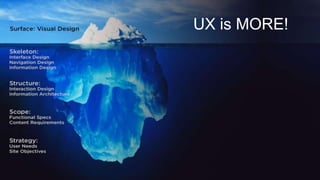
UX is not UI
What we see is visual design
UX is MORE!
“UX is the intangible design of a
strategy that brings us to a solution.”
What is UX?
UX stands for User Experience
Who, What, When, Where, Why and How of a
product
How do UX designers work?
Ask questions/research
Follow a user-centered design process when
designing products
WTF is User Centered Design?
A process in which the needs, wants, and
limitations of end users of a product are given
extensive attention at each stage of the design
process.
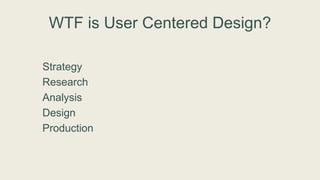
WTF is User Centered Design?
Strategy
Research
Analysis
Design
Production
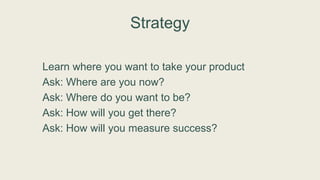
Strategy
Learn where you want to take your product
Ask: Where are you now?
Ask: Where do you want to be?
Ask: How will you get there?
Ask: How will you measure success?
Benefits of Creating a Strategy
Gets your entire team involved
Clarifies abstract design thinking
Reduces the time spent building components that
don’t contribute to user or business value
Research
Is an investigative technique used to add context
and insight to the design process
It is also used to combat the tendency to design
for ourselves
How is Research Done?
Non-directed interviews
Contextual inquiry
Questionnaires
Card sorting
Analysis
Takes information collected in the research phase
and turns it into actionable information
Analysis Techniques
The creation of: Personas
Mental models
Storyboards
Design
There are two parts to the design phase of this
process: information architecture and visual design
Information architecture delivers wireframes and
clickable prototypes
Visual design produces high-fidelity comps and
mockups
Design Methods & Techniques
Sticky notes
Project space
Good practice guidelines
Aesthetics
Prototyping
User requirements
Personas
Scenarios
Progressive disclosure
Usability testing
Rapid visualization
Form over function.
Production
You are familiar with this. Trust me.
Why you should care:
Fast Company recently noted that
industry studies show every dollar
spent on UX brings in between $2
and $100 in return. (DANG!)
Why you should care:
Do you code to deliver value to users?
Do you want to become a better coder?
Think of the experience the user is going
to have.
How to work with a UX designer
Get ready to deal with the neediest person
you have ever met in your life.
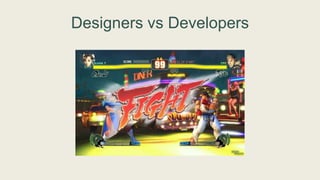
Designers vs Developers
We are both hard to deal with.
We are both terribly opinionated.
Designers vs Developers
We have shared priorities.
Design isn’t completely aesthetic and development isn’t
completely technical.
We must communicate!
Collaboration
Successful product development requires effective
collaboration between designers and developers.
Collaboration Tips
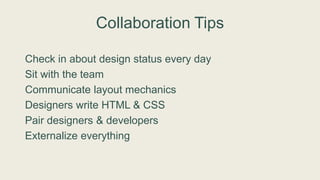
Check in about design status every day
Sit with the team
Communicate layout mechanics
Designers write HTML & CSS
Pair designers & developers
Externalize everything
Q&A
THX!

UX101

  • 1.
    UX 101: Working withUX and the UX designer @natashairizarry
  • 2.
    Design is notjust what it looks like and feels like. Design is how it works. Steve Jobs
  • 3.
  • 4.
    What we seeis visual design
  • 5.
  • 6.
    “UX is theintangible design of a strategy that brings us to a solution.”
  • 7.
    What is UX? UXstands for User Experience Who, What, When, Where, Why and How of a product
  • 8.
    How do UXdesigners work? Ask questions/research Follow a user-centered design process when designing products
  • 9.
    WTF is UserCentered Design? A process in which the needs, wants, and limitations of end users of a product are given extensive attention at each stage of the design process.
  • 11.
    WTF is UserCentered Design? Strategy Research Analysis Design Production
  • 12.
    Strategy Learn where youwant to take your product Ask: Where are you now? Ask: Where do you want to be? Ask: How will you get there? Ask: How will you measure success?
  • 13.
    Benefits of Creatinga Strategy Gets your entire team involved Clarifies abstract design thinking Reduces the time spent building components that don’t contribute to user or business value
  • 14.
    Research Is an investigativetechnique used to add context and insight to the design process It is also used to combat the tendency to design for ourselves
  • 15.
    How is ResearchDone? Non-directed interviews Contextual inquiry Questionnaires Card sorting
  • 16.
    Analysis Takes information collectedin the research phase and turns it into actionable information
  • 17.
    Analysis Techniques The creationof: Personas Mental models Storyboards
  • 18.
    Design There are twoparts to the design phase of this process: information architecture and visual design Information architecture delivers wireframes and clickable prototypes Visual design produces high-fidelity comps and mockups
  • 19.
    Design Methods &Techniques Sticky notes Project space Good practice guidelines Aesthetics Prototyping User requirements Personas Scenarios Progressive disclosure Usability testing Rapid visualization
  • 20.
  • 21.
    Production You are familiarwith this. Trust me.
  • 22.
    Why you shouldcare: Fast Company recently noted that industry studies show every dollar spent on UX brings in between $2 and $100 in return. (DANG!)
  • 23.
    Why you shouldcare: Do you code to deliver value to users? Do you want to become a better coder?
  • 24.
    Think of theexperience the user is going to have.
  • 25.
    How to workwith a UX designer Get ready to deal with the neediest person you have ever met in your life.
  • 27.
  • 28.
    Designers vs Developers Weare both hard to deal with. We are both terribly opinionated.
  • 29.
    Designers vs Developers Wehave shared priorities. Design isn’t completely aesthetic and development isn’t completely technical. We must communicate!
  • 30.
    Collaboration Successful product developmentrequires effective collaboration between designers and developers.
  • 31.
    Collaboration Tips Check inabout design status every day Sit with the team Communicate layout mechanics Designers write HTML & CSS Pair designers & developers Externalize everything
  • 32.
  • 33.

Editor's Notes

  • #11 Non–directed InterviewsNon–directed interviews are the best way to develop a design strategy without asking users or stakeholders to spell it out. Simply set up some rough guidelines and converse with your audience—but be sure to focus more on listening.Contextual inquiryContextual inquiry involves observing what people do as they go about their day—not what they say they do. It’s useful for creating a website that supports users’ actual (and not supposed) activities.QuestionnairesQuestionnaires invite people to say who they are, what they do, and where they go. Creating one is supremely simple with tools such as Wufoo or Google Docs.Card sortingCard sorting asks people to explore relationships between content and/or hierarchies in an effort to find commonalities. Card sorting is a super simple way to help people find information more quickly and easily on your website.
  • #16 Non–directed InterviewsNon–directed interviews are the best way to develop a design strategy without asking users or stakeholders to spell it out. Simply set up some rough guidelines and converse with your audience—but be sure to focus more on listening.Contextual inquiryContextual inquiry involves observing what people do as they go about their day—not what they say they do. It’s useful for creating a website that supports users’ actual (and not supposed) activities.QuestionnairesQuestionnaires invite people to say who they are, what they do, and where they go. Creating one is supremely simple with tools such as Wufoo or Google Docs.Card sortingCard sorting asks people to explore relationships between content and/or hierarchies in an effort to find commonalities. Card sorting is a super simple way to help people find information more quickly and easily on your website.
  • #17 Non–directed InterviewsNon–directed interviews are the best way to develop a design strategy without asking users or stakeholders to spell it out. Simply set up some rough guidelines and converse with your audience—but be sure to focus more on listening.Contextual inquiryContextual inquiry involves observing what people do as they go about their day—not what they say they do. It’s useful for creating a website that supports users’ actual (and not supposed) activities.QuestionnairesQuestionnaires invite people to say who they are, what they do, and where they go. Creating one is supremely simple with tools such as Wufoo or Google Docs.Card sortingCard sorting asks people to explore relationships between content and/or hierarchies in an effort to find commonalities. Card sorting is a super simple way to help people find information more quickly and easily on your website.
  • #18 Non–directed InterviewsNon–directed interviews are the best way to develop a design strategy without asking users or stakeholders to spell it out. Simply set up some rough guidelines and converse with your audience—but be sure to focus more on listening.Contextual inquiryContextual inquiry involves observing what people do as they go about their day—not what they say they do. It’s useful for creating a website that supports users’ actual (and not supposed) activities.QuestionnairesQuestionnaires invite people to say who they are, what they do, and where they go. Creating one is supremely simple with tools such as Wufoo or Google Docs.Card sortingCard sorting asks people to explore relationships between content and/or hierarchies in an effort to find commonalities. Card sorting is a super simple way to help people find information more quickly and easily on your website.
  • #19 Non–directed InterviewsNon–directed interviews are the best way to develop a design strategy without asking users or stakeholders to spell it out. Simply set up some rough guidelines and converse with your audience—but be sure to focus more on listening.Contextual inquiryContextual inquiry involves observing what people do as they go about their day—not what they say they do. It’s useful for creating a website that supports users’ actual (and not supposed) activities.QuestionnairesQuestionnaires invite people to say who they are, what they do, and where they go. Creating one is supremely simple with tools such as Wufoo or Google Docs.Card sortingCard sorting asks people to explore relationships between content and/or hierarchies in an effort to find commonalities. Card sorting is a super simple way to help people find information more quickly and easily on your website.
  • #20 Non–directed InterviewsNon–directed interviews are the best way to develop a design strategy without asking users or stakeholders to spell it out. Simply set up some rough guidelines and converse with your audience—but be sure to focus more on listening.Contextual inquiryContextual inquiry involves observing what people do as they go about their day—not what they say they do. It’s useful for creating a website that supports users’ actual (and not supposed) activities.QuestionnairesQuestionnaires invite people to say who they are, what they do, and where they go. Creating one is supremely simple with tools such as Wufoo or Google Docs.Card sortingCard sorting asks people to explore relationships between content and/or hierarchies in an effort to find commonalities. Card sorting is a super simple way to help people find information more quickly and easily on your website.
  • #21 Non–directed InterviewsNon–directed interviews are the best way to develop a design strategy without asking users or stakeholders to spell it out. Simply set up some rough guidelines and converse with your audience—but be sure to focus more on listening.Contextual inquiryContextual inquiry involves observing what people do as they go about their day—not what they say they do. It’s useful for creating a website that supports users’ actual (and not supposed) activities.QuestionnairesQuestionnaires invite people to say who they are, what they do, and where they go. Creating one is supremely simple with tools such as Wufoo or Google Docs.Card sortingCard sorting asks people to explore relationships between content and/or hierarchies in an effort to find commonalities. Card sorting is a super simple way to help people find information more quickly and easily on your website.
  • #22 Non–directed InterviewsNon–directed interviews are the best way to develop a design strategy without asking users or stakeholders to spell it out. Simply set up some rough guidelines and converse with your audience—but be sure to focus more on listening.Contextual inquiryContextual inquiry involves observing what people do as they go about their day—not what they say they do. It’s useful for creating a website that supports users’ actual (and not supposed) activities.QuestionnairesQuestionnaires invite people to say who they are, what they do, and where they go. Creating one is supremely simple with tools such as Wufoo or Google Docs.Card sortingCard sorting asks people to explore relationships between content and/or hierarchies in an effort to find commonalities. Card sorting is a super simple way to help people find information more quickly and easily on your website.