Research
Methodologies
Week 3
Elroy Chibex
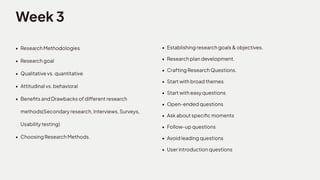
Week3
ResearchMethodologie
Researchgoa
Qualitativevs.quantitativ
Attitudinalvs.behaviora
BenefitsandDrawbacksofdifferentresearch
methods(Secondaryresearch,Interviews,Surveys,
Usabilitytesting
ChoosingResearchMethods.
Establishingresearchgoals&objectives
Researchplandevelopment
CraftingResearchQuestions
Startwithbroadtheme
Startwitheasyquestion
Open-endedquestion
Askaboutspecificmoment
Follow-upquestion
Avoidleadingquestion
Userintroductionquestions
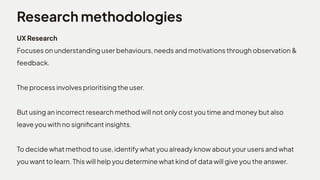
Research methodologies
UX Research

Focuses on understanding user behaviours, needs and motivations through observation &
feedback.


The process involves prioritising the user.


But using an incorrect research method will not only cost you time and money but also
leave you with no significant insights.


To decide what method to use, identify what you already know about your users and what
you want to learn. This will help you determine what kind of data will give you the answer.
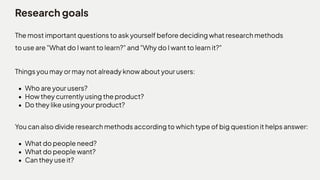
Research goals
The most important questions to ask yourself before deciding what research methods
to use are "What do I want to learn?" and "Why do I want to learn it?"
Things you may or may not already know about your users
Who are your users
How they currently using the product
Do they like using your product?
Y
ou can also divide research methods according to which type of big question it helps answer
What do people need
What do people want
Can they use it?
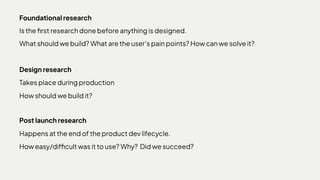
Foundationalresearch

Isthefirstresearchdonebeforeanythingisdesigned.

Whatshouldwebuild?Whataretheuser’spainpoints?Howcanwesolveit?
Designresearch

Takesplaceduringproduction

Howshouldwebuildit?
Postlaunchresearch

Happensattheendoftheproductdevlifecycle.

Howeasy/difficultwasittouse?Why? Didwesucceed?
Primary research

Research you do by yourself and get insights
Secondary research

Uses information someone else has put together e.g quoting an article on the internet.
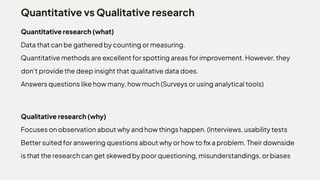
Quantitative vs Qualitative research
Quantitative research (what)

Datathatcanbegatheredbycountingormeasuring.

Quantitativemethodsareexcellentforspottingareasforimprovement.However,they
don'tprovidethedeepinsightthatqualitativedatadoes.

Answersquestionslikehowmany,howmuch(Surveysorusinganalyticaltools)
Qualitative research (why)

Focusesonobservationaboutwhyandhowthingshappen.(Interviews,usabilitytests

Bettersuitedforansweringquestionsaboutwhyorhowtofixaproblem.Theirdownside
isthattheresearchcangetskewedbypoorquestioning,misunderstandings,orbiases
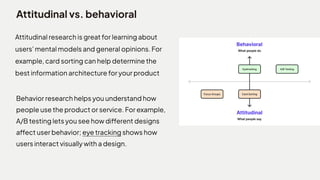
Attitudinal vs. behavioral
Attitudinal research is great for learning about
users' mental models and general opinions. For
example, card sorting can help determine the
best information architecture for your product

Behavior research helps you understand how
people use the product or service. For example,
A/B testing lets you see how different designs
affect user behavior; eye tracking shows how
users interact visually with a design.
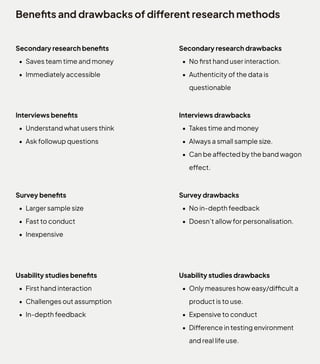
Benefitsanddrawbacksofdifferentresearchmethods
Secondaryresearchbenefit
Savesteamtimeandmone
Immediatelyaccessible
Secondaryresearchdrawback
Nofirsthanduserinteraction
Authenticityofthedatais
questionable
Interviewsbenefit
Understandwhatusersthin
Askfollowupquestions
Interviewsdrawback
Takestimeandmone
Alwaysasmallsamplesize
Canbeaffectedbythebandwagon
effect.
Surveybenefit
Largersamplesiz
Fasttoconduc
Inexpensive
Surveydrawback
Noin-depthfeedbac
Doesn’tallowforpersonalisation.
Usabilitystudiesbenefit
Firsthandinteractio
Challengesoutassumptio
In-depthfeedback
Usabilitystudiesdrawback
Onlymeasureshoweasy/difficulta
productistouse
Expensivetoconduc
Differenceintestingenvironment
andreallifeuse.
Choosing a research method
In user experience (UX) research, the three broad questions that researchers 

aim to answer are
What do people need? (Identifying user needs and preferences
Can people use what we're designing? (Evaluating usability and user interface design
Do people like what we've created? (Assessing user satisfaction and user experience)

These questions help guide the research process and inform the design and development
of products or services that are user-centred and meet the needs and expectations of the
target audience.
Researching needs
"What do people need?" 

Methods that can help you understand what users need include
Contextual inquiry and ethnography: Observing users in their natural environment
allows you to see how they accomplish their tasks and what difficulties they face
Interviews: Face-to-face contact with users is a good way to find out what they need
Surveys and questionnaires: This technique can provide answers similar to what you'd
get from user interviews. While you can't dive deeper into those answers, they allow for
a larger volume of responses that can be analyzed easily.
Researching wants
Here are some research methods that can help you identify what people want in a
product
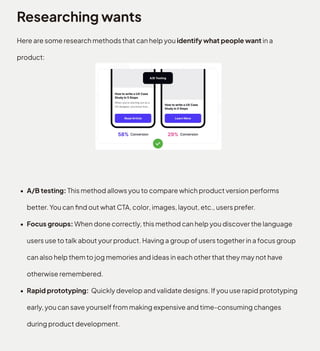
A/B testing: This method allows you to compare which product version performs
better. You can find out what CTA, color, images, layout, etc., users prefer
Focus groups: When done correctly, this method can help you discover the language
users use to talk about your product. Having a group of users together in a focus group
can also help them to jog memories and ideas in each other that they may not have
otherwise remembered
Rapid prototyping: Quickly develop and validate designs. If you use rapid prototyping
early, you can save yourself from making expensive and time-consuming changes
during product development.
Researching usability
Once you have a functional prototype, the research focus shifts to determining if the
product is usable. Here are some methods you can use at this stage
Usability test: Helps you discover what works and what needs to be changed or even
uncover problems you'd never have thought of
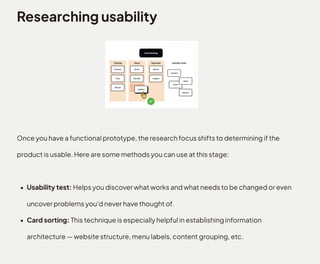
Card sorting: This technique is especially helpful in establishing information
architecture — website structure, menu labels, content grouping, etc.
Putting it all together
The UX research method you choose will depend on the stage of your design process,
how much time you have, your budget, and what you want to know.


Once this is established, decide what type of insight you want to gain. Do you want to learn
what people think and believe or what they actually do? 


In the end, the success of your work is determined by how much of an impact it has on
improving your product's UX. 


Considering the above factors will help you make the best choice at the right time.
Thankyouforlistening
Taskfortheweek: 

Developaresearchplanforyourchosenproject.

UX Research Methodologies