







Art and Experience
agenda 9.4.14 
what is perception? 
neuroscientific answer in last class 
in this class, more of a psychological answer 
particular focus on what happens when perception becomes 
too routine/habitualized/patterned 
art as the antidote to habitualized perception 
Paul Valery 
Viktor Shlovsky 
John Dewey
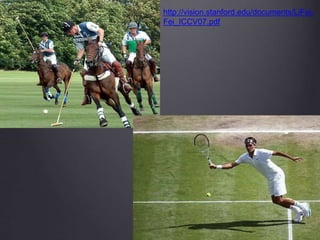
http://vision.stanford.edu/documents/LiFei- 
Fei_ICCV07.pdf
“To see is to 
forget the name 
of the thing one 
sees.” 
—Paul Valery
Viktor Shklovsky 
born 1893 in St. 
Petersburg, Russia 
died 1984 in Moscow, 
USSR 
literary critic and novelist
If we start to examine the general laws of perception, we see that 
as perception becomes habitual, it becomes automatic. Thus, for 
example, all of our habits retreat into the area of the unconsciously 
automatic; if one remembers the sensations of holding a pen or of 
speaking in a foreign language for the first time and compares that 
with his feeling at performing the action for the ten thousandth time, 
he will agree with us. Such habituation explains the principles by 
which, in ordinary speech, we leave phrases unfinished and words 
half expressed. In this process, ideally realized in algebra, things 
are replaced by symbols. Complete words are not expressed in 
rapid speech; their initial sounds are barely perceived. Alexander 
Pogodin offers the example of a boy considering the sentence "The 
Swiss mountains are beautiful" in the form of a series of letters: T, 
S, m, a, b. 
This characteristic of thought not only suggests the method of 
algebra, but even prompts the choice of symbols (letters, especially 
initial letters). By this "algebraic" method of thought we apprehend 
objects only as shapes with imprecise extensions; we do not see 
them in their entirety but rather recognize them by their main 
characteristics. We see the object as though it were enveloped in a 
sack. We know what it is by its configuration, but we see only its 
silhouette.
“I was cleaning and, meandering about, approached the 
divan and couldn't remember whether or not I had dusted it. 
Since these movements are habitual and unconscious I 
could not remember and felt that it was impossible to 
remember - so that if I had dusted it and forgot - that is, had 
acted unconsciously, then it was the same as if I had not. If 
some conscious person had been watching, then the fact 
could be established. If, however, no one was looking, or 
looking on unconsciously, if the whole complex lives of many 
people go on unconsciously, then such lives are as if they 
had never been.”
“Habitualization devours work, clothes, furniture, one's wife, 
and the fear of war. "If the whole complex lives of many 
people go on unconsciously, then such lives are as if they 
had never been." And art exists that one may recover the 
sensation of life; it exists to make one feel things, to make 
the stone stony. The purpose of art is to impart the sensation 
of things as they are perceived and not as they are known. 
The technique of art is to make objects "unfamiliar," to make 
forms difficult, to increase the difficulty and length of 
perception because the process of perception is an aesthetic 
end in itself and must be prolonged. Art is a way of 
experiencing the artfulness of an object: the object is not 
important...”
After we see an object several times, we begin to 
recognize it. The object is in front of us and we know 
about it, but we do not see it—hence we cannot say 
anything, significant about it. Art removes objects from the 
automatism of perception in several ways. 
defamiliarization
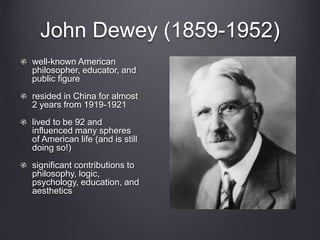
John Dewey (1859-1952) 
well-known American 
philosopher, educator, and 
public figure 
resided in China for almost 
2 years from 1919-1921 
lived to be 92 and 
influenced many spheres 
of American life (and is still 
doing so!) 
significant contributions to 
philosophy, logic, 
psychology, education, and 
aesthetics
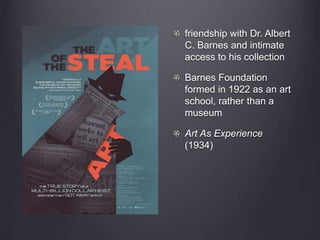
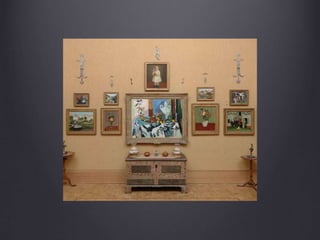
friendship with Dr. Albert 
C. Barnes and intimate 
access to his collection 
Barnes Foundation 
formed in 1922 as an art 
school, rather than a 
museum 
Art As Experience 
(1934)
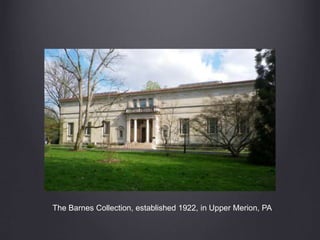
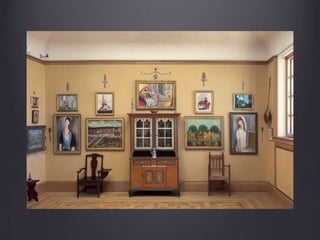
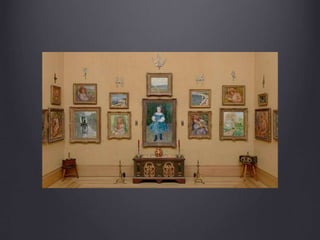
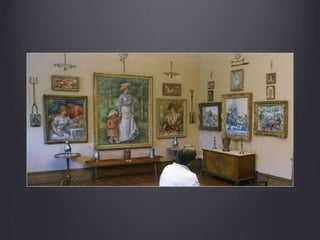
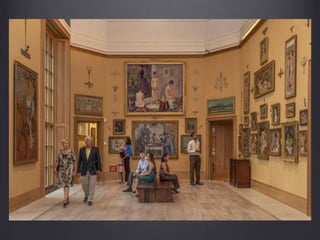
The Barnes Collection, established 1922, in Upper Merion, PA
UVCWeek2Class2
UVCWeek2Class2
UVCWeek2Class2
UVCWeek2Class2
UVCWeek2Class2

UVCWeek2Class2

  • 1.
  • 2.
    agenda 9.4.14 whatis perception? neuroscientific answer in last class in this class, more of a psychological answer particular focus on what happens when perception becomes too routine/habitualized/patterned art as the antidote to habitualized perception Paul Valery Viktor Shlovsky John Dewey
  • 7.
  • 11.
    “To see isto forget the name of the thing one sees.” —Paul Valery
  • 12.
    Viktor Shklovsky born1893 in St. Petersburg, Russia died 1984 in Moscow, USSR literary critic and novelist
  • 13.
    If we startto examine the general laws of perception, we see that as perception becomes habitual, it becomes automatic. Thus, for example, all of our habits retreat into the area of the unconsciously automatic; if one remembers the sensations of holding a pen or of speaking in a foreign language for the first time and compares that with his feeling at performing the action for the ten thousandth time, he will agree with us. Such habituation explains the principles by which, in ordinary speech, we leave phrases unfinished and words half expressed. In this process, ideally realized in algebra, things are replaced by symbols. Complete words are not expressed in rapid speech; their initial sounds are barely perceived. Alexander Pogodin offers the example of a boy considering the sentence "The Swiss mountains are beautiful" in the form of a series of letters: T, S, m, a, b. This characteristic of thought not only suggests the method of algebra, but even prompts the choice of symbols (letters, especially initial letters). By this "algebraic" method of thought we apprehend objects only as shapes with imprecise extensions; we do not see them in their entirety but rather recognize them by their main characteristics. We see the object as though it were enveloped in a sack. We know what it is by its configuration, but we see only its silhouette.
  • 14.
    “I was cleaningand, meandering about, approached the divan and couldn't remember whether or not I had dusted it. Since these movements are habitual and unconscious I could not remember and felt that it was impossible to remember - so that if I had dusted it and forgot - that is, had acted unconsciously, then it was the same as if I had not. If some conscious person had been watching, then the fact could be established. If, however, no one was looking, or looking on unconsciously, if the whole complex lives of many people go on unconsciously, then such lives are as if they had never been.”
  • 15.
    “Habitualization devours work,clothes, furniture, one's wife, and the fear of war. "If the whole complex lives of many people go on unconsciously, then such lives are as if they had never been." And art exists that one may recover the sensation of life; it exists to make one feel things, to make the stone stony. The purpose of art is to impart the sensation of things as they are perceived and not as they are known. The technique of art is to make objects "unfamiliar," to make forms difficult, to increase the difficulty and length of perception because the process of perception is an aesthetic end in itself and must be prolonged. Art is a way of experiencing the artfulness of an object: the object is not important...”
  • 16.
    After we seean object several times, we begin to recognize it. The object is in front of us and we know about it, but we do not see it—hence we cannot say anything, significant about it. Art removes objects from the automatism of perception in several ways. defamiliarization
  • 17.
    John Dewey (1859-1952) well-known American philosopher, educator, and public figure resided in China for almost 2 years from 1919-1921 lived to be 92 and influenced many spheres of American life (and is still doing so!) significant contributions to philosophy, logic, psychology, education, and aesthetics
  • 18.
    friendship with Dr.Albert C. Barnes and intimate access to his collection Barnes Foundation formed in 1922 as an art school, rather than a museum Art As Experience (1934)
  • 19.
    The Barnes Collection,established 1922, in Upper Merion, PA