http://think.eui.eu
Electricity storage:
How to facilitate its deployment and operation in
the EU?
4th Smart Grids Florence Workshop
Florence, 31 May 2012
Xian HE
THINK (http://think.eui.eu)
Florence School of Regulation
http://think.eui.eu
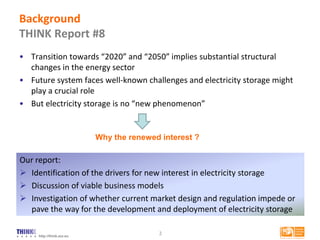
• Transition towards “2020” and “2050” implies substantial structural
changes in the energy sector
• Future system faces well-known challenges and electricity storage might
play a crucial role
• But electricity storage is no “new phenomenon”
2
Our report:
 Identification of the drivers for new interest in electricity storage
 Discussion of viable business models
 Investigation of whether current market design and regulation impede or
pave the way for the development and deployment of electricity storage
Background
THINK Report #8
Why the renewed interest ?
http://think.eui.eu
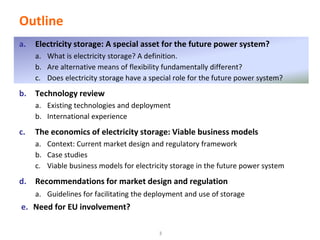
Outline
a. Electricity storage: A special asset for the future power system?
a. What is electricity storage? A definition.
b. Are alternative means of flexibility fundamentally different?
c. Does electricity storage have a special role for the future power system?
b. Technology review
a. Existing technologies and deployment
b. International experience
c. The economics of electricity storage: Viable business models
a. Context: Current market design and regulatory framework
b. Case studies
c. Viable business models for electricity storage in the future power system
d. Recommendations for market design and regulation
a. Guidelines for facilitating the deployment and use of storage
e. Need for EU involvement?
3
http://think.eui.eu
Electricity storage
The value of storage is related to these 3 functions
4
Electricity  Other forms of energy  Electricity
reservoir
(1)
(2)
(3)
grid grid
Value related to inter-temporal arbitrage
Value related to production/consumption balance, depending
on response time, power rating and energy rating:
 How fast it can react? [ms-s-min]
 How much imbalances it can correct? [kW-MW]
 How long it can last? [s-min-hours]
http://think.eui.eu
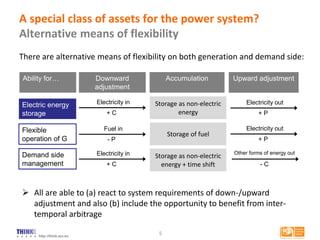
A special class of assets for the power system?
Alternative means of flexibility
There are alternative means of flexibility on both generation and demand side:
5
Storage as non-electric
energy
Electricity in
Storage as non-electric
energy + time shift
Storage of fuel
+ C
Electric energy
storage
Demand side
management
Flexible
operation of G
Downward
adjustment
Ability for… Upward adjustmentAccumulation
Electricity out
+ P
Fuel in
- P
Electricity out
+ P
Electricity in
+ C
Other forms of energy out
- C
 All are able to (a) react to system requirements of down-/upward
adjustment and also (b) include the opportunity to benefit from inter-
temporal arbitrage
http://think.eui.eu
6
Flexibility
Electricity
Storage
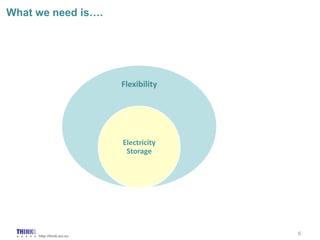
What we need is….
http://think.eui.eu
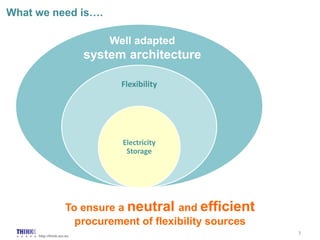
Well adapted
system architecture
To ensure a neutral and efficient
procurement of flexibility sources
7
Flexibility
Electricity
Storage
What we need is….
http://think.eui.eu
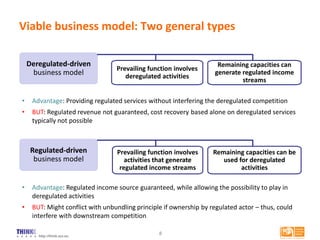
Viable business model: Two general types
8
Deregulated-driven
business model
Prevailing function involves
deregulated activities
Remaining capacities can
generate regulated income
streams
Regulated-driven
business model
Prevailing function involves
activities that generate
regulated income streams
Remaining capacities can be
used for deregulated
activities
• Advantage: Providing regulated services without interfering the deregulated competition
• BUT: Regulated revenue not guaranteed, cost recovery based alone on deregulated services
typically not possible
• Advantage: Regulated income source guaranteed, while allowing the possibility to play in
deregulated activities
• BUT: Might conflict with unbundling principle if ownership by regulated actor – thus, could
interfere with downstream competition
http://think.eui.eu
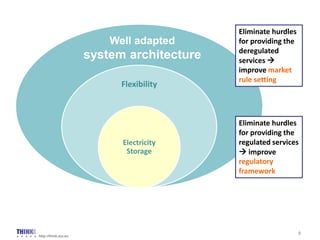
9
Flexibility
Electricity
Storage
Well adapted
system architecture
Eliminate hurdles
for providing the
regulated services
 improve
regulatory
framework
Eliminate hurdles
for providing the
deregulated
services 
improve market
rule setting
http://think.eui.eu
10
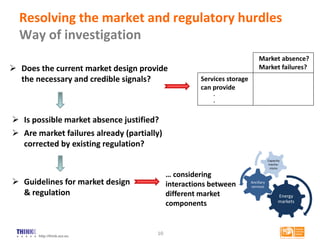
 Does the current market design provide
the necessary and credible signals?
 Is possible market absence justified?
 Are market failures already (partially)
corrected by existing regulation?
 Guidelines for market design
& regulation
… considering
interactions between
different market
components
Market absence?
Market failures?
Services storage
can provide
.
.
Resolving the market and regulatory hurdles
Way of investigation
http://think.eui.eu
Recommendations
improve signals for deregulated activities
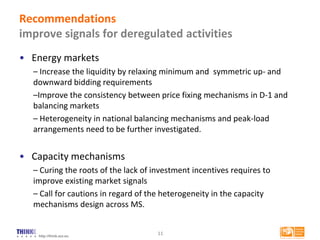
• Energy markets
– Increase the liquidity by relaxing minimum and symmetric up- and
downward bidding requirements
–Improve the consistency between price fixing mechanisms in D-1 and
balancing markets
– Heterogeneity in national balancing mechanisms and peak-load
arrangements need to be further investigated.
• Capacity mechanisms
– Curing the roots of the lack of investment incentives requires to
improve existing market signals
– Call for cautions in regard of the heterogeneity in the capacity
mechanisms design across MS.
11
http://think.eui.eu
Recommendations
improve signals for regulated activities
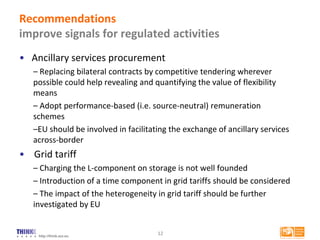
• Ancillary services procurement
– Replacing bilateral contracts by competitive tendering wherever
possible could help revealing and quantifying the value of flexibility
means
– Adopt performance-based (i.e. source-neutral) remuneration
schemes
–EU should be involved in facilitating the exchange of ancillary services
across-border
• Grid tariff
– Charging the L-component on storage is not well founded
– Introduction of a time component in grid tariffs should be considered
– The impact of the heterogeneity in grid tariff should be further
investigated by EU
12
http://think.eui.eu
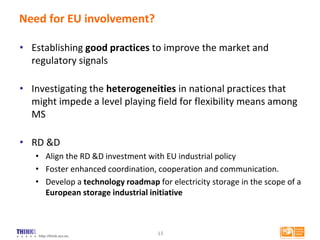
Need for EU involvement?
• Establishing good practices to improve the market and
regulatory signals
• Investigating the heterogeneities in national practices that
might impede a level playing field for flexibility means among
MS
• RD &D
• Align the RD &D investment with EU industrial policy
• Foster enhanced coordination, cooperation and communication.
• Develop a technology roadmap for electricity storage in the scope of a
European storage industrial initiative
13
http://think.eui.eu
Thank you very much for your attention
xian.he@eui.eu
Florence School of Regulation

Electricity storage: How to facilitate its deployment and operation in the EU?

  • 1.
    http://think.eui.eu Electricity storage: How tofacilitate its deployment and operation in the EU? 4th Smart Grids Florence Workshop Florence, 31 May 2012 Xian HE THINK (http://think.eui.eu) Florence School of Regulation
  • 2.
    http://think.eui.eu • Transition towards“2020” and “2050” implies substantial structural changes in the energy sector • Future system faces well-known challenges and electricity storage might play a crucial role • But electricity storage is no “new phenomenon” 2 Our report:  Identification of the drivers for new interest in electricity storage  Discussion of viable business models  Investigation of whether current market design and regulation impede or pave the way for the development and deployment of electricity storage Background THINK Report #8 Why the renewed interest ?
  • 3.
    http://think.eui.eu Outline a. Electricity storage:A special asset for the future power system? a. What is electricity storage? A definition. b. Are alternative means of flexibility fundamentally different? c. Does electricity storage have a special role for the future power system? b. Technology review a. Existing technologies and deployment b. International experience c. The economics of electricity storage: Viable business models a. Context: Current market design and regulatory framework b. Case studies c. Viable business models for electricity storage in the future power system d. Recommendations for market design and regulation a. Guidelines for facilitating the deployment and use of storage e. Need for EU involvement? 3
  • 4.
    http://think.eui.eu Electricity storage The valueof storage is related to these 3 functions 4 Electricity  Other forms of energy  Electricity reservoir (1) (2) (3) grid grid Value related to inter-temporal arbitrage Value related to production/consumption balance, depending on response time, power rating and energy rating:  How fast it can react? [ms-s-min]  How much imbalances it can correct? [kW-MW]  How long it can last? [s-min-hours]
  • 5.
    http://think.eui.eu A special classof assets for the power system? Alternative means of flexibility There are alternative means of flexibility on both generation and demand side: 5 Storage as non-electric energy Electricity in Storage as non-electric energy + time shift Storage of fuel + C Electric energy storage Demand side management Flexible operation of G Downward adjustment Ability for… Upward adjustmentAccumulation Electricity out + P Fuel in - P Electricity out + P Electricity in + C Other forms of energy out - C  All are able to (a) react to system requirements of down-/upward adjustment and also (b) include the opportunity to benefit from inter- temporal arbitrage
  • 6.
  • 7.
    http://think.eui.eu Well adapted system architecture Toensure a neutral and efficient procurement of flexibility sources 7 Flexibility Electricity Storage What we need is….
  • 8.
    http://think.eui.eu Viable business model:Two general types 8 Deregulated-driven business model Prevailing function involves deregulated activities Remaining capacities can generate regulated income streams Regulated-driven business model Prevailing function involves activities that generate regulated income streams Remaining capacities can be used for deregulated activities • Advantage: Providing regulated services without interfering the deregulated competition • BUT: Regulated revenue not guaranteed, cost recovery based alone on deregulated services typically not possible • Advantage: Regulated income source guaranteed, while allowing the possibility to play in deregulated activities • BUT: Might conflict with unbundling principle if ownership by regulated actor – thus, could interfere with downstream competition
  • 9.
    http://think.eui.eu 9 Flexibility Electricity Storage Well adapted system architecture Eliminatehurdles for providing the regulated services  improve regulatory framework Eliminate hurdles for providing the deregulated services  improve market rule setting
  • 10.
    http://think.eui.eu 10  Does thecurrent market design provide the necessary and credible signals?  Is possible market absence justified?  Are market failures already (partially) corrected by existing regulation?  Guidelines for market design & regulation … considering interactions between different market components Market absence? Market failures? Services storage can provide . . Resolving the market and regulatory hurdles Way of investigation
  • 11.
    http://think.eui.eu Recommendations improve signals forderegulated activities • Energy markets – Increase the liquidity by relaxing minimum and symmetric up- and downward bidding requirements –Improve the consistency between price fixing mechanisms in D-1 and balancing markets – Heterogeneity in national balancing mechanisms and peak-load arrangements need to be further investigated. • Capacity mechanisms – Curing the roots of the lack of investment incentives requires to improve existing market signals – Call for cautions in regard of the heterogeneity in the capacity mechanisms design across MS. 11
  • 12.
    http://think.eui.eu Recommendations improve signals forregulated activities • Ancillary services procurement – Replacing bilateral contracts by competitive tendering wherever possible could help revealing and quantifying the value of flexibility means – Adopt performance-based (i.e. source-neutral) remuneration schemes –EU should be involved in facilitating the exchange of ancillary services across-border • Grid tariff – Charging the L-component on storage is not well founded – Introduction of a time component in grid tariffs should be considered – The impact of the heterogeneity in grid tariff should be further investigated by EU 12
  • 13.
    http://think.eui.eu Need for EUinvolvement? • Establishing good practices to improve the market and regulatory signals • Investigating the heterogeneities in national practices that might impede a level playing field for flexibility means among MS • RD &D • Align the RD &D investment with EU industrial policy • Foster enhanced coordination, cooperation and communication. • Develop a technology roadmap for electricity storage in the scope of a European storage industrial initiative 13
  • 14.
    http://think.eui.eu Thank you verymuch for your attention xian.he@eui.eu Florence School of Regulation